Photomonth Looks for Young Photographers

If  you are a photographer aged 11-19 resident in the UK you are invited to enter for the the first photomonth youth award. The theme is Children’s Rights and is related to the 20th anniversary of the UNICEF Convention of the Rights of the Child:

Every child has the right to

  1. a childhood
  2. be educated
  3. be healthy
  4. be treated fairly
  5. be heard

Deadline is 14 December 2009 and each entrant may submit up to 3 images, stating which of the five rights above is the them of each photograph, as well as where and when it was taken.

If you have a son or daughter you might want to encourage them to enter, as the prize is flights and two nights in Cannes in April 2010 at the annual Sony Photography Awards and  World Photography Organisation event for both the photographer AND their parent or guardian.

You can enter online at the photomonth site  and for more details see the site or contact info@alternativearts.co.uk 020 7375 0441

Fotofest – Birmingham Mark II?

I was a little surprised to see a picture by Vee Speers at the top of the press release for the Fotofest International Discoveries II show which opens today in Houston and continues until December 19.  Of course I really love her pictures, but I’d hardly call her a ‘discovery’ given the amount of previous exposure of her work, not just the The Birthday Party, first shown in Australia in 2006 which is now on show in Houston, but also previous work including ‘Bordello‘ which first shown in Italy in 2002.

© 2009 Peter Marshall.

I first met her at Birmingham at Rhubarb Rhubarb in 2007, though she first attended in 2005. In 2007 her pictures were on the wall of the room where I was looking at portfolios, one of several fine photographers selected for the show ‘Otherlands‘, though I’d seen her work previously in magazines. Surprisingly Birmingham doesn’t get a mention in the Fotofest release, although it was most probably there she met the senior curator of Fotofest, Wendy Watriss, who was a fellow reviewer.

© 2008 Peter Marshall

Chinese artist Wei Bi’s re-staging of his 80–day experience in a Chinese prison — a sentence received for making a photograph. His large black and white photographs are minimal, showing a surreal relationship between near expressionless guards and disoriented prisoners. One of his images appears at the top of an earlier press release.

Alejandro Cartagena, born in the Dominican Republic lives and works in  Monterrey, Mexico and at Houston he is showing large-format brilliantly coloured images of the dramatic and ever-expanding suburban development of the area. He has shown work widely in Mexico for around 5 years as well as contributing to international group shows. I particularly like some of the ‘NewWork’ on his site.

Minstrel Kuik Ching Chieh was born and raised in a Malaysian fishing village but she studied photography in southern France. You can see her work, including RRose which is being shown at Houston on her blog.

Christine Laptuta produces work about the mystery of land, “its ambiguity, disruption and rhythm.” She chooses to represent ordinarily vast landscapes in multiple printed miniature platinum/palladium contact prints.

The constructed landscapes of cities are focus for Rizwan Mirza‘s photographs. His shadowy nocturnal images reflect the tension between the mysteries of darkness and the lighting.  Born in Liverpool he studied with John Blakemore in the early 1990s and also came to Rhubarb Rhubarb in 2008, although the previous year he showed at various galleries and festivals including PhotoEspana, Madrid, Spain. His work was also on show – not in FotoFest – in Houston in 2008.

Born Tokyo 1948,  Takeshi Shikama has been showing his black and white photographs of trees since 2004, and “The Silent Respiration of Forests” first appeared in a Tokyo gallery in 2006.

Working between Seoul, London and Paris, Korean-born MiMi Youn was one of the three winners of the Lens Culture – Rhubarb Photo Book Awards in 2008 along with Kurt Tong who divides his time between China and the U.K and has photographed a little-known and officially banned element of ancient Chinese funerary practice; Joss Paper or “Spirit Money.”

Brian Haw Harrassed by Police

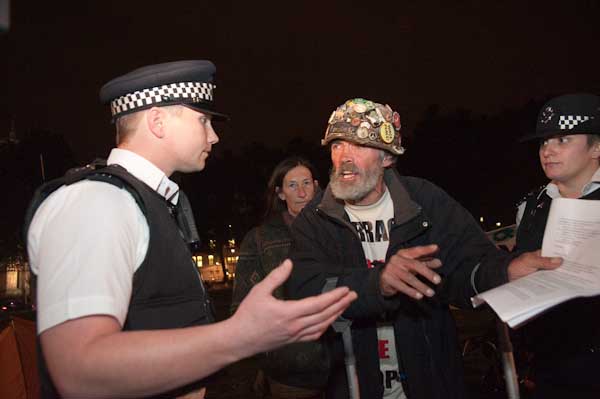
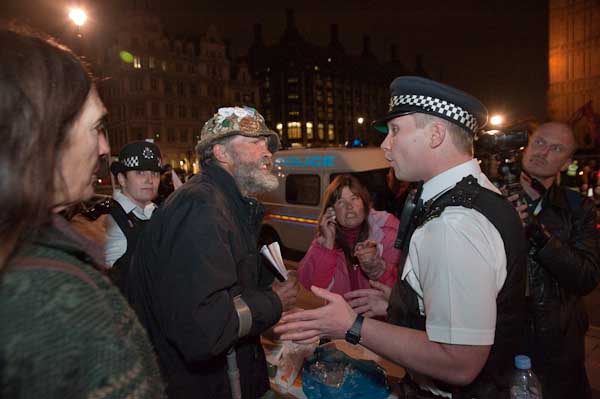
I suspect the small group of police who came to Parliament Square around 7pm on Friday thought that there would be few people around, and will have been a little surprised when they started arguing and arresting Brian Haw to find they were being photographed by two freelances and an AP staffer, as well as another freelance shooting video.

© 2009 Peter Marshall

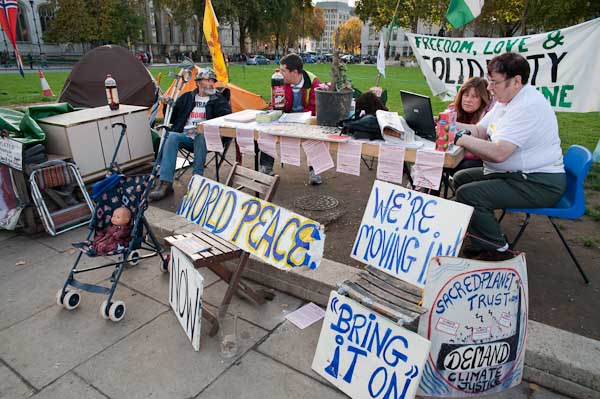
The event appears to be a part of a long-standing campaign of harassment against the peace protester who has been in the square since 2 June 2001 – eight years and almost five months. Over the years police have made various legal and illegal attempts to remove him, and the government passed a law to try and do so – but messed up the drafting. So Brian is still there, still making his appeal to the conscience of the nation to stop the killing – particularly the killing of children – in Iraq and elsewhere.

© 2009 Peter Marshall.

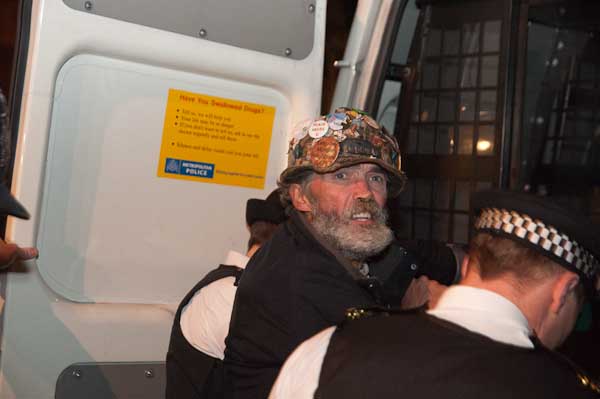
I couldn’t understand the argument the officer was having with Brian, but each seemed to be accusing the other of not having acting lawfully. Eventually Brian was pushed and pulled along on his crutches, still protesting and lifted into the back of a waiting police van.

© 2009 Peter Marshall

I returned the following morning and he was still in police custody at Belgravia Police station, but about to be taken into court. Apparently his immediate release was then ordered. When I came back later in the afternoon he was back in his usual chair in the square.

© 2009 Peter Marshall

Although I was working very close to Brian and the police, I was careful not to get in the way, and had no problems, although things got a little hectic as he was actually put into the van, and I had several  unsharp frames as I was pushed by police and other photographers.

Almost all of the arrest images were shot at ISO 3200, f4.5, 1/60 and using flash. The flash can’t handle subjects very close to the camera and over-exposure of these was a problem in some frames.   Although I moved around the action as much as possibly, there is just too much similarity between the various shots I took, as you can see on My London Diary.

Friday Zombies

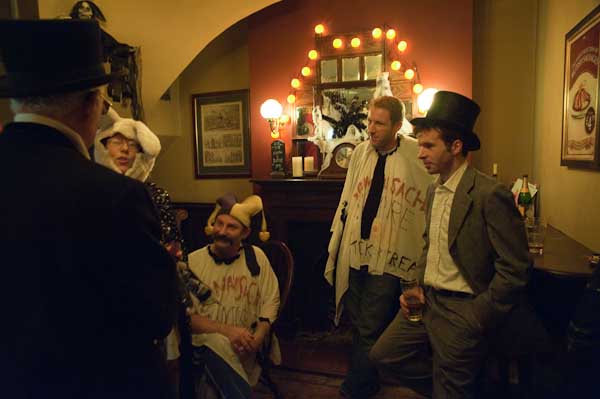
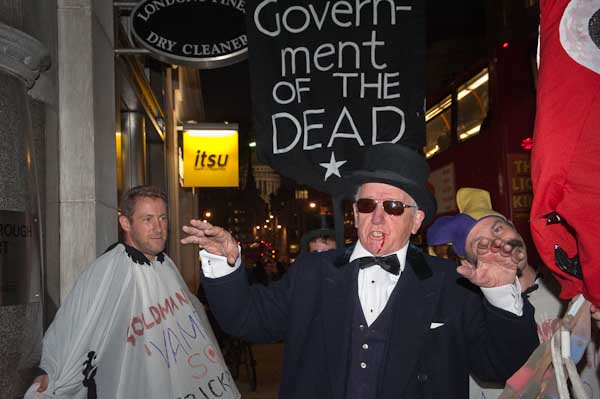
Since it was Halloween weekend, it wasn’t that surprising to have two zombie-themed protests on the streets. The first, by the ‘Government of the Dead’ led by Christ Knight was meant to catch bankers and other city workers going home, but work now seems to stop pretty early on Fridays, and the part of Fleet Street where Goldman Sachs have their office was dark and deserted by the time the small group of protesters arrived around 5.10pm.

Considering that the Facebook page for the ‘Goldman Sachs Giant Vampire Squid Trick or Treat‘ had 97 confirmed guests and 389 ‘Maybe’s, the actual attendance of six was rather disappointing. The idea for the event came from Matt Taibbi who wrote  in Rolling Stone and Goldman Sachs:
The world’s most powerful investment bank is a great vampire squid wrapped around the face of humanity, relentlessly jamming its blood funnel into anything that smells like money…

The group met in the Old Bell pub a few doors away, and lighting in there was low.  Using the D700 I was able to shoot by available light at around 1/8 or 1/10s at f5 – stopping down from f2.8 for more depth of field. At 24mm a reasonable proportion of images were reasonably sharp if I chose moments when people weren’t moving. I was shooting at IS03200, but at -1.33 eV, which I think means ISO 8000.

© 2009 Peter Marshall

Colour isn’t great, but that’s mainly down to the lighting, and viewed at 1:1 one of the guys has moved just a little too much, but otherwise sharpness is fine and my default (low) settings for noise reduction have done a pretty good job, though if I needed to I could improve on it.

Outside it was darker still, and flash was the only answer.  I should have switched to aperture priority perhaps working at around f5.6, but I left the camera on program and it chose f10. Which was fine for the flash but meant I picked up less than I would have liked from the ambient light even though I was working at ISO 3200 and 1/60 s.

© 2009 Peter Marshall

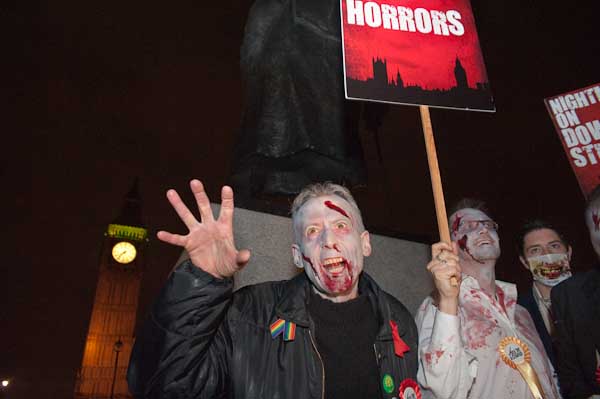
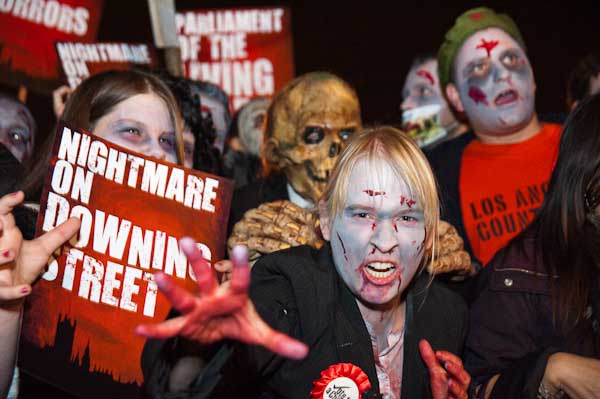
The second group of zombies were ‘The Parliament of the Dead’, protesting at the Houses of Parliament, calling for a referendum to create a fair voting system. There were certainly more of them.

© 2009 Peter Marshall

By now I had switched to aperture priority and was working at f5 (still at ISO 3200, 1/60) and Big Ben in the background was reasonably sharp when I was working at the wide-angle end, but perhaps got a bit too out-of-focus at the long end of the 24-70 zoom.

© 2009 Peter Marshall.

The floodlighting on Big Ben is just a little too weak for it to really stand out against the night sky, though perhaps an extra stop – working at 1/30 rather than 1/60 would have helped.

Some of the pictures aren’t bad, but I didn’t feel anything I took quite gelled. Perhaps there were too many rather similar zombies, and too many mainly amateur photographers getting in the way.

You can see more pictures of both Goldman Sachs and The Parliament of the Dead as usual on My London Diary, along with more details about the two protests.

Catching up – Afghanistan

I’ve had a busy couple of weeks and there are quite a few events I’ve photographed and not mentioned here, starting with the march calling for troops to be brought back from Afghanistan. Given the strength of public opinion in support of this it’s perhaps surprising that there weren’t more than the respectable 10,000 or so taking part, but perhaps it reflects the very different reasons some have for calling an end to this war which is seems we can only lose, and which is killing more and more British soldiers.

Certainly not everyone opposed to it would want to march with Stop the War, CND and the BMI who were the organisers of this march. We are also just seeing the start of mainstream politicians beginning to say what the left has been saying for a long time; I’m rather surprised that the liberal democrats haven’t already come out firmly against the war.

Photographically the main problem was the weather, a dull day, very dull at times, and with the occasional little burst of rain.  Fortunately the D700 is pretty well noise free at ISO 800, and that was fast enough to work at a decent shutter speed with apertures around f4-f5.6. Most of the time I was shooting on the Sigma 24-70 f2.8, and I like to avoid full aperture whenever I can; it’s usable, but definitely a little soft compared to f4. After that, stopping down is only really needed to get more depth of field, particularly at the longer end of the lens.

I took some pictures without flash, but some of them look a little colourless, almost drained. Flash does tend to add a little warmth and colour under lighting conditions such as this though I was generally keeping the amount pretty low.

Here’s a picture that shows this and that I like:

© 2009 Peter Marshall.
Peter Brierley who told Tony Blair “you have my son’s blood on your hands.”

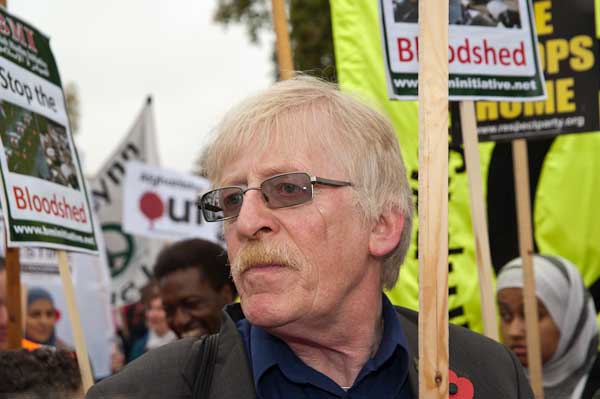
The stewards were holding us a short distance back and there was a very tight scrum of press and others in the minutes before the march started. Quite a few pictures I took – even like this one at 1/250 – have camera shake because other photographers were pushing me from all sides. The len was at 65mm and aperture f8  and for some reason I was using spot metering – which is really better when you have plenty of time and can think what you are doing.  I was pleased to have two posters with the word’Bloodshed’ on them in shot.

I stood close to the start and watched most of the march go by, photographing close in and using the full range of the zoom. It’s an interesting exercise in thinking and working fast to try and frame compositions as people walk by and also enabled me to spot a few people and groups to photograph later.

© 2009 Peter Marshall

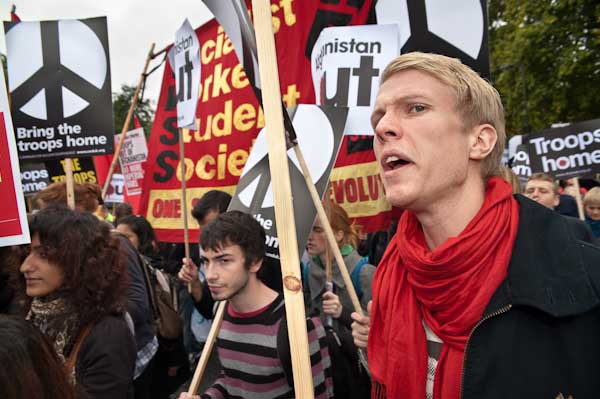
This was one I liked, and again the flash livens it up a little (24mm, 1/250 f7.1) and enables me a lot more freedom when I come to develop the image in Lightroom – where I could choose to ‘burn in’ the figure at the right to the exact tone I want (perhaps just a little darker than above.)

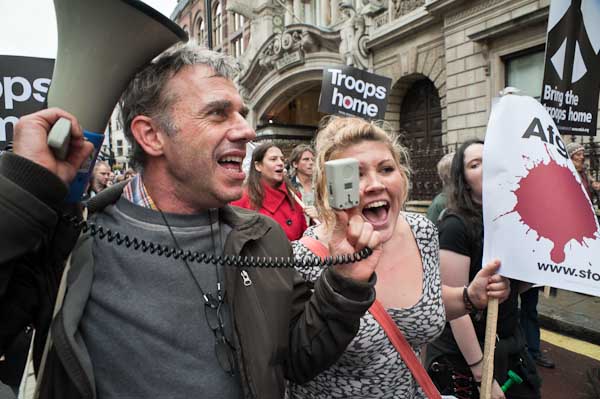
Here’s one I took later on the march without flash, and although I think it’s a good image, I just can’t get the same kind of colour quality.

© 2009 Peter Marshall.

For once I walked the whole distance – which actually means I walked it several times, going back and forth taking pictures. And I took quite a few pictures of both audience and speakers in Trafalgar Square. But suddenly there was a disturbance at the back of the square, and several of us rushed out from the press area at the front of the plinth to cover it. Four Leeds supporters, in London for a match at Millwall had decided to heckle and insult the speakers, and the crowd had taken it badly, calling them racists and chasing them out. They were rescued and escorted by a largish group of police and it wasn’t easy to get clear pictures. As usual the answer was to think ahead and I was lucky when they stopped at exactly the right spot where I had chosen to stand on a ledge a couple of feet high and could look down on the scene.

© 2009 Peter Marshall.

Overall I was for once quite please with my afternoon’s work. No major disasters and quite a few pretty decent pictures. You can make up your own mind about them on My London Diary.

Brian Griffin – Olympic Portraits

I was in two minds as to whether to accept the invitation to the National Portrait Gallery‘s launch of the NPG/BT Road to 2012 Project. The decision to have the games in London is arguably one of the greatest British tragedies of the 21st century to date and it’s legacy for the Lea Valley and East London likely to be only slightly less damaging than Enola Gay’s flight over Hiroshima in August 1946.

But of course the games are going to happen in around a thousand days time, and it’s good to see anything positive that comes from it – such as this project. Brian Griffin is certainly one of the best portrait photographers currently working anywhere in the world at the moment, and it would he hard to think of a better person to photograph those people connected with what is – whatever I think about it – a major project. The six images unveiled today are the first of 20 by him, and commissions to other photographers will bring the total to 100.  I hope those others chosen to work on the project will also be chosen on merit rather than, as so often happens in such things, for political reasons.

I’m not against sport. In my youth I played for various teams, getting a medal myself at the age of ten as a part of an all-conquering wolf club soccer team that included three players who went on to play professionally and at 16 I knocked over ten seconds off my Borough’s record for the quarter mile, finishing a hundred and fifty yards ahead of the next runner. But in my view games are for playing rather than watching and taking part is more important than winning. I think it’s a part of the Olympic Ideal, which doesn’t seem to have much part in our official professional programme for sport.

© 2009 Peter Marshall

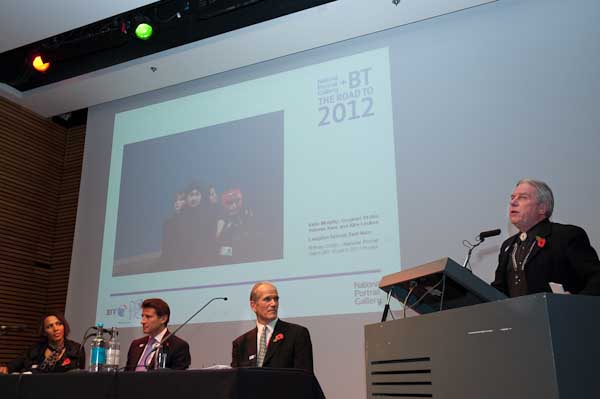
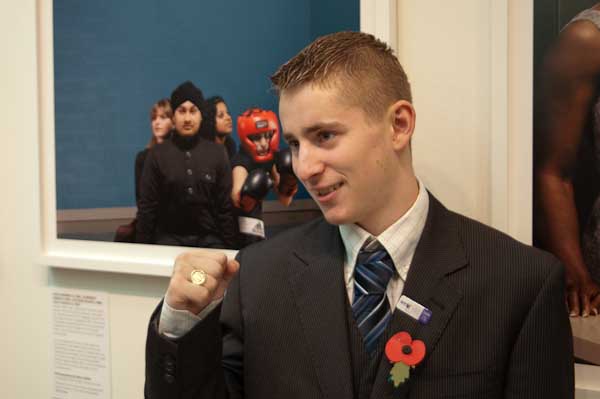
Sandy Nairne, the Director of the NPG opened the event and was followed by rather predictable speeches from Lord Coe and Dame Kelly Holmes, but it was photographer (or artist) Brian Griffin who was the star performer, talking about some of his experiences in making the pictures and his thinking behind them.  Above the speakers throughout the presentation was his picture of four from the thirty East London young people who went to Singapore to support the games bid, and he told us how he had decided to from them into a single sculptural group, but when he had taken what he thought was his picture, Alex Loukos in his red boxer’s helmet, jumped out from the group and made the image that he quickly captured and we saw on the screen.

© 2009 Peter Marshall

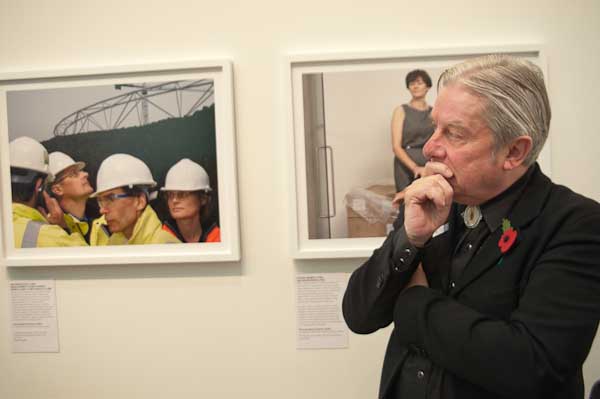
Although Brian stressed that he thinks about his work as a fine artist, he still has the openness to the moment that makes his work truly photographic, and nowhere was this shown more in the set of six images that was unveiled at the event than in a picture of four civil engineers in hard hats under the Olympic stadium which for me – and several others at the event whose opinions I respect – was the outstanding image of the set. I was told that he has also taken a very fine portrait of Lord Coe, but this is apparently being held back for a later date.

© 2009 Peter Marshall

You can see all six pictures on the NPG site, under the heading ‘The First Commission’ and read some of Brian’s comments about them on the London2012 blog.    (Unfortunately I’m not allowed to post the pictures here at a size I think useful – so you will need to click on the links to see the work.)

Brian writes there “So, for example, the portrait of Jonathan Edwards and Denise Lewis. The colouration of this image, in the steel and glass environment of the building, echoes the feeling from a painting by the pre-Raphaelite Sir Edward Burne-Jones. The portrayal of Denise also leads me to the Edward Burra painting ‘Harlem’.”

© 2009 Peter Marshall

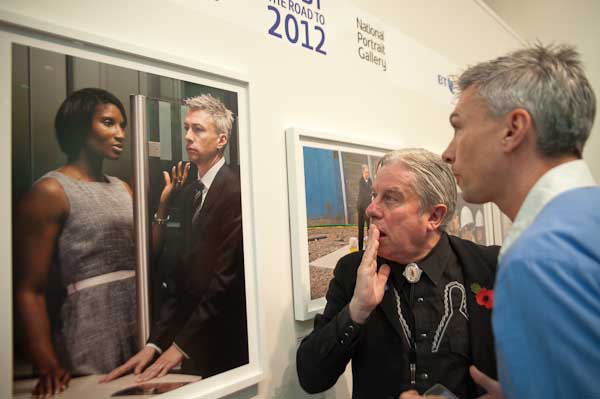
In front of the actual print, my immediate thought was “Beam me up Scotty!”, and there is a definite “Star Trek” feel to this image, exaggerated perhaps by Jonathan’s hair looking like he’s got his hands on the Van der Graf machine and a slightly unreal quality about Denise Lewis’s skin tone and gesture which is a little more apparent in the actual print than in reproduction. However you see it, it remains a striking image.

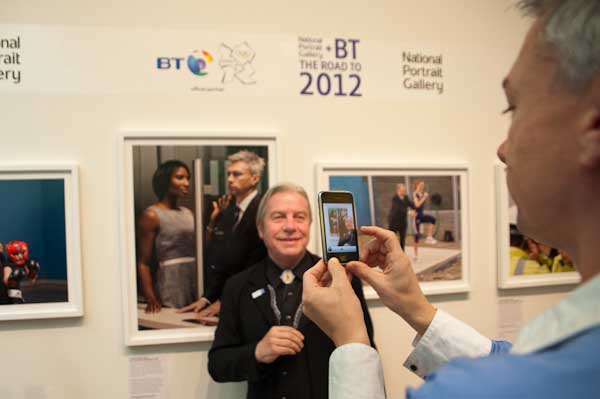
Of course all of the pictures are excellent in their own way, and it was a bonus to have a number of the sitters present at the event. Not only could we see them with their pictures, and at least in some cases photograph them, but also I was able to catch one of them, triple-jumper Jonathan Edwards, getting his own back by taking Brian’s picture in front of his portrait.

© 2009 Peter Marshall

It was good – as always – too meet Brian again, and also of course some other old friends and a few new ones. But as I left the picture below flashed into my mind and I felt a sudden sadness about the missed opportunity to make this a Green Games and incorporate the Manor Gardens Allotments into the site – and to see how Brian might have photographed Hassan and Sam and all the others.

© 2007 Peter Marshall
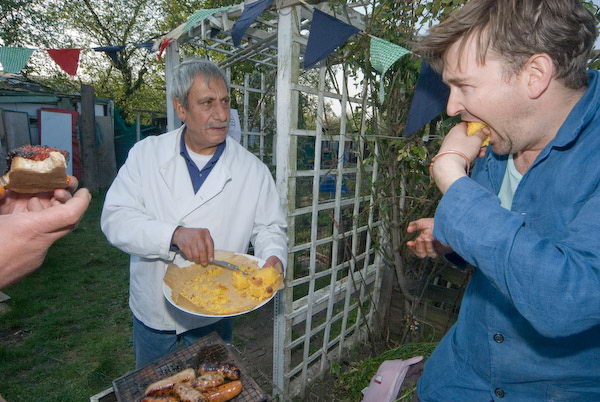
Sam Clark tries some of Hassan’s cake – which was great – while I wait for Sam’s sausages
Manor Gardens Allotments on the Olympic site, April 2007
.
Peter Marshall

More pictures from the NPG/BY Brian Griffin event on My London Diary shortly.

Roy DeCarava 1919-2009

You can read a tribute to Roy DeCarava with a set of images on the Lens blog of the New York Times, and there is longer piece about him in the newspaper. DeCarava was one of the finest photographers of his generation, but somehow failed to quite get the recognition he deserved.

If you don’t already own a copy of his ‘The Sound I Saw‘ which he conceived, wrote and designed in the 1960s but was unable to get published until around 40 years late you should get hold of one now (copies of the softback edition are currently available second-hand at under a tenner – or you can pay about four times as much from other dealers.)  What he subtitled as “improvisations on a jazz theme” became a legend long before it appeared in print. He wrote in it that it “is a book about people, about jazz, and about things…. images for the head and for the heart, and like its subject matter is particular, subjective and individual.

DeCarava was born in Harlem and spent his life there photographing everyday domestic life, producing a unique insider’s view into black experience, although his work also reflects the other ethnic groups in the areas in which he lived. That he also photographed many of the giants of jazz who performed there gives his work an added piquancy for those of us with an interest in the music.

Apart from the retrospective volume by Peter Galassi that accompanied his NoMA show in 1996 (long out of print and very expensive) it was his first book since the famous collaboration with Langston Hughes, ‘The Sweet Flypaper of Life” in 1955, and contains many of his best images.  Three years earlier in 1952 he had become the first black photographer to win a Guggenheim Fellowship.  You can see 10 of his pictures on line at the Smithsonian, and some at Masters of  Photography. But the best resource I’ve found on-line is at  Monoscope, which presents some of his images along with a TV talk with Charlie Rose, who is a sympathetic listener who lets DeCarava talk for most of around 12 minutes, producing a fine interview.

ICO Plans Attack Press Freedom

If the suggestions  – as reported in the  Amateur Photographer –  of the Information Commissioner’s Office (ICO) about a ‘Privacy Code for online use of photography‘ on the streets were to be adopted it would be the end of photography as we know it on the web. Their proposals seem to me ridiculous and unworkable – and my immediate reaction was to check the date of the article by Chris Cheesman. But to my surprise I found it was written on 27 Sept rather than April 1.

The proposal are frankly ridiculous in several respects, but particularly in the attack that they make on news reporting, with the suggestion that it would become necessary to blur many faces in images for publication in newspapers and also on websites – except for social networking and similar sites. The AP reports that while “background shots of passers-by will not normally breach the Data Protection Act, images of a small group of clearly identifiable people, sent for publication to a newspaper for example, may be considered an infringement.” So it becomes clear that this is not just a threat to what can be published on the web, but also to the freedom of the press as a whole.

The proposals according the AP report  “will not prevent someone taking photos in the street without the subject’s consent, provided that the images are for ‘personal use’ and the camera is not being used to harass people” but it will severely restrict what you can do with them. Stick them on Facebook or in your family album and you are fine, but publish them – even on Flickr – and it looks as if you may be damned.
© 2009 Peter Marshall.
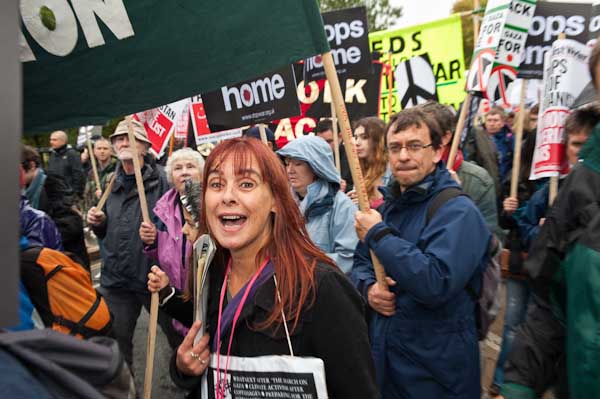
Taking part in a demo on the street implies a willingness to be seen and photographed. More picture from ‘Bring the Troops home from Afghanistan

I mainly photograph public events and demonstrations, where those taking part know they will be under the gaze of cameras and thus implicitly grant permission to be recorded. At times I photograph the people who are standing on the street or in shop windows watching (and sometimes also photographing) events and it seems only a fair reciprocity that they too should expect to be watched and photographed.  And it is clearly important that in situations involving crime, potential crime or unrest that journalists – including citizen journalists – should where possible record both potential criminals and the activities of the police, and that news media – print, broadcast and web – have a public duty to publish such images. Whatever the feelings of those who appear in them, or indeed the Terrorism Act, unless the pictures would clearly be of aid to terrorists.
© 2009 Peter Marshall.
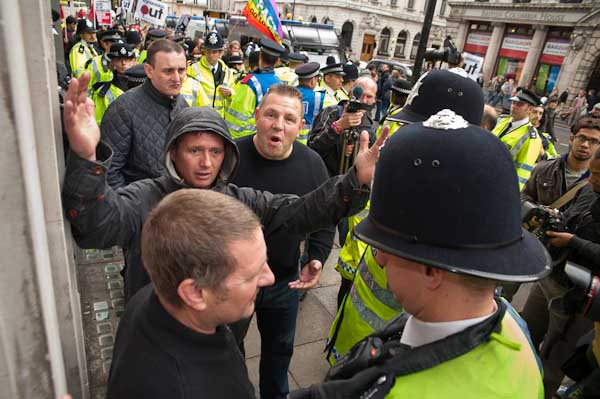
Reporting on the police is important for a free press. More pictures from this incident involving football supporters attempting to disrupt the Bring the Troops Home rally.

I actually follow my own test that differs significantly from that which the woman speaking for the ICO suggests. Rather than asking “whether the subjects would object to their picture being published in this way”, I think “whether a reasonable person photographed in this way would have a reasonable objection to having this particular picture published.”  It seems to me to be an important and fundamental difference, not least in that a “reasonable person” is also a reasoning person, while many of the objections that people have made about the use of their pictures have been purely on emotional grounds.

If someone walks down a street with a silly hat on, I don’t think they can reasonably object to a picture that shows them wearing a silly hat on the street, but if I have managed to catch them at a moment or from an angle that makes a perfectly normal hat look silly their objection might well be sustained. There is sometimes a fine line between being amusing and demeaning the person, but in general I think the distinction is clear.

Any test should probably also distinguish between people “in the public eye” who have chosen to live and profit from being public figures, and those in whom there is no genuine public interest. Although I usually chose to delete or not use images of – for example – politicians in which a momentary gesture makes them look silly, it would make the reporting of party conferences in particular rather boring if all were disallowed. And of course our current London mayor has made his political career on being seen as a buffoon (so perhaps we should not encourage him.)

So far as privacy is concerned, at present we have a fairly clear position –  “a reasonable expectation of privacy” – which offers a reasonable degree of protection to people while allowing publication of news etc. There seems little if any need for any further restriction. We also have the law of defamation that restricts the use that can be made of images of people, and although too it isn’t entirely satisfactory it largely does the job required in limiting the activities of publishers.

It is perhaps an interesting question whether a photograph in isolation is actually personal data. If I publish a picture of you without any accompanying text, only those who already know what you look like will be able to identify the picture as being of you. Without being incorporated into a structure with accompanying data the image to the wider public remains anonymous.

Photographs only truly become data when, for example, they are put into a police database and used to produce “spotter cards” for use by police at demonstrations, or when they are displayed on a right-wing hate web site along with names and other data with the intention of encouraging violence or other illegal acts against demonstrators and journalists (thanks to Marc Vallée for the anonymised link posted on Twitter.)

I’ve published literally thousands of pictures of children over the years, but I’ve always been careful not to give names except in very special circumstances. At times I’ve blurred name badges on them – (and some pictures of adults) – in order to preserve a certain anonymity. I’ve generally only named adults in pictures who are in some sense public figures – if at times in a very local and minor way. There might I think be some sense in restricting or at least reviewing the local paper practice of giving names and ages in picture captions, although local papers are becoming a thing of the past in any case.

Increasingly we are moving from still images to the use of video, and here the problems that the suggested regulations would produce seem more or less insuperable. Could we really have online newspapers without news pictures and online TV without news film from the UK? It does appear to be what the ICO proposals might produce.
Jane Bown

Last Thursday I read a post on Twitter about the Guardian Interactive feature on Jane Bown, which accompanies a show of her work next door to the Guardian at Kings Place, on until 21 Nov 2009 and a new book of her work.

The site has an excellent collection of her portraits and a video in which she talks about her time at Guildford School of Art studying with Ifor Thomas, her first assignment for the Observer in 1949 and some key sessions since then, including photographing the Beatles, The Queen, Francis Bacon, Samuel Beckett and others.

She has really had an incredible career as a portrait photographer, and I’ve always admired her simple and straightforward style both as a photographer and a person. Once well-known for carrying her camera in a basket, she never worried much about equipment. She got an Olympus OM1 with a standard lens when it came out in the early 1970s and is still using it.  When the Queen, awarding her an MBE, asked what she did, the reply was “I’m a hack.” Later she got a CBE and when both women were 80 the Queen sat for a session with her.

You can also view an earlier presentation on her work, made at the time of the publication of ‘The Unknown Jane Bown’ and an essay about her written in 2007  by Germaine Greer.  Photographers will find some details interesting, such as her “40-year-old Olympus OM1 cameras, with a 50mm F2.5 lens”  wondering how she managed to get the camera in 1967 when Olympus only announced it in 1972 and thinking that the lens looks rather like the more familiar and very fine f1.8 that most of the rest of us used, but it still makes interesting reading.

Bert Hardy Talk

Years ago I remember going to hear Bert Hardy  talking about his own work at the Photographers’ Gallery. It was an entertaining evening, but a rather predictable one, as by that time he had a rather carefully worked out script that he followed almost word for word about his life and work on every occasion. It was good to go and see him and watch him perform, but there was little if anything new in the actual content.

The selection of pictures too was predictable. Not least because back in the “good old days“, the “golden years of photojournalism“, photographers worked for hire and the publication owned the pictures, which in the case of Picture Post, disappeared into the Hulton empire. Getty, not am organisation I usually have much praise for, deserve credit for having preserved material that might otherwise have been lost from the Hulton Archives.

And on November 10th, 2009,  Graham Harrison is giving a talk, The Unseen Bert Hardy, showing images recently rediscovered in that Picture Post collection at the Photographers’ Gallery, 16-18 Ramillies Street, London W1F 7LW,  at 7:00pm. The PG also has a nice little selection of his images for sale on line, although the thumbnails are a little misleading*. Harrison, whose Photo Histories site I’ve mentioned before and should visit more often (don’t go there unless you have a lot of time to spare!), was able to look through hundreds of original Picture Post contact sheets and find many Hardy pictures and stories that were never used.

There is a taste of what is in store in Doorstepping a city: how Bert Hardy captured life in Barcelona during the Franco dictatorship on Photo Histories. Spain was under the powerful thumb of Franco’s fascist dictatorship and times were tense as a general strike was taking place in Barcelona as Hardy arrived. Some of his pictures were published together with a story by James Cameron in ‘Barcelona: city in ferment‘ on April 15, 1951, but the others have just sat in the archive until now.

Although Hardy had got into photography with a Leica, in Spain he was using a square medium format camera, presumably a Rollei or Rolleiflex*. This gave the distinct advantage in tense situations of working with a camera held at waist-level with a quiet shutter. One disadvantage was its fixed standard lens, but this was an age where the publishing climate didn’t expect the kind of close intrusion and ‘big close ups’ we take for granted in the press today.  Much of the time he was on the street the camera was probably largely hidden in the folds of his coat. It must also have helped that people generally were much less aware of cameras and their possibilities than today, although some of his subjects have clearly realised they are being photographed, most seem to have remained unaware of the photographer.

Cameras then were simpler beasts, and although they lacked the automatic functions that we now take for granted (but curse when they let us down)  experienced photographers could set the aperture and shutter speed they would need without having to look at the camera (and without of course the help of a light meter.)

Focus with medium format might need some attention, but experienced photographers  became precise judges of distance, in more active kinds of work preferring to set focus by scale rather than relying on the much slower process of viewing the image on the viewing screen.  For many situations they would focus in advance on a particular distance – perhaps 10 ft – and then move or wait to be at exactly that distance when taking the picture.  (This is something street photographers still do, even with modern cameras that may have autofocus, though generally using closer distances and wider lenses with greater depth of field to give a zone of focus ; turning off autofocus – and autoexposure – cuts the lag between pressing the release and the picture being taken.)

Framing with the larger negative was also less of an issue, although some of the contacts on the slide show suggest that at times Hardy did it with great care. In general photographers were advised to leave plenty of space around the subject to allow for cropping that was almost always applied by editors both to fit images into the page layout but also as a way of showing they were doing their job (sometimes even when it meant ruining the pictures.)   Only two of his eight images printed in the Barcelona story are used in the square format they were taken, although that figure is probably higher than average and perhaps reflects the higher regard for images by Picture Post than most other publications.

* On the PG site, all the thumbnails are square but many of the images aren’t, having been taken on 35mm. Presumably apart from his Blackpool girls on the promenade rails, taken with a Box Brownie, the remaining square format images were largely made with a Rollei.

Quite incidentally in this set of pictures I notice the Spanish dancer in his 1954 image complete with leering British sailors in a Gibraltar bar is wearing pants under her swirling skirts, while I was embarrassed to find from some of the pictures that the flamenco dancer I photographed in London a few years ago wasn’t. Only slightly embarrassed, but I did choose not to publish the images that had revealed more to a fast shutter speed than was clearly apparent to the naked eye.