The Future is Red?

Possibly.  We now know a little more about at least one promised Red camera, the Scarlet 2/3″,  (thanks to PDN – but here it is on RedUser) and although it may well be interesting at the moment to anyone shooting video (and the expected price of $4750 doesn’t seem too extreme considering) I don’t see it appealing to still photographers, though there is a picture of it up against a Nikon F3 – but for scale only.

Obviously we are seeing a convergence with pro still cameras now also including video modes. And we’ve seen a film (well to be honest I haven’t seen it – not my sort of thing) ‘The Fantastic Mr Fox’ shot using mainly Nikon DSLRs  as well as a Time front cover (and others) shot on a Red One (both reported recently on PDN.)

Reading the very confusing (at least to me) Red User forum I think we can expect the first Red offering targeted at still photographers around May/June next year.  It will be interesting to see how it compares.

Independent on Photography

Today’s ‘The Independent‘ front-pages the problems faced by photographers on the streets in the UK, and in particular in London.

It isn’t news to most of us that the police – and particularly the Met – are misusing their powers under anti-terrorism legislation. The Home Office even pointed it out to them in their circular 012/2009 as pointed out here last August.

What is news is that the latest criticism of their abuse of power comes from Lord Carlile Of Berriew QC, the government’s Independent Reviewer of Terrorism Legislation (a former Liberal Democrat MP he is also President of the Howard League for Penal Reform.)

Most of these abuses come from the inappropriate use of Section 44, which enables the police to designate areas as stop and search zones.  We aren’t even allowed to know where these zones are, and I had earlier assumed that the whole of London was covered by them, but the Independent article, by Mark Hughes and Jerome Taylor says that there are more than a hundred separate areas in London covered by them. It probably adds up to the same thing.  It also says that every train station in the UK is one, perhaps explaining why 96% of searches in a recent quarter were carried out by the Metropolitan Police or British Transport Police.

Most photographers have their own stories to tell, and there are a few mentioned in the feature, and more relate their experiences in the comments. Here’s one from pjjacques:

Stopped and searched for taking pictures of cyclists near Oxford Circus in June/July – police made me delete pictures – threatened me with arrest – kept me standing around for almost 30 minutes – very unresponsive to any questions I had.

Of course the police have absolutely no right under any law to ask photographers to delete pictures, but as a later comment suggests, it’s often best to accede to police demands – and if you don’t take any more pictures on the card you can always undelete them.

If you make a living from photography, you can get a limited amount of protection from joining the NUJ – as well as support when things go wrong. Many police are aware that they do need to be more careful with journalists event if – as often happens – they refuse to recognise your press card.  After all one of their bosses showed complete ignorance about them when he came to speak to the NUJ.

There is a related story on the Amateur Photographer site where freelance stills photographer Justin Leighton talks about the problems, saying “The Met Police and Police Community Support Officers (PCSOs) are a nightmare. They haven’t got a clue what they are doing.”

At the end of this piece are a whole long list of related links, including those to reports of a number of protests by photographers I’ve taken part in and written about here.  There are far too many of my own features that have dealt with the subject to list here, but here are some of photographers’ protests:

Bhopal – 25 Years On

Twenty-five years ago people living close to the Union Carbide plant in Bhopal, India woke up in the middle of the night coughing and vomiting and began to flee for their lives. Around 3000 died that day and perhaps 8000 in the next 3 days, a death toll that has now reached around 20,000. Probably half a million were exposed to the deadly cloud of gases from the factory, and as it hugged the ground, children were at even greater risk. Twenty five years on, there is still around a death a day directly attributable to the leak,  and pollution leaking from the plant continues to pollute drinking water, leading to around ten times as many birth defects in the area as would normally be expected.

Bhopal was not an accident.   Although it’s exact time and scale could not have been predicted, the disaster was the inevitable consequence of cost-cutting decisions made by Union Carbide management. It was cheaper to cut the plant maintenance so that the safety systems no longer worked, cheaper to leave the toxic material (it was no longer being used)  in a site surrounded by half a million people than to dispose of it safely, cheaper not to train staff properly or inform them of the risks, cheaper to cut corners.

© 2009 Peter Marshall.
Wet pavements give a more interesting foreground

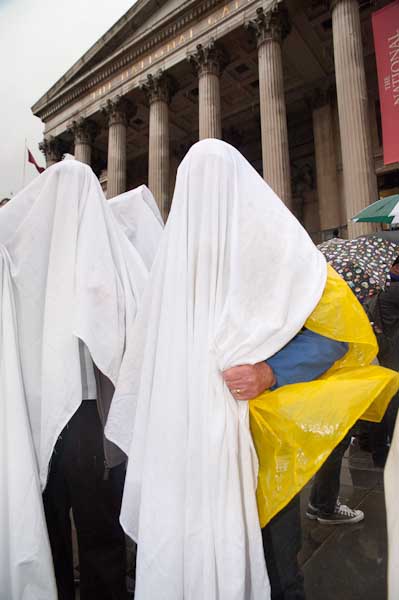
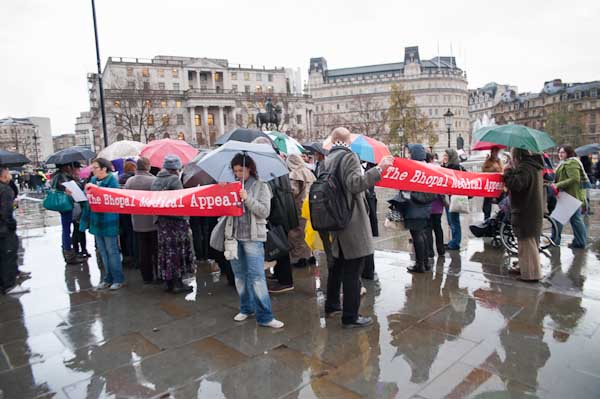
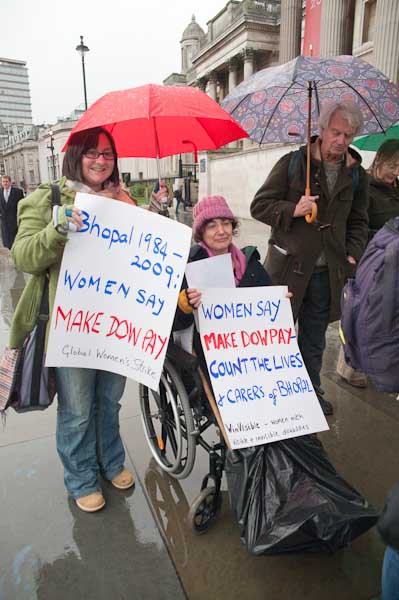
You can read a little more about Bhopal in my feature on Demotix, which reports a memorial service held on December 2, 2009 in a rather damp Trafalgar Square, organised by the Bhopal Medical Appeal.

Photographically the main problem yesterday was the weather. It was raining as I left home for the run to the station (that’s run using feet, not as in school run – and only necessary because I never quite get organised in time for the five minutes or so walk) and about 50 yards down the road I remembered I hadn’t put my umbrella back in my camera bag – it’s generally a fairly vital accessory in London, but there was no time to go back.

© 2009 Peter Marshall.

Fortunately the downpour only really got fully into gear as I came down the footbridge and into the ticket office, but as I sat on the train and it battered against the windows I wondered if the event might be rained off and my journey wasted.  It cleared to just a little light rain  more or less as I arrived at the square, and although the light was pretty low and there were plenty of puddles the umbrellas and the reflections on the wet paving stones perhaps improved some of the pictures.

And I didn’t get too wet, although one or two pictures were lost due to raindrops on the UV filter which protects my lens. As usual I kept a decent-size microfibre cloth in a plastic bag in a pocket and wiped the front of the filter fairly obsessively to try and keep it clear.  Probably I should have resisted the urge to economise and gone for a more expensive chamois leather, but at least with the microfibre I don’t have to worry about producing it while photographing animal rights activists.

Umbrellas may keep people dry, but they also put their faces into deep shade, especially if the umbrella is dark.  So flash became pretty essential on many of the pictures to put some light under them.  I still can’t quite work out how the camera and flash modes interact with the Nikon D700and SB800, and I think there is a little bug in my camera (perhaps that same one that occasionally produces random heavy underexposure and thinks I have that elusive f0.0 lens.)  And I forget to wait long enough for the flash to recharge far too often – as always. Sometimes of course it helps to have this kind of unintentional flash bracketing.

© 2009 Peter Marshall.

The wet pavements did mean that the idea of people getting down on the ground draped in white sheets to represent shrouded bodies wasn’t practical – but perhaps they were easier to photograph standing up.

Die-in for Afghanistan

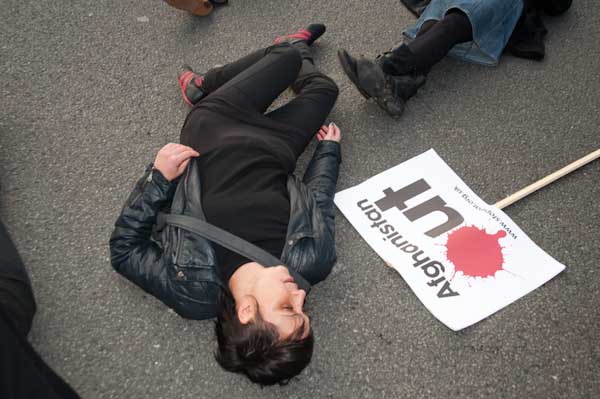
There were a lot of photographers in Parliament Square waiting for the student “Die-In” and I know that some were disappointed that the event was not more theatrical.  One said to me “I was expecting blood and bandages” and there were none of these.

It was in it’s way a nice demonstration, doing what it set out to do and flouting some of our over-restrictive laws that limit the freedom to protest. And although the police at the end did tell those taking part they had been breaking the law in protesting outside Downing St and in using megaphones, so far as I’m aware there were no arrests.

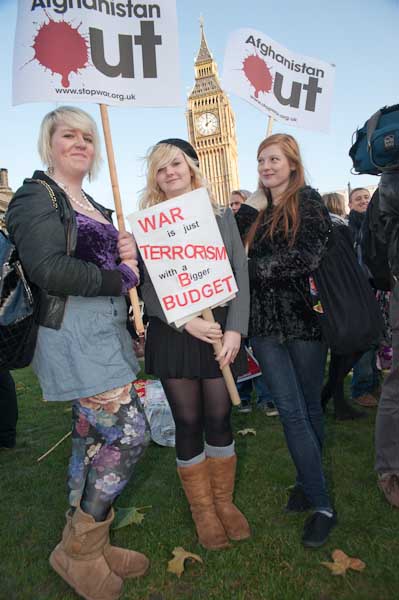
But how do you take interesting pictures of an event such as this? I think all of us look for something a little out of the ordinary, perhaps an interesting placard. But all except one young woman carried the same standard design – so of course she features rather a lot in my pictures, not least because I liked the little bit of humour in ‘Pick fruit not wars.‘  But rather annoyingly all the best pictures I took of her showed the other side that read ‘War is just Terrorism with a Bigger Budget.’

© 2009 Peter Marshall

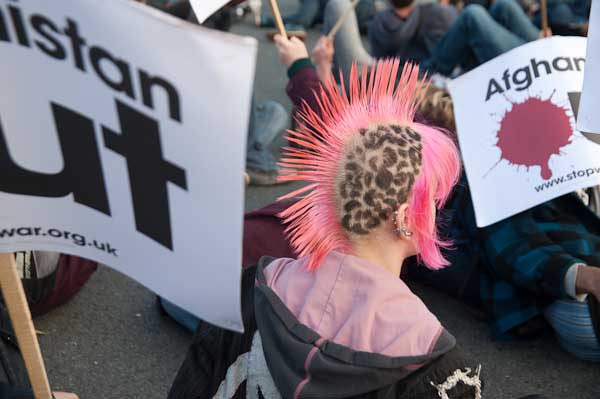
The punk girl with the pink spiky hair obviously felt very much under siege by photographers – and it probably didn’t help that some of her friends tried to shield her with placards. I tried not to be too obtrusive, but she did stand out and make some interest.

© 2009 Peter Marshall.

Often the police actions at demonstrations create a certain tension (and sometimes rather more) but on this occasion they simply stood back and watched most of the time.

Perhaps a very simple approach was the best:

© 2009 Peter Marshall

but it seemed every time I tired something like this other photographers or TV crews would walk into shot.

There are just some occasions where it’s hard to come up with really interesting pictures, though I think those I took – and you can see and read more on My London Diary – do tell the story of the event.

Charis Wilson

Thanks to James Danziger on his ‘The Year in Pictures’ blog I learnt recently of the death of Charis* Wilson, and he gave a link to her obituary in the New York Times which gives a good idea of her life and the support she gave to Edward Weston, as muse, driver, writer and companion during their eleven years together.

These were Weston’s most productive years  and the book which she wrote – with Wendy Madar – ‘Through Another Lens – My Years with Edward Weston‘ , published in 1998, I think gives a real insight into his creative processes – definitely something to be read alongside his sometimes rather pompous but often fascinating Daybooks.

Her writing is a vital part of ‘California and the West‘ “with 64 photographs by Edward Weston” and as well as the text of the book based on the detailed logs she kept on their journeys, she wrote the Guggenheim application that made it possible.

Although biography can sometimes be a distraction from actually seeing and evaluating the work of photographers (and others)  – and the intense fascination of many with Weston’s love life is perhaps a good example of this – it can also give insights into the work.  ‘Through Another Lens‘ I think does that for the partnership between Weston and Wilson that led to some of his best work.

Of course Charis Wilson had a long and interesting life away from Weston – she was only 19 when they met, 30 when they separated and lived to 95.  You can read a little more about that too in the NYT obit.

* from the Greek  meaning ‘grace’ and pronounced ‘Karis’

Internet Photo Criticism II

Great Photographers on the Internet, Part II which was posted on The Online Photographer on Saturday is another of those parodies of the kind of comments that get posted on internet photo-sharing sites, with photographers including Henri Cartier-Bresson, Frederic Sommer  getting the Flickr treatment.

If you missed it before (or even if you didn’t) Mike Johnston’s original Great Photographers on the Internet – where Bill Brandt and Garry Winogrand are among those getting some helpful advice – is also worth a look.

Terry King at Photofusion

Some thirty years ago I was sitting in a darkened hall in Richmond where an elderly man, a long-retired advertising photographer, was talking about the small, high contrast black and white prints which he had entered over the years for the Royal Photographic Society annual exhibition. What was unusual about these photographs by Steinbock was that they contained not a milligram of silver, but had been made on ordinary drawing paper using some black pigment, gum arabic and potassium dichromate.

It’s a story I’ve told before at rather greater length, on the occasion of Terry King’s 70th Birthday celebration, also attended by the man sitting on my left in that hall, Randall Webb, who was later co-authored  ‘Spirits of Salts:  A Working Guide to Old Photographic Processes’ with Martin Reed of Silverprint.

Although I’d heard of the gum bichromate process before – it was highly favoured around the start of the twentieth century among those involved in the ‘Photo-Secession’ and the pictorialist movement of the time, including Edward Steichen and Robert Demachy – and had seen prints made using it, this was the first time I’d heard and seen anyone actually telling how he made these prints.

Later, probably in the pub next door, the three of us decided we were all going to have a go at the process. Gum arabic wasn’t a problem as cooks used it and tubes of watercolour are readily available, but potassium dichromate was more of a problem. But not for me, as I was then teaching chemistry and knew that we had vast quantities of it in our chemical store, over-ordered by previous staff in the days when it was used in large quantities for cleaning glassware, and promised Terry a bottle.

For Terry it was the start of a new career in alternative processes – and you can see some of the results on his Hands on Pictures web site. Together we went on to explore more or less the whole range of alternative processes: salted paper, kallitype, Van Dyke, platinum, cyanotype, carbon and more.  For me it offered an interesting insight into the history of photography, but Terry found these processes the perfect expression for his own photographic work, and went on to research and produce his own variations – the “Rex” processes.

You can also see his work in a new book, ‘Beware the Oxymoron‘ which combines his photography with his poetry – and the preview gives you a good idea of both. I’ve enjoyed his poetry too over the years – particularly some of the limericks that he used to write every day on his short train journey in the days when he worked in a London office – and much more recently I spent an enjoyable evening at a Richmond pub where he and other poets performed their work.

Terry has also taught many others these processes, at colleges around the country (and abroad) and in courses at his Richmond studios. It was hardly a surprise to hear that his  Gum Bichromate Workshop on Jan 9, sponsored by Ilford Photo to coincide with Photofusion exhibition about the art of darkroom printing featuring Bill Rowlinson and Richard Nicholson booked up rapidly (though when I looked the web site reported there was one place left.) Of course if you can’t get on this, Terry does offer longer courses on his Hands on Pictures site.

As well as this course Ilford Photo have also sponsored an experimental print workshop with Branka Jukic on 23 Jan – places still left – as well as a fully booked course in December on black and white photographic printing with Nick Jones.

Last One Out, Please Turn On The Light

Also showing at Photofusion until 27 Jan 2010 is Richard Nicholson‘s ‘Last One Out, Please Turn On The Light‘ a series of large colour prints of London’s remaining professional darkrooms begun in 2006.

© Richard Nicholson, used with permission
Roy Snell’s darkroom.  Richard Nicholson

These highly detailed images were taken using a large format camera using an open shutter in the dark and illuminating them with a series of flash exposures. It’s a fascinating glimpse into the work areas, and although the web site describes these as  “chaotic rooms marked with the patina of time – a world apart from the contemporary photographer’s shiny computer workstation” they are all much larger and rather tidier than my own darkroom. And perhaps too I’ve gone rather further into “personalising” my own un-shiny computer set up.

These images will have a particular fascination for those of us who are or have been photographic printers, and for those who know the work of the printers concerned – or know them socially, but it is perhaps work for a limited audience rather than for the wider public.  They were certainly attracting a great deal of attention and comment on the opening night – where quite a few of those whose darkrooms were shown were present.

As one of the limited number of darkroom geeks, I would have liked also to have seen the other ends of their darkrooms – the wet side rather than just the dry bench with their sometimes magnificent enlargers.

You can see more from the series on  Richard Nicholson‘s web site, where you can also see examples of his portrait work and an intriguing urban landscape series of garages and pramsheds in Tower Hamlets, which are really just my kind of thing.

Bill Rowlinson – Printing Legend

When I was fairly new to practical photography, back in the 1970s, I came across a slim volume which, rather amazingly, was tucked away on a shelf in my local library. They didn’t have a large photographic section – I can only remember one other book, but, equally amazingly, that was Paul Strand‘s ‘Living Egypt.’

The very slim volume was an early edition of ‘The Print‘ by Ansel Adams, and very soon I was myself the proud owner of the latest 1968 edition of the same work, the bible for anyone wishing to become a master printer. Of course some things, even then were outdated and some materials that he mentioned not available in the UK, but although it covers the whole process of making photographic prints in great detail, it was always the principles that mattered.

From that book I taught myself to print, although other aids soon came along, and another vital step was a pilgrimage up Muswell Hill to the store above the pharmacy where Peter Goldfield had begun to import that holy grail of black and white printing papers, Agfa Record Rapid, and later with his partner Martin Reed, produced the Goldfinger craft book. Martin went on to found Silverprint, still in business selling fine photographic materials a few minutes walk from Waterloo station – and the Goldfinger book can still be download from the site as a pdf.

Darkrooms certainly had a magic, perhaps still have it, although we’ve seen some great losses – particularly when cadmium was taken out of many papers, making Record Rapid just another paper. Of course there were also advances, and in particular Ilford’s Multigrade papers giving a flexibility that almost persuaded me it was no longer vital to have two developer baths. And personally discovering that with sodium lighting carefully adjusted to avoid any fog that darkrooms didn’t need to be dark any more.

It wasn’t long before one or two people were asking me if I would print their work, and I briefly considered setting up as a photographic printer. But only very briefly, because although I enjoyed the challenge of printing my own work, I really did not wish to spend more of my life in the darkroom. And perhaps also because I knew there were people who did it so much better.
© 2009 Peter Marshall

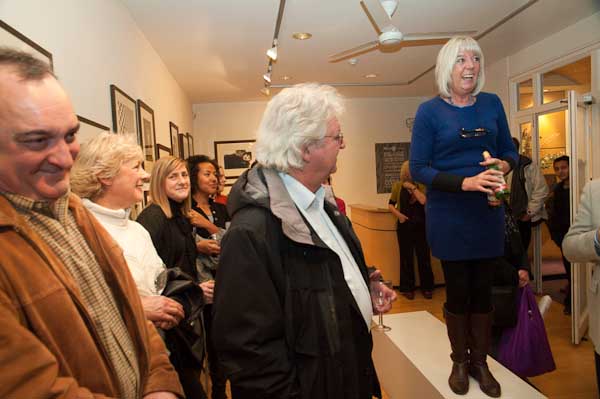
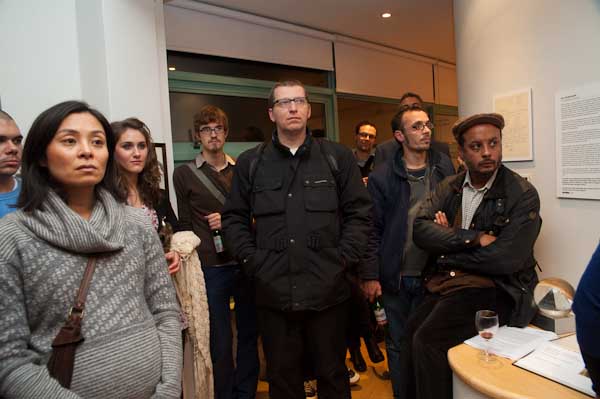
The current show at Photofusion – until 27 Jan 2010 – celebrates the art of arguably Britain’s finest photographic printer, Bill Rowlinson, who died in 2008, aged 78, leaving his collection of prints to Photofusion.

Many of us have worked late in the darkroom, making exposure after exposure trying to perfect the dodging and burning or the contrast of an area of a print, only to find once the prints are toned, washed and dried that the difference that seemed so critical in the safelight are hard if not impossible to discern in daylight, and I suspect that some of those in his collection may be ‘extras’ produced in this way, but certainly all those on show are excellent examples of the printer’s craft.
© 2009 Peter Marshall

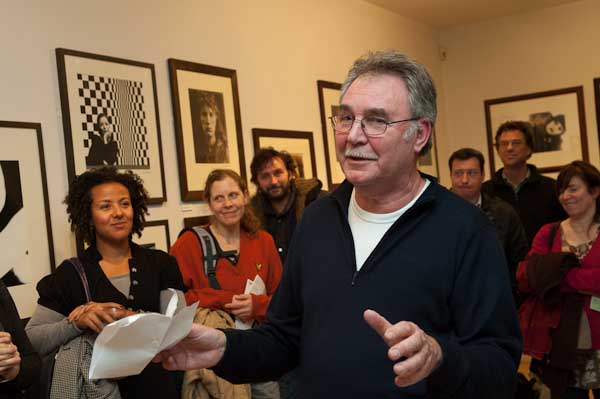
It’s helped of course by the fact that he worked with many of the best photographers around, making his name in the 60s printing for Sarah Moon (who I was delighted to meet and talk to over a couple of days in Bielsko in 2007.)  Also in the show are several of his fine prints for Bill Brandt, as well as some works by Julia Margaret Cameron. Not that he was old enough to have actually worked with her (she died in 1879.) These prints will have been made from copy negatives of prints and were made for the Dimbola Trust which runs the museum in her house on the Isle of Wight (although I think from originals in another collection.)

There are also some intriguing pictures Rowlinson printed for the Kobal collection, along with work by other photographers including Barry Lategan, Jon Swannell, Clive Arrowsmith and Jimmy Wormser.
© 2009 Peter Marshall

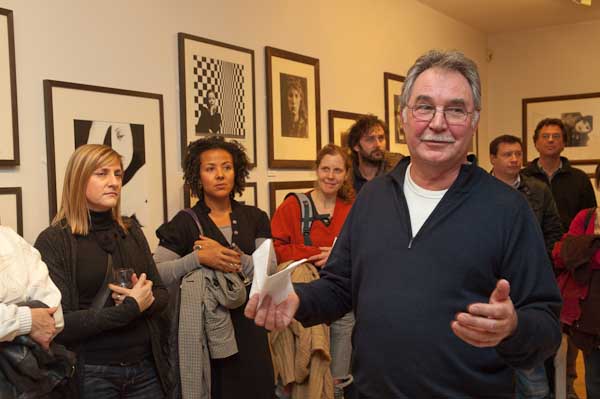
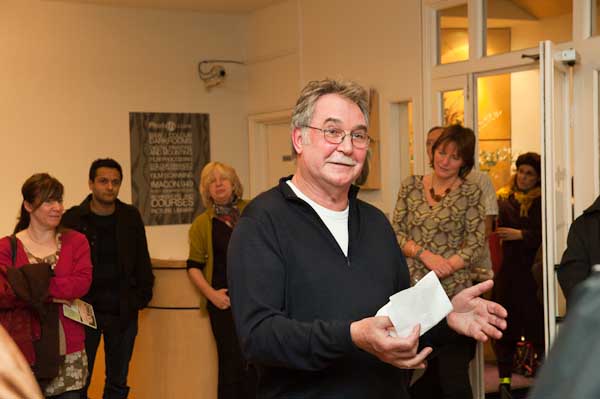
Of course, photography over the past ten years has largely moved to digital, and perhaps the age of the master printer is over. Quite a few of those remaining in London were at the opening last night, including Adrian Ensor, who spoke briefly about Bill Rowlinson at the opening and is appearing in a gallery talk there on 8 December together with Steven Brierley of Ilford and Richard Nicholson to talk further on Rowlinson’s work and “the evolution of photographic printing over the last 40 years.”  You can also hear Adrian Ensor talking with Bob Miller about his contacts with Rowlinson and some of his uncoventional techniques on the Silverprint site.
© 2009 Peter Marshall

Ilford did much to promote photographic printers in the old days, running their Ilford Printer of the Year award for around 25 years, starting in 1968. This was I think unique in that it  gave equal billing – and the same generous prize money – to the photographer and printer. Rowlinson won his first Ilford Printer of the Year Award in 1975.  Ilford – now Ilford Photo – formed from the ashes of the former Ilford imaging group by Harman Technology – exists to be “passionate about black and white” and is producing and promoting photography using black and white film and traditional darkroom techniques.
© 2009 Peter Marshall

A short visit to the working darkroom at Photofusion brought back memories, but its several years since I’ve ventured into my own darkroom to make a print. Perhaps one day I’ll go back again, but with every advance in inkjet printing I feel it’s less likely.
Asylum: Christopher Payne

Many years ago I had the opportunity to photograph the interior of an abandoned hospital and there was certainly something in the atmosphere there that I responded to although I don’t think I truly managed to capture it in my pictures (though I think I did a bit better in a later project on abandoned workplaces in London’s docks which are on my long list of work to put on line at some point.) But it perhaps gives the work of architect and a photographer Christopher Payne’s photographs in his recently published book “Asylum: Inside the Closed World of State Mental Hospitals” from the MIT Press a personal resonance they might otherwise not have.

Certainly I was very impressed by the slide show of this work, Emptied But Still Secret,  on the NY Times Lens blog yesterday.  For me it is very much the details that speak most strongly – the racks of patients’ toothbrushes, the bathtub in a vast area of floor and blue tiles,  a white straightjacket hanging on a white wall, and the details of the beauty salon. Although some of the interior scenes are also impressive, it’s perhaps where the work becomes more architectural photography – and particularly in a couple of exterior views – that I lose interest.

Of course I’ve photographed many buildings myself, some well, many badly. Most pretty averagely, and these two images would appear to me to fall squarely into that category. A shame when the some of the other work is so strong.

Payne‘s web site does have some fine black and white architectural work – including a nice series on substations and some pictures from New York’s High Line.

Which reminds me of a quite different set of pictures that I wrote about some years ago, Joel Sternfeld‘s 2000-2001  High Line series, which can still be seen on the High Line site, where you can also see work by a number of other photographers, particularly in the section headed ‘Art Photography.’