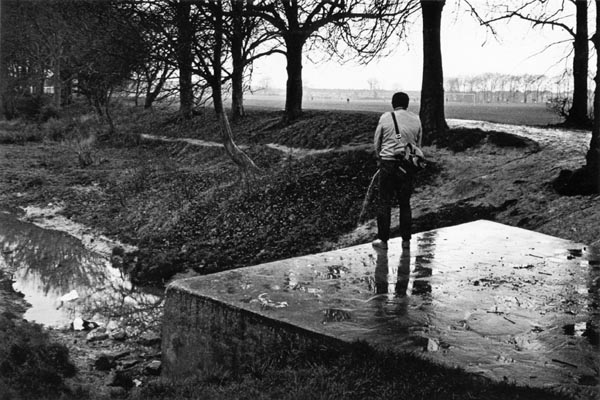
Robert Bergman

My copy of ‘Aperture 199′ arrived a while back, and while I glanced through it, the review by Andy Grundberg of the work of Robert Bergman didn’t greatly attract my attention, largely because I thought the photographs printed with it were not of any great interest. But a piece by Joerg Colberg in Conscientious has (as so often) attracted my attention, and he links to a feature on Aperture’s Exposures blog, Right on Time by David Levi Strauss in which he attacks Grundberg – and gets a reply – now with a link to the review.

It’s a spat that perhaps doesn’t interest me too greatly, but has led me to think more about Bergman. Perhaps the best place to start is with this piece on Real Clear Arts by Judith H. Dobrzynski which links to her piece in Wall St Journal with 11 photographs. There are also a few different images on Dazed. You can also see these pictures possibly a little larger at the US National Gallery of Art, which also has a 15 minute conversation between senior curator Sarah Greenough and Bergman, as well as a singularly uninformative list of pictures in their collection which are not available on line!

I’d actually love it if I thought that someone who had photographed for almost 60 of his 65 years before being ‘discovered’ was a great unsung genius – hope for the rest of us ageing photographers – but unfortunately I don’t think so on the evidence I’ve seen.

And do take a look at Aperture magazine. I can assure you there are more interesting things in it than this review.

Pagan Pride

 © 2010, Peter Marshall

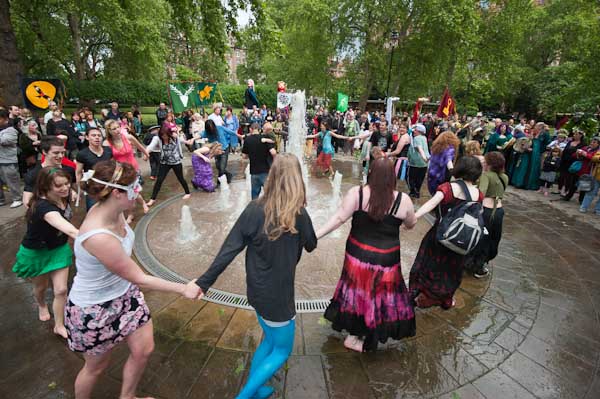
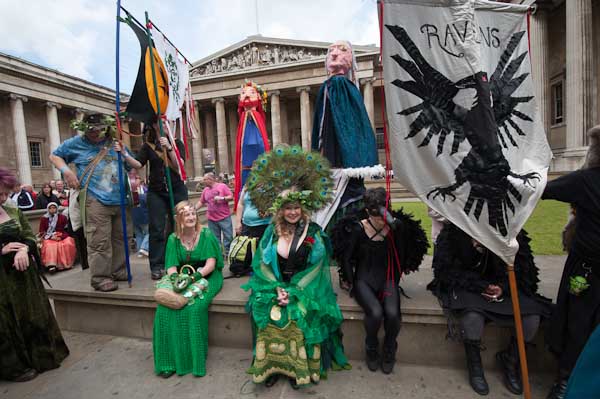
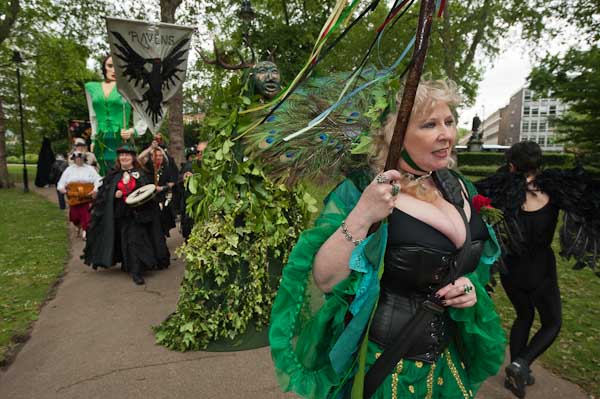
The last Sunday in May I was photographing the annual Pagan Pride Parade in central London. It’s an event I’ve photographed several times before, certainly in 2004, 2005, 2006 and 2008 where you can see pictures on My London Diary, and possibly in early years, when I was still using film. It’s an event that has being going for I think around ten years and has changed a little over that time but is still basically similar.

© 2010, Peter Marshall
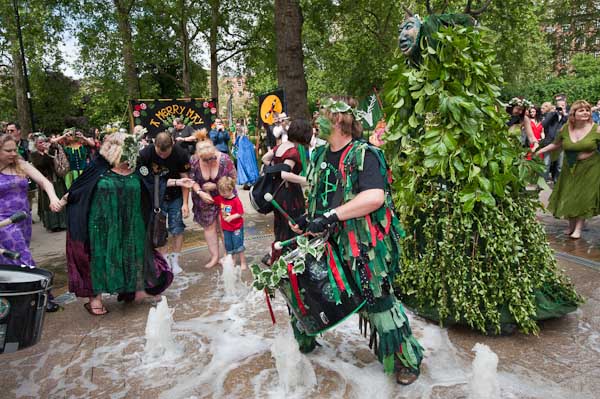
Jack in the Green gets into the fountain

This year I remembered the one vital piece of equipment for the day, a pair of decently waterproof shoes, as one of the more important parts of the event is dancing around and through the fountains in Russell Square, a circle containing computer controlled jets which rise and fall, sometimes rather unpredictably.

© 2010, Peter Marshall

For most of the pictures in this pool I used the D700 with the 16-35mm lens, both reasonably shower-proof, working with my a microfibre cloth clutched inside my left hand to wipe the splashed off the UV filter on its front.  Nikon do make a very nice 14-24mm lens, but it has a bulbous front element which means you can’t use a filter – just like the Sigma 12-24 which I used in some previous years in this situation.  I’m rather less happy keeping wiping a curved lens surface than a disposable filter.

Eventually the front element of that 12-24mm did get scratched and pitted, making it unusable, and although I was able to get it replaced, it did cost around £90 and take two months to get the job done.  A replacement filter from Hong Kong would have been around a fiver with postage.

It isn’t easy to photograph the dancing, because the main thing about it is simply chaos, and it’s the kind of event where you just have to keep on working and hope to get what you want, but you are very dependent on the event itself, and perhaps this year it didn’t quite develop as much as it has on previous occasions.

© 2010, Peter Marshall

From the pool the parade led on through Bedford Square and into the courtyard of the British Museum – an addition to its route which apparently began last year. It makes for some good backgrounds for pictures. I left the parade there as it headed back to carry on with its private events inside Conway Hall where photographers are not welcome and instead went to one of my favourite London pubs, recently restored to its Victorian splendour, the Princess Louise.

Quite a lot of pictures from this year’s event on My London Diary.

Lightroom 3

Lightroom 3 is now officially out, although I’ve not yet bought it but I certainly will. The upgrade price (from version 1.x or 2.x)  in the UK is around £75 (the cheapest I’ve yet seen is £72.99 on Amazon with free delivery) and if you are a teacher or student you can get the full version for around the same price. It seems to cost a couple of pounds more to download, which seems odd to me.

You can watch some Adobe videos about it which as well as showing off the product do also give some useful advice. As yet there don’t seem to be any reviews of the final product that go further than the press release.

As well as the much improved noise reduction that we’ve seen in the beta versions, it now also has several new features I’ve long been asking for, though of course I’m still waiting to see how well they work. Chief among them is lens correction, allowing you to set up single-click profiles for automatically reducing geometric distortion, chromatic aberration, and vignetting. It should ship with profiles for some common Nikon, Canon and Sigma lenses, but Adobe will also offer a free tool for creating your own profiles for any camera/lens combination. You can also manually alter the corrections.

Also very useful is perspective correction, one of the few other remaining reasons why I sometimes need to export images to Photoshop. I can also see myself making use of the new image watermarking tool, though other features such as the film grain simulation and Flickr integration I’ll probably give a miss – unless it’s so easy I change my mind on Flickr (and watermarking might well help there.)

I was less than convinced by the ‘easy image importing’ in the beta – frankly it seemed rather more fuss than the present simple dialogue, and images didn’t always quite end up where I wanted, but I’m sure I’ll get used to it.

Something that isn’t made a great deal of, but I think many will find useful is the ability to use the tone curve just like the one in Photoshop. But perhaps even more important than all the little improvements it promises an overall performance increase.

A Bad Few Days for Lenses

I’ve just put on line at My London Diary the pictures that I took on May 22 at the EDL/Patriot March through Westminster. It wasn’t an event I felt particularly happy about covering, with several groups on the political right involved that I’ve photographed before. But though I may not agree with their politics and certainly not with the way that they express them, I think they have a right to honest coverage. And in the longer term I think photographing and writing about them clearly and as accurately as I can is better at exposing them than the kind of diatribe that I sometimes see elsewhere.
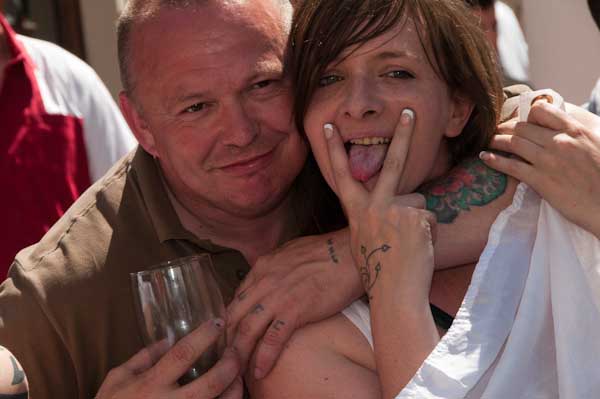
© 2010, Peter Marshall

They complain about the coverage they get from the media generally, but although occasionally I think they have a point, generally they get the coverage they do because of how they behave both generally and in particular how they behave towards the press.

If you want accurate reporting, then it helps to have a clear press release rather than none at all, and it isn’t enough to keep repeating you are not racist, you need to stop supporters chanting racist slogans or insulting people.
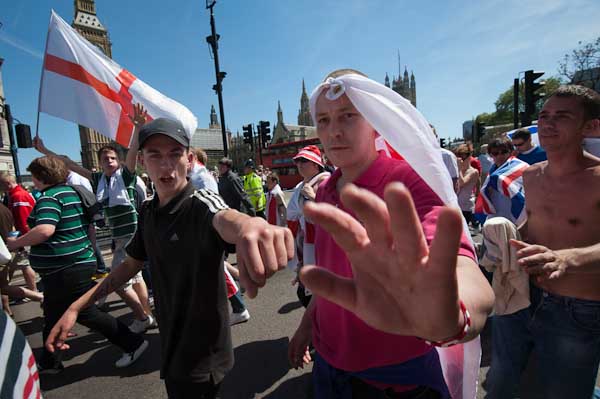
© 2010, Peter Marshall

Although things started off in a fairly friendly manner, towards the end of the event many of the demonstrators were threatening press photographers, pushing them away, grabbing their cameras and holding hands over lenses.  It doesn’t make a positive impression!
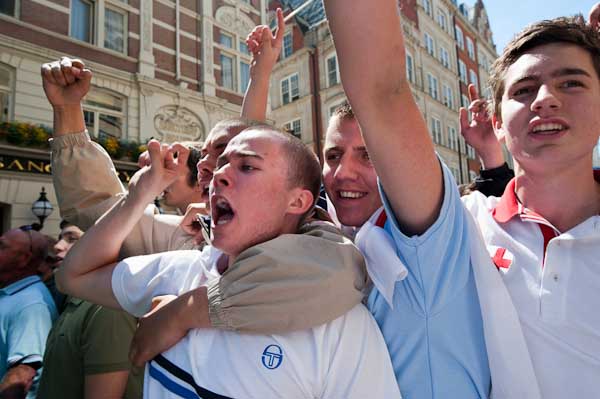
© 2010, Peter Marshall
I wanted a higher viewpoint so…
However I have only myself to blame for an incident as the march started. While photographers were crowding around photographing the guys at the front of the march I decided I needed to lift a camera above my head for a ‘Hail Mary‘ to get a higher viewpoint.  I had two cameras around my neck and as I lifted one, somehow the second, which I thought I was holding by its strap, crashed to the ground.

It was a D300, with a Nikon 18-200mm and an SB800 flash, making quite a heavy package and it landed on the tarmac road lens first, smashing the filter, with the batteries from the flash spilling out. Other photographers helped me to scrabble to pick up the pieces as the marchers moved forward, and one helped to remove most of the broken filter with a small knife.

Stupidly I cut my thumb rather deeply on the broken glass and spent the next twenty minutes or so dripping blood as I continued to photograph with the other camera having dumped the broken bits into my camera bag.

I put another lens – the 10.5mm fisheye on the D300 and was very relieved to find that it at least was still apparently working. Looking at it later there didn’t seem to be any obvious damage, though I perhaps still need to check the autofocus more carefully.

There was some minor damage to the SB800, breaking the hinges of the flash diffuser, but otherwise that too seems to be in working order – and I’ve been using it since with few problems. Perhaps when I have a moment I’ll take it in for repair, but it hardly seems worth the bother.

The 18-200mm was a different story. The filter thread had been damaged making it impossible to remove the remains of the broken filter, and although the lens looked physically sound, once I tried to zoom it became clear that there were some very serious problems. On closer inspection I’d broken quite a lot of the mechanism inside the lens and there were some bits of broken glass – lens elements – in the middle of the lens.  It was fairly clearly beyond economic repair.

The Nikon 18-200 isn’t the cheapest of lenses, but I’d had it since it came out a few years back and it had already needed several repairs. The photographer who was standing next to me when I dropped it told me he was on his fourth of them! It really is an amateur lens, both in terms of performance and also lack of robustness,  and one we only put up with because it is just so versatile with the huge zoom ratio. You can go out with it anywhere as your only lens and, so long as it isn’t raining and there is a reasonable amount of light it will be the only lens you will need.

So I wasn’t too upset over it. It was a lens I expected to have to replace in the near future, and one that I’d had considerable use from. And at least at home if not with me I had a replacement for it, making use of the Sigma 24-70 f2.8 and 50-200 f5.6 lenses to cover more or less the same range.

The following Monday I went out for a walk with a few of the family to Richmond Park, taking just this combination. Not quite as convenient as the 18-200, but better quality. Towards the end of the walk, disaster struck again, and the 24-70 refused to zoom past around 28mm. It was an almost new lens, hardly used since I’d received it as a replacement from Sigma for an earlier one that I’d had problems with.

The following day I packed it up and sent it back to Sigma for servicing. A few days later I got a phone call from them asking why I’d sent it as it seemed to be working properly. Whatever had caused the jam had been cured by the shaking as it went through the post!    I told them in greater detail than in my letter and they went away to work on it, getting the lens back to me a few days ago.

But when I sent off the 24-80 I didn’t have a lens to cover between 35mm and 75mm which is a pretty important range, so I needed to find a replacement quickly. After a little research I ordered a Nikon 18-105mm rather than a new 18-200mm. Although it doesn’t have quite the range, most of what I take is at the lower end, and it is after all a 27-157mm equivalent, so a respectable telephoto.

But the Nikkor AF-S DX 18-105mm f/3.5-5.6 G ED VR (to give it its full mouthful) has several other points in its favour. It is a smaller, lighter lens and a better optical performer in almost every respect than the 18-200, and seems  considerably more robust – though still not a pro lens. And at less than half the price of its bigger brother it was irresistible.  By noon the following day I had it on my camera and was back in business. When I know I’m going to need something longer I’ll take the Sigma 50-200mm as well.
David Hurn

I came into photography in the 1970s, and completely missed the great input that David Hurn made into creative photography in the UK in the 1960s, meeting him for the first time in the early 1980s, when I had a short argument with him in the questions following a talk he gave on one of his shows.

The show wasn’t one of his better efforts, and his reply to my question appeared to me to be entirely based on commercial rather than artistic criteria, so I’ve perhaps never warmed to the man as I should, though I do have his Wales: Land of My Father (2000) on the main bookshelf in my living room (along with a volume by one of the many photographers whose career was intimately bound to his, Josef Koudelka.)

Had I started in photography ten years earlier I might have got to know him better, and if I had been ten years younger I would certainly have yearned to attend the course that he ran from 1973-90, the School of Documentary Photography at the Gwent College of Higher Education in Newport, Wales.

David Hurn is now 74, and his latest book, Writing The Picture with poet John Fuller was published by Seren on June 5th 2010. You can read more about his remarkable life in a feature by Graham Harrison on Photo Histories, where there is also a link to the book, as well as to the title sequence from Barbarella in which a space-suited Jane Fonda weightlessly disrobes.

Harrison attributes former student Dillon Bryden as stating that David’s course  engendered the work ethic and a very particular code of understanding, and although in many ways a strength, particularly in giving its students a way of making a living, it was perhaps also a weakness, pushing them down a particular route.  But it was certainly a great shame when this vocationally oriented course was lost in the scramble for university and degree status.

In his piece, Harrison writes “David Hurn says the art establishment in Britain remains staggeringly snobby about photography, and is particularly resistant to photojournalism and documentary photography.” Despite the work of Hurn and others this remains only too true.  Although he and other photographers did serve on the Arts Council in various ways, photography has never really got a serious look-in, though for a year or so in the 1970s it seemed it just might.

I’ve always felt it summed up the situation pretty well that, until 2001, the only money I had ever got from the Arts Council had been a couple of small payments from the Poetry budget. And in 2001 the money came from ‘The Year of the Artist‘ and again was not specifically for photography.

You can see some of David Hurn’s pictures on his Magnum page, and also worth reading is a piece on Hurn by the late Bill Jay, another vital figure in British photography in the late 1960s through Creative Camera and Album magazines.  This starts:

While still in my 20s, I showed David Hurn my photographs, the results of more than seven years of struggle to be a photographer. It took him about 30 seconds to look through the lot and deliver his judgment: boring. “Derivative”, he said. “You won’t make it.”

We have been friends ever since.

British photography might have had a rather different story had Jay not, as Harrison relates, been turned down for a post at the National Portrait Gallery.

Munem Wasif on Lensculture

I’ve several times mentioned the work of Munem Wasif here, and this photographer born in Bangladesh in 1983 was one of the ‘top five’ I picked from PDN’s ‘Top 30’ in 2008. He was also one of my choices for the Prix Pictet later that year, and although he didn’t win the main prize he was awarded the the commission to document WaterAid’s Chittagong Hill Tracts Project in Bangladesh.

So I’m pleased to see that on Lensculture you can now see a gallery of 30 of his images together with text by Francis Hodgson, head of the Prix Pictet jury,  with an exclusive audio interview about this project, plus another short interview about his evolving style as a photographer. It’s an interesting reflection on the way that he works as well as giving more information about the story. You can also see more about him and his work at Agence Vu.

Save 6 Music

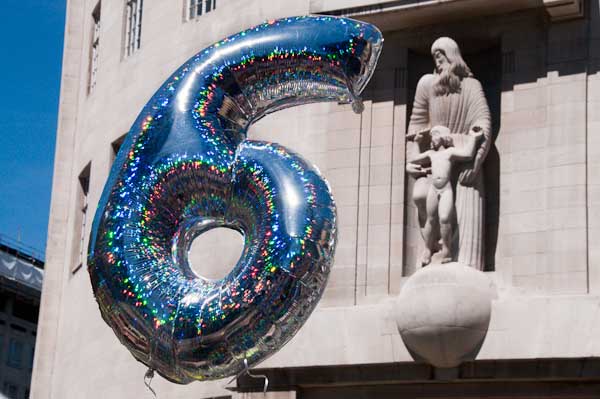
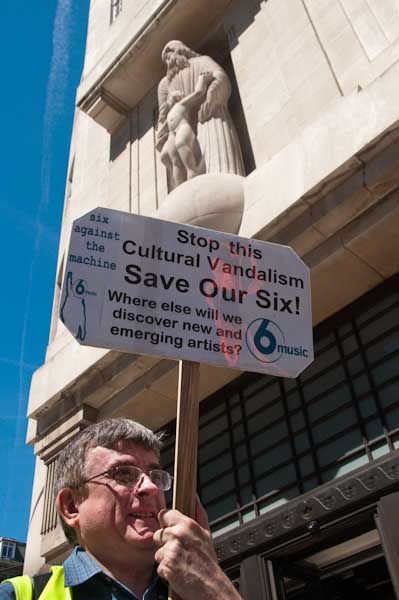
I’m getting rather behind with putting work on My London Diary, and so far I’m only somewhere in the middle of May and its June already. Yesterday I did manage to finish putting up pictures of a demo outside Broadcasting House to stop the BBC cutting a couple of stations, 6 Music and the Asian Network – more pictures here.

© 2010, Peter Marshall

Broadcasting House is truly an ‘iconic building’, a phrase that seems to have come into the constabulary vocabulary here to mean almost any large building in London, but at least I had no problems in photographing it. But the building as a whole is perhaps a little difficult to integrate into pictures taken more or less next to it, though I did try once or twice. But really it worked better when I concentrated on the significant detail of the Eric Gill statue above the main doorway. Here’s another:

© 2010, Peter Marshall

And of course, as so often with demonstrations it helps to get the message in the picture.

6 Music isn’t a station I listen to – it just doesn’t appear on my radio as it doesn’t broadcast on FM, though I could of course listen on-line.  But what little I have heard of it seems to me admirable, very British and very quirky, and this showed in the slogans, placards, banners, dress and performances at the event, and I hope too in my pictures.

© 2010, Peter Marshall

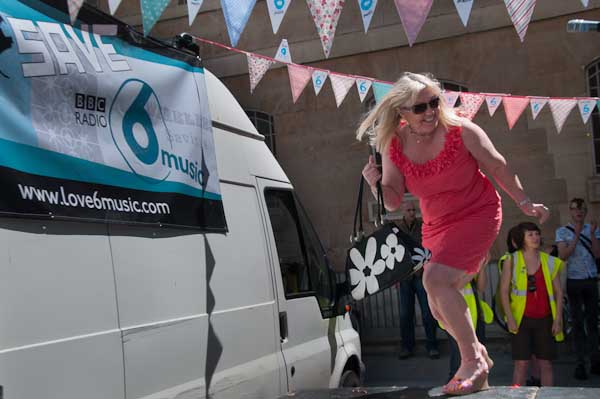
Although I took some straightforward portraits of the station’s presenters – who were of course appearing in their capacity as licence fee payers rather than presenters, it was a couple of pictures of Liz Kershaw bounding up onto the stage that interested me more; the first image unfortunately  I didn’t get quite right, but the second (and there wasn’t time for more) I think catches her well.

© 2010, Peter Marshall

It’s exactly as I saw and framed it – I seldom crop, though it’s not a religion, just usually things are stronger if I get it right when I take the picture. And this is 100% of the frame.

Another Niche For Film

In Digital Myths a month or so ago I tried to question some of the strange reasons that some people – even some photographers – still have for clinging on to film.  I think for most it’s very much as Hilaire Belloc put it in his ‘Cautionary Tales for Children”, keeping a-hold of Nurse. That digital really is something better rather than something worse isn’t enough to remove the fear.

But film does still have its uses, and if you are planning a trek to the North Pole you might be advised to use it, according to a piece in the Amateur Photographer.

Colour Lee/Lea

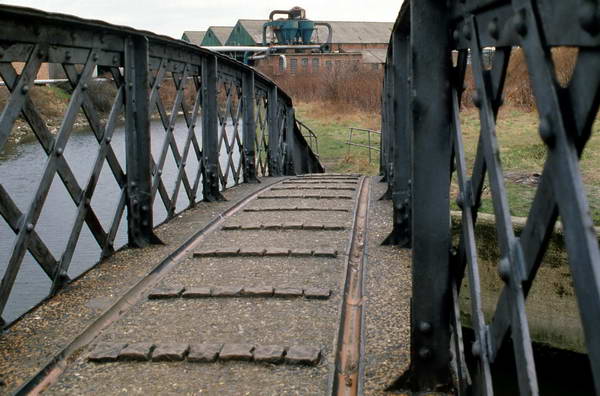
Well not just black and white, I’ve also been taking a look at the colour transparencies that I made in the Lea Valley in 1982 and 1983. I put these on line a while ago, but there were one or two technical problems that needed a little sorting.

Looking back, I can see that the pictures are rather a mixed bunch (and yes,  a couple crept into the Lea Valley from a little way away –  at least one from the West India Docks) but I mean more in terms of approach than the subject.

© 1983, Peter Marshall

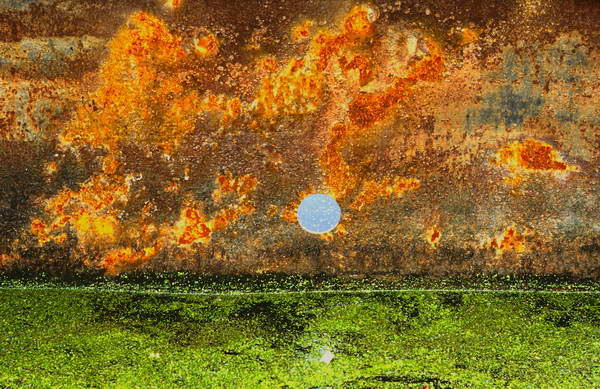
This rather abstract image is the rudder of a barge on the Lea Navigation

© 1983, Peter Marshall

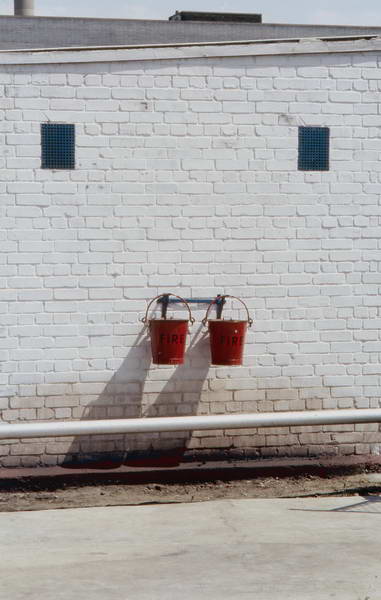
While this is rather different in that the subject matter is quite clear, but it’s also clear that the picture isn’t really simply about what is actually depicted.

© 1983, Peter Marshall

This is another one that I particularly like which I don’t think I’ve put on this blog before, and it shows a bit of what is now the Olympic site.

These three are all from 1983, and there is another set from 1982. Clicking on my name at the bottom left of any of the pages takes you back to the home page of the River Lea site.

Some of the images are not quite the right colour. These were all scanned rapidly on the Epson 750 (using the Epson software) and its hard if not impossible to get some of them right. There is a very nasty purple in some of the shadow areas that can’t really be removed. Probably I could get a better scan on my negative scanner, but in a few of them the colour has perhaps aged a little badly. They were taken on several different films – the picture immediately above is clearly taken on Agfa film while the top two were not. I made dupes of a number of these images and I can’t always tell which was the original.

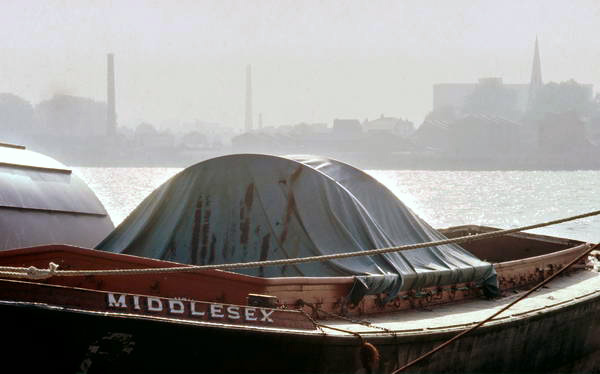
I switched to colour negative film (except for a few jobs where I had to submit transparencies) a couple of years after this, and looking at some of these reminds me why.  But there are a few here that I’ve been able to resurrect with a little help from Photoshop – such as this barge on the Thames not far from the Lea:

© 1983, Peter Marshall

It isn’t perfect, but a lot better than the original slide, thanks to a great deal of jiggery-pokey in Photoshop, some of it not done quite carefully enough.

Middlesex is of course the right bank of the Lea (its left is Essex) and visually the image connects with another in the group

© 1983, Peter Marshall

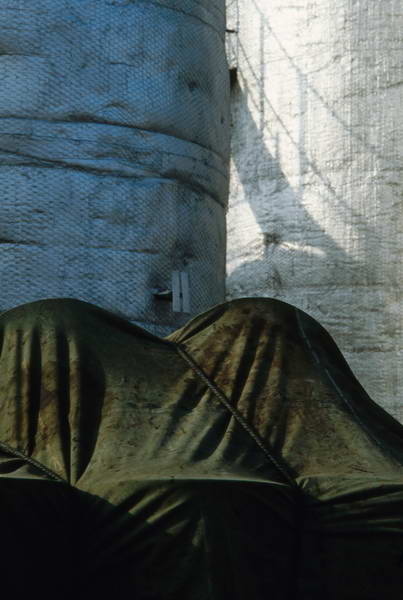
which I’ve always connected with a Man Ray image inspired by a phrase from Lautreamont’s Les Chants de Maldoror : ‘As beautiful as the chance encounter of a sewing machine and an umbrella on an operating table’ . He wrapped what was possibly a sewing machine in a sack and rope, while I found a giant one ready-made on a lorry at Three Mills in Bromley-by-Bow. But unfortunately no Lee Miller every emerged for me there from the Lee.

More on the River Lea (1980-92)

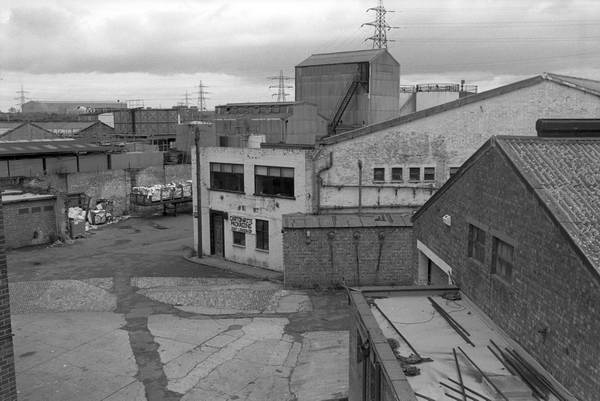
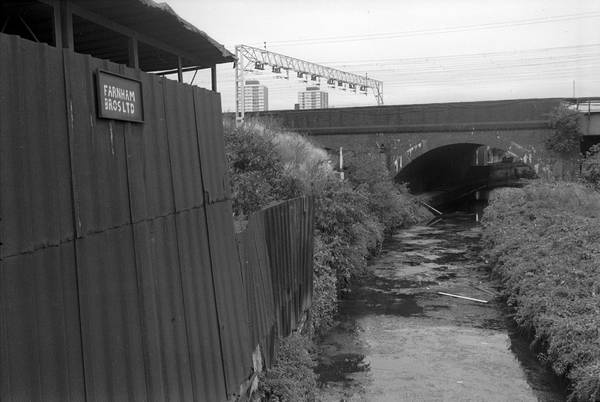
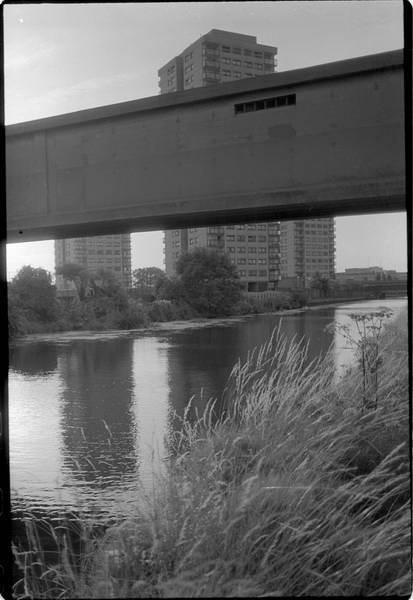
Another wet day, and as there wasn’t a great deal happening that I wanted to photograph and no one had offered to pay me to photograph it, I stayed in and kept my cameras dry. Which gave me a chance to catch up on something I’d started a couple of times before but never found time to finish, a significant update on my web site on the River Lea.

Back when I started photographing it around 1980, the Lea was virtually an unknown river.  Quite a few Londoners would have heard of it, but I think relatively few could have told you exactly where it ran and even fewer would have actually gone to see it. Now, with the 2012 London Olympics being held on a bit of it at Stratford Marsh, it’s a tourist attraction, and if I go there I have to dodge crowds of tourists being taken along the Greenway by Blue Guides.

Of course they won’t see what I saw then:

This was a view of the Olympic site in 1990. Now it looks rather different. And the Pudding Mill River which ran alongside Pudding Mill Lane is no longer visible:

© 1990, Peter Marshall

And the footbridge provided by Major Villiers for the school children of Hackney Wick to get across the Navigation to their playing fields was removed last year; the flats were dynamited years ago:

© 1982, Peter Marshall

As you can see, I didn’t quite get around to trimming the scans – I did several hundred scans for the presentation I gave at  the London International Documentary Festival, and not surprising was rather pressed for time. Quite a few are in need of some spotting and retouching too, time has not been kind to some of these negatives.

Of course the Olympic site isn’t the only part of the Lea that has changed since then:

© 1982, Peter Marshall

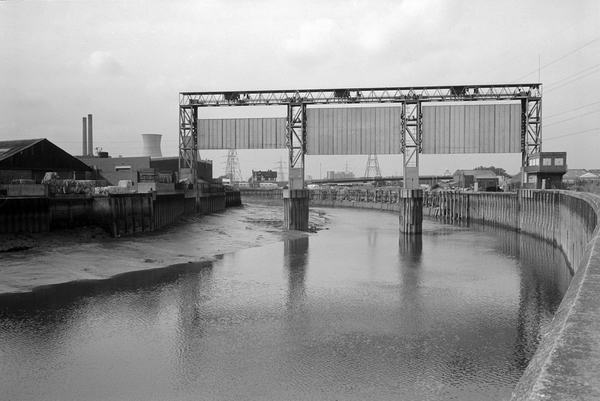
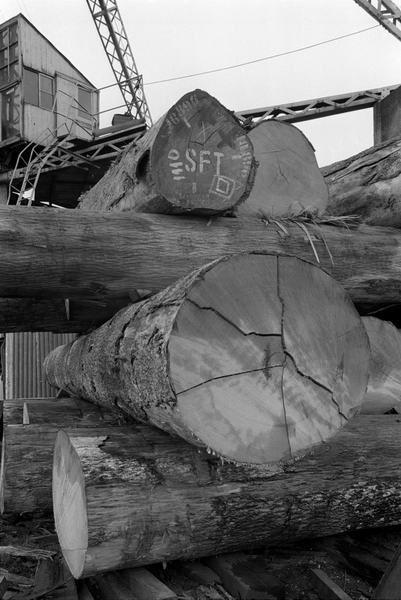
Bow Creek is still there, but not much else. The power station and flood barrier are both long gone.  But my favourite images are still of something else that is lost, the timber yards. There are three from Dorford Wharf in Edmonton that I particularly like – this is one:

© 1983, Peter Marshall

When I took these pictures I wasn’t much into taking notes, and it was of course long before we had GPS. I could remember where I took every picture and what it showed without much trouble then, but 25 years later it is not so easy.  Later I got into the habit of writing significant information onto the contact sheets – things like the grid reference and street name, as well as carrying a little black book where I’d record stuff.

Later I moved to making the field recordings on a miniature tape recorder and filling in the book at home, as the writing I did on the street wasn’t always too legible. This did used to make me feel rather embarrassed as I stood in the street apparently talking to myself, but now we have mobile phones most people seem to do it most of the time.

The site the work is on is of course The Lea Valley, and if you want to go directly to the page with the stuff I’ve been talking about it is Black and white images 1980-92.

If you find anything you know I’ve captioned wrongly please let me know. And I confidently expect to get get more e-mails about this picture of the source of the River Lea asking me if I’ve noticed , er, that man is, er…

© 1983, Peter Marshall

And I didn’t set it up, unless just going there with a French photographer counts.