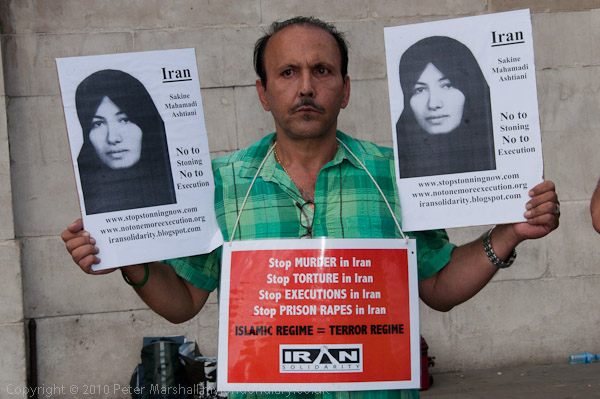
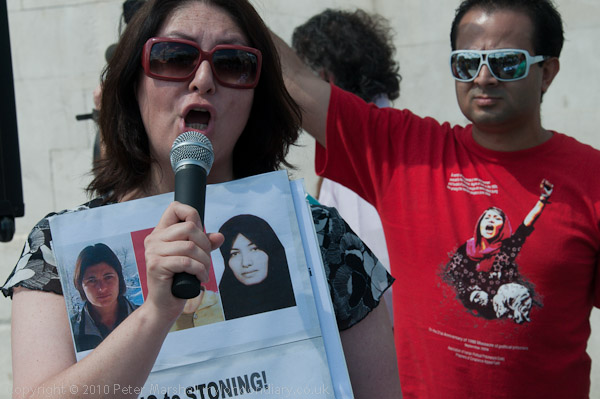
Press Pass or Not?

Controversy rages currently between the long-established professional media organisations and upstart Demotix over the decision by the latter company to issue photographers with its own ‘press pass’. Since 1992 there has been a voluntary UK Press Card scheme, organised by an independent authority which licences 16 national organisations which represent journalists and other media personnel working “professionally as a media worker who needs to identify himself or herself in public” and entitles them to issue a ‘UK Press Card‘ formally recognised by all police forces in the UK (the scheme was launched by the Met) and many other bodies.

In general it has been a good scheme that has benefited photographers, police and public, although it hasn’t always given us the cooperation with the police that it supposedly entitles us to, and even some high-ranking officers have sometimes shown an abysmal ignorance about it.
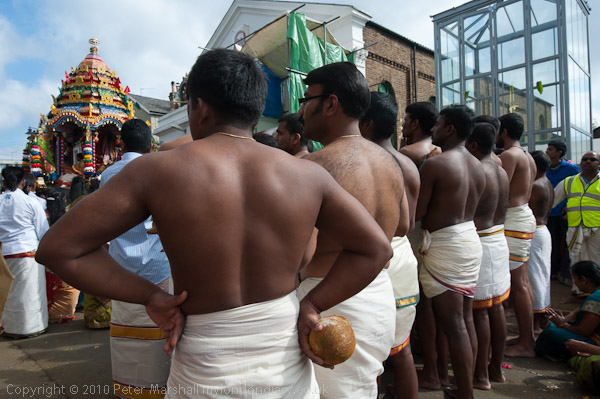
© 2010, Peter Marshall
I didn’t need any press card to cover the latest event I put on Demotix

But I’m certainly very much in favour of the UK Press Card scheme, which has generally worked well, and in which I have a certain interest having carried a card for many years, at first from the PPA and latterly from the NUJ.  Its major use for me has been to reassure members of the public who I am photographing, and if they have any concerns it provides a means that they can check on me through the police via the verification hot line whose number is given on the card. So far they haven’t bothered to do so – looking at the card has been enough.

It does also occasionally get me into areas which are closed from the public at some events, as well as free entry to some exhibitions etc. This has been a privilege I’ve always been careful not to abuse, only using it when I was actually writing or photographing the events concerned, although some colleagues and other card-carriers are considerably less scrupulous. Over the years some or most of the 16 “gatekeepers” have issued this card to many whose work can in no way justify it (a suggestion that many will admit in private but attack anyone who mentions it in public.)

Although I carry the card all the time when I’m taking pictures, at probably 95% of events I photograph it stays in my pocket. Usually if you look as if you know what you are doing and behave sensibly you can work without problems. The other 5% of times – mainly dealing with police or when I’m photographing events involving children –  it does become useful or essential and without it I couldn’t work effectively.

Demotix wasn’t around in 1992 and doesn’t I think belong to any of the associations involved in the UK scheme, although it could possibly join at least one of them.  I first came across their card a few months back, before they began to issue them more widely, when I saw one hanging around the neck of a colleague when we were covering the same event in Trafalgar Square, and asked him about it.

Like it or not, our industry – if that’s the word for it – is changing, and like many others involved in it he simply does not earn enough from it as a proportion of his earnings to qualify to join the NUJ.  To keep up his professional media work (and his work is professional) he has to do other things that make more money as well.

The same is true of many others who put work on Demotix, where you can often see journalistic work of a very high standard from the UK and countries around the world – overall a considerably better standard of work than in many newspapers and in particular recent issues of the NUJ’s own magazine.

Again I have to declare an interest as I often post work on Demotix, largely because it enables me to tell my stories at some length and depth to an audience. On Demotix I can write a story – perhaps 500 or a thousand words and upload it with 15-25 pictures to form a slide show and have it available on-line in less than an hour from when I’ve finished it. A very high proportion of those that I post become ‘front page’ stories promoted by Demotix and seen by a decent number of people. Though still considerably fewer than see them on My London Diary or in posts here.

The only really unfortunate thing about Demotix is that sales are low, and I make very little money from it. I keep hoping things will change.  I actually started with them following a suggestion on how photographers could look at new ways to make a living from photography made at an NUJ photographers’ conference, but it hasn’t so far worked out.

The statement that appears on the NUJ site warning about the Demotix ‘press pass’ is unfortunately a very poor piece of journalism, getting too many of the facts wrong, particularly in the headlines. Demotix isn’t “selling” its ‘press passes’ and it isn’t an “amateur journalists’ website”. As Demotix CEO Turi Munthe stated to Journalism.co.uk,”The vast majority of Demotix’ regular contributors are pro or semi-pro photojournalists around the world, whose work has appeared in every major news outlet in the UK.”

It’s important also to remember that although the NUJ piece treats it as if it was entirely a UK matter, Demotix has photographers around the world in 190 countries sending it stories, including some that have no proper press card scheme.

I haven’t got a Demotix card but if I didn’t have a UK Press Card I would apply to Demotix for one. Before the UK Scheme I worked using cards provided by several bodies both from the UK and one USA company, all of which had my name and photograph, the name of the organisation I was working for, an expiry date and a contact phone number that could be used to check up on me. I cam see no problem with any organisation issuing members with such an identity card so long as they control it properly. It does really simply show that the person holding it is working gathering news for Demotix.

Although the Demotix card has been stated to look rather like the UK Press card, it would be hard for anyone familiar with that to be misled. What perhaps makes it contentious is the large black text PRESS on a yellow background similar to that on a UK Press card, but at around twice the size.

I’ve not checked recently, but it used to be possible for those who met the Demotix criterion of ‘ten published stories’ on the site to download a free PDF to make into their Demotix card, although there were many requests for Demotix to have them produced professionally and made available at low cost to those who qualify, and that seems now to have been done. This isn’t “selling” them any more than the annual fee I used to pay for my UK Press card from the PPA was.

I’d like Demotix to have greater quality control generally; stories are currently vetted by editors at least until photographers establish themselves as reliable, and most contributions do reach a reasonable standard. Perhaps 10 published stories is setting the bar a little too low, and they should consider only issuing them to photographers who have published at least this number and had at least one making the ‘front page.’

But I’m not entirely happy with the UK Press Card scheme either, and not just because some people who never emerge from an office get one. Although at the moment we seem – thanks to a lot of work by the NUJ in particular – to be getting the police who backed it in the first place to recognise it, there are still far too many other places where it isn’t recognised, with people – often I think thorough ignorance of the scheme – demanding their own accreditation. If the scheme were more generally known and accepted and the card recognised there would be considerably less danger of people being confused by a company card such as the Demotix example.

But underlying all of this dispute is the fact that the UK Press Card scheme is based on the status quo of 1992 in an industry that has changed considerably in those 18 years.  The scheme and the NUJ too has failed in some respects to keep up with this changing nature and in particular the huge change from staff to freelance work. Many freelances have to combine various skills – and not all necessarily in journalism – to earn a living. The union should be much more actively promoting professionalism in journalistic work not just in the traditional media but also in blogging and various other on-line manifestations of the new journalism which include companies like Demotix.

We perhaps too need to concentrate more on audience than on earnings when assessing who should qualify for a press pass. Last October my page views for all my web sites for the month were over 250,000 for the first time and are now consistently around that level, and this site reached the 100,000 mark in June and is still increasing. Thanks to all of you for reading this  but this site currently makes me no income. To me it’s still journalism, just the same as when I was writing and photographing and getting paid for it (and fortunately elsewhere this just occasionally still happens.)

————————————————

I’m still wondering whether I should add a donations button to these posts, or even possibly move to another platform where I could add some fairly unobtrusive advertising. But I’d prefer not to.

You can however support me in other ways. First and most easily simply by recommending the site, telling your mates, writing about it and linking to it if you have a blog or web site or use Twitter or Facebook etc.  If you have any connection with using or commissioning photographs then all my work on all of my sites is available as high res for repro, and I’m generally available for work in the London, UK area. And of course you can buy prints of anything on the site at fairly reasonable prices as these things go – both older black and white work such as my Paris Pictures (that page has a link to sales and information on the bottom) or any more recent work.

Finally I’ll mention Blurb books – and I’ve a new one coming shortly when I’ll mention them again. I don’t make a great deal on these, as I’ve kept the markup very low since Blurb isn’t cheap, and my motivation wasn’t to make money but make my work available to anyone interested. Currently two very different books are available:

Before the Olympics  

Before the Olympics:
The Lea Valley 1981-2010

Peter Marshall
Softcover UK £16.45

Over 240 images from the Lea Valley in an 80 page book, including many from the area now redeveloped for the London 2012 Olympics.

and

1989

1989
Peter Marshall
Softcover UK £10.95

20 lack and white photographs from 1989 and accompanying text from an imaginary diary of a walk in north London with a famous deceased author.

The links lead to pages with previews of each work – and where you can also order them.
Post and packing is extra.
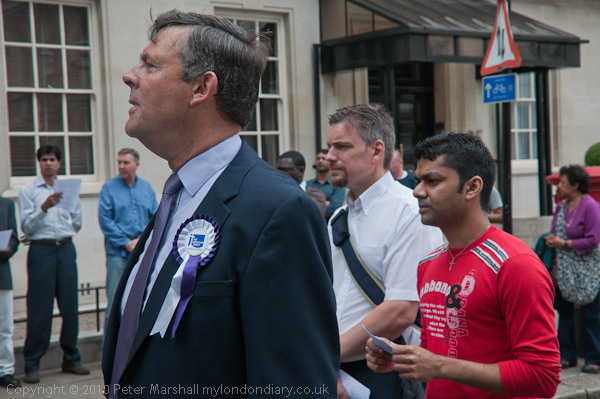
Christians Protest Pakistan Oppression

What do you do when you turn up to photograph a protest where you’ve been told there will be several hundred people and you get there at the stated starting time to find around three people there?

Its actually three more than at one event I went to photograph earlier in the year, which was a total no show. Usually I’ve got the phone number of an organiser or organisation, but too often I find I’ve left these at home when I go out to take pictures.  I’ve been meaning for a while to get either a net-book computer that I’ll take everywhere or at least a rather smarter phone than my present mobile and to start organising my photography on a portable device, but at the moment everything lives on a largish tower system next to my ‘desk’ (actually a rather crude table made from a door in the house we decided we didn’t need that I designed and made one afternoon around 15 years ago having found that something the size and solidity I wanted would cost several hundred pounds.)

Having been disappointed a few times by activists who get ideas for protests but don’t do anything to actually organise them, I do now try to check up on events before adding them to my diary. Sometimes just on the web, other times by contacting other people.

On Saturday there were just a handful of people setting up for a demonstration by the British Pakistani Christian Association outside the Pakistan High Commission, but obviously they were expecting more people.  The event had been timed to start at 11.00, with a minute by minute programme planned with various speakers, prayers, songs etc, but nothing was happening when I arrived a couple of minutes later.

Often, particularly when other photographers are present, this is an opportunity for a coffee in a nearby cafe or something stronger in a pub. I always try and carry a book with me, both to read on the train on my way to events and also to fill in time when I’m waiting for things to happen. And if I’m in the right place I’ll visit an exhibition – in Trafalgar Square often in the National Gallery which has a fantastic permanent collection on display, or the National Portrait Gallery.

© 2010, Peter Marshall

There isn’t a lot to do at Lowndes Square. I did take a short walk – there were a few things around I wanted to check up on – then sat on a wall opposite the protest and read.  Fortunately there were a few more people around by 11.35 when the event actually started. Even then I didn’t find a great deal to photograph, although there were moments.

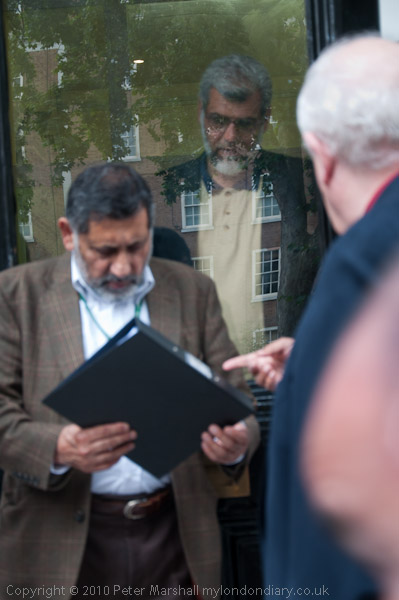
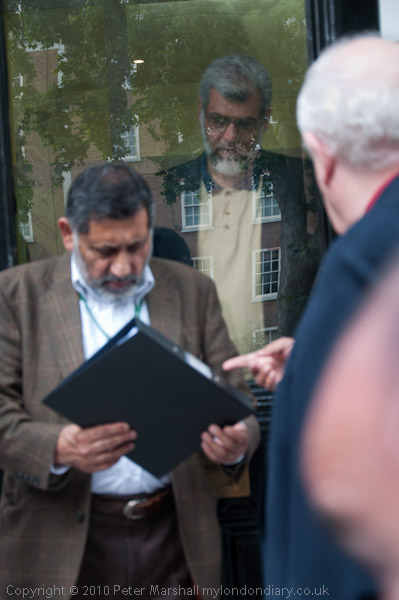
One picture that I didn’t quite get came when a deputation took a petition to the Pakistan High Commission. One man came out onto the steps to meet them and a took a few pictures and then saw a second man looking through the glass of the door.  Unfortunately I didn’t think to zoom as far as I could with the 18-125mm I had on the camera (I was working with just the D300) and by the time I’d though about  it he had opened the door and come out too.

© 2010, Peter Marshall

Not a great picture, and certainly it would have benefited from greater depth of field

© 2010, Peter Marshall

particularly in the cropped version below.

The march from Lowndes Square to Downing St started around 12.20 and having followed for the first couple of hundred yards I decided I had done enough. Sometimes I walk all the way with marches, but often I get too tired and although the backgrounds may change essentially you are working with the same elements. If you’ve got 10,000 people they may be quite a lot to photograph, but with 50 people it’s hard to avoid repeating yourself after a few minutes.

So I went and had my lunch – sandwiches – in Hyde Park (and read a little more of that book) before catching a bus to Trafalgar Square. I’d hoped to catch up the marchers at Piccadilly Circus, and kept a watch out for them from the top deck of the bus, but traffic holdups  meant I just missed them there. Large demonstrations play havoc with the roads in London, but police were taking this one along the pavement and it should have caused little delay. I could have got there quicker on the tube or by bike if I’d brought one with me – or had joined the mayor’s bike scheme which launched the previous day.

© 2010, Peter Marshall

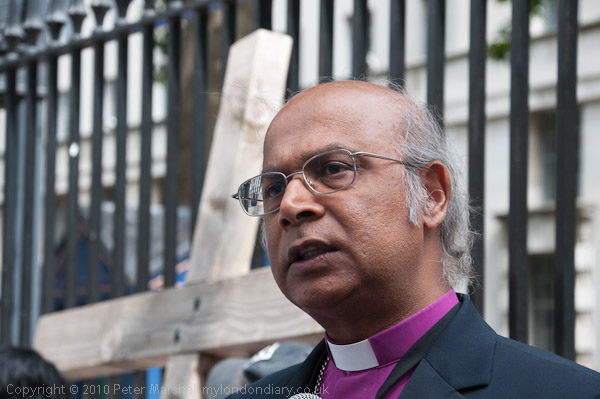
This march was a little different to most, making three stops for prayers en route, and I photographed the last one in Whitehall shortly before it reached Downing St. Here there were more speakers (including former bishop Michael Nazir Ali and London Green MEP Jean Lambert)  and also a singer, as well as quite a few more people waiting to take part, so more things to photograph.

More pictures and the story about this protest on My London Diary.

Hiroshima 65 Years On

At 8.15 am Hiroshima time on 6 August 1945 the bomb called “Little Boy” was released from the B29 named “Enola Gay” after the pilot’s mother and around 45 seconds later its 60 kilograms  of uranium-235 detonated around 1900 ft above the city.

© 2009 Peter Marshall
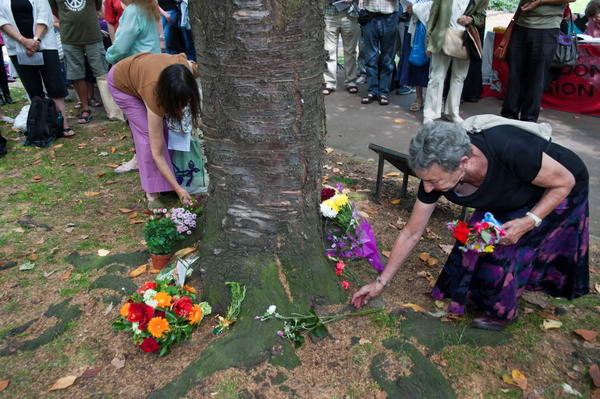
Flowers are laid at the cherry tree commemorating Hiroshima in Tavistock Square, 6 Aug 2009

Several years recently I’ve attended the annual memorial event at Tavistock Square in central London, but this year I didn’t make it.  You can see a report on last year’s event on My London Diary.  I hope to get to the exhibition ‘After the Bomb Dropped: How Hiroshima and Nagasaki Suffered’ which is now showing at the Friends Meeting House on Euston Road until August 12.

I don’t know which photographs the show will contain. The only photographer known to have photographed in Hiroshima on the day the bomb dropped was Yoshito Matsushige (1913-2005) a 32 year-old photographer for the Chugoku Newspaper in 1945, and you can read his testimony in English online. He was eating breakfast without his shirt on at his home, 2.7 km away from the centre of the blast when them bomb exploded. He saw “the world around me turned bright white.” Then came the blast, which felt like hundreds of needles stabbing into his bare torso, blowing holes in the wall and ceiling, filling the room with dust.

Matsushige pulled his camera and clothes from a mound of dust and went out on the streets. War-time shortages meant he had only two rolls of 120 film for his camera. He soon came on victims, school kids with terrible burn blisters, but though he picked up his camera he couldn’t bear to press the shutter. It took him 20 minutes to get courage to take one shot, then he moved to take a second. He walked all around the central area where the damage was at its worst, finding many terrible scenes, including a bus full of 15-20 naked dead bodies, people whose clothes had been stripped away by the blast that killed them, but was unable to bring himself to take the picture. As a newspaper photographer he also knew that pictures showing corpses could not at that time be published.

In all he managed to force himself to take just a handful of images, seven in all, of which only five came out, so stunned was he by the horror of the scenes he saw. He found himself unable to photograph the screaming and suffering victims face on; he could only make himself photograph them from the back, and even then it was hard to know that he was unable to help them. He reports that there were other photographers in Hiroshima that day, both at his newspaper and army photographers, but none of them were able to take pictures. He is the only photographer known to have photographed Hiroshima that day.

Three days later on August 9 a second bomb was dropped on Nagasaki. Yosuke Yamahata was sent by the Japanese Army News and Information Bureau to photograph the city as soon as the news came through, but transport was so badly disrupted that he was unable to reach it until the following day. He published a book of his pictures, Nagasaki Journey, in 1996 (the review by David L. Jacobs looks more generally at pictures of the dead), and you can also see his pictures and read his testimony at the Exploratorium site.

Keep It Clean

The anti-capitalist protest following the decision by the Director of Public Prosecution Keir Starmer not to prosecute the police officer recorded on video assaulting Ian Tomlinson minutes before the death of this previously fit and healthy man, not a demonstrator but simply on his way home from work, was bound to be an angry one. As expected that anger on this occasion, which included several periods of silence in Tomlinson’s memory, was confined to words, both spoken and on some of the banners and placards.

© 2010, Peter Marshall
The United Campaign Against Police Violence marching to where Ian Tomlinson died

The decision wasn’t unexpected, which makes it even more shocking. Our political establishment couldn’t let it go to trial because it seemed inconceivable that any jury would fail to convict. Like in the more than a thousand cases of death in police custody since 1969 there would be some kind of cover up, though this was more obvious than most. Not one single police officer has been charged with either manslaughter or murder in even one of these cases. Of course not every single one of these largely unexplained deaths were caused by illegal actions by police, but it is hard to dismiss the evidence that many if not most were.

The police cover up, they lie to support each other. They use pathologists (as in the Tomlinson case) who are known to be incompetent. Above all they hold things up so that lesser charges can no longer be brought and memories fade.

If the boot had been on the other foot (or rather the baton in the other hand) we would have seen the case in court within days and a verdict within a few months. Instead, the case of Ian Tomlinson has taken more than 15 months to  come to a decision not to prosecute. Even that is fast – the family of Sean Rigg whose sister spoke at the event are still waiting for the inquest result two years after his unexplained death minutes after being taken in to Brixton police station.

© 2010, Peter Marshall
Samantha Rigg-David speaking outside the DPP’s office

So anger isn’t surprising. What is surprising is that so many seem satisfied to put up with the situation without doing anything about it. Perhaps the fact that most of the victims are black and most are working class comes into it.

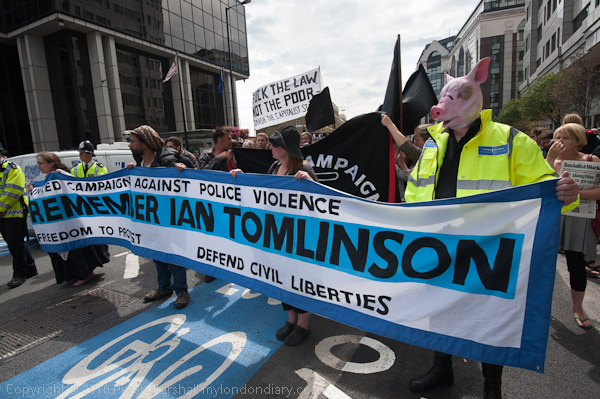
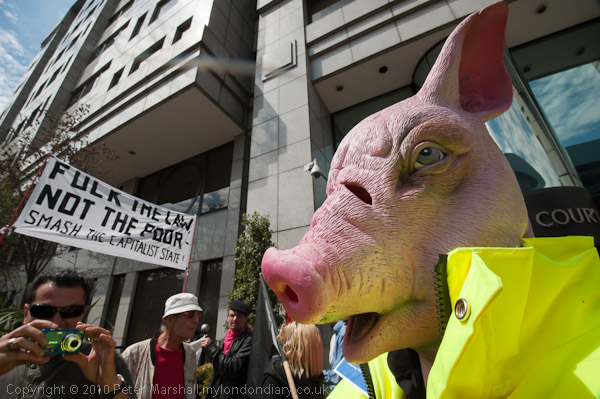
Photographically  one problem was that the anger expressed itself very obviously in the language on some of the banners. Not a problem in some ways, but it can make the publication of images difficult.

© 2010, Peter Marshall

In the above picture the banner was not quite fully visible and could read ‘FOLK THE LAW NOT THE POOR’ but in most other images it was less equivocal! At least one other banner included another word not generally used in polite company, and had I been videoing the event the sound track would also have presented problems, particularly during the march.

The above picture also shows another problem I had, related to fingermarks on the lens and shooting as I was with the sun not far out of image, there is a kind of diffuse arc over a part of the building just left of centre towards the top of the image.  Unfortunately it wasn’t really visible on the camera back unless I zoomed in, and I didn’t notice it until later.

The other aspect of the banners that worried me slightly was the possibility of defamation, as some quite clearly called a named office a murderer.  However given the circumstances it is hard to imagine any possible case being taken over this.

But perhaps rather unusually I should give a warning that the pictures from this event on My London Diary may contain language that some may find objectionable, though in my opinion considerably less objectionable than the decision by Keir Starmer.

Avatar, Vedanta and Bianca

© 2010, Peter Marshall

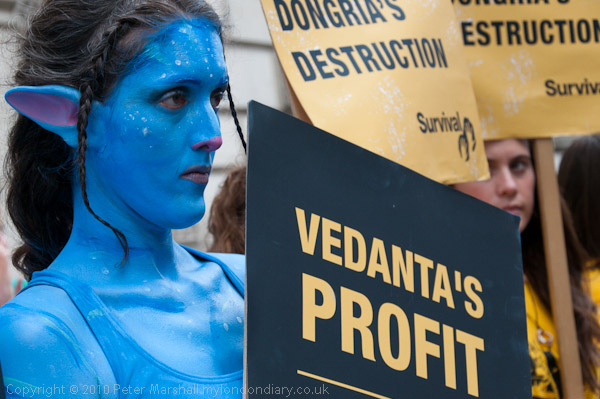
Celebrity and the entertainment industry don’t enter greatly into my photography, but I suppose they have their uses in promoting some causes, and certainly the two guys in blue with pointy ears did make for some fairly striking images. I was pleased too that Survival International had yellow placards to contrast well with them, and the protest was about a tribe, the Dongria, in Orissa, India, whose whole future is threatened by the destruction of their ancestral lands by UK company Vedanta mining and smelting bauxite, so their presence seemed appropriate.

What I like about this image is that by some careful positioning and framing I was able to exactly encapsulate things in the frame as I wanted them. I didn’t pose anything at all (and I wouldn’t) but the expressions and the directions of gaze on the two women’s faces could I think not be better. It’s not a great photograph, but somehow I find it a very efficient one.

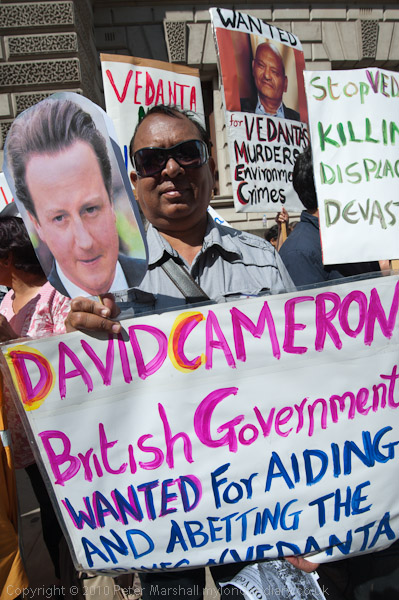
Of course I photographed the other protesters and other aspects of the event, a picket outside the AGM of the company, which receives considerable support in various ways from UK government agencies despite its poor record on human rights.

© 2010, Peter Marshall

and you can see more of the pictures as usual on My London Diary.

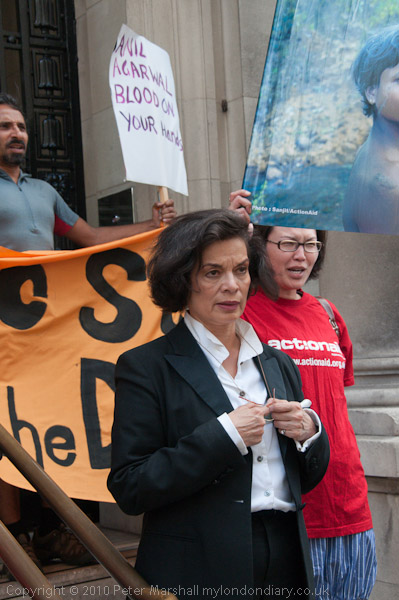
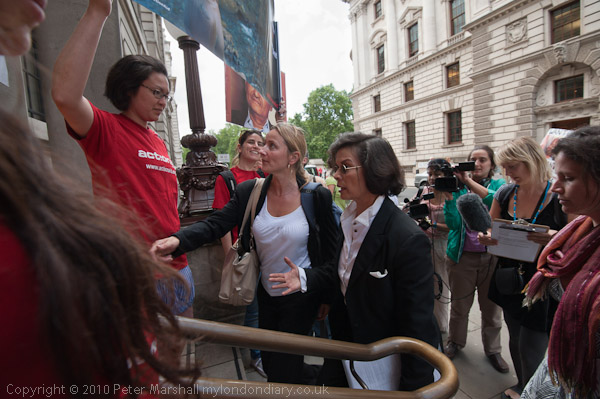
The protest was organised by a number of organisations including several fairly large charities, and a number of their supporters had bought single shares so they could attend the AGM.  Bianca Jagger was attending the AGM on behalf of Action Aid (as she did last year)  to “take a message from India’s threatened Kondh people direct to shareholders” and there was a certain amount of  media interest because of this. It wasn’t easy to come up with a decent picture of her – she didn’t seem particularly to want to be photographed, and the best I think that I made was after the few seconds of a rather uninspiring “photo-opportunity” as she went up the steps.

© 2010, Peter Marshall
Bianca Jagger outside the Vedanta AGM
© 2010, Peter Marshall

Too Big, Too Small, Just Right

© 2010, Peter Marshall

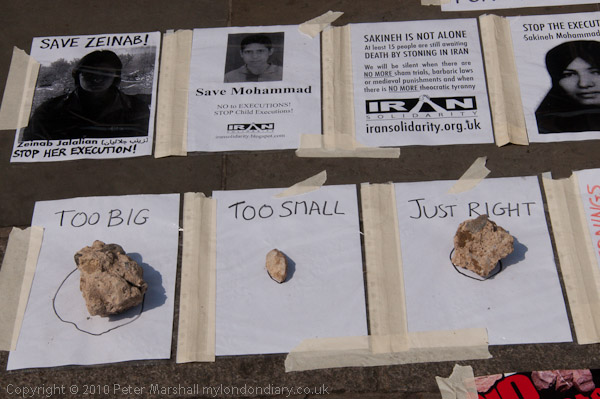
It wasn’t the story of Goldilocks, but the size of stones to be used to hurl at the victim sentenced to stoning under Sharia Law in Iran.  Men to be stoned are buried to the waist before the executioners – mainly prison guards start to hurl the stones with all their might, while women are buried to the neck. If the stones are too small, they will injure but not kill. If the stones are too large they might kill the victim immediately. They need to be just right, so that the victims keep alive to suffer for perhaps twenty minutes as they are reduced to a bloody pulp by stone after stone.

© 2010, Peter Marshall
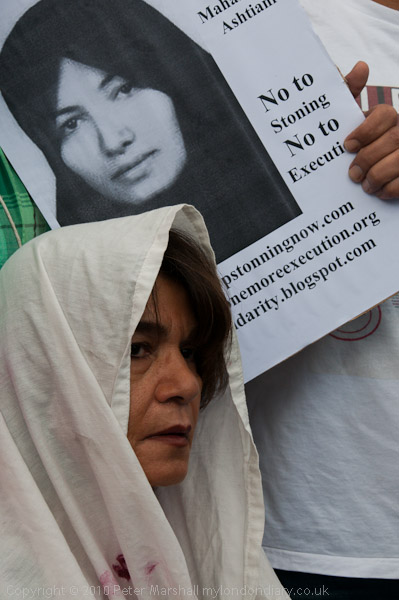
A woman plays the role of Sakine in Trafalgar Square

The sentence passed on Sakineh Mohammadi Ashtiani for her alleged adultery has shocked the world, thanks to her lawyer,  Mohammad Mostafaei and the groups that have campaigned on her behalf, and the outcry has been so great that Iranian sources have stated she will not be stoned, but is expected to be hanged. Hanging in Iran is still a barbaric practice, with the person struggling for breath for many minutes hanging with the noose around their neck, as they are slowly strangled by the weight of their body.

Mostafaei fled Iran after he was questioned and released, but heard that police had already arrested his wife and her brother and were about to arrest him. He has now applied for asylum in Turkey.

© 2010, Peter Marshall

Sakine was initially tried and found guilty of  having an “illicit relationship” with two men after the murder of her husband, on the basis of a ‘confession’ extracted under duress and which she has since retracted. Sentence of 99 lashes was carried out for that offence in 2006, but the courts also decided to reopen her case and charge her with adultery, finding her guilty on a majority verdict apparently based on a judge’s opinion of her rather than any evidence.

Of course hers is not an isolated case, and at least 12 and possibly as many as 50 others are in prison in Iran awaiting stoning.  The death penalty there under the Iranian interpretation of sharia law applies to murder, rape, armed robbery, apostasy (the abandonment of Islam) and drug trafficking as well as  adultery.

© 2010, Peter Marshall
Maryam Namazie speaking
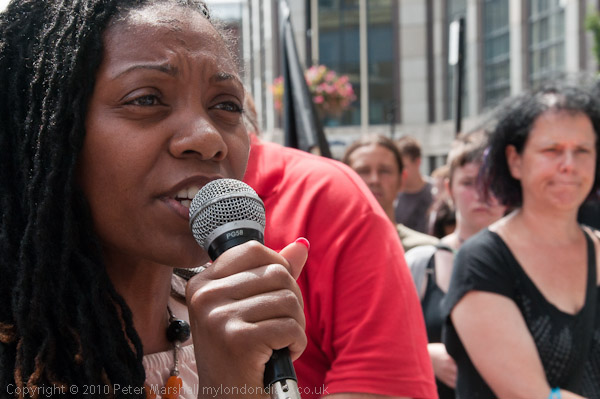
It was hard to find any way to express an appropriate disgust while photographing, and for me at least, the simple image of the stones was most effective. Of course I also photographed the event in Trafalgar Square – people standing with placards, including a small group wearing coloured full body (Zentai) suits who came and joined in briefly, the speakers and a little bit of street theatre, though I’d wandered away briefly when this started and missed the key element!

More about the Day of Protest Against Stoning on My London Diary.

The More Unfundable The Better…

So this is the setting for the question of digital verses film.  The real question faced by a photographer or journalist today is not of course the type of film that is inside their camera, although that matters. The real question is what’s inside their head. That has always been the question and will always be the question.

The quotation above is by Danny Lyon and comes from his 2007 article The End of the Age of Photography on his Bleak Beauty web site. I’ve read it before, and possibly even mentioned it elsewhere in the past, but was pleased to be reminded about it by James Pomerantz on his ‘A Photo Student‘ blog.  You may find it easier to read there than at the original location, especially if you reduce the width of your browser to get a sensible line length.

It’s an interesting piece not just for what it says but also because of who it was written by, and is basically about integrity. While I’d certainly argue and suggest that the conclusion he comes to could equally apply to someone who decided to shoot digital and print ink jet, fundamentally I’d agree with him that the most important thing is not to sell your soul to the devil, but to do

something that you believe in, and not something you think people want to hear.”

You may or may not as he suggests end up financially able to profit from it in your latter years (and of course as he says you may not live long enough) but money isn’t everything.  And I find it hard to disagree with his general principle:

The more unfundable the project is, the better.

Coleman on Adams or Not

As always, when A D Coleman posts about photography what he has to say raises issues, and his Cowflop from the Adams Herd (1)  is no exception.  That (1) on the end of the title is I think an indication that he offers to host and hopes to get a response from Ansel’s grandson Matthew Adams,  as much of the feature is taken up in demolishing “his astonishing statement that prints made from these negatives would somehow not be “original prints””  as well as from photography dealers – AIPAD members – over the issues surrounding the idea of ‘original prints’.

As always, Coleman’s points are carefully and densely argued and I won’t attempt to summarise them here – he writes so ably it would be a shame not to encourage you to read the original and impossible to do it justice.

It has been argued that you can divide photographers into ‘image makers’ and ‘print makers’, although I think most have at least a foot in both camps.

Many photographers have chosen not to print their own work not because they were not interested in how the print looked, but because they acknowledged that others  could perform those particular craft aspects better. Others worked in industries where time constraints made it difficult or impossible for them to print, or where they could make considerably more by taking more pictures in the time they would otherwise have spent in the dark than it cost to have them well printed.

Ansel Adams certainly was one of the greatest of darkroom geniuses, and many of us owe much to the skills that he imparted in his ‘Basic Photo‘ series, from which I learnt to print in the early 1970s. It is arguably something that stopped him becoming a truly great photographer, enabling him to pass off many of the more run of the mill of his images by the addition of a pinch or two – often several too many – of bravura.

But as Coleman states, he was content during his lifetime to describe and sell prints made in his darkroom by other printers as “original prints” and it is only recently that the Ansel Adams gallery has changed to referring only to prints made by the man himself as “original prints.”

Back in pre-digital days, it might have made some sense to use the term “original print” to describe any print made using the original negative on photographic paper. Of course some photographers chose to make their “original prints by processes such as photogravure or other methods that did not involve photographic paper and I think most would allow those to be called “original prints”.

Now many of the best prints are made by scanning the original negative and  then printed either on photographic paper or by inkjet. Are these still by extension “original prints”? Or is the term “original print” not a very useful one in photography?

It isn’t really a photographic term but an art market term, and like most such is more about talking up prices than real substance (indeed sometimes about hiding the facts.) Back in the 1980s I wrote about the work of Bill Brandt which at the time was really just beginning to appear in galleries at what seemed to me then as ridiculous prices, particularly for some “vintage prints”. My argument then was that these had been made not for display as prints but for the plate-maker, and that the real Brandt original was the magazine or book page for which he worked.

I’d be happy never to see the term “original print” used in photography again. The only photographic original so far as I’m concerned is the negative or digital file (or daguerreotype, Polaroid etc) that is made in the camera.  And while we are at it let’s get rid of “vintage” too.

RPS = Rights Plucking Shysters?

More than 35 years ago I entered a competition in one of the UK’s best-known amateur photographic magazines and a part of the prize was a year’s membership of the Royal Photographic Society. It wasn’t this that had attracted me but the other part of the prize, although I can’t at this distance remember whether it was a largish supply of Kodachrome, a new camera or whatever.

At the time I knew very little about the RPS, but a year’s membership along with the magazine and attending one or two meetings convinced me that it was something I wanted to have as little as possible to do with, a society of the self-important who in the main seemed to have little real interest or knowledge about photography. At the end of the year I didn’t renew my subscription.

Getting to know some of its leading members over the following few years did slightly change my views; there were a few who were leading experts in particular technical or historical fields, but as a society it did seem totally out of touch with photography, living in its own separate world which the rest of us thought had ended around the First World War.

The one jewel was of course the collection and I still remember the shock of sitting at a bar with half a dozen former, current and future presidents and hearing them bemoaning it as a curse hanging around their necks which they were unable to sell off. Now of course it is at the Bradford museum.

I never saw the point of its qualifications, other than as a way of adding to the society’s funds. I was several times urged by leading members to put forward a panel, with one FRPS in particular agreeing with me that qualification was a joke but assuring me it would help my career – as it had his.

I had great misgivings about the Images of England project which the National Monuments Record Centre, the public archive of English Heritage ran from 1999 to 2008 with the cooperation of the RPS, involving over 320,000 photographs of listed buildings in England taken by volunteers. It seemed a very good idea in some ways, but as someone who has done a considerable amount of photography of buildings it did appear to be taking an awful lot of bread out of the mouths of those of us in the trade.

Now they are at it again, and the RPS “Visual Journalism group have created a partnership with one of England’s major tourism bodies“, Southwest Tourism, to provide free photos for a nationwide advertising campaign to promote tourism in the south-west of England.

On his blog photographer Pete Jenkins asks if it is fair or ethical and suggests someone should stop this madness now.

RPS member David White on the duckrabbit blog suggests a number of alternative expansions of RPS, the most appropriate of which is perhaps ‘Rights Plucking Shysters‘, because as he writes “Not only do they not want to pay any money but the don’t even guarantee the photographer will be credited. The even demand rights to sub licence the images to third parties!

You may be able read the details from the RPS site, although while I was writing this post the PDF appears to have disappeared and a site search for ‘Southwest Tourism’ produces no result. I do hope they are having second thoughts.

Funeral For Photojournalism?

One of the earliest pieces I wrote for About.com soon after I became the photography guide in 1999 was entitled ‘The Death of Photojournalism‘ and included a potted history of the genre along with some thoughts about the future. My pessimism then was occasioned by attending a show of the work of Brian Harris, “one of the UK’s best and most prolific photojournalists” who had worked his way up from starting at 16 as a messenger boy in Fleet Street eventually becoming a staff photographer on The Times and then in 1986 became the first photographer for a new daily, The Independent, which promised “to reject the typical newspaper contrived pictures and photocalls and to publish honest and powerful photojournalism.

At the start of 1999, Harris had written about his concern for photography in UK newspapers, with an increasing trend to use agency pictures and freelances rather than employing photographers. Within two weeks of this being published in the British Journal of Photography, the Independent acknowledged it had abandoned its radical policy by removing Harris’s own staff job.  As you can see from his web site this hasn’t prevented him from continuing to produce some fine stories, and there are still some great photographers working for the newspapers. The web has at least provided an opportunity for the papers such as The Guardian to feature slide shows of their work, where previously only a single image might have made the paper.

Another piece of sad evidence in my 1999 piece was the demise of the print version of Reportage magazine, started by Colin Jacobson to showcase fine photojournalism, mostly publishing work that magazines and newspapers had failed to show much interest in.

Here again the story since is not entirely gloom, with an even more successful magazine and gallery taking up the baton in Foto8, with Jacobson himself making contributions on line in his far too occasional MOG’s (Miserable Old Git) blog .

Back in 1999 too, I was able to point out that recently Tom Picton had written in Red Pepper:

‘Twenty years ago Philip Jones Griffiths, a Magnum photographer, said: ‘There are no great issues which are treated seriously by picture journalism today… the whole idea is to trivialise everything to make it as colourful as possible in order to get the advertising. Now you say to an editor: “I’m going to Bangkok,” and all he says is &Could you bring me back some temple bells?”‘

I went on to say that the decisive shift now was to digital and that

“If photojournalists are going to survive they need to come to terms with the new technology and use it not only to make and deliver their work, but also to publicise it. At the moment few working professionals seem to have fully grasped this challenge – but more on this in a week or two.”

And indeed a week or two later, in August 1999 I published a further piece with the title ‘Photojournalism live and well?’ looking at the possibilities for photojournalism on the web. I started off again on a rather gloomy note and by the end of the first page was writing:

Because its on the web people expect it to be free. The editors don’t work for nothing. The printer wouldn’t print the paper for free, but somehow photographers are expected to live on zero. If photojournalism is to stay healthy it needs a sound financial base. At the moment the web is not too successful in providing this.

Too true, and it still isn’t. And although I went on from there to look at some successful examples of photographers showing work on the web and web magazines, I couldn’t really advance on that.

I was reminded of these articles by reading an post on the EPUK web site today by Neil Burgess, previously  head of Network Photographers, Magnum Photos in New York and Magnum London, and  twice Chairman of World Press Photo who now run his own picture agency, NB Pictures.

Burgess says that people have been talking about the death of photojournalism for 30 years, and despite his former optimism, he now thinks it time to take the corpse off from the life support system and declare it dead.

It’s hard in particular to argue when he says:

I believe we owe it to our children to tell them that the profession of ‘photojournalist’ no longer exists. There are thousands of the poor bastards, creating massive debt for themselves hoping to graduate and get a job which no-one is prepared to pay for anymore.

I’m perhaps not quite as despondent at Burgess. Even in the ‘Golden Age’ there was work of merit and interest produced without corporate backing – and Eugene Smith‘s Pittsburgh project (only really completed years after his death) and of course Philip Jones Griffiths’s incredibly powerful ‘Vietnam Inc‘. In more recent years too, there have been many significant bodies of work that have been produced largely or wholly unfunded, with photographers scraping a living by odd jobs, weddings, teaching and other non-photographic work, or by having partners who have believed in and supported them.

If you get too despondent (and I sometimes do, particularly when I look at my own falling receipts)  it’s worth looking at sites like Verve Photo, subtitled ‘The New Breed of Documentary Photographers‘, looking at some of the work and reading about the photographers and their projects.

Perhaps it’s harder to really kill photojournalism than even such an experienced figure as Burgess suggests. Few if any of us really do it for the money, though I’m sure we are right to resist being screwed by guys in comfy jobs. But perhaps photojournalism shouldn’t be called a profession but an obsession.