New on Niépce

For many years since its re-discovery by Helmut Gernsheim, a view taken by Joseph Nicéphore Niépce from his upper-story workroom at his Saint-Loup-de-Varennes country house, Le Gras, has been regarded as the world’s first photograph, but the process, heliography,  has been dismissed as incapable of producing anything but the crudest results.

Niépce brought it, along with several other examples of his heliography to England to show the Royal Society in 1827, but circumstances prevented this, and he left the metal plates with his host in Kew. On his death they were sold, later sold again and in 1884 when they came up for auction again they were split into two lots. Three ‘heliographic reproductions’ of engravings and what was though to be an etching made using a heliograph on the plate as a guide were bought by the notable photographer H P Robinson, and on his death went to the collection of the Royal Photographic Society (and were lent to the Science Museum in London for display.)  The second lot, of one ‘heliograph’ and Niépce’s words on the process was bought by the Editor of the PHotographic News, H Baden Pritchard, and later disappeared from view.

Helmut Gernsheim attempted to enlist the help of the Times newspaper in 1948 to find the Pritchard family, but they refused to print his letter about the missing image – and did so for a second time in 1950. But a few months later, when he was contacted by the Observer newspaper about the photography of Lewis Carroll he had rediscovered, he got that paper to print his appeal for news.

Pritchard’s son immediately got in contact but only with the bad news that the family had no idea what had happened to it. But a year and a half later after the son’s death he got more news from the widow. The metal plate had been found in an old trunk – but unfortunately it had faded and there was no picture on it.

Gernheim knew this could not be true, as the process was extremely permanent, and was able to show her the faint image that could be seen if the plate was looked at carefully from the correct angle. He persuaded Mrs Pritchard that  rather than put the plate up for sale – when it would probably be sold at a very high price to a private collector and disappear again – she should make a gift of it to the Gernsheim collection – and later, when that collection was sold to the University of Texas, it was also as a gift.

You can read more about that familiar picture at the Harry Ransom Center site, and also on National Public Radio.

But now a new example has emerged among early photographs, and certainly it is a better image than the Le Gras window view. New tests on the image that was previously thought to be a hand-worked etching on a heliotype plate have shown it is actually a camera-produced image without any extra work, leading to a re-assessment of the process.

Since ‘Interior of an Abbey in Ruins’ is dated c. 1827, it seems likely that the Gernsheim image remains the first, but it does show how Niépce was able to develop his process further.

I read about the discovery in the BJP,  which has a reproduction of the image, but more details should be given today and tomorrow at the conference Niépce in England being held at the UK National Media Museum in Bradford. On the conference web page you can hear Dr Dusan Stulik of the Getty Conservation Institute waxing a little too lyrical about the import of the new discoveries from his investigation of this image.

But I don’t think many of us will be abandoning digital to become heliographers.

Brighton Photo Fringe

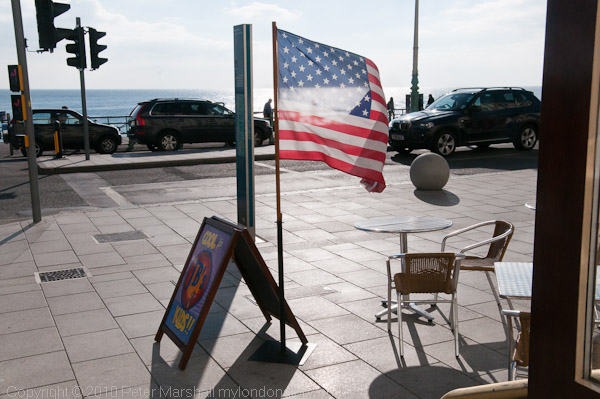
There are an impressive number of shows in the Brighton Photo Fringe Open this year, and some are of a very high standard, others of course rather less so. Organising events such as this must be extremely tricky and I suspect those responsible will be a little frustrated at some of my nit-picking after all their hard work. But I hope they will be taken (and are meant) as constructive suggestions to improve the festival in future years, especially for visitors coming from outside Brighton.
© 2010, Peter Marshall

As with the Biennal, several of the venues – including the major ‘Fringe Focus‘ – were closed on a Tuesday. Some other shows listed either did not exist or I was unable to find them. It would be considerably more helpful to divide the shows in Brighton into areas each with its own local map and fuller key rather than the large area map provided. This would enable precise locations to be shown – numbers which are seldom actually present on the streets are of little use.  Finding the work – for a visitor to Brighton – was something of a logistical nightmare and there were a number of shows that I looked for but could not find at all, and some I did eventually find were invisible from the street – not even a small ‘Brighton Photo Fringe notice in the window – and so could easily be overlooked. Then there was the gallery I walked past three times, and twice the door was locked with a notice saying ‘Back Soon.’  Nothing the organisers can do about that of course.

Although the map gave opening and closing dates for shows, to find which days and at what times they were actually open meant consulting a separate booklet, arranged  in a different order to the map list and not making use of the numbers on the map. Again with so many shows – and doubtless more in 2012 – it would also help if this were broken down into geographical areas. It was actually hard to find a copy of the booklet, so many who visit this year will only have the map, so it is unfortunate that these details were not on it.

The show I was most sorry to miss was ‘degeneration‘, a project by the collective ‘Human Endeavour‘ which “is a study of key areas across Britain” –  Glasgow, Edinburgh, Leeds, Liverpool, Salford, Sheffield, Birmingham, Cardiff, London and Portsmouth – “of 20th century housing that has slowly fallen into decline and is now due for regeneration.”  It’s a project that fits very well with my own interest in urban landscape – for example in my work on Hull – that arose out of an active grass-roots involvement in the redevelopment of Hulme and Moss Side, Manchester when I lived there in the 1960s.

So far all I’ve seen is a nicely printed folding card with one image by each of the photographers, Alex Currie, Richard Chivers, Simon Carruthers and Oliver Perrott and a well-illustrated web site. This is the third show by this collective and the second to receive Arts Council support. Looking at the work on the web, I was particularly impressed by the pictures from Glasgow by Alex Currie and Richard Chilvers.

It was interesting to be reminded again of the work of Michael Ormerod, (1947-91) a British photographer who took to America very much in the footsteps of Robert Frank and Stephen Shore. Ormerod died in a motorbike accident at the age of 44 in Arizona in 1991, and shortly afterwards there was a show of his work at the Zelda Cheatle Gallery as well as a book to accompany this, ‘States of America‘.

While I quite like some of his large colour images, I can’t help looking at them and thinking that other photographers – such as Shore – have done it rather better. I get a similar feeling too about his black and white, which perhaps also leans too heavily on  American precedent without really establishing a voice of his own. Ormerod was a pretty good photographer and I quite like his work, but… You can see for yourself at the Crane Kalman Gallery.

Was he one of the UK’s leading photographic talents at the time of his death in 1991 as the exhibition text suggests? It’s something you could say (if you were an art dealer) about any of several hundred photographers of the time – many of whom might well have taken rather similar pictures on a trip across the USA, and some did.
© 2010, Peter Marshall
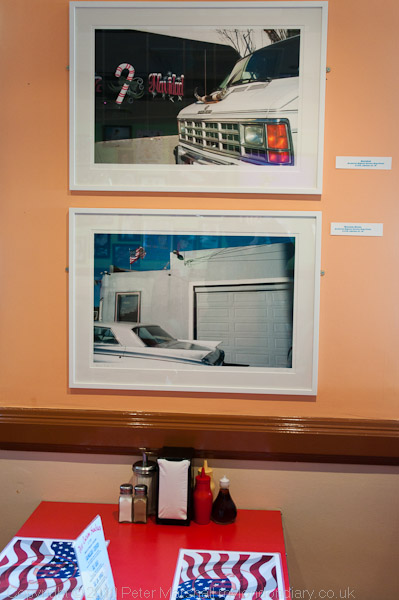
Bascom Avenue by Kit Fordham, on show in JB’s American Diner

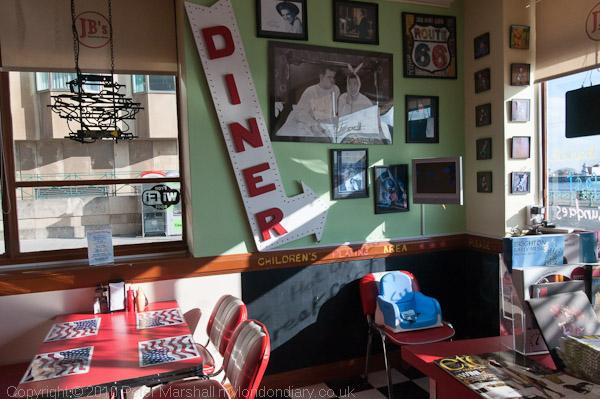
The USA was also the source of another show on the fringe, shown in JB’s American Diner on Kings Road. I found this a more interesting view of America than Ormerod’s, partly because it played a little further from some of the stereotypes but I think largely because it’s subject was so much more clearly defined, with Kit Fordham focussing his attention on ‘Bascom Avenue: The Unloved Hear of San Jose, California.’ The show starts here on Fordham’s web site, although I think the colour was better on some of the prints than in some of these on the web.
© 2010, Peter Marshall
JB’s Diner, Brighton. Peter Marshall, 2010

There was a synergy between the show and the surroundings that worked well and it was the only venue where I really felt I had to take some pictures myself. It can be hard showing work in cafés and shops and this was a great example of how it can really work well.
© 2010, Peter Marshall
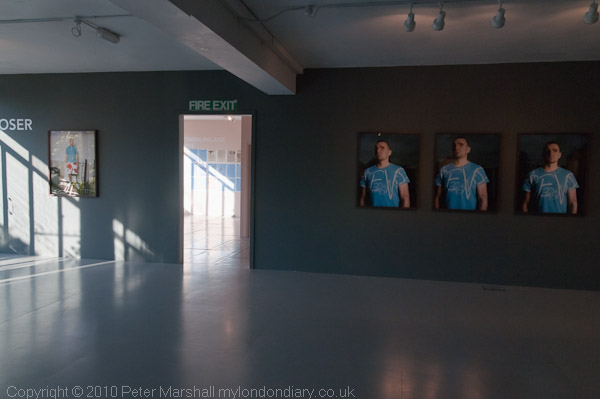
Installation View of ‘Closer’ by Stuart Griffiths

But the outstanding show of those I saw was ‘Closer‘ by Stuart Griffiths, even though looking at his web site I see very clearly how much stronger a show this could have been. I find it hard not to see the presentation at the Phoenix as an example of a kind of curatorial vandalism, pushing his work into a rather different aesthetic. Of course I’m not a great fan of the cult of the curator, which I think has been a curse on photography, particularly in the UK, for the last forty or so years. The show still worth seeing for the rawness of some of the images, but afterwards look at the web site and see how much more it could have been. It’s a pity that they didn’t get around to adding labels to the works (obviously actually a deliberate decision but equally obviously an poor one) but you may be lucky and be given a list of them if you view the show.

I’m not sure how much the smaller room given over to small pictures and letters from Griffiths’s time in the Parachute Regiment from 1988-93 where he became a unit photographer with the Intelligence Section in Northern Ireland actually adds to this as a show. What is perhaps much more relevant is the film about his life, Isolation, was shown as part of the Photo Fringe at the Electric Palace, Hastings on 10 October, and will also be projected at the venue for this show, the Phoenix, Brighton,  on 30 October. You can read about it in The Guardian which also has a  gallery of his pictures. Isolation had its World Premiere at the 2009 Edinburgh Film Festival and from there you can watch a short trailer which includes some of his still images.

I could see no point for the use of three very similar portraits shown in the installation picture above – and it suggests a kind of indecision that although doubtless a decision by the curator seemed to suggest that the photographer was unable to arrive at the image he wanted.  Griffiths actually chose a different image  from the session for his web site in the series ‘Back From the War’, where you can also see some of the other powerful images that were not selected for the Brighton show.

It was, despite the weather forecast, a pleasantly sunny day for a walk around Brighton, although at times a little frustrating. As well as those I’ve written about I saw quite a few other shows which for various reasons – largely that they didn’t particularly excite or interest me – I’ve not mentioned. I’m very aware of having missed much of both the Biennial and the Photo Fringe, partly because some things were not open, but also because this is a very widespread festival – as well as the more outlying areas of Brighton & Hove there are also Fringe shows in Chichester, Lewes, Peacehaven and Portslade and the Biennial also has related photography shows in Portsmouth, Bexhill, Chichester and Eastbourne. There are of course all kinds of events too taking place in Brighton and elsewhere, making this a considerably more exciting event for photographers based in the area.

For some years Brighton has been establishing itself as a major photographic centre in the UK, and in many ways I think more important and certainly more vital than London, which has largely failed to develop a photographic culture, largely due to the stultifying effects of some of our major institutions, but also because of its sheer size. This year’s festival marks another step along that road.

See also: Brighton Photo Biennial
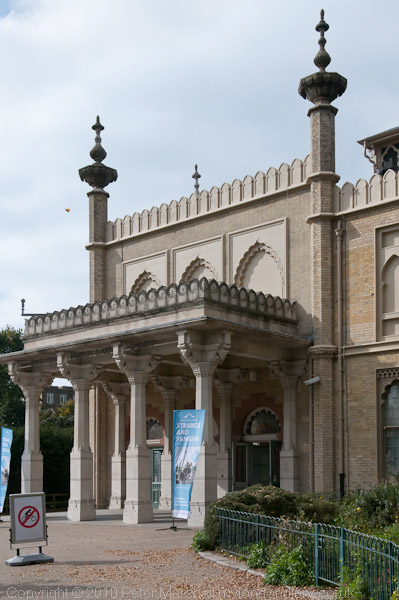
Brighton Photo Biennial

Unfortunately I was only able to visit the Brighton Photo Biennial (which continues until the 14th November 2010) on a Tuesday, when some of the possibly more interesting venues were closed. Perhaps I’ll manage to get back to see them but it isn’t easy for me to find another day to visit Brighton and see more work in both in the Biennial and the Photo Fringe. But if you are thinking of going, this is a festival that – if you want to be able to see almost everything – is only fully open on Fridays and Saturdays.

© 2010, Peter Marshall

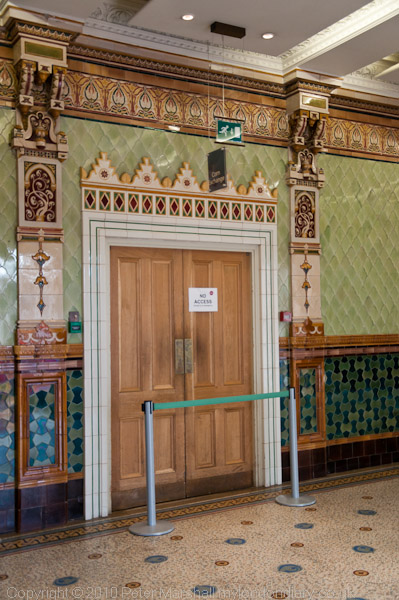
The Brighton Museum where the headline show ‘Strange & Familiar‘ was taking place is well worth a visit, although perhaps more for the building and the permanent collection than the photography on show. Commissioning new work is always a gamble, and here I think the dice have rolled to give Brighton an near minimum score. Of course, having given commissions, the commissioning body is more or less obliged not only to show the work but to praise it inordinately whatever. But I found it hard to believe in emperor Parr’s new clothes.

© 2010, Peter Marshall

I’ve already written about Alec Soth‘s problem on entering the country (in UK Customs) and my thoughts on that; the images on show have some interest as the work of a seven year old with a certain fairly large amount of parental direction, but frankly not very a great deal. I think her drawings are better than her photography. For those of us who on first hearing about the commission had been looking forward to seeing Soth’s take on the city I think this is – to view it generously – a rather poor third-best.

If you like rather wacky ideas you may like Stephen Gill’s ‘Outside In‘ but I found seeing more than one or two images made with rubbish picked from the streets of Brighton in the camera (including cut up bits of transparencies he took for the purpose) tedious. Actually I do tend to appreciate the weirdly unusual, but my first impression that it was an amusing idea was soon undermined by asking the question “But does it work?” and finding myself giving a fairly negative answer at various levels, and found myself wondering if that old computing acronym, GIGO, might have been a better title.

I think it is partly a matter of scale and it does for me work considerably better in some of the smaller prints on display than on any of the rather large ones, perhaps because the collected detritus in the camera (and in a large display case) is closer to actual size. And in the Blurb book which I’ve just seen rather small on line, I really begin to warm to them considerably more. His video chat with Martin Parr did have me laughing at times, though for all the wrong reasons. In the interview Gill talks about feeling restricted by straight photography; perhaps why I don’t appreciate his work here is that I’ve always and still feel empowered by it.

But there was I think a second problem that lay behind this and to some extent all three of these shows; the pursuit of novelty for its own sake and a determination to avoid the stereotypes of Brighton at any and all costs. Gill’s work seemed curiously dislocated from the city despite being based around objects from it, and I think would have been considerably stronger had this not been so.

© 2010, Peter Marshall
A Brighton stereoype

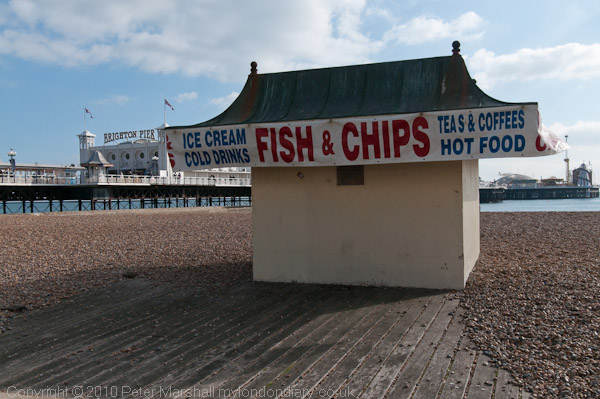
Of these three major commissions I felt only half of one of them, the ‘Murmuration‘ of starlings around Brighton Pier in the winter dusk by Rinko Kawauchi was really at all successful. It’s perhaps a pity that she returned in Spring to do more work, which I think largely fails. Her pictures (like the others) were shown as large unframed inkjet prints pinned to the walls, and they had become somewhat buckled. This was a shame as I found it detracted particularly from those large images of the flocks of birds in flight.

I think I would probably have found both New Ways of Looking and Queer Brighton considerably more to my taste but unfortunately both galleries were closed. Should you want to see all four shows in a single day you need to go either on a Friday or a Saturday between 11 am and 5pm.

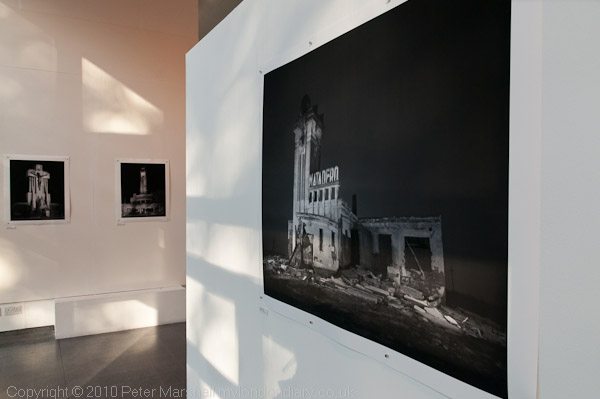
The only other major show in the Biennial I could see was ‘A Night in Argentina‘ with work by Alejandro Chaskielberg and Esteban Pastorino Diaz, in the University of Brighton Building on Grand Parade.

© 2010, Peter Marshall

Both sets of pictures were impressive, though in quite different ways. With Diaz, my main interest was in the incredible architecture of Francisco Salamone, which was however splendidly brought out by the photographer. I couldn’t understand why the programme leaflet labelled this an experimental strategy – how does it differ from the many other photographs of buildings using long exposures at night, certainly since the early years of the dry plate process, if not before? Or was there something I missed? But they were fine images. Perhaps the ‘experimental’ label referred to the fact that he usually prints by the gum bichromate process (which dates from the same era around 1900) but of course there are many other photographers using that – including my old friend Terry King who started using the process around 1980 (with a tiny bit of help from me) and has since taught it to hundreds if not thousands of mainly British photographers – part of a worldwide awakening of interest in ‘alternative processes’ over the past 30 years. But the large prints on show were fairly ordinary inkjet prints, perhaps just a little lacking in the delicacy that the best of these can now achieve.

Chaskielberg‘s work (see the BJP video) is without doubt experimental although others have previously worked with lengthy exposures and the full moon to give results with a distorted colour palette. I find his pictures ugly and brash but also fascinating. He adds light while taking them by using a flash, and using a 4×5 camera appears in some cases to being doing some interesting things with lens tilt, though honestly I could be sure about little. But whether it “open up new ways of representing the world” or “effectively refreshes our photographic vocabulary” I have grave doubts. For me this work was not representing the world, but about creating fictions about it.

More about Brighton in Brighton Photo Fringe

Lost Steps

Lost Steps is a radio series presented by Malcolm Hopkins and produced by Nick Hamilton for Resonance FM, a unique radio station broadcasting in south London on 104.4 FM as well as live on the web. You can also download the programmes a few days later as podcasts.

On its web site, Resonance FM says:

Imagine a radio station like no other. A radio station that makes public those artworks that have no place in traditional broadcasting. A radio station that is an archive of the new, the undiscovered, the forgotten, the impossible. That is an invisible gallery, a virtual arts centre whose location is at once local, global and timeless. And that is itself a work of art. Imagine a radio station that responds rapidly to new initiatives, has time to draw breath and reflect. A laboratory for experimentation, that by virtue of its uniqueness brings into being a new audience of listeners and creators. All this and more, Resonance104.4fm aims to make London’s airwaves available to the widest possible range of practitioners of contemporary art.

and it describes itself as the world’s first radio art station. It came out of the London Musicians’ Collective and has been broadcasting since May 1st 2002.

Lost Steps is a weekly radio show which explores aspects of London’s artistic and cultural landscape with guests including artists, writers, film makers, bloggers, academics and publishers. Among the people who have appeared on it are a number whose work I admire, including writer Stewart Home and, in the last programme of the previous series, the creator of the amazing cult fanzine, Savage Messiah, Laura Oldfield Ford.

© 1990, Peter Marshall
The Olympic Site at Stratford Marsh in 1990

I met producer Nick Hamilton at the London International Documentary Festival in April this year where I was showing the work which is now in my first two Blurb books, 89, a fictional walk through North London, and ‘Before the Olympics‘ and we talked briefly about the possibility of my appearing on the programme later in the year.

Then he met me again as he chanced to be passing when I was photographing the ‘Life 4 A Life‘ march last month and I agreed to go on the show as the first in a new series of Lost Steps. When he emailed me about the details I sent him a link to the photographs I had taken, one of which gave him something of a shock. One of the pictures included members of a family he had known a some years ago in Hackney and he discovered that their nineteen-year-old son, who had been friends with his children, had been murdered last year.  The family had moved away to Eastbourne to get away from the violence and gang culture in London.

I spent an enjoyable afternoon talking with Malcolm and Nick last Friday about my photography of London – including the kind of work which is on my Buildings of London, River Lea,  London’s Industrial Heritage and My London Diary web sites, and the first half hour while we were in the recording studio can be heard this Thursday, 14 Oct 2010, at 10.30 pm and is repeated on Saturday 16th October at 6.30pm. It should also be on the  website from Sunday 17th October.

Perhaps fortunately the next couple of hours of our conversation around the corner at the Kings Arms in Newcomen St, interesting though it was, will not be broadcast!

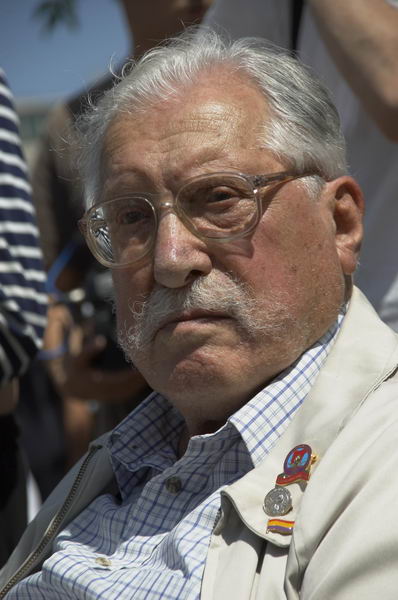
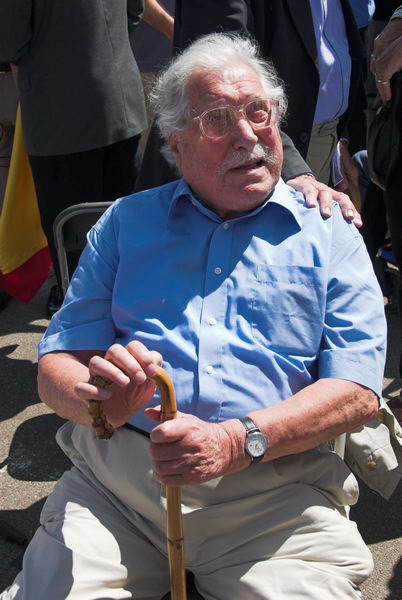
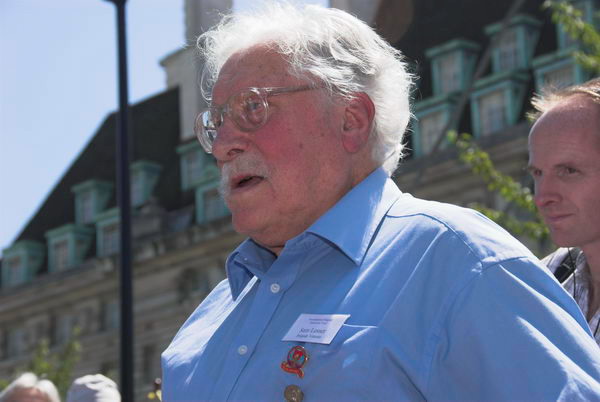
Sam Lesser 1915-2010

© 2005 Peter Marshall.
Sam Lesser, 2005

In the print edition of The Guardian on Saturday I read with sadness of the death of Sam Lesser, one of the few remaining veterans of the International Brigade that fought against fascism in Spain. It was a very short note and I hope they will publish a proper obituary at some point. Spain was important, not just for the left but for all of us, and the Sam Lesser was one of the more than 30,000 volunteers who went to fight for freedom – and around a third of them gave their lives there. He survived and continued through his life to follow his beliefs and work towards a better world.

© 2006 Peter Marshall.
Sam Lesser, 2006

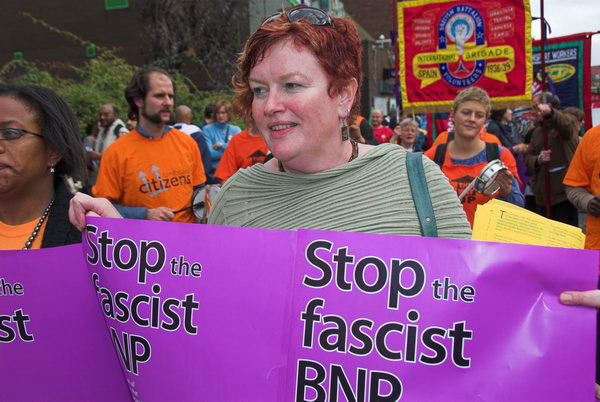
I’d photographed him a number of times, and was impressed by his speeches, although I wasn’t present at the Spanish Embassy last year where along with the other seven then surviving British and Irish volunteers he was at last honoured by the Spanish Government by being made a Spanish citizen. According to the Morning Star obituary, his  “emotional anti-fascist speech” in “fluent Spanish” on that occasion reduced some of the embassy staff to tears. Characteristically it linked the struggles of his youth to the current day fight against fascism here and the rise of the BNP.

© 2005 Peter Marshall.
Sam Lesser speaks, watched by Jack Jones and John Pilger, 2005

Lesser took part in the fierce fighting at the University of Madrid shortly after arriving in Spain in 1936 which killed 24 of the first 30 British volunteers, but was wounded in a battle in January 1937. Hit by bullets from both sides, he was left overnight dying on the battlefield but saved by a comrade who insisted on going back to look for him the following day). After a period in a Spanish hospital he was sent back to England for treatment. He returned to Spain hoping to fight again but failed his medical and instead made radio broadcasts for the Republicans and worked as a journalist for the Daily Worker, escaping to France as the Republicans were finally defeated. You can read more in an interview with Angeles Rodenas which the Socialist Worker published four years ago, and you can hear him speaking in English as a part of the programme ‘Witness‘ broadcast on the World Service of the BBC.

© 2006 Peter Marshall.
Sam Lesser, 2006

During the Second World War he was again turned down for military service because of his wounds and he worked as an inspector in an aircraft factory. After the war he returned to journalism with the Daily Worker, the communist party newspaper, which sent him to many scenes of post-war conflicts. His experiences working in the Soviet Union and reporting on the Soviet invasions to crush the popular movements in Hungary and Czechoslovakia destroyed his faith in communism and he moved increasingly towards social democracy, even becoming a strong supporter of New Labour.

Lesser, who worked as a journalist under the name of Sam Russell, was in Cuba for the missile crisis, and spent a night with Che Guevara at the height of it (his interview was heavily censored by the Daily Worker, removing all Che’s more controversial war-like rhetoric) and he also reported for them on the Vietnam war. As a student I read many of his reports in the Morning Star (the Daily Worker was relaunched under this title in 1966), which often presented a rather more accurate overview of events at a time when much of the media was over-saturated by cold war rhetoric and US propaganda.

The Morning Star obituary also tells the story of his visit to Chile in 1973, where he arrived for a fraternal visit the day before the CIA-backed coup and was woken up early the following morning by the gunfire. His fluent Spanish (he learnt it while in a Spanish hospital bed) enabled him to pose as a Spanish engineer and move into the Santiago Hilton, later relaying his report to the Morning Star, where it made the front page with the headline “I Saw Democracy Murdered.”

© 2004 Peter Marshall.
Sam Lesser at the extreme right of 9 veterans of the Spanish Civil War , 2004

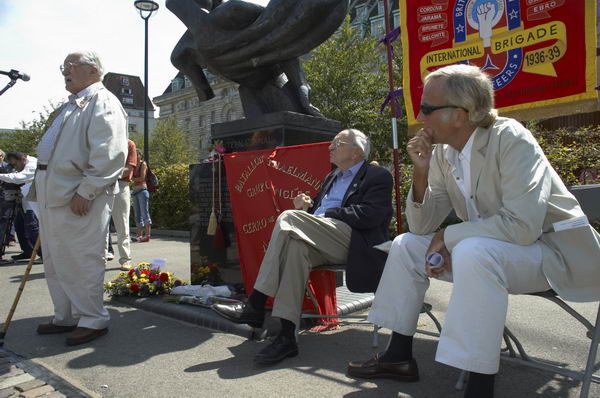
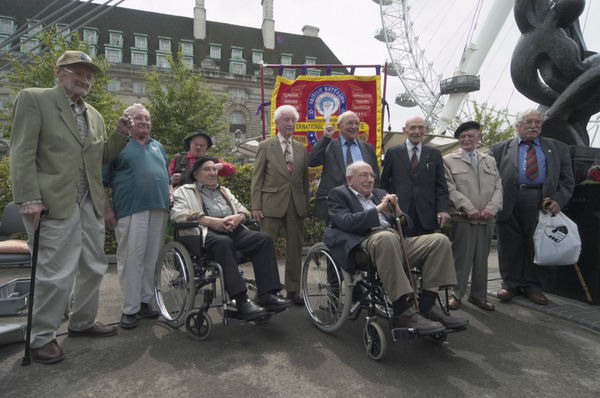
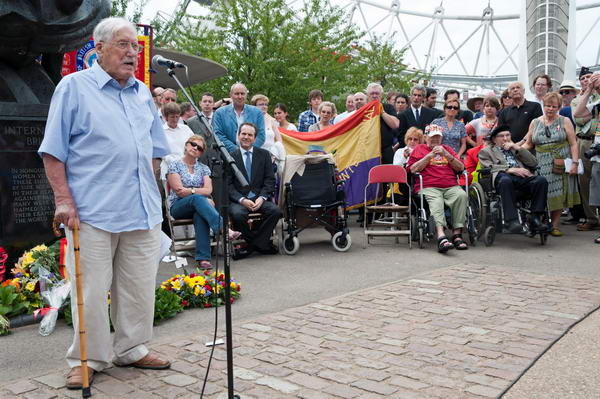
Sam Lesser was a founder of the International Brigade Memorial Trust which holds an annual commemoration every July at the memorial in Jubilee Gardens on the South Bank, at which the pictures here were taken. In 2009 he gave a spirited address there in front of the Spanish Ambassador, a month after he and the other veterans had been given their Spanish passports.

© 2009 Peter Marshall.
Sam Lesser speaking at the IBMT commemoration, 2009

Excalibur!

© 2010, Peter Marshall
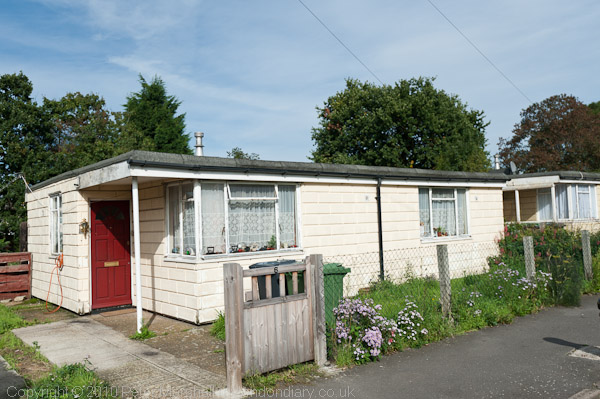
UniSeco Mark 2 Prefab on the Excalibur Estate

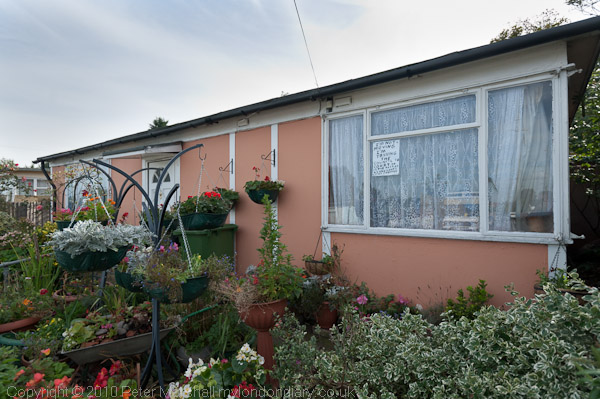
On Thursday I got on my bike and cycled from Waterloo Station to the Excalibur Estate at Downham in Catford, whose streets are named after knights of the Arthurian Round Table. This is the only large example remaining of a number of prefab estates constructed as the Second World War ended for returning soldiers and their family. Although intended as temporary dwellings, they were basically well-made and equipped with all mod cons including fitted kitchens, refrigerators, built-in cupboards and heated towel rails.

For many years now, Lewisham Council has left the maintenance of these bungalows to the residents, and a few of them, along with rather more who have bought their homes, have made a real effort to keep them in good order.

Where tenants or owners – past or present – haven’t taken over the council’s responsibilities, these homes are in often in very poor condition. So bad that when residents move or die, they are no longer re-let, but allowed to become derelict.

As you can hear on a slide show at The Guardian, for the first residents who moved to these properties were impressed by the standard of the accommodation they offered, and the standards set by the Ministry of Works were high- more modern properties are built to rather meaner specifications. The minimum floor area was 635 square feet, though I think these are a little larger, and some have now been extended. Although they were meant to cost £500 each, the actual cost of these was, made by the Selection Engineering Company Ltd was well over a thousand pounds – some things don’t change.

One of the designers of the kitchens in the ‘service units’ – kitchen and bathroom – was the Czech industrial designer George Fejer who worked on them from 1943, and later was one of the team that worked at Hygena creating the British style of fitted kitchen.

© 2010, Peter Marshall
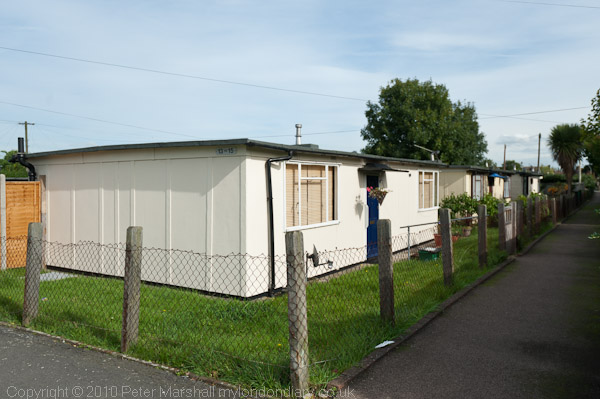
UniSeco Mark 3 Prefab on the Excalibur Estate

The UniSeco design – and around 29,000 were built – was perhaps the most innovative of all the various prefab designs built, with a distinctive modernist look, for example in the joined corner windows and the almost flat roofs.

© 2010, Peter Marshall
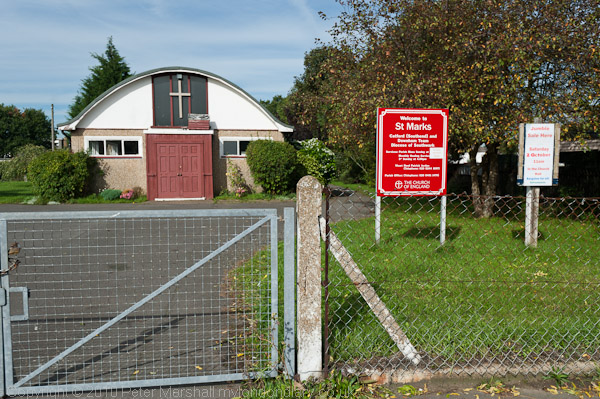
St Marks Downham – the council is talking to the Church of England about its future

The Excalibur estate, with 187 UniSeco Mark II or Mark III units and a prefabricated church – St Marks Downham – and church hall was assembled by German and Italian prisoners of war in 1945-6 on an area of public open space for the neighbouring Downham estate – with the promise that after the 10 or so years these temporary buildings were to last it would be returned as open space. For some years Lewisham council have wanted to demolish the lot and build new social housing on the entire site.

It is the only large prefab estate remaining, and residents and others pressed for its preservation and listing. English Heritage had advised the listing of 21 of the units, which would have enabled something of the character of the estate to be retained if on a much smaller scale. The Department for Culture Media and Sport reduced this  to six; four Mark IIs and two Mark IIIs, which although retaining these individual buildings will loose any real sense of the estate, although those chosen are a compact group and were selected because they were relatively unaltered – while some others have undergone considerable ‘modernisation.’ It still is not clear whether or not the church will be retained, though in any case it is of rather less interest.

One of the problems of renovating prefabs of this type is the large amount of asbestos sheeting and cement used in their construction, covering the timber and plywood frame.

I first came across and photographed the estate while walking the Greenwich meridian around 15 years ago – it runs through the middle of the estate – and was impressed by the feeling of openness and space. As some of the residents say, living there is the nearest thing to living in a village you can have in London, and some have made their homes look rather like country cottages, surrounded by flowers. Many have lived there for a very long time.

© 2010, Peter Marshall
One of the residents who doesn’t want to move – the sign says he’ll take the council to court
Others on the estate want to get out and live in something more modern and better maintained, and there appear to be two fairly well defined camps.  Lewisham, having promised for several years to consult residents finally organised a vote this year, and the results, announced in August were 114 votes for demolition and  regeneration with 89 against, with 21 of those entitled to vote not doing so.

Although the time-scale isn’t clear, the council are going ahead with the scheme which involves transfer to a housing association who will carry out the redevelopment. Current tenants who want to move back to the new estate when it is completed will be allowed to do so.

But I wouldn’t leave it too long if you want to visit the last example of one of our more interesting attempts at providing low-cost housing.

Inscape No 80

 © 1979, Peter Marshall
Street Games, Argyle St area, Hull, 1979. Peter Marshall

More years ago than I care to remember I enrolled on an evening class in the History of Photography being offered at the Camden Working Men’s College just down the road from Mornington Crescent (and doubtlessly coincidentally around the time the famous game of that name made its first appearance.)

It was partly a matter of curiosity – I’d never seen such a course offered as an evening class before, but perhaps more importantly, as I was teaching photography it could be counted as “in-service training”, both cutting down the pressure to go on far more boring courses and also meaning I could claim back both course fees and travel expenses from my employer. An added bonus was that the student card for this short course enabled me to claim a 10% discount from my favourite supplier of photographic materials for the next few years.

From the first session the lecturer, William Bishop, made it clear that although he had all the right art history tools he saw the course as an opportunity for him to learn about the history of photography rather than having a great deal of knowledge about it to impart.  It became very much a dialogue between him and those of the students – myself included – who knew rather more about photography and photographers, and one that proved constructive for us all.

A few years later,  Bishop, who had by this time been reduced by me to Bill in the interests of alliteration, decided to set up a ‘small magazine’ covering photography, producing the first issue of ‘Inscape‘ in Autumn 1992. Immediately I saw it, I contacted him and suggested he might come and make use of my equipment and desk-top publishing skills to improve the production quality, and we produced a few issues this way until he was successful in getting a grant to buy his own computer and scanner.

I had a few pictures in some of the earlier issues and the occasional one since, but I’ve not been a regular contributor to Inscape. My interests have perhaps moved rather in a different direction since those early days, and while the magazine has occasionally published work that interests me, there has also been much that has left me cold or worse.

Inscape is a word coined by Gerard Manley Hopkins, and there is a good short exposition of it on The Victorian Web by Glenn Everett. Inscape for him was essentially a both a Romantic and a religious idea, a revelation of the essence of a thing and an insight into the reason for its creation.  It is one of several attempts to describe the feeling that a particular moment or vision has a special significance.

© 1979, Peter Marshall
Betty’s Corner Store, Selby St, Hull, 1979. Peter Marshall

When we take personal photographs we are perhaps selecting selecting points of view on the real world that seem for us have some particular resonance – an “inscape” and hence the title of the magazine which

is about sharing our personal work, our personal photographic visions, with others. It is about appreciation rather than confrontation and argument, but it is not intended as a cosy corner to slumber in because it believes that the tradition of picture making that has personal meaning is alive and still developing.

It is something of a surprise (although I’ve kept up my subscription over the years) that Inscape is still going 18 years later. I think it started with five issues a year and is now quarterly, and the quality of the reproduction has improved significantly. The three pictures here are from a set of nine printed in Inscape No 80, at least some of which have a connection with its “An Architectural Theme“.

© 1979, Peter Marshall
Albert Dock, Hull, 1981. Peter Marshall

Others might be better suited to the theme of the forthcoming issue number 81, The Urban Scene, for which the copy date is 21 Dec 2010.  Like most small magazines (and unfortunately some very large ones), Inscape does not pay for contributions – the whole thing is very much a labour of love on a minuscule budget by Mr Bishop.

My set of pictures is only one of the contributions to the issue, with photographs by I think ten other photographers and written contributions by the Editor and the mysterious “mjp”.

© 1979, Peter Marshall
Fishers, Spring Bank, Hull, 1979. Peter Marshall

The magazine is now I think on sale in some very selected outlets and costs £3.60 or you can try through the web site, where back numbers are £2.50 post free in the UK. A subscription for 4 issues in the UK is £15.

There are a few more of my pictures from Hull on the Urban Landscapes web site, and I’m currently working through several years of photographs preparing a Blurb book on Hull which should appear later this year, under the title of my 1983 show there, ‘Still Occupied; A View of Hull‘, although the selection of images will be different to the 144 or so I showed then.

Meet Me in Paris?

© 2008 Peter Marshall
All ready to go to Paris

I think that I’ve now sorted out my trip to Paris for Paris Photo next month, along with my interpreter (not that I really need one, but my wife’s French is more than considerably better than mine, and both of us are extremely fond of the city.)  I’ve sent off for my accreditation, booked a hotel room (at the same hotel as last time, which isn’t perfect but is cheap), booked my tickets on Eurostar  – of course I’m not flying.

© 2008 Peter Marshall
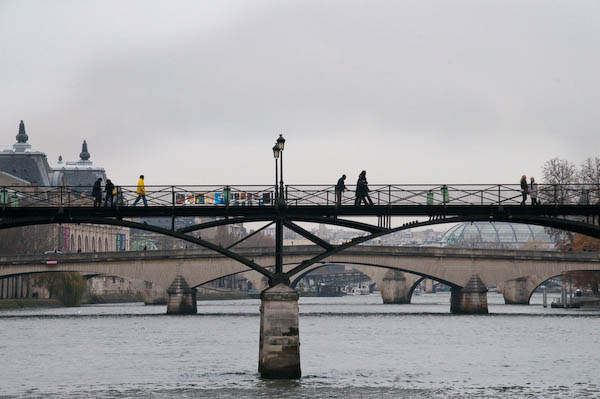
Pont des Arts, Paris, November 2008

Although we met in Manchester rather than Paris, my wife and I spent our first holiday together there a couple of years before we were married, sleeping in separate twin rooms in a student hostel a nine miles south of the city centre in Massy-Verrières, then a rather large building site on the Luxembourg line, although we were in the older part of the town.  It’s the only year I’ve been in France to celebrate Bastille Day, where we went to the celebrations on the main square there,  where people really did dance to accordion music in the streets.

We went back there a few years ago on the day when the Tour de France was finishing on the Champs-Élysées, catching a train back to the centre which should have got us there in time to see it. Unfortunately the line came to a halt around 25 minutes before the cyclists arrived, with the driver settling down in a signal box to watch the finish.

You can read about my last visit to the Mois de la Photo in 2008 in a series of articles under the heading PARIS SUPPLEMENT.   As well as the trade show, Paris Phot, with dealers from around the world showing the work of their photographers, their are exhibitions across the city in the ‘Mois del la Photo’ and even more shows in the fringe festival. For a month, but particular around the few days of Paris Photo, the city is really alive to the sound or rather sight of photography.

In 2008, apart from Paris Photo, which is a great opportunity to see work by established photographers from around the world, I got to see around 40 other exhibitions, as well as attending several openings and a few other parties,  meeting many photographers from around the world I already knew and other new faces.

© 2008 Peter Marshall
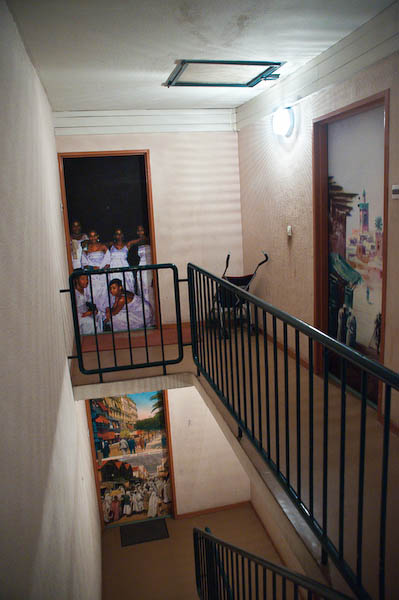
One of the fringe shows was on the landings of a social housing block,
Cité des trois fushias, 20e

You can see many more of my pictures from Paris on my Paris photos site, although not from that 1966 visit, when I dropped my camera in a lake!

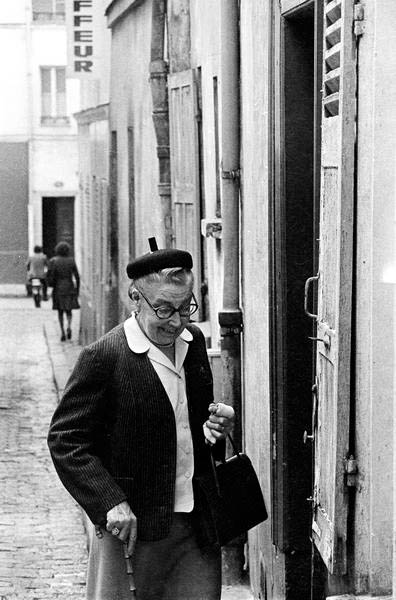
© 1973, Peter Marshall
This woman was walking along a back street in Montmartre in 1973.

If any of you reading this are going to be in Paris at any time between Nov 17-22 I’d be delighted to meet you – and if you are having an opening I’ll do my best to be there and to write about the work. You can e-mail me at petermarshall(at)cix.co.uk – or add a comment here.

74 Years Since Cable Street

 © 2006 Peter Marshall

Grey though my beard is getting, I wasn’t at Cable St in 1936, but four years ago I was there for the celebration of the 70th anniversary of the Battle of Cable Street, which I described as:

“a joyous event, celebrating an important grass-roots victory for the labour movement, when the people of the east end stood up and took action, largely against the orders and advice of the organised Jewish and socialist leadership.

it was a real peoples movement when workers from London’s east end fought the police at Gardiner’s Corner and barricaded cable street to stop Mosley’s fascist black-shirts marching through their area.

(I’ve made a few minor corrections to the lower case original version.)

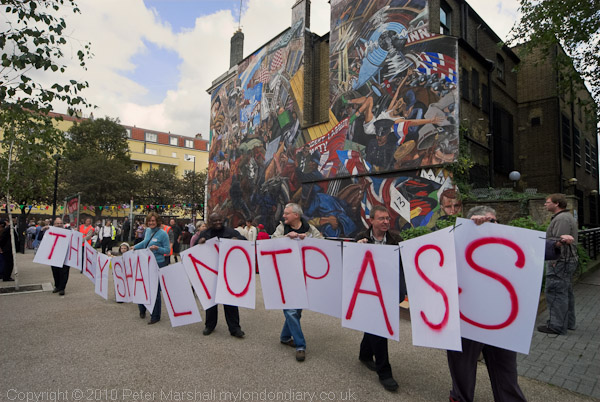
The festival started on Cable Street itself, and then those taking part came into the gardens where it was to continue for the rest of the day, coming past the splendid mural about the event. I’d decided to try to catch the group holding the letters making up the slogan ‘They Shall Not Pass‘ in front of it, and just about managed to do so, though the exposure wasn’t quite correct.

It was something that there was really no time to do, and of course I don’t believe in posing such things, so it was a minor miracle that it came out. It’s also an example of a file that I could I’m sure process rather better from the RAW file now compared to the rush job I did for the web in 2006. I’ve improved it a little working from a larger jpeg and added my copyright watermark for this post. But I get the feeling that I could get an improved result with Lightroom 3 on the original file. RAW software really has improved in the last 4 years.

© 2006 Peter Marshall.

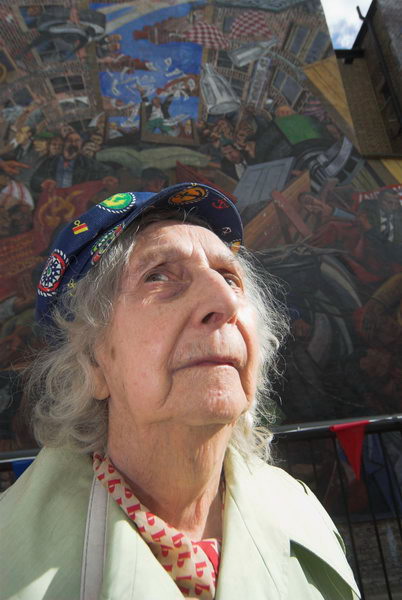
I try not to pose portraits either, although I did ask some of those who had been there in 1936 to stand in front of the mural for me, and moved myself to get them looking in the direction I wanted. Of course by this time there where other photographers also taking pictures of them.  But I hope this picture expresses a little of the kind of spirit of those who stood up and stopped the fascists.

© 2006 Peter Marshall.

There were of course plenty of reminders that it is a battle that still needs to be fought – and at times on the street as well as elsewhere.

More of my pictures from 2006 on My London Diary, and you can read a number of eye-witness reports on the web, though not I think one by the man I talked to and suggested he write his story. One I like was written in 2005 by NUJ member Reg Weston.

More on AFP v Morel Copyright Theft

Go to duckrabbit to read the latest on this clear case of image theft that I’ve mentioned several times before. Large agencies – and not just AFP – appear to to making an attempt to take over any images that don’t have the photographer’s name stamped across them in large letters.

As it says:

It’s no exaggeration to say that the arguments presented in court mean that this case, if it goes AFP’s way, could affect all photographers who use the web.

A few months ago I started putting a discreet but visible watermark on all images that I post on the web, but of course my images go to libraries without this. I’ve also written many times about the need to embed metadata in all images, and I’ve followed my own advice on this for some years.

© 2010, Peter Marshall
A discreetly watermarked image from June 2009

What I’d really like to see is a feature implemented on all new cameras (or at least all professional models) that adds a little black border to the bottom (or longer side) of every image containing our copyright message to every image that is taken – so that every picture we take is automatically labelled. It wouldn’t be too difficult to implement or make the images much larger.

It could of course easily be removed – even automatically – by users, but would put the onus on whoever did so to be sure they had the right to do so.

Is this an idea about cameras worth pursuing?

I didn’t mention it when I added a comment on duckrabbit, where I mentioned the need for photographers to join together to oppose these image grabs. At the moment I know my union has been quite supportive of some photographers over individual copyright cases. But if there are large numbers of photographers whose work is being used without permission by some of the large agencies, perhaps their is a possibility in the US of taking a ‘class action’?