Yangtze and More From Photomonth 2010

Nadav Kander’s Yangtze – The Long River is the outstanding show of Photomonth 2010 both in its scale and its concept. The exhibition continues until 13 Nov 2010 at Flowers East and comes from several voyages that Kander made cover the river from its estuary to the source during a three year period. His journey along the river, shrouded always in the light orange brown haze of pollution gives us an insight into the rapid growth of China, with image after image showing people dwarfed but remaining significant by the giant structures erupting around them.
He says in the gallery notes, “The photographs are an emotional response to what I saw. I gave them simple titles so that viewers are encouraged to respond subjectively before seeking the facts.

I’m not sure how well that latter idea works in the gallery, and I’d recommend that anyone visiting the show go first to watch the video being presented where he talks about the pictures and his ideas, which to me was vital in really appreciating his work. In it he also says that one single picture – a line of washing hanging sturng between rough wooden posts leaning against a wall under the huge girders of some giant bridge in Shanghai- for him sums up the whole process he was observing, and it was certainly one of my favourite images.

I took only a very quick look at the book published to accompany the show which includes “ca. 77 color ills” (couldn’t they count?) and although the work on display covered the two main areas of the ground floor gallery with three or so more tucked away (one of my favourites hidden in an office) there were rather fewer pictures on show than that. But even so there was a certain repetitive aspect which after a while I found slightly disturbing. The prints were very big and I often found myself moving in close to look at the people in them, and felt that perhaps occasionally the photographer might have done the same rather than always keeping a distance. The closest he comes is to a group of five, picnicing under a multicoloured umbrella on the riverside with a large bridge behind them, and I think it no co-incidence that this picture is featured as the largest of four images on the gallery handout.

The weakness – and I think it is one – is not in the photographer’s project, but in the selection of images for the gallery show. On Kander’s own web site (its the first item under ‘Work‘ on the menu) there is a more varied selection of 49 images. Also on the web you can watch the video being shown in the gallery on YouTube.

Upstairs Flowers was showing another very fine show, which again I mentioned briefly in an earlier post on its opening night, Edmund Clark‘s work ‘Guantanamo: If the Light Goes Out’ which combines some startling images from Guantanamo (though many of the images I found most telling were absent from this particular showing) with images in the homes of former detainees now trying to rebuild their lives. All of the pictures are without people, but Clark builds up a very strong atmosphere in these very carefully framed images. Also on show are some of the letters and cards sent to Omar Deghayes, a Brighton resident who was held for 5 years in Guantanmo.

You can see a few of Clark’s photographs on his web site, but rather more on Lensculture. I wasn’t convinced that the ‘Letters to Omar’ actually added anything to the show and would have preferred to see more photographs. As well as this show at Flowers until 14 Nov, there is another show of this work across London at Photofusion in Brixton until 26 Nov 2010.

A couple of doors down the Kingsland Road is the printspace, where there were a series of large portraits of dogs looking out of closed car windows,  ‘Mute‘ or ‘Dogs in Cars’ by Martin Usborne. Superb control of lighting and every hair apparently manicured into place, these seemed to me to be great examples of advertising photography – and taken on a Canon DSLR seemed to blow away the arguments for ‘medium format’ digital. But somehow the very gloss of the finish seemed to take something away from the impact of the work, and looking at them I couldn’t feel they had been deserted but felt they were being watched over not just by the photographer, but a whole team of assistants, stylists, art director and proud owners.

Another short walk takes you to the Red Lion in Hoxton St, where an exhibition by the Shoreditch Group of London Independent Photography (LIP) continues until 20 Nov 2010  – go up the stairs to the right of the bar. The show, which includes personal work by members and a group project ‘Parallels’, is as you would expect from such a group uneven, is worth a look. But having tried the beer, I’d advise going the short distance to one of my favourite London pubs, the tiny Prince Arthur in Brunswick Place with a well-deserved reputation for serving a good pint – and sandwiches (nothing fancy) at sensible prices – though unfortunately rather uncertain opening hours.

Talking of pubs and shows, another LIP member Anne Clements, has a show ‘Don’t Pass Me By‘ in Photomonth 2010 at the Jerusalem Tavern in Britton St, Clerkenwell which opened a few days ago and continues to 26 Nov 2010.

One venue that I was surprised not to see taking any part in Photomonth was the basement at Shoreditch Town Hall. It’s a large and curious labyrinth, great for a  group show as it needs to be manned while open, and really worth a visit just to see the place. I couldn’t resist going in to see the show ‘to be or not to be: a false dichotomy‘ by a group of thirteen artists based around Forest Hill in South London, curated by Dunio Mauro and advertised by a rather large pig. Unfortunately the show was only on for five days  – I imagine the space is fairly expensive to hire despite the dilapidated condition – and ended on October 27. Although I didn’t find anything of photographic interest, I did enjoy much of the show, and thankfully they had provided a numbered map to find my way around the more than 20 spaces (not all in use.)
Geoffrey Crawley RIP

I read yesterday of the death, age 83, of Geoffrey Crawley, and wasn’t intending to write about it as I didn’t feel I had anything to add to what had already been published, particularly by the BJP and Amateur Photographer – he worked for both. The twenty years he spent as editor of the BJP, from around 1967 to 1987 were perhaps its best years within living memory, although not commercially.

I can’t remember ever having met him, but as a very occasional contributor and letter writer to the BJP, I did talk with him a few times on the phone and received several letters from him, including a very nice personal reply following a complaint I made about a rather insane review the magazine had printed by Ainslie Ellis (1920-1997.) 

Like many photographers I made use of the developer formulae which he contributed to the British Journal of Photography Annual, the whole ‘FX’ series of fine grain and acutance developers, some of which, such as Acutol and Acutol-S were commercially marketed.

As well as the magazine, he also edited the annual from 1967. In 1988, which I think was the last issue, it made the proud claim to being the oldest photographic annual in the world, first appearing as a wall calender in 1860, and then as a pocket book supplement to the magazine in 1861. You can read or download the 1898 issue (long out of copyright) made available by the University of Toronto.

It’s interesting to re-read the two page editorial in the 1988 issue by Crawley on advances in technology and how these will effect the future of photography – he notes that the “keynote of the next few years… could well turn out to be the increasing use of photography as a notebook in everyday life and particularly in leisure activities.” But writing in 1987, the article nowhere mentions the idea of digital imaging – how quickly things were to change in that respect.

The 1988 annual had another great figure from the last century of British photography as picture editor, Colin Osman, noted as a photo historian but also as the financial supporter for the crucial years of the magazine ‘Creative Camera.’ I was very pleased to have four of my pictures included in the picture section, along with work by many other photographers, including David Hoffman, Anna Fox, Tom Wood, Crispin Hughes, Mike Seabourne,  Barry Frydlender, John Blakemore and many others.

One of the strangest stories which Crawley was involved in was the 1917 Cottingley Faires hoax, and it was an article on PetaPixel about this that made me change my mind and write this post. As Michael Zhang notes, it’s interesting that so many people were taken in by these pictures (though they were not as he suggests “in the early days of photography” but when it was 78 years old.)

The hoax, carried out by two girls aged 10 and 16, was a very amateur affair. That people believed them was simply because they wanted to believe them, not that they were in any way believable – to any unprejudiced eye they were obviously fake. What Crawley did was to show in detail exactly how they had been made, and to gain the confidence of Elsie Wright and enable her to at last confess to the truth of the matter.

Stuart Freedman

Stuart Freedman, a Londoner born in 1967, has been a photographer since 1991 with  stories “from Albania to Afghanistan and from former Yugoslavia to Haiti” published in leading magazines around the world, including Life, Geo, Time, National Geographic, Der Spiegel, Newsweek and Paris Match. He is represented in London by Panos Pictures.

In 1998 he was selected for the World Press Masterclass and the following year for the Agfa Young Photojournalist of the Year, and has gained awards from Amnesty International (twice), Pictures of the Year, The World Sports Photo Award, The Royal Photographic Society and UNICEF, and his work has been shown widely.

Looking at his new web site, it is easy to see why, with fine photojournalism is stories both in black and white, for example The Mutilated, with images from Sierra Leone, and some stunning colour work in all the essays on the site, although perhaps sometimes I find the colour a little over-saturated.

I’ve had the pleasure of seeing Stuart talk about his work, and there are some excellent pieces of writing on the site, as well as on his blog, Umbra Sumus (We are but shadows.) One recent piece,  “I am not a witch…” Well, actually I am… had some sensible things to say about the Halloween scam as well as his portraits of some British pagans.

I did have a few minor problems with his new site, which certainly looks very stylish. As well as my often-mentioned aversion to sites that need you to scroll sideways (I’m still waiting for a mouse with a scroll wheel that works that way) there were some links that only wanted to work if I opened them in a new tab.

Lost Steps Again

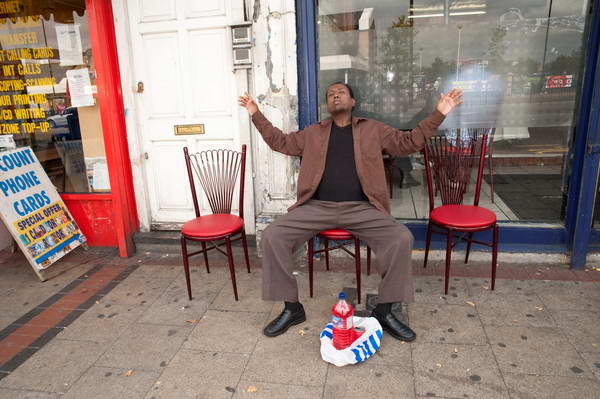
If you missed my broadcast in the Lost Steps series on ResonanceFM last month, you can now listen to it any time you like on the Lost Steps web site  – or even download it from there as a podcast. And there have been a couple more programmes since mine, one about London Hauntings and the latest  with Nigel of Bermondsey and Vanessa Wolf-Hoyle from London Dreamtime which has a couple of film clips of the Old Kent Road, one from the 1970s. I photographed it at some length in the early 1980s, one of the last projects on which I used transparency film and I’ve been there occasionally since – one of my sons lived there for a year. The last time I walked a few yards along it with a camera several people asked me to take their pictures – this guy was the first:

© 2009 Peter Marshall
August 2009 – Old Kent Road

I don’t much like hearing recordings of myself, though on the programme I do sound rather more like I think I do than on some other recordings. And apart from a couple of silly slips I more or less seem to make sense. Its often hard to gather thoughts when being interviewed, and interviewer Malcolm Hopkins had only told me what his first question would be – there really was no other preparation. Actually that one was really the hardest to answer.

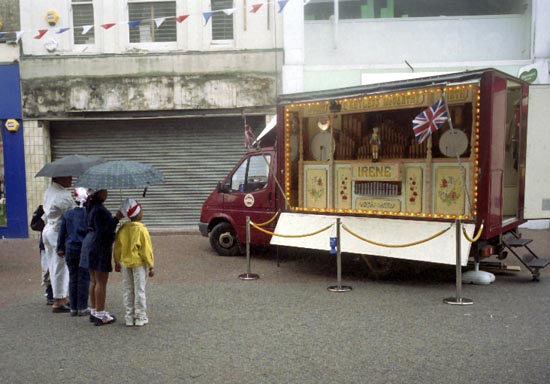
It’s always interesting to see what others think of you (and sometimes – like this – reasonably flattering except for the photograph.)  I was interested to see the selection of pictures and comments by producer Nick Hamilton, with three very different photographs. My favourite of them is one only labelled there Ilford High Road, June 2002:

© 2002 Peter Marshall.

This is of course part of how East London celebrated the Queen’s Golden Jubilee (I went on from there to photograph a rather livelier street party in Mile End.)  But what strikes me particularly about this image is the rather poor colour reproduction, rather typical of images shot on film.  Of course I could probably make a better scan, but digital has so much improved colour, and made it so much easier to get good colour in the images in My London Diary– though I still occasionally manage to mess it up a little when I’m in a hurry.

At the street party I had terrible problems with flare. There is a little on this image but there might have been some water  on the lens as it was raining when I took this picture. Later it was dry and probably I’d managed to leave a fingerprint on the filter. Dirty lenses are of course still a problem with digital, but there is at least some chance to spot it in the results while you are still taking pictures.

Incidentally I’m still using a Lens Pen to clean my lenses when I’m out working – the ones I have are actually called Hama Lenspens – they cost me around £6 from 7Dayshop and last for around 6 months to a year. Very easy to carry and do the job well, though apparently there are some cheaper imitations that should be avoided. I also have a lens cloth and some cheap cleaning fluid to use if things get very messy.

Some years ago I appeared a few times on an American Internet radio programme, talking over a phone line rather than in a well-equipped studio, and every time we started getting into a conversation, one of the two presenters would interrupt with an ad for Lens Pens – and they used to give them away to people who phoned in, though I never got one!  But despite that I still recommend and use them. Lost Steps was considerably more professional, despite being non-commercial, or perhaps rather because it is non-commercial.

Nick has also used a quote from the first Blurb book I produced, 1989,  ‘real’ images and fictional text relating to walking around North East London.  Here’s a part of it:

It’s Sunday morning and on the newsagent’s board the News Of The World promises us it will “UNLOCK THE SECRETS OF SUPERSEX” just like last week and the next week, but still they remain secret.

I go in and unlock the secret of a Mars bar instead.”

(you can see the whole page here.)

Unfortunately now I have to watch my sugar levels as well, and I can no longer indulge in Mars Bars!

Blurb Pop-Up London

I’m not exactly sure what a Blurb Pop-Up is, but we are getting one in London shortly, when Blurb launches its first-ever U.K. pop-up store on Wednesday, November 3. They say “It will be buzzing through November 14 with free workshops, guest speakers, and special events.” It’s at 22 Newman St,  a couple of hundred yards to the north of Oxford St and 5 minutes walk from Tottenham Court Rd tube.  See comment – now closer to Oxford St tube.

The events are listed on the web page, with links to click to RSVP if you want to attend, and everything is free. If you look through the programme you will find that I’m down to give a presentation on my Blurb book, ‘Before the Olympics‘ on Sunday 7th Nov at 13.00-14.00, but there are some highlights too!

© 1989, Peter Marshall
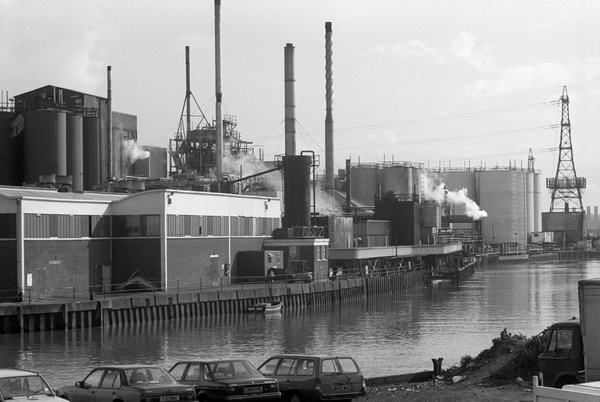
Pura Foods, Bow Creek in 1989. Now demolished.  © 1989, Peter Marshall

Later that day I’ll also be there to take part in the Self-Publishing Debate with guest panelist Bruno Ceschel of ‘Self Publish, Be Happy‘ at 3pm.

Although the main part of my presentation will be about ‘Before the Olympics‘ which gained an ‘Editor’s Pick’ on Blurb, I’ll also be talking about my two other Blurb books and a little about my plans for forthcoming publications, as well as my comments on Blurb and the whole idea of self-publishing and answering any questions people have. I hope it will be an interesting session so if you are in London and free around Sunday lunchtime you can book a free place on the web page.

Striking Firefighters March Against Cuts

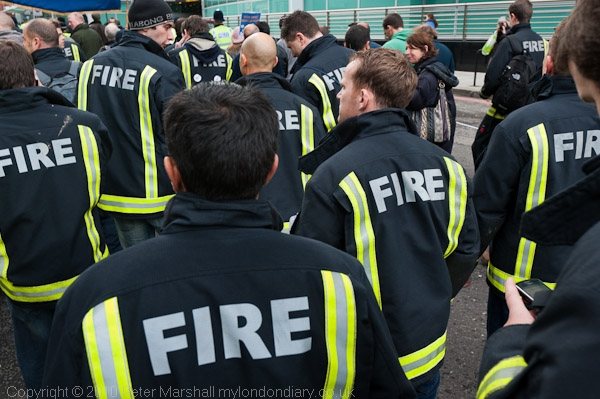
© 2010, Peter Marshall

I was pleased with this image of the fire-fighters at the front of the thousand or two trade unionists marching to a London rally against the cuts.  Framing was a bit tricky as I was holding the camera up as high as I could above my head and saying my prayers – a ‘Hail Mary‘ shot. I took several frames, looking at the image on the camera back after each and trying to get the distance between me and the closest man right as well as the angle of the camera, and this one seemed to work. The D700 does have a shutter blind which stops light coming in through the viewfinder affecting the exposure, but in practice it’s often easier simply to cover it with my other hand as I did on this occasion.

Either I’d misread the details or it started early, as I was expecting to be at the meeting point for some time before the march actually started, but I met it coming along the road a few hundred yards away.  It’s almost always a good idea to go early when photographing events but I’d had a few things I’d wanted to do first. Some days when I’m photographing a whole series of events it just isn’t possible. But often things are more interesting before the actual start.

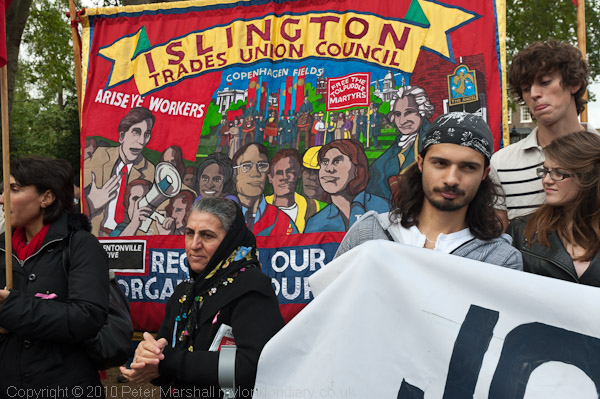
© 2010, Peter Marshall

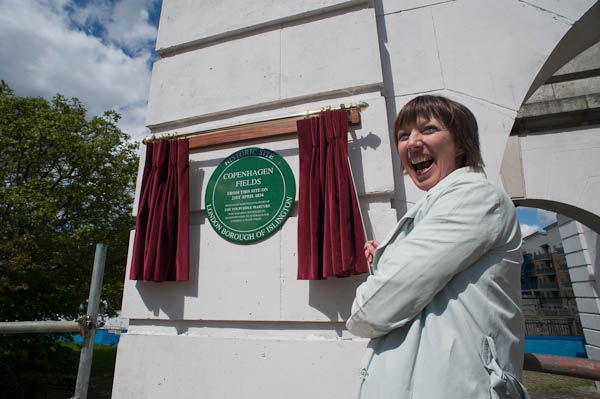
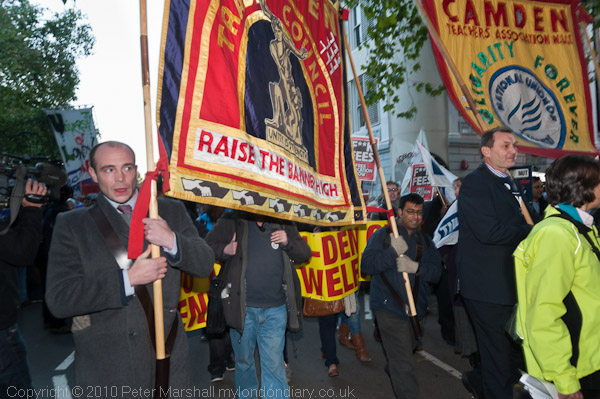
There were plenty of trade union banners and I particularly like this one from Islington Trades Union Council which commemorates the ‘Grand Demonstration‘ by the Metropolitan trades unions to campaign for the release of the Tolpuddle Martyrs in 1834, which gathered at Copenhagen Fields. I was there last year when TUC Deputy General Secretary Frances O’Grady unveiled a plaque to commemorate the event.

© 2009 Peter Marshall

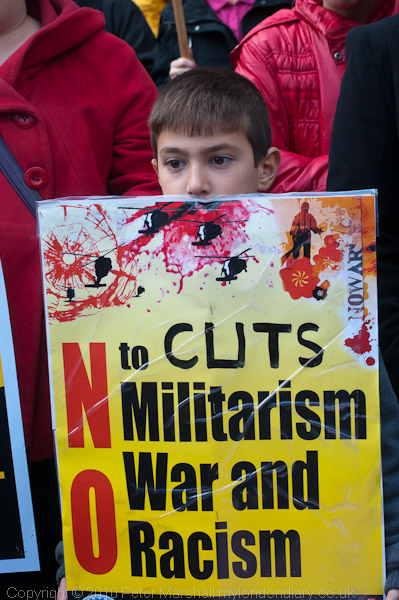
The image on the Islington banner very much reflects the current population of London, and there was a strong group of demonstrators at today’s event from the Refugee Workers Cultural Association Women’s Branch, carrying placards from the  AvEG-Com against Militarism, War and Racism, to which they had added the word CUTS.

© 2010, Peter Marshall

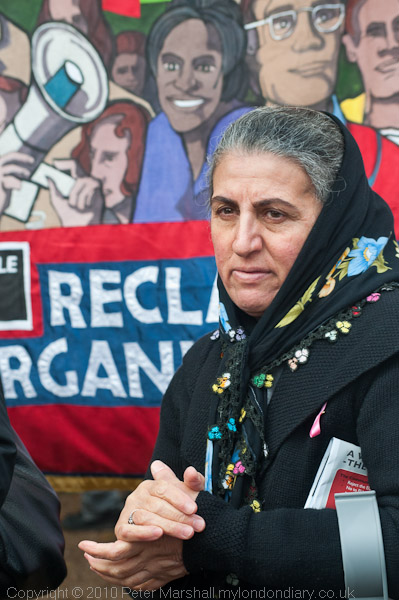
I thought the Islington banner made a fine backdrop against which to mover closer to photograph an elderly woman, I think one of our new Londoners, in a flower-decorated scarf with its crowd as a backdrop.

© 2010, Peter Marshall

Of course there were other pictures, including those of the two main speakers, the RMT’s Bob Crow and  FBU’s Matt Wrack, as well as many more of the crowd, all in Trade Union March Against Cuts on My London Diary.

A Place to Cut?

I’d not gone to Windsor to take photographs, but for a walk with my wife, daughter-in-law and grand-daughter. Fortunately the latter of which finds beards fascinating, so when I was pushing her around in a push chair all I had to do when she got a little upset was to tilt the chair back to horizontal so she could see me making silly faces and she smiled back. She even seemed to enjoy my singing and whistling, which is more than I do.

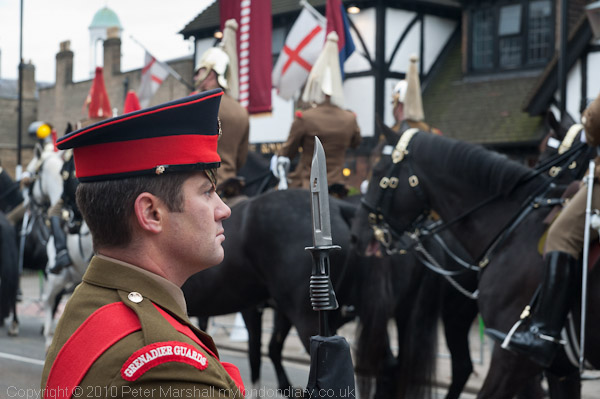
But as we got off the train at Windsor, lots of men on horses started to come past and so I stopped to take a few pictures of them. And there were a lot of police around. Apparently it was all a rehearsal for the state visit a few days later of the Emir of Qatar, paying a visit with one of his wives to the Queen.

© 2010, Peter Marshall

I suppose you can’t expect an Emir to pay for a taxi to take his suitcases up the hill, and the Queen could have sent a car down to meet him, but the scale seemed pretty obscene given the cuts we are going to have to make in other things. Keeping hundreds of horses isn’t cheap, and there seemed to be three carriages. The army are complaining about lack of manpower, so these guys could have been better occupied, as too could the police.

I’m not entirely against a little pageantry, and I’m sure it does tourism no harm, though I doubt if too many actually get to Windsor to see it, but couldn’t we make do with just a dozen or two guys and some inventive filming to create a  bit of spectacle?

I wasn’t at my best that day, and at some point managed to switch the camera to manual by mistake and didn’t notice. It’s fairly easy to do, holding down the wrong button with your first finger when trying to dial in some exposure compensation. When I’m very much engrossed in looking at the scene (as I usually am)  I can be completely unaware of the viewfinder display – sometimes I think it was better when cameras didn’t have one. Of course camera designers can’t win. Reviewers would grumble if they made changing the mode settings hard to do and I’d like them to make it harder.

When I’m going out to take pictures I always like to do a quick check through the settings for A, S and M modes and set them to sensible values before I start taking pictures (things like f8, 1/250 second.)  It’s one slight disadvantage of using Auto ISO as I was that however silly the settings you make there is a good chance of getting an image that looks OK at a glance on the camera back. On the way to Windsor I hadn’t bothered, and the manual setting I’d engaged – 1/60 f6.3 – was actually perfect for taking a few family pictures later inside the pub where we had lunch, but pretty hopeless for galloping horses, where a considerably faster shutter was needed to stop movement or a much slower one for arty blurs. At 1/60 what I got was slightly unsharp images – sharp enough for the blur not so show at a quick glance on the camera back.

© 2010, Peter Marshall

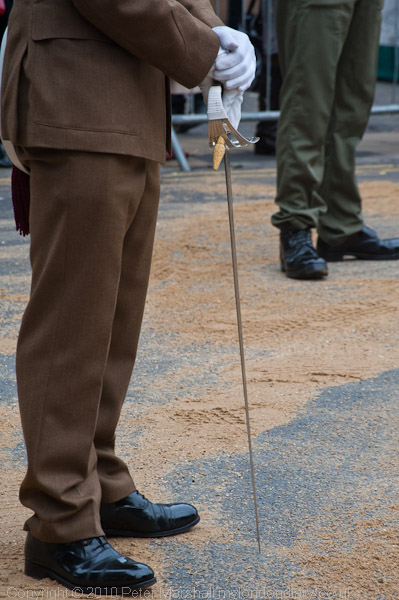
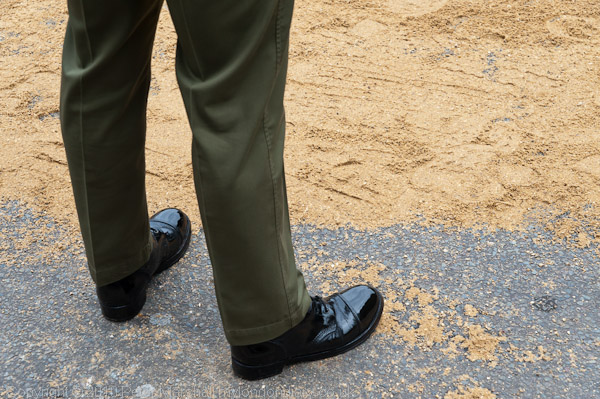
I was standing right next to the road as the cavalry came back and galloped up the hill, and it was an impressive sight. If I was an infantryman on the opposite side with only a musket and a short sword I would have felt pretty scared at the crashing of hooves and the shaking of the ground as the troop passed. But those days have gone and its perhaps time to move on too. These guys really are real soldiers, but we are still getting them to dress up as if they were fighting Napoleon, to carry swords and to shine their boots so they can see their faces in them.

© 2010, Peter Marshall

There are just a few more photographs on My London Diary.

Rivington Place & Photomonth

Monday was an interesting day for me. After a few hours work on the computer I had a very nice lunch at a small restaurant in Tolworth with a couple of friends then went with one of them to London to spend an hour or so looking at some of the other shows in the East London Photomonth, (and one was in a pub) before going on the the Photographers Social in a bar in Soho. A minutes walk from a decent pub.

The following day I had a bit more time after a meeting with a friend at a London hospital and was able to see far more, including two of the major galleries taking part in the event, Flowers East and Rivington Place, before rushing to a union meeting where a distinguished and knowledgeable panel discussed the question whether street photography would still be around in five years time.

But some of the experiences finding shows were rather like those I had visiting the Brighton festival a couple of weeks ago. Galleries that according the the leaflet should have been open at the time we called but were not, one address that was a locked building with no indication that there was even a gallery there, as well as several places where a quick look through the window told us it was not worth entering. But I did find some work worth looking at, particularly on the Tuesday.

The oddest experience came when I went into a gallery on Rivington St, and asked one of a small group of people sitting around and talking there where the exhibition was. It seemed to be quite a large space, and all I could see were fairly empty walls with the occasional poster.

At first there was some laughter as I’d obviously picked exactly the wrong person to ask, but then one of the men asked to see the programme where the show was listed. He scratched his head and told me he knew the photographer, would have been happy to put on a show of his work, but that he knew nothing about it, and the show didn’t exist.

He then said that someone else had come in and asked about it a couple of weeks ago. This was a shock, apparently only two visitors in more than three weeks, and was also rather a surprise. My own show, Paris – New York – London, with Paul Baldesare and John Benton-Harris, only a couple of hundred yards away, tucked away in a side street and not the easiest place to find has been attracting quite a few viewers over the weeks as well as the normal visitors to the Juggler café it is part of. Surely it can’t just be because I’ve mentioned it here most days!

I was surprised again later, visiting one of the more interesting shows on at Rivington Place, a superb well-staffed gallery space – the first new-build public gallery in London for 40 years when it was opened in 2007 –  to find that I had both shows to myself (and in each case an attendant) while I spent some time looking at ‘Ever Young’, showing 60 years of photography by  James Barnor, born in 1929 in Ghana (he tells about his early career here on ‘Nowness‘) and now living in London.

Much of his studio photography from Ghana seemed a little ordinary, but there were a few images that stood out, and in the 1950s his ‘Ever Young Studio‘ was visited by many leading figures around the time that Ghana, in 1957. As well as the studio photography he was also working for a newspaper, The Daily Graphic, and later for Africa’s most popular magazine Drum.

In 1959 he came to England where he studied photography and joined the staff at the Medway College of Art in Rochester. In the 1960s he continued to photograph, including a number of pictures of cover girls that are included in the show, but also covering other stories of African interest including Mohammed Ali in London for a fight and BBC Africa Service reporter Mike Eghan.

In London he was trained in colour processing by Agfa-Gevaert and returned to Ghana in 1969 as their representative to establish colour processing in that country. In retirement he now lives in London, not far from Agfa’s UK HQ.

Barnor was certainly a very proficient photographer and there are several very nice images in the show, including two of people posing in Trafalgar Square and at Piccadilly Circus. But the great interest in his work is more in the different cultures and changing times it spans and to which he had access to photograph some of the leading figures particularly in Ghana, and in the relationship his work embodies between the new Africa and the old colonial power. It’s certainly a show worth seeing, and continues until 27 Nov 2010 (closed Sun & Mon.)

Also on show at Rivington Place is a fascinating set of portraits collected by the leading black intellectual and civil rights activist of the era, W E B Du Bois for the book ‘Types of American Negroes, Georgia, USA‘ and exhibited in at the 1900 Paris Exposition Universelle in the ‘American Negro Exhibit‘. Consisting of pictures from various sources and in a range of styles, these images challenged the racial stereotypes that were a part of the scientific thinking of that age.

Looking at them brought a number of thoughts to my mind. One was of a job I did for an Indian friend perhaps 20 years ago, taking some pictures of him and some of his friends. They were unhappy with the black and white prints I produced, but he was very reluctant to explain why. Eventually I realised that the problem was in the skin tones, which I had printed as I normally did, with an accurate tonal rendition. I made some further prints, dodging the faces to lighten them considerably to a more ‘European’ tone and they were happy. Looking at some of these images it is clear that in some of them a similar process had been taking place, using either lighting or printing to create very light (in some cases very white) skin tones. Of course the  ‘ordinary’ or ‘orthochromatic’ emulsions in this era had a certain lightening effect on all portraits, whatever the skin colour.

Library of Congress Image
Image from the Du Bois album in the Library of Congress LC-USZ62-124654

Another thought I had was that many of these pictures could actually have been from my own family album. Taken away from their context there are many that would not be recognised as black. The gallery notes suggest that this collection “can be read as the origins of a visual construction of a new African-American identity” but it seems more to me to suggest that this identify is not greatly dependent on the visual. But Du Bois’s intention to produce ‘an honest straightforward exhibit of a small nation of people, picturing their life and development without apology or gloss, and above all made by themselves‘ has certainly resulted in a fascinating collection.

At the Library of Congress you can see the complete collection of 482 African American Photographs compiled by Du Bois for the Paris show online, and can download them as jpegs or tiffs (large enough to make the prints in the show.) The portraits start on the second page of thumbnails. The image here comes from that collection and may or may not be in the Rivington Place show.

It is a thought-provoking show, and other people with other backgrounds will certainly have different thoughts from mine, a couple of which I’ve shared above. In many ways the decision to present them all in the same format in two large grids on the gallery wall makes sense, but I did find myself asking what the originals actually looked like, and in some respects the online presentation does that better.

The other shows not to be missed are at Flowers East (also closed Sun & Mon)  and I mentioned them briefly in a post after the packed opening there but I hope to write more about them and some other shows from Photomonth 2010 another day.

Cuts And Chaos

We in the UK are in for a hard winter as following Wednesday’s Comprehensive Spending Review the cuts in public services begin to make themselves felt. Although we were expecting the Con-Dem coalition to make the most of the political opportunity to greatly reduce the public sector and the welfare state while blaming it all on the previous New Labour government, hearing the actual news still came as a shock, and there will doubtless be many more shocks as the planned spending cuts are introduced.

© 2010, Peter Marshall
The start of the student march

So far the official trade union movement response has been relatively quiet and low key – they are planning a national demonstration for early next year, many are calling for earlier and more decisive actions.

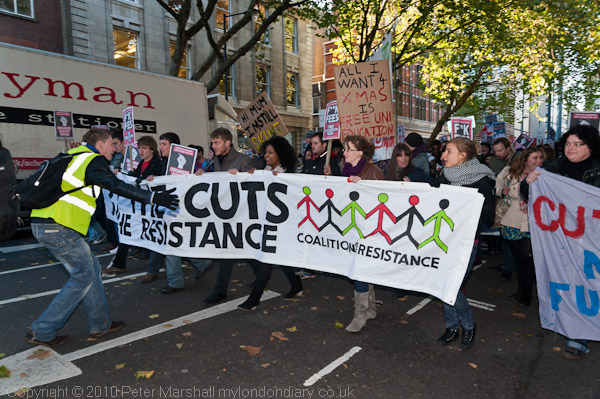
The demonstration at Downing St was called by ‘The Coalition of Resistance’ which describes itself as ” a broad united national campaign against cuts and privatisation in our workplaces, community and welfare services, based on general agreement with the Founding Statement” which appeared in the Guardian in August 2010, signed by Tony Benn and 73 other people including MPs, union leaders, writers and others. It is now supported by “thousands of individual supporters, together with national unions, union branches, anti-cuts campaigns, student, pensioner, unemployed, youth and other organisations” and is still growing.

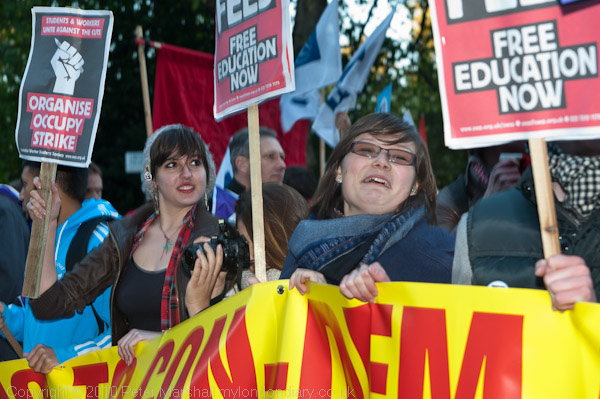
It’s hard to get a large group of people to a demonstration on a Wednesday evening. Around 300 students set off from Malet St in the late afternoon and joined roughly twice that number of trade unionists and others waiting for them at Lincoln’s Inn Fields. Doubtless others met them at Downing St, making this a significantly sized  event, but rather smaller than the 20,000 who marched in Edinburgh at the weekend.

It was a busy day for me – earlier I’d been listening to Jesse Jackson and lobbying my MP and afterwards I was giving a speech at the opening of our contribution to the East London Photomonth 2010 at the Shoreditch Gallery. I’d decided I couldn’t carry around my normal large camera bag all day, so was working with just a single camera – the Nikon D700 – along with my lightweight but slow 55-200mm Sigma and the SB800 flash.

Of course 24mm is quite wide, but I did find I was missing the even wider 16-35mm, particularly when working in the crowd. And having only a single camera meant I took very few pictures with the longer telephoto. I’ve rather got out of the habit of changing lenses when working.

Malet Street, where the student march gathered is pretty gloomy most of the time, with trees and tall buildings cutting down the  light, and by 4pm it was beginning to look like dusk. For some unaccountable reason I decided to leave the camera set to ISO 640 when the sensible thing to do would have been to use ISO1600 or even 3200.

© 2010, Peter Marshall
Behind a banner in Lincoln’s Inn Fields

By the time I finished working at Lincoln’s Inn Fields it was really beginning to get dark. I took a few pictures without flash – at f2.8 which is a pretty useful aperture, but most were with the flash giving an aperture of f6.3 – in the earlier pictures the flash was a fill, but later on it was the main light source with fill coming from the ambient light. I still find the combination of two slightly complex electronic systems impossible to really understand, but mostly with a little fiddling on the flash setting it at different levels I manage to get the results I want.

© 2010, Peter Marshall
The march departs for Downing St

I had to leave as the march left for Downing St, and then needed to work out how to get to Shoreditch when the march was stopping the bus I normally take!

More pictures and text on My London Dairy.

Photographers Social

Long ago, back in the days of film, every year around this time I used to lock away the colour stock and go out with only black and white in my cameras, as I knew otherwise I would waste far too much recording the changing colours of leaves. Had I got round to it I would have got around to printing a t-shirt for photographers with the message “Get over it – leaves turn brown in Autumn!”

© 2010, Peter Marshall
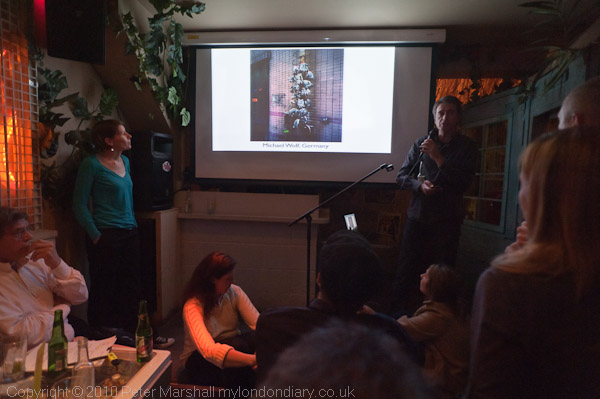
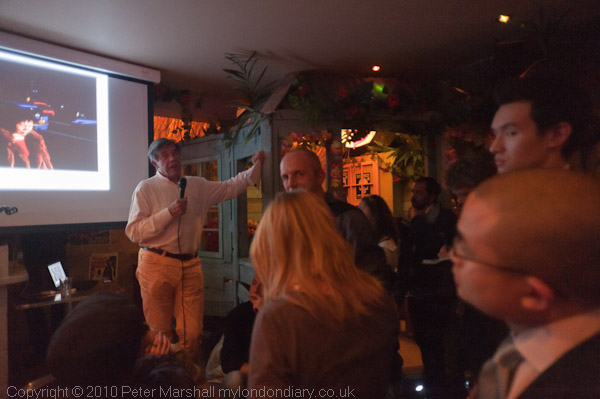
Stephen McLaren talking and showing photographs at the Social at Barrio Central – and as this picture suggests it was dark and crowded there. 20mm f2.8 Nikon D700

I felt something related to this as I watched Stephen McLaren‘s presentation of images by some of the photographers features in the book ‘Street Photography Now!‘ at the first Photographers Gallery/BJP Social evening at Barrio Central in Poland St this evening, though rather than Autumn colours my thoughts were about pictures mainly about and created by strong shadows and unusual lighting conditions.

Of course light is one of the basic tools of the photographer – where would we be without it –  but at least for me the aim isn’t to make pictures about it but to use it to illuminate (in every respect) the subject.

It would be wrong and impossible to propose a complete ban on taking such pictures. Books such as Trent Parke‘s ‘Dream Life‘ show how powerful they can be. But since Trent and rather many others have pretty well ploughed that furrow out perhaps we might turn to other fields?

Stephen McLaren showed some interesting work (and I very much liked his own picture which made use of the low angle sun on a nearby street despite the comments above – from his series Coupling) with at least one image from each of the photographers concerned that gained my admiration, which isn’t a bad average, but I was left wondering if some perhaps showed too much striving after what might be called ‘Flickr approval‘ and that perhaps the hardest thing to learn as a photographer is the power of understatement. And to repeat one of my old refrains, that photography isn’t about making pictures.

I also found it disturbing that the images appeared to be projected on screen at the wrong aspect ratio changing images in a normal format into near-panoramics (I think actually from 1.5:1 to about 1.7:1 – it is a problem with some screen resolutions.*) There was too a problem with the colour, with some images at least being greatly over-saturated. I would have hoped that two of our major photographic institutions could have coped rather better with screen resolutions and colour management and hope it’s an issue they address for further occasions. Surely we should treat photographers’ work with much greater respect.

On the train home I was entertained to hear a lengthy report by a photography student on the evening, and at least he had gathered the main point from lawyer Rupert Grey (of photography specialists Swan Turton), that on the street you can legally photograph anything you like.

© 2010, Peter Marshall
Rupert Grey talking at the Social at Barrio Central

Perhaps the only thing that he said that was new to me was his opinion that the police probably never have the right to demand to view your images; I’d been fairly clear about this so far as journalists are concerned, but he went further to apply this to anyone taking photographs.

Most of us also know that the police have no right to delete images or demand that you do so, although in a number of cases – and he mentioned that of Martin Parr – police have insisted that photographers do so. In practice of course it isn’t a great problem, as so far the police haven’t realised that deleting files from your card doesn’t actually remove them. So long as you don’t take any more pictures on that card afterwards, it is a simple matter to recover them.

There were a few things – particularly in response to questions – that he perhaps might have been clearer about, at times because he failed to make clear the distinction between taking a photograph and publishing it. Working in public places you never need permission or model releases to take a picture, although sometimes it may be sensible to get a release or polite to ask. But many of the best pictures come from situations where neither is possible. But what he failed to explore was the increasing threat to photographers that the legal interpretation of the individual’s right to privacy – even in the absence of UK law – is already having on court judgements in this country.

Using a picture without a model release becomes a problem in contexts where that use might be defamatory. So, for example, using a picture of a person on the street to illustrate an article on drug addicts would be ill-advised unless the picture or other evidence clearly showed that person to be a drug addict. There is so far as I am aware no legal requirement for a model release to use any photograph in an advert (or in any other way), but it is a normal commercial requirement as it should remove the possibility of legal action. Contrary to popular opinion not all adverts or commercial work needs photographs to have a model releases – the last picture I came close to selling  in that field was considered to be quite acceptable despite the presence of a recognisable person but no model release – but it is certainly normal practice to require one.

Grey also made it clear that there were no restrictions on photographing children – unless the images you produce are indecent. This can perhaps sometimes be a problem for street photographers in hot weather, when there may well for example be naked children running through fountains, playing in pools or running along beaches. To you or me, pictures of them might be perfectly innocent, but police and courts might take different view. And this is again an area where the privacy rights under European law are increasingly coming in to play – and at least one judge has made it clear in a judgement that the balance that has to be maintained between freedom of expression and privacy would be biased more towards privacy for minors.

I’ve heard Grey speak on various occasions before and he is obviously an expert in the field, but while it is good to know what the law is, we know that what police and others such as PCSOs, security staff and council employees try to enforce may be very much different – as examples such as the incident involving Parr demonstrate.

Perhaps the most useful and most sound piece of advice Grey gave about such situations was that photographers should be polite. I’d take that a little further and suggest that while where necessary insisting on our rights we should do so without unnecessary confrontation and where possible cooperate with the police and others. So I’m always happy to talk to any member of the public – whether in uniform or not – about what I’m doing, and where I think it appropriate to produce evidence of identity.


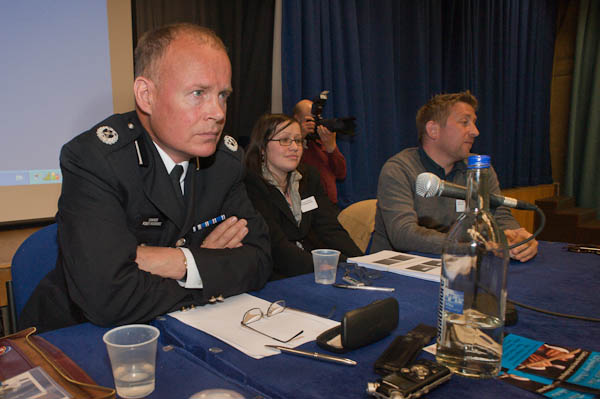
Commander Broadhurst at the NUJ photographers conference in May 2009 listens to photographers accounts of police violence.

Perhaps the most amusing part of his talk related to his conversation with Commander Broadhurst of the Met and a representative of ACPO. While it was good to hear of changes in their thinking about photographers, the suggestion from Broadhurst that police on the streets would all know about this seems laughable. http://re-photo.co.uk/?p=660 It was Broadhurst who said at an NUJ photographers’ conference in May 2009 “can anybody apply for an NUJ card who has a camera?” shocking all present by his  total ignorance and lack of understanding of the UK Press Card scheme (more about this occasion here.)

So while there may well have been some changes, I think we can be pretty sure that most of the police on the street will know as much about these as they have about previous statements which gave essentially similar advice such as that sent by Assistant Commissioner John Yates to all MPS officers and staff last December.

I think there have been some indications of a better attitude towards photographers by police at demonstrations in London at least since their disastrous public performance at Bank in April 2009, and I welcome this, and hope that Broadhurst’s extreme optimism is well-founded. But I’m far from sure that this has as yet had any impression so far as the more general interactions between photographers and ‘officials’ of all types on the street away from protests.

Although the ‘Photographers Social’ seems a great idea, in practice it was too crowded, too hot and too uncomfortable, and the area was really not well suited to such a large event. Like quite a few others I left as soon as the two presentations were over for the comfortable bar (and real beer at rather lower prices) a few yards away.  Perhaps the BJP/PG might investigate other venues in the area.

*Display Aspect Ratios

You should check any screen (or projector) by finding the screen resolution in pixels and comparing the ratio between width and height with the actual width and height of the image. Most displays allow you to run them at  different resolutions, some or all of which may be unsuitable, but LED screens are best used at their native resolution, in the case of my monitor 1680 dots x 1050 lines.

So I’m writing this on a 1680×1050 pixel screen with an image display 454x 283mm, ratios of 1.6:1 and 1.604:1 – essentially identical.

Projector or monitor displays that give markedly different ratios for these two things are unsuitable for photographers.