National Anti-Fur March

After the egg on their face at Millbank last Wednesday, I went to Saturday’s National Anti-Fur march wondering if their was going to be some reaction.  Animal Rights protesters in groups allied to the Animal Liberation Front (ALF) –  have carried out non-violent illegal direct actions and in some previous years this march has attracted some very heavy-handed policing. In 2008 I wrote:

I was several times impeded in my work by being pushed by police as I took photographs and being refused permission to walk onto the pavement, despite shoing a press card. Demonstrators were also prevented from going to hand out leaflets to people on the streets. It doesn’t seem to me to be a democratic way to police a protest.”

Last year, post Tomlinson, things had improved greatly, and I was pleased to find that again there were no problems this year.
© 2010, Peter Marshall

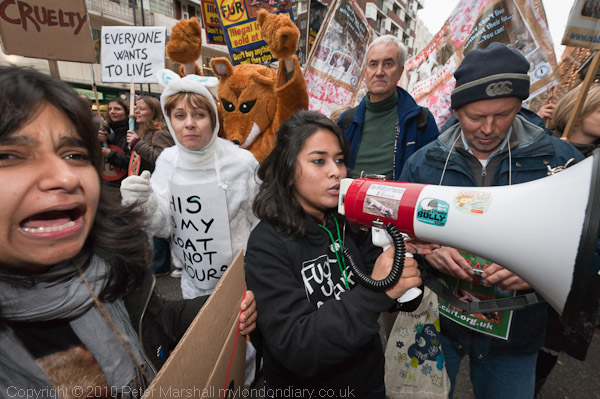
This was I think the best picture that I took on Saturday, although I didn’t spot it in my first quick look through the pictures when I selected twenty or so to upload to Demotix on Saturday night. But it’s certainly a picture that has grown on me since, starting with the word ‘CRUELTY ‘ in the top left and the distorted face below it (that distorted ‘R’ in the word helps too) then moving across to a second piece of text ‘Everyone Wants to Live‘ which perhaps asks rather more questions than it answers, then a group of three heads – a rabbit, a bear and a young woman whose megaphone both sweeps us on across the picture and for me links back to the open mouth at left.

There is also something about the placement of the other figures that I think could hardly be bettered, both the two men standing at the right and the two women in the background at left, and the banners behind. I’m not sure that the hands of the man who is looking a his pictures on the back of his compact camera are really what I would have wished for (it looks to me as if he is rolling a cigarette), but for it’s perhaps something that illustrates the real power of photography, coming up with things I would never have dreamed of, and part of the kind of ordered chaos that makes taking pictures exciting. They are also a part of a kind of swirl of hands around this picture – I start from the upraised paws of that bear and my eye works round through the hands of the two women, the rabbit, a hand holding a cardboard placard, the hands on the megaphone and then on to those holding the camera.

It also pleases me that this is exactly as I framed it in the camera – as indeed are most of my pictures, though I’m not a religious fanatic about it. Sometimes in the heat of the moment you don’t get it quite right, and I’ll happily shave off a few pixels if necessary. But this is exactly as I saw it.

Perhaps too, had I been arranging a shot like this in a studio or on location (it could never had been the same – why does Jeff Wall bother – it just shows up his limitations) I would have arranged for the text on the front of the rabbit to be more easily legible (it says ‘THIS IS MY COAT NOT YOURS’.)

This was taken on the D700 with the 16-35mm zoom at its widest, and it isn’t often that I get an image that works as well across the whole frame with that extreme a wide-angle.  The inherent distortion from such a wide view in a rectilinear lens helps her, exaggerating the pain and anger in the face at left and making what was a very large megaphone seem to loom even larger.

Of course I didn’t stand there thinking about all these things when I took the picture – but I did recognise something that made me press the shutter. Of course I always (well, almost always) have a reason to press the shutter, but things seldom work out exactly how I want. But its all part of training the mind (the ‘eye’) along with looking at the results afterwards. And just sometimes the arrow hits the target.

I can’t remember why I had the camera set to ISO360 at this point. There wasn’t a great deal of light and more typically I would have been giving myself at least a stop if not two more. I think I’d probably forgetten to reset it after taking a portrait earlier. But this was shot at 1/100 at f8, and everything is pretty sharp – 16mm gives fairly extreme depth of field.  But the two closer figures, where fill-flash was more noticeable have just a slight, very slight suggestion of blur along with the sharp flash image. It isn’t visible at this scale, but I think helps prevent the scene looking static when viewed at a larger size.

Using flash of course meant that the closer elements of the image were too bright as taken, and a little bit of burning down was needed. The flash is no longer obvious but it does really add to the picture.
© 2010, Peter Marshall
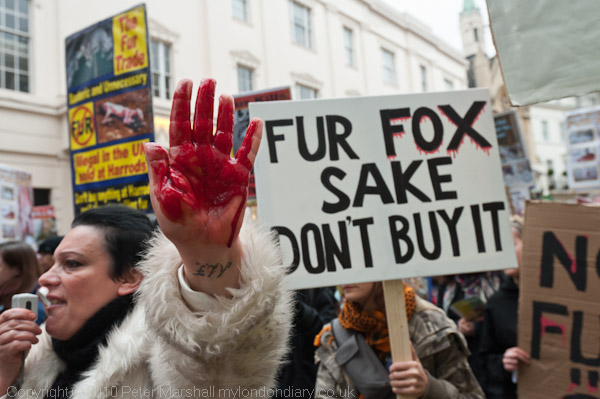
A’ bloody’ hand and a tatoo (upside down) that reads A. L. F.

Most of the other images I liked from the day were really of single figures or concentrating on a single figure in a crowd. This image below was one, like the top picture taken outside Harrods, currently the only department store in the UK still selling fur, although the march organisers, the Coalition to Abolish the Fur Trade, have hopes that the new Qatari owners will end this when they fully take over in January.
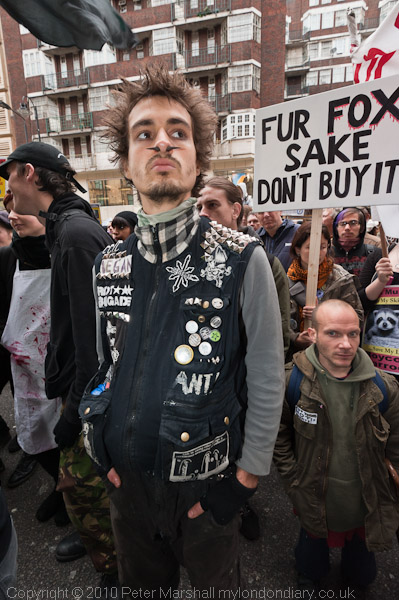
© 2010, Peter Marshall

More about fur, the march and more pictures in National Anti-Fur March on My London Diary.
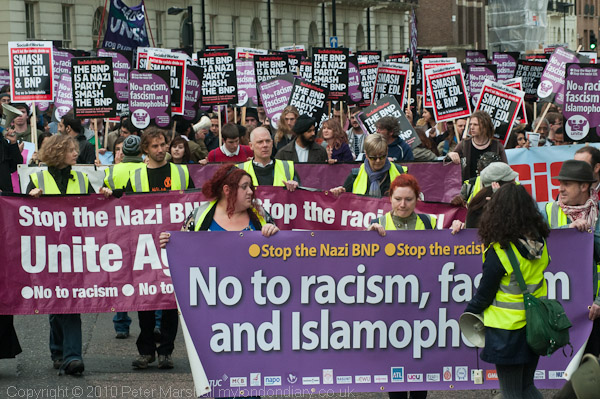
Against Racism, Homophobia & Islamophobia

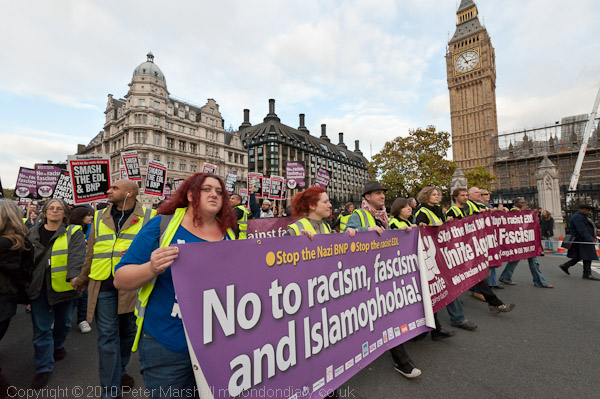
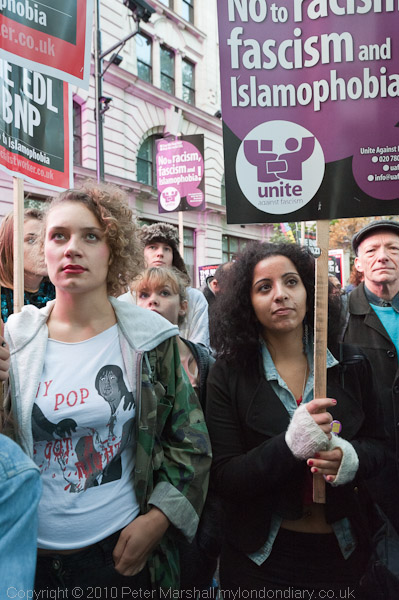
The NO to Racism, Fascism and Islamophobia march on Nov 6 was a decent size and had rather more of a carnival air than most since it was organised by Love Music Hate Racism (LMHR) as well as being organised by Unite Against Fascism (UAF). That did mean we got a DJ playing some very loud music, and when I found at one point I wanted to be right in front of the rather large speakers next to the lorry they were using I wished I had brought some ear plugs. It isn’t that I don’t like music, but when it reaches the kind of decibel level where all your internal organs vibrate it’s a bit too much. It used to amuse me when I saw the guys at Notting Hill Carnival photographing with ear-muffs on, but it makes more sense to me now.

© 2010, Peter Marshall

Both the UAF and LMHR are widely regarded as being closely linked to the Socialist Workers Party (SWP)  although both draw support from a wider range of people – and get funding from bodies such as the TUC which the SWP itself would not.  Many left-wing activists are SWP members and without the effort they put into organising things we would have far fewer demonstrations and they would be considerably smaller. Many of the more active members of Stop The War are also from the SWP.  I don’t suggest anything sinister here, it is simply a matter of fact and generally strongly evidenced by the number of people offering SWP petition forms and publications at demonstrations.

But it is bad news for photographers, as these organisations all share a style of stewarding that makes our job difficult. There is an obsession with control which seems to be central to the SWP mentality (and one reason why I’ll never join them.) Usually it is just a matter of keeping photographers away from the front of marches by surrounding the march with stewards who link arms to create an empty area in front of the banner, making it impossible to get within a reasonable working distance to the front of the march, or indeed to get good pictures of the front of a march from a longer view.

At one Stop The War march the photographers got so annoyed that we staged a sit-down in front of the march on Park Lane until we were allowed a few minutes access.  But it goes further and I’ve several times been assaulted by stewards at such events – although others have been more cooperative and have apologised for the  behaviour of others. During one march from the US embassy I was fortunate to escape serious injury when pushed violently backwards.  It’s not surprising that we sometimes amuse ourselves by making up other meanings for the initials SWP – such as ‘Sod Working Photographers‘.

There was some of that aggressive and obstructive behaviour at this event. One of my colleagues was assaulted and most of us were at times rather frustrated trying to get the pictures we needed. It just isn’t necessary and it certainly is counter-productive. Much larger demonstrations manage without stewards who think they are storm-troopers, and it is obviously in both the protesters and photographers interest to get the best pictures possible.

A little chaos really does work fine and it seldom gets out of hand, as photographers tend to regulate themselves though there are a few who don’t play the game – mainly those with big video cameras, like the guy who several times swung his round rapidly and hit me the other day. And there are those sad individuals who like to try and organise everything and everybody who deserve to be dealt with drastically by the stewards. But most of the time we get along OK, and if they stewards would just stand back and  let us get on with it unless a real problem arose we’d get better pictures without compromising the march in any way.

Fortunately I don’t often spend a lot of time at the front of marches where these things happen. Certainly on this one there didn’t seem to be any ‘celebrities’ who might occasionally need a little protection from a crush of photographers, and almost all the people I found interesting were further back in the march where I could wander around as I liked.  There the atmosphere was much friendlier.

© 2010, Peter Marshall

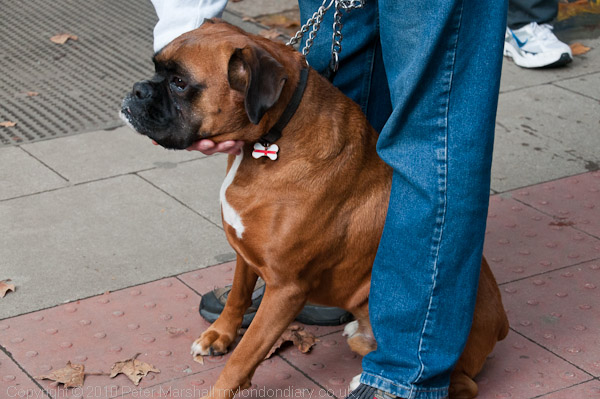
There had been some anticipation that there might be some trouble from members of the English Defence League during the march, but they had the sense to stay away. When we saw this dog, sitting with its owner watching the march go by, most of us probably drew the conclusion both from the St George flag and the appearance of the dog owner that this could have been one of them, but when one of my colleagues asked him he told us he had no sympathy for people who behaved like they do although he was proud to be English. It was a lesson about being careful not to jump to conclusions based on people’s appearance.

© 2010, Peter Marshall
For once the weather was good and I remembered to make reasonably sensible settings on my two cameras, and everything worked as it should. It does happen sometimes.

But by the time we got to Millbank, the light was beginning to fade and it was getting harder to work, and even at ISO 3200 people dancing just moved too much to be always sharp, so after another round of speeches I decided it was time to go home. There was actually another problem, which you can see in a few of the pictures on My London Diary  with light from a large TV screen, mainly filled with purple creating a rather unhealthy effect.

© 2010, Peter Marshall

But by then I was ready to go home anyway.

Jimmy Mubenga

 © 2010, Peter Marshall
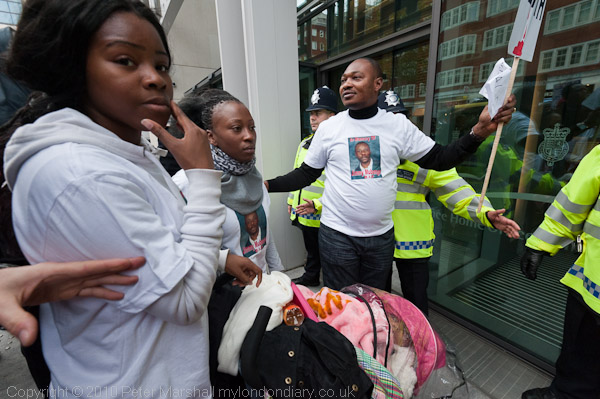
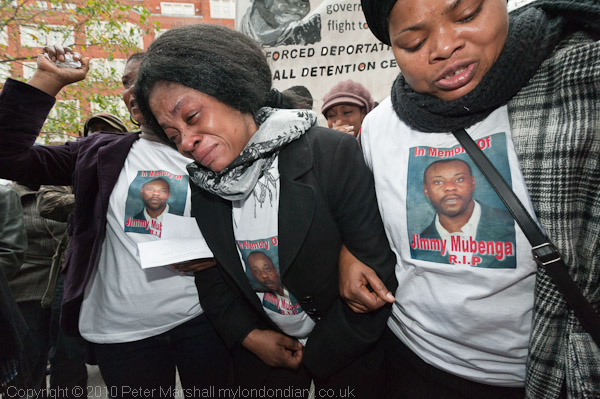
Members of the Mubenga family at the Home Office entrance

The UK Borders Agency (UKBA) generally doesn’t like to do its own dirty work. It is after all a part of the civil service and accountable at least in theory to government. Its own staff would have to go through proper training programs and be subject to various codes of conduct and so on. Not that all that means a great deal or offers us a great degree of protection. But much of the really dirty work is contracted out to private enterprise companies whose main aim is profit, and are often prepared to cut corners, use poorly trained staff and turn a very blind eye towards their actions so long as the job gets done.

One area of activity where this appears to be happening is forcible deportations. Private security guards are used to take people  – usually from privately run detention centres – to airports and put them onto flights back to countries to which they do not want to return. Often they have very good reasons not to want to go and a genuine fear of imprisonment, torture and even death awaiting them at the end of the flight.

We have an immigration policy which is driven by right-wing racism, in particular in parts of the press which has resulted in Labour and Tory parties engaging in a bidding war to show themselves to be tougher on immigration than each other. The rules have been revised time after time to make it harder for asylum seekers to pursue their claims, with fast-track procedures being used to prevent proper consideration of cases. Those working in the UKBA are under great pressure to play the numbers game, removing as many people as possible.

Deporting people like Jimmy Mubenga makes no sense. He’d been living in this country for 16 years,  doing a useful job and contributing to our economy, paying our taxes and bringing up a family, who only know England, having grown up and been educated here. Stupidly he got into a fight in a club – the first time in years here that he had been in trouble – and was sent to prison. Because of that, after serving his sentence, a short time later he found himself being forced onto a plane bound for Angola, the country from where he fled for his life. Had he arrived back there he was convinced he would be killed or imprisoned, and very probably he was right, but we will now never know.

It took three men to get him on that BA Flight at Heathrow, and the witnesses say that they held him down as he screamed “They will kill me” again and again, and they held him down more and he screamed that he couldn’t breathe and they held him down more and everything went quiet and still they held him. Finally they called an ambulance, but the paramedics were unable to revive him.

Few forcible deportations make the news, but this one did. Unusual because a man was killed in front of witnesses rather than simply disappearing in another country. This was news, at least for a few hours – and should become news again when – assuming the Crown Prosecution Service can’t find a way to brush it under their extensive carpet – the three men responsible come to court.

© 2010, Peter Marshall
Jimmy Mubenga’s widow in tears supported by family

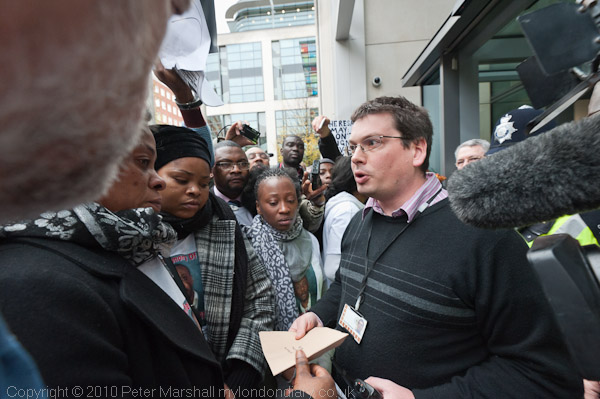
A month after the killing, Jimmy Mubenga’s family and various campaigners for justice for immigrants marched from the Angolan embassy to the Home Office to hand in a letter asking for a full inquiry not into this particular case – which is still the subject of a police inquiry – but the procedures used in such deportations, as well as asking that the Mubenga family’s immigration status be urgently resolved and that they be given indefinite leave to remain.

I was surprised to find that there was almost no interest in the event shown by the press. Apart from myself there was one other photographer and one videographer present; the only other journalist I saw was from a small left-wing daily. My story with some pictures went up on Demotix within 24 hours. A quick Google search finds no other report of the event (though the Guardian has covered aspects of the case well), other than a short note on BBC news obviously written by someone who wasn’t there that simply noted the march was taking place, and misleadingly refers to Mubenga as an “Angolan man who fell ill as he was being deported.” Asphyxiation as a result of having three men on top of you is not an illness.

© 2010, Peter Marshall
A Home Office official takes the letter. The family were upset that no-one could be let in to deliver it.

You can read more about the event and see more of my pictures in RIP Jimmy Mubenga – Killed at Heathrow on My London Diary. It’s the kind of story that makes me feel that what I’m doing is really worth doing even when I know I’m unlikely to sell any of my work from it.  I didn’t find it easy to take some of these pictures, and there were times I didn’t take pictures, but I think it was something that needed to be recorded.

Millbank & Misrepresentation

 © 2010, Peter Marshall

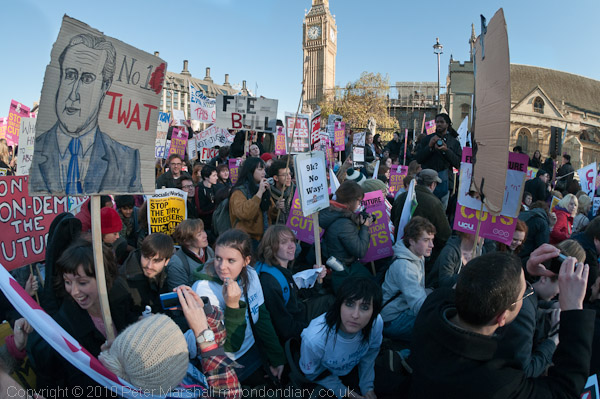
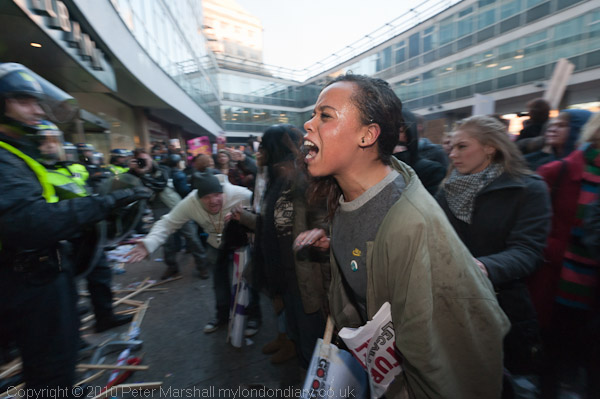
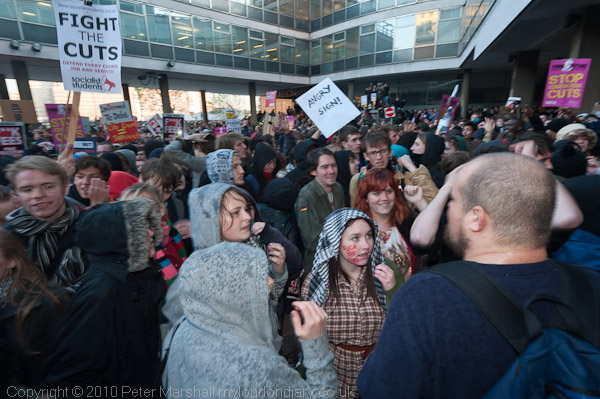
I’ve just posted my pictures from last Wednesday’s higher education march on My London Diary. The pictures I took tell a very different story from that which filled the news broadcasts and papers on Wednesday evening and throughout the next day or two. But of course most of those who pontificate about it weren’t there, and even those of us who were could only get a partial view. But I’ve talked to a number of others, read eyewitness accounts, watched the videos and seen the photographs taken by others as well.
© 2010, Peter Marshall
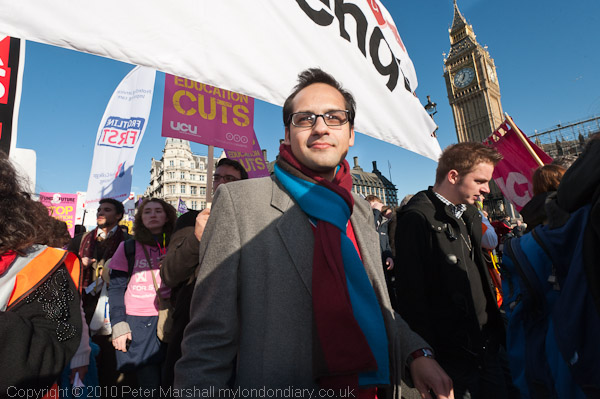
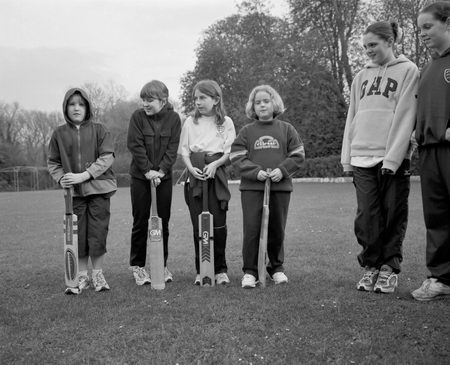
NUS President Aaron Porter passes Big Ben

The account I just uploaded to my web site – and this story here – both differ in some respects from what I wrote for Demotix on Wednesday night, because of what I’ve heard since from others who were there, but it was clear on the day that many published accounts were frankly sensationalism rather than based on fact. Even today the BBC continues to talk about the ‘storming’ of the building which just isn’t what happened. They are simply telling a lie on behalf of the political establishment and the government.

It wasn’t just the Met who got it wrong for the student protest on Wednesday; the journalists and photographers in particular did as well, which is why the editors and politicians got quite such an easy ride in making up their lies about what happened.

As the march came down Whitehall and we stopped to photograph it going through Parliament Square we’d talked about the possibility of trouble. And although one of the best-known anarchists had earlier told me “There’ll be plenty for you to photograph” I didn’t take the hint, or at least failed to understand it, though I doubt if he knew the details of what would happen.

© 2010, Peter Marshall
Sit-down in Parliament Square

I’d thought that the glass-fronted Millbank offices outside which I photographed in May had only been taken over by the Conservatives as their temporary election HQ, and didn’t realise they were still there six months later. Had I known that – and if I was the officer in charge of the policing I would have known it – I might have followed the front of the march down just in case rather than keep on taking pictures in Parliament Square. But probably not, as there had been little indication that there was likely to be anything special to photograph. Certainly there had been no organised bloc that looked like causing trouble – though many obviously angry students – and I’d seen few of those that I’ve photographed at previous events who might be expected to cause trouble. Several photographers commented to me that it didn’t look likely that things would take off.

So I was a little surprised when I heard (thanks to a tweet read by one of the students I was photographing) what was going on. I’d stayed on in Parliament Square as I thought there would be a few things of interest there (and there were) while quite a few of the other photographers had continued down towards Tate Britain, outside which the rally was being held.

But few if any of them were actually there when the first group of students walked into the offices and occupied them – more or less non-violently. There are some people taking pictures on the short and fairly amateur video I’ve seen, but I didn’t recognise any of them as professionals. Rather more of the press were there when the police made their second big mistake, which was to try and forcibly remove the protesters when they had too few officers to do the job sensibly.

The photographers who were there at that point tell me that there was a great deal of indiscriminate violence by the police, much of it against protesters offering no resistance – and some photographers also have the bruises from the batons and riot shields to prove it. The said the effect of this attack was to enrage many of those who until then had been onlookers and produce an angry mob, which was the start the real battle that took place, with the breaking of windows and a fair amount of indiscriminate violence, in a second wave of occupation.  Had the police reacted more calmly and sensibly, waiting until they had the resources to properly protect the building there might have been only minimal damage.

© 2010, Peter Marshall

By the time I heard about what was going on it hardly seemed worth rushing to get there  – I thought I would have missed everything. So I continued taking pictures for quite a while around Parliament, and then decided to make my way home by a route that took me along Millbank.

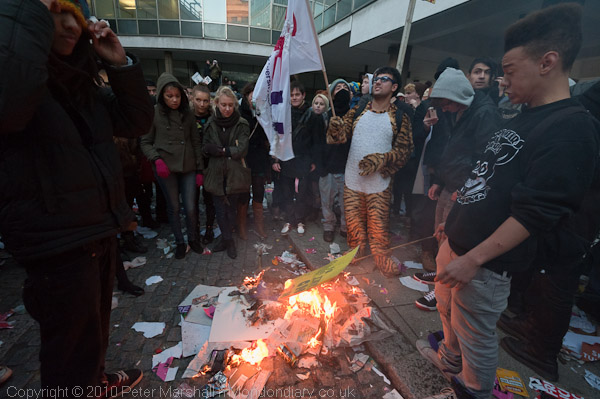
I ignored the NUS/UCU stewards who where by this time turning away protesters coming down Millbank at the Lambeth Bridge roundabout, telling people that the protest was all over and walked down towards the Millbank Tower. As I arrived a group of riot police got out of several vans and ran past me and into the crowded area; I tried to follow them but soon found my way blocked by a crowd of onlookers, so I went back and round into the courtyard which was slightly less packed with people, some standing around a couple of small fires.

© 2010, Peter Marshall
Not a riot!

Over their heads I could see a line of riot police facing the crowd with a small gap between. I pushed through the crowd and eventually got to the front and found myself with a number of other photographers, most of whom I knew, taking pictures.

By that time there wasn’t a great deal happening, and the police were adopting a low-key policy, at least outside the building, forming a line to prevent any further ingress. A few people in the crowd were still throwing the occasional piece of card or stick towards the police, and a number fell short on the photographers and crowd, and a number of those at the front occasionally shouted at the police. Generally it was almost good-natured – more a game than any serious attack by this time. The police certainly weren’t in any great danger and though a few looked a little stressed, many seemed to be quite enjoying it.

© 2010, Peter Marshall

A couple of fire-extinguishers were let off from the crowd, as well as from the roof and I got rather wet, and then covered with powder. Neither healthy for cameras. I wasn’t there when an empty extinguisher was thrown down from the roof, but on the video it’s clear that it caused an immediate angry chant from the crowd below as a stupidly irresponsible act. Someone – and and given the way it was lobbed it could have have been a protester rather than police – could easily have been killed,  was just luck that it missed everyone.

There didn’t seem to be a great deal of point in staying – there were hordes of photographers and videographers there and any pictures I got would be unlikely to add much to the coverage or even get used. Unlike some of the other photographers there I refuse to carry a helmet or hard hat, and this was a situation where I would have been happier with one on. So having taken a few pictures I left and walked across Vauxhall Bridge for a train home.

More detail about the event and more pictures on My London Diary.
Pictet ‘Growth’ Shortlist

You can see the shortlist for the valuable Prix Pictet which was announced today in Paris, where a preview of the work will open at the Galerie Les Filles du Calvaire on Sunday – and I hope to drop in and see it when I’m in Paris next week. The prizewinner won’t be announced until March, so there is plenty of time to place your bets.

In alphabetical order,a the runners are Christian Als, Edward Burtynsky, Stéphane Couturier, Mitch Epstein, Chris Jordan, Yeondoo Jung, Vera Lutter, Nyaba Leon Ouedraogo, Taryn Simon, Thomas Struth, Guy Tillim and Michael Wolf, and you can see their work that is in for the prize on the Pictet web site.

What is unusual for a photographic prize these days is that there are some pretty decent pictures among the lot, and seven or eight photographers whose work I might well have chosen myself. There are a couple I find ‘arty’ in a sense that would have been fresh in the 1930s, but now I just find pretentious garbage, and a couple that do things that I’ve seen rather better done by others (and in one case seems hardly worth doing), but it is good to see so much good photography up for a prize like this – though it remains to be seen what will win.

I probably shouldn’t condemn any of them to oblivion by naming them as my favourite for the prize, and in any case I think it should receive rather though more than my quick first impression. Particularly because it isn’t just a matter of a single image, but really of a set of pictures, and that does need more consideration. But Mitch Epstein has long been one of my favourite contemporary photographers, Guy Tillim’s work I always find of interest and the show by Taryn Simon was one of the best in recent years at the Photographers’ Gallery. The only work that really appeals that was new to me was by Nyaba Ouedraogo. So probably those four are now the outsiders in the race!

I hope I’ve more or less got everything sorted for my Paris trip now, and certainly I’ll be writing about it here. Unfortunately I’ve been having some problems with getting my notebook to connect to the Internet, so I may not be able to post until I return home and there may be a few days without posts on the blog. In any case I tend to be too busy and get too tired (and sometimes emotional)  to comment while I’m there.

Blurb & 893 etc

The first presentation on Sunday morning on the London Blurb Self-Publishing day was given by Anton Kusters, a photographer who specialises in long term projects and is based in Brussels, where he runs his own web and interactive design agency and is also creative director of Burn Magazine, the online publication for emerging photographers curated by Magnum photographer David Alan Harvey, which I’ve mentioned a few times here.

Kusters won the 2010  Blurb Photography Book Now Editorial Prize for 893 magazine  on the 893 project which he has been working on with the help of his brother in Tokyo for a couple of years, making numerous visits there. It took lengthy and complicated negotiations, sealed with an impressive looking document to get the permission to document the Yakuza, a Japanese crime family that runs the streets of Kabukicho, the red-light district in the heart of Tokyo. The contract runs for two years and Kusters has committed himself to publishing 893 magazine twice a year to show his progress. You can also read more about it on his 893 blog where he posts work and discusses the project and his feelings about it.

This is fascinating and at times exciting work, with a real air of menace in some of the pictures, but Kusters is very much concerned with getting under the skin of his subjects rather than taking some moralistic stance. It is a study of a subculture made with their cooperation and collaboration, and every image used has to be approved both by the photographer and his subjects.

During his talk, Kusters talked a lot about the process and the various stages, particularly using printed ‘books’ that he has used to refine his work, and also showed a short film clip. His is work that crosses a number of media boundaries, with some exciting and fresh design.

I’ve never been to Kabukicho, but have seen many pictures from the area, which is part of Shinjuku, the stamping ground of several leading Japanese photographers, including Daido Moriyama (his own web site is slow to load and rather unpredictable)  and Nobuyoshi Araki – in 2005 they did a joint show Moriyama-Shinjuku-Araki.

© 2010, Peter Marshall
‘WassinkLundgren’
It was a hard act to follow, and so too was the presentation by the PBN Portfolio prize winners ‘WassinkLundgren’ after which it was my turn with a rather less dynamic presentation of ‘Before the Olympics‘.

Among those at the event was Pierfrancesco Celada, who had made a Blurb book using his pictures from The Bigg Market in Newcastle. You can see some of these in the two sections insideout and insideout on his web site – and I also particularly liked some of the images from the St James’s pilgrimage.

Unfortunately Bruno Ceschel was unwell and so the self-publishing debate was a little different from anticipated with Robin Goldberg of Blurb in the chair and myself, Anton Kusters and artist Jonathan Lewis of ABC Cooperative on the panel. More about my ideas on the future in a later post.

Not Cricket

Last night I visited the holy of holy for many, the inner sanctum of the world of cricket, the Long Room at Lords. Even for someone with so little interest in the game as me it was an interesting experience, and there in a glass case was a small terracotta urn along with some larger and shinier trophies.

As the name suggests it is a fairly long room, and did look quite large when we were some of the first to arrive – our rush hour bus had taken rather less time than the Transport for London web site’s rather pessimistic forecast. But it felt fairly crowded when the other 290 or so had arrived. It’s a pleasant enough space, and but for the fact it was dark would have given us a good view of the pitch with its unlikely looking stretched out lollipop media centre by Future Systems at the opposite end. But for lovers of cricket, this is the spiritual home of the game and the MCC, the Marylebone Cricket Club, “the guardian of both the Laws and the Spirit of Cricket.

It’s also more surprisingly a part of the London 2012 Olympics, despite cricket not being an Olympic sport (presumably because countries such as America and France have never managed to understand the rules.) Instead they are shooting out the archery here.

We were there not for cricket but for the launch of a book written by a friend about “the first garden suburb“, the villas, many still standing, built a hundred years before the Garden Suburb movement on the extensive Eyre brothers estate of St John’s Wood – where the world’s most famous cricket ground was built on the site of a pond. Mireille Galinou‘s ‘Cottages and Villas – The Birth of the Garden Suburb‘, published by Yale University Press (ISBN: 0300167261) and based on several years of her work on the Eyre archive looks a fascinating and superbly illustrated study of the building of the area and the people who came to live there.

The MCC moved to St John’s Wood – their third ground – in 1814, and the new pavilion we were in was built in 1826 after the previous one burnt down  Many of those who attending the launch were local residents, members of the St John’s Wood Society, founded to promote and conserve their unique area (I don’t think they included any of the pop stars and Russian oligarchs who now live there but keep themselves to themselves in their deeply dug basements behind high gates and security cameras) and the books were selling like hot cakes – I saw one man leave carrying four of them.

Fortunately I hadn’t gone there to take photographs (I commiserated with the man who had), as when I took my camera out of my bag, I found it was completely dead. I’d  brought it mainly to take a few pictures at a party we were going to later, and unusually hadn’t bothered to take a spare battery. I always keep one in my proper camera bag, but I’d only taken the D700 with the 24-70mm and 20mm along with a few books and other things I needed in a small shoulder bag.

I’d charged the battery when I came in on Saturday, as I always do, and had only used it since for a handful of test shots, so it should have been good for the usual thousand or more pictures the D700 can normally clock up on a fully charged battery.

It remains a mystery to me how it came to be fully run down. Sometimes I’ve found that I’ve left a camera switched on when I’ve put it in my bag and it has produced a series of rather noisy but otherwise blank files, but when I checked the card after I got home there were no blank files.

So now I’m left wondering whether there has been some kind of electrical fault in the camera, though it seems to be working fine, or perhaps the battery is faulty. I’ve recharged it and put it back in the camera, and the battery check reports it as good.

But the moral of all this is clear, a message I’ve told others many times, and a practice I always used to follow until the incredible capacity of recent cameras had made me rather slack. ALWAYS CARRY A SPARE BATTERY.

So no pictures of mine showing the Long Room, which is perhaps just as well, because I think almost any mental image you may have of it is probably more impressive than the reality  – a nice enough room of its age (and recently splendidly refurbished along with the rest of the pavillion at a cost of £8 million), but with a rather dull collection of portraits of cricketers (some of whom were surely more impressive on their cigarette cards) and early but largely unexciting paintings of people with oddly shaped cricket bats.

© 2005 Peter Marshall.
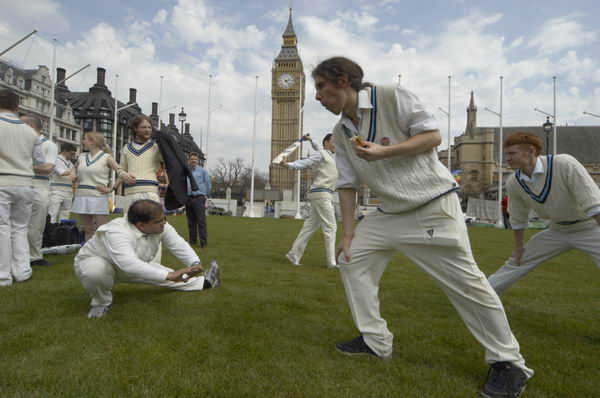
Spacehijackers team warm up waiting for the MPs who didn’t turn up

But of course I have photographed cricket. Not just a couple of games by the Space Hijackers – as here when they challenged our members of parliament (who if they noticed had the sense not to turn up) to a game on Parliament Square, but the real thing a few years earlier when I got a commission from my local council and the Arts Council to photograph one of the leading ladies teams in the country and in particular their younger members.

© 2001 Peter Marshall.
Juniors at the start of a training session at Sheppertone Ladies CC

The most interesting action was almost always off the pitch, and during matches of course I had to keep outside the boundary line, but photographing during practice sessions I was at times in some very silly fielding positions with a camera.

© 2001 Peter Marshall.
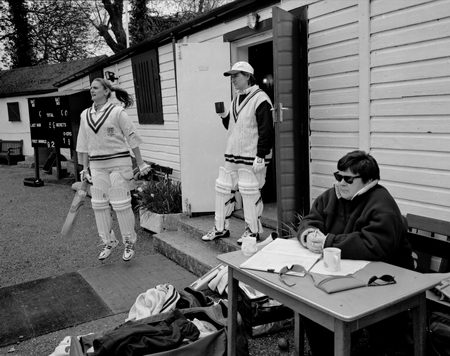
Batters wait their turn next to the scorer at Shepperton Ladies CC

It was a nice project and I enjoyed being with the people there. It is one of very few projects where I’ve worked with medium format, though I also used 36mm, particularly at some of the matches where at times a 200mm with a 2x converter was still a little on the short side for capturing action.

Halloween

I’m not a fan of Halloween, which seems just another sad synthetic commercial opportunity. There is something very unpleasant about the whole ‘trick or treat’ idea, a kind of demand with menaces (and one which sometimes gets out of hand.)

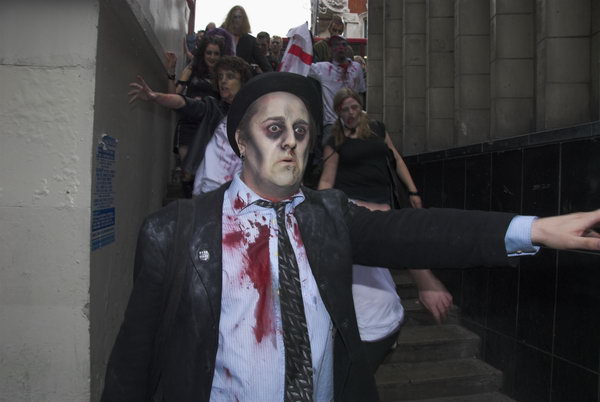
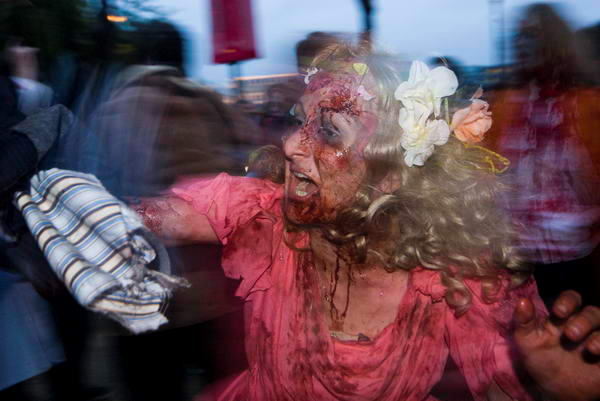
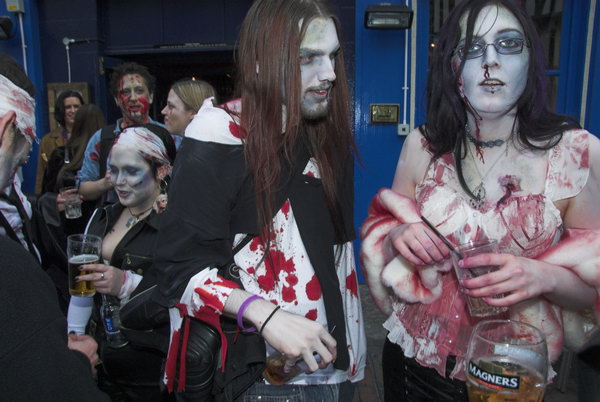
Not that I’m against people having fun, and I do rather like the sight of zombies invading our streets, generally simply out to have a good time and a bit of a party.  These and more formal Day of the Dead celebrations perhaps owe more to All Saints Day and All Souls Day than to Halloween which comes before them, although now they have been drawn into a single commercial exploitation.

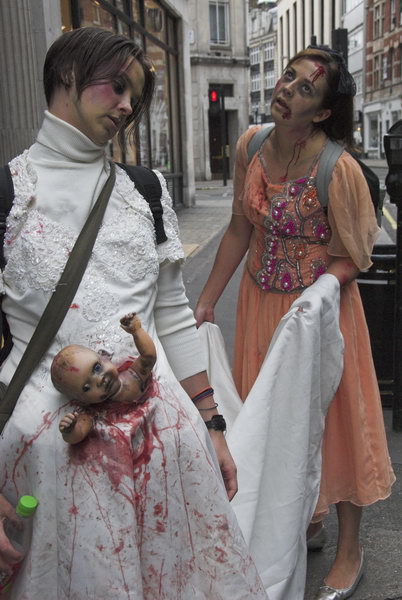
In 2006, (somewhere well down this page) I met up with some very fine zombies, including the two ladies below for a tour around Oxford St.

© 2006 Peter Marshall.

Starting from the very spooky Ben Crouch Tavern (now sadly converted to a pub I find rather plastic and unpleasant) we toured a shopping centre on Oxford Street and walked past the hard-core shoppers before slithering down the steps to Ramillies St (which later became the home of the Photographers’ Gallery),

© 2006 Peter Marshall.

and on to another pub at the top of Carnaby St.

© 2006 Peter Marshall.

On that occasion the pub ‘Crawl of the Dead‘ had started in late afternoon, and although the light was failing there was still enough to work with even by the time I left them.

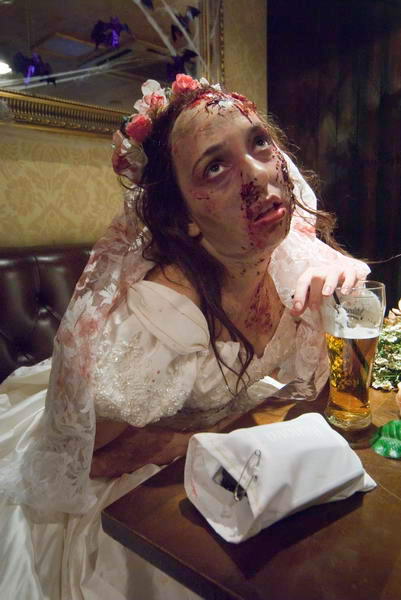
The following year, in the City of London, the Crawl of the Dead started later, which was probably better for zombies but not for photographers, though I was able to take some pictures before the start in ‘Ye Olde London’, a rather dimly lit pub with some appropriate decoration.

© 2007 Peter Marshall.

but by the time we got to staggering on the streets things were a little trickier.

© 2007 Peter Marshall.

It certainly didn’t help that my SB800 flash decided to pack up – in need of a rather expensive flash tube replacement – and I was left only with the built in flash on the camera, really only suitable as a fill, and not usable with big lenses which cast a shadow in the image area.

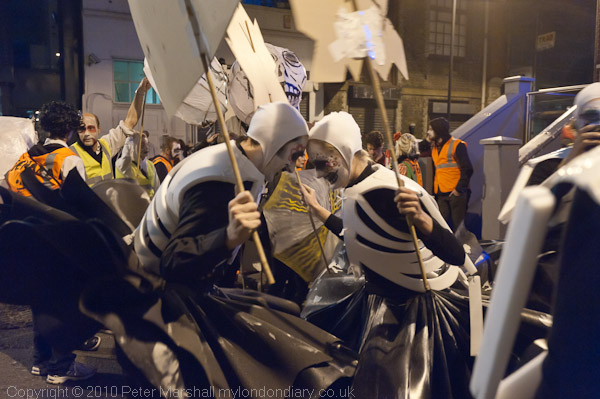
This year it was fully dark when the ‘Dance of the Dead’ street parade from Hoxton Square to Dalston was gathering, and the rather dim street lighting had the very orange colour of sodium lamps.

© 2010, Peter Marshall

So although there was just enough light in some of the brighter areas to take pictures at ISO3200 and get some reasonably sharp,  it isn’t possible to get good colour, even when shooting RAW, as the light is essentially monochromatic orange and sadly lacking in other colours.  The image above, taken at 1/20 f4 was about the best I could get.

Using the SB800 mounted on the D700 camera did produce some better results, but the orange light was still a problem. You can’t light up the whole world with a single flash, so I normally use flash at high ISO when I can to pick up enough ambient exposure to add some background detail. Because of the poor colour of that ambient and to get better quality in the flash lit areas, I compromised on using ISO1000. With the flash I was working at 1/60 f7.1 to get a bit more depth of field and avoid movement blur where the ambient was stronger.  I think that was equivalent to around 4 stops underexposure for the ambient, but I didn’t make a precise calculation.  Looking at the results on the computer now, I can see that the flash, despite being set at -2/3 stop was actually overexposing slightly, though seldom enough to burn out the highlights completely.

© 2010, Peter Marshall

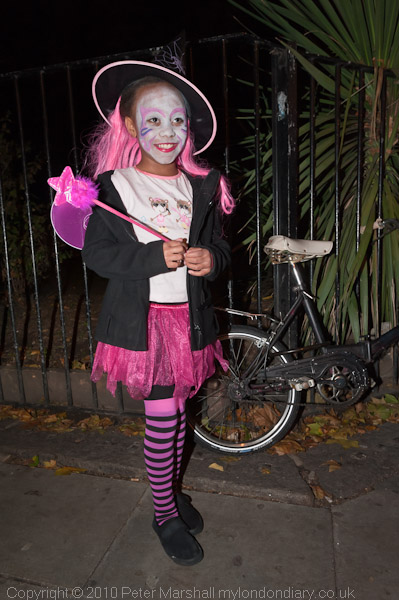
My favourite image from the event was also the simplest, a young girl waiting for the event to start. I photographed her first with her mother standing watching the preparations, then got down on my knees to make this image, in which her witches hat becomes a kind of purple halo.

There are some other pictures that I quite like – and you can see a largish set on My London Diary – but none that really lived up to my expectations, as it was a very tricky, fussy and at times fast-moving event. Perhaps if I’d followed the parade further I would have found some better lighting, and the dance at the end might well have been fun, but I’d been on my feet and taking pictures for over 7 hours and was feeling rather tired, and when I saw a bus approaching I rushed across the road to jump on it and start my journey home. Perhaps next year I’ll do better.

EDL & Israel

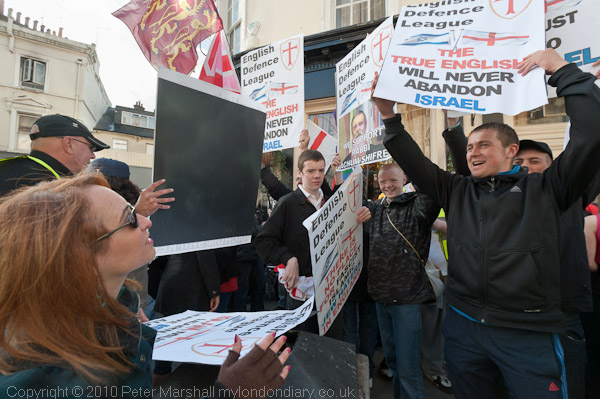
I have my disagreements with the English Defence League, but have tried despite these to cover their London events as objectively as I can. Some of them at least realise this and so I was able to cover the event with relatively little harassment compared to some of the other photographers present. Several of the EDL stewards were supportive, and I only had a couple of minor problems, which were soon resolved. At one point a woman did start shouting at me, telling me to get on the other side of the road, but I simply walked away into the crowd of EDL and I think one of the stewards had a brief word with her.

© 2010, Peter Marshall
Handing out placards to the marchers
The meeting place for the march had to be changed at the last minute as the pub they had planned to use had decided to remain closed when it learnt they were coming there. Perhaps this was why I arrived at the event rather earlier than the other photographers and for around twenty minutes or so was the only photographer on the pavement with the protesters drinking outside the pub. Of course we all like to get pictures that other people don’t but there are also times when you welcome the support of colleagues.

© 2010, Peter Marshall
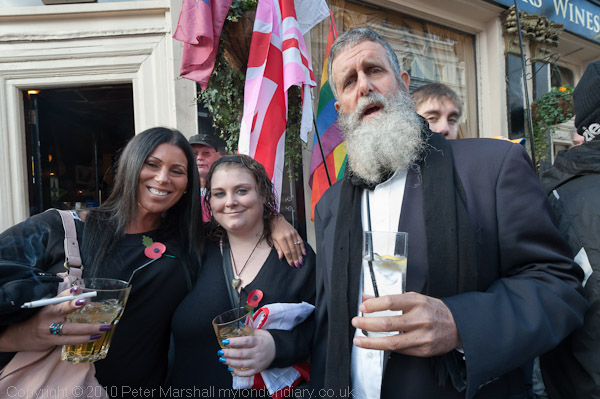
Rabbi Nachum Shifren with EDL supporters

Much of that time I was talking to the EDL members, and although most were happy to be photographed (and quite a few insisted on posing for me)  I spent much of the time being questioned about the way that the press in general treats the EDL, concentrating on acts of violence and pictures showing some of their more extreme members.  I tried to suggest to them that rather than blaming or attacking the photographers they should make sure there was no violence or other extremism to be photographed.

© 2010, Peter Marshall
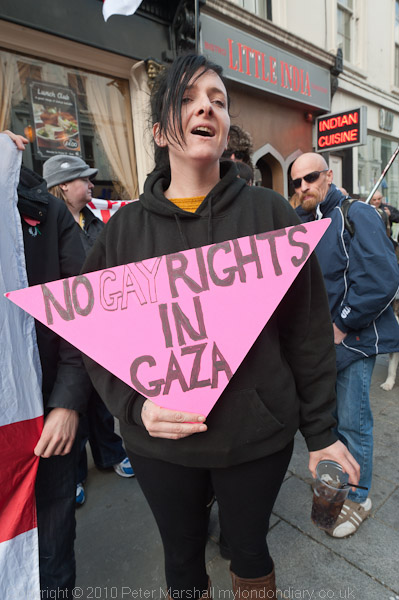
The EDL supports gay rights

The EDL are also pained at being labelled racists and were keen to point out that they will not allow racism and that they support gay rights, and there were several placards making this clear.

Later some of the same people I’d been talking fairly sensibly with were among those baiting several of my colleagues and were making threats at another photographer until a police officer came and stood between them.

It was the speeches which upset me most on this occasion. I find the stand they have taken over Israel and their opposition to the Palestinian people hard to understand, and they seem to me to go deeply against our British traditions of fair play and support for the underdog. There really does seem to be a failure to distinguish between opposition to extremist Muslims – which I share – and opposition to all Muslims, particularly those who live in this country and most of whom are now our citizens. One of the guys I talked to outside the pub told me that Muslims may live here but they are not and never can be English.  I had to disagree.

You can read my account of the march and rally opposite the Israeli embassy in London on 14 October – with many more pictures – on My London Diary.
Blurb’s London Celebratory Kickoff

 © 2010, Peter Marshall
‘WassinkLundgren’  and their winning portfolio

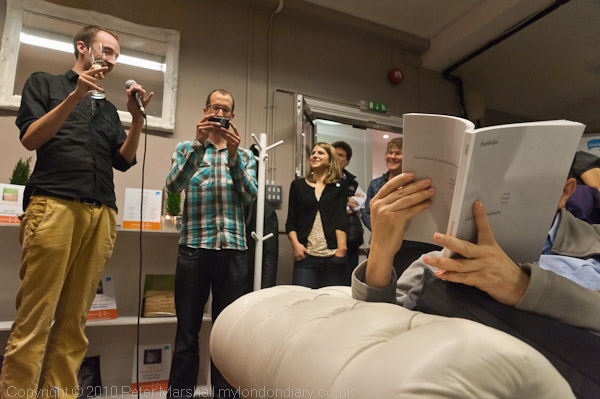
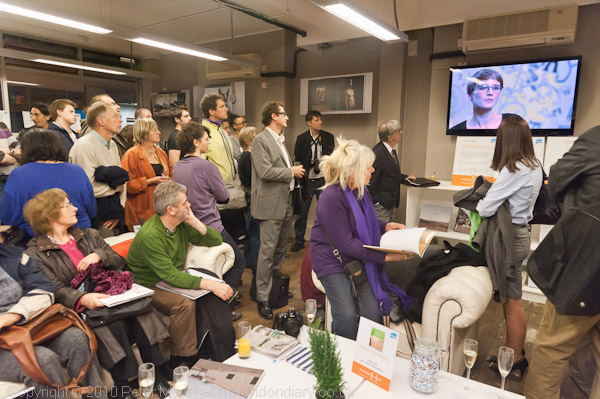
Last night I was at Eastcastle House for the start of Blurb’s London events, celebrating the new pop-up store and the 2010 Photography Book Now winning books.  Several of the winners were present including the Portfolio category winners, Dutch photographers Thijs groot Wassink and Ruben Lundgren, though we had to be content with Judith Stenneken, whose Last Call won the $25,000 Grand Prize, on video.

© 2010, Peter Marshall
Judith Stenneken on video

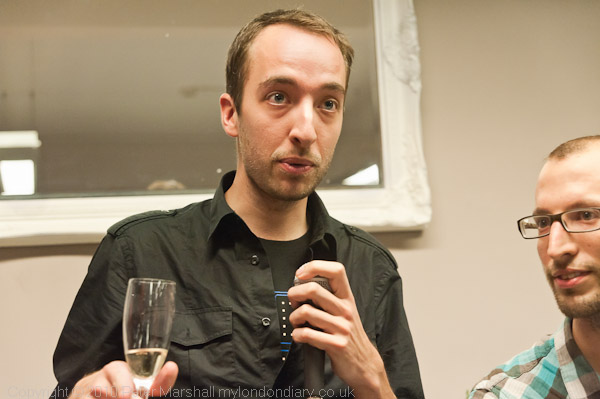
Some of the judges were there too, and I talked briefly to Martin Parr and a number of old friends at the event, as well as drinking too much fizzy stuff (I’m sure it was the bubbles that made me just a little unsteady as I walked towards the bus stop after the event.)

© 2010, Peter Marshall
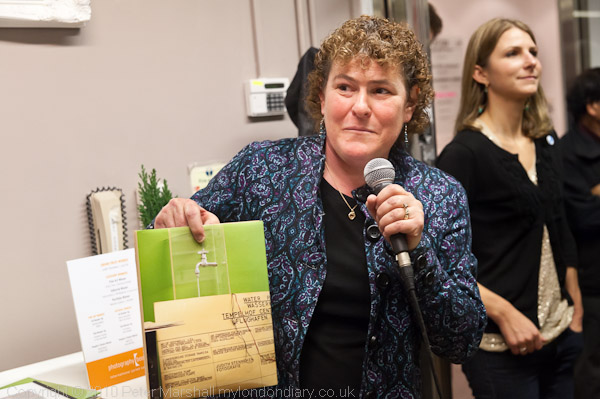
Robin Goldberg, Blurb SVP, International Markets, holds up the winning book

© 2010, Peter Marshall
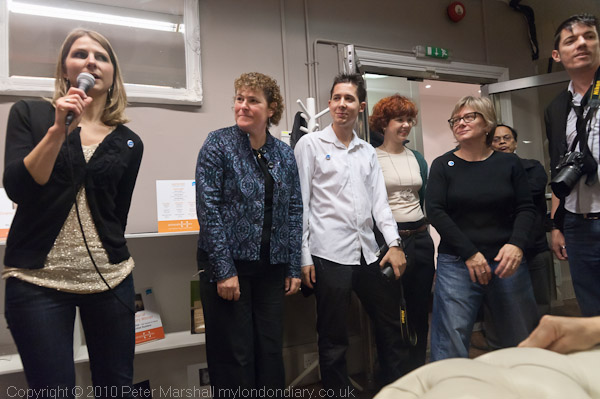
The Blurb Team

After this morning’s session, the events continuing at the London Pop-Up store until Nov 14 are free, and I’ll be there again talking on Sunday about ‘Before the Olympics‘ and my other two Blurb books. Also in Sunday’s programme are some of the Blurb winners, Anton Kusters and ‘WassinkLundgren‘ as well as Jonathan Lewis, and the day ends with a self-publishing debate with guest panellist Bruno Ceschel of Self Publish, Be Happy.

More pictures from last night on My London Diary.