Paris: Wandering in the 20e

© 2010, Peter Marshall

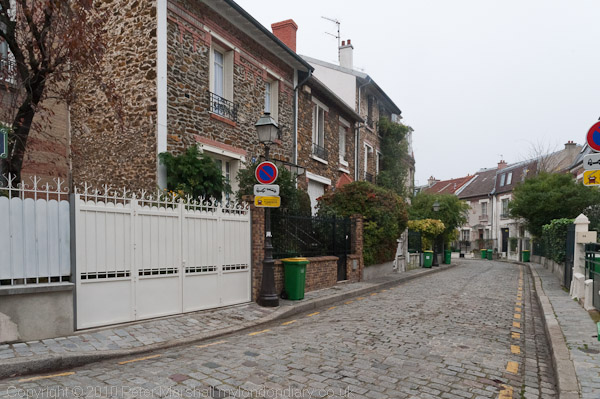
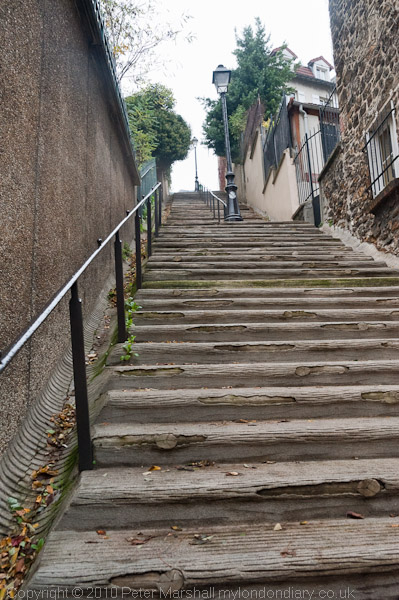
Paris has a number of ‘garden villages’ and one that I’ve visited several times is close to the eastern edge of the 20e, close to the Porte de Bagnolet on a small hill, reached on foot  from the south by a long flight of steps made of rather rustic concrete. It’s really just a couple of tightly packed streets tightly packed with small villa type houses, which undoubtedly have a certain charm and period detail.

© 2010, Peter Marshall

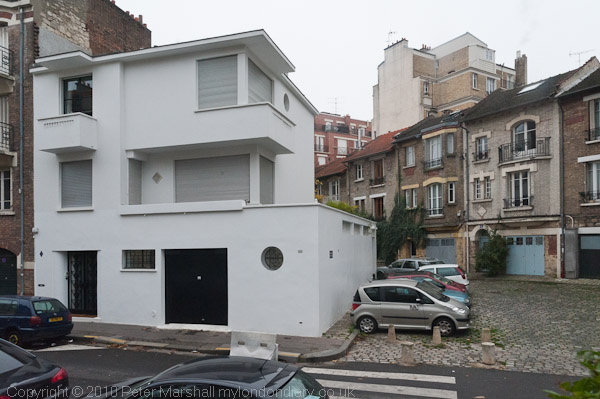
This small area was developed by a cooperative called La Campagne à Paris (the countryside in Paris) from 1907-1926 with around 90 closely packed houses with differing designs, from different architects, except for the more vernacular that just had builders, with small and often flower-filled front gardens (though some are now converted to give access to garages in what were presumably built as their wine cellars.) It comes as a surprise to find such an essentially car-free cobbled rural street in Paris.

© 2010, Peter Marshall

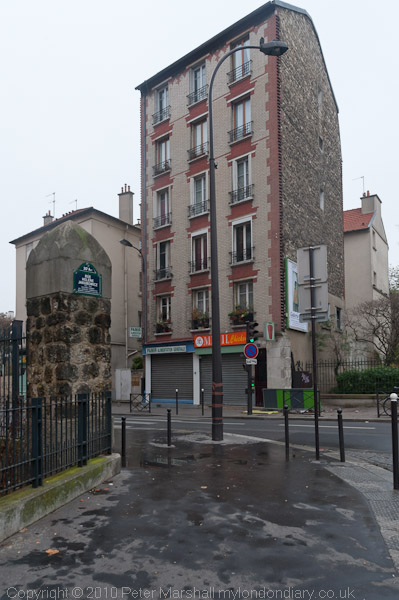
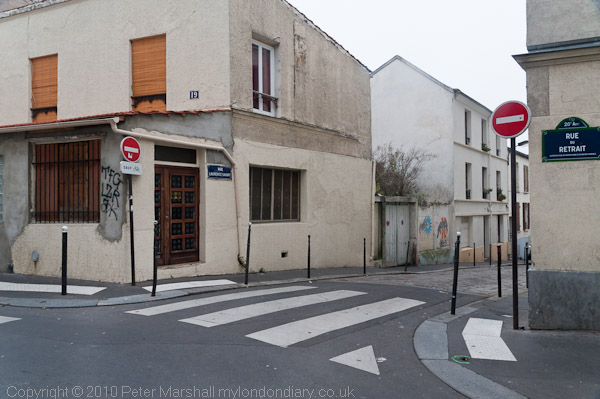
Beyond it is an area more typical of the outer areas of Paris, mainly distinguished by a whole rash of streets named after people killed in aeronautical accidents.

© 2010, Peter Marshall

© 2010, Peter Marshall

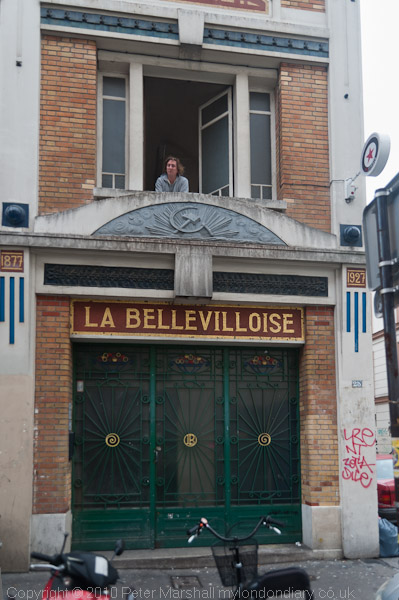
We continued our stroll westwards walking through some familiar alleys and streets, including some we had visited following Willy Ronis’s favourite trail a couple of years ago. There was an alternative big photographic event taking place at ‘La Bellevilloise’ all weekend, but I just didn’t have the time to visit it.

© 2010, Peter Marshall

On the Rue des Pyrenees the Bistrot / Brasserie where we had a fine lunch two years earlier had changed considerably – so much that it took us a few minutes to be sure it was really the same place. It was still a café and we were hungry, so we went in and had a meal, but it was rather a disappointment.

UPDATE:

PARIS PHOTO SUPPLEMENT is now on MY LONDON DIARY

Paris Party

© 2010, Peter Marshall

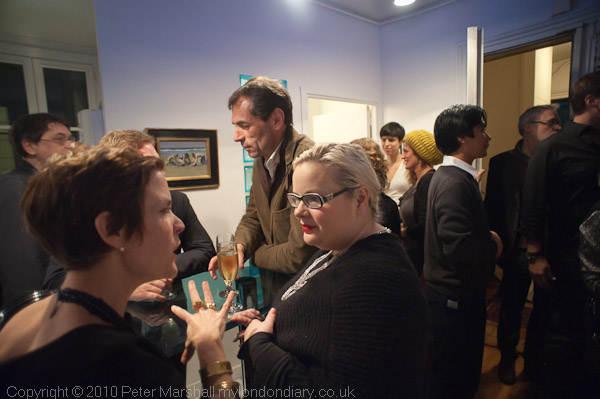
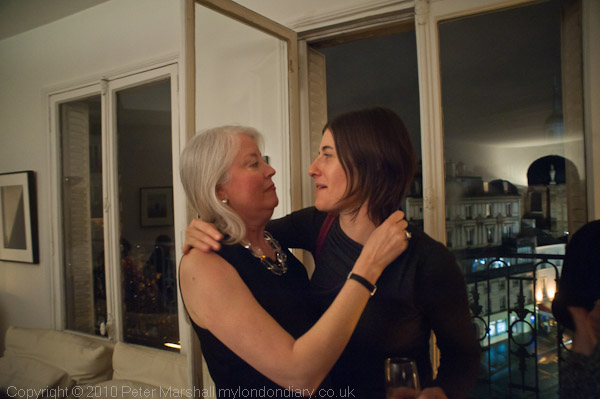
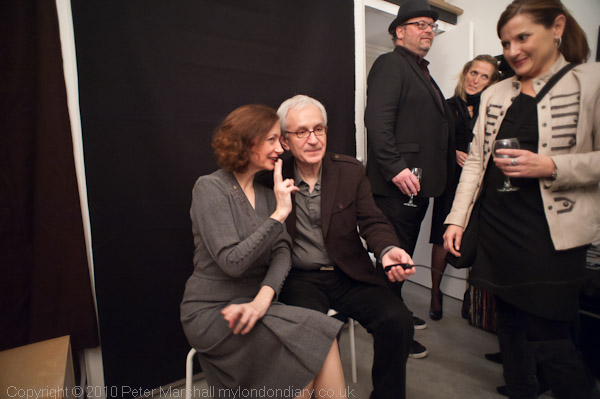
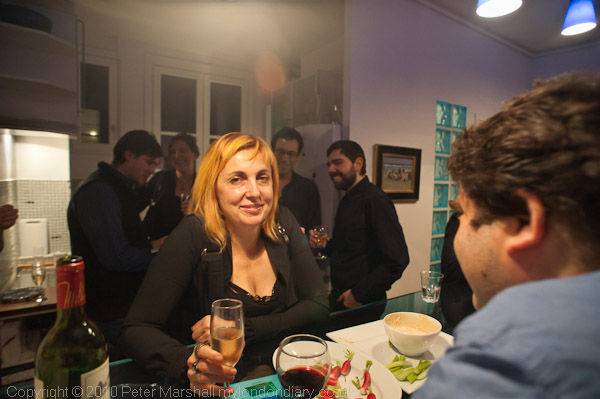
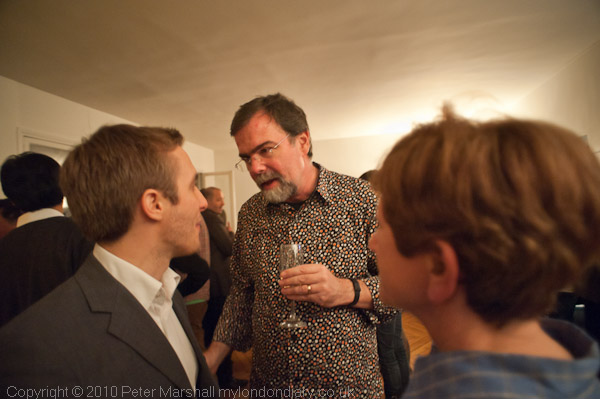
Lensculture is one of the best photographic web sites around, and Jim Casper publishes some great interviews and sets of work, and gets to know some of the most interesting people in photography from around the world. Quite a few of them were in Paris last week for Paris Photo, and quite a few were at a great party given by Jim and Millie in their flat on the rue Saint Antoine, where the champagne was flowing freely and, once I started taking pictures my shutter too.

So thanks to everyone – and Jim and Millie in particular for the invitation as well as all the others I talked to, including Joanne, Damian, Xavier, Vee, Ute, Mike, Ed, and all the others. If you are in the pictures I hope you like them, and if I missed you I apologise, but you may be pleased. Here are just a few, and I’ll put up rather more in a few days on My London Diary.
© 2010, Peter Marshall
You can see the rue St Antoine through the window

Technically all these were straightforward. All with the D700 and 20mm f2.8 Nikon, everything auto using program setting at ISO 3200, which gave exposures from mostly from 1/15 f2.8 – 1/60 f4 depenidng on the room lighting and exactly where people were standing. One or two were a stop or two underexposed. I doubt if you will notice from these small images, but I used rather stronger luminance noise reduction than I normally do when processing these images in Lightroom (I’m using Release Candidate 3.3 which seems fine apart from a few quirks in File Import, which also likes to crash occasionally) and although it significantly lowers the noise, it ends up with sometimes giving skin a slightly plastic look.

© 2010, Peter Marshall
The official party photographs – guests take their own pictures

It’s something that I’ve seen too on some high-end digital images – including some of the large Brian Griffin pictures I was looking at earlier before coming to the party, which were taken on a Leica S2, £25,000 worth of kit loaned him by Leica. I wonder if it really is how skin looks, at least under certain lighting conditions, but that we are so used to seeing it with film grain that our mind demands something with a little more visual tooth?

© 2010, Peter Marshall

As often when photographing by available light, rooms often contain light sources with differing colour temperature, and many low energy lights in particular are pretty discontinuous sources, with big spikes in their spectral distribution as well as some fairly empty areas.  The Nikon auto white balance setting usually takes a decent stab, but there is no perfect solution. Almost always if you use a neutral gray to balance the image it ends up looking too cold, and you need to add a little warmth by increasing the colour temperature –  perhaps from 2400K to 2650K. It’s then generally necessary to remove a little magenta. But always the important thing is to try and getting the skin tones look healthy, if not necessarily accurate.

In situations like this, working with colour film would have been pretty much impossible, and I would have shot on black and white, probably either pushing Tri-X to its limits or perhaps these days Ilford Delta 3200. But digital makes colour at least reasonably usable.

© 2010, Peter Marshall

I was sorry that I had to leave the party early – at around 11.30 when things were just beginning to really get going. But our hotel was rather a long way to walk if we missed the last metro.

More pictures on My London Diary.

Riot Girls?

© 2010, Peter Marshall
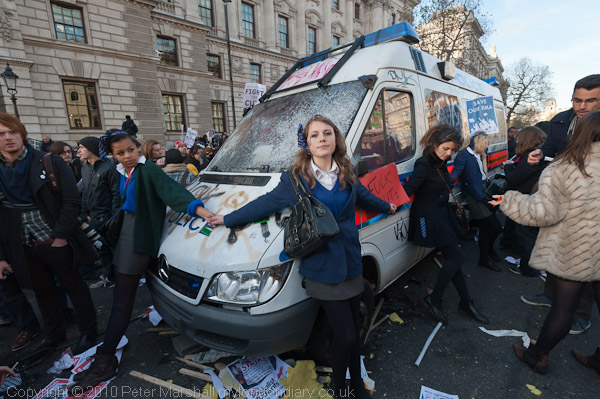
Schoolgirls join hands to peacefully stop attacks on a police van during student protests in London

Wednesday’s student fees demonstration in London had its interesting moments, but it wasn’t easy to photograph, partly because it was pretty chaotic. I got very much crushed in the crowd a number of times and it was fortunate that most of those there were friendly to the press – and when I went flying in the crush hands came out immediately to help me up.

I think together with most of the press who were actually there I was very clear that the police were determined to stop the students and try to discredit them, and that their tactics were designed to encourage the kind of mindless extremism that would give the protesters a bad name. The police took a lot of flak over their failure protect the Conservative HQ during the march on October 10 and were determined not to be caught with their pants down again.

© 2010, Peter Marshall
The start of the student march

Before they confined the large numbers of demonstrators in a small space in Whitehall the protest had shown its anger in the chants and placards, but had remained good-natured and entirely peaceful, at least so far as we could see.

Once prevented from the peaceful protest by kettling, things got a little more confused, but the great majority of those present were simply standing around looking confused. A few small bands of mainly young men who were masked up started to light small bonfires of placards in the middle of the street, and to push their way through the police, but gained little support.

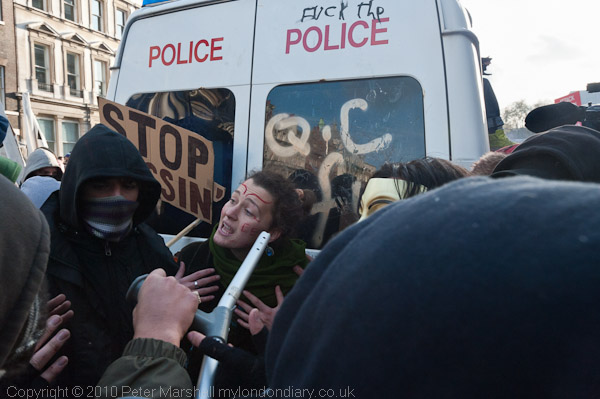
In what everyone present was convinced was a deliberate police ploy, one rather old and rusty police van – its tyre treads worn almost smooth, had been left in the middle of the area where the protesters were confined. Later I was told it was due to be decommissioned the following day, but was unable to confirm this. Stewards and others warned everyone not to be taken in by this trap and provide images that would be splashed over the right-wing press and TV of “violent disorder” that would be used to discredit the demonstration by smashing it up, but a dozen or two masked protesters took no notice, pushing those who tried to stop them out of the way.

© 2010, Peter Marshall
A young woman argues with masked protesters who want to smash in the van windows

I was threatened while taking pictures like this one that I had better move away or they would smash my camera. I had my suspicions that at least one of this group might be an agent provocateur, one of a number of student and ex-student protesters in the pay of the police. There is at least one such young man who I regularly see at protests, but I couldn’t see him. Another who had deceived all his friends for years and encouraged vandalism and illegal acts at a number of protests was unmasked a couple of months ago, and there are almost certainly others still in most activist groups.

By now a number of young women on the protest had begun to surround the vehicle, and I took a number of pictures, one of which – at the head of this post was used in a couple of newspapers, and particularly in a piece headlined ‘Student protests: the riot girls’, although the caption accurately records ‘Schoolgirls join hands to peacefully stop attacks on a police van during student protests in London’.

Today, Sky News published a video taken shortly before the demonstration was kettled which shows the van already abandoned and the entirely peaceful atmosphere on Whitehall shortly  before police imposed the kettle. Although it describes the suggestion that the van was deliberately left there as a ‘conspiracy theory’, at least it is beginning to ask some of the right questions.

Later there were some more violent scenes as students tried a little half-heartedly to push their way through the police lines and escape the kettle. I was watching from one on top of one of the tank traps, and it was clear that a determined group would have pushed through them with little trouble in the ten or fifteen minutes before reinforcements arrived. But most people who got to the front of the crowd simply stood there and watched the police, not wanting to get involved in anything other than a peaceful demonstration.

A few light sticks and placards and the odd mainly empty plastic bottle were thrown at the police, many falling short on the crowd. One officer clearly lost it at one point and lay into some of the demonstrators around the side of one of the barriers wildly with his baton, but his colleagues restrained him. At another barrier an officer in riot gear obviously decided he wasn’t going to miss the chance of a bit of mindless violence and launched himself into the crowd, but had to retreat when none of his colleagues followed his lead.

Soon people gave up and drifted away towards a longer police line blocking the way to Downing St – where I followed but it was too crowded too get near. I pushed my way back out of the mass and made my way round to the side and then managed to get in just in front of the police line, but by then nothing was happening.

Unlike some kettles in past years, the police at this point where little was happening let those with press cards through the line. They were also letting a few demonstrators – mainly younger girls – out so long as they promised to go away and not come back. I did not see any young men being allowed out in the ten minutes or so I was around there.

It was clear that the kettle was going to keep going for some hours, keeping protesters confined largely without food, water or any toilet facilities on one of the coldest days of the year, but there seemed unlikely to be much more to report. I went home to file my story around 4pm and it was not until 10pm that police reported the area as clear, around 8 hours after they had confined the protesters there.

© 2010, Peter Marshall
CU*TS

On my way home I’d seen a group of 12 mounted police, and had thought “On No!” but decided I couldn’t wait to see what would happen. It was several hours later before they made a charge into the protesters. The Met at first denied that this had happened, but although most of the press had gone home by the time it happened, it was still caught on video. More recently police have tried to diminish its significance by claiming that the horses were only “trotting”, but the difference if you are a protester in a dark and confused area is hardly significant.

The press were slow to pick up on the story – but the video had been on YouTube for some time finally appeared on the Guardian site. Next morning I heard it mentioned on the BBC Today programme which simply interviewed a police spokesman advertising how useful police horses were in public order situations rather than looking at the actual incident.

Brian Griffin – The Black Country

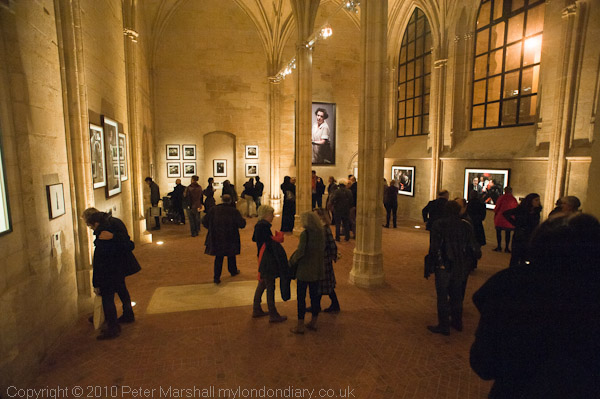
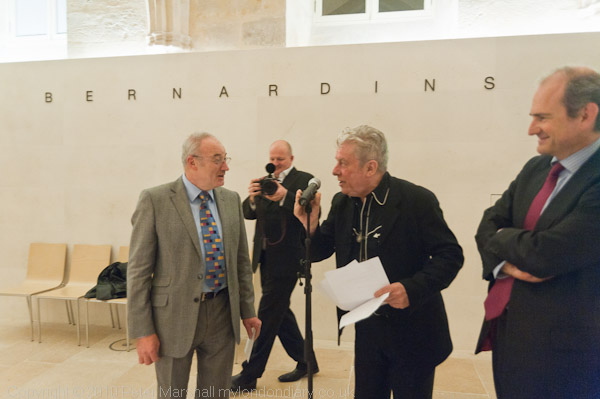
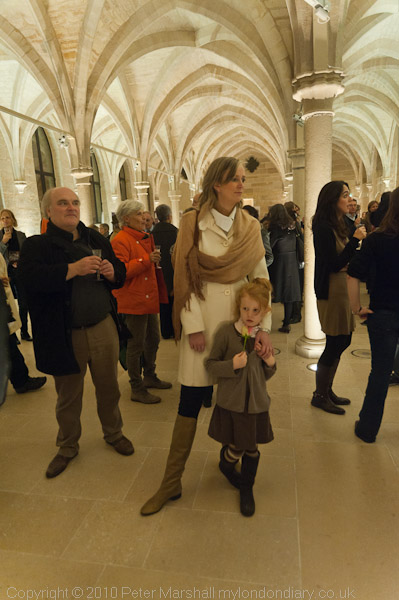
One of the more exciting events of the month – but outside Paris Photo, the Mois de la Photo and the Photo-Off as it was apparently planned too late to be included – was the latest show of work by Brian Griffin, The Black Country, in the superb setting of the recently renovated 13th century College des Bernadins on the Left Bank of Paris in the 5e.  The building is a splendid old religious building and Brian’s show was in its former sacristy, the place where the vestments, sacred vessels, and other treasures were kept. It was a building of impressive size and height and a fine setting for his work.

© 2010, Peter Marshall
The Sacristy at the College des Bernardins

The Black Country is a work that goes back to Brian’s roots, and to the town were he grew up, Lye, in the Black Country around the north and west of Birmingham. The area got its name from the coal seams close to the surface, and together with iron ore, limestone and clay this made it one of the powerhouses of our first Industrial Revolution. The particular specialities of the region were the making of nails and chains, and Lye itself was “the bucket capital of the world” and there were also brickworks and galvanising plants. The work was heavy and dirty. Many like his father worked in filthy jobs, inhaling dust and other pollutants, absorbing toxic materials through their lungs and their skins. Brian’s father retired in 1983 and died within 18 months, worn out and poisoned by a lifetime of poorly paid factory labour.

Brian’s mother Edith too had a hard life. Her mother had died giving birth when she was only seven and she had been left to care for her younger sister. She worked at a factory a short walk from where they lived, packing nails in boxes and making tea. They lived in a two-up two-down terraced house in a short cul-de-sac, in an area surrounded by factories. Although they had no running hot water, their house was unusual in having an inside toilet, rather than having to go out into the yard at the back. But bath night meant boiling kettle after kettle to fill a small galvanised iron bath with perhaps three inches of water, before each member of the family got in and washed themselves in turn. Brian was lucky as he got first turn. The landlord of their rented home refused to make any improvements or even do repairs to the property.

© 2010, Peter Marshall
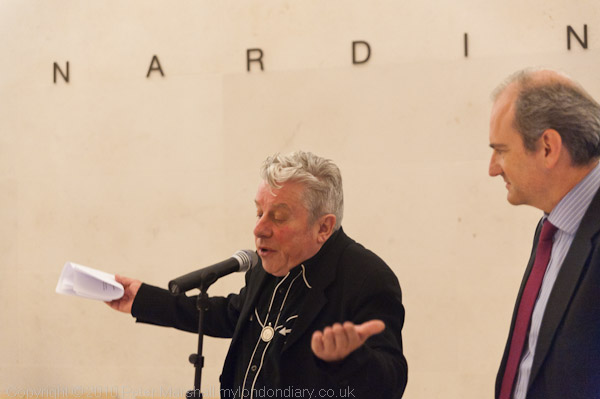
Brian speaking at the opening in Paris

Brian was the only kid in the area who passed his eleven plus; while everyone else went to the local Secondary Mod he went to Halesowen Technical School. But he had to leave and go out to work as soon as he was old enough. He was working in a factory in Lye when the foreman suggested he join the local camera club, and although he didn’t have any real interest in photography he did so. Three years later, after a girlfriend had left him, he wanted to escape from everything he knew and applied to photographic colleges as a full time student just to get away from Lye and everything he had known. Despite the fact that his pictures then were – as he says – “dreadful and displayed little talent” he was accepted.

The Black Country is an intensely personal project, inspired by the people that he knew in those early years and the experiences of life in Lye. Among those present at the opening was one of his oldest friends, a man from there, and during Brian’s speech they had a short exchange in the Black County dialect that would have defied most of the English speakers present, let alone the French.

© 2010, Peter Marshall
Brian’s assistant (right) at the Paris opening

Some of the people in the images, most of which were made on location, are from the Black Country, while a few others were carefully cast for studio portraits based on people he knew who are now dead. Brian works as a part of a team, and liberally acknowledged the contributions made to the project by his assistant, his stylist, printers and others.

© 2010, Peter Marshall

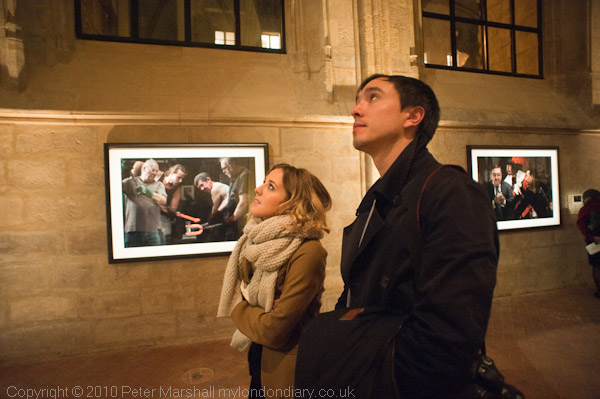
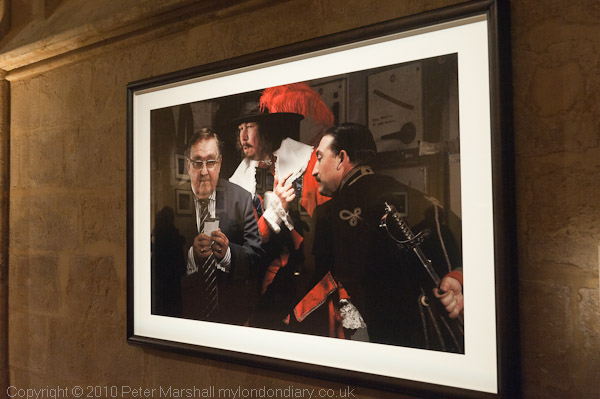
For me the strongest image was based on the Gunpowder Plot which fascinated the young Brian as the conspirators met just a few miles away and it’s mastermind, Robert Catesby was arrested not far away. The image was made in the Boro foundry where his father had his final job before retirement and the man on the left is Dennis Norton, the son of the man who employed him and who has now taken over as chairman and managing director of the firm. It’s a powerful and classic group image, based on a painting ‘Cardsharps’ by Caravaggio, with Catesby played by Steve Goldby, who has blogged about it, and the figure at the right is actor Callum Coates as the Earl Of Dudley, the landowner of much of the Black Country.

© 2010, Peter Marshall

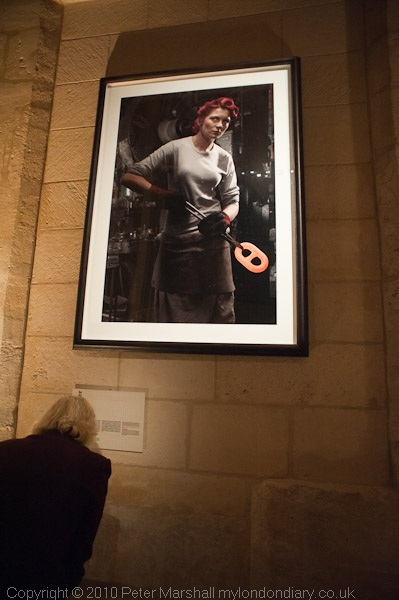
Another striking image shows a young woman as a foundry worker, holding a red hot chain link in tongs. The glowing link on her chain is echoed by a similar shape in her red hair, a small touch which really makes the image far more striking, and suggested by the stylist. The young woman was actually a worker in the factory, although not I think normally doing this particular job, and apparently before the shoot had always kept her hair combed straight down, but was rather taken by the effect.

© 2010, Peter Marshall

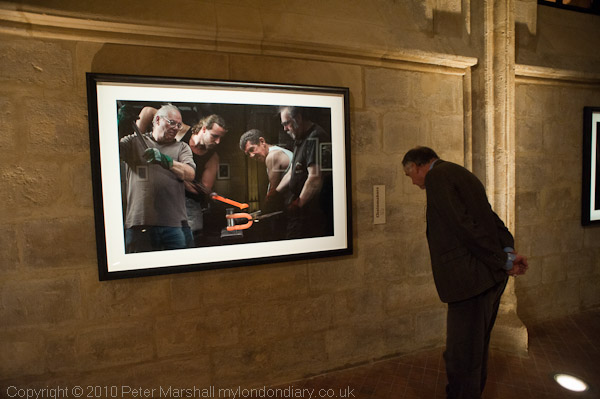
Another strong group image from the foundry shows a group of men making the chain. For me this show had a personal involvement by Brian that made it stronger than some of his other projects, but it also illuminated some of his earlier work. Included in the show were some of the portraits he made of workers at Broadgate shortly after the death of his father – and as he writes, “I photographed the men like knights lying in a cathedral with their swords.” His background (which in some respects is similar to my own) goes a long way to explain the empathy that he showed to the workers in his work on projects such as the Channel Tunnel rail link, and perhaps also a certain ruthlessness in some of his images of management.

You can see more pictures of the show and the opening on Facebook, and I’ll put more up on My London Diary shortly. In the meantime here are a couple more of my favourites from the opening. There were a couple of speeches in French, but as I expected Brian gave his usual fine performance, though parts of it proved tricky for his interpreter, and it was a more distinguished audience than most UK openings. I think this is his first major show in France (and he is one of those photographers who I think was entirely missing from Paris Photo) and it should do much to increase his reputation here.

I did find it slightly difficult to take photos holding a glass of champagne, though after several it seemed to get easier. The light level wasn’t too high in the sacristy, and I was glad I was using f2.8 lenses – the 20mm and Sigma 24-70 on the D700. Faster lenses wouldn’t have helped a great deal as most of the time I needed the depth of field, but it was good being able to work at ISO 3200 and know the results after processing would be fine. I did take a couple with flash as insurance, but the available light was so much better and of course less intrusive.

© 2010, Peter Marshall

© 2010, Peter Marshall
A little Black Country exchange

It was a very nice event, and a great show, and I was sorry to rather rush off when the official business was over (particularly as I could have had dinner) but Paris in November is a busy place and I had a party to attend!

More pictures on My London Diary.

Thursday Afternoon in Paris 3e

I’d chosen to meet Linda for lunch at the metro Filles du Calvaire so we could start our walk at the gallery of the same name, and for once our trains arrived from different directions at the same time and I shouted her name across the tracks. A short walk away we found a decent but not exciting café for the plat du jour and a beer.

© 2010, Peter Marshall

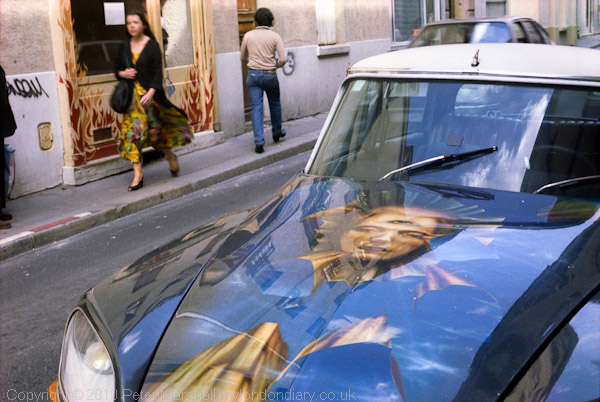
One of the pictures I took in Paris 3e between visiting shows – more below

The Galerie Les Filles du Calvaire was showing the work shortlisted for the 2010 Prix Pictet on the theme of ‘Growth’ which I mentioned in a previous post. Actually seeing the work for real rather than on the web did little to change my prejudices expressed then, except that I was rather more impressed by one of Edward Burtynsky‘s images. He is one of relatively few photographers where the large scale of the print is often vital to the appreciation of his work, although his largish images were relatively small compared to some of the other works on display as you can see from the gallery view. But whereas some of those larger works actually look better on the web – and you can see them on the Prix Pictet site – than they do on the wall, with his Highway #5, a mere 121.92 x 152.4cm is really necessary to do justice to the detailed nature of his work.  Had I been asked to vote on the day from solely the evidence on the wall, this picture would have been my choice.

© 2010, Peter Marshall

The rue des Filles du Calvaire leads on directly to the rue Veille du Temple which was studded with photography shows, including a number outside the MdP and the PhotoOFF. Most of them didn’t detain us long, a short walk around or in some cases even a look through the window was enough to convince us that they were not our kind of thing. But you can look at the work of Bertrand Flachot, Frédéric Chaubin and (in nearby rue Charlot) Arno Lam from the Photo-OFF and make your own judgement. If you think photographs are improved by scribbling on them, or that naked woman in landscape = art you may like the first two, while Lam’s work rather reminds me or some scientific photography of specimens undergoing stress tests. Some of Chaubin’s other work does seem to be a great deal more interesting that this and these three shows were of rather more interest than several that we walked past.

© 2010, Peter Marshall

By the time we got to the Instituto cultural de México I was beginning to lose the will to live but Ombre Et Lumière there revived me. Subtitled PHOTOGRAPHIE MODERNE MEXICAINE this show featured work mainly from the 1930s by Manuel Álvarez Bravo, Agustín Jiménez et Luis Márquez. Bravo has long been one of my favourite photographers and it was good to see a fine selection of his work. Jiménez and Márquez were very much photographers of the period but beside him seem rather shallow, making pictures that are often somewhat clever but, with one or two exceptions, not profound.

© 2010, Peter Marshall

The next good show we found was around the corner in rue Perche, New York Promenade – USA Underground at Galerie David Guirand. It was an enjoyable show, and you can read a good write-up in English on Actuphoto; this enjoyable show was one of a number in Paris (I was told around 50) which included work on loan from the extensive collection of the Maison Européenne de la Photographie.

© 2010, Peter Marshall

A few yards down the road was La Galerie Particuliere  with ‘We Are Watching You’ including work from two projects by Michael Wolf, large blowups of found images from Google in Paris Street View and also Tokyo Compression.  You can see a more extensive selection of work from his two Street View projects and the Tokyo piece, which shows people suffering from poor air quality in cars on his web site, and again I think this is work that hardly benefits – if at all – from the large prints on show. I would certainly have preferred perhaps two or three times as many smaller images.

© 2010, Peter Marshall

The next show of interest we came to was a short walk away in Galerie Sinitude, where Andoche Praudel was showing his series Les champs de batailles – panoramic views of battlefields around Europe, including Glencoe, Waterloo, Agincourt in the Photo-OFF. Also in the gallery were ceramic objects by Praudel, some of which bore some resemblance to cannonballs but with intriguing texture and decoration. However it was the photographs that interested me more, quiet scenes, sometimes with a certain air of malice, nicely printed on large sheets of cotton rag paper. It was an intriguing show, and the images had an unforced quality quite at odds with much I had seen earlier in the day at PP.

Praudel works with an Art Panorama 240, a similar camera to the Art Panorama 170, made in Japan and giving three 6x24cm negatives on 120 format film.  The 240 is normally used with a 105mm lens giving a rectilinear image with a horizontal angle of view of just under 100 degrees, around the practical maximum for rectilinear perspective.

The prints were around 50 by 200cm and appeared to be inkjet prints made on to uncoated traditionally made Japanese Washi paper made from Kozo, the most commonly used wood for the process. They have a slightly less bright and less saturated appearance than prints on the coated matte rag or baryta papers used for most gallery prints.

© 2010, Peter Marshall

By now it was getting a little late and the light was beginning to fade as we came to the final show of the afternoon, which was also a highlight. This was in the fine mansion of l’Hotel de Sauroy on the rue Charlot, and was a travel show with a difference, part of the MdP. Nous avons fait un tres beau voyage which included prints by Jacques Borgetto, Françoise Nuñez (from the Galerie Camera Obscura), Bernard Plossu (from the Maison Européenne de la Photographie) and Sophie Zénon. All of these are interesting photographers, but it was particularly the work of Plossu that caught my attention.

More pictures on My London Diary.

Thoughts on Paris Photo

There is no doubt that for a month every two years Paris is the centre of the world of photography, and at its centre is Paris Photo (PP), the largest annual trade fair for dealers and collectors, with this year over 38,000 visitors and some outstanding sales, particularly for work by photographers who were also showing in major galleries as a part of the Mois de la Photo (MdP). As well as the two Sudeks mentioned in my previous report, the PP press release also records a number of other large sales, with Edwynn Houk from NY selling a Moholy-Nagy print for 265,000 US dollars. Other work with a central European connection also sold well, with Budapest’s Vintage Gallery making sales of 22 prints with a total value of 58,000 Euros (€). Other high prices for older works included the entire (and rather boring) collection of images from a 1931 colonial exhibition held in Paris, bought by a Paris museum for more than €100,000 and a self-portrait by Man Ray which sold for €75,000. Hamiltons Gallery from London sold what I’ve always regarded as a spectacularly ugly image by Horst P Horst, his ‘Mainbocher Corset’ for 150,000 USD.

More recent work too seems to have sold well, although I think that some of the buyers may be regretting the high prices they paid for some of the pieces in a few years time. But there is certainly a lot of money around for a few people in photography, and New York’s Yossi Milo (one of the more interesting contemporary galleries) reported sales of 40 prints at €6-10,000 each. The gallery representing  Hungarian Gábor Ösz who was the winner of the 2010 BMW-Paris Photo Prize, Loevenbruck  from Paris, sold four of his pictures at €20,000 a time.

There were also good sales of some high priced collectors books, both rare vintage items and at least one of the kind of high price limited editions which I think are one aspect of the future of photographic publishing (when most more normally priced books switch to e-books and print on demand), ‘What Man is really like’ by Rachel Whiteread, (with story by Ingo Schulze and layout and case by Naoto Fukasawa) with 20 copies (half the edition) selling for €7,000 each though that does include 11 rather ordinary signed colour prints. It was a book that had it been remaindered at a tenner I would probably have looked at and put back on the pile. One gallery with some rather more desirable vintage books on its stand was rather less fortunate in that an expensive volume was stolen on the opening night.

Although PP is important, and it is an incredible treasure house for those of us with an interest in the history of photography as well as showing a considerable range of contemporary work, it is important to keep in mind that everything there represents a particular viewpoint on the medium. PP holds up a very distorted mirror to photography, and many great photographers of the past are missing simply because they made few prints, and most of those are already in museum collections. There are many from the more recent past, and many living photographers who have either chosen to work outside the galleries or, for various reasons, have not been taken up by them. And when it comes to contemporary work, the selection on view is very much a matter of current fashion.

This year it was particularly useful in the emphasis that it put on photography from Central Europe, but even this was a rather dim searchlight that only penetrated into a few shadows. Three years ago I was presented a book published by the Association of Polish  Art Photographers, ZPAF, ‘Polish Photography in the 20th Century‘ and including the work of around a hundred photographers, beginning with Edmund Osterloff, born in 1863 and ending with Pawel Zak, born in 1965. All seem from the one or two images in the book to have been as interesting as some more familiar names whose work was in PP, but I think only Stanislaw Ignacy Wietkiewicz, Jerzy Lewczynski, Zofia Rydet, Zofia Kulik and Bogdan Konopka were shown at PP, along with some younger Polish photographers, including those on the ZPAF i S-ka Gallery stand. There really is a great deal more to be found – and I think this is likely to be true of all Central European countries.

And of course not just those. Even for England – one of the two countries which saw the birth of the medium – the coverage is very patchy. I could have done a similar exercise with, for example, Photographers’ London, 1839-1945.

Any view of the history of photography will always be the product of a particular bias, and at the moment the two major aspects from which photography is viewed are those of academia and the art dealers. Both are very much centred in the USA, and both have over-emphasised the very considerable role of US photographers in twentieth century photography. We are still at the early stages so far as expanding both views, both with photography entering the art market world wide – and there were galleries from 26 countries at PP, 7 for the first time: Canada, Iceland, Luxembourg, Poland, Czech Republic, Slovakia and Slovenia, and only 16 of the 91 were actually from the USA (21 were from the host country, France) and photography gaining greater acceptance in the academic world of art around the globe.

Even in Paris, the real heart of photography isn’t in PP but in the many other shows scattered around the capital. Its at these, shows in the MdP, the Photo-OFF and many others that the real interest lies.

UPDATE:

PARIS PHOTO SUPPLEMENT is now on MY LONDON DIARY

Paris Photos Day 2

Paris rises every morning a divided city, with workers rushing around in the early hours emptying rubbish bins and other useful work but many shops and other businesses not opening until 11am, Paris Photo (PP) among them.

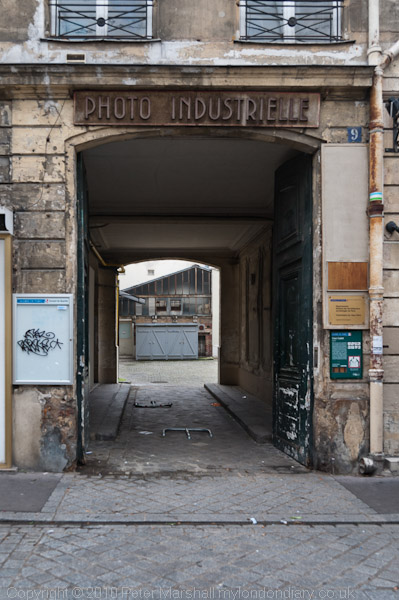
Fortunately my hotel room was pretty quiet and I slept every morning until 8am or later, but that still meant that after showering and having breakfast I had some free time before I could resume work at the Carrousel du Louvre, and I had time to wander a little and take some pictures.

© 2010, Peter Marshall

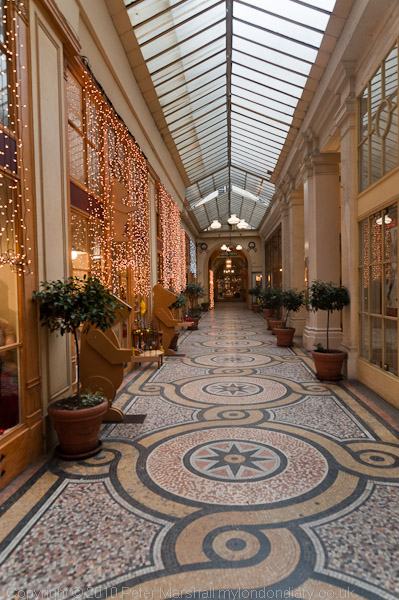
So on Thursday morning I took a leisurely walk that took me across the 9e and 10e and through some of my favourite Paris arcades, leading me to the Jardin du Palais Royal and then on to PP, arriving just in time to walk past the long queue building up for tickets and into the exhibition halls just as it opened. There are definite advantages to press accreditation, and not just the cost, though a VIP pass would be even better!

© 2010, Peter Marshall

It was also a useful walk for Linda, who called in at a hardware store on the rue Cadet and found exactly the rotary grater she had been searching for months without success in England. In France they still cook rather than stick prepared meals in the microwave.

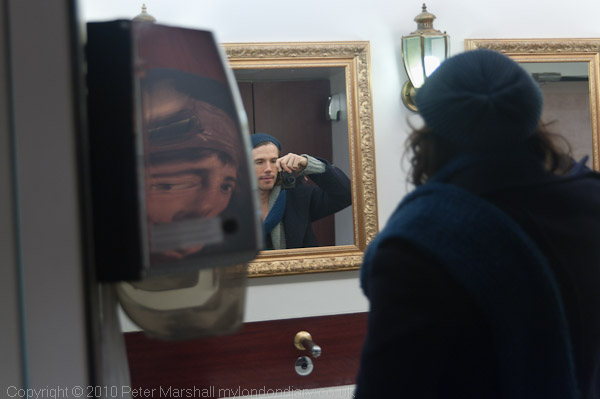
In PP, my immediate destination was the toilets, where I found a man taking a picture of himself in the mirrors, and having photographed him I took a picture of myself too – on My London Diary later.

© 2010, Peter Marshall

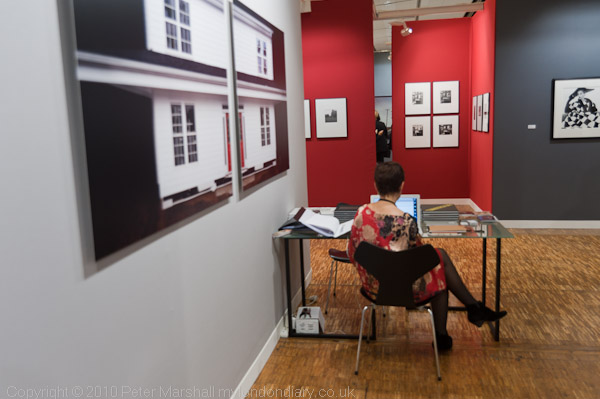
Then it was down to the real business, and I started on the central block of stands in the Salle le Notre. All of the galleries had some work of interest, but one that stood out for me was Bruce Silverstein, with a fine set of pictures by Robert Doisneau. I was specially pleased to see a set of four images from a taken from inside the gallery with a painting of a nude woman displaying her ample derrière, the best-known of which, usually called ‘Sidelong glance‘ shows a man and wife, she talking animatedly about the picture in front of her which we can’t see while his attention is clearly drawn to the nude. My favourite of the others was of a gendarme pretending not to be looking at those curves; it’s an image I have seen before, but it was good to see them again together, along with a good number – perhaps 20 prints in all of other images by the photographer, a mixture of familiar favourites and some I don’t think I had seen before.

© 2010, Peter Marshall

With so much big bad colour on show at some of the stands (there does seem to be something of a rule that the bigger pictures are the more likely they are to  be hideous) it was a delight to come across the little precise observations of Jessica Backhaus at the Robert Morat gallery from Hamburg. Backhaus grew up in Berlin, studied photography in Paris where she made friends with Gisèle Freund, and now lives in New York. Her series “What still remains” which she started in 2006 “explores the question why forgotten or abandoned things turn up in certain places and how they seem to develop a life of their own.” These  prints, roughly 11×14″ are obviously both taken and printed with a great deal of care and feeling and have an intimacy with the things and places they depict. The colour is natural, with normal saturation (a fairly rare thing in PP) and the printing just sings a true and beautiful tone.

© 2010, Peter Marshall
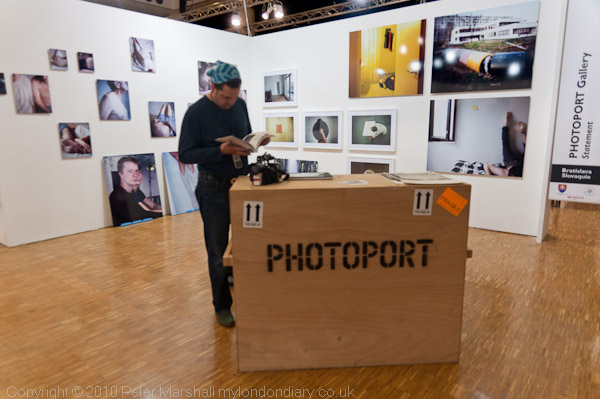
An ingenious solution by Photoport from Bratislava about what to do with your packing case

Magnum‘s display I found disappointing. Not that there were not some fine images – for example by Bruce Davidson – but that it was just too bitty, and some pictures, both old and new work, were I felt not well printed.

© 2010, Peter Marshall
La France – Depardon

Perhaps the most interesting pictures for me were two of the three prints by Raymond Depardon, from his La France (you can see 5 minute film in which he talks in French about the project as the images slide slowly by on the BnF web site.)

I stopped off at the Purdy Hicks stand to take another look at the two large images by Tom Hunter from his Unheralded Stories. One that I was familiar with was Anchor and Hope (2009) taken on Walthamstow marshes looking across the Lea Navigation towards that Fullers house in Upper Clapton, and based on one of my least favourite paintings, the 1948  Christina’s World by US painter Andrew Wyeth, while The Death of Coltelli (2009,) also on show, is based on a detail from a painting by Delacroix, The Death of Sardanapalus, hanging in the Louvre just a few yards away. Hunter has chosen just one figure from the chaos in the painting, the king’s mistress, arms stretched out apparently unconscious at the feet of the king who sits up on his bed apparently unmoved by murders and other violent activity around him as the massacre he ordered of his women, slaves and horses takes place before he by his own choice is to be burnt to death on a sacrificial pyre.

Hunter’s picture, charming though it is, takes the pose of the woman and little else, setting her in a quiet domestic bedroom, looked down on by a photographic portrait of an elderly woman, a plaster religious statue, two framed religious images and a few other knick-nacks. Her eyes are open and she looks fairly unconcerned in what is a mildly erotic image with some rich colour.

© 2010, Peter Marshall
Ellen Kooi

Minutes later in the Salle Delorme, I found myself standing in front of another photographic reprise of Christina’s World, this time on the Beaumontpublic stand and by Dutch photographer Ellen Kooi. Although I like much of Kooi’s work – and she is a photographer who like me has a great interest in panoramas – I found her take on Wyeth less interesting (and I think there is another version on her own site.) Of course that could be because of my particular interest in the Lea, having just produced a book about it. And although I like Hunter’s image, I couldn’t for long live with grass that was such an intense blue-green – really on Walthamstow Marsh it never looks like that.

© 2010, Peter Marshall
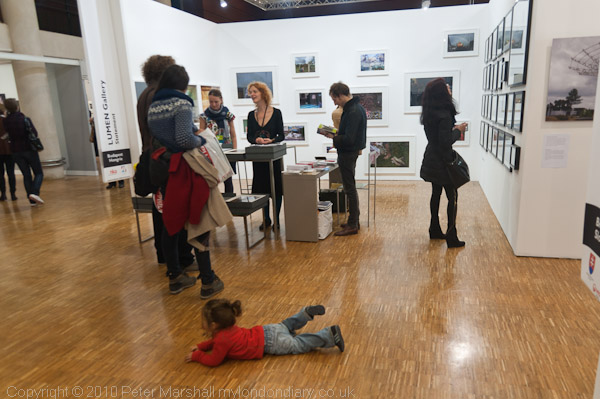
LumenGallery, Budapest

I haven’t mentioned so far the particular focus of this year’s PP on photography from Central Europe. Some of it I’ll write about in a later post on a book launch I attended the following day, and other aspects were already so familiar to me – the work of people like Sudek, Funke, Rossler and the great Hungarian exodus which took Kertesz, Brassai, Moholy-Nagy and others west and others are already so familiar that the show told me nothing new. Others I felt were very poorly represented here, including a number I’ve met and written about such as Antanas Sutkus from Lithuania.

There were three of the galleries exhibiting as a part of ‘Statement’ on Central Europe that particularly interest me. One was Galeria ZPAF from Krakow (The Association of Polish Art Photographers, web site in Polish), the  which I’ll write about when I’ve had time to have a good look at the CD they gave me. A second was Lumen Gallery from Budapest, and you can read about their show at Paris Photo on their site, but I’ll mention them again in a post about the book launch there on Friday, and the third was another Hungarian gallery, Zsofia Faur. The work that most impressed me on their stand was by Anna Fabricius, on her web site as ‘Tigress of Housekeeping.’ There was only room on the stand for 8 of the nine pictures from this series which were displayed as large colour prints. Although these were fine, I still felt it looked better and was better suited to the presentation in the book of her work.

Finally for this post, I’d like to mention my favourite print of all those I saw at Paris Photo, on the Johannes Faber stand. It was a pigment print made by Josef Sudek, Three glasses (1951) unfortunately not shown on their web site. One tall glass in the centre of the image is half full of a dark beer and there are empty foam-stained smaller glasses in front and behind. It is a dark image, one that I don’t think I’ve seen before and that doesn’t seem to be anywhere on the web. If I had a spare 48,000 Euros I might have considered buying it. There were other Sudek images in the show – including two more on this stand, but compared to this they were ordinary (and some rather poor, probably proof prints.) While PP was taking place, Sotheby’s were running a photography auction in Paris, where one Sudek print sold for 300,750 Euros (the estimate was 18-23,000) and another for 228,750 (estimate 14-18,000) and this was in my opinion a rather better image. So it could have been a bargain.

But by this time my feet were getting tired and it was time to meet Linda for a rather late lunch in a cafe near Filles de Calvaire, from where I’ll take up my Paris wanderings in another post.

More pictures now on My London Diary.

Paris Day One

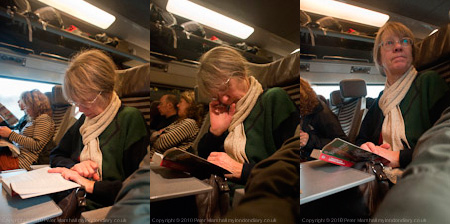
Our Eurostar train got through London from St Pancras at an impressive lick and soon we were at Thurrock before diving down under the Thames to stop at Ebbsfleet. Where almost every passenger probably looked out of the window and said “Where the hell is this?” as we stopped in a deserted station. But soon it was on its way, sweeping across the Medway and on, and we were in the tunnel and arriving in France before I’d had time to finish my sandwiches and the small bottle of red wine I’d taken for the journey.
© 2010, Peter Marshall
England – Tunnel – France

Getting to Paris took a little longer, but we were pulling into the Gare du Nord just around 138 minutes after leaving St Pancras, a couple of minutes early, and hurrying along to the RATP ticket office to get ourselves a Navigo Découverte card which would carry us around Paris on buses and Metro for what seemed a rather small sum for those accustomed to London fares. So my next significant photograph was a rather small  – 25x30mm one of myself, which I slid across the counter and was then attached to a card in a thin plastic sleeve.

© 2010, Peter Marshall
Navigo Découverte

Once you’ve paid 5 euros for the card, you can charge it with a week’s travel across the city of around 18 euros. Unlike London’s Oyster card there are no arcane regulations, although it is less flexible in that the weekly season can only run from Monday to Sunday, and you can only buy it up to Wednesday in any week. But all in all it’s a much better system.

We didn’t need the Navigo to get to our hotel – it was just a short walk – but I wanted to rush off for Paris Photo as soon as we had booked in. This took a little longer than expected as when we arrived we were taken a quarter of a mile to another hotel for our first night as maintenance work meant our room would not be ready until the following day. Fortunately the new hotel was equally close to the metro and soon we were able to rush out to take the train to Paris Photo (PP).
© 2010, Peter Marshall
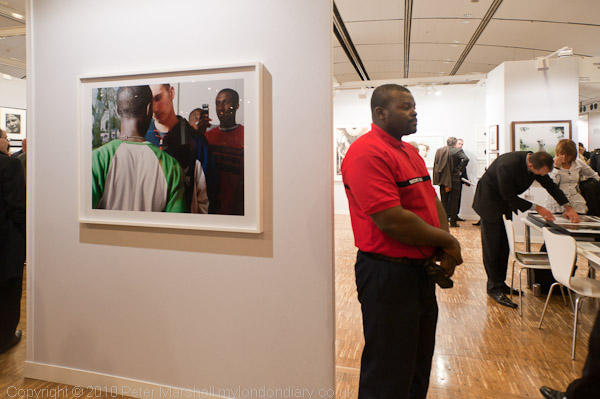
Salle Delorme, Paris Photo

PP takes place in a subterranean shopping and conference centre, Le Carrousel du Louvre,  underneath the Louvre and the Jardin du Carrousel. Two short escalators take you down from street level on the rue du Rivoli or you can exit directly from the line 1 Metro station and walk a couple of hundred yards to the show. From the ticket hall you enter into a central area which includes a number of smaller stalls for publishers, a cloakroom, a bar area, offices and a small exhibition area as well as a stand featuring a BMW or two – BMW are the major sponsors of the show. They provide the money for the BMW-Paris Photo Prize, the short-listed entries for which are up some wide steps on a mezzanine floor above the rear of the central area.

Off three sides of the central area are three exhibition halls with the stand of the various galleries and larger publishers taking part. The stands vary in size, and even more in the number of photographs on show, with some having only a few mural size images and others being crammed with much smaller work – even done to some showing small contact prints.

The only way I can cope with such a huge show – 106 exhibitors from 25 countries – is to approach it in a systematic way, working around the 3 major exhibition halls. I started during the press launch and opening on Wednesday by working around the outer stands of the Salle Le Notre, then moving on to the outside of the Salle Soufflot and finishing with a part of the outside of the Salle Delorme, and coming back in later days to finish the circuit and do the inner blocks of each room. It was the only way I could be sure of seeing everything.

Of course some stands did not detain me long. Many had work that either did not interest me, or that I was already very familiar with. It is sometimes nice to see work you really like “in the flesh” like the Kertesz image Martinique (on the Stephen Daiter Gallery stand and later I found it elsewhere) I’ve written about at some length from its reproduction, though just occasionally the experience can be disappointing, but I’m really more interested in discovering new work that excites me.

Another of the good things about PP is that virtually everyone seems quite happy with people taking pictures of the pictures, unlike many museum and gallery shows – though the only place I went to during the six days I was in Paris where photography was explicitly banned was the Maison Européenne de la Photographie (MEP), though with almost everyone now carrying a camera-phone such bans are virtually impossible to enforce.

One thing that struck me on that first night – and a partial look at PP, was there number of pictures by Bernard Plossu, with a particularly nice set on the stand of Galerie Le Réverbère, Lyon. Plossu is a French photographer whose work has long interested me, and I have a couple of his books including perhaps his best work, ‘New Mexico’. There is a large amount of his work on the ‘documentsdartistes’ web site – click on the images on the thumbnails page to see more.

The work shown by dealers at PP relates to that on show elsewhere in Paris, so Plossu is the major artist in a splendid free show, part of the Mois de la Photo (MdP), ‘Nous avons fait un tres beau voyage‘ at the Hotel de Sauroy (58 rue Charlot, Paris, 3e) until 15 December 2010. It’s a show I very much enjoyed when I saw it later in the week.

There was a lot of Kertesz’s work throughout PP too, to link with his major show at the Jeu de Paume (1 place de la Concorde, Paris 8e) until 6 Feb 2010. Although I’m a great fan of Kertesz, I have seen his pictures so many times. I also have several books of his work and although I enjoyed seeing the many prints of his on display at PP didn’t feel any need to spend time going to see another show of his work as well.

I was particularly struck by a small set of 5 pictures by Lise Sarfati on the Brancolini Grimaldi stand, from her series ‘She‘; the two images of ‘Christine‘ one in a wedding dress and the other apparently in the middle of a desert in California stood out for me.

It’s always good too, to see work by photographers I’ve written about before – and especially if I’ve actually met them. There were some of Vanessa Winship‘s pictures on the ‘Vu Galerie‘ stand (and more of her work from Turkey on ‘The Empty Quarter‘. Vu also had some pictures by John Davies, particularly one from Widnes and another from Blaenau Ffestiniog that I admire. They were also showing the work of Denis Darzacq, although I found these images from his ‘Hyper‘ somewhat less striking than his earlier work in ‘La Chute‘.

But the most striking of all the new work that I saw on that first evening were a large set – around 16 – prints by Lee Friedlander from his ‘America By Car’ series of 192 prints showing at the Whitney Museum in New York until 28 Nov 2010 and at PP on the Janet Borden stand. You can watch the pages of the book of the work being turned on YouTube.

This is inventive and well-printed work that really fits well into the square format and came as something of a shock in the middle of a show rather dominated by very large (and often poorly printed colour images. Much of the black and white work around the show – with notable exceptions – isn’t well printed either, so it was a delight to come upon this set.

Just how many ways can you make use of the structure of a car – its door posts, mirrors, fascia , window – in a photograph. Certainly on the evidence here, rather more than sixteen. Of course the content framed by the car is also both vital and in Friedlander’s case superbly matched, the two integrated into a vibrant whole by the work of the printer.
© 2010, Peter Marshall
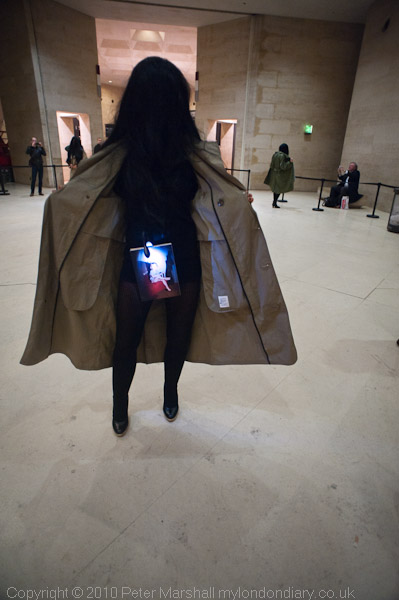
QQQOC counter-event outside Paris Photo

Having seen this, it seemed a good time to leave PP for the day on a high note, and in any case I needed some dinner, and it was time to meet Linda again. On the way out from PP we were greeted by several women in long coats who were rushing up to people and ‘flashing’ open their coats to reveal an illuminated photograph. This was a ‘CONTRE évènement’ against Paris Photo, inspired by its Central European theme and the clandestine circulation of ideas necessitated by state censorship. You can read more about that – in French – and watch videos of the QQQOC artists confronting those leaving and entering PP.
© 2010, Peter Marshall

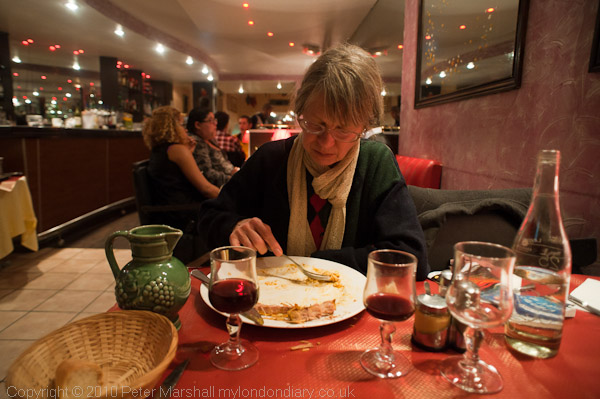
We took a short stroll through the centre of the city to enjoy a leisurely and pleasant cafe meal. Afterwards we strolled again through the Isle St Louis and then looked in vain for a bus back towards our hotel. Fortunately we were still in plenty of time for the Metro.

A few more pictures are now on My London Diary.
Not Quite News From Paris

First an apology for not posting here for almost a week. I’d hoped to make at least some brief initial reports while I was actually in Paris at Paris Photo (PP) but several things defeated me.

One was the Internet provider. I use a BT-provided service which claims to give me access at thousands if not millions of locations around the world. It links to a map of them, and zooming into the part of Paris around where I was staying shows them crowded around it, but it proved to be more of a virtual network than I expected, as on the several occasions I tried none appeared to be in range.

The hotel I was staying at didn’t offer Internet access, except through a special and rather expensive terminal for checking e-mail. It’s cheap hotel I’ve stayed in previously and is basic, but reasonably comfortable, close to a useful Metro station and an easy stroll with luggage from the Gare du Nord where my Eurostar arrives. The kind of place where half the rooms don’t have a plug for the sink (and this year we forgot to take ours) and small children would quickly electrocute themselves from the socket hanging off the wall or the open tops of bedside light fittings. But the rooms we’ve stayed in there have been warm enough, unusually quiet for central Paris, had plumbing that works, plentiful hot water and comfortable beds, and it provides a basic breakfast all in at a price less than the admittedly rather more sumptuous breakfasts at some luxury hotels.

But the real reason I didn’t post was simply a lack of time. There was just too much to do and to see, and most of it connected with photography. PP itself, with stands from over 90 of the best-known galleries from around the world – some with large collections of work on show, as well as all the best-known publishers and magazines was just a start.

It was also the Mois de la Photo (MdP) in Paris, with its long list of shows in galleries around Paris – almost 60 of them, and the Mois de la Photo-OFF which sensibly limits itself to a hundred shows. But these things are just the tip of the iceberg, and on almost every occasion I was making my way to one of these listed shows I came across two or three others.

Last Friday afternoon, after a rushed lunch, I hurried to a book launch at a stand in PP itself for a glass of champagne and a copy of the book (more on this and most of the other things I mention here later) before spending a few minutes looking around the dozen or so stands of the show I’d not managed to see in my previous two visits. The I let myself wander a few minutes around the Jardin du Carrousel before strolling along by the Seine and across the Pont des Arts to the Institut de France fore the superb landscape show there – part of the MdP.

Leaving this I looked briefly at several other shows as I strolled down to St Germain des Pres, where I’d arranged to meet my wife who had been watching a film somewhere in the 5th arrondissement. Together we went to the Magnum gallery to see the MdP show there, mainly pictures from his new book ‘La France’  (Bruce Davidson had just arrived there to start a book signing) before going to a cafe for a beer – or a cofee for Linda. Magnum had been our first stop on ‘Le Parcours Photo Saint-Germain-Des-Pres’ and in the next couple of hours we looked in at the other 30 shows on a trail around the area, as well as two more in the MdP – Eikoh Hosoe and Ralph Gibson – in the area but not part of the walk. We didn’t go in everyone of those 30 on the trail – most specially open that evening until 7pm – there were a few where a quick look through the window confirmed it wasn’t worth stopping, but most of them, and there were a number of highlights, including a small show of the work of Marc Riboud which had a very nice picture of a street in Leeds.

By then it was time for a little more refreshment, after which we took a late evening trip to Montmartre – just a short walk and a funicular ride from our hotel. Then a bus ride down to Place Pigalle and a walk back – by the time we arrived in our room I was too tired and it was too late to do anything but sleep.

Next time I go to Paris, perhaps I’ll be better equipped – one day I’ll surely buy a new phone that does more than make telephone calls – and less ambitious and simply try to make the occasional tweet about what’s going on.

Over the next few weeks I’ll gradually work through the copious notes I made during my trip and get working on the many pictures I took. There are certainly many stories to be told and quite a few will appear here before too long.

UPDATE:

PARIS PHOTO is now on MY LONDON DIARY

OFF to Paris

I’ll shortly be on my way to Paris, travelling of course by Eurostar – the only sensible way to go from London, so it seemed appropriate to write a little about what I’m going for – and the Mois de la Photo-OFF in particular.

© 1988, Peter Marshall

Every two years, November is the Mois De la Photo in Paris, and the Photo-OFF is a parallel fringe festival, which aims – according to the one page in English on their web siteto offer a dynamic selection of emerging photographers exhibited in young galleries and unexpected spaces, like a train station.”

Basically anyone apply to have a show in the OFF, so long as they can find a space in Paris to show their work. It differs in one important way to the East London Photomonth – which this year particularly promoted such places – in that bars, restaurants and cafés are excluded. But any other indoor or outdoor space can be used. In previous years I’ve seen shows hung on railings along a street, in the windows of a community centre on a street (and of course inside such places), in a disused hospital, in a butcher’s shop, on the doors on the landings of a staircase on a high rise block, on station platforms and in various small galleries and other spaces. All the shows have to be free and accesible to the public and in places that can show work in a proper fashion.

I’m not entirely sure what I think about the ban on bars, restuarants and cafés, although some of the least satisfactory venues in shows like Photomonth and the Brighton fringe were in such places, and even when these places were fairly empty they were often very limited and difficult to view. But there are exceptions, such as the superbly appropriate show of pictures from the US by Kit Fordham in JB’s American Diner on Kings Road in Brighton, or my own shows in the Shoreditch Gallery, which is a gallery space in what is really an overspill area for the Juggler café – such as this year’s Paris – New York – London. Would even London’s V&A Museum, which at one time advertised itself as an ace caff with a gallery attached, be allowed?

Once you’ve found a site and arranged your show you can apply  to take part in the festival at a nominal cost, and then have to send in a portfolio to the selection committee. If your show – which has to be open for at least 15 days in November – is one of the total of 101 that can be accepted to take part you then have to pay a further fee of 85 euros. One further rule is that although you can take part if you were included in the previous festivals, you are not allowed to show at the same venue as in 2008, although this does not appear to be strictly applied as I’m intending to visit one listed show by an artist in the same gallery as then.

The festival produces a well-printed program which arranges the shows into different areas, and one aspect I’m sorry to have missed is that each of the 8 or 9 areas of the city has a Saturday afternoon guided walk around all the spaces where you can meet the photographers and gallerists. Each area also has a special night when the galleries are open so you can walk round on your own.

The web site is pretty clear if you have a slight knowledge of French, and you can download the complete programme or if in Paris pick up one of the 10,000 pocket sized printed copies. Or you can make use of the Twitter feed, the Facebook page, your iPhone and Google maps, and there are Flikr pages and videos on Vimeo….

My only problem is knowing which of the 101 shows to see, and how to fit them in with Paris Photo and also the Mois de la Photo, which started in thirty years ago in 1980, though as it only happens every other year I’m not sure if this deserves to be called its 30th anniversary.
© 1988, Peter Marshall

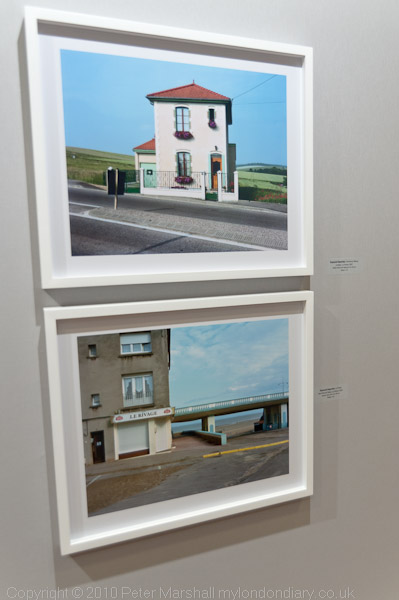
And of course I’ll take a camera and perhaps find times to take a few pictures. It might be nice to revisit some of the places I photographed back in 1988 which appear in my Photo Paris, though the weather forecast isn’t too promising.

© 1988, Peter Marshall

If I get a moment there may even be the occasional short post from me in Paris here, but I suspect I may find I’m just too busy until I get back home and sleep it all off for a day or two. So if you don’t see any new posts for a few days you will know why.