Paris Shows: Tendance Floue & Vanessa Winship

Tendance Floue

I’ve spent some time searching without success for the first piece that I wrote about the French collective ‘Tendance Floue‘, a group of photographers who aim to explore their individual creativity in a dialogue together outside the normal limits of commercial media practice.

I think it was perhaps around five years ago, when their work was included in the Arles Rencontres and also gained an ICP Infinity Award that I became aware of the group on-line, and somewhere around the same time I saw a show of their work I think in the fringe festival during the Mois de la photo in Paris. Possibly it was in an brick arch under a bridge across the railway lines out of the Gare d’Austerlitz at Les Frigos, but I can’t be sure.

Tendance Floue (TF) literally means a fuzzy or blurred tendency or trend, and if the work of the photographers in the group does sometimes become a little too experimental for my liking, blur is not necessarily to be taken literally, but more as expressing a spirit of being prepared to explore outside the boundaries of particular  conventions – such as that of sharpness – that the commercial practice normally demands.

I was slightly surprised to learn that TF is celebrating its twentieth anniversary, with the original five photographers now grown to a dozen. And celebrating in some style with shows in five galleries in the Marais in Paris from Feb 5-22nd.

  • Baudoin Lebon : Thierry Ardouin, Flore-Aël Surun and Patrick Tourneboeuf
  • Galerie Les filles du calvaire : Pascal Aimar and Mat Jacob
  • La galerie particulière : Gilles Coulon and Philippe Lopparelli
  • La petite poule noire : Bertrand Meunier
  • Hôtel de Sauroy : Denis Bourges, Olivier Culmann, Caty Jan and Meyer.

In the French press release that accompanies the show there is a handy map so you can plan a walk around all five (they include one, La petite poule noire, on the Boulevard des Filles du Calvaire I’ve not visited.)

If like me you are unlikely to be in Paris before Feb 22nd, there is plenty of work to explore on the TF web site, though some of it isn’t that easy to find. Perhaps the web site too is deliberately fuzzy. I also found that to see the English version of some pages I needed to load the French version first.

Not Only Rare Birds Sing

And if you can get to Paris, another current show not to be missed is ‘Not only Rare Birds Sing‘ by Vanessa Winship, at Galerie VU’ until 19 March 2011.  You can see a selection of her work on the Agence Vu web site, as well as on her own site, where her blog shows her making the prints for this show.

Galerie VU’ used to be in the Marais too, but has now moved west to the 9th arrondissement, in Hôtel Paul Delaroche, 58 rue Saint-Lazare. The gallery is open Monday to Saturday from 2-7pm and you can leave your Velib handily close by at number 62. Do London galleries tell you where to leave your Boris Bike on their invitations?

London Arbaeen

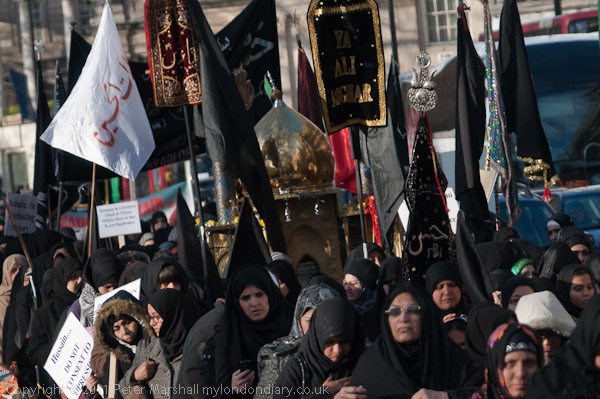
Last Sunday afternoon, several thousand Shia Muslims were at Marble Arch, celebrating Arbaeen, at the end of 40 days of mourning over the massacre of Hussain, the grandson of the Prophet and his followers at Kerbala around 1400 years ago. This was the 30th such march in central London, and I’ve photographed the event – as well as marches on Ashura day at the start of the period of mourning – several times in the past, and I think rather better than I did today.

© 2011, Peter Marshall

I arrived as the event was starting, with long sessions of recitation and community prayers, and then took an hour or so away from the event just as more was beginning to happen, rushing away to cover the UK Uncut demonstration half a mile away along Oxford St.

It isn’t possible to be in two places at once, and trying to cover both events on this occasion was almost certainly a mistake, as it meant I missed important aspects of both. But then I’m pleased that I did manage to photograph so much of both.

Coming away from UK Uncut one of the other photographers I know there came along with me – we’d both wrongly thought everything of interest was over. She hadn’t known about the procession and I told her briefly what it was about as we walked briskly towards it.

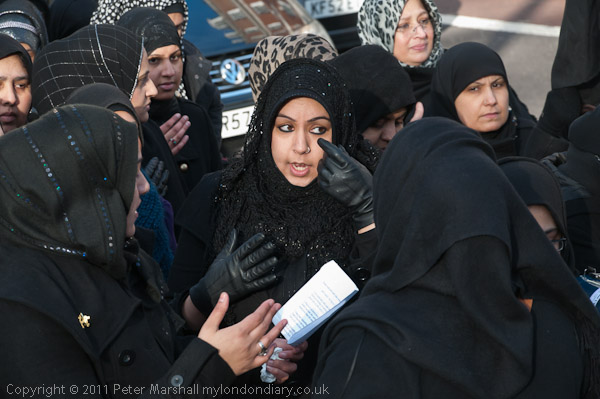
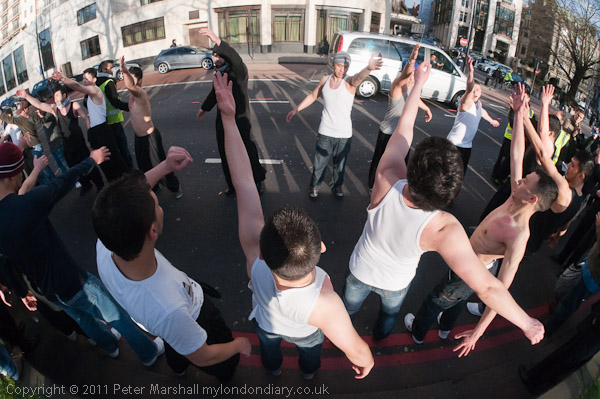
Like many Muslim events, men and women generally take part in separate groups and in different ways. Many of the men show their emotions more openly as well as being considerably more physical in their expressions, while the women are more restrained, but also more of them carry flags and banners.

© 2011, Peter Marshall

It is easier for women photographers to photograph the women at events such as this, getting in close while I was generally standing further back with a longer lens. Things have changed a bit over the years, but there is still a difference, although it is a few years since a steward came up to me and said “We do not photograph the women.”

© 2011, Peter Marshall

But of course I have, and some of them have thanked me for the pictures I’ve taken. Photographing the men presents no problems – for men or women photographers.

© 2011, Peter Marshall

When I looked at the pictures having imported them into Lightroom, for a few minutes I could not find some of the pictures I had taken. These were pictures looking down on groups of men beating their chests in mourning – I was standing on top of a low fence or wall and holding my camera out at arms length above them with the 10.5mm fisheye on the D300.

Then I remembered that the profile for the 10.5mm I have for Lightroom messes up the pictures by “correcting” the fisheye perspective to rectilinear. It’s something I keep meaning to find a way to edit but never get round to. I use the profile because it automatically more or less removes the rather noticeable colour fringing the lens gives, but this correction is just silly. The results are not usable – with extremely poor corner detail – and just look silly, as rectilinear perspective becomes hopeless at greater than around 90 degree angle of view.

If I wanted a rectilinear result I’d use the 16-35mm. I do often use some correction on the fisheye results, sometimes in Lightroom but more often in other software that tames its extremes, but never the full rectilinear effect, always ridiculous unless you crop drastically.

Fortunately Lightroom makes it easy to select images by the lens that was used, and once I realised it was a simple and quick matter to do so, correct the problem in one and synchronise it across to all the rest, and there were my pictures back again.

My fuller report on the event with many more pictures is on My London Diary at Shia Muslims 30th Arbaeen Procession .

Boots Uncut

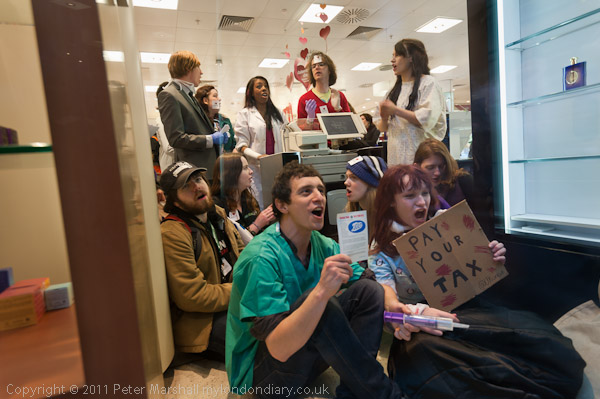
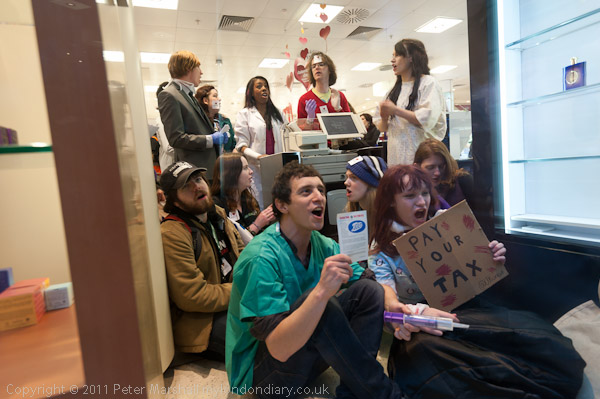
Last Sunday saw another nationwide demonstration by UK Uncut, this time targeting Boots stores across the country. Boots have relocated their corporate HQ to a PO Box in Switzerland, and according to UK Uncut this tax loophole has reduced their annual tax bill from £100 million to just £14 million.

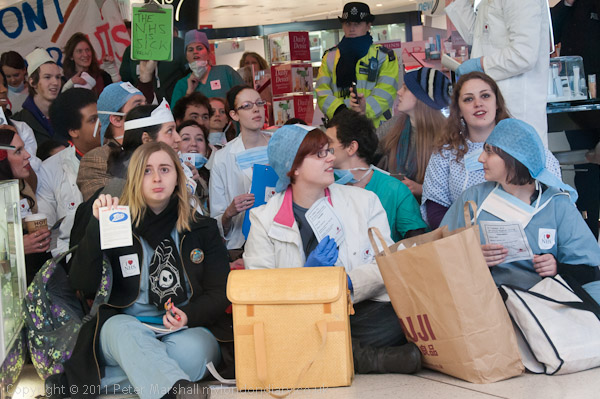
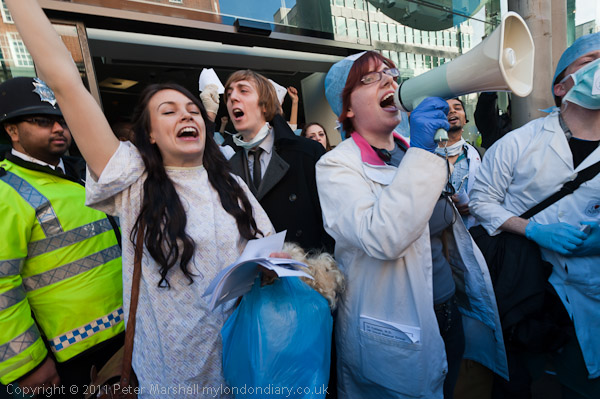
The money that isn’t now coming in as UK tax would, according to UK Uncut, pay the salaries of over 4,000 NHS nurses, now under threat from government changes in the way hospitals are funded.  UK Uncut, in their role as the ‘Big Society Revenue & Customs’ dressed up as doctors and nurses for a protest to make their point that the government are making savage cuts in public services to reduce the deficit while making no attempt to close the tax loopholes through which the super-rich and large corporations dodge £25 billion in taxes every year.

The protest started inside Boots main shop in the middle of Oxford St, but I didn’t arrive early enough to enter unnoticed and was carrying two cameras and a large bag, having been covering another event half a mile down the road, so failed to sneak in past the security guards. Some other photographers had got inside, but were soon escorted out by security and police when they started taking pictures, although the protesters and some shoppers were taking pictures on their mobile phones without being stopped.

Fortunately the shop has large glass windows, and although these are rather blocked with showcases, there were gaps through which we could take pictures – though each had a crowd of photographers around it. Reflections in the glass were a problem, and where possible we worked with the lens as close as possible to the glass to avoid them. If possible right up on the glass, but that does limit you to photographing at right angles to it. Back in the old days when I took a lot of pictures on film through windows I used to use wide-angle lenses with rubber lens hoods which gave a little more flexibility,  but I no longer have these.

Here is one of the pictures I took through one of the side windows:

© 2011, Peter Marshall
After post-processing in Lightroom

and you can see some reflections but they don’t really cause a problem.

Out of interest, I also exported a jpeg from the same image after automatic processing in Lightroom 3 and before I had done any of my usual post-processing on it – perhaps you can see some differences:

© 2011, Peter Marshall
Imported with my Lightroom defaults

The differences are perhaps a little subtle at this scale, though rather more obvious on the high res versions. At a pinch I could live with the lower version – on which Lightroom has applied both my default curve settings and its auto exposure – but to me at least there are clear improvements in the processed version.

I started thinking a bit more about Lightroom and raw processing again last week, after I’d had a request for a few pictures from 2005. I had the jpegs on my hard disk, but thought I would go back and reprocess them from the raw files; surely six years later I could do a better job.

So I worked away as I now normally do on these .NEF raw files in Lightroom until I was happy with them and then exported the files and compared them with those I had produced in 2005.  The differences were not that huge but were noticeable, and in every case the 2005 images I had produced using Pixmantec RawShooter, the software that was bought up and closed down by Adobe were the ones I chose in a ‘blind’ test.

Lightroom is a great programme, and it does more than RawShooter ever did, and it may be that these results are not typical. It might be the particular subject matter or the lighting, or (and very likely) the user having a bad day.

After around half an hour protesting inside Boots, the UK Uncut protesters decided it was time to leave and made their way to the front of the shop – where the security men promptly closed and locked the doors, so again I was shooting through glass. This time I was kneeling on the ground very close to the glass with a mass of photographers behind and above me blocking most of the reflections, so technically at least things were easier.

© 2011, Peter Marshall

Some of the time I was having to take pictures between the legs of the security men though the policeman outside had kindly moved out of our way. When the protesters were finally let out of the shop they continued their protest on the pavement and I stayed until shortly before they were due to leave.

© 2011, Peter Marshall

The protesters had thanked the police for the way they had behaved during the protest – and everything seemed very calm and orderly and there seemed little point in staying until the bitter end, and I wanted to return to the other event I was covering. You can read more about the protest and see my pictures in UK Uncut Protest Boots Tax Scam on My London Diary.

But the end turned out to be very bitter, and provided the main story from the event – which I missed.  As UK Uncut were getting up to leave, one of the women protesters pushed a leaflet through the gap between the glass doors of the shop, and was promptly arrested for alleged “criminal damage.” An argument between police and protesters ensued, in the course of which one officer used a CS spray on twelve of the demonstrators (and himself.)   Boots staff apparently rushed to give first aid to those who had been sprayed using eye wash bottles from their shelves, but three required hospital treatment.

I was shocked when I heard about this later in the day. It seemed completely out of keeping with the atmosphere of the event. The arrest seemed ridiculous, and the use of CS spray totally inappropriate.

No Fees! No Cuts! No Kettles!

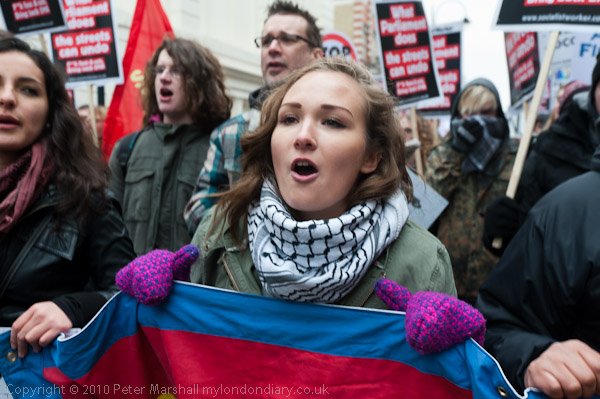
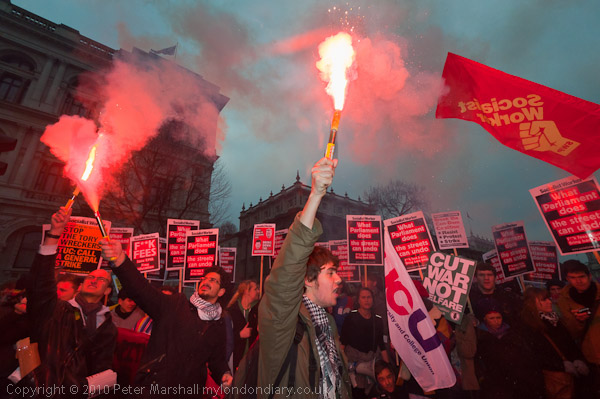
Last Saturday’s student demonstration against the fees increases, the ending of educational maintenance allowance and cuts in public services was a rather tame affair, despite attracting between five and ten thousand marchers, mainly students, with a sprinkling of parents, trade unionists and others.

© 2011, Peter Marshall

Perhaps the main reason for this was the discussion that had taken place beforehand between the organisers and police, and the leaflet that the police again handed out to protesters detailing both the route and the way that it would be policed. This kind of preparation is important to the police as well, as their briefing will doubtless have dealt with the same matters. It begins by stating that police service is committed to upholding the right to protest, something which has not appeared to be at the top of police priorities in some past events.

Of course there was plenty for me to take pictures of, but the lack of confrontation means that the chances of the media using these pictures is greatly reduced; peaceful demonstrations seldom make the news. But my work isn’t mainly for the instant news media, but more about recording events and trends for a future audience. Though making the news would pay some of the bills.

© 2011, Peter Marshall
Bright red flares present colour temperature and exposure range problems at Downing St

You can read my account of the march (first published on Demotix) on My London Diary at No Fees, No Cuts! Student March, accompanied by the usual large selection of images.

By the time I’d walked all the way along with the marchers – probably covering twice the distance they did, including quite a lot walking backwards – I was tired and in pain (I’ve been suffering from plantar fasciitis in my left foot for the past five months and it hurts if I walk any real distance – and unfortunately I mustn’t take Ibuprofen) and decided to call it a day. Most of the marchers were however game for more and a large group – probably between 500 and a thousand – made it to the Egyptian embassy and on to Oxford St.

© 2011, Peter Marshall

There are two stories about what happened at the embassy. A photographer who made it there with them told me that the Egyptians were not very happy with the many placards  from the SWP (Socialist Workers Party) and told them to go away, and the second, from a Guardian story, that this was a great result on its first outing from ‘Sukey‘, an anti-kettling system, which uses text messages (and now a smartphone application) to give phone and smartphone users information about which routes are open to them, and which are obstructed or closed by police.  The new app, not available for this demonstration, uses green to show open directions, yellow for obstructed but passable and red for those that are completely blocked.

Sukey gets its information by Tweets with the hashtag #sukey and other messaging from people on the spot, uses a team in their control room to analyse it and then displays the results on its web site and relays it back as text based warnings to protesters; it now also has a compass-like smart phone application to show protesters the status of routes from their current position – green for open,  though this wasn’t ready for last Saturday.  But apparently protesters close to the Egyptian Embassy who had signed up to the system received a text message from the Sukey control room telling them that there were a lot of reports coming in that the police were about to form a kettle – and so they quickly left.

Although police have kettled protesters on numerous occasions (in recent student demonstrations in Whitehall, Parliament Square, Trafalgar Square and on Westminster Bridge), the fact that there are a lot of police in a particular place doesn’t necessarily mean that they intend to kettle protesters.

Before Christmas I was with students as they took off on a ten mile fast march around London because every time they saw police at a junction someone shouted ‘kettle’ and the march took off in another direction. Police denied that day that they had any intention of kettling, and apart from one brief incident in Parliament Square and later in Trafalgar Square, they seemed to me to make no attempt to do so. Despite this, some student and left-wing web accounts wrote it up as some kind of victory of the student movement over the police.

Since then we’ve seen two student marches where the police have issued a leaflet to try and counter what I called ‘kettle paranoia’ by students. There has been no obstruction or kettling of students during either of them on the agreed route.

Though attempts such as ‘Sukey’, named from the nursery rhyme ‘Polly put the kettle on’ in which Sukey (Susan) takes if off again are welcome as attempts to share information (along with the police leaflet and police Tweets) I do rather worry that it may well simply provide greater positive feedback to the kind of wild rumours about police behaviour that drove that out of control ten mile student route march.

Police like to keep order. It’s their job after all, but they do take it too far. They like everything cut and dried and going to plan.  The police understand static demonstrations and marches that keep to a prescribed route but characterize the kind of freely moving protests that some groups have been making recently – sometimes called  ‘civic swarms’ – as disorder, and have so far not found an effective and proportional way of dealing with them.

Information about the whereabouts of protesters will be of great interest to them, and I am sure they will both be monitoring the reports provided by Sukey as well as perhaps producing their own applications to track the locations of tweets with the #sukey tag, and possibly making use of location data from mobile phone companies.

© 2011, Peter Marshall

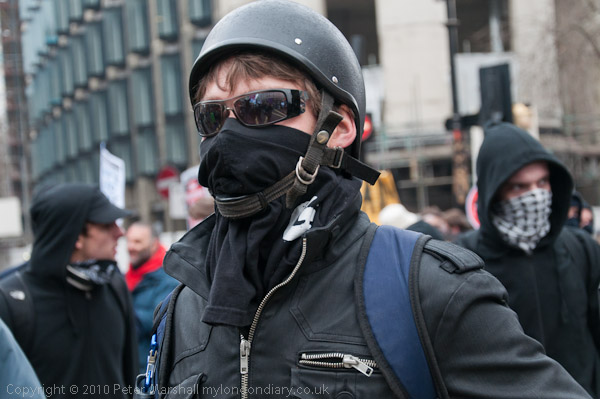
If you are going to mask up to protect your identity, should you take the battery out of your mobile phone too?

No Fees, No Cuts! Student March.

Egyptian Embassy

Several of my friends are working in Egypt at the moment, producing some great work, but having seen what is happening on the streets there, I’m feeling rather glad that I’m sitting safely at home.  Jason N Parkinson’s  video Day of Rage – Cairo gives a great idea of what is happening.

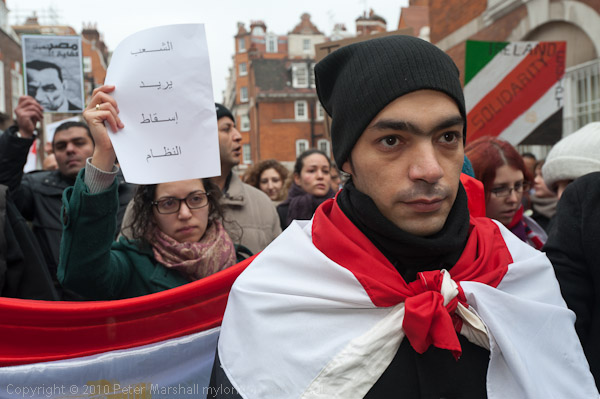
Of course back in London there have been various demonstrations of solidarity with the Egyptians on the streets of Cairo calling for democracy and last Saturday I photographed two of them.  Egyptians have been demonstrating outside the embassy more or less non-stop, and had called a larger demonstration for noon on Saturday, and it was this that I went to photograph, arriving around 11.45.

© 2011, Peter Marshall
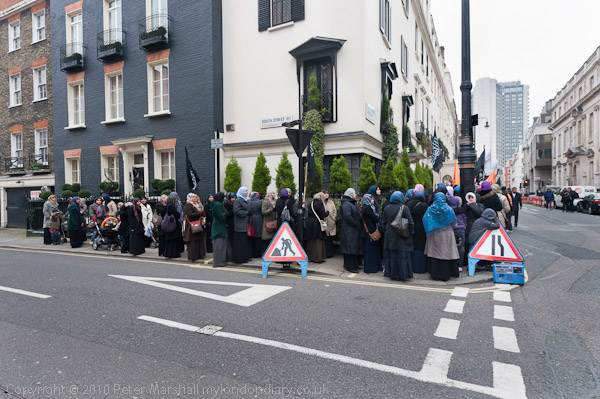
Women on South St – but the men were on South Audley St

Rather to my surprise, when I arrived at the Embassy I could hear another demonstration taking place out of sight in the next street – all I could see from in front of the Embassy were a few women in Muslim dress, standing around and doing nothing. I walked the 70 or so yards to the corner and looked down the street to find the pavement on the opposite side filled by people from Hizb ut-Tahrir Britain.  I wasn’t that surprised as I had been expecting to see them later for a protest at the Hilton Hotel over Bangladesh.  They were there not to express solidarity with the people on the streets in Cairo who are calling for a democratic and secular Egypt, but to urge that the solution to the problem there – as everywhere else – is a Muslim Khalifah.

In Cairo, men and women protest together, and Muslims and Christian, and none of them want the kind of Islamic state than Hizb ut-Tahrir stands for. The Egyptian revolution isn’t an Islamic one but a secular protest, and the Egyptian protesters at the Embassy told me they had made that clear to Hizb ut-Tahrir, and were not prepared to have them join their protest outside the Embassy. (Much later in the day they made a similar point telling members of the Socialist Workers Party that they were not welcome either.)

I knew that Hizb ut-Tahrir would not like the report that I wrote about  what happened, but it was an honest and accurate account of what I saw and what I was told. Within an hour or so of posting it on Demotix there was a hostile comment which appeared to have been written by someone who was not there, attacking me. So I almost certainly got it right. You can read about the event and see the pictures at Hizb ut-Tahrir Turned Away on My London Diary.

© 2011, Peter Marshall

While I was photographing Hizb ut-Tahrir, the protest outside the Egyptian Embassy was growing and it had well over a hundred people present when I had to leave to cover another event, with more still turning up.

It had a very different atmosphere from the other event, with those present taking a more active role and everyone being offered the chance to speak. There wasn’t a set party line and the people were much more mixed in every way, not least with men and women both actively participating and standing together.  Apart from the Egyptians, others had also come to show their support.

You can see more of this story at Solidarity with the Egyptian Revolution on My London Diary. Interestingly, although both stories were posted at about the same time and I noted both on Facebook and Twitter together, and the Solidarity feature certainly has the better pictures,  the Hizb ut Tahrir story has attracted almost six times as many views. A little controversy perhaps helps.

While writing this I heard that four photographers who also contribute to Demotix are among those who have been attacked in Cairo in the last 24 hours. Two were beaten and arrested but later released, and another was rescued by the vigilantes he had been photographing, while the fourth managed to escape after being attacked.

India in London

I’ve never been to India. As regular readers of this blog will know, I’m not a great traveller, at least not outside the M25, though I do occasionally take a train elsewhere, and I’ve photographed in a few other cities.  Perhaps if I’d started young as a full-time photographer I would have got to travel rather more, but for almost 30 years my main job was teaching, and I had no great urge to travel in my holidays – I had work to get on with here.

London is truly a fascinating city, and one to which the world comes – even if those who want to stay for more than a couple of weeks holiday are considerably less welcome officially than they once were. Walking around the city you run into blue plaques commemorating the stays here of those who went on to liberate and lead nations around the world.

© 2011, Peter Marshall

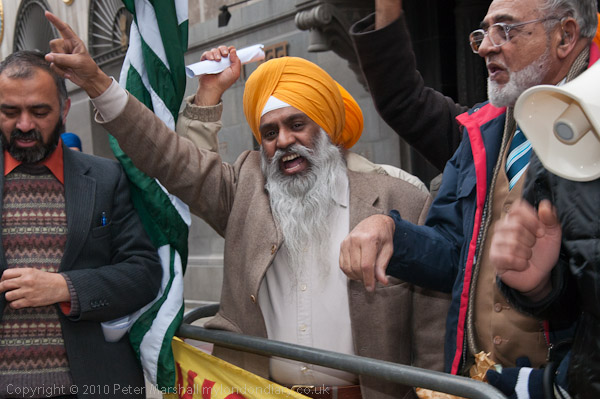
Perhaps this is still happening today, and one day there will be plaques commemorating the future leaders of Khalistan and Kashmir, who may well have been among those I photographed outside the Indian High Commission last week on the Indian Republic Day, which they celebrated with demonstrations calling for freedom from Indian rule for their nations. More about this and of course more pictures in Free Kashmir & Khalistan on My London Diary.

© 2011, Peter Marshall

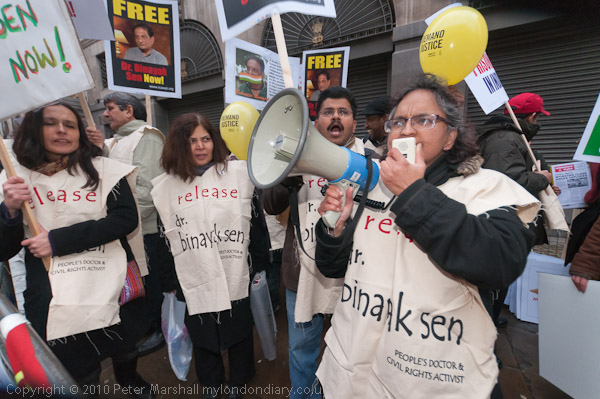
After they left, another protest took their place, calling for the release of an Indian doctor and civil rights activist, Dr Binayak Sen, whose crime has been to spend his life working for the poor.  Release Binayak Sen Now  on My London Diary.

Quite by coincidence, on the train up to London that day I’d been reading Jaspreet Singh‘s novel ‘Chef’, a story about a Sikh man making a journey back from India to Kashmir and retelling the story of his life in his younger years there as chef to an Indian Army General. I read more between photographing the two events, sitting with a pint of Samuel Smith’s in the Lyceum, a short walk from the High Commission (though I actually walked there by a very long detour to the British Museum which had been closed  because of a ‘chemical attack’ which turned out to be a false alarm.) ‘Chef’ is a novel that had some resonance to both events.

It felt rather strange to be working with just one camera, and that the D300, as I’d taken my rather stuttering D700 in to Fixation for servicing the previous afternoon. Although I normally use both, somehow I’d forgotten the difference the smaller viewfinder image makes, though the having less weight to carry was welcome. Instead of the 16-35mm, I’d taken the Sigma 10-20mm out of the cupboard – equivalent to 15-30mm, and I really did miss that 35mm end while taking pictures. Possibly I would have  been happier with the 12-24mm Sigma (18-36 eq), though then I would have missed the wide end.  Along with the 10-20mm I was also using the Nikon 18-105mm (27-157 eq) so I did have a lens that covered 35mm, but often I found myself making do rather than bother to change the lens.

It was also a pretty dull day, and I did miss the extra stop or so I would have allowed in setting the ISO on the D700. I don’t much like working about ISO 1250 on the D300. So I was pleased the following day to get a call from Fixation to tell me the D700 was waiting for collection.  The two-year guarantee runs out next week and I am renewing it, as the camera does get pretty heavy use – the frame counter was at 116,150. Normally I wouldn’t bother, as it’s almost always cheaper to pay for repairs when necessary rather than take out insurance. As well as replacing the faulty unit, Fixation also replaced much of the rubber bits on the outside of the body, carried out a general service and recalibration and checked and cleaned it – including the sensor – and finished the job in two days.

I do rather like the ‘Release Dr Binayak Sen’ image, and I think the picture above is the best frame of several rather similar. There is a kind of rhythm across the frame, which the picture fits rather well, and the text too clearly conveys the message without being too obvious, a built in caption scattered around the image, including the nicely placed “people’s doctor & civil rights activist‘ on the apron at bottom right.  The yellow Amnesty balloon reads ‘Demand Justice’ though perhaps a little to small the read at the scale it is here. There is a difference in expressions in the faces across the picture which I like too, and just a little of the building behind to indicate where it was taken.

BBC’s World to Shrink?

I suppose it was inevitable that there would be considerable media interest in a story about our major broadcaster planning sweeping cuts to what many of us feel is one of the most vital and nationally important  aspects of its services – though to the people that run the BBC it seems to be regarded as a loss-making nuisance.

I’ve long felt that the BBC wastes most of the licence fees it collects and making TV programmes that may have high audience figures but that basically are little different to the offerings from commercial stations, including some which seem little more than thinly disguised promotionals for some industries. And we don’t even have a car manufacturing industry to speak of.

You can read more about it and see more pictures from the demonstration in Save the BBC World Service on My London Diary.
© 2011, Peter Marshall
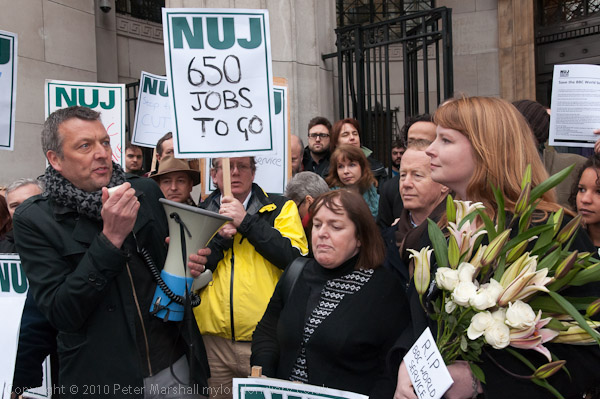
NUJ General Secretary Jeremy Dear speaking at the demonstration

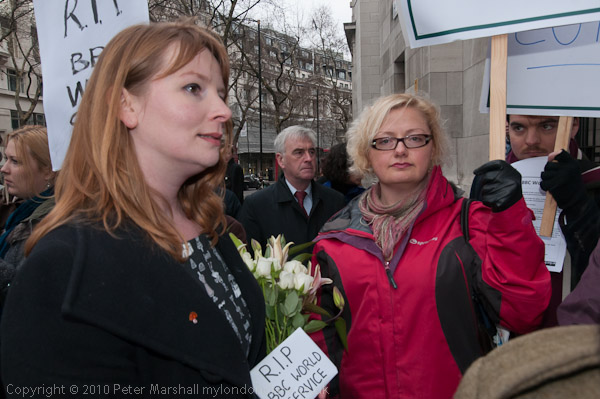
Photographically the biggest problem was that there were too many of us trying to take pictures and film in too small a space.  I was lucky to be in the right place at least some of the time, although of course you largely make your luck by reading the situation and spotting opportunities that others have yet to see. So when Jeremy Dear, the NUJ’s General Secretary came to make his speech, I’d moved into what I thought would be a good position around half a minute earlier when I noticed it looked as if this was about to happen.

I’d chosen to stand where I could get Jeremy in a crowd with NUJ placards, and at the right of frame, Michelle with the flowers. Fortunately she was holding the caption ‘RIP BBC World Service’  so I could read it, and this particular frame appealed to me because of the expressions of those in it. In the picture it looks like a pretty decent little crowd (though most of it was out of frame) and there is enough of Bush House in the background to be recognisable to those who know it.

As I took my pictures, there were cameras to the left of me, cameras to the right of me, on top of me and I think shooting through my legs, and I was having to lean back with a little weight to stop myself being pushed forward by the crush. Of course I don’t complain about this, we all need to get pictures, and if I hadn’t been at the front I’d be doing exactly what these guys were doing in order to do so.

Most of us stick by the unwritten rules that come from having to work together, not deliberately getting in each other’s shot and if at times it happens and we point it out, mostly people apologise and try to move away. Because I normally shoot with a very wide angle, a lot of people do wander into my pictures unintentionally, and there are often other lenses poking into the corners or bottom of my images. Occasionally it improves the picture, but more often I just zoom to a longer focal length.

While we were there taking pictures, we were all rather astonished to see a reporter with a compact camera just walk in front of us all so that she could take some pictures.  I was slightly less amazed, as this particular person had walked in front of me when I was photographing at an earlier event, and when I politely told her that I was taking pictures and she had just stood in my way she told me that she needed to get her pictures and refused to budge. If you read of a journalist being lynched by photographers it will be her.

Another rather annoying habit that is growing among photographers is that you suddenly see a camera in your viewfinder, held out in front of you at arm’s length by someone leaning over your shoulder.  If this habit continues to increase perhaps we will all have to switch to ‘live view’ and photograph in this way to keep ahead of the people behind. It used to be just camera phones that appeared like this, but lately it has been pro DSLRs as well.

Before Jeremy had finished speaking, I decided I had more than enough pictures of him and the other protesters from that viewpoint, and made my way out (it wasn’t easy) to give other photographers a better view.
© 2011, Peter Marshall
John McDonnell in the background of this picture

I would have liked to have photographed MP John McDonnell speaking a couple of minutes later, but this time I hadn’t got in the right place, and could find no way to get a decent view. Of course I’ve photographed him on many occasions and it would not have been a problem getting him to pose later, but I don’t like posed pictures.

At times like this there would be a definite advantage in being a foot – or even six inches – taller. Sometimes you can make up for it by holding the camera up above your head for a ‘Hail Mary’ shot, and some photographers now carry a monopod or tripod to enable rather more height. If I could fit one in my bag I probably would, but so far I’ve only done this for one or two panoramas where it enabled me to take pictures over fences such as that fortified Olympic fence.

The missing link in making this a more usable technique with pro cameras is a rear view screen that folds out and swivels. But such a device might well be rather fragile in the day to day knockabout our equipment gets.

You can actually buy wireless transmitters or plug in monitors for DSLRs with an A/V output, though they tend to be rather large and rather pricey (though photographer Robert Benson makes one – almost certainly illegal to use in the UK – in his garage for around $200), though good for those who want to use the video possibilities of the more recent DSLRs, though not those I use.  But a fairly basic device of this type using a cable from the camera on top of the monopod would make such overhead pictures controllable.

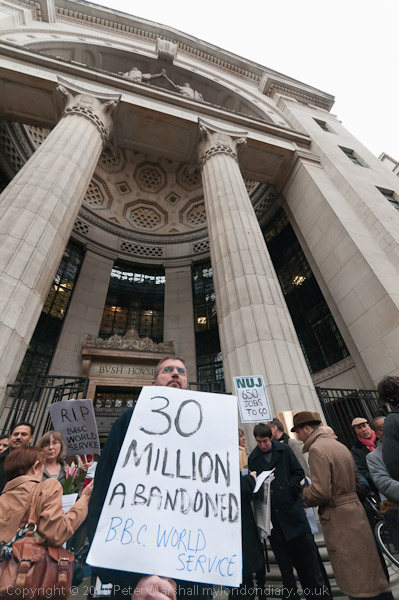
Back to Bush House, here’s an image that shows more of the building:
© 2011, Peter Marshall
16mm rectilinear view

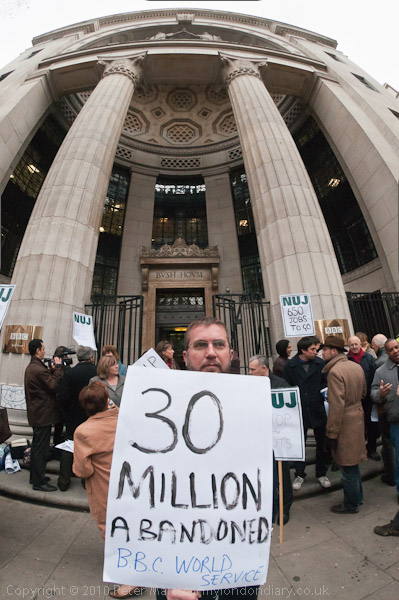
I took it first with the 10.5mm fisheye, but those pillars don’t work quite as well with a curve in them, even partly corrected:
© 2011, Peter Marshall
10.5mm fisheye, slight correction in Lightroom

The Lightroom profile for this lens makes the mistake of trying to correct all of the distortion, resulting in a totally unusable image.  Just for fun, I tried looking at this image in the Panini Viewer, which implements a rediscovered long forgotten projection used by Italian painters long ago, sometimes called Vedutismo, which has been available for some while for panoramas. The viewer software uses a low quality jpeg, but gives a better idea of the building.

© 2011, Peter Marshall
Fisheye mage saved from Panini Viewer and cropped in Photoshop
Later I’ll download other software that will let me do a better job, as the projection, which I’ve been using for around a year for panoramas, really does look to be a promising approach to “de-fishing” images.

Save the BBC World Service on My London Diary.
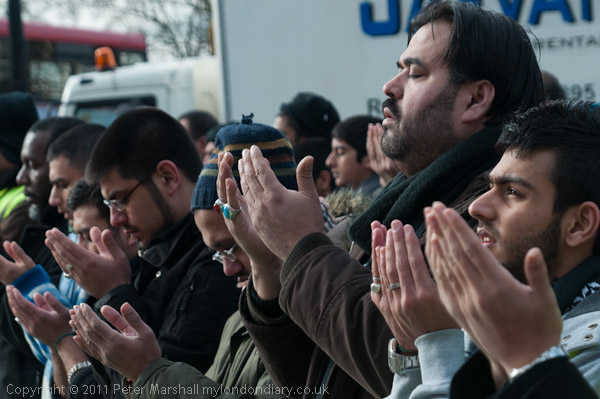
Sharpness is a Bourgeois Concept

Right on Henri! It’s something he said to that fashion photographer who did the huge ugly nudes, and I got a certain amount of hate mail after writing about him in less than glowing terms a few years back and I still don’t like to write his name. But I still think he made attractive women pretty ugly, and that giant quartet certainly look much better in the picture with their clothes on. It perhaps takes some kind of rare talent to make me think that.

I’m not sure that M Cartier-Bresson ever really joked, and he certainly wasn’t too bothered about his pictures being particularly sharp. They were sharp enough even when they weren’t very sharp, his seeing was a razor.  Or perhaps better a scalpel, and I’ve often thought that using a Leica is rather like using a scalpel, while today we work with power tools; they can do so much more but lack the precision.

Anyway probably a dozen people have already told you about the ‘Shit Photojournalist Like‘ blog as they have me. Which is where I was reminded of the quote in the title of this piece.  Things are perhaps a little different here to the USA, but not much.

Atos Don’t Give A Toss

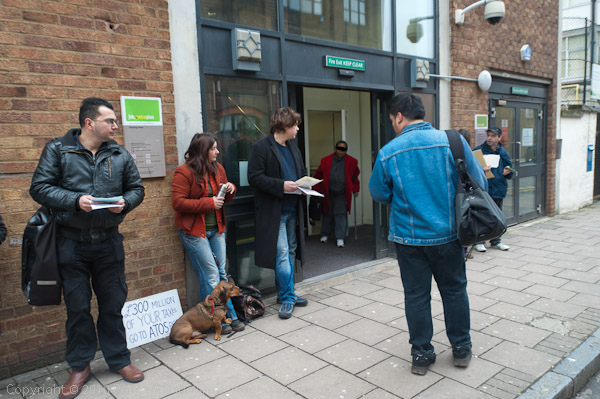
Last Monday was a day of action against benefit cuts, and in particular targeted the company that runs the tests  that people who want to claim the new Employment and Support Allowance (ESA)  have to take (and retake at intervals.)  The tests are an attempt to test their ability to work and are carried out by “trained healthcare professionals” employed by a private company, Atos Origin. As several of the placards said, ‘Atos Don’t Give A Toss.’

Although the amounts individual benefit claimants get are not generous they are essential for those concerned, and losing some or all of their benefit can be a personal catastrophe.  Those who are assessed as able to work get benefit at a lower rate on the Job Seekers Allowance (JSA) and to get it have to keep showing evidence of looking for work, and may be refused all benefits if they are judged not to be doing so. Atos of course does rather better out of it, and despite a large volume of criticism about how poorly they do the job has just been awarded another £300 million contract.

Previously, doctors certified people as unfit to work, and there was occasionally a certain amount of unfairness involved – my own doctor was very loath to provide certificates while others were certainly over-generous. But the decisions were always based on a knowledge of the claimant and their circumstances and their medical conditions. Under the system used by Atos,  an interview with set questions based on a computer system means that the needs and problems of the individuals are often neglected in reaching a decision.

Part of the problem has always been that there isn’t a simple division of people into those who are and those who are not fit for work, and of course that different types of work and different jobs within the same type of work place very different demands and stresses on workers.  Add to that the problem of the availability of jobs in particular areas and we have a problem that is undeniably complex, and not one that the simplistic approach ofAtos’s ”work capability assessments’ can properly address. But they are happy just to take the money – and have just been given another £300 million despite a very critical report by an independent inspector appointed by the government and bodies such as Citizen’s Advice.

© 2011, Peter Marshall
A man in a black mask comes out of the job centre!

The first photographs that I took were of a small protest, with I think eleven people handing out leaflets to people going in and out of a local job centre, one of many where these tests are carried out.  There really wasn’t a great deal of action to photograph, and doing so was made a little more complex by my own decision not to identify the users of the job centre in my picture. I don’t think anyone has an expectation of privacy when going in or out of a job centre, but do feel that I might not like to be photographed in such a situation. I was happy to photograph both the protesters and any job centre staff who might be visible, but tried hard to make images in which the clients were only shown partially or from the back. In the end there were one or two pictures where there were identifiable people, mainly in the background of pictures, and there I either darkened the whole face or drew a black bar to obscure their eyes.

At that place I was working on the public street, but in the afternoon ‘party of protest’ I knew that I would be working in a ‘private place’, one of those increasing number of areas of the city open to the public but under private ownership. I was a little worried because the security staff there – as in many places around London – enforce a fairly strict ‘no photography’ policy.

I kept my cameras under my coat or in my bag until I was in the middle of the group of demonstrators, and then took them out and started pictures. At least I would be able, I thought, to get some pictures before I was approached and asked to stop – and of course I knew that neither the security men or the police had any power to ask me to delete them.

© 2011, Peter Marshall
Security man and Police officer briefly stop a protester but ignore me

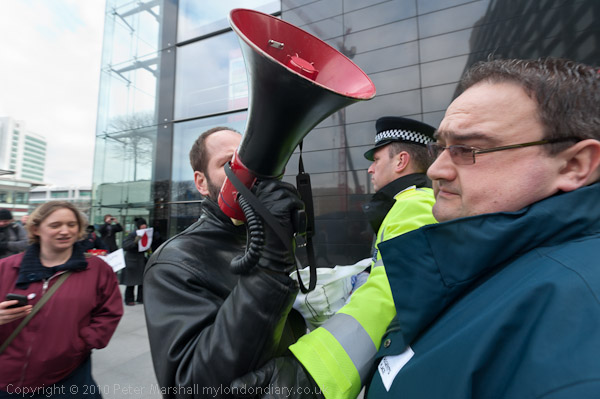
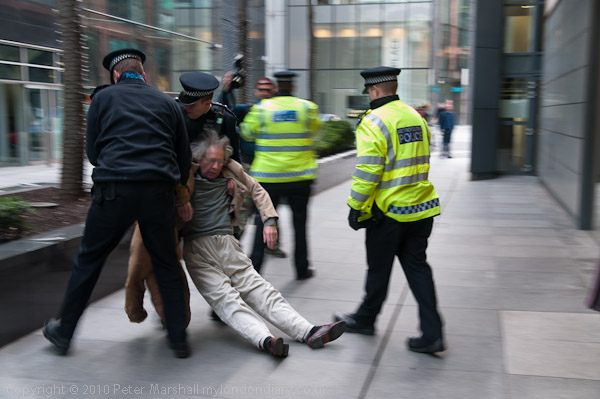
But there were no problems, at least not about taking pictures. Neither the police nor the private security men attempted to stop me, nor as far as I am aware anyone else taking pictures.  Except when one elderly man walked through the police line and was pushed to the ground and then examined and dragged away by police. Then I had two problems.

First was the deliberate obstruction of my line of sight by two police officers. It seems to be deeply ingrained in many police that if they see a photographer taking pictures of an incident they should move to stand between them and it.

This seems to be the standard police interpretation of the paragraph from the ACPO Police-Media Guidelines (introduced by the Metropolitan Police in March 2006 and by other forces in 2007  following two years of negotiations with the BPPA, the NUJ and CIJ):

Members of the media have a duty to report from the scene of many of the incidents we have to deal with. We should actively help them carry out their responsibilities provided they do not interfere with ours.

The second problem that I faced was the D700, which chose this moment to have another of its hissy fits, and refuse to take pictures. I didn’t have time to argue with it, and picked up the D300 to shoot with that.  It was set to a stop or two slower ISO and there wasn’t time for me to move the SB800 from the other camera to it, so I was working at a rather slower shutter speed than I would have liked. The blur really works quite well on one or two pictures, but there were others that were just blurred.

© 2011, Peter Marshall
I’ve moved to one side of the officer in my way, while behind the incident
another officer moves to block a colleague

I’d already decided the D700 had to go in for repair, but just hadn’t had the time to take it in, but I did so the next day.

When I got back I wrote a fairly lengthy piece about the problems that disabled people are facing with ending of disability benefit and its partial replacement with the ESA to go with the pictures for Demotix. A few days later, with rather more pictures, this went onto My London Diary as Atos Tests Unfair to Disabled.

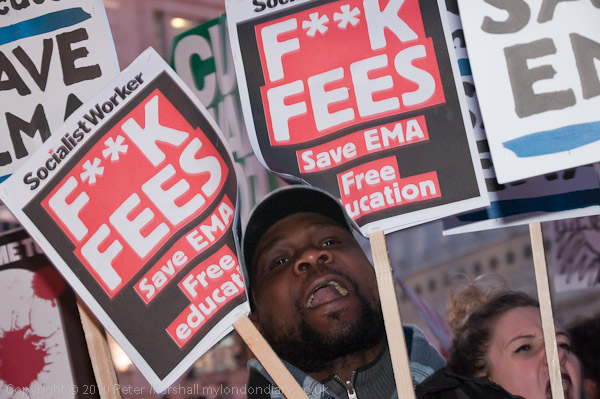
Students March Over EMA

Yesterday I went to photograph students demonstrating and there were very few to be found, at least in Trafalgar Square where we expected some to meet at noon, and what they were doing wasn’t very interesting. It didn’t worry me greatly as I had a couple of other events to photograph (and ended up finding a third, as well as wasting some good drinking time over a false chemical incident emergency at the British Museum which got major emergency treatment, closing the place down for over an hour.)

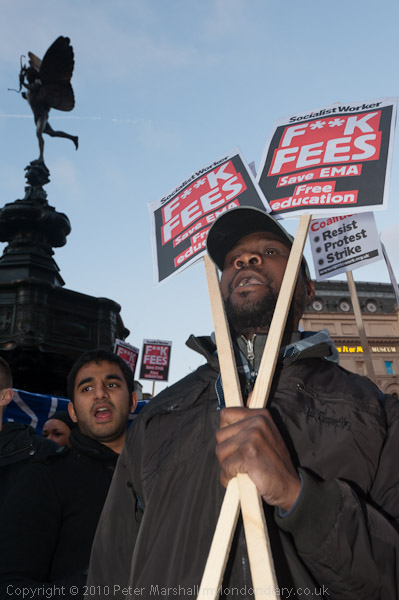
But the previous Wednesday, students were marching and I got a few decent pictures. They met at what I’ve always found to be one of London’s more curious tourist attractions, Piccadilly Circus. You see them all going there and wandering around trying to find out why they had bothered to come to a not that impressive statue with a bow and arrow at a busy traffic junction with an awful lot of neon advertising.

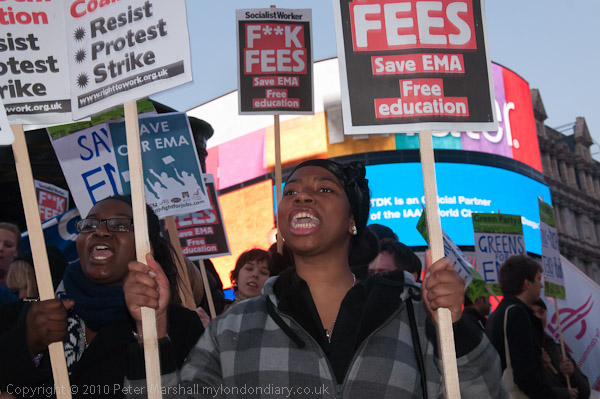
But still all the world comes there, and on this occasion that included around 500 students (and a few more joined later.)  We were there around half an hour as dusk fell and I and almost as many photographers struggled to photograph them, balancing flash and daylight to take advantage of the background features.

© 2011, Peter Marshall

So here was one using those adverts, though the screens really were rather blank at that particular instant.  At one time a major on-line agency culled all of the pictures it could find with logos on them from its collection and this would have probably have been one of the few pictures of Piccadilly Circus that would have been left standing. Of course they were wrong to do so, as there would only be real problems with a logo appearing in the picture if that was the point of the image, not for the ‘incidental inclusion’ that arises if logos happen to have been left around the street where you are taking pictures. It isn’t your fault if the copyright holders are so careless!  But I seldom see any reason to give them extra free advertising if I can avoid it.

© 2011, Peter Marshall

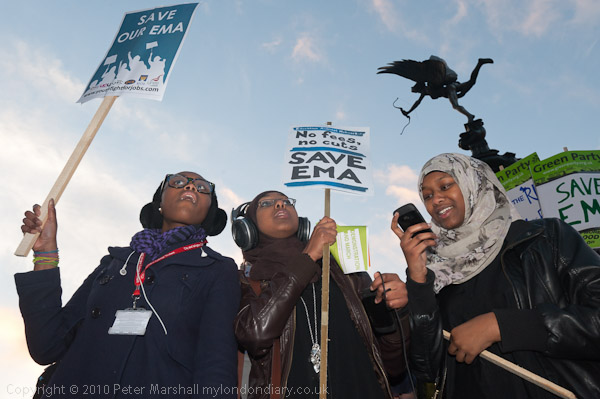
And this is one of many I took including Eros, (who isn’t really Eros, but his brother) a memorial to Lord Shaftesbury, a noted 19th century philanthropist who would I think have been right behind the campaign to keep the EMA, which enables many from poorer homes to stay in education.

© 2011, Peter Marshall

The bronze base of the fountain was designed as a drinking fountain, with cups ” giving water to rich and poor alike at all times of day and night” but these did not last long as the site was too windswept and the water went everywhere.  Eros, unvieled in 1893 a short distance away from where it now stands, was probably the first free-standing sculpture to be made from what was then a very expensive metal, aluminium. The supporting leg is solid but the rest is hollow.

© 2011, Peter Marshall

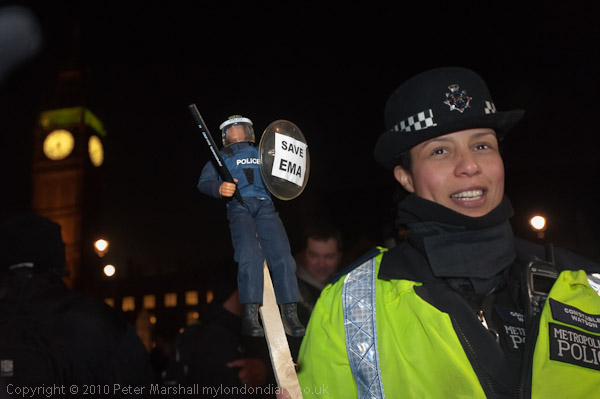
The march itself to Parliament Square was uneventful. The organisers seemed to have gone out of their way to cooperate with the police and the police made an rather greater than usual attempt to cooperate with the marchers, handing out a leaflet telling them about the march and how they hoped to police it. Everything went more or less according to plan.

© 2011, Peter Marshall

In Parliament Square (cue for photograph with Big Ben) there was really very little to do, other than stand around and wait for the result of the vote at 7pm. Most of the marchers had gone home by then, and so had I.

Photographically most things worked, but I was having quite a few problems with the D700, now almost two years old.  Occasionally in the past I’ve pushed the shutter release to take a picture and absolutely nothing has happened. Often this can be because the camera has been unable to focus, but in the last couple of months it has happened occasionally for no obvious reason, and at the same time the viewfinder and top panel displays have lost some of the characters. I first really noticed it happening more frequently just before Christmas, and found the problem usually cleared if I turned the camera off and on – and if not if I took out the battery for a couple of seconds.  During this event it happened more than ever and I missed quite a few pictures because of it.

There are some pictures where you get a second chance – and most of those above were like that, where I have several similar frames from which I could select the best. But other things, if you miss them are gone. You can’t afford equipment that is not reliable.  So the D700 is going in for repair. Intermittent faults like this can be hard to trace and soemtimes it is even hard to convince people that there is anything wrong.

And of course sometimes there really isn’t a camera fault. I had some great exposure problems with the Hexar Konica F, sent in in several times for service, only to finally realise the problem was just the second finger of my right hand, which would rather conveniently rest over the light sensor on the front to the body when my finger was on the shutter release.  I guess it could be called a design fault, either of the camera or hand.

My London Diary –  Students March Against EMA Vote – for more pictures and text about the event.