Love on the Left Bank from Dewi Lewis

The 2011 catalogue from Dewi Lewis Publishing (DLP) is worth downloading, if only to see the wide range of work available from this publisher. It includes several books of bodies of work I’ve mentioned here, including some I’ve written about at some length, such as Ed Clark’s Guantanamo: If the Light Goes Out, The Animals by Giacomo Brunelli, Vee Speer’s The Birthday Party and many more.  At least one of those pieces I’ve written I’ve never got round to actually publishing, as I’m still waiting for the promised review copy, having written my piece on what I had seen of the work on show, and there are several others I would certainly have reviewed had I received a copy. But I’m just a blogger?

But one of the greatest services that  DLP has given to the photographic community is through the republication of classic works, and the most recent of these is Ed van der Elsken’s 1954 photo-novel Love on the Left Bank, shot in a documentary black and white style.  There is an interesting review that fills in some of the details, particularly about its star, the Australian artist Vali Myers who plays Ann, a bohemian later described by Patti Smith as “the supreme beatnik chick”  around whom the book revolves.

What too is remarkable at the end of the catalogue is a very small section – I think just 17 books – of out of print titles. With some photographic books now going out of print in the blink of an eye, this reflects a real commitment to serving the  photographic community.

Among the other reissues are a couple of classic works by Martin Parr, including his 1986 ‘The Last Resort‘ which really changed him from a photographer into a phenomenon.  Although I felt the power of the work, it reflected an attitude towards the people he photographed that I felt very uneasy about, lacking the kind of respect I’ve always felt essential.

Also in the catalogue is the book London Street Photography 1860-2010 which accompanies the show opening at the Musuem of London later this week.

It includes the work of well-known photographers such as Paul Martin, John Thomson, Humphrey Spender, Bert Hardy, László Moholy-Nagy, Roger Mayne and Tony Ray-Jones as well as the work of many anonymous photographers whose contribution has been just as important in recording the story of the city.

And also includes the work of over 40 other named and still living photographers, and I’m pleased to be one of them, although like I think most I only have a single image in the book.

© 1981, Peter Marshall
Whitechapel, 1981 – Peter Marshall

My picture has been used in quite a lot of the publicity for the show, and although I’ve yet to see it, one of my friends tells me it one of several images on a poster advertising the show he saw in Piccadilly Circus station the other day. You can see some more from the related series of work in Cafe Ideal, Cool Blondes and Paradise revisited on this site, which also links to a larger set on line. The title actually came from a book dummy I put together many years ago following a workshop with Dewi Lewis on book publishing and I hope to publish a greatly revised version through Blurb later this year.

I’m  looking forward to seeing both the show (open to the public from Friday this week – and I’ll post more about it after seeing it at the opening)  and the book London Street Photography 1860-2010, although the reports I’ve heard on the book so far are a little disappointing.

Khalifa For Egypt?

on Saturday 5 Feb, unlike the previous week, Hizb ut-Tahrir Britain were really demonstrating at the Egyptian Embassy rather than around the corner and there were rather more of them than before, more or less filling South Street between Park Lane and the embassy.

© 2011, Peter Marshall

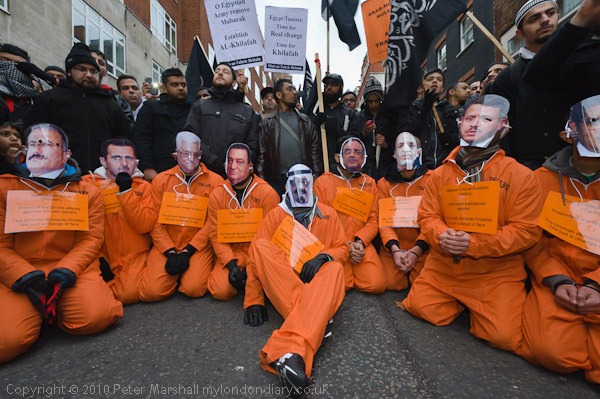
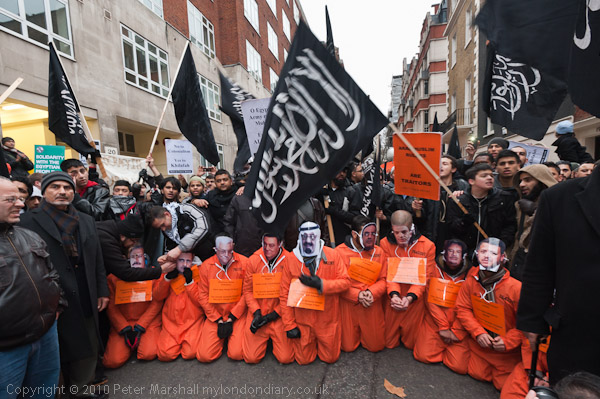
At the front of their demonstration was a low stage with a speaker and set out for the press to photograph was the scene above, with orange clad ‘detainees’ wearing masks that were the faces of Arab Muslim rulers who Hizb ut-Tahrir see as traitors.  Around the necks of these men were orange placards with their names and a short epithet regarding their crimes – Mubarak was described as ‘Israel’s most loyal bodyguard’- and the message ‘The Umma demands Khilafah – Not just a change of face‘.

It was a nicely done piece of theatre, and all of us photographers snapped it up, despite the fast fading light. But it was the kind of thing where we would all get very similar pictures, and I certainly could find little to do to make my pictures different.

These bright orange suits are rather a pain to photograph, at least on Nikon cameras, as the orange colour comes out too intense and too red, as in the image close to the top of this post.

© 2011, Peter Marshall

The best way that I’ve found to deal with this is by using a different camera calibration profiles to those supplied with Lightroom . There is something about the theory behind these things on Sandy McGuffog’s Chromasoft blog, and recently Nik Player has posted a zip file with sets of both ‘invariant’ and ‘untwisted’ profiles for the D3/D300/D700 based on the latest ‘Beta 3’  camera profiles for selected Nikon bodies released by Adobe Engineer Eric Chan. I’ve not yet had time to try out these newer profiles, which should do an even better job than the old ‘untwisted’ profiles I wrote about some time ago and which I used for the above image.

More about the demonstration at Hizb ut-Tahrir at Egyptian Embassy on My London Diary.

E3 Grime

Thanks to dvaphoto for the news that Simon Wheatley’s Don’t Call Me Urban! The Time of Grime was published by Northumbria University Press based in Newcastle at the start of the year. I wrote about his work with young Londoners in Lambeth and Bow when Magnum in Motion published a fine audiovisual presentation Inner City Youth, London on his work in 2006  (he joined Magnum as a nominee in 2005, and his work is still on their site although he left in 2008.)

The Don’t Call Me Urban web site is well worth a look, and as well as still images includes a video by Wheatley made on the streets of Bow with some of the ‘Grime’ artists who he got to know and who let him share and photograph some of their lives. The video and his photographs are a very direct and honest look at the lives of these young Londoners, perhaps oddly disconnected from their locale, living in a universe that only connects occasionally with the E3 others know.

January’s  Professional Photographer magazine included an interesting interview with Wheatley about the work and his attitudes, including his need to write a lot of text to put the work into context, something I think some photographers fail to appreciate the need for. Without it work often becomes a voyeuristic enterprise. He also gives some idea of his current situation, living in Calcutta and “looking far beyond photography itself” while also “rediscovering a love of photography.”

Egyptian Embassy Protest Continues

After the rally at the US Embassy, the Stop the War Banner led off the march to the Egyptian Embassy deliberately in exactly the opposite direction, going north past the US Embassy before turning east along Brook Street.

This footsore photographer felt no need to follow them, and limped his way the 400 yards or so to the conveniently located Egyptian Embassy – far too short a route for a protest march – where Egyptians have been keeping up a more or less permanent protest in support of their compatriots back home who have so far liberated Tahrir Square but are staying there until that extends to the rest of their country.

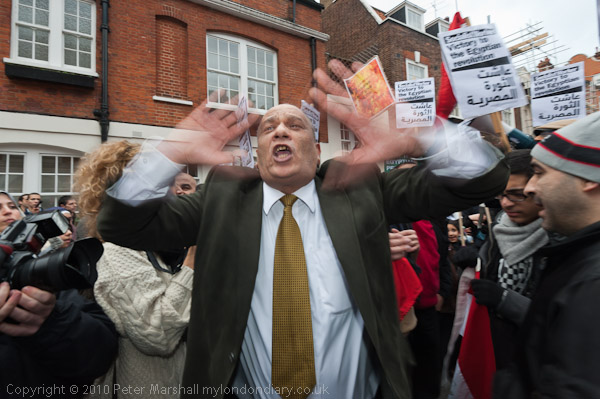
Their protest in the mews directly opposite the embassy was a good-natured volatile crowd, people jumping up, shouting slogans, climbing on other’s shoulders and making a great deal of noise, just the kind of situation where a wide angle lens such as the Nikon 16-35 really comes into its own.  The only problem was that there were too many other people there taking pictures, and at times it was difficult to avoid them crowding into my view (and doubtless I was often very much in theirs.)

© 2011, Peter Marshall

So, as you can see, at the left of the picture a camera and flash pokes its way in (I’ve burnt in hands on the edge of the frame to make them a little less obtrusive) and less obviously,  the woman in the white jumper is also taking pictures, though the central figure’s arm almost obscures her. By now it was beginning to get dark, and my exposure was down to 1/60 f8, with the flash giving as I hoped a rather nice sharp image to those blurred the hands.

© 2011, Peter Marshall

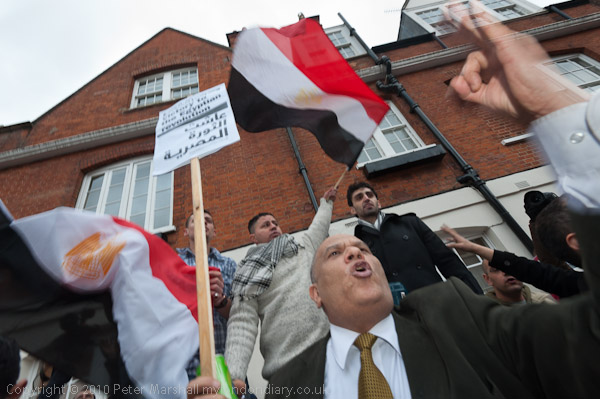
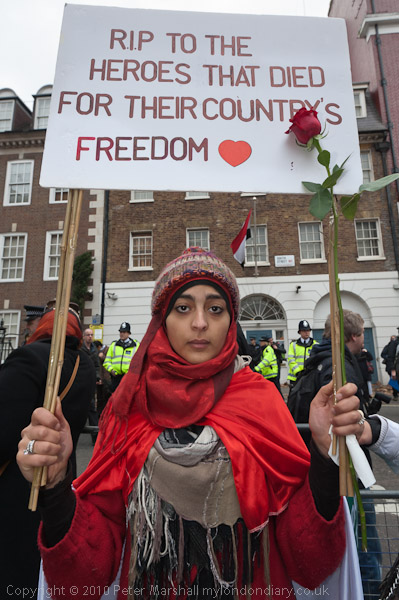
Ten minutes later the same man supplied me with another image, and there were several others that I quite liked, including a very different mood from one young woman:

© 2011, Peter Marshall

I’d taken quite a few pictures of her before this, starting with one when I glimpsed her on the edge of the crowd, but she had immediately turned around and walked away to the barriers at the front of the protest. I’d followed her to take some more pictures, but half a dozen other photographers were crowding around there photographing her, and although I took several, I wasn’t sure that I had what I wanted. I went away and took some more pictures, then came back and said to her that I would like to take her picture with the embassy in the background.  So this is, in a way a posed, set up picture, though quite similar to that first image I made of her, which wasn’t quite as sharp as I would have liked:

© 2011, Peter Marshall

It was a picture I grabbed very quickly, and has suffered a little from camera shake. With the default sharpening I use in Lightroom it is definitely un-sharp, particularly when compared to the posed version above. But some careful sharpening  using Focalblade on the full-size jpeg has improved it greatly. (A new and apparently improved version Focalblade 2 is now available but I’ve not tried this.)

Egyptian Embassy Demonstration on My London Diary

US Embassy Egypt Protest

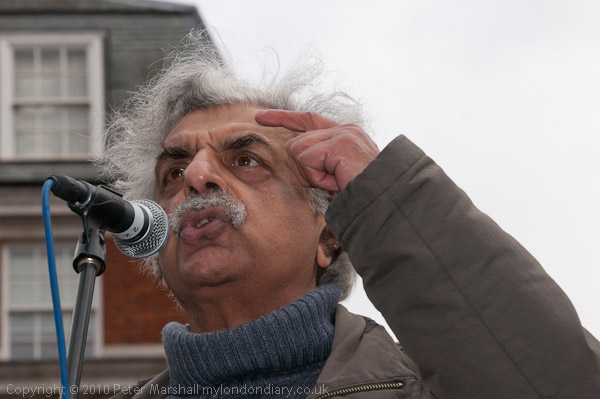
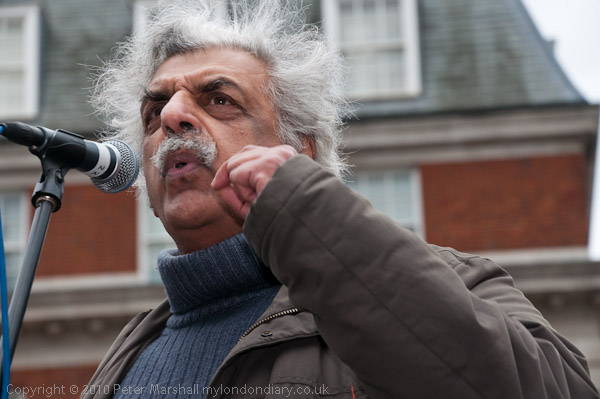
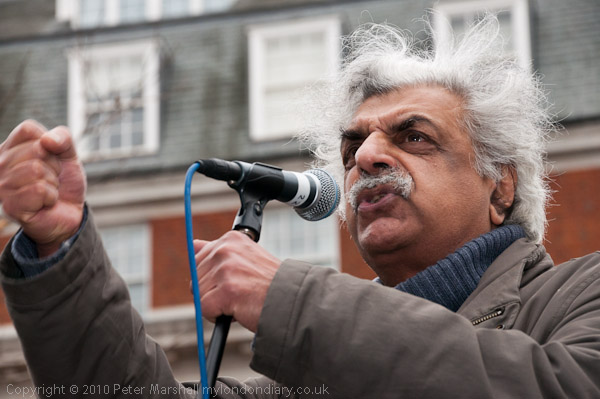
Tariq Ali is really a gift for photographers:

© 2011, Peter Marshall

© 2011, Peter Marshall

© 2011, Peter Marshall
Three views of Tariq Ali speaking

And I could have chosen a dozen or more other frames from the many I took as he spoke with great passion outside the US Embassy in Grosvenor Square, a place which brings back many memories for those of us involved with protest since the sixties.

One of the problems of photographing speakers is always the microphone, making its presence felt in many shots, often getting in the way of the picture you would like to take.  There are relatively few occasions on which it really improves an image to have it in front of someone’s face, but sometimes it can’t be avoided.

The  hardest people to photograph speaking are those who get really close to the microphone, speaking quietly into it and always looking in the same direction. Most of them never open their eye too!  Tariq Ali speaks with great force, making full use of dynamics, and although he took the loudspeakers rather beyond their rated limits, most of the times there was at least a small gap between him and the microphone. And as you can see he has quite a range of gesture and expression, looking around the crowd.  Actually rather more than my pictures here show, as probably around four fifths 0f the time he had moved so that the microphone was obscuring too much of his face for my liking.

There was also space for me to move around, though I had to take care doing so to avoid getting in shot too much for the several video cameras and other still photographers also taking pictures. But I’d started by choosing the position from which I’d taken these shots – usually around my favourite angle for such pictures, and after trying from a few other angles, came back to it, just moving slightly.

These pictures were taken with the D300 and the Nikon18-105mm, and most of the time I was working at its full stretch, equivalent to 157mm.  It is a little long for portraits, but a decent compromise, as I’m looking up at quite an angle to the speakers on a small stage.  I’d set ISO 1000 to give me shutter speeds and apertures around 1/250 f8, though with the camera on P setting they were changing a little frame to frame. But you do need a fairly fast shutter speed both to avoid camera shake with the long lens and also to avoid too much blur with those highly controlled ‘wild’ gestures. And of course they all use flash, which really helps to bring the face out of the shadows.

I tried to keep the focus on the eyes – and to make sure they were open, and generally succeeded. It’s great having the preview button set up to zoom right in during image playback so you can check that these things are right.

Backgrounds are often a problem, and sometimes – as in this case – there was not a great deal I could do about it. I did take a few pictures from a different angle with just a white sky as a background, but again it wasn’t a great background. It would have been nice if the stage had been set to have the embassy US flag and that big eagle hovering above him as he spoke, but it was actually directly behind me as I too the pictures

Of course I photographed others as well,  the protesters as well as most of the other speakers.

© 2011, Peter Marshall
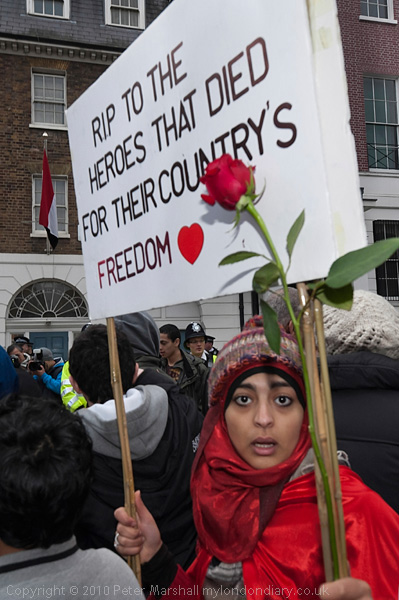
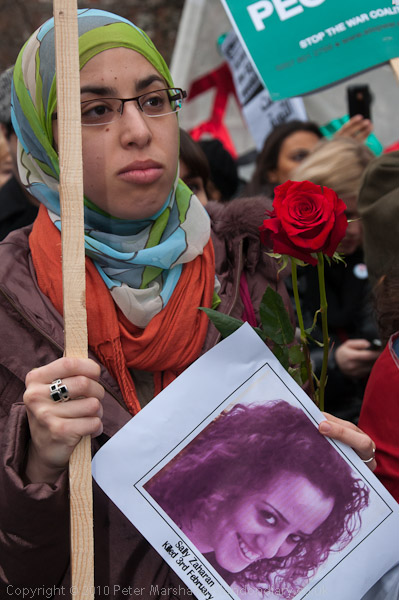
Muslim woman in headscarf holds red rose& photo of Cairo victim Sally Zaharan

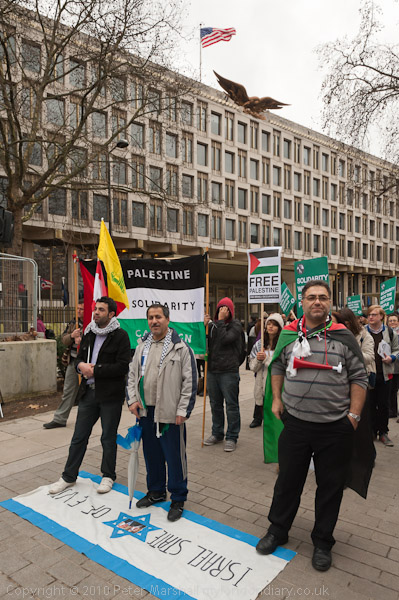
And of course I had to have at least one picture showing that embassy, eagle & flag.

© 2011, Peter Marshall

More at US Embassy Rally For Egypt on My London Diary.

Islington on the March

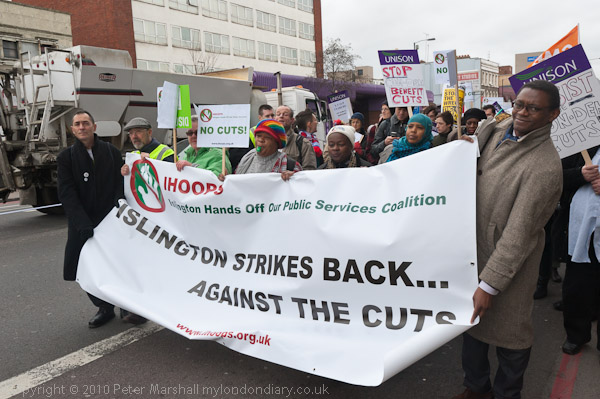
© 2011, Peter Marshall

One of many protests against the cuts in public services was a local march on Saturday in Islington. As local marches go, there was pretty strong support, but not as strong as one web report suggested in its headline One thousand march in Islington against cuts.

I often complain that the figures given by police and particularly the BBC (who shouldn’t have an axe to grind) are ridiculously low, though the BBC often play safe, with phrases like ‘Hundreds marched’, which is still rather misleading if – as sometimes – it was really around 25 hundreds. But this time I’d written a report before I read that on the web, and I’d used the actual figure in it.

Unless another 600 snuck in over the last half-mile after I had left to go elsewhere the actual figure was around 400. Just before Highbury and Islington station I stopped and counted as the whole march went past me, and I got to 397. Of course there is a small margin of error in such counts, however carefull you are. But I would be reasonably confident that there were between say 380 and 420 people marching (including a few very young children who were actually being carried.)

It is fairly easy to count a smallish march like this with some accuracy by actually counting individuals as they go past, though just a little tedious. It is easy to miss the odd one or two, and equally easy to count a few twice, but the errors tend to cancel out. Larger marches I count as batches of roughly twenty people, and above a couple of thousand I usually give up and rely on a rough estimation.  Years ago I used to stand two or three mornings a week looking down at around 1200 students in a morning assembly, which still gives me a rough idea of what that kind of number looks like, though protests are sometimes rather more spread out.

It may not be vital, but numbers are a fact which is often commented on and reported, and part of the job of a journalist is to get the facts right.

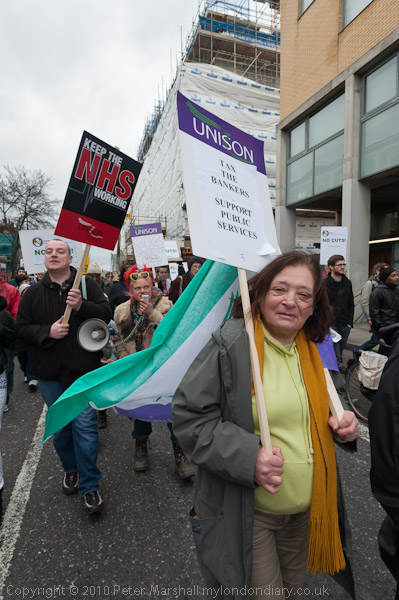
© 2011, Peter Marshall

It wasn’t the most interesting of events to photograph, but people are always interesting, and I found some that  I hope express something of the spirit of the event.

© 2011, Peter Marshall

You can read my report and see more pictures at Islington Strikes Back. Like many of the posts on My London Diary it was first published on Demotix, where I managed to upload the image above in a rather dim and dark version, having somehow failed to correct it in Lightroom. All my images get corrected on import using a standard preset which I have set up and this includes having Lightroom automatically adjust ‘tone’ – exposure, recovery (highlights), fill light, blacks, brightness and contrast. But this ‘auto tone’, which is the same as the button in the Basic section of the Develop module, is one area where Lightroom definitely needs some improvement.

Of course there is always some room for interpretation, but a good starting point for most images is to set shadows and highlights at the two ends of the histogram, and ‘auto-tone’ sometimes simply fails to do so. This image was such a case; Lightroom inexplicably made an exposure adjustment of -0.15 to leave a large gap at the highlight end of the histogram – and the corrected version above has an exposure adjustment of +0.57 – a difference of 0.72.  Normally I improve on the auto settings before sending pictures out, but somehow I missed this one in my late-night rush.

Demotix does a certain small amount of editing on the reports sent with pictures, though the changes made to mine are usually minimal. This time an editor had noticed that I had said that the march started at the Nags Head, and thought it would help to add the words “public house” after it. Unfortunately it’s some years since the Nags Head has been a public house, but it has bequeathed its name to a road junction and the area around it.  Fortunately I was able to log in and add my own correction, but it was a little annoying to have to do it in all the picture captions as well.

Demotix itself is in the news, having struck a deal with the Press Association (PA) which will now distribute some at least of its images.  It is really rather misleading of the report to say that Demotix “receives contributions from amateurs across the globe“, as although it does, it receives contributions from professionals around the world too, as well as some based here in the UK. But it certainly draws on photography from a wider base than existing agencies such as the PA, and often shows the strength of work from people with local knowledge rather than those flying in for short periods from abroad to cover stories. The best work on Demotix is as professional as that from any other agency.

Downing St Art Direction

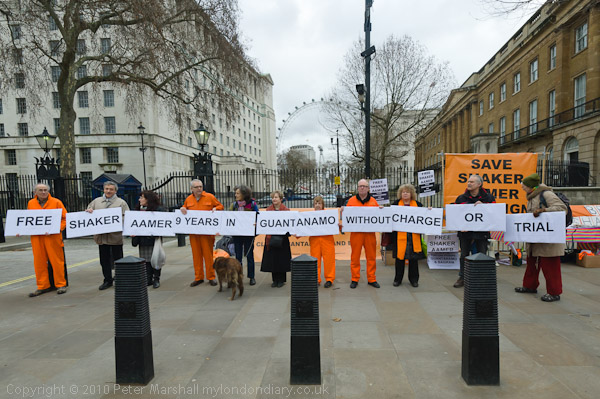
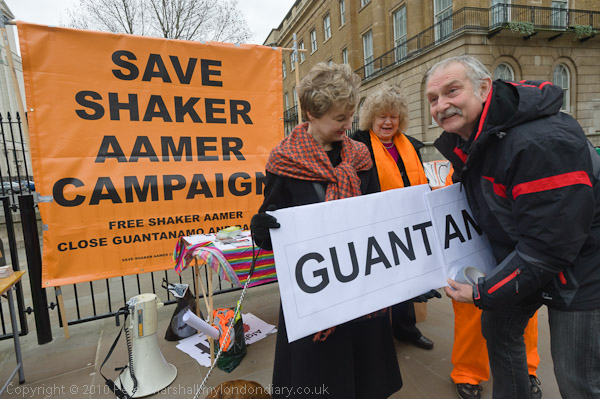
Saturday at noon I was at Downing St to photograph a vigil. It marked 9 years than an innocent London resident has been tortured and kept, for most of the time in solitary confinement, at Guantanamo. Everyone who has looked at the case seems to come to the conclusion that despite what they may say, both US and UK governments do not want Shaker Aamer to be released where he could talk to the press and solicitors, give the evidence he has about how he was tortured – by Americans but with British secret service assistance – both at Bagram Air Base and in Guantanamo, and also how others there were treated.  His evidence would certainly be extremely embarrassing to both governments, but that cannot be an acceptable reason for keeping him incarcerated, and the governments need to be shamed into letting him free.

It wasn’t a big demonstration, and we had to wait until enough people arrived to take the picture that the event organisers wanted. It looked like this:

© 2011, Peter Marshall

The message is clear enough, and it wasn’t too difficult to take, but it just isn’t very interesting visually, often a problem when organisations think up what they think will be great ideas for a photograph. Still at least this was easy to take, and with the 16-35mm I could even stay on the pavement to get it all in, although the other couple of people taking pictures had to dodge the buses in the middle of the road. Sometimes the ideas that certainly untrained art directors (are there any other sort) have involve that curious camera that is able to point in two directions at the same time or somehow levitates at 20 metres above the ground.

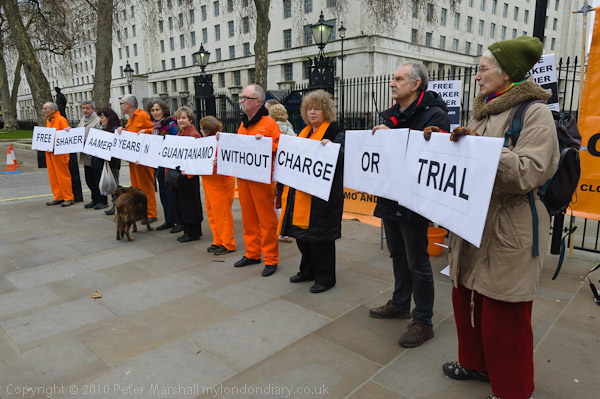
It looked a little better from one side, for example like this:

© 2011, Peter Marshall

At least now the interest in the picture isn’t confined to a narrow strip across it – less than a quarter of the image area in the upper picture. Or I could put it into a better overall picture like this:

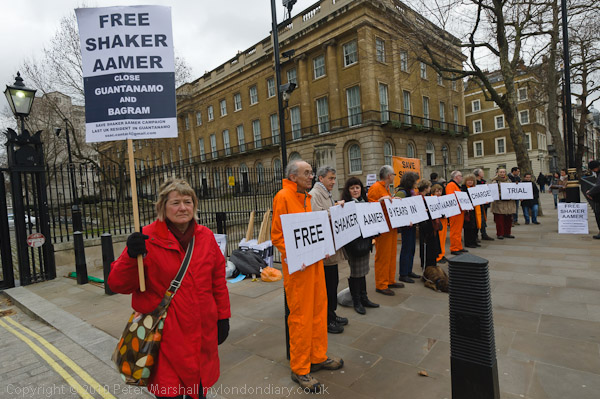
© 2011, Peter Marshall

though I should have compromised my principles and moved the woman with the placard closer to the slogan, enabling me also to get rid of that foreground post by moving up to it to take the picture.

But my favourite image from the fairly small number I took didn’t use that long long line of text at all.

© 2011, Peter Marshall

Although it doesn’t mention the 9 years, the rest of the message is pretty clear, and it shows the two figures at the vigil who might be recognisable to a wider public, Kate Hudson of CND amd London’s Green MP Jean Lambert, along with one of the organisers.

You can read more about the event and see the few other pictures that I took on My London Diary in Shaker Aamer – 9 Years in Guantanamo.

Photography a Soft Subject?

The advice to prospective students given in the Russell Group’s booklet Informed Choices which came out last week is of course a clear and excellent guide to making sensible decisions for those who want to study at one of Britain’s most prestigious 21 universities, and it naturally reflects their particular view of Higher Education  – which is also reflected in the government’s funding of UK education.

Perhaps because I have a couple of degrees from one of them and spent around 30 years teaching in secondary and further education I don’t have a particularly high opinion of our education system as a whole, and particularly not of certain aspects of our higher education system. Of course I have a great admiration and respect for many who work in them – and certainly parts of the system are only kept running by a great deal of largely selfless dedication, particularly by the classroom teachers, despite a great campaign largely orchestrated  by OFSTED to denigrate them over the years.

I started my teaching career as a science teacher, and science subjects rank highly for the Russell Group, hard, ‘facilitating’ subjects that will get you onto their courses, along with others that involve writing lots of essays (our education system still seems largely geared to produce civil servants.) One thing that characterises all these ‘hard’ subjects is that they reward the student who can summarise and regurgitate a large body of information and theories – and that they all discourage any original thinking and experiment.

This is actually a very successful strategy for a small minority of those who go on to study at university and finally perhaps get to do some truly original work, usually now well after their second or third degree, but I think fairly disastrous or at best stultifying in terms of personal development for the great majority who take these courses.

One of the more disappointing aspects of the education system for me has been the increasing tendency over the years of art courses, particularly photography, to jump on that same academic treadmill, neatly characterised by one of the comments to the  BJP’s feature, which read (in totality):

Outrageous

Barths
Foucault
Sontag
Lacan

All fairly soft eh?

(sic, though I’m in no position to comment on typos)

Later I went on to set up and teach several photographic courses in the school and later college where I worked, and later still taught in a part of what I think is still on the leading edge of vocational courses worldwide, the Cisco Networking Academy programme.

Down in the lower depths of the chalk face, the great liberation for me (and my students) came not by the incorporation of tedious academia (with the pointless reproduction of tedious essays) but with art and design based photography syllabi which encouraged and rewarded experimental background work and projects which allowed students to research and develop their own ideas at an appropriate level in both level 2 and level 3 courses.

Many like myself and my colleagues developed new materials and methods – some of which have since in part been published (and notably by a former colleague of mine, Mark Galer.) Our students benefited both from the exploration of their own ideas and thoughts, and also from the CSE and A level grades their work  – both photographic projects and research presentations gained.

Among our students were some who had never previously passed an examination, working alongside some academic high-flyers, often out-achieving them, and most responded to our encouragement and the stimulation of following their own ideas. Photography became for a few years the most popular subject at our college and the subject in which students gained the highest average grades.

The high level of awards wasn’t a result of photography being a ‘soft’ subject, but of it being something that interested and challenged students. Challenged them intellectually in ways that many ‘hard’ subjects never do to think both for themselves and about themselves. And challenged them in a way that was apparently rare in those who went on to study photography further.

Our particular work in photography largely came to an end more than ten years ago with an increased emphasis on specialisation and the encouragement of students to concentrate on a core course leading either to university entrance or employment, very much the kind of thing that the Russell Group advice is not urging on students.

We were also hit by the changes in the curriculum, particularly from a two year A level to A1 and A2; previously we had run GSCE as a one year course which also served as the first year of A level, and we just did not fit into the new pattern well. And to introduce what was meant to encourage a broader curriculum, the college responded with a reduction in the number of timetable blocks that students were required to work, very much a cost-cutting measure.

Photographic education generally in the UK – with some rare exceptions (David Hurn’s Newport course springs immediately to mind – but it couldn’t survive) has never impressed. In the old days it was formulaic and largely technical, and after a brief period when things seemed to be looking up then became saddled with a largely irrelevant academic burden in an attempt to justify degree status.

Photography education now has an academic content largely unrelated to its practice, and produces many graduates who appear to have only a very hazy view of the history of the medium. From some courses they emerge with no great appreciation of its practice, while others insist on perpetuating the kind of craft skills (though usually at a fairly basic level) that are no longer relevant to current practice.

The academic study seems to do little to expand the horizons of those who undertake it, and fits them only to teach the same dull dry materials to others. But photographic education is curiously schizoid and at the same time pretends to be vocational, while we know that there is only work for a very small percentage of its output, who in most cases would have been better prepared for what work there is by actually going and doing the job rather than going to university.

Part of the tragedy is that there are many good people involved in photographic education, even some good photographers. Over the years I’ve met quite a few of them and often heard some bemoan exactly the kind of things that I mention.

Of course I used to talk to students and try to get them to study photography. At the start I told them that I thought they would find our courses interesting and rewarding, and they would learn skills that would continue to be useful in later life, and enrich their experience, whatever they went on to be or to do. And I think I was right. But I also told them that the chances that they would ever earn a living with a camera were extremely small.

Of course we should have abandoned A levels years ago and gone over to a system of education not based on filtering people for university courses but on broadening the person. A system that perhaps might end with a portfolio rather than a certificate with a few letters on it, something showing what people have produced and are able to do. Not unlike some of those courses I taught, where the real result wasn’t the A or B on the exam certificate but the the work – studies and projects – that the students took with them in their portfolios.

Paris Shows: Tendance Floue & Vanessa Winship

Tendance Floue

I’ve spent some time searching without success for the first piece that I wrote about the French collective ‘Tendance Floue‘, a group of photographers who aim to explore their individual creativity in a dialogue together outside the normal limits of commercial media practice.

I think it was perhaps around five years ago, when their work was included in the Arles Rencontres and also gained an ICP Infinity Award that I became aware of the group on-line, and somewhere around the same time I saw a show of their work I think in the fringe festival during the Mois de la photo in Paris. Possibly it was in an brick arch under a bridge across the railway lines out of the Gare d’Austerlitz at Les Frigos, but I can’t be sure.

Tendance Floue (TF) literally means a fuzzy or blurred tendency or trend, and if the work of the photographers in the group does sometimes become a little too experimental for my liking, blur is not necessarily to be taken literally, but more as expressing a spirit of being prepared to explore outside the boundaries of particular  conventions – such as that of sharpness – that the commercial practice normally demands.

I was slightly surprised to learn that TF is celebrating its twentieth anniversary, with the original five photographers now grown to a dozen. And celebrating in some style with shows in five galleries in the Marais in Paris from Feb 5-22nd.

  • Baudoin Lebon : Thierry Ardouin, Flore-Aël Surun and Patrick Tourneboeuf
  • Galerie Les filles du calvaire : Pascal Aimar and Mat Jacob
  • La galerie particulière : Gilles Coulon and Philippe Lopparelli
  • La petite poule noire : Bertrand Meunier
  • Hôtel de Sauroy : Denis Bourges, Olivier Culmann, Caty Jan and Meyer.

In the French press release that accompanies the show there is a handy map so you can plan a walk around all five (they include one, La petite poule noire, on the Boulevard des Filles du Calvaire I’ve not visited.)

If like me you are unlikely to be in Paris before Feb 22nd, there is plenty of work to explore on the TF web site, though some of it isn’t that easy to find. Perhaps the web site too is deliberately fuzzy. I also found that to see the English version of some pages I needed to load the French version first.

Not Only Rare Birds Sing

And if you can get to Paris, another current show not to be missed is ‘Not only Rare Birds Sing‘ by Vanessa Winship, at Galerie VU’ until 19 March 2011.  You can see a selection of her work on the Agence Vu web site, as well as on her own site, where her blog shows her making the prints for this show.

Galerie VU’ used to be in the Marais too, but has now moved west to the 9th arrondissement, in Hôtel Paul Delaroche, 58 rue Saint-Lazare. The gallery is open Monday to Saturday from 2-7pm and you can leave your Velib handily close by at number 62. Do London galleries tell you where to leave your Boris Bike on their invitations?

London Arbaeen

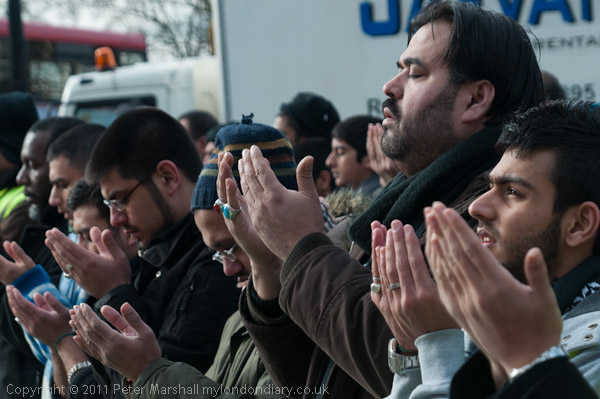
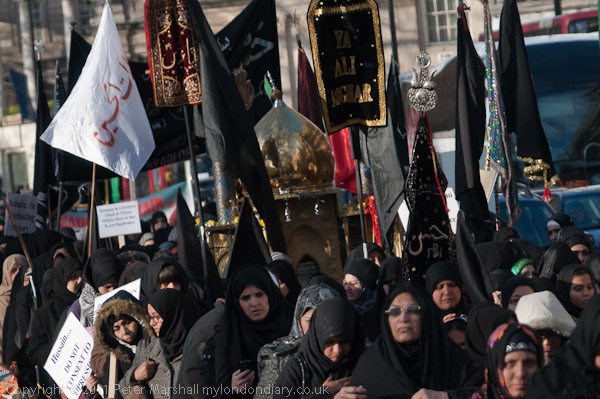
Last Sunday afternoon, several thousand Shia Muslims were at Marble Arch, celebrating Arbaeen, at the end of 40 days of mourning over the massacre of Hussain, the grandson of the Prophet and his followers at Kerbala around 1400 years ago. This was the 30th such march in central London, and I’ve photographed the event – as well as marches on Ashura day at the start of the period of mourning – several times in the past, and I think rather better than I did today.

© 2011, Peter Marshall

I arrived as the event was starting, with long sessions of recitation and community prayers, and then took an hour or so away from the event just as more was beginning to happen, rushing away to cover the UK Uncut demonstration half a mile away along Oxford St.

It isn’t possible to be in two places at once, and trying to cover both events on this occasion was almost certainly a mistake, as it meant I missed important aspects of both. But then I’m pleased that I did manage to photograph so much of both.

Coming away from UK Uncut one of the other photographers I know there came along with me – we’d both wrongly thought everything of interest was over. She hadn’t known about the procession and I told her briefly what it was about as we walked briskly towards it.

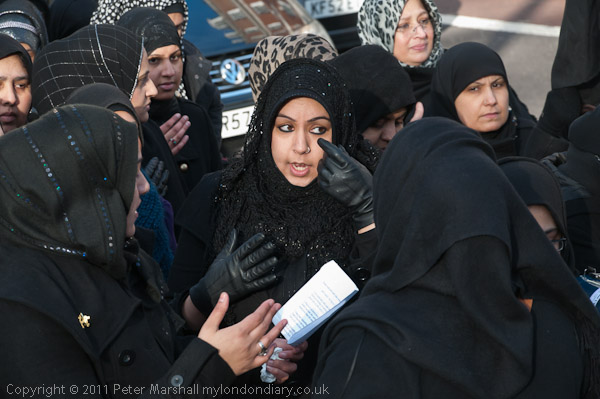
Like many Muslim events, men and women generally take part in separate groups and in different ways. Many of the men show their emotions more openly as well as being considerably more physical in their expressions, while the women are more restrained, but also more of them carry flags and banners.

© 2011, Peter Marshall

It is easier for women photographers to photograph the women at events such as this, getting in close while I was generally standing further back with a longer lens. Things have changed a bit over the years, but there is still a difference, although it is a few years since a steward came up to me and said “We do not photograph the women.”

© 2011, Peter Marshall

But of course I have, and some of them have thanked me for the pictures I’ve taken. Photographing the men presents no problems – for men or women photographers.

© 2011, Peter Marshall

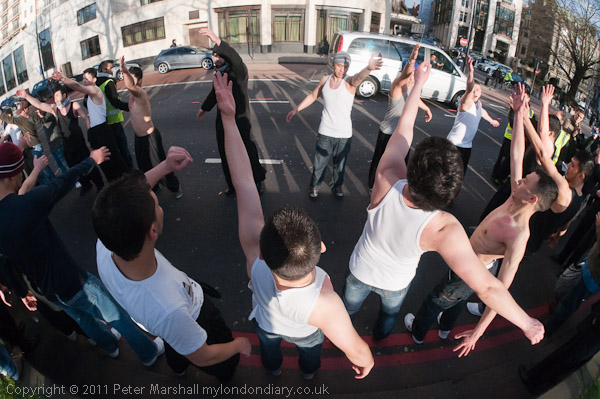
When I looked at the pictures having imported them into Lightroom, for a few minutes I could not find some of the pictures I had taken. These were pictures looking down on groups of men beating their chests in mourning – I was standing on top of a low fence or wall and holding my camera out at arms length above them with the 10.5mm fisheye on the D300.

Then I remembered that the profile for the 10.5mm I have for Lightroom messes up the pictures by “correcting” the fisheye perspective to rectilinear. It’s something I keep meaning to find a way to edit but never get round to. I use the profile because it automatically more or less removes the rather noticeable colour fringing the lens gives, but this correction is just silly. The results are not usable – with extremely poor corner detail – and just look silly, as rectilinear perspective becomes hopeless at greater than around 90 degree angle of view.

If I wanted a rectilinear result I’d use the 16-35mm. I do often use some correction on the fisheye results, sometimes in Lightroom but more often in other software that tames its extremes, but never the full rectilinear effect, always ridiculous unless you crop drastically.

Fortunately Lightroom makes it easy to select images by the lens that was used, and once I realised it was a simple and quick matter to do so, correct the problem in one and synchronise it across to all the rest, and there were my pictures back again.

My fuller report on the event with many more pictures is on My London Diary at Shia Muslims 30th Arbaeen Procession .