Prix Pictet

I’m pleased to announce I was wrong.

In November, in the post Pictet ‘Growth’ Shortlist I wrote:

I probably shouldn’t condemn any of them to oblivion by naming them as my favourite for the prize, and in any case I think it should receive rather though more than my quick first impression. Particularly because it isn’t just a matter of a single image, but really of a set of pictures, and that does need more consideration. But Mitch Epstein has long been one of my favourite contemporary photographers, Guy Tillim’s work I always find of interest and the show by Taryn Simon was one of the best in recent years at the Photographers’ Gallery. The only work that really appeals that was new to me was by Nyaba Ouedraogo. So probably those four are now the outsiders in the race!

Though when I actually saw the work on the wall in Paris I did change my mind a little, perhaps because I wasn’t entirely happy with the printing of Epstein’s work and there was one really interesting image by Burtynsky (see Thursday Afternoon in Paris 3e for my visit to the show and elsewhere.)

But despite my recommendation, Epstein has won, and you can see a slideshow of his 12 images, along with his accompanying text on Lensculture.  The first image there, of Amos Coal Power Plant, Raymond, West Virginia 2004, is the one that really caused me to have doubts when I saw it in Paris; to me the colour just looks wrong, particularly the grass (and I’m viewing it on a colour-corrected screen with a background image of a grassy hill next to a window that looks out on a lawn.)

I’m actually pretty sure it is wrong, because Mitch Epstein states in his Lensculture piece that he and his wife, writer Susan Bell, have created a web site to share this project, What is American Power? And the first image on this is also  Amos Coal Power Plant, Raymond, West Virginia 2004, but in subtle and beleivable (and probably realistic) colour. While the Pictet print – both for real and on the web – more resembles the kind of early inkjet prints we used to get before people had sussed out things like colour management.

It’s worth looking at the work on the web site, though I found the performance with swirling prints between each picture incredibly maddening, and really had to grit my teeth to click the next button each time. I can’t tell you how many pictures there are or get any real idea about the work as a whole because I couldn’t force myself to sit through more than around a dozen images.  I can’t see any point in this kind of demented web design.

ESOL Day of Action

Just posted on My London Diary are my pictures from last Thursday’s ESOL (English for Speakers of Other Languages) Day of Action.
© 2011, Peter Marshall
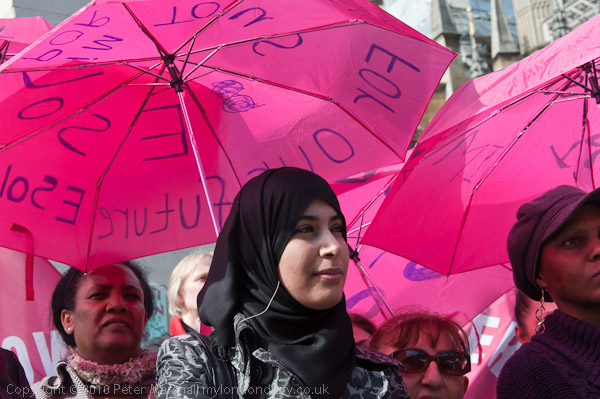
ESOL students and lecturers at Downing St

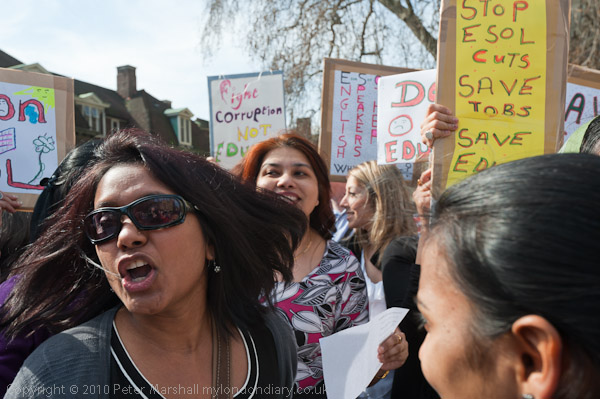
It was a very fine day for the time of year, but started really slowly, and for some time I wondered if my journey into London had been worth it.  But things soon livened up, particularly with one very vocal group of students, mainly fairly young women, arrived and began to shout the slogans that had been provided as one of several educational resources on the web site for the day of action.

© 2011, Peter Marshall

At least one of the other photographers had left before they arrived, and certainly missed the rally where many of the students spoke about how essential the ESOL classes were for them, where I very much enjoyed photographing both speakers and audience.

© 2011, Peter Marshall
Listening to the students speaking

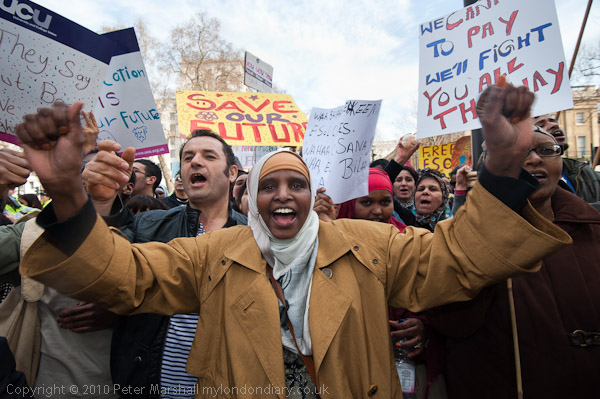
The event seemed as if it was over by then, as although they were going to take a letter to Downing St, the police had advised that they go there in small groups rather than march as a body. So I’d actually left and gone to photograph another event taking place opposite Downing St when I saw the bulk of the ESOL students coming down the road and rushed across to take more pictures, including the one at the top of this piece.

© 2011, Peter Marshall

There was a very dense crush outside the gates to Downing St, making it rather difficult to move – hard to get far enough away to photograph these outstretched arms, even with the 16mm on the D700.

It’s in really crowded situations like this that I like to use the 10.5mm fisheye with the D300 (perhaps one day I’ll get the 15mm which does a similar job on the D700.)  I took a number of pictures, but I think the one at the top of this piece is the best. Fortunately I’ve managed to get Lightroom to stop automatically correcting the fisheye effect while still correcting for the vignetting and chromatic aberration (of which there is plenty.)  The example here benefits from the way the fisheye curves in the placard at left and particularly the tree at right, although for some images a small amount of distortion correction or an appropriate filter does help. All of those that are in ESOL Day of Action on My London Diary are uncorrected.

I hope the government can be persuaded to see sense over ESOL and realise the real value these courses provide, both to the individuals who take them and also to the country that benefits from the contribution that they enable these people to make.  But unfortunately they seem bent on appeasing the racists and taking a very negative line on anything concerned with asylum seekers and refugees in particular and immigrants in general.

March 26

I don’t usually write here about the posts that I make on Demotix, preferring to wait until I have had time to take a longer look at the pictures I took and to sort out more of them for My London Diary.  But it may be a little while before I get those from Saturdays events in London on-line here, while I spent most of Saturday night and Sunday writing stories and uploading images to Demotix.

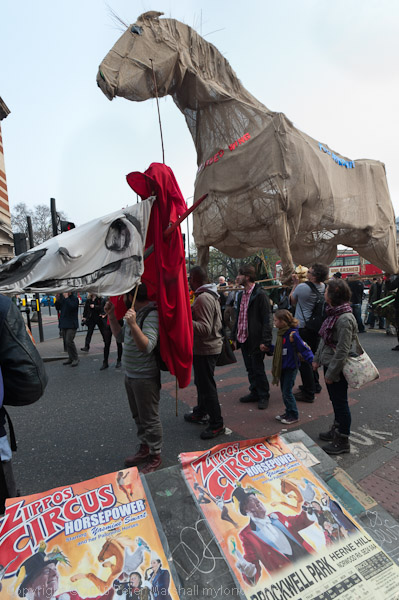
Saturday was a long day for me, and not without its problems. Everything started fine and I arrived at Camberwell Green in time to watch the final preparations of the ‘Armed Wing of the TUC‘ who then proceeded to march to Kennington with their Trojan Horse, tank, Spitfire, the 4 Horsemen of the Apocalypse, armed Lollipop Ladies and the large ‘Capitalism Isn’t Working’ banner.
© 2011, Peter Marshall
Trojan horse Joins Anti-cuts March on Demotix

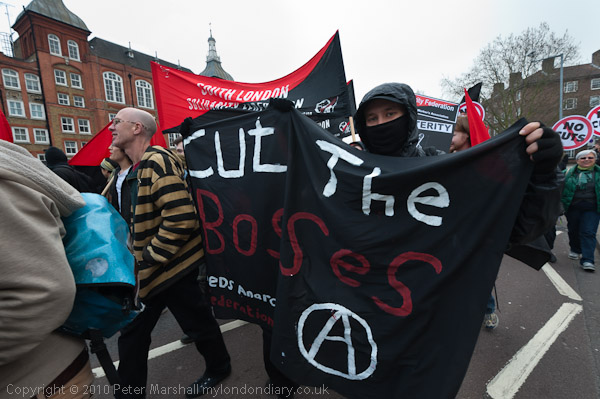
We walked to the South London Feeder March for the TUC demonstration (though for reasons best known to itself the TUC disowned all of the feeder marches) at Kennington Park, a location of some importance in the history of the labour movement, where there was a short rally before the couple of thousand or so there marched off to join the main march.
© 2011, Peter Marshall
South London Marches to the TUC March

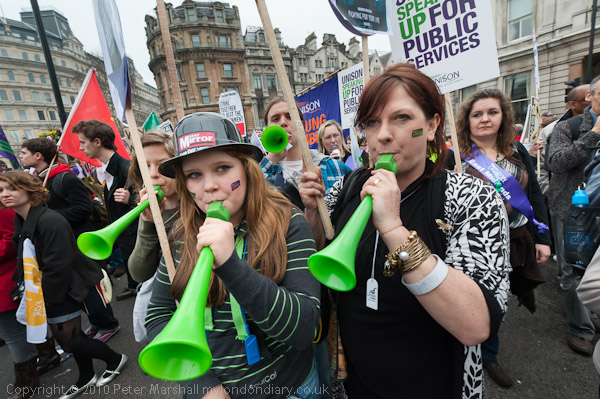
I left them after a few hundred yards to take the tube from Kennington into Charing Cross and went to Trafalgar Square. I should have been there before the TUC march according to the published timetable, but they had started early and were already streaming past when I arrived.  So I spent an hour or so taking pictures of the marchers and the other things happening around Trafalgar Square then – and also took some more pictures of the march which was still passing around four hours later when I was at Piccadilly Circus. But both times included I probably saw fewer than a quarter of the approaching half a million on the march, so I called my Demotix feature Glimpses of the TUC March.
© 2011, Peter Marshall

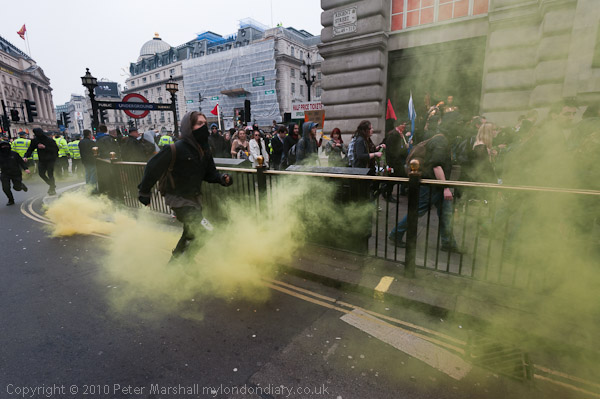
Then I saw the black bloc of anarchists taking a different route and followed them for the next 45 minutes or so. They were not really doing a great deal most of the time I was with them, and the police seemed largely to be ignoring them. I read a newspaper report that they “broke through” a line of police at the bottom of Regent St, but most of them simply walked by on the pavement which the police were not blocking, and the police made little or no attempt to stop the few who kept on the road.
© 2011, Peter Marshall

Many of the protesters walked round police line on the pavement

A couple of police followed the group up into Regent St, and then down Conduit St.  One anarchist account says they took this route as police were about to kettle them on Regent St, but there was really no sign of this happening, with just a few police in the distance. They let off a few fireworks and flares, and on Bond St a few made a rush towards a branch of the RBS, but the dozen or so police standing outside soon pushed them away. A few light sticks from placards were thrown and some paint sprayed, but little else.

On Oxford St they made a more deliberate attempt to rush into Topshop, but there were quite a few police as well as security men inside the shop. A lot of paint was thrown and there were scuffles as the police arrested one young man. I took a number of pictures of police holding him on the ground and then moved slightly back.  Suddenly I felt a thump on my chest and found I had been hit by a ball of yellow paint, probably aimed at the police just behind me (although later some photographers were certainly deliberately targeted.)

I kept taking pictures for a few minutes – although both cameras were splattered with paint, there was none on the lenses and they were still working fine. Most of the photographers around seemed to be taking pictures of me now, and I’ve seen one on Flickr that gives a good idea of what I looked like. before retiring to a nearby public convenience and wiping and washing off as much paint as I could. You can see my pictures of the black bloc in Anarchists March on Oxford St, although events with them did get a little more interesting after I had left them.

Though I’m not sure why so much media attention is directed towards this very small group – really just a few hundred – and their activities. Though I would like it if the BBC and others actually took the trouble to find out who was who and what things were about, having just watched a video in which the BBC presenter refers to them as anarchists, Socialist Workers Party and UK Uncut. Or is it a deliberate policy to misunderstand and mislead?

A  ball of emulsion goes a very long way, and although I wiped as much as I could off my jacket, the surface of my jumper, both cameras and elsewhere I gave up with a great deal of paint still on me, and feeling rather uncomfortable with a a slab of wet paint in my vest, shirt and jumper soaking my chest.

I spent the next hour or so with the very different UK Uncut who were holding peaceful protests, an outdoor comedy show and a party in and around Oxford St. Being covered in yellow paint is quite a good ice-breaker, but I hope to avoid it in future. There are a few pictures and some text at UK Uncut Party and Protest on Oxford St.
© 2011, Peter Marshall

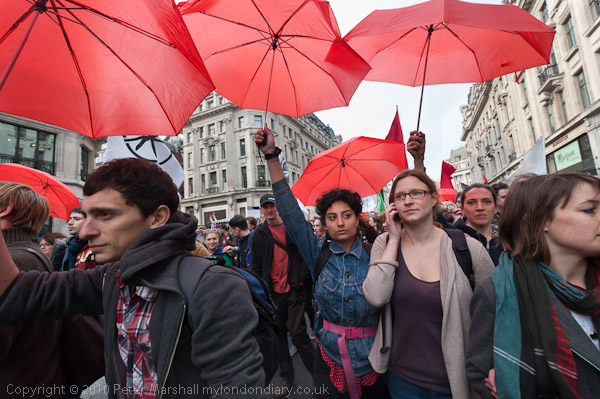
The I left with one of the groups that was making its way to a protest at an undisclosed location (following the red umbrellas) which turned out to be Fortnum & Mason’s, although I didn’t get there. At Piccadilly Circus I was feeling a bit fed up and decided it was time to go home and clean up, though I did hang around for a bit and take pictures of the TUC marchers still passing by.

Despite some of the stories in the press and broadcast on radio and TV, the UK Uncut action at Fortnum & Mason remained non-violent and the protesters were very careful to avoid any damage inside the store.  Outside was apparently a different story, with other protesters having what several people have described as a riot, with some injuries to both protesters and police.

But when, by arrangement with the police, the UK Uncut protesters filed quietly out of the store, they were all photographed, handcuffed and arrested, and most at least were held in custody for around 24 hours before being released.

These peaceful and restrained protesters against tax avoidance and evasion made up the majority of arrests by police over the whole day. Few if any of those rioting on the streets were picket up, and I think most of the other arrests followed an unprovoked attack by police on people partying in Trafalgar Square later in the evening. I wasn’t there but have read the tweets and comments of friends who were, as well as what appears to be the most reliable account of the day’s events yet to have appeared in a major publication, by Laurie Penny in her New Statesman blog. Here she comments:

“With the handful of real, random agitators easy to identify as they tear through the streets of Mayfair, the met has chosen instead to concentrate its energies on UK Uncut – the most successful, high-profile and democratic anti-cuts group in Britain.

This is a piece that has clearly hit a number of nerves among those who weren’t there and show little or no understanding of what is actually happening on the streets of Britain today, but although I may not always like her style, most of what she writes rings true.

I was I suppose lucky that I was only hit by paint. One of my colleagues was hit by a brick, needing nine stitches – and was lucky that it just missed his eye – and another had his camera smashed.

I’m not sure I’ll ever get all the paint off of my gear, but it still seems to be working fine. Given that they were already pretty worn it isn’t a great problem. I did have some anxious hours when the D700 stopped working after I’d been scrubbing it a bit too much and some water had penetrated, but it recovered after I’d dried it for a few hourse3 in front of my computer fan. Most of the clothes I was wearing are ruined, although I’ll perhaps keep the paint stained jacket and trousers for covering protests where similar things might occur.

Stewards – March For the Alternative

I’m pleased to see that the NUJ London Photographers Branch has issued a ‘Statement To March 26 TUC Stewards‘ which will be read out at the stewards meeting before the ‘March For The Alternative‘, reminding them that “stewards have no legal power to push, move or obstruct journalists recording the event” and that reporters “should not be corralled or directed as part of the demonstration.

It is perhaps surprising to read the TUC web site for stewards, which for many of the lower level Travel and Route Stewards is the only training they will have had, and find no mention there of photographers and journalists, when the TUC should be making clear to them all that we are fellow union members with a job to do.

Stewards should be given guidelines perhaps similar to those agreed between the police and journalists in the published ACPO Police-Media Guidelines although they of course rightly enjoy much less power than the police.

Stewards at some other large marches have been less than cooperative with the media. Like many other photographers I’ve on several occasions been assaulted by Stop The War stewards and at one march was among a large group of photographers who felt so aggrieved at the way we were being kept away that we sat down on Park Lane and stopped the march until we were allowed to do our job.

From the various reports it would seem that the TUC are determined to try to control the march as much as possible, although it seems very unlikely they they will manage to do so given the various other groups who will be taking part in the protest on the day. The march is after all billed as the ‘March For The Alternative: Jobs – Growth – Justice‘ and it is only to be expected that the alternative groups will demonstrate some of their views of the alternative on the day. I think it is likely to me rather more alternative than many in the TUC would like.

Since the unfortunate displays by police at the student protests in November and early December the police do appear to have been making an effort to police demonstrations in a calmer and more balanced manner – and to have taken seriously the comments that I and many others made about their failure to communicate with protesters. So I’m hoping that this will continue tomorrow.

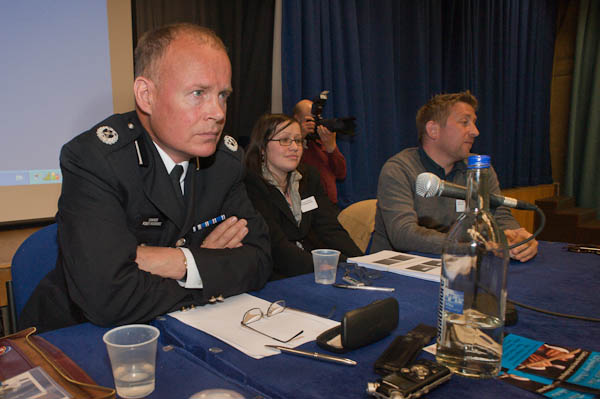
What does not give me great confidence is the appointment of Commander Broadhurst as Media Liaison Officer – you can see a video of him talking about the press and demonstrations made by Jason N Parkinson  at the 2009 NUJ Photographers Conference. I was standing just a couple of feet to his side photographing him while he spoke (I needed to get rather closer than I might have liked because the only lens I’d taken with me was the 20mm – having agreed to photograph the event I’d forgotten to add a longer zoom to my bag when I had to leave home rather early that morning!)

© 2009 Peter Marshall
Commander Broadhurst looking very uncomfortable – and so he should

His performance there was I think a low point in police-press relations, and I think he realised it. You can read my thoughts at the time – and see more of the pictures in Can Anyone Apply for an NUJ Card who has a Camera ?

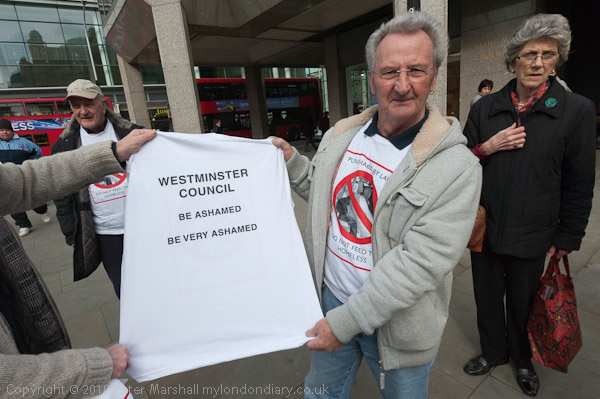
Westminster Council Should Be Ashamed

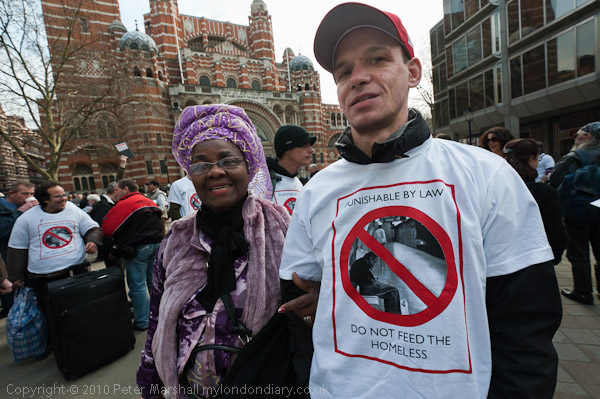
I was appalled when I heard that Westminster Council were proposing to make it an offence to offer food to the homeless, and even more so when I found that they also want to fine those sleeping on the street in their borough up to £500. Of course if people had £500 they would not be choosing to sleep on the street.

When I heard that a protest was being organised against the proposal I was keen to photograph it and try and get as much publicity as possible for the opposition to the by-law.

© 2011, Peter Marshall

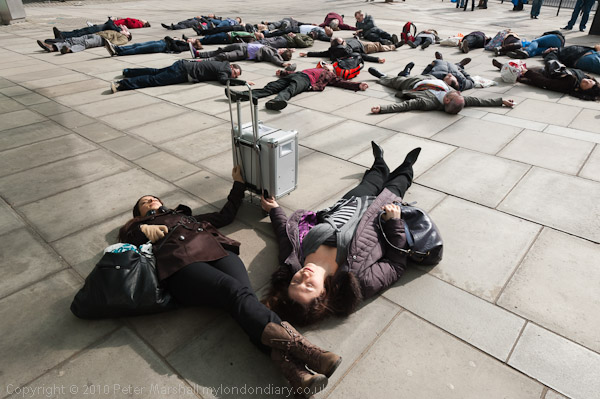
The afternoon started with what was advertised as a Flashmob, but rather to my surprise people turned up early and stood around chatting, waiting for it to happen. Which it duly did at the specified time, with people getting horizontal on the pavement as Radiohead’s ‘Just’ started and keeping flat on the ground until the song ended.

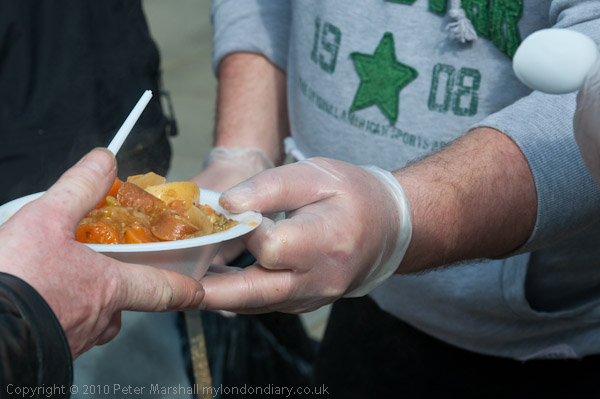
Then we all went back to Westminster Cathedral plaza, where a number of people had been sleeping rough – and some were woken by the music as tables were set up and food to give away loaded onto them.

© 2011, Peter Marshall

Usually at public events I photograph those taking part without thinking at all about their privacy – they have chosen to be there and act in public, but this was perhaps rather different. I decided that I did not want to take pictures – or at least not identifiable pictures – of those who were sleeping rough without being reasonably sure that they were comfortable with being photographed and having their pictures used.

© 2011, Peter Marshall

The free food was available to anyone who wanted it – I’d eaten on my way to the event so all I had was a couple of crisps, but those eating included some of those who hand it out at various ‘soup kitchens’ and other events around Westminster as well as passing tourists and the homeless.

But I think the pictures I took were more powerful because of that decision, which made me concentrate on how to communicate rather more than usual. And I did photograph those people who were clearly happy to have their pictures taken.

© 2011, Peter Marshall

Later I looked at work by another photographer from the same party, which was very different to mine, concentrating on the homeless people who came to it. I’m sure that he took his pictures with respect for the dignity of those he photographed and with their permission, but I still felt a little uneasy about the work. It seemed somehow to stigmatize them rather than draw attention to the issues and record the event as I had tried to do.

You can see my report and more pictures at Don’t Make Compassion Criminal on My London Diary.

Synchronise cameras

One trivial but annoying aspect of working with more than one camera is that of synchronising time between them. It seldom mattered with film, as it was only compact models intended for amateurs than generally kept any record of the time, imprinting it on the film during exposure, and most more serious photographers quickly turned to the pages in the manual that gave instructions for disabling the feature.

But most of us have now grown to rely on the time recorded in the EXIF data of our digital files for various purposes. For me it is often vital in putting images from two camera bodies in correct time sequence, and also often useful when writing about events. What time exactly did something happen? How long was it, for example between the start of an incident and the arrival of police on the scene? Where before I would normally have to rely on having noted down the times (and in the heat of the moment it was often not uppermost in my mind), now a quick peek at the file on camera back or computer tells me to the second. Or should.

This morning I spent a frustrating few minutes trying to synchonise the time on my D300 and D700 bodies, having moticed that some of the pictures I took on Saturday were clearly out of order when sorted by time. I’ve been noticing some slight differences for a while, but when I checked I found the two cameras had drifted over 2 minutes apart.

I didn’t find any easy way to put them right. Setting the two cameras to the same time and trying to push to two buttons at the same time turned out to be frustratingly different as I have the display on both set to turn off quickly to save running down the batteries. My first step should have been to find the custom setting c4: Monitor off Display and set that for rather longer than my normal battery-saving 4s but instead I did it with that, which made it more of a game of chance. Eventually I got it so that the two cameras are now within a second, and I’ll be interested to see how long they stay that way. The clocks don’t seem that accurate – perhaps they sometimes stop for the odd millisecond when the camera is actually busy?

Both are now around 35s fast, but I just could not be bothered to go through the whole thing again to get them closer to GMT.  Accidentally they are now more or less in that curious time zone of British Railway Time, where the 10.29 train actually shuts its doors 30s early at 10.28:30, although for some even more curious relativity unknown to Einstein the trains still seem to arrive using 5 minutes behind GMT.

And I’ll have to remember this Sunday to tell both of them that we are now on BST. At least there is a setting for that in the menu. It was several months before I remembered to do so the last time the clocks changed.

Most of the clocks I now own set their time (and make the change to Summer Time) automatically from a radio signal, and perhaps cameras should do the same, although I’d prefer them only to do so when asked. One of my less useful purchases is a travelling alarm clock that when you take it to other time zones still insists on keeping British time. You can set it manually to some other zone, but whatever you do, in the middle of the night it will call home and set the time right. I wouldn’t want cameras to do that!

Sigma, Ahava, Hare Krishna and Pakistan

Saturday evening I wanted to go on to a social occasion after a day of taking pictures, and I decided that my normal camera bag would be a bit in the way. There would have been a cloakroom where I would have had to leave it for some of the time, but I hate having to leave my kit in these, as I’m sure it would not be covered either by their or my insurance. It may be an old and beat-up looking bag, but typically is more than £5000 worth of gear in it. And afterwards I would have to take it with me into a busy pub, where camera bags present an invitation to opportunist thieves, particularly when their owners are perhaps a little less careful after a few drinks.

So I decided to travel light, taking a smaller and less obvious shoulder bag that I can usually take into places without any problems and doesn’t look as if it contains anything of value.

Ordinary bags lack the protection for your gear that is built into camera bags, which means a smaller bag can potentially hold more, but you do need to be careful about damage to gear, and not try to pack in too much. So I decided to make do with just the one camera, the D700, with two lenses, the Nikon 16-35mm and a Sigma DG 28-300 f3.5-6.3. The DG means designed for digital, and although I bought it fairly recently it has now been discontinued.

The Sigma is in some ways a remarkable lens, only sticking out just over 3 inches (87mm) from the front of the camera when at its shortest (and shortest focal length), weighing just over 1lb (465g) and taking a 62mm filter. Considering it covers the full frame this seems incredible, and it is perhaps just a little too good to be true. Nikon’s 28-300 is over an inch longer, weighs 800g and takes a 77mm.

Usually I use it on the D300, as an alternative to the Nikon 18-105mm when I know I will need something longer – on that format it is equivalent to a 42-450mm. So long as there is enough light (at say ISO 1250 that needn’t be a great deal) for its small maximum aperture not to be a problem it can do pretty well.

© 2011, Peter Marshall
28-300 Sigma at 60mm, 1/320 f9, ISO 1000

Of course there are limitations, and on Saturday I came across some of these when I tried to use it to photograph the two demonstrations and a religious event I covered.

© 2011, Peter Marshall
28-300 Sigma, 35mm,  1/200 f7.1 ISO 560

It is pretty hard to find an undamaged recent lens that doesn’t deliver acceptable image quality these days – quite a change from when I started in photography, when even some of the big names produced some less than mediocre performers, but the Sigma, especially at full aperture on full frame, does seem to fall a little behind the other lenses I use. It’s actually pretty good at the wide end but not quite so hot above 200mm. It’s still a usable lens, just not in the top flight, and given its specifications and price (I think I paid around £200, around a third of the Nikon), a compromise I expected and accept.  The Nikon is certainly better at 300mm and has VR which would also be an advantage at the long end.

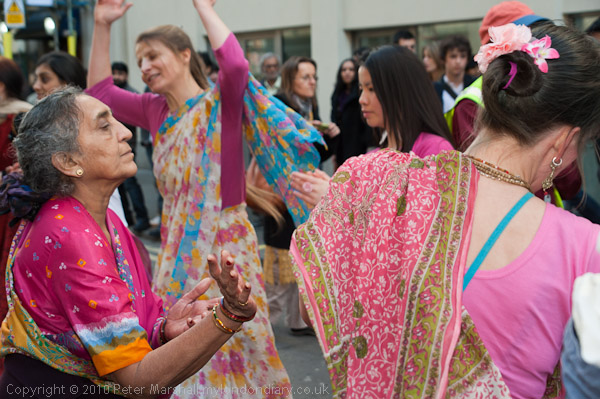
But in particular when photographing the dancing by Hare Krishna, where I was trying to focus on fairly close and rapidly moving subject matter, I found this lens focussed just a little too slow – so much so that I gave up trying to take some pictures. With the 18-105 I would have been able to lock on and follow the movement more readily, and the 16-35 sometimes focusses so fast I don’t believe it has done so.

© 2011, Peter Marshall
Sigma 28-300 at 200mm, 1/200 f7.1 ISO 800

Most of the time I’ve used this lens for relatively static subjects – such as speakers on a platform where I can’t get close, or concentrating on a single face in a static or slow-moving crowd – and haven’t had huge problems. Of course working at around 3-400mm I don’t expect every frame to always be pin sharp, but enough are.

So I got by with one camera, but missed a few pictures because of it, both by having the wrong lens on the camera at times, and also because of the slow focus.

It was a not unusual day in London. I photographed two demonstrations, one with two opposing groups about the Middle East and another about events in Pakistan, and I’d gone to cover another political event but found little or nothing happening there. I’d also photographed a festival of a religious movement with its roots in India.

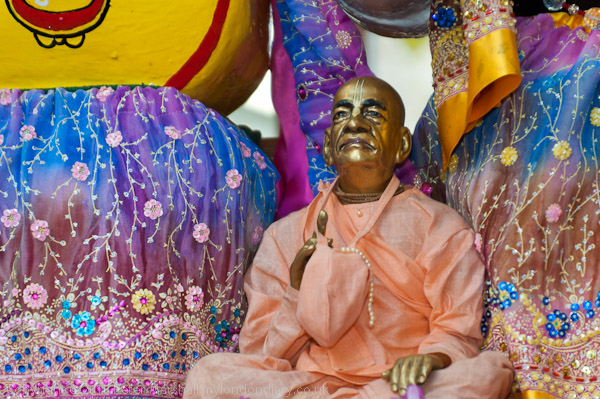
You can see the results in Ahava Boycott Protests Continue, Hare Krishna Celebrate Gaura Purnima and Repeal Pakistan Blasphemy Laws.

After finishing taking photographs I was going to eat at an Italian restuarant and then watch a French film, but we had to change our plans following delays on the Tube and I ended up eating a Chinese meal in a Korean restuarant, accompanied by a bottle of French wine.

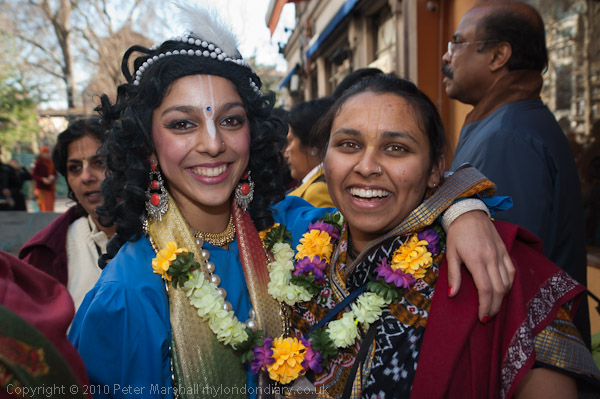
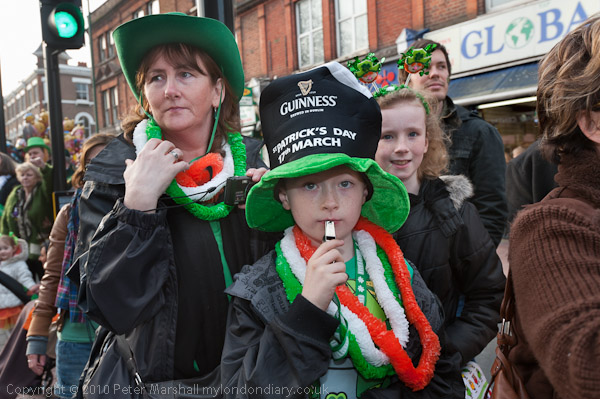
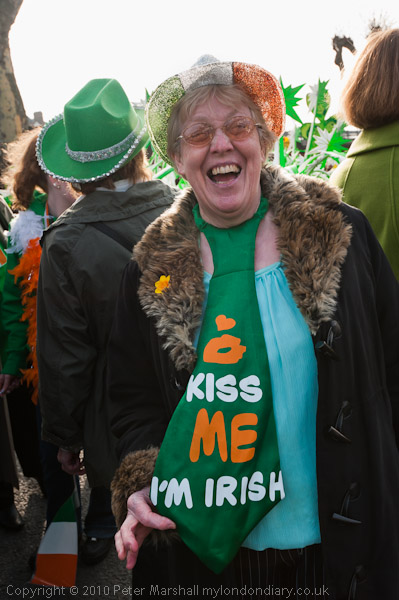
St Patrick’s Day in Brent

© 2011, Peter Marshall

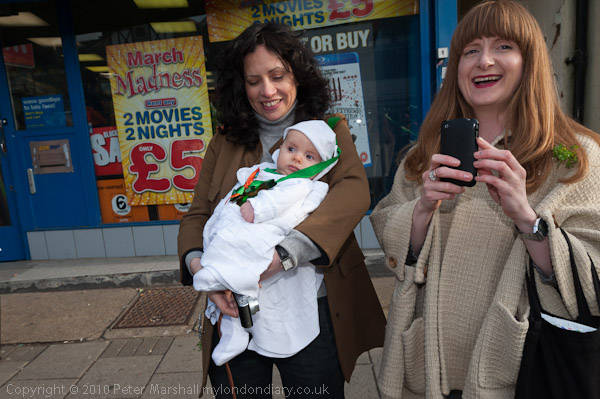
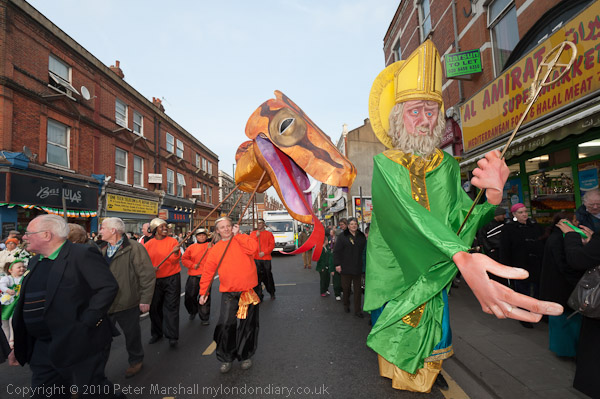
St Patrick is under threat in Brent, as the local council looks for ways to make the massive cuts that the government is demanding, but I hope very much he can be saved.  It’s perhaps hard to see why the annual parade there actually costs very much and I suspect more of the money goes on rather less essential things – perhaps paying performers at the festival. And while the security firm may be needed to comply with the council’s health and safety agenda it doesn’t in fact seem to serve any useful purpose other than supplying a little employment.

People were collecting signatures to get the council to reconsider axing this, along with most of the other community festivals they sponsor throughout the year, and I think it would be a great loss to see any of them go. But perhaps most – and rather surprisingly certainly the few they still intend to fund – could readily be largely if not entirely self-supported by the communities involved.

© 2011, Peter Marshall

Photographically it was the kind of situation where most of the time I would have preferred to be working with a Leica. But I’m still not convinced it would be worth trading in my M8 and paying the ridiculous amount extra for the M9.  Several of my friends now own them, but I’ve yet to see them getting the kind of results that justify the expense.

© 2011, Peter Marshall

Perhaps part of the problem is that we now expect rather more from our cameras than in the old days, and having the name Leica on a camera isn’t enough. Leica just don’t seem to have the digital know-how or research budget to compete. So far neither of the major camera companies has come out with a non-DSLR large sensor model, and perhaps until they do we won’t have a truly state of the art market sector.

© 2011, Peter Marshall

Meanwhile I’m waiting for my Fuji X100 and hoping  it will be all it promises, though the recent events in Japan are going to hold things up. Fuji’s Taiwa-Cho factory, 20 miles from Sendai city, has been damaged, although fortunately none of the workers there are reported injured. But there has been a temporary halt in production of the FinePix X100, which is expected to result in a delay in the camera coming to market.

But back in Willesden Green, I was shooting as usual with the Nikon D700, along with the 16-35mm lens, and the D300 with the 18-105mm. And it was a beautiful day for March, the Guinness was flowing well and my only problem was that I had to rush away as soon as the parade was over to see my grand-daughter and her father, staying with us for a day.

More of the pictures at St Patrick’s Day – Brent on My London Diary.

Prince Loses Case

I almost put down the mouse and clapped when I read on A Photo Editor the post Richard Prince Loses Fair Use Argument and I think all photographers should drink a toast to US District Judge Deborah A. Batts for her ruling on the case.

It’s dealt with so well on A Photo Editor that there really is not a great deal for me to add other than my applause, which also goes to its author  Rob Haggart, and to some of those who have commented on the post, who include another photographer whose work was ripped off by Prince.

But what I think reflects so badly on the wider photography and art community is that the work of Richard Prince has ever been given any credence. That any gallery has ever exhibited or sold it. That magazines with a high reputation in the photographic world have published it. That idiots have bought it (or perhaps I should say invested in it.)

As for the $18 million that people seemed to have paid for it, frankly it beggars belief.  But I think I made my own views about Mr Prince and his work clear several years ago in A genuine Richard Prince photograph? though then I was rather too kind towards him.

I imagine Prince and Gagosian, his gallery, will appeal, and if so I very much hope the decision will be upheld, not because of any particular animosity towards those concerned but because of what the whole case implies about the status of photography, and of documentary photography in particular as their case asserted that Patrick Cariou’s photographs “are mere compilations of facts concerning Rastafarians and the Jamaican landscape, arranged with minimum creativity in a manner typical of their genre, and that the Photos are therefore not protectable as a matter of law.” Of course legally it is  nonsense (and I think a nonsense settled in courts in the nineteenth century when copyright protection was extended to photographs) but as QT Luong points out in a comment to the piece, it is a widespread if “particularly arrogant and insulting expression of how the art world views “documentary” photography.

Given there is very little justice in this world whichever way it goes they will still both be laughing all the way to the bank.  Even the maximum statutory damages if awarded would only make a minor dent in their profits and the publicity from the settlement would probably increase the value of the works they still hold by a greater amount.

Perhaps the only thing that could truly dent the party a little is if they Emperor’s new clothes were to be widely seen for what they are.

About Turn on Stop and Search

I learn from the British Journal of Photography that Home Secretary Theresa May has brought back the police powers of stop and search, which the European Court of Human Rights (ECHR) threw out in their ruling last June – and with a vengeance.

© 2010, Peter Marshall
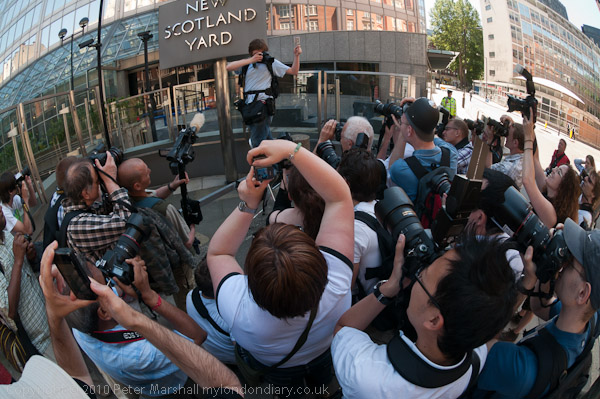
Photographers celebrate the end of Section 44 at New Scotland Yard, July 2010

Section 44 of the Terrorism Act 2000 became infamous because of its use by police to harass photographers and journalists going about their legitimate business in reporting protest.  The new section 47A, brought in under the “The Terrorism Act 2000 (Remedial) Order 2011,  replaces  the discredited sections 44-46 and not only allows the same abuses of power by police but removes the need for police to gain prior permission from the Home Office to employ them. Now any “senior police officer” – an assistant chief constable or above – can decide these powers are necessary and put them in place, with no requirement to gain any permission, only a requirement to inform the Home Office that this has been done “as soon as reasonably practicable.” In fact it will only be necessary to do so if the powers are to remain in action for more than 48 hours, and it seems it might be possible simply to repeat the order at 48 hour intervals to keep it in force without event letting the Home Office know.

© 2010, Peter Marshall
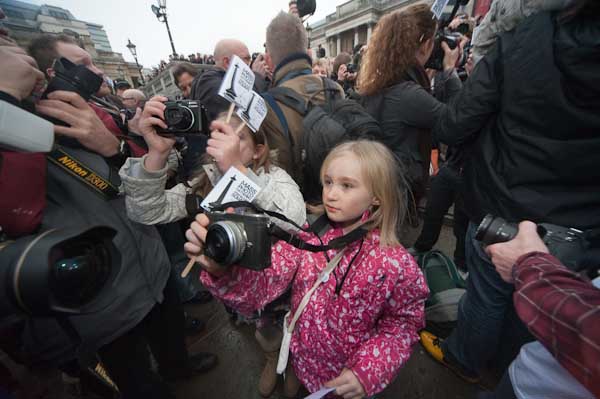
Photographers protest against police harassment and Section 44, Jan 2010

Prior to the ECHR ruling, some photographers faced ridiculous obstacles in carrying out their work. One was stopped and searched three times in one morning covering a protest, another I think well over a hundred times in one year. So far as I am aware there has been not a single case in which any of the thousands of searches of photographers carrying UK Press cards has ever yielded any  evidence relating to the reason used to justify them.

The authorisation of stop and search in a particular area is only justified if the officer doing so “reasonably suspects that an act of terrorism will take place; and considers that the authorisation is necessary to prevent such an act.” But as before, the main use that will be made of them will be in circumstances where terrorism – as this term is normally understood – is not in any way at issue.

The Orwellian-named “Protection of Freedoms Bill” once it becomes law will replace this temporary legislation, probably with some equally draconian abuse of our rights, nodded through by our political machine, though possibly with a little coughing against it by the peers. The reason for this hasty emergency measure is obvious. March 26 promises to see one of the largest demonstrations ever in London, against the government’s cuts.

Photographers can expect a further round of harassment from police, which comes as a particular disappointment as following the demise of Section 44 and other events over the past year or so there has generally been some improvement. Since the obvious mishandling of the student demonstrations in November and December there does also seem to have been an attempt by police to improve both tactics and communication with protesters too. But this Order suggests that their political masters at least want them to play a tougher game.