Wheelchair Protest

© 2011, Peter Marshall

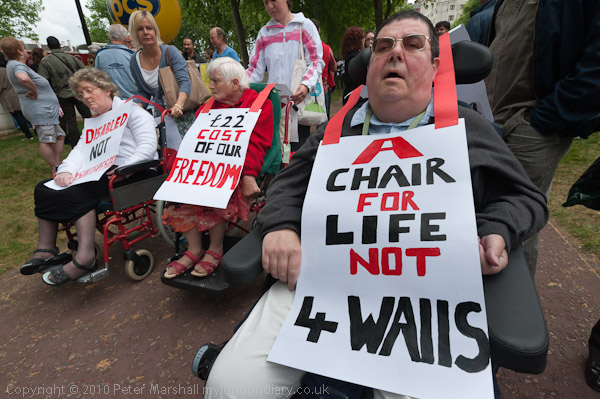
Perhaps what surprised me most about the ‘Hardest Hit‘ march on May 11 was how cheerful and friendly everyone was, despite the great deal of anger at the government cuts which hit the disabled hardest.  It isn’t just the cuts in public services, although those with disabilities are likely to depend more on these than the rest of the community, but a process of trying to decimate the number of people who can claim mobility and disability benefits that was started by the previous Labour government.

Most of us would agree that a policy of encouraging disabled people to work in ways that make use of their capabilities is a good idea, but the new policies while paying lip service to this actually fail to make any attempt to do so, and are just designed to get as many as possible off benefits, or at least onto lower scales of benefit.

Rather than proper and personalised assessments of people’s capability and attempts to find ways that people can be integrated into employment, successive governments have contracted a private company to carry out tests using a computer system that cannot properly take individuals into account. Those administering the tests often lack the essential skills to make a proper assessment and are allowed insufficient time to do so. The company, Atos,  has a financial incentive to carry out the tests on the cheap and to turn down benefit applicants.

Although the tests are unfair to all, they are particularly unfair to some classes of applicants, particularly those with intermittent problems – many of whom if they attend the test centre are by definition having a ‘good’ day rather than a typical one – and those with mental illnesses.
© 2011, Peter Marshall

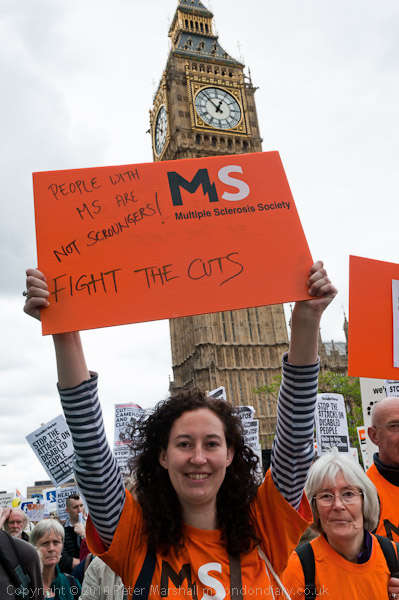
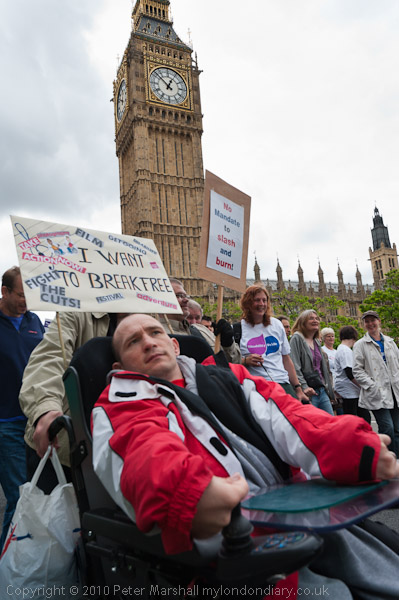
As well as the disabled, there were many supported and carers taking part in the protest, which was one of the shortest marches I’ve ever photographed. It started a couple of hundred yards before Big Ben’s Clock Tower at one end of the Houses of Parliament and finished a couple of hundred yards after At Stephens tower at the other end, so a very large proportion of the pictures I took have these buildings in the background.

As always, the height of Big Ben is a problem – fine when people are holding placards above their heads – as above, but harder to use when people are sitting low down.
© 2011, Peter Marshall

More at Hardest Hit March Against Cuts.
Michael Ward (1929-2011)

I don’t think I ever talked to Michael Ward, who started as a freelance in 1958 and worked as a photographer for the Sunday Times for around 30 years starting in 1965, but there are a few of his pictures I recognised when I read about him and his work.

Ward, who died last month, once calculated that he had covered 5,500 assignments over his career. In some respects he seems a rather typical British press photographer from an earlier age where things were rather less pressured, and, as Ian Jack notes in his obituary in The Guardian, Ward “wrote that he knew ‘as much or as little about the processes of photography as a decent amateur’.” Jack goes on to comment: “Technically, he knew he was far from accomplished. Aesthetically, he was never sure what separated a good picture from an indifferent one.”

Ward got his first picture published by borrowing a Rolleiflex from a friend, racing driver Stirling Moss, and taking pictures at the track while Moss was driving; one of them, a picture of Moss’s wife Kate, was published in Women’s Own.

You can examine a little of Ward’s photography on his website , where I think you get a very good idea of him from the stories he tells about some of the pictures and the people he photographed.  He met and photographed many people I would have liked to have met, though they are not always fine pictures, but occasionally he captures a great moment.

He also handled some difficult stories, in particular the Aberfan disaster, but some of his best pictures are those of children which you can see in his ‘Portfolio 6’, in particular one that stands out from the rest of the images on the site, of five young kids – three white and two black – posing with their bogie and a tricycle in front of a Gents Hairdressing Salon on a grim street in Manchester in 1969.  Although it is titled Racial Tension – Manchester they seem to be playing happily together and directing some large grins at the camera.  It’s a picture I’ll remember him for.

Ward wrote an autobiography which included more than 200 of his pictures, entitled ‘Mostly Women’  and it was published by Granta in June 2006, leading to a renewal of interest in his work and several more exhibitions.

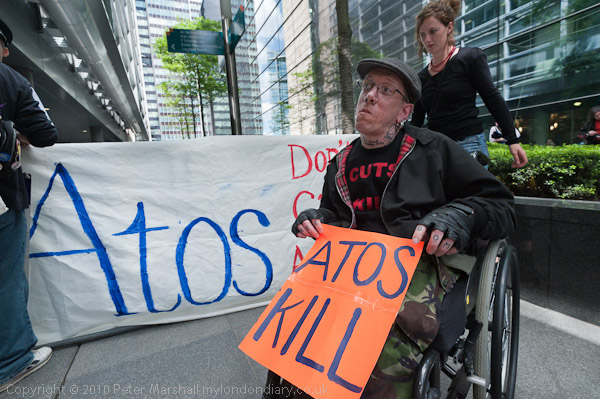
Disablement Protest at ATOS

© 2011, Peter Marshall

Atos, the company who run rather dodgy computer-based tests in a conspiracy with the Dept of Work & Pensions to cut down the number of people who receive disablement benefits, have their offices in Triton Square, which is on the north side of the Euston Road. This is a new development, and like most such in London is a privately owned public space, patrolled by security guards. Just the kind of area photographers were protesting against earlier this month because of the anti-photography policy they adopt.

Doubtless, parties and political demonstrations are also banned, but doubtless Atos realise the terrible publicity they would get from an obvious attempt to interfere with a protest by disabled people, many of them in wheelchairs, and although there were police and security in attendance, there was no real attempt to stop the protest or prevent photographers taking pictures of it. A security guard did come and take down one or two placards that had been taped to some of the trees, and the police provided a few barriers, but this time that was all. At the previous disabled “party and protest” on the site there had been a little more intervention, with police at first trying to prevent the protesters approaching the Atos offices and later briefly kettling the disabled, but perhaps they learnt a little from those mistakes.

I was rather annoyed to find, after taking my first 20 or so pictures, that I had not looked at the camera settings at all, and have left the camera on manual exposure when I had previously used it in bright sun, whereas particularly at the bottom of a cavern of tall office buildings it was now deep gloom.  When I looked at the display there were just traces of images and I did the only sensible thing and deleted them and then tried to retake as many as possible. Easy enough where all I had done was to photograph people holding placards, but impossible to get that security guard to repeat his taking down of a poster, or the police to set up the barriers again. And I forgot to repeat one image, a closer view of the man above with his two fists together, tatoos spelling out the word ‘FREEDOM.’ ‘DOM’ on its own isn’t quite as good.

© 2011, Peter Marshall

It is the kind of error that happens most often when something that seems worth photographing happens before I’m ready for it, and I just grab the camera out of my bag and start shooting.  Which is why I try to remember to do those ‘pre-flight’ checks on my way to events – ISO, white balance, image quality (always RAW), exposure mode, sensible settings for aperture and shutter in shutter priority, aperture priority, manual modes, suitable custom settings (most of which I never change.)  But for some reason I hadn’t, perhaps I was busy talking to someone, I can’t remember.

This image was also one that showed the need for an ‘untwisted’ camera profile. Processed normally using the ‘Adobe Standard’ profile the top right of the fluorescent orange poster changed from orange through yellows to a burnt out white, and burning it in was pretty well impossible and still maintained a colour shift towards yellow. Simply changing to the ‘Camera Neutral v3 dcpTool Untwist’ profile removed any colour shift, and the image became more or less as above, and needed very little local adjustment.

I don’t use this profile all the time, as I think the Adobe Standard one generally does give reasonably accurate and more pleasing results – as was its design objective. But it certainly is handy to have the other profile available, and it seems often to be needed when dealing with very bright oranges – such as this image. All of the other images in Disabled Protest Calls Atos Killers were produced with the latest Adobe Standard profile.

Hunger Strike Ends

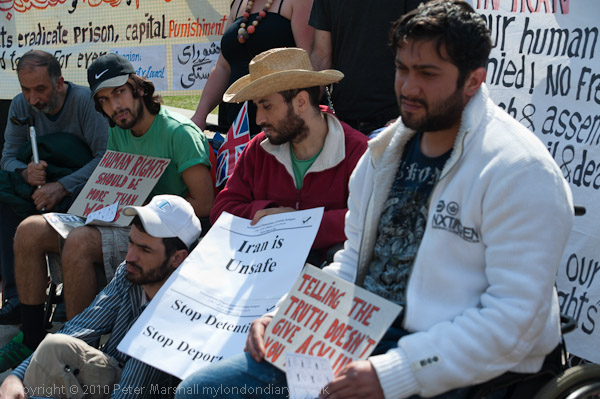
For once there is some good news to report about one of the events that I photographed and supported. On Friday 6 May I photographed six Iranian men who had been on hunger strike for a month, three outside Lunar House in Croydon and the other three in Shoreditch when they came to protest outside the houses of Parliament and the nearby Home Office building, along with around 50 supporters.

 © 2011, Peter Marshall

My own report on the event, Iranians Hunger Strike against Deportation to Torture And Death, went on Demotix that evening, and on My London Diary a couple of days later, and I gave permission for the group supporting the hunger strikers to make use of some of my pictures to publicise their cause. Every little helps, but it was the determination of these men (of course driven by their desperate position) that impressed me and finally the UK Borders Agency to agree to reconsider their cases and their evidence, and I was very pleased to read a report in the Croydon Guardian (CG) on May 11 to that effect.

To most of us it seems insane to suggest that it can be safe to send anyone – or at least anyone except a card-carrying Muslim fundamentalist – back to Iran. Certainly not anyone who is linked in any way to the Iranian protest movement. Though the CG story attracted several comments apparently from people who knew nothing about the case and had failed to read what the CG had actually reported, but just saw it as an opportunity to air a little racist anti-immigrant bile.

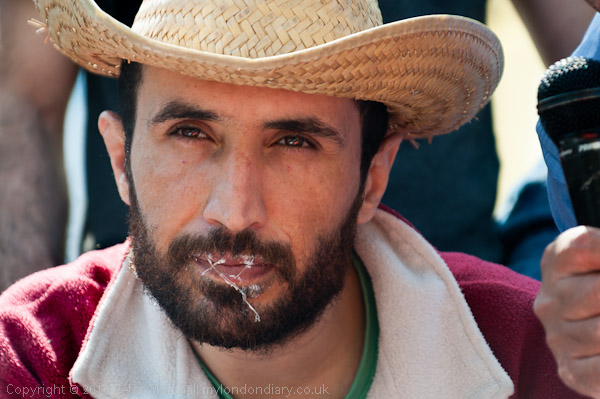
Photographically I wasn’t entirely pleased with what I had taken, and felt I had missed one obvious image. Three of the hunger strikers had stitched up their lips with nylon fishing line, and really I hadn’t gone in for a close enough image to show this.  Possibly the reason was that I was using just a single camera body, the D700, with the 16-35mm Nikon and the 28-300mm Sigma, as I’d been out earlier with some of my family and didn’t want to carry more.

© 2011, Peter Marshall

The Sigma does focus reasonably close, and I took a number of fairly tight head shots in which the nylon line is clearly visible, but I could (and should) have got closer, even though the lens that would really have let me do the job well, the Nikon 60mm macro, was back on my desk at home.

Although my usual kit covers most eventualities, I try to think before I leave home if I might need any of the many bits and pieces that I don’t usually carry.  But though I might have wanted to take the macro, I also wanted to travel lighter than usual because of the other things I was doing that day.

More on the story and more pictures at Iranians Hunger Strike Against Deportation on My London Diary.

Photographers Protest

I didn’t quite photograph myself, but for once I was as much taking part in a protest as photographing it, along with around 50 other photographers in an event organised by ‘I’m a Photographer Not a Terrorist‘ (PHNAT), an organisation set up a couple of years ago to protect photographers and the right to photograph largely as a reaction to a Met campaign which had involved posters and ads suggesting that anyone with a camera was suspicious and should be reported to them.

We’ve seen case after case in recent years of people being stopped, searched, arrested and otherwise harassed, often entirely illegally, by police and also by security personnel, and quite a few have made the national news.  But the PHNAT protest was more about the way that more and more areas open to the public in our cities are now privately owned and patrolled (and under CCTV surveillance) by security guards with an unreasonable attitude to people taking photographs.

One of the more stupid and indefensible acts of political pique in British politics of the last century was the abolition of a London-wide authority in 1986, after which the headquarters of London government, County Hall was sold off to the sorry mix of hotels and commerce that now occupies it.  Eventually at least some kind of sanity returned and we now have a Greater London Authority and a Mayor (if sanity doesn’t really describe the current incumbent) but it did not have a home of its own. The odd curate’s egg of of a building it hires for its home sits in a private estate called ‘More London’ with a huge area of public walkways on which photographers are not welcome (although thousands of tourists walk through it and photograph Tower Bridge.)

My biggest problem on the day was finding a tripod to take with me as the event organisers suggested. I do have a rather large and heavy one which used to support my 4×5, but I wanted something that was reasonably portable. It’s years since I’ve seriously used a tripod – and high ISO digital performance makes it less and less likely for my normal work, but I knew I had something smaller – but bigger than my plastic table tripod – somewhere.  Eventually I ran it to earth in a box  on top of my wardrobe.

© 2011, Peter Marshall
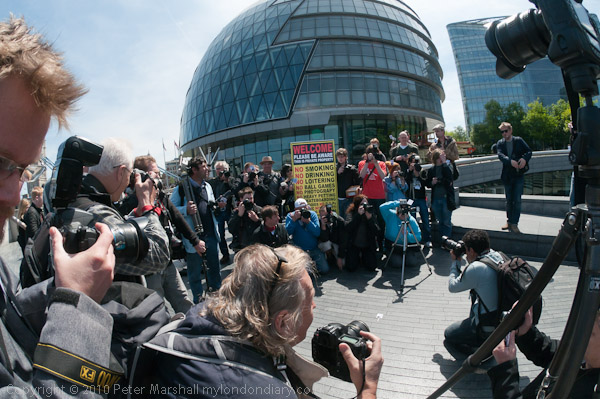
A herd of photographers at City Hall

I decided that the 10.5mm fisheye was going to be a very useful lens on the D300, making it possible to show the photographers and also the oddly-shaped City Hall, where a little spherical effect would hardly be noticeable. At a pinch in some images I could get in Tower Bridge as well. Of course I did some pictures with the 16-35mm on the D700 as well.

© 2011, Peter Marshall
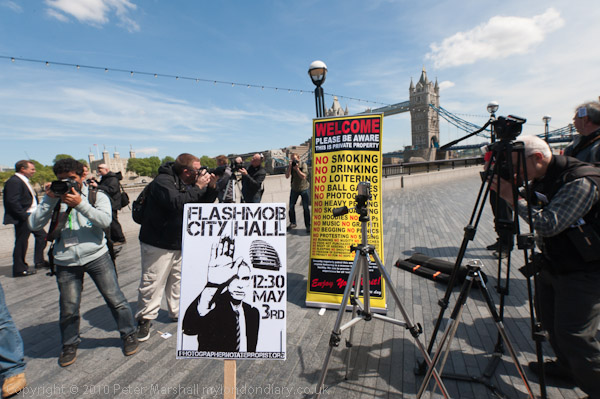
My dinky tripod towards the right of the picture

This is a 17mm picture at f20 to get plenty of depth of field, as I’m holding my own placard again. No depth of field scale on the lens, but I thought set at 2m most of the universe should be in focus.

Photographers City Hall Flashmob

Stabbed in Rochester

Stabbed! In the eye. By my camera strap.

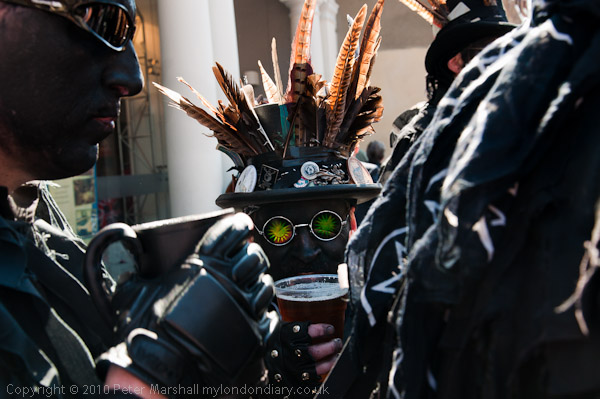
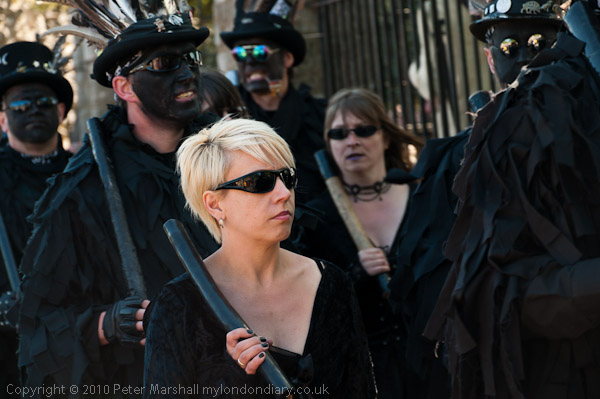
It doesn’t look like a dangerous weapon, but as I raised my D300 to my eye yesterday to photograph some morris dancers, I felt a sharp pain in my right eye and the image in the viewfinder suddenly went very, very blurred.

My immediate response surprises me in retrospect. I switched the  camera to my left eye and went on taking pictures for several minutes. It wasn’t even as if I were photographing anything very urgent or important, but I kept at it rather than worry about my sight.

I did realise I had poked the strap into my eye, but hadn’t realised how much damage it had caused, though fortunately I don’t think anything particularly serious. The strap was a normal nylon webbing one, but there were a few loose inches coming out at the end of the fastening, and it had been cut off by the manufacturer at an angle of about 60 degrees, leaving a sharp corner.

Lately I’ve been trying to take pictures wearing bifocal glasses. Although my cameras have dioptre correction that I can use to see through the viewfinder, my poor close vision means that I was constantly having to put on reading glasses to  read the dials and external screen displays on the camera. Both the D300 and D700 viewfinders are more or less OK with glasses and the bifocals allow me to see the settings as well. I’m getting used to working with them, and I was doing so when this incident happened, the glasses probably serving as a guide to deflect the end of the strap into my eye.

After a minute or two working, I took the glasses off and was considerably relieved to find my vision returned to its normal clarity (or near clarity),  but slightly disturbed by the mixture of fluid including blood on the rear of the right lens. Peering in my dim reflection in a shop window I decided that the damage seemed to be limited to the corner of my eye, and decided there was no need for urgent medical attention.

The next day I bolted the stable door, cutting off the sharp corners from the straps and taping down the flapping ends.

© 2011, Peter Marshall

Rochester, apart from that wasn’t bad so far as I was concerned, though the photographer I went with lost a credit card and didn’t have a good day at all.

© 2011, Peter Marshall

I don’t know if I’ll go there again, though I’m told the earlier couple of days can be more interesting, with a lot more happening around the town. Rochester itself is an interesting place and I’d perhaps enjoy it more without the festival.

More pictures at Rochester Sweeps Festival.

May Day

I wouldn’t want to miss May Day, but sometimes it seems like I’m taking the same pictures each year of the same people.

© 2011, Peter Marshall

doing much the same things as last year. Sometimes I do it just a little better than other years, and I enjoy it but perhaps feel I’m not getting anywhere.

© 2011, Peter Marshall

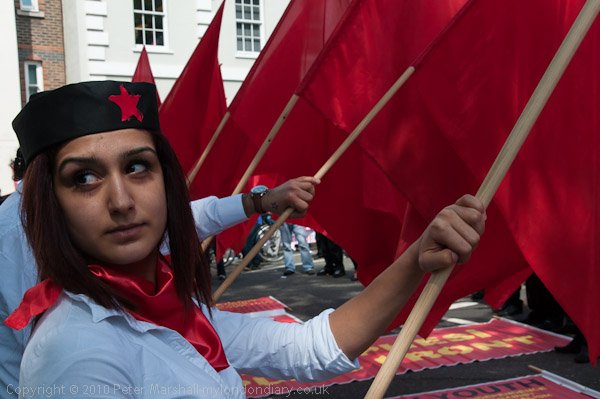
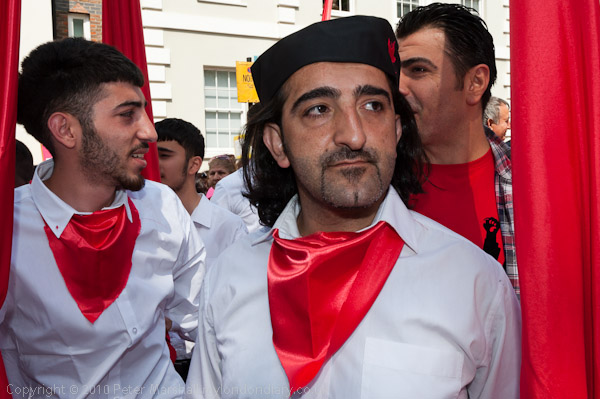
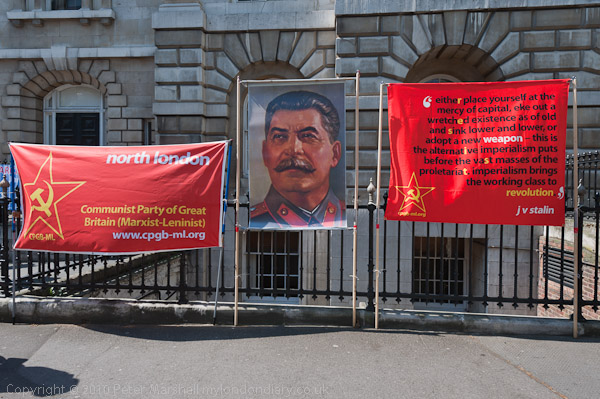
But the Turkish communists certainly put on a spirited performance, and one that makes a part of my heart warm, while elsewhere I’m chilled by the thought of Stalin.

© 2011, Peter Marshall

Of course in my early years he was ‘Uncle Joe’ and still remembered here as the man who had led the dogged resistance that really defeated Hitler – with the help of arms and other supplies from the US and UK. We knew that without him we would have been living under German rule (or rather a later generation of German rule than the Saxe-Coburg-Gothas.)  But then few of us knew much about the purges and all the rest.

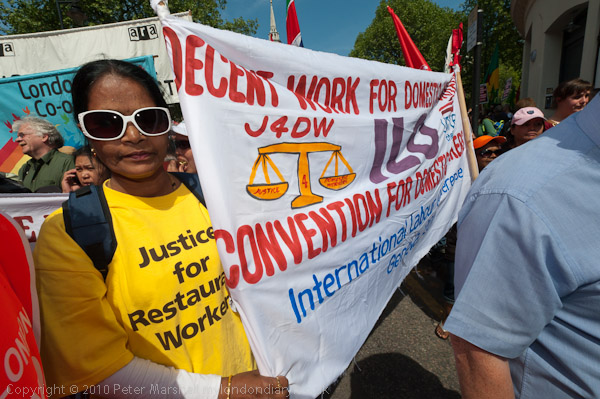
Of course there were some things new at May Day – including the launch of a new campaign for justice or at least better working conditions and more pay for one of the worst-treated groups of employees – domestic and restaurant workers.

© 2011, Peter Marshall

Last year the event proved rather embarrassing for me, as getting down on my knees to photograph some of the many children who take part I heard a loud tearing sound as my trousers ripped from waist to knee. Fortunately that day I was wearing a jacket, and for the rest of the day covering the march and a later event in Parliament Square, I was kept more or less decent by this jacket tied around my waist as a skirt to cover the gaping hole. This year I made sure to bend down more carefully as I’d left my jacket at home!

Pictures and text from this year at London May Day March.

Burke and Norfolk

Last night at a small meeting of photographers, one of my friends came with a copy of the recent book, Burke + Norfolk (published by Dewi Lewis Publishing) and I was greatly impressed by it, truly a handsome volume, and some stories to tell about an event he had attended with Norfolk at Tate Modern where work from it is currently on show in the Level 2 gallery until 10 July 2011. A second show of the work opens at the Michael Hoppen gallery in Chelsea tomorrow (May 13) until 11 July 2011.

Much though I like Norfolk’s work, to me the major figure in the book is John Burke, whose life and work  I wrote about at some length in a feature ‘Baker & Burke: Photographers of India‘ in 2004,  the eighth of a series of features on 19th century photography in India unfortunately no longer on line, linking to work by Burke in the British Library collection and elsewhere, and as I made clear, very much dependent on the researches of Omar Khan published  in History of Photography in Autumn 1997 as John Burke, Photo-Artist of the Raj and his 2002 book From Kashmir to Kabul, a generous amount of which is available on line in a Google preview, which unfortunately does not include what Khan describes as the only known photo of Burke himself.

I don’t own the book, but it would be interesting to see, if only because Norfolk on the Hoppen site is quoted as saying “There are no photographs of him. In a couple of sketches we see him from behind, but never his face; that has to be more than just reticence, surely?” There are two sketches in the preview pages, but I think the answer to the question is in any case not really. Many photographers dislike being on the “wrong” end of a camera, and of course photography was not the ubiquitous medium it is now. I have very few pictures of my own ancestors of that period, and unless people took care to caption and conserve them most images of the time are now anonymous. Of course, Burke’s son Willie was also a photographer – having started as his father’s assistant, and might perhaps have photographed his father, but the only images of his I know about are a few in the India Office collection and they would be unlikely to include the family snaps.

You can of course see more of Norfolk’s (and Burke’s) work from this project on Norfolk’s own web site, which also has a transcript of a conversation between him and Paul Lowe about the project, and you can see him at work (not with a wood and mahogany camera that he mentions in that piece but with something more modern and possibly digital) in Afghanistan in a Tate video on YouTube. Also worth listening to is a series of 5 short audio clips of him talking to Jim Casper on Lensculture, along with 30 of his pictures from his series Forensic Traces of War.

The book is also I think a good example of the kind of production values that “proper publishing” can achieve, the kind of volume that makes me think there is still something that they can do that Blurb and other publishing on demand can’t, or can’t yet, match.

May Day Came Early in Brighton

Getting to Brighton is faster than getting to some parts of London, though it is further away and more expensive.  I walked off the train at Brighton station at 11.27 and looked around for someone I knew, but there was nobody in sight, and I guessed few had come down from London for the ‘May Day Protest and Party‘ held a day early on April 30.

© 2011, Peter Marshall
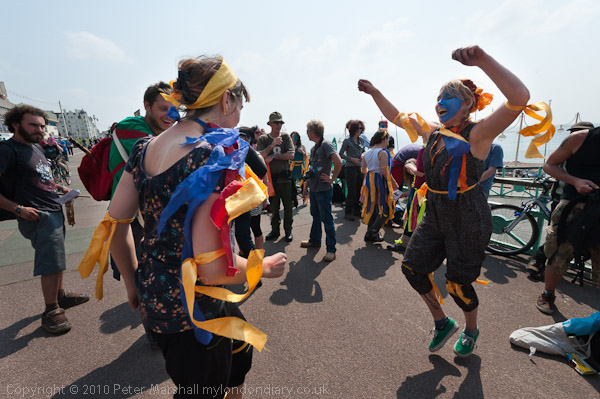
The protesters were clearly in the mood for a party

I knew at least one photographer had come earlier, as before leaving home I’d read his tweet from a café at the station. The event organisers had decided to try and keep the police guessing by not releasing the meeting point until 11.30 when they would announce it on Twitter and Facebook. Fortunately for the benefit of people like myself with antique mobile phones which don’t read that kind of thing there was also a number we could ring and hear a recorded message. A heavy lorry passed close by just as it started, but I heard enough to guess which way to go, and set off.

Making a mental note to myself that I really need to upgrade my phone to something that will keep up with social networking. More and more tweets are used to keep people informed of exactly what is happening and in particular where the action is in demonstrations, and I’m missing this out on the street unless I’m with another photographer who can read them.

I’m fairly sure that the police will have known in advance, with at least one of those in the group planning every demonstration being an undercover cop, even if perhaps  Brighton hasn’t yet got the the stage of G K Chesterton’s ‘The Man Who Was Thursday’ where six of the seven members of the anarchist’s central council turn out to be police spies.  But certainly by the time I arrived on the seafront there were at least two mounted police and two slightly obvious plain clothes cops there, with a row of police cars watching from the opposite side of the road. More gathered as the protesters also arrived for the start.

© 2011, Peter Marshall
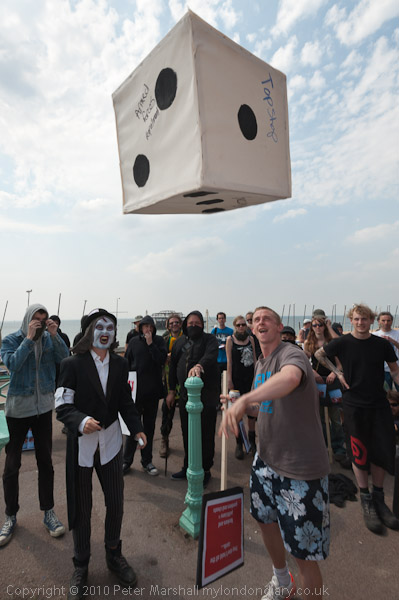
A large dice was used to decide the first protest target – though we never got there

It seemed to be a day when neither police nor protesters knew what they were trying to do. The police kettled and then unkettled on several occasions and seemed to panic whenever the protesters started moving, while the protesters – with rather more justification given what happened – thought that every time they saw more than a couple of police they were about to be kettled and rushed off in a different direction.

© 2011, Peter Marshall
An officer adopts an aggressive stance

A few people on both sides occasionally lost their tempers a little, and police arrested eight protesters, some apparently on very trivial or non-existent grounds. Most of the public who saw the protest seemed to be asking what it was about – and if they found out there were generally expressions of support.  All of us got sore feet, from walking and running in circles around the centre of Brighton, and well over half of the protesters had disappeared before the protest seemed finally to come to an end and the remaining group began to party on the shingle that passes for a beach and I finally went home.

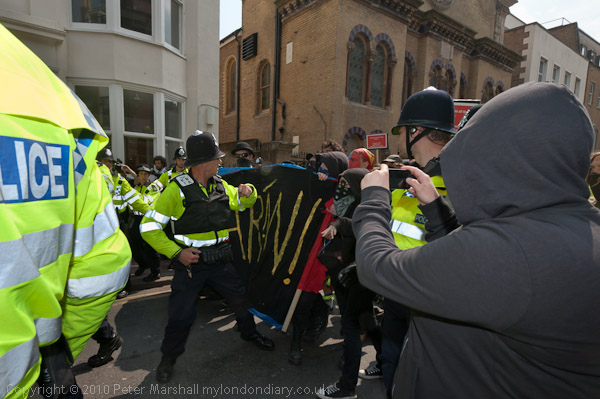
Compared with the few previous protests I’ve photographed in Brighton – and certainly to some of the videos I’ve watched of other events – this was a relatively peaceful day, with less relatively indiscriminate violence by the police, and much less interference with the press and other photographers.  Most of the times I was asked to move I think there was a genuine concern for my safety by officers who realise how dangerous and unpredictable police horses can be – and there were clearly times when they were not really under control.

More about the day and many more pictures at Brighton MayDay Protest.

That Wedding

I’m not keen on weddings, and since I didn’t get an invite to the one that filled our newspapers, TV and radio for most of last week I didn’t go. Like more than half of the UK population I didn’t watch it either, but it was something even the most dedicated anti-monarchist couldn’t entirely fail to notice.

I got a phone call a few days before to enquire and discuss what I was going to cover,  and I listed a couple of events related to it. What I thought would be the more interesting of these didn’t happen because on the day before, police called at the home of those organising it and arrested them on an obviously fake charge, holding them in custody until the whole thing was safely over.

Although I wasn’t there to photograph the arrests, I was able to watch a video later in the day, and it seemed pretty clear from what little the police said and did that they were under orders to prevent any possible embarrassment to royalty competing with the wedding in the media.  Even if doing so meant breaking the law – or rather inventing a new one – and having to pay compensation for wrongful arrest later.  We live in a country where there is clearly one law for the monarchy and another for the rest of us.

© 2011, Peter Marshall
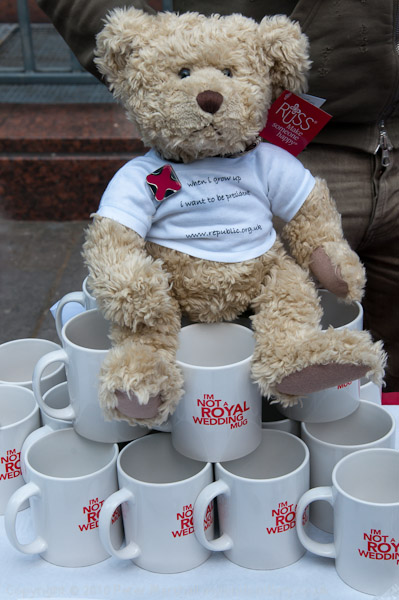
I’m not a Royal Wedding Mug

Instead I went to photograph the street party organised by the Republic organisation. I’m not really a republican, though I do believe that had this country ever had any half-decent socialist government it would have nationalised the crown and land without compensation, returning the estates they and others over the past ten centuries have stolen from the people, and we would have a royal family who ride bicycles and live modest comfort while drawing an average wage for their not particularly onerous duties. It really was a tragedy in the history of our nation that Cromwell and his supporters were not more reasonable people rather than religious fanatics.

But it turned out to be a rather dull event, in part because the organisers were so keen to keep politics out of what seems essentially a political event. See more at Republic: Not the Royal Wedding Party

I’d actually taken some wedding pictures the day before, on my way to photograph a protest against the government’s intentions to end most workplace health and safety checks. It is just so inconvenient for employers to have to worry about things like workers breathing in asbestos dust or having cranes fall down on top of them.

© 2011, Peter Marshall
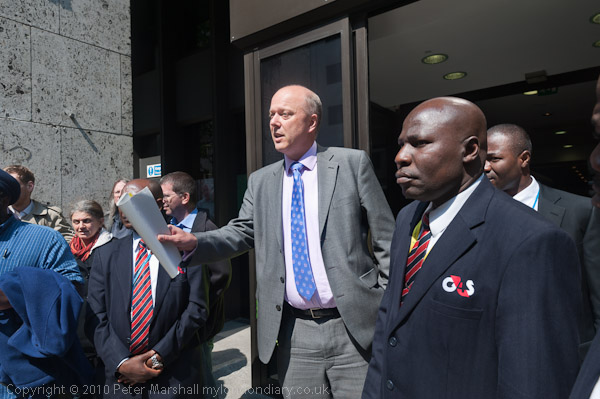
Employment minister Chris Grayling looks a little harassed

While the Prospect union representative for London’s HSE inspectors, Simon Hester was telling the protest about the dangerous conditions he had found the previous Friday in one of the site inspections that are being abandoned to save money, his boss, employment minister Chris Grayling came out of the office and there was a short argument between them, with Tony O’Brien of the Construction Safety Campaign joining in, which ended with Grayling running off down the road.

More at International Workers Memorial Day.

The offices are just around the corner from Westminster Abbey, so I walked past the people camping out on the street there to catch a glimpse of the royal couple, and I did stop to take a few pictures.

© 2011, Peter Marshall
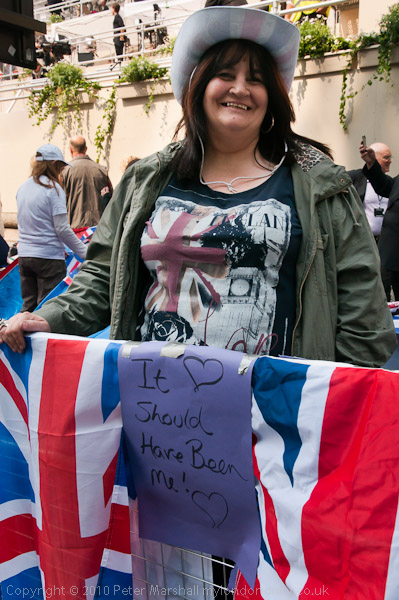
It should have been me!

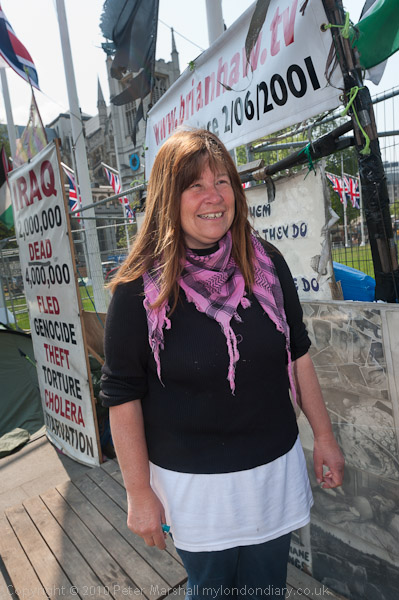
And I also made a point of going to see the protesters in Trafalgar Square, still there despite the promises of our leading politicians to get rid of them for the wedding.  Brian Haw has been in hospital in Germany for some months, but his colleague Barbara Tucker was there and we had a long talk.

© 2011, Peter Marshall
Barbara Tucker

A little way along the pavement, Maria Gallastegui was on top of one of her boxes dressed in orange Gitmo jump suit and a black hood; I’d talked to her a few days ago and she told me then that she had agreed to cover up her display for the royal event. More pictures at Parliament Square Protests Continue.

On the day itself there were no buses in the central area of London, and I walked through the streets with another photographer on my way back to the station, looking for signs of celebration. We did find a few people on the streets, but most were still around the actual route back from the Abbey to the Palace or watching the large screens in Trafalgar Square. And  after having seen the rather pathetic flypast as I was walking towards Charing Cross, I looked up and saw the royals just leaving the balcony on those screens, as  you can see in the final image in Royal Wedding in Soho.