A Walk Around the Street Photography Festival

 © 2011, Peter Marshall
A powerful blow on the tube today

I very much welcome the current London Street Photography Festival, as anything that creates something of a buzz about photography in a capital that largely seems to ignore it is a good thing. We need more photography events in London, and we need better photography events, and the publicity that the LSPF has got may help. Of course it’s on nothing like the scale of London’s largest photography festival, the East London Photomonth in October, which has been going around ten years and is perhaps ten times the size, and even that is a minnow compared to the month every other year in Paris.

I’ve already written about the work of Vivian Maier, which is the highest profile show in the festival. It’s a nice story and she certainly wasn’t a bad photographer, but unfortunately I think it’s simply untrue to suggest (as the festival program does) that she “captured daily life with a vision and sensitivity to rival any of the great street photographers of the time.”  The work we have – and you can see it on the web – simply doesn’t back that up, though it is of interest.

Back in the cafe at the British Library are a set of pictures from their collection by Walter Joseph, which for me were perhaps the most interesting of the festival. Taken in 1947-8 in London street markets even the poorest of them (and there are a few poor ones) has a historical interest that most work in the LSPF lacks. I don’t know what other work Joseph took in the years between his release from internment at the end of the war and his death in 2003, but it seems a great shame that only 80 of his pictures appear to have survived. Displaying 30 of these was perhaps too many – there is a certain amount of repetition and a few weak images – but the best have a humanity and warmth and show a keen eye for the moment.

We (I’ve not gone all Royal – accompanying me was one of London’s best street photographers) made our way out of the side entrance on to Midland Street and up to the Minne Weisz Studio to see ‘Adventures in the Valley‘, a collaboration by Polly Braden and David Campany. The LSPF booklet says that they “push the boundaries of street photography“, but it would be rather more accurate to say that this work really has no connection with street photography – which makes it no less interesting or worthwhile as photography but did make me wonder why it was included in the festival.

As someone who has photographed the Lea valley for over 30 years I had a particular interest in this work, and there are some pictures in it that I really liked, although the text on her web site rather contradicts that in the show handout. On her web site it says:

Adventures in the Valley is an ongoing project. It was shown as a 150 image, 15 minute digital slideshow at the Institute of Contemporary Arts, London as part of the programme London in Six Easy Steps, Summer 2005

The web site quotes Sarah Wise from The Guardian in a piece that starts:

A beautiful photo essay, Adventures in the Valley filled one wall of the group show Real Estate; it was the most powerful piece in the show. Polly Braden and David Campany spent a year in the Lea Valley, part of which is to become the 2012 Olympic Village.

© 2011, Peter Marshall
Adventures in the Valley showing at Minne Weisz Studio

There were a few prints on both floors of the gallery, but the real show was a projection of a large number (possibly even the 150 stated, although it seemed rather less) images. Viewing conditions – as you can see on my photograph – were not ideal, even on a rather dull day. The 17 images on Braden’s web site give a very good impression of this work. Looking at Waltham Abbey, Christmas Day, 2005, a canal mooring on the Lea navigation with pylons and a light mist, a large Santa on the roof of one of the narrow boats, I do wonder is this is really Ponders End, with the Ford car park on the left and the bridge across to the Ford Enfield works in the distance at the right, the site of the bitter Visteon dispute and worker’s occupation in 2009. But hers is a nice picture.  Here is one of mine taken not too far away as I walked away from the factory in 2009.
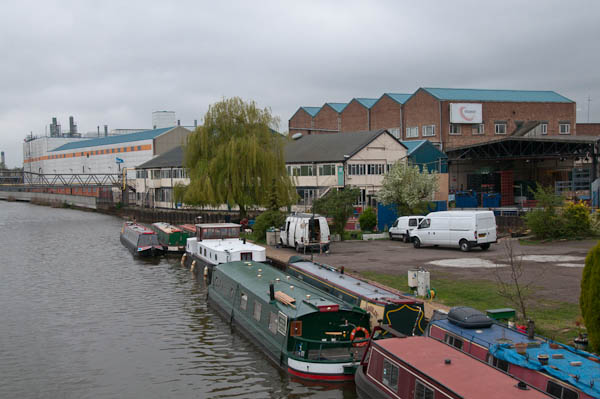
© 2009 Peter Marshall
Visteon (Ford) at Ponders End (but no Santa) in April 2009

It took us some time wandering around inside St Pancras International to find Entente Cordial, a set of double sided pillars with work on one side by Nick Turpin and the other by Nils Jorgensen, as we entered the station from the wrong side. If you are an international traveller you will probably miss it, as both the Eurostar exit and entrance are some distance away. They are at the ‘main entrance’ from Pancras Road, immediately opposite the German Gymnasium where the Maier show is taking place, and so hand for those who are attending that. But unfortunately the architect put the entrance at the wrong end of the station for most passengers (and I speak as a regular traveller from there.)

Both of us were too familiar with this work to spend much time there, having hoped that both photographers would have more new work to show. We had much the same feeling later in the day at Exmouth Market where ‘Street Photography Now‘ was on show. But of course those new to this work will have a very different reaction. And doubtless there are people who have not yet seen it, even if some of us are rather tired of seeing the same few pictures again and again.
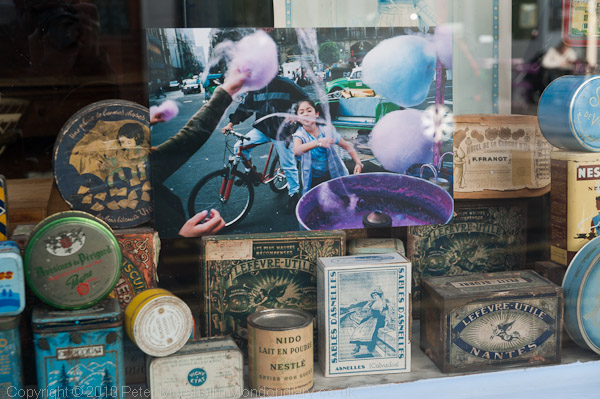
© 2010, Peter Marshall
One picture from Street Photography Now in the Rue de Marseille, Paris 10e

After the innovative showing of the best of this work in Paris last November, for me it felt rather tame here.  I hope that this will not be the last London Street Photography Festival (and I was told there are plans for more) but I hope too that any future years will feature at least one major show by one of those “great street photographers of the time”, along with rather more street photography than the current manifestation – and rather less of the same now rather old “contemporary” work and more truly new work. And I also hope there will be more getting photography out onto the streets, as with both the show at St Pancras station and also the eight Camden bus shelters with work by George Georgiou in this year’s festival.

Most of the shows in the LPSF end on 17 July 2011, with the Maier show continuing until 24 July and that in St Pancras until 31 July. The bus shelter pictures remain until 5 Aug.  The London Street Photography show at the Museum of London, surprisingly not included in the festival, continues until 4 Sept 2011.
Uneasy Birth of a Nation

I thought about going to celebrate the new nation of South Sudan on Saturday, but felt too tired after photographing a couple of other events in London to go on to do so, and caught the train home instead.

Of course the real celebrations were going on a few thousand miles away in   Juba, the capital of this newest of countries, but as I’ve often noted, the whole world comes to London to protest, and also they celebrate here when there is anything to celebrate.

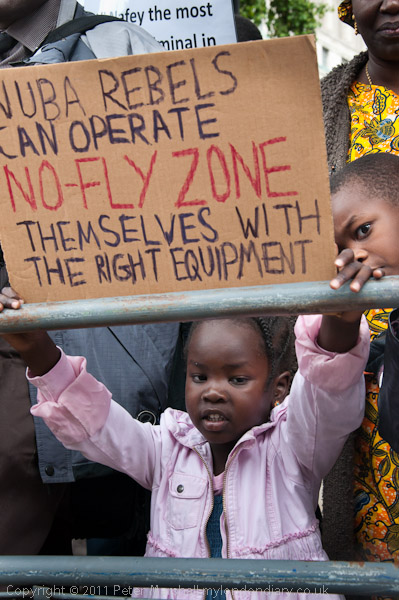
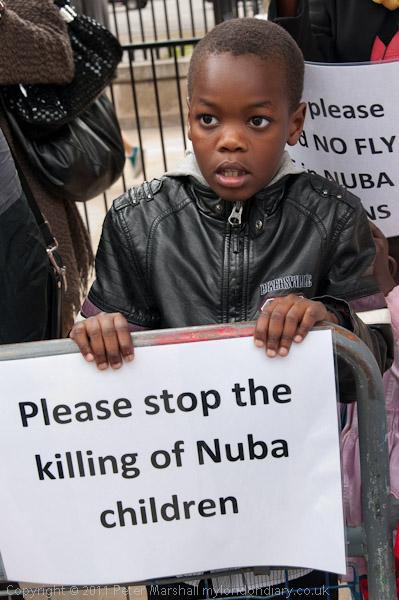
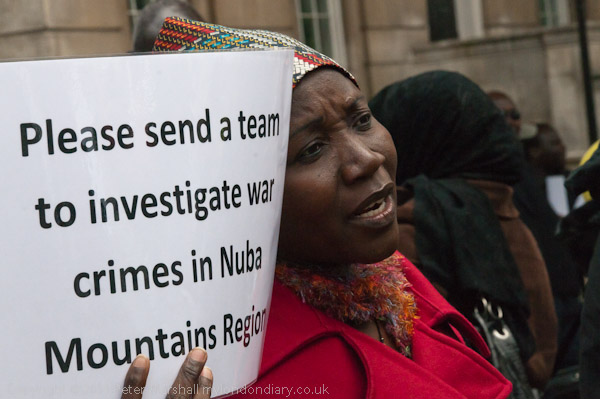
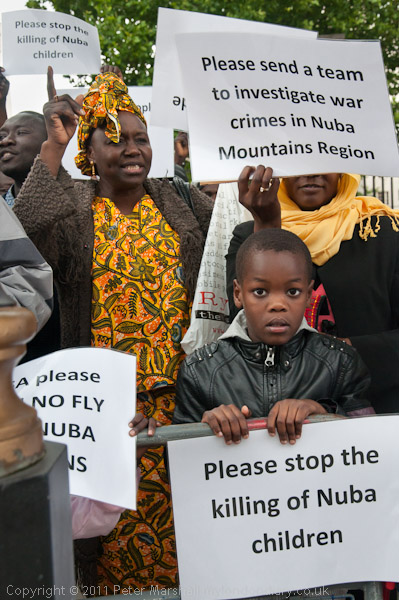
But three weeks ago there was a powerful reminder of some of the problems that Sudan and South Sudan face, with a protest by the London-based human rights movement Nuba Mountains Solidarity Abroad. You can read about it and see more pictures in Solidarity with Nuba in Sudan

The Nuba mountains lie more or less on the border between the two countries, but have not become part of South Sudan. One of the more balanced and informed comments I’ve read on the area puts it like this:

The Nuba, as has been the case for more than 20 years, are fighting for their land and their cultural survival. The fact that their southern allies left them in the lurch by choosing to secede doesn’t change that.

The roughly 1.5 million Nuba (not to be confused with Nubians) have a diversity of religion, including Christian, Muslim and traditional faiths (even at times within the same families) as well as around 50 different languages. The Sudanese government, as well as quelling all military opposition in the area aims to create an Islamic state, making Islam the official religion and Arabic the official language. Sudan’s president al-Bashir at the start of the month repeated his orders for the ‘cleaning’ of the area and its conversion into a loyal part of this Islamic state.

© 2011, Peter Marshall

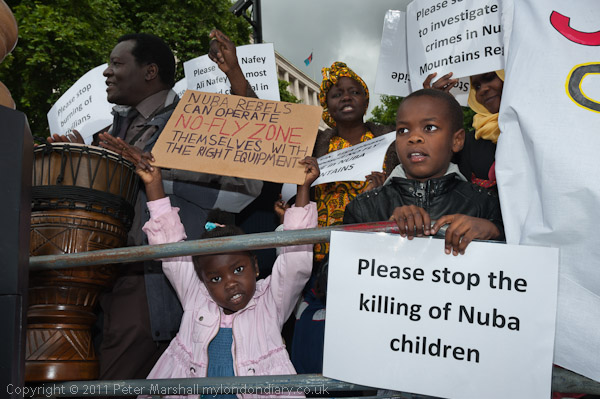
Photographically I found it difficult not to concentrate on one young man, with wide open eyes. Though when he was joined by a younger girl with a similar gaze there was strong competition.

© 2011, Peter Marshall

The problem in photographing her was the police barriers in front of the protesters, the upper bar of which was just above her eye level. As you can see clearly from the shadow on her forehead and jacket, I was using flash. The SB800 was as usual in the hot-shoe and really needed because the light level was pretty low and things just looked rather dull without it. But I did try a few pictures, including this one:

© 2011, Peter Marshall

Skin tone is often an issue, and many of those taking part in the protest had truly beautiful dark skin, and in processing the images rapidly to put on the web I’ve lightened it too much in some pictures.

© 2011, Peter Marshall

I had a few exposure problems with some of these pictures, largely because I didn’t realise that I had the D300 set for spot metering. In a picture like the one below, this gives quite different results from the face or the poster the woman is holding, neither of which is appropriate. Of course there is a beautifully clear symbol at the bottom left of the viewfinder image to tell you the metering mode in use, but when you are absorbed in the subject, anything else is easy to miss. Spot (or more pedantically, semi-spot) metering like this is a great tool to have on a camera, but one that requires considered use.

© 2011, Peter Marshall

This is also a picture where it was important to have the whole of the message on the poster legible, and I was pleased to find that in this and most of the other images I took at least the key placards were legible. At this event it was easy, as everyone was facing more or less the same way and holding the signs in that direction, and there were plenty of them, unlike some protests where there is little or nothing to tell the viewer what they are protesting about.

This was another London protest ignored by the mainstream media, and I seemed to be the only photographer covering it. Although it’s taken a long time for me to post here, my story and pictures were on Demotix later the same day (I’ve used more or less the same text in the My London Diary feature.)  When sometimes I think about taking things easy and stopping reporting on events, it is events like this that might otherwise go unrecorded that keep me going.

Hizb ut-Tahrir Sisters Protests

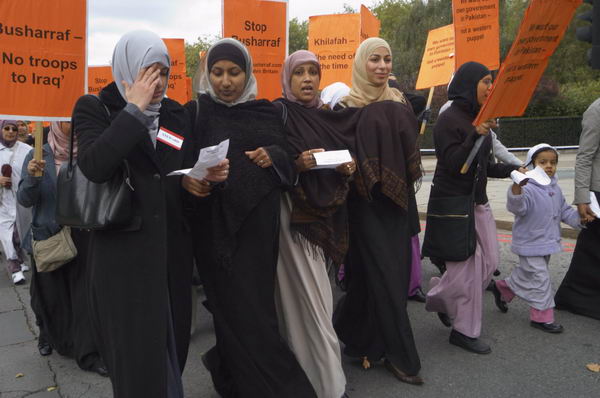
I first photographed Hizb ut-Tahrir in October 2004, when they held a rally in Hyde Park and marched to the Pakistan High Commission in a protest against Presdent Busharraf. Then, as at most later occasions involving them I was quickly approached by their press officer keen to know where I was from. Although they were polite, it always seemed to be more a reflection of a desire to control than to help, although usually they did give me a helpful press release .

Writing about that event, I noted that they separated the women from the men, and that the rally was held by the men – with all the speakers being men and the platform in the centre of the men, with the women all in a separate group around 50 metres away, where it was hard to hear what was being said and even harder to see. There were a few women on the edge of the group, closest to the men, holding up camcorders, with zoom lenses  doubtless giving them a better view.

© 2004 Peter Marshall

During the march too, the women marched separately, with a large group of men leading the march, and a smaller group behind the women. It pleased me slightly that although the instructions were repeated again and again that the marchers must all line up and march in lines of six people, there were a few who defied the orders.

Of course, all the placards were the official ones with no individuality tolerated, and the marchers were issued with sheets of the slogans to chant (and I reprinted most of them in my piece on the event.)  Hizb ut-Tahrir seemed to me a slightly sinister organisation, and certainly not one I would want to see in power in any country, but it was hard to see any good reason why they should – as some people wanted – be banned.

© 2010, Peter Marshall

Over the years and quite a few demonstrations, little seems to have changed, although I have photographed at least one of their demonstrations – against the French ban on Islamic face veils – which was almost a women-only event (there were just a few men around who seemed to be there to make sure they behaved.)

One of the points made by Hizb ut-Tahrir it was difficult to disagree with in many of their speeches in English I’ve listened to when taking pictures was about the corruption and despotism of many Arab rulers. But the Arab spring we’ve seen this year has nothing to do with the kind of revolution they preach, based on establishing a peculiarly fundamentalist version of  Islamic rule under a caliphate (khilifah.)

© 2011, Peter Marshall

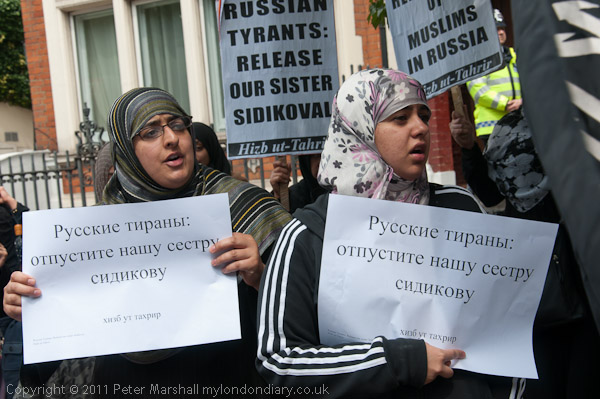
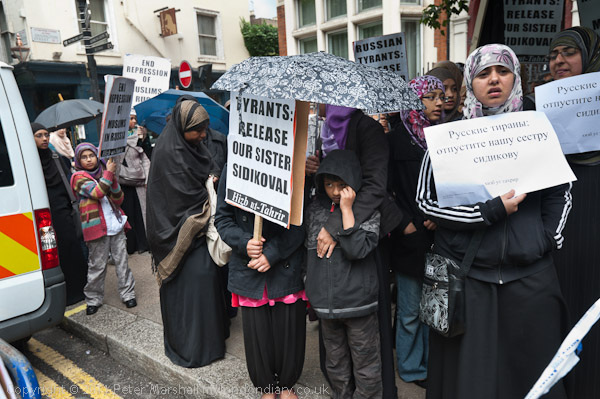
But last month they were protesting against the persecution of some Muslims in Russia, where Hizb ut-Tahrir is an illegal organisation. In researching the article I wrote I got the impression their complaints of violation of civil rights there were real and justified, although perhaps more directed against members of their organisation than Muslims in general. You can read more about what has been happening in Russians Told ‘Release Our Sister Sidikova’ on My London Diary.

The only real problems in covering this event opposite the Consular Section of the Russian Embassy in Kensington were the weather and the traffic. The embassy proper is hidden away in Kensington Palace Gardens, a private street where neither photography nor protests are permitted, but the consular section overlooks the busy Bayswater Road, and the protest was taking place on the opposite pavement, which is not particularly wide.

There were perhaps around 50 men and 20 women present when I arrived, behind a line of police barriers on the edge of the road. So to photograph them I could either go behind the barriers with them or stand on the edge of the road. Usually police put these barriers with their triangular base pointing out into the road, but here they had put the bases towards the curb, making them stick out eighteen inches of so further into the road.  It seems a small difference (and it is easy to trip over those bases) but it does expose photographers significantly less to traffic. On busy roads like this there is usually too a line of cones to warn traffic which also gives us another foot or so to work in safely. But there were none here, just a police van parked in the road immediately before the protest, obscuring oncoming motorist’s view of it and any photographers.

Of course in tight working areas like this the 16-35 mm on the D700 is very useful, and mainly at the wider end. But one or two cars and lorries did go past uncomfortably close to me as I photographed the men and a smaller group of women at one end of the protest.

© 2011, Peter Marshall

It had started to rain slightly as I arrived, but fortunately after a few minutes during which I was working microfibre cloth in hand and wiping the UV filter before every shot it stopped for a few minutes and let me get on with taking pictures. But not for long. Possibly the umbrellas help in some of the pictures, but as well as stopping the rain they also fairly effectively stop light, especially if large and black.

I stuck it out for some time, perhaps rather longer than I would have done if any other photographers had been present (of course there were people from Hizb ut-Tahrir taking pictures with cameras, phones and camcorders too.)  Much as I like many of my colleagues, it’s good to occasionally photograph different things to them. But then we got a really torrential storm; I put up my umbrella and thought briefly that there might be some interesting pictures as people sheltered from the rain, but decided instead to make for the nearby underground station and go to my next location.

Although I’ve only used pictures of the women at the protest here – it was mainly a protest about women after all – I actually spent rather more time photographing the men, and perhaps got some slightly better pictures, as you can see on My London Diary.

On the Buses

 © 2011, Peter Marshall
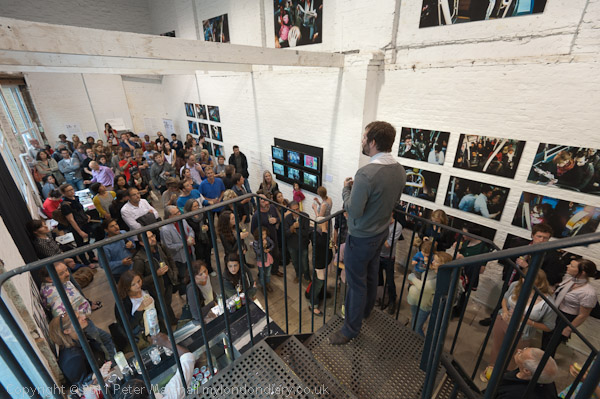
Brett Jefferson Stott talking in the gallery

© 2011, Peter Marshall

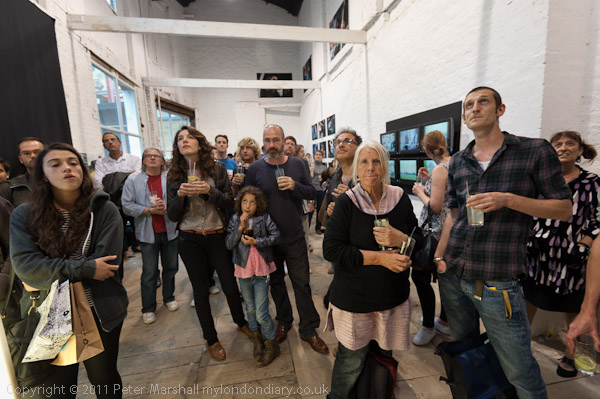
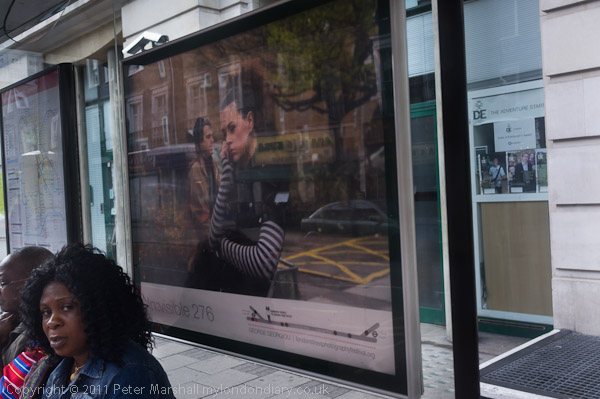
London’s first Street Photography Festival is now in full swing, and last night I was at the opening of what is perhaps the most impressive of the several shows, although not one that has received any great publicity. Seen/Unseen at the Collective Gallery down an side alley at 15 Camden High Street, a few yards from Mornington Crescent station is for various reasons an interesting show, and is open 7 days a week until 17 July, although a display of 8 of George Gerogiou’s images is also on nearby bus shelters until 5 Aug.

© 2011, Peter Marshall
Waiting for the 168 at Mornington Crescent

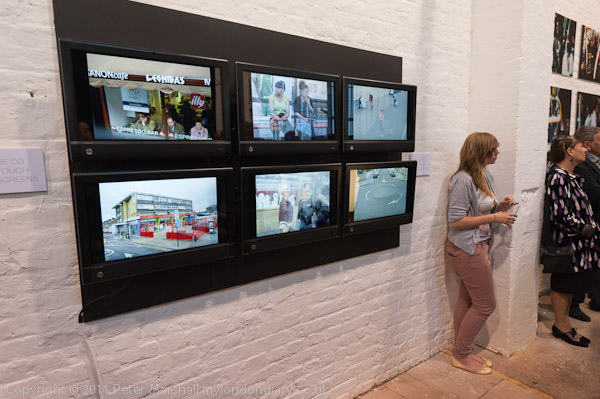
It was Georgiou’s images, taken looking out of bus windows, that held my interest, displayed on a grid of six screens in the gallery. At least during the opening, the light level in the gallery shining on the front of these largish monitors seemed to me at least a couple of stops too high for optimum viewing, more designed for the large prints by Mimi Mollica around the rest of the space.

© 2011, Peter Marshall
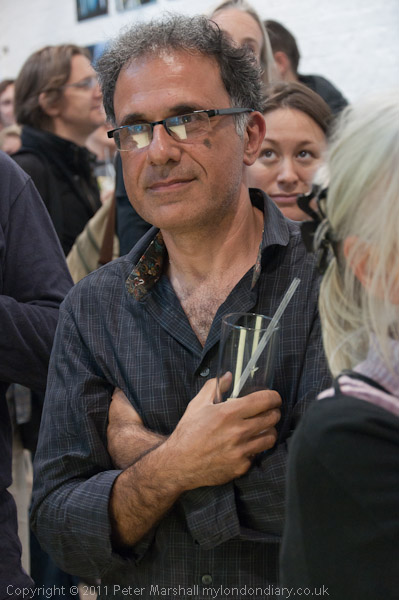
George Gerogiou

Part of the interest was in recognising many of the views captured by Georgiou, but the work also reflected the near-invisibility of the photographer, recording unobserved from the window of the bus. Of course he is not the first to take advantage of this kind of privileged position (and most of us city photographers have done the same) but he has persevered at it in a way that few others have.

© 2011, Peter Marshall
Six screens display Georgiou’s work

His work incorporates the reflections and irregularities that come from shooting through glass which is seldom clean, and although at times this gave the images a greater depth, there were others images where I found it simply annoying and wished he had worked harder to avoid these – as some other photographers have done. But then we would have had different pictures.

© 2011, Peter Marshall
Mimi Mollica

I found Mimi Mollica‘s images taken of people inside buses somewhat less gripping, at least in part because of their technical qualities. I felt they would actually have looked rather better on computer screens than as the large and rather garish blow-ups on the wall, and certainly felt they looked considerably better from a distance than close to, and I think better in my photographs than in reality. But others will certainly disagree.
© 2011, Peter Marshall
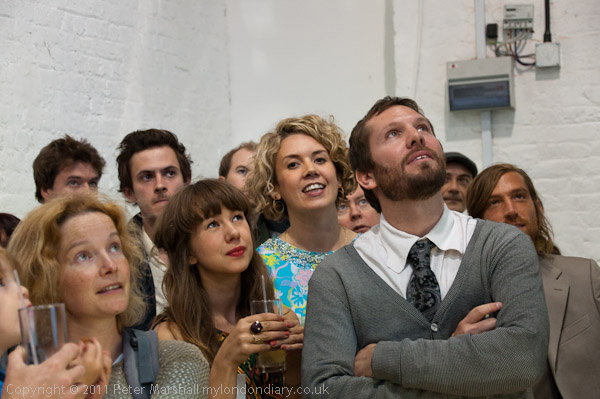
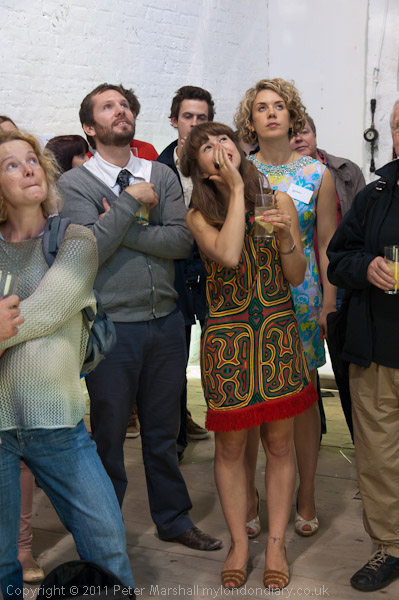
Grace Pattison, Brett Jefferson Stott and others listen to the photographers talking

© 2011, Peter Marshall

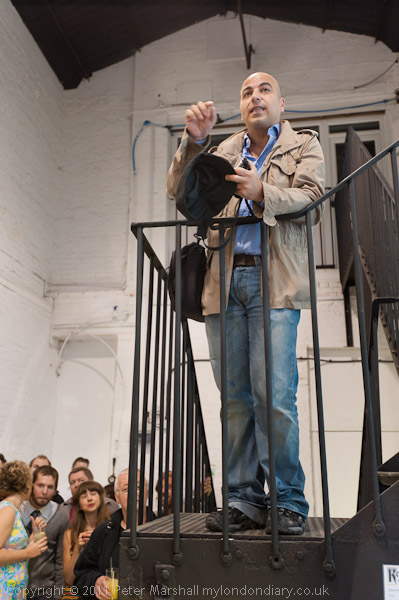
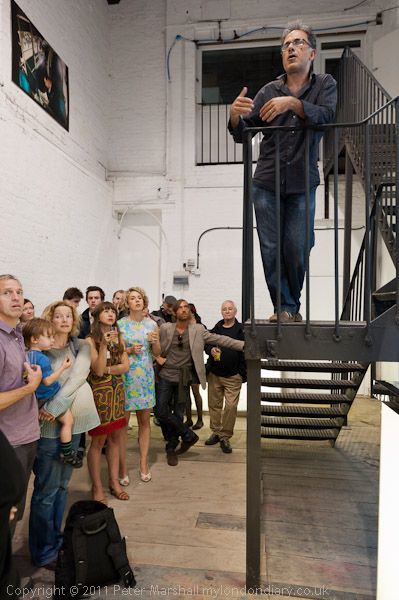
Both Brett Jefferson Stott, the founder/director of the London Street Photography Festival and the two photographers spoke at the opening, and there was a large and appreciative audience including a number of other photographers. Brett in particular talked a little about the difficulties of photographing in public, which I think can easily be overstated. So far as buses are concerned I do of course have a little form, producing a set of black and white pictures on them which was shown at the Museum of London back around 1991.

© 2011, Peter Marshall

On my way home I had a long time to wait at one of the bus shelters for the 168, and so had plenty of time to photograph one of Georgiou’s images on display there. And as often on my bus journeys I did take a few pictures out of the window, as well as one of my fellow passengers.

© 2011, Peter Marshall

© 2011, Peter Marshall

Another show in the LSPF not to be missed, which I’ve yet to see but which looks to be of great interest is Walter Joseph‘s ‘Street Markets of London in the 1940s‘ which is at the British Library until 31 July. It’s good to see the value of this work being recogised, I think promises to be rather more interesting than the much hyped Vivian Maier show.

A few more pictures from the opening will be on My London Diary some time in the next few days.

Red Hot Pictures

Well, I exaggerate slightly. But too hot to hold.

As I’ve written before, I still stick to a rather relaxed regime for filing work, preferring to have had a good look at my images on a large colour-corrected screen and making any necessary adjustments – burning, dodging and occasionally even a slight crop – before sending them out into the world.

So last night as usual, I got home, powered up the computer, put the CF card into the reader, added a few keywords to the Lightroom input dialogue, clicked on import and then went downstairs to pour out a glass of a rather decent southern French red and start on dinner. Fortunately before I picked up my knife and fork, I remembered something else I needed to do and went back upstairs, to be greeted by the acrid smell of bien cuit bakelite and an error message on the screen telling me that a USB device was malfunctioning. A small wisp of smoke confirmed this.

I picked up the card reader and immediately dropped it again – it really was too hot to hold – then pulled out the plug and holding the reader by its cooler edges, away from any components, held the card also by its cooler edge and pulled it out.

I’m not sure what temperature a CF card has to reach for meltdown, but I was certainly very worried at that point that I had fried my pictures.  Fortunately I had a spare card reader handy and was able to plug that in.  A couple of minutes later I sighed with relief as the drive opened on screen and I saw a complete list of files, and even more relief when images appeared in Lightroom’s import.  This time I watched to make sure the import started properly before going down for dinner.

© 2011, Peter Marshall

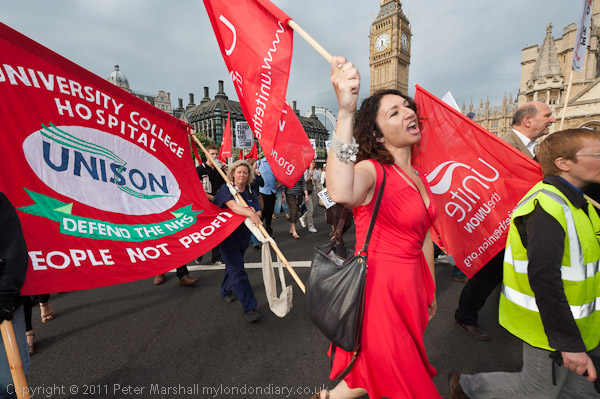
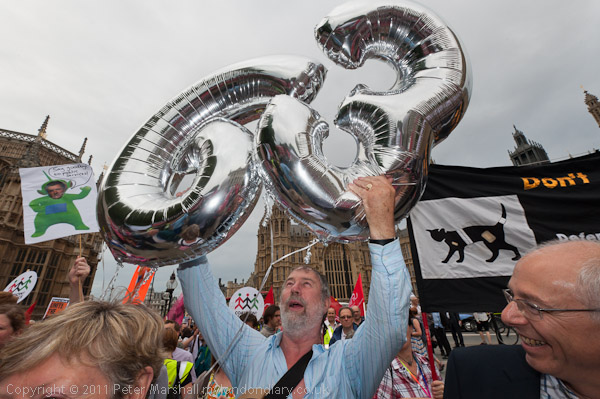
One or two of the pictures weren’t bad, and together with the story NHS 63rd Birthday March in London they were on Demotix before I went to bed just a little after midnight. But I’ll probably write more about them in a week or two after I’ve put them and some more on My London Diary.

© 2011, Peter Marshall
Celebrating the 63rd Birthday of the NHS at the Houses of Parliament

War Over War Photography

I’m not a war photographer, and probably I panic far too easily ever to have made a good one. The worst thing I’ve been hit by taking pictures is paint, though there have been some near misses from bricks, bottles, bags of flour, shoes and other handy urban missiles and over the years I’ve received numerous and sometimes all too convincing threats of violence both at close range and occasionally on-line by people who “know where you live.”  And a few rather nasty moments, as when when guy was dragged back by his BNP mates after promising to do something totally anatomically impossible to me with my camera.

Like most photographers who cover demonstrations I’ve been hit, pushed and punched and spat at, mainly by the police,* but occasionally by the rabid right or fringe anarchists or even bulky men with Northern Irish accents and dark glasses. But usually when trouble starts I like to try and cover it from the sidelines rather than get stuck in, to think carefully about whether I want to go there.

Unlike most other photographers now covering such events in the UK I refuse to carry or wear a helmet, a decision that would not be tenable in most other countries, but then I only work in England, and seldom even outside London.

But though I don’t do it, anyone with an interest in the history and practice of photography has to have an interest in what has been an important strand in our medium, at least since Roger Fenton went to the Crimea. As well as Fenton, I’ve written in the past about a number of the great war photographers – Robert Capa, Gene Smith, Don McCullin, Stanley Greene are just a few that come immediately to mind.

So I’ve been following with great interest the controversy aroused by the ‘The War Photographers biggest story: themselves‘, a controversial point of view posted on the Duckrabbit blog on July 1, and in particular the responses to this from a variety of points of view. A follow-up post on July 4, with the improbably long title  highlights a perhaps rather tetchy and perhaps ill-thought out comment to the first piece by the one of our leading current war photographers, Christopher Morris of VII, and a response to that by Asim Rafiqui. Again interesting reading, with a growing string of comments. Really quite a war!

Duckrabbit truly has form in raising interesting questions about photojournalism, for example with   last February, and radio documentary producer Benjamin Chesterton and photojournalist David White have produced some great work. As well as the blog, their website also has some fine features, for example The Other (side of Sweden) which shows the work of photographer Joseph Rodriguez with young Muslims growing up in the city of Malmo.


* I take that back – the police have yet to spit at me.

Hawk’s Wings Clipped

Jay Maisel isn’t on my list of favourite photographers, but must rate as one of the better commercial photographers of the twentieth century, and there is certainly a great deal to admire in his portfolio even if very little if anything  I would want to emulate. We obviously think and work in very different ways.

One subject we seem to agree on is copyright and I was pleased to hear that he had reached a settlement over the unauthorised use of one of his images – not my favourite picture of Miles Davis – by  Andy Baio, some sort of internet entrepreneur who made a fortune selling a web company to Yahoo a few years back. For the USA it seems a rather reasonable cost settlement for what was a clear breach of copyright.

But apparently Maisel has become the target of a hate campaign spearheaded by someone who aims to put a million pictures on Flikr. I’ve only seen a hundred or two – mainly his most ‘faved’ images – by the pseudonymous Thomas Hawk, but they do seem to epitomise the worst of Flikr, and include what look like a few third-rate attempts to emulate Mr Maisel’s work that only increase my admiration for the originals.

Jeremy Nicholl in The Photographer, The Entrepreneur, The Stockbroker And Their Rent-A-Mob on his Russian Photos blog has yet another of his excellent pieces of research and reporting about Hawk and Baio, suggesting why Hawk should have an interest in stirring up a hate campaign against Maisel.

Perhaps what he fails to mention is what I think may really be the true motive. Jealousy. Even if Hawk/Peterson realises his million images on line there won’t be one that comes up to Maisel’s standards.

Anyway, read it and if you agree with Nicholl’s and my estimation of the integrity of this stockbroker employed by Stone & Youngberg in San Francisco – and at whose address his web site is registered – you too may want to click on their web comment form and tell them what you think.

Nice one Jeremy!

PhNAT History Launch

By the start of 2008, photographers who covered protests on the street were getting pretty fed up of being harassed by police photographers.  On one occasion I’d found myself covering an event in Parliament Square with a police photographer around 10 feet away photographing me time after time for around 5 minutes as I kept my camera to my face, waiting for me to lower it.  On an earlier occasion I’d been engaged in conversation by an officer only to look up after a minute or so to find myself staring into the  large lens of another member of the same FIT team around 5 feet away.

There were other little tensions too – the officers who would look at my press card and say flatly “That’s not a real press card” or others who would simply say “I don’t care if you’re the effing press” or words to that effect. The odd stop and search. Various threats of arrest unless I got off the road – or once if I continued to stand on a wide empty pavement, forcing me to stand in a road with fast-moving traffic.

In fact I got treated better than most, if only because I usually decided life was too short to argue and the best response was often just to walk a few yards away and get on with my job. And for the sake of balance there were plenty of occasions too when police helped me, gave me good advice and occasionally protected me from harm. One officer came up to talk to me at a demonstration and as we chatted told me that he had been given a firm telling off for talking to me at an earlier event. Others would come up and ask me questions that let me know that they were keeping an eye on me – and in some cases reading this blog.

Around Christmas 2007, a series of posters started to appear outside police stations aimed at getting people to report suspicious activities, and one of these included a camera. Then we got one all to ourselves, with the caption ‘Thousands of people take photos every day. What if one of them seems odd?’ and it was a kind of last straw.

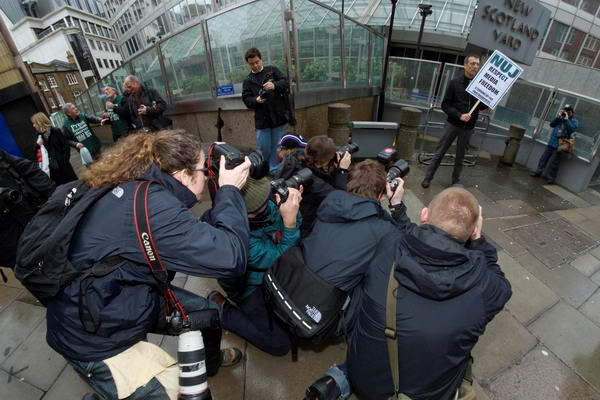
On March 28, 2008, along with 20 or so other photographers, mainly NUJ members, I was outside New Scotland Yard to photograph NUJ general secretary Jeremy Dear in a one-person protest for press freedom which centred around this campaign.

© 2011, Peter Marshall

You can read about that event and see more pictures in my post here, Photographers by the Yard. The protest was followed up by a letter from the NUJ to the Home Secretary calling on the government to “stamp out the routine and deliberate targeting of photographers and other journalists by the Forward Intelligence Team ” and at the TUC Congress in September 2008, the NUJ showed a short film by Jason N Parkinson with evidence of police targeting and obstruction.

I’d first met Jason a couple of years earlier outside Harmondsworth Detention centre, when I was standing on a grass bank photographing a group of demonstrators who had been surrounded by police – the term kettled had yet to enter our vocabulary. He was showing them his press card and they were refusing to recognise it as a real press card.

© 2006, Peter Marshall

Jason called up to the three of us who were standing on the bank and asked if we could come and show a press card to confirm his was the real thing. I’d walked past the police earlier carefully holding my thumb over the date on mine – it had run out 8 days earlier and I hadn’t noticed until too late to ask for a replacement, so I didn’t volunteer, but fortunately one of the other photographers did.

Other events followed, both through the union and through other organisations, and in February 2009 there was another protest, a flashmob called by the NUJ and backed by the BPPA and the BJP, and given publicity in Amateur Photographer and on Facebook and elsewhere on the web – including here. Around 400 photographers turned up to make their protest.

© 2009 Peter Marshall

You can read my report and see more pictures at Media Protest at Terror Law on My London Diary.

Our protests were beginning to have some effect, and by July 2009 police were certainly being more careful about photographing the press. Outside the French Embassy I confronted a FIT officer who had pointed his camera with a very long lens straight at me from around 20 metres and he squirmed and made excuses, saying he hadn’t been photographing me and wouldn’t dream of photographing the press. Though of course he had.

But there were still too many instances of harassment of photographers, and a group of them, mainly NUJ members, decided to set up the organisation ‘I’m a Photographer Not a Terrorist’ which had its launch party – one of the few events I didn’t get to as I was in Glasgow , but 300 others made it – at the late-lamented Foundry pub in Shoreditch

You can find more on the Phnat web site where you can download the pamphlet with a history of the campaign to date. It was actually launched earlier in Manchester, but we re-floated it on a plentiful supply of wine at the AoP gallery just a short walk from the former Foundry.

© 2011, Peter Marshall

More on the ‘launch’ and a few more pictures at Not A Terrorist History Launch on My London Diary.

Giz Us A Job

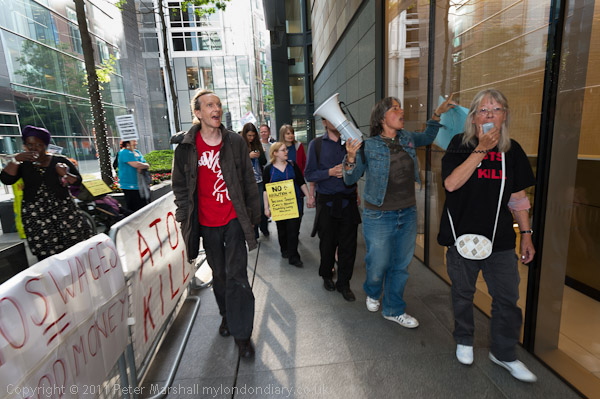
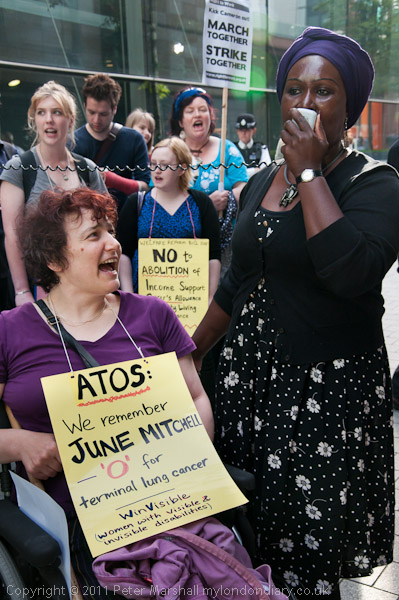
This was the third protest outside the Triton Square offices of Atos Healthcare, the company that run computer-based fitness for work tests for the government, who have caused huge distress to many disabled people.

There is something of a Catch-22 about the whole situation. If you can get to the job centre to attend for the test, then clearly you could also get to work, and if you don’t manage to get there you will be penalised for not attending….  Never mind that it might have needed you to organise friends to help you to get there or that it may take you several days to recover.

The tests that Atos don’t really look at the capabilities of the individuals but use a series of stock questions and force the person conducting the test to choose a stock answer, when there may really be nothing that really matches the person in front of them. Rather than a proper medically based test it is a matter of ticking boxes on a computer screen, and although some kind of medical experience is demanded of those carrying them out it may not be in an appropriate area to the person being tested. Someone who has worked with sports injuries may well be assessing people with mental health problems.

You can read more about these tests and the drastic effects they have had on some of those who have been failed by them on My London Diary in Atos, Giz A Job!  and my earlier posts.

At one of the previous demonstrations here, one of those who spoke was the sister of a man who had committed suicide when the tests failed to recognise his mental health issues, and one of the protesters at this event carried a placard about a woman with terminal cancer who was given zero points – no disability – at an Atos test. 70% of those who appeal the decisions have their appeals upheld, an alarming failure rate.

The lighting outside the offices, with bright sun in  the canyon between tall glass-faced buildings was in places fairly dramatic, with patches of bright sun and reflected sunlight in otherwise quite deep shadow.

© 2011, Peter Marshall

You get some idea of the problem in this picture, where fill flash and considerable Lightroom magic has managed to bring the RAW file down to the output range of an image, with just a little loss of highlight detail at top centre.  I quite like the challenges of tricky lighting, which tend to result in more interesting images, but at times it was difficult to avoid excessive flare.

As usual, some of this time I was shooting with my personal extended lens hood, otherwise known as my left hand, held above the lens. The built in hood on the 16-35 is as would be expected, almost useless, having to cope with such a wide angle of view, and that on the 18-105, although better is still not very effective.

It’s in this situation that you notice that the optical viewfinder has a slightly smaller view than the camera actually takes (I think according to the manual, which I can’t be bothered to find, showing around 95% of the images. So quite a few of the actual images taken in this way – looking through the viewfinder to see the increase in contrast when you are shading the lens from the sun – turn out to need a little cropping along the top edge where my fingers show in the image but not in the viewfinder.

© 2011, Peter Marshall

As you can see there is still some flare in this and some other images. Occasionally things like this green spot can add to images, but usually they just look odd. I’ve toned this down to some extent, but perhaps might also have desaturated it a little more.  I wouldn’t want to remove it completely, as it and its less obvious near neighbour perhaps do give a little of the impression of the light conditions (along with the greatly toned down bright area of pavement at bottom right.)  But I would see no ethical problem in removing flare spots which are generally not apparent in the actual view you are photographing.

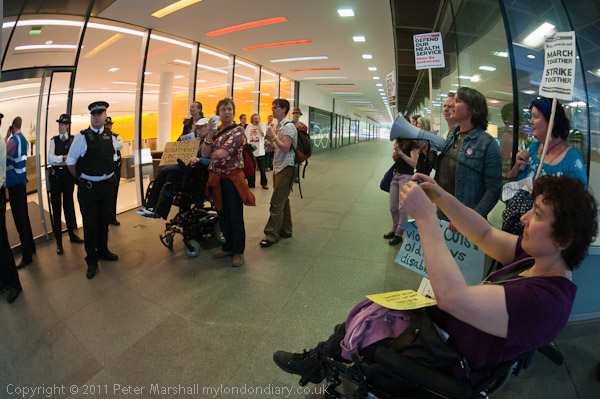
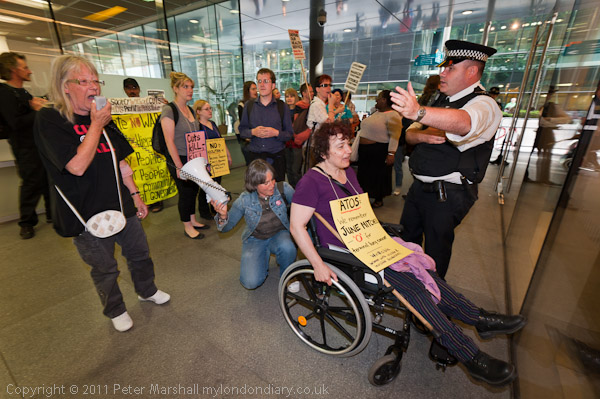
Most of the protest was taking place in the shadows, and there was little excitement about the event, though things became more interesting when the protesters decided to go for a ‘walk’, making their way around the barriers provided by the police into the passageway through the building past the office  reception area.  Light was lower here, provided by lighting in the ceiling and coming through the glass windows of the offices, and was also of varying colour, greener from the overhead lighting and rather orange from that indoors.

I wasn’t entirely happy with the pictures I was getting in this fairly confined space from the 16-35mm with the D700,  and when the protesters went back later I decided to try using the 10.5mm fisheye on the D300. As always it was a strange beast to use, but I think it did the job pretty well.

© 2011, Peter Marshall

I got very close to Clare as she raised her camera at arms length in front of her to take this image, trying hard to keep the camera more or less upright. The picture is very slightly cropped at the right and top, and also I’ve corrected the curvature slightly – perhaps around 10-20% in Lightroom. The horizontal angle of view is around 140 degrees and I’ve managed to include both the faces of the group of demonstrators on the right and the police and security outside the revolving door at left.

It doesn’t include all the protesters – they continued in a rough circle behind me , and in a perfect world perhaps the placards at the right would have been about this event and not for other protests, but that’s how things were.  But there is something here about the curving lines that brings this image together for me, whereas the rectilinear distortion you get with the 16-35 at 16mm as in the image below seems to sweep things away at the edges.

© 2011, Peter Marshall

Naked Bike Ride

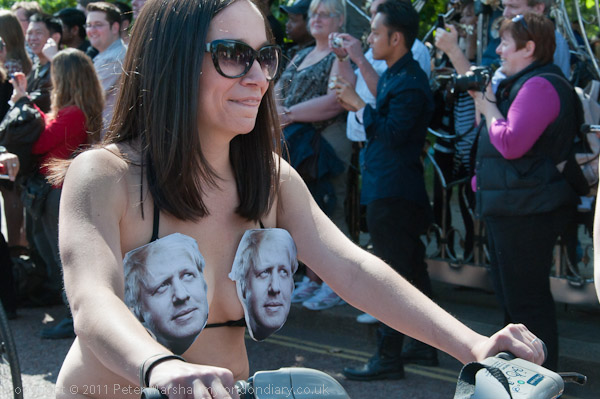
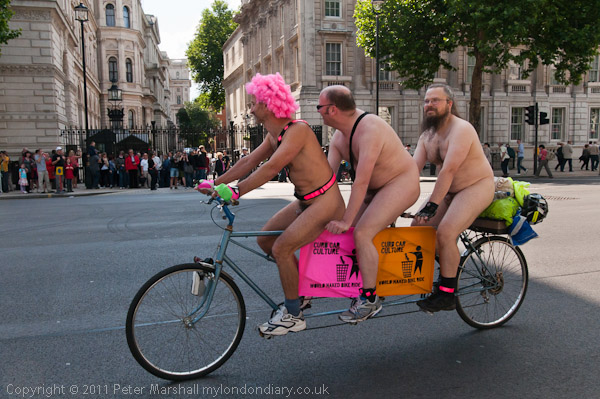
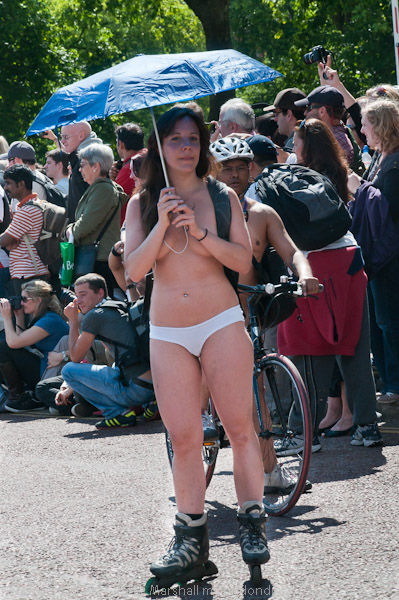
The annual Naked Bike Ride through central London is to my mind a rather peculiar event, with some very mixed motives among participants, viewers and certainly photographers.

© 2011, Peter Marshall

I don’t have a particular hangup about nudity, but generally given our English weather I think clothes are a pretty good idea, and given the lack of ozone to cut down the UV, even on those hot days they make sense. It’s certainly more pleasant to wear a shirt than to keep having to smear nasty oily sunblock oils over your body, and melanomas (like Melanie Phillips which Google came up with when I was checking out that word) are certainly best avoided.

But I’m not that worried about ‘decency’, other than not getting arrested for indecent exposure.  After all, around 50% of the population have similar equipment to me and it isn’t something I feel any particular need to flaunt or hide.   Actually the ride reveals some pretty wide differences between people though I don’t find any great interest in this at least so far as the males are concerned. Women are of course different, and I can’t deny that looking at them unclothed has a certain attraction.

© 2011, Peter Marshall

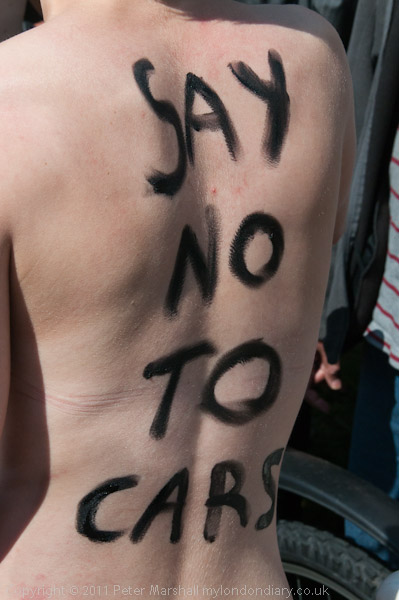
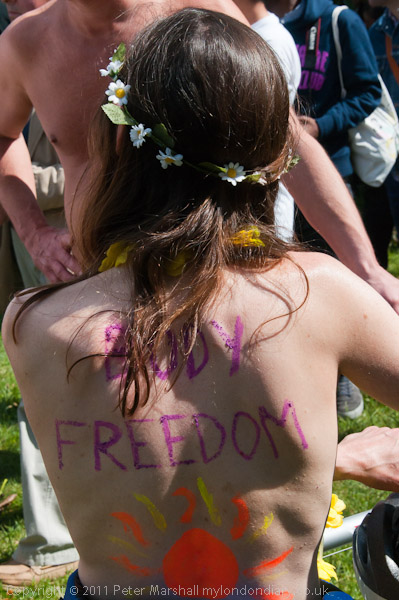
But as an environmental protest, the NBR seems to me rather lacking, not least in that so few of those taking part show any great sign of viewing it in this way. In taking pictures I try hard to find ways in which people are trying to express some particular view – so anyone who paints a slogan or design on their body, or has some kind of placard or flag on the cycle is likely to get their photograph taken by me. But there are not a great many who do.

© 2011, Peter Marshall

The NBR also now suffers from being listed as a tourist attraction on various web sites, resulting this year in a very large crowd of viewers inside Hyde Park where the riders were preparing.  Perhaps this was part of the reason why this year there seemed to be many more clothed riders than on previous occasions that I’ve photographed the event.

Although I think it is clear that there are no privacy issues involved in photographing this event where people have clearly chosen exactly how much of their bodies they want to put in the public sphere, there are pictures that I have taken on this and previous occasions that I have decided not to publish, or at least not on the public pages on the web.

© 2011, Peter Marshall

There are various reasons for this. I have no wish to offend people, and have put a warning message on the links to these pages on my site as well as at the top of each page with pictures from the ride, and tried to chose carefully the images pictures people will see without scrolling down the page.

I also have no wish to attract some people to view my site, although I do want to make it available to a wider audience around the world. There are countries where the images I have used – including those in this post – would be considered illegal.

Shortly after I published the pictures from the first London NBR I photographed I had an e-mail from the director of a large educational project saying they would like to include ‘My London Diary’ in the links from their project – and would I please remove these pictures which made it an unsuitable site!  I replied saying that there were no pictures on my site unsuitable for children.

© 2011, Peter Marshall

However it isn’t coincidence that in many of the pictures I have published in My London Diary of the Naked Bike Ride* are carefully framed or that handlebars, bags, arms etc are rather conveniently placed to hide certain areas.  In some pictures I made these decisions as I was taking them, but more came at the editing stage.  I think it helps to make these images more about the event and less about the personal peculiarities of the participants.


* But there are still pictures that might offend the particularly straight-laced or might cause some embarrasment if you view them in the office, so only click on the link if you want to see photographs of people without their togs on.