£7348 +VAT!

I first read a review of the Leica Noctilux-M 50mm f/0.95 ASPH in 2009, and I’m not sure why the BJP has chosen to publish a review by Edmond Terakopian now. Obviously he liked it very much, and a Leica lens at that kind of money is bound to be a fine performer.  But it did come out in 2008, and is currently there is a waiting list for it even if you do have a spare small fortune.

I often idly wonder about going back to using rangefinders and am now looking hopefully at the latest breeed of mirrorless cameras, particularly the Panasonic G3. Certainly the strain on my shoulder and back would be considerably less with either a Leica based digital system or a micro 4/3 camera.

A lens like the Noctilux would help to compensate for the poorer performance of the Leicas at high ISO. But what a cost, and the Noctilux too is a relatively large and heavy lens by rangefinder standards – around 75 mm long, taking 60mm filters and weighing around 650g. Cosina’s 50mm f1.1 Nokton is a little slower, but quite a lot shorter and lighter, and over £6000 cheaper.  Leica’s own Summilux 50 f1.4 isn’t a great deal slower and very much smaller and, at least in Leica terms, affordable at less than 1/3 the price of the Noctilux, while Zeiss have a 50mm f1.5 that costs around half of that.

Several of my friends are using Panasonic G series cameras, and although I’ve not been entirely impressed with the image quality of the earlier modes, but from the reviews the G3 seems to be a considerable improvement on the earlier models.

But for the moment, for the next few days I’m trying out a combination of  cameras that I actually own, the Fuji X100 and the Leica M8. The 35mm f1.4 Summilux makes a good ‘standard’ lens on the M8, even though thevintage lens I own isn’t recommended for use with it.  What I really use as a standard is the 35mm equivalent on the Fuji X100, while for something a little wider I have both 15mm and 21 mm Voigtlander lenses on the M8, giving roughly 21 and 18mm equivalent, while the Leica 90 f2.8 gives me a moderate telephoto.

I’m not sure that the combination will do all I want; in particular I’ve got quite addicted to using very wide lenses. It might be better to move to the Leica M9 and with the the wide angle Tri-Elmar giving me 16, 18 and 21mm, and add to that some new fast glass. But weight would be a disadvantage and cost makes it an unlikely option unless I win a lottery.

But a couple of G3 bodies, the kit lens, a wideangles zoom and a telephoto wouln’t eigh a great deal and would cost less than a typical Leica lens, let alone  the Noctilux.

Pride Portrait

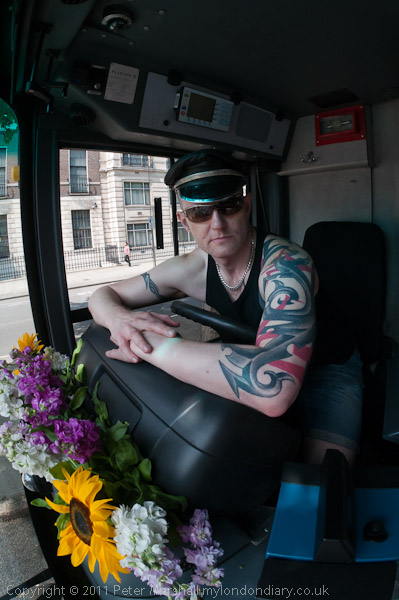
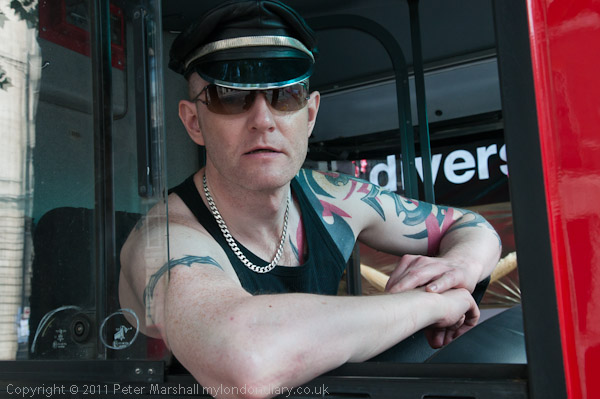
One of the advantages of being around in the couple of hours before the Pride parade actually starts is that you have time to talk to people and take their pictures. One of the drivers of the various buses that take part in the parade looked rather interesting sitting in the driving seat, and I took a picture of him looking at me out of the driver’s window.

© 2011, Peter Marshall

It wasn’t bad, but I thought it was a shame that it didn’t really show his left arm which was rather more interesting than his right. Also, in front of him but out of view were some flowers decorating the front of the bus at the bottom of the windscreen.

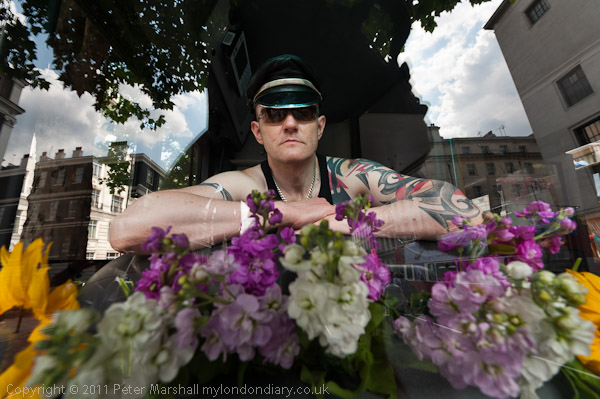
So I asked him to lean forwards and tried to photograph through the windscreen. Unfortunately almost all I could see was reflections, with him almost invisible. If I were writing a how-to book, this would be the point where I showed the difference a polarising filter would make, but I haven’t carried one of these since lenses changed to plate-sized filters and prices became astronomical.   The lens I now mainly use  – the Nikon 16-35 f4 – takes 77mm filters and the largest polariser I own is a 49mm. Since I moved from Olympus M film cameras to Nikon digital I don’t think I’ve ever owned two lenses with the same filter size either; back then almost everything in the bag was 49mm.

Polarisers always worked better in the text books than in reality, where somehow it was always the wrong kind of reflections or the wrong kind of light you needed to control. But I didn’t have one anyway to try.  Here’s the picture I managed, not perfect but much improved by a simple trick.

© 2011, Peter Marshall

I must have looked a rather odd sight taking this image, camera to my eye in my right hand, and in my left holding my camera bag up above my head to get an area of shadow on the windscreen so that I could see the driver clearly. It did require quite a bit of work in Lightroom afterwards to get a picture more or less as I would have liked – perhaps stopping down or more careful focu would have made the foreground flowers just a little sharper.

I said thanks and was walking away when I had another idea of how to do it, and went back, got on the bus and told the driver what I wanted.  I could get rid of reflections by working from inside the bus, using the 10.5mm semi-fisheye held close to the flowers to take the picture. The only small problem was that the camera had to be right up on the glass and I both had to guess what I was getting – and check after shooting – and keep myself out of the image, which covers 180 degrees corner to corner.

© 2011, Peter Marshall

I rather like the result, though it really needed some extra lighting. I had to underexpose the driver quite a bit to keep detail I could burn in on Lightroom in the street outside. Like most of the pictures here, I worked on this fairly quickly and it could be improved with a little more work in Photoshop.  One minor worry is the patch of green light close to his left wrist. It really was there, but it annoys me. Would it be ethical to remove it?

More pictures on My London Diary from this year’s Pride Parade.

Stand Your Ground

On the 21 June, as a part of the 2011 London Street Photography Festival, six photographers, each accompanied by a videographer was sent to film in different areas of the City of London.

As it says on YouTube:

Some used tripods, some went hand held, one set up a 5 x 4.

All were instructed to keep to public land and photograph the area as they would on a normal day. The event aimed to test the policing of public and private space by private security firms and their reaction to photographers.

All six photographers were stopped on at least one occasion. Three encounters led to police action.

You can see what happened in some detail in the film ‘Stand Your Ground‘.

© 1992, Peter Marshall
I had no problems taking pictures like this in 1992

It had a particular interest to me for several reasons, not least because I know the photographers concerned and the places they were photographing in. They were all places where I’ve photographed over the years, mainly without problems, though I’ve come up against some of the same attitudes that these six people met.  Mainly I’ve had problems when I’ve been in places we might think were public – walkways and estates that are open to the public but are actually privately owned. Years ago, so long as you didn’t hang around too long, you were unlikely to be noticed taking a few pictures, but now our every move is covered by surveillance cameras.  There is a certain irony in the fact that because we are continually being pictured we can no longer take pictures.

© 2004, Peter Marshall
But a security guy is just walking away after telling me I can’t take pictures here in 2004.
I’d stood my ground an told him to go and check the law with his manager, and surprisingly he walked away to do so – I think he was new at the job!

What is positive about the film is the behaviour of the City of London police when called out by the security guards when the photographers refused to stop taking pictures. There is perhaps just a little unnecessary questioning of the photographers but generally the policemen in the film are quite clear on the law and on the right of the public to take photographs in public places, and make the position clear to security.

I have a feeling that there are still many police forces around the country where there would be a different response, so the City force deserve some credit. But clearly photographers apparently still need to make an effort to educate the security firms and their employees at all levels.

A couple of years ago I suggested that we – perhaps through the ‘Photographer Not A Terrorist‘ organisation which has organised previous flashmobs – should organise a mass photoshoot in the city. I wasn’t thinking of half a dozen photographers, but perhaps hundreds (or even thousands) all coming into the city at the same time on the same day and making the point that we have a right to photograph in public places.

Personally I’d like to go further and try to establish a right to photograph in all places freely open to the public at those times when the public are allowed to access them freely, which would return our right to take pictures in the estates like Broadgate and places like Trafalgar Square. With increasing areas of public space no longer being truly public we need to fight to retain our rights. But perhaps we should go one step at a time and start by asserting those rights we already have by law but which others try to deny in practice.

Pride 2011

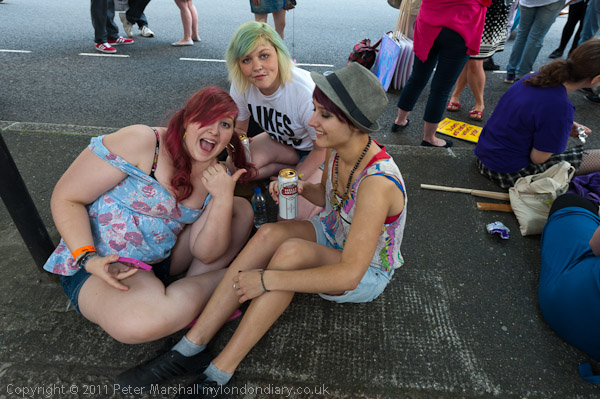
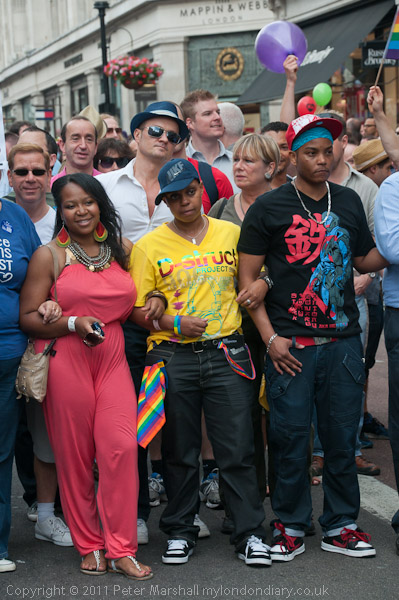
I was in two minds over whether to photograph the Pride Parade in London this year. But in the end I did, and ended up with rather similar pictures to those I took last year, and the year before that… But there were just a few that were different, and perhaps this was my favourite:

© 2011, Peter Marshall

I find something very satisfying about this circular group of three young women, close together with the differences in their body language (and bodies) and gesture but somehow fused into a single entity, and having a good time waiting for the parade to start.

I first photographed Pride in 1993, and looking back at the contact sheets I find they are titled ‘Gay Rights’, and it was then still very much a political event as well as a personal one for those taking part.  Now it is very much a festival and a parade, and a celebration of what the gay community has achieved and has a very different feel, and though there are still reminders of battles that still have to be fought they are rather marginalised.

It is still an interesting event, but I hope my pictures – taken as a whole – still reflect something of the agenda and not just the carnival.

© 2011, Peter Marshall

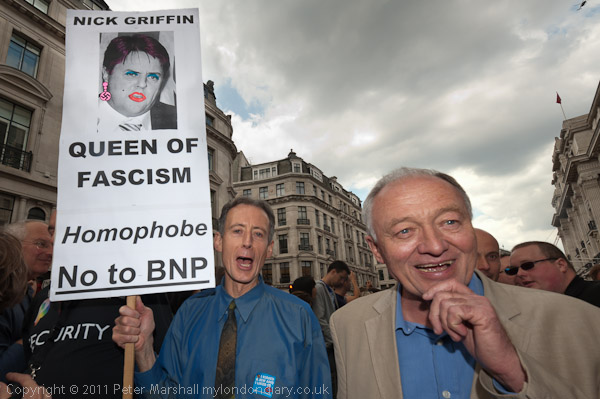
Pride is one of the few events I cover where I bother to get accreditation; although it happens in public space it is fairly heavily stewarded, and difficult to work in parts without a press pass.  In parts the stewards make it difficult to work even with one, and the press, myself included, got pretty fed up with the lack of access to the celebrities at the front of the parade, where stewards most of the time kept us well away and stood between them and us. I managed to grab the image of Peter Tatchell and Ken Livingstone, but  was soon pushed away.

© 2011, Peter Marshall

I was perhaps less upset than most other photographers, partly because I was happy with that picture, but mainly because I had little interest in the rest of the group at the front, not having the slightest idea of who any of them were. For me that’s just one of the advantages of never watching TV!

I kept on walking in front of the march to Piccadilly Circus, then stopped to cover the parade more seriously. I chose to stop there because it would give some at least of my images a recognisable background, and the curve of Regent Street where it comes in to there is also elegant if apparently always marred by scaffolding.  The parade moves in fits and starts through this area,  usually giving plenty of time to take photographs, and the streets there are wide enough to give plenty of light.

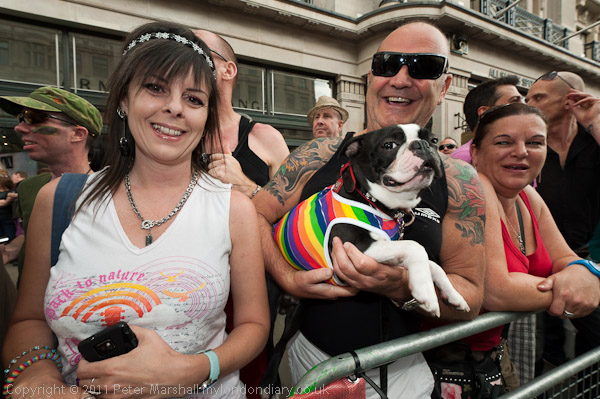
There was also a useful area by the street side around the closed Underground  entrances where I could stand and work without getting in the way of any of the spectators who had been waiting behind the barriers to see and photograph the event. I know how annoying it can be when a  photographer comes and stands in front of you at some critical moment, and although we have a job to do it’s nice to be able to do it inconveniencing the public as little as possible.  Of course some of those crowds watching are also interesting to photograph, and I particularly liked one gay dog watching.

© 2011, Peter Marshall

Probably it would be more interesting not to photograph the parade but to concentrate on the other events around Pride, particularly in Soho a little later in the day. As it was I felt too tired to continue working after around five hours of the preparations for the parade and the parade itself.  I suspect next year’s London WorldPride Parade on Saturday 7th July 2012 might be a good time to think about something different.

More pictures from this year at Pride Parade on My London Diary.

Swansong for My D300?

© 2011, Peter Marshall

I took this picture at lunchtime yesterday. I wouldn’t normally go out to take pretty pictures of swans, but yesterday I spent the morning travelling up the River Thames alongside the swan uppers, something I’ve done most years since I left full-time 9-5 work to become a freelance a dozen or so years ago.

Although I live just five minutes walk from a part of the river they go along, for 25 years or so I was always busy earning a living a few miles away when they came through. Sometimes the following week there would be a picture in the local paper of the boats in one of the local locks, but more often or not just a brief note or nothing at all.

The first time I actually went to watch them at work was something of a revelation. I’d assumed it was simply a week of rowing up the river in fancy dress and making the most of the many riverside hostelries, but what I found was rather different, highly skilled men (as yet there are no women uppers) working together in an activity that now has some genuine environmental worth.
© 2011, Peter Marshall

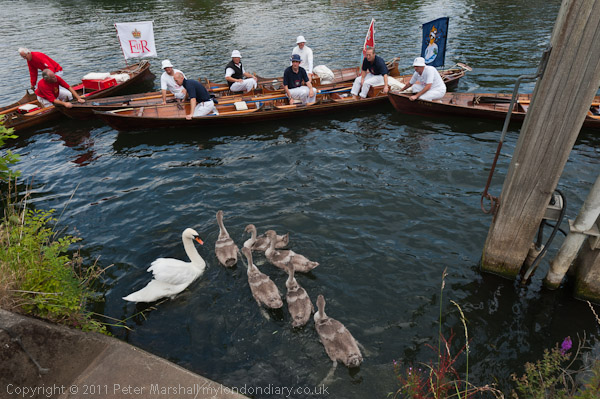
It is a delight to watch them at work, their expertise in handling the boats to surround a pair of swans with their young, the brief struggle as they grab the birds out of the water, the careful way they handle and examine them before returning them to the river, where seconds later the family is swimming again as if nothing has happened and the men are getting back into the boats to continue their journey upriver.

We hadn’t seen a great deal of action yesterday, and there does appear to have been a considerable decline in mating pairs on our stretch of the river in recent years, and this year in particular several of them had no cygnets. Somewhere swans must be doing rather better, as at Staines and particularly Windsor, where tourists flock to feed them there are large herds of unattached swans.

I’d almost given up hope of taking more pictures of the uppers at work to add to my extensive collection when I saw the Swan Warden’s boat (a no-nonsense dinghy with an outboard) several hundred yards ahead had pulled over to stop near a couple of swans just a hundred yards or so short of the Swan Hotel where the uppers were to stop for lunch. It was on the other side of the river, but close to Staines Bridge, so I cycled madly (and a little badly) and managed to arrive on the towpath just in time.

The male bird had swum away, possibly frightened by the arrival of the launch carrying the journalists which had for once got ahead of the rowers or the small crowd who had gathered to watch, but the uppers were able to surround the female and her six cygnets and with their usual skill bring them to land. You can see a few of my pictures on Demotix, and more in due course on My London Diary.

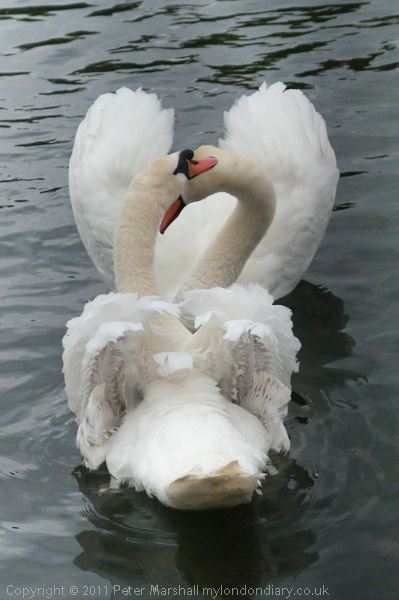
But finally, after the cygnets had been ringed and the details recorded, the birds were carefully returned to the river, swimming out to meet their father. Last to be put in the water was the female swan, who immediately swam out to her mate, and I took a sequence of pictures of their reunion – of which the image above is one.

Although the swans were happy, I was not, because the picture above isn’t quite as I took it, as I did a quick and not quite complete exposure gradient correction in Lightroom. Below is the next frame from that sequence, totally uncorrected and as you can see the exposure differs greatly at the right side of the frame, taken with a Sigma 28-300 on the D300. By the time I arrived home twenty minutes later, the fault was even worse, with half the frame completely blacked out.

© 2011, Peter Marshall

I’ve actually had this fault before, a month or so back, but on just a few frames, and the camera had then returned to normal working. I had another event to photograph later on in the day, but I left the D300 at home and worked just with the D700, suffering from not always having the lens I wanted on the camera, and missing opportunities when changing lenses. I really have got used to working with two camera bodies.

This morning I picked up the D300 again and took a couple of test frames, and it was working perfectly. Looking at the EXIF exposure data there appears to be a link between this fault and fast shutter speeds. I hadn’t actually meant to take these pictures at 1/2000, but I had the camera on manual and this happened to be the setting when I saw this reunion take place, and the overall exposure was roughly correct. I hadn’t deliberately set such a fast speed, which I think was simply a case of idle fingers on the camera dial.

I’ve now tested this, and can reproduce the effect. The camera works fine up to around 1/1250, and at 1/1600 I can see some slight darkening on one side. At 1/2500 slightly over half the frame is dark and faster than this most or all. So at least I have some idea of what is happening, and know how to avoid it. It also means that when I take it – as I will need to one day – for the inevitably expensive repair I’ll be able to say exactly what the fault is, which considerably improves the chances of getting it repaired.  But perhaps Nikon will come out with something shortly (if they have recovered from the earthquake) which will mean that rather than repiar the D300 I will want to replace it.
Slut Means Speak Up

July has finally dawned for My London Diary. It’s taken a while longer than usual for several reasons, not least the work I’ve been doing for an exhibition in September, something rather different for me, on the gardens of St John’s Wood. More about this later, but although I’ve only been photographing one afternoon a week for it, I’m working with digitally stitched panoramas and an hour of taking pictures can generate a day of work on the computer.

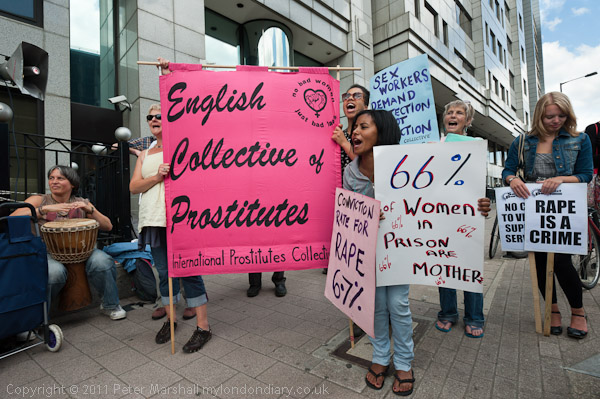
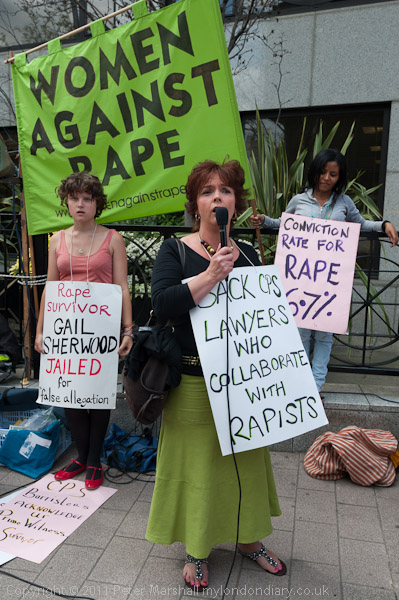
July’s first protest that I covered was outside the offices of the Crown Prosecution Service and the Director of Public Prosecutions and followed on from last month’s ‘slutwalk‘.   This first of a planned programme of ‘Slut Means Speak Up‘ events was calling for changes in the law and changes in police attitudes to rape survivors and sex workers. Women Against Rape, one of the groups supporting the protest, state that over 30 women who have “reported rape have been disbelieved and imprisoned in the last 12 months. Asylum seekers who report rape and other torture are often deported. Sex workers who come forward risk prosecution.”

© 2011, Peter Marshall

This was in part a very emotional event, with a number of people telling stories of their own traumatic experiences and mothers and fathers of victims talking about the difficulties in getting justice.  At times I found it difficult to take pictures, and had to remind myself that my own problems were insignificant and that these people were making a great effort to get their stories told and it was my job to do what I could to tell them. Taking photographs – though needing sensitivity – wasn’t an intrusion.

© 2011, Peter Marshall

Obviously the text of posters and placards is particularly important in protests such as this, and I think you can see this in the pictures on Prosecute Rapists Not Rape Survivors.

J30 Protest & Street Photography

© 2011, Peter Marshall

A myth seems to have arisen that somehow street photography died out in the UK, after a somewhat desultory start in the 1970s with the work of photographers including Tony Ray-Jones and John Benton-Harris, and was then somehow rediscovered in the early 21st century by new young and dynamic photographers.

This is of course completely untrue. Street photography is exemplified by the work of those photographers and the largely American photographers, mainly from New York and in the1940s very much associated with the Photo League and other New York pioneers such as  Leon Levinstein (1910–1988) and later reaching its heights in the 1950s with Robert Frank (b1924) and later with Garry Winogrand (1928 – 1984) and others, strongly influenced a whole generation of photographers in the UK in the 1960s and particularly the 1970s through the magazine Creative Camera.

Many of them continued to work in later years in a similar vein; although Ray-Jones died young, Benton-Harris is still working and many other, younger British photographers also picked up their influences. Where photography here in the UK in the 1950s and 60s when I was growing up was very much exemplified in the work of Henri Cartier-Bresson (often cited as one of those who developed the genre of street photography though I suspect he preferred the earlier description of himself as a surrealist – but took Capa’s advice not to get himself labelled as the little surrealist photographer but instead to call himself a photojournalist) but by the 70s Frank and Winogrand had very much taken over the mantle.

Most of those photographers continued working. But like Cartier-Bresson they called themselves photojournalists, or some preferred to be known as documentary photographers. But if you want to see much of the best of UK street photography in the 1980s and 1990s you do not have to look far and there is plenty in the coverage of disputes such as the miner’s strike, the poll tax and other major social and political events of the era. It’s a whole strand of photography, a swathe of street photographers that remain largely ignored by our museums and art establishment.  Despite many fine pictures being taken in London, its an area of work that is completely absent from the Museum of London show, London Street Photography 1860-2010, and perhaps also severely under-represented in its collection.  But if you truly want to see ‘Street Photography Now‘ in the UK you are rather more likely to find it in newspapers, magazines and on the web on sites such as Demotix than in shows about street photography.

Not that these are not worth going to see, but I think they reflect a misunderstanding of the source of much of the imagery they contain.  Perhaps one that in part we can blame H C-B for. I can’t for the moment remember which great American photographer first introduced me to the idea of ‘waiters’, dividing Cartier-Bresson’s oeuvre into those images stolen on the run and those which were more design-oriented, where the great master saw a location – perhaps a pattern of white washed houses of a Mediterranean village and sat or stood there for minutes or even hours, waiting for a person to put themselves in a key place in the design.  For me it is only the grab shots which are truly street and not the waiters.

Design is of course important in photography, but its more formal aspects come from a different source, in particular in my own case from the work of the Bauhaus, both direct in books such as Johannes Itten’s Design and form and The Art of Color, two of the most important texts for photographers ever published, and in the more photographic form of Andreas Feininger‘s many text books on photography one of which I bought when starting photography and which have formed the basis of almost every ‘how to’ photography book since. 

© 2011, Peter Marshall

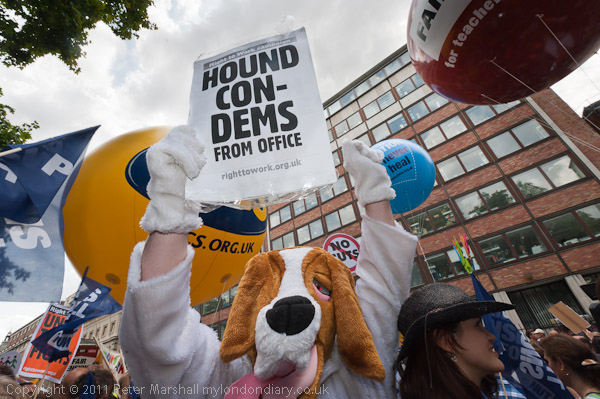
So although I may not often call myself a ‘street photographer’ now (or even a ‘post-street photographer’), street and the attitudes central to it still inform much of what I do, whether it’s photographing the ‘Right to Work Hound’ attempting to Hound the Con-Dems from office

© 2011, Peter Marshall

or most (not quite all) of the pictures that I take at protests such as the J30 march against cuts and to protect pensions (including on this occasion my own fairly small one from 30 years of teaching.) These are pictures that are candid and spontaneous, that concentrate on ‘ordinary people’ rather than celebrities, which seems to me as good as definition of street photography as any and rather better than most.

Although that hound is becoming something of a celebrity.  You can now see rather more of my pictures from the event than on Demotix on My London Diary in 20,000 March for Pensions & Against Cuts, and decide for yourself if they are street.

The Umbrella in Photography

One of my earliest published serious articles on photography was entitled ‘The Umbrella in Photography’ and perhaps one day I’ll hunt for a copy (I can’t remember now when or even where it was first published) and either post it here or die of shame on reading it.  I do remember that it looked at a number of pictures including two by Kertesz, one I think of people coming down a bridge onto a station platform seen from above and concerned largely with design, and another of a man beside a park bench with a broken umbrella serving staunchly as a metaphor.  It’s an image I saw again this week in an original print hanging among others on a friend’s wall, and given the current interest in Hungarian photography is almost bound to be on show currently in London, either at the Royal Academy or a dealer show. Together the two illustrate different aspects which always combine in photography, though in differing extents.

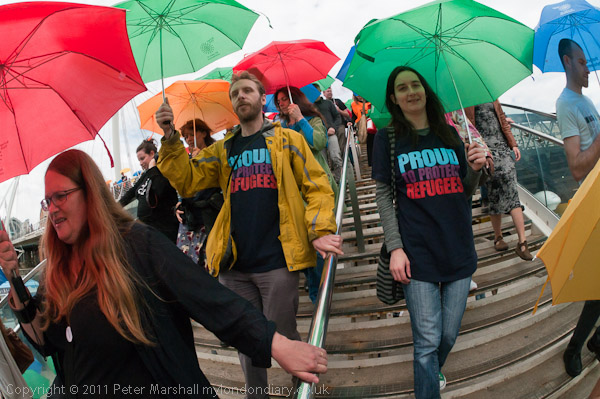
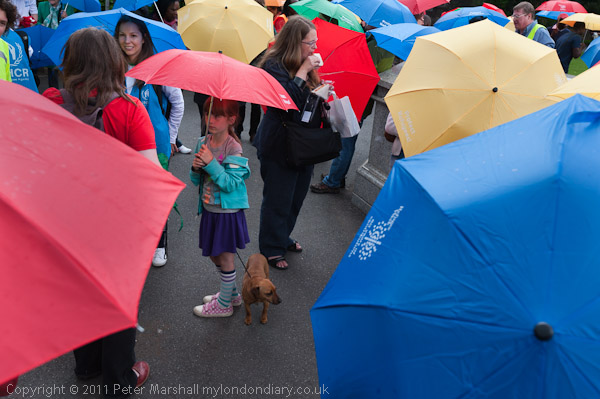
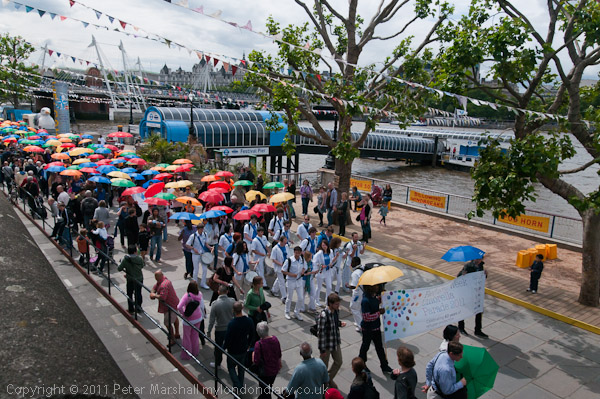
One Sunday last month, at the start of Refugee Week 2011  I found myself rooted to the spot on the steps coming down from the Jubilee/Hungerford Bridge as coloured umbrella after umbrella came down past me, trying to capture something of the event. I think this was my best picture:

© 2011, Peter Marshall

in part because of the two t-shirts ‘Proud To Protect Refugees’ in the centre of the image which make clear what the parade was about.  But in Refugee Week Umbrella Parade you can see quite a few of the others I took in that same spot, including more with the 10.5mm full-frame fisheye on the D300 and also some with the 16-35mm on the D700.  I think the fisheye works better in this situation, although the effect it gives of people walking out of frame at the edges isn’t always a help. The woman at the left I think it gives a useful added dynamic to the image, but the guy with the blue umbrella at top right seems to be doing his own thing (and perhaps about to jump of the side of the steps.) I suppose I could crop him off (or use a little distortion correct which takes out the corners) but then I do like the blue umbrella.

I did photograph the rest of the parade, from its start in Victoria Embankment Gardens

© 2011, Peter Marshall

to its finish on the South Bank

© 2011, Peter Marshall

and of course you can see rather more pictures on My London Diary.

On the Buses Again

The pictures I saw last week in Seen/Unseen at the Collective gallery as a part of the London Street Photography Festival reminded me of my own very different work on the buses around 20 years ago.

© 1991, Peter Marshall

In the early 1990s I was a member of a group of photographers called ‘London Documentary Photographers‘, brought together by Mike Seaborne, which met at the Museum of London, and discussed our work documenting the city as well as working together on some joint projects. One of these was a project on Transport, shown as Transport in the City at the Museum in 1992. Having admired the work that Paul Baldesare had already been carrying out on London’s underground for several years I decided that I would photograph people on buses.

You can see some of Baldesare’s black and white work from that project – with scans that are fairly typical of the web around ten years ago – on the Fixing Shadows web site.  He later worked on the project again in colour.

A dozen pictures of my work on London buses – with similar antique scans rather than those here- also went on to Fixing Shadows, where I was the first of several photographers from London. Fixing Shadows was one of the first great photographic sites on the web, founded in May 1995 to champion ‘straight photography’ by J. David Sapir, then a Professor, now Emeritus Professor in the Department of Anthropology at the University of Virginia and for some years the editor of the Visual Anthropology Review.

© 1991, Peter Marshall

Here’s the introduction that I wrote to my work on that site and which was particularly pertinent to the work on the buses :

Some people feel that you should only photograph others after asking permission. However, our behaviour in public places is public behaviour and thus, I believe, proper subject matter for the photographer.

It is – I was taught as a child – wrong to stare, but these pictures are glances rather than stares. All were taken with a wide angle lens, typically within a few feet of the subjects. Most were unaware of the camera: others choose to ignore it. Asking permission would have destroyed both the events I was trying to picture and the spontaneity of my response to them.

Many people – myself included – would generally prefer not to be asked. Just get on with it and don’t make a fuss – preferably don’t let me know. Daily our images are recorded unasked on security cameras on almost every city building and interior. I find the odd guy with a camera far less threatening; at least as a photographer I acknowledge a responsibility towards those who I photograph. I hope none would consider themselves misrepresented.

Documenting the way we live is perhaps the most important role of photography.

In some ways it would be easier to carry out this project today, although people often say that it is getting harder to photograph on the streets.  The cameras I used then were certainly noisier and more obtrusive than some now, and many designed to be used away from the eye.  Some of these images were taken without using the viewfinder, and framing then was a problem, which today’s swivelling screens would have greatly simplified. Usually I managed to lift the camera quickly to my eye for a quick glance, but there were occasions when I knew I needed a lower viewpoint, and had to rely on experience and guesswork, shooting either with the camera held in my lap, or on my chest.

© 1992, Peter Marshall
A swivelling screen would have made pictures like this rather easier

The other main problem was contrast, with sometimes huge differences in lighting inside the bus and through the windows. Unfortunately some of the best pictures came in the worst weather for this, with bright sunlight outside. Using chromogenic film was a part of the solution, as I found it possible to recover detail from highly overexposed areas, but I learnt a great deal about printing techniques in the darkroom from coping with these negatives, including the use of coloured filters while burning in areas on multi-contrast paper. Again things are so much easier with digital printing, and using RAW on the Nikon cameras does appear in practice to cover a pretty wide dynamic range.

© 1991, Peter Marshall

I can only remember one occasion on which any of those I photographed objected to me taking pictures. It was an African man travelling wearing shorts and a large snake draped around his upper body, on his way to Covent Garden where he and his snake would, for a fee, pose with tourists. He was off-duty and I wasn’t offering him any money. Before I could really reply to him, two elderly ladies sitting to one side joined in on my side telling him in no uncertain terms that if he got on a bus dressed like that he should expect to have his picture taken.

A Host of Pictures

Having made our way around much of the London Street Photography Festival, Paul and I required some refreshment, and not too far away in Smithfield was the Rising Sun. It doesn’t have a great line in photography, though there are some pictures of the Samuel Smiths dray horses on the first floor landing, which perhaps might be considered closer to street photography than some of the work we had seen.

We tore ourselves away from there having put the photography world to rights over a pint and made our way past the Golden Lane estate to Honduras Street and the Host Gallery, which was not taking part in the LSPF, although Panos pictures which shares the building was one of the sponsors.

Packed into the fairly small gallery (apparently soon to be extended onto a second floor) was a show in its way as interesting as any in the festival, although also one that I find in some ways annoying, if not worse.

This was a photography beauty show, the Foto8 Summershow 2011, with 150 photos chosen from 2853 submitted “on single image impact alone” by the Foto8 editing team and then from these the overall winner chosen by four “illustrious judges.” Although I think it’s somewhat demeaning to the medium and insulting to photographers to judge and exhibit their work out of context in this way, I did actually rather enjoy looking at it. It was fun even if I’m not sure it is harmless fun.

You can see the short-listed 150 or so images on the wall at the gallery, where they are identified  simply by a number, or in a slide show on the web. In some ways the web show is better than looking at them in the gallery, where they crowd the walls and screens from top to bottom and it’s very easy to miss some images altogether. You get a pleasant soundtrack, though if like me you sometimes pause to look at a picture for longer than the 3 seconds required to squeeze 150 into around 8 minutes it does rather mess this up.  Some images look better on screen than on the wall, where the standard of printing isn’t always equal to the work, and if you rest your mouse cursor on the ‘caption’ link you actually get to see the photographer’s name.

There are of course also advantages to being at Host and seeing what we used to call the “real thing”, a rather debatable concept in this almost 100% digital age. A few are actually rather better prints than the web image would suggest, and you can buy (for a remarkably low £2) the small red catalogue that has every picture on its own page with the photographer’s name and caption. For the price it is also remarkably well printed – and again some of these reproductions improve on the wall prints. Also if you go along in person,  you can, as we did, vote for the ‘People’s Choice Award’.

None of my 3 votes went to any of the four pictures selected by the distinguished judges (one of their choices wasn’t bad, but still not among my 3 choices.)  I’d made my choice ‘blind’, without referring to the catalogue, and was surprised on checking after voting to find that two of my choices were by the same photographer and my third a picture I’d not seen before by a friend of mine.

I don’t think you can take either the short-listing or the selection of winners and runners up with any more seriousness than Miss World or the Eurovision Song Contest, though it is obviously nice for those who get selected and win the prizes. But the show does present an interesting cross section of current work by the kind of photographers who go in for prizes.

For a rather more interesting and more serious view of photography I can of course recommend Foto8 magazine which comes out twice a year and “is regarded as the most exciting photojournalism and documentary photography publications today.”  Better still, become a Foto8 member.