Guardian Views

I don’t often find the time to sit and read a serious newspaper during the week. Normally I’ll just hear the news on the radio, usually while I’m eating, and perhaps skim through a few articles on the web, mainly ones that people have recommended on Facebook. And often, while I’m travelling up to Waterloo or Victoria on my way to take pictures I’ll take a quick glance through The Metro or relax with the Evening Standard later on my way home.

But yesterday I had to wait around at The Print Space while some of the pictures for my gardens show (more later) were being printed, and after leafing through a copy or two of Vice Magazine I picked up The Guardian and found a piece by Roger Tooth, the paper’s head of photography on picture manipulation and trust in news imagery.

You won’t be surprised to find that he’s against it – manipulation that is – at least so far as news photography is concerned, but it’s actually a very clear and sensible piece on the subject. Like me he comes down to a very simple principle, but one that would be hard to define in detail:

“cropping and toning – basically anything that might have been done in a darkroom – is OK, but the moving of pixels or “cutting and pasting” is forbidden”

and he continues by saying that “We have to trust our photographers and the agencies we deal with“. In the end it does have to come down to trust and the integrity of the photographers concerned. This is one reason why it is so important that photographs are properly attributed, not just to an agency (Getty or Hulton or AP never took a photograph) but to an individual. Of course attribution is one of our moral rights, though unfortunately at the time of the last copyright act the government let itself be lobbied by the newspapers and magazines into denying it to photographers. (The Guardian probably tries more than most, but it would be nice to see closer to 100% attribution there.)

Of course many if not most of the pictures published by The Guardian and all the other newspapers will have had pixels moved, and also other things done to them that would have been difficult or impossible in the darkroom.  We routinely use tools to remove dust spots that clone pixels from one part of an image to another, and make complex adjustments to exposure, contrast, colour balance et al which were just not possible in those dim days of BD (before digital.) And back in BD I used to teach students how it was possible to combine negatives and many other tricks.

It really does come down to intention. To show the viewer what I saw as clearly as I can and as honestly as I can. What I do at the computer or in the darkroom is a continuation of what I do at the scene.

Tooth also makes the fine and sensible point that what is acceptable depends on the usage of a picture. Some things that would not be acceptable in a news photograph would be fine when making a portrait for the arts pages. There are still limits, but they are – at least arguably – in rather different places.

© 2011, Peter Marshall
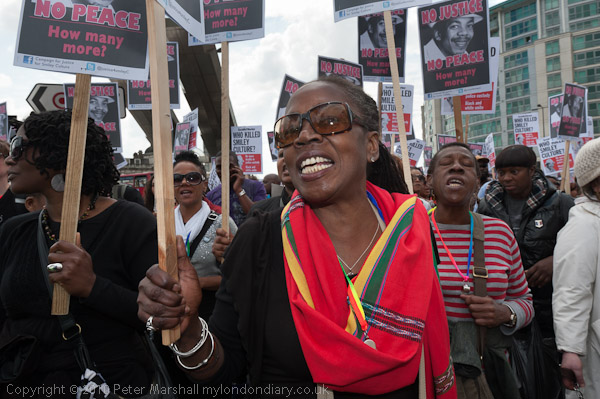
Who Killed Smiley Culture – protest marchers at Vauxhall

I did get time to read the Guardian at the weekend, although it was late on Sunday before I got around to reading Saturday’s news. I was pleased to see this picture (properly attributed)  illustrating a feature about Smiley Culture after the news leaked out that the police who were present when he died and whose actions quite probably led to his death are not to face prosecution.

I thought immediately of the many other cases of suspicious deaths at the hands of police, where investigations have failed to come up with satisfactory explanations and where no charges have been made. Since 2007 the number of such deaths in the London area has roughly doubled – there are now around 30 a year. Smiley Culture has made the papers – and so for different reasons did the shooting of Mark Duggan and the killing of Ian Tomlinson, but most cases get little publicity.

© 2009 Peter Marshall
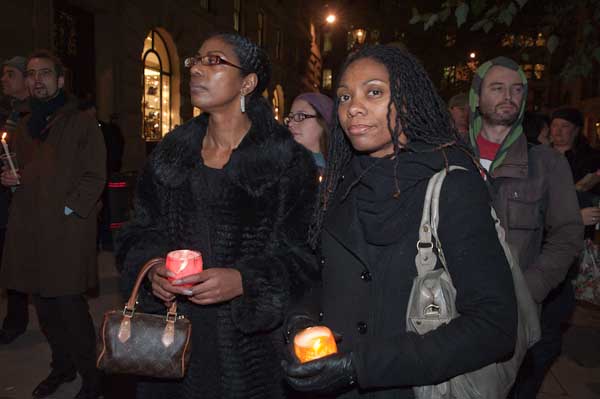
Marcia and Samantha, sisters of Sean Rigg killed in Brixton Police station in August 2008 attend a memorial vigil for Ian Tomlinson in December 2009

Of course not all the deaths are down to police action. But far too many mainly black and healthy young men die, and few if any police are ever brought to account. ‘Quis custodiet ipsos custodes?’ remains a good question, and the answer for the UK is that nobody is really watching the watchmen, or perhaps more accurately that we have a complex system set up including complaints procedures, the IPCC (more police) and courts which work together to ensure that there is no justice.  We should not be surprised when sometimes there is no peace.

London Street Photography – Our Favourite Pictures

As a way of introducing ourself to the audience in the panel discussion on street photography, the three of us (myself, Mike Seaborne and Polly Braden) were asked in advance by chairman Stephen McLaren each to choose our two favourite pictures from the show at the Museum of London and to start the event by talking about them for five minutes.  Here are my views about what they said, as well as what I meant to say but quite likely didn’t quite.

Mike Seaborne, one of the curators of the show, chose one very well-known work, a photography by John Thompson from his work with sociologist Adolphe Smith published in monthly parts as Street Life in London in 1876-7. You can see a fine selection of them on the Spitalfields Life site,  which also has an entire article about the picture chosen by Mike, of Hookey Alf of Whitechapel, accompanied by the interpretation by Smith and some recent discussion. Certainly this is a photograph I admire and work that I’ve written and talked about in the past.

His other choice was an anonymous picture of a woman walking in Hyde Park, which he compared to the images by Lartigue of well-dressed women strolling in the Bois de Boulogne. Although there was a superficial resemblance, I couldn’t really agree in this case with his argument which seemed to be that Lartigue’s pictures are seen as more important because he later became a well-known photographer. I’m not a great fan of Lartigue, but his pictures – such as the woman with two dogs here – show so much more flair and style than the mildly interesting image we were looking at. I have rather more sympathy with the general point Mike was making but perhaps this is not a particularly good example.

Polly Braden‘s choices were a rather nice pictorial image made in 1930 by Hans Casparius (which I can’t find on line) of two women seen from a moderate distance caught by light passing on a Westminster street corner. It was an image that in its use of light reminded me of some of her work, as well as some of my first pictures of London in the 1970s. The women seem to be simply passing, but somehow the lighting creates a relationship between them.

Her second was well-known to me, one of the relatively few images made by Margaret Monck, who was a part of the documentary movement of the 1930s and who I wrote about elsewhere some years ago, along with her mentor, Edith Tudor-Hart (the sister of the oldest living photographer in this show, Wolf Suschitzky, who as well as being a fine photographer was also the most effective of Soviet spies in the UK, recruiting  Bertie Broda who worked on the Manhattan atomic bomb project, passing the US atomic secrets to her and so to Russia – as well as Philby and others.)

The picture chosen, taken in Westminster shows a wealthy woman stopping to put a coin into the hat held by the seated figure of a disabled ex-serviceman at the edge of the pavement. Although Monck ‘dressed down’ to take her Leica on expeditions to the poorer wastes of London, I can’t look at this picture without perhaps unfairly mirroring her similarly dressed to the woman in it, holding her Leica to her face and attracting the attention of the man on the steps in the background of the picture. I wonder too if she had been walking together with this woman and had set up this image rather than simply coming across the event on the street. Not that this alters the fact it is a finely seen and composed picture, then man’s walking stick leaning against the wall at left, and a man who appears to have no cares in the world, a flaneur in flannels and sports jacket approaching from the bottom of the stairs. But perhaps the most intriguing feature are the two large landscape paintings at the left of the image.  Were these perhaps put there by the beggar to attract the attention (and largesse) of passers by, or in some way to avoid prosecution for begging under the Vagracy Act? Like many photographs it is often the unexplained details that intrigue.

I had been the first to speak and my first choice was Outside Claridges Hotel, Mayfair, 1967 by Jerome Liebling. Probably my favourite image in the show, it also seems to me to represent the very heart of street photography.  As I said at this point, the four of us on the platform would probably have very different views of what street photography was (it was a topic our chair had warned us to avoid) but I felt we might agree that it’s golden age was in New York around the Second World War.  Liebling, who died this July age 87, studied photography with Walter Rosenblum and was a member of the New York Photo League in the late 1940s working in the city with many of the other great street photographers of the time – including Helen Levitt, Sid Grossman, Morris Engel, Ruth Orkin, Lou Stoumen and Dan Weiner.

Liebling has caught a moment of confrontation between the two main figures in the image, evidenced by their gaze and body language. It isn’t clear exactly what is happening, with a small crowd (including I think another photographer) and a policeman gathered to watch, but it is a picture very much about class differences and class uniforms, with the added twist that the doorman holding the door of the car is – like all doormen – in reality a low-paid employee dressed in a uniform that is a kind of parody of the upper class dress of a previous era.

At about the time this image was made, another photographer from the New York school had come to this country and settled here. I’ve recently been helping John Benton-Harris working on some of his pictures of the English for a show in Poland next month and a book, from a series he calls ‘Mad Hatters’ and into which this image would rather nicely fall.

John too is a link to the second image I chose to talk about, by Tony Ray-Jones, who like him studied (although in New York rather than New Haven where Tony was then) with the great designer Alexey Brodovitch. Others of his students included Richard Avedon (who hosted many of the classes in his studio) Diane Arbus, Lisette Model and arguably the greatest master of street photography, Garry Winogrand.

When Ray-Jones returned to England, he began working on a book on the English, and although the picture in the Museum’s show is perhaps not one of his best it is in some respects typical, a very recognisable example of one of the ways that he made pictures. When I first saw it on the museum wall, I was very doubtful about its caption, ‘Notting Hill, c 1967’. Although obviously taken at some kind of street event – you can see the reflection of small crowd in the large window behind the figures, it didn’t look like Notting Hill, and certainly it wasn’t the carnival, very small in those early years and attracting an almost entirely West Indian audience.

The poster for the social photographers ‘Milvain Studios’ also worried me, as Milvain is a village in Northumberland, and although the name might not be connected it did seem more likely that this was perhaps Newcastle or somewhere around there rather than London. The captions on Ray-Jones’s photographs are notoriously inaccurate, as most were added after his early death in 1982 by his widow and photographers who had worked with him – including Benton-Harris who printed much of his work and who loaned the print to the museum for the show. Many of those in the posthumous ‘A Day Out’ published the year after his death are incorrectly captioned.

Although Ray-Jones took a number of fine pictures in London, with my favourite being a gloriously surreal street corner in  Brook St, with one man emerging from a hole in the pavement and two others engaged on the ends of a short length of tubing, one on his knees on the pavement and another holding some kind of device on its other end up in the air, apparently the Museum of London has none of his prints.  You can see a good selection of several hundred of them – though not including the ‘Notting Hill’ image – at the Science & Society Picture library* – and can buy reasonably priced good quality inkjet prints for £15 each. I own several of them, as well as one rarer example actually printed by the photographer. The inkjets are better prints.

The print in the show reminded me a little of some  of his better-known images but one that somehow didn’t quite make it. I wasn’t surprised when curator Mike Seaborne told me it had been taken in Durham, and the actual site has been identified thanks to some real detective work by a police officer who visited the show and was able to identify the uniform of the policeman as being from that city, and more than that sent Mike the link to a Street View image of the shop at right, still much the same, though Milvain Studios and their advert are long gone. Ray-Jones went to Durham for the miner’s Gala, and Benton-Harris also has some fine images from the same event.

I hadn’t known it was taken in Durham, and hadn’t chosen it because it broke one of the rules established by the curators by being taken outside London. (There were a few others taken a little  outside the London boundary in the surrounding counties such as Surrey.) In fact it broke a second of their rules also, as it was taken at an organised event, if not the one they had assumed. Perhaps if the show as hoped travels abroad it could be replaced by one of his better London images which truly fit their criteria and I’m sure Bradford would oblige. The best prints of Ray-Jones’s work by a long chalk are those made on bromide paper  from scans for his show there are few years ago, and I imagine the inkjets on sale come from the same scans.

But apart from being a not bad photo, it was also for me a link to a photographer who played an important role in bringing street photography as we knew it to Britain. It was at Ray-Jones’s prompting (aided by John Benton-Harris) that editors Bill Jay and later Peter Turner published the work of many American photographers in the magazine Creative Camera that really changed our view of photography here, and photographers influenced by him – including Martin Parr – gave British photography a new impetus and direction.

I didn’t get to say quite all that in the five or so minutes I had to talk about the two pictures on Wednesday night, and certainly what I did say would not make quite so much sense, talking off the cuff (although I did notes on paper.) I’m happier with the extra time to reflect that comes from writing – or with giving a lecture, though a discussion like we had was perhaps more entertaining.

© 2008 Peter Marshall
Rather fewer May Queens in 2008 than when Tony Ray Jones photographed this event 40 years earlier

* Where some of the pictures are still incorrectly captioned. That large group of May Queens for example is at Hayes, Kent and not Sittingbourne. It was an image that prompted me in the early years of this century to begin my own extensive work on May Queens. I took the picture above working on behalf of that year’s London May Queen in the centre of this group.
August Comes Late

August has at last arrived on My London Diary, although I’m still considering adding some of my pictures from Berlin in July. But there are now two new events on the site.

Every August 6 I like to reflect on an event that took place a few weeks after I was born, the first atomic bomb exploding over the Japanese city of Hiroshima. To many at the time it seemed pointless, as Japan had already lost the war and the only option remaining was some kind of surrender. Many thought it went ahead only because of the kind of inertia of the project (rather as the invasion of Iraq had an inevitability about it months before Parliament here took the vote which, largely thanks to the deliberate misleading by Tony Blair and his fellows in crime, sanctioned it.)  But I think we now realise that Hiroshima and Nagasaki were the opening salvo of the cold war, bombs on Japan that were actually directed towards the USSR.

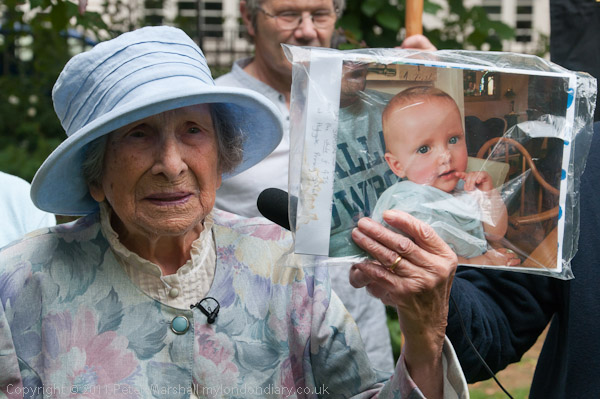
As an event, the annual commemoration close to the Hiroshima cherry tree in Tavistock Square isn’t the most exciting, and while I go to many events to photograph them, this is one that I photograph because I am there. This year however it had a star,  the 105 year-old Hetty Bower, who arrived with a camera crew in tow, and captured the hearts of the audience as she told us how as a young girl of nine in 1914 the sight of men returning from France minus an arm or a leg had convinced her of the futility of war and made her a life-long pacifist.

© 2011, Peter Marshall

Photographically the only problem was avoiding that camera crew, making a video of her life story while getting to the kind of distance I like to work at. Perhaps rather more pictures than usual were taken towards the longer end of the 28-105mm.  There was a clear cue for a picture when Hetty held up a picture of her grandson, one the following Tuesday, but it was wrapped in highly reflective cellophane and the reflections killed some of the best pictures. Later, when the formal part of the event had ended I tried to photograph her sitting and talking with another veteran (if young by her standards) Tony Benn, but I couldn’t find an appropriate angle, they were too far from each other and facing more or less in the wrong direction. Perhaps I could have posed them, but that isn’t the way I work.

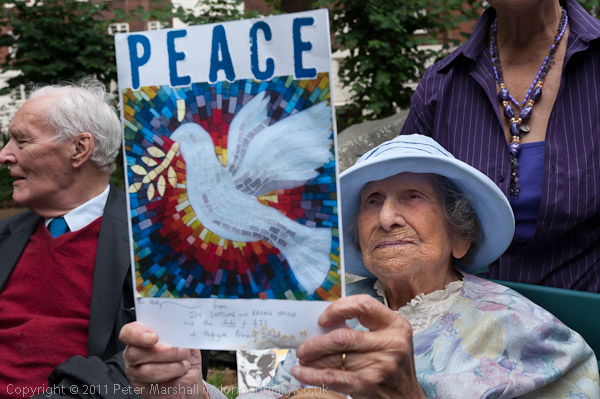
I think my best picture came when she showed me a large Peace card given to her when she visited a primary school. At first I was too close, looking at the signatures she showed me inside it, with greetings from the children and staff, but as I moved back a little she closed it up and held it up for me.

© 2011, Peter Marshall

The other part of the event I’ve always wanted to get a good picture of but never quite managed is the laying of flowers around the cherry tree planted years ago in memory of the victims of Hiroshima.  It’s hard because people come spontaneously and from all directions, and of course turn to face they tree when they place their flowers.  Its also a moment when I feel a photographer is rather in the way.

© 2011, Peter Marshall

This was perhaps my best attempt, and the video cameraman at left perhaps doesn’t really add to it.  I thought I might have another good picture a few seconds later, when another woman came to add her flowers, but as she lent down to do so my picture became rather dominated by her low-cut dress billowing out to display considerably more than was appropriate for the occasion.

Perpignan

The professional week at Visa Pour l’Image in Perpignan has just drawn to its close and for yet another year I’ve not made it there, or to any of the other major festivals.  I’m not quite sure why I’ve never really got into the habit, perhaps because I don’t much like the kind of networking that these things are very much about, but probably more that I just don’t like travelling. Lack of money also comes into it. If there was a similar event in London, I’d probably make it, and I have managed to drag myself across to Paris a few times, largely I think because its another city I love.

But al least if I don’t get to the meetings or to see the exhibitions I can look at the web site, and I’ve spent some time doing so for Visa Pour l’Image. It’s very much a festival of serious photojournalism and after a while the images can get rather depressing, no matter how good the photography, so it was a pleasure to come across the work of Peter Dench, with his often light-heated look at the English. You can see more of this on his own web site.

Congratulations also to the winner of this year’s Canon Female Photojournalist AwardIlvy Njiokiktjien (The Netherlands), which will enable her to continue work on her project on Afrikaner teenagers in post-Apartheid South Africa for a showing at Visa Pour L’Image 2012.  You can read about her project on the Canon site and there is a link to an interview. I did wonder slightly if text on the site saying she had already photographed a  “nine-day period of training sessions led by a racist leader” was likely to make relations between her and the people she is intending to photograph more difficult. But perhaps they only read Afrikaans.

Perpignan has one big advantage over most photo festivals in that it is an open competition and any professional photographer one can send in an entry – the simple rules are given on the web site.  Unlike some other events, there is no entry fee. Of course you do need to have the right kind of work, and at least 50 images on a single story. The web page states: “Please note that we are an international festival of photojournalism focusing on news and current affairs. Please, NO art photography or series of portraits.”  Entries for 2012 open in January and the deadline is 30 March 2012.

Gomorrah Girl

This year’s winner of Blurb’s ‘Photography Book Now, an annual prize for self-published books is Italian photographer Valerio Spada for his Gomorrah Girl, a photographic exploration of the murder of 14 year-old Annalisa Durante in 2004, a young adolescent girl involved in “the land of Camorrah”, (the Naples Mafia.) You can of course read more about it on Blurb’s site, and there is a feature about the prize on Time, and the ‘lightbox’ there shows more of what looks like a truly amazing book, along with some images of this years other PBN prizewinning books.

Perhaps the first thing that struck me – apart from the quality of the work – was that this book was not and could not have been produced on Blurb. This is an open competition – for which Blurb deserves praise – and any self-published book by professionals or amateurs can be entered. But Spada’s book has a complexity which adds interest that goes beyond what is possible with Blurb. The book combines and binds together Spada’s own documentary pictures interleaved with a smaller book of pictures he was allowed to take of police photographs from their investigations of the case.  I’ve not been particularly impressed by all of the earlier winning books in the various categories of this prize, now in its fourth year, but this looks a very worthy winner. Perhaps it means that word has now really got round that the $25,000 prize (courtesy of HP Indigo Digital Press) is really worth winning.

Although I’ve now completed six books on Blurb (and helped friends in the production of a number of others) I’ve not entered any of them for PBN, largely because I’ve not thought any of them was the right type of book to have a chance in the competition, either for the overall prize or any of the categories. Many books that are worth publishing are never going to win prizes.

My latest book, now eagerly awaited from the printers, has seen me struggling with several of the limitations of Blurb’s free publishing software, BookSmart.  In particular, printing double page spreads is very much a gamble, and the only solution I can find is to take an educated guess on the amount of overlap of the two halves needed and send it for printing, then wait the week or two until your book comes back, make adjustments and repeat until you are happy and the book can then be released.  Blurb’s help suggests you avoid important detail in the region of the gutter, but I think all of the detail in my pictures is important! The forums have some more common-sense approaches (although as always there are people, always American, who see no problem and I suspect have no important detail anywhere in their pictures) but no real solution.  Depending on exactly where the image is in the book and the type of binding you seem to need to allow around 1/8″ to 1/4″ of overlap.

I’ve never much liked having images that run across the gutter, but my latest book – for a show opening shortly – the pictures are panoramic images of gardens, and some have a aspect ratios that really need to use the 20×8″ of a double-page 10×8″ spread.  Others are close to square, where I’ve used a fairly extreme vertical angle of view as well as horizontal, and fit a single page without problems. But more about this in a week or two when the show should open.

Last Days of ‘London Street Photography’

This is the first of several posts I hope to write following the panel discussion I took part in on August 31 at the Museum of London, a few days before the end of the Museum’s ‘London Street Photography‘ show, which has been the most successful show in terms of audience figures ever held there. The book of the show has also sold well, and had to be reprinted to meet demand.

It’s also possible that this show will now be shown in several overseas venues, perhaps including a showing in Rio, the next city after London to host the Olympics.

I very much welcome the success of the Museum of London’s show London Street Photography 1860-2010, which along with other ‘street photography’ related events has I think helped to shift the whole perception of photography by museums and galleries in the UK. Not only the Museum of London but other institutions are thinking much more seriously about showing photography, and of showing photography outside practices in the more general art world and portraiture. We could even in the future see shows of British documentary photography or landscape at major institutions in this country, and it could, just could mark the beginning of the end to the critical coldshouldering of photography – and particularly British photography – that has prevailed here.

Although I have my doubts, not least as there are now so few curators with any real knowledge of the media in position in UK institutions – on a generous estimate a couple at most.

Mike Seaborne, who along with Anna Sparham, curated this show for the Museum (and is one of that very few) is shortly leaving the museum after a long tenure there. He was also responsible for what was arguably the last great survey related to British photography (there have been a few more partial and half-hearted attempts since,) again at the Museum of London, with the show ‘Photographers London 1839-1994’, and unsurprisingly quite a few photographers are common to both volumes. The book of that earlier show was rather larger and better produced but long out of print, although you can get a secondhand copy in fair condition for less than it cost at the time or pay another £550 or so for a “collectable” copy.

It is perhaps important to state that the current show is not a show of ‘street photography’, but “a compelling view of London street life over 150 years” and designed to give a “fascinating insight” into the museums photographic collection, with few images drawn from other sources. Its title is perhaps a little of an opportunistic grab at the zeitgeist, but ‘Photographs taken on London Streets from the Museum of London collection‘ would have been rather less compelling.

In fact the show was even more restricted than this, as the curators took the decision at the start of their work to exclude all pictures taken at organised events. Possibly this was on pragmatic grounds, simply a way to reduce the workload of looking through the huge collection, but for whatever reason it had the effect of excluding what must surely be the largest source of street photography (or photography on the streets) and certainly where most of the more interesting street photography of the last thirty or more years has taken place. It has the effect also of producing an anodyne view of the capital, removing most if not all of the evidence of dissent and social action; one of my friends described the result as “perfectly pure pabulum puree”. I certainly felt that in the work from the past fifty years the show reflected surprisingly little the great changes in population that have produced today’s vibrant multicultural city.

Contrary to the rumours put about by some (including the curators of some other exhibitions) street photography is alive and well in London and has been so for many years. The real problem has been photography and art institutions that have turned their backs on documentary photography (and particularly British documentary photography) for so many years.

It was a policy that perhaps reached its asinine depths earlier this year with the Arts Council decision to remove its support from Side Gallery, one of the very few institutions that kept the flame of documentary burning strongly in this country – and gained international recognition for its work.

The show certainly had its strengths and its weaknesses, and some of both come from the museum’s collection, which includes some real gems but also has significant weaknesses, in part because for much of the period covered by the show it lacked a curator for the medium or anyone with the knowledge of the medium to form a rounded collection. But I also felt the show was weakened by the desire of the curators to avoid showing some of the well-known works of some photographers and instead including unknown images. Certainly in some cases there was evident good reason why these works have been less often seen.

Perhaps the weakest aspect of the exhibition is a slide show of recent street photography, which I think adds little to the overall show. When I viewed it last week I was also shocked by the presentation, showing a complete lack of concern for the medium. The images were all being projected at the wrong aspect ratio, stretching out the vertical dimension and making the images look like something from a ‘Hall of Mirrors’, presumably because the screen of the computer sending the signal to the projector had been incorrectly set. They were also being projected at too low a resolution for the screen size and were ridiculously blurred to a degree that made them uncomfortable to watch. This isn’t the first time I’ve been appalled by the apparent disdain shown by the museum towards the display of photographs on-screen which is truly unprofessional.

This was also a show that very much side-steps the question of what street photography is, something I’ll return to in a later post.

According the to museum web site, the show ends on 4 Sept, and it says:

Please note that due to the popularity of this exhibition, a timed ticketing system will be in operation during weekends and school holidays.

Tickets can be collected from the Museum front desk on arrival, tickets cannot be prebooked.

A Rare Opportunity

You can read my opinions on photography with some regularity on this site, although I’ve been rather busy in the last few days with a  couple of shows coming up, and producing a catalogue for one, and, when I get around to it a web site for the second. A more normal service will I hope be re-introduced here and on My London Diary (where August has yet to begin) shortly.

But tomorrow there is a fairly rare opportunity to actually hear me talking, in an event at the Museum of London, where with a few others I’m on a panel discussing the future of street photography and related issues.  On the panel with me are the curator of the museum’s attendance-breaking London Street Photography show, an old friend of mine, Mike Seaborne, and one of the other photographers with work in the show, Polly Braden, while photographer Stephen McClaren will try to keep some order. The discussion starts at 7pm and you can still book on-line.

Unless pressed I don’t intend to talk about my own picture in the show, not least because I don’t think it really is an example of street photography, although it was indeed taken on a London street, and was one of the images used on the poster for the show. But I have taken plenty of other pictures that are street photography but were not chosen. Of course the fact that it – and many other images in the show are not really street doesn’t mean they are not good pictures, but rather questions the criteria used in curating the show.

© 1991, Peter Marshall
Whitechapel 1991- a documentary image but is it ‘street photography’?
© 1987, Peter Marshall
But Portobello Road, Notting Hill, April 1987 certainly is

I wrote earlier this year about the opening of the show in London Street Photography, a piece that included one of my images that was a small attempt at a comment on the future of street photography.

© 2011, Peter Marshall
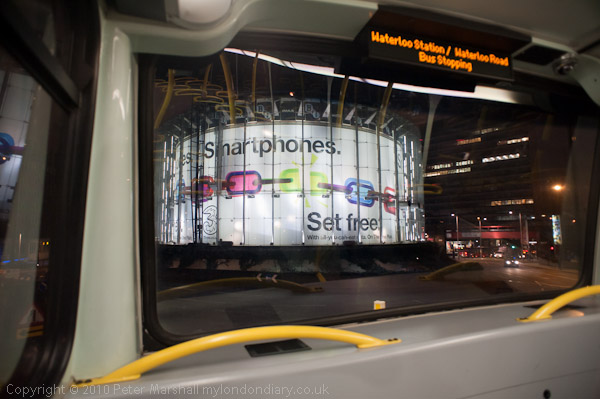
Smartphones  Set Free – perhaps the future of street photography?

The discussion lasts – including the time for questions – an hour, after which there is a further opportunity to see the show, which closes this Sunday, September 4. I’m not at all sure what the talking will be like, but I have been asked to supply five of my own pictures for a presentation as well as nominating two pictures from the book that I would like to say something about.

Although in some ways I found the show disappointing, as an event in promoting photography I think it has been a great success – and of course I was very pleased to be chosen to be in it and the book London Street Photography published by Dewi Lewis Publishing, ISBN 978-1-907893-09-4, together with it. But when asked to talk about two pictures from it, I found it hard to find pictures that I really wanted to talk about, as although there were some great photographers included, the pictures were seldom particularly good examples of their work. There were also some aspects of it I found hard to swallow, including the disregard for the moral rights shown in projecting some images taken on medium format cropped to 35mm format in the slide show. A museum should really not treat photography like this.

Despite such reservations (and I have others), this was a show that came at exactly the right moment, when street photography was high on the popular agenda, with shows in Derby and of course the first London Street Photography Festival which has just concluded, although there is still a chance to see a show of the much-hyped work of Vivian Meir at Photofusion in Brixton, where it continues until 16 September 2011.

Although the publicity for the show talks about “her unique style of candid street photography” unfortunately the images on show – including some that I liked very much – confirmed her as a fine but derivative photographer. I walked around the show last week with a photographer friend and we were saying things like “not a bad Lisette Model” or “sub-sub Arbus” in front of almost every image.  Most things she did do well, but I found it impossible to see any unique personal vision in the work. We all produce works that are based on those of others, but the aim needs to be to try and stand on their shoulders rather than march behind them. Of course there are many good photographers, people whose work adorns the history of photography, but very, very few who really advance it.

No Copyright on Ideas?

Many years ago when I first started writing and taking pictures I remember being firmly told “there is no copyright in ideas“. The FAQ on the US Copyright Office site states it clearly: “Copyright does not protect facts, ideas, systems, or methods of operation, although it may protect the way these things are expressed.”

Of course it isn’t always clear quite where the boundary between idea and expression lies, particularly in photography, and some court decisions in the past have perhaps clouded the water. So it was good to see the judge dismiss the case that photographer Janine Gordon had brought against Ryan McGinley so clearly; the New York Times quotes from his written judgement that her idea of copyright would result in claiming copyright in “virtually any figure with outstretched arms, any interracial kiss, or any nude female torso” and that it had “no basis in statute, case law or common sense.”

You can read a slightly longer report on ARTINFO, which also links to an earlier feature there which includes a slide show comparing several images by the two photographers which I think clearly demonstrates the ridiculous nature of the claim.

Ryan McGinley is a photographer I’ve written about on several occasions, here and elsewhere. In Ryan McGinley’s Lost Summer I suggested that he “seems to have got lost, perhaps seduced by becoming too well-known.” But his project that I was writing about was based on the “the kinds of amateur photography that appeared in nudist magazines during the 60s and early 70s” and that seems to me the true source of exactly the kind of things that Gordon was complaining about.  Surely something has to be original for you to claim copyright on it. But that might rule out the entire oeuvre of many photographers!

Facing Bruce Gilden

I’m not a great fan of Bruce Gilden, although I do still have a review copy of his ‘Facing New York‘ which Cornerhouse brought out here in 1992. But then I’ve never sold my review copies (plenty of reviewers made more money from doing so than writing reviews)  though I have put some in the bin.

I think I did review it at the time, and it was a work I disliked but I recognised the power of his pictures, although in some respects the book seemed and still seems over-repetitive. They work made me uncomfortable, it seemed too much like being rude to people. Though if you are a New Yorker you are surely used to people being rude to you.

I mention the interview* with him in Vice by Jonnie Craig published a week or two back mainly because I rather like the paragraph at the start about street photography which ends with a definition of what it used to be:

“picture-taking informed by unchecked insanity, spontaneous joy, downtrodden souls, criminal behavior, spewing fire hydrants, and all the other varieties of filth and glory that can be documented by simply walking down an unfamiliar sidewalk.

I think it’s the “unchecked insanity” and “spontaneous joy” that mostly appeal to me, and as Craig states, it is a far cry from the kind of thing that many people who like to call themselves street photographers are now producing.

It’s a fairly short read and I think gives a very clear impression of Gilden and comes with a few of his previously unpublished pictures. You can of course see more of his work on his Magnum pages, and I think he is generally a rather better photographer than ‘Facing New York’ made me think. Or at least there are many pictures that I like in his other work.

Vice seems to attract a particularly poor line in comments, but one of them says “Go look at Kurata Seiji’s book, Flash Up.” I googled a little, but only came up with the cover, which I looked and and thought of Daido Moriyama.  And then Wikipedia tells me that he “practised under Daidō Moriyama in an independent photography workshop in 1976“, as well as that he was born in 1945, perhaps a vintage year for photographers. But the only other pictures I could find were some colour pictures that, at least out of context, could be seen as fairly generic travel work.  So although it also apparently gets a recommendation from Messrs Parr and Badger, I can’t really tell you if ‘Flash Up‘ is worth a look.

*Thanks to American Suburb X to posting a link to this on Facebook.

Street View Photography

Last November in Paris I saw Michael Wolf’s ‘We Are Watching You’ and was underwhelmed.  Large blow-ups of images from Google’s Street View (GSV) neither seemed particularly interesting or much to do with photography.  As I’ve said in various other articles on work taken from TV screens I think photographers should be out in the real world and not looking at a box on which other people have put images for them to look at.

Apparently neither Wolf or other artists using GSV even actually find these images themselves, but get links to them from Internet forums which post up these kind of things.  Pete Brook who has a fine blog ‘Prison Photography‘ has been looking at these projects and writing about them both on his own blog and on Wired’s Raw File. There in Navigating the Puzzle of Google Street View ‘Authorship’ he tries hard to find some merit in such projects but I find the artists’ justification of their practice less than convincing, and Google’s claim to copyright difficult to argue against.

It seems hardly a big deal that each of the two artists he considers crops the GSV image differently (although often not very differently) and Michael Wolf’s attempt to equate this with framing by a photographer seems merely an attempt to mislead.  Framing is very much about your point of view as well as about where you then put the edges, and in GSV the point of view is supplied by Google.

It’s also hard to take the analogy with Duchamp’s Readymades too seriously. He took objects – urinals, bicycle parts etc – and completely re-purposed them. GSV users simply take images and make smaller images from them, before blowing them up into senselessly big images for the gallery walls.

I find the whole thing a waste of space and resources, galleries, articles, discussion etc that could be used by real photographers making real images. For me it is the kind of thing that gives art and art photography a bad name.

Back on his own Prison Photography blog, in Photographing the Prostitutes of Italy’s Backroads: Google Street View vs. Boots on the Ground Brook looks at two contrasting approaches to the same subject matter, one by photographer Paolo Patrizi who actually went out on those back roads with a camera and researched the subject as well as taking pictures and the other a virtual tour using GSV by Mishka Henner. It is a comparision which makes the difference very clear. As he concludes:

‘Patrizi’s photographs return us to the shocking fact that that these women are human and not just bit-parts in the difficult social narratives of contemporary society. Works full of threat, fear, flesh and blood.

By comparison, Henner’s screen-grabs are anaemic.’

To me one is real photography, the other voyeuristic image collection. I find myself totally in agreement with Alan Chin who Brook quotes as saying:

‘This is about as interesting as cutting out adverts from magazines that have some connection and then presenting your edit as a work of art. ‘

Also by Brook on Wired’s Raw File is another piece, Google’s Mapping Tools Spawn New Breed of Art Projects which looks mainly at Wolf’s work and in particular quotes from a BJP article that I linked to in a piece about what I considered the nonsensical award made to Wolf in World Press Photo.

It’s perhaps interesting that although in his earlier work Wolf relied on Internet forums to find the incidents he used, he now says that in more recent work he finds the scenes himself on GSV. I’m not sure why he finds this necessary or necessary to mention.

Also interesting – and perhaps it may one day be tested in court is his claim quoted here that because he actually photographs the screen, chosing which part of it to include in the image, he somehow creates something that belongs to him.

There are I think two good reasons why he is wrong. Firstly that copyright law would seem quite clear that if the work on screen is copyright of Google any reproduction of it will also be covered by their copyright. Secondly that Wolf’s work is essentially a mechanical reproduction of an existing work and lacks the artistic intent that is necessary for any new copyright to be created. Or interesting pictures.