Cable Street Revisited

Cable Street occupies an important place in British left-wing history, and like all such events is shrouded in myth. I’ve been criticised by some for pointing out some of these, but I think it never belittles our history to get the facts right. Just as last month, when the EDL tried to march into the East End, the people of the East End never got to fight the fascists. The battle in 1936 was with the police, and the people were successful. It was a victory for the people, and one against the fascists even if they didn’t actually come into contact.

This year the police were fighting with the EDL at times, and it was the police who stopped the EDL, as well as succeeding in stopping the people from the East End getting at them, although I saw no real attempt made to breach the police lines. The protesters against the EDL in 2011 remained peaceful, except when a coach full of EDL stopped in the area and started to insult people.

Back in 1936, the East End didn’t stop the fascists, though on that one day they did manage to stop Mosley marching through. But the fascists were busy inside the East End then.  It was also a time when real battles were being fought against them in Spain, and several thousands of brave men, many of them communists or anarchists, including workers from the East End, defied the government and went to fight.

Relatively few of those who went to Spain – or who stopped the police in Cable St – are still alive, but the memory of what they did lives on, not least through the splendid mural in Cable St itself.
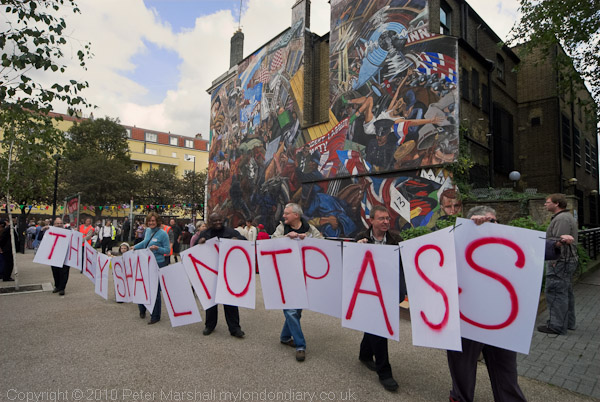
© 2009, Peter Marshall6
‘They shall not pass’ in the 70th anniversary celebrations in 2006

The picture taken 5 years ago, when the celebrations were a little smaller and more local makes the connection between Spain and Cable St clear. This year there were people from all over the UK present, including quite a few Indian groups as well as the local Bangladeshi organisations.
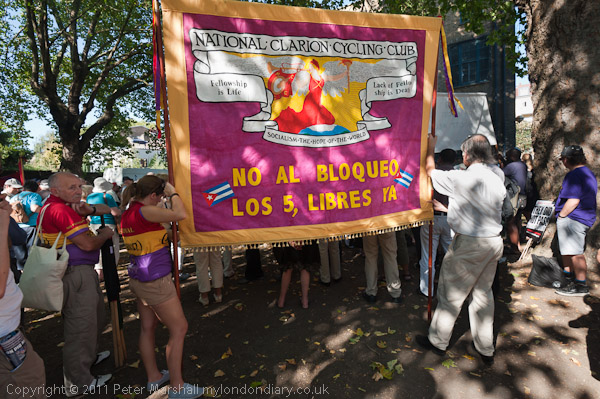
© 2011, Peter Marshall
2011: The National Clarion Cycling Club banner also supports the ‘Cuban 5’

This year’s 75th anniversary also included several groups connected to Spain, including the International Brigade Memorial Trust, the Connelly Association and the National Clarion Cycling Club, who had taken part in an anniversary ride from Scotland.  Their banner was also that of the ‘Centuria Anglesa Tom Mann’
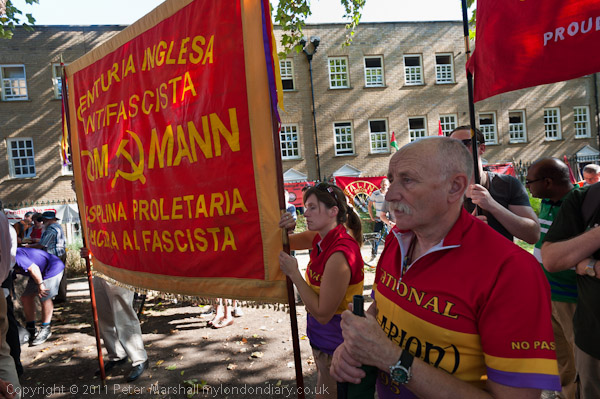
© 2011, Peter Marshall
And on the other side is the Tom Mann brigade banner

More about the 70th anniversary in the second story down this page of My London Diary, and this years event is  Battle of Cable St – 75 Years.
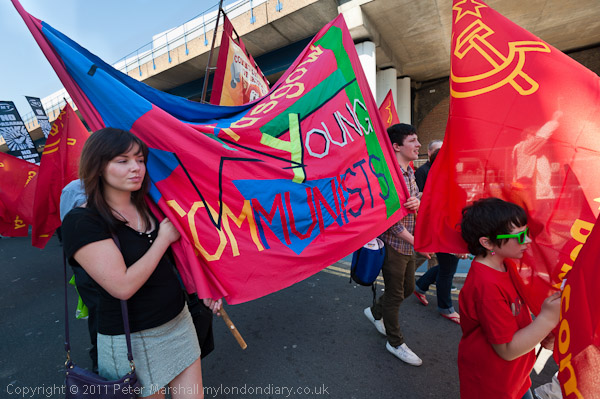
© 2011, Peter Marshall

I took two frames with this woman carrying a banner, the second with the red flag hiding the boy in the green glasses, and I’m not sure which of the two I prefer. The main photographic problem was one of contrast, with a huge difference between the shade and sunlit areas.  Even the picture above, where the sunny areas were small required some fairly extreme burning in.
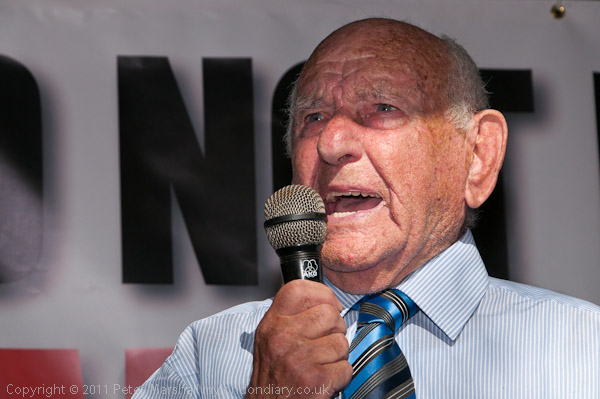
© 2011, Peter Marshall

Of course fill-flash becomes very useful in these situations. When Max Levitas was speaking, one of my friends standing next to me was cursing as he didn’t have his flash with him; Max as the image above shows, was standing with his face in the light and forehead in shade, and flash was really essential to cope with this. Usually I have the flash set to -2/3 stop, and I don’t think the exposure can take the flash into account, so I generally use -1/3 stop of exposure compensation with it.

Another image where it was essential was this of 106 year old Hetty Bower, who was 31 at the time of the battle, and certainly the oldest person on the march – she walked the whole way from Aldgate.  She was looking up at the mural when I took this picture of her with a friend.
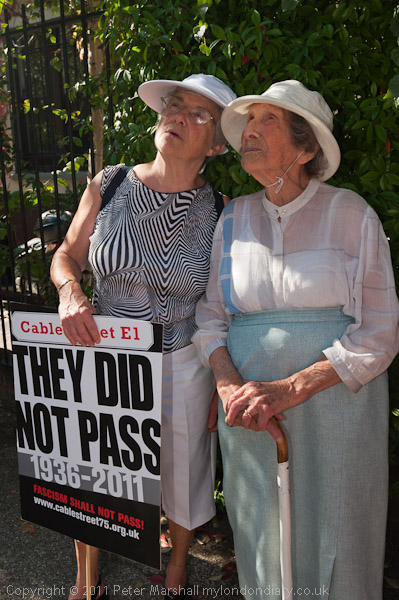
© 2011, Peter Marshall

Benny Wenda

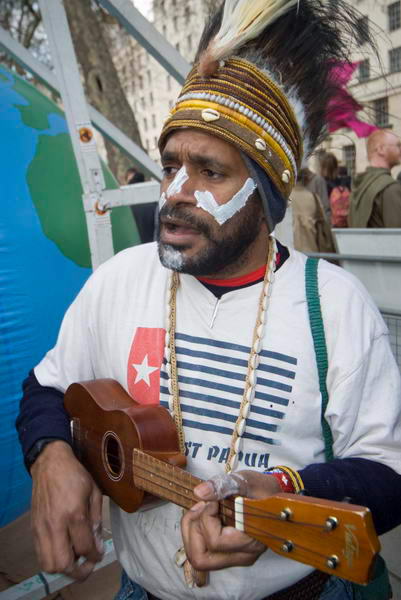
I woke this morning to hear a name I recognised on the news, listed as a wanted man by Interpol. I first photographed Benny Wenda at a protest opposite Downing St against biofuels in April 2008.

© 2008 Peter Marshall

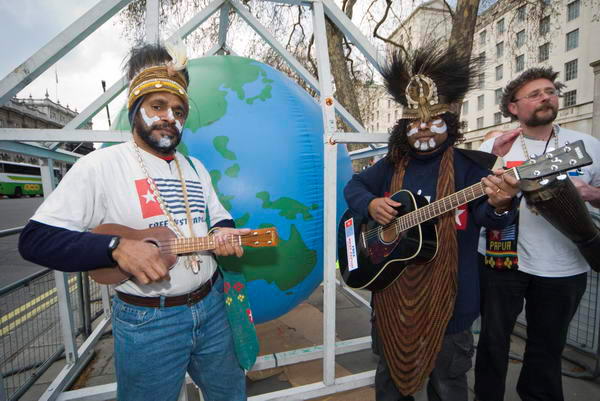
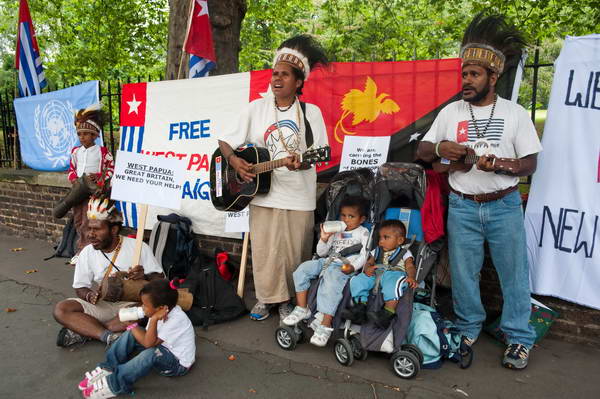
There are several more pictures of him and his companions on that page, along with a series of captions which read:

  • Musicians from the Free West Papua Campaign
  • Benny Wenda , Chairman of Demmak – the Papuan Peoples’ Tribal Assembly, was arrested, imprisoned and tortured by Indonesian solders for his part in leading a peaceful independence movement, but manged to escape and come to the UK.
  • West Papua was invaded by Indonesia 3 months after it gained independence from the Dutch
  • West Papua is the left hand half of Papua, the large island above Australia on the globe

The final caption was perhaps the only time I’ve found a photographic use for the Campaign against Climate Change’s inflated globe in a greenhouse, which has always seemed at other protests a visual embarrassment however conceptually appropriate it may be. For once I was pleased to have it there, and made sure that Mr Wenda’s uke was strategically positioned for the picture.

© 2008 Peter Marshall

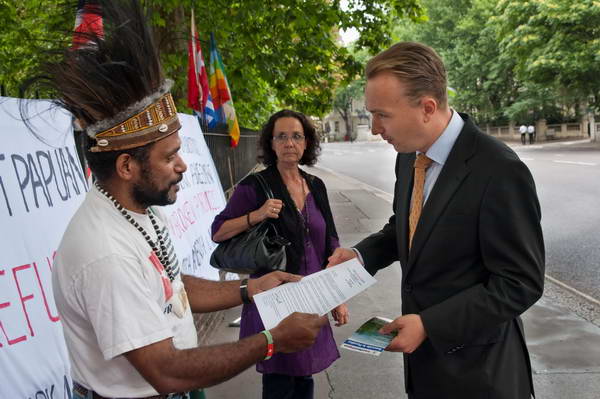
On Friday 14 Aug, 2009 I photographed Benny Wenda again at a protest opposite the Netherlands Embassy in London marking the anniversary of ‘The Day of the Broken Promise‘, 15 August 1962. Then I wrote a much longer piece which you can read there on My London Diary, as well of course as taking more pictures. There were few journalists present and I think I was the only photographer who attended the event.

© 2009, Peter Marshall

© 2009 Peter Marshall
A man from the Netherlands Assembly takes a letter from Benny Wenda.

I’ve often said that the whole world comes to London, and this was another example (though Mr Wenda actually lives in Oxford.) I sincerely hope that our government will act to prevent Interpol carrying out this politically motivated extradition.

Lea Valley Gets New Life

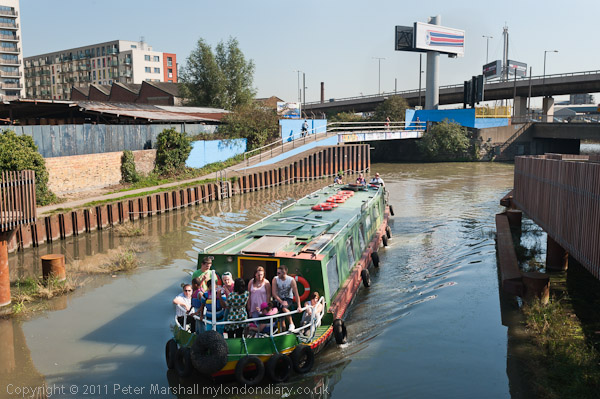
The Lea Navigation has always been teeming with life, but in the early years I went there it was mainly wild, both in the water and on the banks, where paths on the back rivers were often blocked by rampant brambles, vicious nettles and other weeds, and home for a wide range of birds and insects. But you could often walk for a mile or two and not see another person, enjoying what was then an inner-London wilderness.

© 2011, Peter Marshall

Now the area has been tamed, domesticated and generally tidied up, and most of the life seems to be guided walks and people on bikes with enough gears to face Everest.  There were several boats full of people on Saturday afternoon tours too. The area may be rather less interesting than it used to be, almost sterile (and thousand of tons of its earth covering dug up, sterilised and then replaced anywhere on the site) but it is now a visitor attraction, part of the London tourist trail.

© 2011, Peter Marshall

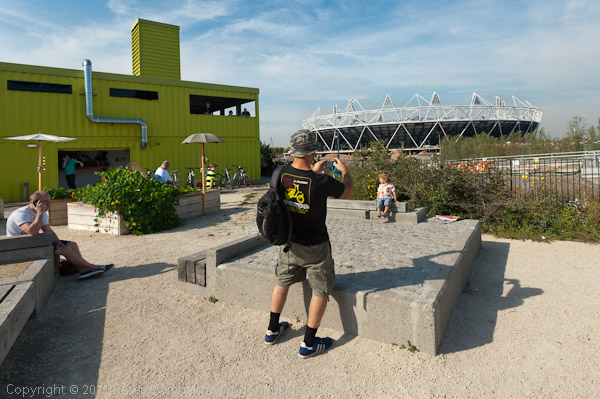
As I walked along the Greenway (itself an earlier marketing revision of the Northern Outfall Sewer) overlooking the London Olympic site, a couple of Japanese held out a camera towards me and asked if I would take their photograph. Of course I obliged, though I find these compact digitals with an invisible image on the screen at the back hard to manage.  A few yards on, I photographed a man taking a picture of his young son on a rather arty looking seat with the stadium in the background.

© 2011, Peter Marshall

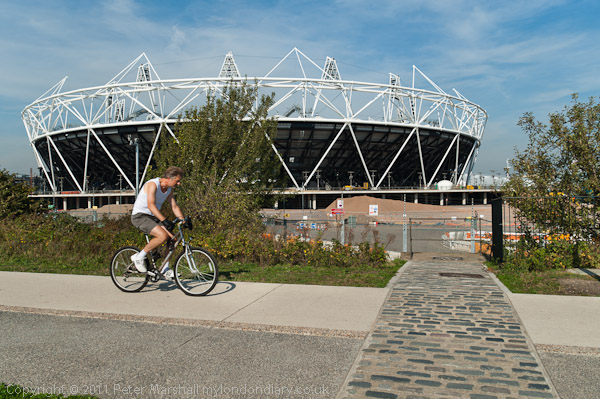
Going past the stadium was a man in a hurry, perhaps practising for the Olympics, though more likely trying to keep fit. The atmosphere on the Greenway was quite different to that a year or so ago, when every few yards there was a security man, and photographers sometimes got harassed. There were a few about, and one did come and tell me I couldn’t take pictures, but it was his idea of a joke, though given my many previous experiences I wasn’t over-amused.

© 2011, Peter Marshall

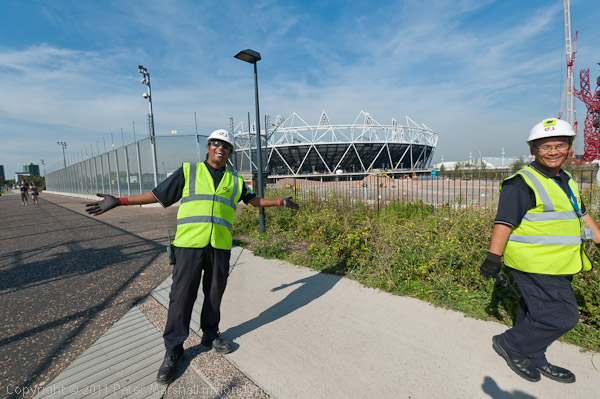
I’m not quite sure why his colleague was flying, but these things happen. I was actually there to take part in an event with four other photographers, all talking about our work around what is now the Olympic site – and in my case particularly about the book ‘Before the Olympics’ – but I’d brought the D700 and a couple of lenses with the aim of making a few panoramas, and I took a few other pictures as well.

© 2011, Peter Marshall

This isn’t perhaps the most interesting of those I made – and you can see these as well as the other work from the afternoon in Lea Navigation & Olympic Site on My London Diary.

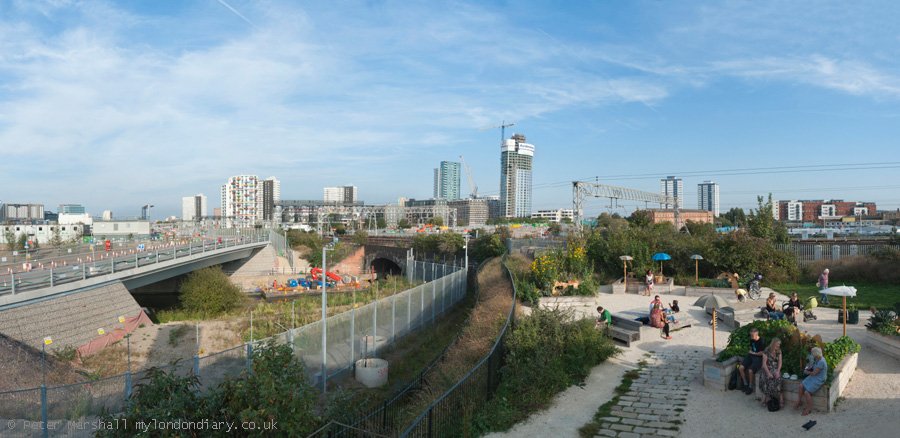
The picture above, which shows a new suspended footpath that goes under the Bow flyover, has the file name 20111001-d0120eqr209-900s.jpg which is perhaps rather a mouthful, but a good illustration of how I’ve now taken to naming these panoramic files.

  • 20111001‘ needs no explanation, simply the date in the order that sorts correctly.
  • ‘-d‘ is really a hangover from the days when photographers used film and any scans from my colour negatives would have a ‘c’ in the filename to remind me they were colour. Now everything is digital, so perhaps I don’t really need the ‘d’.
  • 0120‘ is simply a sequence number, allocated by Lightroom to my digital files in the order that they are imported (most days these start at 0001.) This particular panoramic image was actually stitched together from seven exposures, numbered 0120-0126, and takes the number of the first in the series (all of which were vertical format 16mm images on FX format.)
  • ‘eqr’ is a three letter short form of the projection used, in this case equirectangular. Other possibilities include ‘rec’ (rectilinear), ‘cyl’ (cylindrical.  ‘ved’ (vedutismo) etc.
  • ‘209’ is the horizontal angle of view when I stitched the panorama; sometimes the actual angle in the image may be slightly less due to a little cropping, but it gives a good indication. Images do rather more often get considerably cropped top and bottom after processing to give a straight edge, so I decided there was no point in including the vertical angle of view in the name.
  • ‘900’ is the width in pixels. I don’t give the width for the original full-size file, so this is one way of specifying that this is a reduction.
  • ‘s’ stands for ‘sRGB’.  AdobeRGB is my default work space both in camera and in Photoshop, and files that end without a letter are in that default space.

This is a naming convention that I’ve found very useful, although there are some things that it doesn’t tell me, and others might like to use longer conventions, that would include things like the focal length, camera orientation, number of separate frames etc. But  20111001-d0120eqr209-900s seemed to me a good compromise.

Stick at 359 degrees?

If you are in or have ever photographed in Slovenia you need to know it is now illegal to publish 360 degree panoramic images with recognisable faces unless these are pictures of events published as news.

You can read more about this apparently bizarre legal position on Dliberation, which kind of blames the situation on Google Street View’s decision to blur faces in its imagery, although Google wasn’t able to comply with Slovenia’s demand that they carry out the blurring of Slovenian images in Slovenia so Street View does not yet extend there.

Although the decision is bad news for Boštjan Burger, a Slovenian who is one of the pioneers of immersive photography, it actually seems pretty good news for the rest of us, as the deliberation by the Slovenian information commissioner clearly recognises and validates street photography.

I’m not a great fan on 360 degree panoramas, or really any that you need to use viewer software to see rather than viewing as a flat print (or on a screen) although Street View certainly has its uses. Although I have occasionally made 360 degree views I don’t think I’ve ever shown or published one. As I found a month or so ago photographing the Olympic site from the View Tube and earlier in the year on the gardens project, anything over 180 degrees or so seems to lose interest.

© 2011, Peter Marshall
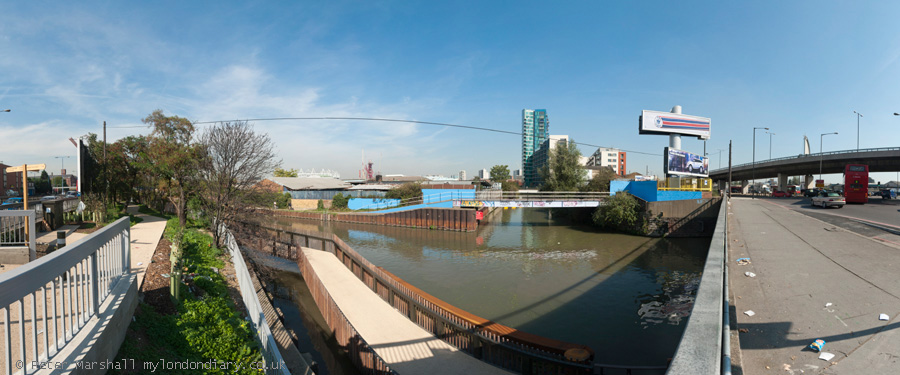
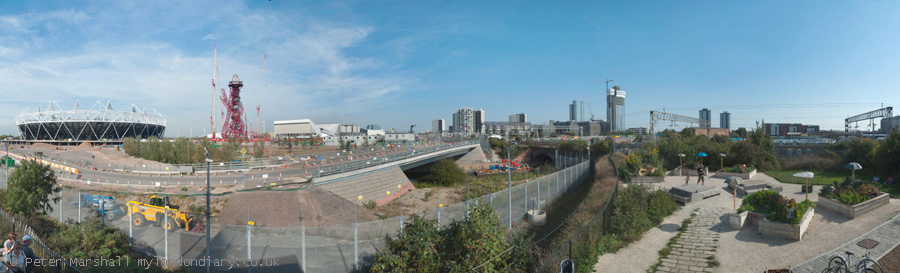
Roughly 240 degree view
© 2011, Peter Marshall
120 degree view – My London Diary has larger versions of these and others made in the same area on the same day

But for those people who want to go the whole hog in Slovenia, couldn’t they stay inside the law by simply incorporating 1 degree of blank non-photographic space into their images?  Given suitable colour, tone and texture it would hardly be noticeable.

Thanks to a Facebook post by EPUK for bringing this Slovenian story to my notice. Another recent post is to an authoritative and very useful article on their own site, Stolen Photographs: what to do? though I think it is more an answer than a question.

Camera Club

Mention of Clive Landen in the post on one of his former students, Anastasia Taylor-Lind, sent me off to Google to find out more about him, though there was disappointingly little. Almost all that I found were links about his exhibition and book Familiar British Wildlife, pictures of roadkill, which reminded me of the work of a friend of mine, Carol Hudson, and a group show back in 1985 where as well as her fine still life images of dead birds we had a row of prints of her photograph of a dead cat laid out across the gallery floor. Most visitors stepped very carefully over them.

I sent some of Carol’s work to J. David Sapir,  then a Professor (and now Emeritus Professor) in the Department of Anthropology at the University of Virginia, Charlottesville, who had a pioneering web site ‘Fixing Shadows’, founded in May 1995 with a commitment to ‘straight photography’, and it precipitated quite a discussion about exactly what was meant by that term.

Also Google took me to another historic web site which I’ve not visited for perhaps ten years, Camera Club. This was set up by “artist, writer and lecturer Stephen Bull” as a contribution to Photo 98: The Year of Photography and the Electronic Image, and for it he persuaded six “well known gallery artists and photographers” to submit work to be judged as a part of an amateur photographic competition at the Ilkley Camera Club in Yorkshire.

Most of the links away from this site no longer work, and so some of the associated material is no longer available, but you can still see the four pictures from each of the photographers and the brief comment made on them by the judge (who was fully aware of the project) along with his mark out of 20 for each picture.

In my experience, club judges seldom gave any picture less than half marks, so the 10 out of 20 awarded Landen for one  of his pictures was rock bottom, though Martin Parr also achieved this for his cup of tea. Landen’s four images totalled 51 points, making his by 2 marks the lowest score of the six. The club star was  John Kippin with 70, one of his landscape images gaining the full 20, and he was duly awarded the The Stephen Bull Trophy.

It’s a site that still amuses – at least it amuses me – and  also very much shows the passage of time, both in web design and in photography in the choice of photographers and their pictures. Though I’m not sure camera clubs have changed much; certainly in 1998 they were still very similar in their ideas to 20 years earlier.

September Has Officially Ended Here

© 2011, Peter Marshall

Or at least I’ve now finished putting up my pictures from it onto My London Diary. It has taken me even longer than usual, partly because it was a busy month for events – and so has October been since then, but also for other reasons.

© 2011, Peter Marshall

A couple of extra things had been occupying my time. Producing the work for the show on the gardens of St John’s Wood, mainly hidden behind high walls, started in mid-May. I finished the photography at the start of August, by which time I’d photographed around 20 gardens, including half a dozen that for various reasons were not included in the show. People almost always underestimate the amount of work involved, after all it only takes a fraction of a second to take a photograph. In fact I spent around 40 minutes working in each of the gardens on average, but that was only the start of it. There was of course travelling time – and the journey from my home takes well over an hour each way, but also the time spent at the computer producing the panoramas from between three and around 18 exposures. For the average garden this was probably between four and eight hours.  Producing the show catalogue – an 80 page Blurb book – added several days of work, and it took another day or so for proofing and delivering the final files for the show to the printers.

This isn’t a complaint, it was a project that I enjoyed and I learnt quite a bit from it. However perhaps it was because of all the extra work that my computer complained – and a month after I’d finished my work on that show – and had also worked on and printed the dozen pictures for the East of London show  decided that ‘enough was enough’ and gave up the ghost. Apparently overheating had fried its memory.

For once I was lucky, and found a computer tech guy who knew his stuff, but although he quickly diagnosed the problem, getting replacement memory for this five-year-old computer has proved a problem. I have it back and running now, with more efficient cooling, a better power supply and yet another hard disk (making 4), the replacement memory isn’t quite right, and gives the occasional blue-screen when you least expect it – we are still waiting for a replacement for the replacement memory to make it fully usable.

Meanwhile I’d ordered a new computer. They promised it in 5-10 working days but it took 14, and again isn’t 100% fit, with an odd video problem that kicks in under stress. There seems to be a slight incompatibility between my Eizo monitor and the Radeon video card  (we’ve tried two of them) and I’m wondering what to do about it. But it isn’t that bad – today I’ve been working for three hours without a problem, so I’m beginning to catch up on somethings – like My London Diary.

© 2011, Peter Marshall

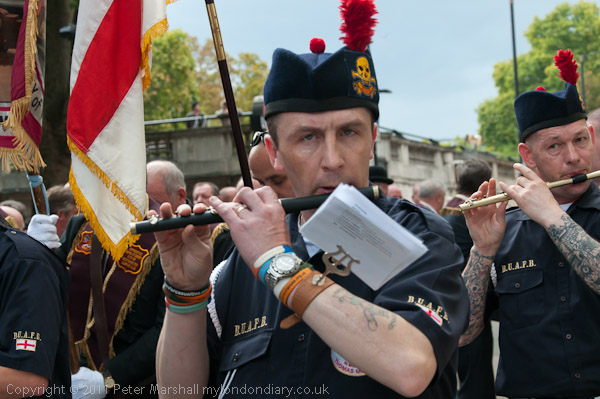
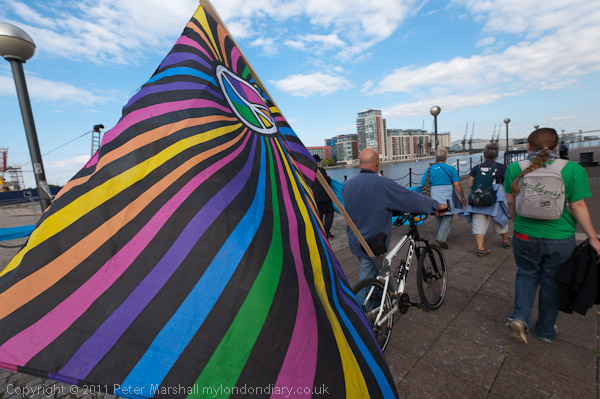
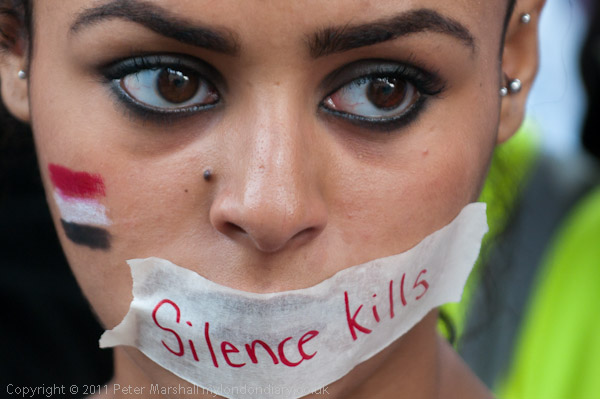
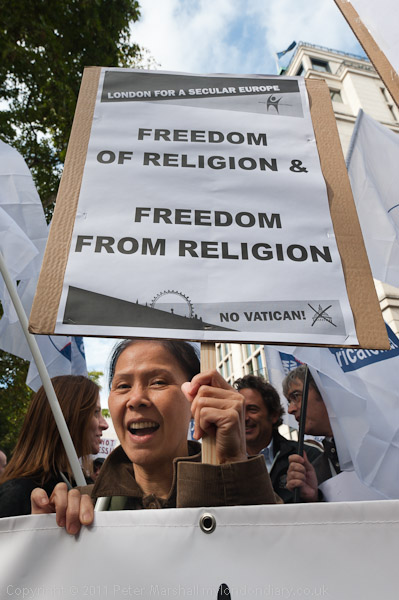
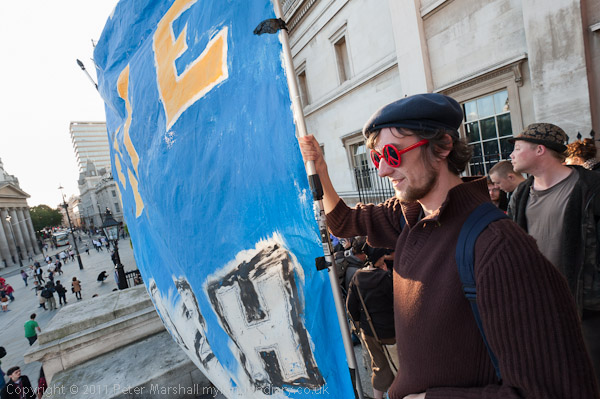
You can probably guess which events the four pictures in this post come from in the following list of links:

East London Photomonth Opens
Enough Is Enough – Abolish Vivisection
Silent Vigil For Yemen At Downing St
Intifada 11 Years Protest at M&S
Apprentice Boys Carson Memorial Parade
London Oddments
March For A Secular Europe
Wreath For Victims At London Arms Fair
Flash Mob Against Dale Farm Evictions
Arms Fair Fracas At National Gallery
DSEi Protest at BAE Systems
Down the Drones City Arms Fair Protest
Secret Gardens of St John’s Wood
Dr Zig’s ‘Bubbles Not Bombs’ Protest
Arms Fair Protest At Parliament
9/11 Anniversary – EDL & MAC
March Supports Dale Farm Against Evictions
Candlelit Vigil Against NHS Privatisation
Protest At Climate Change Deniers
Tower Hamlets Unites Against EDL
Protest Against Repression In Syria
Alternative Action Anti-Sharia Protest
Brian Haw Peace Protest Continues

© 2011, Peter Marshall

And of course you can find out more about all of them and see my pictures on the September 2011 page of My London Diary.

Anastasia Taylor-Lind

One of the dozen youngish photographers selected for this year’s World Press Photo‘s Joop Swart Masterclass was Anastasia Taylor-Lind, a graduate of the Newport photography course, currently based in Lebanon. She has produced some remarkable photographs of ‘ordinary’ women in conflict zones around the world which you can see on her own web site. There is also a Radio Wales interview with her about her work which is well worth listening to.

There is a story and video about her project ‘The National Womb’ produced for the masterclass which had the theme of ‘Respect’ on the Canon Professional site, and this, the web site and radio interview are the source for almost all I know about her.

I looked at the Taylor-Lind image on the front page of the WPP web site immediately after writing about the $4.3m sale of Andreas Gursky’s ‘Rhein II’ and my immediate thought was how much more her picture was worth than anything from his plastic universe.  Although I’d think the same about the work of many other fine photographers too.

Taylor-Lind also has an unusual story to tell about her home background, which seems to have been in many ways an ideal preparation for her work. Her Swedish mother gave up a career as a ballet dancer to travel the world after meeting her British father, following the hippy trail before returning to the UK, where Anastasia’s early years were spent travelling around in a gypsy wagon. The family settled in Devon when she was nine and she was able to go to school for the first time. Her father often told her that the worst thing you can do is to be ordinary, but at that age she desperately wanted to be like the other people, with a house, car and modern conveniences.

In their home they had no TV and didn’t take newspapers; almost the only early contact she had with the media came from an uncle who every year gave her parents an annual subscription to National Geographic as a Christmas present, and this was perhaps the main place where she saw good photography in her early years. It was a story that struck a chord with me, as when I was small I also grew up among piles of National Geographic magazines, though in my case they were issues from twenty years earlier, again donated to us from a wealthy relative.

She went on to study A level photography at East Devon College, but still didn’t have much idea what photography was about until one day at college she opened a book of Don McCullin’s work and immediately decided that was the kind of thing she wanted to do. Fortunately her tutor had the sense to tell her that if she wanted to take pictures like that she should go and take the course at Newport. There her tutor was Clive Landen, who she says not only taught her the basics about photography but that it would have an effect on her whole life, and this certainly has been true.

In her third year of study Taylor-Lind went to Turkey to photograph Kurdish guerillas, one third of them are women and you can see her pictures of some of them in ‘No Friends But the Mountains’ on her web site.  Her upbringing was certainly a great preparation for the kind of travelling that this involved, and for getting on with the people that she met.

One of the other projects on her web site is on cider makers from Devon. She told her Radio Wales interviewer that she feels more at home in unusual, alternative communities – ” I like crazy people” and that she is the opposite of those photographers who like to disappear into the background as she likes talking too much and “my pictures speak as much about my relationship with the people I’m photographing as anything else.” But really the whole of the interview, video and web site are worth a careful look.

Taylor-Lind’s The National Womb is one of the 12 projects from the Joop Swart Masterclass featured in the book Next #01 published by WPP:

·  Eunice Adorno, Mexico, There Is No Such Place
·  Antonio Bolfo, USA, Survival in Cité Soleil
·  Kitra Cahana, Canada, Nomadia: Young American Nomads
·  Alinka Echeverria, Mexico/UK, Becoming South Sudan
·  Alessandro Imbriaco, Italy, Angela’s Garden
·  Kuba Kaminski, Poland, The Whisperers
·  Sebastian Liste, Spain, On This Side of the Mountain
·  Leo Maguire, UK, Dark Strangers
·  Ivor Prickett, Ireland, Free Libya
·  Mohammed Salem, Palestinian Territories, In Honor of Death
·  Dimitri Stefanov, Bulgaria, Collapse
·  Anastasia Taylor-Lind, Sweden/UK, The National Womb

There are several in the list whose work I’ve seen elsewhere, and doubtless all are worth following up, and there are links to ther web sites on the WPP page.

It’s a volume that seems interesting and at a fairly reasonable price, although unless I get offered a review copy I can’t tell you more.

Arms Unfair 4

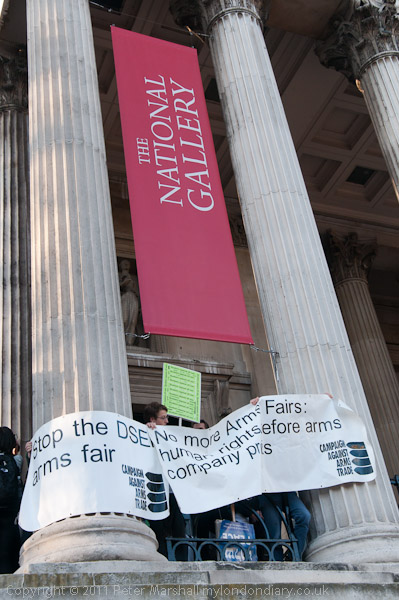
The published timetable for the day of action against the DSEi arms fair had ended with the protest outside BAE Systems, and I’d really spent long enough on my feet and was looking forward to going home and having dinner – as well as working on the many pictures I’d already taken.  So I wasn’t too pleased when I was given the information that there would be another protest outside the National Gallery, and if it hadn’t been on my route home I might have decided enough was enough.

Although we were told to keep it quiet, I got the impression that the police already knew about it, and there were quite a few around as the protesters tried to enter the gallery. I was just behind the first group to go in the main entrance but hesitated about whether to go in.  It is often a tricky decision, and I have no right to enter premises just because I’m carrying a camera and a press card when the staff are clearly trying to keep people out, although some photographers just rush in.

The gallery was just closing to the public, and I would have had to have joined the protesters in trying to push past the security staff to follow them. I think a few may have made it, but were fairly rapidly ejected. I decided instead to try to photograph the larger number of protesters who were still on the steps, ignoring the security men telling them to go down.

© 2011, Peter Marshall

They were trying to put up banners, and so were right against the balustrade at the front, making it difficult to get a suitable angle. I took a few pictures, leaning out and even holding my camera further out, then decided to go down and photograph from in front of the building on the North Terrace of Trafalgar Square.

© 2011, Peter Marshall

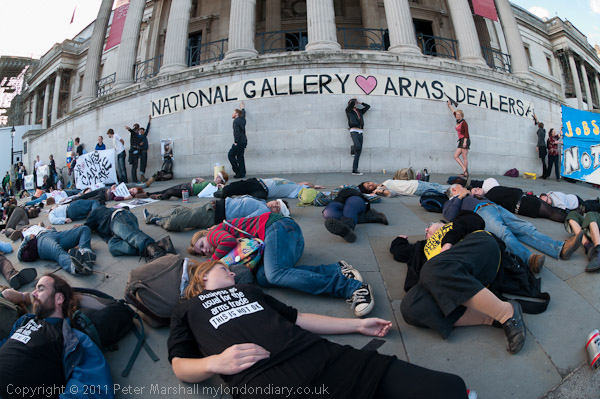
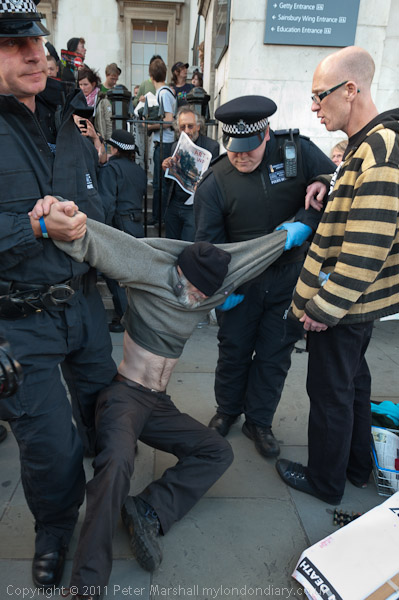
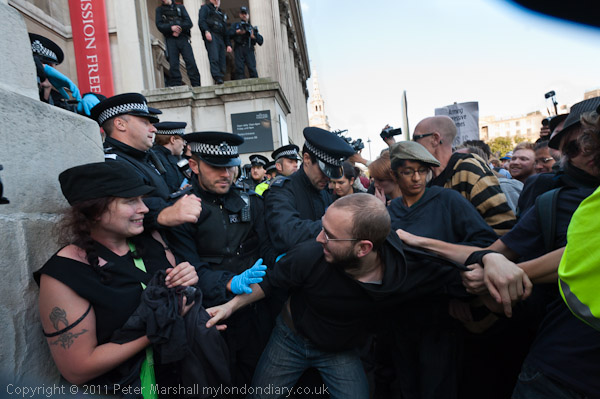
The protest developed, with a struggle going on with police to clear the steps, for some minutes by persuasion and then, after reinforcements had arrived, by force, which was more effective. There were some angry scenes as one or two protesters were dragged away to police vans from the steps, while others staged another die-in on the pavement and I ran back and forth trying to record both.

© 2011, Peter Marshall

© 2011, Peter Marshall

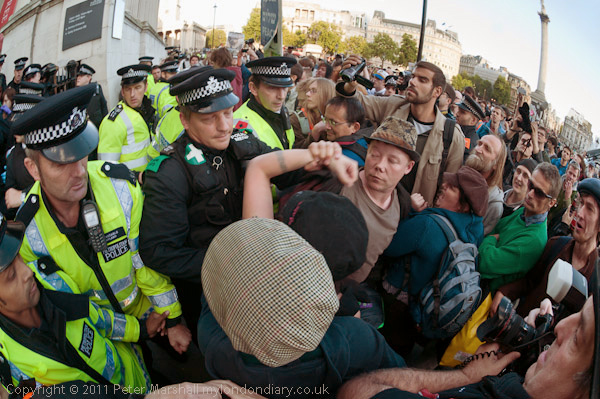
Then more officers still arrived, and one or two of them, including a senior officer, started to get very physical.

© 2011, Peter Marshall

It is the kind of situation where to see anything you have to be very close (or very tall, which I’m not.) And very close in a crowd the 10.5mm can work well. Here I’m holding it up in the air at arms length to get pictures; with experience and checking on the rear screen it is possible to frame things with some accuracy, although there is still an element of chance. I wanted to put Nelson in the top right corner, and in this frame at least I more or less got him there. But the 10.5mm is a rather vulnerable lens, as it cannot take a filter, so does need a little care.

Most of the time I was photographing this fracas I was working with the 16-35mm, a nicely solid (but over-large) professional lens, which can take quite a bit of rough handling (and I’ve been through several filters on it.) It’s main weak point is the lens hood, and frankly the Nikon lens hoods are all pretty useless, flimsily made with an under-engineered bayonet mounting.  One small tap and they either fall off completely or move around, producing vignetting at the corners. So of course it happened in that crowd, and I didn’t notice it until too late, working very much in the heat of the moment. I’ve cropped most of the pictures to remove as much of the vignette as I can, but you can still see it on some of the images.

© 2011, Peter Marshall

If you should lose or break your Nikon lens hood, don’t pay the arm and a leg Nikon ask for these few pence worth of plastic. The cheap replacements available on eBay are in my experience slightly better made and look as good. Of course they still suffer from the same Nikon fixing problem.

More on the event and more pictures at Arms Fair Fracas At National Gallery.

Arms Unfair 3

The 10.5mm again came to my aid at the next protest venue in the continuing ‘day of action’ against the DSEi arms fair organised by the  ‘Stop the Arms Fair Coalition‘,  outside the offices of BAE Systems in Carlton House Terrace, a very posh street tucked away above the Mall, and generally rather deserted, with just the odd French tourist coming to view or possibly deface the statue of De Gaulle who had his reduced empire in a large house here during WW2.

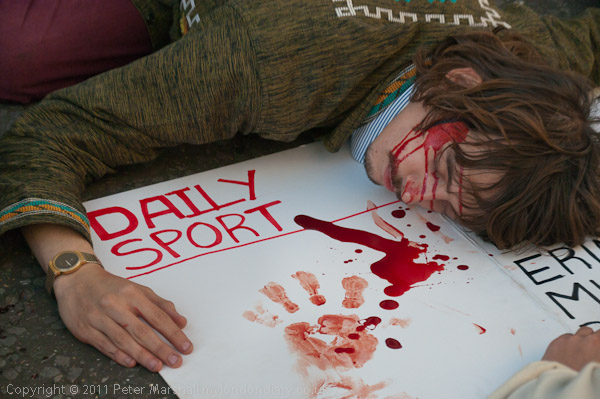
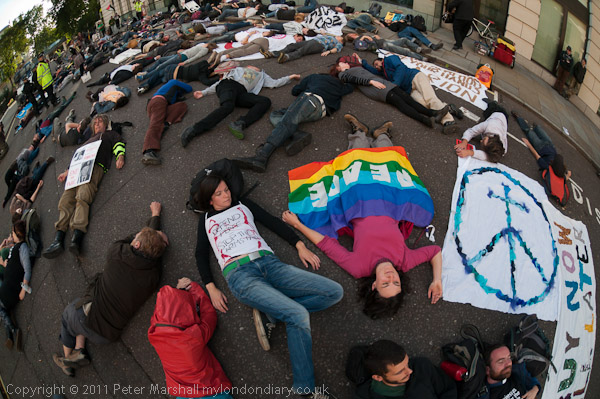
After a little fairly disorganised chanting and a few short addresses, the main event here was a mass die-in, with most of the protesters prone on the roadway. There were a few small points of interest:

© 2011, Peter Marshall

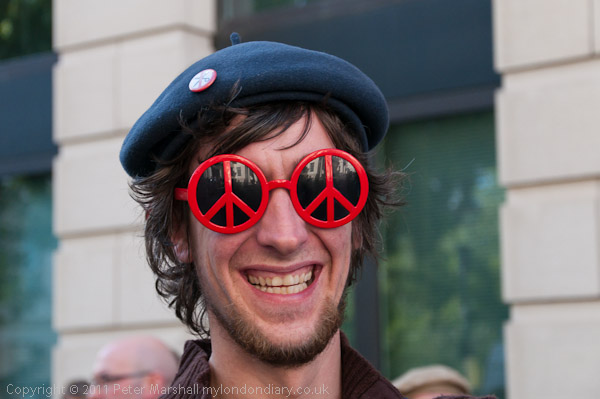
and earlier I’d photographed some of the placards, banners and protesters who stood out a little from the rest, such as this guy in rather striking glasses:

© 2011, Peter Marshall

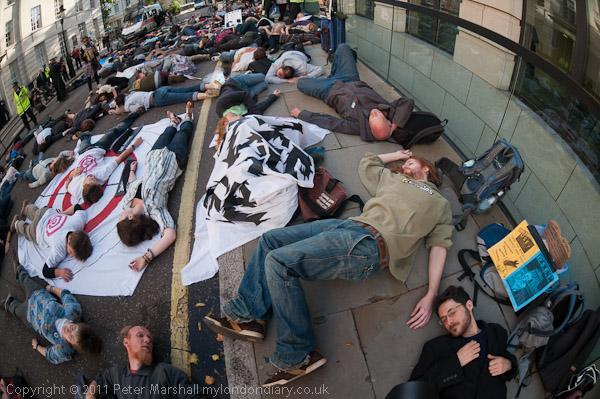
but getting good overall pictures of the event was a little tricky. My two favourites are these:

© 2011, Peter Marshall

© 2011, Peter Marshall

As you can see I’ve chosen not to correct the curvature of the fisheye in either, because it seemed to me to work well and not overpower the images as sometimes happens. In the upper image it enhances the sprawl of the dominant figure at the right. When I was taking it I liked the contrast in shapes with the almost straight yellow road-mark line a little to the left of centre splitting the near-circle the lens produces from the banner and target sheet of the UK Drone protesters.

In the lower picture I used the lens to concentrate on the peace flag and Christian peace banner, but to put them in the overall view. It was tricky to get the exact framing that I wanted as I couldn’t stand on people and wouldn’t on principle ask them to move, but I was fairly happy with the result.

More pictures at DSEi Protest at BAE Systems.

Arms Unfair 2

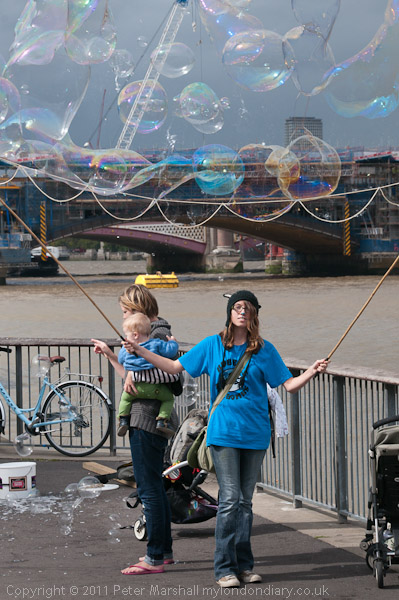
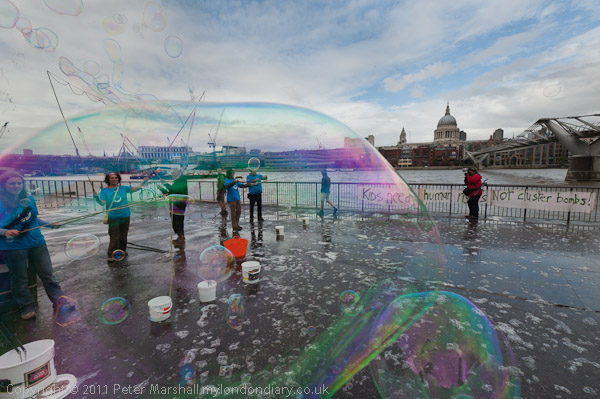
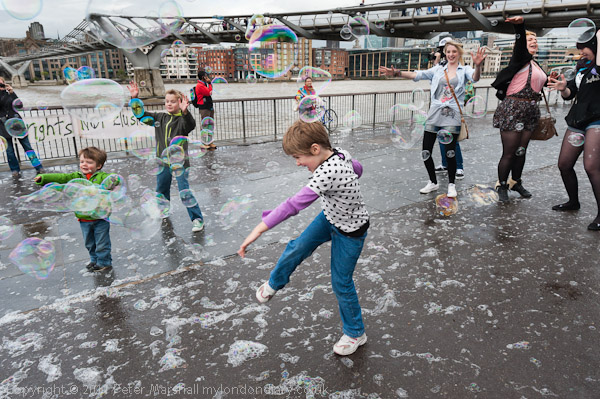
From Parliament I went to St Paul’s and walked across the footbridge towards Tate Modern to see the next anti-DSEi protest, a ‘bubble-mob’ by Dr Zig and his gang from Wales. The bubbles were truly amazing, and a squally wind drove them at speed once they were released. Made from a suitably magic and secret formula, they seemed to be tougher than the average soap bubble and took on some intense interference colours, particularly against the slate black clouds which were advancing.

© 2011, Peter Marshall

Capturing the colours in a photograph doesn’t always seem to be easy and they seem usually to record less intensely than we see them, but I was reasonably happy with a few.

I’d arrived shortly before the end of a  bubble session, and while the bubble-makers took a break had time to sit and eat my sandwiches before  the heavens opened.  Perhaps making bubbles is an effective rain-making ceremony. Fortunately there was shelter at hand under the Millennium Bridge, and we all stood it out there until it eased off enough to make more bubbles.

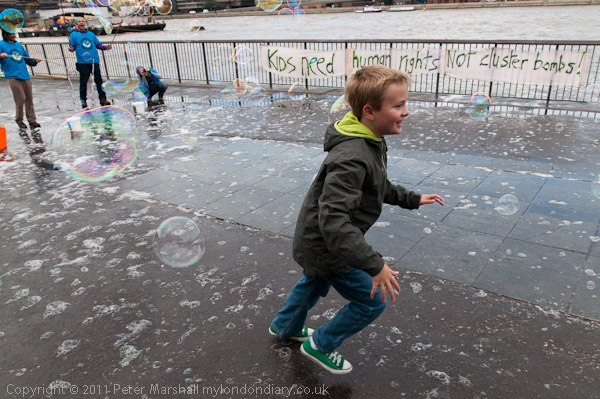
What was more difficult was making some kind of visual connection between the bubbles and the Arms Fair. The protesters had brought a couple of banners, but neither was particularly easy to include with bubbles in the pictures. Here’s a picture where you can just about make out that the banner says ‘Kids need human rights not cluster bombs‘ but most of the time there were too many people in front of it.

© 2011, Peter Marshall

Add kids playing with the bubbles and it gets trickier; here are two of my better attempts.

© 2011, Peter Marshall

© 2011, Peter Marshall

Eventually I gave up – you can see some more of my attempts at Dr Zig’s ‘Bubbles Not Bombs’ Protest.

I took a bus across Southwark Bridge into the City for the next protest on my list, arriving to find only a small group there wondering why nobody else had turned up. After a quarter of an hour I thought to check the times on my printout from the web site and discovered that we were still 45 minutes early – the time we had read was when people were going to leave from Parliament and the protest was due for an hour later.

© 2011, Peter Marshall

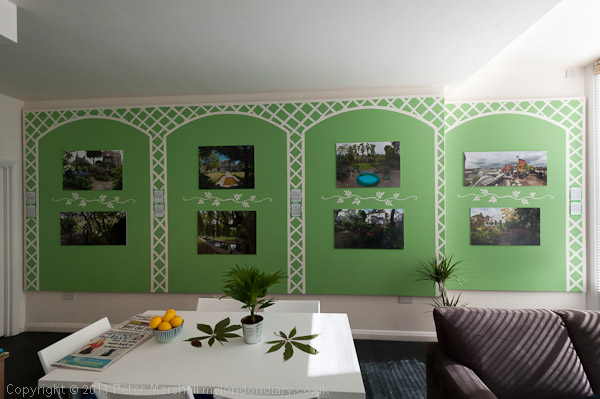
I took the chance to rush away to see my Gardens show in St John’s Wood which I had last left with the walls being painted and my prints piled on a table, but had been hung at the weekend, and I needed to get some decent installation views. I didn’t quite have time to get there and back and take the pictures, but thought it wouldn’t matter being just a few minutes late. Then on the way back I just missed a train, and the gap until the next one was several times longer than normal, and the interchange at Kings Cross had me walking at least half a mile underground. Fortunately the protest was still going on when I arrived after running from the station.

© 2011, Peter Marshall

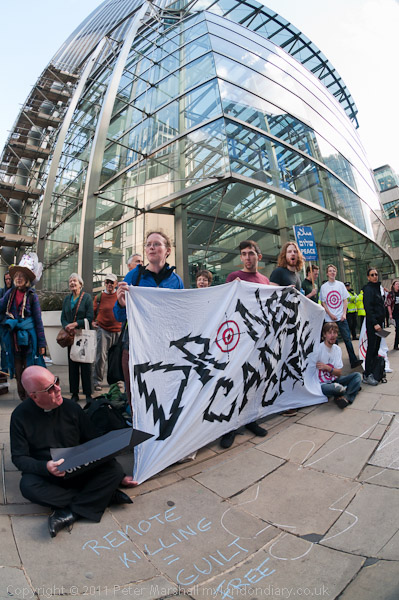
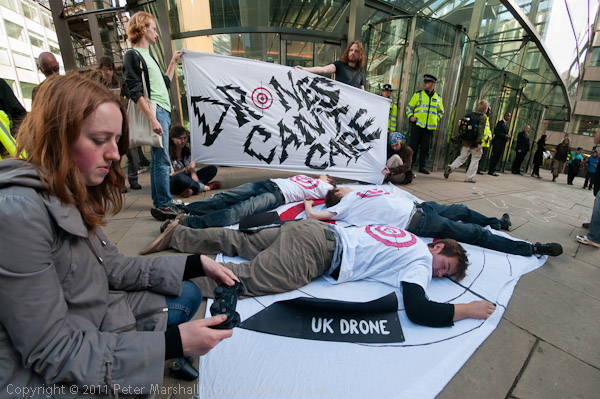
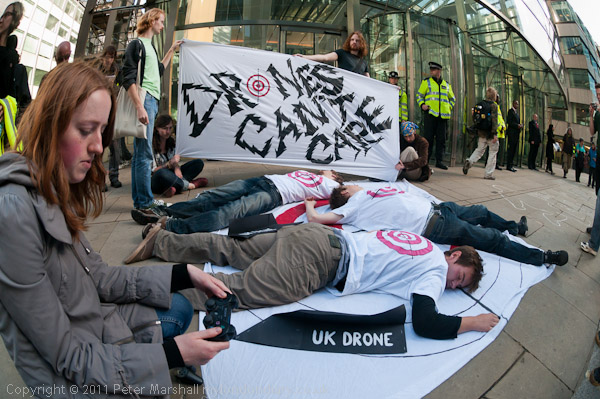
It was a very tight location, a narrow pavement with traffic on the road behind me, and I was glad of the 10.5mm which enabled me to include the pavement and the London offices of General Atomics, makers of Predator and Reaper drones.  Things got tighter still when UK Drone set up their tableaux photo-opportunity, with ‘dead bodies’ on a target in front of their banner and a woman with a Playstation controller standing in for the remote RAF and USAF pilots in Nevada killing people in Afghanistan.

© 2011, Peter Marshall

Again taken with the fisheye, but you can see that the verticals of the buildings, although at an angle have been straightened. Without this partial correction using the Image Trends Fish-Eye Hemi filter plugin for Photoshop, the woman at the left of the image appears too distorted for my taste.

© 2011, Peter Marshall

More pictures at Down the Drones City Arms Fair Protest.