POYi Flowchart

I’m often surprised and amused by how things link together when I’m looking at pages on the web, often finding things that link to posts I’ve made or thoughts I’ve had but not quite got around to writing about.

One of the latter was about another of those annual awards, POYi, (Pictures of the Year international) which is unusual in conducting its business in public, web-casting the judging with 99 on-line publicly open seats in a chatroom.  The judging is spread out over most of the month, and has now more or less ended – so you will need to wait until next year to take part.

The Photojournalism Contest entry flowchart  on the Shit Photojournalists Like blog has more than an element of truth in it, judging from the various shows and lists of winners I’ve seen over the years. Certainly they lead me to the conclusion I’ve always had about such competitions, “Save your entry fee and buy gear.”  They also link to the POYi Chat Room Heroes blog, though I think you have to have been their to get much out of that.

One photographer who gets a particular mention is Melissa Little, whose work was apparently “pulled in, kicked out, pulled in, then kicked out again.” I don’t know what she had in for POYi, but you can see some interesting work on her own web site, where I find that in 2001 she was a student at the Eddie Adams Workshop and “have been honored to return for the last seven years as staff, where I’ve done everything from mow the grass and rake the leaves to documenting everything in sight as workshop photographer to leading, finding stories and coaching a team of 10 students. ”

I’ve not yet looked at all the awards for POYi, but did enjoy looking through the results for the ‘News Picture Story – Newspaper’ class, where first place went to
Michael Robinson Chavez (Los Angeles Times) for DECONSTRUCTING MUBARAK, second to Mads Nissen (Berlingske / Panos Pictures) for pictures of the LIBYAN REVOLUTION, third to Hiroto Sekiguchi (Yomiuri Shimbun) for TSUNAMI AFTERMATH and the ‘Award of Excellence to Craig Walker (The Denver Post) for his pictures of OCCUPY DENVER. And I mention this not just because there are some fine pictures in these stories (which are always of more interest to me than the single picture awards) but because of the controversy I may have mentioned earlier over World Press Photo, when some judges anounced publicly that they had seen no pictures of the Occupy movement worthy of an award. I don’t know if Walker’s work went to WPP as well, but certainly some other very worthy images did.

Rainy Valentine

 © 2012, Peter Marshall

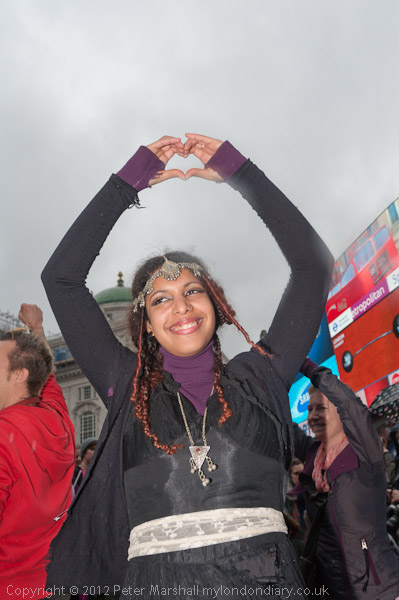
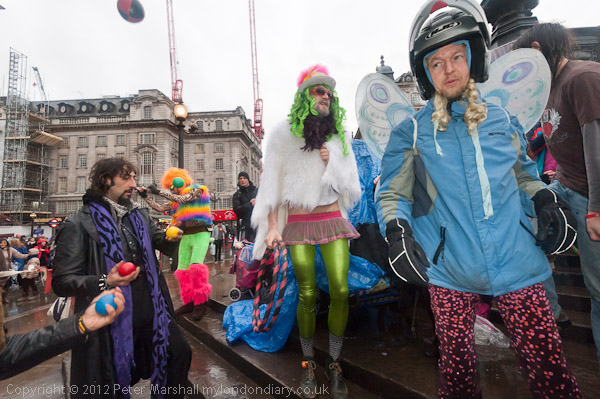
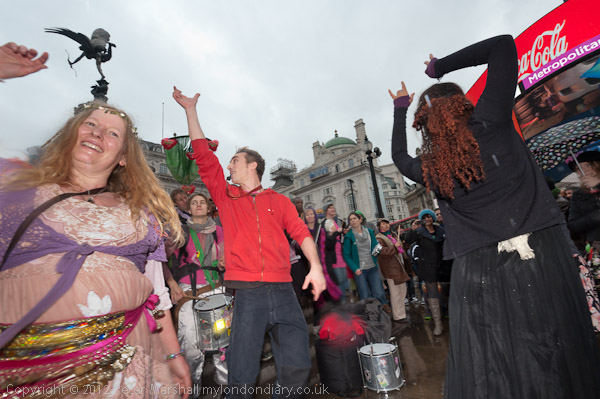
It was a cold, dull, wet and windy afternoon in London, but that didn’t stop everyone at the ‘Reclaim Love‘ Valentine party at Piccadilly Circus having fun, though it did make photography rather tricky at times.  As usual in wet weather I was working holding a lens cloth in my hand and wiping the filter on the front of the 16-35mm before every image, but even so on the picture above you can see several areas of unsharpness caused by raindrops on the front of the lens.

© 2012, Peter Marshall

It didn’t worry me when looking at pictures such as these, where what I thought were the key elements of the images were sharp, though I don’t particularly like the water-induced flare visible around the head and arms of the dancer above, it doesn’t spoil the image for me. But there were plenty of images that I had to edit out because of water in the wrong places.

The Nikon 16-35mm is a good lens to use in the rain, for several reasons. Being a professional lens it has better water-sealing than most, and this is greatly helped by internal zooming and focussing – there is no change at all on the outside of the lens other than the rotation of the two rings for zoom and focus. The front of the lens doesn’t move at all, and there is none of the extension of the lens that you get with most zooms. The 18-105DX lens is a typical example, and the zoom action works to pump water and damp air into the lens, where it condenses on the large cold glass elements and pictures soon become completely impossible.

© 2012, Peter Marshall

I took very few pictures with the 18-105mm mainly for this reason,  but also because much of the time I was working in very crowded situations where the 10.5mm DX semi-fisheye was more useful. Being a single focal length with virtually no need to focus avoids much of the problems of water ingress,  but it has a bulbous front element unprotected from the weather – you can’t really have a lens hood on a lens with a 180 degree diagonal field of view. So it suffers even more from raindrops than does the 16-35, although the lens hood on that is pretty vestigial.

© 2012, Peter Marshall

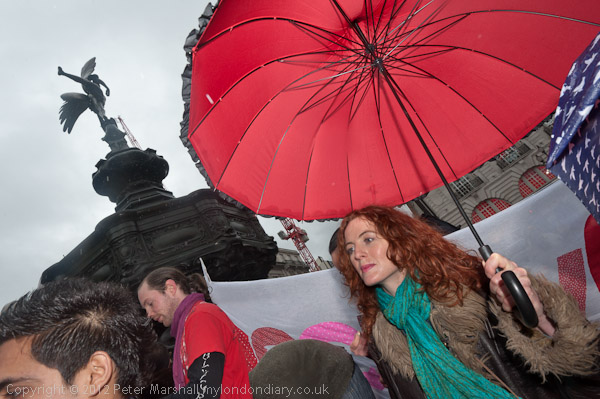
Although some of those taking part had umbrellas, it’s not really an option if you want to move around and take pictures, and of course the drips from these umbrellas are an extra hazard for the photographer.

Using flash in the rain also has its odd problems or opportunities, as you can just see from the red umbrella, where the white streak at its left is a rain drop, illuminated by the flash – and some more can be seen less obviously in front of the dark fountain supporting Eros (though it’s actually his brother.)  But I needed flash, because without it the pictures were too dull and failed to bring out the party atmosphere.

The Nikon SB800 flash is perhaps the least waterproof of all my equipment and most difficult to protect from the rain. As you can see from Reclaim Love – Occupy Your Heart!  I took (and put on My London Diary) too many pictures, and by the time I gave up I was rather damp and the flash was soaked and had stopped working. It did recover after drying out, but has since failed more or less completely.  Hopefully a trip to the repairers will get it working again.

________________________________________________________

My London Diary : Buildings of London : River Lea/Lee Valley : London’s Industrial Heritage

All photographs on this and my other sites, unless otherwise stated are by Peter Marshall and are available for reproduction or can be bought as prints.

To order prints or reproduce images

________________________________________________________

Urban Landscapes – Luca Tommasi

 © Luca Tommasi
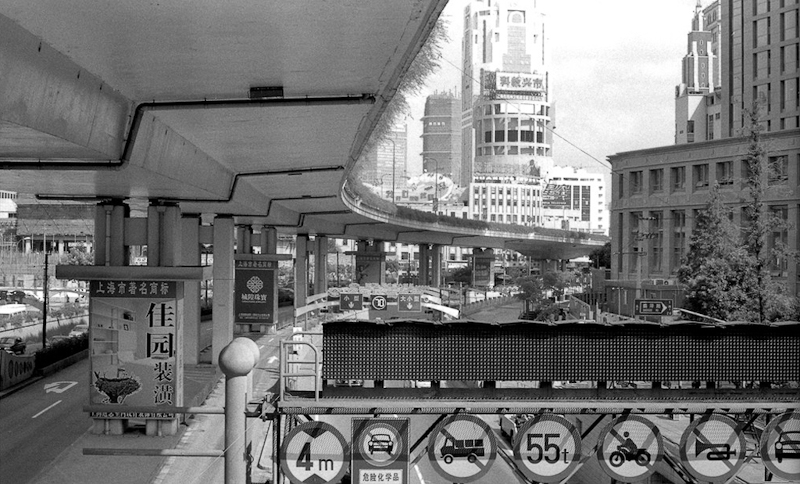
© Luca Tommasi – A changing China

I’ve just updated the pictures in Luca Tommasi’s A changing China on the Urban Landscapes web site that I run with Mike Seaborne.

Although Mike and I are both based on the outskirts of London and much of our own work on the site is from London, we intended this as an international site, and of the eleven photographers whose work is on the site only four are actually from the UK.

We welcome contributions to the site, but insist that these show a serious approach to urban landscape, and on the site I give a brief idea of what this might mean. It isn’t just pretty pictures of a city, and it isn’t just architectural photography. Here is my check list from the site which explains my idea of what we are looking for :

Urban landscape photography

  •  in some way describe a town or city
  •  represents an attempt to understand our experience of the city
  •  shows a dedication to the subject, expressed through a body of work rather than isolated images
  •  concentrates on structures or processes rather than on people
  •  may deal in either details or a broader view

If you have work that you think would fit, you are welcome to submit work and we have a page on the site that tells you more. Now that most web users are on broadband rather than dial-up we normally use slightly larger images, typically 600-800px larger dimension. Projects have to be accompanied by some explanatory text, and we also welcome relevant essays on the subject – up to around 5000 words.

I wrote a little more about this definition and the site as a part of a lecture I gave five years ago, which I presented in a series of posts on this site, including Architecture and Urban Landscape photography.

Like many things on the web, we run the site for love not for money, and there are no prizes or payment for having work on the site, which got a respectable 165,000 hits last year.  Though of course – as with this blog –  it’s the quality not the quantity of our visitors that counts.

Barnstorm – Eddie Adams Workshop

If you are a student or have less than 3 years experience working as a professional photographer (freelance or otherwise) you may like to consider applying for a place on this year’s Eddie Adams Workshop or ‘Barnstorm’, “an intense four-day gathering of the top photography professionals, along with 100 carefully selected students. The photography workshop is tuition-free, and the 100 students are chosen based on the merit of their portfolios.” Unfortunately only 10 of those places are available for non-US students.

It takes place from October 5-8, 2012 in Jeffersonville, New York, and although the tuition is free, those who get a place will need to pay their own fares to the event and also a flat fee for room and board ($375) at the Workshop. It all adds up, but the quality of the free tuition makes this seems a great opportunity.

For more information and to apply, see the Eddie Adams Workshop site.  Described as “the premier tuition-free photography experience” it exists thanks to many volunteers – who over the years have included many well-known names among photographers and editors with Adams “shamelessly exploiting a lifetime of friendships and contacts” who over the years included Gordon Parks, Joe Rosenthal, Alfred Eisenstaedt and editors and picture editors of Time, Newsweek, Life, Fortune, The New York Times Magazine and Parade magazine and is currently sponsored by many of the leading names in photography, including Nikon, Adobe, ASMP, AP, B&H, Getty Images, HP, Manfrotto, PDN, Photoshelter and Sandisk.

Most people know Eddie Adams (1933-2004) for one particular image from Saigon, but he took many fine pictures. He began the workshop in 1988 and this is the 25th Barnstorm.

Wim Wenders on James Nachtwey

Burn Magazine prints a long speech by Wim Wenders on the photography of James Nachtwey, made at the award to Nachtwey of the third Dresden International Peace Prize at the Semper Opera House in Dresden, Germany on 11 Feb 2012 .

It’s an interesting eulogy, and one in which Wenders backs up his arguments with a detailed look at three images by Nachtwey.

Wenders as well as being an internationally renowned director for his films including Paris, Texas (1984) and Buena Vista Social Club (1999) and, nominated for this year’s Oscars, Pina (2010), is also something of a photographer himself, as you can see from his Places, strange and quiet which was shown in London last year. 

Alex Webb’s Chicago

Thanks to Jim Casper’s Lensculture blog for showing me Alex Webb‘s Chicago Street Photography slideshow, made in collaboration with Leica and Magnum. The pictures sometimes disappear a little too fast for my slow-working brain, and although there is nothing wrong with the sounds recorded by Webb and his commentary it perhaps more makes for an easy experience than adding a great deal to the pictures. As to be expected from Webb, there are some interesting images, though in the nature of a presentation like this there are those which are less so, but overall I found it largely held my attention.

The video (which incidentally I couldn’t see using Firefox, but played without problems on Internet  Explorer) is also on the Leica Camera blog, where it appears with a short interview with Webb about the work, along with a half a dozen comments.

One person asks for information about the audio recording and gets a rather poor answer from the Leica Internet team “Some of the information regarding the audio in the piece can be found at the end credits.” If you blink you miss these and certainly it is hardly possible to read past the first few lines crediting Alex Webb, though with a little fiddling around you can stop the video at that point (4m35s) and find that as well as Alex’s own recordings it also credits Freesound.org and ChicagoStreetMusicians.org. There is a kind of odd 14 seconds of blank screen with a couple of bursts of sound after the credits disappear, suggesting some kind of production error, so perhaps the credits were intended to be more readily legible.

In some respects I think that digital works better with Webb’s liking for deep shadows than transparency ever did, and although one of the comments calls for the contrast of these images to be ‘beefed up’, I can’t agree. But when I saw his first book in 1986 I thought it relied too much on the drama of large areas of darkness – to me at the time it seems too easy a way to create drama, and I probably still feel that way.

Nor do I agree with ‘Fred’ who says “Most of these are pretty dull shots.”  But it’s worth spending the 5 minutes to watch this and make up your own mind. You may even want to see it a second time, as I did, with the sound turned off.

Pancake Contrasts

Yesterday was Shrove Tuesday, also known as Pancake Day, and there were many pancake races around the country, mainly at lunchtime. I had a choice of around half a dozen to cover in central London, but as they are all at more or less the same time, only managed to photograph two.

© 2012, Peter Marshall

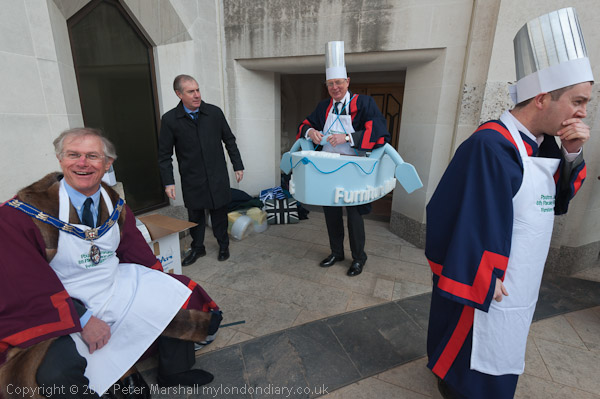
I started at a very exclusive event, with entries limited to teams from the various Worshipful Companies of the City of London and a few other City institutions. Even for these there is competition for places, with many being unable to gain a place. Of course the City is really a very competitive place (although sometimes it hides it well) and there were some very competitive races.

Many of the livery companies are fairly recently formed, and the race itself only began a few years ago, organised by the Poulters (who supply the eggs) and it raises money for the annual Lord Mayor’s Appeal, which this year is supporting a Trauma unit at the London Hospital.

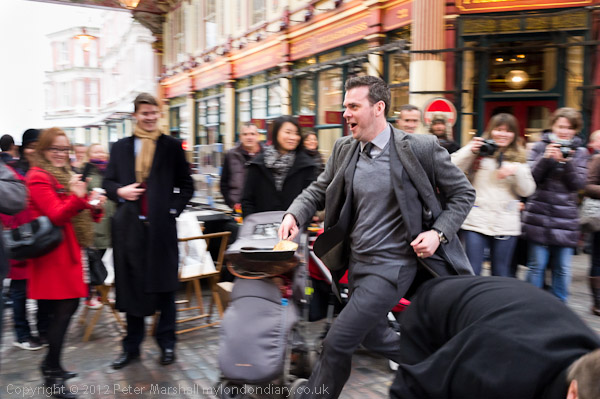
From Guildhall Yard I rushed across the square mile to Leadenhall Market, where a very different pancake race was about to take place, organised by the Lamb Tavern at the central crossing of the market.  It was an event where people were rather more obviously having fun, but lacked the dressing up of the Guildhall event.

© 2012, Peter Marshall
A little panning sometimes helps photographers as well

Leadenhall is a finely restored Victorian covered market, and light levels were considerably lower, and unfortunately the SB800 flash I’ve been having the odd problem with lately now decided to more or less give up. It didn’t stop flashing, but just seemed usually to do so randomly either on around zero power or 100% output. I struggled with it for a while, then gave up and shot without flash, which was just a little tricky for real action shots of the races.

See more at Pancakes in the City – Guildhall and Pancakes in the City – Leadenhall Market.

________________________________________________________

My London Diary : Buildings of London : River Lea/Lee Valley : London’s Industrial Heritage

All photographs on this and my other sites, unless otherwise stated are by Peter Marshall and are available for reproduction or can be bought as prints.

To order prints or reproduce images

________________________________________________________

Deaths and Injuries in Syria

Probably everyone will have heard the sad news from Baba Amr, where a Syrian Army shell hit a centre being used by the media, killing Sunday Times journalist Marie Colvin and French photographer Remi Ochlik, and wounding others including photographers Paul Conroy and William Daniels, and writer Edith Bouvier.

Ochlik recently was awarded 1st prize in the General News Stories section of World Press Photo for his pictures from Libya – you can see the set of 12 pictures on the WPP site. Daniels too has several fine stories from Libya on his web site.

It’s a reminder of the risks many photographers and journalists take every day to tell the world what is happening in places such as Libya and Syria. You can read more about them and the other around 900 journalists who have been killed over the last 20 years on the Committee to Protect Journalists site.

WPP Pietà

I’ve been reading quite a lot of criticism of the WPP winning image by Samuel Aranda on various pages around the web, and you can read an interesting summary of the controversy it has aroused from Jeremy Nicholl on his ‘The Russion Photos Blog’ in his Why The Critics Of The World Press Photo Muslim Pietà Are Wrong – By The People Who Know Best.

I’ve not always been too impressed by WPP winners, and I share many of the overall criticisms that various people have made over the years of the WPP and other similar awards. I’m not a fan of such competitions, which I think tend to trivialise work and concentrate on the spectacular and neglect work that is perhaps in the longer term more important in changing attitudes and exposing evil. Although I have a great admiration for those photographers who continue to expose the horrors of war – and think it is a necessary and useful work, unfortunately much of it is now only too familiar.

Samuel Aranda’s image spoke strongly to me when I first saw it and still does now. And its strength comes from the way it uses various stereotypes, and repositions them.  I don’t agree that the Pietà can be claimed as uniquely Christian imagery, although we know its representation in Western art. But I would expect similar images to emerge in any representational art tradition, because essentially it is about a human relationship, between mother and child, which is widespread across humanity and I think has a powerful evolutionary basis. Although taken up and used by Christians and made a part of Christian iconography, its roots I think lie deeper in our humanity.

The black burkha is in some respects a more potent and loaded symbol of our times, promoted by Western media in a demonisation of Muslims, a looming presence that relates back to sinister and shadowy nightmares and horror, as well as to more recent images, media hysteria and even some government bans. This is a picture that reminds us strongly of the person and the humanity underneath that black covering, her gestures amplified by the white gloves.

This is a picture that speaks at several levels about good and evil, and the framing and the shadows help to make it a powerful statement, as well as a complex one.

Nicholls ends his piece with the comments from four Yemenis, including the young man and his mother in the picture, both of whom are proud and happy to see it winning the contest. Like him I find it hard to disagree with their verdict.

Cleaning the City

One of the clearest indications that there is something very wrong with our society is the huge disparity in wealth and income, and nowhere is this more apparent than in the City of London, where people who work in the same offices may be on the minimum wage – around £6 an hour – or being paid millions in bonuses on top of huge salaries.

Those at the bottom of the pile, the cleaners, suffer from unsocial hours, part time jobs, poor working conditions and little or no job security. You can’t live in London on the minimum wage and many have several jobs to keep their families afloat.

The campaign to get a ‘London Living Wage’, a couple of pounds a week above the UK-wide minimum has had some success, largely through the vigorous actions of the cleaners and other low-paid workers themselves, organised through various groups, and I’ve photographed a number of their protests. Although they got some important support from some British trade unions, in some cases cleaners felt that they were neglected in the settlements the unions made with the bosses, their needs compromised by unions who also represented people on higher pay.
© 2012, Peter Marshall
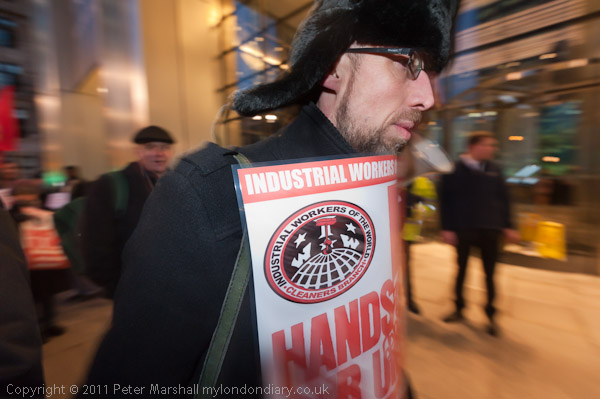
16mm, 1/30 f5.0, ISO 2500, flash

Now many of the cleaners belong to a branch of the IWW, the International Workers of the World, a US based international union only formally recognised as a trade union by the UK in 2006, although small branches have existed here since shortly after its founding in 1905. The IWW is based on the kind of grassroots action that the cleaners have been taking, and is notable for its democratic structures making it run by and for the rank and file.

Alberto Durango has been in the lead in the cleaner’s fight for better wages and conditions, leading a number of successful campaigns to gain the London Living Wage. Last summer I met him outside Heron Tower where he was able to tell me that the protest planned for that evening had been called off because the contracting firm employing the cleaners there had agreed to their demands. Towards the end of the year, the cleaners were taken over by a new company who refused to accept those agreements reached earlier (despite our laws about the take-over of enterprises,) and soon found a reason to dismiss Durango who was standing up for his rights and those of his fellow workers.

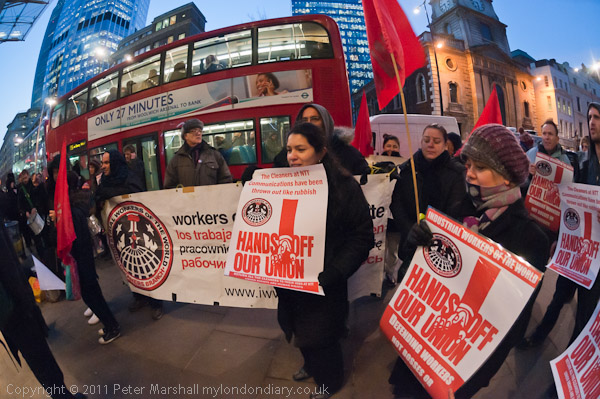
The IWW organised a protest against his dismissal outside Heron Tower at 5pm on a Friday night, in the rush hour as workers were leaving for home, and darkness was falling. Half of the pavement is actually owned by Heron Tower, and their security soon moved both protesters and photographers off from that onto the fairly narrow strip beside the road.
© 2012, Peter Marshall
10.5mm, IS01600, 1/60 f4.5

Bishopsgate is one of the busier streets in the city, with a fairly constant stream of buses, taxis and other traffic passing, and it wasn’t possible to step out into the road except when this was halted by a nearby traffic light, so most of the time I had to work from within a fairly crowded pavement area with a small supporting samba band as well as the cleaners and their banners.

Fortunately there was just enough light from inside Heron Tower, the street lighting and the windows of passing buses to work by available light with the 10.5 mm lens on the D300. Although I can generally handhold this at very slow speeds for static subjects, with protests there is generally movement, and anything less than 1/30 is likely to blur just those parts of the subject you want sharp. It is an f2.8 lens (actually as fast as anything I own in a Nikon fitting) and although you seldom if ever need to stop down for depth of field, and it performs well more or less wide open. I think all of the pictures I made with it at this event were between f2.8 and f4. The sky was rather darker than it looks in the picture, and got darker still while I was taking pictures.
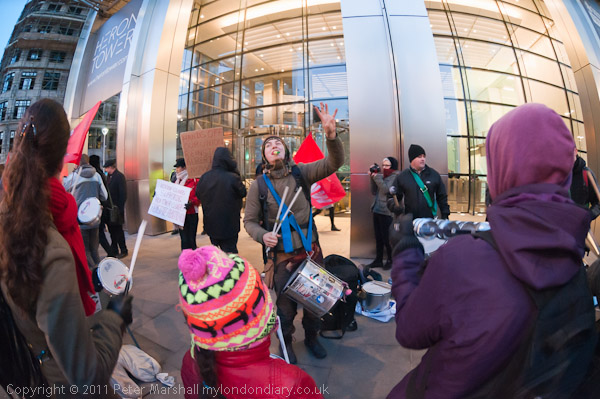
© 2012, Peter Marshall

You can forget flash with the 10.5mm, except as a special effect, unless you have some kind of magic diffuser that will cover 180 degrees. Occasionally I’ve played with it to highlight a part of the picture. I had the flash on the D700, where the longer end of the 16-35mm was as extreme a telephoto as I had room to use. With the D700 I gave myself another stop, working at IS02500 to get a better balance between flash and ambient, mainly working on shutter priority at around 1/30th to try for just a little blur along with the sharp core from the flash.
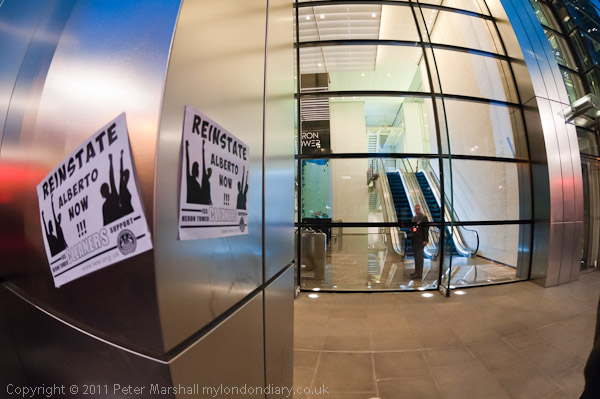
© 2012, Peter Marshall

As always there were the ones that got away. I’d been photographing a couple of posters on one of the metal-clad pillars in the middle of the pavement supporting the building calling for Alberto’s replacement, with a security guard inside the glass-fronted atrium looking out at the protest. A minute later he came out and tore one of them off the pillar, but I saw him too late to get in a suitable position to photograph the moment. Others I missed when the D300 mirror stuck in the up position – it takes just a second or two to press the menu button, select to lock the mirror up, press the shutter release, turn the camera off and then back on, but remembering to do all that in the correct order in the heat of the moment can be tricky. I keep putting off the time and money to get it repaired, but will have to do it soon.

Perhaps it was some kind of compensation for this problem that I ended up taking far too many pictures – as you can see in IWW Cleaners Demand Reinstate Alberto  on My London Diary.
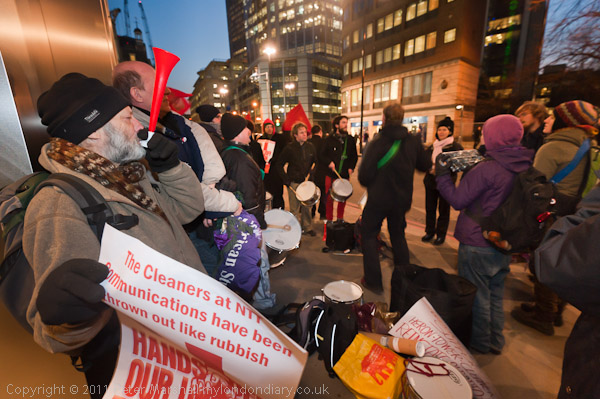
© 2012, Peter Marshall
16mm, 1/30 f5.6, ISO 2500, flash

A few days later I got some good news, though not about Heron Tower. Some of the cleaners at the protest had been sacked in another dispute in which Alberto and the IWW were engaged, and there was to be a protest outside their workplace the following week. A day before it was to take place I was pleased to read a message it had been cancelled after agreement had been reached with the management.

________________________________________________________
My London Diary : Buildings of London : River Lea/Lee Valley : London’s Industrial Heritage

All photographs on this and my other sites, unless otherwise stated are by Peter Marshall and are available for reproduction or can be bought as prints.

To order prints or reproduce images

________________________________________________________