Photography – the Art of Our Time

Jonathan Jones in a post on his On Art Guardian blog recently wrote “Photography is the art of our time. The old masters painted the drama of life and death. Today photography captures the human condition – better than any other artistic medium of our age” and went on to say “It has taken me a long time to see this, and you can laugh at me if you like.”

Well, I won’t laugh at him, not least because it is something I have been writing and saying and more importantly – at least for me – trying to do for many years, though I think when years ago I wrote that ‘photography is the defining medium of the twentieth century‘ I was including moving pictures in my definition. Of course I don’t claim any originality in my thought, inspired as it was by the thinking and writing of others, including Lazlo Moholy-Nagy and Walter Benjamin, well before I was born.

So Mr Jones is rather late in coming to the party, and though I welcome him, I’m not entirely convinced that the party is not more or less over. Certainly now in the twenty-first century we have photography being appropriated and emasculated by both academia and the art market, turning it into careerism and commodity. Though of course there is still much fine work being produced, and some younger photographers are showing themselves to be adept at sitting on several stools.

Art and academic pin-sitting/hair-splitting/bullshitting are perhaps the two major games photographers will have to play as a way to earn a living to support them as they continue their photography.

History Lesson

History teaching in the UK has been in the news recently with a report from the All-Party Parliamentary Group on History and Archives last month and education minister (and disaster) Michael Gove giving his opinions, including the view that Mary Seacole should be dropped from the national curriculum so history teachers can concentrate on Winston Churchill and Oliver Cromwell in what has been described as ‘air-brushing black people out of history‘.

© 2013, Peter Marshall

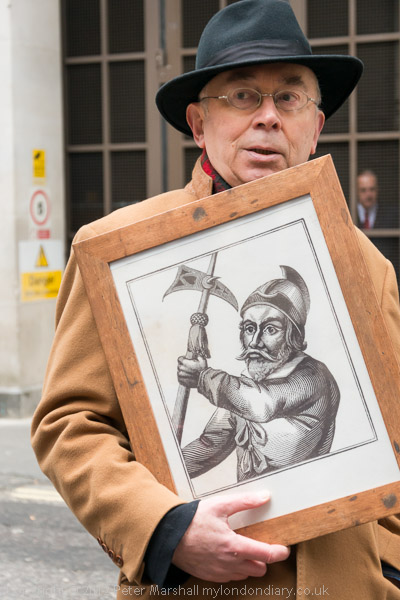
Ian Bone
holds a framed portrait of Thomas Venner

Many other events have also been air-brushed out of our history in the past, and although so far as I know all those taking part were white, I doubt if Thomas Venner‘s brief and doomed insurrection of 1661 will be a part of the Tory history agenda.

The whole story of the ‘Fifth Monarchists’ is an intriguing one, and one I give a little background in my introduction to the pictures in Epiphany Rising Against King, and to understand it requires thinking in a very different frame of reference to our own age. Religion was at the very centre and everything was seen through a glass that seems unnatural to us now, although there are perhaps parallels in some current movements.  But the story of our English revolution is largely seen (and was perhaps taught) as some kind of aberration,  with everyone giving a sigh of relief when the monarchy was restored to its rightful place, and Venner serves as a reminder that not everyone felt that way.

© 2013, Peter Marshall
The event portrayed Venner as a part of a continuing tradition of dissent

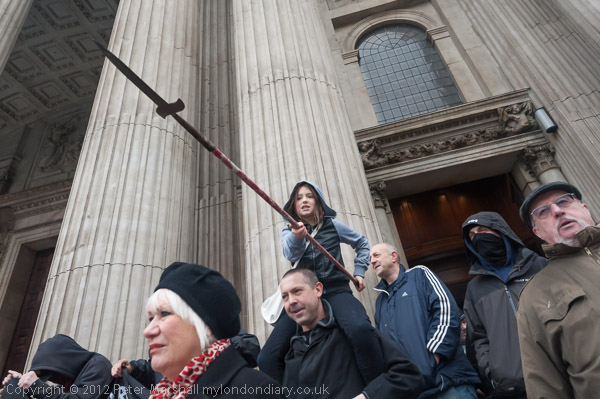
As well as the ‘jehadists’ of the Fifth Monarchy, there were also the Muggletonians founded in 1661, and represented at the event by Sam Johnson, the grandson of  Philip Sidney Noakes, the last of the Muggletonians who died in 1979 leaving the papers of the group to the British Library. Like the Fifth Monarchists they were egalitarians, like them basing their ideas on biblical sources, but beautifully and deliberately disorganised and crucially pacifist. Which added at least a little amusement for me when Sam’s daughter Rachel was the one flourishing the pike on the steps of St Paul’s Cathedral.

© 2013, Peter Marshall

Venner’s revolt against monarchy was of course cruelly suppressed, and our ‘reconstruction’ for a film began on the site of his congregation, where he and others were hung, drawn and quartered. The same fate was meted out to some other sympathisers who had not taken part in the violent events of the first few days of 1661, and repressive laws were passed to outlaw dissenters and dissent.

The event was organised for a film being made about Venner and other radicals of that era, and this demanded a certain restraint on my part, trying not to get in the way, though of course I was a part of the event being filmed. But there were times when I stayed back a little, and other times when there were lengthy waits while the camera got into position and prepared for action.  I used the 70-300mm a little, but even at high ISO the light was a bit dim for it (it was a cold and dull day with a hint of drizzle at times.)

Continue reading History Lesson

Walking With Others

© 2012, Peter Marshall

I started 2013 with a walk. Come to that I finished 2012 with a walk too, and although neither of them was primarily a photographic exercise, of course I took a camera, and made a few pictures on route.

But the kind of walks that other people – or at least my wife and elder son who I was walking with – do are very different from the way that I walk when I’m on my own and out to take pictures. In the past for some walks where I know the paths are good for cycling I’ve even taken my Brompton with me so that instead of always finding myself running to catch up with them I can easily do so with a few flicks of the pedals.

Photography really isn’t a very sociable activity, even when you are taking pictures of people you have to think and interact with them differently than if you were not taking pictures; you become an observer rather than a participant, though I’ve often worked hard to blur that distinction. But photographing a landscape often seems really to be a very different activity from walking through it.

I learnt a lot about photography – particularly the technical stuff –  from the old Ansel Adams Basic Photo series, written in the early 1950s and already rather out of date when I read them around 20 years later. One of the things I learnt was how Ansel could look at a landscape, perhaps a few tree trunks, and see something that was really completely different, a picture that he could make from them by a particular exposure and development, along with some localised dodging and burning, and perhaps using filters etc. It was an approach to making pictures that I felt uneasy with, a kind of bravura performance with the elements of the landscape. What I wanted was to show it how it was rather than to show what I could do with it.

© 2012, Peter Marshall

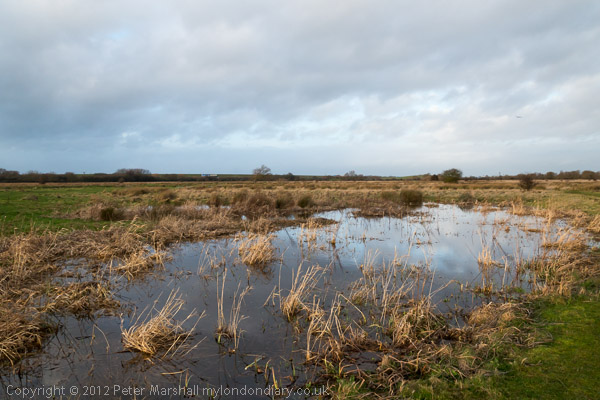
But over Christmas and the New Year, I was more going out for walks with the family than going out to take pictures, though I did occasionally find myself running after them (it was far too muddy to think of taking my bike) having stopped to make a photo or two.

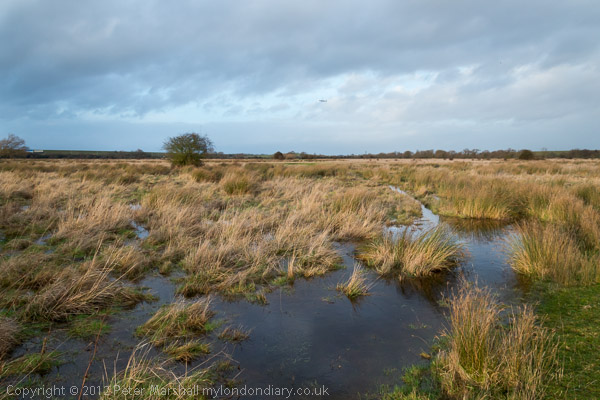
I particularly liked the picture above of Staines Moor, not least for some of the details which you probably can’t make out at this scale. Along the horizon at the left are two of the boundary features of the moor, the M25 and a reservoir, and in the sky near the centre of the image that isn’t a bird or a nasty spot of gunk on the sensor but a plane taking off from Heathrow, less than a mile away.

You can see more of the pictures in Around Staines, and from our New Year’s Day walk in Kent in Northfleet & Southfleet.

© 2003, Peter Marshall
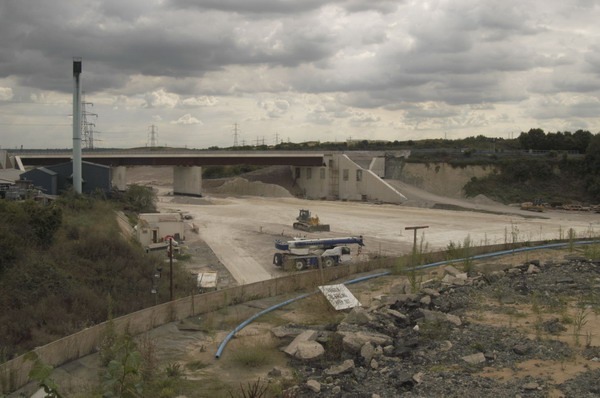
Channel tunnel rail link construction site, 2003

We had several reasons for going to Northfleet, not least that I’ve just been working on a new book of photographs including the area taken in 2000-2001, but the idea was actually my wife’s as I’d just given her a book, ‘A Pilgrimage of the Thames’ by Donald Maxwell, published in 1932 since she and my son have for some years he and my wife have been walking parts of the Thames Path, and it made the area sound fascinating. It was a book I’d first found when I was first photographing the area in the early 1980s, when much of what Maxwell wrote, allowing for his imaginative perception, was still recognisable. Things in the area have changed rather more since then, something I’ll perhaps write more about when I get that book sorted. Meanwhile you might like to take a virtual walk (or rather cycle ride) with me from 2003, three pages starting here.

________________________________________________________

My London Diary : Buildings of London : River Lea/Lee Valley : London’s Industrial Heritage

All photographs on this and my other sites, unless otherwise stated are by Peter Marshall and are available for reproduction or can be bought as prints.

To order prints or reproduce images

________________________________________________________

New Year

2013 has now officially started on My London Diary. Somehow I didn’t quite get around to making New Year Resolutions this year, didn’t quite get around to doing most things I meant to do, but I did more or less finish updating My London Diary for 2012 before the clock began to strike midnight on 31 December, which considering I was out taking pictures on the 27th and the 30th took a little doing.


Google search t-shirts: ‘israel – Did you mean: Palestine

December 27 was, I was surprised to find, the fourth anniversary of Operation Cast Lead, the Israeli attack on Gaza which lasted around 22 or 23 days and killed at least 1400 Palestinians, mainly civilians, including many women and children. I wrote a little about photographing the event in 2012 – My Own Favourites – December, and of course you can see the pictures at Gaza – End the Siege.

I don’t often pose pictures, and I didn’t really pose the one above. I’d been photographing a small group of young women including these two, and had noticed the t-shirts with the Google logo, but couldn’t really see them well in the pictures as it was a fairly cold day and they were mainly hidden under their jackets. I sometimes feel a little embarrased about asking women if I can photograph their t-shirts, but when I asked about them, these two immediately pulled back their jackets for me to make this photograph, with one of them pulling hers out flat to show the text more clearly.

I was almost giggling too much to take the picture – and it was pretty crowded so I couldn’t move back any more, and they nicely filled the frame at 20mm (D700, 16-35mm, ISO 640 1/200 f7.1 – or rather press the button on P). I’m told that ‘I Googled Israel and got “Did you mean Palestine”‘ has been around for a very long time – and as a Facebook group since July 2010, and I had a vague recollection of having seen it before, but if it had been on a t-shirt I’d forgotten it. Perhaps its an advantage of old age forgetfulness that you can see the old freshly.

I don’t think it was the best picture I took that afternoon, though it was good to see it getting several thousand ‘shares’ on Facebook – probably more than any other picture I’ve taken. I liked several other pictures from the afternoon more, including another with these two and others, waving a Palestinian flag and shouting towards the embassy from the front of the crowd.

By then it was around an hour later and quite a bit darker, and I had changed to ISO 1250, taking this picture at 1/125 f8 and needing flash as they were in shadow from the flag. I’ve not yet taken the Nikon flash in for repair and was using a cheap Nissin unit that works a little differently. This time the 16-35 was at its widest both aperture and focal length, 16mm f4, and I’d rushed around to the front of the protest and got down on my knees to take this and several other exposures.

The Nissin Di622 is a little strange and seems to give less even coverage than the Nikon unit.  It is a dedicated Nikon iTTL flash, and is supposedly controlled by the camera when set to TTL in just the same way as the built-in flash. It has a diffuser you pull down for wide angle lenses (it claims to zoom to cover 24-105mm without) and sometimes works well, though like the Nikons it gives me problems on P setting, and is best used on S or A. The design of these units has improved a little since I bought mine and they have become more versatile (and the price has roughly doubled, but is still half that of the more or less equivalent SB700.)   But given the rate at which I go through flash units, perhaps I might buy another Nissin rather than an SB700 next time I need a flash.
Continue reading New Year

Nowhere People

With inequality yawning wider by the hour in the UK, and being given yet another step up in Parliament with attacks on benefits today, it’s salutary to look at the fine set of images by David Hoffman, Nowhere People.

He comments under the pictures:

Homeless people in London. Young and old alike forced from the margin of survival out into the streets by the inequality of our financial system. Shot over more than 30 years it’s depressing to see how similar the most recent ones are to the oldest. Yet in that same time the income of those at the top has increased tenfold.”

But although the circumstances are depressing, these are pictures that are full of humanity and which show an understanding and respect for the people in them, a dignity we all deserve, whatever our circumstances.

If anything I think David’s comment is too optimistic; there has been the occasional improvement but things really – particularly in recent years – have got worse. The Labour government at least tried, but generally were incompetent and failed to address the issues, while the coalition just fails to understand the problems faced by the poor and out of work. When you are earning thousands a week it’s hard to understand what life is like on £71 (£56.25 if you are under 25.)

If we really were “all in this together” the present Government would be pressing for a more equal income distribution, perhaps by making a limited ratio of salaries of those working for an organisation a condition of tendering for all government contracts – and by getting rid of outsourcing as a way to pay poverty wages and impose primitive employment conditions. They’d also be clamping down on the tax avoiders and bankers, working for fixed actual wage increases rather than percentages, and raising the minimum wage to a living wage. And supporting a real ‘big society’ that helps provide support and services for others rather than one that makes huge profits for a few often corrupt companies while putting many charities out of business.

Jonas Bendiksen – Extinction Tourism?

Another interesting post by Pete Brook on Raw File, Extinction Tourism: Work at a Newspaper While You Still Can looks at the decision by Magnum Photographer Jonas Bendiksen to take a job at a small town newspaper in a remote area in the north of Norway,  the Bladet Vesterålen, with a circulation of only 8000.

I’m not sure how the paper survives on such a low figure, and I doubt if it pays the kind of rates Magnum photographers usually expect, but apparently working for a newspaper was something he wanted to be sure to have done before he and newspapers die, and a challenge to work “where nothing too obvious or dramatic was going on“. There are a dozen of his pictures in the post and links to a couple of stories on the paper – the one on moose hunting despite the subject showing the quality of his work.

He splits his life between weeks in Oslo and weeks at the newspaper, and the job has turned out to be more of a going back to his roots than he expected. Having chosen to stay in the small village of Myre when working on the paper he found out that this was the place where his great-grandfather was born.

Bendikson (b1977) first came to Magnum as an intern in their London office when he was 19, before going to Russia to work for several years as a photojournalist. He joined Magnum in 2004 and was made a full member in 2008. His best-known work The Places We Live, made in 2005-7,  looked at life in the slums of Mumbai, Nairobi, Caracas and Jakarta, and was published as a book by Aperture in 2008.

I’m not sure what future there is for printed newspapers, but from the look of its web site,  the Bladet Vesterålen seems to be doing a very good job and deserves to survive. This lunchtime I was reading my own local paper – we still buy one – and thinking how hopeless it was, and that a half-decent blog based in the area could provide a much better service. It is part of a large group that has many titles, and I think few of the reporters or editors know our actual area well, though there are still one or two struggling journalists who do a good job.  But half the time it publishes news not related to our particular area and misses what is happening here – and seldom sends reporters or photographers. And of course won’t pay to use pictures. Frankly much of our local press has lost its way and would hardly be a loss.

Shades of Grey

Although I’m a regular user of Surrey Libraries, I’ve yet to contribute to the statistics just announced that show Surrey borrowers to be the most avid readers of EL James’s Fifty Shades of Grey series – which apparently accounts for one in 5 loans – as a libray spokesman commented “they just can’t get enough.” Certainly I’ve noticed over recent months the ‘New Issues’ and ‘Quick choices’ troughs clustered around the front of the library are engorged, full to bursting with these titles and the many, many rip-offs, ‘Seventeen Shades of Purple‘ and the rest. It’s perhaps surprising that ’50 Shades’ was also reported to be the country’s least wanted Christmas present, so there are presumably many virgin copies lying around in homes through the country.

Although I’ve yet to open the covers of any of these titles which seem to be multiplying like rabbits – after all I’m not in any way the target audience – Shades of Grey has been on my own bookshelves – and regularly consulted – for over 20 years. And if anyone got that volume, long out of print, for Christmas they will have been entranced by Oscar Marzaroli‘s picture of Glasgow from 1956-87, published shortly before his death in 1988 (and reprinted twice the following year.) There is a very wide selection of his work on the Marzaroli Collection web site, but unfortunately the images are rather small and seem contrasty and over-sharpened (rather like some pictures I put on the web in the early days of the mid-1990s) and don’t show his work to advantage. The site does seem overdue for a re-vamp.

The book Shades of Grey, second-hand copies of which now seem to sell for £50 or more, wasn’t particularly well printed – bog-standard offset of the period, with poor separation of the darker tones and perhaps in homage to the title lacking a true black – but it does a much better job than the web site, and is a wonderful portrait of  a city and its people, complemented by a fine piece of writing ‘Where Greta Garbo Wouldn’t Have Been Alone‘ by William McIlvanney. I’d take issue with the flyleaf description which states that this, “with its subjective impressions perfectly complements the objective images from Marzaroli’s camera” only because his pictures are fortunately an equally subjective view of the city.

Free James Foley

When US journalist James Foley was kidnapped by unidentified gunmen in Northwest Syria, on November 22, 2012, his family wanted it to be kept out of the news, hoping for his safe return. Four other journalists, including Richard Engel, chief foreign affairs correspondent for NBC News were kidnapped in the same region and were freed after a battle between their captors and one of the two main Syrian rebel groups. It isn’t known if there is any connection between the kidnappings, or who has held Foley or why.

His family has now decided to go public and has set up a web site and a Facebook group to appeal for his release. Please sign the appeal on the web site and if you are on Facebook, you can ‘Like’ the group too.

You can read more about this on GlobalPost, for whom Foley had filed many reports over several years. In April 2011 on assignment for them in Libya, he was captured by Gadaffi’s forces and held in prison for 44 days before being released – and later he returned to Libya to photograph the events around the fall of Gadaffi. AFP to whom he had sent around 30 videos since March 2012 have issued a statement of solidarity with his family.

You can also see more of Foley’s work on his ‘A World of Troubles‘ web site. On its front page, as well as the appeal from the family for his release is a video he made in Aleppo a week before his capture showing home-made weapons being used by the rebels.

His Family say:

Jim is the oldest of five children. He has reported independently and objectively from the Middle East for the past five years. Prior to his work as a journalist, Jim helped empower disadvantaged individuals as a teacher and mentor assisting them in improving their lives.

The family appeals for the release of Jim unharmed.

I too hope and pray for his safe release. They feel publicity can help and we can all add our names to their petition.
_________________________________________________________

Just before Christmas, the Committee to Protect Journalists published a special report on journalists killed  in 2012 which states:

 Syria was by far the deadliest country in 2012, with 28 journalists killed in combat or targeted for murder by government or opposition forces. In addition, a journalist covering the Syrian conflict was killed just over the border in Lebanon. The number of fatalities related to the Syrian conflict approached the worst annual toll recorded during the war in Iraq, where 32 journalists were killed in both 2006 and 2007.

Those killed in Syria included four international journalists, Marie Colvin of the Sunday Times, French freelance photographer Rémi Ochlik, France 2 reporter Gilles Jacquier and Mika Yamamoto, a journalist for Japan Press. At least 13 of those killed were ‘citizen journalists’  and others included local professionals Abdel Karim al-Oqda of Shaam News Network, Mosaab al-Obdaallah of Tishreen and Ali Abbas of SANA. Two others, Bashar Fahmi working for Al-Hurra and Mohamed al-Saeed of Syrian State TV are missing, with unconfirmed reports that al-Saeed was beheaded. US Journalist Austin Tice has also been missing since August.

Harlem Views

Roy DeCarava has long been one of my favourite photographers, and his ‘The Sound I Saw‘, pictures of his from the 1960s was one of the more interesting publications of the early years of this century, and one that I often reach down from the shelf in my living room to leaf through. It helps of course that in the 60s, before became a photographer I was a great jazz fan (and the world’s worst tenor sax.)

The book is about jazz and Harlem, and is a kind of improvisation around his pictures and poetry of jazzmen and Harlem, something I can’t pick up and leaf through without the sound of Ellington’s ‘Harlem Airshaft‘ and other compositions including ‘Drop Me Off At Harlem’ springing into my head. I think too of Ben Webster (pictured here with Coltrane) who I once spent an afternoon with, trying to keep him sober for the evening’s concert with spectacular lack of success but who despite that reduced me to tears with a few breathy notes and continued to play a set that left me emotionally exhausted.

I was pleased a day or two ago to come across John Edwin Mason‘s blog and an article Roy DeCarava’s Harlem in which he rightly calls DeCarava “the greatest of all photographers of Harlem” and which includes video about him and links to a fine essay by A D Coleman. Elsewhere there is a nice review of the (re-issued) 1955 book The Sweet Flypaper of Life he produced with poet Langston Hughes by Alan Thomas and there is a fine set of pictures on the 2009 obituary programme on NPR. There is a DeCarava archive site, but authorisation is needed to access the images. There is another obit at BlackandWhiteCities, which links to the NYT Lens feature, as well as the JazzWax tribute with the Webster/Coltrane image and more – and you can read a long scholarly article by Rebecca Cobby, ‘Visions, dreams and a few nightmares’: Roy DeCarava’s Representations of African American Workers in Harlem‘ in the BAAS journal.

Mason’s post compares DeCarava’s view as an artist and an insider to that of photojournalist Gordon Parks, and the triumph and tragedy of his fine photo essay ‘A Harlem Family‘ which appeared on pages 48-62 of the edition of Life Magazine for March 8, 1968, the first of five features in a special section ‘The Cycle of Despair: The Negro and the City. As Mason points out in a second post ‘Gordon Parks: “A Harlem Family,” Life Magazine, 1968‘,this was published after “the end of the long hot summer of 1967, a summer of urban uprisings in black America.”

The feature is worth reading and thinking about, with some interesting reflections on the essay and the publication, and I think too on the role of photography and photojournalism which remain pertinent.  Mason ends with an account of the tragedy which followed – although unconnected – for the family Parks had photographed and Park’s own thoughts, as well as linking to an exhibition of the work marking the centenary last November of Park’s birth at the Studio Museum in Harlem, continuing until March 10, 2013, with an exhibition catalogue to accompany the five volume publication of Park’s work by Steidl.

Although a fine publication for libraries, at £148 it seems a little excessive both in terms of cost and shelf space for impoverished photographers, particularly those like me whose walls are already full of books. Perhaps a single print volume with an accompanying DVD with a larger selection of images would be more attractive to a wider audience.

2012 – My Own Favourites – December

© 2012, Peter Marshall

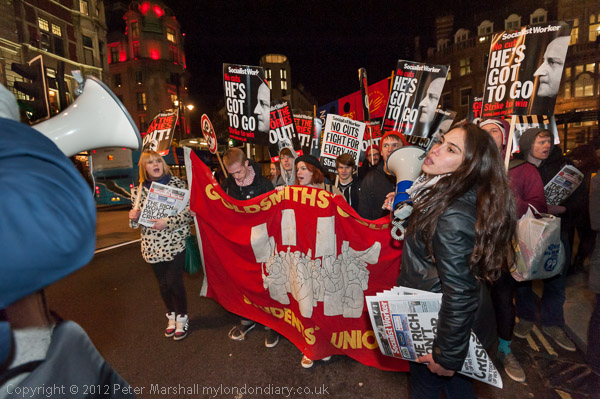
I still don’t like working in the dark, but at least digital cameras now make it a lot easier and enable us to get images that don’t look as if they were taken in a black hole. This image from a march by Unite the Resistance and UCU to Downing St in protest against Osborne’s Budget Cuts announced that day in his autumn statement in jobs, services and education which will unfairly impact on the vulnerable was taken on a well-lit street in central London, but I still needed a fairly high ISO (ISO 2000.)  Although I think the marchers had actually paused, they were still moving around quite a bit and I needed to use  a reasonably high shutter speed to avoid any blurring and I took it at 1/200s.  Although they were stopped I think it still has a pretty dynamic feel to it, and there was certainly a high energy in this group. At 16mm on the 16-35mm even wide open at f4 gives a reasonable depth of field and the lens is pretty sharp even at full aperture.

Flash has provided the main light source on the people in the picture – with considerable burning down of the close figure on the left, though I may have twisted the flash head slightly away from her when making the exposure. I’ve also taken the figure at the right down a little, though she still stands out a little from the rest. There is enough ambient light to give some detail in the surrounding buildings, but the sky is still black. There is still a little bit of luck in lighting at night, and I often get it wrong, but there are also times like this when it works really well. To get that kind of result back in the old days would been impossible outside of a film set.

Later in the evening at the rally that these protesters held together with CND and Stop the War opposite Downing St I was finding it a little difficult to get the kind of lighting I wanted on the speakers, until I realised that the open gazebo under which they were speaking (like most days at this end of the year  it was raining if only slightly) was more or less white and made a perfect surface for bounce flash.  I cursed myself for not realising it immediately, but it’s something that is seldom possible out of doors.
© 2012, Peter Marshall

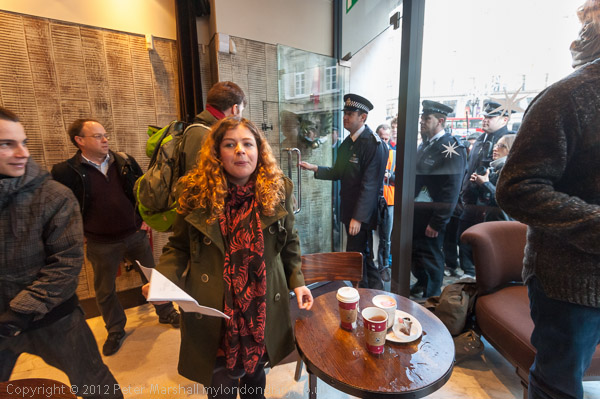
This is the moment during UK Uncut’s Visit to Starbucks on Conduit St, just off Regent St, when the police walked in to the store, roughly a minute after the occupation had begun, and a statement about Starbucks’ avoidance of UK tax was being read. It’s one of a whole series of pictures taken over the roughly ten minutes I was inside the crowded shop, all with the 16-35mm on the D700 (this at 16mm.) At first I was working without flash, as I was worried that the shop management might ask me to stop taking pictures, and though I would have told them it was in the public interest and ignored them I prefer to avoid confrontations, but later I used it when photographing people with their backs to the window. None of the pictures I took here or at the protests against Starbucks in Vigo St and Euston Rd were spectacular, but perhaps that reflects the nature of UK Uncut, who make their point firmly but generally politely, direct action with intellectual rather than physical confrontation.

Among the other images I might have chosen is one from the Euston Rd branch, where a father is reading a book with a young child as the police walk in. The low viewpoint and the change in lighting from the warmth inside the shop on the father and child to the cold daylight flooding in from the front of the shop making the officers cold and blue add a little sinister drama. You can see it in  Starbucks Euston Road.
© 2012, Peter Marshall

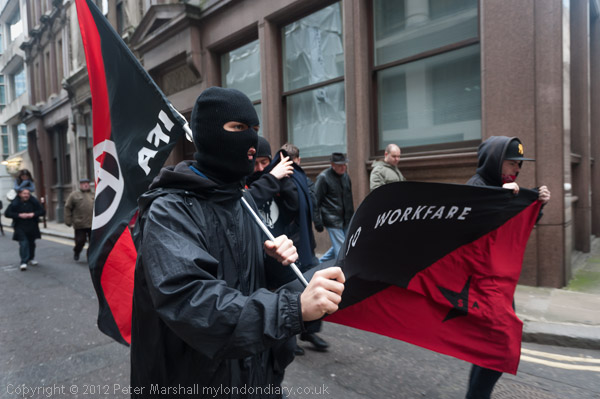
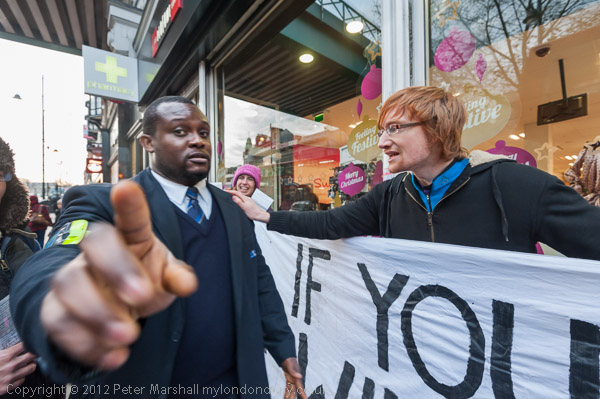
When a finger gets that close to the front of your 16mm lens it is just a little worrying, particularly when a fairly bulky security guard is behind it and making physical threats. After all you don’t want to get any fingermarks on your lenses. You can read more about the protest against workfare in Brixton – here outside Superdrug who are using unpaid forced labour – work for nothing or lose your benefits – in Boycott Workfare Surprise Party in Brixton.
© 2012, Peter Marshall
Anti-Capitalist Carols in the City

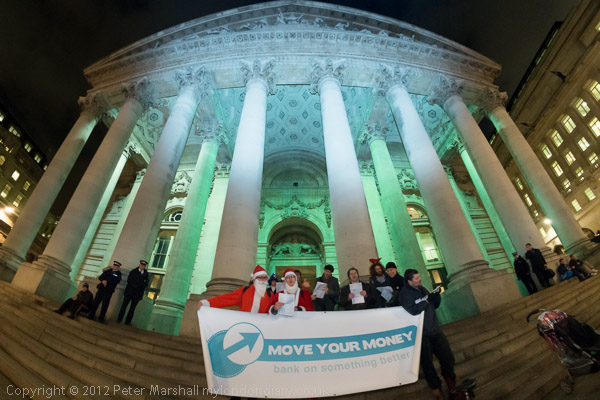
There was more of a Christmas atmosphere around as a small group visited banks and branches of Starbucks around the City of London to make their protest in song. A few places locked their doors in time to stop the carollers entering, one or two places didn’t seem to notice them, and there was no trouble, with a couple of police officers calming the staff and letting them know the protesters would leave without trouble.

At the NatWest in Poultry, a few yards from the Bank junction, the high circular hall had a fine acoustic and the choir sounded pretty good, having practised a little on the way around. Some staff came out onto the balconies to listen and it would not have surprised me if the manager had come out with mince pies and mulled wine and implored them to return next year.

Royal Exchange, shown in the picture above, made a good backdrop for the picture, but out of doors the sound was lost.  I had to leave before the protest finished at St Paul’s Cathedral, to go to another Christmas event. It wasn’t until December 27th that I was able to drag myself away from the festivities having eaten and drunk too much (and more to come at the New Year.)
© 2012, Peter Marshall

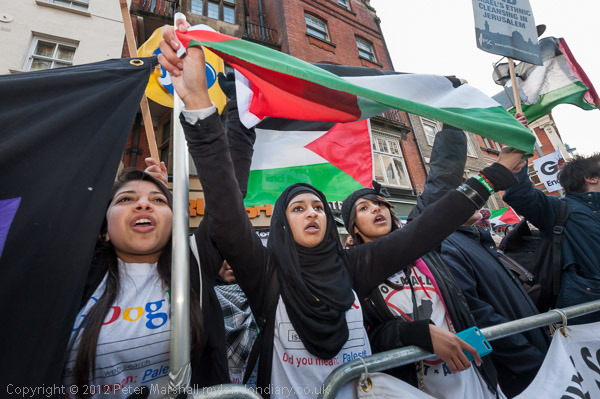
Four years ago, on Dec 27th, Israeli forces began their attack on the people of Gaza. By the time Operation Cast Lead came to an end 22 days later, around 1,400 Palestinians, mainly civilians had been killed. Israeli deaths totalled 13, three of them civilians. These bare facts, from UN and independent sources, give a clear indication of the imbalance of terror and power. The UN Human Rights Council fact-finding mission (with which Israel refused to cooperate) documented 36 specific cases of alleged breaches of international law. There were numerous documented instances of the illegal use of white phosphorus incendiaries on populated areas including attacks on at least two hospitals.

The picture I took that got most attention – it was widely shared across the net – was of two young protesters both wearing t-shirts  with a Google front page in which someone had type the word ‘israel’ and had got the response ‘Did you mean: Palestine’. You can see both of them in the picture above on the left, holding up a Palestinian flag and shouting towards the Israeli embassy, calling on them to end the siege of Gaza. I think this is a better picture, even though you can’t really read the t-shirts.
Continue reading 2012 – My Own Favourites – December