Bee-have

The trouble with bees is that they are dying, which is a disaster for us all, but also on a more trivial level that they seem unavoidably to lead to bad puns. On the morning of Friday 26th April I sat at my computer and began to type in a status update, ‘To Bee or not to Bee...’ but I think (and hope) that I came to a decision, jumped up, grabbed my camera bag and headed to the station on my way to Westminster before I pressed the enter key.

Part of the reason why I’d been in two minds whether to go had been the huge publicity about the issue, with mentions in the daily papers and that morning on Today programme and Radio 4 news; I didn’t know if it was going to be a very big protest, but I was sure the media would be swarming over it.

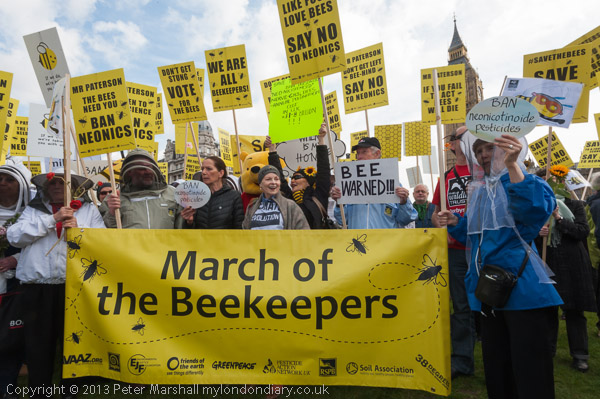
My indecision meant I missed my first train (not really the first, but the first without taking out a mortgage for the ticket) as well as the next slow service, and got to Parliament Square half an hour later than if I’d not prevaricated, and had missed the first 15 or so minutes of the photo-call. I’d been right about the media scrum, with almost as many photographers and videographers as people taking part in the protest.

As usual, the picture that almost everyone was trying to take – in a line 3 or 4 deep – wasn’t of great interest – a big crowd behind the main ‘March of the Beekeepers‘ banner and behind that Big Ben, but I took a couple of frames just because it was there when I arrived, before moving away and into the crowd to find something more of interest. I tried to make use of the many placards close together, with glimpses of that clock tower between the placards, and concentrated on single people or small groups in the foreground, particularly those who had gone to some trouble with flowers or bee-keeping clothing.
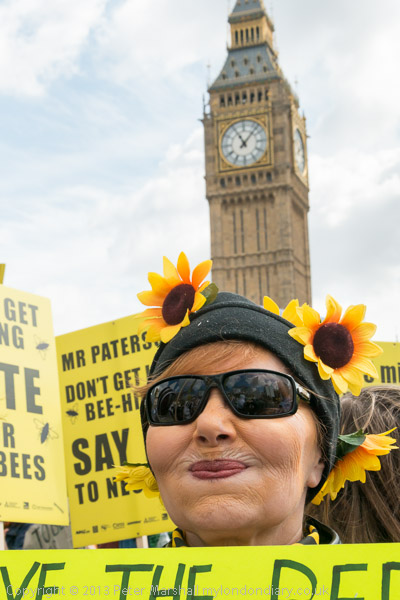

Just how much Big Ben do you need in a picture?
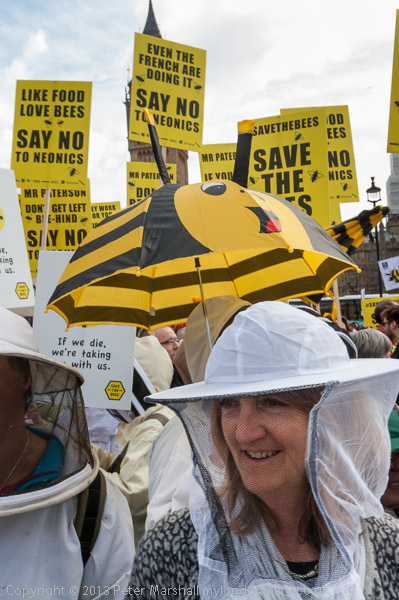
Perhaps this much?

After a while I got fed up with the big clock, and tried playing with hiding it or almost hiding it, and then tried to forget it and concentrate on the people and their costumes and props. There was a group in full bee suits, but somehow I couldn’t quite get to grips with them – the costumes were just too overpowering.
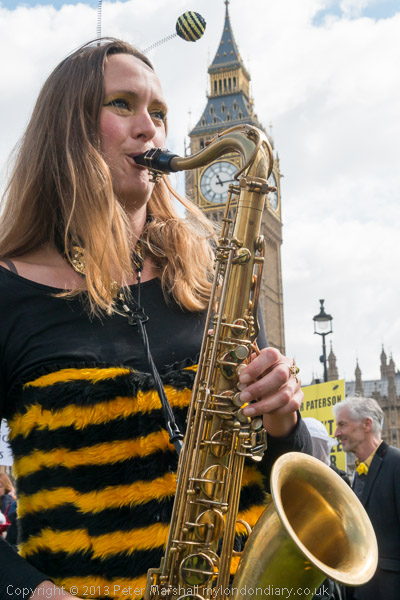
I made one picture playing with Big Ben that I did rather like, where I was able to use several circular shapes in the image of a woman in a bee costume playing a tenor sax. It wasn’t entirely straightforward because she was swaying around as she played, but I was able to frame the clock in the bend at the neck of the instrument, with one of the two balls on springs on the top of her head in the sky just to the left of the spire and the bell of the sax (elliptical rather than circular) at the bottom right of the image. Looking at if afterwards I wasn’t sure if I should have framed it a little wider to get the ball on the second of her antennae in the image as well, rather than choosing to cut off the image at the top of the bell tower (which also has a tiny ball.)
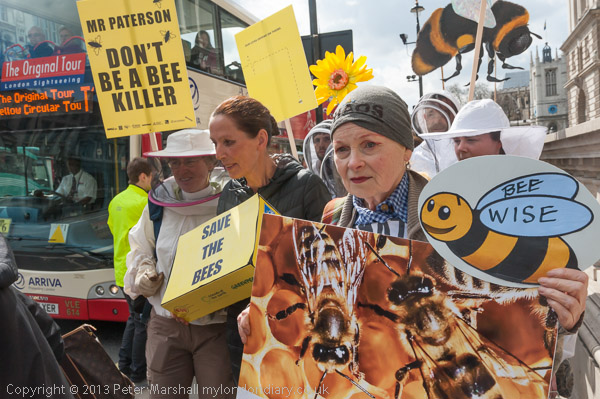
By now I’d realised that there were several celebrities present, though I hadn’t recognised them including fashion designers Dame Vivienne Westwood and Katharine Hamnett. But Katharine Hamnett was carrying the box containing the petition, a yellow box labelled ‘SAVE THE BEES’ and they were on their way to Downing St to hand it in.

Now we were in a position for one of those familiar arguments between those photographers who want to get in close and those who keep saying “lets go back, guys, so we can get a long shot.”  This got a little more acrimonious than usual when one very young lady, I think still a student, called a highly respected press photographer easily old enough to be her father, a “dirty pap“.  Anyway while the argument was continuing – and I couldn’t move back because my way was blocked by the photographers behind, I got in close to get the image I wanted, with a great feeling of movement and a four nicely placed bees, as well as the petition and the two designers with people in bee veils behind them. When I could manage to move back so that anyone who wanted a long shot had a clearer view –  a TV crew  jumped in the gap holding up the whole protest as well as greatly annoying the photographers. It wasn’t so much the camera but the large and hairy microphone on a boom that was really a pain for all the rest of us, and the interview completely stopped what was happening until the organisers broke in and said that they had to get on to meet their pre-arranged time at Downing St.

I didn’t bother to go inside through the security check at Downing St – things in there are seldom of great interest, although editors seem to like the boring pictures – and made my way back to Parliament Square for some more pictures of the bulk of the protesters who had stayed there while the small group went to deliver the petition.

The crowd there was getting quite animated, chanting various slogan, and there were a number of people taking videos and photographs. When one of the videographers walked in front of me, I decided it was time I moved in closer too, and did so, only to have another of them come and actually pull at on my jacket and tell me I had got in ‘his shot’. I ignored him as best I could while I finished photographing the person in front of me and then moved back.

These things often happen when a lot of people are working together, but it’s something you really just have to live with, and while most of us respond sympathetically to a polite request, grabbing people just is not acceptable. I hadn’t got in the scene he was taking on purpose – and was just as much a part of the event as whatever he was filming. This was an real event not something set up in a studio for his convenience.

More pictures at March of the Beekeepers.

________________________________________________________

My London Diary : Buildings of London : River Lea/Lee Valley : London’s Industrial Heritage

All photographs on this and my other sites, unless otherwise stated are by Peter Marshall and are available for reproduction or can be bought as prints.

To order prints or reproduce images

________________________________________________________
An Extra Ear

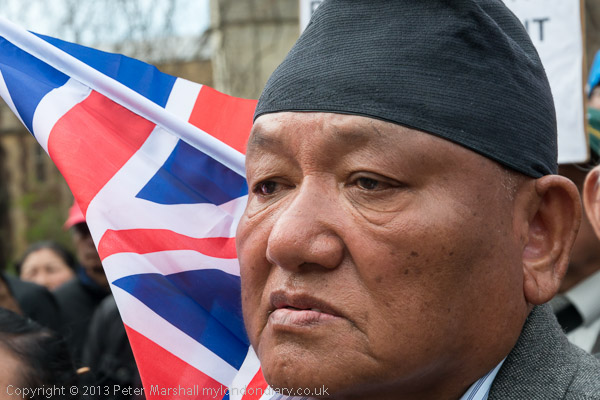
It’s often hard to know why I photograph a particular person, but this man at the protest by Ghurkas opposite the House of Lords had a face I could not pass by. He has a strength and dignity and an expression that to me expresses the disappointment of these people who served in the British Army but have been rather poorly treated by successive British governments. You can read more about their protest in Gurkhas Call for equal treatment. It’s a relic of our colonial past that still embodies the kind of attitudes that were thought acceptable – and indeed hardly questioned – 198 years ago when the army first recruited in Nepal.

One small thing that annoys me about this full-frame – that is uncropped – image is the extra ear at the extreme right. It would be simple to crop while retaining the aspect ratio by taking just a little away from the top and right of the image, and the kind of thing I often do when ‘developing’ my images in Lightroom. Using optical viewfinders – even on DSLRs has seldom if ever been precisely 100% accurate, even on cameras which have claimed this,  and the D700 only claims to show approximately 95% of the horizontal and vertical frame coverage – which means that around a tenth of the image area is invisible. Things like this extra ear can creep in and I feel entirely justified in cropping them out, despite my commitment to the uncropped image.

My commitment is not an absolute one and I’m certainly not a purist in this respect. I think trying to work in this way leads to better seeing, but when occasionally I get it entirely wrong I’ll crop if I have to. Very occasionally I’ll even realise I should have framed an image in portrait rather than landscape format and do so after the event. But mostly what I do isn’t really cropping, but a tiny bit of ‘trimming’.

Using the D800E as a DX camera, with the area around the image ‘greyed out’ (CS a6 set to ‘Off’) has several advantages, allowing you to frame in a similar way to using a rangefinder. But also, so far as I can tell, the framing seems 100% accurate. For most purposes the smaller image file at 16Mp is also a benefit, and – at least with FX lenses – you have the choice of switching to a larger 32Mb file for those few cases where it is an advantage. The disadvantage is of course the smaller image size in the viewfinder.

It has always amused me that the staunchest advocates of the uncropped image have been those who have used cameras with some of the least accurate viewfinders. I was a great fan of range-finder cameras, owning and using a number of them over the years – Leica, Konica, Minolta etc, and none of them were particularly precise – and with some lenses spectacularly wrong. And of course even that great photographer and advocate of the full frame – to the extent of producing images including the sprocket holes where he had loaded the film incorrectly – cropped what is perhaps his most famous image.

________________________________________________________

My London Diary : Buildings of London : River Lea/Lee Valley : London’s Industrial Heritage

All photographs on this and my other sites, unless otherwise stated are by Peter Marshall and are available for reproduction or can be bought as prints.

To order prints or reproduce images

________________________________________________________
Time to Bring Home Shaker Aamer

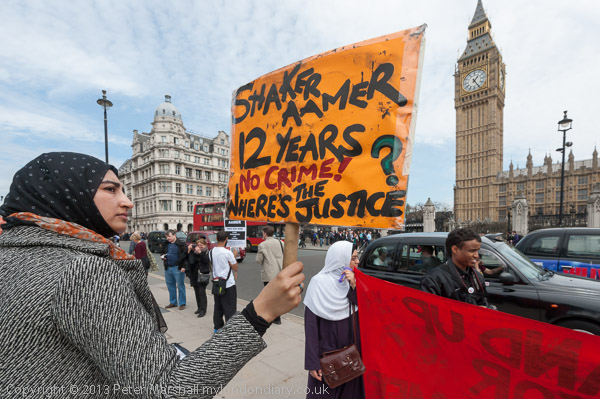
Shaker Aamer should never have been held by the Americans. He should never have been tortured at Bagram. Guantanamo should never have been set up, and he should never have been kept there for more than 11 years. But he is still there, and still being tortured. Like many of the others held there he has been cleared for release. Like most he is now on hunger strike.

I’m one of the 117,387 UK citizens who signed a petition on the government web site calling for his release, which led to a debate by MPs in Westminster Hall on 24 April.  And while I’ve photographed and written about numerous protests calling for his release and put this on the web, it is only in recent weeks that the campaign to release him has really emerged in the mass media in the UK.  Obviously I’m pleased it has, and hope that it will lead to real action by the government, rather than them supporting the case in public while in private agreeing with the US government that releasing him to the UK would bring out into the open a great deal of evidence about both US torture and the complicity of our security services in this.

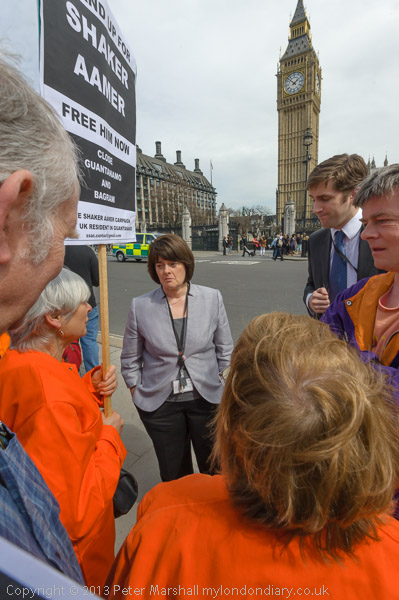
I wasn’t there for the debate, nor for all of the protest, leaving shortly after it began to photograph a protest in the City, and only getting back a short while before it finished. But I was please to be able to hear and photograph Conservative MP for Battersea Jane Ellison, one of a number of MPs who came out to talk the the protesters. Aamer’s family live in her constituency and she has given her support to the campaign and hopes to be able to have a debate again shortly inside the House of Commons.

Continue reading Time to Bring Home Shaker Aamer

Down Three, Up One

When I get news of a forthcoming protest – from any of a wide range of sources – I put it in my diary and usually on the night before I copy down the relevant details onto a small sheet of paper, usually around A6 in size to put in my pocket when I go to take pictures. Sometimes I need to do a little research, both to find out what the particular event is about, and sometimes to check on travel times, ways to travel and so on. Some days very little seems to be happening, and on other days events in London are just like the buses, they all come along together.

Saturday April 20th was one of those days when quite a few things were happening (or were supposed to be happening) and it wasn’t physically possible for one person to be at all of them. So I’d spent some time deciding which it was feasible to cover, thinking about when I would need to leave one event to be at the next one in time to take pictures and how I would travel between them.

On paper it looked good, and I left home hoping to cover five events, four protests and one of the more commercial events that take place from time to time in Trafalgar Square, that Saturday to celebrate St Georges day (which was actually 3 days later.)

The first event was an annual march to remember the Armenian Genocide, which began with a massacre on April 24, 1915 when the Turkish authorities arrested around a thousand leading members of the Armenian community in the capital city of Constantinople (now Istanbul) and murdered them. Turkey still hasn’t acknowledged its role in the atrocities which continued off and on for the next 8 years with around 1.5 million Armenians being killed. The Armenians demand that Turkey recognise it as a condition of entry into the EU, and also want it to be on the UK National Curriculum.

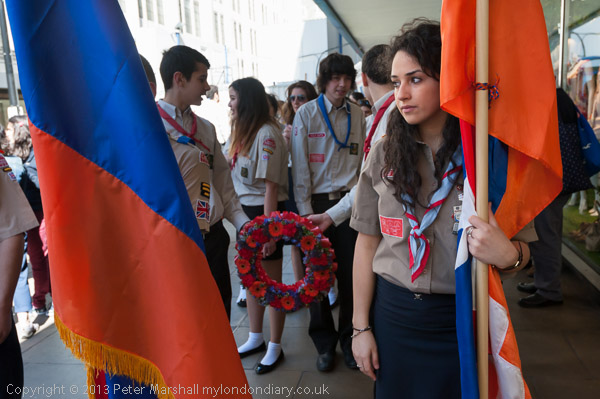
I felt that the picture I took while people were meeting for the march on a side-street on Oxford St somehow fitted well. The national flags, the uniforms, the wreath and of course the expression on the young woman at the right of the image, which for me was one of yearning or longing. Although I doubt if it was for her lost country, it served the purpose.

Technically, the lighting contrast in the scene, with the important figures in the shade and bright sunlight on the background was pretty impossible. Working with flash was out of the question as it would have alerted her and the others to what I was doing. This wasn’t the first frame, but I think the third of the situation,and with flash that girl and probably the others would have been posing for me. giving a very different – and less interesting – image. I realised as I was taking it that it would need considerable post-processing to get the effect I wanted – and it was only just possible.

There was just enough detail left in the over-bright background for me to burn down, and just enough light on the foreground figures for me to work with, altering the contrast slightly and making things a little brighter.

I walked with the Armenians to their laying of wreaths at the Cenotaph – you can see the pictures in Armenians Remember the Genocide – and then left them to go back to Trafalgar Square, where St Georges Day was being celebrated officially. But  it didn’t seem to be celebrated at all, or at least not in any interesting way – so after walking around the square and taking a good look at things I crossed that off from my list of events.

Next was a protest against the bedroom tax, also planned for Trafalgar Square, which I expected to take place on the North Terrace, and I sat down on the wall in front of the National Gallery and waited for it to start. By the time I’d finished my sandwiches, there were two people present, along with a pile of placards, and it was around half an hour after the advertised time. I decided it made more sense to do something else, and took the tube to South Kensington, where supporters of the newly elected President Maduro were preparing to protect the Venezuelan embassy from his opponents.


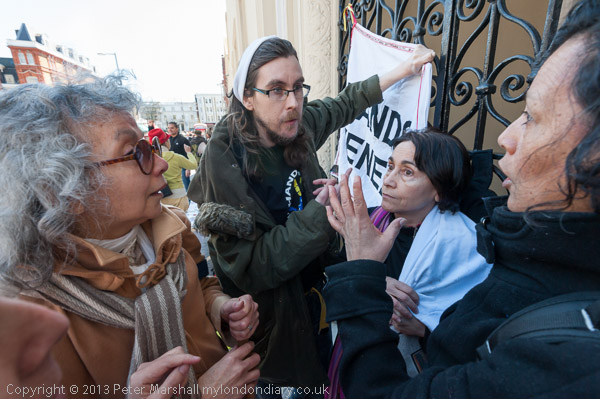
Supporters of President Maduro discuss how they should protect the embassy

There were around 30 people there when I arrived, with a megaphone and the embassy wall had a number of posters and banners stuck to it.  The opposition were due to arrive in a few minutes, and there were only a handful of them present, but soon more began to arrive, and an interesting situation developed, with considerable arguments between the two groups, who faced each other a few yards away.

The police were rather late to arrive on the scene, but came eventually and stood in a line between the two groups, though I don’t think their presence was necessary as neither side seemed likely to become physical. Shortly after this I left, intending to return later, as I expected a march to be taking place back in Westminster.

On my way back I took a second look for the bedroom tax protest. Although there is considerable outrage against it, there seem to have been many small uncoordinated protests rather than any large ones in London, and the one I was looking for was still too small to be seen! Nor could I find any sign of the march I had been expecting – so that was the third disappointment of the day.

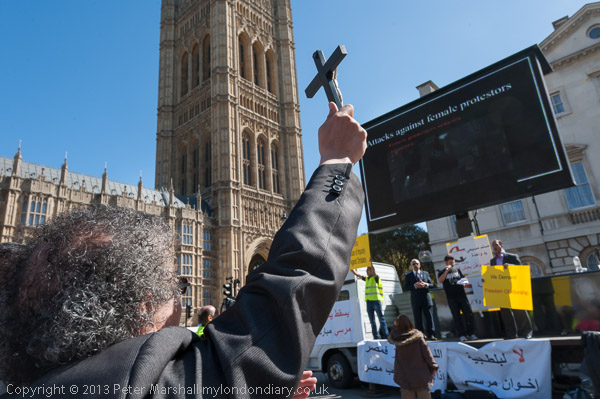
But then I came across a protest – Copts Say End Egyptian Persecution – I’d not known about, taking place in Old Palace Yard, where Copts living in the UK were protesting against the new regime in Egypt, led by President Morsi of the Muslim Brotherhood, which they accuse of being behind recent attacks on Copts, including an attack on St Mark’s Cathedral in Cairo when a funeral was being held of five men killed in earlier violent clashes in the northern suburbs of Cairo. This was something I knew little about but was pleased to be able to report. The speaker who got most applause while I was there was an Egyptian Muslim who spoke about the need for the different communities in Egypt to live and work together.

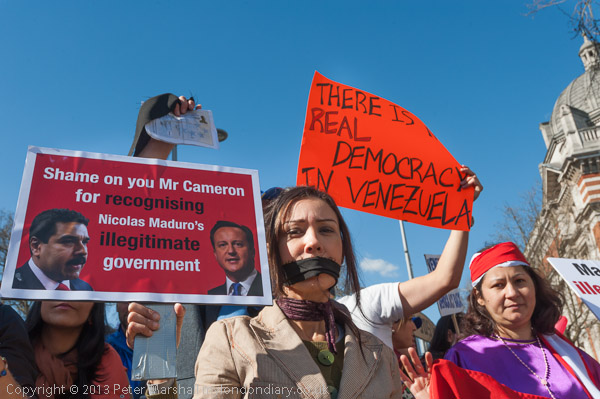
As that protest drew to a close I hurried back to South Kensington, where both sides had increased in numbers, with many more of the opposition to Maduro having turned up and making a lot of noise.  Most Venezuelans working in the UK are from the middle classes who feel threatened by the popular reforms that President Chavez brought in, and they had come to make their opposition clear.

But although they had the numbers, the supporters of Maduro – for me at least – had the winning argument. Although the margin by which Maduro won was smaller than expected, it was still a majority, and rather more convincing than that by which many other democratic leaders have been elected in recent years. More in Stand Off at Venezuelan Embassy.

From my original five stories, I’d only managed to cover two. It isn’t unusual to find the occasional event that only exists in the imagination of those posting the details on the web, or that turns out not to be worth covering, but things are not usually that bad. Fortunately it’s also not unusual in London to find things happening that I knew nothing about as I’d done on this occasion, and I felt quite pleased with my day despite the disappointments.
Continue reading Down Three, Up One

Vedanta Foiled?

I wasn’t sure there would be a demonstration outside Vedanta’s Berkely St offices or not. It had been planned to coincide with the Indian Supreme Court giving a verdict on their appeal against a 2010 order by the Indian Ministry of Environment and Forests (MoEF) which had stopped them mining the Dongria Kondh’s sacred Niyamgiri Hills.   Although the court didn’t give a final verdict, the ruling that they made was generally seen as a defeat for Vedanta, putting the decision back to a consultation with the local councils of the tribal people. So long as Vedanta are prevented from undermining this process, it seems almost certain that they will reject the mining.

So I wasn’t sure if anyone would turn up for what would seem to be a possibly premature and rather muted celebration rather than a protest, and wondered whether it was worth going.  Fortunately I did, and so did a dozen or so protesters. Unfortunately almost as soon as the protest started, so did the rain, and with a vengeance. The protesters crowded with their banner in front of the window where they were sheltered by an overhang of the floor above, but I’d only made a handful of images, and it was coming down too hard to stand in the open in front of the banner and take pictures.

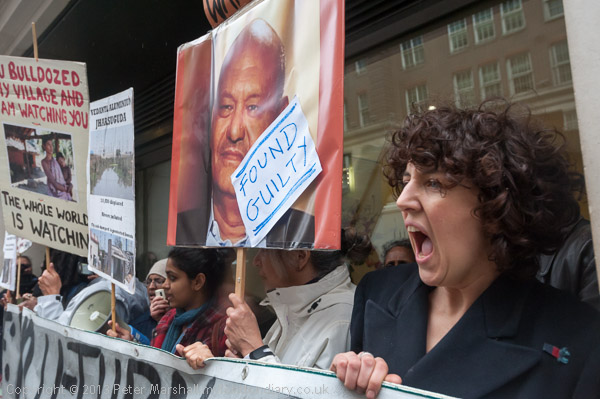
All I could do was to take shelter in a nearby doorway and wait for the rain to stop. Eventually it slackened off a little and I came out to take a few more pictures, trying to keep close to the line of protesters because it was just a little more sheltered. I might have got as close to the nearest protester anyway, but the rain perhaps served to push me a little closer, and I think it worked quite well. The woman’s mouth stretched wide open is the key element, but the angle puts the placard with the large headshot of Vedanta boss Anil Agarwal with the added caption ‘Found Guilty’  in the centre of the image, with the other placards carrying on from it. It’s perhaps a shame that the text of the end placard isn’t entirely visible, but I think there is enough to get the point of it. It may even be better to leave the viewer to work a little than make it too easy. More at: Supreme Court Nyamgiri Decision

Continue reading Vedanta Foiled?

Too Much Control?

Perhaps there are good reasons why a photographer should sometimes want to limit the flash sync speed of their camera to – for example 1/60s – but I can’t for the moment think of a single one. Any suggestions are welcome.

Of course using slow shutter speeds with synch is at times a useful technique, but something quite different. There is no problem in using flash with a synch setting of 1/250 on an exposure of 30s – and the results would be identical to those with any other synch setting.

Back in the old days, slow sync speeds were often a problem when using flash, particularly once we moved away from flash bulbs to electronic flash. Back in the 1970s, the cameras I was using – Leica M and Olympus – had horizontal travel cloth shutter blinds in its focal plane shutter that could only manage 1/50 and 1/60 respectively. This slow X-sync speed was one of the limitations of the OM series (including the OM4 – my favourite 35mm film SLR – and I still own two, though it’s now probably ten years since I used them) despite its revolutionary (at the time) off the film through the lens flash metering which made flash so much more usable.

Cameras using vertical metal FP shutters had a shorter travel for the blinds and could also manage a faster movement, allowing higher flash sync speeds – often 1/125 in the 1980s, though at the expense of louder and more noticeable shutter noise.

The Nikon D700 (and D800E) offers flash sync in normal X-synch mode at up to 1/250, with special FP modes of 1/250 and 1/320. But custom setting e1 lets you select synch speeds – down to 1/60th. It shouldn’t be confused with CS e2, which sets flash shutter speeds from 1/60s to 30s, as the slowest shutter speed that will be used in P or A modes when using flash.

For normal use on my camera I set e1 at 1/320(FP) and e2 at 1/60. I can’t see any point in using a lower synch speed than the maximum, and I’d like to be able to set a faster slowest speed than Nikon allows to avoid blurring in some images rather than have to remember to do this manually. For most purposes we can simply forget sync speeds now, as these cameras will also synch at higher speeds using ‘Auto FP high speed sync” with the SB800 and other units that implement this though the manual seems very confusing on this. But it just works, even at silly fast speeds like 1/2000. So why have a custom setting at all?

The last few of times I’ve been out working, I’ve been unable to get fill flash to work with the D700, getting over-exposure all the time. It’s taken me quite a while to work out why, though the answer was simple and obvious once I took the time to sit down and think about it. But in the middle of a fast-changing situation you don’t have time to think, and it wasn’t obvious that things were going badly wrong on the kind of occasional quick glimpse at the images on the back of the camera.

When I got home, I’d take a few test images and find that the camera and flash were both performing perfectly, and forget about it. Fortunately it hadn’t been vital to use fill, and I’d got by without it. But this morning I decided I really had to sort it out.

My first thought was that it was a problem with the flash (and I’ve had a lot of problems with flash units, with two needing expensive repairs and a third being being beyond economic repair in the past year.) So I started by resetting all settings on that. I made a few test exposures indoors and things seemed to be fine, so then I went outside where the light was considerably brighter. And noticed that when I turned the flash on the shutter speed dropped right down to 1/60. I couldn’t understand why, nor why their was a ‘HI’ in the control panel – and then I realised.

Most of the time I’ve used flash in recent weeks, a shutter speed of 1/60 has been more or less what I might have chosen if I’d been making manual settings. Possibly 1/125 or even 1/250. But the camera was still set at a high ISO and I was now in pretty bright light – the kind of conditions where I might want to use fill.

I’m sure I didn’t deliberately choose to set 1/60 as my flash sync speed, but possibly did so by mistake, thinking I was setting CS e2. Or just perhaps a load of electrons ganged up on me and decided to change it behind my back. It’s something that often seems to happen when I use the computer, and modern cameras are just computers with a few analogue bits tacked on.

But  I do wonder if the choice of sync settings is one that is there simply because it is easy for Nikon to implement and adds yet another ‘feature’ – even though it makes the manual fatter and understanding and using the camera tougher – or is there really some point to it?

City to Blackwall 1978-84


Millwall Inner Dock, 1984

Just published on Blurb:

City to Blackwall 1978-84 London Docklands 1
ISBN 978-1-909363-09-0


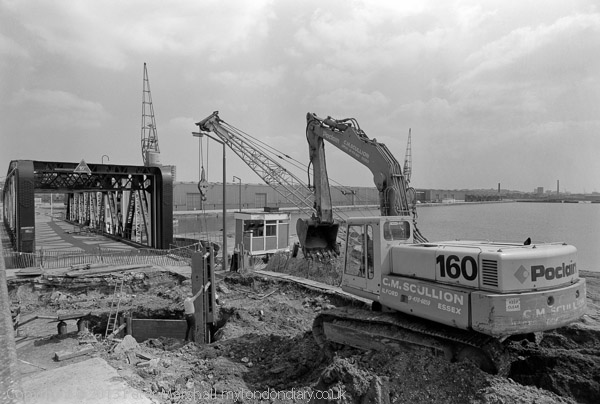
South Quay bridge and Millwall Inner Dock, 1984/

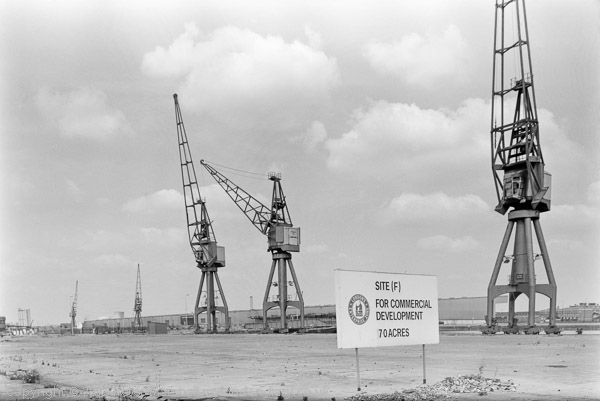
The late 1970s and early 1980s was an interesting time in London, especially in the areas where the docks which had been at the heart of London’s existence were closed down, left derelict and then began to be developed. City to Blackwall is the first of a short series of books looking at these changes through the photographs of Peter Marshall, and was made over around ten years from 1974-84 in a series of walks from the heart of the City of London, close to London’s first dock, through Wapping, Limehouse and the Isle of Dogs to Poplar and Blackwall.

80 pages, 87 black and white photographs.


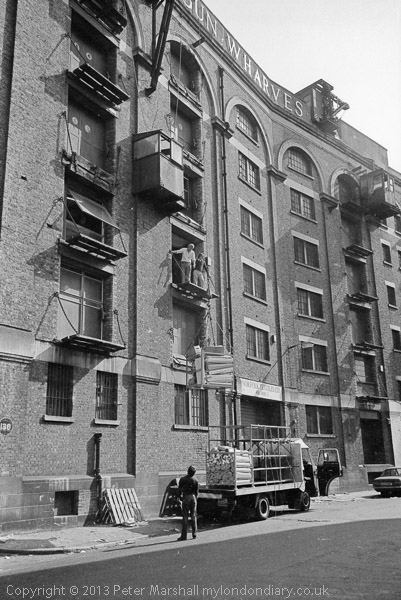
Gun Wharves, Wapping High St, 1981

Available cheaply as a PDF download (£3.99) or rather expensively as a printed paperback at £26.99 plus Blurb’s arm and a leg post and packing charges.


Limehouse, 1984

If you live in the UK, you can usually buy the print version of any of my books slightly cheaper direct from me (£25 inc p/p for most) but there can sometimes be a few weeks delay if I am out of stock as I need to order in batches to get a discount to pass on to you.


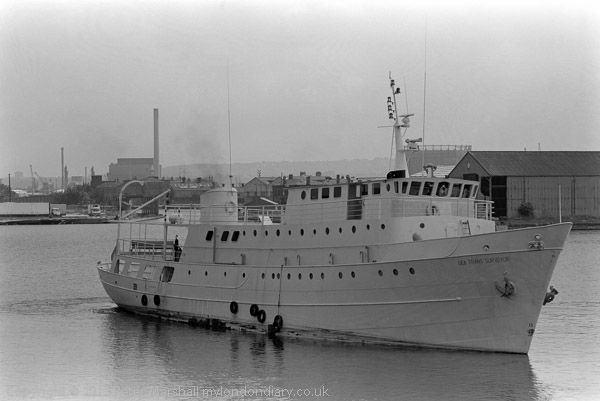
Sea Trans Surveyor leaves West India Dock, May 1984

I was photographing on Hertsmere Rd, roughly where the Museum of London now is, when men working in the dockside sheds on West India Dock invited me to come and photograph this ship leaving from the walkway overlooking the dock. I had a mug of tea with them and took a few pictures inside the shed and then walked out as the ropes were untied and the Sea Trans Surveyor cast off, turned around in the dock and made for the entrance. They told me it would be the last ship leaving before the redevelopment as the dock would be closed for some years. I took several pictures (perhaps 4 or 5 – film wasn’t cheap) as it left and two are in the book.

________________________________________________________

My London Diary : Buildings of London : River Lea/Lee Valley : London’s Industrial Heritage

All photographs on this and my other sites, unless otherwise stated are by Peter Marshall and are available for reproduction or can be bought as prints.

To order prints or reproduce images

________________________________________________________
ICP Infinity – David Guttenfelder

I’m not a great fan of awards ceremonies – and the nonsense over things like the Oscars, BAFTA and the rest really turns me off, but perhaps I’d make an exception for the ICP Infinity Awards, which don’t seem to suffer from the same kind of sycophancy, in-breeding and embarrassing acceptance speeches.

There are certainly a number of worthy winners each year (and sometimes one or two I find hard to understand) and this year is no exception. You can see a video presentation on each of the winners on Mediastorm, and I’d particularly recommend watching the video on David Guttenfelder  who won the Photojournalism Award – scroll down from that for the others. His isn’t a household name, even among photographers, but as a photographer for AP he has “spent the past 20 years of his life in some of the worst places in the world. He spent his 20s photographing bloodshed in Africa and his 30s reporting on the war in Afghanistan. Now the chief photographer for Asia, where he is primarily based in North Korea” and there are some fascinating images from there as well as a few which are perhaps more like we would expect from an AP correspondent covering official visits. As he says on the video, “the most mundane pictures sometimes are the ones that are the most powerful.”

I’ve not watched all of the other videos the whole way through, but I was also particularly impressed by Kitra Cahana, winner of the Young Photographer Award, and of course who could argue with the Cornell Capa Lifetime Achievement Award going to David Goldblatt – I’m only surprised he hadn’t already won it. His classic ‘On The Mines‘ has been on my bookshelves since it was first published in 1973, and I was pleased to see a revised version published last year by Steidl as the first in series on his work they are bringing out.

These videos were shown to the audience at the awards ceremony on May 1, and if you were disappointed not to get an invitation to be there in New York, console yourself that it’s probably better be able to watch them in the comfort of your own home, without any of the razzmatazz.

And thanks to one of my favourite photographers, Ami Vitale, who shared the link on Facebook with the message “David Guttenfelder is amazing. Beautiful story.”

The Marquis of Lansdowne

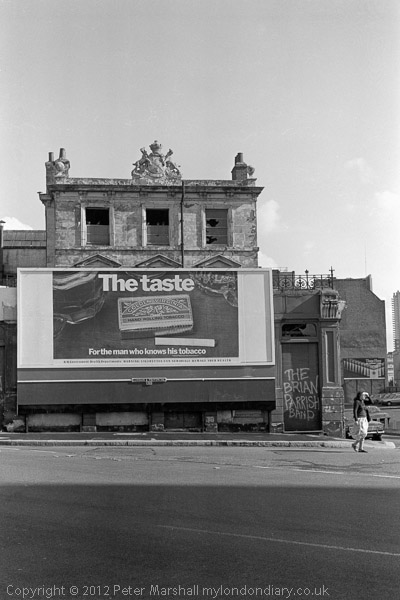
The Marquis of Lansdowne is not my name-dropping of a personal friend, but a former London pub, fortunately still standing in Hoxton, but not in ale since around 2000 (and possibly not a place I would have cared to frequent since it had a make-over as ‘Partners’ around ten years earlier.) Recently it has been threatened with demolition by plans for a  £13.2m expansion of the neighbouring Geffrye Museum.

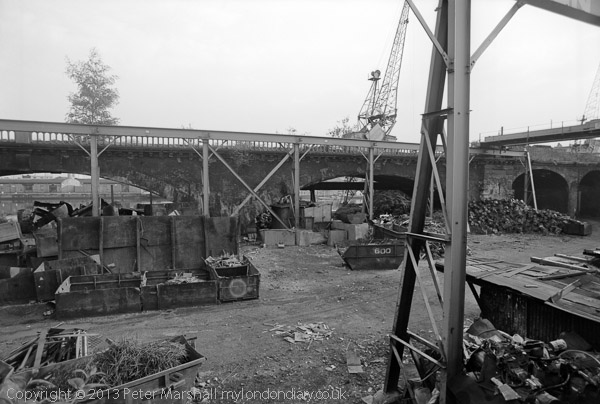
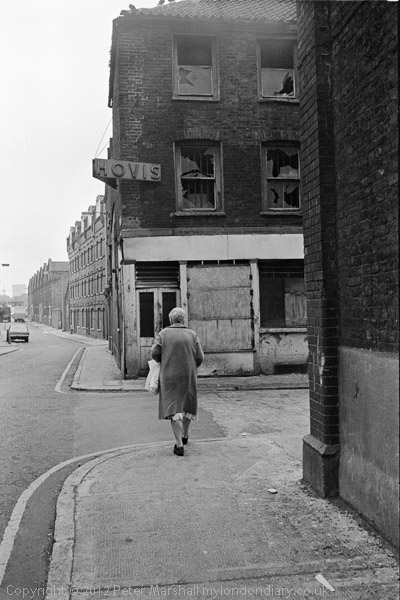
Back in the 1980s I began over a project to photograph the whole fabric of London, wandering in a fairly systematic manner through the capital rather than the rather freer approach of earlier years that you can see in my recently published ‘London Dérives‘, (and the images on this post come from it and the accompanying web site.) Most if not all of the pubs and many of the shops in this earlier work were derelict.

But my ‘Buildings of London‘ project, which began long before Google’s ‘Streetview’ made it somewhat redundant, was more conceptual than literal. Although I intended to look at most of London and went about it in a fairly systematic way, I had a clear focus on photographing not everything, but the interesting and the typical.  You can still see a few images from it in the web site I built in 1996, itself now a rather decrepit relic – seventeen years is a long time on the web (though I had to make a few changes to keep it working, and added a few pictures, it still retains the essentials of its 1996 design.)

I’m not sure if I ever photographed The Marquis of Lansdowne, though I will have looked at it, and at the now demolished ‘The Flying Scud‘ nearby on my walks in the area.  It would probably take an hour or two of searching through my files to be sure. It isn’t an outstanding building, but one that is very much typical of its age and certainly that I would be sorry to see demolished. You can see what it looks like now in an article in Building.co.uk by William Palin, a trustee of the Spitalfields Historic Buildings Trust and former Secretary of SAVE Britain’s Heritage.

So I was very pleased to see in Spitalfields Life that a long campaign which has included a feature in ‘Country Life’ (not a publication usually concerned with Hoxton) as well as a series of articles in Spitalfields Life and work by the Spitalfields Trust and others has resulted in the building being saved, with Hackney Council Planning Committee telling the Geffrye Museum to rethink their development plans to include this building.

I hope the Museum will see it as an opportunity to enhance its display of period rooms (well worth a visit) to include that of a genuine neighbourhood Victorian (though the building is a little older) pub, truly a part of the living room of many among the working class of the era in overcrowded neighbourhoods such as these.  Hopefully too it will be realistic enough to have some genuine beer on tap, although the current London price per pint is at least a month’s Victorian wage.

Indian Protests in Westminster

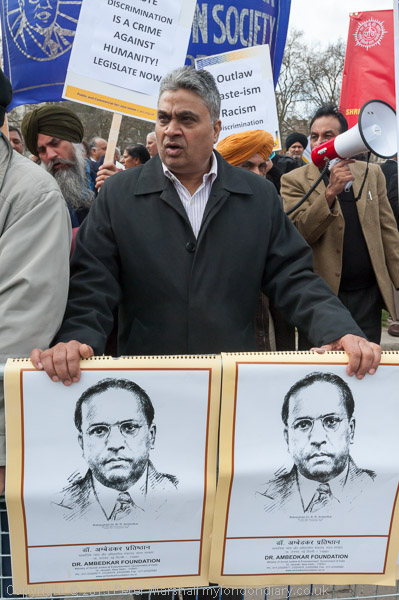
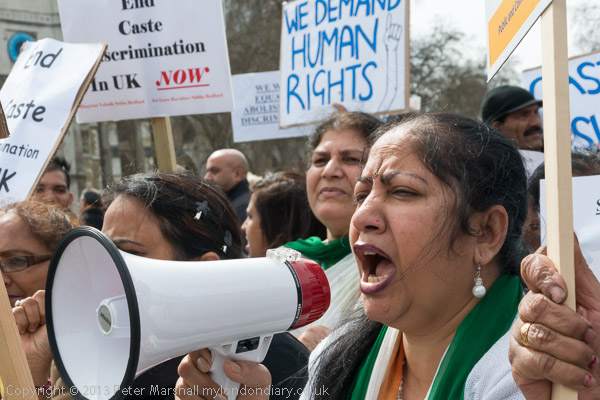
One of the great things about photography is that you meet people and learn things, and at the protest by CasteWatchUK and the Dalit Solidarity Network I learnt a little about Dr B R Ambedkar (1891-1956) which led me when I got home to find out more about him on the web – and you can read a little of what I found in Outlaw Caste Discrimination on My London Diary, with quite a few pictures from the event.

Through several friends over the years I’ve known something of the problems faced by Dalits in India, and it was good to be able to cover the protest about caste discrimination here in the UK, something I know has been strongly felt by some communities here, particularly the Ravidass, whose March against Caste Discrimination I photographed in 2009.

The government policy – perhaps based on advice from groups dominated by those in higher castes – to reject legislation and simply have an education programme called ‘Talk For A Change’ was overturned for the second time by the House of Lords, who on the day of the protest again voted for caste to be treated legally as an aspect of race. Around ten days later the government finally accepted defeat and tabled an amendment accepting this – good news for the 400,000 or so (though estimates differ widely) Dalits or ‘untouchables’ living in the UK who will soon be protected.

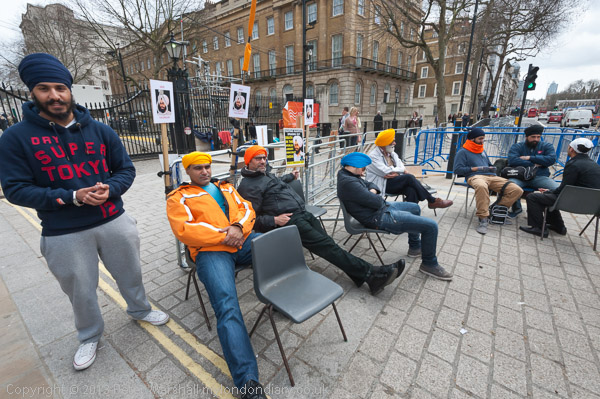
After photographing this protest, I walked up Whitehall to a group of Sikhs protesting opposite Downing St in a vigil calling for justice in India and an end to the death penalty and in particular to get the UK Prime Minister to argue the human rights case with Indian Prime Minister Manmohan Singh and to put pressure on him both to stop capital punishment completely in India and to prevent the hanging of Professor Bhullar, on death row in India for 18 years, whose execution is thought likely to be imminent.

Talking to the people there they told me that the police had expressed concerns about their presence there for the funeral of former PM Thatcher whose hearse was to pass along Whitehall the following morning. Later I was please to find that the police had not attempted to clear the protest, which was still continuing when I went past ten days later.

While it was easy to photograph the large and active protest by Dalits in Parliament Square it was harder to find a strong image with the Sikh vigil, and I wasn’t very happy with my images – in Don’t Hang Prof Bhullar. Without setting something up there seemed nothing much I could do, and setting something up would I think compromise the whole basis of my work. This is a vigil where nothing much happens most of the time, and my record of it shows nothing much happening. Though it doesn’t make good ‘news’.
Continue reading Indian Protests in Westminster