Hunting the Polar Bear

There was no sign of Aurora where the #Iceride protesters were gathering in the Victoria Tower Gardens, and the Greenpeace media people weren’t over helpful, though they did tell us to expect her coming over Lambeth Bridge. We went there and waited. And waited.
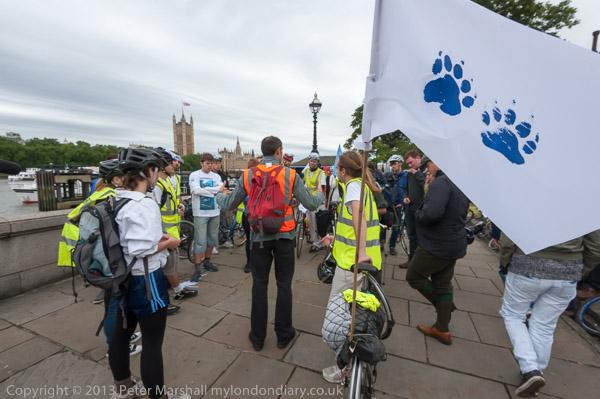

Paw marks but no bear

We found a group of #Iceride cyclists on the Albert Embankment, but they seemed equally in the dark. Then at last we saw a few Greenpeace stewards making their way across the bridge and finally they admitted they were on their way to the polar bear, and we followed them down the Lambeth Rd.
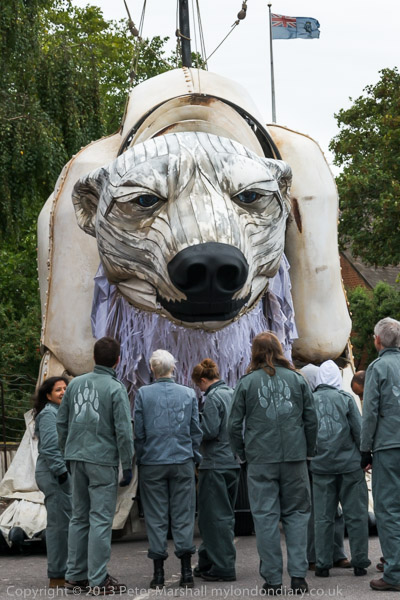
If I’d stayed on the train to Waterloo I would probably have spotted the giant bear in a yard next to the railway bridge, but on Sundays my trains call at Vauxhall, from where a bus took me directly to the advertised meeting point. But despite all the waiting we still got there before Aurora with its teams of pullers and crew left the yard for her slow journey to the Shell Centre.

It isn’t easy to navigate a 3-ton polar bear the size of a double-decker bus crewed by a team of twenty and powered by another 20 or so on ropes, and for a while it seemed touch and go whether Aurora would make it out of her lair and on to the A3203 or not. But eventually she was making her way down the Lambeth Rd to the roundabout by Lambeth Palace.

The plan had been for her to go over Lambeth Bridge and past Parliament, returning to the South Bank and the Shell Centre over Westminster Bridge. I’d already decided a key image would be on the bridge, with the Houses of Parliament behind – as had probably every other photographer out that day.

But the weather had robbed us of our cliché. High winds and a forecast of heavy rain meant the team had decided it was unsafe to cross the bridges, where strong winds blow unchecked down the river, and Aurora was to take a shorter direct route on the south bank.

By the roundabout at the ‘south’ end of Lambeth Bridge (the Thames actually runs roughly west to east, so this is a kind of liturgical south, being on that side of the river which is flowing roughly north here) on the is a large and I think rather ugly block of flats (what estate agents term a prestigious development) called Parliament View. For £3000 per calendar month you can rent a flat there with a perfect trajectory to the Houses of Parliament only around 650 yards away, though I suspect would be renters get a fairly strict vetting from the nearby MI5 in Thames House just across the river. But I went for the cheaper option of trespassing on the steps and garden area around its front.
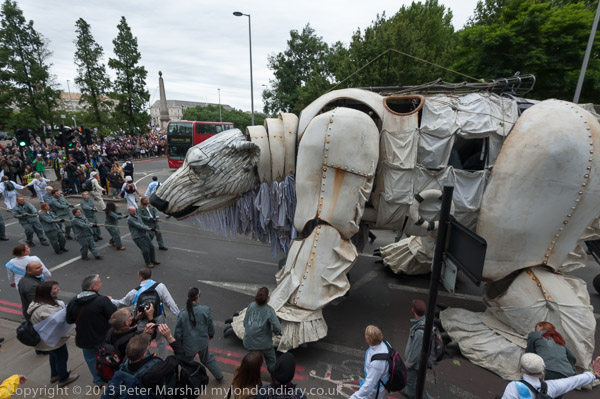
Which was fine except for a little street furniture when Aurora came down the Lambeth Road, and I moved into position for a picture as, together now with a large crowd of followers who had swarmed across Lambeth Bridge she turned the corner to go in front of the river frontage of the HoP.
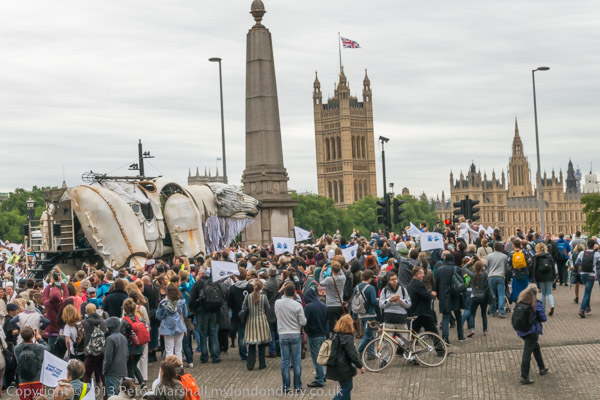
She was coming up to the right position and I took a few pictures. But at the critical moment, Aurora disappeared behind a No 3 double-decker bus, waiting to get on to the roundabout. And waiting, while I tried running back and forth to get a better view. It almost happened but not quite. It wouldn’t quite have worked event without the bus, as the bear had turned around just a little too much before coming in front to the building.

It was time to photograph some of the people who were following Aurora, some in bear costumes and other fancy dress, as well as the team of three dancers who were in front of the bear. At the Westminster Bridge roundabout we got another glimpse of Big Ben in the distance, but it didn’t make a great picture for me. There was a little too much harassment by police and stewards to make it easy.
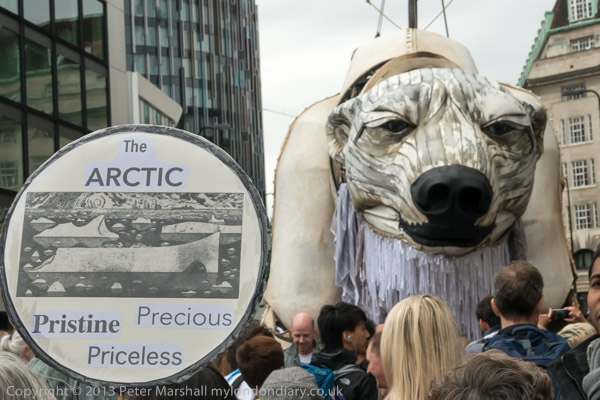
But finally on York Road, close to the end, I made an image that satisfied me. This was an event with very few placards, but I saw rather a good circular one, and an idea for a picture.

It wasn’t easy to get and keep in the right position in the crowd, as both bear and placard were moving, the placard rather more erratically. It was easy for people to get in the way too, and they did. But the main problem was the difference in size so I had to keep the two at very different distances and zoom to frame.

I took 21 frames working at the idea – the best was frame 16. The focal length needed varied from 39 to 99mm (equivalent) with the 18-105mm on the D800 and was 93mm equiv on the image above. Working at ISO800 I had closed down the aperture to f14, giving me a usable shutter speed of 1/200 but not quite enough depth of field. The placard is sharp, but the bear is just out of focus. I decided it was sharp enough for the image to work (with just a little help from Lightroom ‘Clarity’.)

There were some interesting moments at the rally at the Shell Centre, with some chances to use both the 10.5mm fisheye and the 70-300 at up to full stretch (45omm equiv) and you can see these at Aurora tells Shell – Stop Arctic Drilling.

Continue reading Hunting the Polar Bear

Wembley Arches

I hadn’t gone to Wembley to take photographs, but to go to the opening of a show by an old friend in a community arts centre. It was getting dark as I ran across the road from Wembley Park station and jumped on a bus.

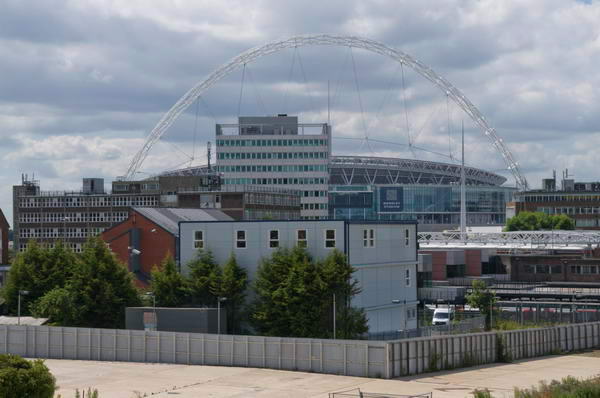
I’d come from photographing a couple of protests, one by Sunni Muslims opposite the Iranian Embassy with Anjem Choudary – Iran ‘Release Sunnis, Don’t Hang Them’ -and a larger event in front of the National Gallery in Trafalgar Square against cuts in funding for the Arts – Human Chain over Arts Cuts, so I was carrying my camera bag, and quickly pulled out the D800 to take a picture looking down Olympic Way from the top deck.

It’s a view that certainly benefits from the extra height, and I’m always disappointed when going by bus if the service isn’t on a double-decker, as the views are generally so much better. I don’t much like the new Wembley Stadium and haven’t ever photographed it properly, though it is certainly a landmark that can be seen from many places in West London.

The only other picture I can recall taking was from the roof of a nearby building that was being occupied against the building of an unwanted academy school in 2008. Perhaps one day I’ll go and photograph it properly.

By the time I left the exhibition opening, fortified by a couple of glasses of red wine, it really was dark. Again I got on the top deck of a bus, and again saw a view with arches, though one that seemed rather more interesting. Its rather a pity that Wembley Stadium station doesn’t get more trains.

There were after all three arches, not just one (you can see just a little of the stadium arch at the left too.) But really it was the colour that caught my attention.

Of course many photographers have worked taking pictures from buses, including an interesting series of panoramic images of London High Streets by another of my friends, Mike Seaborne. And I – like others – have taken pictures of people on buses too.

But there are problems in taking pictures through bus windows. Bus companies don’t generally clean them very often, and while one can wipe the inside, the outside windows on the top deck are too high even if you could get the driver to stop while you gave them a polish. All you can do is to choose your seat carefully and then put the camera lens close to the cleanest patch you can find.

Vibration is a problem if you actually let the camera lens rest on the glass. Some bus windows shake so much it must be a design feature. Keeping a gap between the solid parts of the camera and lens and the glass is essential unless you like a bit of blur.

But if the camera lens isn’t on the glass you will get unwanted reflections. You can see a little at top right of the top image on this page.  I generally remove the lens hood to get the lens closer and hold around the lens with a hand which can rest on the window but absorbs the vibration while cutting down reflections. A better solution which I used to use was a rubber lenshood.

It’s hard to avoid reflections unless you work more or less perpendicular to the glass, and working at a close distance cuts down the effect of spots on the window.

I spend quite a lot of time travelling in London on buses, not least because I now can travel free, while on the tube or overground I have to pay. But it’s generally a more interesting way to get around, though often rather slow. I’ve often thought that when my legs get too tired to walk much (and I think they are wearing out fast) I might spend some time photographing London from the bus.

Free Sinyakov

In Russia, Conflating Journalism and ‘Hooliganism’’, posted on the New York Times Lens blog is an article by Steven Lee Myers about photographer Denis Sinyakov,  the Moscow-based freelance photographer who was arrested when Russian soldiers illegally seized the Greenpeace ship the Arctic Sunrise on the high seas on September 19.  All of those on board, including Sinyakov and were initially charged with piracy. On 26 September a court in Murmansk ordered he be put in  preventive detention for two months, according to Reporters Without Borders because ‘he “often travels abroad” and might try to elude the authorities’.

The Russian prosecutors have since reduced the charges against him and the other 29 arrested to  hooliganism, which still carries a maximum sentence of 7 years, and they could be held in jail for up to 18 months before the case comes to court.

Reporters Without Borders comment:“

Sinyakov was arrested while working as a journalist and his detention constitutes an unacceptable violation of freedom of information,. By investigating this photographer and the Greenpeace activists he was accompanying on such an absurd accusation as piracy, the Russian Investigative Committee is criminalizing both journalists and environmental activism.

They report Sinyakov’s speech to the court:

“This ‘criminal activity’ is journalism and I will continue to practice it […] Greenpeace is an organization with a 40-year history and is well known for its activities. But I don’t work for it. I am a journalist. You can see my photos in the media in Russia and all over the world. All my equipment has been seized. My only weapon is my camera.”

Sinyakov worked as a photo editor and a staff photographer at Agence France-Presse (2004-2007) and at Reuters (2007- July 2012) when he went freelance to be able to concentrate more on the stories that interested him “on the environment, human rights, politics and the economy.” According to the NY Times post, the Russian news agency Lenta.ru have provided a letter for the court that he was accredited with them.

Those who can read Russian can read his ‘Entries from Jail‘ (Записи из СИЗО) on his web site. All of us can support Sinyakov and the rest of the Arctic 30 by sending a letter to our Russian embassy from the Greenpeace site. Protests are also being organised outside many of them, including one in London this evening.

Kieron Bryan, a British freelance videographer who previously worked at The Times, the Mirror and Current TV,  leaving The Times in January to pursue freelance work, is also among the 30 arrested. He was employed by Greenpeace on a short-term contract to document the organisation’s work on Russian oil exploration in the Arctic Circle. The BBC reported today that his family are hoping to fly out shortly to visit him in prison.


Secular and Sacred

Fortunately the weather began to clear up soon after I left Lewisham, catching the train back to London Bridge and then the tube to Westminster. And although I was too late to photograph the 6th annual Secular Europe Campaign march, I was there in time for the rally opposite Downing St.

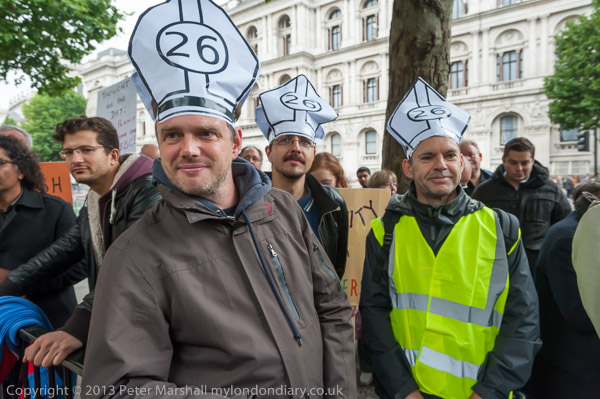
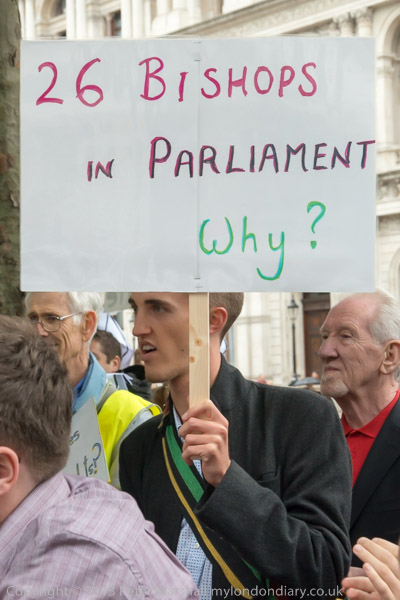
Visually the most noticeable thing were the paper hats worn by some of those taking part, in the shape of a bishop’s mitre with the number 26 on them. The point was perhaps made more clearly in a placard.

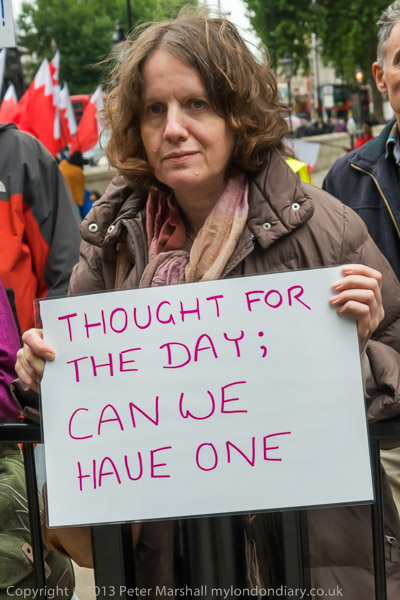
Though my favourite poster, as a regular morning listener to the ‘Today’ programme on my radio alarm, was one saying ‘Thought for the day; can we have one?’.

Although my alarm is set for much earlier, it’s nearly always ‘Thought for the Day’ which actually drives me out of bed, and I seldom hear all of this three minute interlude in the programme, though there are just a few that make me stop and listen before I rush to the bathroom. Some of them – or what I hear – strike me as pretty secular in any case, as is most of the rest of the programme, and if what I’m hearing from the speakers as I take some pictures is representative of what their ‘Thoughts for the Day’ might be, I’d be in real danger of going back to sleep.

I left the Secular Europe Protest sooner than I needed, as there seemed little chance of good pictures and a certainty of getting rather bored. I’ve no love of the established church, and certainly in favour of secularism so far as our laws are concerned, but can’t get worked up about Bishops in the House of Lords, who generally seem to do at least as good a job as the rest of that unelected body. Tackling class and elitism and the entrenched power of a small minority seem far more important issues and being anti-religious as those I heard seemed to be seems rather a matter of ‘bashing the bishop’. An activity that of course has its place.

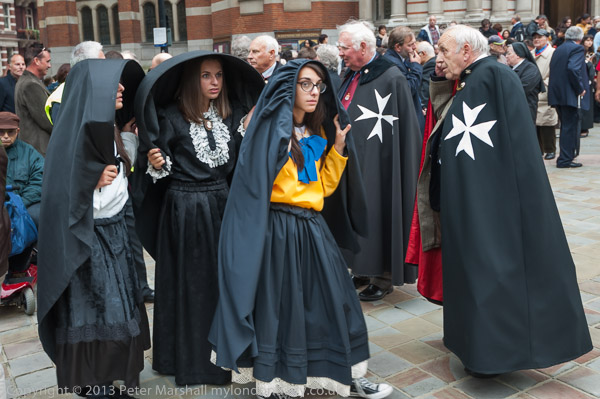
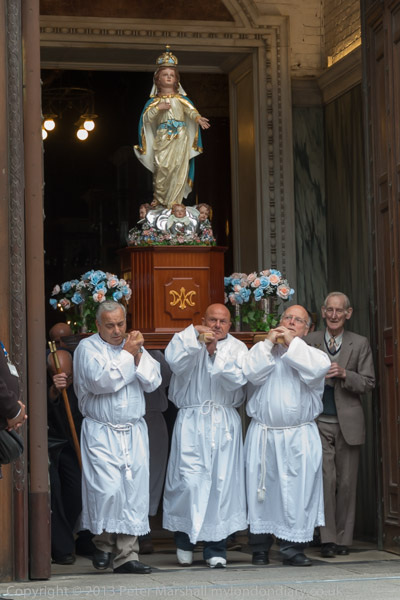
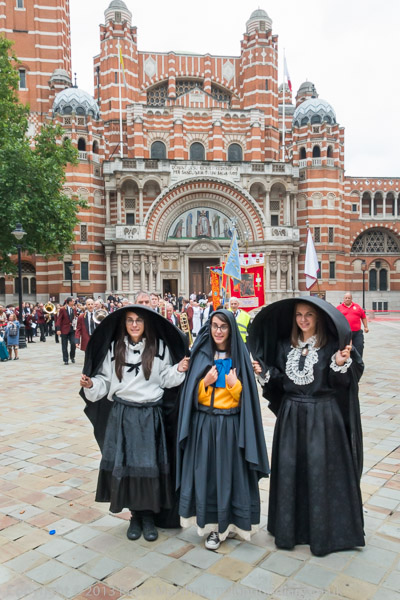
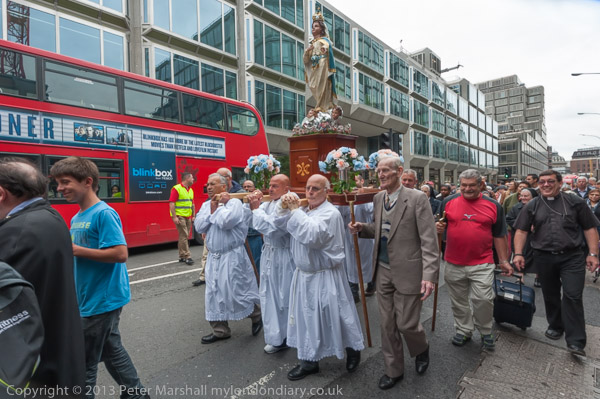
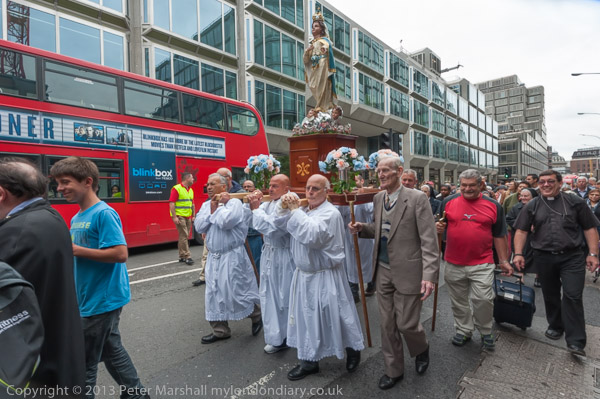
I wandered slowly to my next appointment, arriving early, and having to wait a very long time outside Westminster Cathedral as the web page for the event had misled me about the time that the Maltese would emerge from their celebratory mass for the Malta Day Procession procession to make their way carrying the rather hefty statue of the Bambina  to the Sacred Heart Chapel of Ease in Horseferry Road.

I’m not a fan of the Catholic Church, though it is a very mixed organisation, parts of which seem not to have move on since the Spanish Inquisition, while others are organising some of the more radical movements in South America. Perhaps too I still bear a personal grudge against the Maltese branch of the church, since my earliest girl friend was Maltese, her uncle a bishop. When he heard she was going out with a non-Catholic she was immediately shipped back from England to Gozo. It was a very long time ago, and I think I’ve got over it!

But while I don’t share their religion, visually the event was far more interesting. I particularly liked the view of the statue being carried out of the cathedral door.

And in its peculiar way, Westminster Cathedral is a quite splendid building which makes a good background.

I had a few technical problems, partly I think because I got a little distracted with someone talking to me. I’m generally not very sociable and need to concentrate on the job when I’m making pictures and being interrupted a lot really does put me off my stride. So a few exposures were way out – probably because of all the black cloaks and those strange hoods worn by the girls. Possibly I had the camera on ‘spot’ metering, which is fine and precise so long as you pick the right spot, but can be disastrous if you are not thinking.


Image before crop and manual processing

And for the final few frames I managed to knock the lens hood on the 16-35mm slightly out of position, getting a little total vignetting at top right and bottom left. Small enough to be easily missed in the viewfinder, but annoying, though in this case fairly easily dealt with.


Image after crop and manual processing

But its a shame that Nikon didn’t design a better bayonet fitting for their lens hoods and make them slightly more rigid. Most days when I’m out taking pictures I find myself bending down at some point to retrieve a lens hood that has self-detached.

Continue reading Secular and Sacred

Capa 100

It probably hasn’t escaped your attention that Robert Capa, or rather Endre Friedmann was born 100 years ago on October 22, 1913, as there have been a number of newspaper articles about him and this anniversary.

Apparently while at school in Budapest he gained the nickname cápa – Hungarian for ‘shark’, and he used this in a scam when having problems making a living in Paris in the mid-1930s. To charge more for his pictures he invented an entirely mythical ‘famous American photographer’ giving him  de-accented form Capa as a surname because of its similarity to the name of US film director Frank Capra, whose 1934 film It Happened One Night had won five Oscars. Friedmann chose the first name ‘Robert’ because he thought it typically American (and he didn’t at the time know that ‘Bob’ was a shortened form of the same name.)  He, by now calling himself André Friedmann, posed as the famous photographer’s ‘darkroom boy’, while his partner, photographer and picture editor Gerda Taro (born Gerta Pohorylle), became Robert Capa‘s agent, insisting on double the normal fees for the work of this famous photographer.

Friedmann was soon caught out, as Gerda tried to sell one of the editors who had been paying over the odds for Capa’s work some pictures that he had seen Friedmann taking.  But Lucien Vogel of Vue was I think amused by the ingenuity as well as impressed by the quality of the images, and sent the two photographers to cover the Spanish Civil War, with Friedmann now adopting Capa as his own name.

I’ve just spent a fruitless half hour searching for my copy of a book on Capa produced long ago by the ICP (International Center of Photography) in New York, a body founded in 1974 by Robert Capa’s brother Cornell Capa to keep the work of his brother and other ‘concerned’ humanitarian documentary photographers alive, which has a number of Capa’s own stories in it, as well as probably the best selection of his pictures.

I’ve also been listening to a broadcast recently discovered and available on the ICP site that Capa made on a morning talk show ‘Hi! Jinx.’ in October 1947.  It is the only known recording of his voice, for although Capa was known as a great story-teller, this was apparently his only appearance on radio and he was never interviewed for television. He came on radio to promote his  autobiographical novel’ Slightly Out of Focus but much of his talk is about the trip he had just made to Russia for the forthcoming A Russian Journal, with his pictures and a text by his travelling companion John Steinbeck. Both books are available dirt cheap second-hand, presumably meaning they sold very well.

Autobiographical novel is a good description of ‘Slightly Out of Focus’, as Capa seems seldom to have let sticking the absolute facts spoil a good story and many grew considerably with the telling. The recording contradicts the description of his mode of speech by some friends as incomprehensible ‘Capanese’. In the interview, Capa, a considerable linguist who spoke Hungarian, German, French, Spanish, and English, shows himself to be clear and highly articulate in what ‘became his dominant written and spoken language’ by 1941, English.

It’s certainly interesting to hear Capa talk about his work, and in particular how he made the picture that made him famous, the 1936 ‘Falling Soldier’ . He says he had no idea what he had taken, holding his camera above his head and pressing the shutter, and only knew he had taken a great picture later. The ICP comments, ‘He says, “The prize picture is born in the imagination of the editors and the public who sees them.” It is the only public comment we have directly from him about this famous image.’

Those who are in Korea, Hungary, Italy, Japan, Mexico, France and of course New York can visit shows that are a part of the centenary celebrations, and earlier this year the Atlas Gallery in London put on a show of Capa’s work. Probably the best place to see his work on-line is at Magnum Photos.

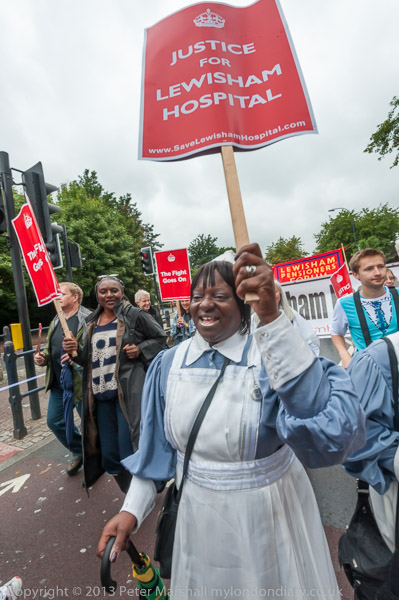
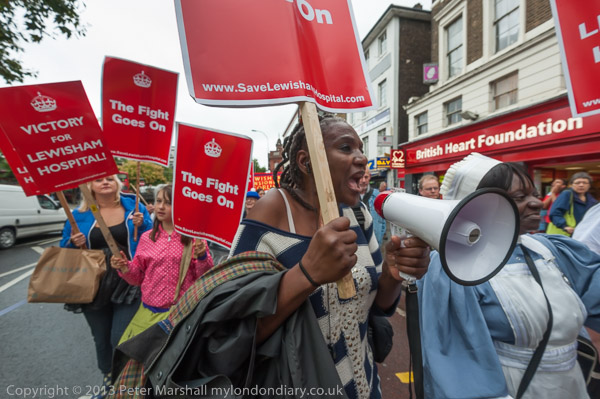
Lewisham Victory Parade

It was a shame that it was such a damp and rather chilly day for the Save Lewisham Hospital Campaign‘s Victory March. Perhaps rather more would have come on a nice day, and it would certainly have been more pleasant both to take part in and to photograph.

Fortunately the rain slackened off a little, and people could march without umbrellas, but the atmosphere was still a little dampened.

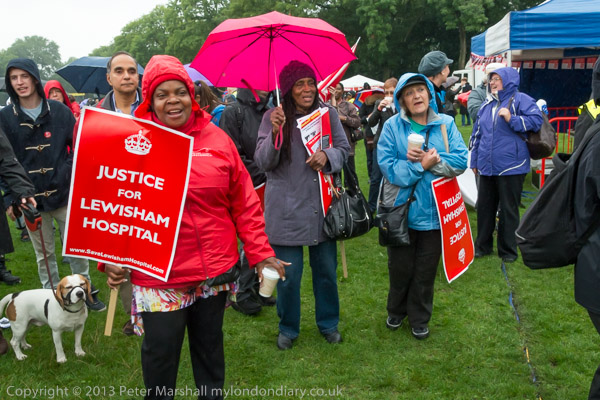
Though the umbrellas were up again for the fair at the end of the march, and it wasn’t really the weather to be dancing on the grass in Ladywell Fields.

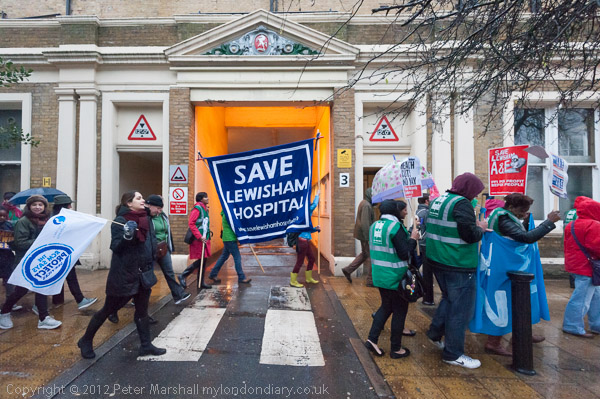
Or even like these people, standing watching others dance.  It really was a shame, because the Lewisham campaign – which brought a huge crowd out onto the street on another rather cold and damp day last November – see Save A&E at Lewisham -Hospital and had us all wading in the mud at Mountsfield Park in January – Save Lewisham Hospital  may not always have had the weather on its side but has been very successful.

Although the minister decided to appeal when he lost the case in court (and will probably decide if he loses to pass legislation to change the rules) the strength of the local opposition has meant significant gains for the local community – and will mean fewer unnecessary deaths in the area.

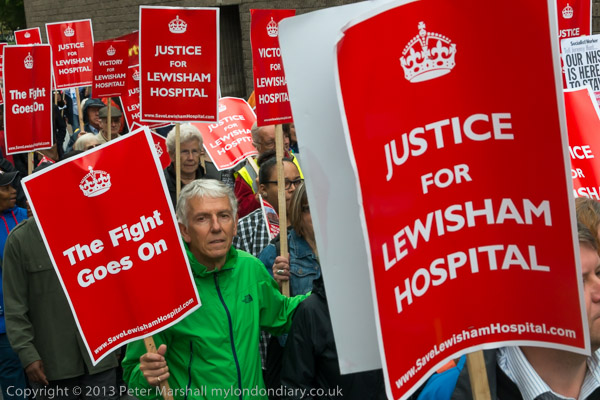
I was standing on the low wall around a roadside flowerbed, and the bright green coat being worn by one man really stood out in the sea of people in largely rather drab rain wear and carrying uniformly red placards. This was the first of four frames – with the 218-105mm at 50mm (75mm equiv) and clearly the best, partly because he is looking at me, but also because it is the one with the clearest link between the two placards in the foreground, and also because of the fairly precise framing of the placards at the top left. As usual this image is full frame.

More pictures: Lewisham Hospital Victory Parade.

Continue reading Lewisham Victory Parade

Arms Fair Die-In at Parliament

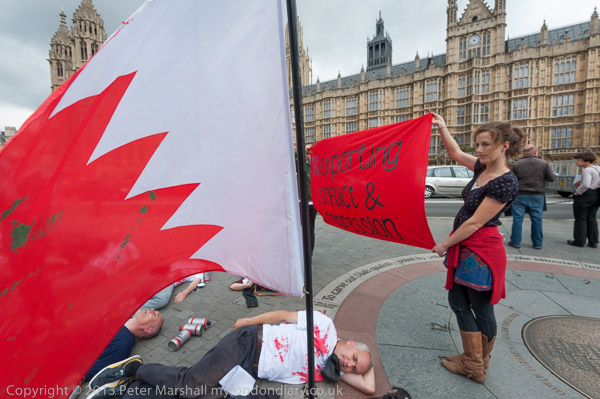
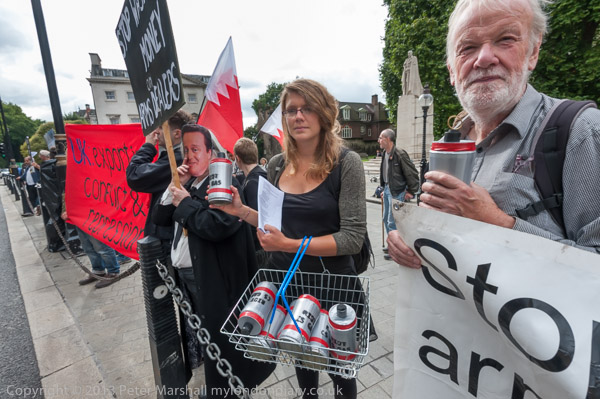
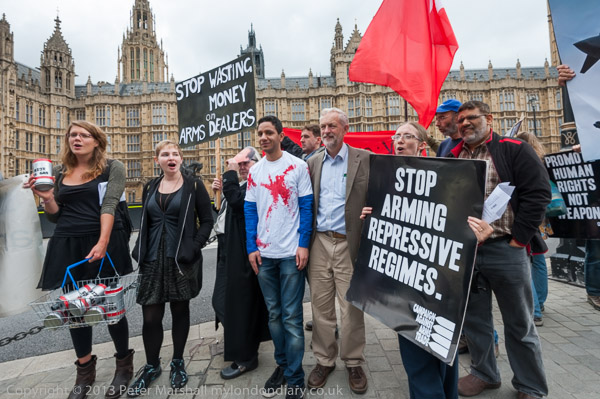
Pictures with flags blowing in the wind are always something of a challenge, and it took a little patience and luck to get this Bahraini flag blowing how I wanted it.  The picture was made during a photo-op at the Houses of Parliament organised by the Campaign Against Arms Trade (CAAT) as a part of its week of actions against the DSEI arms fair that was taking place in East London.

I don’t much like such ‘photo-opportunites’ as they usually end up with a large group of photographers, often with some kneeling and others standing behind them taking a rather boring group photograph. Most of the pictures of course look rather similar, and it’s depressing that newspapers seem to like these predictable images. So I take at least one of them, but try to provide something more interesting, though too often it will be the posed one that sells.

But I’d gone to this one partly because I think about the last thing we want in London is an arms fair, but also because I expected CAAT to provide a more varied event than most to be photographed, and I was right.

Someone did suggest that I was either holding the flag or got someone else to hold it, but that wasn’t the case, though I have to admit I have occasionally done so in the past. But this was the second of five frames I made, and they show convincingly that it was blowing free.

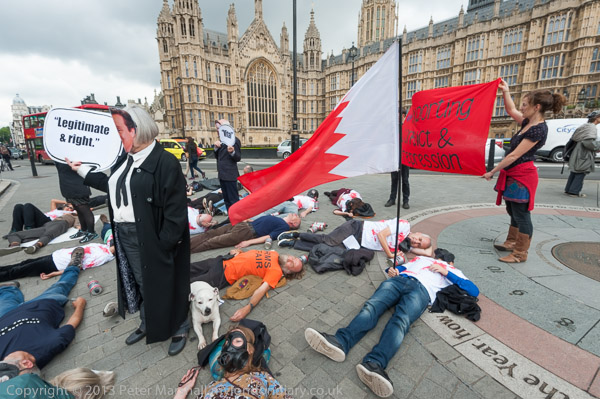
I was using the Bahraini flag for several reasons. First for the same reason that it and the Bahraini protester on the ground at my feet and just out of the picture had brought it – that arms from deals made at earlier DSEi arms fairs sold to Saudi Arabia and Bahrain had been used against peaceful protesters in Bahrain. But it was also for its graphic effect, and not least in an attempt to simplify the rather messy scene in front of me – which you can see in another image taken just a few seconds later.

Both images were with the 16-35mm on the D700 at 16mm, and at ISO 400 and exposures around 1/320 f8.

The red banner with the message ‘exporting conflict and repression’ is more or less at the centre or the top picture (though you can’t read the ‘UK’ at the start), with the red continuing into the jumper around the waist of the woman holding it and to the fake bloodstains in the ‘victim’ on the ground and also on the stripes on the ‘tear gas’ canisters.

I think it’s an image that would benefit from just a slight crop at right – not every image quite fits the 3:2 format, and I find the figure on the extreme right in a white shirt pulls my eye away a little. I suppose too that I would have rather have had a slightly more recognisable view of the Houses of Parliament as the backdrop, but you can’t see Big Ben from this part of Old Palace Yard.

Of course I took more pictures, and after the ‘photo-op’ there was also something more of a protest and a short rally, with Jeremy Corbyn coming out to talk to the protesters., and pose with them for a few pictures.

You can see more pictures at Arms Trade Die-In at Parliament.

Continue reading Arms Fair Die-In at Parliament

American Modern

Talking on Skype with a friend today, he told me about a great show he saw recently in New York, American Modern: Hopper to O’Keeffe at MoMA until January 26, 2014.

Apart from having two of my favourite American painters in the title, the works in the show include photographs by some of my favourite American photographers, including Stieglitz and Evans and much else.

As it says on the MoMA page:

American Modern takes a fresh look at the Museum’s holdings of American art made between 1915 and 1950, and considers the cultural preoccupations of a rapidly changing American society in the first half of the 20th century. Including paintings, drawings, prints, photographs, and sculptures, American Modern brings together some of the Museum’s most celebrated masterworks, contextualizing them across mediums and amid lesser-seen but revelatory works by artists who expressed compelling emotional and visual tendencies of the time.

The selection of works depicts subjects as diverse as urban and rural landscapes, scenes of industry, still-life compositions, and portraiture, and is organized thematically, with visual connections trumping strict chronology. Artists represented include George Bellows, Stuart Davis, Edward Hopper, Georgia O’Keeffe, Charles Sheeler, Alfred Stieglitz, and Andrew Wyeth, among many others.

Well, personally I could well have done without Wyeth’s contribution; Christina’s World to me is retch-making kitsch, but my friend actually likes it. Had we been on Facebook I might have felt bound to unfriend him, but in the real world I’m a little more tolerant of the aesthetically misguided. But the web site that accompanies the show is also commendable, with images of 118  of the exhibits.  You can also see them in several orders, of which I recommend by date, and you can scroll through the images in order with details and comments which you may chose to read or ignore.

Although there were many familiar images – that white fence, those peppers and more – there were also some that were new to me, and some even by artists I’d not heard of.

You can also download a generous sample PDF of the related publication American Modern: Hopper to O’Keeffe by Esther Adler and Kathy Curry, which includes the introduction as well as including some images not on the web site. It looks a very attractive volume, and one which gives due weight to photography, and finding it available at my favourite online book site for under £19 including p/p completely undermined my resolution that we just haven’t space at home for any more books.

Estuary – Last Chance

It seems a very long time since I was enjoying oysters and other seafood at the opening of Estuary in mid-May at the Museum of London in Docklands, and like all good things it has to come to an end – and that end is on 27 October 2013 – this Sunday.

So this weekend is your last chance to see the show as a whole, although my images are also mostly on line on various sites – including a few here in the post Not A Drop in Bermondsey, and others in my book ‘Thamesgate Panoramas‘ or on the Urban Landscape web site, as well as in the on-line Museum of London Collection.

But there are other artists in the show, and some of their work is rather harder to find anywhere, and there is also something about having different views together in the same space.

The show is the largest contemporary art show the museum has attempted so far  with work by Nikolaj Bendix Skyum Larsen, Christiane Baumgartner, John Smith, Andrew Kötting, William Raban, Simon Robert, Michael Andrews, Gayle Chong Kwan, Jock McFadyen, Peter Marshall and Stephen Turner, and Time Out’s Critics’ choice described it as ‘Unexpected and thoughtful insights into this often overlooked but mesmerising environment.’ But it’s a little disappointing that I’ve not seen any serious critical review of the show. There is a short video made by the museum on putting on the show which is interesting, and also a video featuring the work of two of the artists.

Currently I’m beginning to think about another show next year at a central London venue where I will be showing work with artist Hilary Rosen. The central theme of the show is likely to be the River Thames, but I think most of the work will be different to that in ‘Estuary’.


Heathrow Blue


Heathrow Blue

Almost a hundred years ago today, my mother would have been walking home from the local grammar school where she was taking a course in shorthand and typing (now its an FE college and they mainly teach hairdressing) and had she looked up on a day like the one I took this picture, just a couple of miles distant, she would have seen (as the weather forecast had promised me) a clear blue sky, with not a wisp of cloud. She might have been on her way to help her father at his market garden, though more likely going home to help here mother in the kitchen.

A mile or two to the north, my father – if he was on one of his rare days off from work – might have been cycling on the quiet country lanes between the orchards of Heath Row, a hamlet in the south-west of Middlesex. The chickens might be making a bit of noise, and there would be the occasional clip clop of hooves on the stony parts of the dusty roadway. The bees would have been buzzing, birds singing, and as he neared the Bath Road, there might be the occasional car or lorry disturbing the peace

September 24th when I took the picture above was a beautiful day, and I’d been sitting out in the yard a the back of my house eating my lunch. I’d been trying to listen to the radio, but had missed the odd vital word drowned out by an air-plane passing overhead. Luckily for us, building Terminal 4 blocked one of the airport’s six runways and the noise we used to suffer a few days a year when strong crosswinds made the main East-West runways difficult is no longer. We now live away from the flightpath and the noise is no longer deafening, and our windows seldom rattle, but is still occasionally loud enough to make conversation difficult.

Those lanes through Heath Row are of course long gone, though not far away (and threatened by impossible plans for new runways) a few remnants of the past remain. But the lanes couldn’t bear the traffic to the airport and we now have the M25 and the M4 (and not far away the M3) and together with the airport they now provide some of the most polluted air in Western Europe. On some roads the smell of petrol is such you feel you could run a car on air alone.

The weather forecast had promised a clear blue sky. I drained my lunchtime coffee, looked up and saw it. D700, 16-35 at 16mm, 1/400 f10 ISO 200. Heathrow Blue.

——

Within a few days of making this picture, an envelope came through my door with what purported to be a questionnaire from an organisation that styled itself as ‘Back Heathrow: the grassroots campaign.’ It had none of the feel of a grassroots campaign, and the approach was clearly skewed to be part of a campaign for the expansion of Heathrow.

I wasn’t surprised to read later from Keith Taylor, Green MEP for the South East of England, that this was a part of a PR campaign run by Robert Gray – the founding director of lobby group ‘The Aviation Foundation’. The group was established by four of the biggest companies in the UK industry: BAA, British Airways, Manchester Airports Group and Virgin Atlantic.

Heathrow occupies a little over 12 square kilometres in the west of London. It was in the wrong place from the day it was built as an entirely unneeded military air field (because a civil airport would have been unlikely to have got permission), and certainly by the time I was watching the planes flying over my back garden to land there. Successive governments failed to grasp the nettle and provide London with a new airport to replace it, though we do have Gatwick, Stanstead, Luton and the ridiculous London City as well.

‘Back Heathrow’ stresses the large number of jobs that Heathrow provides in the area, while failing to consider that there would be little change in this if extra and runway were built at Gatwick or Stanstead.

Perhaps it’s time for some real blue sky thinking. I’ve long felt that there are better uses of 12 square kilometres of outer London, though there is no real possibility of turning back the clock to its fruitful agricultural past. Housing (we are desperately short), industry, shops, schools… The terminal buildings are essentially shopping centres now (if with nothing I want to buy), but some could perhaps be converted into proper shopping centres. Much though I’d hate to see a Westfield Heathrow, it would be considerably less environmentally damaging than an airport.

Development of a site this large would provide many new jobs, perhaps even as many as the airport closure would mean were lost to the area – and many of those that ‘Back Heathrow’ includes would in any case remain were the airport to go. I hope that others who receive the mailing will see it in its true colours as ‘Cack Heathrow’ too.