Friends & Families

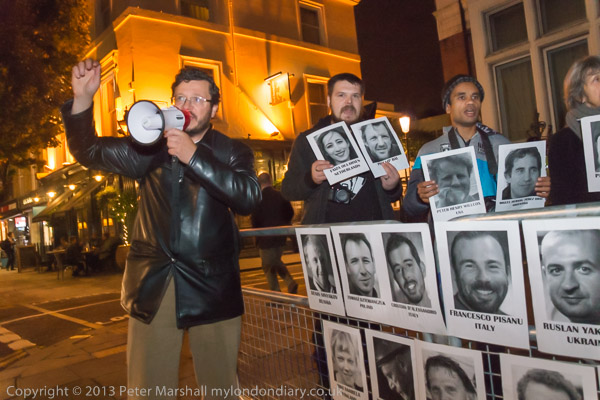
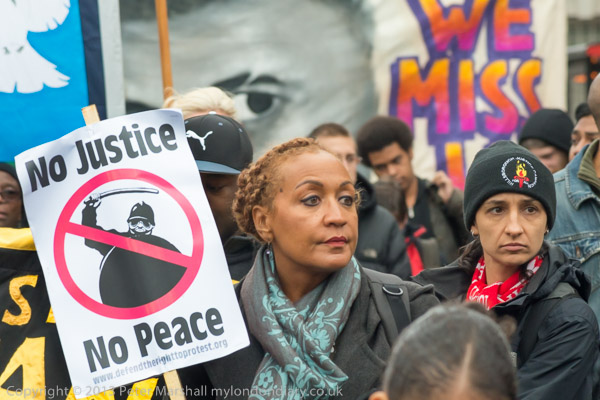
There are some events where I become more emotionally involved than others, and the annual United Families and Friends Campaign procession to remember all those who have died in the custody of police or prison officers, in immigration detention or psychiatric hospitals, held on the last Saturday in October, is one of them.
The first of these marches I photographed was in 2000, but it was in 2003 that I remember finding tears streaming down my face as I took pictures as I photographed Pauline Campbell speaking about her daughter Sarah who had died died in Styal prison
because the prison authorities and staff simply would not recognise her condition. It hit me hard partly because she was an impressive speaker, but perhaps more because she came from a not dissimilar background, around my age and working (as I was still part-time) in FE. Her daughter was just a few years younger than my sons.
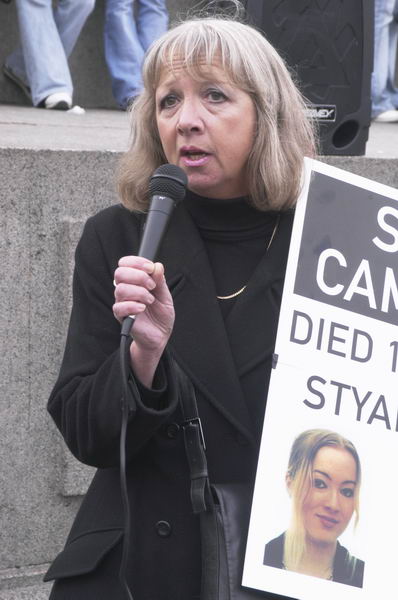

Pauline Campbell speaking in 2003

She became a full-time campaigner for the cause of women in prison, working with organisations including the Howard League for Penal Reform (she became a trustee) and in 2005 was awarded the individual award of the Emma Humphreys memorial prize organisation, for “highlighting the distressing reality of women’s lives and deaths in prison”. Later I got to know her better, particularly after I photographed her trying to throw herself in front of prison vans at Holloway on a cold winter night, and received many e-mails from her encouraging me in my work. But a few months later she became another victim, found dead beside her daughter’s grave.

I’ve come to know others who have lost sons or brothers or other friends and relatives over the years, and have photographed some of them on many occasions as well as this annual march. It is still a very emotional event for me as well as for them. I’m not sure how this affects my photography, but perhaps it makes me try harder to capture their emotions.
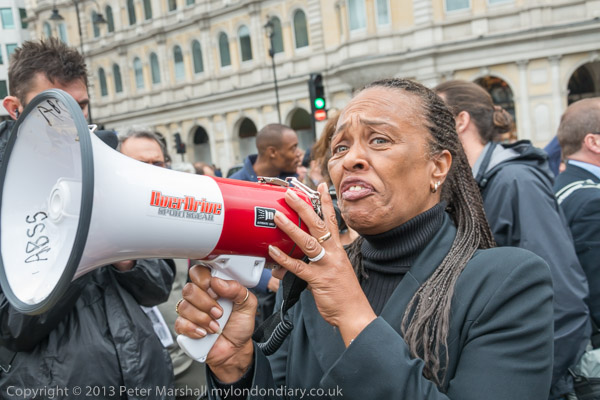

Stephanie Lightfoot-Bennet talks about the killing of her twin brother Leon Patterson by Manchester police in 1992
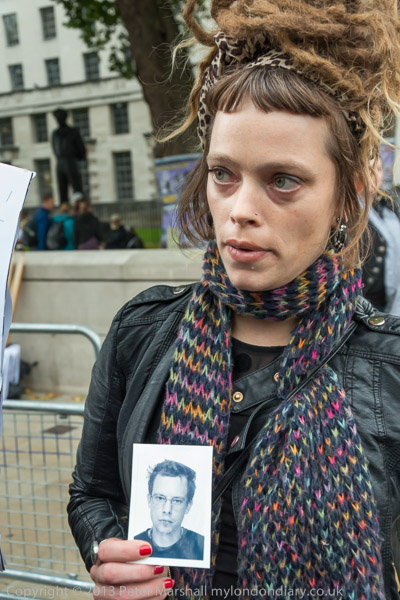

His sister Jo holds a picture of Thomas Orchard, killed by police in Exeter in 2012
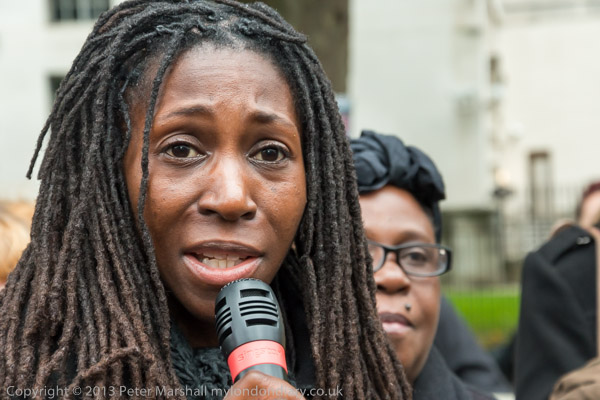

Ricky Bishop was killed in Brixton Police Station in 2001 – his sister speaks about the failure to prosecute the 12 officers involved
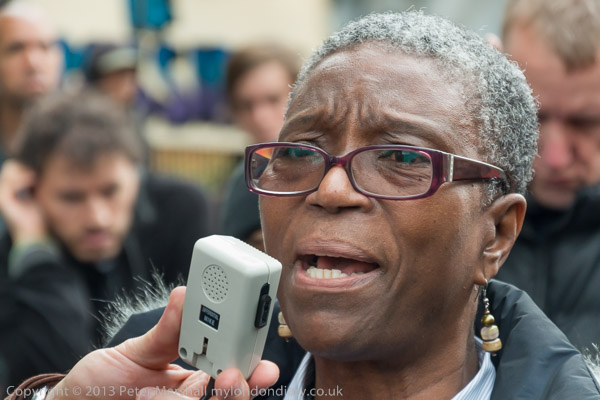

Ajibola Lewis, whose son Olaseni Lewis died after being restrained by police at Bethlem Royal Hospital in 2010
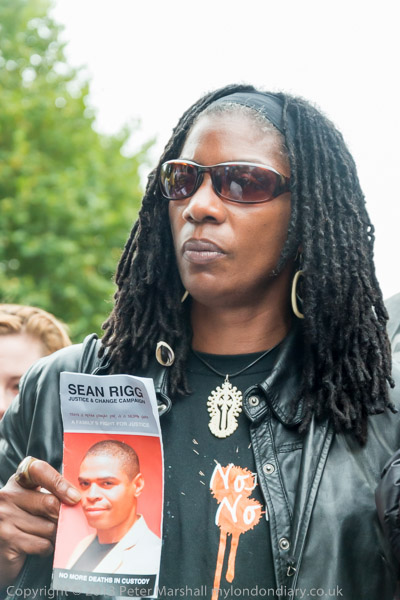

Marcia Rigg holds a leaflet about her brother Sean Rigg, killed by police in Brixton Police Station in 2008
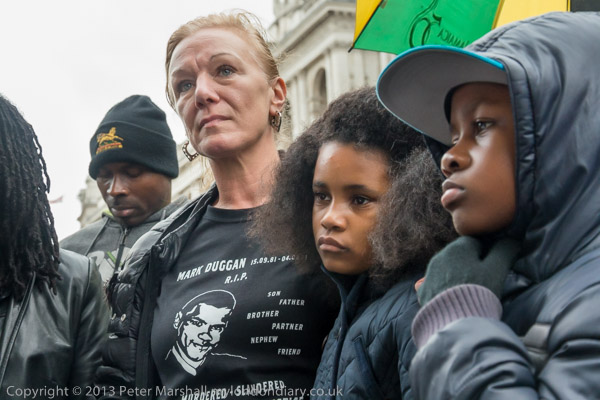

Carole Duggan, Mark Duggan’s aunt with two of his children.

I’ve written in the past about a number of these cases, and you can find more about them on the 4WardEver UK  web site.

Relatively few of these custody deaths are properly investigated, and it was only the consistent and determined campaigning by the Rigg family that led to an inquest jury coming to the conclusion that the police had used “unsuitable and unnecessary force” on him, that officers failed to uphold his basic rights and that the failings of the police “more than minimally” contributed to his death.  The inquest on Mark Duggan currently taking place has already revealed many inconsistencies in the police evidence, which together with that from other eye-witnesses make it hard to avoid the conclusion that his death was the kind of extra-judicial execution that we would condemn if it happened in other countries.

More pictures at United Families & Friends Remember Killed.
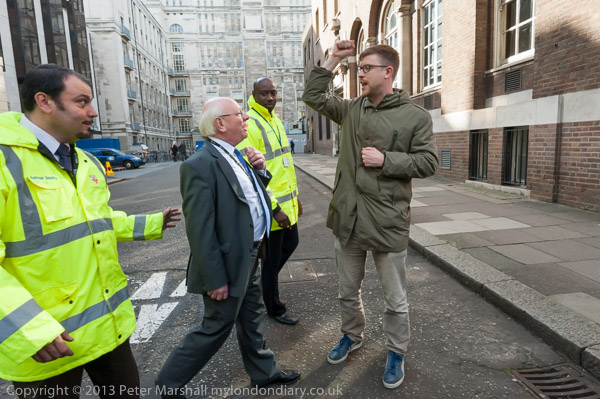
Continue reading Friends & Families

Film Night

I’ve not watched all the 16 films that are listed in 16 Photography Documentaries every Street Photographer should watch on the Street View Photography site, though there are some that I have seen. Most of the 16 can be found on YouTube, although a few are only available on DVD.

Perhaps I’ll find myself some spare time over Christmas to watch some of the others, although I usually keep pretty busy, and I find it hard to just sit and watch, especially for the longer films.  Daido Moriyama: Near Equal is 1hr 24 minutes, and  so far I’ve just dipped into it at a few points, so I can’t tell you if it is worth watching as a whole. Picking up his ‘Shinjuku 19XX-20-XX‘ from my bookshelves and looking through a few pages is rather more satisfying if I only have a few minutes to spare. But if you don’t have the book (or others with his work – and there are some available more cheaply), YouTube is considerably cheaper.

And while film is seldom a good medium for looking at photography, it can be good at talking about it, and the film features the photographer and  a number of other people (fortunately with subtitles for people like me whose Japanese is non-existent.)

I’ve never considered myself a ‘street photographer’, a term which always seems to me to lack any real meaning, though usually I work on the streets, and certainly see my own work as being a part of that great body of photography that was celebrated in ‘Bystander: A History of Street Photography‘, a book that annexed at least half the history of photography to its presumed genre (as you can appreciate from this speed-reading video.)  I don’t think any of those included in the original publication in 1994 – Atget, Stieglitz, Strand, Cartier-Bresson, Brassai, Kertesz, Lartigue, Walker Evans, Helen Levitt, Robert Frank, Diane Arbus, Garry Winogrand, Lee Friedlander, and more –  called themselves street photographers either.

I don’t have the Eggleston DVD mentioned in this feature. but I did put another one on my Christmas list a couple of years ago, William Eggleston Photographer, a Reiner Holzemer film (extended trailer here) made in cooperation with the William Eggleston Trust, and I might watch that again.  And since people never know what to get me for Christmas, I might just search for a few more films I could add to put on a list for this year.


Cops Off Campus!


The university moves in to try and stop free speech

You might expect universities to be enlightened employers and to respect freedom of speech, but while that might once have been so, nowadays you – like me – would be disappointed. When workers at London University staged a number of in noisy protests last academic year for a living wage and proper conditions of service, the response of the university management was not to support them but to ban further protests and threaten to call in the police.

The ‘3 Cosas‘ campaign for proper pay and conditions for low paid staff at the university has widespread support from students and academic and other staff employed by the university. Earlier campaigns by the low paid workers have resulted in some of them now getting a living wage, but even for these the conditions of employment – things like sick pay, holidays and pensions – are far less favourable than they would be if the university employed them directly, rather than buying them in as cheap labour from contractors.


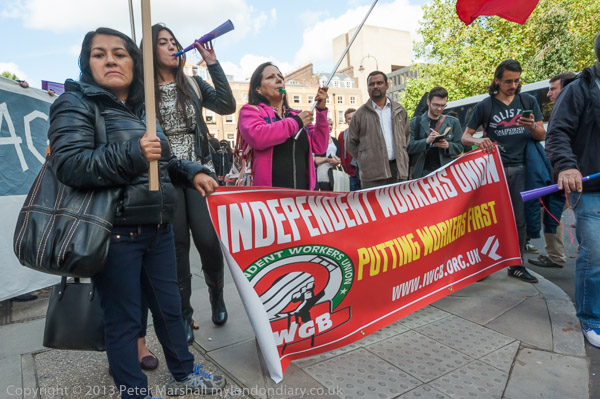
IWGB supports the ‘3 Cosas’ campaign

Its a curious position to work at the university but to be employed by another organisation, as their work is vital to the running of the institution. Even if the university engages another company to manage the cleaners, security and catering staff etc, they are still a part of the institution and it surely has a duty towards them to ensure they get proper pay and conditions. Many other organisations have realised this and made paying the living wage and proper conditions a requirement on companies contracting to run services for them.

But rather than standing up for those who work there, London University has said it is none of their business and objected to protests warning members of the university they may face arrest if they protest on campus.


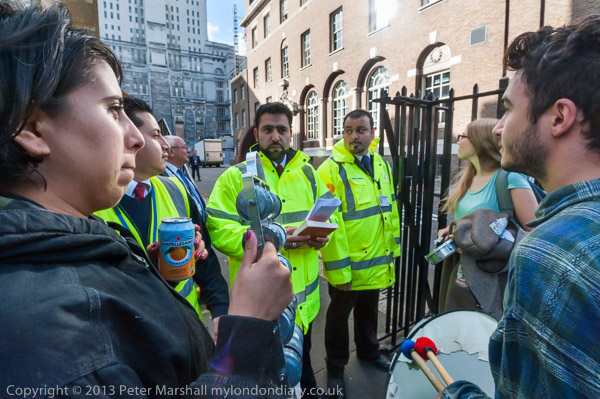
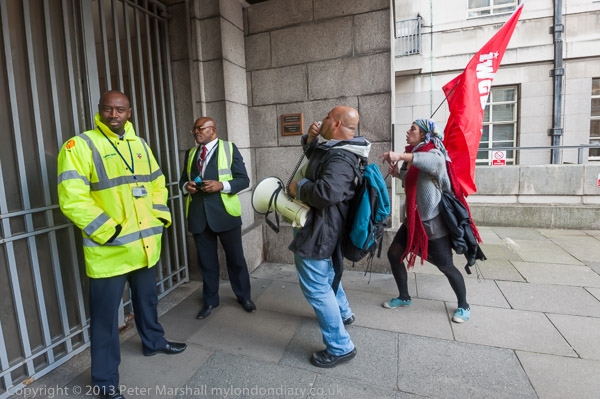
Security on the gate to the Senate House car park

The protest by the ‘3 Cosas’ movement on 24 Oct was in direct defiance of this ban, and resulted in far more disruption than any previous protest – and greater cost to the University. Extra security staff were on duty, with gates around the Senate House locked and checks made on all those entering.  At first this kept the protesters out, but a few students and academic staff made their way inside the closed area and started to protest, resisting arguments by security and managers to leave.

Eventually the bulk of the protesters decided to walk around some of the barriers and make their way to the Senate House, and I followed them. Some had actually climbed the tall fence or gates in front of Senate House, but I was considerably less athletic, simply walking through a gap in a very threadbare hedge and across a lawn.


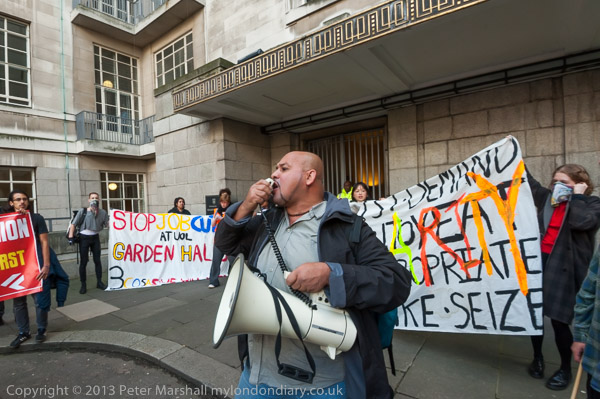
Protesters outside the Senate House, guarded by security

Having defied the ban on one side of Senate House I was a little surprised when it turned out to be equally easy for the protesters to walk round to the other side and do so again. But if the authorities really intend to stop protests they will need to invest heavily in barbed wire! By this time the university management had called in the police, though I don’t think the police were all that pleased or sure what their role should be. It was after all a peaceful protest and causing little or no disruption – and what disruption there was mainly from the action of the university security.


Protest continues on the other side of Senate House

Finally as the protest was almost at its natural end, the police decided to act, moving in and trying to stop the protest ending!  The result was something of a farce, with a handful of police grabbing the odd student while the others simply walked past – as I did.  After a little argy-bargy and some actual barging the police came to their senses and walked away, leaving the protesters to rightly claim a victory. They had stood up to the university authorities and to the police in a protest not just about the ‘3 Cosas’ but about freedom to protest and freedom of speech.


Police try to stop protester leaving while other police are shouting ‘Let them through!’

It may not end there. While the protesters were inside around the Senate House, there was a man on a balcony filming them – to which the protesters took exception. It seemed an unnecessary provocation, and suggests that the authorities might be considering disciplinary or legal action against those taking part.  This would be an extremely inflammatory act, and one that would reflect badly on the university.

More at 3 Cosas Defy London Uni Protest Ban.

Continue reading Cops Off Campus!

Adobe I Think Not

Like quite a few other photographers, I’m wondering whether to jump aboard Adobe’s licensing programme, which, for the next couple of days only – until Dec 2nd – is on offer for photographers at at $9.99 per month to include both Photoshop & Lightroom for those who don’t own a recent copy of Photoshop. Earlier Adobe had made the offer available only to those with Photoshop Creative Suite 3 (CS3) – and that offer continues until the end of 2013.

Given the fairly regular paid updates that both Lightroom and Photoshop have had in the past, this doesn’t seem a bad offer for those who need to keep up to date in both programs, but it does tie you in to a continuing commitment. Once you are on the licence scheme, the newer versions you get will stop working if you stop paying.

For those of us in the UK, Adobe’s offer is not quite as generous. Allowing for VAT, the offer should translate to around £7.50, but Adobe are asking for £8.78 a month, which adds up to £105.36 a year. It still doesn’t seem excessive, but the licensing programme ties you into a scheme in which Adobe have the upper hand and can (and surely will) increase the monthly subscription as they wish. Once you are in you have the choice of paying the increase or going back to the software you had before you joined, which could cause problems.

At the moment it looks as if Lightroom will continue to be made available for the foreseeable future as a paid for program with charges for major upgrades. Unlike Photoshop, which has been around so long that upgrades are seldom of huge significance (and sometimes make annoying minor changes that move or alter the familiar), every major upgrade to Lightroom so far has been worth buying (and the minor ones which come free have also been worth installing.)

Photoshop isn’t of course the only software for photographers, and many make do with alternatives, such as Adobe’s own Photoshop Elements, though its interface always puts me off. But there remain a few things for which Photoshop seems essential, notably for me its ability to produce CMYK files, and it remains an industry standard. For me it is also the easiest software to use for retouching my scans, and a reliable carrier for a number of Photoshop plugins I find useful (though other software would also support these.) Some people find Photoshop buggy, but I’ve seldom had any problems with it.

Were I to need to look for an alternative, perhaps the most suitable software would be Photoline, software which started on the Atari ST in 1996 and first came to Windows the following year in version 2. There is a useful Wikipedia article on it. Version 18 is now available for both Windows and Mac and has full colour management and Lab and CMYK support. I’ve not tried it (you can download a 30 day trial version) but it looks impressive. The full software costs 59€ and a single user licence allows you to install it on several computers (even both Mac and Windows.) Major version upgrades seem to come every year or two but cost only 29€. Currently the euro prices convert to around £49 and £24 respectively. If any readers are using Photoline, comments would be welcome.

Were it important to me to keep up-to-date with Photoshop I’d sign up today, but it isn’t, and I’ll save the money for the moment. If Adobe ever move to put Lightroom on a subscription only basis I’d have to reconsider, though perhaps too I’d look for alternatives. Adobe isn’t the only game around.

Saul Leiter (1923 – 2013)

Saul Leiter who died yesterday was a photographer who became better known in his eighties than he had been earlier in his life, as it was only in his seventies that he took many of his old 35mm Kodachromes taken on the streets out of their boxes and made the prints which showed his colour work from the 1950s and 60s, an age before colour photography became respectable to the art world.

Of course he wasn’t completely unknown before. He’d exhibited paintings on walls along with some very well-known artists, worked as a fashion photographer for Harper’s Bazaar, and even had his black and white photographs exhibited in MoMA (Museum of Modern Art) when Edward Steichen was at the helm.

Back in 2006, his show ‘Saul Leiter: Early Colour’ attracted a great deal of favourable critical comment, and at the time I noted:

Currently on show until 21 Jan 2006 at the Howard Greenberg Gallery in New York is Saul Leiter: Early Color. For a real photographic treat go to the gallery web site and look through the 42 superb images dating from 1948-60, mainly taken in New York, but also from Rome, Venice and Paris. Despite the title of the show, the site includes 12 fine black and white pictures.

Leiter, born 1923, the son of a distinguished Talmudic scholar, began to study at Cleveland Theological College before leaving for New York to work as a painter. There he met Abstract Expressionist painter, Richard Pousette-Dart, who was also working with photography, and he also began taking pictures, working with 35mm colour on the streets of New York in the late 1940s.

Colour was alive and well in photography long before its discovery by the art world as ‘new color’ in the 1970s with the work of William Eggleston, Stephen Shore and others.

(Links updated – the Howard Greenberg gallery link is to his artist page there rather than the 2006 show and is not the identical selection and there are now only 39 works.)

One of the nicest current pieces I’ve seen about him is on Faded and Blurred, but you can also see selections of his work on Retronaut, Time Lightbox, Jackson Fine Art, Gallery 51, InPublic and of course Lens Culture, as well as watch the trailer for the film about him, ‘In No Great Hurry.’

As he says in the opening moments of the trailer, “There have always been people who liked color, its not as if I was the only person“, but although there certainly were others – such as Helen Levitt and possibly others currently unknown whose work may yet come to light – his work is permeated by a remarkable lyricism which apparently continued unabated even after he switched to digital in recent years.

Thursday

I don’t often go to Hounslow, although its only a few miles away. I can get on a bus a short walk away and it will take me there, though it’s faster to either take the train to Hounslow or get off a stop before and catch a bus, depending on which part of Hounslow I want to go to. But not a lot happens there. Not a lot happened there in the eighteen or so years I lived there until I left for university. A few years later my family had all moved away, and there didn’t seem a great deal to go back there for.

But on a Thursday morning I found myself standing alone at a bus stop outside Eaton House, the Hounslow Reporting Centre. Most asylum seekers have to report either daily, weekly or monthly at one of these centres – there are around 15 covering the whole country – or sometimes at a police station. They get fingerprinted and their biometric ID cards are reactivated. Or they may be taken from the interview room and put into a holding cell, to be transferred to one of our immigration prisons (officially called detention centres) to await deportation. Eaton House serves those living in much of West London and further afield, and certainly wasn’t chosen as the easiest place to find or travel to, on the western edge of Hounslow. Reporting often seems to be a way to harass asylum seekers rather than anything more.

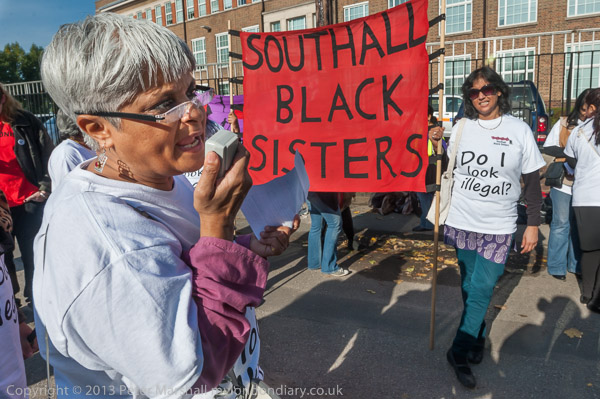
Southall Black Sisters was founded in 1979 to fight for the human rights of Black (Asian and African-Caribbean) women and like many others are appalled at the growing racism of government legislation and activities against asylum seekers and other migrants. I’ve photographed them taking part in many events over the years, but I think this was the first organised by them I’d been to.

I have a suspicion that Eaton House was chosen as a reporting centre (and I think as a base for some of the UKBA officers who go out on immigration raids) because it is rather out of the way. The journey is intended as a disincentive to wanting asylum or a punishment, and to make organising protests more difficult. Although bus services in London have improved since my youth (then the route between Southall and Hounslow was particularly unreliable, and on several evenings I stood for an hour or so waiting for a 120 before giving up and walking home.)

But this time, coming from Feltham, my bus was dead on time and I arrived a few minutes early and I walked up and down, then sat down at the seat inside the bus shelter and waited hopefully. I like to get to protests a few minutes early, but it’s always nice to have a others gathering there so you know something will happen, and as the start time approached I was beginning to wonder if I was wasting my time.

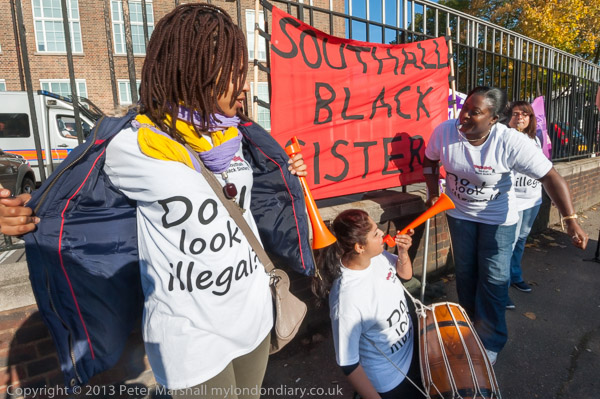
But Southall Black Sisters arrived on the dot, a minute before the advertised time and the protest got underway. Many of those taking part were wearing the group’s white t-shirt with the message ‘Do I look illegal!’ printed very large on its front, and with the protest involving quite a lot of activity it proved surprising difficult to get images in which this was fully legible, as you can see in Southall Black Sisters Protest Racist UKBA.

There were a few interesting moments, particularly when police officers tried to liaise with the women, and when one officer complained about the language one of them had used shouting at a man walking by who had made a racist comment, and was surrounded by the women telling him he should be taking action against racists, not those who stood up to them. The officer claimed to have been unaware of the comment that had been made, and eventually backed away as women shouted at him and blew whistles and vuvuzelas. But although I took pictures, it was perhaps something that would have been rather better recorded on video.  I’d not heard either the racist comment or the response the officer objected to.

My time at the protest was limited as I wanted to be in central London for another event, involving a journey by bus, then a short walk to the underground at Hounslow East from where the Piccadilly line would take me, very slowly, to my destination.

I was beginning to get worried that I hadn’t really managed to take an image that really worked about the protest as a whole, when I made the one at the top of this post, showing the Director of Southall Black Sisters, Pragna Patel speaking. I’d moved around very close behind her using the 16-35mm on the D700.  This was the sixth of seven frames; at first I’d been a little further back, and working at 16mm, and she had been partly obscuring the banner.  I’d been working with the banner and to its right a group of the women with drums and horns in front of the UKBA fence and building, and Pragna Patel was reading from a list of slogans in her hand. As she turned her head around more towards me I zoomed in slightly for a frame and then stepped closer to tighten the framing a little. Even so, the image, taken at 20mm, needed a little cropping mainly at the right of the frame, and this also enabled me to bring the top of the image to the top of the banner.  I’ve retained the 3:2 aspect ratio, though I think it might improve the picture with just a little more off the right hand edge. You can see my shadow in the bottom right by the way, and the t-shirt of the woman holding the banner is nicely legible, with a curve in  her stance that seems to send my eye back into the picture.

I took one more frame immediately after this, almost identical except that the speaker’s mouth had closed and her head moved very slightly forward. As soon as I had taken these two images I thought I had managed what I needed, and, moving back a little, made a quick check on the screen on the back of the camera to confirm this. I don’t often stop to ‘chimp’ when taking pictures (and often get annoyed with photographers who keep standing in the way of others to do so) but wanted to be sure.

As I looked up from the camera, I saw my bus coming down the road, and quickly waved goodbye and jumped on it, on my way to take more pictures elsewhere.

Continue reading Thursday

October 2013 on My London Diary


Letting Agencies Illegal Colour Bar

I rushed to finish the posts on My London Diary for October before I left for nine days in Germany earlier this month, but then forgot to post this for almost a week after I returned.

October was a rather busy month for me, as you can see, despite having to be away from London for a very long weekend (at five days, closer to a week) earlier in the month. Most of the pictures I took while away in Derbyshire were of friends and family and I won’t post them on My London Diary. There are still a few events in the later half that I’ll probably write about at more length here on >Re:PHOTO.

October 2013


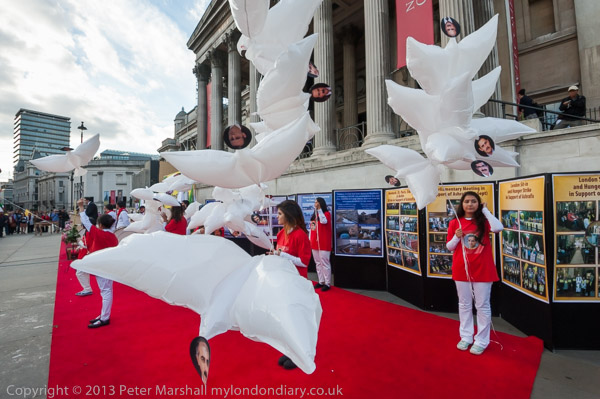
Russia, Free Greenpeace Arctic 30

Protest Against Colombian ‘Vulture of Death
Cleaners Invade John Lewis Oxford Street


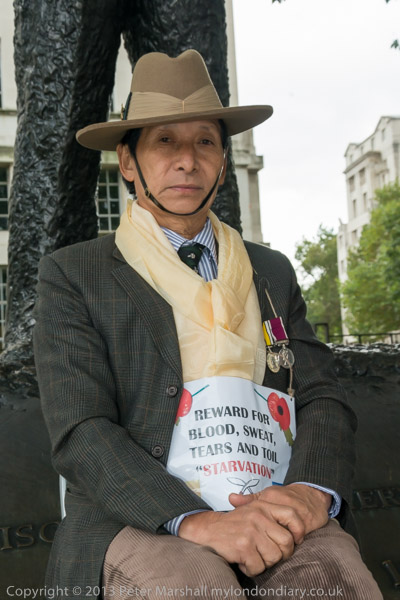
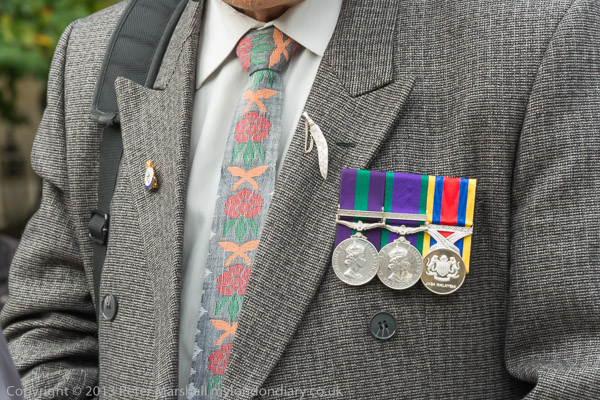
Gurkhas Hunger Strike for Justice
United Families & Friends Remember Killed
3 Cosas Defy London Uni Protest Ban
Southall Black Sisters Protest Racist UKBA
Climate Deniers told ‘Frack Off’
Justice for Cleaners Protest
Fossil-Free London Lobby Tour


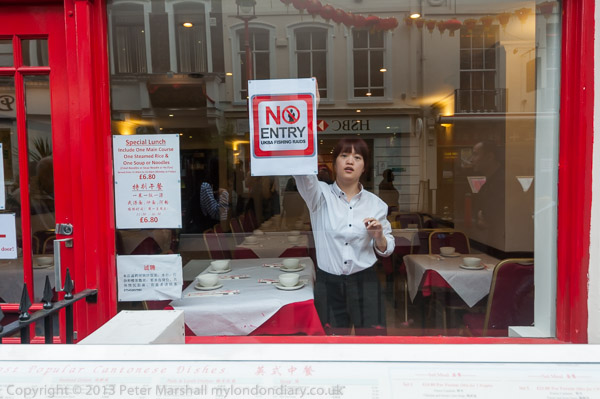
Chinatown Says ‘No Entry UKBA’
Movement Against Xenophobia


Vigil at Work Assessments Appeal
Make Caste Discrimination Illegal Now


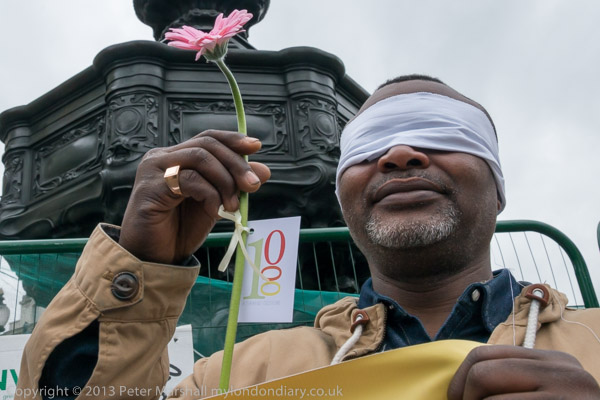
Don’t Be Blind to DR Congo Murders
Global Frackdown: Lord Browne resign!


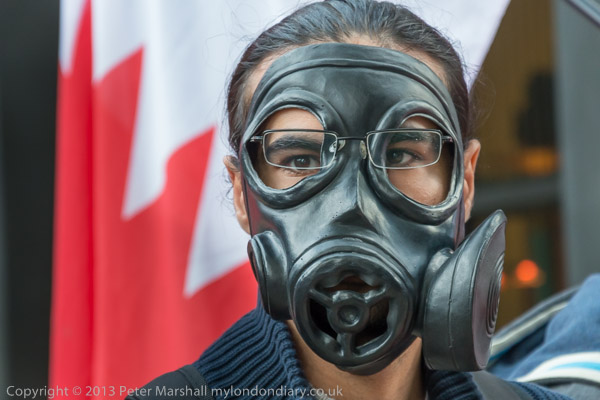
Stop Shipping Tear Gas to Bahrain
Anti-Slavery Day Sinai Torture Protest
Teachers March against Government Plans
Letting Agencies Illegal Colour Bar
Vigil for Shaker Aamer
Cannabis Hypocrisy Protest


Gurkha Veterans Demand Justice
Police & Developers Evict Soho Working Girls
Scrap Royal London NHS PFI Debt
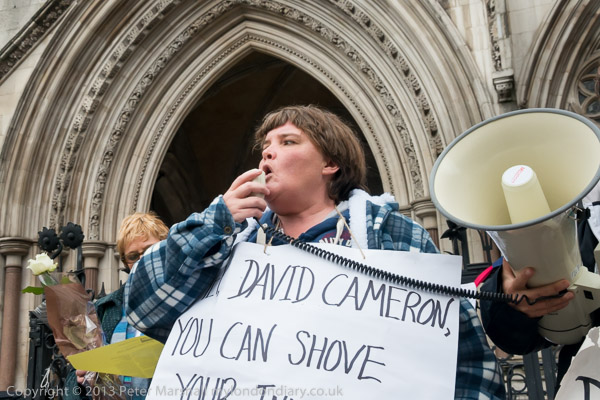
Don’t Gag Free Speech


PMOI call for release of 7 Hostages in Iraq
EgyptFor & Against Muslim Brotherhood
Freedom for Ocalan & Kurdistan
Daily Mail You Told All the Lies


Bring Talha Ahsan Home
UK Uncut Road Block for Legal Aid


Support South African Shack-Dwellers
Cops off Campus- Royal Holloway

As usual in these summaries, the pictures are mainly from protests I’ve not otherwise mentioned here on >Re:PHOTO.

Continue reading October 2013 on My London Diary

Against Xenophobia


Lee Jasper of the Movement Against Xenophobia

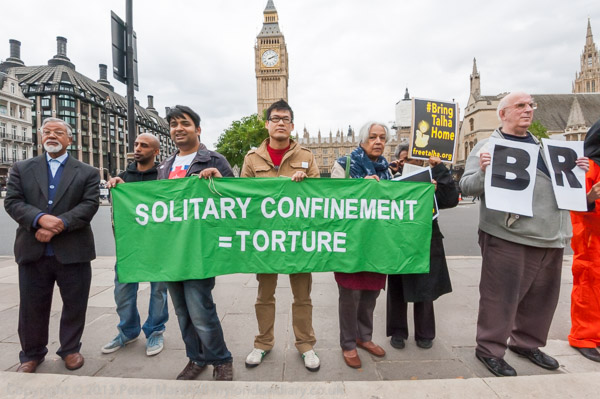
Many of us here in the UK are worried by what seems an increasing tide of prejudice against foreigners. Newspapers making up hate stories about foreigners, biased reporting even by some of the more respectable media, and increasing statements and actions by the government against asylum seekers and immigrants generally. Raids by the UKBA on places where foreigners are thought to be working, picking out people who look foreign for bullying questions about their status, vans in the street encouraging those without the necessary documentation to be here to go home, e-mails suggesting the same sent to many regardless of their immigration status and more.

And now a new Immigration Bill aimed to remove most of the grounds on which people can appeal against deportation, and to get banks, landlords and others to check on immigration status, checks on driving licence applicants and more, including levies on temporary migrants who want to access the NHS.

All this despite report after report that immigrants have a positive effect on the economy, and the obvious (except to racists) invigoration they have brought to so many aspects of our society. London could not run without migrant labour carrying out low paid jobs, many of them without proper immigration status. And no, I refuse that racist term “illegal immigrant” that the government has labelled them with – and the BBC and other media use. People may be here without the documents that allow them to stay here, they may even have committed an immigration offence though that generally remains to be proven, but people are not illegal. They are here perhaps because they could not safely remain in their own countries, but largely because we need them. Need the work they do, and need the taxes and national insurance that they pay.

Labour had a poor record in office, bringing in new restrictions if never managing to deal with what some see as the problem, kowtowing to the racists and the right wing press. The Condem coalition is worse, not least because it has begun to be more efficient in its anti-immigrant measures.

The newly formed Movement Against Xenophobia brings together various groups concerned about this increasing racism and victimisation, and intends to challenge the current anti-immigrant discourse and the attacks on human rights.

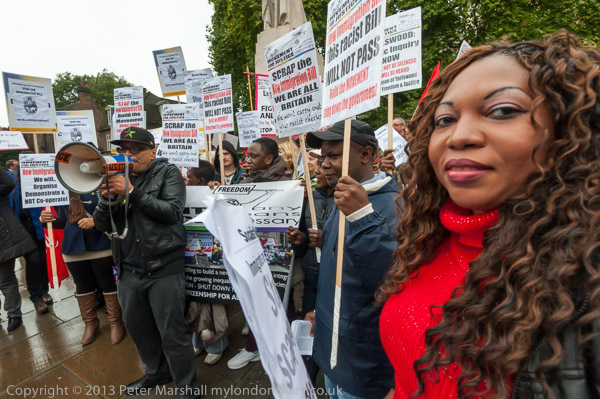
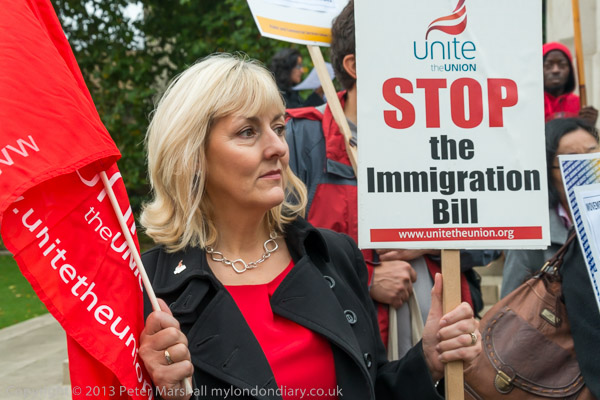
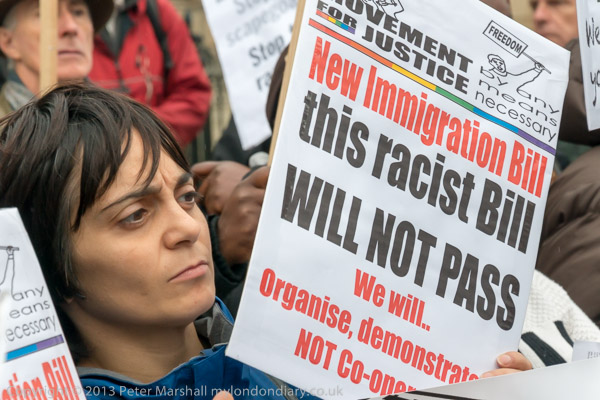
Photographing the event I was keen to bring out what the protest was about in the pictures – and focussing on some of the placards was one way to do this. The protest involved a number of fairly well-known people – trade unionists, MPs and others who I wanted to make sure to include. And then there were those whose features I found particularly interesting – such as a woman with such splendid hair and a bright red jumper (people had been invited to wear red for the event.)

I got close to put her on the edge of the frame, with as many people as possible with placards and a banner in the background. Lee Jasper, the main organiser of the event and a well-known Black campaigner is speaking in what was perhaps the best overall view I made of the event.


Unite political director Jenny Formby

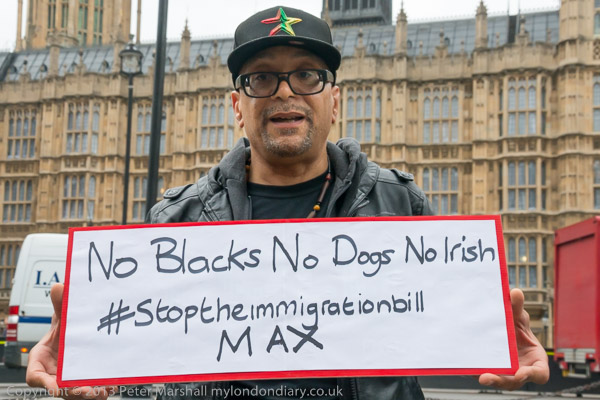
I took some better pictures of Lee himself, including several with the poster ‘No Blacks No Dogs No Irish’ he had brought to the event, and it also comes in some other pictures. Among the others I made sure to get decent pictures of were Unite political director Jenny Formby, Habib Rahman, Chief Executive of the Joint Council for the Welfare of Immigrants and Jeremy Corbyn, MP.

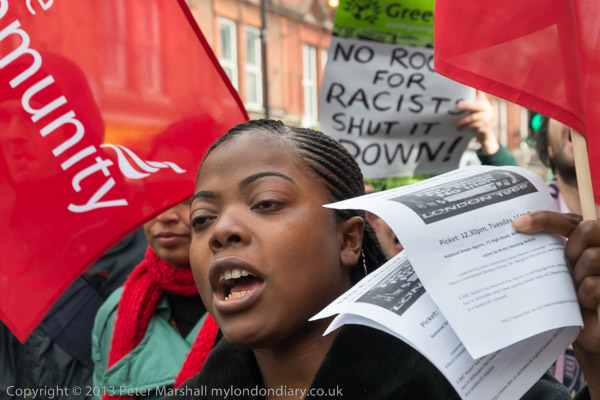
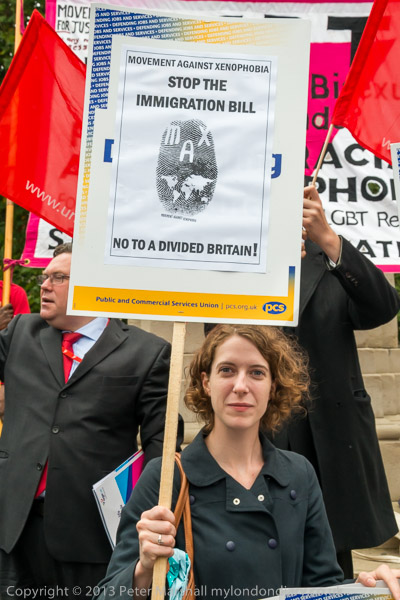
As well as the main banner from the ‘Movement for Justice’ I also took pictures showing the other banners present clearly – including those of Southall Black Sisters and the LGBT banner for the Movement for Justice. I also tried to cover the whole range of placards, including those from Unite, PCS, Socialist worker and Movement for Justice (who had prepared a number of variations.) I try to make sure that at least in some images the whole message on the placard is legible, though often cropping tightly to avoid a whole series of simple ‘person holding placard’ pictures.


A person holding a placard, but the lively background adds interest

More pictures and text at Movement Against Xenophobia.
Continue reading Against Xenophobia

End UK Caste Discrimination

It was raining fairly heavily as I made my way into Hyde Park for the protest by CasteWatch UK, but I didn’t want to put my umbrella up. It’s days like this that I wish I had an assistant to hold an umbrella over me, as it isn’t really practicable to photograph holding one yourself, though I have sometimes done so. I like to get close to many of my subjects and it just gets in the way, apart from being rather tricky to manage. But at least I have a decent hood on my jacket that keeps me dry without getting too much in the way, though it does make it just a little harder to work, and in particular restricts peripheral vision, making it easier to miss things going on around me.

I’ve also experimented a little with waterproof housings for the two cameras (D700, D800E) I like to use, but have yet to find anything I like though Op-Tech make a cheap one that looks interesting. Perhaps readers have some other suggestions?

So I work with the front of my waterproof jacket partly open, slipping the cameras partly inside when I’m not taking pictures. Two Nikons with large lenses don’t really fit easily inside, especially if one has a flash attached. Though flash is seldom a good idea in the rain unless you want to take pictures of raindrops. I put a large microfibre cloth over them, or spend my time wiping them down to try and keep them dry. The cameras are fairly well sealed against water, but the lenses – even the pro 16-35mm f4 – not so good.

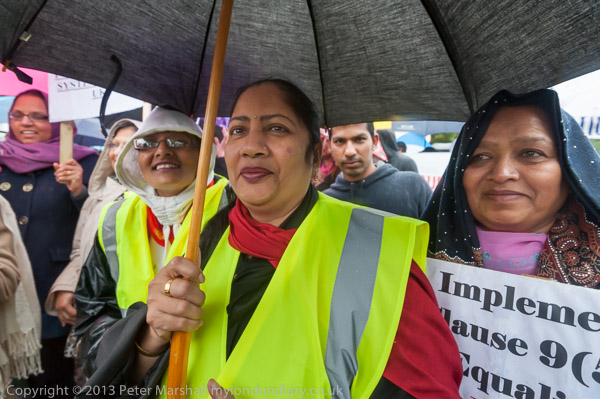
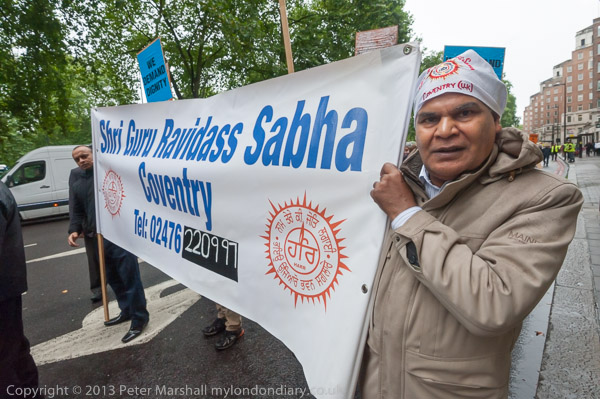
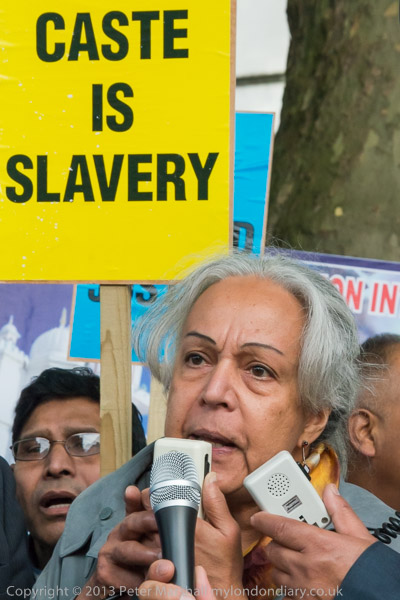
Caste Discrimination is illegal in India, though that hasn’t stopped it remaining to be a real problem there, and one that has now been exported to the UK. It’s a problem that has a religious dimension too, with many of the lower caste Dalits being followers of the 14th century Indian guru Guru Ravidass. He is considered holy (but not a Guru) by Sikhs and  many Ravidassia places of worship are called Gurdwara and until recently many considered themselves as Sikhs (and some others as Hindu.) But in 2009 the murder of a Ravidass leader, Ramanand Dass, by Sikh extremists in the temnple at Vienna led to a decisive split between Ravidass and Sikhs. Ravidass Gurdwaras that had previously flown the Sikh
Nishan Sahib flag with its Khanda symbol now adopted the distinct Ravidass Harr Nishaan, and in place of the Guru Granth Sahib they brought out their own Amritbani Guru Ravidass Ji containing the hymns of Guru Ravidass.

Ravidassia complain they are discriminated against because of their low caste by both Hindus and Sikhs. The government didn’t want to act, but were forced to do so by the House of Lords and MPs, and in April legislation was passed to ban caste discrimination in the country under the Equality Act. Rather than accept this, the government, under pressure from Hindu ad Sikh higher caste groups and individuals, decided to delay implementation by setting up a two year period of consultation with these groups, angering both the Dalits and others opposed to discrimination.

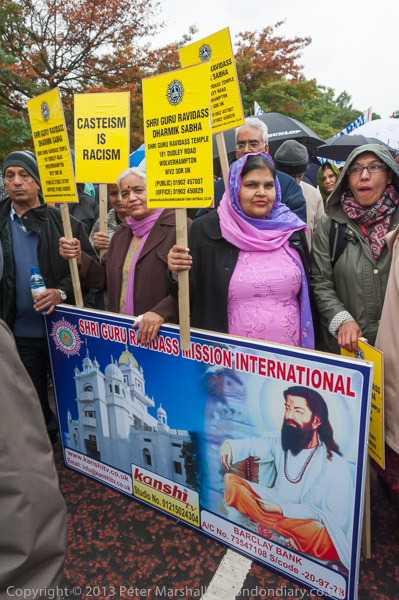
Almost all those on the march were Ravidassia, with just a few Sikhs and others also supporting the demand for speedy implementation of the law. A little under a thousand were standing in the rain when I arrived, many under umbrellas, some listening to speeches and others just standing around waiting for the march to begin, out of earshot of the speakers.

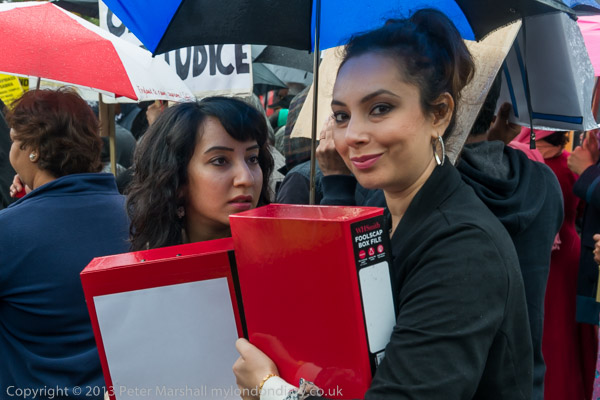
Umbrellas can be a problem, particularly for colour photography. While black umbrellas simply cause shadows, sometimes rather deep, coloured umbrellas can give some very strong colour casts from the light coming through them onto the faces beneath. One solution is to use flash, but unless you are also under the umbrella this can give reflections from rain drops in the air. Instead I relied on being able to use Lightroom’s Adjustment Brush to adjust ‘temperature’ and ‘tint’ on faces where necessary. You can see a blue patch I left on the forehead of the woman in the image below.

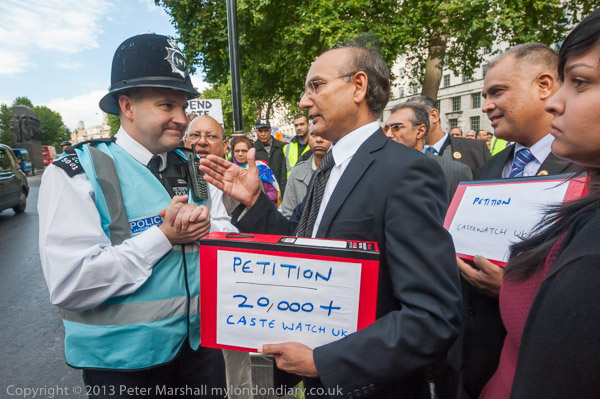
I noticed two young women carrying red boxes, which I guessed contained the petition the march was to present at Downing St, and went over to photograph them and ask about the protest. They took me to photograph the march organiser, and later at the end of the protest I photographed them on their way into Downing St with the petition.

Although it was still raining when the march started, it soon eased off, and I was able to photograph the march as it went down Park Lane to Hyde Park Corner in the dry. Park Lane has many trees along the Hyde Park side, and the lighting varies considerably. Usually I hand around in the lighter areas taking pictures, then after a while hurry on to the next area with decent lighting.

At Hyde Park Corner I decided I’d been on my feet for long enough (walking is fine, but photography usually involves too much standing around, which is bad for more legs) and I took the tube for a couple of stops, meeting up with the protesters as they came along Pall Mall towards Whitehall. I’d not made a note of the exact route and had spent a little time waiting at Piccadilly Circus before I realised they were not taking a rout passed there.

Opposite Downing St there was a rally on the pavement, with a number of speakers, few of whom I recognised. It’s sometimes a problem in captioning, but if I don’t recognise a speaker or remember having heard the name before it probably is not going to be of great interest to likely clients.

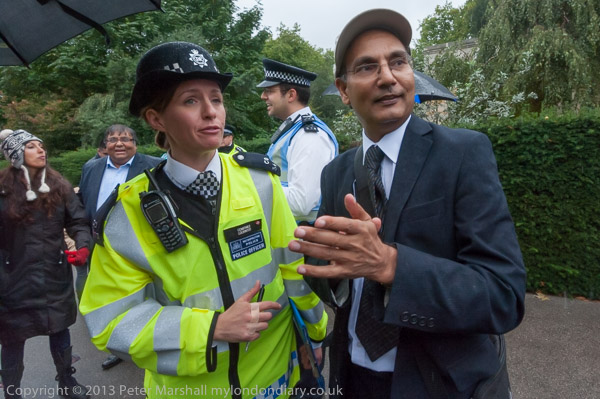
Although it was fairly noisy in the crowd and with the speakers using megaphones I was still listening for other things happening, and something made me move out of the crowd to the side of the road. There I found the event organiser and a few others having an argument with a police officer, who was trying to stop them going across the road to present the petition. Finally he realised that they were telling him that they had arranged to do so with the authorities and agreed to let them do so.

I was pleased with the pictures I’d taken. It was a cause I could wholeheartedly support, and the people were all very warm and friendly and keen to have their pictures taken. You can see more of them at Make Caste Discrimination Illegal Now.
Continue reading End UK Caste Discrimination

Morel Wins Hands Down

I feel good. I hope that never happens again to any of us. This is a victory for all artists, for all copyright holders

Daniel Morel’s verdict, (as reported in the Times of India) after hearing the jury had returned a unanimous verdict that AFP and Getty had willfully violated the Copyright Act expresses what many of us feel, though he has the added bonus of having been awarded $1.2 million – the maximum statutory penalty available – along with an extra $20,000 for their violations of the Digital Millennium Copyright Act.

Reading the day by day account of the trial on Editorial Photographers UK makes it pretty clear why AFP and Getty lost the case, and reinforces what I and many others wrote earlier about the madness of AFP and Getty in fighting it rather than admit their mistake and come to an early settlement as the other offenders did.

It seems to have been a case of the agencies thinking they were so big they could do what they liked, and get away with it despite the law. The attempt by AFP to blame the photographer could hardly have made a positive impression on any sentient jury member, and I suspect that had the jury been able to make a higher award they would have done so.

I’m not generally in favour of the scale of damages that US Law allows, which often seems unreasonably high (while the UK approach lets off deliberate offenders too lightly.)  But this case seems to be  good example of why such high damages should be available.

For more on the background of the case see Jeremy Nicholl’s excellent feature on his Russian Photos blog. I’m sure he and EPUK will have something to say about the verdict.