NHS End Game


Unusually I’ve cropped and image image well away from 3:2 format to remove a camera

The Conservative Party is determined to privatise the NHS, while at the same time telling us that it is safe in their hands, and the Labour Party in office made a good start on their project through the private finance initiative, which loaded the NHS with huge amounts of debt to private developers. PFI solved some short-term problems  but it predictably turned out to be as good a long-term strategy as taking money from loan sharks.  Never sensible, the problems of PFI were exacerbated by the financial crisis, which has turned it into total disaster.

There are many in parliament who stand to gain personally from the privatisation of the NHS, while others have a doctrinal opposition to the welfare state. Many of those of us who grew up with it still know how important it was in our lives, in many cases literally live-saving, and still bless Nye Bevan for his vision and determination.

Of course the NHS is not perfect, and there are many aspects which need reform, to cut down on inefficiencies as well as to meet growing demands and medical advances. But although some of the huge changes being made can be dressed up as doing this, most are a back-door privatisation of the NHS, shifting money to suppliers of goods and services.

When Health Secretary Jeremy Hunt lost a court challenge for exceeding his powers in closing down the A&E and other departments at a much needed and clinically and financially successful hospital in Lewisham (to pay PFI debts elsewhere), he appealed and lost again. But instead of obeying the law, he decided to change it, tacking on Clause 119 to the Care Bill going through parliament, a clause which gives him as health minister more or less the power to do anything he likes.
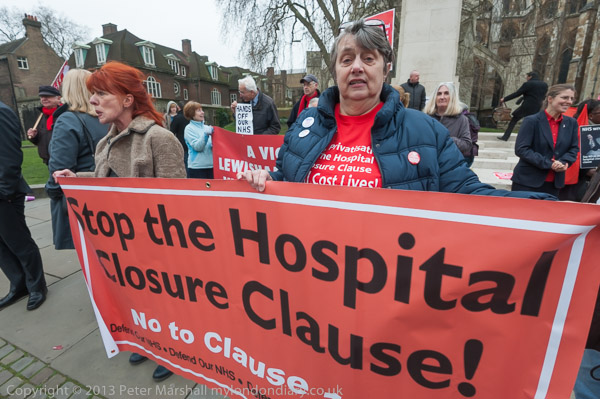

Careful framing helps (see below)

As often happens in legislation going through parliament, the actual number of the clause often changes as other items are withdrawn, amalgamated or inserted. The framing of the banner in the image above helps to eliminate a little confusion as the banner had an earlier number for the clause. Though really it was more about putting the exclamation mark at the edge of frame. I’ve framed tightly to the banner at the right edge, and just managed to get the ‘Cost lives!’ visible on the shirt of the central figure. The top edge of the frame was determined by wanting a just a little space above her head, and I’ve made use of a placard behind her to get her head to stand out a little from the background.  With 3 sides of the frame determined there wasn’t a great deal of choice about the fourth, but it works OK. Ideally I would have liked to be just a few millimetres higher, I’m not sure whether this would have been possible. Sometimes it would be nice to be just a little taller.

Framing is vital in photography, but so many photographers (and myself at time) seem to be rather sloppy about it. I try to get things right in camera, taking a particularly careful look at the edges of the image when I’ve time to do so.

Occasionally there are things that just won’t work in the normal 3:2 frame for various reasons, and I’ll take these with another framing in mind. The image at the top of this post was an example, with an intrusive video camera at the right of the scene. I couldn’t move the camera or find a way to frame without it, and framed for a cropped image.
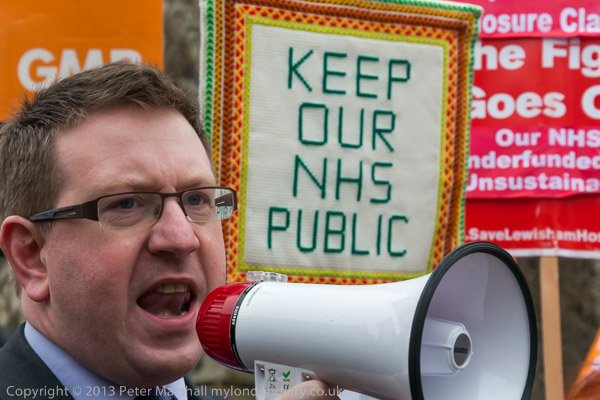

Andrew Gwynne MP, a member of the Shadow health team

The embroidered placard ‘Keep Our NHS Public’ must be one of the most photographed placards around, and I’ve photographed it at various protests over several years. The woman who made it and carried it was a colleague of my wife in the early 1970s. It’s effective because it stands out, and the message is large and clear. Often the ideas that people think up for protests end up with being hard to photograph, and there were two examples at this protest.
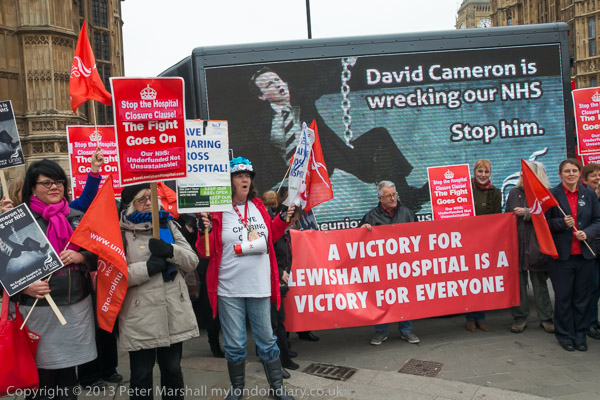

The van was hard to incorporate into the picture

One was the large digital image of Cameron the side of a van with the message ‘David Cameron is wrecking our NHS – Stop him.’, which the protesters formed up in front of. I didn’t really manage to find a good way to integrate the image with the rather more colourful protesters in front of it – and it largely obscured the Houses of Parliament – you can see the clock-face of Big Ben peeking over it.  I imagine it was being driven around and used elsewhere, but here it seemed to be something of a nuisance. Another photographer was responsible for directing the scene and including the van, and it rather killed the event at that point, though it recovered later. As ever, posing produced cliché, and took some working round.
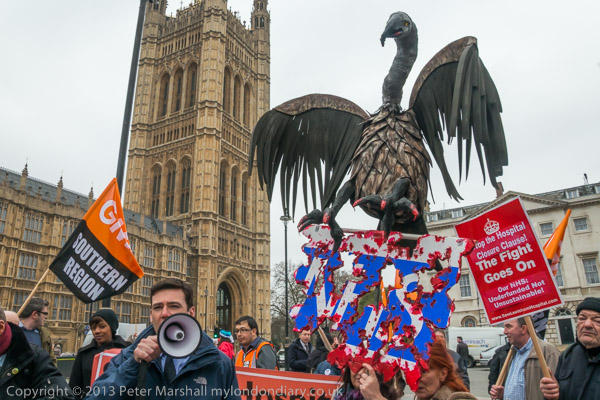

The Victoria Tower of the Houses of Parliament, shadow health minister Andy Burnham & Jeremy the Vulture

Jeremy the Vulture (named after Jeremy Hunt) destroying the NHS was a nice touch, but fiendishly difficult to photograph. As you can see he was rather dark, and against the sky was a virtual silhouette. Which might have been effective, but I couldn’t make it so. To get the result above, I’ve angled a flash in the hot shoe up and to the right, avoiding excessive exposure on the speaker who is closer to me.  A few test exposures enabled me to get the lighting about right (quite a lot of local control – darkening some areas and lightening others was needed back on the computer.) But although this image is reasonably clear, it was hard to get the bloodstained and holed body of the NHS to really be clear. Obviously I wanted to get the Houses of Parliament in the background too, but Jeremy was a moving target, and there are only some angles from which a vulture really looks like a vulture.  You can see a couple more of my various attempts to photograph him in Stop Hospital Killer Clause 119, along of course with other pictures of the event.
Continue reading NHS End Game
30 And 30

There is a lot to look at in both this year’s  PDN 30 and Photo Boite’s ‘30 Under 30′ Women Photographers, and most of it is of interest. And if you’ve not done so previously you can also look at the four previous years selections.

I’m not sure what it means that there are relatively few photographers from this or previous years whose names are familiar. Perhaps it means there are just so many interesting young women photographers, but looking back at similar lists such as the  ‘PDN’s 30: New and Emerging Photographers to Watch’ from previous years – such as 2010 – there are rather more names I now recognise – and even more women.

Of course the PDN feature has been running for 15 years while ’30 Under 30′ is relatively new, only in its fifth year.  And the two operate in different ways, PDN relying on  nominations by photo editors, art directors, curators, educators and fellow photographers around the world, with some invited to submit based on work seen in promotions, portfolio reviews or photo contests.

Twelve out of the 31 photographers featured in PDN’s list (it includes a husband a wife team) are women, so perhaps the introduction to 30 Under 30, with its emphasis on the traditional gender role of women in photography is outdated or at least overstated:

“Photography, whether we like to admit it or not, is by and large a male-dominated arena, where the ‘looking’ is a masculine act, and the subject is feminine, playing the role of ‘looked-at’ and admired mainly for their outward appearance. Photography, then, has been a mirror for conventional gender roles in western society.”

It seems to me to be more a commentary on the persistent gender stereotypes in advertisements rather than an accurate reflection of the state of photography. In my years as a teacher of photography, in a school and a college I almost always had more female than male students in my classes, and most of my better students were female. And although there are more men than women among the photographers I know and meet while working, many of the best and most successful are women.

But  I welcome anything which gives us a chance to look at some fine photography – whether by women or men, and I’ll come back to both these rather different sets of work and enjoy them – and wish all those concerned a successful future in photography.

Reuters Questioned

Olivier Laurent in the British Journal of Photography has an interesting post Reuters maintains dogged silence on allegations of ‘staged images’ on the continuing controversies over some Reuters images from Syria first raised by the New York Times three months ago, and of their refusal to answer questions about these and the photographers concerned.

Reuters have always insisted on high standards from the photographers who work for them, and their ‘A Brief Guide to Standards‘ in their Handbook of Journalism sets out in some detail what it expects.  Laurent gives a short quote from it in his article, but here is another that I think is particularly relevant not just to some of the images from Syria, but also to current journalistic practice in the UK.  In a section headed ‘Set-ups / Staging of Pictures’ they state:

“Reuters does not stage news photos. Sometimes, subjects may strike an artificial pose, such as at a product launch, a show business event or a sports victory ceremony or when requested to do so to illustrate a feature. In some circumstances, such as during demonstrations, civil unrest, street celebrations or conflict, the presence of photographers and television crews may prompt subjects to act abnormally.

These images should be few and can be clichés. They must be clearly captioned to show the reader that the actions are not spontaneous and to explain the context.”

The guide goes on to say “The best news photography occurs when the presence of the camera is not noticeable” and I agree completely with them, though I think their suggestion that this can be achieved using long lenses is seldom the case. Although it may occasionally be necessary or advisable for reasons of safety to work from a distance, it seldom produces the best images – and almost always has a distancing and distorting effect.  Being ‘not noticeable’ is a way of working which you can use even with a fisheye.

Captioning is certainly important, but only goes a certain distance. Generally as far as the sub’s bit bucket.  It’s perhaps a part of our moral rights as creators, a part of the integrity of our work, that along with attribution that photographers and the agencies haven’t really ever stood firm on.

I think it is sad that so much of what appears in our UK newspapers is just such staged photography, and have often felt some annoyance at photographers who will come into events and start staging pictures. Sometimes it is unavoidable, but let these clichés be few. Even if some picture editors seem to love them.

As I’ve mentioned in previous posts, the Reuters guide also gives some useful suggestions as to what is and what is not acceptable in camera settings and Photoshop, though I think it isn’t really possible to be as prescriptive as they are – nor do their ‘Technical Guidelines‘ cover every eventuality.

I’ve certainly occasionally transgressed over some things like selective sharpening, and I think their comment on saturation is simply incorrect – it does things which can’t be achieved using levels (and in many published images it is too high.) They might well find some of my local tonal alterations too extreme (as I’ve occasionally done.)  But it is the intentions that are more important than the detail.

Reuters set a high standard. One that I think all news photographers should aim to meet. But there is little point setting a standard if you refuse to demonstrate whether or not you meet it.

Chase Farm


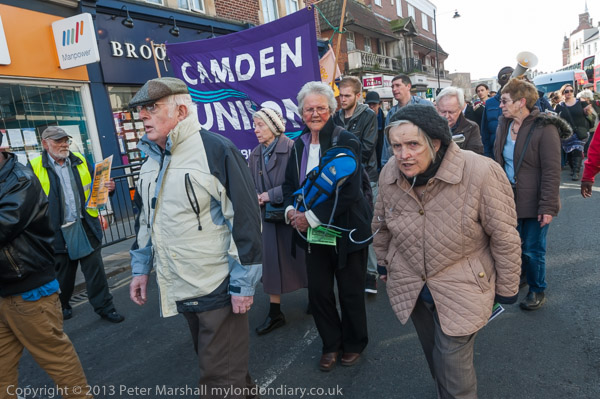
The march at a cross-roads in the centre of Enfield

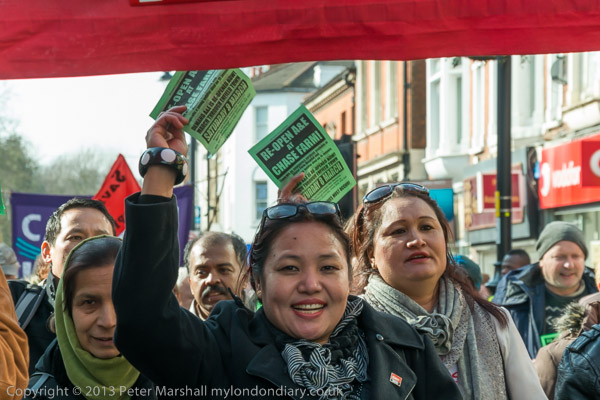
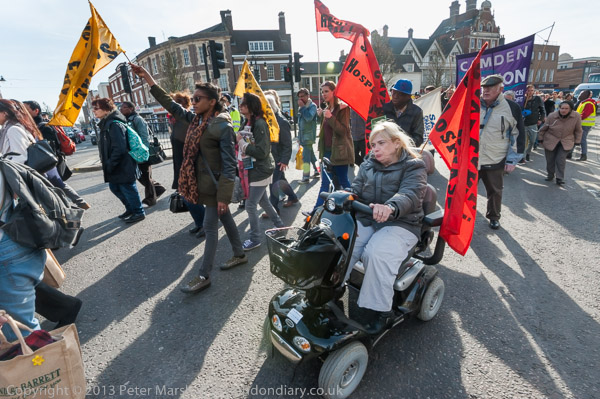
Enfield is right at the north of London, and I’d been photographing a march on Oxford St, and the problem was to get there in time for the start of a protest march calling for the re-opening of the A&E department at Chase Farm Hospital, closed three months ago.

The closure came after a long fight, starting before the last general election, with the Tory candidate getting elected on the back of a campaign in which David Cameron, the leader of the opposition had come to the Labour seat and pledged the Tories would keep it open – as so often pre-election promises mean nothing.

A month after the closure, a desperate woman rushed her sick child to Chase Farm only to find the department locked. By the time an ambulance had been called and arrived and taken the child to the nearest A&E around 25 minutes drive away 2-year-old Muhammad was dead. The health authority’s response has been to replace the small sign at the hospital about the closure with a much larger one.


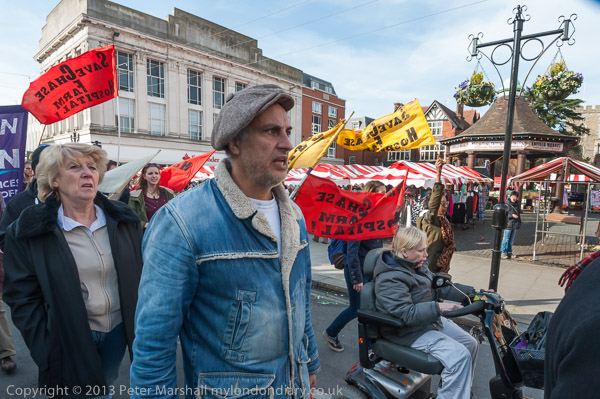
Marchers, including a woman on a mobility scooter, go past Enfield Market

No problem I thought:  tube to Finsbury Park, then the Overground to Enfield Chase, a few yards from the gathering point. The Transport for London web site gave me the times I needed to arrive a few minutes before the start of the march. But on the Central Line platform at Bond St, the next train to Oxford Circus was unusually delayed. It would probably have been quicker to go back to street level and walk. Normally I’d have got a bus to get to Oxford Circus, and the only reason I’d taken to the tube was because the march I’d already photographed was blocking the street.

So I missed the connection for the half-hourly service from Finsbury Park, but fortunately I’d also noted down an alternative train from Seven Sisters which I could still probably make. It took me to Enfield Town station at the other end of the town centre, arriving 3 minutes after the march was due to start. I jogged through the town centre, almost certainly the fastest half-mile I’ve done for some years (but still not that fast), to arrive very much out of breath just as the march was about to start, a little later than planned.

It was a reminder (though with rather long-winded unnecessary travel details here) that for taking photographs of events the most important thing is to be in the right place at the right time. Information and ‘logistics’. I’ve often felt the old photo-journalistic adage ‘f8 and be there‘ was the wrong way round, though ‘be there and f8‘ doesn’t sound as good. You can write a story without being there, but you can’t take the pictures, though I suppose by now our ‘security’ services are tapping in to those millions of CCTV cameras without budging from their screens in Cheltenham or Fort Meade. It’s not something that makes me feel safe.

As I ran and my heart rate soared, the thought did occur to me ‘What would happen if I was to have another heart attack?’ Would I survive the wait for an ambulance followed by the possibly 25 minute journey through heavy traffic blue lights flashing to the now nearest A&E? I ran on slightly slower…


Some of those on the march were workers from Chase Farm Hospital

On the march I struggled to find images that would dramatise the protest and make it of interest to those outside the immediate circle of those taking part and personally affected by the story. It isn’t enough just to show what is happening, your pictures (and text) have to reflect on the what and why and to provoke a response from the audience.

It isn’t really a camera that you take pictures with, but your thoughts and feelings. Framing and composition is all about expressing those as strongly and directly as you can. The real sensitive material in photography isn’t the film or the sensor but your mind.


One woman was marching with the help of an oxygen cylinder

There are some events which are easy to photograph, with a great deal happening, and others, like this march, which take rather more work to produce something. It’s not the greatest set of pictures I’ve made, but by the time the march had taken me back past Enfield Town station I felt I’d as much as I could, and made my goodbyes and took the train home.

Reopen Chase Farm A&E

Continue reading Chase Farm

Women March

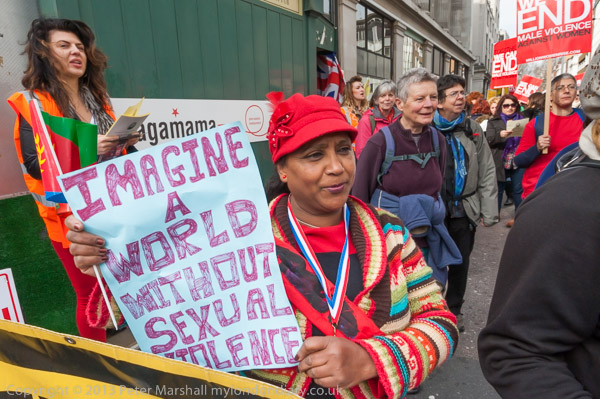
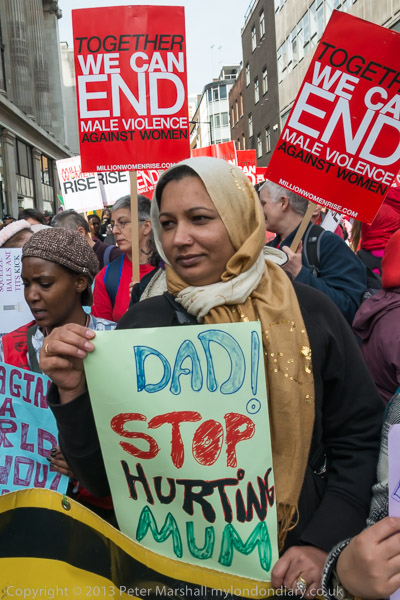
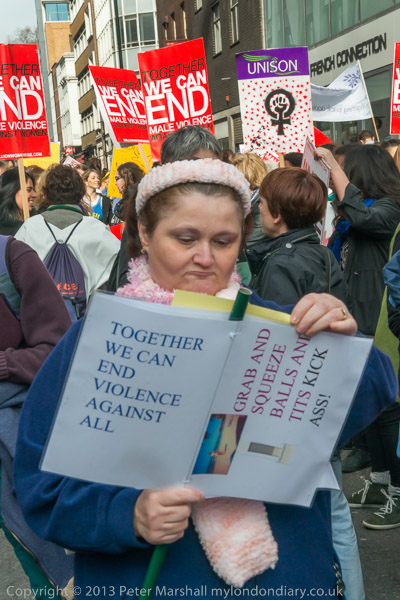
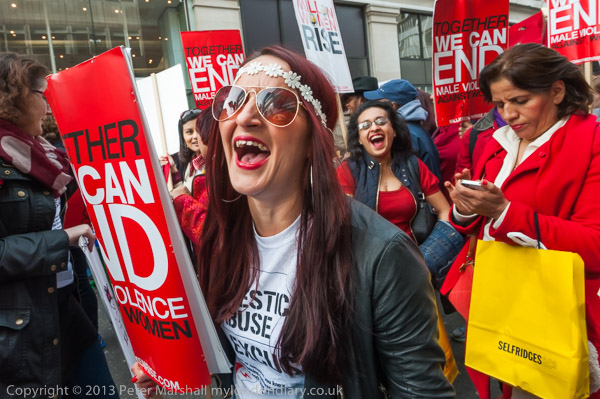
It was certainly an event where I occasionally felt I was the odd man out, though there were not a million women on the Million Women Rise March, but it was a women-only event. Or at least almost so, as later as it went along Oxford St I did spot one very bearded young man among the marchers. But a the stewards did make it very clear to a small mixed group wanting to join the march in support of mothers in Syria that they were not welcome.

It’s an event I’ve photographed annually since it started a few years ago, and even supplied a few pictures in the past at the organiser’s request for use on their web site. Most of the women were pleased to have their pictures taken (and some fairly insistent that I do so), and generally my presence before the march started was welcome, though I was pounced on at one point by a woman (not someone I was photographing) who objected to me taking pictures.

If women feel they want to march in an all-women march it isn’t a problem so far as I’m concerned (not that my opinion matters, only that if it was I probably wouldn’t bother to cover the event.) But the slogan on their banner and placards is ‘Together We Can End Male Violence Against Women’ and I think it will take both men and women together to really tackle it (and for that matter other personal and domestic violence.)

Photographically the main problem was in lighting contrast; it was a bright clear day and there were areas of bright sun and others of deep shadow. Working in the shadows  wasn’t a problem, but in the sun things were a little harder, and I should have used fill flash on some of the images, but I think I was just feeling too lazy.  So there was quite a lot of post-processing needed to burn down sunlit areas and bring up shadows in some images. But at least with digital you can rescue these things, and work far better in situations with both sun and shade than was possible on film.

I left the march as it made its way along Oxford St to rush off to another event in the north of London.  More about it and many more pictures at Million Women Rise March.
Continue reading Women March

Legals Protest

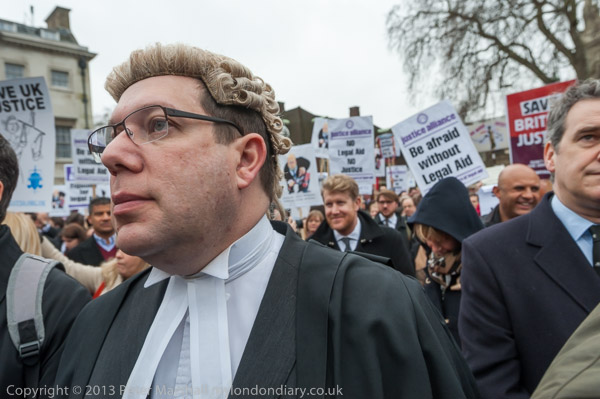
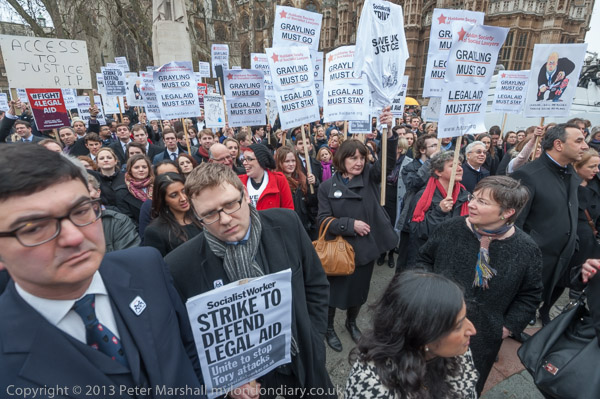
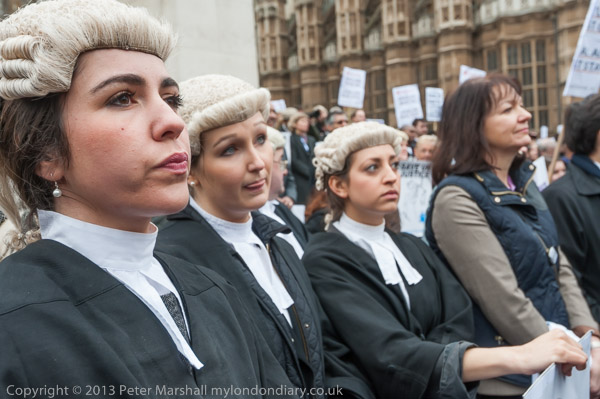
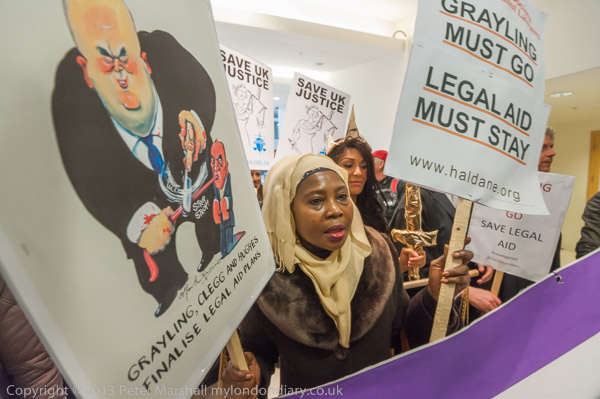
It was perhaps appropriately a rather grey day when lawyers came to Old Palace Yard opposite Parliament to show their outrage at the response by Justice Minister Chris Grayling to his Transforming Legal Aid consultation on criminal legal aid.  They describe it as ‘A shameful day in legal history’ and it was hard to pick a fault in their case, though it was perhaps naive to expect anything positive to emerge from any ‘consultation’.  Governments have never been strong on consultation, and for present ministers they are certainly just an opportunity for people to talk to deaf ears before they do exactly what they had previously decided.

They are almost completely discredited exercises by a government that prefers its own dogmatic and largely unthinking solutions. The only kind of logic behind its proposals appears to be that people who get brought to court are criminals and we shouldn’t waste much public money giving them a proper defence.

Lawyers as a whole are generally rather unexciting visually, and looking at the crowd as a whole it seemed a dark mass. There was something a little surreal seeing barristers and solicitors many in legal dress of black gown and horsehair wig holding up placards and shouting slogans in a political protest on what was their first every full day’s strike.

Legal dress is worn far less now in courts, and for some of those attending it was a fairly rare outing for their ridiculously expensive horse-hair.

Our legal system is ridiculously expensive, and in need of extensive reform to make better use of the time of everyone concerned. There are occasional abuses of legal aid, with some taking advantage of it who should not be and others who need it not being eligible. But while some reforms are needed, the government proposals seem simply to be about saving money at the expense of those on trial, making them far less likely to get justice.

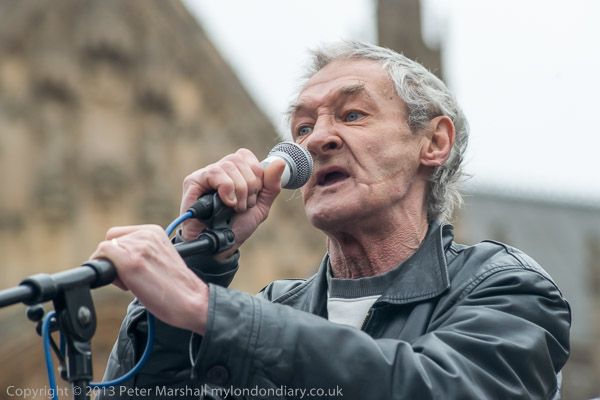
Certainly the most impressive and powerful speech at the event came from a man who had been wrongfully convicted for an offence he did not convict. Better legal aid at his initial trail might have made the initial miscarriage of justice and the life sentence less likely, but it was legal aid that enabled Paddy Hill and the others of the Birmingham Six to eventually get justice. Had Grayling’s proposal already been in force they would still be in jail for a bombing they did not commit.

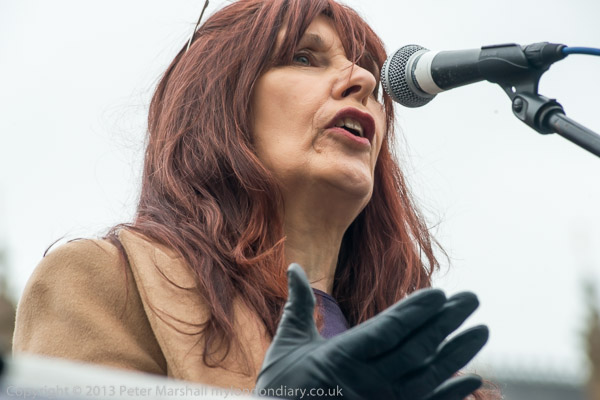
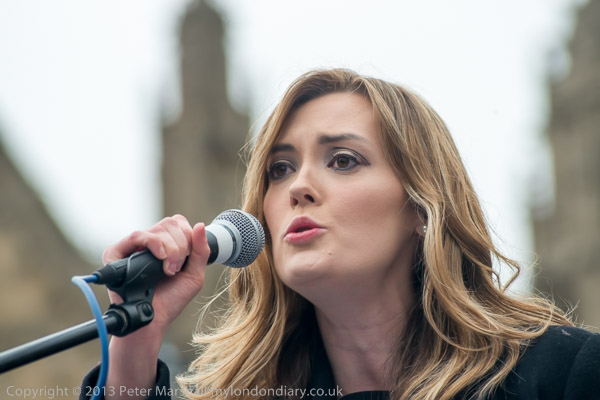
It was an electric and rabble-rousing call for revolution, if in the situation only theatrical. By contrast most of the other speeches seemed a little dull and pedestrian. Hill too was more interesting to photograph, with a strong face and a full range of expressions, while some of the lawyers were about as interesting as a blancmange. There were exceptions – including most if not all of the women who spoke, but by the end of the speeches (I think around two hours of them) I’d had enough.

The speakers were on a scaffolding platform, standing with their feet around head height with the main event banner in front of them. Some stood a little back and were too much obscured by the banner. Mostly for the speakers I was using the 70-300mm Nikon on the D800E. It’s a full-frame lens and I didn’t think to set the camera to use it in DX mode, so they are 32Mb files, much larger than I need. At ISO800 most a typical exposure was 1/400 f10, and I was working at focal lengths from around 100 to 300mm. The lens isn’t at its best above around 200mm and it would probably have been better to use it in DX mode for these tighter views.

A big problem when photographing speakers at events is the microphone. Different speakers use them in different ways, some staying very close, others standing back more – almost always better for the photographer.

At many events there is a crowd of photographers that make it hard to change position, particularly when celebrities are speaking. Here there were no real celebrities, and there was quite a lot of relatively empty space in front of the platform so I was able to move around and pick my angles. I live to work from one or other side, at least so the speaker’s mouth is not obscured (though that’s hard with the mike-huggers.) Here I was able to move closer or further away, with one of two images from quite a close position looking up as well as those with a long lens from a distance.

Changing position also varies the background, with some pictures against almost entirely empty sky, and others with parts of the Houses of Parliament visible – with different degrees of blur.

The came the march to the Ministry of Justice, via the Liberal Party HQ, where Paddy Hill led those going into the offices with their letters – and I’d taken up position to photograph him doing so, and a minute or so later photographed him inside after letting some of the others follow him.

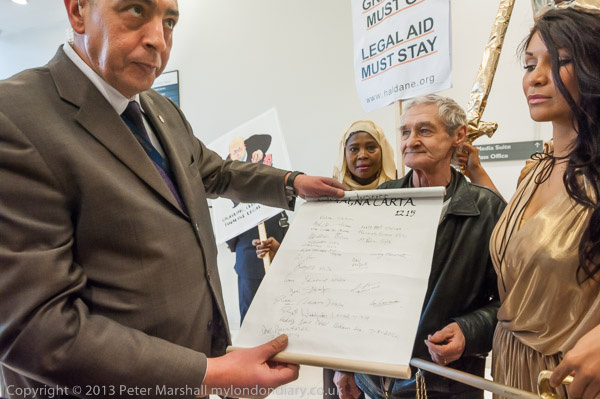
When a small group went inside the Ministry of Justice led again by Hill carrying a scroll to present for the minister I was with them, and walked past the rather surprised-looking security guards to photograph the scroll being presented to an official. When I saw him rolling it after looking at it with its back towards me, I asked him if he could show it to us too, and he did. I think it made a better picture. I don’t really think it counts as setting it up.

As we turned away to leave the ministry, more protesters and photographers pushed in, and things got a little more interesting, though everyone eventually left after the security had requested us to do so.

Story and pictures: Outraged Lawyers Legal Aid Protest

Continue reading Legals Protest

NOT For Sale

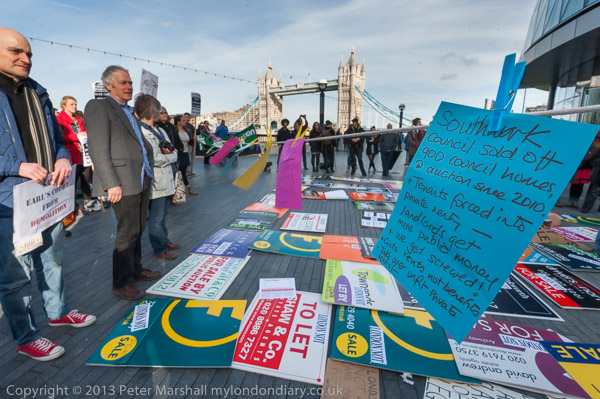
London is not for sale was the first protest I’d attended organised by the Radical Housing Network, and London certainly needs some radical new thinking on housing, or at least a complete change in the direction so far as housing policy is concerned. The way to solve its housing problem is actually pretty simple to state, and, given a complete change in the mind of government would not be impossible to acheive. Build more social housing and make it available at sensible rents – rather less than the currently largely unaffordable ‘affordable’ rents.

Unfortunately such a change in mind seems unlikely. About as likely as the Green Party coming to power. Both major parties want to sell off London, whether it is the national parties at Westminster or the local parties in boroughs such as Southwark and Newham. The protest took place a few days before London Mayor Boris Johnson was to fly off to the MILIM world property market festival in Cannes, France to try and sell off more London property to foreign investors and make our housing situation worse. There’s money in it.

The Radical Housing Network was also launching its two case studies, one of which particularly interested me as it was on one of London’s great scandals that I’ve previously written about, the “murky tale of developer Lend Lease’s relationship with Southwark, which gave birth to one of the most appalling instances of community displacement, coupled with financial mismanagement and barefaced lies.”  The other, about the South Kilburn estate

in Brent linked to another housing story I’ve covered, that of the Counihan family, now fortunately resettled a little further from the centre of London.

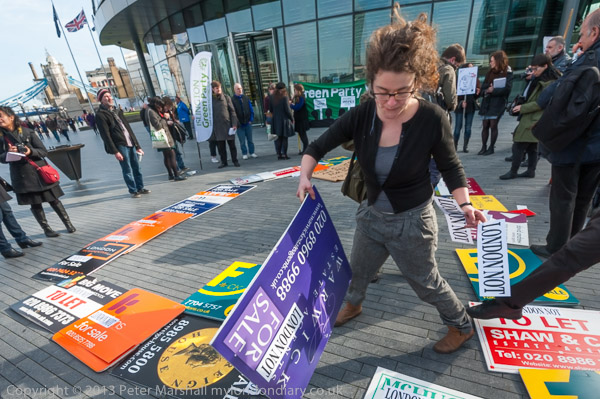
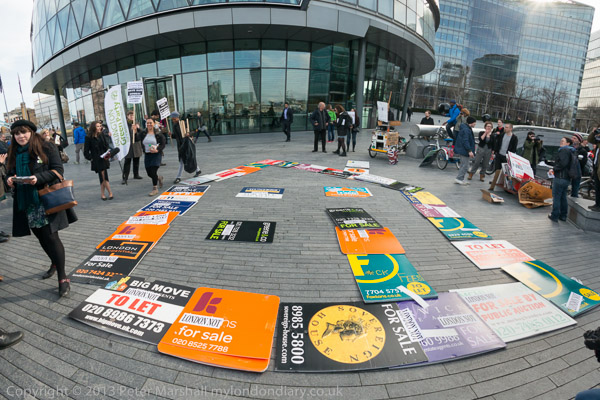
Photographically the main problem was that I’d forgotten to pack a helicopter. Difficult to get one into my camera bag, though I suppose a drone might be possible. As you may be able to guess from the image above, one of the organisers is trying to set out the modified estate agent signs on the paving outside City Hall in the shape of a house -or rather in it’s frontal elevation. So it would look like a picture of a house drawn rather badly by a child if seen from directly above – and so my need for a helicopter.

This was about the best I could manage – and you can see that as well as a rather tall door it has 3 windows and a chimney. This was taken with the 16mm fisheye held as high as I could reach – I didn’t have my monopod with me which would have given just a little more height.  It wasn’t easy to get this, mainly because every time the house was clear of people another photographer – either amateur or professional – would walk on top of it.

The sun was inside the frame at top left when I took the picture and so there was chance of using a lens hood or a hand as a flag. I had to add some exposure to stop the image being underexposed. Using the Fisheye-Hemi plug-in has moved the sun just over the edge, but that area still needed quite a bit of burning in. It’s surprising – that the image was still virtually flare-free (I think I have done a tiny bit of retouching) but there were some annoying surface reflections from the boards at the right of the picture which I’ve attended to a little. I’ve also cropped the image a little to tidy it up.

I tried using Photoshop’s Adaptive Wide-Angle filter (I’d just upgraded to Photoshop CC from Photoshop 7) and the results were interesting but I couldn’t  get anything better. You can twist your image in all sorts of ways, but it’s very easy to make a mess of things by trying to correct too much. The image above ws the best I could manage without obvious faults. By forcing the bottom edge to a straight line it gives a better idea of the ‘house’. I’ve made the image as large as possible, resulting in it being a little wider than the normal 1.5:1 format.

It would have been better to stand further back, but clearing enough people and photographers to do so and make it possible to get everything in frame with the 16-35mm just wasn’t possible.

I found another problem when updating My London Diary, which is that somehow I’ve managed to alter either the way I export files from Lightroom or how Explorer sorts them so that they no longer sort in correct order in Explorer. Usually I put images on the web site in more or less the order I took them, but somehow it didn’t happen for this story.

London is not for sale

Continue reading NOT For Sale

Time Change

For once I’ve remembered to change the clock on the four digital cameras – two Nikons and two Fujis – that I use regularly before taking pictures with them. Most years after we have either put the clocks on or back it has been a month or so before I’ve got all of them sorted out, which has occasionally given some odd results, particularly when I seem to have taken things before they happened.

I had to make another time change around a week ago, as the clocks on the two Nikons – D700 and D800E – don’t keep good time. Both had gone a minute or two out, though not by the same amount, which was beginning to get annoying when editing work taken when using both of them.  It’s useful when you use ‘Sort by date’ in Lightroom to have the times more or less the same.

Back in the old days, we didn’t have to worry about such things. Cameras didn’t even have batteries let alone clocks. And when cameras did start having batteries, all they powered were exposure meters. Then you had to remember to change these at least on an annual basis – I used to make my birthday a day to do this. Then came cameras that had auto-focus and power wind and you needed to pack spare batteries in your camera bag, though they were small and took up little space. Now with the Fujis you need to change the batteries every hour or two.

The Nikons are rather better, and I can only remember having to change a battery while out taking pictures once in the past year. When I get home I look at the battery level and if it is below 80% it gets recharged. With the third party batteries (cheap replacements) if I’ve not taken much they can still be at 100%, as they have higher capacity than the genuine Nikon ones.

Batteries are one thing that puts me off changing entirely to Fuji-X. Not just their low capacity but also the lack of a proper battery level indicator. A warning when at best you have one or two exposures remaining isn’t enough.

Of course it is useful to have cameras that know the time, at least when you have it set correctly. Once after I’d had to do a complete reset of a camera I got the year wrong, which rather upset the  agency I sent the pictures to who rejected the work. Fortunately Lightroom or other software can change the date.

But looking back at some old work on film, particularly on colour transparency, it can be hard to know which year it was taken, let alone which month, day or hour. Some transparencies are in mounts with a date stamp showing when they were processed, but many are not.

With colour neg or black and white I’ve usually put at least a year and month on the negative filing sheets – indeed it is the basis of my filing system. Occasionally I’ve added a date and a place, either there or more often on the contact prints. Where I thought it appropriate I’ve added more details, sometimes including street names and grid references, but geotagging would have saved me many hours of work and probably have been more reliable.

Ash Wednesday

After Pancake Day follows Ash Wednesday,  the first day of Lent, 40 days of penance, repentance, reflection and fasting in the Church calendar leading up to Easter, 46 days later (Sundays don’t count.)  The 40 days reflected the 40 days Jesus spent in the wilderness being tempted by the devil, according to the Gospels.

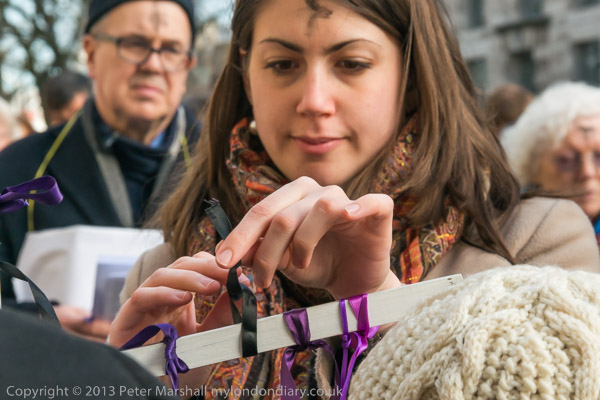
Every year since 1982, Christian peace organisations including Pax Christi, Christian CND and London Catholic Worker have observed the day with an act of prayer and witness at the Ministry of Defence in London, calling on them to repent from their deployment of weapons of mass destruction, and making use of the traditional symbols of sackcloth and ashes, though this year I think there was no sackcloth, though there were ribbons, being tied to a cross “in memory of a place/people in need of peace“.

Photographing a religious event taking place in public like this I feel requires a certain reverence of approach, which sometimes makes it difficult to get exactly what you want. I think you have to be non-intrusive so far as the actual worship is concerned (not that photographers should get in the way at other events,) As a documentary photographer I try to alter things as little as possible, although of course there is always some interaction and our presence always makes some difference. But my heart always sinks when other photographers start arranging people and setting up pictures and getting in the way of an event.

There are occasions when this may be appropriate. Press calls are events set up just to be photographed, although even at these I’d prefer to see how those taking part want to organise themselves rather than how photographers would like to take pictures. I can see why photographers do this, and much of the blame is down to picture editors who seem to have a peculiar attraction to the clichéd boring group shots that are too often the result.

Occasionally during an event – though more often before or after – it may be appropriate to take portraits of some of those involved, directing them for your camera, but to try and do so during an event I think is disruptive to the event and those taking part and rude to other photographers.  The streets are not a personal studio.

It is sometimes a thin line between what is acceptable and what is not, but one which at events like this it is important to try and draw. A few years ago, photographing this same event, I perhaps stepped over it, and received a complaint from one of the organisers. Since then perhaps I’ve been a little more careful – or perhaps they have become more used to me.

As I walked down the street after the service had finished with a couple of those who had taken part, they asked me about another photographer, complaining strongly about her getting in the way.  I didn’t say much to them, but I was pleased when they also commented that I had been almost completely unobtrusive.  It’s how I think it should be, and makes it easier for me – and other photographers – to work with these people another year.

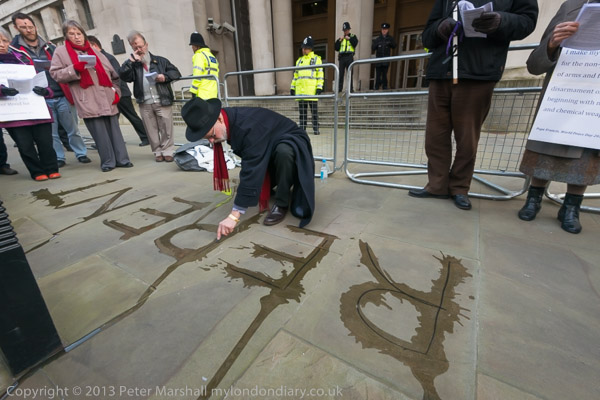
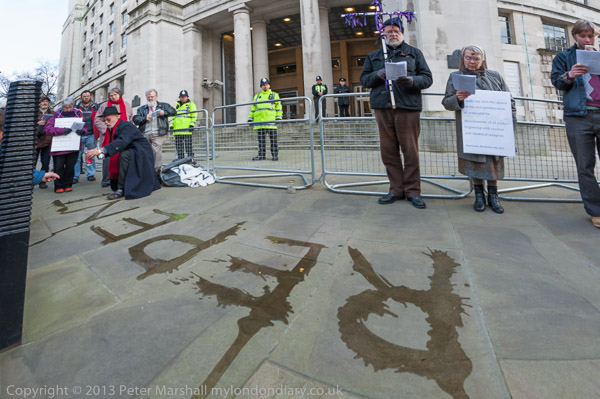
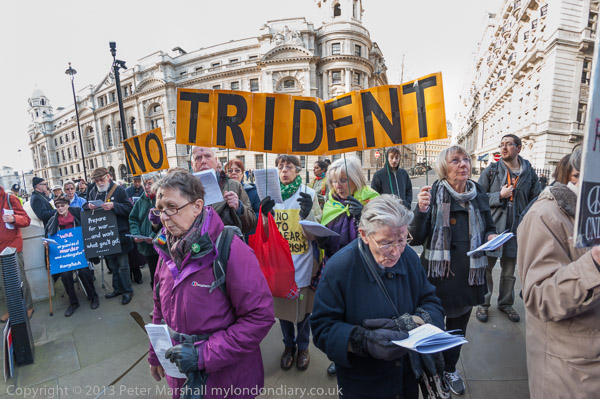
Fortunately for much of the event I had been the only photographer present, and was able to sit on the ground in the middle of things when the word ‘REPENT’ was traced out first in water, and then in ashes on the pavement in front of the Ministry of Defence.  It isn’t easy to photograph, and I was glad of the 8mm fisheye to give me a very wide view (later converted to cylindrical perspective), as well as using the wide end of the 16-35mm.

As a part of their witness, a number of those taking part try to mark the Ministry of Defence and War Office in charcoal with crosses and messages against war, and police are stationed all around both buildings to try and prevent this. It is a long perimeter, and people try from early in the day to well after the end of the service, making it hard for the police and for the photographer to catch them at it.

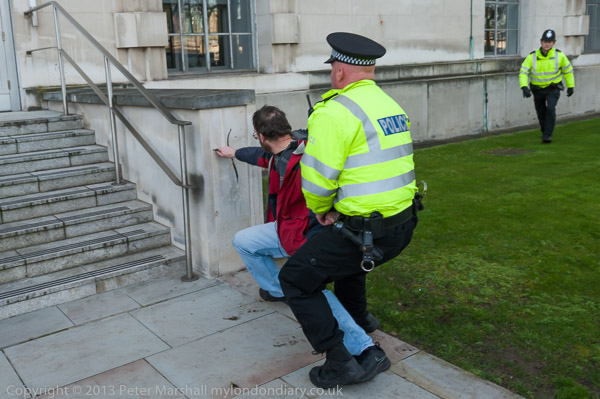
Even when an attempt was most predictable, when the roughly 100 people present were lined up at roughly arm’s length all along the long low fence between the ministry and the gardens, it was hard to know which of them would jump over to try and make a mark as they ended saying the Lord’s Prayer together. I was some distance away when I saw one man jump over, and the police had caught him short of the wall by the time I was close enough to take pictures, but seconds later I was in the right place as he managed to pull away from the officer holding him and make a cross before the police again overpowered him. Fr Martin Newell was released a few minutes later, but ten days later was sentenced at Westminster Magistrates Court for refusing to pay fines of £565 imposed for a number of similar acts of witness.

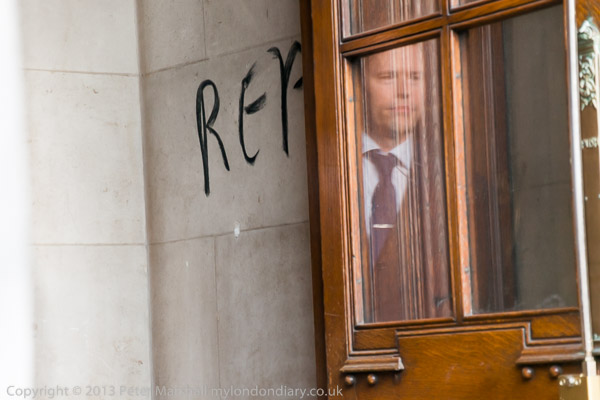
Later I saw another man being put into a police van, after having managed to write ‘REPENT’ inside the doorway of the War Ministry.  I couldn’t see the whole word from the street, and was told by a police officer that I couldn’t take photographs as it was a “restricted place.”

It seems fairly clear that even if the old War Office is a prohibited place (and it seems unlikely as it is no longer owned by the government thanks to a PFI leasing scheme) this does not ban photography by the public for non-espionage purposes.  Tourists in their droves photograph this and the Ministry of Defence building on a daily basis. But certainly the police were rather upset at having been caught napping, and were probably expecting to get a ticking off later.

But I’d taken my picture already, and wasn’t going to bother to stop and argue the point.

More pictures from the event at Ash Wednesday Act of Resistance

Continue reading Ash Wednesday

Come to the Party

31 Contemporary Photographers

I’ve often mentioned LensCulture here; it now styles itself as a ‘Global photography network and online magazine celebrating current trends of contemporary photography in art, media, politics, commerce and popular cultures worldwide’ though I still think of it mainly as one of the best on-line photography magazines. But its Editor & Publisher Jim Casper clearly thinks in a larger context, and it has organised portfolio reviews and and has a very wide range of photographer’s portfolios on the site – including a few of my May Queen pictures.

And rather to my surprise I find that the new Lensculture exhibition which is coming to London is the 5th annual LensCulture Exposure Awards show. You can see work by the Award winners and finalists in 31 Contemporary Photographers at the London College of Communication, Elephant & Castle, London SE1 6SB from April 1 – April 5, 2014, 10 am – 5 pm.

The work on show was from thousands of submissions by photographers from 62 countries and was selected by a nine-person international jury. Between them the six winners and 25 finalists represent 20 countries. Photography is indeed an international medium.

Jim also asks me to share the invitation to the Opening Party for the show on Thursday 3 April, 2014 from 6 pm – 9 pm with all of you. I hope to see some of you there.