Szarkowski Dies

one’s point of view is formed by the work one chooses to write about, because it is challenging, mysterious, worthy of study, fun.
John Szarkowski ( interview with Mark Durden, 2006.)

It would be hard to overstate the importance of John Szarkowski to photography, so I suppose it is inevitable that some of the obituaries following his death following a stroke last Saturday at the age of 81 have done so.

Great that Szarkowski was, he didn’t invent photography, and its progression into commercial galleries and the art world would certainly have ocurred (although undoubtedly rather differently) without his presence. One or two writers also need reminding that photography had started to play a significant role at the Museum of Modern Art some 25 years before he arrived there in 1962.

He built his work – as he always acknowledged – on that of others, notably Beaumont Newhall and Edward Steichen. Walker Evans, whose work had a key role in Szarkowski’s pantheon, had his first show at the museum in 1933, thanks to Lincoln Kirstein and Alfred Barr, and his major outing there, “American Photographs” in 1938, a year after Beaumont Newhall’s groundbreaking “Photography, 1839-1937“. (Kirstein, a wealthy “friend” of the museum, was also largely responsible for the publication Walker Evan’s classic book to accompany his show there.) Szarkowski’s 1971 retrospective of Evans was very much following in Newhall’s footsteps.

Szarkowki’s immediate predecessor at the museum, Edward Steichen, had given sterling service as the captain at the helm of photography, doing much to increase its popularity as an art form, particularly with his record-breaking “The Family of Man“.

But of course Szarkowski’s acheivements were immense. During his time as director from 1962-91, the museum set out a coherent direction in photography with shows such as “The Photographers Eye“, (1966), the catalogue from which remains an important text for photographers. “New Documents” (1967) introduced the work of Diane Arbus, Lee Friedlander and Garry Winogrand, giving a new impetus, and one that few critics of the time were ready for. Similar reactions greeted “William Eggleston’s Guide” in 1976, although here the main problem for many was that Eggleston worked in colour. These shows and others changed the course of photography.

Among his other writings, “Looking at Pictures” remains one of the most engaging books on photography, and certainly one that has inspired many writers on photography, as well as encouraging photographers to think more deeply about their own work. If you don’t already own a copy, I’d suggest you go out right now and buy or steal one.

One of the great treasures of MoMA is perhaps the finest collection of the works of Eugene Atget; most came when Szarkowski acquired the Berenice Abbot collection. The set of four volumes, “The Work of Atget” by Szarkowski and Maria Morris Hambourg that were published from 1981-5 are a fine work of scholarship superbly presented.

Szarkowski retired as director in 1991, although fortunately he continued to both curate shows and write, but he was no longer the emperor of photography. At times he must indeed have had grave doubts about the new clothes worn by some of the new emperors who took his place, and photography does sometimes seem to have lost its way and be moving down strange paths with odd bedfellows.

In recent years there have been several shows of Szarkowski’s own photographs. As might be expected, they show a great care and lucidity of thought. However his much greater legacy to us is through his work as a curator and writer.

Peter Marshall
Bernd Becher (1931-2007)

The work of Hilla and Bernd Becher was controversial to some people in the 1970s and 80s, but I came to it having sat (fleetingly) at the literal feet of Lewis Balz and studied with him and others of the work of the American New Topographics, so the kind of cool objective view embodied in their work came as no shock.

Of course their studies had a kind of ruthless scientific typology that the American work lacked, but it was something that the work of another German, August Sander had prepared me for. The kind of objective view of the Bechers fits well too with the Neue Sachlichkeit which came from Germany in the 1920s, a straightforward depiction of reality as seen in the work of Albert Renger-Patzsch or indeed of Helmut Gernsheim, whose photographic ideas rather disturbed the Royal Photographic Society when he arrived in England from Germany in the 1930s. As the title of Renger-Patzsch’s 1928 book says, ‘The World is Beautiful‘ and his work attempted to bring that out, while one of Gernsheim’s books was entitled ‘Beautiful London‘ (1951.)

The Bechers came to prominence in the rapidly developing art world in Europe, and were clearly seen as artists as well as photographers well before American dealers really began to take art seriously. They were accepted by the academic art world in Germany, and took photography into the Dusseldorf Kunstakademie, where they had met when both were studying painting. Their classes turned out a new generation of masters of photography, among them Andreas Gursky, Candida Hofer, Thomas Struth and Thomas Ruff.

Sadly, I’m prompted to think and write about the Bechers again because of the sad death of Bernd Becher, aged 75, following a heart operation. I knew the work of the Bechers in reproduction long before I saw their actual prints, and the presentation of their images in grids of small images which led to their recognition as conceptual artists had not prepared me for the quality of their work. Some of their large prints of cooling towers and other industrial structures had a truly classic beauty.

Sight and Sound‘ have republished an interesting feature on them, High precision industrial age souvenirs to mark Bernd’s death.

The Bechers became the most influential teachers of the era, not least because of the tremendous financial success of some of their students who became mega-stars of the art world (the Bechers themselves have never commanded similar prices despite the quality and influence of their work.)

I’ve always been uneasy about the great dynastic teachers such as the Bechers, Minor White and Callaghan. Sometimes their influence on their students has perhaps been too strong, turning out too many near-clones, who they have perhaps been rather too successful in promoting. Often this has meant that after the teacher’s death, the work of the students has tended to become less highly regarded. It is perhaps hard to see the market allowing this to happen in this case, although equally hard to see how some of the current art-market prices can be justified. But I suspect the work of the Bechers themselves may well be a very good investment.

How We Are: Twentieth Century Blues

Coming back finally to the current Tate Britain show, ‘How We Are’, the first section ‘First Moves’, dealing with the nineteenth century is certainly the most comprehensive and inclusive of all six chronological sections of the exhibition.

Around 120 photographers are listed for the remaining five sections, and they include some fine photographers (as well as some whose inclusion is hard to justify on any grounds.) My own selection of a similar number of photographers would perhaps have included rather under half of those chosen. It was certainly good to see a fair number of those whose work I think deserves to be better known – for example Norah Smyth and Edwin Smith in their very different genres, and obviously pleasing to see a number of photographers I know or have know with work on the wall, as well as to find some of those books on my shelves are now museum pieces. Some people – such as Bill Brandt – could not of course be omitted (although I’m assured that it was initially planned to do so.) Others, quite frankly had little relevance even to the particular view that the curators were presenting, perhaps representing strongly argued cases by some of those called in to review the plans.

In part the titles given to the different eras both indicate and dictate the omission of many fine photographers. ‘Into the Twentieth Century’ may seems pretty vague for the period 1900-1918, but appears to be a pretext for ignoring almost all of the pictorial photography and news photography of the era. As this was the first age in which cheap methods of mass reproduction led to photographically based newspapers, I would have expected more emphasis on how these new media used photography, rather than the rather specialised examples in the show. The photography of the Suffragette movement, with Christina Broom (Christina Livingstone, (1863-1939), Britain’s first woman press freelance photographer) and Norah Smyth, is a highlight of this section, reflecting the curatorial interest perhaps more in that movement than in their photography, which for both was considerably wider than the visitor to this show might conclude. Both of them are also featured in Mike Seaborne’s Photographers’ London: 1839-1994, which, despite its obvious metropolitan bias, succeeds in offering a considerably wider view of this era and others covered by the show.

By defining the period 1918-1945 as ‘New Freedoms in Photography’, the curators again choose particular work from the era rather than cover it more generally. Despite the title, there is perhaps less emphasis on photojournalism that might be expected from the era that saw the growth of the photographically illustrated magazines such as Liliput, Weekly Illustrated and Picture Post.

Again, it seems to me impossible to consider the period 1945-69 adequately as a whole under the title ‘The New Britain’; for most of us it changed radically at some point between the fifties and the sixties.

Equally it seems hard to argue that the seventies and eighties were dominated by ‘The Urge to Document’ or indeed that since then we have been making ‘Reflections on a Strange Country’. These are strange generalisations indeed, and the choices (and missing persons) they lead to make the show unrepresentative.

That isn’t to say that there is not a great deal of work of interest in this show. British photography does have a great deal to offer, and the story of British photography shown here is at time enthralling. But different curators would have made different choices of photographers and images, telling at least an equally valid view of photographing Britain.

So here are just a few names from the 70 or so who would have been on my personal list for 1900-1990 but are missing, in vaguely chronological order. Where I’ve written about them elsewhere and remember I’ll give a link.

Horace Nicholls, John H Avery, George Davison Reid, Emil Otto Hoppe, Felix H Man, Margaret Monck, Cyril Arapoff, Kurt Hutton, Thurston Hopkins, Henry Grant, John French, Eric de Mare, Raymond Moore, John Blakemore, Philip Jones Griffiths, Don McCullin, Ian Berry, John Benton-Harris, Jo Spence

Among the foreign visitors who perhaps have a greater claim to be included than most of those actually present are Izis Bidermanas, Henri Cartier-Bresson, Robert Frank and Sylvester Jacobs.

The final selection deals with contemporary work, and selection in this area is always going to be a lottery. The 20 or so photographers whose work appears in this section are an almost random cross-section from the several hundred whose work I find of some interest at the present time.

Although there is much to see, How We Are is a show that disappoints, as a missed opportunity. How long will it be after this before Tate Britain once again tries to tell the story of photography in Britain?

Missing Persons: First Moves

The ‘Missing Persons’ series has provided me with a little amusement although I think the point is basically serious – publicity from Tate Britain suggests that How We Are: Photographing Britain is “The unique story of British photography” when it is just one of many possible stories about British photography.

To adequately tell the story of British photography would need a larger space and a larger budget than the Tate provided. (Budget problems may also explain the rather unusual choice of images for some photographers.) As well as the particular viewpoint of the curators, these factors also helped to shape the show that we see.

This first section, entitled ‘First Moves’, and dealing with the nineteenth century is certainly the most comprehensive and inclusive of all six of the chronological sections of the exhibition. As a history it lacks some major figures, but also fails almost completely to deal with the technical, aesthetic, political and even largely the social changes that helped to change the nature of photography in Britain over the sixty years concerned.

There are of course many others apart from those already mentioned in ‘Missing Persons’ who might well be included in a proper overview of British nineteenth century photography, far too many to devote a whole feature to each one of them. So here are just a few more from the nineteenth century who I would have expected to see in any show claiming it was the story of British photography.

One of the best of the daguerreotypists was Antoine Claudet, and Calvert Richard Jones and John Dillwyn Llewelyn produced some fine work with the calotype and later wet plate process. It is hard to believe that there were no portraits by Lady Clemintina Haywarden in the show (perhaps by some error they left her out of the credits?), but she is not on the list. David Wilkie Wynfield was another of those to whom Julia Margaret Cameron turned for advice, and on who she perhaps based her approach.

A man very much after my own tastes, Henry Dixon produced some splendid records of London streets, showing both the buildings and the people. He also took some early candid street pictures, using a camera obscured by tarpaulin on the back of a cart.

Of course there are so many other interesting photographers of the period who I’ve not mentioned who are an important part of the early history of photographing Britain. What we do get – and is certainly of some interest – is a number of relatively anonymous works by rather ordinary photographers, including the work of commercial studios (some good, some bad) and others.

Viewed on its own, and for what it is – a kind of cross section of Victorian photography, seasoned with a number of choice tidbits from some of the finest photographers of the era – this section has much to recommend it. The coverage of some of the later eras – as I’ll show in later posts – is much less complete and more biased.

Peter Marshall

Water, Water Everywhere.

From the beginning, photographers have always had a thing about water. Of course it’s inherited from painting, as a quick walk around almost any art gallery, at least of work before the twentieth century, will soon confirm. Walking around art galleries is always useful exercise for photographers, and in London we are peculiarly blessed with both the National Gallery and the National Portrait Gallery adjoining Trafalgar Square where I’m often photographing events, and Tate Britain a short and pleasant walk from Parliament Square, where I’ll drop in and say hello to Brian Haw even if there is no other demo taking place. These galleries are also handy places to dry out when you’ve got soaked photographing in the rain.

In the first decade or two of photography, exposures were long, and one of the great challenges was to photograph waves. I wrote recently on ways to photograph water, and mentioned the success of John Dillwyn Llewelyn in an image of waves breaking on the Welsh coast in the early 1850s.

Water was essential to the wet-plate process that he used, where the photographic plate had to be coated and made sensitive to light on the spot, then exposed and developed before it dried to form a hard, impermeable skin. Of course water remained essential to photographic processing until the advent of digital, but we didn’t need to do the business on the spot. Even now, large quantities of water are needed for the manufacture of digital cameras, computers and the other equipment we need. Truly water is essential for life!

Few photographers, even the most cynical of us, are not occasionally seduced by the reflections of our subject in a smooth pool or broken by ripples, even though we know such things have already been done to death (and there is much evidence of this demise on Flickr and elsewhere.)

I’m trying hard to remember which the photographer was when asked for his definition of photography replied “never anything shot on a beach” or words to similar effect. I don’t think it was me, though I have a certain sympathy with the sentiment. As in the same way I used to call for a moratorium on the sale of colour film in the “Fall”, so aptly named by Americans. O Kodachrome, O tempora, o mores!

So when I agreed to take a walk with Linda and Samuel along some of London’s canal system last Saturday, did I stick to my principles and leave the camera at home? Of course not. From Mile End, we walked not to Paradise, but Willesden Junction by way of Kensal Green.


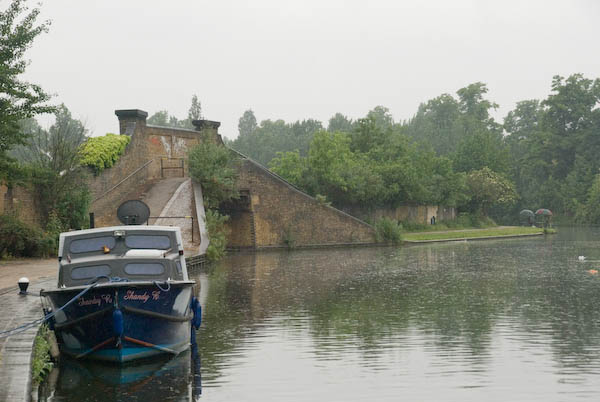
Grand Union Canal (Paddington Branch) at Kensal Green, steady rain.
(C) 2007, Peter Marshall

Water, at least towards the end of our journey was certainly everywhere, with an intense fine rain falling constantly as we walked the last few miles, although for once I managed to keep most of it out of my Nikon. Perhaps the canal looks at its best in rain?

More pictures from the walk in My London Diary, May 2007

Peter Marshall

Summer Photography

Certainly the most satifying of the various photographic shows currently in London is the Summer Photography Exhibition at Bernard Quaritch Ltd on the edge of Golden Square in Soho. It gains from being a relatively small show, concentrating on photographers who have photographed within a particular community or urban area. The show continues until 29th June, 2007 and is open Mondays to Fridays, 9.30-5.30.

(C) 2005, Mike Seaborne.
Mike Seaborne, Bethnal Green, 2005

Quaritch is an antiquarian bookseller, established in 1847 by Bernard Quaritch, who on his death in 1899 was described, according to The Times, as “the greatest bookseller who ever lived.” Their premises in Golden Square, where they moved in 1970, have something of the air of a gentlemen’s club and the walls are lined with bookcases of old and rare volumes.

Before going into the downstairs gallery, we lingered around a glass case with some examples of the work of Thomas Annan, including a couple of fine large published volumes of his work, the superb carbon prints published in 1878/9 and the photogravures published in 1900 by his son, Robert Craig Annan, which included 12 of his prints along with 38 taken by his father. The photogravures are also splendid prints.

Downstairs in the gallery is a rare treat, 5 salt prints from the calotype images that Hill and Adamson made at the fishing village of Newhaven on the edge of Edinburgh, not a great walk from their Calton Hill studios. These prints are still powerful images 160 years later, and I was particularly struck by the image of the three fishermen. The different poses they have adopted to attempt to remain still for the lengthy exposure required express powerfully their varied characters. It remains a far more powerful portrait than anything I saw in Photo-London, and reminds me strongly of some of the best images of August Sander, taken some 80 or 90 years later. The five fishwives grouped around some of their baskets is also one of their more interesting images.

The five Thomas Annan prints in the show are glowing examples of his work on the closes of Glasgow in 1868-71 (printed in 1877.) Carbon prints are perhaps capable of a quality unequalled by any other photographing printing process, and these are good examples.

John Thomson’s Street Life in London, with text by Adolphe Smith is represented in the show by six Woodburytype prints. These are carbon prints produced in a printing press from a lead relief plate, created under high pressure from a gelatin relief image made in a similar manner to a carbon print, contact printing a dichromate sensitised gelatin coated sheet under the negative using a powerful UV source.

Street Life in London was one of the truly pioneering works of documentary, and the nicely produced Quaritch catalogue for the show (Catalogue 1351) lists copies both of this work and ‘Street Incidents’, published a few years later to get rid of unsold sheets of prints from ‘Street Life.’

Although Henry Dixon along with Alfred and John Bool produced many fine images recording London around the 1870s and 1880s, their work was perhaps the least striking in the show. Compared to the Annan images, the prints shown lacked depth, and both the viewpoints and the choice of times when the streets were largely deserted make their work of less interest.

By contrast, Roger Mayne’s images from North Kensington, Notting Hill and Paddington in the 1950s are entirely about incident. I was particularly taken with his view of children and teenagers on the doorsteps of St Stephen’s Gardens. Times have changed, not only in the dress and behaviour of children, but also in public attitudes to photographers and being photographed; it would be a brave photographer who tried to take similar pictures on the streets of London today.

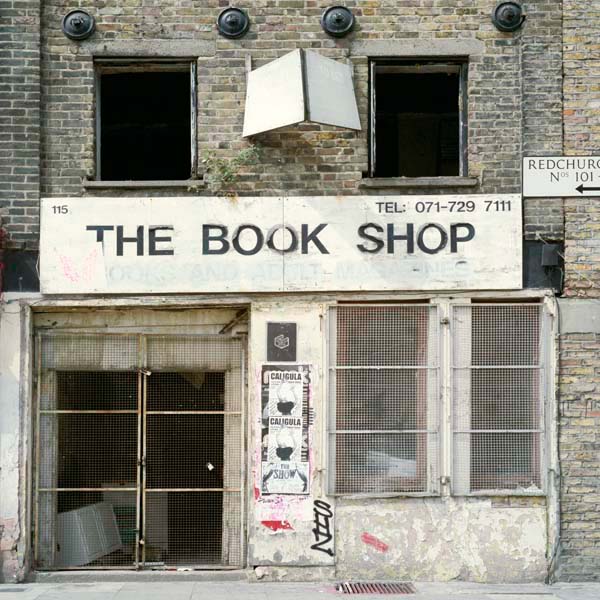
Again by contrast, Mike Seaborne’s ‘Facades are deliberately empty of people. Taken from across the street with a square format Rolleiflex camera, they create a systematic visual catalogue of shopfronts surviving (in some cases only just) from an earlier age. Taken in 2004-6, these colour images (some of which are on the Urban Landscapes site I started with Mike) are powerfully evocative, the remains of an older world still with us, often in contrast with ugly 2000s street furniture.

Also included in the show is a single print of New York by Berenice Abbott, a beautiful riot of washing in the yard of New York’s first model tenements, built in 1882 and photographed by here in 1936.

Peter Marshall

Missing Persons 5: James Craig Annan

Another important figure from the 1890s omitted from ‘How We Are: Photographing Britain was the second son of photographer Thomas Annan (whose work was included.) James Craig Annan joined the family fine-printing firm when he was 19 in 1883, and went with his father to Austria to the studio of Karl Klic to learn his novel photogravure process for the reproduction of photographs, for which they bought the sole UK rights.

The firm specialised in the reproduction of works of art, and in the early 1890s, James applied his skills to making carbon prints and photogravures from the negatives of calotype pioneers David Octavius Hill and Robert Adamson. The Annan family had known Hill, and had moved from Glasgow to live in his Calton Hill studio in Edinburgh for the last year of Hill’s life.

At the same time, James decided to become a photographer, and his first show, on the company premises in Glasgow in 1892 made a great impression. His landscape work from Holland inspired Alfred Steiglitz, who went to a similar area of the coast and made a his own, in some ways similar image. Soon he was a member of the ‘Linked Ring’ and his work was shown to critical acclaim in London, New York, Paris and Russia, and later in many other cities in Europe, America and India.

James Craig Annan was included with Hill and Evans in a 1906 show at Alfred Steiglitz’s ‘291’ gallery in New York, as well as in the great show Stieglitz organised in Buffalo in 1910 which in some ways marked the end of the Pictorialist movement (and the Linked Ring dissolved in the same year.) Steiglitz published eight of his images from a trip to Spain in 1913 in ‘Camera Work’ the following year. This more or less marked the end of James’s photographic career, and he apparently took few photographs after this time. He retired from the family firm around 1940 and died in 1946, his photographs largely forgotten.

I’ve never fully appreciated the work of Annan, probably because of his use of photogravure as a printing method. I can testify from limited personal experience that this is an extremely tricky method. I made one print, largely to see exactly how it was done and never wanted to repeat the experience. It is a process that requires (and allows) great control. Although I can appreciate the photography of Annan, I find the prints themselves have too pictorial an aesthetic for my more ascetic taste.

There are many photogravures by other photographers that I admire, but his work has always left me with an uneasy feeling of compromise between the photographic and the pictorial, which to some extent characterizes almost all the art photography of this era.

Peter Marshall

Missing Persons 4: Frederick H Evans

No proper view of British photography in the late nineteenth and early twentieth century would be complete without the work of Frederick Evans. At a time when most photographers with any pretention as artists were busily engaging in making their prints look less like photographs and more like paintings through the use of rough papers and special printing techniques that allowed them to work on the image.

Evans followed instead the example of P H Emerson, photographing in a technically precise manner and printing on platinum paper, which produced a linear tonal scale and was not normally susceptible to manipulation. He was noted for refusing to retouch his work, relying instead on perfecting his technique. His images owed their effect to light, and he would sometimes spend hours, days or even weeks studying the effects of light in the buildings he wanted to photograph in order to find the time of day and light that would produce the photographic effect he wanted.

He valued the clear and delicate tonality of the platinum print to such an extent that when the material went off the market he made no more prints, refusing to use the cruder and less linear tonal scale of the silver print. Some of his images were also reproduced using the Woodburytype process, which uses a relief image on a lead printing plate to produce different thicknesses of pigmented gelatin – and hence different tones – on the paper – essentially a mechanically produced carbon print.

As well as his architectural studies, which certainly include some of the finest images of English cathedrals and their interiors, he also made a number of fine portraits, including justly well-known images of Aubrey Beardsley.

Evans was a leading member of the ‘Linked Ring’ group of artistic photographers. He was also the first English photographer to have his work printed by Alfred Stieglitz in his magazine ‘Camera Work’ in 1904, and 2 years later Stieglitz showed his pictures in his New York gallery, ‘291’, along with the work of D O Hill and James Craig Annan.

Peter Marshall

Missing Persons 3: H P Robinson

Looking at the booklet for the show ‘How We Are: Photographing Britain’ before making my way into the gallery I got a shock. The curators appeared to have omitted the very man who started the whole thing, W H F Talbot. I checked again – it couldn’t be true, and thankfully it wasn’t. They had simply placed him wrongly in alphabetical order under the letter F. So when I realised that H P Robinson was missing, I immediately looked for him under ‘Peach Robinson’, but he wasn’t there either.

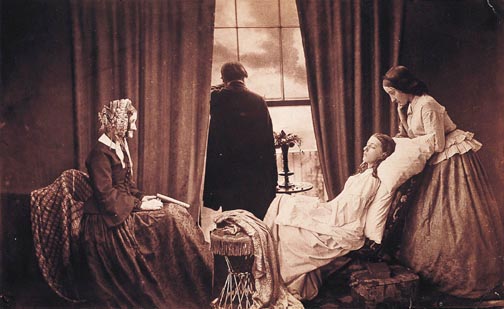
Although Rejlander’s ‘Two Ways of Life’ showed a path for photography, it was one taken most enthusiastically by his friend Henry Peach Robinson (1830-1901), who, over the years, starting with ‘Fading Away’ (a ‘touching’ deathbed scene which is perhaps hard for us to appreciate, but was only too common an experience in the era before modern medicine) produced a number of impressive works using similar combination printing techniques (such as ‘When The Days Work is Done’, as well as many fine portraits and landscapes.

fading away - HP Robinson
‘Fading Away’ is one of 12 images by H P Robinson available on the Free Information Society web site.

Robinson had trained and exhibited as a painter and was a great fan of Turner and of the Pre-Raphaelites, and he composed his works in much the same fashion, and dealt with some of the same subjects, including for example, a picture of “The Lady of Shallot“.

His use of combination printing continued to cause controversy in photographic circles, Robinson arguing that the aim of photography was to make beautiful pictures, and that the techniques used were irrelevant. He explained his appraoch in the influential book, “Pictorial Effect in Photography“, published in 1867, and was famously involved in arguments with another great photographer, Peter Henry Emerson, who favoured a more simply photographic approach to produce pictorial images.

Pictorialism to which both men contributed, remained a powerful influence in art photography for the next 40 or so years, particularly through groups such as the ‘Linked Ring’ (a strangely masonic guild established by Robinson and others when he left the Photographic Society in 1891) and various other seccesionist groups of art photographers based in other countries.

Although pictorialism was eclipsed in art photography by the rise of modernism in the early twentieth century, much of the debate between Robinson and Emerson had strong resonances in the 1970s and since, when increasingly fine artists began to take up photography and reject much of the purist orthodoxy.

Peter Marshall

Photographing with a Bicycle

The bicycle and photography were products of the same era and have many synergies. A few years ago, being interviewed by an amateur photographic magazine, I was surprised by the question “What is your favourite photo accessory?” but needed no time to think. Number one was my Brompton, with a good pair of comfortable walking shoes coming a close second. I can’t remember if either response made it to print, certainly they were not the kind of answers the reporter was looking for.

At the end of the nineteenth century, both bicycle and camera (thanks to the recently introduced dry plates and Mr Eastman’s Kodak film, and the introduction of the new ‘safety’ bicycle as an alternative to the ‘penny-farthing’) were popular crazes for the young and wealthy middle-class city-dwellers. In New York, as Alfred Steiglitz struggled to get his photographic crusade into top gear through the New York Camera Club, he took a tumble as its members put forward a motion to transform it into a bicycle club. (The motion was narrowly lost, but he took the hint.)

Both photography and cycling were relatively new and exciting and in keeping with the spirit of the times, offering new freedoms and an increasing ability to investigate a wider world. Some thirty years later, industrial workers, benefitting from shorter working hours, also took to their bikes and cycled out into the surrounding countryside, some of them with cameras. Bert Hardy was one, and began his career photographing cycle races. And many years later still, in my first conscious photographic project, I too got on my bicycle and cycled out to photograph a grove of ancient oaks.

Forty-five years later, the bicycle is still my favourite photographic transport, though I favour a folding model that can easily be taken on trains or even buses for longer distances. Unlike a car, you can stop and jump off when and where you like, and carry it up steps, over footbridges and ride or push it along footpaths.

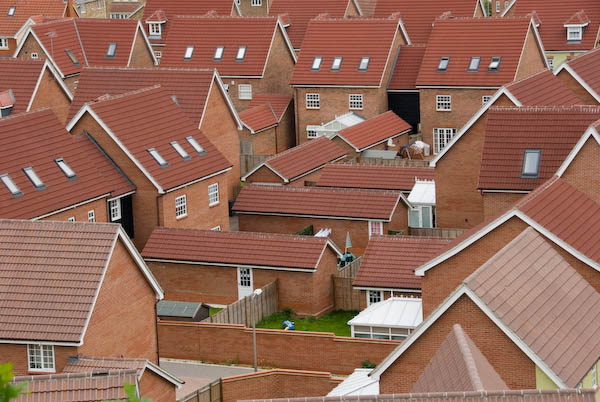
Chafford Hundred (C) 2007, Peter Marshall
Chafford Hundred. 1/250 f8 70mm ISO 200 Nikon/Brompton!

This picture was taken in Essex, one of many last Thursday made possible by Brompton. The bike got me there and many other places, and it also, by standing on the crossbar, gave me the height necessary to shoot over the fence which stopped me falling to my death over the edge of a cliff. Its a part of a long-term study of the Thames Gateway area, one of the largest developments anywhere.

I’ve always envied the tall guys who can see (and photograph) over walls. Although taking thought can add nothing to my stature, taking the Brompton gives me an extra 20 inches or so (or, more precariously, with one foot on handlebars and the other on the saddle a full three feet.) Think of it as a stepladder with wheels.

Peter Marshall