Anonymous Protest

Fair game‘ isn’t fair, or a game, and it isn’t either legal or moral. Wikipedia describes it as “various aggressive policies and practices carried out by the Church of Scientology towards people and groups it perceives as its enemies.” So if you plan to protest against them, it is probably a good idea to hide your identity.

Last month, part of a Scientology video featuring Tom Cruise was posted onto YouTube, and the Church of Scientology (C0oS) successfully demanded its removal, although it and other material about them has since been reposted. The unauthorised biography of Cruise by Andrew Morton has also stirred up controversy, with its allegations – repeated on YouTube – that Cruise is ‘Number 2’ in the organisation. There are also YouTube videos which allege that the CoS had pressurised some Australian booksellers not to stock the book. CoS is also alleged to have forced YouTube to remove some other material that describes its doctrines and practices.

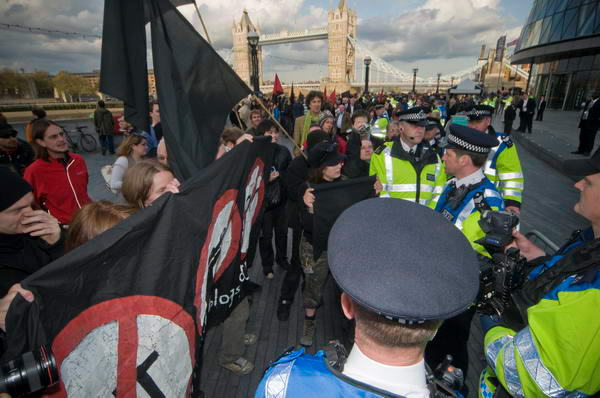
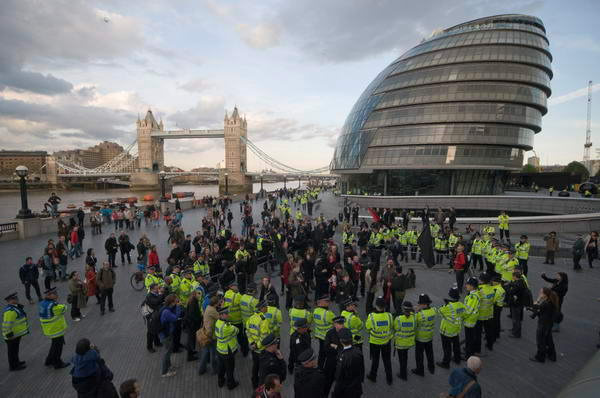
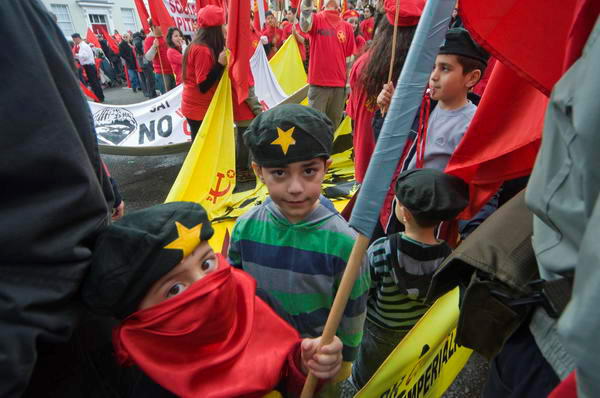
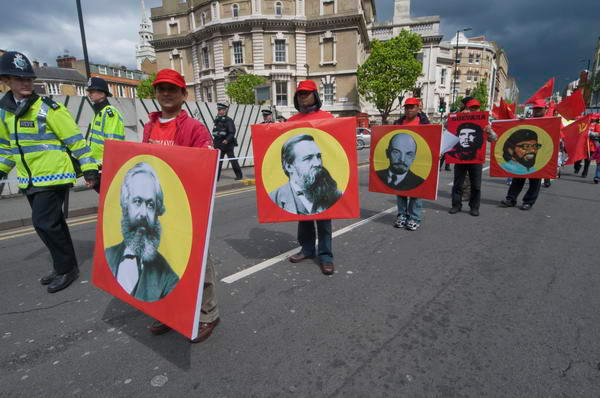
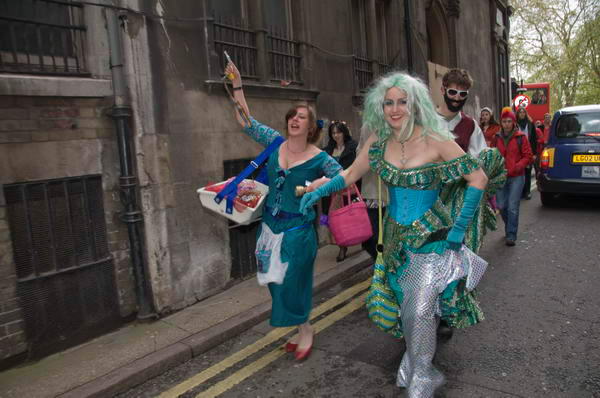
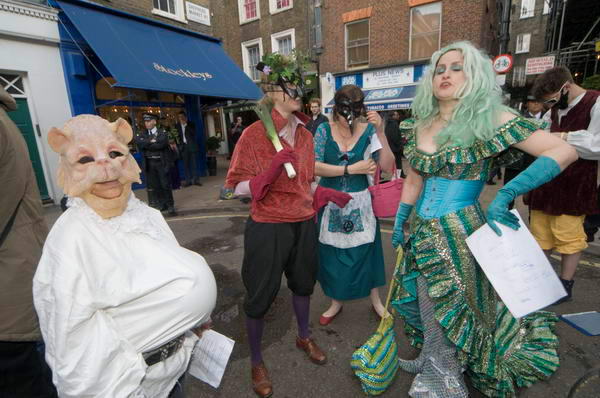
The Internet movement ‘Anonymous‘ emerged  to oppose these CoS activities in mid January,  aiming to remain anonymous to avoid retailiation under the ‘fair game’ policy. In a couple of weeks it managed to set up an international day of action with demonstrations in 50 cities in 14 countries against the CoS, including two in London.

Demonstrators work masks, many choosing the mask used in the film ‘V for Vendetta’, with some also togged up in the matching wig, hat and the rest. The ‘Anonymous’ YouTube videos also had some resemblance to the Warner Bros product, and I’m sure that at one point I heard “People should not be afraid of their governments; governments should be afraid of their people.

Pictures from both London demos

Ash Wednesday

Ash Wednesday is of course a much more serious day, the start of Lent, and a time for sack-cloth and ashes, which I did get to photograph, although my photographic day started with a couple of hundred people opposite Downing Street as a reception committee for ‘war criminal’ Condoleezza Rice. Unfortunately she came in to visit Gordon Brown by the back door and so missed our welcome – and a much-needed Geography lesson from the Friends of Lebanon:

The Middle East

I felt sorry for the guys inside the stockade opposite the famous door, cooped up for hours with nothing to photograph, perhaps because it was too noisy for Condi to emerge in case her delicate ears might hear the shouted advice from the road opposite. It really was much more fun outside, and the picture opportunities were also much better. I’m sure this would have made a better picture for the paper than another boring shot of a politician:

By 3pm we had all had enough and went away – but they were still waiting and hoping. I hope they did finally get to take something, although a quick look through the papers the next day certainly failed to find anything of interest.
More pictures.

Meanwhile the Ministry of Defence was getting more and more barriers and a policeman every few metres around its periphery, as if a huge and violent demonstration was imminent. Others were gathering across the road.

I walked past them and into Embankment Gardens, where a small circle of around 50 people was holding an Ash Wednesday service. This was the combined forces of Pax Christi, along with Catholic Peace Action and Christian CND. One man held a simple wooden cross on which were small photographs, I think of modern Christian martyrs, another a megaphone. The only other weapons – and ones that had seemingly struck fear into the hearts of the Metropolitan Police were ash and charcoal (and later I was also to see a hammer, some nails and sack-cloth.)

This was a Lenten Witness for Peace, an Ash Wednesday Liturgy of Repentence and Resistance to Nuclear War. The vast police presence was because a small number of those taking part were prepared for an act of civil disobedience, writing on the walls of buildings using charcoal. In fact all of those taking part were almost certainly in breach of the SOCPA legislation as the organisers “have never sought permission from the police to engage in the act of prayer and resistance which has taken place here every year since 1982.”

The ashes and charcoal were blessed with holy water and then those present took part in an act of penitence, symbolised by the marking of each of them with a cross of ashes on the forehead. After some further prayers there was a procession to ‘Station 1′, the pavement outside the Old War Office, where the service continued.

This was fittingly a situation begging for a ‘Hail Mary‘ shot, holding my camera above my head at the fullest height I could get, cursing Nikon for their cheapskate omission of a viewfinder curtain from the D200 (actually they give you a small rectangle of black plastic which you lose in ten seconds and isn’t exactly convenient) which means you have to hold one thumb over the viewfinder to get correct exposure while doing so. They did build one into the D2X, but over a thousand pounds and a large weight penalty is a lot to pay for this fairly essential but cheap for Nikon to implement feature. My first attempt (above) was possibly the best.

As this section of the event ended, one of those taking part pulled me to one side to tell me to watch out for people trying to write on the building, and so distracted me from actually taking a photograph of it happening (and I’d already changed lenses and added the flash for that very eventuality.) Of course he meant well, and I was able to photograph the police holding the guy and the unfinished message. Later I saw a woman writing on another wall, and ran, but was too far away to get to her before a policeman had stopped her and was telling her off.


A fisheye used in ‘Hail Mary’ mode to give an overall view. More curses on Nikon.

Outside the Ministry of Defence itself, a large sheet of sackcloth was used to cover the pavement and the cross laid on it. A set of theses for the modern church was read and each of them nailed to the cross while the congregation continuously repeated their chant of a short ‘Litany of the Martyrs.’

Unfortunately I think my curses must have upset Nikon, because halfway through the event my D200 stopped working. I think it had crashed, always a possibility with computers (and modern cameras are computers.) I tried the standard treatment of removing the battery for a few second, and it came back to life, though just to make sure I also changed the battery as it was below 30% left.

Somehow in doing all this, the camera went from the RAW setting I always used and on to basic quality JPEG, and I didn’t notice until I got home, and got rather a nasty surprise on viewing my work. Using my normal LightRoom import settings on jpegs always gives very contrasty poor quality images (they work best using the Linear . Once I had realised the problem I was able to get surprisingly decent results, but the lighting had been extremely tricky and I really missed the flexibility of RAW.

More pictures on My London Diary.

A Busy Friday

Demonstrations are sometimes rather like buses, with none for ages and then three come along together. On the afternoon of Friday 25 Jan it was four rather than three, and I think there were a couple more I didn’t manage to get to.


Stop Kingsnorth – No new coal fired power stations

The first I photographed was outside the Pall Mall offices of energy company E.ON who have recently got planning permission from Medway Council to build a coal-fired power station at Kingsnorth on the Thames Estuary. It’s now up to the government to decide whether to give it the go-ahead – another test of whether they take environmental issues seriously.

Of course it’s time we were moving away from large power stations and the high energy losses that come with transferring electricity long distances on the grid, moving to a decentralised low energy use society.

I like the picture above because of the way it lines up demonstrators and police facing each other and shows the whole situation with a speaker addressing the demonstration at the left of picture.

In fact I largely had to work from the side as the officer in charge told me I was obstructing the pavement when I stopped in front of the demonstrators to take photographs. We had a small argument and I reminded him that the police had reached an agreement with the press that recognised we had a job to do and should be allowed to do it, but it didn’t help. I pointed out that if I stood in the large gaps between the officers on the kerb I would not be either obstructing the pavement or impeding the police in any way, but was simply refused permission to do so, without any attempt to justify the decision – but with the clear suggestion I would be arrested if I disobeyed the instruction. So much for police cooperation. As you can see from the other pictures I took, I didn’t entirely do as I was told, but it did make my work difficult.

From Pall Mall I walked along to Trafalgar Square, stopping briefly outside the Uganda High Commission where a group of Kenyans was beginning to gather to demonstrate against the Ugandan president who has given support to the fraudulent Kenyan President. I didn’t stop long as I wanted to go to a larger gathering in Whitehall.

President Musharraf was visiting England, and expected to arrive in Horseguards Avenue by car. A group of around 50 Pakistanis was waiting their to protest against him. I took some pictures of them (and as with the other demonstrations you can see them on ‘My London Diary’.)

Finally I went to Borough in Southwark, where ‘Feminist Fightback‘ were demonstrating outside the offices of the Christian Medical Fellowship.

The CMF gave misleading evidence to the Parliamentary Committee which was considering possible reforms of the abortion act last year, and a number of its members with little direct scientific knowledge also gave evidence as if they were expert witnesses. They also support (and hosts) the minority report, which is in part based on their unreliable evidence.

Here there were no police and I was able to work without hindrance. Several people came out of the CMF office to talk to the demonstrators and they also had a table with soft drinks and biscuits although I don’t think anyone took any.

Although it was only a small demo, it was more interesting than many to photograph, and presented a few interesting problems, particularly because of a stiff breeze that kept blowing the items of ‘washing’ on the line that the demonstrators strung between a couple of roadside posts, making it hard or impossible to read the slogans on them. But I also liked the contrast between the CMF people and the demonstrators (with whom I felt considerably more at home despite a religious background.) Abortion is a subject that arouses strong and not always rational feelings, often with a failure to understand or appreciate what others are saying.

More about all these events – and of course more pictures – on My London Diary:
Stop Kingsnorth – No New Coal
Kenyans protest against Ugandan President
Protest against Musharraf
Feminist Fightback

Photographers and Politicians

Nowadays it seems to be de riguer for celebs feeling a tad low on publicity oxygen to slap a pap, and the police always seem to have better things to do than investigate cases of assaults on photographers (perhaps because the officers are too busy assaulting those photographers who cover demonstrations – more on the event where this took place on My London Diary.) So it was good to hear (thanks to PDNPulse) that it isn’t open season for politicians to give us a kicking too – or at least not in the USA.

Douglas Bruce, a new qand already controversial Republican in the house from Colorado Springs, interrupted his public prayer at the start of the session in the Capitol, diverting his thoughts from the holy to the lowly photographer crouching rather too close to his feet for the photographers safety. Bible in hand, Bruce booted photographer Javier Manzano one in the knee, upset that he was being photographed during his prayers.

According to the report in The Denver Post, Bruce thinks its ok because he just “tapped him with the bottom of my shoe” and his assault didn’t leave the photographer squirming in agony – there was “no sound, no shriek, no anything” – clearly we need to make sure to squeal well, though that could be tricky should you happen to be knocked unconscious. Manzano actually didn’t seem to be badly hurt – you can see a video of the incident on CBS4Denver although it doesn’t show the actual impact – you see Bruce moving to take a fairly firm swing and hear a thump. And before you get to the action you do have to put up with some more thumping in an ad for medical heart testing.

Bruce is still refusing to apologise, adamant that it is the photographer who should apologise – presumably for doing his job of taking pictures and getting kicked. He continues to refuse despite a 5-1 ruling from a Capitol panel that the Speaker should request a formal apology from him for disrupting the dignity of the chamber. The panel also unanimously recommended that the House should censure him.

The Denver Post already has, with a columinst giving him the tag of ‘Girlyman’, because he “kicks like a little girl” and suggesting that in any other business his conduct would have led to suspension or dismissal.

The Denver Post prints a picture taken just before the kick by their own photographer, and it clearly gives Bruce a dignity that his subsequent action shows is unfounded. Manzano was working for the Rocky Mountain News, where his rather more straightforward picture appears with their feature on the incident.

As this article states “House rules allow the media full access to the floor where the incident occurred. No restrictions are placed on photographers during prayers or any other activities.” Of course, things are rather different in this country and it may perhaps be wise to give Gordon Brown a little more room.

Thinking of politics and the press, things are also different in Brazil.
Congress Brasilia
This picture shows is the area immediately next to the lower house in their Congress building, open to the public, where representatives stroll out from the chamber and are interviewed by the press. As for security, I did write my name and country in the visitor book, though I think this was probably optional.

Rights of Publicity etc

Perhaps the clearest thing you can say about Rights of Publicity is that they are a mess. And it’s a mess to which the recent decision in California concerning images of Marilyn Monroe, which you can read about on the ‘State of the Art‘ blog only adds. Monroe was of course photographed by many photographers, notably Dennis Stock, Milton Greene, Sam Shaw, and Tom Kelley. I suspect this is a story which will continue in various courts.

If you want to read more about the confusion of legislation world-wide, the best introduction I’ve found comes from the Australian consultancy Caslon Analytics.

My own advice for photographers is simple. Don’t photograph celebs. It may mean passing up a bit of income now, but it will avoid the possibility of a lot of hassle in the future for us and our heirs.


Outside the National Gallery, Jan 2008 (C) Peter Marshall

A better reason for not photographing them is simply that in general I find them – and the pictures of them that clog the press – extremely boring. There are just so many other more interesting things to photograph.

But it wasn’t a surprise when out of the sixteen stories I’ve so far posted this month, the only one to attract any attention from the mainstream press was a small protest outside the National Gallery in London against the expansion of an airport in Siena. Although it’s a cause I’m in favour of, here’s part of what I wrote about it:

The protest group is apparently led by the young grandson of a Lord, and includes models and young people from some of the richest families around (the kind of people who own Guinness rather than drink it.)

If you had a nice big villa there you probably wouldn’t want all sorts of riff-raff coming in on cheap flights either, and would have been there outside the National Gallery too.

I do think it’s time to take urgent action about airport expansion, particularly because of the effect of increasing flights on climate change. Far more pressing than Siena is Heathrow, and the No Third Runway campaign.


Global Climate Change March, London, Dec 2007 (C) Peter Marshall

To be fair, those protesting against Siena that I talked to also told me that they would think about doing more to protest against the expansion of Heathrow.

This week’s crash-landing at Heathrow again raises the question of safety, and the danger of having a major airport in such a heavily built-up area. I grew up under the main flightpath in Hounslow, a major centre of population only a couple of miles from touchdown, and live in another highly populated area where where planes on approach to one of the alternative runways (fortunately now seldom used) come in low enough to rattle the windows. So while applauding the brave performance of the senior first officer John Coward, I’m also shocked at the fool-hardiness of the authorities in allowing Heathrow to remain, let alone to expand.

Trouble-shooting

Just when I thought I had flash sorted out, it jumps up and hits me, just refusing to do what it ought to be doing and what I wanted.


Not quite what I intended, but still usable…

I set 1/15s and it gave me 0.80s, and a rather more abstract effect than I wanted. Both images (C) 200, Peter Marshall

In the heat of the moment (I was covering a demo outside the jail against the death of women in Holloway Prison) it isn’t easy to think clearly. I still don’t know why the method I’ve been using with great success should suddenly stop working, but I do know what should have been the first solution to try.

In the old days, cameras were simple, mechanical devices. Worked by levers, springs, a bit of clockwork. If something went wrong it was usually pretty obvious – you couldn’t wind the film on, or nothing happened when you pressed the button. The big change came not with the switch to digital imaging, but with the introduction of electronics into the actual working of cameras. At first we mainly had it in exposure metering, and it was analogue rather than digital and pretty benign, even extremely useful. And it also gave us far more reliable and accurate shutter speeds.

In many ways the Olympus OM4 represented a near-perfect mix of manual and electronic camera, although if the battery went you were left with only a single emergency shutter speed of 1/60s. But for those of us who took black and white seriously, it had a built-in metering system that was perfect for the precise placement of shadow detail.

As someone who taught photography to beginners, the increasing electronic complexity of cameras after that soon became a nightmare. Where previously you could pick up any camera a student came with and show them exactly how to use it, you now – unless they owned the same model as you – had to get them to bring in the manual and pore through a hundred pages of Japlish for even the basics.

So if, like me you are out there and things get pear-shaped, the first thing to remember is that you are not dealing with a camera, but with a computer. If you are using a flash as well, things are even worse, because you have two computers and a network to trouble-shoot.

Fortunately I know a bit about computers (and networking) as well. The great majority of computer faults can be cured simply by re-booting. A few cameras actually do have a button you can press (often only with the tip of a pen) to do this, but more commonly it involves taking out the battery, counting for 10 seconds or longer and then replacing it. (The camera I have to do this most often with isn’t a digital camera, but a Konica Hexar F, a great camera for street photography despite only having a fixed 35mm lens.)

If you are using a flash, then it makes sense to give that the same treatment. Mine also has setting using the buttons which will reset it to factory defaults, which, given its incomprehensible menus and non-intuitive setting methods is probably no bad place to start.

Once you’ve rebooted the two computers, its also worth thinking about the network. There is an old rule about trouble-shooting networks, around 99% reliable, and is expressed simply: “Cables, cables, cables!” If like me you usually plug your flash directly into a hot shoe, then the appropriate paraphrase would be “contacts, contacts, contacts!” Clean them and then make sure you push the unit firmly all the way into the shoe.

More pictures from that demo are of course on My London Diary.

Seeing Orange


Amnesty organised a vigil at the London US embassy to mark 6 years of illegal detention of prisoners at Guantánamo last Friday.
(C) Peter Marshall, 2008

By the end of last Friday, I never wanted to see an Orange jump-suit again. Of course, like almost everyone else in the civilised world, I believe that the US prison camp at Guantánamo Bay should never have been set up, and that it should certainly be closed down without further delay.

I don’t support suicide bombers or those who carry out acts of terror that kill the innocent. But it makes no sense to try and combat these by the denial of human rights and the detention, torture and humiliation of hundreds of largely innocent men. And most of those detained were innocent, people who were desperately unlucky to be at the wrong time in the wrong place, some expendable so far as those who denounced them to the US under torture or for cash rewards, others almost randomly selected.

If there was proper evidence against them, they would by now largely have been tried and convicted by proper courts. The British citizens – as others – who have been released have not been brought to trial – because there was no evidence to do so. It’s good news that some of the British residents there have also been returned (though the Spanish government is trying to extradite two to stand trial in Spain) but very bad news that two are still there along with around 250 other prisoners.


Jackie Chase holds a picture of Binyam Mohamed, still imprisoned, at the Parliament Square rally, part of a day of action by the London Guantánamo Campaign and Cageprisoners.
(C) Peter Marshall, 2008

One of these is Binyam Mohamed, whose is currently in a very poor state of heath and unlikely to survive any further prolonged confinement.

Garden Suburbs and Garden Cities*

From almost the start of photography, photographers have been recording the urban landscape. Thomas Annan, was commissioned by Glasgow City Improvement Trust to photograph the slums they were about to demolish. Roughly 40 of his pictures were published as carbon prints in a book in 1878, and with a few extra plates by his son, James Craig Annan, printed again as photogravures in 1900.

Similarly in Paris, Charles Marville worked for the city and other official bodies. As well as recording the buildings and areas that were to be demolished, he also made pictures of the new streets that replaced them. (You can also see a little of his work online at the Getty and MoMA as well as occasional prints at commercial galleries. (Unfortunately I can’t find a good French source of his images. There are 54 good thumbnails online at Scholarsresource but will need an account and payment to see larger images.)

In the early years of the 20th century, the great Eugène Atget was to cover similar territory, impelled by his own desire to record a French civilisation he saw disappearing, preserving this in his images which he sold to museums, artists and fans of ‘Old Paris.’

Although his work could always be seen in museums and collections in Paris (where I first came across it, at the Musee Carnavalet), it was for many years largely forgotten by photographers. In America, Berenice Abbott, who had bought the residue of his personal collection after his death, continued to publish and promote his work, but it was only in 1964 when she published the book “The World of Atget” that he began to be a significant influence on photographers in America and around the world – including myself. As well as the selection on Luminous Lint (link above,) there is a superb collection of almost 500 of his images on line at George Eastman House.

John Thomson, another fine Scottish photographer, is now best known for his book ‘Street Life in London‘, made with writer and socialist reformer Adolphe Smith, one of the earliest classics of photographic documentary, and published in 1877-8. The photographs were printed using the Woodburytype process, one of the first methods for the volume production of photographs – which were essentially carbon prints. Although his work was not urban landscape, the work – both pictures and text by both Thomson and Smith – was important in a campaign to get improved flood protection for the poorer areas of London.

Renovation in Bedford Park, 1987 (C) Peter Marshall

The Bedford Park estate, in the borough where I was born in West London, was started around the same time in 1875 and was the world’s first ‘Garden suburb’. Much of the property was in a sorry state of decay by the time I first knew it, in the 1950s, but it has since gone up considerably in the world. Most of the buildings were designed by architect Richard Norman Shaw, and it set a pattern for suburbs around much of the world, including many on a rather less grand scale.


Monk’s Orchard, a 1930s development, LB Croydon, London, 1995.
(C) Peter Marshall

The ideals of the Garden City movement were clearly stated at the turn of the century by Ebenezer Howard, who aimed to produce communities that were self-contained, carefully balancing housing, agriculture and industry, and combining the best of town and country living while avoiding their worse problems.


Cité Jardin in Stains, near Paris. (C) Peter Marshall, 2005.

England’s first environmental charity, The Town and Country Planning Association, was founded by Howard as the Garden Cities Association in 1899 (you can download a largish well-illustrated pdf of its centenary publication.) It still has the original aims of promoting well-designed homes in an environment on a human scale, and sustainable development. It also tries to empower people to influence the planning decisions that will alter their lives.


Brentham Garden Suburb, developed from 1901, Ealing, London, celebrates its 100th May Queen festival. (C) Peter Marshall, 2006

Howard’s was a utopian vision, deriving much from earlier utopias, probably including ‘News from Nowhere‘ written in 1890 by the great English socialist thinker and designer, William Morris, in which the idea of the garden plays a key role. In it Morris wakes up in a future England which is his dream of a better society, set at a date not far from the present day, and makes a journey into the centre of a rather different London, finding out on his way about the incredible changes that have occurred since his times.

In one of many answers to his questions about the new England, Morris is told that by the mid-twentieth century England had become “a country of huge and foul workshops and fouler gambling-dens, surrounded by an ill-kept, poverty-stricken farm, pillaged by the masters of the workshops.” Not quite the language I would use, but not entirely an inaccurate description.


Manor Gardens Allotments, demolished in 2007 for the forthcoming London 2012 Olympics. (C) Peter Marshall, 2007

The answer continues “It is now a garden, where nothing is wasted and nothing is spoilt, with the necessary dwellings, sheds, and workshops scattered up and down the country, all trim and neat and pretty. for, indeed, we should be too much ashamed of ourselves if we allowed the making of goods, even on a large scale, to carry with it the appearance, even, of desolation and misery.”

Morris was writing in 1890, significantly it was before the age of the car and plane, but his is a vision that does perhaps have some relevance to our current problems, although for various reasons – not least that we failed to have the socialist revolution of which he dreamed in Britain – it has yet to become true.

An effective response to our environmental challenge will require a radical shake-up of our political and economic systems, one that looks at sustainable lifestyles and the elimination of both wasteful production and wasteful consumption. Like Morris, I think it will require a far more local and people-centred approach. I think we also share the view that essentially it is shared ideas – culture – rather than the economic base that determine the evolution of our civilisation, although the twentieth century has provided a greater awareness of the finite limits within which these have to operate. As some of the placards I photographed recently put it, “There is no Planet B

Unfortunately, what came next after Morris was a twentieth century obsessed by ideas of growth and progress, increasing Gross National Product (whatever was being produced) and the motor car, which drove us all in this very different direction. Instead of carefully planned environments, we got roads and ribbon development along them, and urban sprawl, both entirely dependent on the car. Along with this came vehicle emissions, road deaths, decreased personal interactions, increased transport costs and more.

Continued in Under the Car

*NOTE

This post is one of a series based on the talk “Photography and the Urban environment” given by me at Foto Arte 2007 in Brasilia in December 2007. Previous posts in the series include ‘Under the Car‘ and ‘Architecture and Urban Landscape photography.’

Peter Marshall

Burma – 60 but Not Free

Last Friday was the 60th anniversary of Burmese Independence. Most of us have probably forgotten that Burma was a British colony, or that the events of the Second World War led to its gaining independence.

Although the Burmese nation may be independent, its people are not free. As the brutal repression of peaceful protests by monks showed, Burma is ruled by a ruthless military regime.

There were few celebrations in Burma, where the streets of the capital were filled with riot police to prevent any popular demonstrations. On Saturday, led by Buddhist monks, around 200 people, including many Burmese living in the UK, marched through London. They wanted to keep the problems of Burma – and the killing of thousands of monks – in the public consciousness.


Marble Arch, 6 Jan 2008

Few reporters and photographers turned up; other stories have now pushed Burma out of the news. You can see my pictures of the silent march and the rally in Trafalgar Square on My London Diary.

Hanging Out in Brasilia

When I got back to ECCO after helping to hang my show, I was told I had an hour to spare before lunch, and I decided to take a short walk. ECCO is in the SCN or Northern Commercial Sector on the edge of the central axis of the city (Eixo Monumental) around which all of the major public and commercial buildings are grouped.

Brasilia is Car City. Planned almost entirely around the idea of movement by car, with streets seen simply as routes. The guide books say it is too large to walk, which isn’t true. They say people don’t walk, ditto. Few people may stroll for pleasure as I was doing, but many were hurrying from A to B, usually taking the most direct route, often in the absence of paved routes cutting a path through grassed wastes, exposing the deep red soil as a violent gash in the city fabric.

I wish I’d had more time to explore and photograph. It was hot to walk in the sun (and I’d forgotten I’d need a hat, so my forehead was peeling a few days later) and it seemed very odd to be celebrating Christmas in mid-Summer weather. Though they have that all the year round in Brasilia.

I took a few pictures around the outside of two large shopping centres, and a few around the offices and waste areas between, then returned to the gallery.

Later, on the way to lunch, we stopped at a large and empty building in the SCS and while Karla was trying to sort things out I took some pictures from its balcony. One shows the Bank of Brazil and the other is looking roughly north, with a row of ministries at the right hand side. On the full size image there are roughly 20 people visible, either walking or standing around under the trees.


There are almost 20 people walking, standing under the trees and waiting for a bus.

I’ve chosen these images partly to be different to those I’ve already put on line on the pages of my pictures from Brasilia.