Protest Against Forcible Deportation to Iraq

Kurds protest

Friday was a gloomy day for me, although the weather was typical April sunshine and showers. I’d decided to cover a demonstration by Iraqi Kurds about the forcible deportation of their fellow asylum-seekers back to Iraq. It takes a considerable and shameful leap of the imagination for our government to consider that anywhere in Iraq is a safe place to return those who have previously fled in fear of their lives. Even though the Kurdish area may be safer for most than the rest of the country, among those who have been returned were people who came from elsewhere in the country, as well as some who feared retribution for their previous support of Saddam and their Christian religion.

Our policy on returning people who have failed to gain permission to remain is shameful, but the way it is implemented is even more so. Dawn raids, violence, dumping people at inappropriate destinations without support or resources and so on. All done to appease the racist elements of our popular press (and apparently assisted by racist attitudes in parts of our civil service that deal with immigration, along with inappropriate government-set targets that reduce people to numbers.)

Even those papers that might support human rights – even for immigrants – generally fail to regard such stories as news. The plane-full of Kurds dumped in Iraq at the end of March was reported only in the Guardian among the commercial newspapers, and no mention of Friday’s demonstration appeared anywhere – other than perhaps in the odd blog, and of course my own report on Indymedia.

Jean Lambert

It wasn’t a particularly exciting event. There was no riot, no arrests. It was a relatively small protest, with most of the speeches not in English. One exception was Jean Lambert, Green MEP for London, the only British politician to take an interest, and I admire her for it, but have to apologise for detaining her for a few seconds as she was about to leave. After I’d taken a couple of pictures and thanked her, many of those taking part in the demonstration came up to her and wanted to have their pictures taken with her, so she was still at the event 5 minutes later when the heavens opened and we all got rather wet.

More about this and more pictures on My London Diary.

I suspect rain was also behind another reason for me feeling gloomy on Friday, when I finally had to admit that my 18-200mm VR lens really wasn’t working well enough and took it in for service. For some months it’s been getting harder and harder to get auto-focus at shorter focal lengths – and I’ve often found myself having to zoom out to focus before zooming back to take a picture – and sometimes missing a picture by doing so.

The long zoom range comes with a quite impressive extension to the length of the lens, and this basically seems to pump moisture into the lens even from the slightest of London drizzle, often resulting in condensation on inner elements. It’s a very handy lens in dry weather, but one I’ve come to leave at home when the forecast is bad. But on a few occasions recently its been impossible to avoid it getting a little damp, and I suspect this will result in a very expensive bill for repair.

Its great to be able to read the news that commercial media doesn’t bother with on Indymedia, but it has several flaws, especially for the professional. Not least that it doesn’t pay – nor does this blog or My London Diary.

Bilal Hussein Cleared, Still Held by US in Iraq

Free Bilal icon

The good news from the Free Bilal Committee is that an Iraqi court has dismissed the terrorism charges against Associated Press photographer Bilal Hussein and ordered his immediate release.

But at the moment he is still held by the US Military, almost 2 years since they first detained him on April 12, 2006. It is not clear yet whether they will release him or not – they claim that a UN mandate, valid until the end of the year, allows them to hold anyone they think is a security risk whatever the courts say.

A further allegation, which appears to have no substance, has been made against Hussein over an incident in which he and two other journalists were taken at gunpoint by insurgents to see the body of a kidnapped Italian journalist.

Bilal Hussein’s case is, as the Free Bilal Hussein web site puts it, “a serious affront to the press as a whole, as well as to democratic traditions.” He was one of the AP team in Iraq to be awarded the 2005 Pulitzer prize for Breaking News Photography “for its stunning series of photographs of bloody yearlong combat inside Iraqi cities.”

Almost 2500 journalists, photographers and writers from around the world have signed the petition for his release, along with over 750 working in fields outside of journalism. Many of us have also written in print or on-line about his case and added the graphic at the top of this post which links to the petition site.

Images and the Press

Thursday this week at the Old Lecture Theatre, Westminster University in Regent St, London, at 7pm, Media Workers Against the War are hosting a debate ‘Iraq 5 years on – How the media sells war and why” with Dahr Jamail, Iraqi independent journalist and author of “Beyond the Green Zone“, the Guardian‘s Nick Davies, author of “Flat Earth News“, Kim Sengupta, defence and diplomatic correspondent of the Independent and Lindsey German, national convenor of the Stop the War Coalition.

The venue is 2 minutes walk north of Oxford Circus and tickets can be bought on line – £5, £3(concessions.)

In their mailing, MWAW give a number of links to the ‘iconic’ image of the toppling of Saddam’s statue in Baghdad, the most memorable image from the Iraq invasion until we saw those pictures taken by soldiers of prisoners at Abu Ghraib, showing clearing how this event was staged for and misrepresented by the media. One of the best of the links is an interview with eye-witness Neville Watson on Australian TV, together with footage of the scene in a You-tube video.

For a rather different story about photographing the news, read the Reuters blog, in which their senior Bangkok photographer Adrees Latif describes how he took the pictures of the killing of Japanese video journalist Kenjii Nagai which have just won Latif the 2008 Pulitzer Prize for Breaking News Photography.

Latif’s story gives a real description of the problems of covering such protests. You can see a larger version of his winning picture on the Pulitzer site. Also on the same site is the series of nineteen colour images, an intimate chronicle of a family coping with a parent’s terminal illness, which gained Preston Gannaway of the Concord Monitor her Pulitzer for Feature Photography.

End the Siege of Gaza – Another Demo

Around 50 people turned up to protest opposite Downing Street on a wet and wintry Saturday afternoon (5 April 2008) calling for and end to the Israeli siege of Gaza. The measures imposed in September 2007 are an illegal collective punishment against the population and have already resulted in many dying.

At Downing st

The demonstration was one in a series organised by the Palestine Solidarity Campaign , which calls on the British government to end the arms trade with Israel, and to press Israel to abide by international law, end its illegal occupation and allow the return of refugees.

Man with Palestinian flag

While the demonstration was taking place on the opposite side of the road with friendly cooperation from the police, one young man with a Palestinian flag went and stood on the pavement outside the gates to Downing Street. He was pulled to one side and questioned, and his flag taken from him and dropped on the ground, the officers explaining to him that because of the SOCPA law he was not allowed to demonstrate there. He picked up the flag again, and one of the officers swore at him, grabbed the flag out of his hands and dropped it on the pavement.

While I was there the man with the flag was informed that he was being stopped and searched under (I think) section 44 of the Terrorism Act, 2000. I could see no evidence of any specific terrorist threat in his behaviour that would justify this – waving a flag is not terrorism.

Another officer moved in front of me to prevent me from photographing this and on learning that I was press insisted I move further away as he alleged I was interfering with the actions of the police – although I was clearly at a reasonable distance by this time. After making my opinion clear I moved back as ordered.

At this point a woman officer came up and held her hand in front of my lens. I told her that this was illegal and that one of the senior officers in the Met had told a colleague that he would consider it “a sacking offence” and she hurriedly moved off across the road and away from the area. Unfortunately I failed to get her number, or that of the other officer who impeded me – I was still busy trying to take pictures.

I left and returned across the road where the protest was continuing. The man was still being held by the police when I left the area. You can see more pictures from the demonstration on My London Diary.

Light the Passion, Share the Dream, Free Tibet?

Argyle Square Gardens is a relatively small park just south of Kings Cross, and I arrived just as the Tibetan Freedom Torch Relay was starting, to find it absolutely jam-packed, and it was a rather difficult job to make my way to the stage at the centre where there was a space for the press to work.

This too was pretty packed, and it wasn’t always possible to find a position from which one could photograph those appearing on stage adequately. Working in confined spaces is made considerably harder by the increasing trend of photographers to use backpacks rather than shoulder bags. There were also too many inexperienced photographers moving in front of others taking pictures without thinking about it. It’s something we all do occasionally by accident, but when working with others most try to avoid as much as possible. The worst offenders are people with camera phones or similar who think nothing about holding them out at arms length in front of other’s lenses.

Face in crowd

There were stirring speeches and some fine performances on stage, but mostly the interest there was for the ear rather than the eye, and it was the members of the audience that attracted the photographers’ attention. The exception came at the end of the event with a short drama depicting the treatment of Tibetans by the Chinese and the Tibetan response, followed by the introduction to the Tibetan Freedom Torch and Team Tibet.

Athletes of Tibetan origin living around the world want to compete for Tibet in the Olympic Games and formed a national Olympic committee and mad an application to the International Olympic Committee to compete in Beijing. They received no response to this and last month withdrew their application, demanding the IOC remove all Olympic Torch relay stops in Tibet, including those in the Tibetan areas now a part of Chinese provinces.

I’d stood on the pavement where the press were cleared to by police in Bloomsbury thinking that the Olympic slogan – Light the Passion, Share the Dream – really needed a third statement to seem complete, and ‘Free Tibet’ made the obvious one. That supplied by the Tibetan Freedom Torch organisation, ‘Freedom and Justice for Tibet’ is just too long to chant.

Team Tibet also appealed to athletes around the world to show solidarity with them by visible actions to protest about human rights abuses by China, and have started their own alternative Olympic torch relay. This began in Olympia, Greece on March 10th, the 49th anniversary of the Tibetan Uprising and has travelled across Europe, with ceremonies in Budapest, Rome, Munich and Edinburgh and London.

Tibetan Torch Relay

I photographed the torch as it was carried by one of the Drapchi nuns, imprisoned and tortured by the Chinese, on its route to St Pancras Station for the train to Paris – – like the other Olympic torch was going on to Paris. From there it will travel through North and South America and Asia, with its arrival in Tibet planned for the first day of the Beijing Olympics.

Text and more pictures on My London Diary

Chinese Torture Torch Relay Shames Olympic Ideals

Four years ago I photographed the Olympic torch relay as it made its way through Brixton.

Brixton torch

At the time I described it as a rather sad non-event, which seemed to lack the kind of real community involvement that might have made it worthwhile. Unfortunately the whole Olympic movement has become so tied up with the commercial exploitation of sport that it is now impossible to see much evidence of the original ideals that led to its foundation.

It was an organised but low-key event, with little apparent security and I was able to stand only a couple of feet from Frank Bruno and as Davina McCall as they carried the torch, which had arrived by taxi and was accompanied by dancers as it made its way along the high street.

Davina
This is Davina and not Frank

Sunday was in contrast a giant security operation, with crowds of police, and a rather sinister phalanx of Chinese security men. I’d chosen the Bloomsbury leg as the torch was to have been carried there by the Chinese ambassador, but these ‘secret’ plans were altered at the last minute (she carried it instead in Chinatown) apparently as police decided it would be too dangerous. Instead the torch was smuggled through hidden inside a vehicle, with no sign of it visible to the waiting crowds. About all we got to see – apart from a huge security operation were some very silly looking dancing girls.

There were probably around a thousand demonstrators for human rights in Tibet on and around Great Russell Street, mainly penned behind barriers in Bedford Place, roughly ten yards back from the road. Probably about the same number of Chinese with pro-Olympic banners and flags were allowed to remain behind banners along the route. This seemed to me to be a very debatable taking of a particular side by the police.
British Museum
Police hold Free Tibet protesters outside the British Museum

Similarly when the motorcade had passed, the police attempted to detain the Tibet supporters, while allowing others to disperse freely. The crowd pushed through a double line of police close to the Montague Street junction but were held for some minutes further down the road before eventually being allowed to disperse down Coptic Street. Presumably this was a delaying tactic to stop them catching up with the Chinese ambassador in Chinatown.

By this time I’d decided it was probably too late – given the traffic disruption caused by the event and the likely crowds – to get to a worthwhile position in Whitehall (a BBC reporter who had been in Bloomsbury and hurried there had to rely on a man standing on a wall to tell her what was happening – less practical but not entirely unknown for a photographer, and at least one of Henri Cartier-Bresson’s well-known pictures from India was taken by a man up a pole he handed his Leica. But I did walk down to see the crowds in Trafalgar Square, arriving just minutes after the relay had left. The square was still full of people, with crowds of Chinese arguing heatedly (if seldom very cogently) with mainly British human rights demonstrators, and the police in general seemed to be doing a decent job of preventing actual conflict, warning those who became overheated or abusive.

Police step in
Police try and cool down the argument

After a short while they decided to clear the square, and I got on a bus to go the Tibetan Freedom Torch Relay in Argyle Square. More pictures from the London Olympic Torch Relay on My London Diary as usual.

‘Bangladesh 1971’ at Autograph

I was surprised not to see more people at the press view of ‘Bangladesh 1971‘ yesterday, at Autograph ABP‘s superb new premises that opened last year in Rivington Place in London’s now-trendy Shoreditch.

Women preparing for battle prior to the crackdown of 25th March 1971
Photographer: Rashid Talukder, courtesy of Drik and Autograph ABP

Produced in partnership with Shahidul Alam and the Drik Picture Library (I was disappointed not to meet Shahidul, having corresponded with him over the years, and read his newsletters, but he was held up getting his visa for Croatia) this is in several ways an important show, and one that curators Mark Sealy of Autograph and Shahidul Alam can be proud of.

The show in the superb ground-floor gallery is of photographs, taken mainly by Bangladeshi photographers, of the events that led to independence for Bangladesh. One of the bitterest and bloodiest conflicts ever, many of the details are not widely known and still contested, and one of the aims of the curators was simply to provide a true account through photographs.

As they state, “For Bangladesh, ravaged by the war and subsequent political turmoil, it has been a difficult task to reconstruct its own history. It is only during the last few years that this important Bangladeshi photographic history has begun to emerge.” After showing here it is hoped that this exhibition will return to Bangladesh and become a part of a museum collection there. Although it is a show with considerable photographic interest, it is also one where the historical background is vital for fuller appreciation.

In an attempt to impose its will on the country the Pakistan army implemented the systematic killing of Bengali members of military forces, intellectuals and students, along with any other able-boded men they came across. Estimates of the number killed range from 200,000 to three millions (although an official Pakistan government investigation somehow arrived at a figure of only 26,000.) Similarly, estimates of the number of women raped during the atrocities cover range between 3000 and 400,000.

Over two million refugees fled from the army atrocities over the border to India. I also watched the film ‘Bangladesh 1971‘, part of the associated ‘Bangladesh 1971 Film Season‘ at nearby Rich Mix Cultural Centre, which includes powerful scenes from film made during the liberation struggle. We see refugees stepping through deep mud on their journey and of an old, near blind woman making her way by putting down a bamboo staff flat on the ground every few steps to find a route.

The 60 minute film, produced by a group at the Rainbow Film Society in Bethnal Green, describes the events in a clear time line, with footage of some of the key scenes also covered by the still photographs – and I think one or two of the featured photographers may be seen in it.

This show is politically important, and not just for Bangladesh, or the British Bangladeshi community- many of whom live in neighbouring Tower Hamlets – but also is very much relates to the British history of involvement in India since the days of ‘John Company‘, founded in 1600 “for the honour of the nation, the wealth of the peoples” of England, leading to over 300 years of colonial exploitation (in some respects little changed by independence in 1947.) The partition of India at independence was an unsatisfactory (and also extremely bloody) solution, and one which underlies the events of 1971.

US support of Pakistan, both through military aid and at the UN, also had disastrous consequences, and it would be good to see this show put on in the America. President Nixon even urged the Chinese (who also armed and supported Pakistan) to mobilise its forces on the Indian border, as well as sending the nuclear-powered aircraft carrier the USS Enterprise to the Bay of Bengal. Such support encouraged Pakistan to launch a ‘pre-emptive’ attack on India, and it was the failure of this followed by the rapid intervention of Indian forces against the Pakistan army in Bangladesh that brought the war for independence there to a speedy victory.

If I’ve spent too long on history and politics, it is because this show is in several respects an importantly political one (and if I have a criticism it would be that the exhibition needs to have more background material on display, including a time-line of the main events.)

But it is also an powerful show in terms of the actual photography – and also one that relates to the politics of photography. These are pictures taken by photographers from Bangladesh, several of whom deserve to be far more widely known. Although some of the images are important simply for what they show and in other respects are typical or even rather poor press images, there are also some outstanding pictures here. There are several very fine photographers among the dozen or so included here (and at least one excellent anonymous image) but the work of Rashid Talukder (b1939, India) and Abdul Hamid Raihan is outstanding.

Two Boys
Two boys stand among rocket bombs left by Pakistani army at the picnic corner in Jessore, Bangladesh. 11/12/1971
Photographer: Abdul Hamid Raihan, Courtesy of Drik and Autograph ABP

One picture by Raihan which stays in my mind is of a man standing in the ruins that were once his house. You can see it, along with another 32 of his pictures at Majority World, a “collaboration between The Drik Picture Library of Bangladesh and kijijiVision in the UK to champion the cause of indigenous photographers from the developing world and the global South.”

Talukder’s work is also striking, and in many cases not for the squeamish, with a startling picture of the discarded head of an intellectual along with bricks in a puddle, or the public bayoneting of a collaborator by guerillas. He also has a fine images of more peaceful events, including the release of a dove by Bangabandhu in 1973. Again you can see more of his work – over 90 images – on Majority World.

Drik, set up in 1989 by a small group including Shahidul Alam, its name the Sanskit for ‘vision,’ has pioneered the representation of photographers from the majority world, seeing it “vibrant source of human energy and a challenge to an exploitative global economic system.” It has very much challenged “western media hegemony“, promoting work from the majority world, running education programmes and setting up the first Asian photography festival, Chobi Mela.

The show – and the work of Drik – also raise questions about the future. We live in a rapidly changing world, one where India is fast becoming a leading power in the world economy, and also one where Bangladesh itself is under considerable threat from rising sea levels as a result of global warming.

The exhibition opens April 4 and runs until May 31, 2008. It is hoped it may also show elsewhere in the UK.

April 1

Photo Safety Identity Checking Observation (PSICO) in EPUK’s April 1 post is great stuff – worth a look if you’ve not already seen it.

Met Police to relax London photography restrictions in pilot scheme is the headline, and the feature gives some pretty full details of the pilot scheme for tagging photographers – including the cost of licences and a map of the area covered. And of course, “There will nevertheless be full consultation with the NUJ and other interested parties once the scheme is up and running.”

Of course you can read several true stories related to police and photography on the web, including my own piece on Jeremy Dear’s one-person protest at New Scotland Yard last week.

Kingsnorth - Parliament Sq
‘No New Coal’ read the cooling towers in Parliament Square

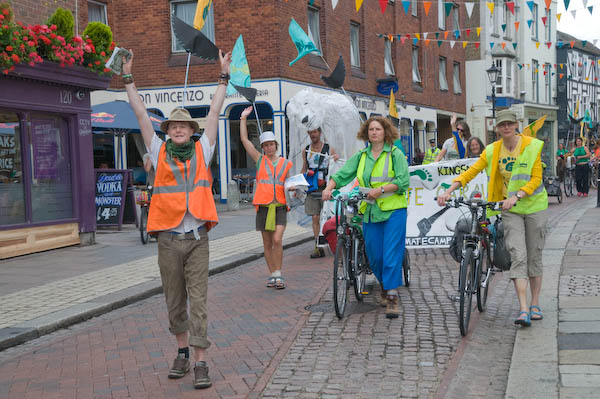
I was too busy to read the April Fool post on 1 April, being out taking pictures of protests in London on ‘Fossil Fools Day’ against the Kingsnorth coal-fired power station and opencast mining in Merthyr Tydfil.

St Patrick comes to London

St Patrick outside Shell HQ

St Patrick came to London, bringing with him a rather large pipeline, which his friends from environmental and social justice movement Gluaiseacht tried to take into the Shell HQ near Waterloo.

Pipeline at Shell HQ

Shell have the major share in the Corrib Gas Project in Mayo, Ireland, given away at a bargain price by the Irish government, and the associated high pressure pipeline and refinery will pollute the local countryside. Around half the Irish protesters were from Mayo, and they brought the pipeline to Shell’s HQ to remind them, in the words of one of the many songs sung during the protest, ‘Shell Sells Suicide’, that “they forgot about the will of the people, and the people of Mayo say “No, no, no, no, no, no, no… ” There was music and dancing too, and despite a chill wind around those drearily Soviet-style blocks of the Waterloo steppes it felt good, as you can I think see from the pictures.

Brent St Patrick’s Day Parade

Another St Patrick, slightly older, was at Willesden Green for the Brent St Patrick’s Day Parade later in the day, and you can see his picture on My London Diary along with others from the event. I have to admit I enjoyed photographing the women at the event more than the saint, and here are a few of them – more of course on MLD.

Brent St Pat's Day Parade
Sorting out the Irish county flags
Brent St Pat's Parade
Waiting for the start of the parade
Brent - Celebrating difference

I think this last image says something about one of London’s most culturally diverse Boroughs, which celebrates Diwali, Eid and other festivals as well as St Patrick’s Day.

Stop the Wars

Saturday’s anti-war demonstration in London was a large one, with estimates of 50,000 by the organisers. It took roughly 40 minutes to pass me going over Westminster Bridge, and by the time I’d photographed the final protesters opposite Westminster station I had to run the hundred yards or so to catch up with the head of the event going round Parliament Square. They had arrived there by walking a roughly 2km circuit, coming back across the Thames over Lambeth Bridge and up Millbank.

It was remarkable too for the range of different people and groups supporting it, many adding their own causes to the general aims of getting our troops back from wars in Afghanistan and Iraq, not going to war with Iran and ending the Israeli seige of Gaza.

I tried to reflect the whole range in my pictures, though I’m sure I missed some. And although thankfully the police did largely leave the conduct of the demonstration to the march organisers, the event did show the continuing fascination of FIT teams with the anarchist fringe, which only serves to encourage them. The only real clash, when four were arrested on what seems a very dubious pretext, predictably came when I was taking a break from the event as little seemed to be happening.

Although I’ve written a little on My London Diary about the event, mostly I’ve just put up pictures, roughly in chronological order, that cover the event. It was a big event, so I took a lot of pictures and there are rather a lot on line, perhaps about one in ten of what I took.

Thinking again about Winogrand, he liked to keep his work for a couple of years before he looked at it and selected the pictures that worked. Although nothing on My London Diary is in the same league, my serious edit will also be in a few years time. For the moment the site is really more like my digital version of contact sheets, as the name suggests a diary of how I saw things in London.