Lords Fail Chagos Islanders

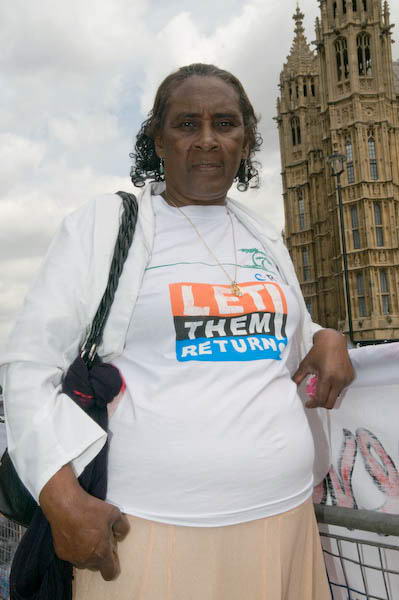
I wrote briefly about the disturbing case of the Chagos Islanders in May 2007, having met them at the May Day March in London. They were turfed off their homeland in the late 1960s by the Wilson government so we could give the US the island of Diego Garcia to build a huge military base. (The picture of them is in the middle of this page if you don’t want to look at the rest of the pictures from May Day.)

Rt Click, View image to see larger

Earlier this year they were picketing the House of Lords where an appeal was being heard on their case. Our Labour government, having lost over the fundamental justice of their case, and lost an appeal in the High Court, had decided to take the matter to the final stage possible in this country, appealing to the House of Lords.

Today’s judgement, reported on the BBC web site, appears to be a matter of politics and pragmatism rather than justice.

It’s hard not to agree with John Pilger, quoted by the BBC, who described it as a political decision which upheld an “immoral and illegal” act. The case seems likely to go to the European Court of Human Rights, where perhaps justice will prevail over politics.

Italy’s Ethnic Cleansing

Rt Click, View image to see larger

The problems facing the Roma in Italy were highlighted in July this year when media published pictures of holiday makers sunbathing on a beach near Naples ignoring the bodies of two drowned Roma teenagers.

In May 2008, the right-wing Italian government led by Berlusconi introduced a whole range of repressive measures to deal with what they describe as the “gypsy problem“. The measures remind many of the fascist policies under Mussolini – when Italian Roma were stripped of their citizenship and many died in concentration camps. They include dismantling all Roma camps and fingerprinting all Roma – children as well as adults.  Almost all of the Roma are actually Italian citizens. There have since been more or less daily reports of arrests, evictions and other attacks on the community, both by police and by criminals inspired by the government campaign.

Several camps have been burnt to the ground after Molotov cocktails where thrown into them, and many Roma have been left homeless. Forcible evictions from the camps by police have started and many Roma have been arrested.

There are around 150,000 Roma in Italy, less than 0.3% of the Italian population – a lower proportion than in many other European countries. Most of them live in desperately poor conditions in squatted camps around major cities.

Sentiment against Roma has also been hardened by the Italian population’s confusion between them and the mostly non-Roma Romanian migrants who continue to arrrive in Italy and the Roma are scape-goated for crimes committed by these often desperate Romanian refugees – another problem the rigth-wing government has exacerbated rather than attempting to solve.

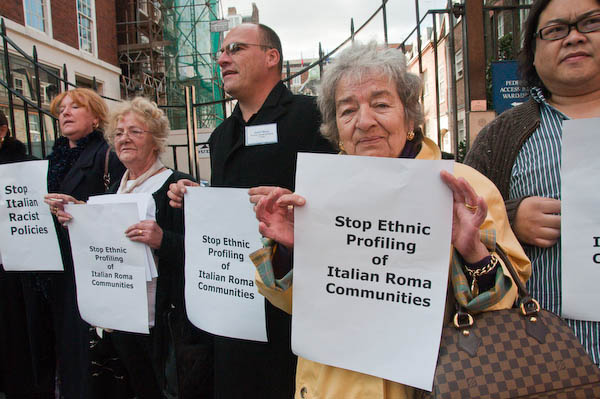
Around 20 people, many of them Roma, met at the gates of the Italian Embassy in London at Friday lunchtime (17 Oct) to protest against the human rights abuses in Italy which constitute ethnic cleanisng of the Roma. A deputation of four, including Peter Mercer, MBE, the Chair of the National Federation of Gypsy Liaison Groups were allowed into the Embassy to give their views.

Catherine Beard of the UK Association of Gypsy Women and European Forum delegate had brought back a distinctive ‘Against Ethnic Profiling‘ t-shirt from Europe.

Rt Click, View image to see larger

After the vigil outside the embassy, a number of the protesters went on to a meeting at the House of Lords.

A few more pictures from the event on My London Diary.

Police attack Photographers

I wasn’t feeling too well last Wednesday and didn’t feel up to going to Brighton to photograph the Shut ITT! demonstration there, a follow-up to Smash EDO’s ‘Carnival Against the Arms Trade‘ which I photographed last June. Had I made it his time there seems to have been a pretty good chance I would have ended the day with at least minor injuries from police action.

Rt Click, View image to see larger
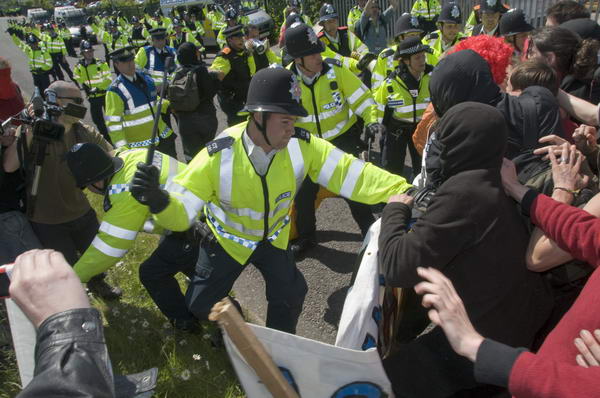
Police use batons on demonstrators outside EDO in June 2008

In June the policing had got pretty heavy-handed, and apparently even more so after I had left early thinking the demonstration was more or less over, when for some unaccountable reason the protesters were actually let on to the factory site and there was considerable mayhem all round.

This time things were tougher still, and not just for the protesters but also for photographers. On his blog,  Jason Parkinson writes  about the police actions:  “I am sick to death of seeing my work colleagues getting hurt while trying to do their job” and talks about “a continuous pattern of abuse, ignorance, intimidation, harassment, surveillance and violence” directed at journalists, particularly photographers and videographers who need to be very much in the thick of things to get their pictures.

Two other photographers, Marc Vallée and Jonathan Warren have described how they were filmed and questioned before the start of the event, and told they were not allowed to photograph in the area where protesters were arriving.

Later, Vallée was assaulted by police (again!) and another photographer was bitten when a police dog was set on him, requiring medical attention. At least one photographer was pepper sprayed.

In my camera bag I carry a copy of the Guidelines for reporters, photographers and news crews for dealing with police at incidents published by the BPPA, CIoJ and NUJ in association with the Metropolitan Police, which on their reverse carry the Met’s guidelines for officers. As it states, these guidelines “have been agreed at senior levels by all parties.  Please use them in a spirit of mutual professional respect to resolve any problems.”

These guidelines were adopted by all police forces in Britain in April 2007. They lay down general principles that recognise the law, the duty of the media to report from the scene of incidents, and the police duty to help them in doing so where possible.

These guidelines are simply not being followed so far as the policing of protests is concerned. As Jason ends his blog post:  “There is no excuse to baton a photographer, no excuse to pepper spray a photographer and absolutely no excuse to use a dog as an offensive weapon against a photographer.” This isn’t my idea of “mutual professional respect.”

Bank rates

I’m not an economist. Nor a rich man, because I’ve never thought it worth my time thinking about money.

Rt Click, View image to see larger

When I grew up we had none. At least that was simple, although my mother kept careful accounts of every penny in a small red bock, balancing her accounts carefully each week to avoid getting into debt. Penny-pinching all the time, making do and mending.  But my early years were years of austerity and rationing for the whole nation, and being poor like we were wasn’t very different from being almost as poor as the rest of the people down the street.

Even on a student grant I was better off, and my first full-time job earned me more than my father ever had but I’ve never got into the habits of spending (except on cameras) and waste that most people seem to take for granted, so I’ve never had to really count the pennies.

Banks have changed dramatically since I opened my first account to handle my student grant cheque. Rather than computers there was a man in the corner sitting with a big black-covered book and when you presented a cheque the cashier would go over to him and check that your account had the funds to pay.

Now it seems they have all been busy trading with borrowed money, betting on bets in ways that no-one had thought to regulate, making huge profits for their shareholders and massive bonuses for themselves in the good times. Which have now come to an end and the taxpayers are having to pick up their massive losses.

The failure of the banks doesn’t give me any pleasure, not least because it also has resulted in a fairly dramatic fall in the value of my own investments towards a pension, which I thought (and had been assured) were reasonably safe. Oh well, its only money.

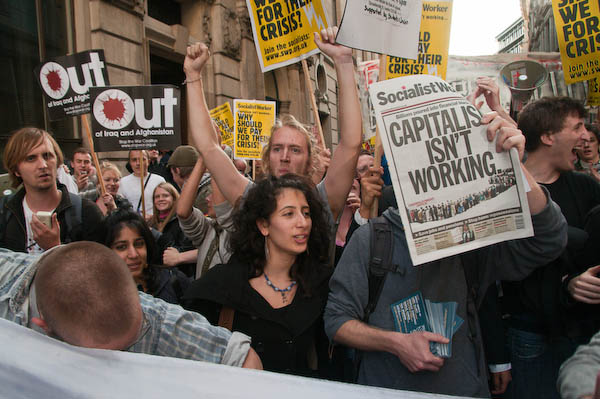
But I certainly had considerable sympathy for the protesters who organised the March on the City with the slogan ‘We Won’t Bail out the Bankers’. As usual, more details and pictures on My London Diary.

Rt Click, View image to see larger

Climate Rush – Deeds Not Words

Rt Click, View image to see larger
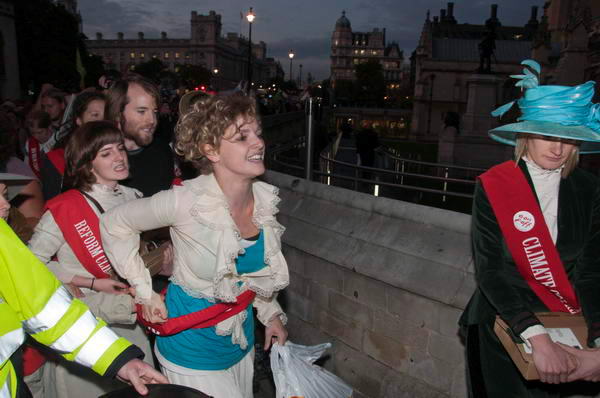
Women dressed as suffragettes, including Tamsin Osmond (center left) rush toward the entrance of the Houses of Parliament in London, Oct 13, 2008

Exactly 100 years ago, more than 40 women were arrested in the ‘Suffragete Rush‘ as they attempted to enter The Houses of Parliament in Westminster, London. To mark this centenary, young women concerned with the lack of political action to tackle climate change organised and led a ‘Climate Rush‘ rally in Parliament Square, calling for “men and women alike” to stand together and support three key demands:

  • No airport expansion.
  • No new coal-fired power stations.
  • The creation of policy in line with the most recent climate science and research.

It turned out – as expected – to be an interesting evening, although unlike 100 years ago none of the women managed to get into parliament and disrupt the proceedings there.  You can read more about it – and see rather a lot of pictures – on My London Diary.

Inside the building, the upper house was debating one of our more repressive pieces of proposed legislation, the Counter-Terrorism Bill 2007-08, and threw out by a large majority to proposal to allow suspects to be detained for 42 days before charge. However this is only one of several extremely suspect provisions, and we can only hope that their Lord and Ladyships will also throw out the proposals for secret inquests and look very carefully at the other provisions of the bill when they return to it in the next few days.

Lytchett Matravers

I must admit that until last week I had no idea that Lytchett Matravers even existed, let alone where it is. Nor for that matter its neighbouring village, Lytchett Minster.  And I think that is exactly how the people who live in these Dorset villages a few miles from Poole would like to keep it.

Rt Click, View image to see larger

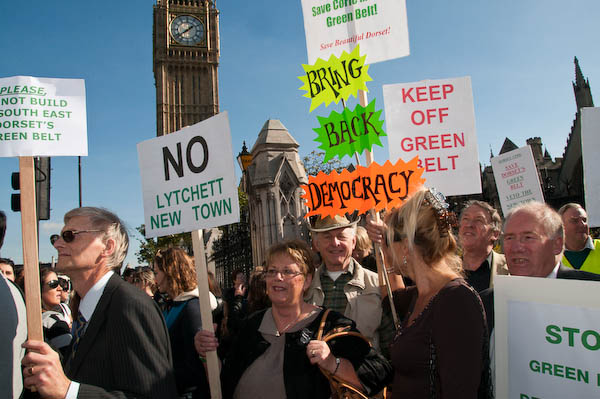
The government has other plans, intending in its Regional Spatial Strategy to include a new town of 2750 houses in the Green belt next to it.  This private development was rejected by the regional authority who drew up the draft plans, the local authorities in the region and bodies including Natural England, the Dorset Wildlife Trust, RSPB and CPRE, but somehow found itself in the final version of the draft currently waiting approval by Hazel Blears, Secretary of State for Communities and Local Government.

They had a big demonstration in Bournemouth to oppose the plans, and on Thursday some of them came to London to deliver a petition to the Prime Minister in Downing St.

In my lecture in Brasilia I talked about the need for a Green Belt that came about with the growth of car culture, and you can read a little about this in my post Under the Car which looks at my reaction to car culture. In Green Belt Protest Rally on My London Diary you can see my pictures and thoughts on last Thursday’s demo from Dorset. I wrote about another related event earlier in the year  here in Time Running Out.

Uganda

I’ve had a busy few days, and they started on October 9 which was the anniversary of Ugandan independence.

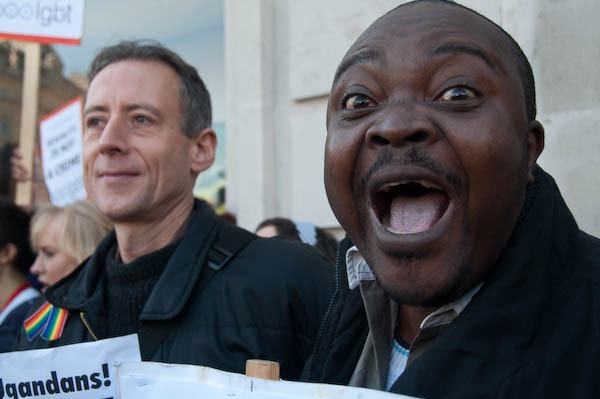
For gay Ugandans in particular there is little to celebrate.  Around 50 people met in a demonstration sponsored by the NUS outside the Ugandan Embassy in Trafalgar Square at noon on Ugandan Independence Day, Oct 9, to protest against human rights abuses in Uganda.

Rt-CLick and 'Show image' for larger
Peter Tatchell of Outrage! and Davis Makyala of Changing Attitudes
You can see more pictures and a longer comment on the event on My London Diary

Orphans Act- your images up for Grabs?

Although the US Senate passed the Shawn Bentley Orphan Works Act of 2008 a few days ago, hotlined through a back door while most Senators eyes were fixed on the attempts to save the US economy,  there is still actually quite a road to travel before it becomes law, even in the USA, where it still has to pass the House.  And given that it basically alters the whole situation over copyright and intellectual property it isn’t beyond imagination that it could lead to considerable problems between America and the rest of the world, even though its perhaps more likely that many other countries will quickly slip through similar legislation.

Although most photographers are opposed to the ideas behind the US concepts of ‘orphan works’ in this and other bills, there are many others who would welcome the opportunity they offer for free-loading at our expense. These include the education industry, and Internet and media giants. At an earlier stage, Google were licking their lips over the prospect of using a million ‘orphan images‘, although probably even the weak safeguards of Shawn Bentley would queer their proposed piracy. It’s perhaps interesting to see the discussion of orphan works on non-photographic sites such as Public Knowledge.

As PDN comments,  Shawn Bentley does give some further ideas about what might be considered a ‘diligent search‘ and thus what steps we should do to protect our own work. Which of course include making sure our images contain the proper metadata – particularly IPTC copyright and creator data, and considering the use of registries such as PLUS – though it remains to be seen how usable and affordable such systems will be, particularly for low-earning freelances and semi-pro photographers.

Using Lightroom or similar software you can set up templates that add basic metadata to your images as you upload them from card to computer, including in the IPTC copyright section a copyright message, coypright status, rights usage terms and a web address for a page giving copyright information. In my case this part of the preset looks like this:

Rt Click, View image to see larger

although I’m not sure that these are exactly what are intended for these fields.

Part of any ‘diligent search‘ must surely be to look for image metadata, and I hope one  beneficial aspect of orphan works legislation (which I’m sure we will eventually get) will be to create a greater awareness of the existence of metadata and include the ability to read it into all viewing software.

Another positive result may well be an increased insistence on the proper attribution of published work, though I’m less sure that publishers will bother to do this. It really is something that photographers and their organisations should campaign more about.

I’ve always resisted putting visible watermarks on my images, but its perhaps time to rethink this, or at least to include them in an added image border. Again, software such as Lightroom enables you to automatically add a visible watermark.

Big agencies have for some years used image tracking services such as PicScout to locate unauthorised image use on the web, although these are perhaps too expensive for most freelances.  You can try out the Tin Eye beta from Idée – the easiest way to use it is to install the browser plug in and then right-click on your image on a web page and let it search. But so far its image data base seems too small to find any of mine – even where I know they are in use legitimately on other pages.

You will also need to be very careful about using image sharing services, both to look at what rights you are giving away, and also to see if your metadata is retained when the images are shown on the pages.
Gary’s Crime – Showing up the USA

 Rt Click, View image to see larger

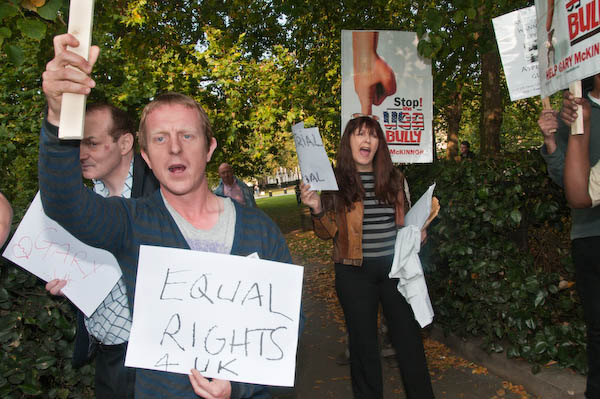
Gary McKinnon caused a lot of red faces among top brass in the USA when he penetrated and wandered around computer systems at the Pentagon and NASA in his obsessive trawl for documents revealing their cover-up of UFO sightings.  They didn’t like their incompetence being made obvious, and want him “to fry” for it. His case is also useful in their attempts to secure large amounts of extra funding for security.

David Blunkett brought in a one-sided extradition treaty with the US through the back-door when Parliament was on holiday which means that McKinnon can be sent for trial in the US without any evidence being presented in the courts here. The only thing that can stop this now is a decision on compassionate grounds by Jacqui Smith.  McKinnon has now been diagnosed with Asperger’s Syndrome which is said to be the cause of his obssession. If tried here, the case would probably collapse (as an earlier hacker prosecution did) or result in a very short sentence, but in the US he might get 40 years or more in jail.

The demonstration outside the US Embassy in Grosvenor Square on Sunday was organised by the London Autistic Rights Movemeny. More pictures on My London Diary.

Al Quds Day and Iran

Controversy has grown in the last couple of years over the celebration of Al Quds (Jerusalem) Day in London.  Al Quds Day was started by Ayatollah Khomeini in 1979, and is promoted by some groups supported by the Islamic regime in Iran, which most of us have some good reason to protest against.

Rt Click, View image to see larger
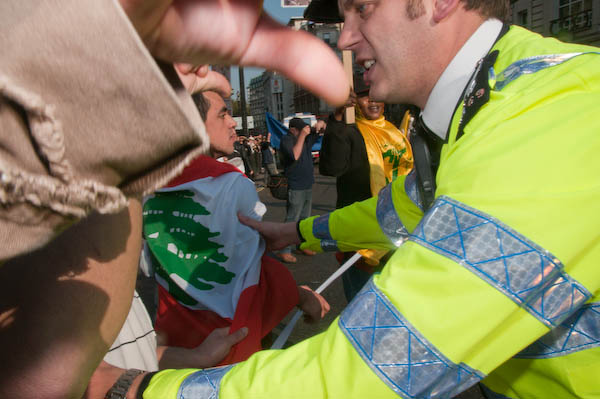
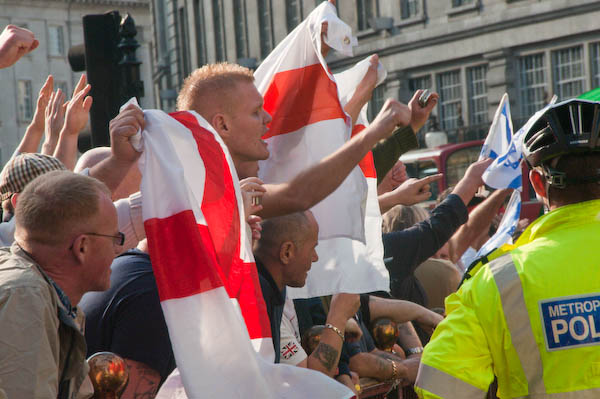
Police hold back marchers at Piccadilly Circus

But it is also supported by a number of groups that clearly are not supporters of the Iranian regime (though like most people they would be opposed to a US attack on Iran)  who see the day and the march as supporting the Palestinians and the Lebanese in their fight against Israeli occupation and aggression.

Rt Click, View image to see larger
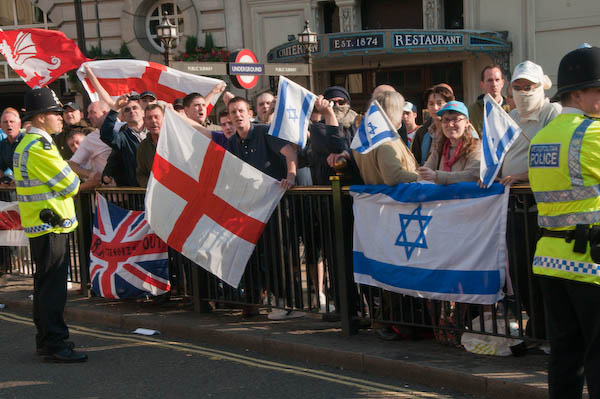
Not all of the groups against the march were Iranian

As a photographer and a journalist I try to approach things without closely identifying with either side, keeping a certain distance and although I always have a point of view, I went to photograph both sides of the argument.

Rt Click, View image to see larger

So you can see my pictures of the march, and also of the demonstration against the march as usual on My London Diary.  Perhaps this kind of unpleasantness could be avoided in future if groups that  support Palestine but have no connection to Iran were to organise an alternative Al Quds Day march.