Brian Griffin – Olympic Portraits

I was in two minds as to whether to accept the invitation to the National Portrait Gallery‘s launch of the NPG/BT Road to 2012 Project. The decision to have the games in London is arguably one of the greatest British tragedies of the 21st century to date and it’s legacy for the Lea Valley and East London likely to be only slightly less damaging than Enola Gay’s flight over Hiroshima in August 1946.

But of course the games are going to happen in around a thousand days time, and it’s good to see anything positive that comes from it – such as this project. Brian Griffin is certainly one of the best portrait photographers currently working anywhere in the world at the moment, and it would he hard to think of a better person to photograph those people connected with what is – whatever I think about it – a major project. The six images unveiled today are the first of 20 by him, and commissions to other photographers will bring the total to 100.  I hope those others chosen to work on the project will also be chosen on merit rather than, as so often happens in such things, for political reasons.

I’m not against sport. In my youth I played for various teams, getting a medal myself at the age of ten as a part of an all-conquering wolf club soccer team that included three players who went on to play professionally and at 16 I knocked over ten seconds off my Borough’s record for the quarter mile, finishing a hundred and fifty yards ahead of the next runner. But in my view games are for playing rather than watching and taking part is more important than winning. I think it’s a part of the Olympic Ideal, which doesn’t seem to have much part in our official professional programme for sport.
© 2009 Peter Marshall

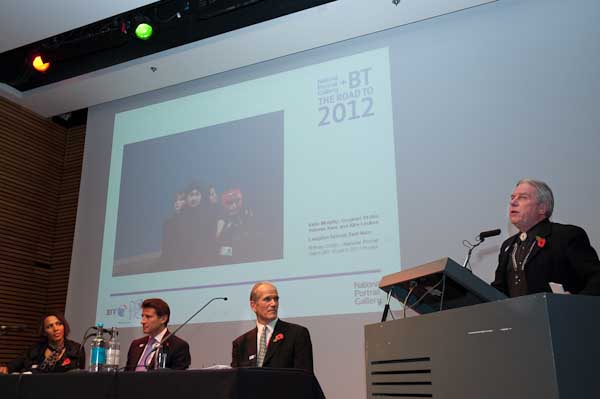
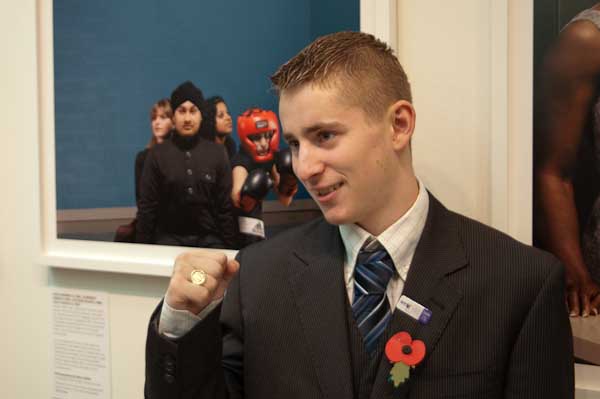
Sandy Nairne, the Director of the NPG opened the event and was followed by rather predictable speeches from Lord Coe and Dame Kelly Holmes, but it was photographer (or artist) Brian Griffin who was the star performer, talking about some of his experiences in making the pictures and his thinking behind them.  Above the speakers throughout the presentation was his picture of four from the thirty East London young people who went to Singapore to support the games bid, and he told us how he had decided to from them into a single sculptural group, but when he had taken what he thought was his picture, Alex Loukos in his red boxer’s helmet, jumped out from the group and made the image that he quickly captured and we saw on the screen.
© 2009 Peter Marshall

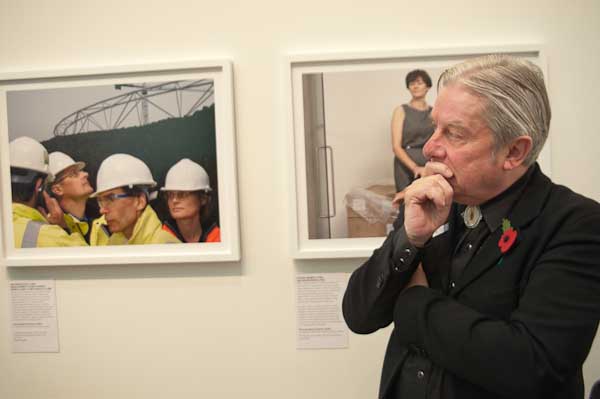
Although Brian stressed that he thinks about his work as a fine artist, he still has the openness to the moment that makes his work truly photographic, and nowhere was this shown more in the set of six images that was unveiled at the event than in a picture of four civil engineers in hard hats under the Olympic stadium which for me – and several others at the event whose opinions I respect – was the outstanding image of the set. I was told that he has also taken a very fine portrait of Lord Coe, but this is apparently being held back for a later date.
© 2009 Peter Marshall

You can see all six pictures on the NPG site, under the heading ‘The First Commission’ and read some of Brian’s comments about them on the London2012 blog.    (Unfortunately I’m not allowed to post the pictures here at a size I think useful – so you will need to click on the links to see the work.)

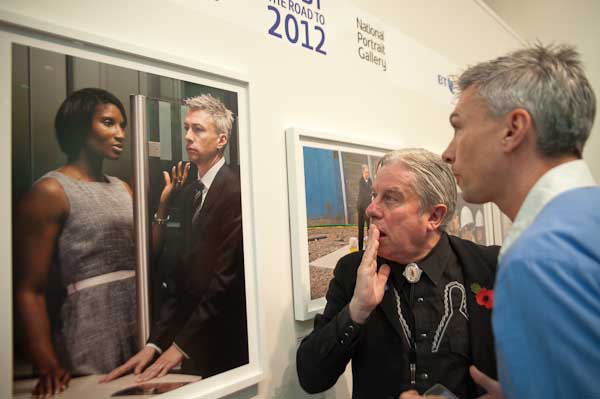
Brian writes there “So, for example, the portrait of Jonathan Edwards and Denise Lewis. The colouration of this image, in the steel and glass environment of the building, echoes the feeling from a painting by the pre-Raphaelite Sir Edward Burne-Jones. The portrayal of Denise also leads me to the Edward Burra painting ‘Harlem’.”
© 2009 Peter Marshall

In front of the actual print, my immediate thought was “Beam me up Scotty!”, and there is a definite “Star Trek” feel to this image, exaggerated perhaps by Jonathan’s hair looking like he’s got his hands on the Van der Graf machine and a slightly unreal quality about Denise Lewis’s skin tone and gesture which is a little more apparent in the actual print than in reproduction. However you see it, it remains a striking image.

Of course all of the pictures are excellent in their own way, and it was a bonus to have a number of the sitters present at the event. Not only could we see them with their pictures, and at least in some cases photograph them, but also I was able to catch one of them, triple-jumper Jonathan Edwards, getting his own back by taking Brian’s picture in front of his portrait.
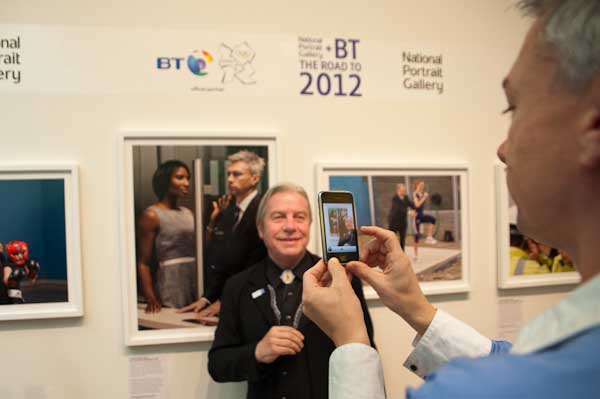
© 2009 Peter Marshall

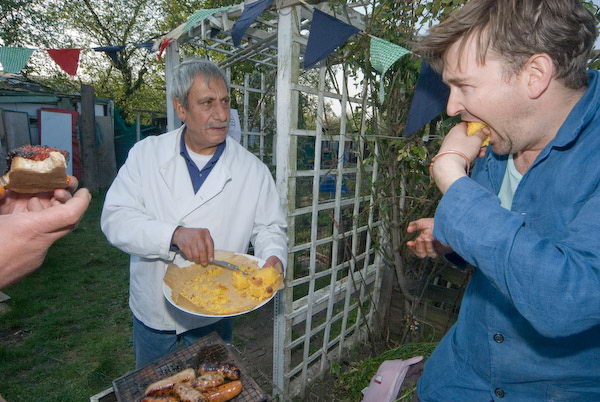
It was good – as always – too meet Brian again, and also of course some other old friends and a few new ones. But as I left the picture below flashed into my mind and I felt a sudden sadness about the missed opportunity to make this a Green Games and incorporate the Manor Gardens Allotments into the site – and to see how Brian might have photographed Hassan and Sam and all the others.
© 2007 Peter Marshall
Sam Clark tries some of Hassan’s cake – which was great – while I wait for Sam’s sausages
Manor Gardens Allotments on the Olympic site, April 2007
.
Peter Marshall

More pictures from the NPG/BY Brian Griffin event on My London Diary shortly.
ICO Plans Attack Press Freedom

If the suggestions  – as reported in the  Amateur Photographer –  of the Information Commissioner’s Office (ICO) about a ‘Privacy Code for online use of photography‘ on the streets were to be adopted it would be the end of photography as we know it on the web. Their proposals seem to me ridiculous and unworkable – and my immediate reaction was to check the date of the article by Chris Cheesman. But to my surprise I found it was written on 27 Sept rather than April 1.

The proposal are frankly ridiculous in several respects, but particularly in the attack that they make on news reporting, with the suggestion that it would become necessary to blur many faces in images for publication in newspapers and also on websites – except for social networking and similar sites. The AP reports that while “background shots of passers-by will not normally breach the Data Protection Act, images of a small group of clearly identifiable people, sent for publication to a newspaper for example, may be considered an infringement.” So it becomes clear that this is not just a threat to what can be published on the web, but also to the freedom of the press as a whole.

The proposals according the AP report  “will not prevent someone taking photos in the street without the subject’s consent, provided that the images are for ‘personal use’ and the camera is not being used to harass people” but it will severely restrict what you can do with them. Stick them on Facebook or in your family album and you are fine, but publish them – even on Flickr – and it looks as if you may be damned.

© 2009 Peter Marshall.
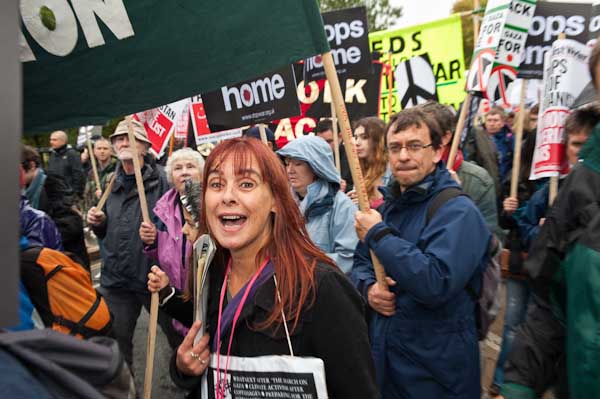
Taking part in a demo on the street implies a willingness to be seen and photographed. More picture from ‘Bring the Troops home from Afghanistan

I mainly photograph public events and demonstrations, where those taking part know they will be under the gaze of cameras and thus implicitly grant permission to be recorded. At times I photograph the people who are standing on the street or in shop windows watching (and sometimes also photographing) events and it seems only a fair reciprocity that they too should expect to be watched and photographed.  And it is clearly important that in situations involving crime, potential crime or unrest that journalists – including citizen journalists – should where possible record both potential criminals and the activities of the police, and that news media – print, broadcast and web – have a public duty to publish such images. Whatever the feelings of those who appear in them, or indeed the Terrorism Act, unless the pictures would clearly be of aid to terrorists.

© 2009 Peter Marshall.
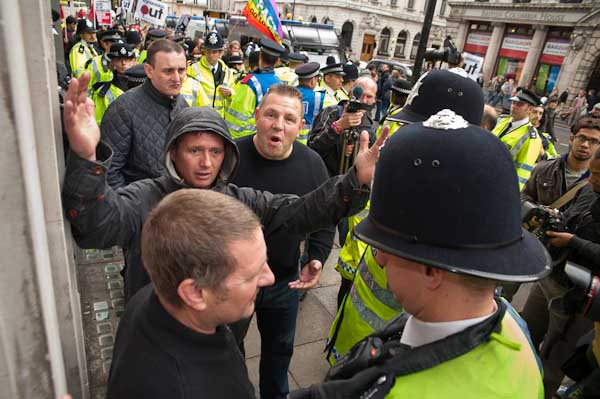
Reporting on the police is important for a free press. More pictures from this incident involving football supporters attempting to disrupt the Bring the Troops Home rally.

I actually follow my own test that differs significantly from that which the woman speaking for the ICO suggests. Rather than asking “whether the subjects would object to their picture being published in this way”, I think “whether a reasonable person photographed in this way would have a reasonable objection to having this particular picture published.”  It seems to me to be an important and fundamental difference, not least in that a “reasonable person” is also a reasoning person, while many of the objections that people have made about the use of their pictures have been purely on emotional grounds.

If someone walks down a street with a silly hat on, I don’t think they can reasonably object to a picture that shows them wearing a silly hat on the street, but if I have managed to catch them at a moment or from an angle that makes a perfectly normal hat look silly their objection might well be sustained. There is sometimes a fine line between being amusing and demeaning the person, but in general I think the distinction is clear.

Any test should probably also distinguish between people “in the public eye” who have chosen to live and profit from being public figures, and those in whom there is no genuine public interest. Although I usually chose to delete or not use images of – for example – politicians in which a momentary gesture makes them look silly, it would make the reporting of party conferences in particular rather boring if all were disallowed. And of course our current London mayor has made his political career on being seen as a buffoon (so perhaps we should not encourage him.)

So far as privacy is concerned, at present we have a fairly clear position –  “a reasonable expectation of privacy” – which offers a reasonable degree of protection to people while allowing publication of news etc. There seems little if any need for any further restriction. We also have the law of defamation that restricts the use that can be made of images of people, and although too it isn’t entirely satisfactory it largely does the job required in limiting the activities of publishers.

It is perhaps an interesting question whether a photograph in isolation is actually personal data. If I publish a picture of you without any accompanying text, only those who already know what you look like will be able to identify the picture as being of you. Without being incorporated into a structure with accompanying data the image to the wider public remains anonymous.

Photographs only truly become data when, for example, they are put into a police database and used to produce “spotter cards” for use by police at demonstrations, or when they are displayed on a right-wing hate web site along with names and other data with the intention of encouraging violence or other illegal acts against demonstrators and journalists (thanks to Marc Vallée for the anonymised link posted on Twitter.)

I’ve published literally thousands of pictures of children over the years, but I’ve always been careful not to give names except in very special circumstances. At times I’ve blurred name badges on them – (and some pictures of adults) – in order to preserve a certain anonymity. I’ve generally only named adults in pictures who are in some sense public figures – if at times in a very local and minor way. There might I think be some sense in restricting or at least reviewing the local paper practice of giving names and ages in picture captions, although local papers are becoming a thing of the past in any case.

Increasingly we are moving from still images to the use of video, and here the problems that the suggested regulations would produce seem more or less insuperable. Could we really have online newspapers without news pictures and online TV without news film from the UK? It does appear to be what the ICO proposals might produce.

Bike Power at the nabokov Arts Club

Another first for my work tomorrow when it will be projected for the first time by bike power!

© Peter Marshall

The nabokov Arts Club returns with another extravaganza of live theatre, music, comedy, poetry and visual art in a vast, atmospheric Victorian warehouse in the heart of Shoreditch … at Village Underground, recently named ‘Top Venue for Wow Factor’ by Time Out Londonthe Arts Club will be joining tens of thousands of people from over 150 countries for the biggest ever day of climate change activism. We’ll be part of a global action coordinated by 350.org to urge world leaders to take bold and immediate steps to address climate change and reduce carbon emissions. Within our solar-powered venue we will have a bicycle-powered art installation showcasing climate change photography…”

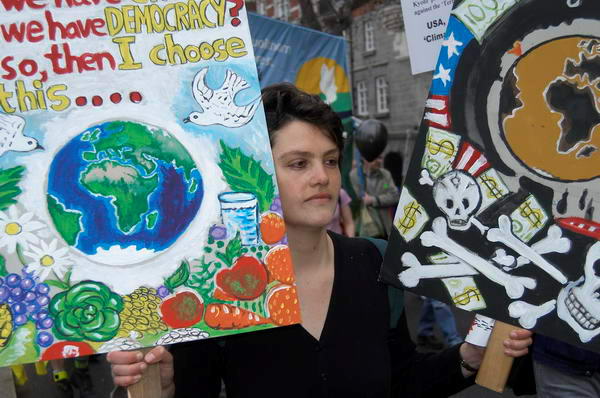
Which will include the set of 24 pictures – including the one above – that I put together for Foto Arte 2007 in Brasilia. Just in case you can’t get along to Shoreditch for what looks like a very interesting evening (and I can’t make it myself) you can see the full set of pictures here. As well as showing a number of demonstrations in London there are also some pictures from the Manor Gardens Allotments, which were bulldozed to make way for the London 2012 Olympics – see London Olympics – Green Disaster for my thoughts on that and links to some more pictures.

© 2007 Peter Marshall
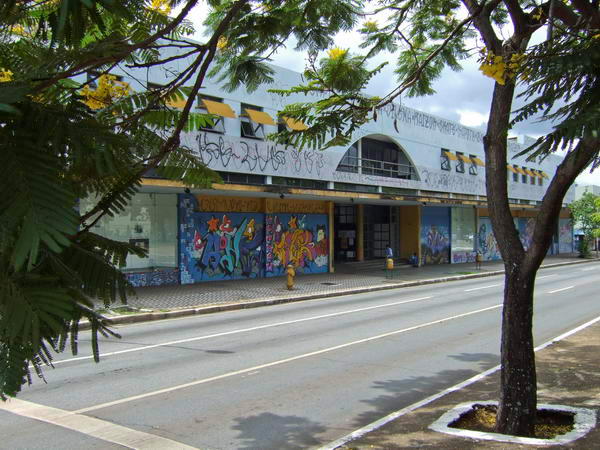
The venue for the Brasilia show  – more snaps from my Brasilia trip

The partying in Shoreditch goes on from 8pm until 2am – including an extra hour when we change back from Summer Time to GMT, always a sad moment for those of us who like to photograph out of doors. The people there are going to produce a banner which will be photographed on the rooftop with the City as a backdrop and become part of the 350.org campaign to put pressure on world leaders to actually agree to some effective action at Copenhagen in December.

Village Underground is just a few minutes walk from Hoxton Market, where the exhibition ‘Taken in London‘ with work by myself and Paul Baldesare continues until the end of the month at ‘The Shoreditch Gallery‘ in the Juggler – see Opening Night, Hanging Day and Taken in London for more details. And just before lunch on Sunday, Paul and I will be giving a five minute illustrated presentation on the show as a part of the ‘This is Not A Gateway‘ festival in Hanbury St, Spitalfields, again about a five minute walk away. Things really are all happening in this part of London – and Photomonth 2009 really is keeping photography very much at the heart of them.

Stop Sending Refugees to Baghdad

© 2009 Peter Marshall.

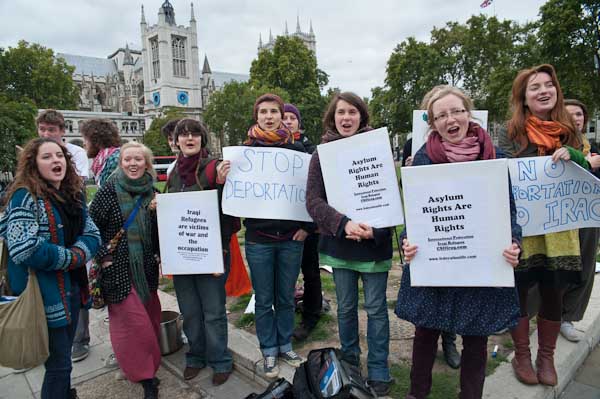
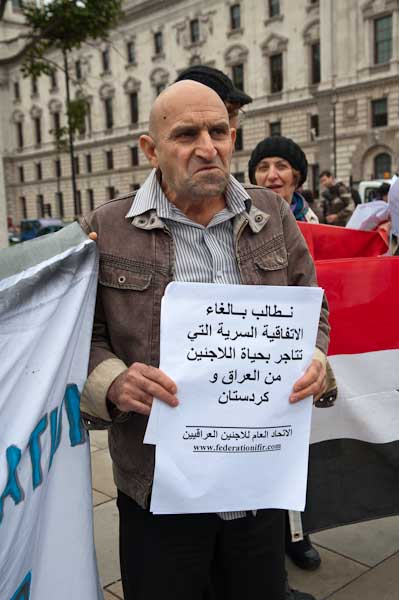
The Foreign Office advises “against all travel to Baghdad and its surrounding area” on the grounds that it is unsafe, but somehow the UK Borders Agency thinks it’s fine to forcibly take Iraqis who have sought refuge in this country on planes, fly them back there under heavy guard and dump them back on its streets, leaving them to fend for themselves having shoved a few dollar bills in their hands.

They flew 44 to the airport last, but the Iraqis refused to let most of them disembark. One who was put off there was interviewed by a reporter for the BBC, obviously in fear of his life, in hiding there. He’d only left Baghdad after his brother was murdered, convinced that it was a case of mistaken identity and that the real target for the attack had been him. Now he feared to meet his attempted killers on every street he walked.

© 2009 Peter Marshall.

It’s a sorry tale of a government determined to look tough over migration into this country, to appear to take a harder line than the Tories – or even the ultra-right. More about this shameful failure to meet our obligations under the UN Convention on the Treatment of Refugees and the EU on My London Diary.

© 2009 Peter Marshall.

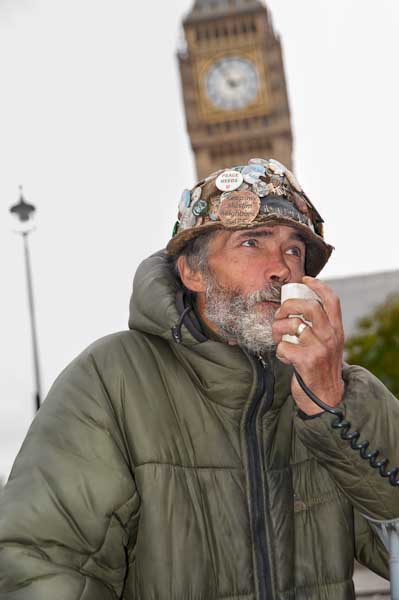
Standing alongside the lawyers, the International Federation of Iraqi Refugees and others at the emergency demonstration on Saturday was Brian Haw who has become a public hero for his continued peace protest in Parliament Square since June 2001 – over 8 years. It is a vigil that has taken its toll on him, but he still spoke strongly at the event.

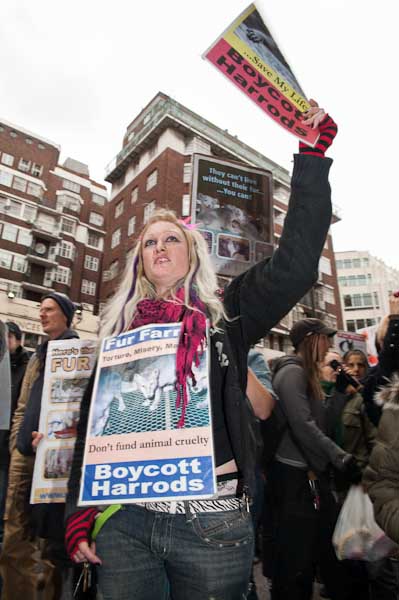
Fur is For Animals

I’m not a great supporter of animal rights. I enjoy eating meat and fish – though I also eat a lot of vegetarian dishes. But I do think we should treat animals with a decent amount of care and respect, and avoid the kind of cruelty that is so much a part of factory farming. It isn’t all like that, and I’ve known farmers who really care for the animals they raise and spend a great deal of time and effort in making sure that they are well treated. Of course I can’t be sure that all the meat I eat or all the dairy products come from farms like this, but we do try as much as possible to avoid factory farmed produce when we are buying food.

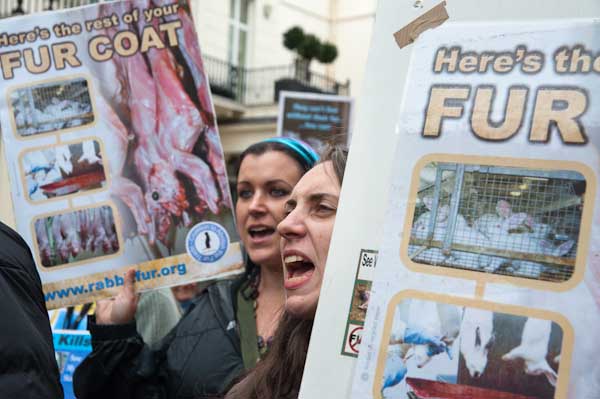
But there is no such thing as cruelty-free fur. Wherever countries have tried to provide less cruel conditions in fur farms the result has always been to make the farms unable to compete with those in other countries that have no concern for animal cruelty. The UK policy banning fur farms is the only sensible policy and one that should be adopted across the world.

Trapping and hunting of wild animals for their furs also involves considerable cruelty, and around the world traps are still in use in many countries that were banned here years ago. Shooting too often fails to kill cleanly, with some wounded animals escaping to die a lingering death, and young animals whose parent is killed may be left to starve.

© 2009 Peter Marshall

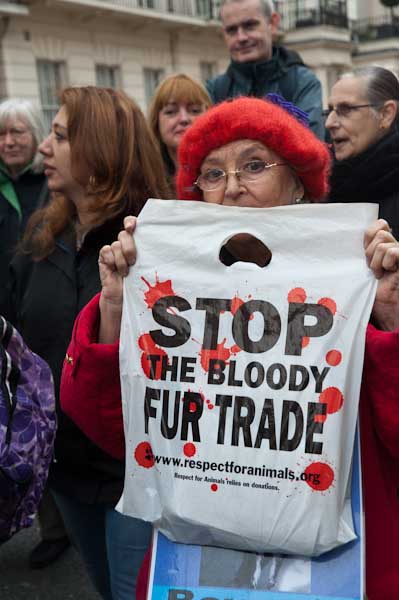
We don’t need to wear fur, and for almost any purpose that fur is used there are better vegetable or synthetic alternatives. Most fur used now is simply decorative, and even when produced under cruel regimes is still expensive. It’s become just a marginally less crass way than sewing large denomination notes onto clothes for people to say “look how effing rich I am darling.

© 2009 Peter Marshall

Wearing fur – including fur trimmings – had more or less become unacceptable in polite, civilised society, but recently some parts of the fashion trade have been trying to rehabilitate it. We shouldn’t need a Campaign to Abolish the Fur Trade in the twentyfirst century, but unfortunately we still do.

© 2009 Peter Marshall
Boycott Harrods – the only department store still selling furs

More on My London Diary about the National Anti-Fur March and more pictures

Almost all these pictures were taken with the 24-70mm f2.8, which was pretty much an ideal lens, enabling me to work close in and at a reasonable shutter speed and ISO in the rather poor light. There were just a few times when I wanted something longer (usually considerably longer) and rather more where something just a little wider was called for.  I think the ideal kit on full frame would have at its centre something like a 20-50mm lens, but unfortunately they don’t exist.

Tamils March Again

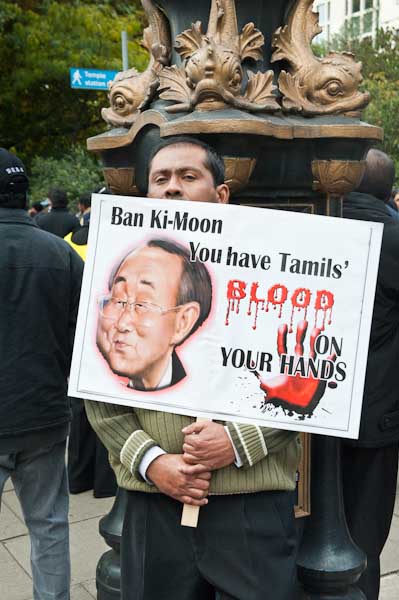
It would be hard not to feel a great sympathy for the Tamils. The world – including the UN and of course our own government have for many years decided to turn a blind eye to the takeover of Sri Lanka by the majority Sinhalese. Britain failed to protect their interests when we gave Ceylon independence, failed to inspire Commonwealth action over the years, but particularly at the time of the creation of Sri Lanka. The world looked away (or gave encouragement and arms)  as the Sri Lankan government imposed a military solution on the Tamil areas, killing many thousands of civilians as well as the Tamil Tigers.

The Tamils were calling for the release of the  over 280,000 Tamil civilians – including at least 50,000 children  – still held in miserable and squalid conditions in camps run by the Sri Lankan military.  They want international aid agencies and press to have access to the camps and a full independent investigation of the war crimes committed by the Sri Lankan government and army. They have lost faith in the UN and its General Secretary Ban Ki-Moon.

© 2009 Peter Marshall.

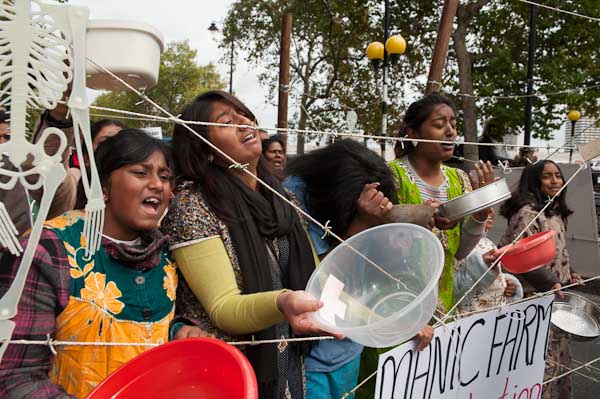
At the start of the demonstration at Temple, protesters seemed rather thin on the ground and the mood seemed  one of resignation and dejection, rather than the energetic enthusiasm of the much larger demonstrations before the military defeat. Even the ‘prisoners’ in the mock concentration camp leading the march seemed subdued, although by the time I left the march as it turned up Northumberland Ave they were noticeably more animated.

© 2009 Peter Marshall

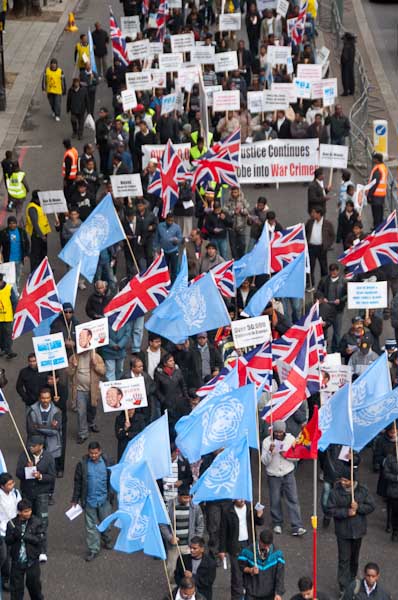
But it was a difficult event to find anything to photography, which is perhaps why rather more than usual of my pictures were taken from a distance, looking down from the footbridge on the east side of the Hungerford Bridge (now one of the two bridges on each side of the rail bridge.)

© 2009 Peter Marshall

I wasn’t particularly happy with the pictures I took. I had hoped to catch up with them later in the afternoon before the march reached Hyde Park, but with the smaller numbers the police were able to pressure them to walk rather faster than on previous occasions where they had taken over the roadway and by the time I was able to get back the march had finished. You can see them as usual on My London Diary.

Spelthorne? Where? Wilshire? Who?

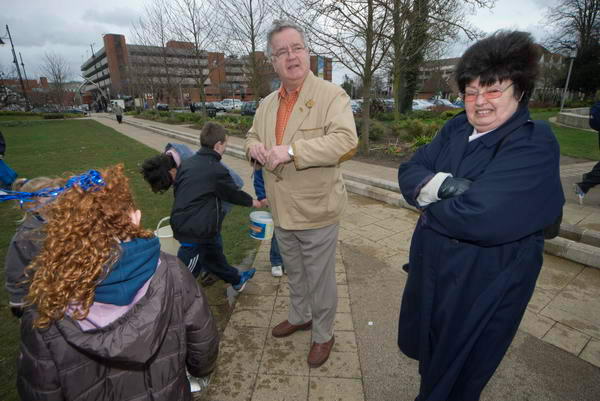
While these were the questions asked over the toast and marmalade in many homes this morning, for once I knew all the answers. Because I was at the centre of David Wilshire MP’s constituency, Staines.  Spelthorne is at the centre of all those reservoirs visible on the left immediately after take-off from Heathrow as you wantonly increase your carbon footprint.

© 2008 Peter Marshall
David Wilshire and his partner and office manager Ann Palmer

All that water is not enough for our local council, which also goes under the rather silly name of Spelthorne, and despite the fact that the River Thames was only a few yards behind me they had to install the rather fatuous ‘water feature’ (a concrete ditch) that you can see behind the Spelthorne MP and his very personal assistant taking part in a very worthwhile charity event Stepping Out for Water that I photographed last year.

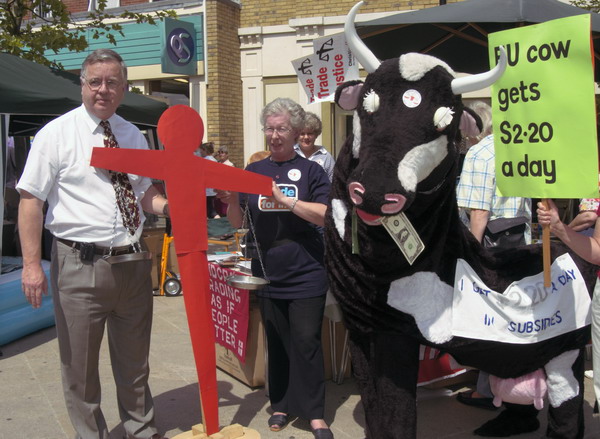
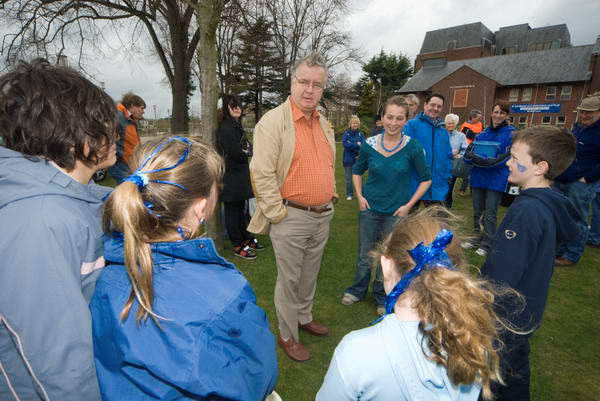
Mr Wilshire has earned some local respect for getting involved in events such as this, where he came to speak at the meeting in the Staines Riverside Gardens/Car Park at the end of a walk raising concern and cash about the one fifth of the world who lack clean water and the 40% who lack basic sanitation – and our failure to do our part to meet the Millennium Development Goals, one of which included the aim to halve those without clean water and sanitation by 2015.  He’s also supported other events, such as a Trade Justice demonstration in Staines. So he isn’t all bad.

© 2003 Peter Marshall
Wilshire at a Trade Justice demonstration in Staines in 2003

He also regularly replies to letters from me and Linda, telling us of his support for various things we oppose – such as the wasting of vast amounts of money on Trident and the expansion of Heathrow – an issue where he is one of few local MPs to defy official Conservative policy. But he does keep in contact with constituents and argue the case even if he almost invariably ends up coming to the wrong conclusion.

He must have been doing something right, as there is a group of local Tories reported to be trying to get rid of him since August – though their main beef is over his expenses claims, others criticise him for not living in the borough (reportedly he has homes in Somerset, Hanworth and London.)  The current allegations are about payments to Moorlands Research Services, an unregistered company owned by himself and his partner, Ann Palmer.

Spelthorne exists because of opposition by Conservative backwoodsmen and women back in the 1960s, who fought tooth and nail to keep this true blue area out of Greater London and in particular the London Borough of Hounslow (thus ensuring it remained under Labour control. Oh dear!)  It then jumped over the Thames to become part of Surrey, although that country has never quite accepted it, and even now some local activities get missed out from Surrey listings because they are in Middlesex. But Staines really isn’t Surrey. We have the crime rates, unemployment and social problems  you’d expect for outer London, with an extra dose of pollution from Heathrow and three motorways around our edges – the M25, M3 and M4.

© 2008 Peter Marshall
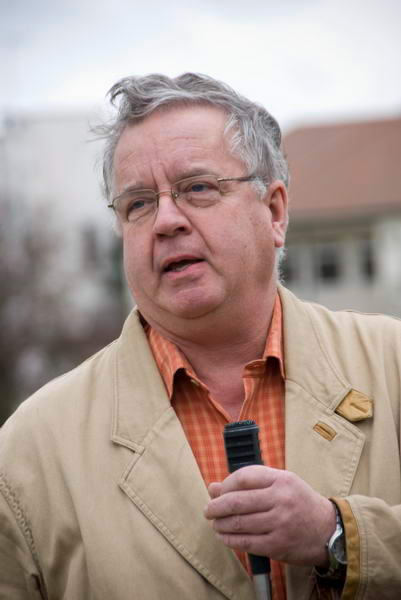
David Wilshire MP speaks. Rather a lot of nonsense as usual.

Wilshire, a former Conservative whip, probably last made the national headlines for the controversial Section 28 which he introduced into the Local Government Act, 1988 aimed at preventing “local authorities from promoting homosexuality“.  A half-baked and largely ineffectual attempt at discrimination, it had the effect of uniting and galvanising LGBT groups in protest and thus advancing the cause of equality in the period until it was repealed (in Scotland in 2000 and the rest of the UK in 2003 – hard to comprehend why it took New Labour so long.)

It seems inevitable in the current climate that Wilshire will have to go – whatever the justice of his case. But I don’t hold out any great hope that the conservative candidate that replaces him as MP (a monkey with a blue rosette would get elected here) will be any better.

© 2008 Peter Marshall
Another picture from ‘Stepping Out For Water

Camp Ashraf Update

I was sorry not to be at Grosvenor Square on Friday when the the news came through that the 36 men detained in Iraq had been released. The account on the Free Iran web site says:

Upon hearing the news of the hostages’ release, everyone was crying, dancing, singing in the street in Grosvenor square in front of the US Embassy.

and gives a link to a video on YouTube of the release in Iraq after 72 days of hunger strike.

I was also unable to attend the celebrations at Grosvenor Square on Saturday evening, however it is good to be able to report some success. But  the release of the prisoners was only one of the demands.

Many of the 36, who had also been refusing fluids for a week, as well as those who went on hunger strike around the world in sympathy – including the 12 in London – may have permanently damaged their health – and according the the report I heard early on Sunday morning on the ‘Sunday’ programme on Radio 4,  five of the London hunger strikers have been kept in hospital.

The Church of England often gets a pretty poor press, but the Archbishop of Canterbury took a prominent role in the campaign – and kept the issue in the religious media while the mainstream largely ignored it. Here’s another quote from ‘Free Iran’

Huge international pressure, prompted by hunger strikers, helped bring about their release.

The Archbishop of Canterbury, Dr Rowan Williams, the vice president of the European Parliament, Dr Alejo Vidal-Quadras, and the former Prime Minister of Algeria, Sid Ahmed Ghozali, and thousands of parliamentarians, jurists, human rights icons, dignitaries and personalities across the world condemned the Iraqi regime for failing to release the refugees, despite three separate rulings by Iraqi judges.

Amnesty International joined the chorus of voices denouncing the actions of Iraqi Prime Minister, Nuri Al-Maliki with another Urgent Action appeal which was its 12th statement since the ordeal started.

You can see my earlier pictures and comments on the Grosvenor Square hunger strike in Serbian Pride and Camp Ashraf, and more on My London Diary.

Serbian Pride and Camp Ashraf

A week or so on ago on Friday afternoon I photographed two demonstrations that haven’t otherwise got a lot of media coverage. And perhaps if I had not been coming to London for a couple of other things I would not have made it to them. I’m pleased that I did, as it meant both got some publicity through Indymedia and Demotix, but neither is likely to do a lot for my bottom line.

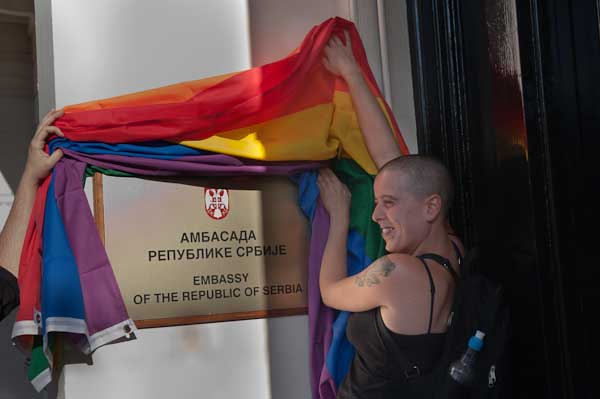
LGBT Solidarity at Serbian Embassy

The first was a LGBT demonstration outside the Serbian Embassy in Belgrave Square to protest at the last-minute cancellation of the Serbian government of Belgrade Pride. There is a strong homophobic right-wing there, and a previous attempt in 2001 to hold a procession there ended in violence with the parade having to be abandoned.

This time the government had promised to ensure it could happen, but at the last minute backed down to the right-wing pressure and cancelled it just hours before it was due to take place.

© 2009 Peter Marshall

There wasn’t really a lot to photograph, some rather straightforward pictures of people standing on the steps, handing over a letter… It was really an occasion where I start to understand why press photographers so often set things up. But that just isn’t how I work.

Perhaps the best opportunity was with the picture above (and a few variations of it of course) but here the difficulty was in the lighting contrast between the very bright sunlight coming in low on the left of picture and the deep shadow at the right. Of course I had my flash, the Nikon SB800, but for once it simply refused to work properly, and wouldn’t go into BL (balanced light) mode at all.  I made a few exposures, trying several ways to get the balance I wanted, but couldn’t really make it.

I still don’t know why it wasn’t working, but I think it was the camera rather than the flash that wasn’t playing ball, as when I got home and tried with my second SB800 I had exactly the same problem. I cleaned the flash contacts on camera and flash, fiddled with the menus on both flash and camera with no luck. Then finally it did start to work again, but I’ve no idea why. Modern automatic systems are great when they work, but can be so frustrating when something goes wrong.

More at: LGBT Solidarity at Serbian Embassy

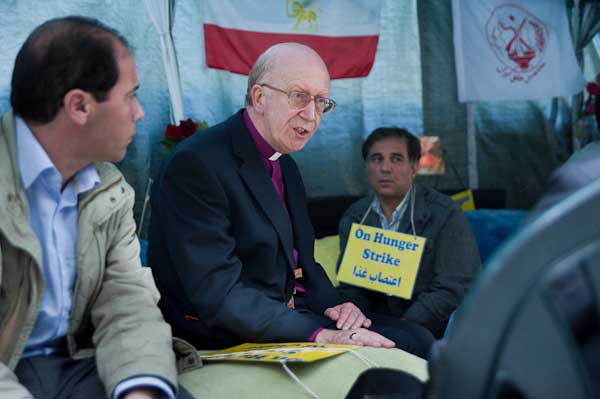
Camp Ashraf Hunger Strike – Day 60

Camp Ashraf is in Iraq. After the 1979 Iranian revolution a number of camps were set up in Iraq for Iranian refugees, and some of them were also armed to continue resistance. The main Iranian opposition group, the People’s Mujahedin of Iran, was housed in Camp Ashraf. After the US led invasion, the US took over responsibility for refugees in Iraq, and after a short while decided to disarm the PMOI.

At the start of the year, the US handed over control of the camp to Iraq, giving promises that those living in it would be treated humanely and not deported to any country where they had a “well-founded fear of persecution“. The Iraqi government apparently has other ideas, as it wants to improve relations with Iran it wants to send the PMOI back there, possibly as a part of a prisoner exchange. Iraqi forces came into the camp, attacked the residents, killing 11 and injuring hundreds and took 36 men into detention. They are still detained despite a court ruling they must be released.

The detainees started a hunger strike in Iraq, and 12 Iranians in Britain also gone on hunger strike as a protest outside the US embassy in London, as the US is still thought to be responsible under the Geneva Conventions for the safety of the men in Iraq. When I was there they were on their 60th day and several had already been taken into hospital but had returned to continue their protest.

© 2009 Peter Marshall

Although the awnings under which the hunger strikers were sitting or lying on beds were fairly dim, the lighting under them was reasonably even and I could work at ISO 1600-3200 without great problems.

My problem was how to dramatise the story to make it more likely to be taken up by the media, and I couldn’t find a solution. I’m not sure if I was having a bad day or there really wasn’t anything there, or perhaps I just didn’t spend long enough or work hard enough at it.

Of course the story and picture did get out on Indymedia and Demotix, but I would have like it to get more publicity. The failure of the US and our governments to do anything at all about it is truly shameful.

More at: Camp Ashraf Hunger Strike – Day 60

Climate Chaos

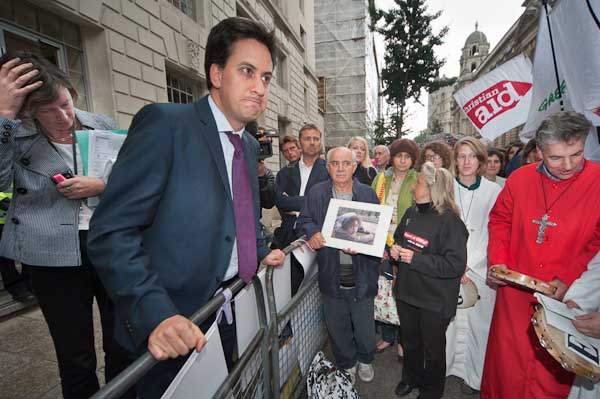
I’m getting to know the Department of Energy and Climate Change pretty well, but two demonstrations outside there in a week was perhaps a little too much. The first on Monday evening was timed to try to influence the decision that Ed Miliband has to make on the building of a new coal-fired power station at Kingsnorth, following the end of a public consultation.

The decision, expected in the next couple of months, will give a clear indication of whether our government is serious about climate change or has bowed to the intense lobbying and financial clout of the energy industry. We don’t need Kingsnorth, and an alternative programme of investment in wind power has long term advantages as well as avoiding “climate-wrecking dirty coal power.” Nobody seriously believes that we will get 100% carbon capture and storage – or that it would in any case be a serious long term solution; all the technical solutions exist for wind power as a major power source for the UK (and for its export potential. Perhaps even more seriously, if the plant is built it is very hard to believe it would not be used even if, as seems likely, only marginal carbon removal proved economic.

Organising the demonstration were the Climate Chaos Coalition (CCC) representing virtually all the major environmentally concerned groups in the UK, including Friends of the Earth, Greenpeace and the Campaign Against Climate Change, as well as faith groups, aid agencies and many others – a total of over 100 organisations with a total membership of more than 11 million. There are probably few other organisations that unite the RSPB, the World Development Movement, Unison and Viva!

Christian Aid provided a choir in white surplices (and with one in a cardinal’s bright red)  and tambourines which livened the proceedings considerably but the big surprise was when Ed Miliband came out of the ministry to talk to the demonstration and answer some very aggressive questioning.   I took a few pictures from one side as he leaned over into the pen, shaking hands, but obviously the best place would be in front of him, in with the demonstrators. So I ran around to the back and made my way inside. It was a very crowded area, but I soon changed to a 12-24mm lens which let me work in the confined space.

© 2009 Peter Marshall
Ed bites his lip, his aide tears her hair

I was sorry I’d only brought a single body, as it was so crowded it was hard to change lenses, and I knew Miliband would not stay long and wanted to make the most of it so anyway didn’t want to waste more time with lens changes.  12mm is really too wide to be useful and I would have liked something a little longer than 24mm, perhaps something like a 17-35mm would have been ideal.  The 24-70mm just wasn’t wide enough most of the time.

Fortunately the other photographers present and the video guys didn’t follow my lead as there really wasn’t room for me let alone others there.  It was yet another story that made the front page on Demotix and I also put it on Indymedia,  but found no other takers. You can read the story and see rather more pictures on My London Diary.

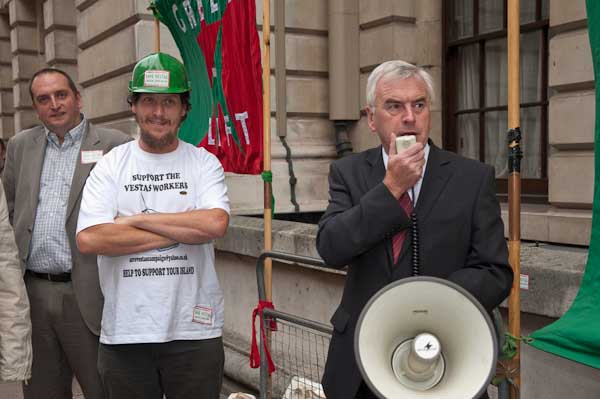
Thursday evening I was back more or less in the same place – the pen was on the opposite side of Whitehall Place for the  Vestas  ‘Day of Action for Jobs and the Planet’ demonstration there organised by the Campaign Against Climate Change, with speakers including John McDonnell, MP, Darren Johnson, Green Party spokesman on trade and industry and chair of the London Assembly, trade union organisers and Mark Flowers, one of the sacked Vestas workers.

© 2009 Peter Marshall
Darren Johnson, Mark Flowers and John McDonnell

The other acid test of the Government’s seriousness over climate change is of course their reaction to the closure of Vestas Blades. Unfortunately they have completely failed rather than take the opportunity of setting up a vital UK industry in the manufacture of wind turbines that could be important both in meeting our energy needs and investing in green technology with great future opportunities for export of both electricity and plant.

More on My London Diary.