Nikon Bows To Extreme Right

In January this year the Shinjuku Nikon Salon in Tokyo agreed to show the project Layer by Layer of South Korean photographer Ahn Sehong, with the show due to open on June 26 and to run until July 29, 2012.  The pictures were also to be displayed at the Nikon Salon in Osaka  for a week in September. As a part of the pre-show publicity, Sehong gave a lecture in Nagoya, Japan on 19 May, and the lecture and show were covered in a long article in the local edition of the Japanese newspaper Asahi Shimbun.

When the Japanese Imperial Army occupied China in the 1930s and 1940s, a number of women, mainly from Korea, were abducted by the military, taken there and forced to provide sexual services. At the end of the war these so-called ‘comfort women’ were abandoned in China.

On his web site in the project Layer by layer Sehong writes:

When the survived Korean Comfort Women were forced to stay in China in 2001, the contact with them made me understand much better their situations. I saw the individual women selling things on the bus, or on the train, or on the ship for living. Such a miserable way of living seemed to mirror their past lives as the displaced. This harsh reality made me visit to China five times to find out them.

It’s worth reading his text there in full, and also looking at the fine set of black and white images. The women were all in their 80s and 90s when he met and photographed them, and his images reflect their stories with a great sense of intimacy and compassion.  He began photographing ‘comfort women’ in 1991, ten years  earlier, but although his pictures have been published in Japanese magazines, the Nikon show would have been their first exhibition in Japan.

The Ashahi Shimbun reports that from May 21, two days after his lecture, their were frequent postings condemning the exhibition on the Internet, with one describing it “as propaganda by a foreign nation, while another said it was an act of betrayal that would only serve to falsify history” and calls for people to protest about the show to Nikon.

The following day, an official from Nikon phoned Sehong and told him the show could not go ahead. Nikon have refused to give him or anyone else a reason. A Nikon official told The Asahi Shimbun “While it is a fact that we received several phone calls protesting the holding of the photo exhibition, the cancellation was decided on after comprehensively considering various circumstances.”

On the Nikon Salon site it says “Ahn Sehong’s photo exhibition has been cancelled based on a number of reasons. We sincerely apologize for any inconvenience this has caused concerned parties.”

The English Edition of Hankyoreh comments on the increasing activity of the Japanese extreme right in recent months since last December when the South Korean urged that the issue of the ‘comfort women’ be resolved. They deny that there was any abduction and continue to hold frequent protests outside the Korean embassy in Tokyo.

The Japan Daily Press links the cancellation to a refusal by the residents of Palisades Park, New Jersey which has many Korean living in the area to take down a memorial to the ‘comfort women’.

Japanese government officials requested that the monument be taken down, as it was reflective of behavior from a long time ago, and no longer represents the Japan of today. As expected, the town declined and its residents were furious with the request. As result, there was a small amount of protesting in Japan about Ahn’s planned photo exhibit.

You can read more about the Japanese reactions to the cancellations in The Japan Times, which reports that the Japan Visual Journalist Association is preparing a statement (and someone from it comments “This is basically Nikon’s self-censorship. Is it all right for a large corporation like Nikon to permit such a wimpy reaction?” ) They also report the statement of the campaigning group ‘Military Sexual Slavery by Japan During the Second World War’:

Ahn Sehong does not accept the cancellation of the photo exhibition, which (Nikon) cannot explain the reasons for. The world-renowned Nikon’s reaction damages one photographer’s honor and will be known by the global media.”

As reported there and elsewhere, there is to be a showing of Sehong’s work in Japan on the afternoon of June 10 in a community hall in Yokkaichi. But it deserves a much wider showing both in Japan and elsewhere. Nikon should certainly be ashamed of their part in this affair, and I hope the photography community worldwide will make its views clear to them.

Noorderlicht Under Threat

I was dumbfounded to read that the Cultural Council of The Netherlands advised the Dutch Government to cut the financial support to Noorderlicht after 2012. Particularly when this followed one of the most succesful exhibitions to be held in the Netherlands, certainly in recent memory, Cruel & Unusual (see also my  second post, Cruel & Unusual 2) a show that had prompted me to write the post We Need A Noorderlicht Here.

The cutting of financial support to Noorderlicht would be a disaster not just for the organisation, not just for photography in the Netherlands, but for photography around the world. And as they say on their site, the advice came following a very favourable evaluation by the council:

“A front-ranking national and international position, standing out for its engaged themes and good presentations. Good educational programmes, realistic plans for generating its own incomes, and an engaged attitude with regard to developing new talent. Noorderlicht generates considerable media attention here and in other countries.

On the web site are some suggestions as to ways that you can show your support for Noorderlicht,  including recording your opinion on the Noorderlicht and ‘Noorderlicht Has to Stay‘ Facebook pages. It takes only a few seconds to ‘Like’ the page, and comments are welcome.

Noorderlicht’s work has been ground-breaking in many areas through its festivals and projects, notably for me with Nazar which opened up a whole area of Arab photography (and of course it has also had festivals featuring Latin American, African and Asian work.)

I can’t help wondering if the show Cruel and Unusual, a great popular success, was too much for some of the cultural politicians to take. Perhaps if cultural institutions seem likely to bring about any political change they are likely to lose official funding.

This is a case that reminds me of what happened in England, where last year the Arts Council cut funding for Side Gallery, the only gallery in this country devoted to documentary photography and again with a truly international reputation. That decision was called  “a profoundly stupid, culturally illiterate and illogical decision“,  a description that seems to apply also in the case of Noorderlicht.

Signs & London Festival

Let This Be A Sign

I was pleased to arrive at Swiss Cottage Library last night for the opening of what I think is the first show of the London Festival of Photography, “taking place throughout June with a focus in King’s Cross, Bloomsbury, Euston & Fitzrovia. ”  A little outside this both physically and temporally, ‘Let This Be A Sign‘ by Simon Roberts opened last night.

My journey had not been a good one, thanks to a broken-down train at Acton Wells that shut down the Overground service from Richmond, followed by lengthy delays on the longer alternative route via Clapham Junction with trains too packed for everyone to board and I almost gave up and went home. It was perhaps an appropriate introduction to a show that deals with the political and social effects of our continuing recession here in the UK, with nothing in our lives and economy quite working as it should.

This is an interesting show and it continues until 1 July, open with the library 7 days a week, combining 4×5 images printed large with collages of small digital images of protest placards and closed down shop fronts, text,  graphs, and a collection of actual posters and placards on the floor below (and I’m sure I’ve missed something.)  Although I’ve nothing against such a multifaceted approach, I felt it worked rather better in the free newsprint publication ‘This Is A Sign‘ by Roberts, available free at the library which I read at some length on my rather smoother journey home, than in the showcases and on the gallery wall.

We’ve seen several such newsprint publications in the past couple of years, and this, designed by FUEL and printed in an edition of only 2000 is like some others probably destined to become a collectors’ item, so go there soon and grab your copy.  It’s always difficult to know the constraints in mounting a show such as this, but I didn’t quite feel it gelled, and in particular the separation of the posters and placards, possibly dictated by security considerations, was unfortunate. Perhaps too this collection lacked the strength and diversity that those of use who regularly visited Occupy London or go to protests are accustomed to.

Roberts has taken on a large and important topic, and certainly one which is difficult to do justice to. It is also one which politically presents some problems for the council owned venue, and Camden is one of the Labour councils that last year saw angry protests blocking streets outside the council offices and an occupation of the council chamber as well as a high-profile campaign against cuts in its Library service.

Possibly fortuitously, his pictures of protest were made elsewhere, including a couple in the neighbouring borough of Islington, from Occupy Finsbury Square, where Islington Council, who had for many months supported the Occupy movement’s right to peaceful protest announced earlier this week that they would take legal action to regain possession of the site after many living there had ignored a legal notice ordering them to leave by last Friday.

But what I missed most in the show were people as people. Protesters were largely shown as crowds, and other images had people mainly as co-incidental inclusions, standing for example on a street corner looking – as was the photographer – at the after-effects of the riots. In the newsprint a page digital collage of images ‘Brokers with hands on their faces’ stands out from the rest of the work – not because the photography is better (it isn’t) but because it concentrates on people. Later I read the small print at the back of the publication and found that these pictures were not by Roberts but from the Brokers With Hands On Their Faces blog, images from Wall Street rather than the UK. Perhaps for me the strongest image in this publication/show was the one exception, placed deliberately after the brokers, it showed people queuing outside a Sheffield Credit Union.

Perhaps too the strengths of large format are not best suited to covering protest, and the images on display to some extent reflected its lack of flexibility. There are times when the extra resolution of 4×5 film adds a great deal, but I seldom felt it in these images, and in some the printing didn’t help to make the case. Seeing the work in newsprint works better because we have no expectations of higher quality, but also it helps to unify the various aspects of the show.

But this is a show worth seeing – and go soon and get your copy of ‘This Is A Sign’, complete with a blank placard on the cover for you to supply your own slogan.

————————————————————————-

Memories of Swiss Cottage & the Death of Large Format

Of course like most openings it was perhaps more interesting for the people that I met and talked to, and few of those present seemed to be paying a great deal of attention to the pictures – though perhaps they had done so more before I arrived. Among those there was an old friend, Mike Seaborne with whom I organised a show  in the central space of this same library in 1993 of work by members of London Documentary Photographers, which included couple of dozen of my own pictures of shop-fronts and interiors, some of which are in the web project ‘Café Ideal, Cool Blondes, and Paradise‘, including this example.

© 1990 Peter Marshall
Lewisham, 1990

Soon after I also helped to organise and took part in two shows in the same venue for London Independent Photography. Apparently it was not possible to put anything from this current show into this larger central space, a shame as this is considerably more visible to the many users of the library who pass by on their way to take out and return books. At least they may see the placards on the ground floor entrance, although I managed to walk past without noticing them on my way in.

Mike and my conversation turned to new cameras, and in particular the Nikon D800E, which we agreed looked likely to make 4×5 totally redundant, so long as it is teamed with the high quality prime lenses which Nikon is now bringing out. Frankly I seldom feel the need for that kind of quality, and have always preferred to work with smaller formats – and if necessary with smaller prints. Curators and photographers I showed the ‘Café Ideal...’ project to in the 80s and 90s often said to me “If only you worked with medium (or large) format …” to which my response was always that for several reasons the work would simply not exist if I had done so, and that the prints were of more than adequate quality for what I needed, particularly as I’ve never been a great fan of large prints – for me part of the essential power of photography has always been that it is an intimate medium, producing objects that one can hold in your hands.

I’m still thinking of getting an 800E, but if I do so I would expect to be using it as a DX rather than an FX format camera for perhaps 99% of my work, and to continue working with my current Nikon zooms. I’ve found the 16-35mm f4 and the DX 28-105mm pretty amazing, at least with a little help from Lightroom’s automatic corrections, and you just don’t need huge files most of the time, though it’s great to be able to make them when you do.

————————————————————————-

Frederick Wilfred

More about the LFP at a later date. Glancing through the festival guide perhaps the most intriguing show is of work from 1956-62 by Frederick Wilfred (1925-2010), who I’d not heard of before despite the fact that we were both at times active members of the same photographic club (though perhaps at different times, and I saw the error of my ways in the early 1980s) which doesn’t open at the Museum of London until 16 June (it runs until 8 July) although you already can see a fine set of his work on line. Probably when I was around he was busy with his commercial work and portraiture.

One thing the two LFP shows have in common is that both include an element of audience participation. In the case of Wilfred, one thing I found annoyingly lacking on his web site were captions, and the museum  which has recently acquired 124 of his pictures is appealing to anyone who recognises the locations (some are of course obvious) or the people in the pictures are being asked to let the museum know.

But it is also a good reminder for us as photographers to make sure that our prints have captions on the back and our digital files include appropriate metadata.

Plod On the March

© 2012, Peter Marshall

There is somehow something inherently slightly funny about the police protesting, but their march ten days ago wasn’t the easiest thing to photograph. There really was very little about the police themselves that made the kind of visual hook that we need to work on as photographers. Very few placards, and they were rather lacking in interest. People dressed in ordinary and generally rather dull clothes, walking without animation, rather like fans leaving a match where their team has suffered a humiliating defeat. The big visual idea that the Police Federation had come up with was black caps, 16,0000 of them, and it wasn’t one that I really found inspiring, try as I did.

© 2012, Peter Marshall

There were a few who had made more of an effort with t-shirts showing on the front the police warrant badge with the message ‘Her Majesty Gave Me This’ and on their back a knife and blood ‘May and Winsor gave me this’ but photographing the front and back of a t-shirt proved a little tricky (at least if like me you don’t set things up) and I didn’t quite manage it.

© 2012, Peter Marshall

So like many other photographers on the day I was pleased to see some real protesters who livened things up a bit, including a group from Occupy London, who joined in the march, though not entirely welcomed.

© 2012, Peter Marshall

Their demands for the police had some overlap with those of the bulk of marchers, and certainly both are opposed to the privatisation of the police forces, but Occupy want the police to be more accountable and more concerned with justice. Our police have the job of enforcing a system of law in which the concept of property is paramount, and work for an administration that sometimes seems to care little about justice, and be more concerned with sweeping things under the extensive carpets of the Crown Prosecution Service and the Independent Police Complaints Commission.

One thing that many of us watching the police march were joking about was the number of marchers; police estimates being often on the ludicrously low side. The first number I was given by someone from the Police Federation was 10,0000, but later this went up to 20,000 and later still to 30,000. There were nothing like any of these numbers when I arrived at Millbank where the march gathered at the appointed time, but certainly they were belivable when marchers were still filing rather dumbly past me over an hour after the leading banner and I decided it was time to go home.

What had detained me so long was not the police, but other groups of protesters. A group with the ‘Defend the Right to Protest’ banner stood shouting about the many unexplained and often hardly investigated deaths at the hands of the police, in few if any of which has justice been seen to be done, and was faced by a row of a dozen or more on-duty uniformed police staring at them. If there were there to protect anyone they would have had their backs to these protesters.

But more interesting to me were the Space Hijackers, who, as at the previous police march in January 2008, were there with their ‘professional protest stall’, giving advice to the police on how to make effective placards and suggesting a few useful chants. Unlike in 2008, when many of the marchers were visibly angered by their presence and suggestions for placards (such as ‘No Justice No Peace We Are the Police‘ and ‘Without Us, Democracy Would Triumph‘) many of those marching past seemed to be visibly amused.

© 2012, Peter Marshall

Not so the uniformed officers who stood in front of the stall glaring at them, and the Space Hijackers were threatened with arrest for displaying a placard with the acronym ‘ACAB‘ on it. As a kid in the 50s I learnt the traditional English song (I’ll sing you a song and it won’t take long…) and the abbreviation was in common use in the miner’s strike and as a prison tattoo long before it became a minor punk hit in the 80s. I’m told it can also mean All Cats Are Beautiful and Always Carry A Bible.

My London Diary: Police March Against Cuts and Winsor

________________________________________________________

My London Diary : Buildings of London : River Lea/Lee Valley : London’s Industrial Heritage

All photographs on this and my other sites, unless otherwise stated are by Peter Marshall and are available for reproduction or can be bought as prints.

To order prints or reproduce images

________________________________________________________

Energy Bash

My big problem in covering the ‘Big Six Energy Bash‘ protest outside the UK Climate Summit on 3 May was too many unsharp pictures – mainly a bad case of camera shake. You can see it in this picture:

© 2012, Peter Marshall

but in many images it was much worse, making them unusable.  The picture above was taken at 1/30 f4 with a 16mm lens, and some of the lack of sharpness may be due to subject movement, but most of the ruined images were at faster speeds – 1/50 or 1/60 – and with the 16mm I would normally expect most of them to have been sharp.

Of course in retrospect I should have increased the ISO above the ISO1250 I was working at, but that had served perfectly well for pictures earlier in the event – even when I was photographing people on the move. I just had not realised how dim the light was in the street in front of the hotel where the picture above was taken.

© 2012, Peter Marshall

A little movement blur – as on the figure in white at the left above – I always thinks adds a little life to images like this, taken a little earlier around the adjoining side of the hotel.

I think the real difference was not in the light but in what had happened to me. Shortly after taking the second picture I was knocked to the ground as people surged back when police rushed into the crowd of protesters, and just a minute or two before taking the top image I’d been hit full on by a protester bodily thrown in my direction by a police officer, again getting knocked to the ground.

Fortunately I wasn’t injured – just the odd bruise – and nor was my equipment, but I was quite shaken, and I picked myself up, said “Don’t worry, not your fault” to the protester who had landed on me and was apologising profusely and kept on working. Although I felt fine, judging by both the blurred pictures and the number of colleagues who came to ask me if I was ok, I was obviously not quite. The adrenaline rush was keeping me at it when really I should have gone and sat down somewhere quiet for a few minutes to recover. And perhaps have had a cup of tea.

© 2012, Peter Marshall

I did get some pictures that were reasonably sharp, although my personal favourite isn’t quite as sharp as I would wish.

© 2012, Peter Marshall

Even with a 16mm there are limits to depth of field when working wide open (1/80 f4) and the woman at the front is very close to me, and was walking past, so may show some subject movement.  I did a little local brushing to sharpen her eyes (increasing sharpness and clarity) and also increased both contrast and exposure a little.

Other pictures were mainly in better light and I had fewer problems, though getting quite the picture you want in fairly fluid circumstances isn’t easy.

© 2012, Peter Marshall

It was a protest with dinosaurs and I did my best to capture some of the rather surreal possibilities. You can see more of the pictures I took in UK Energy Summit – Big 6 Bash on My London Diary.

________________________________________________________

My London Diary : Buildings of London : River Lea/Lee Valley : London’s Industrial Heritage

All photographs on this and my other sites, unless otherwise stated are by Peter Marshall and are available for reproduction or can be bought as prints.

To order prints or reproduce images

________________________________________________________

The Right To Photograph

Don’t let them stop you taking photographs on the Glasgow subway is the headline on a fine piece by John Perivolaris in today’s Guardian ‘Comment is Free’ section, provoked by the news published in the Amateur Photographer that ” the Strathclyde Partnership for Transport announces plans to ban all photography on the Glasgow subway except that for which written permission has been obtained.”

The AP quotes the authority as stating that all photography is banned unless

a passenger has the written permission of SPT in relation to the activity.

The passenger must be carrying the permission, show it to an officer on request, and comply with any conditions of that permission.

Of course such a bye-law is impossible to enforce now that almost everyone has a camera phone, but that isn’t really the point. Perivolaris writes about some of the classics of photography such as Walker Evans’s pictures on the New York subway with a hidden camera later published as ‘Many Are Called’.

I’ve taken the occasional image on the London Underground over the years, working discretely to avoid disturbing the people I was photographing. I hope I do so with a proper respect for the people I am photographing, but if we hope to record something meaningful about the human condition most of the time we need to work without permission.

But the only permission that we ever may need is not that of the company the runs the subway – essentially an extension of the street – but of the individuals we are photographing. There are times when I ask permission and when I feel it would be impolite not to do so (and I think many photographers, including some very well known photographers in works that have made their reputations have been inexcusable impolite.) I feel I need to ask not when I am taking someone’s picture, but when to do so I need to intrude on their personal space, whether or not they would notice it.

I don’t often travel on the Glasgow subway, but when I do so I’ll feel honour bound to break their bye law and take pictures. I hope all other photographers – and indeed anyone who has a camera on their phone or otherwise – will join me.

Back in the 1990s my friend Paul Baldesare carried out a couple of project on the tube you can see online. In Zone 1 he worked in colour, and previously in Down The Tube he used black and white. Both projects are also available as Blurb books.

© 1991, Peter Marshall

I saw Paul’s work and decided he had done such a good job I wouldn’t try to emulate him, but he did inspire me to photograph on buses for a transport project which included both our work, along with several other photographers, shown at the Museum of London.

© 1992, Peter Marshall

Some of the people I photographed did notice they were being photographed, although most remained unaware, even when I was making no attempt to hide what I was doing. I didn’t use a hidden camera or anything special, although sometimes, as obviously in the lower image I worked with the camera – a small and quiet model –  held on my lap.

As I’ve written before, only one person I photographed on the buses complained. He was sitting opposite me wearing sandals, shorts and a very large snake, and was on his way to Covent Garden where he expected tourists to pay him to take photographs of their partners with his snake. His objection was I think because he was off-duty and I wasn’t paying. When he objected I didn’t really get a chance to argue with him, as two elderly ladies butted in and told him in no uncertain terms that if he got on buses dressed like that he should expect to have his picture taken!

4000 Days Today

© 2004 Peter Marshall

I’m not sure when I first became aware of Brian Haw‘s protest in Parliament Square, though certainly he had been there some time before I first got to know him, longer still when I took the first pictures of him that I posted on My London Diary in 2004, when he had been protesting for almost three years. (I may have photographed him earlier on film – but very few of my film images have made the web.)

© 2004 Peter Marshall

At first I’d thought of him more as some kind of eccentric rather than a serious protester, and couldn’t really see a way to make a story about him, except when he took part in other protests that were happening in Parliament Square.

© 2005 Peter Marshall

What changed all that was the attempt by the Blair government to pass an Act of Parliament which was in part obviously solely aimed at his protest. SOCPA was a very large hammer to crack a rather small embarrasment to the government, and turned out to have been poorly drafted and to miss the intended target altogether.

© 2005 Peter Marshall

Over the years I talked to Brian many times, often calling in as I was passing, occasionally taking photographs of him or his display. My favourite image was during another protest, with him wearing a t-shirt designed by disablement activist Dan Wilkins, a picture that both men appreciated.

© 2007, Peter Marshall

I was in the square for the parties celebrating his five years there, then his six… On one occasion when police dragged him away and pushed him into the back of a van, one of quite a few times he was arrested and kept in a cell overnight.

© 2009, Peter Marshall

I watched as Brian’s health deteriorated, and was saddened by his death, but of course his protest has continued, with Barbara Tucker leading a small team of supporters. The harassment which has always been present from police (no doubt pressured by their political masters) has stepped up recently. Under the repressive Police Reform And Social Responsibility Act 2011 (PASRA) the tents belonging to the Parliament Square Peace Campaign were removed in January, and Barbara Tucker was arrested at 3 am on 17 Jan. She was released around 5.30pm that day and returned to Parliament Square to join those who had continued the protest in her absence.

© 2010, Peter Marshall

Pressure is increasing on the campaign. On the morning of 10 May police came first thing and spent 90 minutes “searching” the few square meters of their display in the early morning. Three days later, at 2.30am on Sunday 13 May, police and Westminster Council came and took away Barbara Tucker’s two blankets, despite there being no legal basis for their action. The law forbids any “structure designed solely or mainly to sleep in” but blankets are not a structure.

© 2012, Peter Marshall

You can see the few pictures that I took on my visit last Thursday in the post 4000 Days in Parliament Square on My London Diary.  You can also use the ‘Search’ facility on the site to find more of my pictures of Brian Haw, Barbara Tucker and the Parliament Square police campaign.

________________________________________________________

My London Diary : Buildings of London : River Lea/Lee Valley : London’s Industrial Heritage

All photographs on this and my other sites, unless otherwise stated are by Peter Marshall and are available for reproduction or can be bought as prints.

To order prints or reproduce images

________________________________________________________

More On May Day

Between the official London May Day march and photographing some of the Occupy London protesters at last managing to occupy their original target, the London Stock Exchange (although only on a token basis – and there are now more pictures on My London Diary) I photographed two very different protests.

I knew that the protests against workfare – unpaid labour that unemployed people are pressured to carry out at least sometimes under threat of losing their benefits – which had begun earlier in the day and had been continued by some of the marchers supporting UK Uncut and the autonomous bloc during the May Day march were expected to continue after then end of the march. I’d been given a hint that one group might target the company who run the scheme whose offices are in deepest Soho, around 15 minutes walk from Trafalgar Square. I left the rally in Trafalgar Square to check, but nothing was happening in the area – and I suspect the protesters were unable to find the place and turned elsewhere, or had simply changed their mind. It isn’t unusual for protests not to happen, sometimes even when they have been quite widely advertised, though I was sure that workfare protests were going to happen elsewhere later.

© 2012, Peter Marshall
Placards, coffin and Merlin Emmanuel who was one of the organisers

From checking on this I caught a bus to Holborn, where I knew that there was going to be a protest against the so-called ‘Independent Police Complaints Commission’ or IPCC.  Set up in 2004 to replace a discredited body that was widely seen as simply there to deflect public anger without and prevent any real investigation or redress against the police, this replacement body has turned out to be equally lacking in independence or powers. Recently even its boss has admitted it needs reform, when it was not even able to question the 38 officers involved in the fatal shooting of Mark Duggan, whose killing by police sparked off last Summer’s disturbances.

Although in general the British police forces are among the best in the world, they have problems, and have unfortunately failed to deal with them. We can all name high-profile cases where the police have failed, have been shown to be racist, have used inappropriate levels of force, often with fatal consequences, have issued statements known to be false to the press, have lied in court evidence and more and of course there are many more cases that have not received attention in the media. We know that in general police look after their own, and there are few effective investigations of police corruption or abuses, and that prosecutions of police are extremely rare. Cases tend too be neglected, drawn out to excessive length and pushed under legal carpets on into the long grass. And the IPCC, staffed with a high proportion of former police has turned out to be some of the longer grass.

© 2012, Peter Marshall
The Scots also have a system to not investigate complaints such as
those involving the abuse of Hollie Greig in Aberdeen

Photographically the main difficulty in covering the event was that little interesting was happening. There were a few posters, placards and banners, and a black coffin with the message RIP IPCC, but it didn’t add up to a great deal to make pictures with. It was just a very static event with people, including a number who were videoing the event well back from the speakers , making it difficult to take pictures without getting in their way.

What interest there was came mainly from the speakers, and some of these were rather undemonstrative, even while some of what they had to say was a powerful indictment of the police and the IPCC. It wasn’t easy to find different angles, and this wasn’t helped by a strong low sun. Things got a little more interesting for me later because of some of the people involved.

© 2012, Peter Marshall
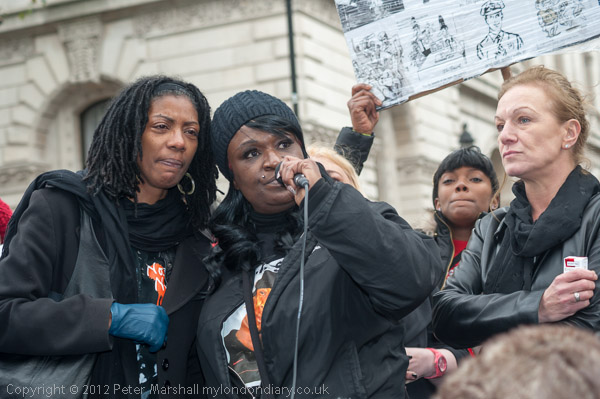
Marcia and Samantha, sisters of Sean Rigg, killed in Brixton Police Station in August 2008
© 2012, Peter Marshall

I’ve photographed Marcia and Samantha Rigg on various occasions over the years since their brother Sean was killed shortly after being taken in to Brixton Police station  in August 2008. As well as campaigning for a proper investigation of his death they have also become leading campaigners for the proper investigation of all deaths in custody and for effective control of police behaviour. Although they were limited in what they could say because of the forthcoming inquest, they gave damning testimony on the total failure and inadequacy of the IPCC.

© 2012, Peter Marshall

Although occasionally the sun went behind a cloud, using flash fill helped improve the lighting in the other images I took of them.  But working from the side the lighting with the sun shining almost directly into my lens was considerably more dramatic.  The kind of result shown here needed considerable work in Lightroom to burn down the sunlit areas as well as adding brightness and contrast to the shadows.

From here I got a bus back to Oxford St with a colleague. Getting on buses on days where extensive protests are taking place is often a mistake, as the traffic can get very badly held up, partly by protesters but often mainly by police blocking off much larger areas than the protest. We got stuck in Oxford St and could tell that something was happening when the police helicopter that we had seen from our seat at the front of the top deck was hovering was more or less directly above us. I spotted a crowd and police a couple of hundred yards away and we rushed downstairs. The traffic was completely at a standstill but the bus was between stops and at first the driver refused to open the doors to let us off, but my colleague and the other passengers persuaded him and we rushed to join the protesters running along Oxford St.

The light was tricky here too, shining low directly behind the protesters.

© 2012, Peter Marshall

That’s my hand at top left – without using it to supplement the ineffectual lens hood the image would have been a mass of flare – you can see a nice ‘rainbow’ effect at bottom right. I could crop it out, but that would lose some of the figure in blue below, which I think would be a shame. Most people don’t realise it is my hand, which after all was there anyway, so why should I remove it?

© 2012, Peter Marshall

A little later, in the Charing Cross Rd there was some nice rim lighting – and again fill flash was essential. One big advantage of modern flashes and cameras is that flash can be used at fast shutter speeds – 1/320th in this case.

© 2012, Peter Marshall

By the time we got to McDonalds on The Strand there was more strong side-lighting which made my picture of a man with a megaphone outside the store more effective – and this time I managed without flash fill, but with quite a lot of work in Lightroom.

You can now see my work from the whole of May Day on My London Diary:

London May Day March
Abolish The Corrupt IPCC
May Day Workfare Protest
Stock Exchange Occupied

________________________________________________________

My London Diary : Buildings of London : River Lea/Lee Valley : London’s Industrial Heritage

All photographs on this and my other sites, unless otherwise stated are by Peter Marshall and are available for reproduction or can be bought as prints.

To order prints or reproduce images

________________________________________________________

May Day – See Red

Red isn’t my favourite colour in photography, although it’s sometimes been said that every good picture needs a little bit of it. Nonsense of course, but while a little bit of red is fine, it’s very easy to have too much of it, and neither film nor digital is all that good in coping with large amounts of bright colour in that area of the spectrum. Which can cause something of a problem on May Day.

© 2012, Peter Marshall

With red road,  red bus and red buildings as well as the clothing and banners there isn’t really a great deal that isn’t red in this picture, and getting a truly believable skin tone on the face was something of a challenge with all the reflected red light.

© 2012, Peter Marshall

Most of the brighter red areas of these pictures needed some burning in to get some tonality, and the red tends to make other colours – such as the yellows in the above picture – look too wishy-washy and they have to have some attention too.  I think I’ve perhaps overdone it on the flag at the bottom left in the picture above, but it certainly needed some darkening.

© 2012, Peter Marshall

All the big heads made me want to do something with them, and I was attracted by the solidity and the expression of the man in the foreground, and though it might not show his best side I didn’t feel it was too unkind. But one face that truly makes me feel uneasy is the huge portrait of Stalin. Although he was ‘Uncle Joe’ to the press in the days of my childhood, and a vital figure in winning the war against fascism, it’s hard to understand why there are people still prepared to carry his banner or wear his t-shirt.

© 2012, Peter Marshall

London’s May Day celebrations bring together “trade unionists, workers from the many international communities in London, pensioners, anti-globalisation organisations, students, political bodies and many others in a show of working class unity” and it’s a shame that May Day isn’t a bank holiday so that more people can take part.  This year’s May Bank Holiday came almost a week later.

© 2012, Peter Marshall

© 2012, Peter Marshall

Jim Connell’s word’s, written at the time of the dock strike in 1889 are stirring and for an hour or so a year in London the red flag is flying over at least a small part of the capital. Here is his second verse (in web colour scarlet #FF2400) for any of you who have forgotten it.

Then raise the scarlet standard high
Beneath its fold we’ll live and die
Though cowards flinch and traitors sneer
We’ll keep the red flag flying here

I didn’t hear the words sung in English this May Day, (and its a long time since many in the Labour party sang them with any conviction, and the tune makes most of us think of Christmas trees.) The Internationale which was also getting played certainly has a better tune, but the standard English words are impossible to sing.

Few of the flags and banners in my pictures are scarlet, although I’m not sure that the colours are entirely true to hue, but many seem to be a little bluer shade of red, and, as I’ve deliberately made some darker than they appear to retain some tonality.  In the real world, colours don’t always look the same anyway, and change in different lighting conditions. You can see more of my work from the day on My London Diary in London May Day March.

________________________________________________________

My London Diary : Buildings of London : River Lea/Lee Valley : London’s Industrial Heritage

All photographs on this and my other sites, unless otherwise stated are by Peter Marshall and are available for reproduction or can be bought as prints.

To order prints or reproduce images

________________________________________________________

April On My London Diary

My work for April is now all on line on My London Diary, and it was a busy month for me, and rather more varied than most. I was trying to take things a little easier, but things didn’t really work out that way.

Walking the Rip-Off – Heygate & Aylesbury
Support For Palestinian Hunger Strike

Big Ride for Safe Cycling

© 2012, Peter Marshall
Workers Memorial Day
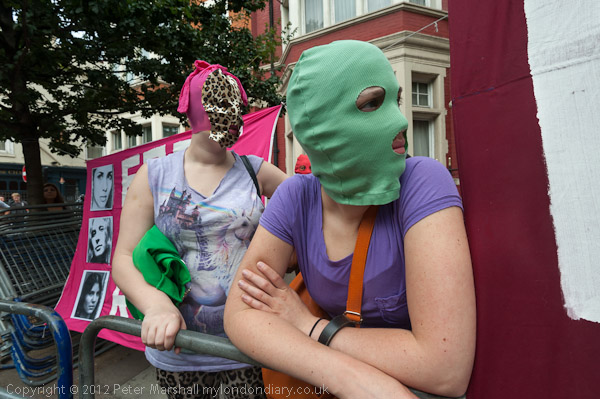
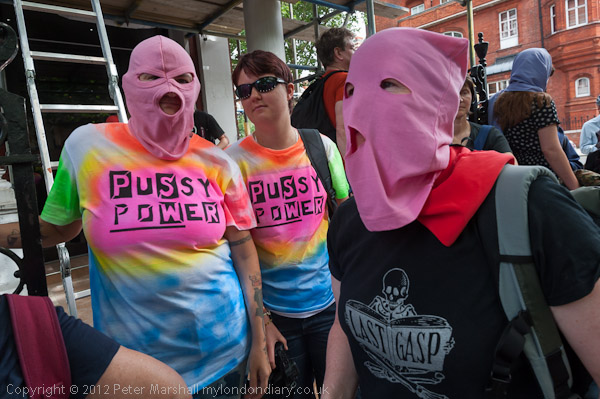
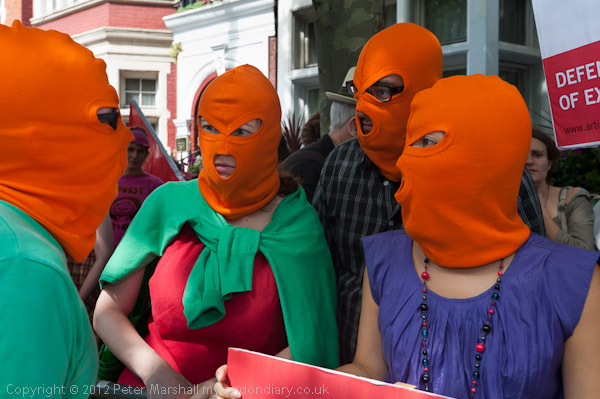
Protest Supports ‘Pussy Riot’
Olympic Course Day 2
Olympic Course Day 1
Climate Rush Spring Clean London’s Air

© 2012, Peter Marshall
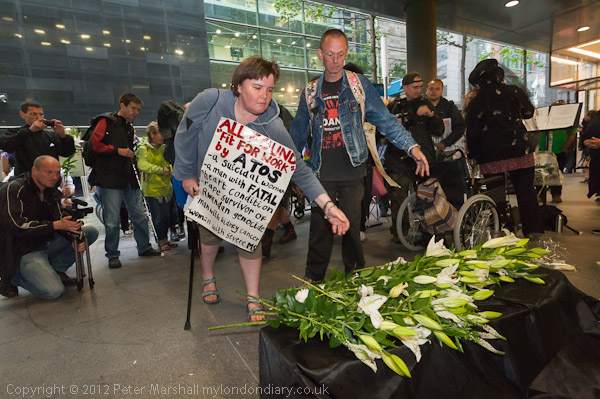
Disabled Activists Block Trafalgar Square
Free Syria Embassy Air Strike
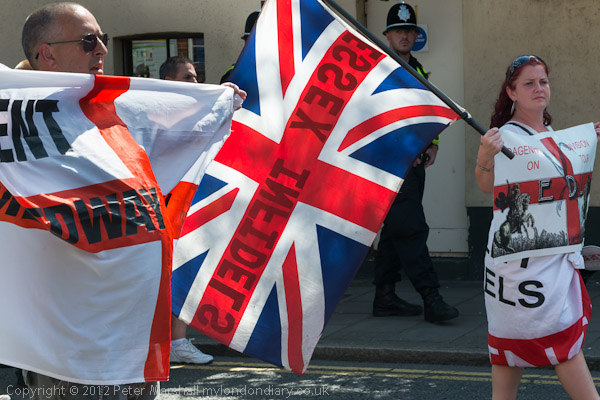
EDL and UAF At Home Office
Binfield Walk
Gravesend Vaisakhi
Olympic Site Revisited
Gasworks Dock Revived
Class War Snack Attack
Roma Nation Day Of Resistance

© 2012, Peter Marshall
International Pillow Fight Day
Syrians Continue Protest Against Asad
World Health Day: Lansley’s Bill
Christians Celebrate Good Friday
Twickenham & Richmond

________________________________________________________

My London Diary : Buildings of London : River Lea/Lee Valley : London’s Industrial Heritage

All photographs on this and my other sites, unless otherwise stated are by Peter Marshall and are available for reproduction or can be bought as prints.

To order prints or reproduce images

________________________________________________________