Pillow Fight

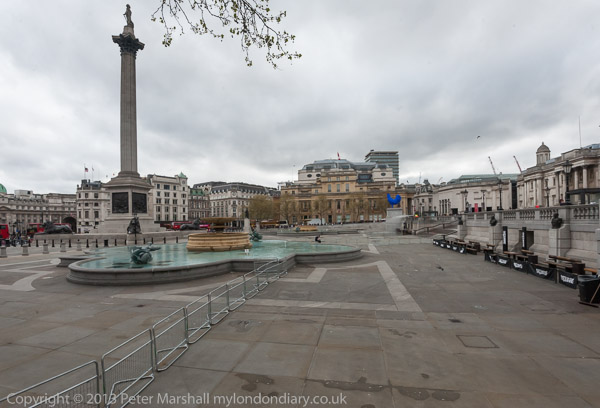
I’d heard a day or two earlier that London’s Mayor had decided to close Trafalgar Square on World Pillow Fight Day, but it still came as a surprise to find the square entirely empty, surrounded by barriers and a a thin line of police and ‘Heritage Wardens’ when I arrived a few minutes before the pillow fight was due to begin.

The Mayors office had put out that the event had been cancelled, but that didn’t stop at least a thousand people turning up with pillows. But instead of taking place in the large area of the main square, everyone was crammed into the much smaller space of the North Terrace. I think because until fairly recently that was a road, it comes under the control of Westminster City Council rather than the Mayor of London.
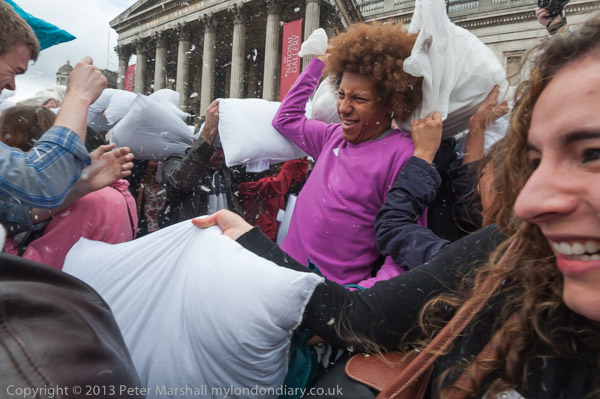
I was rather disappointed that the pillow fighters didn’t simply push over the barriers and swarm into the square, instead staying on the North Terrace, though of course the organisers couldn’t encourage this – and had come under pressure from the Mayor’s guys to call the whole thing off. But it was the kind of thing that once started could hardly be stopped.

I don’t know why the Mayor decided to be a spoilsport. Its the kind of event that is good for tourism after all – and there were quite a few tourists taking part as well as a good crowd watching. There are quite a few commercial events that take place in the square that I think should be stopped – its a place that should be for everyone to enjoy. And I’d like to see  an end to the ban on unauthorised protests there – it is after all one of the traditional areas in London for protest.
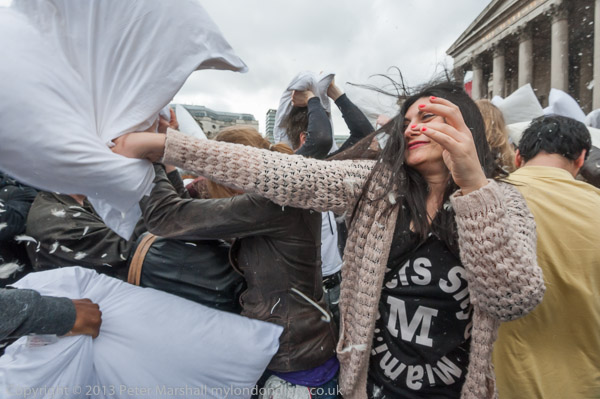
There were different versions of how long the fight was supposed to last, from 15 minutes to an hour, but I understand it continued for rather longer this year, though I had to leave after half and hour. And I was quite pleased to be out of it, as the air got pretty full of feathers and dust and I was beginning to suffer a little.

There are a few sensible rules for the pillow fight, and the one that I particularly like is number 3: “Do not hit anyone with a camera, they are our friends! ”

Of course, this doesn’t mean that if like me you like to get into the thick of things you won’t get hit by quite a few pillows. They are going everywhere and the odd one is bound to end on your head or camera gear. Though some people will apologise after having hit you!  But it does mean that you won’t get set upon and attacked deliberately.
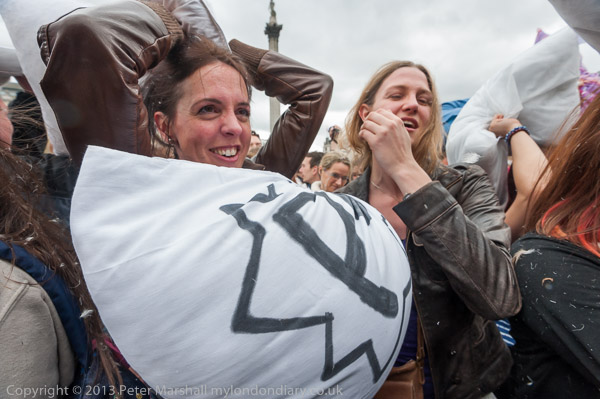
Quite a few frames I took ended up being full of pillow, and others came out rather differently to what I’d expected from the viewfinder,. with people and pillows moving pretty chaotically in every direction. Its the kind of situation where you have to react rapidly and don’t have much time to think.
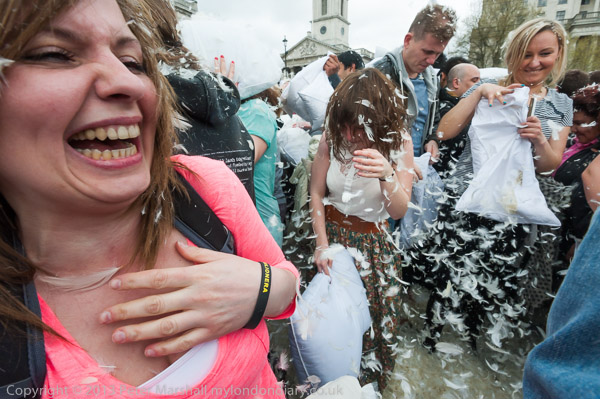
Before things kicked off I’d taken a few precautions. I’d taken the flash out of the hot shoe and put it away in my bag, and decided I could only really look after one camera and one lens in the mêlée.  I chose the D700 and the 16-35mm and put everything else well out of the way in my camera bag, carefully closing it up.

I’d decided that ISO1250 (or really 1600, as I had 1/3 stop exposure bias set) would give me decently fast shutter speeds to stop motion and plenty of depth of field from a moderate to small aperture, especially since for most pictures I was at around 16mm on the zoom.  I was using the camera on the P setting (though A or S would have done as well) and typically shutter speeds were around 1/500 – 1/800s and apertures f8 -f11, depending on which way I was facing and how many pillows were blocking out the light.
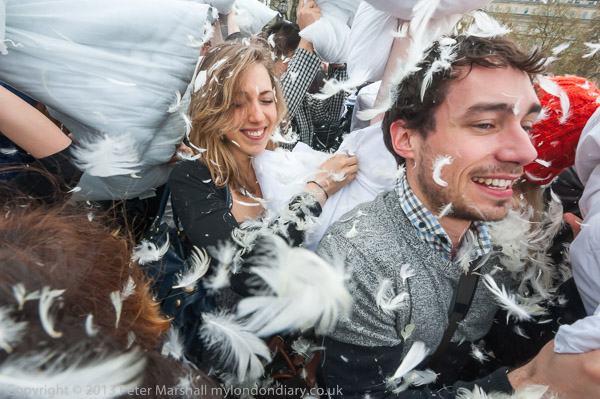
Subject distances were rapid and changing, with some at very close range. I could have used zone focus, but sometimes people were close than this would have rendered sharp, so I opted for autofocus, using the C setting – continuous-servo AF – and auto area AF. This is supposed to be able to distinguish faces with Type G or D lenses like the 16-35mm, and the autofocus is fast.  It all seemed to work pretty well.

Plenty more pictures at World Pillow Fight Day on My London Diary.

I had a shower and a complete change of clothes when I got home, and emptied out all my pockets, took everything out of my camera bag and vacuumed it. A month later I’m still finding the odd feather in unexpected places.
Continue reading Pillow Fight

Muslims & Britain First

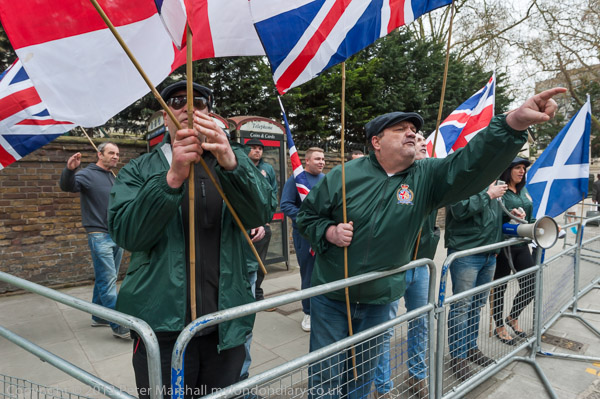
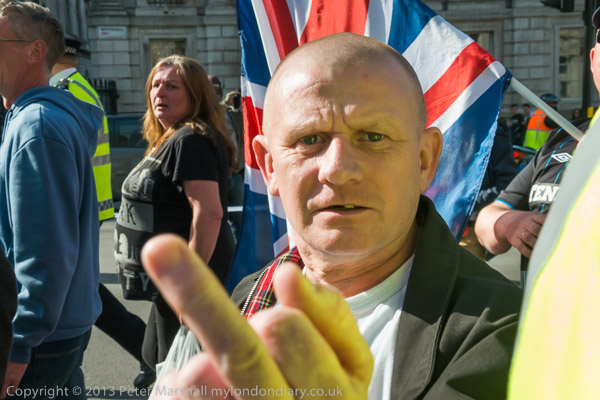
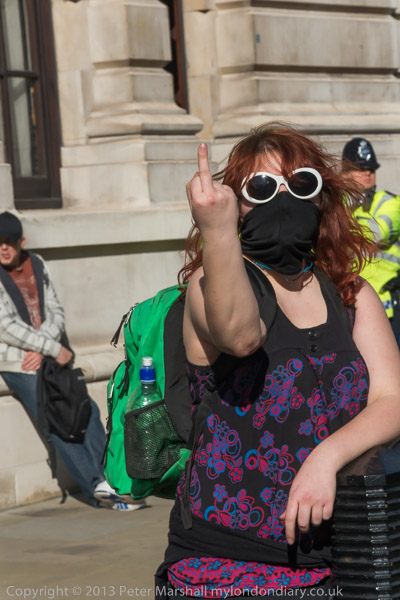
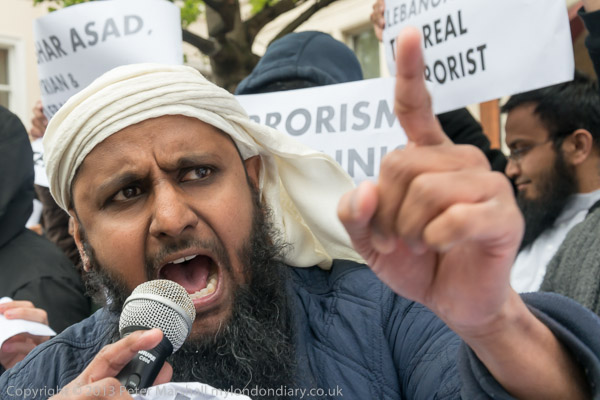
I think this picture is a good example of why I like to get fairly close to people when I’m photographing them, with the hand and finger closer to the lens being emphasized. Though I wasn’t that close, using the 18-105mm on the D800E, where its 40mm setting as a more or less standard 60mm.

Soon after I took this picture – and others you can see in Muslims & Britain First Clash on My London Dairy, police moved me and other photographers away from the narrow strip of road at the edge of the pavement on the fairly busy Bayswater Road, effectively preventing us from taking decent pictures of the event.

The Inspector in charge told us it was because us standing there were putting his officers at risk from the traffic, but since they continued to stand in exactly the same positions after we were removed that hardly held water.

I and another photographer moved to a refuge in the middle of the road, a perfectly safe place designed for people to stand while crossing each carriageway separately. But again we were told we had to move – and for the same ludicrous reason.

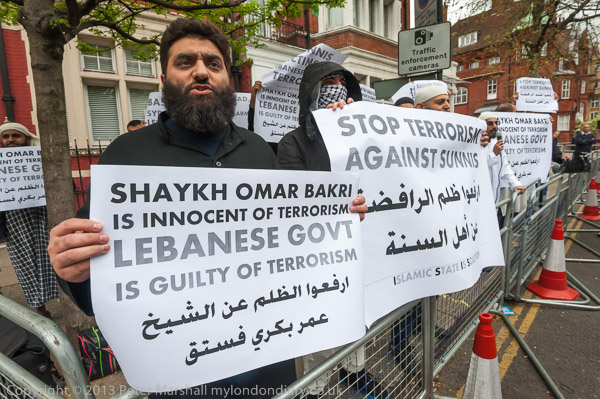
I suggested to the Inspector that if he were worried about the safety of officers he might consider making use of the traffic cones that were present but totally ineffective on the edge of the pavement – as you can see in the picture above. Moving them out perhaps three feet to where the officers were standing would have provided safety for the officers – and a working space for photographers.

But police officers sometimes go into a curiously deaf mode where they refuse to listen to any advice or comment, however sensible. And he did, simply repeating over and over that I had to move from the refuge where I was talking to him in a very reasonable manner and go to the other side of the road.

After I’d been trying to talk to him for a minute or so, he grabbed hold of me – I pointed out he was committing an illegal assault – and pushed me across the road, causing cars to have to brake to avoid the two of us.  Having pushed me onto the pavement, he then walked back into the road without looking, and a car had to do an emergency stop to miss him.

While I appreciate that police have a difficult job at times, this was no way to engage with the public, and certainly not in the spirit in which the police are supposed to cooperate with the press (and my suggestion to him was made in a spirit of cooperation.) Fortunately I’d had time before this officer started behaving stupidly to get the pictures I needed, and when a few minutes after this incident the Britain First protesters on the side of the road I’d been pushed to packed up and went home, I left too.

I later heard that after I left the  Inspector had come to apologise to my colleague for moving him from the refuge, admitting he had been wrong to do so; perhaps if I’d stayed on I would have go an apology too.

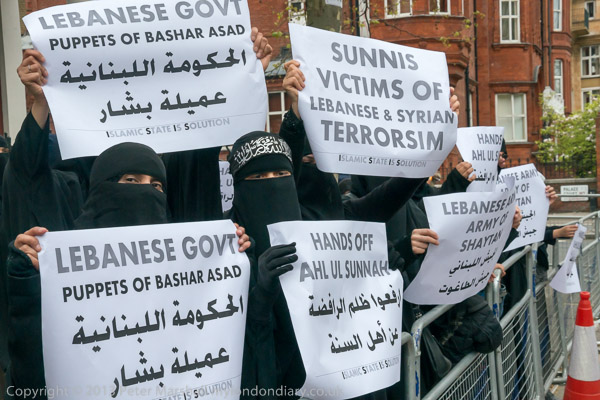
This was a protest involving two fringe groups, neither of which I feel any sympathy with. The Islamist fringe associated with Anjem Choudary had a least come to protest with a genuine grievance over the arrest and attempted arrest of Sunni Muslim activists in Lebanon and were also more interesting visually, while Britain First I just found rather sad, apparently there only to insult the Muslims.  Britain is still – at least in many respects – a free country and groups like both these have a right to protest, even though I think both stand for a society in which we would enjoy very little freedom.
Continue reading Muslims & Britain First

NAPO Strike Protest

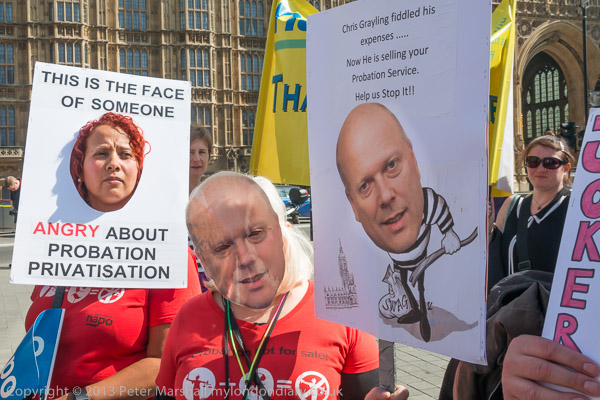
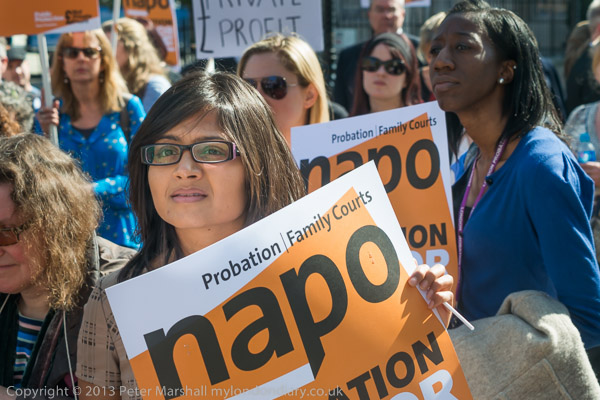
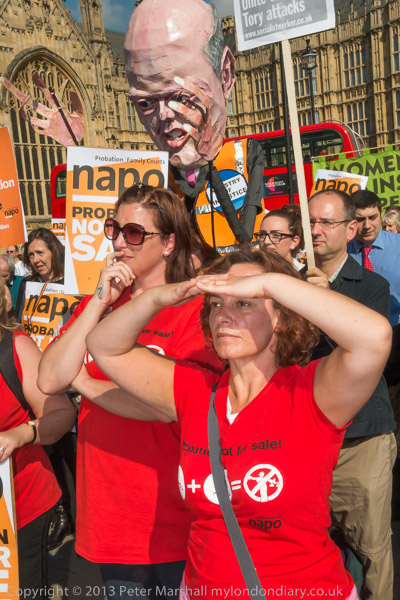
I’ve never had to have a great deal to do with probation officers, though I’m sure they do a very useful job, and also sure that the plans by Justice Minister Chris Grayling to sell off 70% of the service this year will result in a considerable deterioration – as well as handing private companies around £700 million a year worth of business. Doubtless many of those picking up the contracts will have links to various politicians, largely but not entirely in the Conservative Party.

It’s long been time for our opposition to have a rather tougher policy over privatisation – and particularly over the reversal of privatisation. In this case the Labour Party have asked that the contracts be written so they can be cancelled by a new government without huge financial penalties, but perhaps they should be thinking of bringing in legislation to put the reversal of privatisation on a more even basis to the selling off.

But I was there to take pictures, not to tell the Labour Party what to do. I didn’t really find anything really interesting at the rally, though there were several nice placards and posters, and a few faces that attracted the attenti0n of several of the photographers present.

Perhaps one problem is that ‘NAPO‘ always seems a rather ugly name to me, though I’m not quite sure why; perhaps it’s too close to nappy, though the other suggestion that comes up as I type it in on Google is ‘Napoleon. But I’m rather surprised they didn’t change it to something more pleasing when they decided the  National Association of Probation Officers was too much of a mouthful.

Or perhaps I just wasn’t in the right mood after the previous couple of events I’d photographed.  The lighting was a little tricky, with a low sun often shining into my lens. Some pictures I used fill flash, and others I had it turned off, and the Nikon SB800 seemed to be having one of its unpredictable days. I lost a few pictures where the flash had completely overexposed the image


Fill-flash was essential with a very deep shadow from this woman’s hands on her face

I did put the flash into the hot shoe and turn it on, but there were some of the audience where either I wasn’t using it or had turned it too low. One of the problems of working with two cameras and one flash unit is that it is often on the wrong camera. If you wait while you move it, the picture often disappears.

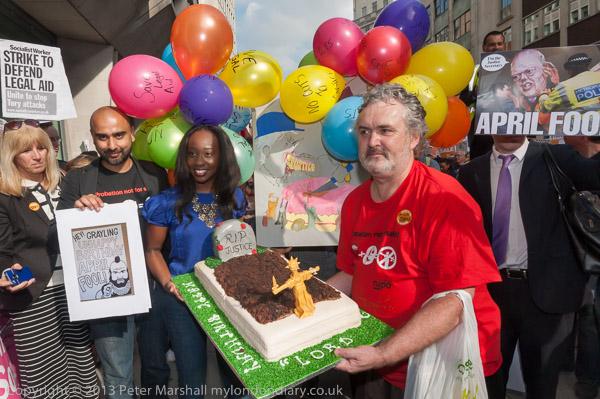
Things got rather more interesting later outside the Ministry of Justice, where after a few pictures of people standing with banners outside the entrance I wandered off towards the birthday cake which I thought would be important in the next part of the event. That was a little premature, but I did find I was standing next to the PA system, which seemed to be a good place to be.


At 58mm (87mm equiv)

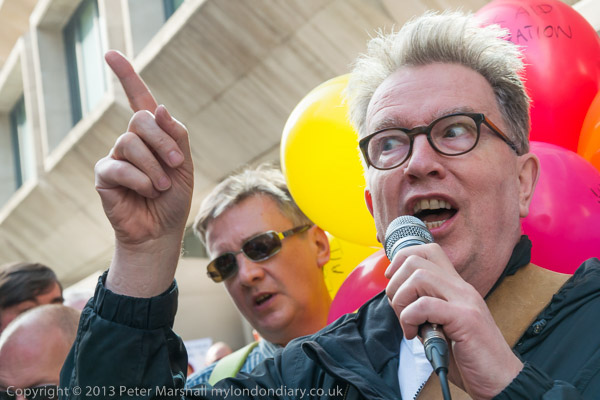
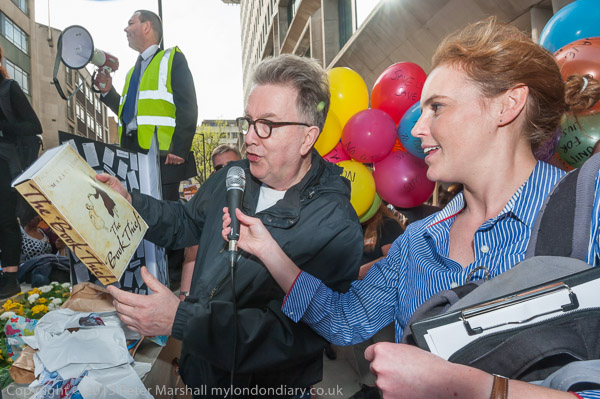
And so it proved, when singer/songwriter Tom Robinson was introduced to lead the singing of the special verions of ‘Happy Birthday’ for Grayling, and then to open the presents for him, which included a book, ‘The Book Thief’ for the man who had just announced that prisoners in UK jails would not be allowed to be sent books from outside prison.


At 17mm

For once I was pretty well in the right place to take photographs – and without a crowd of other photographers pressing on either side. The crowd of protesters was simply too closely around and behind me for other photographers to approach. A few like me had followed what was happening enough to be around, but had chosen other positions where they had less good a view.  This time I’d been lucky and had taken a lot of pictures, both with the 16-35mm on the D700 and the tighter head shots with the 18-105mm on the D800E.

The 16-35mm also came in useful when the cake was being carried in to the Justice Ministry, though I was disappointed on this occasion to be stopped by security as I tried to follow it in. They had obviously learnt from our previous visit on a legal aid protest in March – Outraged Lawyers Legal Aid Protest.

More pictures in Probation Officers Strike for Justice.

Continue reading NAPO Strike Protest

Man Up?

Blogger Duckrabbit‘s latest post Man up for the World Press Photo Awards has certainly stirred up a great deal of controversy, and deservedly so.  In it he starts with a reminder of the previous complaints by him and others about conflicts of interest in the judging of the WPP awards, and the “credibility problem when the chair of judges is required to chair over and vote on the work of a business partner“, something which WPP don’t apparently see as a problem.

To his credit that chair , Gary Knight, offered to stand down, but was told by the WPP that this was not necessary (and I understand that it was not possible for him to do so.)  I think he should have insisted on doing so, but that is of course something easier to say both in hindsight and from my position well outside the situation.

But Duckrabbit goes on to raise rather more fundamental problems in his typically robust fashion:

The biggest issue is that they appear to be unaware that the human race has two sexes and that black people don’t exist just to be photographed dying of starvation.

The WPP have just been having a two day awards event with 21 speakers, and Duckrabbit lists them, adding the comment:

Out of the 21 there is just a single woman. As far as I am aware not a single person on this list is black.

Fifteen years ago, when I started writing seriously (and for money) about photography, one of the major issues I tried to tackle was the chauvinistic nature of most of our thinking about photography.  Post-war the centre of gravity for many areas of photography other than photojournalism had shifted from Europe to North America, but anything that came from outside the major centres in those regions was off the photographic map.

Of course there were exceptions, and plenty of pioneers working away and bringing photography from places outside that narrow view. And the North American audience in particular was generally remarkably unaware of anything that had happened in Europe after the foundation of Magnum.  There were too parts of their own tradition – such as the Photo League – that they also tended to have forgotten. Photography in the USA had perhaps become rather tied up in a cold war attitude.

Things have move on a little both politically and in photography, but perhaps the WPP has failed to register this. Many of the more interesting photojournalists at the present time come from the majority world, and one of, if not the, leading centres for teaching photojournalism is the South Asian Institute Media Institute Pathshala, set up in 1998 by Shahidul Alam in Dhaka, Bangladesh.

WPP of course know this – and I single out Pathshala as its students and former students have won a number of WPP awards, but there are other things happening in other countries too. But somehow the WPP seem to have failed to respond to the changes.
I don’t know what proportion of entries to the WPP come from the majority world, but Duckrabbit points out that only 14% of entrants last year were women.  I’m not sure what proportion of photojournalists are women, but it is surely rather higher than 1 in 7, and certainly many of the best photographers whose work I’m aware of are women (and some have had work in the WPP shows.)

One of them is Abbie Trayler-Smith, who has just been at WPP in Amsterdam talking about her work (her presentation followed that of Edward Burtynsky.) There is a picture of her giving it in Bas de Meijer’s post about the WPP Awards Days, The real value of the World Press Photo.

But Duckrabbit’s post is not about the award winners, but about invited speakers at the event. And it would be hard not to agree with his conclusions.
Liebling Revisited

Some posts just get away, falling into the cracks in my computer system and my failing memory. Often I’ll see something and make a quick note, perhaps save a link as a draft post in WordPress, or in the text editor I usually write with – a kind of beefed up Notepad, which allows me to work on several documents but doesn’t add  the kind of formatting that word processors do, making it easier to paste text into various applications. I’ll save the draft or the text file, intending to come back to it later. But later is usually after I’ve been out taking pictures, and by the time I’ve finished dealing with these and writing the captions and text I’ll have forgotten all about the draft I wrote before I went out.
So I saved a draft a couple of weeks ago, and then came across it today, about an article on the New York Times Lens Blog, Look Again, With Love and Liebling, by James Estrin.

Well for me it was looking again, as I think all the pictures (certainly almost all) are in Jerome Liebling’s 1995 Aperture book The People, Yes which I have on a shelf downstairs. Its title comes from that of Carl Sandburg’s epic 300 page poem, published in 1936,  inspired by the the language and lives of ‘ordinary people’ in the economic and social upheavals of the 1930s, and Liebling’s work reflects a similar social and political outlook, reflecting his photographic studies with Walter Rosenblum and membership of the New York Photo League. I’ve written about Liebling in the past, but there was a good obituary with some details by Sean O’Hagan in The Guardian in 2011.

The Lens blog was published shortly before the end of a show of Liebling’s work at the Steven Kasher gallery in New York, which you can read more about on the Jerome Liebling web site. On the videos page there you can listen to him talking about his work and the people in his photographs:

“There are no superiors, I think we’re all about the same, but there certainly are advantages in life, and money and who writes the history ..  so I suppose I’m saying these are valuable people…”

He goes on to talk about his work as showing “the politics of everyday life” and the idea that going to look at the work should get people to challenge their ideas.

You can also read an interesting piece by Randy Kennedy in the New York Times in 2006, The Still-Life Mentor to a Filmmaking Generation which looks at Liebling’s influence on documentary film through his teaching in which “he tried mostly to impart a deep suspicion of dogma, of piousness and of the compromises that can lie just beneath the surface of American culture.”

Teachers on the March

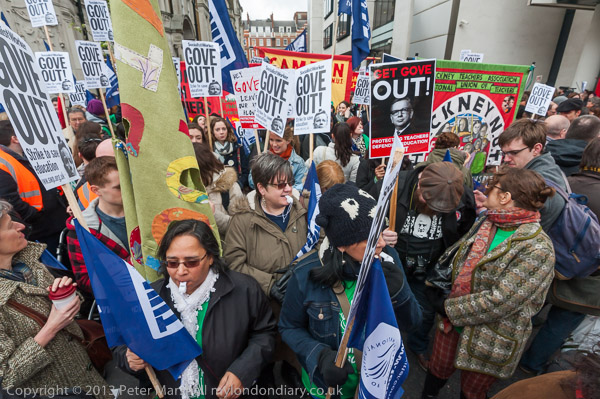
Education is something almost everyone thinks they are an expert on. After all, we all (or almost all) went to at least one school. Those who end up running education ministries obviously did very well at it. So it’s hard for them to realise what it is like for those who don’t succeed. It’s also very hard for those who haven’t experience it to understand what it is like to be on the other side of the experience, as a teacher, particularly a teacher in very different schools to those that most government ministers attended. Though Michael Gove wasn’t one of the Etonians; an adopted child (his birth mother an impoverished student in Edinburgh), he did very well at the state primary he attended in Aberdeen, well enough to pass the scholarship to one of Scotland’s best private schools, and later to get a scholarship to meet the costs, and then on to Oxford – in the days of student grants and before students paid fees. His was hardly a typical experience of our state education system.

Back in my own twenties and thirties, I spent almost ten years teaching in one of the country’s largest comprehensive schools. People used to think teaching was an easy job, but I saw the toll it took on some of my colleagues, several who had to leave the profession after breakdowns and felt the stress myself. Actual teaching – ‘contact time’ – was around 25 hours a week, but with meetings, marking, lesson preparation and record-keeping I was putting in over 60 hours a week during term-time.

Although we didn’t have Ofsted then, there were various inspections and observations. One man came into my lesson armed with some kind of form for recording what teachers actually did; at the end of the lesson – a science practical class for 12-year-olds – I asked him about it. His reply was that he simply could not keep up with me, and supervising 15 pairs of students carrying out various practical tasks was often physically as well as mentally demanding.

After ten years I was feeling exhausted, and took a pay cut to move to a former grammar school that was in the final transition to a sixth-form college. It had the advantage too of being closer to home – a couple of miles on a bike – so I could spend a little more time with my young family (see my first ever web site.) For a few years things were easier, but soon things began to ratchet up, particularly with the greater demands for highly detailed lesson plans, the national curriculum and in 1992, Ofsted. Teacher morale became very low, and staff turnover – with many colleagues leaving the profession or moving to the private sector – reached an all time high. Even in a relatively easy outer London suburban area (although there were particular local problems with a bullying principal), one year around a third of the staff changed.  I was relieved when I began to earn enough outside of teaching from my photography related activities to go part-time, and then to stop teaching altogether.

The whole trend of education (and other) policies in the UK over the past 20 or so years has been driven by successive governments taking away powers from local authorities and both centralising control and handing some out to non-elected private bodies. The result is chaos and competition in a system which needs cooperation and organisation. Students suffer, and so even more do teachers. And Gove wants to make things even worse.

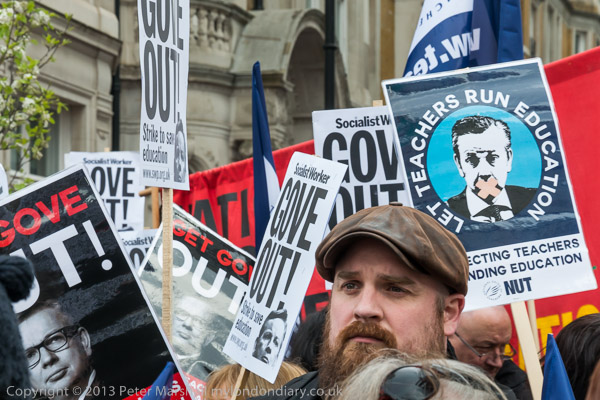
I’m still a member of the NUT – though a retired one – as well as of the NUJ, and have considerable sympathy for the teachers who were striking and marching though London.

The day started off rather dull, with just the occasional spot of rain – just enough to make it necessary to keep a watch on the lens filters for a drop and for the occasional image to be ruined when I missed this.

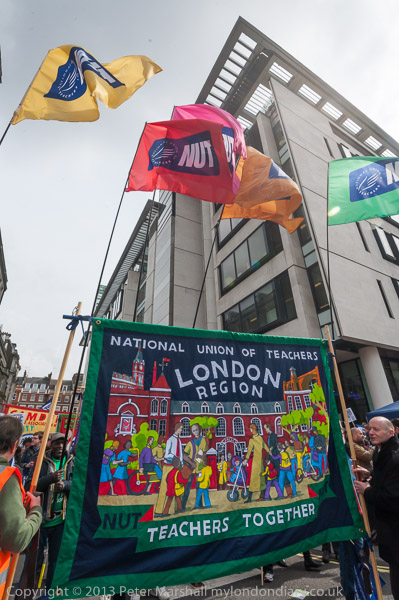
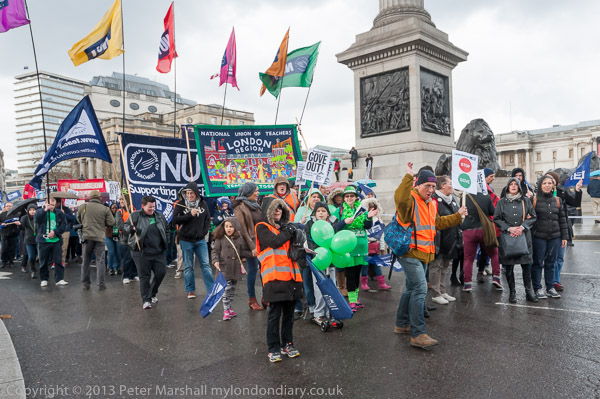
Those tall flags were something of a problem when close to the protest, but I suppose they showed up well from a distance – as when the march was entering Trafalgar Square, where it was also hit by a really heavy shower.

I’d thought of some obvious key points at which to photograph the march, apart from the start, always a good place as people are crowded together and relatively static. It was actually a little too crowded on this occasion, making it very difficult, particularly with the banners in the way, to move around. The march gathered in a fairly narrow street and it was very full.

The first of these points was Broadcasting House, particularly since the teachers (like almost all other protesters) feel they are not given fair treatment. In the weeks leading up to the strike the BBC had largely ignored the case being made by the teachers and given rather more prominence to the governments view that this was an unnecessary strike, and had also very much minimised the effect it would have in closing schools. In most parts of London a very high proportion of schools were affected – either fully closed or with large numbers of pupils told not to attend, and the same seems to have been true across the country.

On the day, the BBC did give a lot of coverage to the strike, and NUT General Secretary Christine Blower was interviewed on the Today programme, though there were some slightly curious aspects to some of their comments. Their report of the London march as by ‘over 1500’ teachers is as usual significantly lower than most estimates.

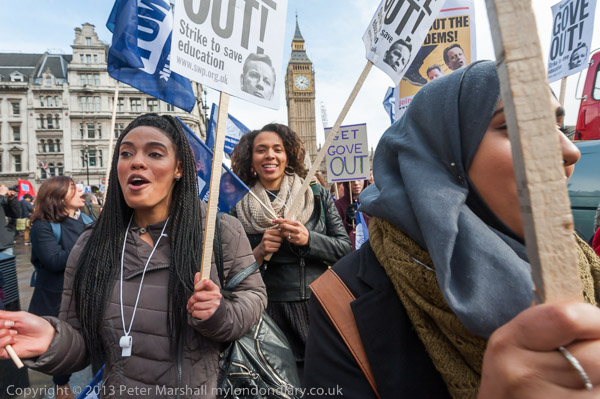
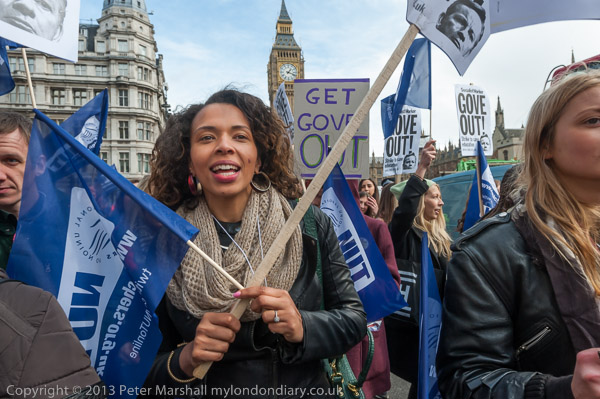
Other key points were those that say ‘London’ strongly, such as Piccadilly Circus and Trafalgar Square, and I didn’t really do to well as either of these, partly because of the heavy shower. I paused briefly at 10 Downing St to record some of the shouting and gesturing at that point, but the main attraction for almost all of the photographers was of course Big Ben and the Houses of Parliament.

There are quite a few more pictures taken with that clock in the background in Teachers March on NUT Strike Day and a couple are not bad, but perhaps not quite as strong as I would have liked. You need a little luck working in complex situations like this, with protesters moving, people holding placards (and often obscuring the background) and passing traffic as police kept the road open, and today it didn’t quite happen.

Continue reading Teachers on the March

Anti-Fracking Carnival

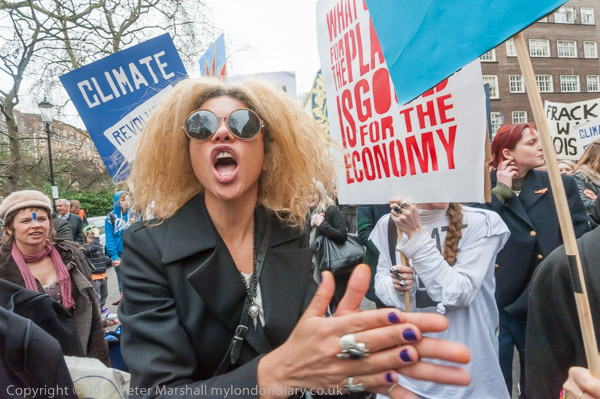
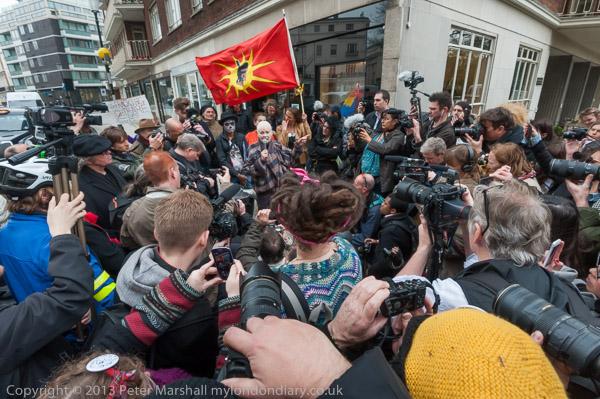
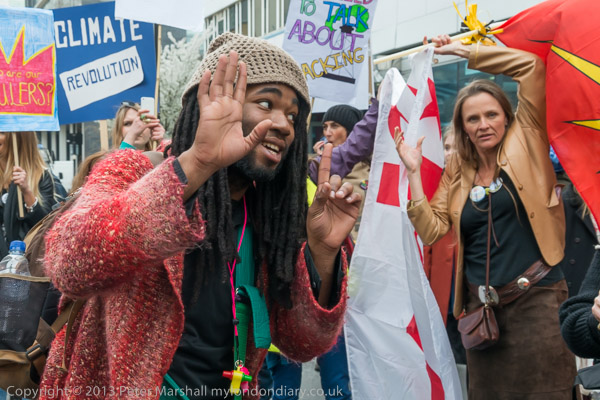
The march led by Vivienne Westwood with her ‘Climate Revolution’ met up with other anti-fracking protesters at Knightsbridge for the Fracked Future Carnival, an event intended to let the government and the energy companies trying to develop fracking in the UK of the growing opposition to their plans. The depth of that opposition has been made clear at Balcombe and now at Barton Moss, and there were a number who had been at both places at the protest.

The protest carnival had been planned to take place outside the hotel where the ‘Shale Gas Forum’ of government and industry was to take place, but shortly before the event, the forum had been moved to a ‘secret location’ to avoid the protest. Of course it wasn’t possible to keep that location secret, as among those attending the forum were some who realise the power of the arguments against fracking and were sympathetic to the protesters.

Increasingly informed opinion is that to avoid disastrous global warming we need to move away from using coal, oil and gas as fuels, either leaving them in the ground or using them only for chemical feedstock or some increasingly niche energy uses. Highly carbon intensive hydrocarbon sources such as tar sands and shale might result in profits for the companies who exploit them (and even governments who tax them) but only lead to catastrophe for the planet.

As the organisers of the Fracked Future Carnival say, “We know fracking won’t lower our bills and it won’t bring significant jobs. It has the potential to ruin our land, our water, our soil and will keep us dependent on fossil fuels.”

What we need is a determined shift towards renewable energy, as well as an increased investment in reducing energy use. Both will provide jobs. Energy saving will start to reduce bills immediately, and renewable energy will also do so in the longer term. Solar panels have already reduced dramatically in cost and increased in efficiency, although on-shore wind still currently has the greatest potential in the UK. But the coalition government seem keen to support opposition to it.

Photographically, the largest problem outside the hotel where protesters held a rally as previously planned before moving on to the new location was simply the crowd of people with cameras around the speakers and Vivienne Westwood in particular. Away from this fairly small area it was relatively easy to work, although there were still too many photographers for us to keep out of each other’s way.

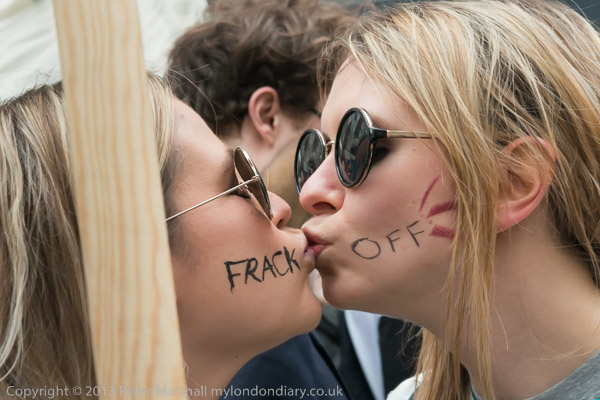
But while I was occasionally frustrated by photographers moving into my frame, there were also occasional gains. It was a photographer standing next to me who asked two girls with the message ‘Frack Off’ on their cheeks to kiss, but I was able to take advantage of the moment – and I think was at a slightly better angle than him. I didn’t set it up, but it happened and I photographed it – and I think my caption made clear that the two girls were posing for a photograph.

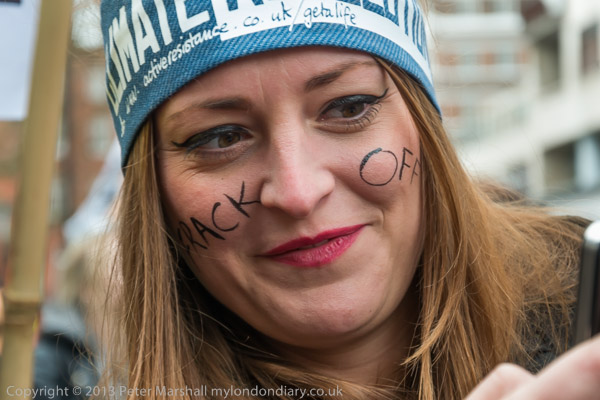
It was a neat solution to the problem of trying to see the message clearly when photographing a single person with a message across both cheeks – the curvature of the face generally makes it hard to read in its entirety. There was a great deal of posing going on, with many of those taking part in the event taking ‘selfies’ while waiting until it was time to move off.

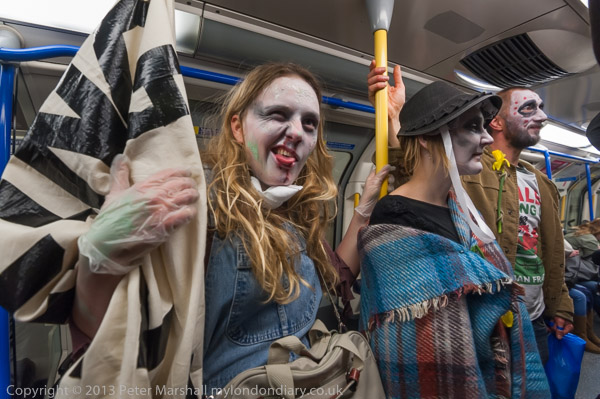
I’d hoped to take some pictures of people travelling across London to the military location where the event had been rescheduled, but the protesters got very dispersed and when I did get on the underground with a small group it was too crowded – the train was fuller than normal with a large school party of young children spread across several carriages. The lighting in the carriages isn’t too kind for photographers or to their subjects, with a fairly discontinuous spectrum and also with the actual light sources in the picture. Although I managed one or two pictures they were just a little disappointing and have a slightly odd colour, though perhaps that improves them.

I lost touch with that group when we had to change trains at Kings Cross, and although I’d hung around for quite a while waiting to take pictures in Knightsbridge station, I still managed to be one of the first to arrive at Old Street. The underground can still be rather confusing for those who aren’t familiar with it.

There was a lot of building work on the corner of Old Street, making the space for meeting there very restricted, and photography rather difficult. Things were much easier once the protesters marched off and rallied outside the two gates to the Territorial Army centre where the forum was taking place. As intended, the protest was peaceful though at times very noisy, with the Rhythms of Resistance samba band making their presence felt, and the event did have something of a carnival nature, as well as some very serious speeches by people concerned with the future of our country and the planet. The frackers inside will certainly have been aware of the opposition.

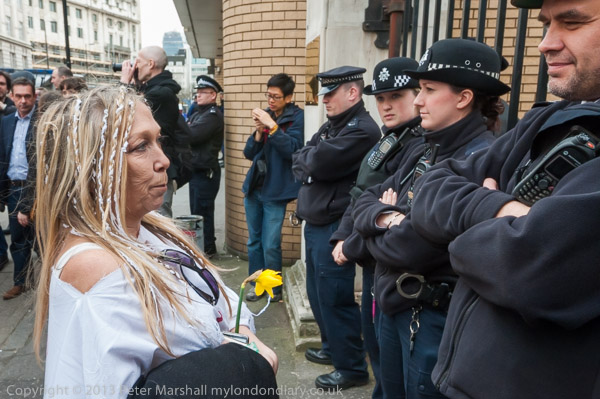
I rather liked this image of Tina Louise from Residents Action on Fylde Fracking facing a line of police, as much as anything as a little homage towards a far stronger and deservedly famous image, where Marc Riboud photographed a young woman holding up a flower to a row of soldiers with bayonets fixed outside the Pentagon in 1967.  Riboud’s Flower Child image had a power which this lacks, and it flashed into my mind as I made this image – and was a reminder of how powerful still images shape the way we see the world.

Fracked Future Carnival at Shale Gas Forum
Fracked Future Carnival in Knightsbridge

Continue reading Anti-Fracking Carnival

Lions in Trafalgar Square

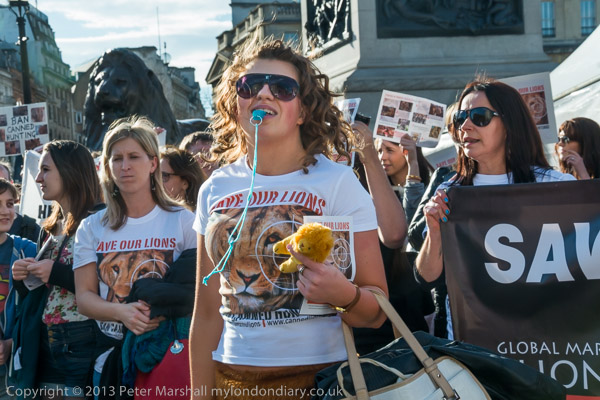
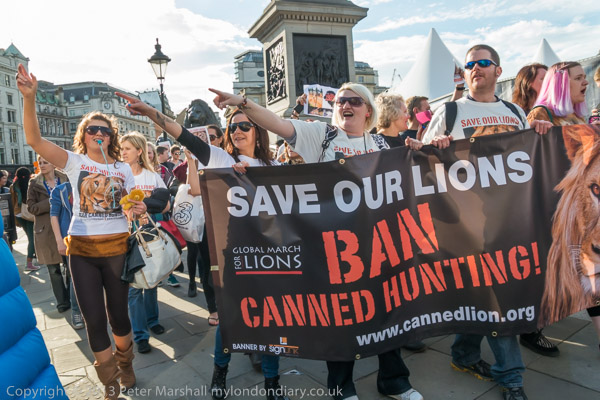
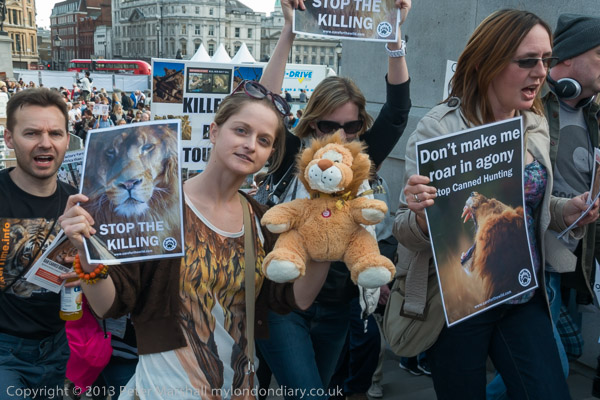
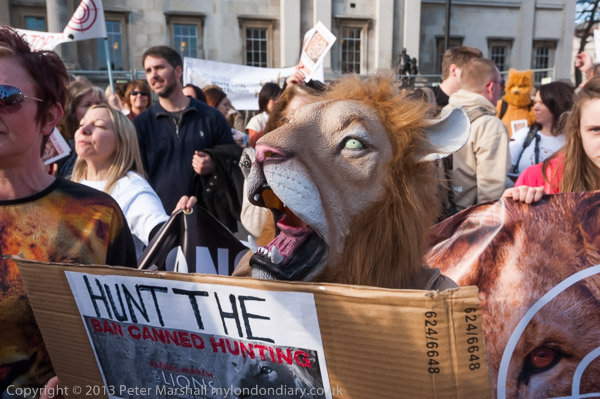
Landseer’s Lions were joined by a couple of hundred protesters, some dressed as lions or with lion images on their t-shirts with the message ‘Save Our Lions’.

The photographic difficulty in putting the two together was largely that the sun was low and more or less exactly in the direction I wanted to point my camera, just outside the frame above. I was using the Nikon 18-105mm on the D8o0E, and it is a DX lens, so at 50mm was 75mm equivalent. The 28-105 has a reasonably effective lens hood, but  I needed to use my hand as well – and being able to see in the viewfinder the image area outline as a rectangle over a larger view makes this a little easier.

Trafalgar Square was in a little of a mess, with tall fences around the plinths of the lions, so it wasn’t possible to use them well in closer images. A wider image (18 mm on that 18-105) taken from the same position a few seconds earlier gives a clearer view of the situation as well as showing the main banner for the event. As you can see in Save Our Lions – Ban Canned Hunting I took quite a few different images from that same spot.

AAfter quite a lot of the march had passed me, I ran up around the side of the march (it had been joined by another group of marchers that the people carrying the banner  had been pointing towards) and got to the top of the steps going up to the North Terrace to photograph people coming up. Again I made a series of images.

At the top on the North Terrace things were very crowded, particularly as preparations were being made there for the St Patrick’s Day celebrations the following day and the space for the protest was rather restricted. It wasn’t always possible to get enough clear space between camera and subject for some pictures and I think I could have done a little better on pictures like the above.

I hadn’t really realised what was happening with the lions and ‘canned hunting’ and it’s significance, so this was a protest where I learnt something. It’s a practice which degrades both the ‘King of the Beasts’ and the miserable rich who take part in it.

Continue reading Lions in Trafalgar Square

British Values?

Probably you won’t have read ‘Life in the United Kingdom – A Guide for New Residents‘ written by the Home Office and the basis for our Citizenship tests, but it could be a useful study for those who call themselves ‘patriotic’. Here’s a short excerpt from the first chapter:

There is no place in British society for extremism or intolerance.’

‘The fundamental principles of British life include:

  –  Democracy
  –  The rule of law
   – Individual liberty
   – Tolerance of those with different faiths and beliefs
    -Participation in community life.’

I don’t like the idea of the Citizenship Test, particularly when most of those of us who are already citizens would fail it., but I think that the quote above is a good start to defining British values and one that should be taken to heart by anyone who wants to call themselves ‘patriotic’.

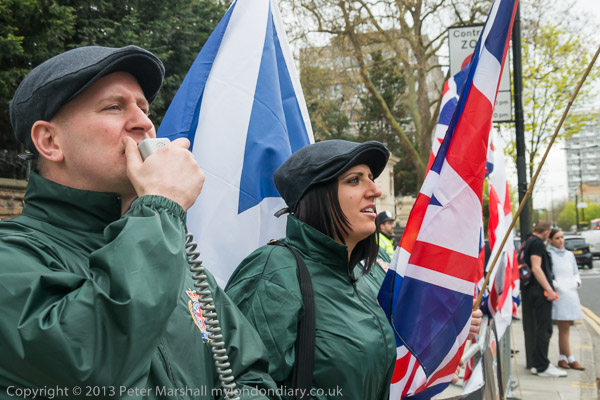
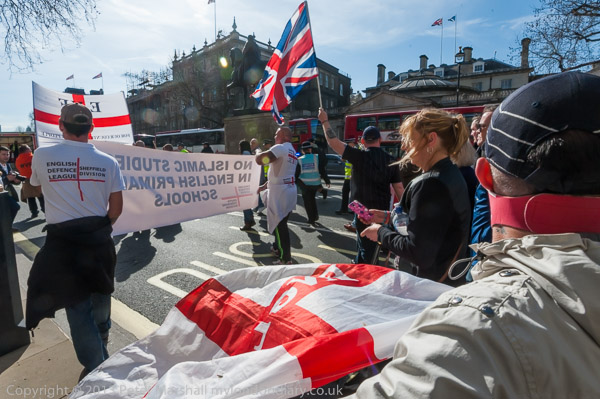
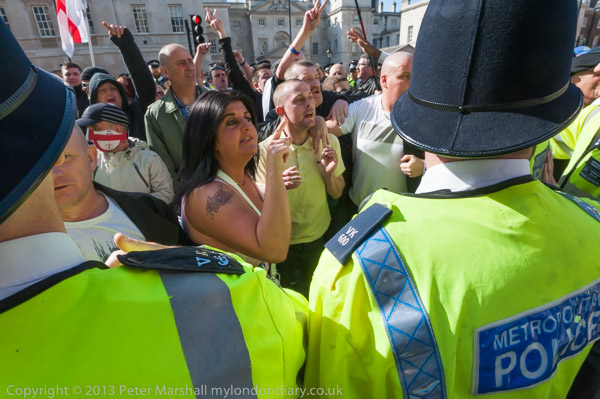
I don’t like photographing events like the march along Whitehall to Parliament by the English Volunteer Force, which seems to be the latest of various post-EDL right-wing groupings, but I think it important to record these various groups as a part of our society. I don’t agree with most of what they say and don’t like much of what they do, but think that they should be reported on as accurately as I can.


One man objects to being photographed. Another man lunged towards me and pushed my camera in my face; later outside Parliament he threatened to break my camera. A police officer held him back but didn’t take any other action despite the threatening behaviour.

Some of them seem to hate photographers and journalists. While most protesters like their act of protest to be reported. Most want exposure, but groups like this fear being exposed.

Antifa who had come to oppose the EVF and had been kettled by police for around an hour when I took this picture were not all keen to be photographed either

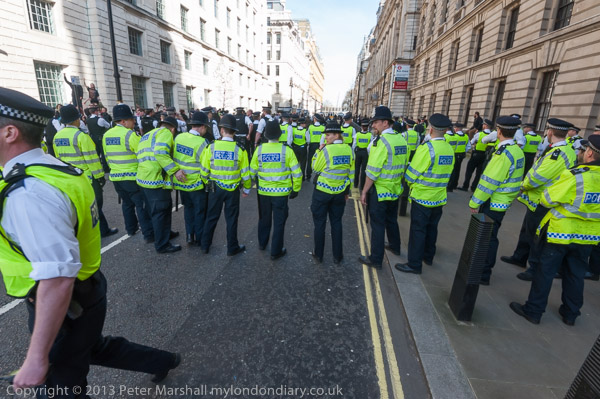
There were more anti-fascists than EVF in London, and probably more police than either of them. Antifa claimed a victory, which may be good for morale but seemed not to be born out by the facts. The EVF had marched and held a rally, protected by a large number of police, who had managed to keep the two groups apart.

The EVF had been forced by the police to change their meeting point to a pub near the top of Whitehall, just a few yards from where they had first intended to start the march in Trafalgar Square. Police had easily held them back when they made a surge towards the Antifa – who were mainly beyond several more lines of police. The police arrested a few from both sides, but there was no major outbreak of violence, and as I concluded, ‘it was really the police’s day.’

More at: English Volunteer Force march in London
Continue reading British Values?

Chasing Nuclear Waste

It’s hard to believe it was three years ago that the Fukushima disaster occurred, though recent reports suggest that the situation there is still no entirely under control, with several leaks of radioactive water. It’s also hard to be entirely sure that reassuring reports such as that recently published by the United Nations Scientific Committee on the Effects of Atomic Radiation which suggests the health impacts of the radiation leaks are likely to be fairly minimal except possibly for the 160 site workers accurately reflect the total risks, and I have a sneaking suspicion that there may be previously unsuspected pathways and dangers – as has happened previously with other forms of environmental pollution.

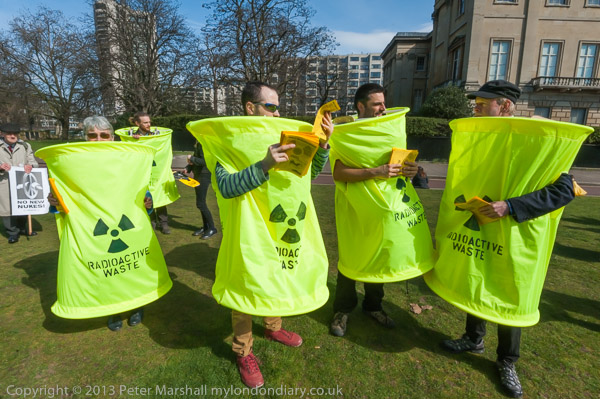
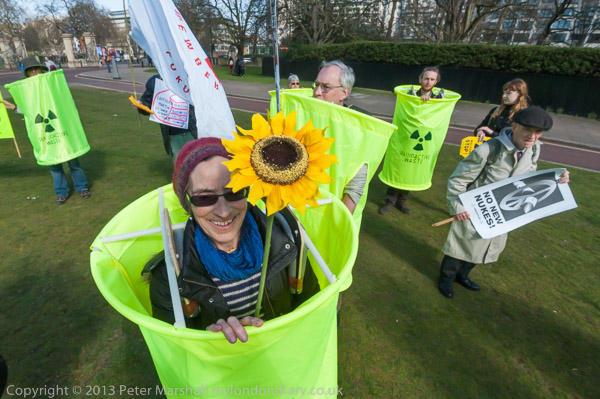
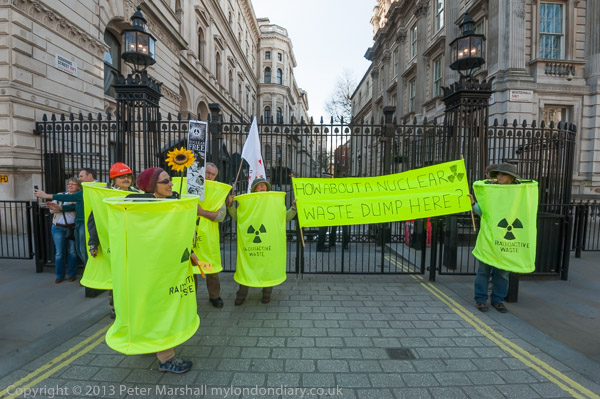
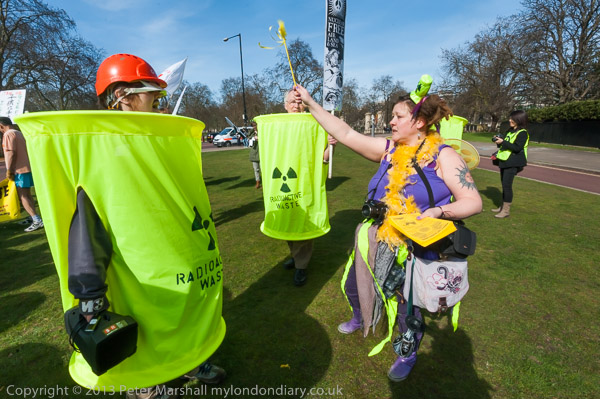
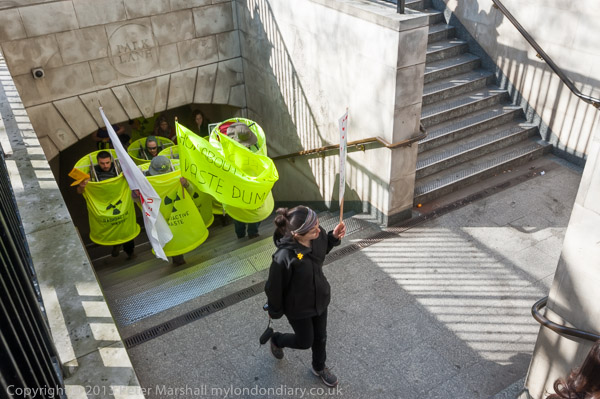
What I can be sure of, is that photographing a rather random moving group of people in costumes representing barrels of nuclear waste is harder than it looks!   It would have been fun to have followed their progress around London from Hyde Park to Parliament, but there were so many other things happening too, and I only met them at the start of the march and close to Downing Street later in the day.

Photographing them would have perhaps been easier if there had been fewer distractions – sometimes positive and sometimes rather getting in my way, including an improbable nuclear waste fairy, whose magic wand somehow failed to work.

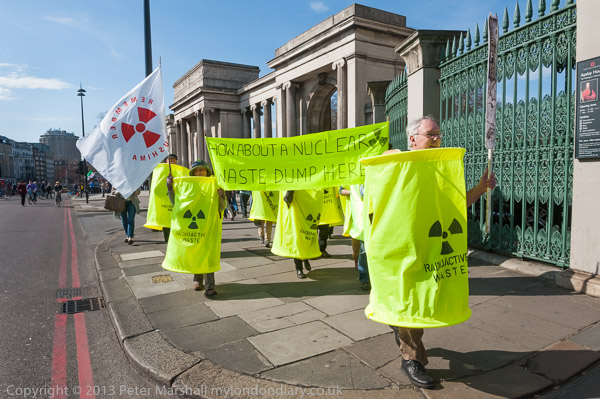
Of course I’ve nothing against fairies, but they really need to keep their wands in better order! The march started at Hyde Park Corner, and I rather liked the sight of them coming along in front of the arches there, though it was hard to get exactly the image I wanted.

It might have been nice to have been a little further out to the right, but I would then have got mowed down by the almost incessant heavy traffic. That road at the left may look empty, but just out of frame the ranks of cars were speeding towards me. After I’d taken this picture I did ask the leading barrel if he would turn his placard so I could see it, and took some more pictures as they came along the pavement, but this remained my favourite.

Sensibly, to cross Park Lane, the waste barrels took the pedestrian subway, and it might have been a good image as they emerged (I’d run across the two carriageways in the gaps between traffic to get there before them) but they didn’t really emerge in a suitable formation. This was life and not a movie set.

I caught up with the nuclear waste barrels later in the day, having waved goodbye as they went towards the Japanese embassy on Piccadilly (and I think they were also going on to the Berkeley Square offices of the Tokyo Electric Power Company) as they were approaching Downing St with the rest of the anti-nuclear protest.

I think that many voters might think have an answer for their question ‘How About A Nuclear Waste Dump Here‘ and feel it might be a rather better use for the site than its current occupants. Or that perhaps it is already one, and Cameron and Osborne are the result of some terrible mutation caused by the radiation.  (No, that’s just a joke.)

But I’d certainly not feel happy about living near a nuclear power station, and have often felt a certain tension and dryness in the air around those I’ve visited, though I’m sure that it is purely psychological. I’d certainly not feel safe eating the crops from my garden if I lived close.

Not that I’m against nuclear power. There is a perfect location for a nuclear power plant, and we already have one there. It’s called the sun.

More pictures of those barrels and the rest of the event at Fukushima Nuclear Melt-down Remembered.

Continue reading Chasing Nuclear Waste