Prison Visit

Technically Harmondsworth Immigration Detention Centre isn’t a prison, but people are still locked up there, some for many months on a stretch, though under different conditions to prison. They are locked up without trial and often get little recourse to justice. ‘Fast Track’ procedures were introduced because asylum seekers were making use of our justice system to appeal when refused asylum, and the Home Office decided that it would be better to deny them the chance to put their cases properly and whenever possible to get rid of them without proper consideration.

Handing the running of these immigration prisons to private companies has resulted in various corners being cut to increase profits. Conditions inside them have been strongly criticised by various reports, and led to hunger strikes. People are treated in a way that simply should not happen in any civilised society. We should all as a nation be ashamed of what happens inside them.

When I walked on to the site there were few protesters around and I and a couple of other photographers wandered up the drive to photograph the outside of the buildings. Workers coming out of the Colnbrook Detention Centre called out to one of the photographers, telling him that photography was not allowed there. They would like us to know nothing about these places or what goes in in them.
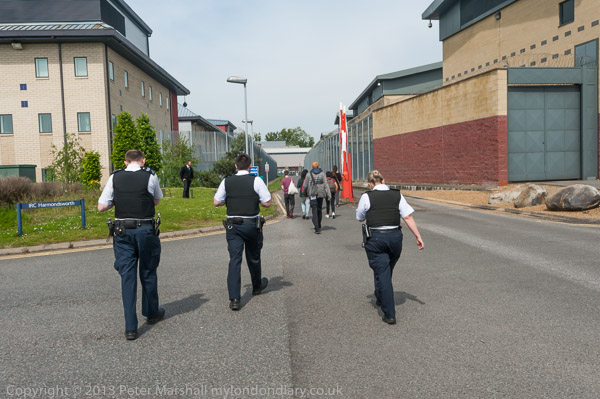
When the protest actually started, there were no problems with taking pictures, and the police had come to ask the protesters what they intended to do. The officer failed to get much of an answer, as nobody was in charge, but he told them that so long as they behaved sensibly the police would give them no problems.

Three police officers followed the protesters onto the road through the centre of the site –  with Harmondsworth Detention Centre on the left and Colnbrook on the right. It is a private road, though the barrier on it was raised and we walked past it. It leads at the end to a site belonging to BT, and the whole area was until 1966 the home of the Road Research Laboratory which I visited while in the sixth form.
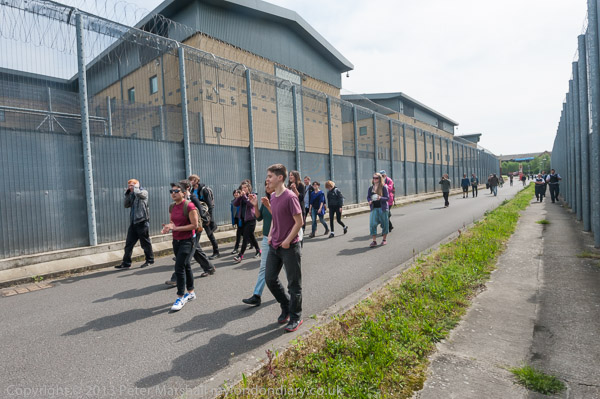
The officers – and the two men in Serco jackets who joined them – kept their distance and watched the protesters, but didn’t interfere with the protest, even when there was a complaint that it was disturbing the airport security dogs in their kennels just to the north of the prison.  Last time I photographed a protest here, in November 2012,  when the protesters kept drumming on the tall prison fence they were told that they would be arrested if they continued, and then issued a warning that they were committing an aggravated trespass and would be arrested if they returned to the site within 3 months, but today the police just stood and watched.
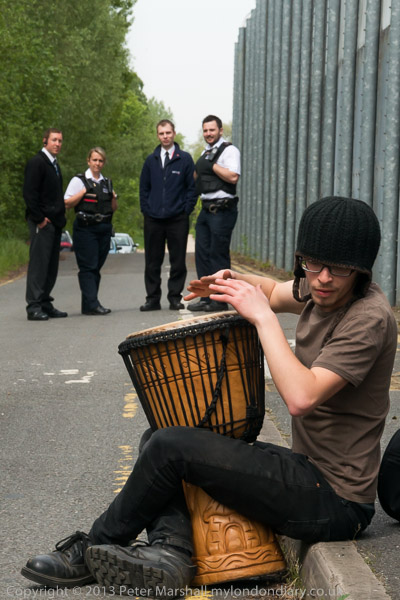
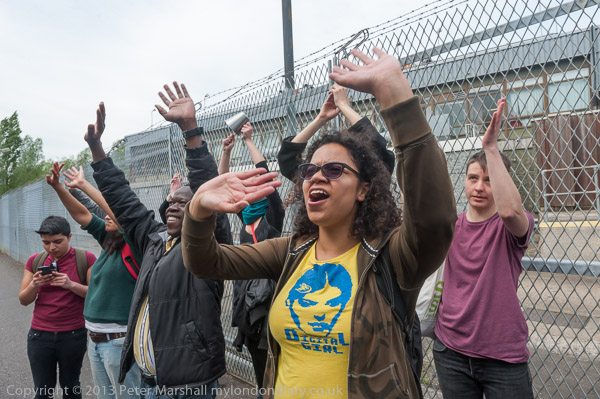
Most of the drumming today came from a drum, and I didn’t see anyone kicking the fence, though it was attacked rather firmly by a frying pan, though even more effective was thumping it with palms, which made the whole structure resonate.

Those inside the prison responded to the protest, waving out of the windows. Phone calls to and from some of those inside told the protesters how pleased the inmates were to know that some people at least in the UK cared what was happening to them.

Few of the windows are visible except through a tall – roughly 12 ft  – fence, with fairly narrow gaps between the parallel wires that run along it. Auto-focus has no problems with focussing on the wire, but it is almost impossible to get it to auto-focus on the windows some distance behind.  I was using the 70-300mm at or close to the longer end on either the D700 or the D800E, and the images are cropped down, and depth of field was minimal.

Auto-focus is great, but one of the small problems with cameras that rely on it is that manual focus becomes rather more tricky. Focussing screens just aren’t made to work as well as they did when we relied on manual focus. But manual was the only way to get the hands at the window anything like sharp. I don’t think they clean the windows, and inside them I think there is also a rather dirty and sometimes scratched plastic pane. So people and hands were hard to see. But they certainly wanted to be seen.
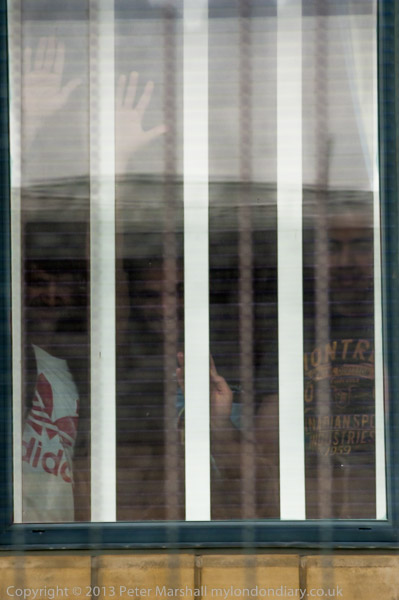
I couldn’t really tell on the camera read screen if there was anything sharp on these frames. The raw files opened in Lightroom gave flat and rather indistinct images, and there were problems too with colour balance, as well as with the whole image being seen between those well out of focus wires.  Considerable post-processing was needed to get anything as distinct as you see here, and the horizontal wires and thicker vertical supports are still clearly visible over most of the image. What is rather surprising is the clarity of the designs on the shirts of two of the three men in the picture, although their hands and faces are still impressionistic.
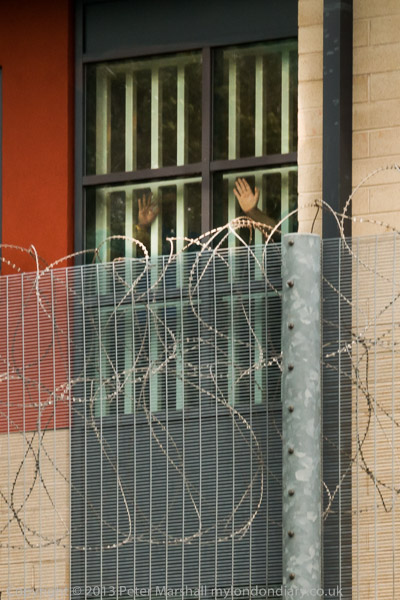
On the west side of the prison, the car park stretches some way back, to a low bank covered with trees. Standing a little up this gave a clear view over the top of the fence of the top of the top floor windows. Reflections of the sky in the glass still made the  view far from clear, and quite a bit of post-processing, using the adjustment brush with various settings on different areas was needed.

You probably aren’t allowed to photograph here, but I’m sure there is an overriding public interest in making what is happening at places like this known.
Continue reading Prison Visit
Protest at the Opera

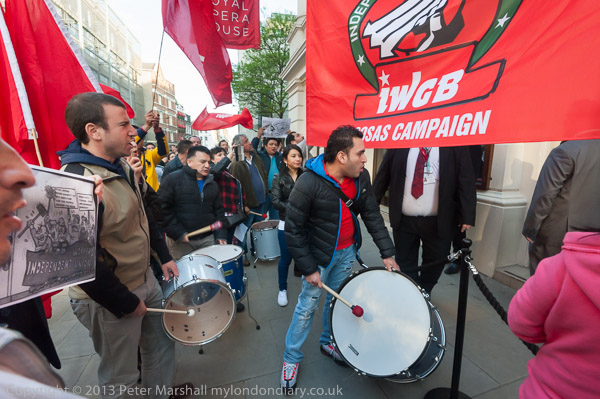
I almost missed the International Workers (IWGB) cleaners protest at the Royal Opera House (ROH) in Covent Garden. I’d been told they would be there at 5pm and either the time had changed or whoever told me had got it wrong, and they were actually planning to start at 5.30pm.

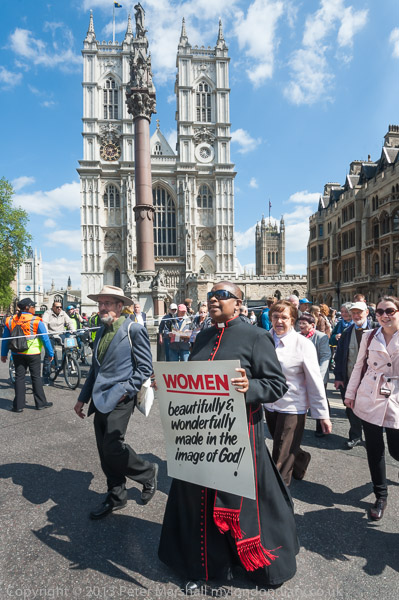
But there was clearly nobody around, or at least no protesters when I arrived a little before 5pm, having been photographing a few other things on the way – a Rastafarian protest calling for the Restoration of the Ethiopian Monarchy (I couldn’t at all understand why they thought that would help in ‘Economic Liberation), then on my way back on the top deck of a double-decker bus I saw the weekly Anti-Fur Picket at Harvey Nichols and decided I had time to cover that on my way to finding a large crowd of Anglican women priests celebrating 20 years of Women Vicars. They were marching from a rally outside Church House, the Anglican HQ where the decision to allow them was taken (rather belatedly as some other Christians had allowed women to take a full part in their work many years earlier – even centuries ago.  Then, as so often when walking up Whitehall I’d come across another couple of protests, and photographed one of them, a token Baloch Hunger Strike in sympathy with that about to enter its second week in Karachi.

At 5pm outside the ROH I really thought I’d had enough for the day, and thought about going home; but I’d promised the cleaners I would be there, and sat down in the sun to read a book and wait.

A lot of press photographers spend a lot of time waiting, often outside the homes of people who don’t want to be photographed, or outside courts during celebrity trials, opposite the door of 10 Downing St, and more. I don’t, partly because I’m not desperate for money, mainly because I don’t want to hound the innocent or glorify celebrities. And also because I’m very impatient (and not on payroll.) Anything over ten minutes is really beyond the call of duty for me.

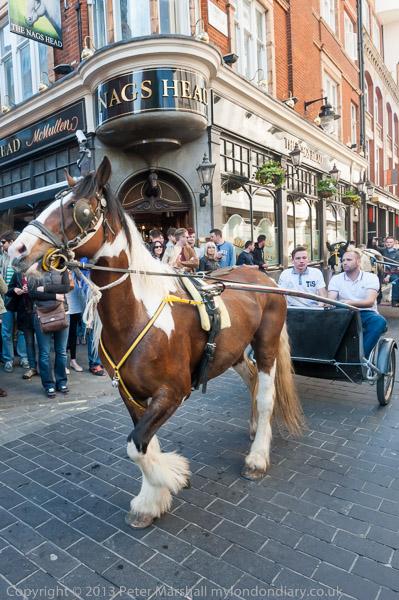
But it was a nice May early evening, and I found a comfortable place in the sun – not then too hot to sit out in and was well into a chapter or two when I was suddenly disturbed by the unmistakable sound of iron-shod hooves and wheels on tarmac and got up to see a whole string of horses and traps approaching at a brisk trot.

I stood up and prepared to take pictures as they came past, but then the leading trap took a fast left turn down Floral St by the side of the Royal Opera House, and I had to run across and down the street to photograph them.

On Floral Street they soon slowed down as the leaders stopped to decide which way to go, before slowly turning to their right and parking up, appropriately by the Nags Head pub. Soon after I’d finished taking a few pictures of them – they included at least one cart rather like those my grandfather had a business making – and made my way back to the front of the ROH, a couple of the cleaners came round looking for people, and I found they were meeting up around the corner at 5.30pm.


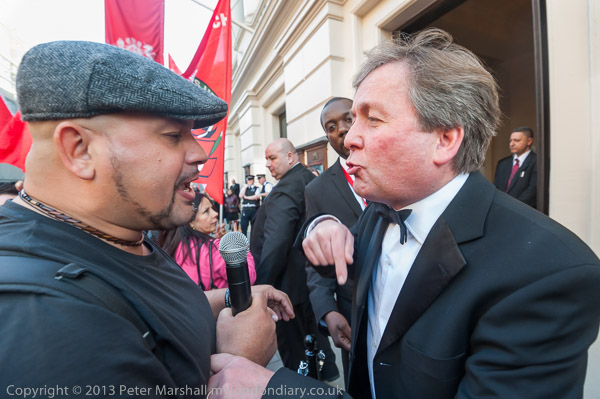
A man in a funny suit gets angry – and the security guard steps in as he grabs IWGB leader Alberto Durango, who refuses to be provoked.

You can see more about their protest and read about why they were at the ROH in IWGB Cleaners at Royal Opera on My London Diary.

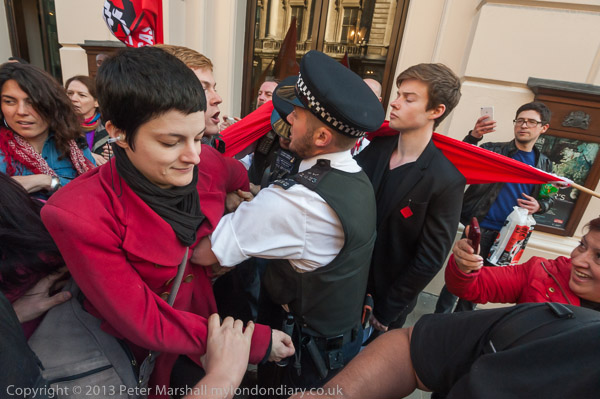
As often seems to be the case at the moment the police, when they arrived some time after the protest had started, seemed to be unsure whether they were present to defend the right to protest or to defend the interests of the wealthy – in this case the ROH and its clients. And at one point when a couple more vans had arrived, they simply seemed to lose the plot completely. It was just lucky those water cannons haven’t arrived yet.

I’m not an opera fan, though I often listen to bits of it as my wife is something of a singer, though her choir sings choral works rather than opera, and often listens to Radio 3 as well as going to some of the Proms and other classical concerts. My favourite singer is BillIe Holiday, who only puts in very rare appearances on Radio 3, though it does have the occasional jazz programme. I favour public subsidies for the arts but object to the fact so much of it goes to opera and in particular the huge £26m for the ROH*. More generally I think it’s time to give a finger to the star system and pay the ‘stars’ less. I think the BBC should take a lead too with truly drastic cuts in what they pay often rather dubious ‘talent’ and management. But if the odd fat lady or gentleman decides not to sing in London, it’s no great loss, and many of the ROH audience will fly abroad to see them in any case.

I’d certainly hope that any future Labour government would make it a requirement for any organisation that receives Arts Council funding in England (and any remaining parts of the UK still under Westminster control) to pay all employees (direct and indirect like the cleaners) a living wage and have decent conditions of employment.


* Disgruntled northerners may like to know that Opera North gets another £9.6m and these two organisations account for around 11% of the budget. The total grant of grants to 699 organisations is £339m, an average for each of £485,000.
Continue reading Protest at the Opera

Joint Enterprise

The last fatal duel in England took place a short bike ride from where I live (or if I’m feeling lazy there are a couple of buses that more or less take me up the hill) ino Englefield Green, where in 1852 two Frenchmen came with their four companions to settle their differences. One of them, politician Frederick Constant Cournet, described by Victor Hugo in Les Miserables as “a man of tall stature; he had broad shoulders, a red face, a muscular arm, a bold heart, a loyal soul, a sincere and terrible eye. Intrepid, energetic, irascible, stormy, the most cordial of men, the most formidable of warriors” received a fatal wound and died in the local pub, where you can read a possibly not very accurate account of the event.

Cournet had been one of the engineers on the streets of Paris in the 1848 revolution – Hugo describes his massive barricade in the Faubourg St Antoine as “three stories high and seven hundred feet long.” He was elected to the National Assembly in 1850, but then sentenced to a year in prison for abetting the escape from jail of Eugen Pottier who later composed ‘L’Internationale‘. In December 1851 Cournet was in trouble again, having been one of the leaders of a failed coup d’état against Louis Napoleon and had to flee to London.

His opponent in the duel was another veteran of the 1848 barricades, Emmanuel Barthélemy, and although the dispute is sometimes claimed to be about remarks Cournet made about a former girl-friend of his, more likely it was because Barthélemy was a supporter of Louis Blanc, and Cournet  a supporter of his opponent among the emigre French socialists in London, Alexandre Auguste Ledru-Rollin.

Duelling was illegal, and three Frenchman who got on the train at Datchet were detained on arrival at Waterloo following a message (presumably by telegraph) from the Windsor police. Barthelemey was first charged with murder, but this was later reduced to manslaughter and his sentence was a short one. But less than three years later he was caught in the act of murdering his employer and a neighbour and was hanged at Newgate in 1855. For those who are interested there is more about the duel from the trial (in brief, Cournet fired first and missed, Barthélemy had the second shot, but his pistol did not fire – so Cournet lent him his, and was then fatally wounded) as well as information about the murder on a rather grisly site, Execcuted.Today.com.

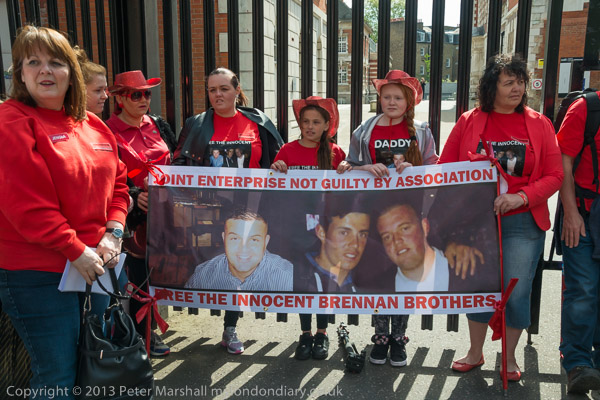
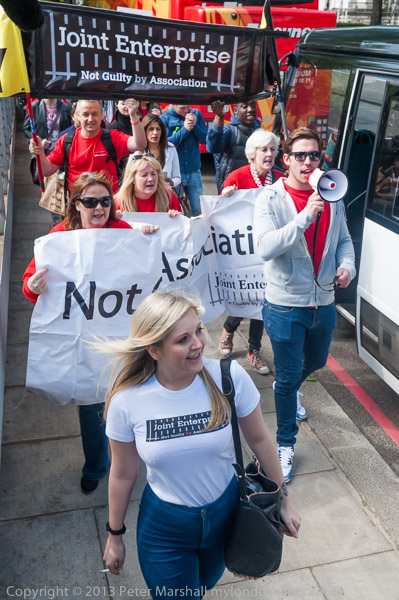
All this came to mind (and prompted a little research, though I’d read the not entirely accurate account inside the bar of  the Barley Mow a while back) when I went to photograph a protest by the oddly named JENGbA, short for Joint Enterprise – NOT Guilty By Association, a campaigning group against the injustice of ‘Joint Enterprise’, an offence said to have been “introduced three hundred years ago in a clamp-down on dueling, enabling the seconds and doctors who attended duels to be arrested as well as the actual duelists.”

Being Common Law rather than defined by any statute the exact history is hard to trace, though there are a number of key cases which serve as precedents to define it. But its Common Law orgin also renders it liable to be misused and subject to political pressures on those responsible for prosecutions who attempt to widen its application. What makes good sense in very limited circumstances has over recent years been expanded into a catch-all offence in what is seen as a war on gang killings. Surprisingly there are no official statistics, but through freedom of information requests researchers concluded recently that more than 1,800 people had been charged with homicide (and many convicted) under joint enterprise in the previous eight years.

I was shocked when I read about some of the cases of injustice that JENGbA has taken up, one or two of which I mention in My London Diary. Although there has been considerable disquiet over this in legal circles with a Bureau of Investigative Journalism study and a report by the House of Commons Justice Committee, there has really not been the public outcry that it demands, probably because most of those convicted come from disadvantaged groups and many are tarred, often inaccurately, with belonging to criminal gangs.

It is just one other aspect where ‘British justice’ no longer meets the standards we used to believe in – as too are the police killings of suspects during arrests like that of Mark Duggan and the many suspicious deaths in custody.


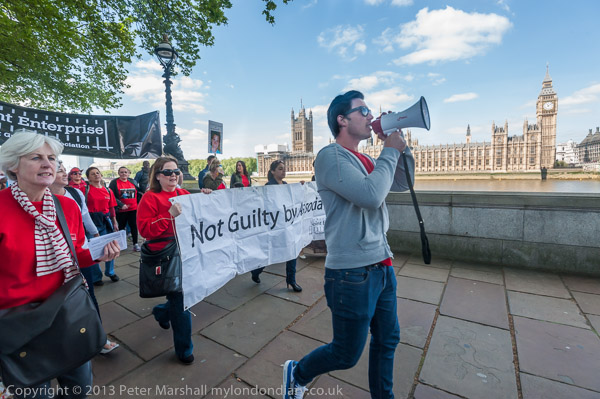
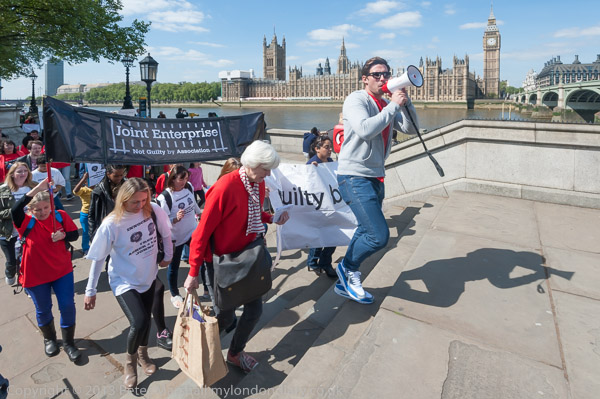
Obviously I wanted the Houses of Parliament in the background, but also carefully framed for the shadow at right

Photographically the main problem I had in covering the march by JENGbA was one of contrast, with the low sun often seeming to come from exactly the wrong direction for my purposes. Of course I should probably have used some flash fill, but somehow I felt this might be a little intrusive and upset what felt like a rather delicate relationship between me and the families involved in the protest.

I’m also getting a little worried about the 16-35mm lens. It does seem to be giving far more flare than it used, and I wonder if it is in need of a good clean. But given the bill I got the last time I took it for repair I’m not keen to repeat the experience, particularly when I’m not quite convinced it is necessary.

I do seem to get both more specular flares (aka ghosts), bright spots of light, sometimes coloured and often hexagonal, and also more veiling flare, the diffuse creeping of light from over-bright into shadow areas of the picture.

Ghosts sometimes add a little to the image and are usually difficult to remove or ameliorate. Somtimes it is possible totone them down a little. Small ones entirely in areas like sky can be cloned away if necessary. With the diffusion, using an adjustment brush on the affected area to increase contrast, reduce highlights and increases clarity can help, sometimes with a slight positive or negative exposure change.  I’ve tried to do this, perhaps a little clumsily on the head of the leading figure with a megaphone on the top image in this post.

Shortly after the start of the march, it came across the rather macabre site above on the pavement, in an area well away from any buildings in front of the large yard of Chelsea College of Art.

More about the march and a little about some of the cases at Joint Enterprise – NOT Guilty By Association.

Continue reading Joint Enterprise

Shad Thames


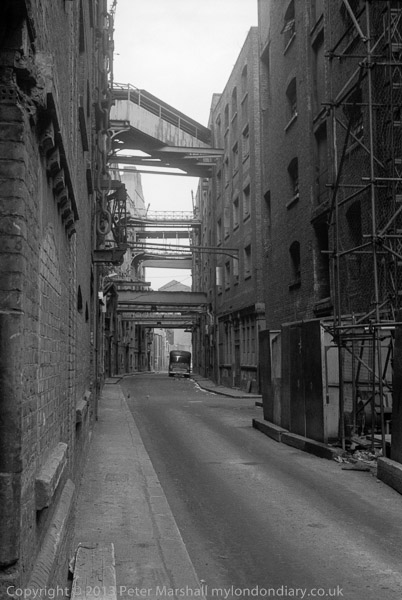
Shad Thames, 1981

This weekend there is a festival taking place in Shad Thames, though I doubt if I will have the time to go there, and to do so always makes me feel a little sad. Though I wish the Shad Thames Area Management Partnership (STAMP) and the Shad Thanes Resident’s Association and their Local Eyes Festival  well, I can’t help feeling that the love for Shad Thames really came perhaps over thirty years too late.


St Saviour’s Dock, 1980

Shad Thames, like the rest of London’s Docklands, used to be completely off the radar for most Londoners, even though you could glimpse it from Tower Bridge. There was indeed a sense that even if there were no fences or walls the general public were not welcomed, and it looked – and was while it was still a working area – a rather dangerous place.

It’s perhaps hard to remember when it is now a tourist trap, that back in the 1970s and 1980s it hardly got a mention in even the more adventurous of the tourist guide books. Access to the south bank of the Thames east of London Bridge was then pretty limited, with no riverside walks and it was certainly not regarded as a desirable area to live. Few would have dared to go there at night.

Disused warehouses became homes for artists, inhabited by a Who’s Who of British artists, most of whom were forced to leave the area after a disastrous fire at Butler’s Wharf in 1979 alerted the authorities to their semi-official presence and the fire risk they posed, particularly as many were living in their studio spaces.


Shad Thames, 1980

I first went there shortly after the fire in 1980, when plans were being made to turn the area into something that one local councillor described as “like a zoo where you come to gawp at the jet set” with Terence Conran taking the lead in a scheme described by Southwark Notes as “The perfect plonking down overnight of the Conran dream. Timeless and spectacular with a winter Dickens chill and fog off The Thames but nary a boat to be seen. Just the clanking of coinage and the rustle of 20’s” and by the perpetrators as ‘a combination of luxury apartments and offices and to make it a gastronomic destination‘.


Shad Thames, 1980

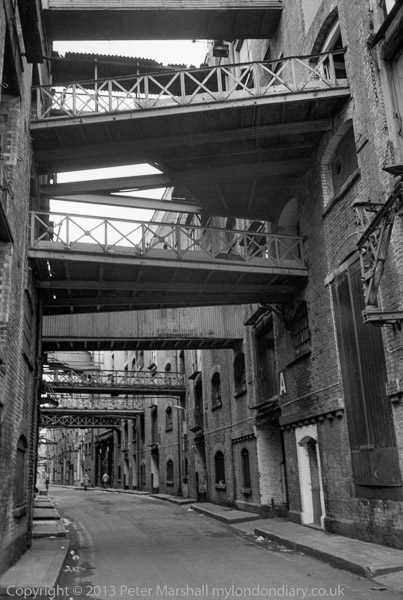
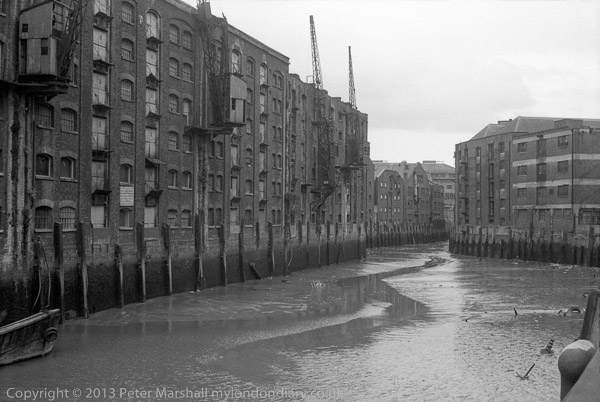
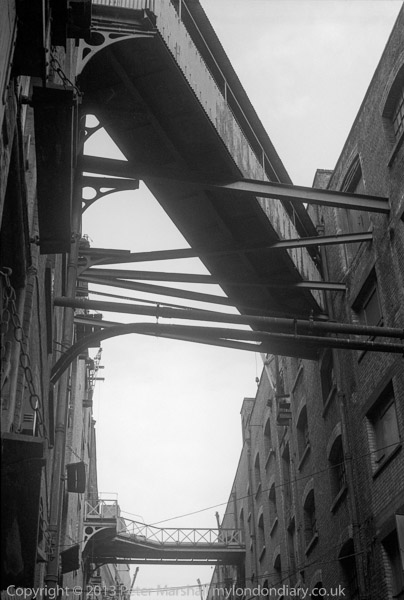
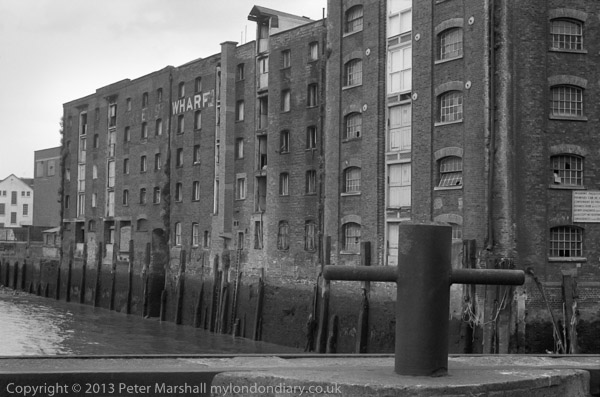
Although the area still retains many of the original buildings (though some are just façades) much of the detail that gave the area and the street Shad Thames in particular with its many seemingly chaotic bridges across the narrow street between the tall buildings its character was taken away, in part replaced with bland replicas. Replica is far too kind a word, as no attempt seems to have been made to reproduce the originals and their variety. Poor pastiche would be more accurate.


Reed’s Wharf, 1980

Recently I put together a small book of some of my pictures from Southwark and Bermondsey taken in 1974-84. Much of it is work that I first published on line in small images on the web site ‘London’s Industrial Heritage‘ around 15 years ago, and some has been exhibited a few times in various places. I wrote more about it here a few weeks ago where you can see a preview of the book and a link to buy it as a PDF or a print version.


Shad Thames 1980

If you are going to Shad Thames for the Local Eyes Festival, you may like to download a copy of the PDF of ‘Southwark and Bermondsey’ and take it with you on your tablet or notebook and see something of what has been lost. Perhaps then ‘Local Eyes‘ will cry with mine. Though of course there are still things that remain and are worth groups like the Shad Thames Resident’s Association fighting to keep.

London May Day March


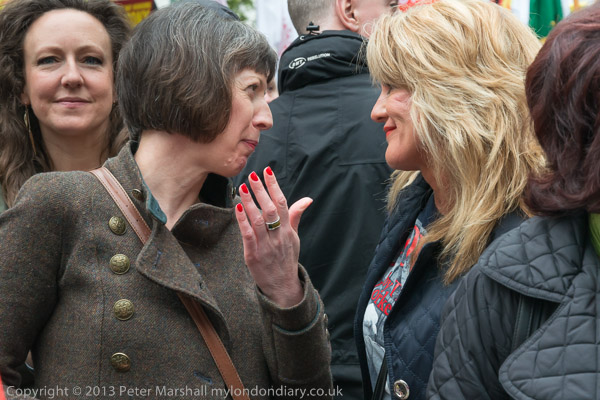
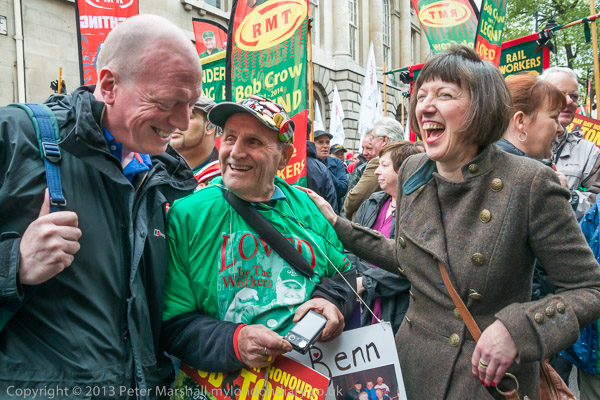
Frances O’Grady talks to Bob Crow’s partner Nicky Hoarau

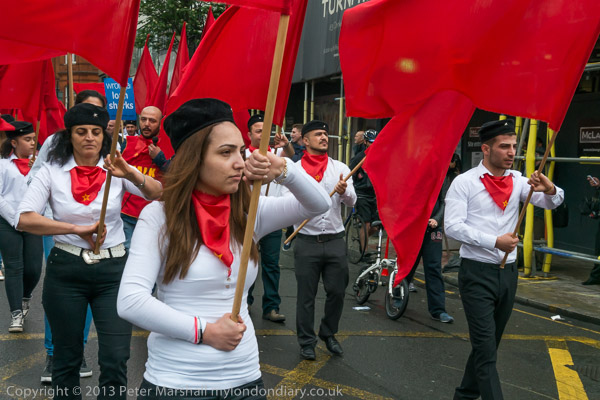
May Day is a big day for the left around the world and in London in particular for some of London’s ethnic communities – most of whom are British and were born in London, but still very much relate to the countries where their parents or grandparents were born, and where May Day is celebrated more widely than the UK.


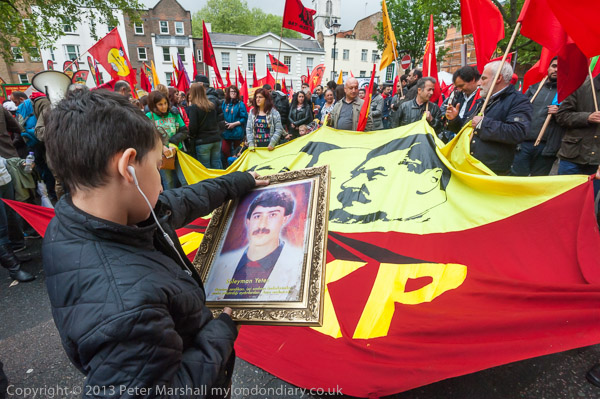
Turkish worker’s newspaper journalist Suliman Yete was killed in a Turkish prison in 1999 – MKLP

The traditional British left does take part, but for most people in the UK, May 1 is a normal working day. While I was working as a full-time teacher, it was only when May 1 fell at a weekend that I was normally able to go to the march, but now as a photographer I go every year and it is very much a working day for me.


Turkish People’s Front – Halk Cephesi

May Day, 1 May is a public holiday in many countries around the world, but in the UK we instead have (since a Labour Government couldn’t quite bring itself to back anything as socialist as May Day in 1978) a bank holiday on the first Monday in May. Because May 1 is usually a working day, support for May Day celebrations such as the annual London march from UK trade unionists has generally been limited, although of course the march gets official support – and some trade union leaders take part.

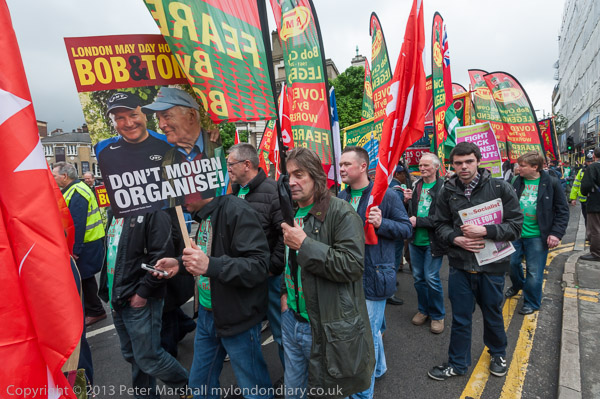
Among the regular marchers have been Bob Crow of the RMT and veteran of the left Tony Benn. This year’s march was dedicated to both of them, with their faces and the message from a telegram sent by union activist Joe Hill shortly before his execution in 1915, “Don’t Mourn, Organaise” took pride of place on the official banners and placards as the theme for this year’s march along with its three ‘constant calls’ – trade union rights, human rights, international solidarity.

This is a London march, and it reflects the nature of London now, as the statement from the organising committee shows:

The London May Day has been a unique bringing together of trade unionists, workers from the many international communities in London, pensioners, anti-globalisation organisations, students, political bodies and many others in a show of working class unity (see our supporters list). The whole theme of May Day is unity and solidarity – across the city, across the country, across the world. Three constant calls have been made – trade union rights, human rights, international solidarity. We have been proud that a vital and major part of the March are workers from the different international communities in London – a practical expression of working class solidarity.

In the list of supporters referred to among others it lists “organisations representing Turkish, Kurdish, Chilean, Colombian, Peruvian, Portuguese, West Indian, Sri Lankan, Cypriot, Tamil, Iraqi, Iranian, Irish, Nigerian migrant workers & communities plus many other trade union & community organisations” and it is certainly a lively and at times rather confusing event, particularly for a photographer weaving his way though the crowded Clerkenwell Green where the marchers meet up and mingle. Sorting out quite who is from which group is a problem both while taking pictures and when captioning, and I as usual have to apologise in advance for any I’ve got wrong.


Matt Wrack, Terry Hutt and Frances O’Grady

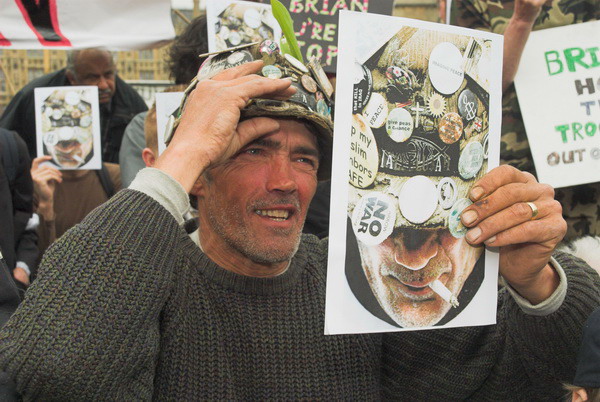
The main press interest was in the family of Bob Crow who were among those at the head of the march, along with TUC General Secretary Frances O’Grady. I was pleased to get a few pictures of her talking with someone I’ve photographed at many protests and still going strong as a pensioner, Terry Hutt, though photographers often call him Terry ‘Hat’ for his headgear over the years, which is now a badge covered cap threatening to rival the one that Brian Haw wore in Parliament Square for his epic almost ten-year protest


Brian Haw in Parliament Square in 2006

There is a lot to photograph on May Day, and I try hard to show as many of the banners and placards as possible as well as the people. It’s an event where I take a great many pictures and I think something important to record, so there are well over a hundred images on line from Clerkenwell Green and the march at May Day March for Bob Crow & Tony Benn.

Continue reading London May Day March

Glenna Gordon & #bringbackourgirls

The New York Times Lens blog has a follow-up to its story about the abuse of images by Ami Vitale which were used to publicise the kidnapping of the Nigerian schoolgirls by Boko Haram which I wrote about earlier (Image Abuse.)

In Bringing the Nigerian Schoolgirls Into View, James Estrin writes about the work by Glenna Gordon who having photographed the demonstrations over the kidnapping in Nigeria decided she needed to do something more personal about the missing girls, and made the difficult journey to meet with some of their relatives and friends. In the Lens blog, and on her own web site you can see pictures of some of the clothing, notebooks and other items that belonged to them, along with some short descriptions of them and their hopes in life and some pictures that their families allowed her to share with the world.

It is also worth looking at the other work on Gordon’s web site, which as well as the 16 pictures on the Lens feature includes a longer series, ‘the hunters who want to #bringbackourgirls’, vigilantes keen to take on Boko Haram, said to be better armed than the Nigerian Army, with bow and arrows and hunting rifles.

There is of course much more to look at on her web site, including a lovely series on Nigerian weddings, as well as a powerful set taken in King George Home for the Elderly in Freetown, Sierra Leone.

Rana Plaza

I’ve little interest in fashion, and I think it’s almost 50 years since I bought something because it was fashionable. It was for going to university in 1963, really the first time I bought clothes for myself, and I wore denim jeans (skin tight that took some getting on and off) and a black polo neck under a sports jacket, just like the pictures I’d seen in the newspaper fashion pages. Most of the others in my classes still wore suits and ties.

I kept wearing polo necks for years, partly because in my first real job there was a dress code – men had to wear a tie. With the polo neck, my boss couldn’t tell that I wasn’t wearing one (and often not even a shirt) and somehow I got away with it.

And I still almost always wear ‘designer’ jeans. It began not as a fashion statement but for medical reasons. I’d fallen heavily on my backside one summer around 1980, with painful consequences, and eventually had to have a minor operation, which left me very tender. For weeks I couldn’t sit down without a rubber ring to sit on- and even that required considerable care. Wearing trousers was painful too, I was only really comfortable in a very light pair of summer-weight pyjamas, hardly the ideal kit for going out in.

Sitting cautiously in the doctor’s waiting room I read one of the old magazines left there. It’s the only place I ever read ‘Country Life’ or ‘Vogue’, but on this occasion I think it was some kind of magazine for walkers or outdoor life in some way. And there I read a review of Rohan Bags, which told me that they were tough but so light you had to look to check you were actually wearing trousers. It was I thought worth a try, and sent off for a pair that afternoon.

Sitting here writing this, I’m still wearing Bags, though not the same pair, but the design has changed little. They are comfortable, practical and reasonably hard-wearing, though they don’t quite stand up to the rigours of a photographic life, and I often have to ask my wife to patch the knees.  In a ruck outside the Israeli embassy a few years back one of the pockets got torn halfway off and I lost a CF card with most of my pictures on it, and covering the May Day march one year I heard a loud tearing sound as I knelt rapidly to photograph a group of children, and found a split up the front from crotch to waist – I spent the rest of the day photographing with my jacket tied around my waist as a skirt to keep me decent.

But generally they are great, and I can’t live without the four large pockets to (usually) keep things secure. I’ve tried others but I always come back to Bags. Rohan’s various jackets too are among the best, and I now seldom go out in anything else, and my two favourite jumpers are also from them.


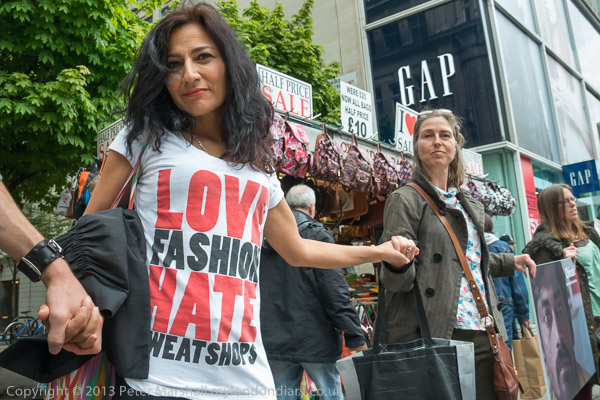
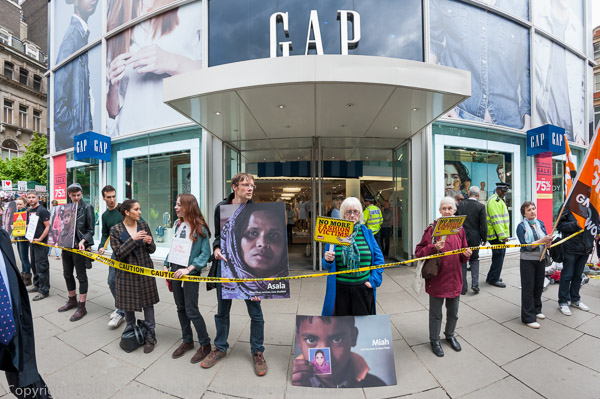
A rare case where I got someone to pose so I could read both her t-shirt and the two GAP
signs – but she was still doing almost exactly the same as before I talked to her

Rohan has been described in the Daily Telegraph fashion column as “a British brand to relish, both for its practicality and glorious immunity to fashion”, and its an immunity that appeals to me.

But although the designs are British they are made internationally, including some in Bangladesh. The company has been a member of the Ethical Trading Initiative (ETI) since 2005, working with their clearly set out standards for the treatment of factory workers in areas such as wages, working hours, conditions, forced and child labour which they insist all their garment suppliers sign up to. They regularly visit the suppliers throughout the year and pay independent and highly qualified auditors to check up on them.
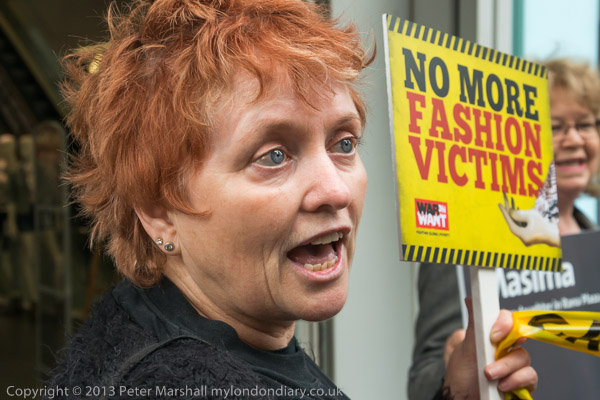
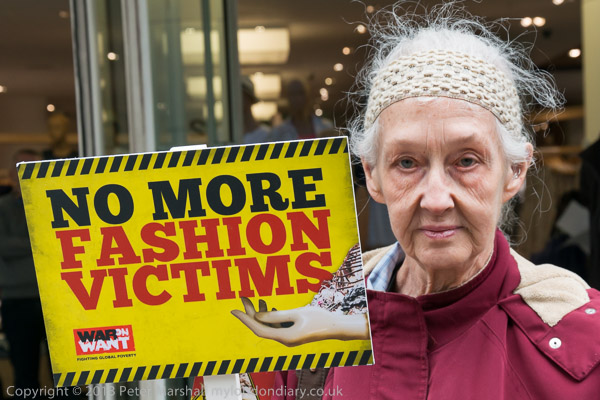
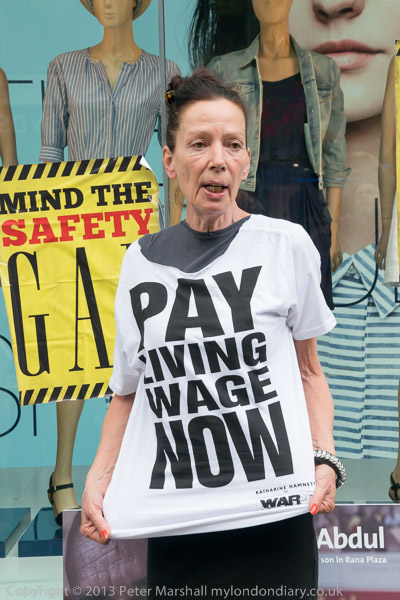
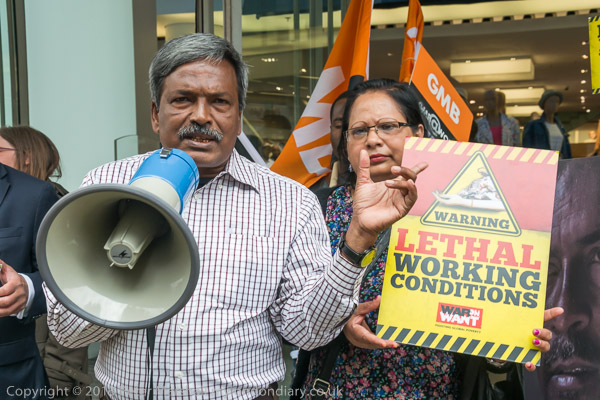
War on Want organised the protest outside GAP as they were one of the outlets for clothing produced in the Rana Plaza factory in Dhaka, Bangladesh where 1,138 workers died on April 24, 2013. GAP is one of several companies who have refused to sign the Bangladesh Accord for Fire and Building Safety launched by War on Want and their Bangladeshi partners the National Garment Workers Federation.

There were quite a few video teams from various media organisations present, always a problem as they all want to do video interviews with anyone at all well known, which often means taking them away from the action for rather long periods. Still photographers want to photograph them in the centre of things, and if they do direct them (I seldom do) and stop the flow of things it is seldom for more than a few seconds. At times too, there was quite a scrum around fashion designer Katherine Hamnett in particular, making it difficult to take pictures.
While I think the main media often concentrate far too much on celebrities (and sometimes the actual event can be almost entirely neglected) as someone who tries to sell images to the media I do of course need to take pictures of the main figures at any protest, especially if they are well known. But I try hard to keep a balance.

But there are plenty of pictures in Rana Plaza Anniversary at GAP of Katherine Hamnett both modelling the t-shirt design she has donated to War on Want and speaking at the event, as well as of Amin Haque from the National Garment Workers speaking, and a few others of both. Another public figure taking part in the protest (and in my pictures) was London’s Green MEP Jean Lambert.

And this was another occasion where the 16mm fisheye came in useful – used here on the D700. There isn’t any real point putting it on the D800E for pictures like this as you don’t need a 32Mp file.

Continue reading Rana Plaza

Barts Tries Censorship

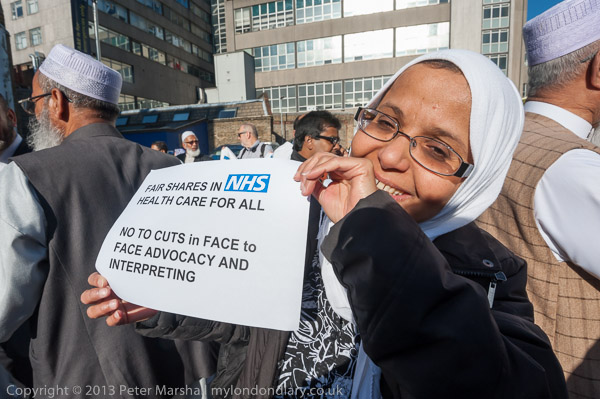
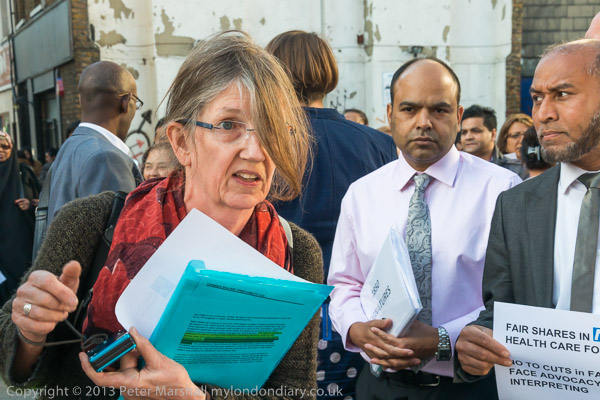
I never take kindly to being told I can’t take photographs anywhere.  I was at the protest outside the Royal Whitechapel Hospital in Whitechapel in a crowd of around a hundred people, probably at least half of whom were using their phones or compact cameras when a security man came up to me and asked “Excuse me, Sir, are you from the press?”

It’s a question that always makes me remember a film showing one of the greatest pioneers of photojournalism, ‘Eisie’, Alfred Eisenstaedt (1898-1995) working on the streets of New York, photographing kids at play, who when asked whether he was a professional replied that no, he was just an amateur*.  And of course he was a great amateur in the original sense of the word, a lover of photography. And so too am I. And given the current level of fees the press are willing to pay we are all getting to be amateurs in every sense now.

So it’s always something of a judgement call what to reply to such questions. And there are a few events where I wear my press card visibly, around my neck, but rather more where I keep it in my pocket. Everyone has a right to photograph and I don’t usually want to claim any special privileges.

But it was a polite question, and he showed me his ID card, and when I told him I was a freelance journalist he told me I could not photograph as this was land owned by the Barts Hospital NHS Trust.

I had several problems with that. Firstly it was clear that he was not attempting to stop others around me from taking pictures, so this seemed clearly to be an attack on the freedom of the press to report events, and an attempt at censorship. Secondly, the NHS trust is a public body, paid for out of my taxes as a member of the public and I feel that gives me some rights. But overriding everything was the legitimate public interest in what was happening.

So I made it clear that I intended to continue taking pictures and did so, and the security didn’t bother me any more. It seemed a particularly inept attempt to control media coverage of the event, and one that was aimed at me alone. Among the others recording the event were a couple of professional videographers who were not approached. Or perhaps they just gave up after they found I told them they had to be joking.


Local GP Dr Anna Livingstone,

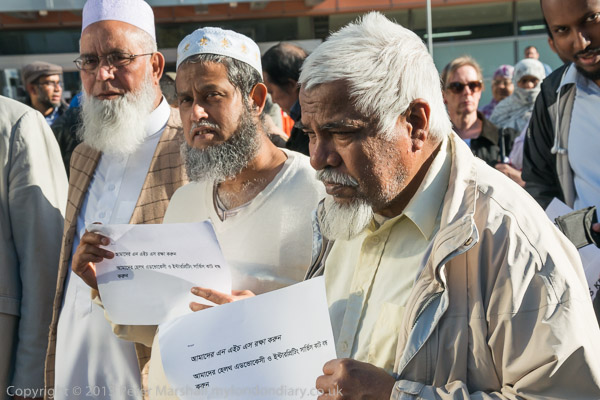
It wasn’t a hugely photogenic event as you can see at Barts cuts Health Advocacy & Interpreting but over an issue which is of great importance to the local community as well as arising out of wider issues over the future of the NHS across the country. It wasn’t the first time I’d photographed in the grounds of the hospital either, and there had been some rather strange responses from security last October at the protest  Scrap Royal London NHS PFI Debt
when police had to persuade them to let the protest happen in the roadway leading to the hospital after it was clear the numbers were creating a severe problem on the Whitechapel Road.


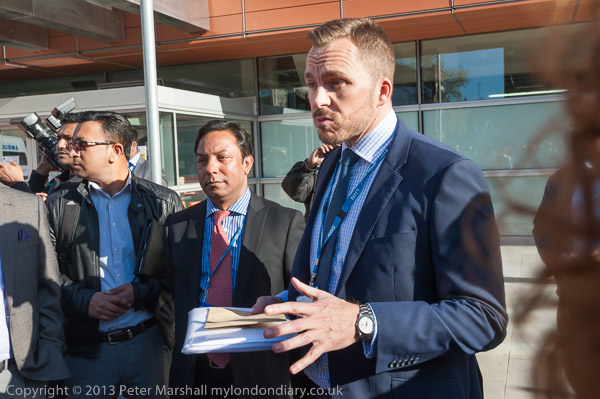
Mark Cubbon, Executive Director of Delivery came to receive the petition

You can see more of the hugely expensive new building, both on the outside and some views from the staff canteen area in Whitechapel – Hospital Views.

* I don’t think the film I used to play to classes about ‘Eisie’ is available on-line, and although some of his best work is on the LIFE site, this seems to be a site which really fails to celebrate the photographers and it is difficult to look at more than odd pieces of work by him. But on YouTube you can watch in four parts a BBC programme Alfred Eisenstaedt Master Photographer from 1983 where he says the same thing at the end of part 3.

Continue reading Barts Tries Censorship

Boutef


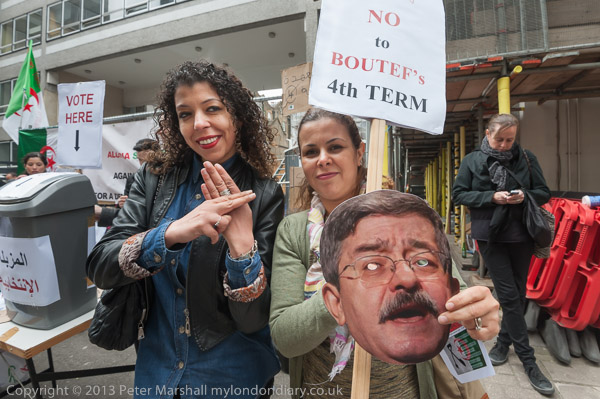
A protester signals ‘No Fourth term’ for President Bouteflika

I have to admit to having no idea who ‘Boutef’ was before getting an invitation on Facebook to cover a protest at the Algerian embassy. Nor for that matter did I know where the Algerian embassy was, though I recognised the address on the Facebook page as being just around the corner from the BBC.

In case you are as ignorant as me, Abdelaziz Bouteflika is the President of Algeria and has been so since 1999, with constitutional amendments allowing him to stand for a third term in 2009 and again to stand for a fourth term from 2014.

Six days after this London protest he was re-elected, having gained 81% of the votes in an election in which slightly over half of those eligible voted. Opposition parties boycotted the vote amid allegations of fraud and the rigging of the whole system, particularly through state-run TV and radio.

There were widespread protests in Algeria in 2010-12 during the ‘Arab Spring’ but these were at first heavily suppressed and then largely bought off by decreases in basic food prices and led to no real change.  Protest remains illegal in Algeria.

This part of Riding House Street is gloomy and narrow, with high buildings on both sides, and it is easy to miss the Algerian embassy. The protest was in the street outside, with people occasionally having to clear the road for a car to pass by, but there was little traffic and it was all slow-moving, inconvenient rather than dangerous, but it did perhaps inhibit the protest.

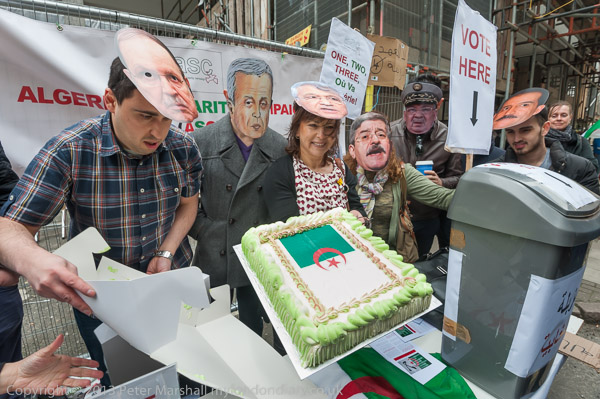
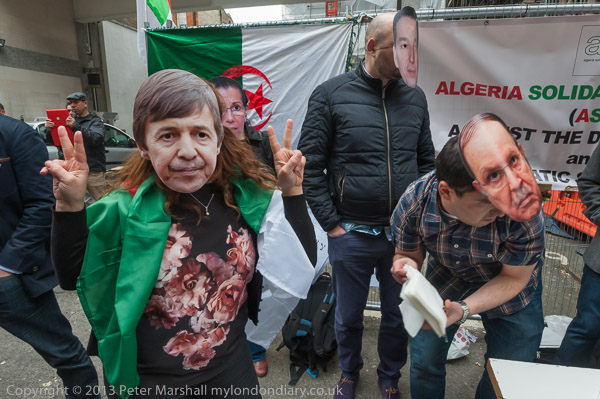
My biggest problem was with the various masks that people had brought along and wore or held. I’m poor on recognition skills of UK politicians (quite a few Conservative ministers seem rather lacking in character) but totally out of my depth when it comes to Algerians.

At least these facial images were largely clear and well-produced, unlike so many used in protests, where considerable post-processing is often needed to make them look even vaguely human.  But as to who they were pictures of, I had to admit defeat.

Usually when I have problems over the identity of people I turn to Google. It’s usually great when I’ve a name written down but am unsure of the spelling or if I’m not quite sure who was who. I can search for names and for images to find out who it was that I photographed.

But on this occasion, checking on Google images when writing the story simply made me more confused. I hope I got what captions I did add correct, but there were some I just could not identify.

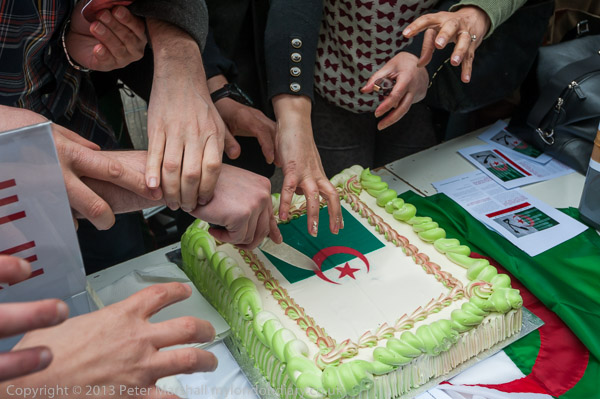
One thing I could easily identify was the Algerian flag, which many of the protesters were waving and was soon revealed on a cake.   I particularly liked the hands that all came to join in the cutting of it.

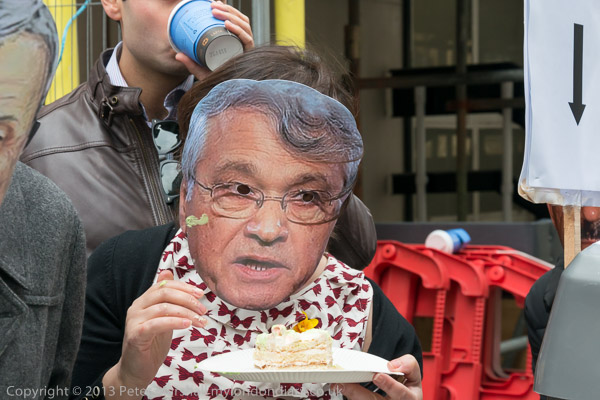
The cake created a small problem for the protesters, with it being impossible to eat through a cardboard mask, though some tried for the photographers.

And that is a bit of off-target green cream on this mask, though don’t ask me whose face it is.

Dedicated photographer that I am, I was still busily taking pictures when one of my colleagues handed me a paper plate with a very large slice of it, including a part of that light green tall creamy border and the deep green flag. At that point photography ceased while I attended to more serious matters.

More pictures at Against the Electoral Masquerade in Algeria.

I did take a few more pictures after eating the cake – including the one at the top of this post, but had to leave shortly after for another protest, conveniently just a short walk away. But it was one without cake.

Continue reading Boutef

Image Abuse

Probably most of us have seen pictures tweeted around the world with the hashtag #BringBackOurGirls but I imagine few have asked ourselves about the source of the three commonly used pictures.

James Estrin did so, and on May 8 Lens published his The Real Story About the Wrong Photos in #BringBackOurGirls in which he interviewed the photographer who took the pictures, some time ago and in a different country more than a thousand miles from where Islamic militant group Boko Haram carried out the kidnapping that has shocked the world.

The first photographer Ami Vitale knew about it was when she was told by someone from the Alexia Foundation that the work was being used in this way, and she was enraged. She had made the pictures in a long-term project showing the “dignity and resilience” of African people whose lives were improving, and had promised the families she had lived and worked with that she would take responsibility for the images and use them to tell their stories.

As she makes clear, it isn’t that the images have been used without her permission that upsets her, and she supports “the campaign completely and I would do anything to bring attention to the situation” but the misrepresentation and the use of these images without the consent of those in them for a very different purpose to that for which they are made.

If you don’t feel it is important, think for a moment if a picture of you, or your daughter or some other family member had appeared across the world illustrating a similar story. If you had the resources and could identify who had carried out the abuse you might well sue and receive hefty damages.

And as Vitale put it: “I can’t help but wonder that they thought this was O.K. just because my friends are from Africa. If it were white people from another country in the photos, this wouldn’t be considered acceptable.”

The article and a comment there on one of Vitale’s images prompted John Macpherson to make an image search, and revealed a huge level of unauthorised use across the web of this particular image, as he shows in his Tears for fears on the duckrabbit blog on May 11th, Mother’s Day in the US.

The first comment on this piece came from Ami Vitale herself, expressing her surprise at the many ways her picture was being used “for almost every stereotype one can imagine” and going on to say how it was “particularly poignant and disturbing to read this on Mother’s Day. How would any of these people feel if they saw their own child’s image used in the same way? ”

I’d loved Ami Vitale’s work from Guinea-Bissau from when I first saw it, particularly for its warmth and intimacy and its life-affirming nature, presenting a very different view from the stereotypes we see of Africa. And when I was fortunate enough to meet Ami in Poland it was clear how her work embodied her ideas and personality.

I’m not sure what can be done to prevent the irresponsible use of our images, though I do know those who have made large amounts of money in the courts from people who have misappropriated their work.

But we really need to somehow change attitudes. Using images in this way is simply dishonest, but people who wouldn’t dream lying publicly seem quite happy to do so through images. I don’t know if it is going to be possible to change attitudes, when it does seem to be going against the whole stream at the moment. My images on blogs and my own web sites carry a simple copyright watermark, but it isn’t possible to insist on this on most usages, and perhaps that doesn’t in any case go far enough. Perhaps it might begin to get our message across if we also included a simple message ‘May not be used in any way without permission’ as well.