Rotherhithe & Surrey Docks


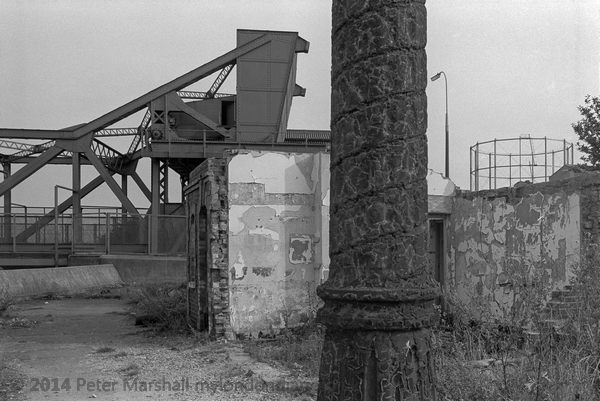
Surrey Docks entrance, Rotherhithe St, 1984

It’s always exciting when I get the first copy of a printed book of my photographs delivered, and I ripped open the parcel and was pleased to find that as usual Blurb had made a decent job of ‘Rotherhithe & Surrey Docks: 1975-85‘, the fourth in my series on London Docklands.

Of course I’d seen it all before, when I’d spent days scanning and retouching the images, and then selecting and putting them in some kind of order (not an easy task) and designing and preparing the book using InDesign. Being the fourth in the series, much of the design had already been done for the previous volumes, though there are some minor tweaks. And, no matter how many times you check, there are always some minor errors that you miss., though in this case nothing that I feel really needs a reprint to correct.

The printing of the black and white images is as usual good, though not perfect, and certainly not as good as with the PDF version, which I recommend. As with my other recent works, this book is published as a digital version, ISBN 978-1-909363-12-0, downloadable from Blurb, with the print version available for those who would like a convenient hard-copy of the PDF. You can also view the whole book in the preview on the Blurb page.  The PDF costs £4.99 and a printed copy will currently cost £31 plus postage. Incidentally buying the PDF also gives you a licence to print out a single copy of any (or all!) of the 90 or so pages of the book, though to print the whole book at comparable quality to the print version on my home printer would cost me around £70.

The scans for the book were mainly made with a Minolta Dimage Scan Multi Pro scanner – one of the best film scanners ever made, particularly when fitted with a purpose made light diffuser and specially machined holders to ensure flatness across the whole negative. Some of the scans needed considerable retouching in Photoshop, mainly because of some insect infestation of the negatives, but also in some cases because of uneven development. The scans were converted to high-quality CMYK files using Photoshop, and saved with the Blurb supplied ICC profile. Black and white images tend to be printed slightly off-neutral and the images were given a slightly warm tone which I’ve always preferred for my work.

The printed copy I have is a good match to my originals (and the PDF), though prints are always a little duller, but seem very close to neutral. But as this is ‘print on demand’ there can be small copy to copy differences. I use Blurb’s premium lustre paper which prints black and white better than the standard, and the print quality is quite acceptable. Of course it doesn’t match the superb quality of the duotones and tritones of some photographic books, but is generally good enough.
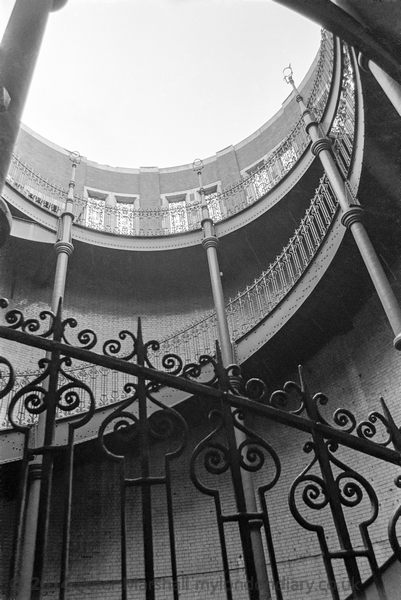
When I first cycled through the area in 1976 I didn’t stop to take many pictures, but then you could walk down the ventilation shafts to go under the river in the Rotherhithe tunnel. By the time I took the photograph at the top of this post in 1984 they were locked, presumably to discourage people using the crossing, though you can still walk or cycle through the tunnel from the vehicle entrances although at some risk to your health.
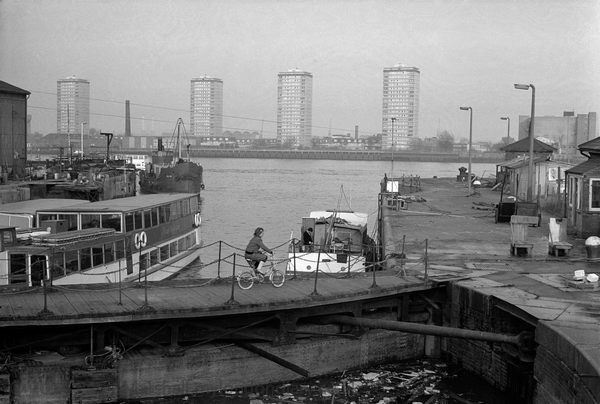
Later I went back on foot, walking over the footbridge across the entrance to South Dock, next to which was then the Surrey Docks Farm, one of several ‘city farms’ across London. I took several pictures of a young girl on a bicycle as she went across the lock gates to the farm. Some years later on another visit to the area I was mystified, as both the farm and the footbridge had moved to different locations in the area.
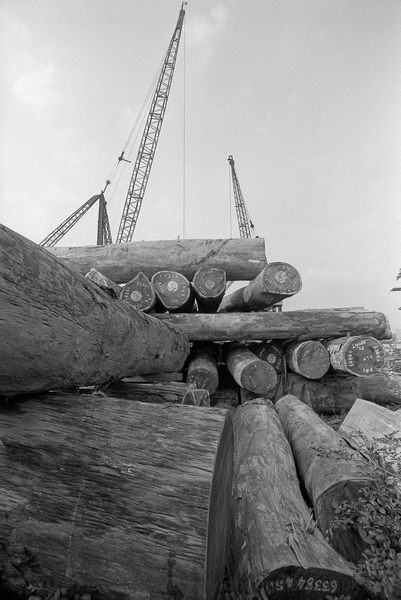
In 1984 I spent a couple of days wandering the area and taking pictures, including a little to my surprise a wharf still handling timber, which used to be the main business in the Surrey Docks, where there were once large ponds in which it was stored, as well as huge open timber sheds, some of which were still around, standing empty. Some of the timber would then be taken on barges up Bow Creek to timber yards on the Lea Navigation to be sawn up.
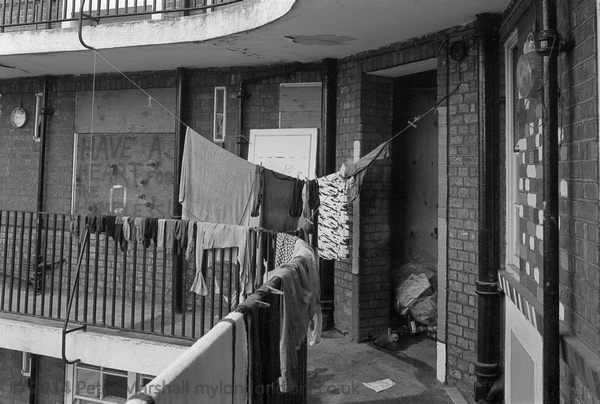
The redevelopment of the area had been started by the London Borough of Southwark and the Greater London Council, but progress had been slow, partly because they were kept short of money. The Conservatives once Mrs Thatcher had come to power saw docklands as a great opportunity for developers (and many Conservatives were developers or invested in them) to make money and set up the London Docklands Development Corporation 1n 1981 to speed up the regeneration and pour public subsidies into private pockets.

While the results have not been entirely disastrous for the area, the developments have not served the people who were living in the area as well as they might.
Continue reading Rotherhithe & Surrey Docks

Fair Pay Now!

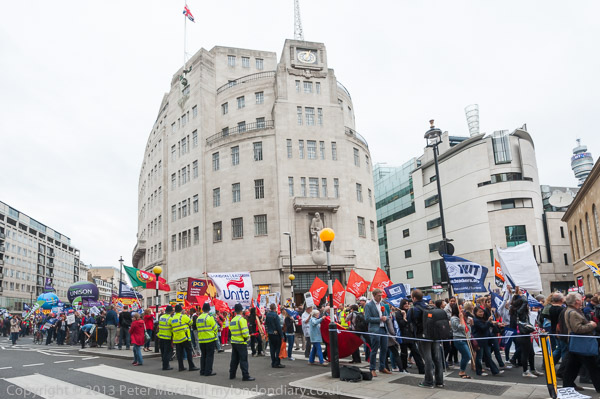
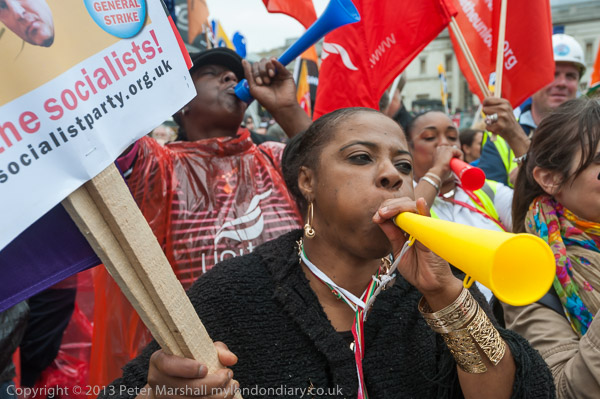
It’s always hard to estimate the numbers taking part in large marches, and this was certainly a large march, with perhaps around 15,000 being a reasonable estimate. At the start, as people gathered outside Broadcasting House – fast becoming a popular starting point for protests as more and more groups get tired of the way that the BBC ignores or marginalises most UK protests, it was certainly very difficult to move around for the crowd in the road and to find the space needed between camera and subject. Most of the pictures from before the start of the march were taken around the edges of the packed crowd, and as usual I was looking for things that would tell the story, as well as meeting people that I knew.

Sometimes the two things came together, as in the picture of Jasmin Stone and her daughter and others from Focus E15 Mums in front of Broadcasting House – and there are other faces in some other pictures that regular visitors to My London Diary will recognise.


Another view of Broadcasting House, where reporters were careful not to really notice what was happening outside

But there were many here who are not regular protesters – and some told me this was their first protest march, and others that they seldom take part in such things. A number of trade unions had called a one day strike, and groups like the teachers are so fed up with being ‘Goved’ that they had turned out in force for the march, though I was surprised that only the NUT were supporting it.


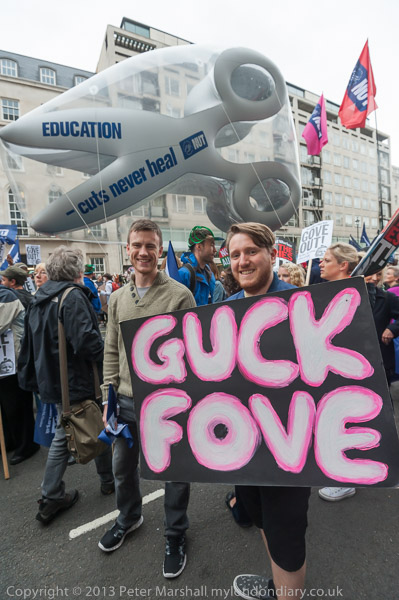
‘Education – cuts never heal’ – ‘Guck Fove’

I always find  the large balloons that some unions like to take on their marches are a problem to photograph,so high that they are difficult to connect with the people on the ground. Designed to be visible from a distance, they aren’t ideal for photographers like me who like to work close, where even with a wide-angle they are hard to include. The NUT Scissors with their message ‘Education – cuts never heal’ are rather more interesting,and I was pleased to be able to combine them with a strong message about Mr Gove, who shortly afterwards lost his job, not because of the havoc he has wreaked destroying what system there is in our education, but because of his silly squabbles with Teresa May.

There was just so much to photograph while the march was forming up, and it was so crowded that although I’d been keeping an eye on my watch, I actually just missed the start of the march, which I’d intended to photograph with Broadcasting House in the background. But by the time I made it back to the start, they had started very  punctually and already moved a couple of hundred yards down the road. It isn’t a great picture, but it does show the flags (and balloons) of some of the main unions involved, GMB (just), NUT, Unite, PCS and Unison. There is also what seems to be a Portuguese flag (and I think I know who would have been carrying it) but more important to me in framing the picture, on top of Broadcasting House, the Union Jack.

This was a fairly short march, only a little over a mile to Trafalgar Square, but marches usually go fairly slowly. I waited until the end had gone past me close to Oxford Circus, around a quarter mile from the start (it took 50 minutes), then rushed along the route to the end, only stopping a couple of times to take more pictures and arriving before most of the marchers more or less as the rally was starting.


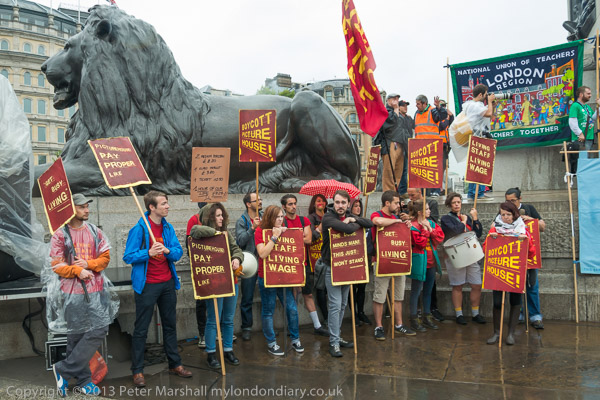
Workers from the Ritzy cinema in Brixton who are striking for the London living wage

As well as photographing the speakers, there were also people in the crowd to photograph, including those responding to the speeches in the picture at the top of this post. I managed to photograph the Ritzy strikers in front of one of the lions just before too many other photographers arrived and started walking in front of them.

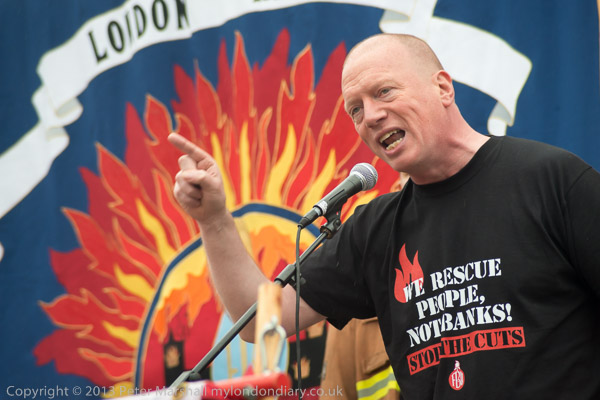
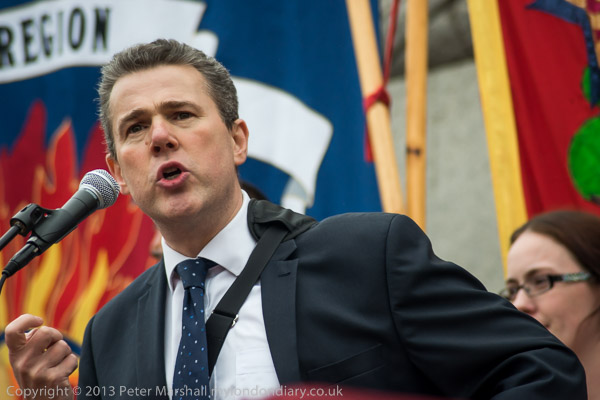
The London Fire Brigade Union banner, standing against the plinth of Nelson’s column to one side behind the speakers made a splendid backdrop for the FBU leader Matt Wrack, although it was perhaps less appropriate for some of the other speakers. I was also careful to frame so as to get the message on his FBU t-shirt ‘We rescue people, not banks – Stop the cuts‘, the first part of which is a quotation from Spanish fire-fighters when asked to assist in the eviction of people unable to keep up with their mortgage payments.

I was also pleased to see and photograph Mark Serwotka of PCS who I knew had been ill, but was certainly in fiery form at this event. It wasn’t until almost two months later that we all heard how great his health problems are, and how remarkable he has been in coping with them.

More pictures from the march and rally at Public Service Workers Strike for Fair Pay.
Continue reading Fair Pay Now!

Save Our Surgeries

I left the ‘Housing for All‘ march at East Ham station and took the District Line to Aldgate East, in the neighbouring borough of Tower Hamlets. Like Newham, this also has a directly elected mayor, but a very different character. For a couple of years Lutfur Rahman was the leader of the Labour council here, but was replaced by the party when he became controversial over media allegations about his links to the Islamic Forum of Europe, a group with an important place in the Bangladeshi community in Tower Hamlets. IFE supporters say it works actively to oppose extremist groups, while the right-wing press accuses it of extremism.

After much infighting among various groups in the Labour party Rahman was finally elected by Tower Hamlets Labour Party as their candidate for the first elected mayoral elections by a large majority. But the Labour National Executive Committee removed him, replacing him by the man who got the least votes of the three candidates, a decision that, along with the published account of what actually happened in the meeting, puts the party in a very bad light.
Rahman considered legal action to get reinstated, but then decided to stand as an independent candidate instead and got elected – and this year elected again for a second term. But his ‘Tower Hamlets First‘ party are a minority on the council, with around half of all councillors still being Labour. A great deal of ill-feeling still appears to exist between at least some of the Labour group and the Mayor, with non-cooperation and allegations of malpractice being fed liberally to the media, most of which have been only too pleased to report and distort it.
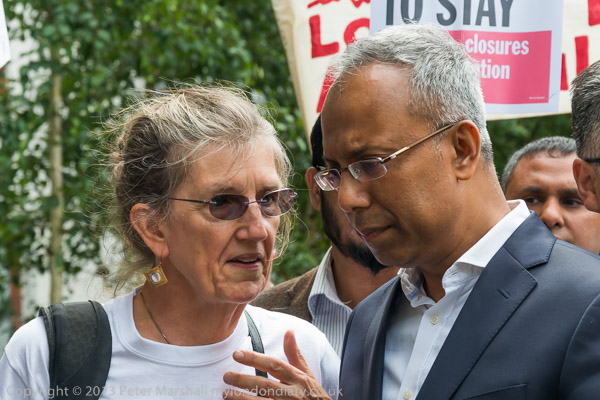
To an outsider, Rahman appears despite the problems to have done a very good job as mayor and to be very open to the people of Tower Hamlets – and indeed to put them first. He has turned up at several events I’ve photographed (and sent along others with his apologies and a message of support when unable to come personally) and seems to have supported projects across the many communities in the borough. I’ve not known another mayor who is as visible and accessible to local people and wish other mayors were more like him at least in this respect.
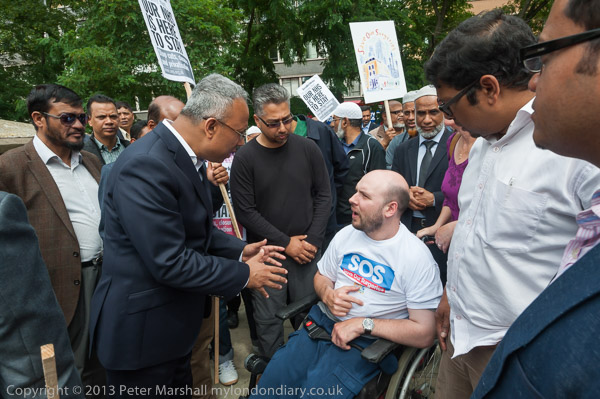
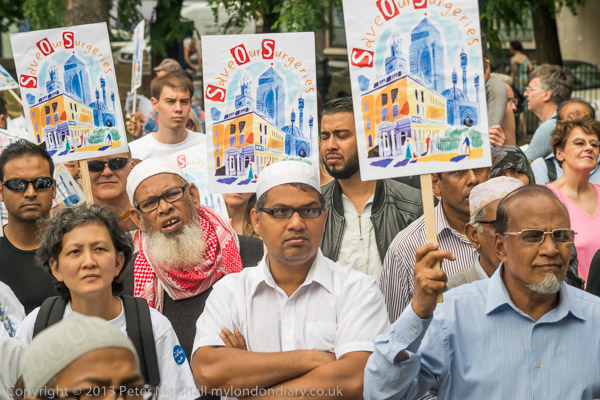
Like most people in Tower Hamlets the Mayor is greatly concerned to the threat to the surgeries in the area (and in other deprived areas) of the withdrawal of the support they currently get because of the extra needs of the area. They fear these will be unable to continue, and will be replaced by cut-price services run by large health companies and providing only a low level of health care. The date chosen for the Save our Surgeries rally and march was the 66th anniversary of the founding of the NHS.

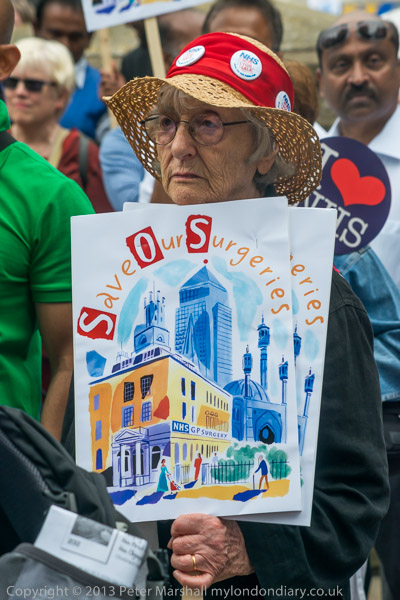
Of course the Mayor was just one of a number of speakers, including the local Labour MP, Rushanara Ali as well as doctors and other health professionals and a patient. I tried to photograph them all, but it mainly their audience that attracted me, very much a reflection of one of London’s multicultural boroughs. The placard too is one of the more decorative I’ve photographed, though rather less graphic than most, and reflects something of the diversity of the area, with its small island of business wealth at Canary Wharf, old buildings and the recent mosque, though it does rather lack the bustle of its streets.

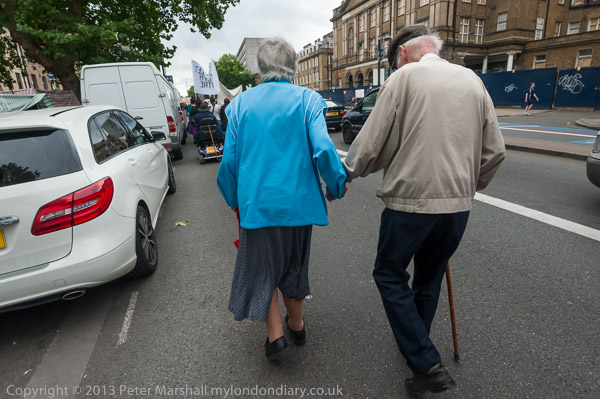
It is perhaps a reminder that when taking photographs we too need to be aware we are creating representations, and we need to be aware of the message that our pictures convey, not just of who or what we see as the subject of our photograph. At the end of the march as it went past the old Royal London Hospital building were an elderly couple, walking slowly and with some obvious difficulty. I took several pictures, including the one above, including some showing their faces, taking care not to disturb them, but this is the one I chose to use. At first I wondered why I had deliberately chosen to include that disturbing red light which to me looks like a distorted mouth sliming its way across the rear of the car so prominently in the frame. But now I’ve grown to rather like it, though I’m not entirely sure why.
Continue reading Save Our Surgeries

Housing for All March

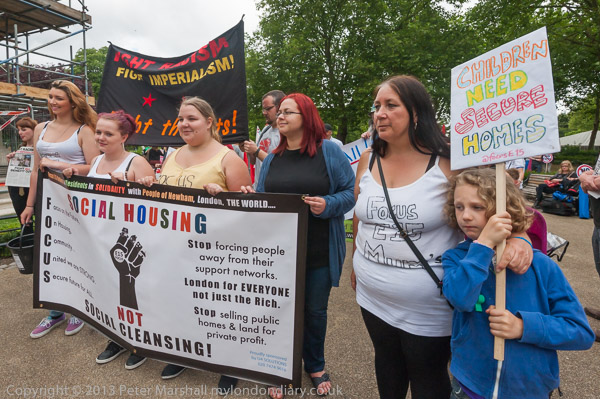
Focus E15 Mums began almost a year ago as a campaign by a group of young mothers living in a hostel in Stratford to fight eviction when Newham Council cut the hostel’s funding. They started a weekly protest stall and made their fight to stay in the area a very public one, asking questions at meetings and staging protests, some of which have featured here before.

Their campaign has meant that so far they have managed to stay in London, close to families, support services and jobs, when Newham was trying to move them out to Birmingham or Hastings or anywhere rather than Newham.  It isn’t that there is no housing available in Newham, at the centre of one of the largest areas of regeneration in the country, with new blocks of flats appearing every time I go there and of course huge developments on the former Olympic site.  Not to mention the many vacant properties on the Carpenters Estate close to the centre of Stratford. More that these young women are not the right kind of people for Newham’s new vision; to put it simply they just are not rich enough.

Newham is of course a Labour-run council. Entirely. All of the 60 councillors now in office are from the Labour party. Unusually it also has a directly elected mayor, Robin Wales, Leader of Newham Council from 1995 to 2002 and Mayor since then, elected for a fourth term in May this year. You might think that this should mean a council that cares for the poor and the disadvantaged in the community, but it appears you might be sadly wrong.

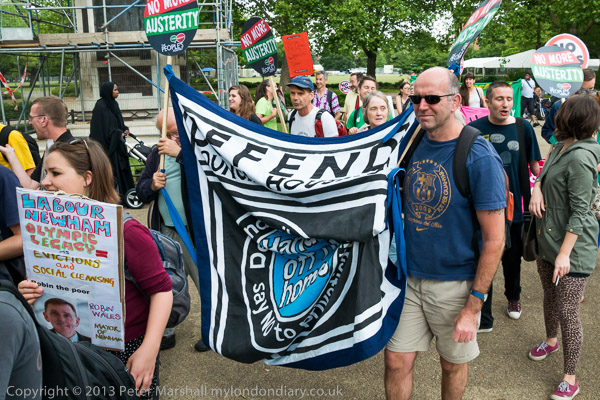
One of the placards being carried in the protest had a picture of Sir Robin on it, along with the text  ‘Olympic Legacy = Evictions and Social Cleansing – Robin the Poor – Robin Wales Mayor of Newham’.  His policies are built around the ideas of ‘resilience’, which seems to mean helping those who help themselves, rather than any care or concern for those who are weak or who face problems they are unable to deal with. To me they seem to have abandoned the key ideas of the Labour movement, and would readily fit with those of the Chamber of Commerce and the Conservative Party.

I was disappointed not to get a better picture with that placard, and it wasn’t for want of trying. Perhaps I was mistaken, but just occasionally at protests there do seem to be people who go to considerable effort to evade the camera.


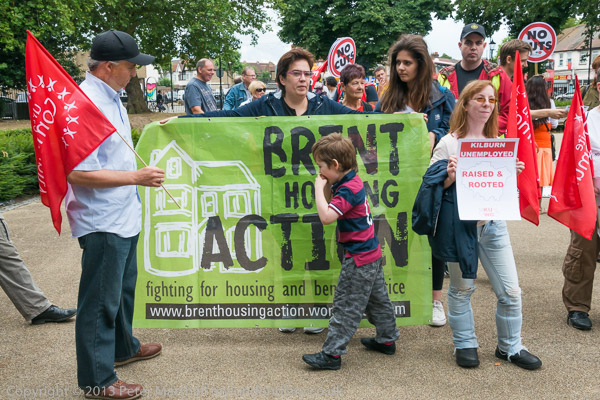
Four members of the Counihan family came with the Brent Housing Action banner

Of course there were many people at the protest who were happy – if not keen –  to be photographed and many that I knew from other events. I’ve photographed the Counihan family who started a campaign about their own housing problem with the London Borough of Brent – and who like the Focus Mums have gone on to campaign over housing on behalf of others in their own ‘Housing for All’ campaign, Brent Housing Action.

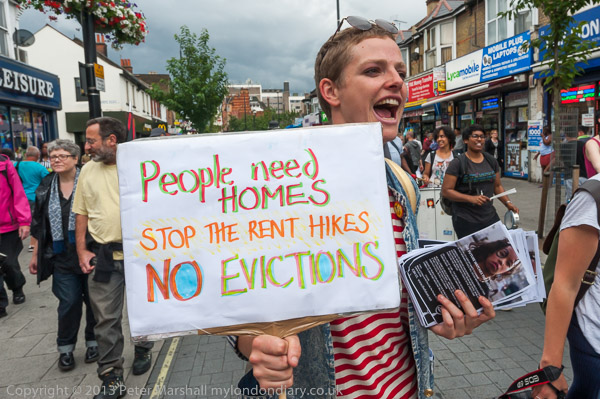
It was also good to see another friend I’ve photographed on various occasions, Tamsin Omond, who was handing out leaflets for a protest against the expansion of London City Airport, also in east London as well as carrying a placard in the protest. Some of the events I photographed her and the other Climate Rush activists at 5 years ago were against the building of a third runway at Heathrow  – and it now looks increasingly as if we will be protesting there again before too long.


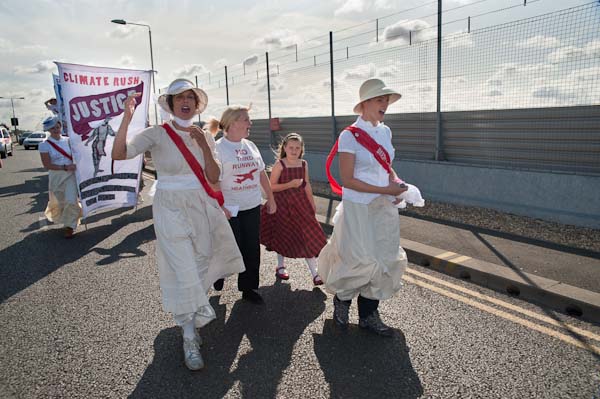
Climate Rushers and local residents lead the ‘NO THIRD RUNWAY’ procession at the Heathrow perimeter fence
I had to leave the ‘Housing for All’ march as it passed East Ham Station as I wanted to photograph another event. You can read my report on the march and see more pictures at Focus E15 March for Decent Housing.

Continue reading Housing for All March

25 Years of Drik

Hard to believe it, but there are still people with an interest in photography who haven’t heard of Drik, the innovated photo agency set up by Shahidul Alam in Dhaka, Bangladesh 25 years ago. As he puts it in his blog, “Tired of being pitied for our poverty, and do-gooder attempts to ‘save’ us, we had decided to become our own storytellers.”


Shahidul Alam talking in London in 2011

It has been a difficult journey, starting on shoestring resources, and for which they also had to create much of the infrastructure, including setting up Bangladesh’s first email network using Fidonet. The government did their worst to close them because of their support for human rights, sending police to shut down some of their shows, and they were “stabbed in the street, arrested, and generally persecuted.”

The photographic school set up by Alam and those working with him, Pathshala, the South Asian Media Institute in Dhaka is now widely recognised as one of the leading schools of photojournalism in the world, and many photographers who have studied there have become well-known, and its former students increasingly feature in the major international photojournalism competitions.

On my table downstairs, until now unopened, is the September issue of ‘New Internationalist‘ magazine – which I’ve subscribed to since its inception (and before it became ‘New’ in 1973, when it was the magazine of ‘Third World First, a student group now known as ‘People and Planet’) though I don’t always get around to reading every word – and I’m still reading the previous issue. It’s essential reading if you want to know what is really happening around the world – and why – and not just what Murdoch and his like want you to know. Over the years they have published a number of articles by Alam, including The Majority World looks back in 2007, as well as making use of images from Drik and Majority World, another of his initiatives.

The latest issue of the magazine has a double-page spread, ‘Telling our own stories‘, celebrating 25 years of Drik, which you can see and download from Alam’s post. I’m pleased to add my small voice to the congratulations.

Epping Forest

Should you be in the London area and feel a need for some exercise on Sunday September 14 you might consider heading to Epping Forest for the annual Epping Forest Centenary Walk organised by the the Friends of Epping Forest from Manor Park station to Epping.


The walk starts off across Wanstead Flats

The route was devised in 1978 to commemorate the 100th anniversary of the Epping Forest Act, 1878, which placed responsibility for the forest in the hands of the City of London, giving them the powers to take on the landowners who were then rapidly putting up fences around their properties. Although the City haven’t always seemed to have the best interests of the forest at heart, and various governments have interfered negatively (most recently during the London 2012 Olympics where they twisted the City’s arm to allow a temporary police building on Wanstead Flats) they managed to roll back some of the encroachment and have preserved pretty well all but the southern tip “for the recreation and enjoyment of the people.”

The advantage of going on the organised walk is that you meet people and there “will be ample stops and pauses when short explanatory talks will be given on the Forest and its management and history in furtherance of the Walk’s objective to promote the appreciation and knowledge of this priceless Open Public Space!” You also won’t get lost, which is rather easy to do on some sections of the walk.


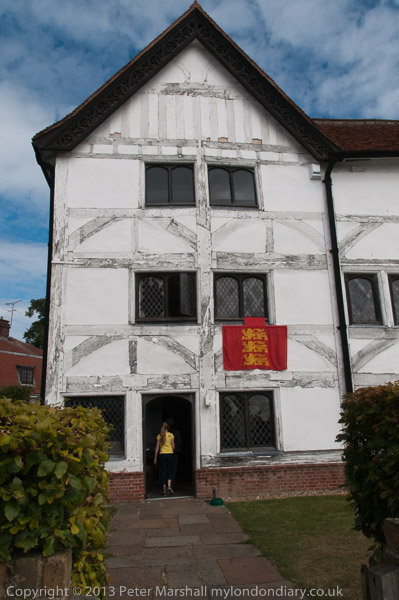
Queen Elizabeth’s Hunting Lodge at Chingford is worth a visit

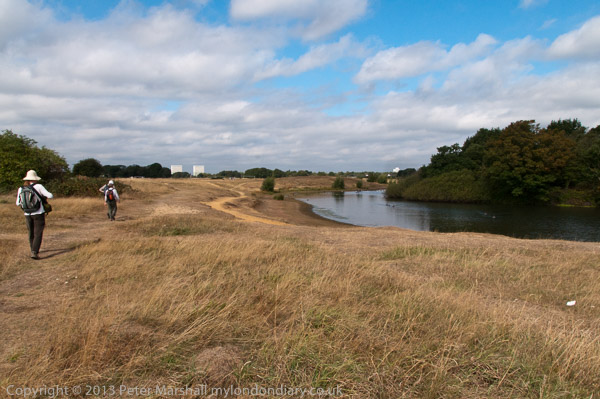
There are timings given on the site linked above for those unable to walk the full 15 or 16 miles. But if you want to take pictures, it is probably better to walk it on your own, or with a small group of friends or family as I did in 2009, though it has taken me 5 years to put the pictures on the web – at Epping Forest Centenary Walk.

And of course you could split the rather long 16 mile route (and longer when you get lost or wander off to take photographs) into several sections. Something I’d heartily recommend as I was more than shattered by the time we reached Epping station for the journey home. I was calling it Effing Forest by the time we finished.


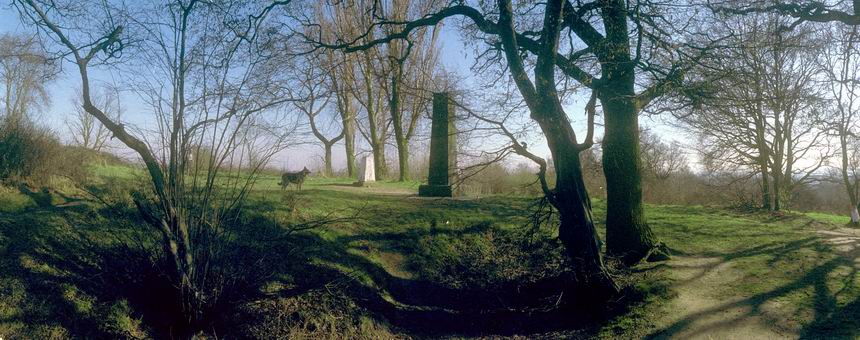
Pole Hill at Chingford is a little under a mile from the route

It would make two rather nice walks, splitting the route at Chingford. You could even make a short detour to some interesting parts nearby – such as Pole Hill, which has a pole, or rather an obelisk which was erected by an astronomer royal on the Greenwich Meridian so he could line up his telescope from the Royal observatory and make sure it was pointing due north. Some time later they decided to move the meridian a few yards, though I suppose if the telescope was still in the same place it didn’t really matter.


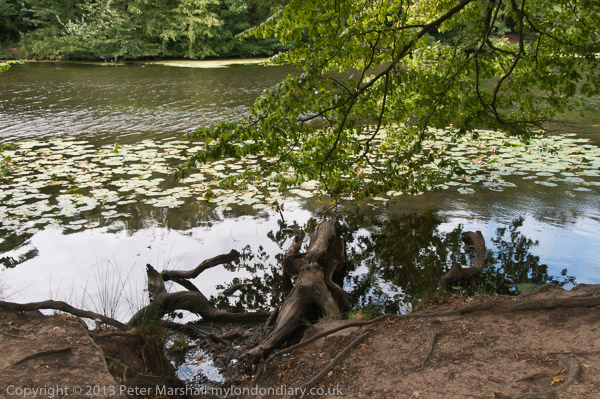
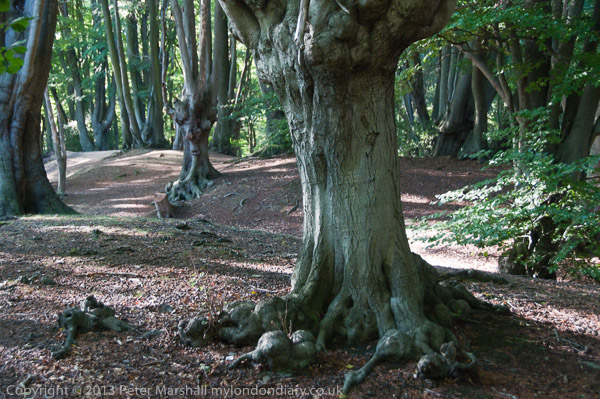
There are many seriously old trees in the forest, but also some open space – forests are not just trees
Continue reading Epping Forest

Independent living at risk


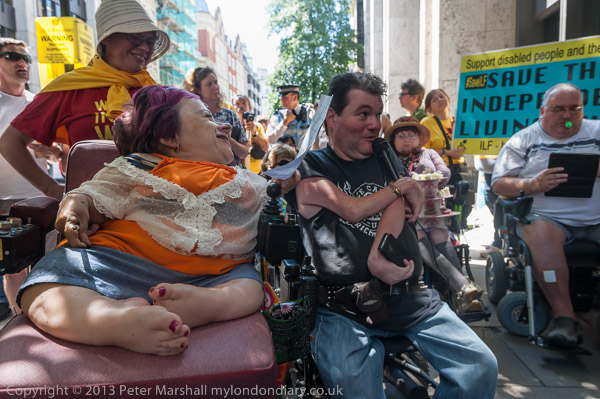
Sophie Partridge, John Kelly and others party outside the Dept of Work & Pensions

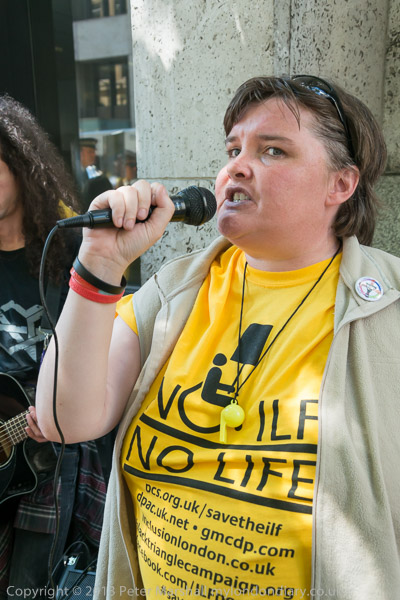
Some of the people that I photograph amaze me in various ways, and among the more amazing are many of those who take part in the protests organised by DPAC (Disabled People Against Cuts) who have regularly shown others how to organise effective and powerful protests against unfair attempts by the government to cut welfare benefits.

They have been hit much harder by various cuts in services; many have suffered from the  work capability tests – tests that were designed to be unfair and were then poorly administered largely by unqualified staff pressured by a company which had been given financial incentives to fail as many as possible.


Paula Peters speaking at the DWP

But although ATOS’s failings have received some media attention (largely thanks to DPAC’s protests) this is only a small part of what DPAC rightly describes as “a national scandal”, which they accuse mainstream media of failing to report.

They say:

“the media owes a duty to the wider public to give way to propaganda and needs to out this scandal for what it is.

1 million delayed assessments/decisions, 1.7 million appeals & 1.3 million put through the sanction regime is a collective 4 million exposed to some degree of benefit decision related chaos.  How can 4 million people locked in government backed chaos not be a national chaos? “

You can read the details on their web site,  and it is hard to disagree with their conclusions about the suffering and chaos caused “by DWP incompetence and IDS arrogance.”


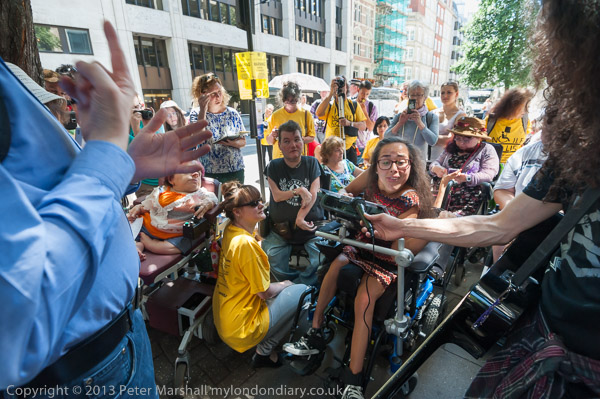
Nadia tells her story with the aid of her computer – and a BSL signer relays it

It’s hard to avoid the conclusion that Iain Duncan Smith thought the disabled would be an easy target, unable to stand up for themselves, but how wrong he has been proved to be. Hard too not to be convinced that there has been something of an unwritten conspiracy between the newspapers and mass media and government to play down or ignore the problems that government policies are causing – and because Labour too see a need to reform the welfare system they have avoided the duty of any opposition, although a few individual politicians have stood up for the poor and disabled. Media owners and governments share various interests, are closely intertwined in various ways, depend on each other.

It isn’t because journalists have not exposed the facts, written the stories and taken the pictures, but that those who control the media have decided they are “not news”, and mainly they only get published in personal blogs and fringe publications. The BBC has lost much of its reputation for independent reporting – at least of UK events – because it seems now to be more concerned about cosying up to government to avoid losing the licence fee than speaking truth to power.


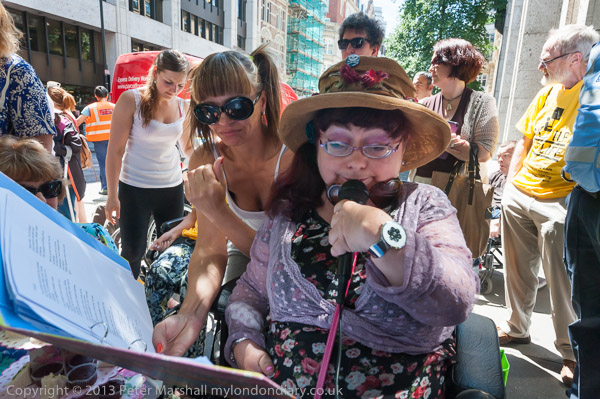
Penny Pepper reads some of her work

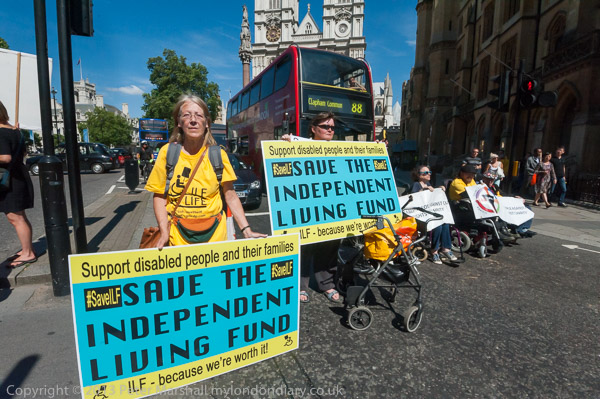
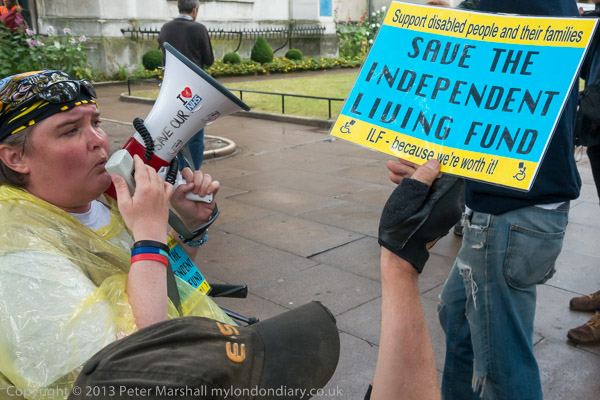
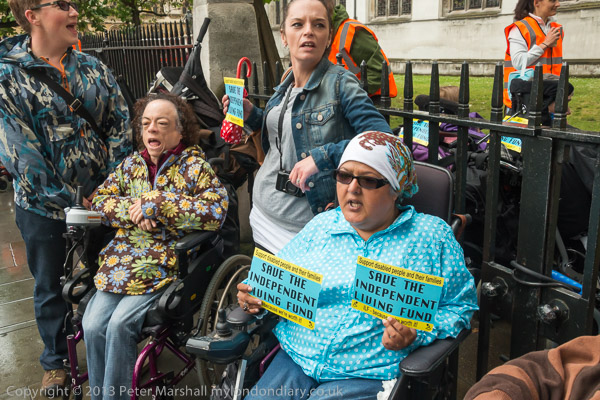
This protest – a tea-party on US Independence Day -was about the ending of the Independent Living Fund, which gives those who desperately need it the extra care which enables them to live in and contribute to the community.  You can read more about it in an article in The Guardian, one of the few papers that has sometimes shown an interest. But this and other stories about what is happening to so many of the poor and disabled, affecting altogether many more of the people of this country than the four million should regularly be making headlines across the media. Instead we get huge stories about wacky politicians, faded performers, unknown celebrities, footballers and their wives and the rest of the largely salacious nonsense. Even across the BBC and the so-called ‘quality press’.

Photographically there were few problems for me. It was a very crowded situation, and at times very difficult to move – even the few inches needed to frame as I would like. At times I was shoulder to shoulder with a BBC cameraman (not working for the news) and that restricted my view and I had sometimes to use a longer focal length than I would have liked to avoid his lens blocking part of the picture or a large woolly covered microphone (a ‘deadcat’) wandering into shot. Doubtless too I got in his way, but in the confined space we had to work together, and did so with no real problems.

In tight situations, the 16-35mm is a great lens to have, though just occasionally the 16mm fullframe fisheye is better. But here I didn’t really have that option when I wanted to use it, both because the guy with the TV camera would have occupied too much of one side of the frame, but for a much simpler reason – there just wasn’t the space to get into my camera bag and to change a lens, we were so squashed together.

I hung around at the end of the official end of the protest at the DWP because I knew something else was likely to happen, having been given a hint by one of the organisers. I didn’t know what this would be, but wasn’t surprised when around half of the protesters decided to block nearby Victoria St – the busiest road nearby.

At the front of a queue of traffic held up by the protesters in front of Westminster Abbey was a number 88 bus, headed for Clapham Common. At last I thought, the message is getting through to the “man on the Clapham omnibus”. I’d thought too that the direct action might involve Westminster Abbey, who had called in police to turn away DPAC protesters the previous Saturday.

The protest did however take the police by surprise and it was a few minutes before they arrived and started to divert traffic away. At one point they got protesters to clear a path though one of the two carriageways for an ambulance – but it never arrived, though I think it more likely that it had been diverted than that this was police subterfuge.

You can read more about the protest and see the rest of my pictures at Independent Living Tea party

Continue reading Independent living at risk

Exit re-enters stage left

Exit was the most significant single documentary project in UK photography in the 1970s (if not in the whole century), and although it gained some publicity – and a showing at the Side Gallery in Newcastle (home to most of the rest of significance in the genre in this country) in 1982, as well as publication by the Open University of ‘Survival Programmes in Britain’s Inner Cities‘ (ISBN-10: 0335101119) in the same year, it soon disappeared in the morass of theory than engulfed British photography in the lost final decades of the twentieth century.

Documentary was old hat. Seen as outdated, lacking in discursive mumbo-jumbo the project failed to be recognised and legitimised by academic flummery. And although the OU got some funding from the Arts Council, the two testimonials on its rear cover come from Peter Townsend, Professor of Social Policy at the University of Bristol, the leading sociologist of the era and Chris Hamnett, Lecturer in the Faculty of Social Sciences at the OU. The academic photography establishment preferred to hold its nose and look the other way, largely towards its own navels.

This was work in a tradition that many – largely those who were ignorant of it and had failed to understand it had rejected. But it was also fresh, compelling and highly political. And it was probably most importantly the political nature – telling the truth about our inner cites – that made it too hot to handle for the major galleries that should have shown it.

There were notable images in the book, taken between 1974 and 1979, by all three photographers, Nicholas Battye, Chris Steele-Perkins and Paul Trevor, though for me it was particularly the work of Trevor in Liverpool that stood out. Steele-Perkins writes informatively about the group in Photoworks (via David Hofmann  who I thank for posting the link on Facebook) and includes this about how they divided up the country:

We all did some work in London as we all lived there, and we all did some work in Glasgow, but most of Paul’s time was spent in Liverpool, Nick’s in Birmingham and mine in Newcastle, Middlesbrough and Belfast.

His article also gives a good idea of the shoe-string nature of the project, and how the photographers worked, and of the importance of the interviews along with the photographs.  The first image on his Magnum portfolio is from Belfast in 1979.

I first met Paul Trevor in the’80s and went to several events where he showed and talked about his work, in Survival Programmes as well as in East London and in India, and I was highly impressed. But it was only in 1997 when I reviewed a book giving a very one-sided view of the magazine ‘Camerawork*‘ (not to be confused with Camera Work!) which Trevor had been one of the nucleus from its first issue in 1976 that I got to know him personally. I sent him my draft review for comments, and as well as correcting some of my misconception he also contributed his own review to the small magazine, LIPService, I was then editing for London Independent Photography. You can read the text of my review for ‘Visual Anthropology Review‘ on-line and the final article with illustration here if you have a Wiley Online Library account. Though why they should charge for accessing my work without giving me a share is something of a mystery.

The following year ‘Visual Anthropology Review‘ published a feature with 20 of my pictures from the Notting Hill Carnival with text by George Mentore (my name does not appear in the abstract – and again you pay but I get nothing) and also an article by Dale Newberry, ‘Photography and the visualization of working class lives in Britain‘  (same terms) in which Trevor’s work was featured, and I was rather surprised to find how little known his work was at that time in the USA.  I got the front cover of the magazine, with a rather better image by Trevor on the back.

More recently, I wrote about his work in Liverpool and the book and show there in 2011, Like you’ve never been away. It’s a nice book, with much better photographic printing than Survival Programmes, though with its portrait format some of the images disappear rather disastrously down the gutter.

Grain, the new Photography Hub and Network for the West Midlands at the also new The Library of Birmingham, has recently acquired a collection of over 250 vintage prints from Exit Photography Group as a gift from the the Calouste Gulbenkian Foundation who funded the original project, although I think there are only 3 pictures – one from each photographer currently on line. There is a large collection – 125 pictures –  of Paul Trevor’s work from Liverpool – reproduced from his contact sheets in a rather strange sepia –  on Flickr.


* Camerawork is now apparently rare. I just found a bookseller offering a copy of a single issue for £32.95 (+ postage). I have an almost complete set and gave away some spare copies…   You will be lucky to find a copy of Survival Programmes for less than £100 too.

Boots and the ILF

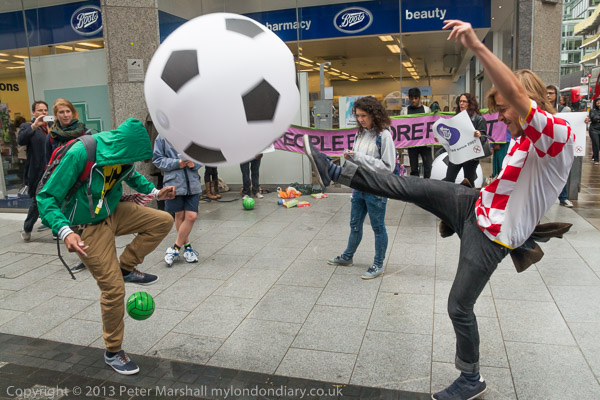
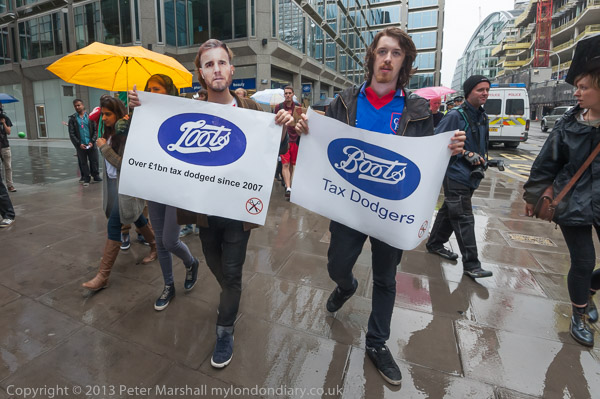
It was a football-themed protest outside Boots by UK Uncut, but although Boots (or ‘Loots‘ as some of the posters called them in a nice version of their logo) have been dodging tax, I knew that the protest there was only a diversion.  UK Uncut were there to occupy the police while DPAC and Occupy London were getting busy with another protest somewhere not very far away.

Obviously the protesters wanted to keep what they were doing a secret from the police, and surprisingly seemed to have managed to do so, but I felt just a little left out of things in that they hadn’t trusted me more. Of course I wouldn’t pass it on to the police, and I think most of the protesters know me well enough to know that.

I could have gone to one of the planning meetings for the event – which I had known about – but there is a line between being a part of a protest and reporting on it that I think it is important to stay clearly on one side of. Not that protesters can’t photograph protests, but you can’t be a part of the protest and report objectively on it;  a little distance is vital. But it would have been nice to know what was happening and when – as I have done at some previous protests by DPAC – so as to be at the right place at the right time.

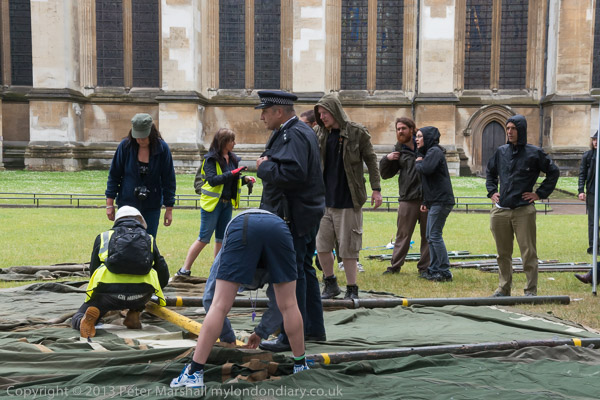
As it was, by the time the protesters from Boots had marched down to Westminster Abbey to join the others already there we were just a vital minute or two late. So I wasn’t able to photograph the initial stage of the protest, and I would have liked to have done so.

I had to make a choice quickly whether to go over the fence and join the protesters or stay with the others who were outside the fence. It wasn’t hugely high, and there were certainly places I could have managed to go over even despite my age and condition (I have a real problem now with balance if I take my feet off the ground.)  But I wasn’t sure if I wanted to, and certainly was not convinced if I had done so that I would have been able to leave when I wanted, even by showing my press card. The police are not always helpful to the press.

There were a few things I might have been able to do better inside. Although my picture shows quite clearly the officer standing on the tent so that it could not be erected, a closer viewpoint with a wide-angle might have been better, and would have shown more of the abbey behind.

And while I was able to take some decent pictures of Paul Peters of DPAC speaking by leaning as far as possible over the fence, being able to move a few feet further might have been better. But at least I was able to get pictures, if rather more with the 70-300mm than I would have liked.

Using that lens should have had one big advantage. It was dull and raining slightly, and the long lens hood on that zoom is a great rain shield. Unfortunately I’d lost the lens hood a few days previously, and although the replacement I’d ordered arrived that day, it only came after I’d left home. So I was taking pictures using my left hand to shield the front of the lens.

It was raining enough for most of the pictures taken with the 16-35mm to have a least one area with some diffusion caused by rain on the filter, including a whole series where I got a little excited and didn’t wipe the lens until I’d taken quite a few frames.

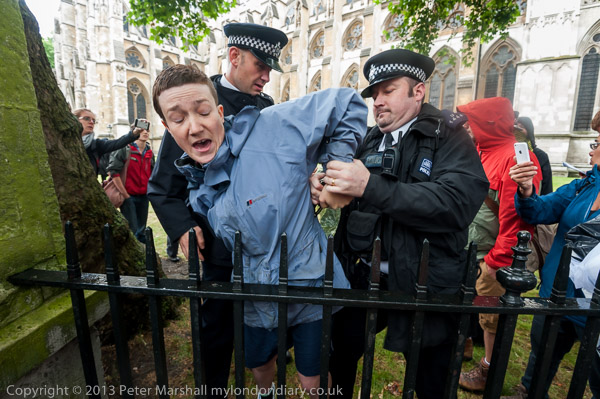
I’d I had been inside I would not have been able to photograph the protesters who had been left outside, and would also have missed the pictures of the arrest, where the protester was pushed against the fence by two officers, nor to run around to photograph as the protester was put into the police van.

As more and more police arrived, it did become harder to take photographs as most of them formed a line around the area inside the fence a couple of yards away from it. Fortunately there were a few feet between each of them, and by moving around I was able to see through the gaps. At times there was quite a crush of onlookers and other photographers at the fence which made this difficult, but I was quite pleased with what I was able to do.

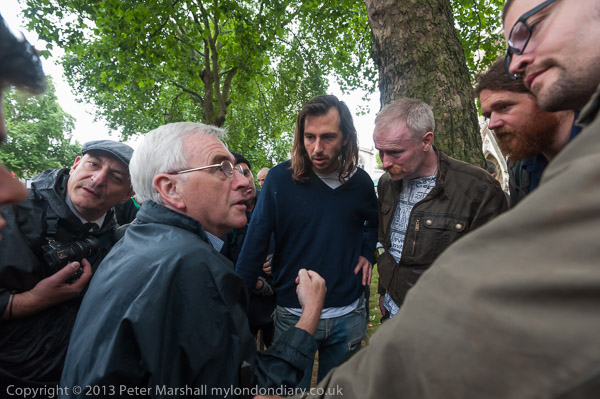
Among others outside the fence was MP John McDonnell, who spent a lot of time trying to contact the Dean of Westminster and get him to allow the protesters to set up a temporary camp in the area to protest against the ending of the Independent Living Fund. Unfortunately although the Church of England has made some principled statements against the loss of the ILF, the Dean wasn’t prepared to talk to the MP or the protesters, but simply wanted the police to get these people off his grass.

Being outside did have the advantage that when I got tired  I could simply walk away and catch the train home. But by then I’d decided there was unlikely to be much of interest happening.

You can see the pictures I did get both of the earlier protest, UK Uncut ‘Boot Out Boots’, and also the protest proper, Occupy Westminster Abbey – save the ILF

, and find out more about the protests there.

Continue reading Boots and the ILF

No More Austerity

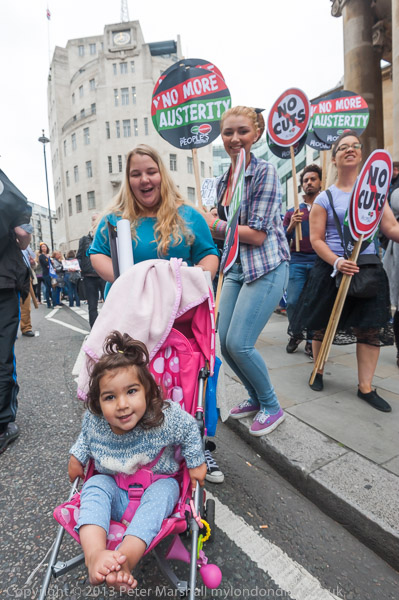
It was one of those days when I spent rather a lot of time running around London looking for things that either didn’t happen or I decided there was nothing much to photograph. On top of which there was also one of London’s largest protests, the No more Austerity march and rally organised by The People’s Assembly, trade unions and campaign groups starting from outside the BBC.

Two groups had promised to hold protests on their way to the big one, and I did manage to find one of these, a protest outside the Regent St Tesco branch where earlier protests and direct action had led to the removal of ‘homeless spikes’, designed to stop rough sleepers resting there. The Call for Nationwide Homeless Spikes Ban was smaller than I had hoped, but there was a story and it’s demand for a nation-wide ban was reinforced by a protester from Cornwall – carrying a Cornish flag – and policed by a Welsh police officer. But of the beach party themed flash mob taking the underground to the more austerity march I saw no sign, though I did I think find them later on the anti-Austerity march.

I’d also planned to cover two unrelated protests, one at Downing St and the other at the US embassy. I went to both shortly after their advertised starting times; opposite Downing St there were a small group of people, but no sign of them beginning a protest. At the US Embassy there was a small protest taking place, but little to photograph. I took a few pictures, talked to the protesters, who told me there were more coming and I promised to return later when they thought there would be more. But when I returned to both groups later, neither were anywhere to be seen, and I didn’t have enough material for either to make a story.

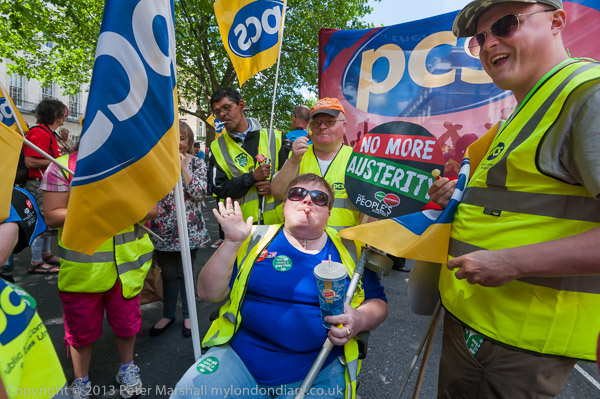
No More Austerity was different. A large protest with perhaps 15-20,000 people marching from outside the BBC, who almost entirely failed to notice it (a short mention appeared belatedly on the local news.) The organisers claimed 100,000 on the march and at the rally, and some papers quoted that unrealistic figure as fact.

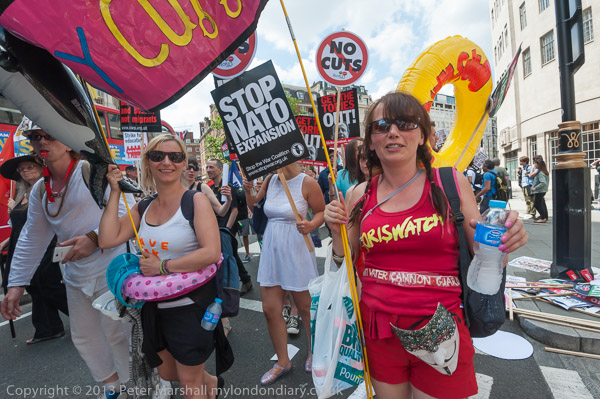
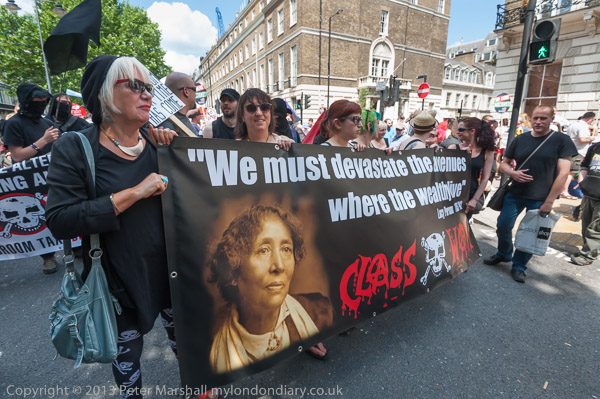
My main problem in covering the event was simply it was too large and too crowded, at least at the start, and there was just too much to photograph. Too many interesting banners – such as that carried by the ‘Class War Womens’ Death Brigade’ with its typically uncompromising quote from US anarchist activist Lucy Parsons (Chicago police called her ‘More dangerous than a thousand rioters!’) “We must devastate the avenues where the wealthy live”  as well as a rather fine crocheted less controversial ‘Tax the Rich’.

It was also rather warm, and I could have done without the extra rushing around central London for the missing protests I tried to find as the end of the march reached Oxford Circus, a quarter mile or so from the start.

When there are large protests in London like this, traffic is hugely disrupted, and the only ways to get around quickly are either on foot (or bike) and the tube. But underground stations are seldom very close to where you want to be, so that too involves a lot of walking or running. Often too, as on this Saturday, key lines or stations are closed for engineering works, and I found I had to do rather more on foot than I liked, particularly when carrying a heavy bag on a hot day. So when I finally arrived at Parliament Square, a short walk from Westminster tube – I was as hot and tired as the protesters who were just arriving having marched the whole distance.

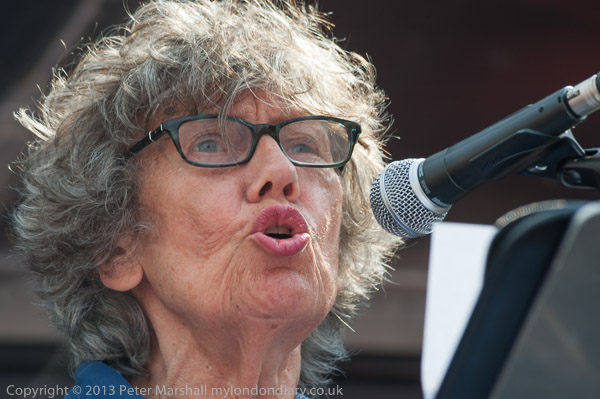
Fortunately the organisers had arranged for a fairly large press area in front of the platform, unlike at some other events, which made it easy for us to work, and particularly to photograph the speakers at the rally. The microphone then became the main problem, with some speakers apparently trying to hide from my camera behind it, along with a metal lectern that almost completely hid some of the less tall.


Celia Mitchell reads one of her late husband Adrian Mitchell’s poems

What surprised me greatly about the rally was that there were no speakers from the most active group of anti-austerity protesters, DPAC and other groups of the disabled. I later learnt that this was because the event organisers had refused to provide disabled access to the stage, or rather asked that DPAC should pay for it. It seemed unbelievable that any left group should be so clearly anti-equality; had they known in advance I suspect many of those who did speak would have boycotted the event.


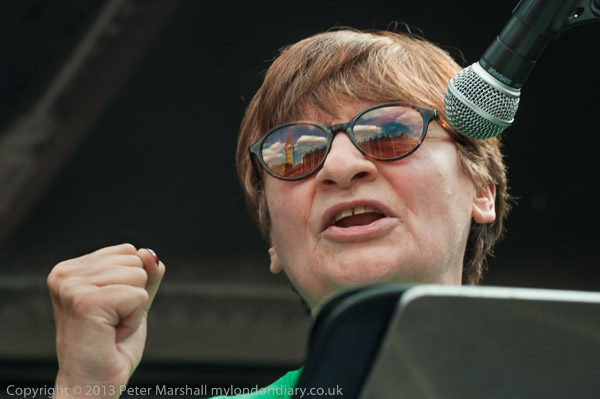
NUT General Secretary Christine Blower with a reflection of Big Ben in her sunglasses

Something I did find annoying were the continual announcements that Russell Brand was on his way to speak at the rally. I expected him on past performance to be the least interesting of the speakers, and while his support brings publicity for the cause I think the whole cult of celebrity is something that the left should try and oppose. When he hadn’t turned up an hour and a half after the rally started I decided it was time to go home. Of course it was pictures of him on stage that dominated the press coverage of the event.

I was quite pleased with some of the pictures I made of the speakers, mainly using the longer end of the 75-300mm zoom, though some were on the 18-105mm. It wasn’t too crowded in front of the stage and I was able to move around quite a bit, which makes a big difference. There were also relatively few large video cameras, which also rather impede movement, particularly as you try to avoid being in shot. And of course there was no sign of the BBC!

Pictures from the day at:
Call for Nationwide Homeless Spikes Ban
No more Austerity – demand the alternative
People’s Assembly Rally
Continue reading No More Austerity