EDL and Pictures

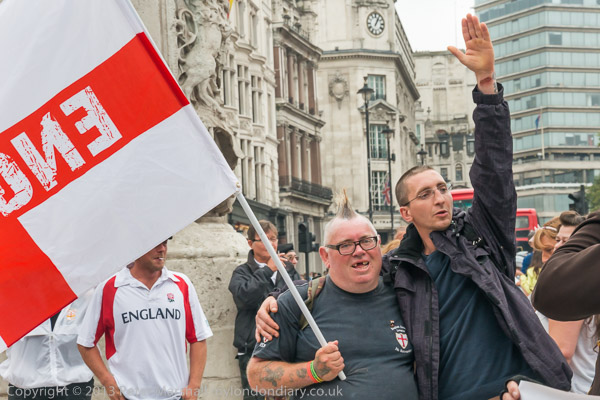
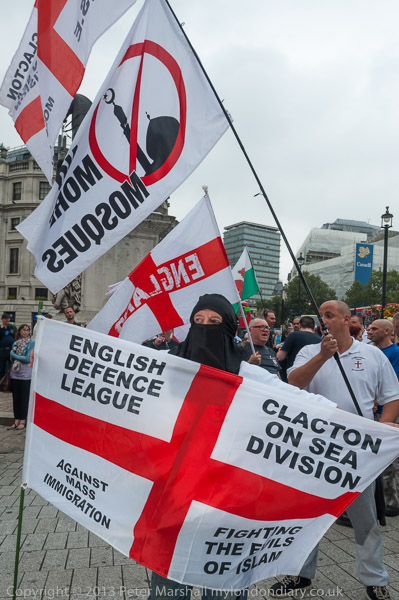
These two men were posing for a photograph in Trafalgar Square, not posing for me, though I’d photographed the man on the left several times earlier, but for a picture being taken by a man with a phone – I think the elbow seen at the right of image is his. The man in the centre is looking at me and may be aware that I’m taking a photograph, though I’m a short distance away using the 18-105mm at 62mm (93mm equiv). He is wearing an EDL sweatshirt, with its motto ‘No Surrender’ and holding an England flag. He probably isn’t aware of the raised hand salute the man with an arm around his shoulder is making for a photograph. Its something most who come to EDL marches have learnt to avoid, preferring to raise two fingers, as you can see in the image below, taken a second later with the same lens in wide-angle, but there are almost always a few who stick to the old ways.
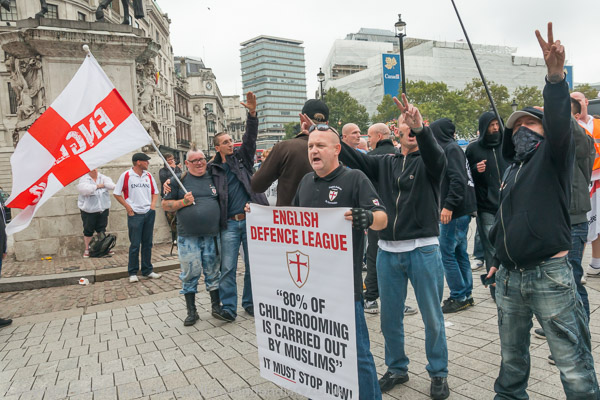
The EDL have often accused photographers of misrepresenting such gestures, of catching someone waving to his friends. Here I think it is clear that this is not the case. It wasn’t the only such gesture that I saw during the event, but was certainly atypical. And gestures are often easily misinterpreted.
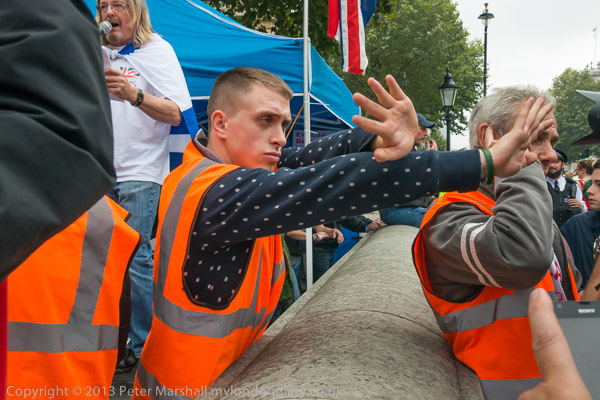
This was one that perhaps left little room for misinterpretation, with one of the EDL stewards holding both palms in front of the lens  of another photographer who like me was attempting to photograph the public rally that came after the short march.  Again taken with the D800E and 28-105mm, at 26mm (39mm eq) and perhaps just cropped a little too tightly in camera. with the top of the speaker’s head cropped at upper left, and the lens hood just not quite pushing far enough into the image.  Perhaps it could also be made a little clearer in post-processing. Like around 99% of the images I use this is the un-cropped frame – I try hard to crop in camera and sometimes perhaps do so too tightly.

I don’t know why the steward felt he wanted to stop one of my fellow journalists photographing the event. There might well have been a good reason for trying to stop anyone recording the speaker, but I suspect the EDL will themselves have put videos of his speech on the web.
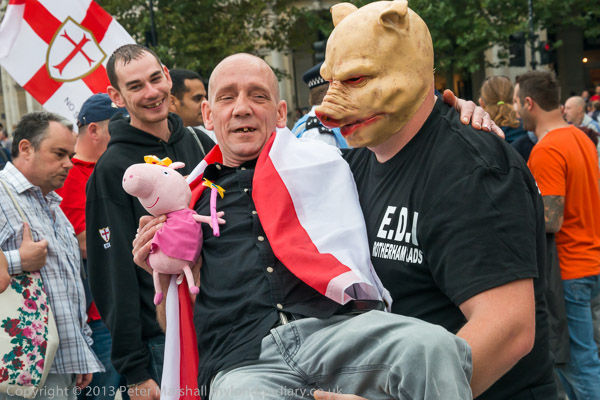
The EDL did seem to be making an effort to improve their image. Early in the day I’d heard a steward tell someone to put their can of beer away when he started drinking in the pen opposite Downing St, and there was certainly less drinking than at earlier events. The meeting point for the march wasn’t this time at a pub, but in the traffic island at Trafalgar Square with Charles I on his horse.  And although some groups were drinking, most people were simply standing around and talking. Some posed for photographers and others were happy to be photographed. I had a few polite conversations, including some with people who recognised me from earlier events (and hostile comments on the web) and was able to wander freely without harassment.

Again the man carrying the pink pig was posing for a friend of his to take a picture, being held by the man in the E.D.K. Rotherham Lads shirt and pig’s head mask.  I was a little too far away to get the picture exactly how I would have like, and by the time I had moved closer the picture had gone. Again I perhaps could have framed a little less tightly, but I didn’t have a clear view. I did take some other pictures of the man in the mask a minute or two later, some with a wide-angle, which are graphically stronger, but perhaps this one is a more truthful images of the event.

There are always dilemmas. Does producing strong images glorify the activities of the EDL? Do photographers inevitable sensationalise groups like this? Do we always pick on the atypical but photogenic?
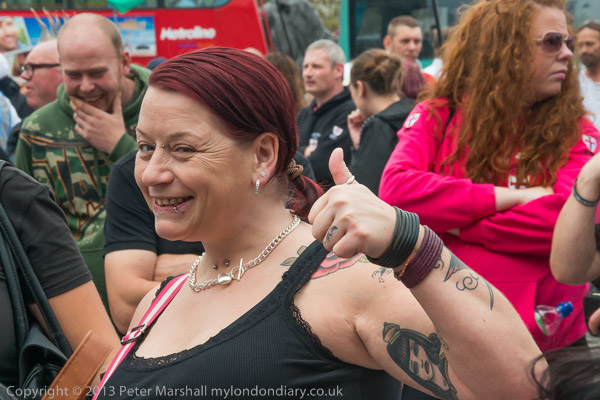
Of course we have to dramatise, to make pictures which will interest the viewer – or else no one is going to look at them event when they do get published. And while I may disagree with the politics of the EDL and other extreme right groups, they do include some visually interesting individuals. But I try hard not just to photograph these people but to show the events in the round, to tell the story through my pictures.

Back in the days when reproducing images was difficult and expensive there was perhaps some justification for the way that newspapers handled images, with those that used photographs (and some of the more serious press didn’t) generally picking a single image. Magazines would perhaps use a few, but even with the ‘illustrated magazines’ they were seen as subservient to the text.

Economics and production have changed, both in print and of course on the web, but the major media still largely stick to the old mould. Where they have embraced images it has largely been as video. Some publications will occasionally add an ‘image gallery’. But I can think of no major publication that has ever seriously engaged with Moholy-Nagy’s 1930s statement ‘The illiterate of the future will be ignorant of the use of the camera and pen alike’.

I’m not sure what the results of taking this seriously would be, though of course there were some attempts in those illustrated magazines, both back in the 1930s and since. Occasionally there are article which effectively mix text with pictures on the web, but not I think that really go far enough.

My own My London Diary for practical reasons largely separates images and text – site design and time constraints don’t allow me to go further in this direction. It’s also not possible for one person to effectively cover almost any event both as a photographer and as a writer; the two require different approaches. Combining videography with writing  is rather easier, as the video provides a continuous stream which records the event, while the still photographer has to concentrate on moments.  And for us the sounds and speeches are often a distraction while for the writer they are essential. A video camera can act as a notebook for the writer (particularly those ignorant of shorthand) in a way a still camera cannot.
Giving journalists a camera and sending them to events to write and photograph is to sideline photography, and some of the results that we have seen show this clearly. But it is also true that the media have seldom managed to use images effectively.  And perhaps photographers have played some part in this, with the willingness to play along with the clichés, often in the name of professionalism, particularly in the UK.

Any publication that tried to do so would of course be accused of ‘dumbing down’ in our logocentric culture, but there is no reason why this should be the case. Images can add to understanding and appreciation of events without in any way compromising the written text, while the current emphasis on getting writers to take photographs will undoubtedly damage their writing.

And were publications to serious use photographs, both online and in print, they might just become more popular, reaching a wider audience. Which would be good news, and even perhaps reverse the current financial bankruptcy of photographers, as repro fees continue to plunge. If the papers used ten of my pictures in place of one to help them tell the story effectively it would just about compensate for the lower rates compared to twenty years ago.
Continue reading EDL and Pictures
Mitie’s Heathrow Prison

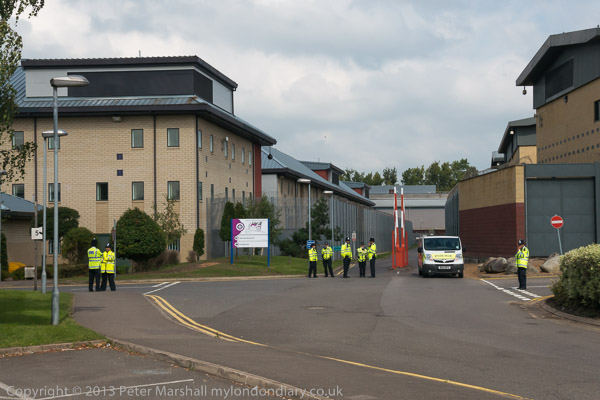
On September 13th I was back again at Harmondsworth, but things had changed, not for the better.  There was a new sign up in front of the buildings, and a new name, ‘Heathrow Immigration Removal Centre‘, combining what had previously been the Harmondsworth detention centre on the left of the road with the Colnbrook centre, a high security unit to its right under the very dubious ‘Care and Custody’ subsidiary of Mitie, one of the private contracting companies our government uses to distance itself from the shameful neglect and maltreatment that immigrants and asylum seekers are subjected to by our immigration laws.

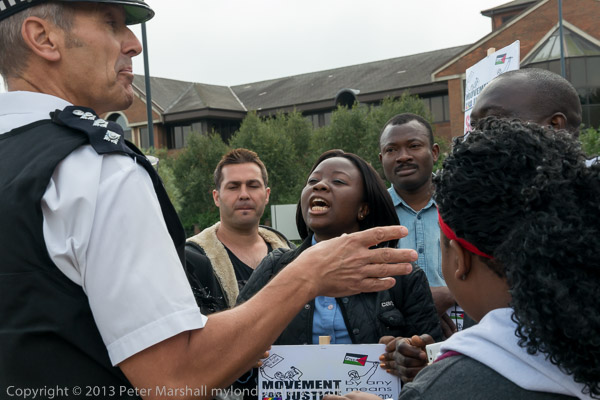
And, as you can see in the picture, the police were waiting for the protesters, and a couple had come to talk with those who had arrived early to begin the protest, telling them that they would not be allowed onto the site along the road next to those tall fences, where those inside the prisons would be able to see and hear them.

Police blamed the change in policy on the new management, although protesters suspected it was perhaps motivated by the increasing tension inside these and other immigration prisons following the death of Rubel Ahmed eight days earlier in Morton Hall immigration detention centre in Lincolnshire after he was refused medical treatment for chest pains, despite being heard by other prisoners screaming in agony. The prisoners took over the centre in protest and their resistance was brutally suppressed.

When I arrived protesters were arguing about their right to protest around the prison with one of the police officers, and I moved close to photograph this. It was easy to photograph either the police officer or the protesters, but rather harder to get a picture which shows both in a meaningful way, and I think the image above was the closest I came to it – there are a few others of the situation in Close UK Immigration Prisons on My London Diary, so you can make up your own mind.

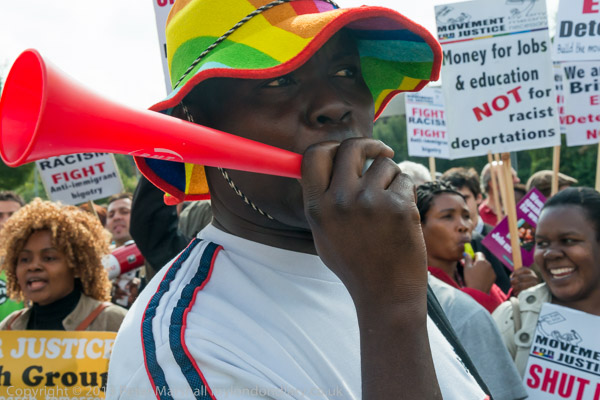
Photography is very much a matter of making judgements, both when taking images and editing them. I’ve photographed the man below with his rainbow hat at several protests, and obviously he is a pretty colourful subject.  I took quite a few pictures of him, particularly when he was blowing the bright red horn, and again this is the image that I think works best.
Firstly there is the framing of him, cutting that horn neatly at the left edge and the red edge of his hat just at the top edge of the frame. But the background is also important, showing the crowd of people. The two women’s faces at each edge help, but it is particularly the various texts that made me pick this frame. Going around the frame there are words like Justice, Racism, Fight, Shut and the complete placard, just tangential to the red hat band, the well known protest refrain ‘Money for Jobs & education NOT for racist deportations’.

That red band also just touches the man’s right eye (on our left) – had my camera been an inch higher it would have been lost. It’s partly a matter of luck that all these things came together in this frame, but also a matter of working on the subject and feeling for the it until luck happens. What perhaps this picture doesn’t on its own shown is the incredible dynamism of the protest, though I think the colour and composition gives some indication. Again there are other pictures on My London Diary.
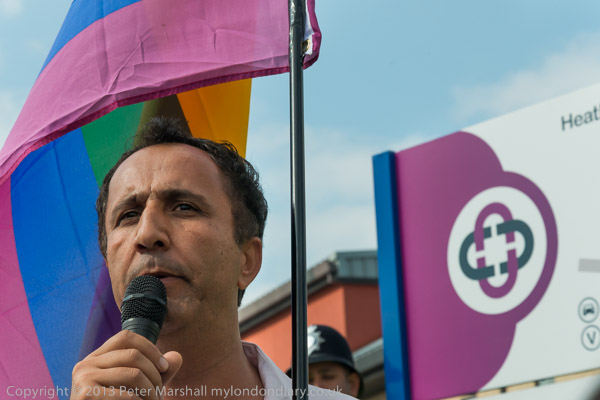
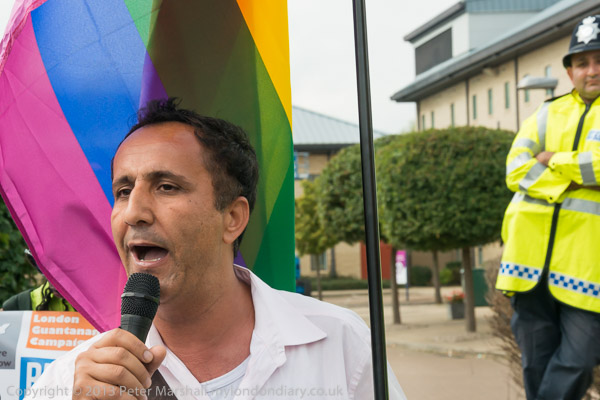
The next two images show a former prisoner in the centres talking about the conditions inside, and I was quite please with both of them.

I wanted to photograph him speaking, and was attracted by the similarity of the colour in the flag and that of  the Mitie sign and worked from a low position to combine the two.

Standing up and moving very slightly I could show him speaking with the prison building more clearly behind and the police officer watching him. Despite both having the same man and flag, I think these images have a very different feel to them. I think I prefer the lower one, mainly because of the greater animation of the speaker.

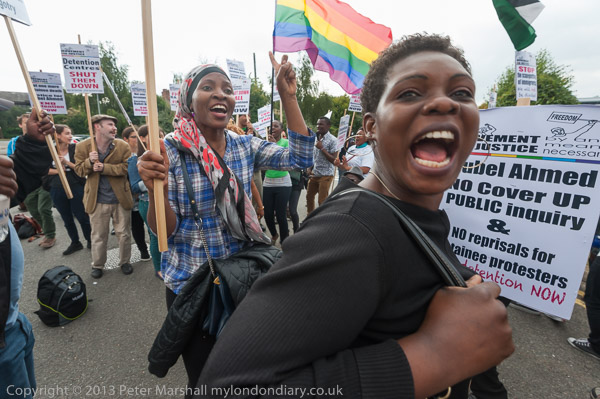
I tried hard and in several ways to show something of the dynamic nature of the protest and am not completely happy with any of my images (not that I ever am, though a few I feel quite please by.) One that does have some appeal, largely because of that wide open mouth and grinning face so close to my wide-angle lens perhaps show something of the energy of the protesters. Many of them have suffered inside these prisons, some still face the agony of reporting and knowing they may be locked up and deported, and others have lost friends or relatives sent back to uncertain or dangerous futures, imprisonment and worse.

I’ve written on previous occasions about the issues involved and the attitudes that lie behind (and too often politicians and others do lie) the shameful treatment this country hands out, particularly to those from countries that we grew rich from in the days of the British Empire, and continue to exploit through multinational companies.  It’s important that people learn more about what is actually happening behind the high fences and locked doors of centres like this and the whole mindset that allows it to go on in what is still claimed to be a civilised and democratic country. And that they are closed down.

More at Close UK Immigration Prisons

Continue reading Mitie’s Heathrow Prison

Save the NHS


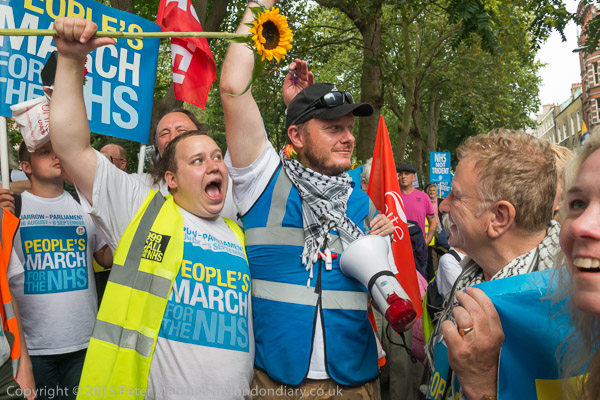
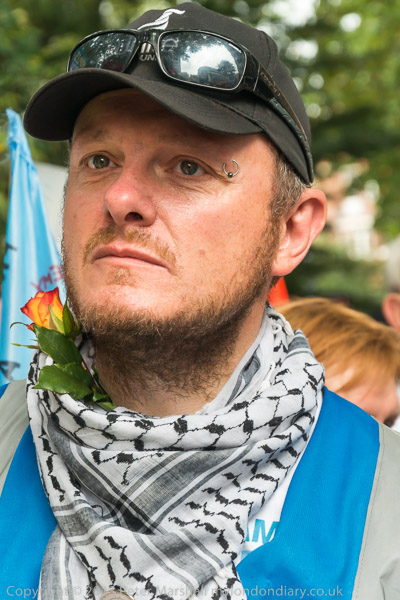
Marchers at the rally before the final stage – Craig Farlow in cap centre

The fight to save the NHS continues, though many parts of it have now been taken over by private companies. It is very big business, and one in which many of our leading politicians have a financial interest. And although the Conservatives are the worst offenders, Labour and Lib-Dems are not far behind. And of course UKIP – or at lest Nigel Farage –   would be even worse. But one of the things I find it hard to forgive Labour for was the introduction of PFI, the scheme under which they got large capital projects – like new hospitals – built but shackled the NHS to huge repayments – and at interest rates which now seem ridiculously high.

I’m fortunate to have lived almost all of my life while we had the NHS. When I’ve needed it, free health care has been there – and without it I probably would not be here. It’s not a perfect system, and has particular problems from a governments that keep making unhelpful changes, but generally delivers a high standard of service at a much lower cost than – for example – the US system which has so attracted Conservative health ministers.  It’s had to see any reason for this attraction other than the huge profits that healthcare companies make from it.

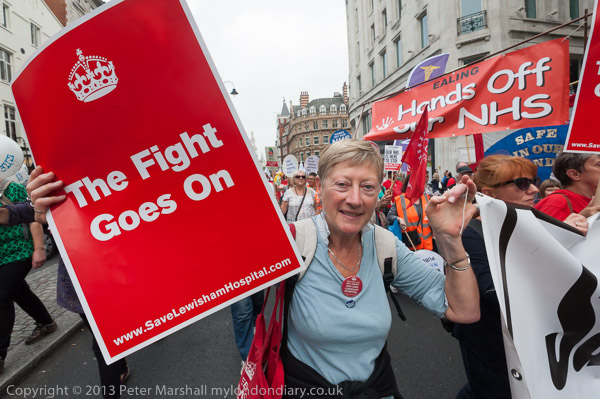
There are good clinical reasons for wanting to concentrate specialised clinical care in fewer well equipped and staffed centres, but it isn’t this that lies below most hospital closures. It isn’t even the need to make economies because of the financial situation – even if one accepts that.  The main driver is the huge repayments of PFI loans, that has led to the pressure to close solvent and clinically successful hospitals such as Lewisham.

The People’s March for the NHS began in Jarrow, up in the North East, and was based on the Jarrow March (Jarrow Crusade)  of 1936, when over 200 unemployed men marched to London, petitioning parliament for help for their town. All they got was a pound for their fare home. And that same amount, though in this case a pound coin, was included in the medals awarded to this year’s marchers who had gone the whole distance when they arrived in London on September 6th 2014.

The 2014 Jarrow March, the People’s March for the NHS NHS, came about from a suggestion by Craig Farlow, one of those who marched the whole distance – the ‘300 milers‘. I think they took the same route, and like the original marchers were supported by local people along the route, staying in churches and other buildings. One big difference was the presence of the ‘Darlo Mums‘ rather than the all-male event of the 30’s.


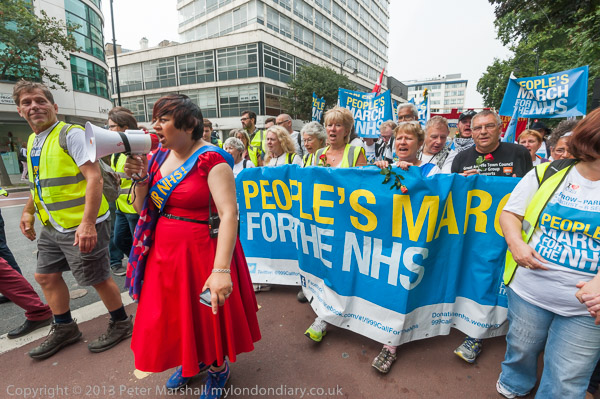
The march leaves on its final stage led by Rehana Azam, GMB National Organiser for the NHS and the 300 milers

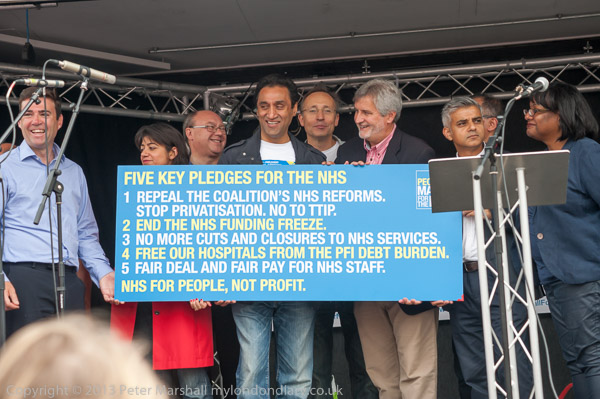
The march appeared to receive relatively little support from the left establishment, though unlike in 1936 the Labour Party and the TUC didn’t actually oppose it. There were indeed many trade unions and union branches who supported it, and the main organiser, Rehana Azam is the GMB National Organiser for the NHS. On the platform during the final rally in Trafalgar Square there were at one point the Shadow Minister of Health and half a dozen other Labour MPs holding the large poster listing the marchers demands, and during his speech Andy Burnham pledged that the Labour Party would repeal the Health and Social Care Act which has opened up all of the NHS to privatisation.  But it is the same Labour Party that is backing the TTIP treaty which will have the same or greater effect.

The main problem I had taking pictures was simply the crowds and space to work. Crowds of supporters and marchers at the rally in Red Lion Square before the final short march, and crowds of photographers in the relatively small press area in front of the stage at Trafalgar Square. Space there was restricted with part of the area in which press usually work being fenced off up for the official video crew and roughly half as seating for the disabled, most of which was unoccupied while I was there. It was difficult and at times impossible to get a good enough view of what was happening on stage, not helped by the sun shining directly towards us.
Continue reading Save the NHS

Remembering the Dead

A few months ago, late on Sunday evenings, I lay in my hot bath listening to BBC Radio 4’s weekly omnibus editions of a series of programmes about the events that led to the start of the Great War in 1914. It was a remarkable series which illuminated how the pride, stupidity and greed of a few rich and powerful men can lead to catastrophe for millions, and made evident the strength of anti-war feelings prevalent in Britain in the months leading up to the war, something which seems to have been largely overlooked in our national myth.

It was a war both my parents lived through, though my mother was only just finishing her school years when it finished. My father worked in a munitions factory, then joined up and went to both France and after the war ended to Germany, but was rather more at danger from the British authorities than the Germans, not being good at keeping his mouth shut and obeying obviously nonsensical orders.

By 1918 there were many Germans who were also getting fed up with nonsensical orders, and the Great War ended not because of a military victory,but because German sailors mutinied, setting out from Kiel and Wilhelmshaven to Germany’s industrial centres where they gained the support of the workers and then on to the capital, with the Kaiser being forced to abdicate on 9th November 1918 when the streets of Berlin were taken over.

Like many workers in the UK, German workers had actually been opposed to the war at its start, with hundreds of thousands of socialists going out on the streets in August 1914 against it. As Paul Mason writes in his Channel4 blog post, How did the first world war actually end?

‘We know now, thanks to the publication of records and memoirs, that it was entirely possible to have stopped the first world war. Key members of the British cabinet were against it; large parts of the social elite in most countries, including Germany, were stunned and appalled by the unstoppable process of mobilisation.’

The ‘War to end all wars‘ sadly didn’t, despite the experiences of those who survived and the work of war artists and poets which vividly depicted its horrors. Perhaps nothing in history is inevitable, but the settlement at the end of that war certainly created the conditions for the next great war twenty years later.

So while we remember and celebrate the bravery of those who fought and the sacrifice of those who were killed, perhaps we should do so with a sense of mourning and of the futility and horror and one that includes those on both sides.

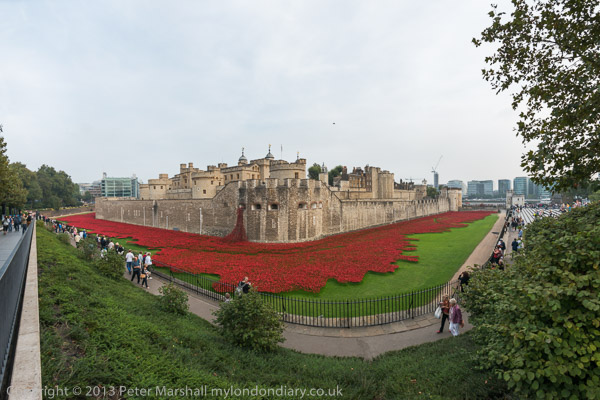
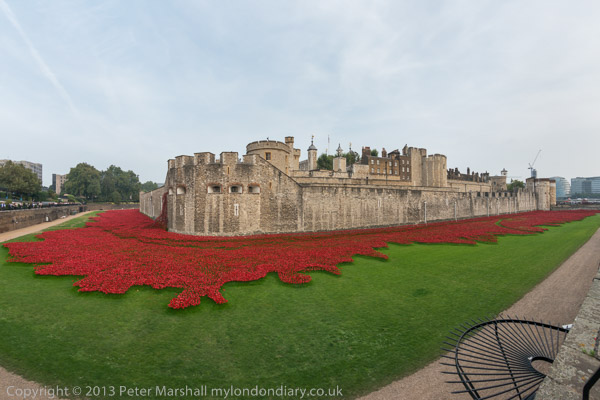
I’ve already published some pictures and thoughts about the field of poppies around the Tower of London, a spectacle that has caught the public imagination and dominates the front pages of many papers. I didn’t file my own pictures,  as I did not want my work to be used to glorify war. On my own sites I have control over how my work is used.
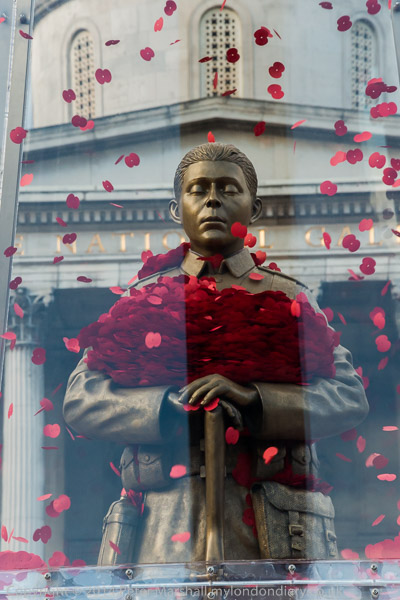
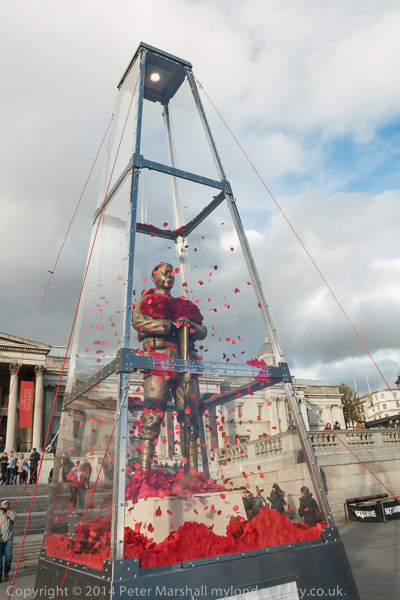
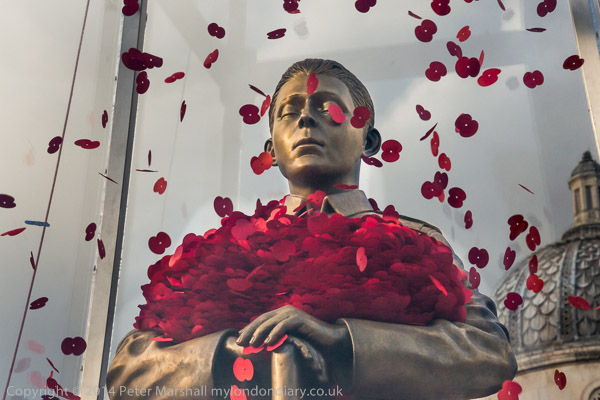
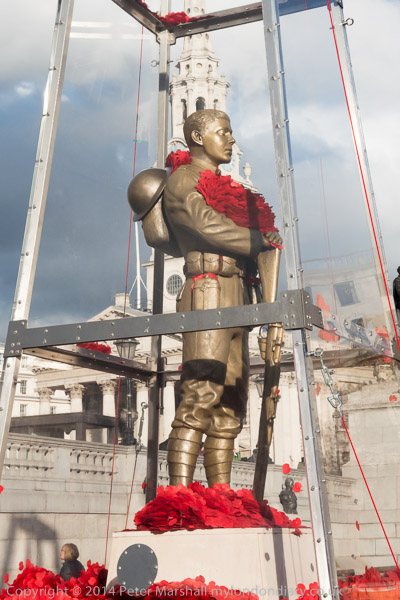
On Friday, another memorial sculpture was unveiled in Trafalgar Square, Mark Humphrey‘s brass ‘Every Man Remembered‘, a brass figure of an ‘unknown soldier’ standing on a block of Somme limestone, caged in a perspex enclosure and cradling a huge agglomeration of poppies in his arms, with hands resting on his rifle butt, another pile of poppies fixed around his feet. As I watched it and the tourists photographing it for around half and hour, every five minutes I saw a cloud of poppies being blown into the air around the figure.

There are I think far better figures of men who fought on war memorials around the country – at which many as I write (on Sunday morning on the 9th Nov) will be marking the occasion with services and military parades. The perspex canopy looks cheap and temporary (which I assume it is, but that isn’t a reason why it should so obviously look so), while the plinth lacks character. I rather like the poppies ‘blowing in the wind’, if only for the possibly unintended reference to Bob Dylan.
Almost all of those present around these memorials will be wearing red poppies, though a few may also wear a white poppy. In the past I’ve bought a red poppy and worn it, the ‘Poppy Fund’ providing income to support injured ex-services personnel, a good cause – if one that should perhaps be met by government rather than charity. There is a red poppy, with its rather strange green leaf, on our living room table as I write, where it will stay so far as I am concerned until recycled after November 11th.

Continue reading Remembering the Dead

September 2014 My London Diary

Most of the last three days I’ve spent catching up with my work from September, sorting out and editing the pictures I took in the last half of the month and putting them with stories and captions onto My London Diary.

As you can see from the roughly 30 entries below, it has been a busy month for me yet again

September 2014

Sainsbury’s told Stop Selling Illegal Goods
By the Royal London
HP told Stop Supporting Israeli Military


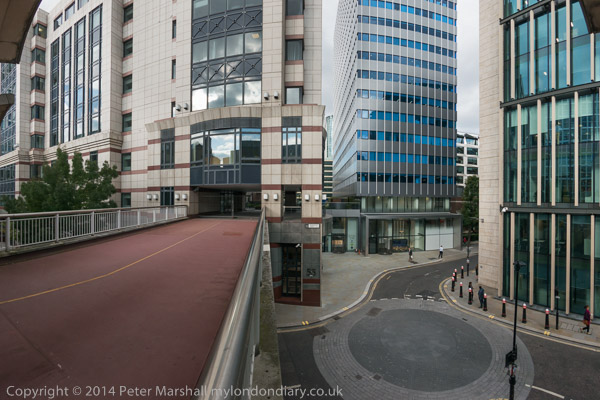
City Wall, High Walk
Don’t bomb Iraq
CETA Trade Deal Threat to Democracy


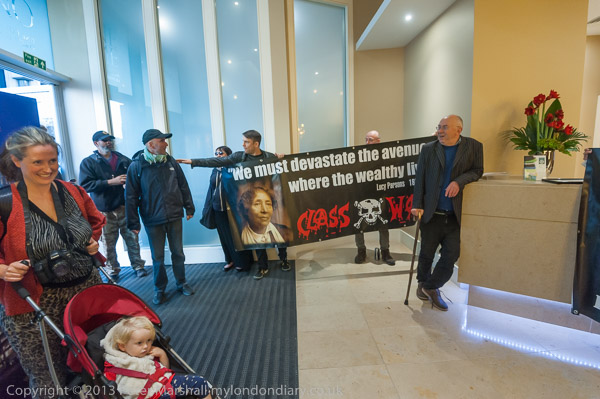
Class War Occupy Rich Door
Gambia anti-Gay Bill


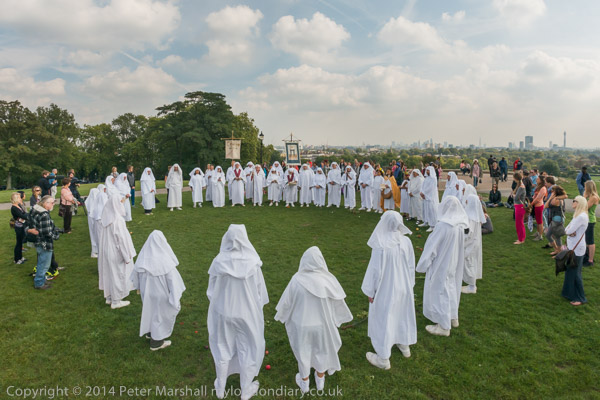
Druids on Primrose Hill


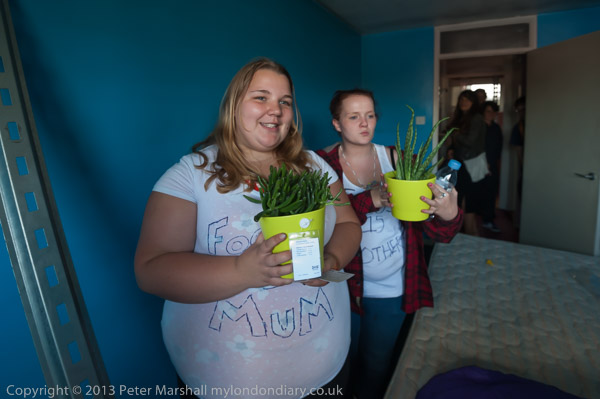
Focus E15 Open House Day
Peoples Climate March
EDL London March & Rally
Music at Class War Poor Doors


Sea of Poppies
Vintage Cinelli in poor state
Freedom for Alfon – Anarchists protest
Stop the Human Zoo petition to Barbican
Shian Tenants protest Huge Fuel Bills


Close UK Immigration Prisons
Colnbrook and Heathrow
IWGB Cleaners protest at Deloittes
CETA (TTIP) Trade Deal
Balfron Tower
Poor Door Broken, Rich Door Protest


People’s March from Jarrow for NHS
Mourning Mothers of Iran
Rolling Picket against Israeli violence
Stolen Children of the UK
Class War ‘Poor Doors’ picket Week 6

Continue reading September 2014 My London Diary

Cricklewood – Round 3


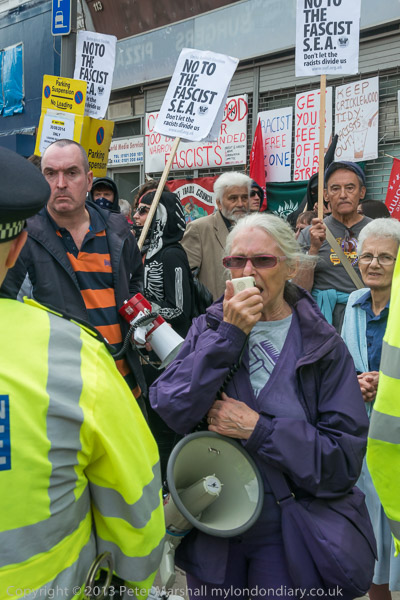
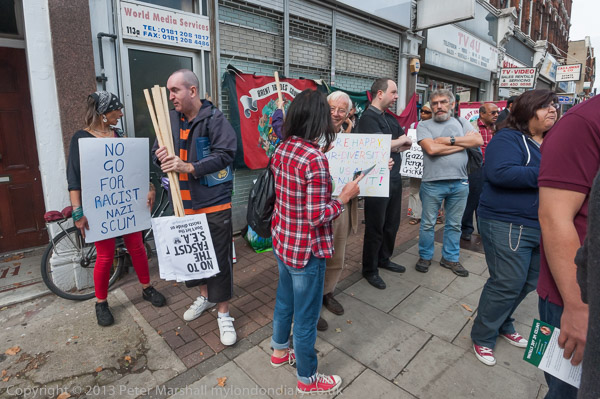
People outside World Media Services shout at a small group of SEA supporters across the road

Cricklewood isn’t a place I often visit, and perhaps there is not a great deal to draw the visitor there. Even when I was engaged in my encyclopaedic photographic wanderings of London in the 1980s and 1990s I’m not sure if I penetrated to its core (if it has one.) Its always seemed to me a kind of in-between place, between Kilburn and the North Circular, Willesden Green and Fortune Green, split between the boroughs of Brent, Barnet and Camden. A railway line – and some railway cottages, the A5 and some shops.


World Media Services with North West London United supporters outside to protect it from the SEA

And it was one of those shops that was the object of my journey. A closed-down kebab place, the room above it the home of a small web company run by Egyptians (though it wasn’t clear whether it was still in use) with the grandiose title of World Media Services. One of the activities based there was an unofficial English language web site for the Muslim Brotherhood (MB), a political party founded way back in the colonial era in Egypt in 1928 which became a rather unexpected beneficiary of the Arab Spring which led to its becoming legal in 2011, having been illegal in Egypt for most of its existence, and its candidate Mohammed Morsi (standing for the Freedom and Justice Party) was elected as president in 2012.

Not unsurprisingly there was some activity in London around World Media Services when Morsi was deposed by the military a year later and there were protests by the supporters of the MB around the world. But it was probably sloppy reporting that led to the small group in Cricklewood being designated as the European headquarters of the MB, and if it had been important in their organisation it seems clear that their activities in Europe are now based in Graz, Austria – also, coincidentally the home of the bi-lingual photography magazine Camera Austria.


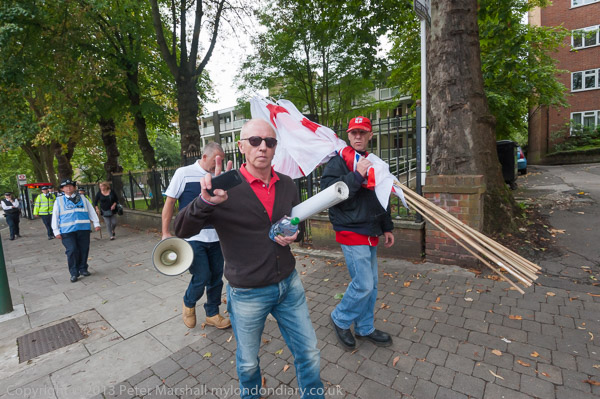
The SEA march from Kilburn started with 3 men and a woman some way behind

But Cricklewood is a little closer to home than Graz for supporters of the South East Alliance, a right wing group which includes former supporters of the EDL, BNP, EVF, NF, British Movement, and other extreme right groups, led by Paul Pitt, former  Essex/South East EDL organiser (the EDL called him a Nazi and expelled him in 2012; he was fined for racially aggravated intentional harassment, alarm or distress outside the US Embassy in May 2011.)


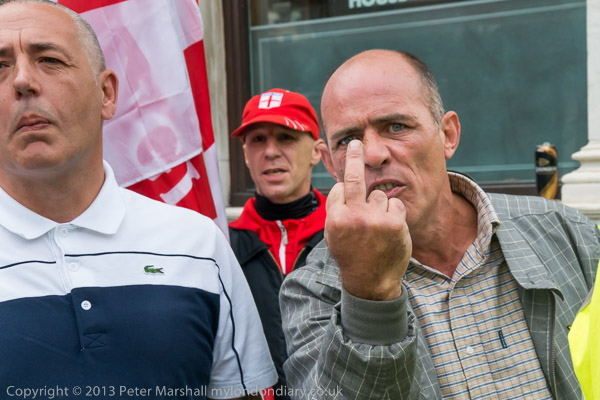
I get insulted taking pictures

I missed the first two SEA protests in Cricklewood in June and July (I was on holiday for the second and had better things to do on the first) and was surprised given the poor turnout for their second protest they had decided to try again. But this third round, which I was able to cover turned out to be even smaller than the second, disappointing for photography but rather positive for Cricklewood. One poster read “We Are Happy in our Diversity. Leave Us Alone to Enjoy It!’ and perhaps that wish will now be respected.

I don’t like covering the extreme right, but I think it is important to show what they are like, and I try to do so in an objective fashion, reporting as accurately as I can what they say and what they do. I think they condemn themselves more effectively than I could. They constantly complain of unfair treatment by the press and there is sometimes some truth in this, but swearing and threatening reporters as many of them do is hardly a way to encourage fair reporting.


I get attacked with a Union Flag on a bamboo pole

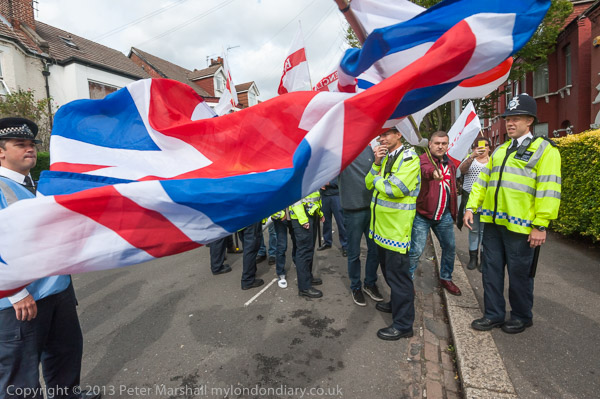
I was particularly disgusted at the disrespect the SEA, who claim to be patriots, showed towards their national flags, using them and the bamboo poles they were on as weapons, attempting to poke out the eyes of photographers or damage their cameras. And at the police response to this; rather than warning or arresting those using offensive weapons or confiscating them, they simply prevented photographers going within range of them.

At the start of the SEA march at Kilburn there were four photographers present (including one apparently working for the SEA – most of the others had stayed at Cricklewood) and four marchers, and although another perhaps 20 turned up at Cricklewood it was still a rather pathetic event, with the protesters outnumbered by around 150 people supporting the counter protest. Some who had come in the morning had left early when they saw how small the SEA protest was.

I think the pictures – you can see many more at South East Alliance ‘Racist Thugs Not Welcome’ – show clearly the differences between the two groups which faced each other in Cricklewood. On one side an atmosphere of suspicion and hate and on the other a welcome and openness to being photographed.  I think the account I’ve given of the event is accurate, fair and unbiased (except perhaps for the headline, which originally read South East Alliance told ‘Racist Thugs Not Welcome’ but that was too long.)
Continue reading Cricklewood – Round 3

London to #Ferguson: Don’t Shoot!

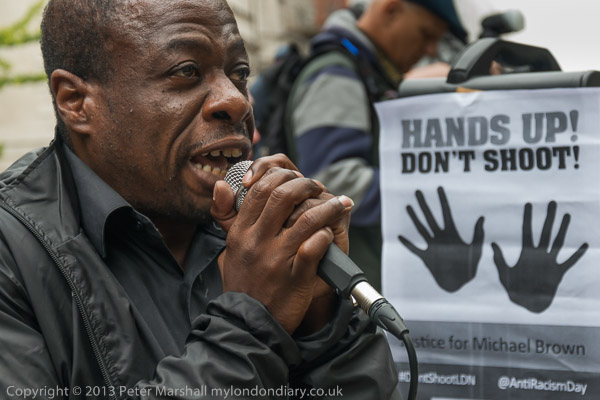
In August I went to two events organised because of the shooting of unarmed black teenager Michael Brown in Ferguson, Missouri and the military-style response by the US authorities to the protests there that followed his murder.

Although the scale of that repression is something we haven’t yet seen in the UK, I’m writing this a couple of months later just before I go out to photograph the annual march by the United Families and Friends Campaign who have a long list of 3,180 individuals who have died in state custody since 1969; at the bottom it states ‘Too many have died in questionable circumstances. Too many killed unlawfully … and pitifully too few held to account for the deaths of those we name here.’ Also published today, accompanied by one of my photographs (and another by Matthew David), is the closing speech by writer and activist Kojo Kyerewaa from last month’s annual conference of the London Campaign Against Police & State Violence.

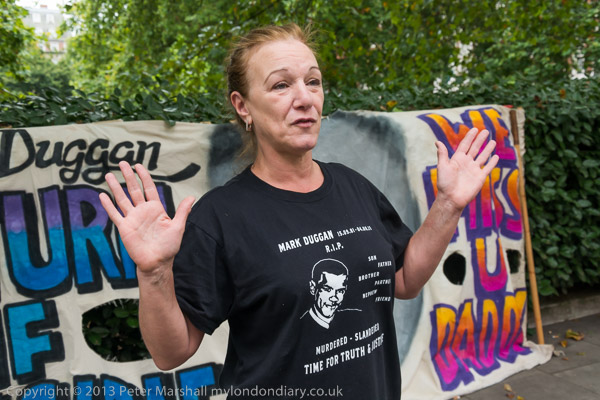
And another reminder that similar things happen here in London were the speeches at the first of the events I covered of Carole Duggan, the aunt of Mark Duggan, unarmed and surrendering to police when they shot him, and at the second by Marcia Rigg, the sister of Sean Rigg, killed inside Brixton Police station in August 2008.

The two events, both at the US Embassy in Grosvenor Square, were organised by different groups, the first by ‘London Black Revs‘, the Revs being short for revolutionaries, rather than men of the cloth, and the second, ten days later, by a wider range of organisations, led by Unite Against Fascism, and including the United Friends and Family Campaign as well as trade unions and other campaigns.

Prominent at the first event were the family of Mark Duggan, and in particular his aunt Carole Duggan, who spoke eloquently and at some length drawing out the parallels between his death and that of Michael Brown. Both were black, both were unarmed, both had raised their hands in surrender when they were shot by police. And both deaths were followed by a response from their communities that were turned to violence by police responses and followed by panic reactions by politicians. Both brought into swing a huge media effort by the authorities feeding lies and covering up the truth about what happened, and in various ways conspiring to deny justice.

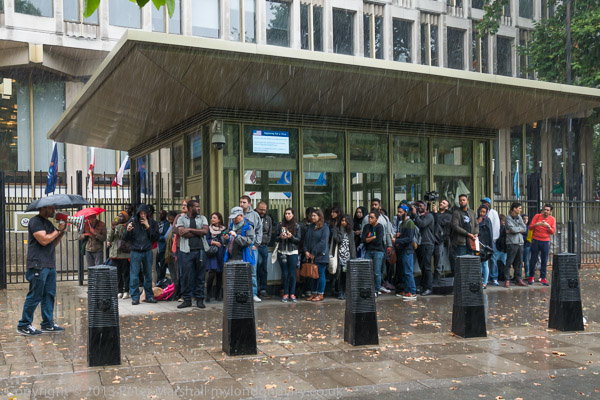
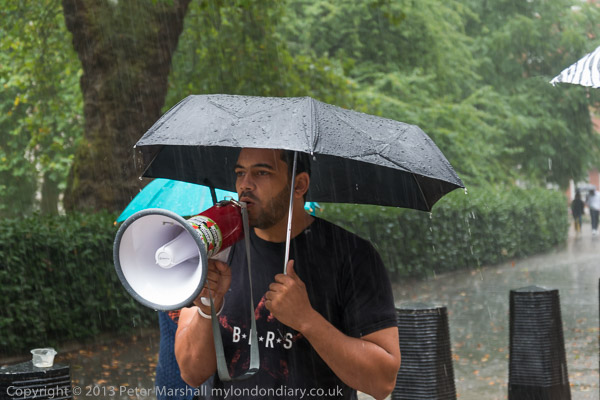
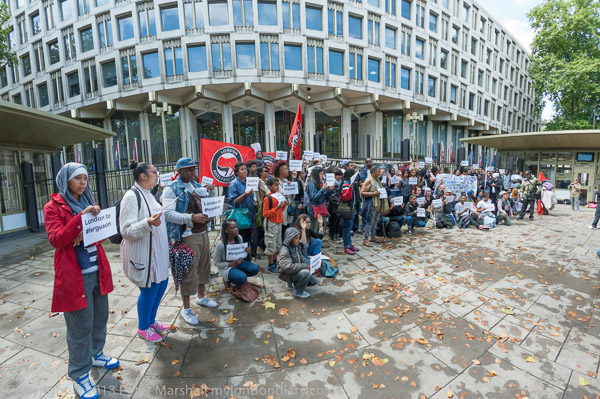
A torrential rainstorm added to the photographic problems of the event, though also providing some opportunities. At first I sheltered – along with many of those present – under the trees along the edge of the park facing the embassy, but soon the rain coming through and under their dense leafy canopy was too much, and I had to put my head down and dash for the cover of the broad concrete overhang of one of the embassy lodges with those shown in the picture above. It’s perhaps unfortunate that this picture suggests a rather smaller gathering, with others like me sheltering under the trees, under the canopy of the left-hand lodge and a few standing under umbrellas out of view.

Although it does show the rain, I don’t think any of my pictures give a real impression of just how heavy it was, a photographic problem for which I have no solution. Using flash certainly doesn’t work, though the light had sunk considerably and it would have been useful on this account, but it lights up every raindrop, with those close to the lens appearing over-large and out of focus and of course brighter. An effect well exploited by Martin Parr in his 1982 book  ‘Bad Weather‘,  I think the only one of his books I own that I actually paid my own money for, but not something that generally appeals to me or to editors. There are pictures in there by Martin that mean none of us should ever feel the need to do the same again.

My damp dash did get me closer to the speakers, and I was able to photograph them from the dry as they, standing a few yards out in the open and holding an umbrella as well as a megaphone, were still getting rather wet. Although an umbrella stops most of the rain, with heavy driving rain a fine spray passes through and slowly soaks.

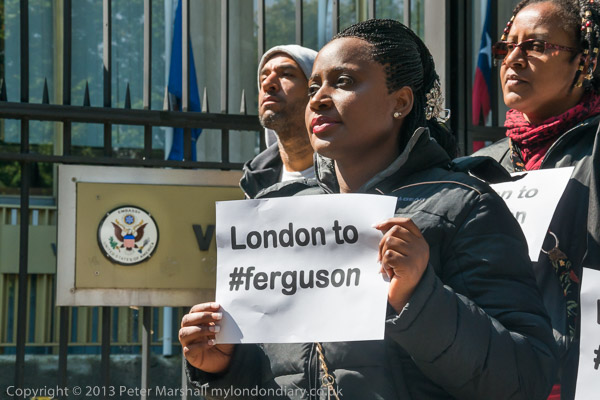
Eventually the rain did slacken and stop, and photographers and some of the people came out from under the canopies, giving more varied opportunities for photography. We were a little too close to the embassy for many pictures to include the US Eagle and flag was too sodden to fly, but there was a small plaque on the gates that I could include in a few images, though it meant stopping down the lens to a rather smaller aperture than I would normally use to get sufficient depth of field.

Fortunately it had got a lot brighter – the sun was out and causing some contrast problems. For the man speaking under the umbrella I had been working at 1/100s f5 (ISO 800) with the 18-105DX lens at 52mm (78mm equiv), while at the same ISO the exposure for those holding the ‘London to #ferguson’ posters I needed 1/500 f13 – at 66mm (99mm equiv.)  I think that means a difference of over 5 stops, though it’s too early to really do the maths as I write.

At the end of the protest, those present decided they would like a group photo in front of the embassy. I’m never a fan of group photos (except perhaps the Brown sisters) and certainly not for groups of this size. Photography always works best (or certainly almost always) on a more intimate scale – if Hill and Adamson had been able to photograph all 457 of the ministers at the First General Assembly of the Free Church of Scotland we would have just had one rather boring photograph rather than the earliest (and still one of the best) great collection of photographic portraits.

And the picture the activists wanted did rather remind me of that ‘Disruption Picture’, except there were rather fewer people and they were far less well organised. It too was impossible to take as the area in front of the large group was crowded with people with cameras and phones in the way. As usual people there were people shouting and gesturing ‘Let’s move back, move back‘ but while photographers might reluctantly respond if they see any chance that others will do so rather than just as usual move in front of them, holding up a phone to take a picture (or worse video) seems to render people terminally deaf and impervious to their surroundings. It really isn’t a licence to walk in front of photographers.

The only way I could manage to get everyone in – if not very satisfactorily – was by working close to one end of the wide spread group with the 16mm fisheye – and then converting the image to a cylindrical perspective to lose some of the fisheye effect. But even with the fisheye I could not get far enough back to take the picture from the centre of the group without people with phones and cameras being in the way.

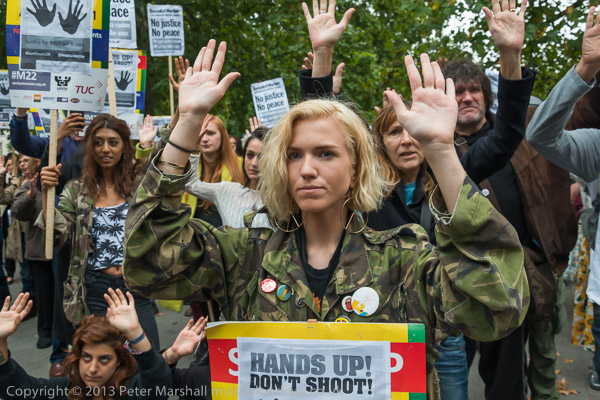
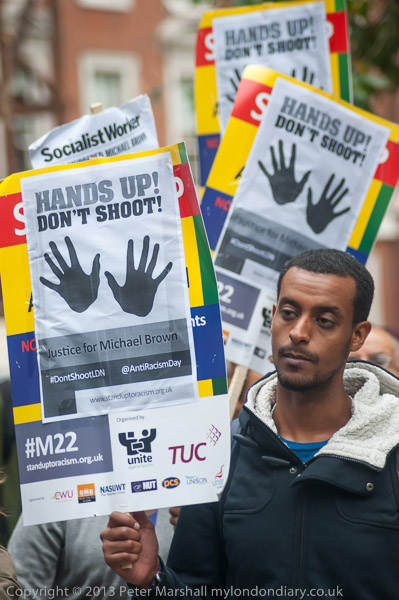
The second protest, ten days later, was held in the evening, and towards the north end of the embassy frontage, in front of the rather dreary statue of Eisenhower. The organisers had produced a graphic poster, two black hands with the message ‘Hands UP! Don’t Shoot!‘ which dominates perhaps rather too many of my pictures, though it was unmissable.

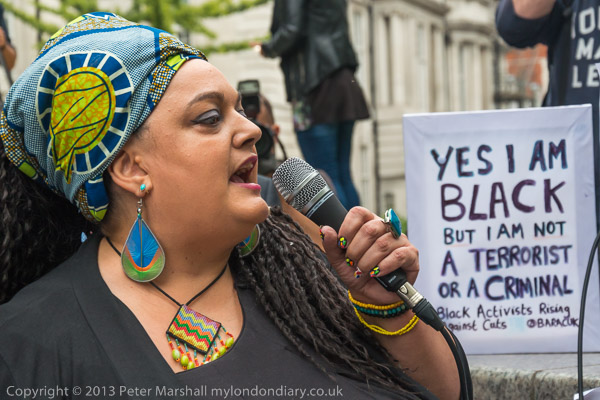
Weymann Bennett is someone I find it hard to take a bad picture of, and there were others speaking that I also like working with, including Marcia Rigg and Zita Holborne, who had brought along a couple of placards of her own.

You can see her other one in another image of her, standing together with Marcia Rigg which is together with a larger selection of pictures from both protests – and text about them – on My London Diary:

Solidarity with Ferguson
Hands Up! Against racist Police Shootings

No Justice, No Peace!

Continue reading London to #Ferguson: Don’t Shoot!

Ozier Muhammad photographs protest for NYT

What attracted me most about the New York Lens blog video showing New York Times photographer Ozier Muhammad taking photographs at the People’s Climate March in New York was that it was showing another photographer working the kind of event that I often cover, though perhaps everything in London is on a slightly smaller scale.

It’s a shame that the video covering the Climate March when I saw it was preceded by an advert for Shell, one of the major companies responsible for climate change, and according to the Greenpeace petitionincreasingly desperate to plunder the Arctic in any way possible. It has recently made a deal with the devil: partnering with Russian oil and gas giant Gazprom to access the Arctic through Russia. If this joint venture continues, an Arctic oil spill is practically inevitable.” The petition as I write has 6,177,332 signatures from around the world and is hoping to reach 10 million. The video has them trying to make them look as if they are trying to save the environment, a prime example of ‘greenwash‘.

NYT videographer Deborah Acosta followed Muhammad who talks about how he works, mainly using a couple of digital Leicas but also a Canon with a very large zoom. I got the impression that neither of the Leicas had a particularly wide lens, and he seemed to like to work from a rather greater distance than I do, with perhaps rather less interaction with the people he was photographing, at least while he was taking pictures, though he was shown taking down some details from them after having made the picture, something I seldom need to do. As a photographer I would like to have seen more detail, but doubtless sharp eyed Leicaphiles will identify cameras and lenses in use.

I was also surprised at the amount of space there was inside the protest. At the London People’s Climate March things were considerably more crowded when I was photographing it.

Also surprising was that the event was covered for the NY Times by “upwards of 5 photographers” – and its perhaps not surprising that given so many of them around trying to file work he had problems. Although there were a lot of photographers covering the London event, I think the vast majority were freelances, and I think our media didn’t really consider the march as a major event. Except for the involvement of a few celebrities I doubt if any of our newspapers would have sent a single photographer.

It’s perhaps a shame that so much of the video is taken up with the problems of transmitting images and meeting deadlines, and I would have liked to see more of him at work, hear more of his comments about his approach and see more of his pictures from the day. You can see more of his work from elsewhere on his own web site, but not those from this protest. There is some fine work from the NATO protest in Chicago as well as other events around the world that he has covered in his more than three decades as a photojournalist.

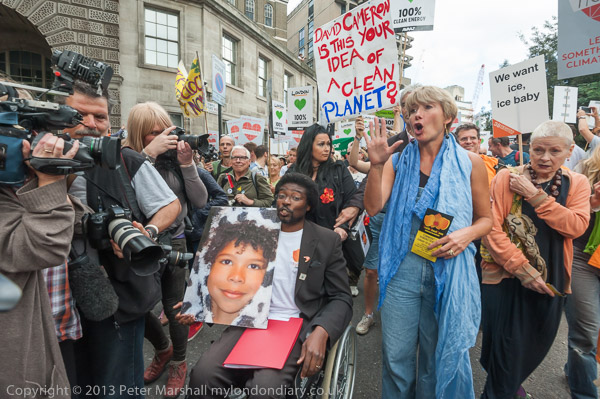
I’ll write more later about my own work on the People’s Climate March in London, but for the moment here is just one image that perhaps shows a rather different view of what it is like to work at such an event – and taking the kind of pictures that our press are much more likely to publish than Muhammad’s more thoughtful work.


Not one of my best pictures – from the People’s Climate March in London. Nikon D700, 16mm

I didn’t go there to photograph this kind of thing, but I was there and thought that I might as well do it. It certainly isn’t one of the best images I made that day, and I had a very limited time as I had another event I strongly wanted to photograph and had to leave shortly after the march began.

Continue reading Ozier Muhammad photographs protest for NYT

No More ‘Page 3’

I’ve never been a fan of The Sun newspaper, and have never bought a copy, though I have leafed through the occasional copy left on the train or elsewhere. It’s always seemed stuffed full of non-news about so-called celebrities and opinionated views lacking any factual basis with only the occasional actual news story, usually given an impressively shallow treatment. To me it’s always been the kind of newspaper that makes it hard to hold the views I have about the importance of a free press. And of course The Sun isn’t a free press, but a press controlled by the interests of one man, the owner of the giant media corporation which owns it. It isn’t about all the news that’s fit to print, but about all that Murdoch wants printed, news or not.

Why Murdoch should want pictures like those on Page 3 printed was simple when the paper was launched; it was a straight-forward commercial decision that he thought it would increase sales. It reflected and reinforced a particularly insulting view of the male working-class audience he wanted to buy the paper. It’s a decision he is now apparently having second thoughts about, as the world has changed since the first Page 3 appeared in 1970, shortly after Murdoch took over the title.  Around 40% of Sun readers are women now, and the No More Page 3 petition has so far attracted over 200,000 signatures.

When I wrote about photography for a living, I used to get fairly frequent approaches from so-called ‘glamour’ studios, asking me to publicise their activities, and sometimes offering me the chance to attend their courses free of charge. Although at times I wrote about photography of the nude (male and female) my response to them was always that I found the photography they promoted of no interest, though perhaps I tried to put it politely. But my objection to ‘Page 3’ is not that it shows part-naked women, but that it trivialises what is something very basic and fundamental to our human condition. Worse than that, I think it is essentially dishonest, telling lies about our humanity.

Frankly too, ‘Page 3’ is boring. That’s not to in any way disrespect the young women involved, but the mould into which they are processed. And in many ways the photographers and others involved in that processing are very professional in what they do. It probably isn’t something I could do – but then I don’t want to. I’d find it hard to live with myself if I did.

Part of the reason why ‘Page 3’ is boring is the near-interchangeability of the models, day after day. Real women are far more varied and more interesting – even if not half-naked – and of course not just, and even to a photographer not largely, for their physical characteristics. Too often women I’m photographing tell me that they “don’t look good in photographs” and I think my pictures of them prove the opposite to the world – if not to their own satisfaction.

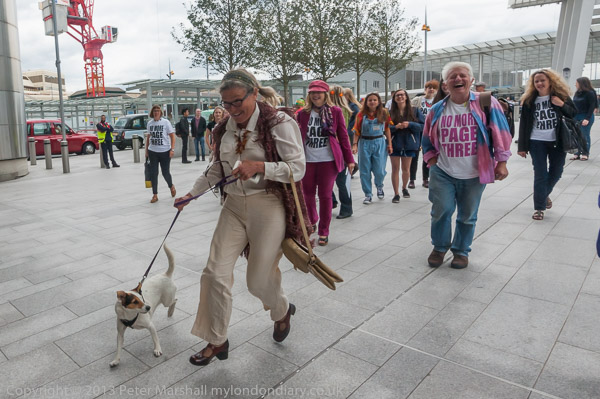
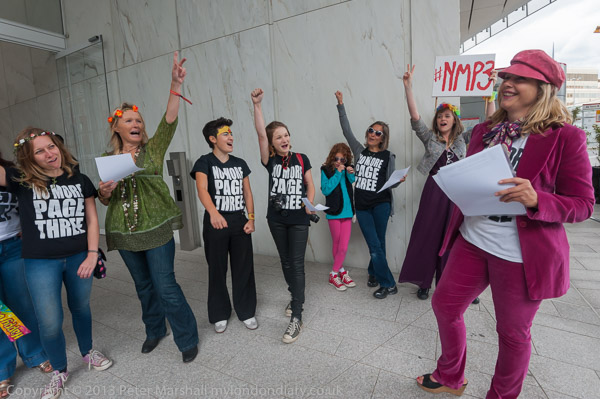
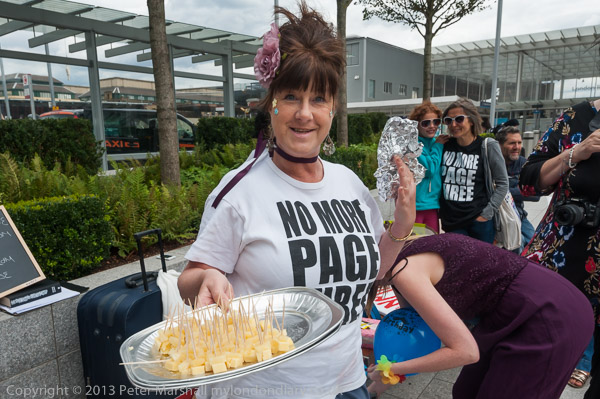
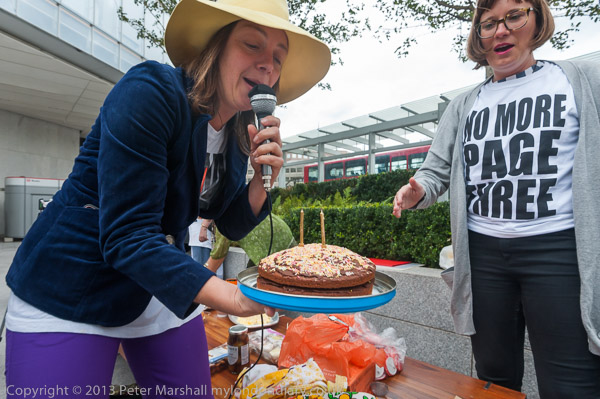
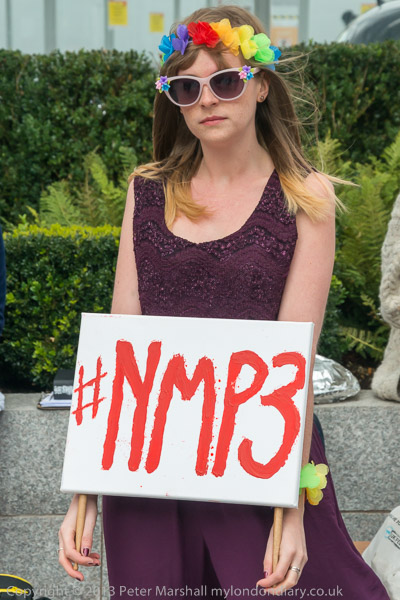
One of the photographers had brought a chalk board for people to write their reasons for being at the event and be photographed holding. I took pictures of some of them holding it too and you can see them in No More Page Three on My London Diary, but I was too busy taking photographs to write my own view at the event.

Photographically the main problem I encountered was wind. It wasn’t a bad day, but a chilly breeze was being generated or attracted by the Shard and the News UK towers, and the candles on the cake for the second birthday of the campaign kept blowing out. I was also in danger of over-indulging in the seventies party food!
Continue reading No More ‘Page 3’

Poor Doors 4

The series of protests outside one of London’s more prestigious (or at least more expensive) new developments is still continuing – after writing this I’ll be getting on the train to go to the twelth weekly event.  Other committments have prevented me from covering it every week, but I’ve managed to get to most of them, and it has been interesting to see how the events have developed.

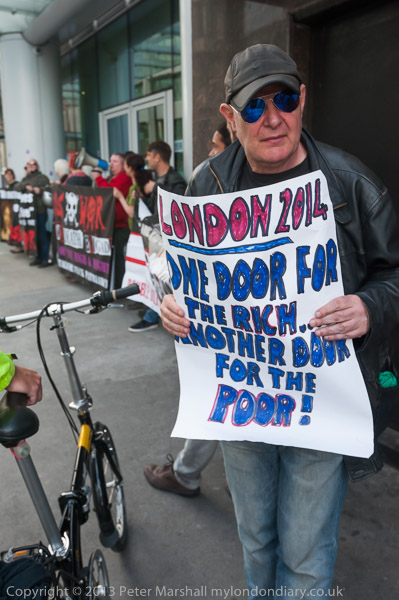
August 20th was the fourth week (and the third that I’d attended – you can see the first and third weeks on My London Diary) and as my headline Class War steps up ‘Poor Doors’ protest suggests, the protests were developing.

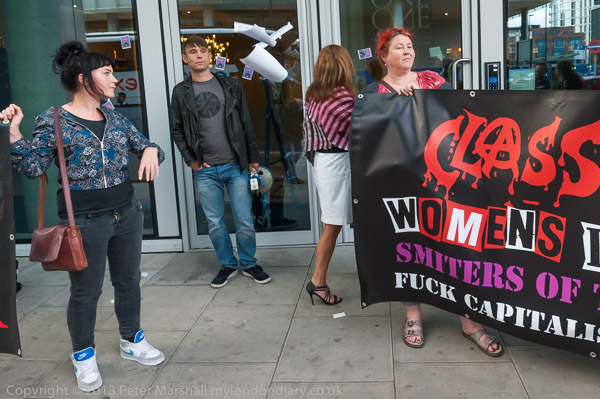
It was just as well that there were some incidents, as otherwise I was having trouble with trying to come up with something fresh each week, as the basic set-up was the same on each occasion. Protesters, banners, stickers, leafleting, the building security…  It really was getting hard to produce new images.


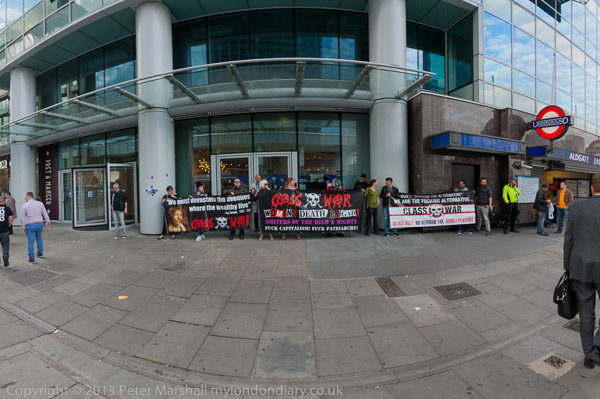
The 8mm fisheye gives an overall view with the three banners in front of the ‘rich door’

At least the banners had changed a little. Class War, the loose group that is behind these protests, has a good line in banners, intended to offend. As I wrote in My London Diary:

Class War draws attention to real and important issues – the gentrification of this and other areas of London and the financially based social cleansing that is resulting. They do so in a manner that is confrontational and theatrical, but amusing and not always entirely literal. Among the banners at today’s protest was that of the ‘Women’s Death Brigade’ with its message ‘Smiters of the High & Mighty’ and ‘F**K Capitalism! F**k Patriarchy!’

Almost everyone would agree that London has a housing crisis. And that little is actually being done about it. Most of the new developments – such as this block, ‘One Commercial St’ (confusingly its actual address is in Whitechapel High St) are actually making the situation for ordinary Londoners worse. As I also write in my piece on the protest ‘Tower Hamlets has a huge list of people wanting housing. The whole idea of building large blocks as investment properties for rich overseas buyers is simply obscene.’

Tower Hamlets council is at least I think doing its best to house its people, unlike neighbouring Newham, a monolithically Labour council. But council powers are very limited and no match for the developers who make huge profits from blocks such as these. The best they can manage are a few crumbs from the table – including the flats here behind the ‘poor door’ in a dingy alley along the side of the building.

You can read more about what actually happened on the evening, and more on the background in My London Diary. When I wrote it, I believed that there was no internal connection in the building between the parts containing the ‘rich’ and ‘poor’ residents, but that appears to be untrue, though I’m sure the door between the two parts is normally kept firmly locked.

But although there were some incidents to photograph, and I think I took some decent pictures of them, it also left me thinking about how much the still photographs leave out, and how easy it is to miss the critical moment.

In photographing this and other protests, I normally try to avoid taking pictures of people who are not really involved in the event, except in the background. Most of those actually going in and out of the ‘rich door’ are tourists staying there on holiday lets, who know nothing about the building and are not profiting from it, and unless they choose to become involved – perhaps by stopping to argue with the protesters – have little to do with the story.

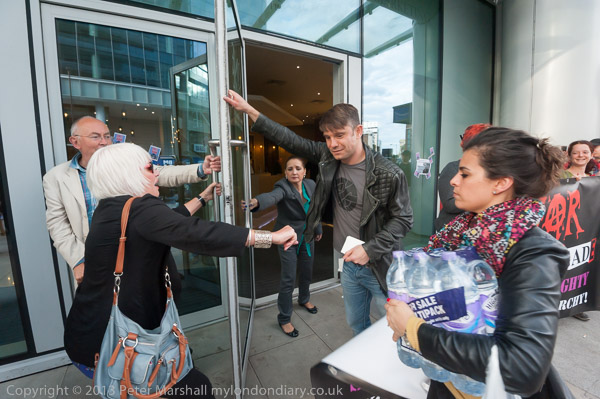
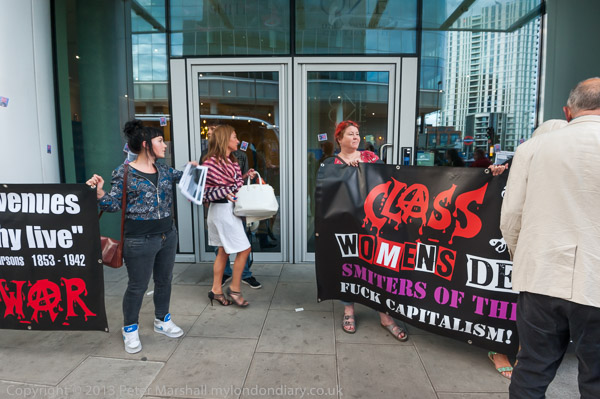
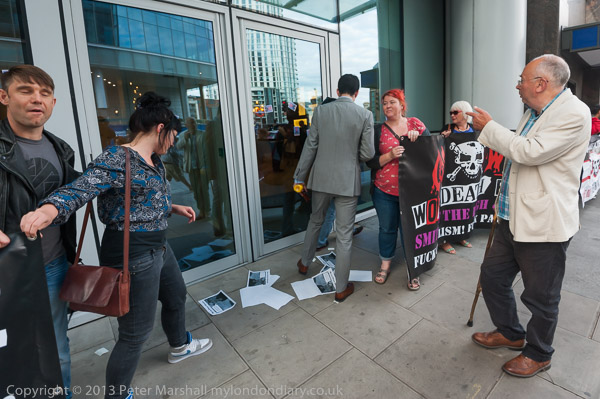
I’m not sure why I took a picture of the woman in high heels and a striped top carrying her white bag towards the ‘rich door’, perhaps just to show that people were still going in despite the protest. But I missed the moment just after this when she turned rapidly and snatched the leaflets from the hand of the woman at the left holding one of the banners, throwing them into the air, and by the time I had reacted she had turned back towards the door and the flyers were actually flying. Had I been taking a movie it would have been an interesting incident. You can tell how rapidly it happened as the papers are still in the air in the second image and the others in the picture have not reacted.

Finally, when someone came forward to hold her end of the banner, the protester moved to pick up the leaflets, as another person – a man in a grey suit – stepped carefully over the leaflets to enter the rich door.

Continue reading Poor Doors 4