Baltimore to Brixton


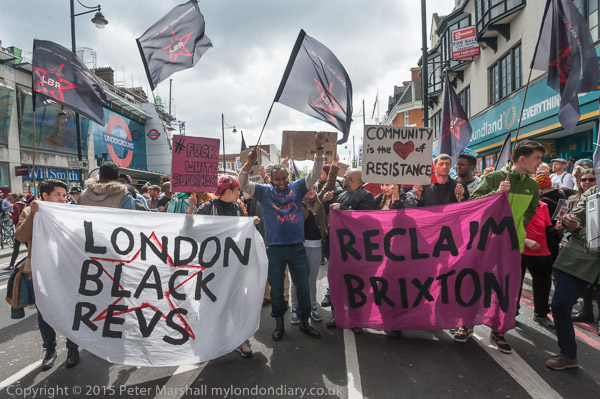
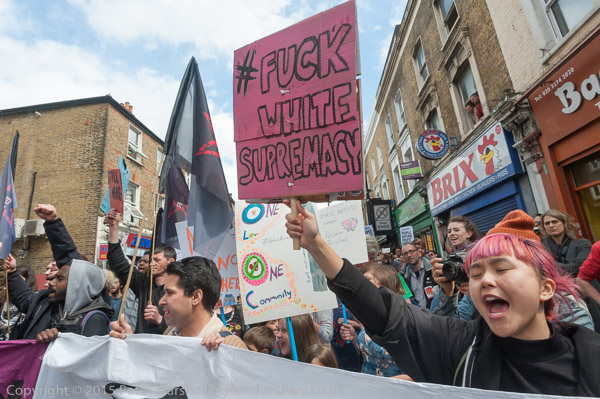
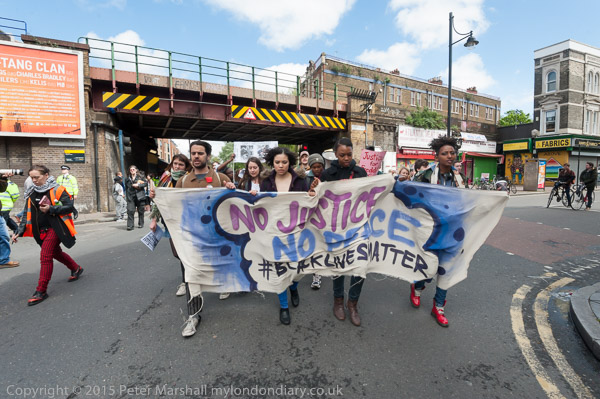
No Justice, No Peace – #BlackLivesMatter banner heads the march: Baltimore to Brixton – Black Lives Matter!

I was back in Brixton on Sunday May 2, for a march protesting after the killing of Freddie Gray in Baltimore and police attacks on his funeral. There had been huge protests in Baltimore, and others in solidarity in other cities across the USA, and this event in Brixton had been called by London Black Revs and other groups including the International People’s Democratic Uhuru Movement and Reclaim Brixton. There was also support from a number of other groups and I’d anticipated a rather larger event than it turned out.

Unfortunately there seems to be a divide between the more mainstream groups and the grass roots movements when it comes to protesting over black issues, and while many on the left are rightly appalled at the events, they fail to turn out at grass-roots organised protests such as this. There have also been internal problems in one of the organising groups which won’t have helped. But it would be good to see the left united on black issues in particular.

I arrived more or less on the dot for the protest, to find only a couple of police officers present in the area, and absolutely no-one at the address given, a property next to a street corner on Coldharbour Lane. I got out my phone and checked. Yes, I was in the right place at the right time. I walked a little way down the road and back again, meeting one woman I know who was also searching for the protest. We walked back to the meeting point and found now three students also looking for the protest.
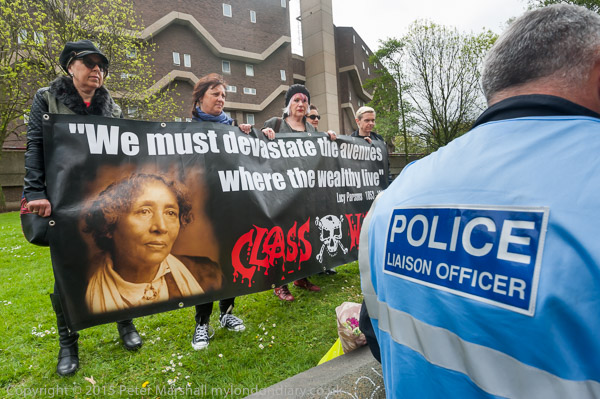
Slowly people arrived in ones and twos, and half an hour later a small crowd had arrived, icnluding a group from Class War with the Lucy Parsons banner. Still there was nothing happening, just people standing around and talking.
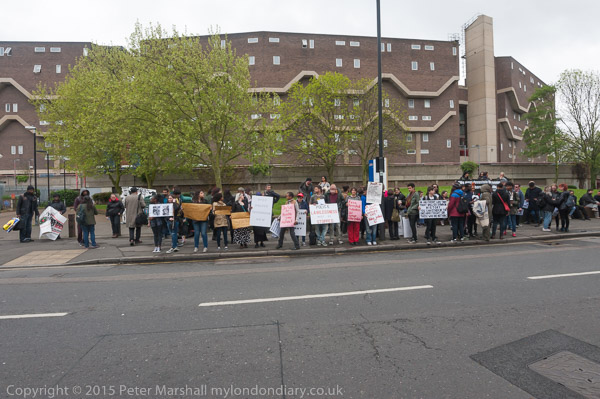

Some agency editors seem to prefer pictures like this.Not me

After a little more than an hour, someone organised people to stand with their banners alongside the curb. The view from the opposite side of the road was rather distant, and I always find such things boring. A thin narrow strip of protesters, the placards and banners too distant to read, and almost half the picture empty foreground. Exactly how not to photograph a protest, though if I were to send it with other images to the main agency that handles my pictures, its odds-on that some idiot editor would displace the image I’d selected as the lead image for the story with it.
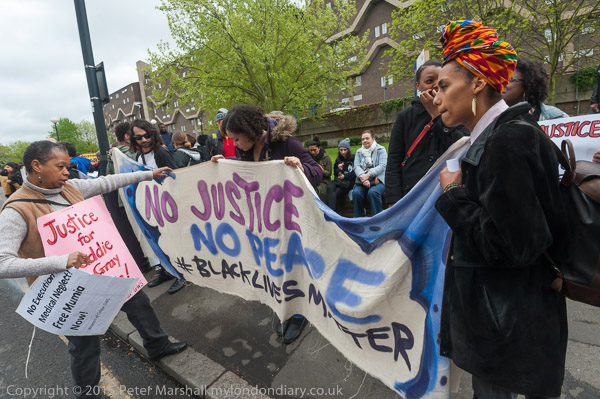
I moved in closer, at some risk from the traffic which was still coming along the road at times fairly densely, and tried to find something a little more dynamic. If there are banners and placards I want them to be legible, and I like a little animation. I didn’t quite manage what I was looking for, but there were several such as the above which were certainly better.

Finally around 75 minutes after I arrived, the march set off, not along the road as I’d expected, but through the centre of that long block behind the people in the view from across the road, going into the Moorlands Estate through the gap in the centre of Southwyck House.

The fairly narrow path here made photographing a little tricky, and I don’t think I did as well as I might; in the centre of the estate the march stopped briefly a little short of where I’d anticipated and climbed on a small raised area, and I had to jump down and rush back, perhaps missing the best of the action there.

The march then came out in front of the Guinness Trust Estate, where tenants and leaseholders are fighting against eviction, and I assumed it would stop at least briefly there in support, again I was wrong-footed (and disappointed) when it turned away and marched on.
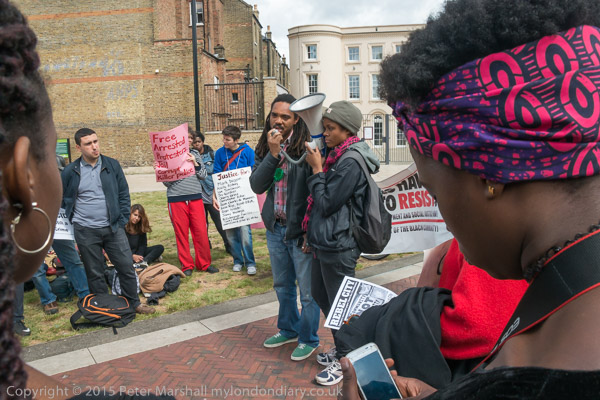
It made its way back past our starting point and under the railway bridge into the centre of Brixton (top image), going on to Windrush Square for a rally. Then it was time for more marching, up on the Brixton Road through the centre of Brixton – still fairly bustling even on a Sunday afternoon.

Again there was a small disappointment for me in that they marched past Brixton Police Station with its memorial tree to the victims of police killings without pause – given the nature of the event and the several speeches that had stressed the similar problems the black community has faced with police here it seemed to me an obvious target for protest – and the line of police outside showed they had come to the same conclusion.

The march went on to Loughborough Rd, marching through the centre of that estate and then returning down Coldharbour Lane – past the start point again and turning down to Number Six on Somerleyton Rd, a short life former kitchen given over to the community on a temporary basis.

The march was to continue from there after an interval there for rest and refreshment, but I’d had enough of walking around – we had already covered around 3 miles and left to catch a bus to Westminster, where I called in briefly at the Occupy Festival of Democracy before making my way home.

More on the march and rally at Baltimore to Brixton – Black Lives Matter!
Continue reading Baltimore to Brixton

Go Jeremy Go


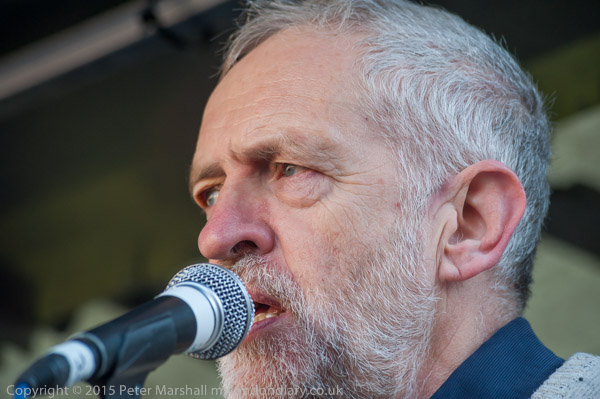
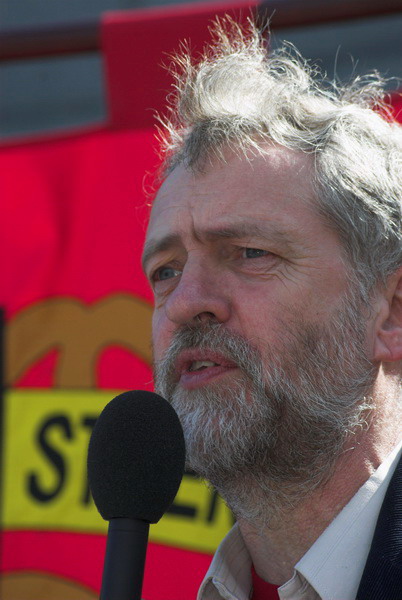
Jeremy Corbyn, 2006

I’ve long ago lost count of the number of occasions on which I’ve photographed Jeremy Corbyn, and listened to him speaking. He’s an unusually good speaker, logical and clear, and even though I’m concentrating on his gestures and expressions I can usually also follow what he is saying. And often, though not always, I find myself agreeing.

If you have been relying on the mass media for your opinion of him, you will think of him as being some kind of left-wing extremist, but I think you would be mistaken. Jeremy is a liberal, perhaps a left-leaning liberal, but one who most of my left-wing friends decry as a woolly liberal. Islington man is nothing like radical enough for them, lacking the support for the deep structural and economic changes they feel are needed to move the country towards true equality and justice.


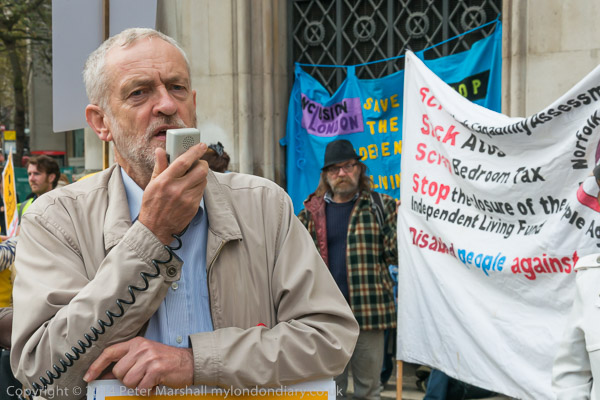
Jeremy Corbyn, 2014

I’m not a member of the Labour Party. I was as a student, but they threw us all out and I’ve never quite felt it worth going back to since. I do belong to two trade unions and am an active member of one, the NUJ, at least occasionally attending branch meetings and making my views heard. Until recently I used to vote Labour, solidly Labour, but I haven’t done so in recent elections. So I’m precisely one of those voters the Labour party needs to win back, though perhaps not a typical one, and my constituency is in any case one of the safest Tory seats in the country.

The only one of the four candidates I can envision doing so is Jeremy. Partly it’s because of his policies and those speeches, but mainly I think because he really isn’t a politician. He’s far too honest and sticks up for his principles; conviction rather than convenience. He’s a man I would trust to leave holding my bike and know it would still be there when I came back and not sold or left unguarded. And I would trust him with our NHS knowing it wouldn’t get privatised while he was busily assuring everyone it was safe in his hands.


Jeremy Corbyn, 2010

Photographically Jeremy can present a problem. A while back I got an e-mail from a young photographer I know asking how I managed to photograph him with his eyes open. He does have a tendency (and I suffer from it too) to close his eyes when speaking in public, and I think is more sensitive than most to bright light. Often you simply have to keep your eye fixed for the moment when his eyes open and react immediately before they close again. That one click zooming in preview mode is vital (its the top of the top ten Nikon customisations in SLR Lounge if you are a Nikon user and don’t know what I’m talking about) so you immediately know if you were fast enough.

Another reason I warm to Jeremy is that clearly he doesn’t take a great deal of thought about how he looks. Most politicians you feel spend rather too long looking at themselves in mirrors, and employing people to improve their ‘image’.  I rather prefer the more natural look to the highly manicured.


Jeremy Corbyn, 2015

The pictures of him that I’ve put in this piece are more or less random images from over the years from My London Diary. I used the search feature on that site (top right of page) and typed in ‘Corbyn’, finding 128 items and then clicked on the first few of them. Most of those 128 pages will include pictures of Jeremy, though I have taken just a few of his brother Piers Corbyn. But those here are really a fairly random selection of the pictures I’ve taken of him over the years.

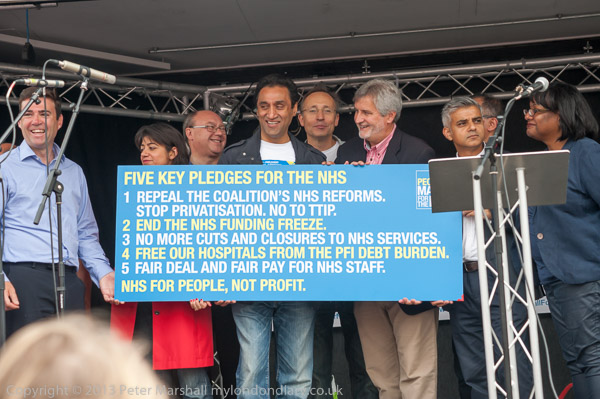
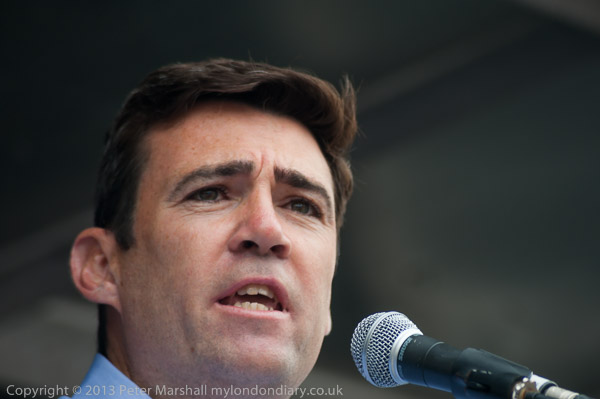
I’ve also a few times photographed Andy Burnham, at the extreme left in the above picture, who would I suppose be my second choice, though I suspect he wouldn’t deliver a Labour party I’d ever vote for. He came I felt somewhat reluctantly onto the stage where other MPs were surrounding a doctor holding the ‘Five Key Pledges for the NHS‘ at the rally ending the People’s March from Jarrow for NHS in 2014.

As I took the picture with him standing a little to one side I couldn’t help wondering whether if the support he was expressing as Shadow Secretary of State for Health would be quite as whole-hearted if he got the real job of being in charge of the NHS. It isn’t a good picture – those microphones were in the way, but I took quite a few more of him at the event both with other protesters and speaking.

I won’t be voting in the election, but will be interested in the result, which the opinion polls seem to indicate will be closer than anyone expected. It would be good to see a future for Labour as a real opposition to the Tories rather than a Blairite Tory-lite.

Continue reading Go Jeremy Go

Reclaim Brixton


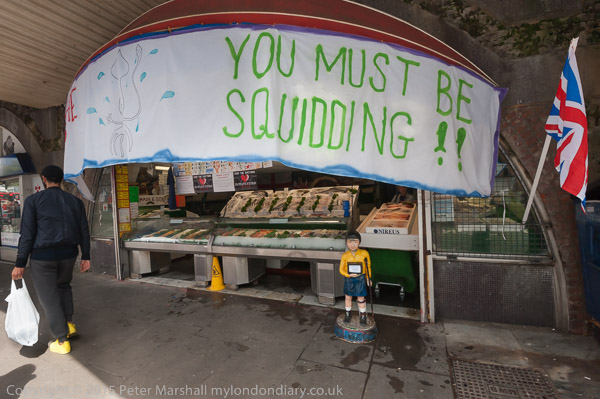
L S Mash & Sons has been in Brixton Arches since 1932. Network Rail are evicting them and the other shops

The final weekend of April was dominated for me by housing and the related issue of gentrification and regeneration. Housing has always been tight in London, particularly for those will little money, and it’s something that has always been an issue. In the Victorian era, philanthropists set up various housing associations and companies to provide housing of a decent standard for the poor and tore down many of the worst slums to build large blocks of flats.

It wasn’t always if ever a fair or comfortable process for those whose slums were demolished, many of whom found themselves out on the streets and had to squeeze themselves into the already overcrowded slums adjacent to the new blocks, but it did provide a great deal of decent living space for the working poor who moved into the new buildings. And there was no doubt that the intentions of those driving the process was good, even if they did also want to provide a sensible return for investors who financed some of the schemes.


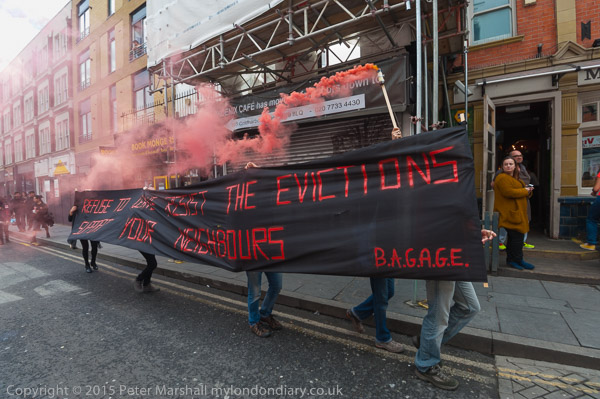
Brixton Action Group Against Gentrification and Evictions banner ‘Refuse to Move – Resist the Evictions – Support your Neighbours’

In the first three-quarters of the twentieth century, the London County Council and the local councils across London took up the challenge of providing decent low cost housing for Londoners who needed to live in the capital where they worked. Many small and large estates were developed across London, as well as new areas on the outskirts and later new towns outside of London. Private developers too built huge estates mainly in the outer suburbs for the middle classes who could commute to work by train and increasingly by car. Huge numbers of housing units were provided at costs which London’s workers could afford, although councils still had long waiting lists of people living in poor or cramped accommodation who wanted to move into council property.

In the last quarter of the twentieth century, things began to go spectacularly wrong. Thatcher’s ‘Right to Buy’ was one of the the first straws, and while providing a huge bonus for the lucky few who got their property at a knock-down price (though many could not afford to keep it long), it was not matched by any attempt to replace the low-cost housing that was taken out of council hands. Other measures actually took most of the housing out of council hands and created housing associations, which in the longer term have also been a disaster for the poor. The final straw has become the building of properties in London simply as investment vehicles for overseas buyers. I don’t think any solution to the crisis can be found unless this is very severely curbed in some way, perhaps by a punitive tax on sales by or on behalf of overseas residents.


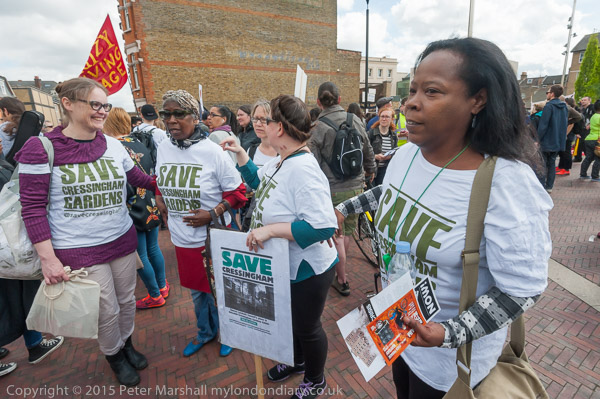
Not only is Lambeth council going to evict Cressingham Gardens tenants, it wants to charge each of the £14,000 for renovations before it knocks their properties down

Regeneration programmes were perhaps brought in by the Labour government with good intentions, but if so these have now been subordinated to profit and greed. Labour councils, realising the huge financial potential of their large well-located council estates for redevelopment began to ‘decant’ those living in prime sites so that they could be developed for private and overseas sale at much higher densities than the well-planned estates that are being demolished. Increasingly developers of these sites are finding ways to avoid meeting any need to include social housing in their redevelopment, with councils (who are mainly under Labour control) conspiring to help them do so.

Gentrification involves more than this, but the cost of housing is a major part in this, along with the changing nature of employment, and of changes in culture. The people who live in ‘up and coming’ areas of London bear the brunt of the process, getting priced out of the market, decanted from council and housing association properties, usually moved well out of the area and away from jobs and friends, and often having to move into private rented property with little or no security and high and increasing cost.

Areas such as Brixton and the Elephant in south London are under particularly high stress, in part because they have long been unfashionable with historically low house prices (for London) but also because of their location, close to the centre of London with excellent transport links. Brixton has the added attraction of a particularly vibrant culture, mainly based around exactly those people and businesses that are now finding they can no longer afford to live there.

The railways run through the centre of Brixton, with Atlantic Road alongside the rail arches and above it Brixton Station. Around the corner a few yards away on the Brixton Road are the underground station and bus stops for the many routes that make Brixton something of a bus hub. At right angles in its centre is Electric Avenue with its incredible street market – and the market also extends in the other direction to the north of the railway lines with more small businesses in the arches there. Running from Atlantic Road to Coldharbour Lane are the arcades of ‘Brixton Village’, increasingly catering for the new, young middle-class that are beginning to take over the area, and there are other arcades to the south as yet less affected.

It’s a unique centre in London, and I can think of nothing like it elsewhere in this country. I’ve been going there occasionally for years, at first to buy cut-price photographic materials – outdated bulk film and paper – and later to Photofusion, where I put pictures in their library and went to exhibition openings.

Surrounding the centre are some areas of Victorian terraces, but also huge housing estates built by the London County Council and local councils, as well as some by the philanthropic housing companies. All these are now under threat, as all could be demolished and rebuilt at higher densities for sale at huge profits. Most of the properties are in reasonable condition, built to higher standards in many respects, particularly size, than new properties, though often in need of some refurbishment. Typically this might cost £15,000 per property, while building a new council flat costs perhaps £350,000.  But flatten the site, build twice as many flats and sell them at market price, perhaps £600,000 gives considerable margin.

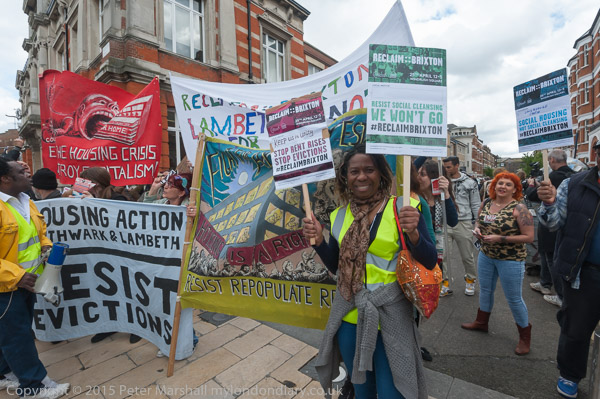
Reclaim Brixton brought together many different groups who see their lives and their culture at risk. The small businesses in the railway arches and arcades, currently threatened by huge rent hikes from the owners Network Rail which will put them out of business. A number have been there more or less since the war, and at least one for longer, but they can’t afford to pay three times their current rent. People living in private rented property where rents keep rising and rooms are getting harder and harder to find. People from housing estates currently under threat of eviction, including Cressingham Gardens and the Guinness Trust Estate, as well as supporters from similar campaigns from around London. And many Brixton residents who see the aspects of the area they love – particularly pubs, cafes, shops and small businesses – being replaced by those catering for the new richer residents moving in to the area.

Much of Brixton’s vitality comes from the high proportion of people who came to live there from the West Indies, moving to Brixton as many from the early arrivals were given temporary housing in the area and they found jobs from the Brixton Labour exchange. It became an area where Africans and West Indians felt more welcome than much of London and the black population grew, opening shops and businesses there. The vitality of the area along with cheap rents (and squats)  attracted others too, both black and white, including many young artists and musicians, some of whom have now grown old there.


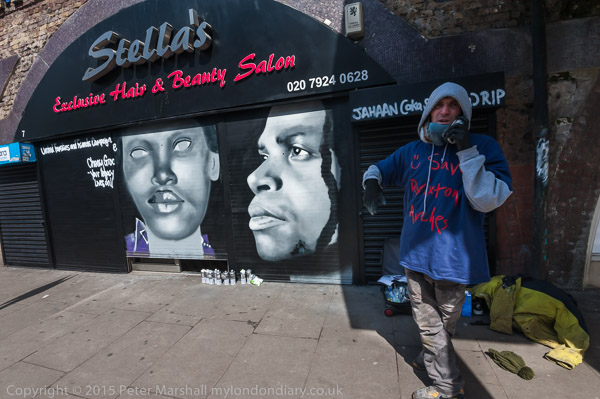
A mural on a shop front in Brixton Arches with images of Cherry Groce and Sean Rigg, just two of those killed by police in Brixton.

It’s hard to understand the events there both on this Saturday and in the past without knowing the background – and there is much more than I’ve written above, particularly for example about the relationship with the police and events such as the ‘Brixton Riots‘ and the various deaths in police custody in the area.

I divided my coverage of the Saturday into four stories, though they are all part of the same story. There should have been another couple of stories, but I went home early. As I stood at the bus stop I thought I would almost certainly miss things happening, but I was tired, and decided that plenty of others were present who would record them. I keep telling myself that I can’t do everything and sometimes at least have to admit my age.

So I went home, fully expecting that things would kick off, that there would be some at least minor friction between protesters, police and authority that was likely to make the headlines, while most of what led up to this and I had covered would somehow not be news.  What did happen – a short-lived occupation of the Lambeth council offices and the breaking of the windows of the most notorious estate agents – was actually rather less than I had expected.

The four stories I sent in, from earlier in the day were:

Brixton Arches tenants protest eviction showing some of the businesses in the railway arches which I think all closed for a couple of hours across the middle of the day as a protest;

Take Back Brixton against gentrification, a planned march from outside Brixton Village to Windrush Square involving mainly groups concerned with housing issues;

London Black Revs ‘Reclaim Brixton ‘march,  a ‘spontaneous’ march around central Brixton involving all the more radical groups and individuals leaving and returning to Windrush Square,

Reclaim Brixton celebrates Brixton, an organised static event in Windrush Square at the centre of the protest with various groups setting up stalls, making speeches in different areas.

Continue reading Reclaim Brixton

Another Busy Saturday

On April 18th I posted 7 stories, though it wasn’t really as busy as that makes it seem, as four of these were really from the same event as it developed over around five or six hours, but it was still a long day for me, and one of those where the ‘logistics’ seemed almost as important as the photography.

At the weekends we have engineering work taking place on the Underground, with some lines being part-closed, and it can make getting around London something of a puzzle to be solved. There is help on-line, particularly through the TfL (Transport for London) web site’s Journey Planner, though a recent update designed to help the casual user and those on smartphones has actually made it considerably less useful for me. The problem is that it can’t be relied on to give the right answer, and that sometimes you really need to ask a slightly different question, or split your journey into smaller parts to get the best results. Recently it gave me a route with three changes taking around an hour for a journey, and I looked at it and thought to myself that I actually knew a rather better answer as the two places were linked by a ten minute trip on a number 10 bus. Which I took instead. Though extreme, this isn’t unusual, though it does sometimes tell me that a journey I want to make is impossible.

It is actually a useful site, but trying to deal with a complex set of networks – bus, rail, underground – and streets over a very wide area that are just a little beyond its capabilities.  Though it can often come up with suggestions that I would not have thought of. One of my reasons for getting a smartphone is that I can also sort out my travel around London using it – though I now find Google Maps more useful that TfL on this.

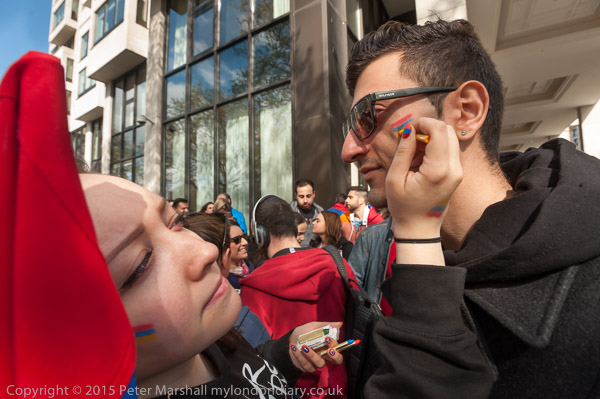
My first problem was simply that the march commemorating a Centenary of Armenian Genocide and a series of ‘flashmobs’ presenting the Football Action Network Manifesto to the offices of the main political parties were due to start at the same time but in different places. Even I have my limitations on that score!  I decided I could start with the Armenians who were gathering on Piccadilly and spend perhaps 45 minutes with them before the start of their march (usually when things are most interesting) then rush to catch up with the football fans who had conveniently published the times that they would descend on the different party HQs. I would have missed them at the Labour Party, but should just be able to make it for their appearance outside the Conservative Party HQ.

It should have been a fairly easy journey on the tube, walking from by the Hard Rock Cafe to Green Park, then one stop to Westminster and another short walk, but the Victoria Line wasn’t working. Given it was only just a mile to Matthew Parker St and I had just over 10 minutes I decided to do it on foot. It was a little warm for jogging with a heavy camera bag, but I made it in time, only to find nobody there when I arrived a minute before the stated time. It was advertised as a flashmob, so I waited, hoping for a sudden appearance as Big Ben chimed twelve, but still nobody came.

I walked on to their next venue, the Lib Dems, 300 yards away and came upon them there, running around half an hour early and took some pictures and talked briefly with them. There were rather fewer than I (and they) had anticipated but they have some interesting views about the game and how fans are let down as big business dominates the game which you can read on their web site, along with the responses they got from the parties to their manifesto.

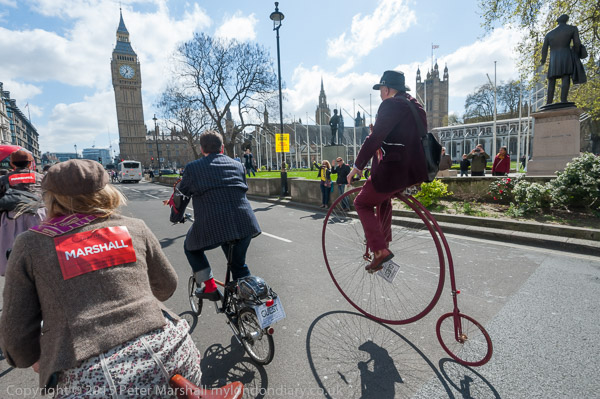
As I was talking with them and hoping to go with them to take some pictures in front of the Houses of Parliament, a group of strangely clad cyclists, some on vintage machines including ‘penny farthings’ stopped in front of use, and I rushed to photograph them. I’d not heard before of the Tweed Cycle Ride, and would not have gone out of my way to photograph it, but when something actually materialises in front of my camera I’ll usually take pictures even if it isn’t really my type of story.  By the time I’d gone with them the couple of hundred yards on to Parliament Square – fortunately they were stopped by two sets of traffic lights – it was too late to go back and take more of the football fans.

Because again I needed time travel. I’d been standing outside the Tory HQ at noon, and that was when the Stop TTIP rally was starting on Shepherd’s Bush Green. Shepherds Bush is four miles away from Westminster as the crow flies, but normally lacking wings I would have taken the Jubilee Line and changed to the Central Line at Bond St. But on this day the necessary part of the Central Line wasn’t working. I’d planned the journey in advance, with TfL coming up with several different routes depending on the exact start time, but it wasn’t quite clear which would be best.

From Westminster I got on a west bound District line train towards Earls Court and I still wasn’t quite clear which way would get me to Shepherds Bush faster. Fortunately my phone could get a signal (it doesn’t on the deep tubes) and I was able to check while travelling that my best choice was to change to the Overground at West Brompton.


Dame Vivienne Westwood makes her second point

It turned out I needn’t have been so worried. Although the event had been advertised as starting at 12.00, the rally didn’t begin until a couple of minutes after I arrived at around 12.40. It was a fairly slow-moving event, with a great deal of audience participation, people discussing the issues around TTIP in small groups as well as coming together to listen to speeches.

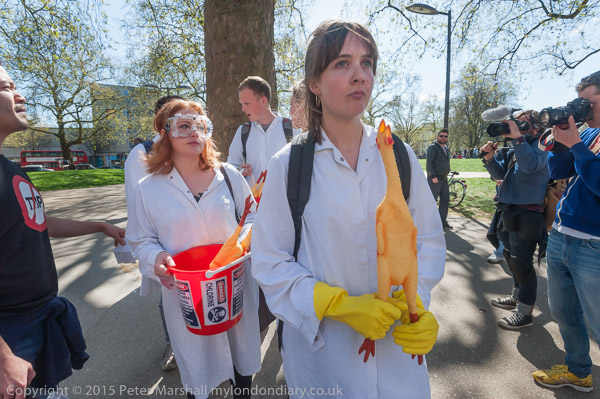
At the rally I was told there were going to be a number of direct actions following from it, and the first was immediately opposite, KFC protest over TTIP. I’d talked with and photographed the group in their white coats before this happened and had something of a lead over the other photographers when they made their way across the road for this, but the very narrow and busy pavement made it a difficult protest to photograph.

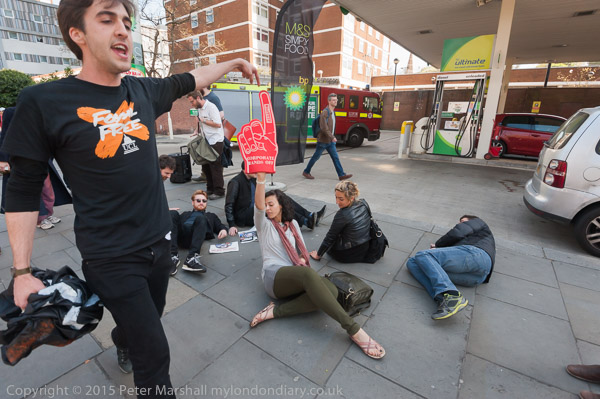
Again, one of the protesters had told me they were about to go across to the other side of the green for the BP die-in against Climate Change. It  was a little déjà-vu, as I’d photographed another protest at exactly  the same location back in 2010 with Tar Sands Party at the Pumps, as well as dancing outside here back in the 1990s with Reclaim the Streets.  I was tempted to leave as this protest finished but again I was told there would be more happening shortly, with a visit to the Westfield Centre coming up.

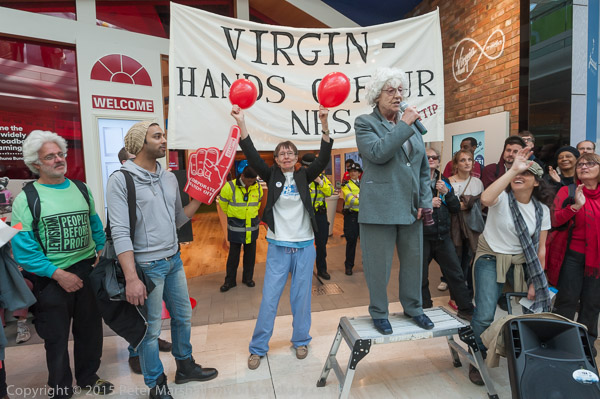
I was a little apprehensive about this. Shopping centres are not photographer-friendly, and security at this particular centre had assaulted both protesters and photographers at a previous protest there. But in the event I had no problems, although at least one other journalist, a demographer, was told he must not film as the Westfield ‘Save our NHS’ protest began outside the Virgin shop.  I’d been deliberately keeping a slightly low profile which was perhaps why I didn’t get approached by security at the same time, and shortly after I think they decided that so many people were involved they couldn’t really stop it. In theory you need permission to publish photographs taken in a private place – which such shopping centres are – but if there is a genuine public interest in doing so then journalists go ahead and do so, with little fear of any consequences. Though often security will lead you away should you try and do so.

By the time this action had finished, I think both protesters and this photographer had had enough, and though there was some discussion of further protests, it was time for me to go home. With seven stories to write up and photographs to edit and send off (and of course a dinner to eat) it would be well after midnight before I finished.

Continue reading Another Busy Saturday

Freedom of Panorama


CETA (TTIP) Trade Deal

Although I’m pleased to hear the news today in Peta Pixel and elsewhere that an overwhelming majority of European Members of Parliament voted to a  reject a controversial proposal that threatened to restrict the photography of copyrighted buildings and sculptures from public places, I’m not convinced that its passing would have made a great deal of difference to most of us.

According to Petapixel, who on June 20th published a report based on Wikipedia’s Signpost, the proposal that “the commercial use of photographs, video footage or other images of works which are permanently located in physical public places should always be subject to prior authorisation from the authors or any proxy acting for them” would have brought all European countries into line with those, including France and Italy where such laws already exist.


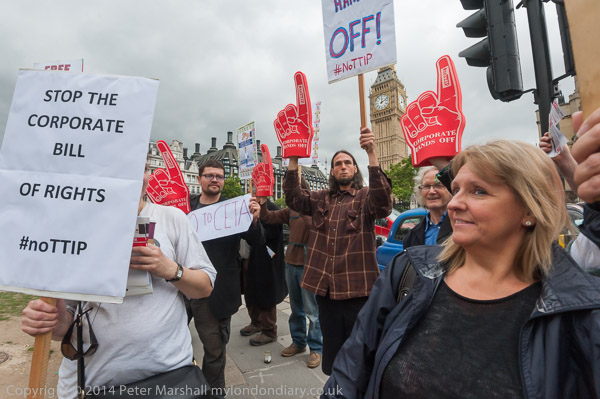
Stop TTIP rally

I’ve yet to notice any great outcry among French or Italian photographers at the problems that they face in photographing in their cities, and certainly I’ve never felt encumbered by this aspect of their law.  Except in the one case of photographing the Eiffel Tower at night, where apparently the lighting is trademarked, and that is at times enforced. And of course there have sometimes been problems related to quite different issues of privacy.

For the same reason, there are also some problems already in London over the London Eye in commercial photography. While these may mean you would need permission to use it as the background for a fashion shoot, it has never prevented the kind of use that Signpost illustrated in a graphic, of the London Eye seen in a wider view of London landscape.


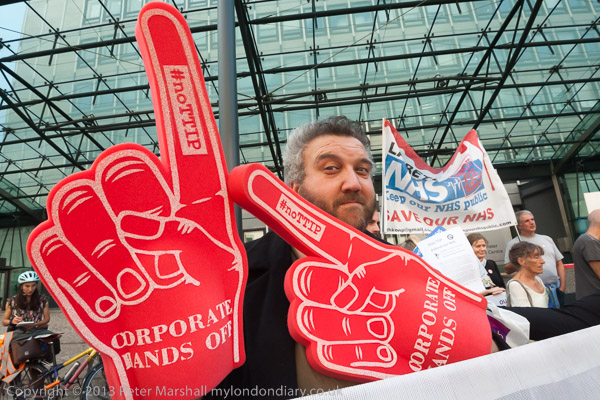
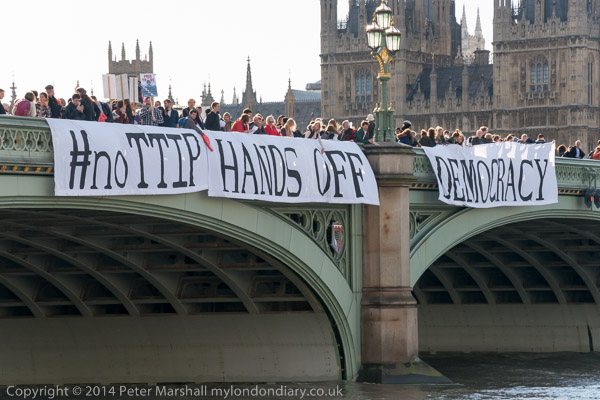
#NoTTIP – Hands off our democracy

Another ‘No-No’ for commercial photograph in London is of course the Underground roundel, again a trademark.  It is almost certainly (at least in two-dimensional form) protected by UK copyright law as also would be billboards, posters, graffiti, murals and all 2D artwork displayed in public. But their incidental inclusion in photographs has never been a problem, and many of us have also published images where murals and graffiti were the main or only subject without comeback.

UK Copyright law explicitly gives us permission to photograph buildings in the public eye, and also sculptures displayed in public. Probably as photographers we are quite pleased that our work, even if visible in public, is still protected along with paintings and drawings.


CETA Trade Deal Threat to Democracy

When I once was one of the volunteers who helped to run a small non-profit magazine covering the visual arts I found a great difference between the attitude of photographers and people making paintings and drawings in regard to the reproduction of their work in reviews. While artists were keen to have their work in print, photographers were sometimes difficult or impossible to persuade – and often requested payment although we were investing heavily in them out of our pockets by reviewing the work.

In a way it’s understandable. In publishing a painting or drawing we were only actually publishing a photograph of a painting or drawing, while in publishing a photograph, you are in effect publishing the real thing. A photograph of a photograph is a photograph.

The outcry against the proposed law included a petition signed by 540,000 people around the world. I’m pleased that the MEPs have rejected it, but sorry that they have so far failed to stop something far more important, passing a resolution on the secretly negotiated EU-US trade deal, the Transatlantic Trade and Investment Partnership (TTIP).

The fight on TTIP is far from over yet, and the vote was passed despite a petition signed by over 2.3m European citizens, who realise, as War on Want Executive Director John Hilary stated, that: “TTIP offers a nightmare vision of a world sold into corporate slavery.” Rather more important an issue than a copyright principle that would probably have had little effect on 99.99% of the photographs we take of cities. Unless you are happy at being a slave who can take photographs.

Continue reading Freedom of Panorama

May 2015 complete at last

May 2015 was an eventful month for me, both personally and in terms of the various events I covered. It was also a month of great political disappointment, that left me feeling very depressed about the future of the country. I was born as the welfare state came into being and grew up with it, and consider it one of the great British achievements of the 20th century. But since 1979 and the Thatcher government we have seen it being attacked; New Labour continued to wind it down, and the coalition took over the process. But now we have a government dedicated to greed and I fear for our future. Britain is becoming the kind of country I don’t want to live in. Though its now perhaps more that I don’t want my children and grandchildren to live in. I’m sad and I’m angry.

Here’s the listing:

May 2015

Mass rally Supports National Gallery strikers
Biafrans demand independence

UK Uncut Art Protest
Walking the Coal Line
Filipino Nurses tell Daily Mail apologise
People’s Assembly ‘End Austerity Now’
Ahwazi Arabs protest Iran’s war
NCAFC March against ‘undemocracy’
NCAFC rally in Trafalgar Square
Disco Boy plays Trafalgar Square
Police arrest man in Trafalgar Square
‘I am Edna’ – protect whistle-blowers
Class War protest Queen’s speech
Cody Dock Opening for ‘The Line’
White pride protest for David Lane
March Against Monsanto
Waiters Day – fair contracts and union rights
Photo London
Walk the City

Cleaners invade Barbican Centre
Silent protest over Sewol ferry disaster
Caged vigil for Shaker Aamer
Victory Rally For Jasmin Stone

Sweets Way & West Hendon at Barnet Council
Grant FGM campaigner Maimuna Jawo asylum
Lyme Disease – Urgent action needed
End Child Abuse, support Whistleblowers
Northern Interlude
We Stand with Baltimore – Black Lives Matter

Occupy Gandhi – stop fossil fuel criminals
Occupy Festival of Democracy
Baltimore to Brixton – Black Lives Matter!
Truth for Zane at Stand Up For Spelthorne
‘Reclaim the Beats’ at ‘Poor Doors’

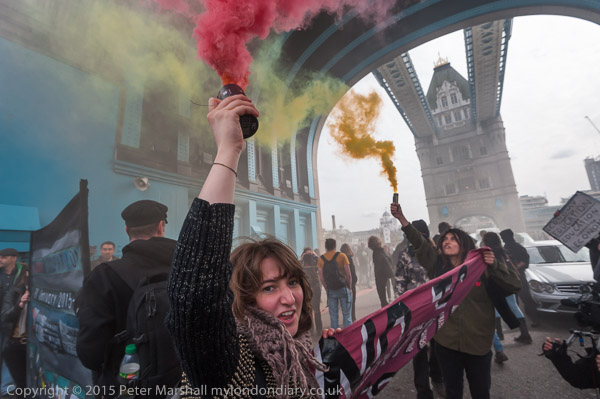
Anti-Capitalists block Tower Bridge
May Day Rally supports National Gallery
May Day march against austerity and racism

Continue reading May 2015 complete at last

Wednesday Evening

April 15th was one of those evenings where a lot was going on in London. Events do often seem to cluster and there are often several days with nothing I feel worth going to photograph and then everything happens at once. Usually its on a Saturday, understandably because most people who go to protests do actually work during the week, or have lectures to give or attend Mondays to Fridays. But this week it was Wednesday. I don’t think there was anything special about this Wednesday, though it was three weeks and a day before the general election.

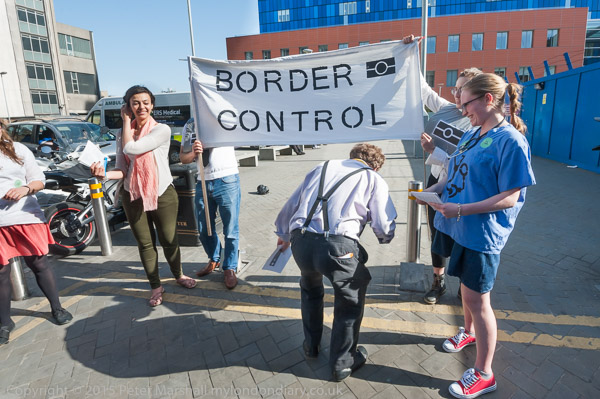
I don’t know why Docs Not Cops chose this particular day to set up a border post outside the Royal London Hospital in Whitechapel against the plans by the Tories to make doctors and medical services check up on the immigration status of patients.  It came at fairly short notice after some details of the plans were announced to charge some migrants for GP and emergency treatment from the 6th April under the  Immigration Act 2014.

It was a relatively small event and was aimed at informing those entering and leaving the hospital, both patients and medical staff, and a number did stop to find out more about the plans. You can see some more pictures at Checkpoint Care – Docs Not Cops. Most medical staff certainly seem to resent the idea that they – like landlords – should be doing the job of border control, rather than treating those who need treatment.

Earlier in the day I’d decided against covering a couple of protests. One, over the sacking of an RMT cleaner for her trade union activities was a little early for me to get there, and would have meant me paying the excessive fares for rush hour travel.  It’s something I’ll only do for very special events, or when (as rarely happens) I’m commissioned to cover an event and can get my travel expenses paid.  I’d like to cover such things, but with the current low fees for the few pictures that are used it just is not feasible.

There was a second event a little later that I could also have gone to photograph.  The day had been designated a global day of action in solidarity with the fast food workers’ strike movement in the US, and Fast Food Rights was organising protests at McDonald’s in cities and towns across Britain, with Unite organising a protest at Marble Arch. Had there been nothing else on later in the day I would probably have gone to photograph this (and perhaps the RMT protest as well, as the two events might just make the extra cost worthwhile.)

But I decided against doing so on this day, as I would then have had nothing to do for around four or five hours in the middle of the day. I could have filled in time – perhaps going to an exhibition or two, perhaps sitting in a pub… Back in my younger days I would have gone and done some ‘personal’ work, but now that would tire me out too much. Working what amounts to a ‘split shift’ like this is now a problem for me, as I live just a little too far out of London to sensibly go home and travel back later.


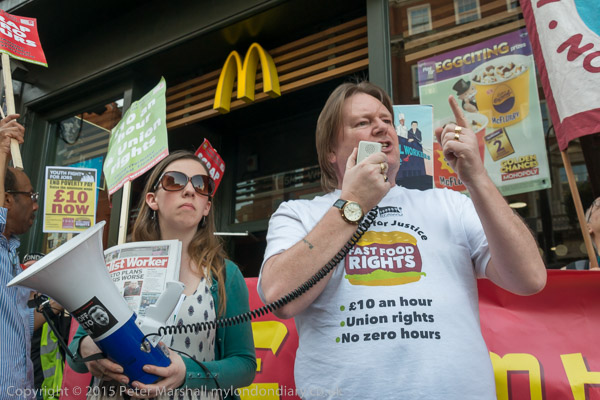
Baker’s Union leader Ian Hodson at McDonalds demands union rights and an end to zero hours contracts

But fortunately  there was another Fast Food Rights protest in the early evening at McDonald’s on Whitehall that would fit in nicely between ‘Docs not Cops’ and a later event. So I decided to cover this rather than the morning protest.

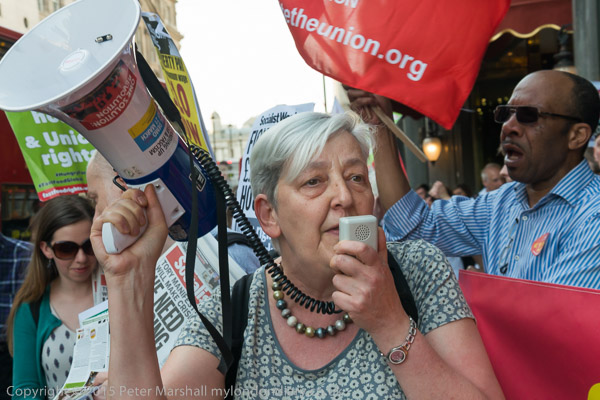
It wasn’t an easy event to cover, because the pavement outside is narrow, and police were continually asking photographers and protesters to move on and keep the pavement clear. They should really have closed the inside lane of Whitehall to traffic with a few cones to make it possible for the protest and the normal heavy pedestrian traffic to keep moving – and make it safer for us all, as well as easier for photographers. But the Met Police almost always seem to make keeping traffic moving their number one priority, only closing or part closing roads when it becomes impossible to keep them open. See more at Fast Food Rights at McDonald’s.

This protest turned out to be a case of two birds with one stone, with striking workers from the National Gallery and in particular their victimised union rep Candy Udwin coming to speak.

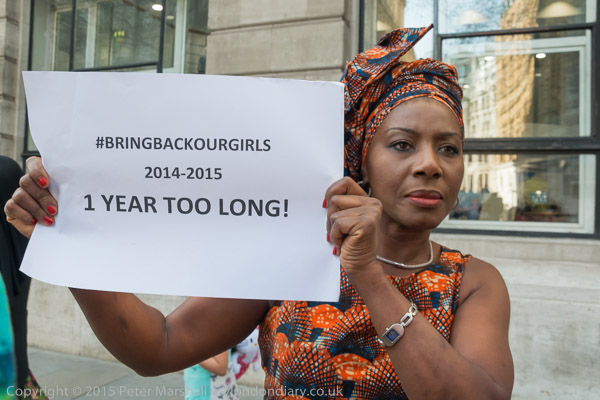
On the way from Whitechapel to Whitehall I’d taken the tube (well at least the Underground – it was the District Line which pedants will insist is not a tube) to Embankment and walked up Northumberland Avenue past the Nigerian embassy, coming across a group of Nigerians, mainly women, protesting on the anniversary of the kidnapping of the over 200 Chibok girls abducted by Boko Haram. Bring Back Our Girls was their message to the new Nigerian government.

I wasn’t surprised to come across another protest I hadn’t known about. Probably more often than not on days I walk around the centre of London I’ll come across a protest by chance – and if it seems interesting will photograph it. There are a few, particularly by fundamentalist Christians, some anti-abortionist as well as by individuals who seem rather unbalanced that I’ll just take a look and walk by.

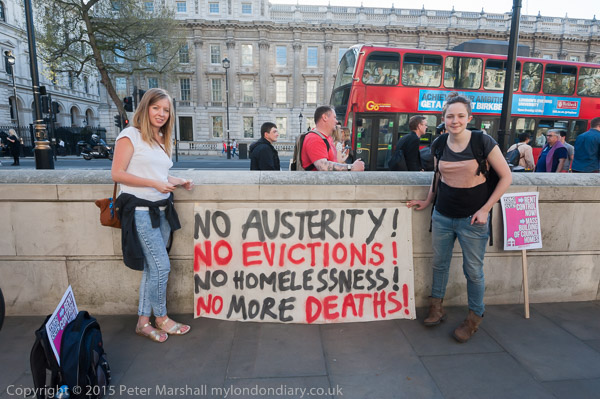
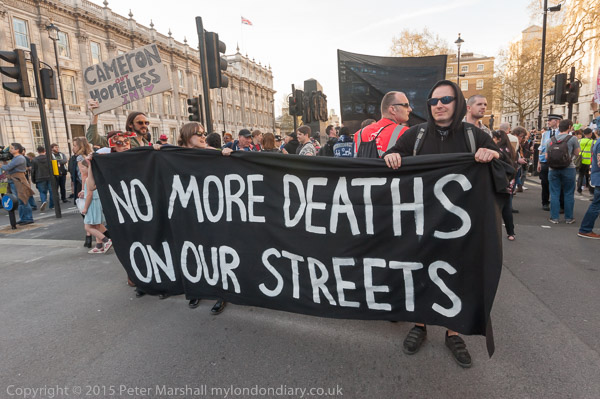
The main event I had actually come up to London to photograph was No More Deaths on our Streets, a protest by people and groups worried by the growing number of homeless people living on the streets of the UK, the removal of welfare support and increasing official persecution. When I was young it was rare to see anyone in London sleeping rough, and I first saw street begging on a visit to Paris in my twenties. It became a growing problem here later, and has increased markedly in the last couple of years.

While many individuals and charities give help to people on the streets, the official response seems to be getting harsher and harsher. By laws to make feeding the homeless an offence, police being sent in to take sleeping bags, cardboard and possessions away from rough sleepers. Measures to move them out of various areas (for example at the time of the Olympics in 2012.)

Homelessness has become more of a problem recently mainly because of the increasing lack of affordable housing in London, and because of the cuts made as government cuts the funding to local councils. London is fast becoming a city for the rich, where those at the bottom are not welcome to live, however necessary they remain to keep the city working.

A static protest opposite Downing St became (as planned) a march around Westminster. After it had gone in a large an seemingly aimless circle, I left it and went home, too tired to continue.

Continue reading Wednesday Evening

Harmondsworth Sunday


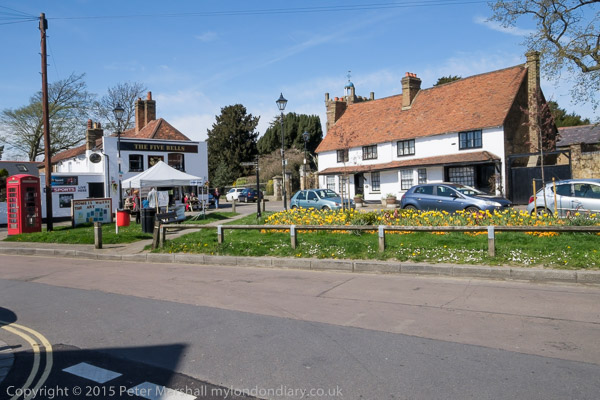
The Village Green at Harmondsworth

The day after I’d photographed the End Immigration Detentionn protest at Harmondsworth’s immigration prison, I got off the bus at the same stop, but instead of walking the few yards towards London turned the other way and took a pleasant footpath alongside the Duke of Northumberland’s River and up to the village of Harmondsworth. It’s a pleasant enough path, but one with a constant reminder of Heathrow, not just in the continual noise from take-offs and landings but also because the path is in the landscaped grounds around ‘Waterside’, the headquarters of British Airways.

The river looks natural now, but was created around 500 years ago in Tudor times to take water from the River Colne at Harmondsworth to the River Crane at Feltham to give a more reliable supply to the watermills on the Duke’s property at Isleworth. Not much else happened to change Harmondsworth until the Colnbrook Bypass was built in the late 1920s, with the Road Research Laboratory set up here (where the prisons now are) in 1930 and a few businesses in the next few years, including Penguin Books, here until the 1990s.

The area south of the Bath Rd changed dramatically after the RAF it took over with the hidden intention of making it into London’s new civil airport after the end of the war. Plans to take over much of the area north of the Bath road were defeated, and aside from a little new housing, Harmondsworth Village remains a small Middlesex village, much as it was when my father cycled around the area before the war.


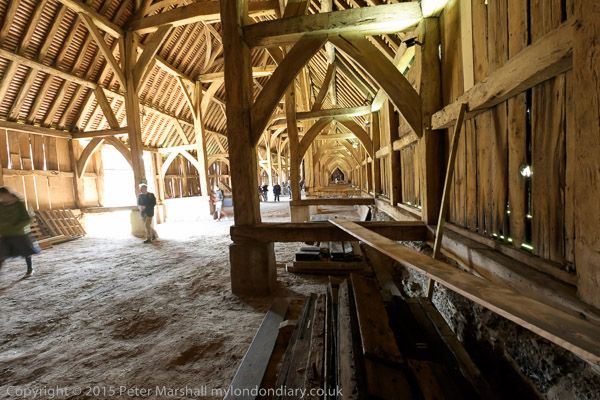
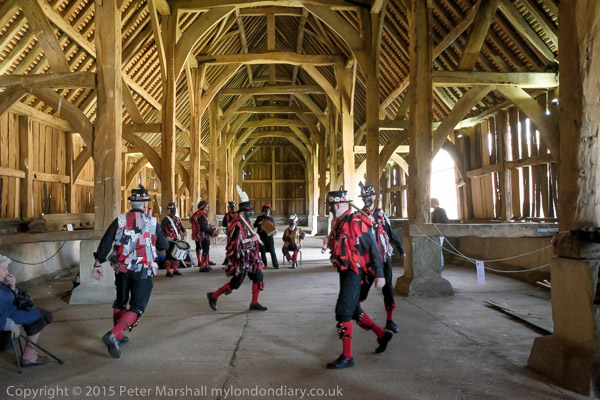
Great Barn interior (image for personal use only)

It has kept its small village green, with a fine church and two pubs (though a third is now a private house.) Take the footpath from the back of the churchyard and across a couple of fields you reach a bridge across the M4, but the fields are still farmed, and just to the west is the Colne Valley Regional Park, with pleasant walks (and bordered by the M25 and its huge junction with the M4.) But most importantly of all it has kept its huge tithe barn, Grade 1 listed, built in 1426 and described by Sir John Betjeman as ‘the Cathedral of Middlesex’ and the largest surviving medieval all-timber building in Britain.


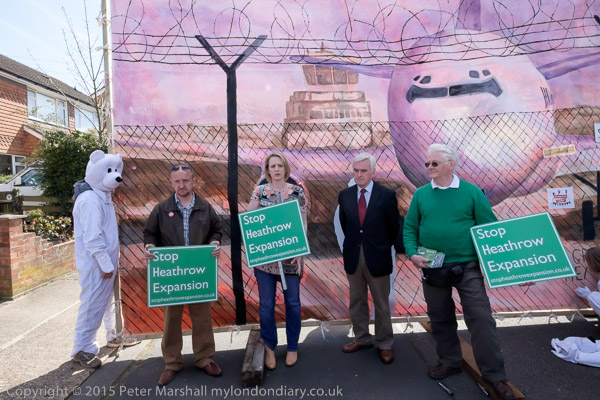
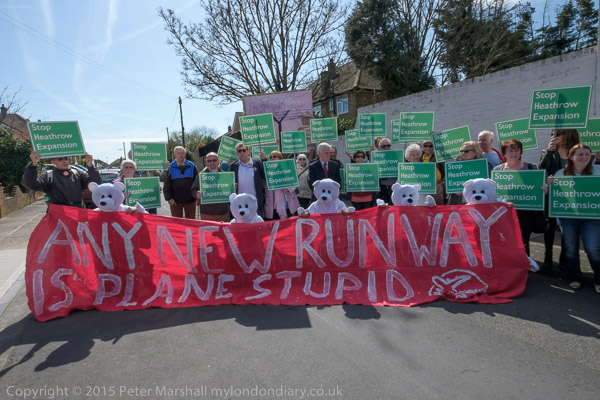
A giant mural where the proposed airport boundary would be, just yards from the Village Green with a polar bear and four general election candidates all opposed to the expansion.

A local campaign led to the barn being bought by English Heritage in 2012 and one of those who led that campaign was local MP John McDonnell (wearing a tie above), who was among those at today’s events, aimed at preserving the area against the latest expansion plans by Heathrow. The report of the Davies Commission was always expected to recommend that Heathrow be allowed to grow yet again, despite that possibility being ruled out a few years ago after massive protests in the area. And even more massive protests can be expected if a further attempt is made. Politically it remains very doubtful if it can ever happen, and perhaps the report will be shelved as have other rather more sensible proposals before it.

It was a very pleasant afternoon, marred only by the feeling of impending doom. I had taken two Fuji cameras, the X Pro-1 and the X-T1 along with a few lenses, and the bag on my shoulder seemed almost weightless compared to the normal load.

It wasn’t however an entirely satisfactory exercise, as I kept finding both cameras were not working exactly as I expected. I’m just not familiar enough with how they work, and it wasn’t until some weeks later that I managed to sort out one or two problems. Somehow I had managed to lock in an incorrect white balance setting on the XT-1, making everything rather pink (though of course I could correct this in Lightroom) and all too often I still find the fastest way to get either camera to respond to a shutter press is to switch it off and then on again. Batteries as always were a problem, and I’ve now disposed of a couple (one genuine Fuji, another a cheap replacement) that  didn’t seem to recharge reliably. But the X-T1 still sometimes seems to run through batteries very fast, and sometimes gets noticeably warm.

I missed a few images when I had to turn the camera on and off, and sometimes focus was just too slow, but most of the pictures were fine. The 10-24mm which I’d recently bought seems to be an excellent lens, as is the 18-55m which I kept on the X Pro-1 all the time.  With the X-T1, as well as the 10-24mm I also took a few images on the 8mm Samyang fisheye.

Photographing the Datchet Border Morris dancing inside the Great Barn did present some problems, with movement and relatively low light levels. The light inside the ban was also very uneven, coming mainly from the large doors and some post-processing was needed to even things out. By increasing the ISO setting to ISO6400 I was able to work wide open on the 10-24mm at around 1/100s, enough to stop at least the slower movements in a wide-angle view – the lens is at around 18mm, giving the equivalent of a 27mm view on full frame.  A faster lens would not have helped, as I needed to use f4 to give sufficient depth of field – and another half stop down would have been even better.  Had I used the 18mm lens at f2.8 the beams would have been noticeably out of focus.

English Heritage have done a fine job in restoring the roof of the barn, which had been neglected for years; it lies just outside the boundary of the expanded airport, but it would be no pleasure to visit should the expansion go ahead (which I think is very unlikely, though it will be a fight to prevent.)  The tiles on the roof have been replaced, the new tiles having been specially made for the purpose to the same pattern as those used previously. Photography is allowed on the site, but only for non-commercial use, and you can see quite a few more pictures of its interior – and an exterior view – at Heathrow Villages fight for survival.
Continue reading Harmondsworth Sunday

Harmondsworth Saturday


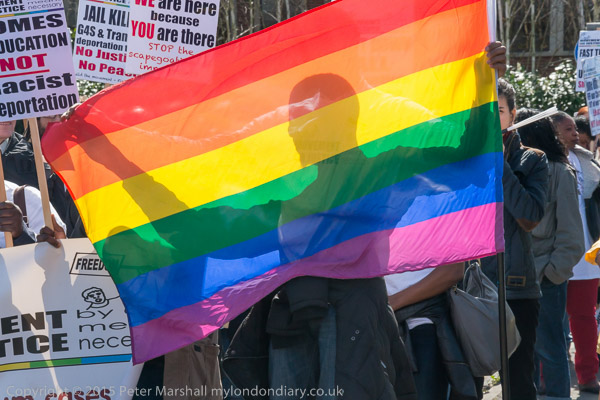
Many asylum seekers come to the UK from countries where being gay can be life-threatening

Harmondsworth isn’t far from where I live, but it isn’t a place I visit often, but in April I found myself there two days running.

I don’t avoid it because of the place itself, but the journey there is off-putting. As a kid I used to cycle there along back lanes in the Middlesex countryside, from Cranford, a short distance from where I lived. But sixty years later things have changed rather, mainly because of the impact of Heathrow and the tremendous amount of road traffic that this generates, which new roads like the M25 and M4 have also added to.

Now I live a little to the south and the route between reservoirs and around the side of the airport is along unpleasantly busy roads and dangerous junctions, large roundabouts with with lorries revved up from or anticipating the motorway. I don’t often cycle that way. Fortunately there is a bus which, having made an extensive tour of the suburb to the south of Heathrow makes its way from Terminal 5 to Heathrow Central and will drop me off just a few yards from the immigration detention centre, where protesters were arriving to call for an end to immigration detention.

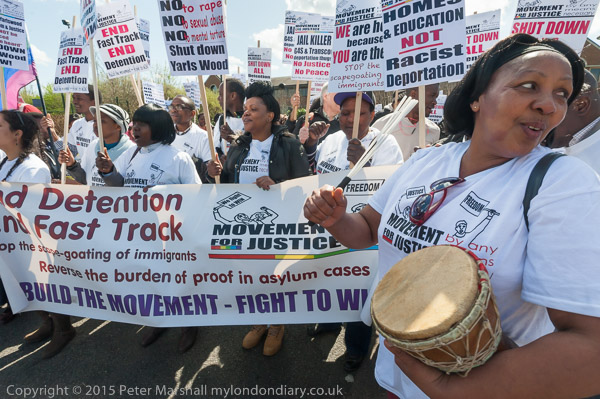
Most of those coming to protest there have a longer journey, from central London to the end of the Piccadilly line for another bus, or by coach from Birmingham, Sunderland or even Scotland. For many it is still a short and easy journey compared to coming to this country, for many of those taking part in the protest are asylum seekers or those who have been granted asylum here. Many have suffered being held in detention centres like Harmondsworth (now renamed Heathrow Immigration Removal Centre) or Yarl’s Wood, imprisoned with no fixed length of sentence and facing the treat of deportation at any time to the countries where they left to escape persecution.


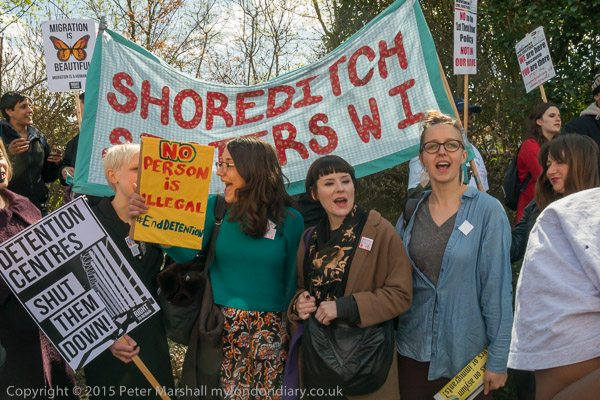
Support for the protest from Shoreditch Sisters WI who call for an end to immigration detention

The name is significant. This is an ‘immigration removal centre’. It isn’t concerned with investigating the truth of their claims for asylum, but intent on removing these people from the country. Our immigration system starts from the assumption that they have no right to asylum, and locking them up makes it harder for them to prove their case, while the fast-track system recently found to be illegal by our courts ensures they don’t have time to do so. The whole thing is a travesty of justice, a turning upside down of the rights we see as the cornerstone of our legal system.


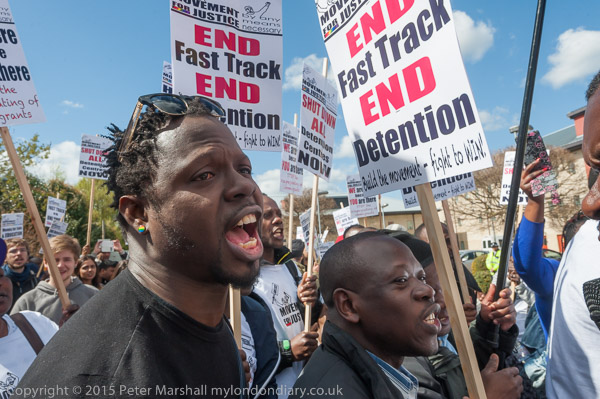
The protesters aim to make a loud noise so the prisoners inside can hear that people care about them

The fight for an end to detention and fast track and for a proper and just system for migrants to this country has been led by the Movement for Justice, a group which grew in the 1990s after racist attacks in London, organising protests against fascist groups, deaths in custody and racism. This protest was one in a long series against our racist asylum and immigration system, now going back twenty years. The event in April was the seventh in a series of protests there (some months their have been protests at Yarl’s Wood instead) since the Movement For Justice began a new campaign around a year ago in solidarity with a mass hunger strike in the prison.

The two immigration prisons at Harmondsworth (Harmondsworth and Colnbrook, now both run by Mitie as Heathrow) stand on either side of a short private road leading from the main A4 which runs along the northern edge of Heathrow. The whole site is government property, having been long ago the site of the Road Research Laboratory. Except for a range of tall buildings along the front of the site, the prisons are enclosed by a very tall fence and at some earlier protests, the protesters were allowed to walk along the track around this. Since Mitie took over running the prison at the start of the year, organised protests have been confined to a pen at the front of the site, with police and security present to ensure they stay there.


Shouting “Detention Centres, Close them Down” in front of the Harmondsworth Administration block

Photographically the event and its problems were similar to those I wrote about at the end of my post Surround Harmondsworth 6, and I’m afraid the pictures are perhaps rather similar too. It’s difficult to think of an entirely different way to approach the event, though the liveliness of the protesters makes them a delight to photograph.

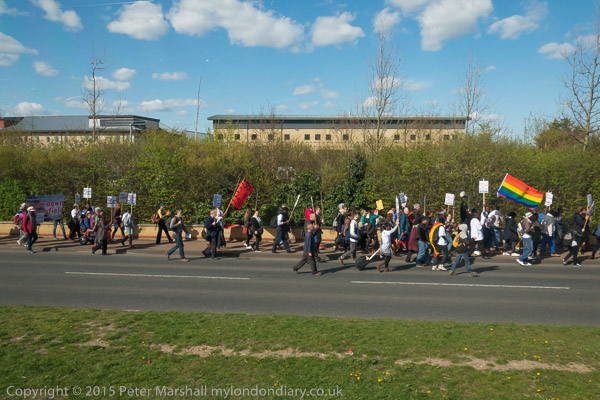
Although the protesters still had plenty of energy after a couple of hours of shouting and dancing in the warm April sun, I got tired and decided to leave, keen to get on with processing and then uploading the story, and I crossed the main road to catch a bus. As I climbed to the top deck ten minutes later, I looked out of the window and saw the protesters emerging on to the main road, and marching along.


Protesters march along the Bath Road in front of Harmondsworth (left) and Colnbrook immigration prisons

(It isn’t a good picture, and the bus windows were none too clean and with a slight tint and as well as the normal reflections there was also some odd colouration like ‘Newtons Rings’, all of which I’ve worked to reduce.) It was too late to jump off the bus and join the marchers (the next stop is a mile or so away in Terminal 5 and the service infrequent) but had I known this would happen I would have sat down to rest and waited. They were on their way to protest at the back of the Colnbrook prison where a public footpath runs to a park and then on to Harmondsworth village, and I was sorry to have missed it. I should have checked with the organisers before leaving and had failed to do so.

More on the protest and more pictures at End Immigration Detention.
Continue reading Harmondsworth Saturday

Police and Protest

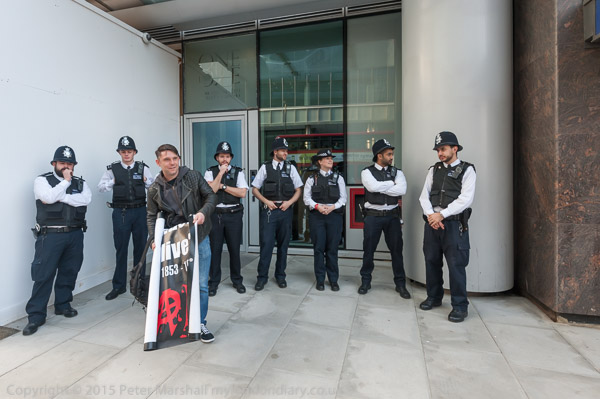
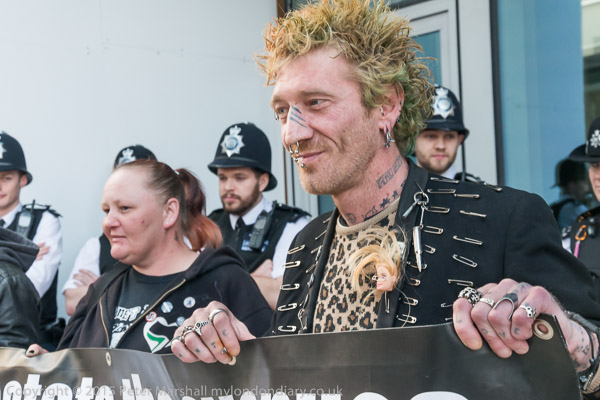
Police seemed almost pleased to see Class War as they turned up for the weekly protest outside the ‘rich door’ of One Commercial St. In general these events are a fairly easy and straightforward part of their job, just standing around in front of a doorway, and the protesters are generally little problem. The door wasn’t in use, and the entrance foyer seemed empty and in darkness; presumably the wealthy residents had been told to leave and enter by another route, perhaps through an interconnecting door with the hotel or another of the businesses with a ground floor entrance on one of the three roads around the block. Not however through the ‘poor door’ in the alley, although they can normally enter or exit through this if they choose. At least one resident uses it when walking her dog!
The protesters provide the police with a little entertainment – and sometimes a little fairly gentle ribbing, reminding them they are class traitors, protecting the interests of the ruling class who have, the protesters remind them, been attacking police pay and conditions.

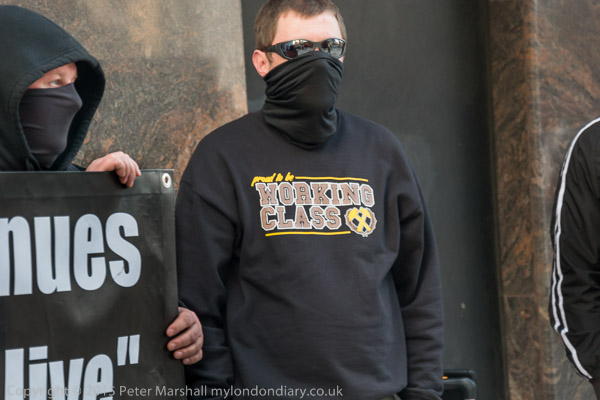
One of the protesters was wearing a sweatshirt with the message ‘proud to be Working Class‘ and the protesters appealed to the police to be proud of their class origins and come and join them in the protest, but it surprised none of us present they did not take up the offer.

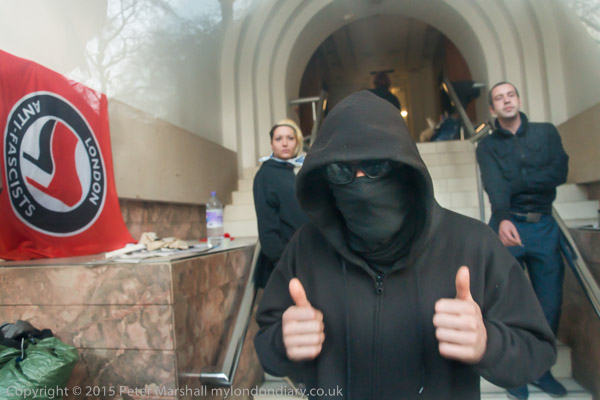
The officers were perhaps disappointed when the protest ended early – as one of the organisers pointed out they would get less overtime. But Class War had received a request for support from the two groups, Squatters and Homeless Autonomy and Autonomous Nation of Anarchist Libertarians, occupying some offices in St James’s Square, empty for some years after having been used by the Institute of Directors, who were being illegally harassed by bailiffs, and I was invited to accompany a group of them who were making their way there.

The laws on squatting are quite clear. In non-residential properties trespass is not a criminal offence, and there are proper procedures that property owners should employ to regain their property, including going to court to get a possession order.  Usually these give squatters 24 hours notice to leave, after which staying in the property is a criminal offence, and police can aid bailiffs in a properly managed eviction.

Other laws protect the rights of occupiers of property (whether squatters or not) giving them the right to leave and enter the property. There are also laws against assault, and governing the actions of security guards.

Clearly when we arrived, several of these laws were being broken. People were being prevented from entering the premises by men dressed in black. And by not wearing visibly their SIA licence these security guards were committing a criminal offence under the Private Security Industry Act 2001 which should result in their losing their licence; it’s an offence punishable by up to 6 months in prison – nd/or a fine of up to £5,000. When people attempted to enter, they were also clearly being assaulted by these men.

As in many other cases, the police generally seem to be choosing not to apply the law against these illegal activities by security guards, employed by companies that boast of being able to get around the delays of legal evictions. The same company that these men were working for have also been employed by Southwark Council to work in a similar illegal fashion on the Aylesbury estate.

The police (or their political masters) should not be allowed to chose which laws to enforce and which to ignore in this way. On this particular occasion, Class War were able to help the protesters to persuade the police to act, if only in a fairly desultory fashion. The officer who eventually turned up – I think following a complaint by someone from Class War did listen to the protesters and did make some attempt to sort things out, but was unable to get the security guards to comply with the law. There were no arrests, no people facing prosecution for their illegal actions, but eventually the security firm was persuaded to call off their action after getting a phone call from the police station. They left smiling and returned the following morning to illegally finish the job with the help of police.

When it comes down to it, we do have one law for the rich, which generally overrides the interests of the 99% and the niceties and fair dealing that Parliament has decided in its legislation.

It isn’t always easy to photograph at events like this. There are people who don’t trust the media and their lack of trust is unfortunately often well-deserved, with protesters often being treated very unfairly in print and on screen.  Though it’s normally by editors and journalists who were not at the scene rather than by photographers. But I had been invited by some of those present, and knew a number of the others present, at least slightly, from other protests that I’ve taken pictures of, and had few problems.  The protesters too had the law (if not the police) on their side, and it was others that were breaking it.

I’d set both cameras (Nikon D700 ande 800E) to ISO 3200 on the tube journey, as the light was beginning to fall outside, and when I started taking pictures, I was getting exposures around 1/250 at f8; by the time I left it was down to 1/30 f3.5, and it was getting too low to work sensibly as people were moving. I don’t really have any fast lenses for the Nikons, partly to cut down weight; nothing faster than f2.8, and the only f2.8 lens I had with me was the 16mm fisheye, which I didn’t use. The 16-35mm is an f4 lens and the 18-105mm is f/3.5-5.6, getting rather slow at the longer end. Towards the end of the time I was there I was feeling the lack of something faster. I had some problems with subject movement during the few scuffles too, with shutter speeds of around 1/125 causing some images to be blurred.

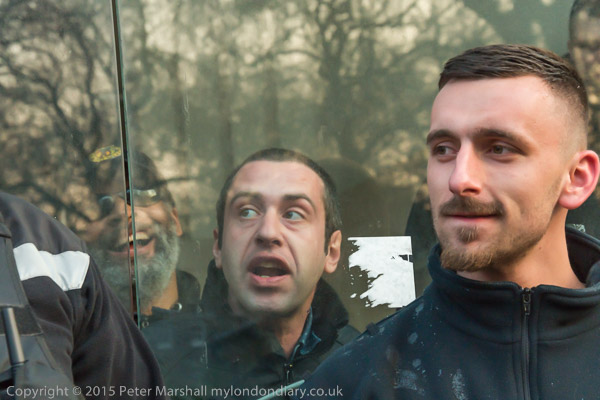
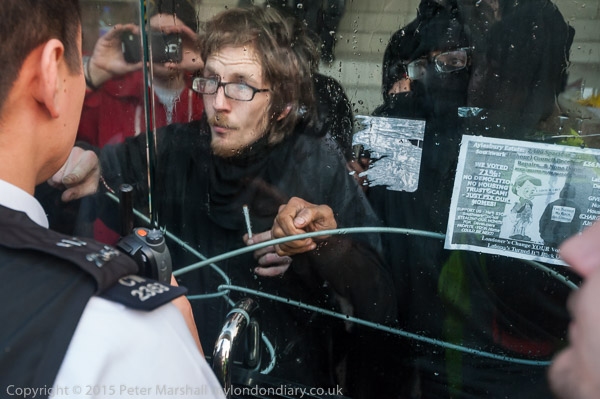
One problem – but also something that made many of the pictures possible, was that the doors which were being blocked were glass. It meant I could see through them, but also that at times reflections in them limited what I could do.

Photographing the people inside them through the glass was possible, but the glass was rather dirty – the building had been out of use for some years – and also got wet in places when some water was thrown from an upper balcony.

The light fell off very rapidly away from the doors inside the building, but I was able to take a few pictures with the lens held close to the glass to avoid reflections, using a hand to block some of them.

More pictures at Class War keeps up Poor Door protests and Illegal Security blocks St James occupation.
Continue reading Police and Protest