Summer 2015?

Today it really seems summer is over. The rain stopped and I went out in the sun, getting a little hot in my jacket to buy something to bring home for lunch, thinking it would be nice to sit out in the garden and eat it with a glass of wine, but by the time I got home, dark clouds filled the sky and there were a few drops of rain. And it was dark by 8 o’clock.
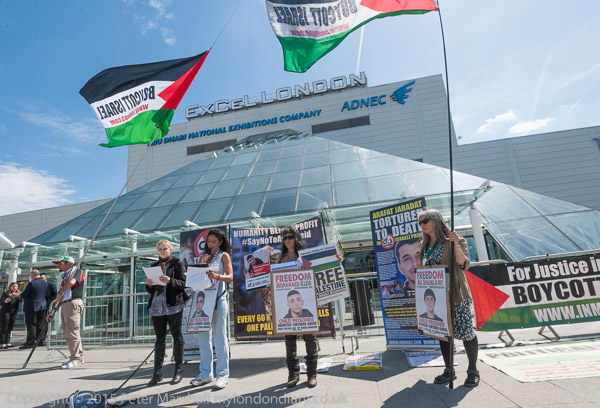
Looking back we hardly seemed to have had a summer at all, but there were a few good days, and one was early in June, when there was a protest in the morning at the Excel Centre in East London, where G4S had chose the UN International Day of Innocent Children Victims of Aggression to hold their AGM. Actually like me they probably didn’t know there was such a day, but it was established back in August 1982. And though it’s an international day and relates to all children around the world, it was established because the UN General Assembly, meeting in a emergency special session on the question of Palestine, was “appalled by the great number of innocent Palestinian and Lebanese children victims of Israel’s acts of aggression“.
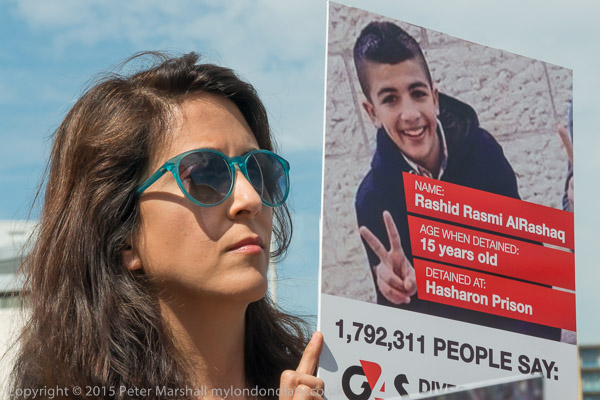
Unfortunately the UN General Assembly’s resolution 33 years ago appears to have done little to change the situation for Palestinian children, and the protest was aimed at G4S because of its involvement in running the Israeli prison system in which young Palestinians are held, sometimes in solitary confinement in underground cells, are threatened and sometimes tortured. There are regular protests outside the G4S HQ in Westminster which I’ve occasionally covered, but the AGM brings together a wider range of organisations comprising the StopG4S coalition to protest, not just about their work in Israel but also in this country, where they are best known for their failure to provide security at the London Olympics and the death of Jimmy Mubenga during his forcible deportation. They currently run five UK prisons as well as a young offender institution and secure training centres and “is the main provider of in-country escorting, overseas repatriation services, and the operator of four of the eight of the privately run immigration removal centres in the UK.”
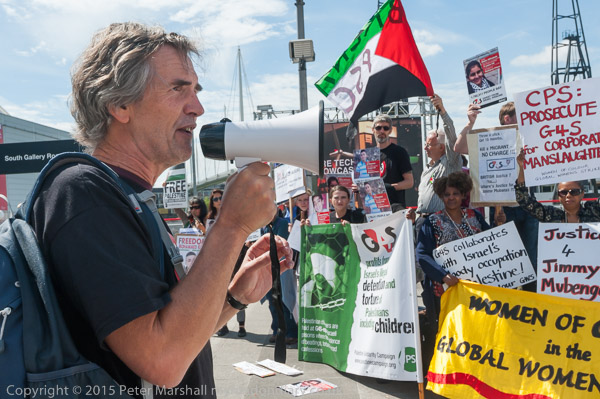
Although there was plenty to photograph outside, with protesters from the various groups, much of the protest takes place inside the AGM, where protesters purchase shares to entitle them to attend. When they ask awkward questions or otherwise protest inside the meeting they are removed, sometimes rather forcefully, by security staff. After the bad publicity following the publication of a mobile phone video taken of this at last year’s AGM, mobile phones were not allowed to be taken inside at this year’s events – and I certainly had no chance of taking pictures there.
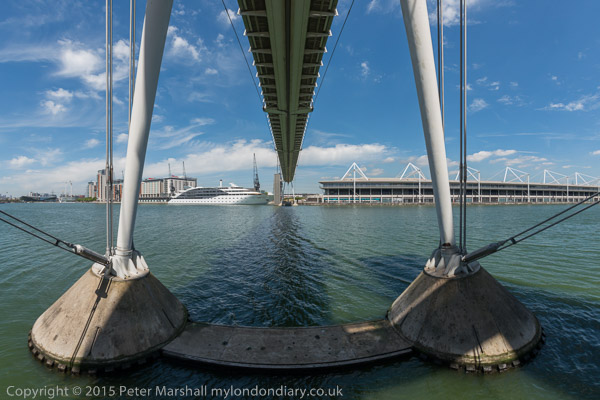
But it was a fine day, and the protests had started early, and by 11.50 I felt I’d taken enough (though looking back at G4S AGM Torture Protest I think I could have done better) and had the rest of the day to myself. I started by going over the high-level bridge across the Victoria Dock next to the Excel Centre, then walked around the dock to photograph the three sculptures there as a part of The Line – Sculpture Trail.
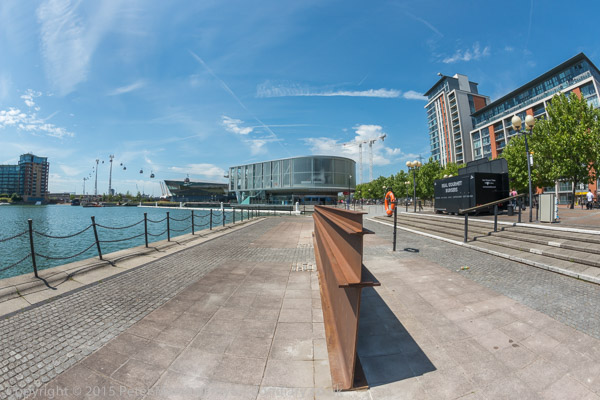
It was an experience that left me under-impressed. The docklands cranes, the high level bridge and the cable car all seemed rather more interesting than the sculptures, with the only work of the three there really having a strong presence being the tall figure of Vulcan, a 30ft-high bronze by the late Scottish artist Eduardo Paolozzi. This proved tricky to photograph, situated on a corner where I wanted to be suspended over the water for what seemed likely to be the best viewpoint. Perhaps it would be easier at a different time of day.


Martin Creed’s ‘Work 700’ perhaps looks better straightened out

I was working to produce very wide angle images, using the 16mm fisheye on the D800E, and transforming these to remove the curvature of vertical lines. The D800E has a big advantage for this in helping you to get the camera level, providing markers at the right and bottom centres of the viewfinder. Get both of them showing as little triangles and you have the camera straight and level. It would be slightly easier with the camera on a tripod, but you can – and I always do – work hand-held.
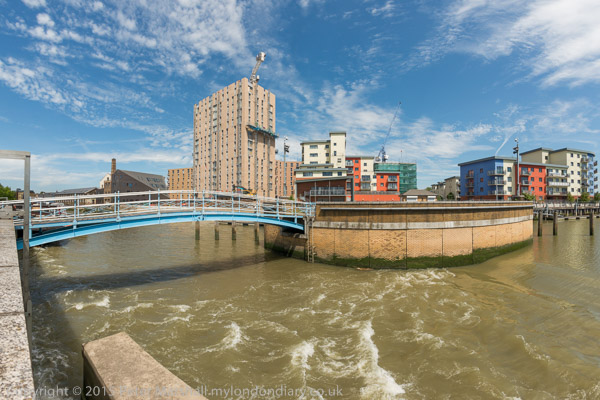

Barking Barrage

As usual I’d bought a Travelcard, so I could then travel on to anywhere in London, and decided to revisit the River Roding and Barking Creek. I’d tried a few years back to walk along the riverside path there and found it was closed. Unfortunately I found it still was and again had to walk in the other direction and went as far as the Barking Barrage, which I crossed and then returned along the other side of the river to the A13 to catch a bus.
Continue reading Summer 2015?

Celebrating Corbyn


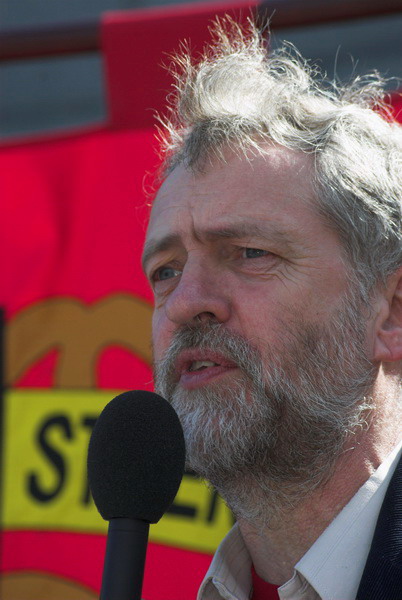
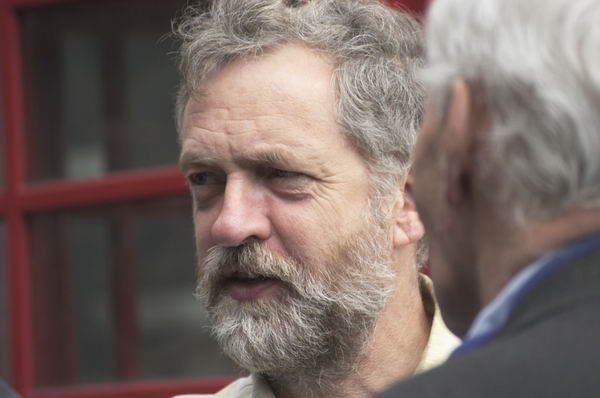
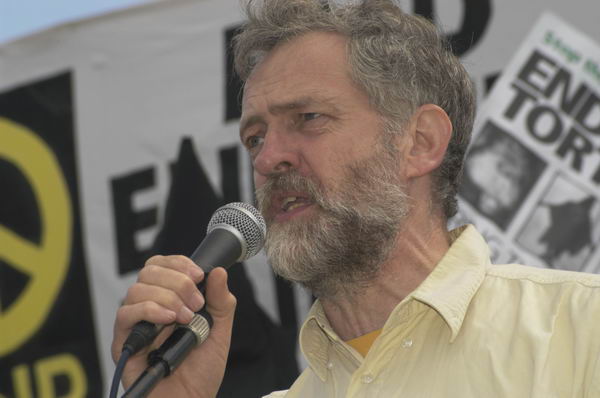
Jeremy Corbyn, MP, End The Torture, Bring The Troops Home Now 22 May 2004

As I sat in the garden this afternoon, taking a rest after a week of hard work – 16 stories in the last six days – and still quietly celebrating Jeremy Corbyn‘s victory in the Labour leadership election with another glass of white wine, I wondered when I had first photographed Jeremy.

Certainly it was long ago, almost certainly in the BD era (before digital, which for me really means before 2002.) In more recent times it sometimes got to be embarrassingly often bumping in to him so regularly, along with another Labour MP Jphn McDonnell, destined now for a leading role in the Shadow Cabinet. Both men I admire for their integrity, even if their views on the moderate side. The idea of Corbyn being on the extreme left put forward by Cameron and other Tories (including some in the Labour party) is laughable, though I hope his election is a sign that we genuinely have a widespread reaction against the lurch to the right by Thatcher and Blair.

But enough party politics. Searching for my pictures of Corbyn presented some problems, but mainly that before digital I have only a limited capacity to search my images digitally. I actually got seriously into computing with an Amstrad PC 1512 in 1986, though I’d by then been using computers at work for six or seven years, mainly to catalogue my work. And I do have a database that lets me find images by locations and key words that I started then and covers my black and white work until sometime in 2000. But somehow it never seemed worth taking the time to fully enter people and events I covered into this, though some get on it. Most were filed separately to my main projects which were largely related to the urban fabric of London and thus not entered on the database.

Although I went digital to the extent of buying a Nikon D100 at the end of 2002, I could only afford one Nikon lens, a 24-85mm (equivalent to 36-127mm). The library I was then submitting images to could not at that time handle digital files, working with only black and white prints and colour transparencies, so most of my serious work was still on film. My earliest pictures of Jeremy will certainly be somewhere in those black and white negatives and probably in the 1990s.

By 2004 when the two images above were made I was still working with the D100, but had managed to afford a longer lens, though I can’t now remember which it was. The top image was taken at 140mm (210mm eq) and the lower one at 195mm (292mm eq), both in Trafalgar Square. I suspect it was a fairly cheap Sigma zoom, perhaps a 55-210mm, possibly the one that disappeared out of my camera bag in January of the following year when I was photographing the Red Army Choir. Not I hasten to add by one of the choir members, but in the very densely packed crowd of onlookers. I wasn’t too sad to lose it, though it was a very light lens to carry, but it did give me a good excuse to buy the newly introduced Nikon 18-200mm.


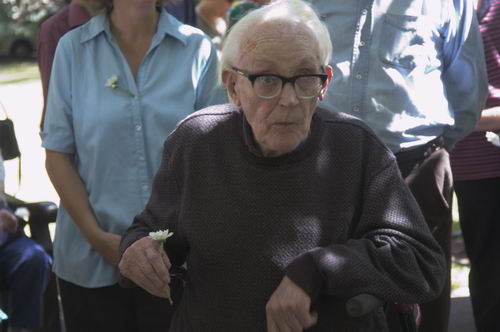
Michael Foot, Hiroshima Day Aug 6th 2004

I’d photographed Jeremy again as he compered the annual Hiroshima Day Ceremony that August, but its a rather ordinary picture and I seem to have been having problems with developing raw images at the time. Perhaps more interestingly, also present is someone with whom Jeremy is sometimes compared, Michael Foot, and I have several pictures of him. Foot was crucified by the press for wearing a donkey jacket to the Remembrance Day protest (of course it wasn’t really a donkey jacket) and Jeremy will doubtless get similar treatment this November, both for his attire and the white poppy he is expected to wear (though he might follow the advice of some others I know who wear their white poppy together with a red one.)


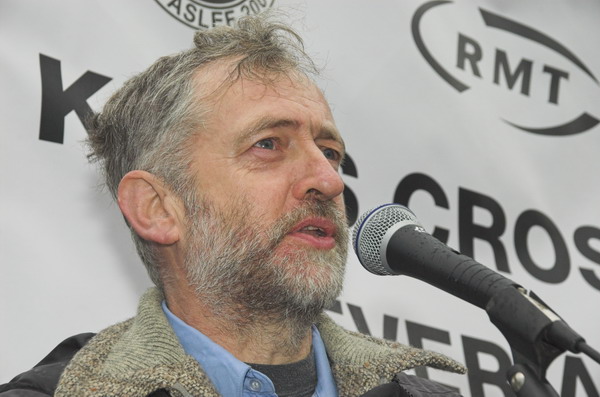
International Workers Memorial Day London, April 28, 2006

I’ve always felt that Jeremy and I share the same tailor, though not literally, but we certainly have a similar attitude to dress and hair. His hair is rather more lively than mine but we have quite similar beards and I have occasionally been mistaken for him, though I don’t think we look much alike.


Kings Cross – never again! London, 26 Nov 2005

By November 2005 I was working with a Nikon D70, bought on the cheap as a grey import. Although an ‘amateur’ camera it was far superior to the D100, and by then I was getting rather better at raw conversion, partly because of improved software.

Time for another glass. Though for Jeremy it will be another cup of tea.

Continue reading Celebrating Corbyn

The New East

Somewhere I picked up a link to an article in the Calvert Journal from July this year, In focus: 29 women photographers picturing the new east written by Anastasiia Fedorova who states:

With cameras in hand, women are leading the way in defining the visual identity of the new east. Reclaiming their gaze from a conservative, male-dominated society, they are exploring gender roles and sexuality, myths and archetypes, the body, landscape and the urban environment. Here’s our pick of the female photographers at the head of the pack in picturing the new east.

Its an interesting selection, with much worth looking at. Quite a few of the photographers are now working mainly in the old west so some names may well be familiar to you.

I wondered about the Calvert Journal, which I’d not come across before and find it is published by the Calvert 22 Foundation, “a non-profit UK registered charity created in 2009 by Russian-born, London-based economist Nonna Materkova” which describes itself as providing: “A guide to the contemporary culture of the new east: the post-Soviet world, the Balkans and the former socialist states of central and eastern Europe” and as well as publishing the on-line Calvert journal established the Calvert 22 Gallery, (currently closed for refurbishment) dedicated to the contemporary art of Russia and Eastern Europe, in two floors of a converted warehouse on Calvert Avenue in Shoreditch, East London.


Arnold Circus, Bethnal Green (C) Peter Marshall, 1986

Calvert Avenue is a street I’ve often walked down, leading to Arnold Circus, at the centre of the Boundary Estate which has a good claim to be the oldest council housing in the world, built starting in 1890 by the Metropolitan Board of Works and completed by the then new London County Council. (That body’s successor, the Greater London Council, was the victim of one of Thatcher’s most malicious and senseless acts, from which London still suffers, with a ridiculous, divided and unsuitable system of government for a major city.)

It was a slum clearance scheme, replacing part of London’s most notorious slum, the ‘Old Nichol’. You can read a little more about it in my post Bethnal Green Blues, and much more about the area as a whole and its people in Cathy Ross’s ‘The Romance of Bethnal Green’ which that post is partly about.

The gallery and other recent developments in Calvert Avenue are a part of the gentrification of the area. One blogger described it in this way: “Just a few years ago it was semi derelict save for the launderette and newsagent, but now the street is a buzzy destination for the style-savvy supporters of the independent retailer revolution.” That semi-derelict street was of course the home to many who now find themselves priced out of the area as it gets taken over by oddly-bearded ‘hipsters’.

One of the events I missed photographing in July was a street party in neighbouring Camden; its event page on Facebook included the following:

The heart of Camden is being ripped out, pubs are being converted to luxury flats no one can afford, venues are under threat, the market is flogged off to be a casino (and yet more unaffordable flats) Rents are rising….fast.

Soon this community will be an unrecognisable, bland, yuppie infested wasteland with no room for normal (and not so normal) people.

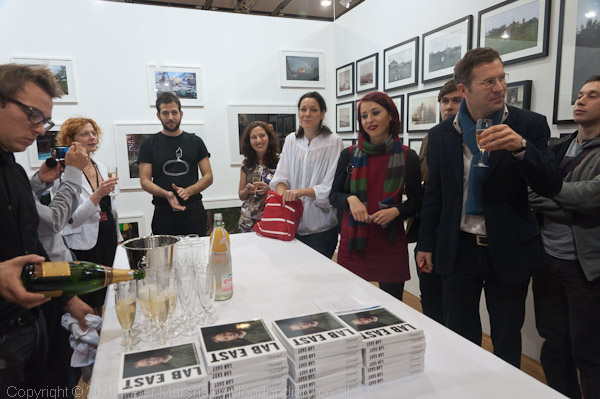
Back in 2010 at Paris Photo I went to the launch of the book ‘Lab East’, featuring 30 young photographers from Central and Eastern Europe, writing about it on this site.

I don’t think any of the women from this book are included in the Calvert Journal feature. Partly this reflects the great number of interesting photographers emerging from Central and Eastern Europe, but also I think that ‘Lab East’ seems to be more at a grass roots level, while the more recent feature is more about those who have already made it in the west.

Eight a Day

I don’t normally do Royal occasions. I think the only sensible approach in British history regarding the monarchy happened back in 1649, with the execution for high treason of Charles I, though I don’t approve of beheadings. Just a shame that the Commonwealth went wrong and the monarchy was restored.  I also don’t like royal occasions because of the gawping and fawning crowds, and also the security that surrounds them. And opportunities for photography, except for a privileged few, are often rather limited.  So May 27th this year was the first time I’ve ever been in London for the State Opening of Parliament.

I hadn’t gone to photograph the Queen, but some of the friends I’d made covering the protests against ‘poor doors’. Class War had decided to protest at the event.

It wasn’t the best planned of protests, and they had perhaps not  realised the enormous level of policing that would be applied to ensure that the right to protest was denied to anyone in the area on the day.  Quite why the Queen should be granted this level of immunity from protest isn’t clear.


Nikon D700, 16-35mm

But one group of protesters I was with was stopped around 50 yards from the royal route, and then were escorted away and followed closely by police for the next couple of hours. A couple of others were more successful, managing to display the Class War political leaders banner for perhaps half a minute on the actual route – though a quarter of an hour before she came down it. Police jumped on them rapidly, forced them to take down their banner and made sure the moved away.

After a while Class War decided to make their way to a nearby pub. They were followed by at least twice as many police who stood on the opposite side of the road watching and were still there an hour later when I left to go elsewhere. More about it at Class War protest Queen’s speech.


Nikon D800E, 18-105mm DX

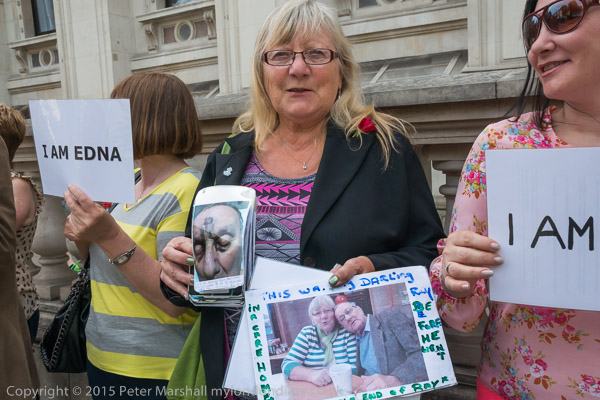
Here, well away from the Queen, a protest was taking place, but very differently. The organisers of ‘I am Edna’ – protect whistle-blowers had applied to the police for permission and had accepted the limits they had set for the protest. I think these included not using amplification of any kind, staying in one place and not handing out leaflets. Most protesters would find these unacceptable.

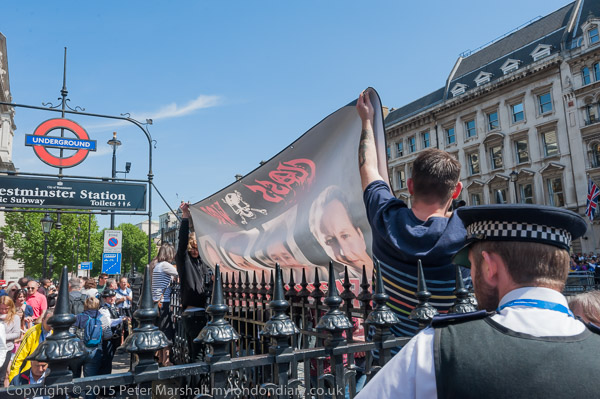
I continued on my way to Trafalgar Square and sat down to read a book while I waited for the next protest. But soon I looked up and saw that some Class War people had come to the square and were standing close to me. There were now only two police officers watching them from about 20 yards away, even though they were only standing around in the square.


Nikon D800E, 18-105mm DX

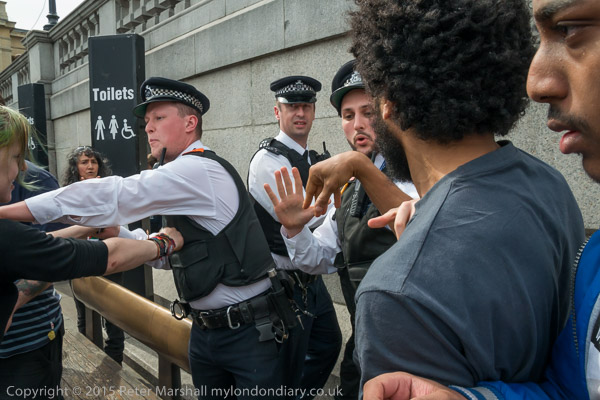
Suddenly we noticed another small group of police had arrived and were surrounding a man, questioning and apparently arresting him, and people rushed across to find out what was happening.  Police pushed those asking questions away and refused to say anything about what was happening, and a larger crowd of those waiting in the square for a further protest soon gathered around.

More police came, and the man was marched away followed by a large group of protesters to one of the many police vans now around the area in Northumberland Avenue. A young man standing there was roughly pushed aside by an officer, and when he objected was arrested as well.

By this time, surrounded by an angry crowd, some of the police realised that they needed to explain their actions, and eventually we found that the man arrested first was not being taken for anything connected with the protest but for an earlier offence elsewhere. Had that been made clear earlier the situation shown in Police arrest man in Trafalgar Square, including the second arrest – could have been avoided.


Nikon D700, 16-35mm

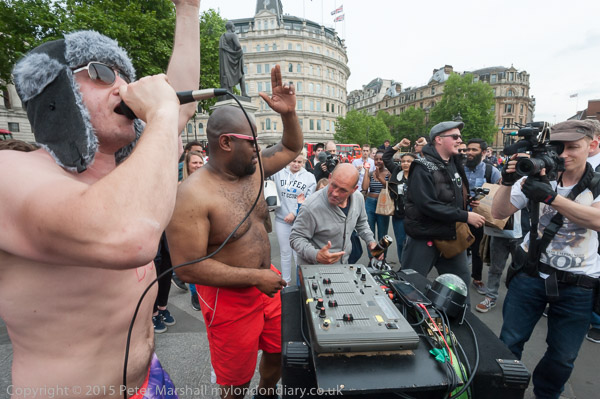
Next we heard loud music, and ran across the square to find a mobile disco and people dancing. Disco Boy had come to play Trafalgar Square as an unsolicited warm-up act for the student protest expected shortly. I followed him and the dancers until he left the square, going on to play in Whitehall and outside Downing St.


Nikon D800E, 18-105mm DX

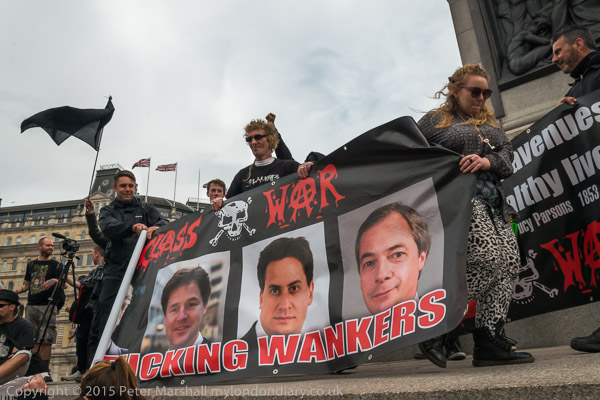
More noise told us that the student rally organised by the National Campaign Against Fees and Cuts, NCAFC, was beginning, and all those who had been waiting around the square for this hurried towards the plinth of Trafalgar Square. Class War had come to support them and took their place on the plinth with them, getting huge cheers when they unrolled their new political leaders banner, along with several others.

The NCAFC perhaps felt a little upstaged by this, and by others who joined them on the plinth, the Hashem Shabani Ahwazi Arabs, and although there were several speeches by student leaders, it felt a little downbeat.


Nikon D750, 16-35mm

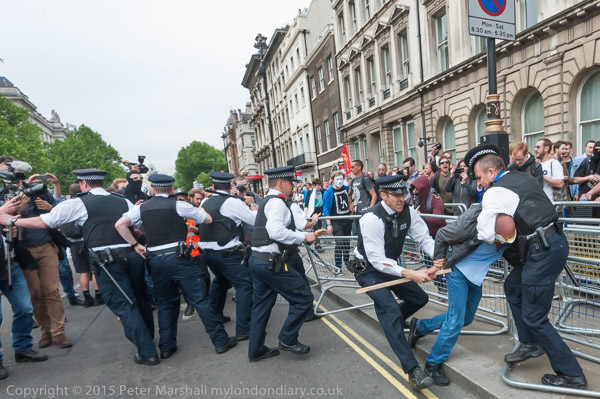
But the rally was only a prelude to the NCAFC March against ‘undemocracy’ which soon started off down Whitehall towards Parliament. Police formed a line across just before Downing St, but officers were too spread out and it would hardly have stopped a Sunday School outing, with students soon pushing past. The police made a more determined effort to stop the marchers lower down in Parliament St where barriers had made the road narrower, with some parked police vans. A few students were pushed to the ground by police and held, but many of the students simply did as I did and walked by on the other side of the barriers.

After a few minutes – and a little posing with batons and some arrests – police realised they had failed and withdrew, continuing to follow the protest as it went through Parliament Square and up Victoria St.


Nikon D800E, 18-105mm DX

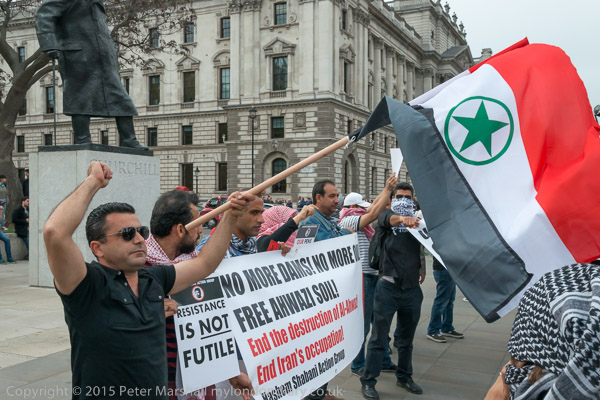
I’d more or less loss interest and stopped to record yet another protest as the Ahwazi Arabs had left the march in Parliament Square to call for an end to the Iranian attacks on their heritage and identity in their homeland which was occupied and incorporated into Iran in 1925, mainly because of its rich oil fields.

I ran on to find the NCAFC marchers again, and caught up with some of them marching back towards Westminster along Petty France. They protested briefly outside the DWP in Tothill St but a line of police diverted them from the Conservative HQ around the corner and they came back through Parliament Square to go up Whitehall and protest outside Downing St.


Nikon D800E, 18-105mm DX

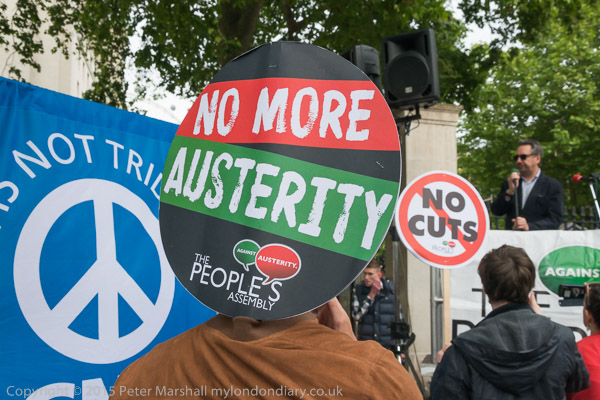
It was unfortunate – though not unexpected – that the People’s Assembly had decided to organise their own End Austerity Now rally at the same time as the NCAFC march.  But when that march stopped outside Downing St, the People’s Assembly rally was still going strong and I went across to take pictures there for a few minutes.

Visually it wasn’t exciting, just people standing around, few of them with placards or posters, listening to speakers. Most of them were saying things we’d all heard many times before, and most of the audience could probably have gone up and made the same speeches. I amused myself a little in the image above lining up the circular symbol and placards like some gear train in a machine, imagining it was generating the speech that John Rees at right was producing.

When I made it back across the road the rest of the NCAFC marchers had arrived, and within a minute or so they started to leave, intending to go up the Mall to Buckingham Palace. I turned in the opposite direction; the light was fading fast and it had been a long day, covering eight stories, and I had much work still to do on them.
Continue reading Eight a Day

Brian Griffin: Himmelstrasse

I don’t think I’ll be able to make the book launch of Himmelstrasse by Brian Griffin at the Photographers’ Gallery tonight, though the book with its images of the railway tracks in Poland which took around three million people to the death camps seems a powerful and impressive personal response to the Holocaust. And any opportunity to meet Brian is always rewarding.

I’ve twice been to the area of Poland close to Auschwitz, and never felt able to make the visit there, always telling myself “perhaps next time.” It would have been difficult to fit in to a busy schedule, but I think this was just an excuse.

The images of the rails, all single track, running through areas of forest have a desolation, seem all to be made in winter, a few with snow on the ground. Some are a little overgrown, but most seem still to be in use, with occasional track-side signs and still shining rails. The 15 images on Brian’s own web site are half in black and white and half in colour (as well as the Nazi-style design book cover with its title in ‘black type’ and simple graphic design in red and white.)

Although most publicity for the book seems to have chosen the black and white images – and particularly one with two sofas and a chair neatly at the side of the line – I think the colour images are perhaps more straightforwardly emotional, with their sombre browns and dull winter greens, with sometimes sparse patches of snow. A couple also have the blue sky of ‘Himmel‘ in the cynical Nazi joke which gives the book its title.

The single track in most images is an appropriate metaphor for what was for almost all a one way journey, although the death trains must of course have returned empty on the same rails before their next journey. Much of Poland’s rail system that I saw ten years ago seemed to be single track like these with only very occasional trains making their way slowly along them.

I’ve not seen a copy of the actual book, which looks excellently produced by Browns Editions, though the colour in the nine double page spreads  reproduced on their web site seems rather garish compared with that on the photographer’s own site.  At £50 it’s perhaps too expensive to add to my already rather large collection, though I’m tempted to do so.

The book will have a second launch at the New York Art Book Fair 2015.

Himmelstrasse
Brian Griffin
Published 2015
Designed by Browns
297mm x 232mm
Hardback
120 pages
69 black and white images
33 colour images
Edition of 500 hand numbered.
ISBN 9780992819415

Barbican

Without doubt the greatest opportunity for the planning of London in the last century came from the destruction of large areas of the city during the war, and one of the areas where the results are most obvious is the Barbican.  It provided an opportunity to develop new approaches with pedestrian walkways high above the city streets separated from their traffic, and put homes back into the city.

It wasn’t an entirely successful experiment, although the recent demolition of parts of the ‘highwalk’ is I think a great loss for the city (and doubtless huge profits for the developers) and while many have found the Barbican an exciting place to live prices now for its over 2,000 properties and those on the adjoining and perhaps rather nicer Golden Lane Estate are pretty astronomical.

For non-residents, finding the way around the Barbican has always presented something of a challenge, with yellow lines needed to guide people to the Barbican Arts centre from the surrounding Underground stations. Inside the Arts centre too, I’ve always found the layout totally confusing, though over the years I’ve learnt easy routes to find my way to the places I’ve used, including the main art gallery and the Library, in which I’ve organised and taken part in several group shows over the years.

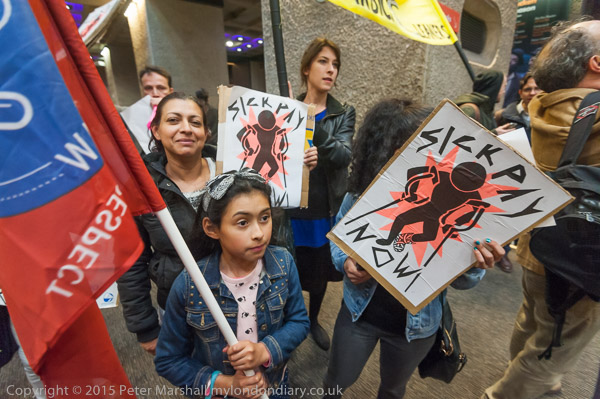
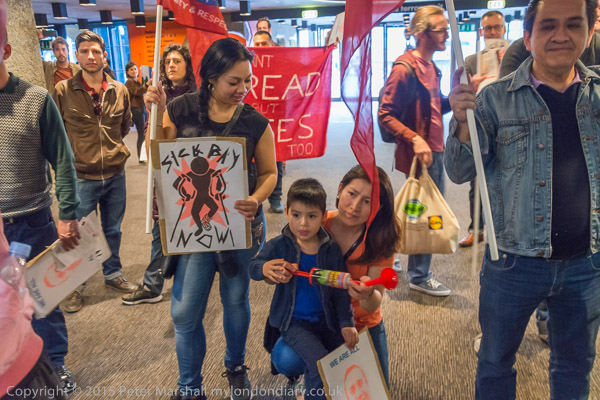
But on May 16th I had no problems in finding my way, simply having to follow the crowd of cleaners and supporters as the United Voices of the World rushed in to hold a protest inside the building.

The UVW are a grass roots union that is standing up for the rights of some of London’s lowest paid and worst treated workers, particularly cleaners who are employed by contracting firms to clean inside London’s many prestige buildings, including the Barbican Arts Centre, owned by the City of London.

The only reason for outsourcing services like cleaning is to cut costs, and the only way that the outsourcing companies cut costs compared to direct employment is by employing workers on conditions that would be unacceptable to companies and organisations that are concerned about their public profile.

The Barbican Arts Centre would feel it had to pay at least the London living Wage, provide proper pension arrangements, sick pay and holiday pay, as well as managing its employees properly, providing proper equipment and materials to do the job and not imposing excessive workloads. I’ve never worked for them, but I imagine that they aim to be a responsible and highly respectable employer.

The cleaners complain that the contracting companies treat them like dirt. Low pay, bullying management, impossible demands, and the statutory minimum conditions. Workers come into work sick because they cannot afford to take time off with only statutory sick pay. And of course an attempt to prevent union organisation and protests. As my summary reported:

Cleaners at the Barbican Centre employed by MITIE have been threatend with sacking if they protest for a living wage and proper sick pay. They say a disabled worker has been assaulted by a manager and that he was accused of terrorism for posting a video of himself at work.

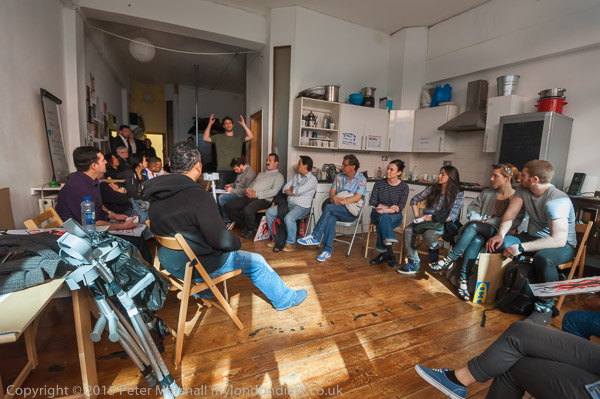
This protest was unannounced, and the cleaners and supporters met up well away from the Barbican. I met with most of them at a union meeting beforehand. UVW is a small and entirely voluntary movement with no paid officials, and as well as negotiations and protests at workplaces also provides representation and support for its members at tribunals and disciplinary hearings, and classes in English, as many of its members are from Latin America or Spain.

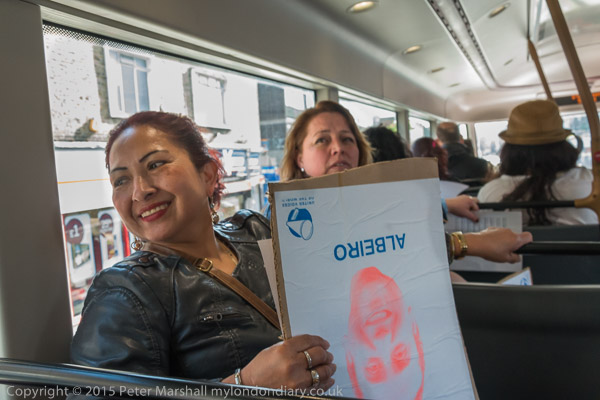
I travelled with them on the bus, then walked with them to a rendezvous with other supporters before they marched quietly to the Barbican, regrouping on a corner close to the main entrance, which they then rushed through at a suitable moment, with me following a short distance behind the leaders, making their way noisily through the building to a suitable area for the protest.

As usual with such incursions, I’m careful to avoid confrontation with security, who made some attempt to stop the first few people who entered, but then had simply to stand back and watch as the rest streamed in following them.  Theoretically I would stop taking pictures and leave if requested by a suitably authorised person, unless I felt there was an overwhelming public interest in the events being recorded, when I would attempt to do so. I would have felt so in this case, but it’s better not to have to make such a decision.

Photographically the main problem in taking pictures was the light. Rather the lack of it, and its unevenness.  The centre always reminds me of a cave, and it has lots of fairly small lights in a very large space.

I didn’t want to use flash. Partly because I didn’t want to attract attention to myself, and experience tells me that security are far more likely to tell you to stop taking pictures if you use flash, but also because it’s difficult when working close to avoid huge differences in lighting between people very close and those a few feet further away. But the light was pretty low in some areas, and when people were moving a lot there was really little alternative. But I think the picture I liked best was taken without, working at ISO 3200.

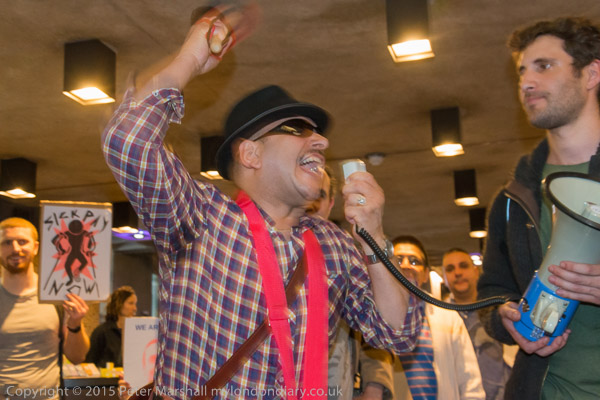
I was also working at ISO 3200 with flash, but with the aperture a couple of stops down (and sometimes about a stop faster shutter speed too) trying to retain a more even result with some exposure from the ambient light. As a consequence there is some double-imaging on these frames, which often but not always enhances the image – it adds a feeling of movement and immediacy to the speaker above.

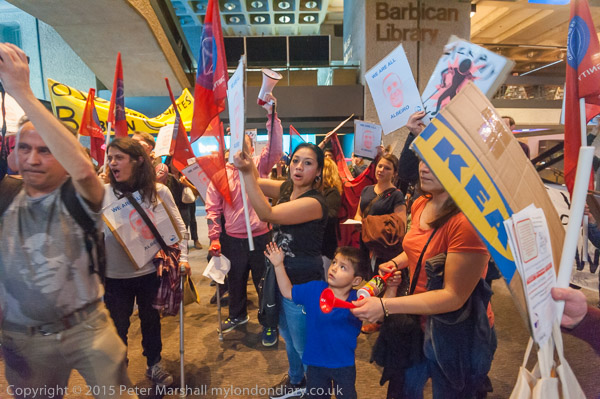
Colour temperature is also sometimes an issue. Later the protesters moved to an area with both artificial light and large windows letting in some daylight. Using flash might have helped in the lower image, but unfortunately the D700 which I was using seems now to be very unreliable with flash and I’ve been avoiding using it. All the flash pictures I’ve made for some time have been with the D800E.

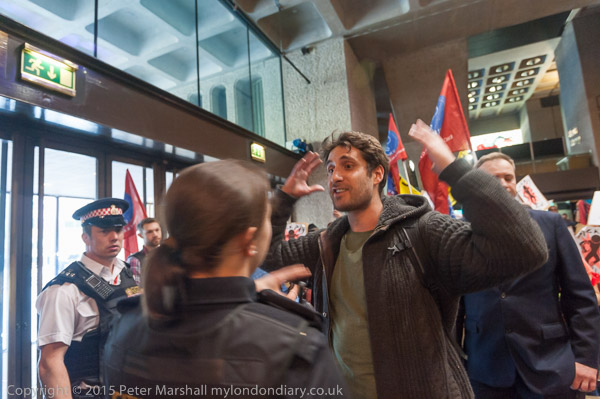
Shortly after the protesters left the building and continued to protest, marching around a little of the Barbican estate and then continuing outside the main entrance, which enabled me to take some pictures including the Barbican signage, including one of Albeiro, the cleaner being victimised and UVW general secretary Petros Elia, the man with his hands up in the image above.

Many more pictures and more about the protest at Cleaners invade Barbican Centre.

Continue reading Barbican

CLASS WAR: Rich Door, Poor Door

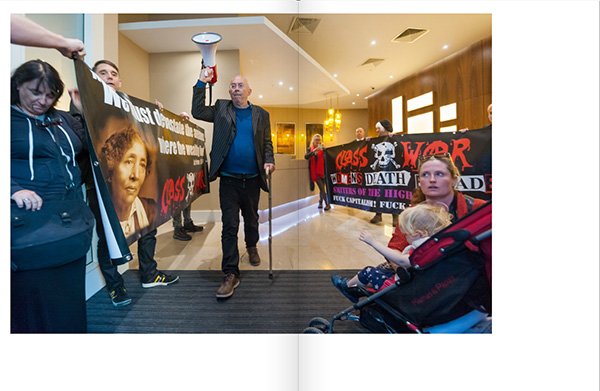
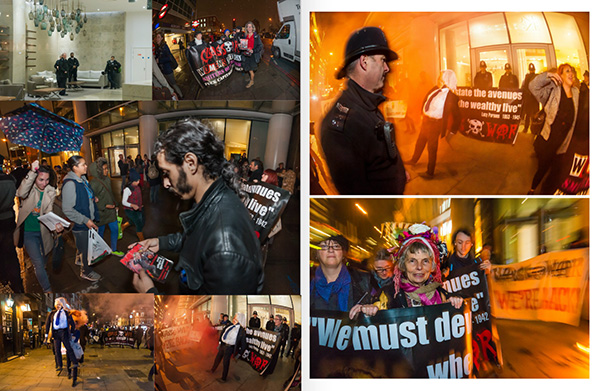
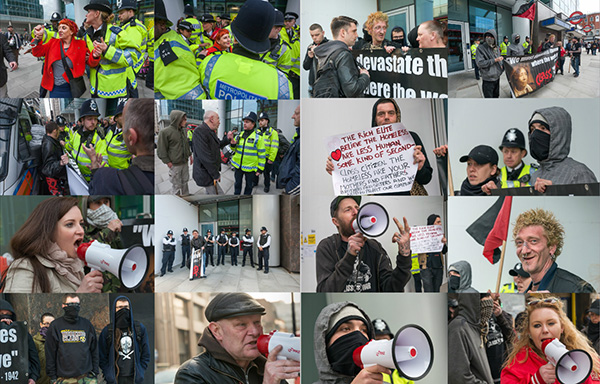
CLASS WAR – Rich Door, Poor Door is a relatively cheap 48 page magazine style publication of my coverage of the protests by Class War at One Commercial St, a large block on the corner of Commercial St and Whitechapel High Street in Tower Hamlets on the eastern edge of the City of London.

The building ‘One Commercial St’ is a tall block which includes shops, a hotel, an entrance to Aldgate East Underground station, parking and expensive flats as well as other flats which are social housing. While the occupiers of the expensive flats enter through a large, well lit lobby with a manned concierge desk and comfortable seating through a door on the main road, social housing tenants have a separate entrance some way down a narrow alley.

When I first visited it, this alley was strewn with rubbish and dog mess, with a strong smell of stale urine, and was virtually unlit, the kind of alley that drunks stumble down to relieve themselves after the pubs have closed. The ‘poor door’ had a card entry system, but for some weeks it was broken and the door left unlocked. It led onto a long narrow corridor, empty except for some post boxes for the residents.

The building manager told us that the social housing was completely physically separated from the privately owned flats, though we soon realised this was a lie. There are links between to two areas both at ground floor level and on at least one of the upper floors which both sets of flats occupy. Inside the building, when I later was taken around by a resident, the corridors and lifts were very similar, with identical signage. We went in the ‘rich door’ and came out after the tour through the ‘poor door’, having during the tour seen two locked doors between the two sides as well as walking through at ground level between them.

Having separate doors for rich and poor living in the same building is something many find unacceptable, and the protests by Class War served to publicise this ‘social apartheid’ and to put the issue on the national agenda, one of a number of direct action campaigns that have brought housing issues increased public attention. Some of those other campaigns supported Class War, with visits by supporters of Focus E15 and New Era, and Class War also supported others including the Aylesbury Estate Occupiers, with supporters also joining other housing campaigns.

During the roughly nine months covered by this magazine, from July 30, 2014 to May 1, 2015, Class War were also running a campaign to stand candidates in the May General Election. Eventually there were Class War candidates in seven seats, three in the Greater London area. Their first policy pledge was for a 50% mansion tax. Although I covered several events connected with their election campaign, including the manifesto launch at the gates of Buckingham Palace, I’ve not included these in the magazine, which includes pictures from 29 of the 31 protests at One Commercial St.

Several of the candidates were prominent in the protests, and one of the more controversial actions by the police was the seizing of their ‘political leaders’ banner which had been produced for the 2010 General Election and displayed at many events over the years without problems. A case for displaying a similar set of posters also produced in 2010 was thrown out of court for restricting freedom of expression.  Class War responded with an updated version of the banner for 2015, which so far police have failed to seize.

Police made at least five arrests at the protests which are shown in the magazine. One case has still to come to court and another was dismissed when it did so, with the court clearly suggesting that the police were trying to restrict legitimate political protest. One other case still pending also seems to have been clearly politically motivated and will I hope be thrown out by the court if not dropped beforehand.

You can read the story of the campaign in the regular posts and pictures from it on My London Diary. In the magazine I’ve included the text from just the first of these which sets the scene along with a chronological selection of over 200 images from the protests. There are just a couple of very short comments and on the final page some biographical material.

Getting over 200 images into 48 US letter size pages involved many compromises. There are a couple of images which have a double page spread and about 45 that are roughly half page size (about 8 x 5.5 inches.) The rest are crammed in at up to 8 pictures a page with little or no white space. I wanted to keep the price down so that I could offer this publication for a fiver.

For the same reason, I chose Blurb’s cheapest paper, which they say gives magazine quality reproduction. This is not the quality of a quality magazine – they call it Economy magazine. The reproduction lacks punch, with no real black, but even the smaller images are detailed and readable.

I’ve made over half the book viewable on the preview at Blurb. If you make the preview full-screen (button at bottom right of preview) you will get a rather better view than the actual magazine – much better, brighter and more accurate colour. But I’d like people to buy the magazine, though I make only a very small margin on it, as it would be good to get copies out there and perhaps seen by more people than would look at it on screen. You can of course already look at the pictures on My London Diary (I think there may be one or two where I’ve chosen slightly different images for the magazine.)

I’ve also decided not to make this publicly available as a PDF or e-book, unlike almost all of my other books. The cost of the ‘hard copy’ – actually a rather floppy soft-cover – is more or less the same.

The magazine CLASS WAR – Rich Door, Poor Door is for sale through Blurb, where it costs £6.00 plus carriage (I haven’t checked but probably an arm and a leg.)  As with my other publications, UK readers can save by ordering direct from me – contact me here to check it is still in stock and arrange payment by cheque, bank transfer or PayPal. I can currently supply copies at £6 including UK postage. I think all my other books are also in stock here.

And for people I meet it’s a fiver if I’ve got a copy on me. The price of a pint in some London pubs these days.

Continue reading CLASS WAR: Rich Door, Poor Door

Hiroshima: 70 Years

On the 360 Cities World Panorama site you can see an incredible 360 degree panorama of the city of Hiroshima, taken around 260m from the hypocenter less than two months after the city and much of its population was destroyed by the atomic bomb on August 6, 1945, seventy years ago. The series of pictures was taken by former army engineer Shigeo Hayashi, a Japanese photographer who had worked since 1943 for the magazine ‘FRONT’ and was one of two photographers (and an assistant) chosen by the Japan Film Corporation  to document the aftermath of the bombs on Hiroshima and Nagasaki for the Special Committee for the Investigation of A-bomb Damage organized by the Scientific Research Council of Japan (under the Ministry of Education).

In his comments on the image Hayashi states:

On October 1, 1945, I stood at the hypocenter of the Hiroshima atomic bombing and made a slow revolution. In that instant I had a difficulty grasping that this city had been felled by a single explosion. Nothing in my experience had prepared me to conceive of that magnitude of destructive force.

There is also a second panorama by Hayashi taken a little further from the hypocentre.

Other panoramic images on the site include photographs of Hiroshima again in October 1945 by Harbert F. Austin Jr, and the following month by H. J. Peterson.

You can see more of Hayashi’s images – now in the Hiroshima Peace Memorial Museum in their Shigeo Hayashi Photo Exhibition online.

I’ve written on various occasions about the photographs of Hiroshima following the dropping of the bomb and also about the annual commemoration in London which I’ll attend today. There are several posts on this site, including Hiroshima 65 Years On
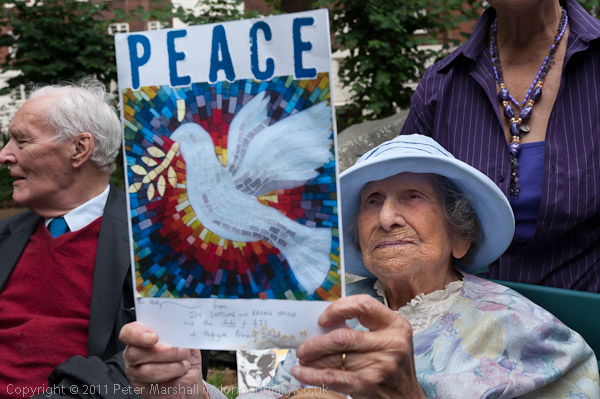
and Hiroshima Day, which included the picture at the top of this post, of the remarkable peace campaigner the late Hetty Bower, 105 when the picture was taken in 2011.
Continue reading Hiroshima: 70 Years

Things Left Unsaid

I’ve never been a great fan of either Donovan Wylie or Paul Seawright, but the video of their conversation at the opening of Seawright’s show in Paris last November with the working title of ‘Making News’ but shown as ‘Things Left Unsaid‘ at the Centre Culturel Irlandais,  held my attention, although I soon got rather fed up with looking at the two photographers and took to looking instead at the eight images and installation view which you can find on Paul Seawright’s web site.

On the web site it explains the project:

‘Exploring the theatre of war through the internal landscape of the US television news studio. Developing Virilio’s writing on electronic warfare and weapons of mass communication, Seawright focuses on the illusory nature of these spaces, where information is selectively transformed into news. Characteristically Seawright continues his exploration of contested spaces and illuminates an invisible aspect of contemporary conflict.’

(You can read an interview with Paul Virilio on Vice, and more on Wikipedia.)

The book contains – according to the talk – 26 images, and you can see a slide show of 7 images on APB where the 56 page book is on sale.

Seawright at one point says he doesn’t like taking photographs, the ‘moment’ for him is when he sees the exhibition for the first time on the gallery wall, and he comments that the book is secondary, lacking the drama of the exhibition.

WhileI feel with him and Wylie that the camera is a purely functional thing I find myself more in sympathy with Wylie’s comments about taking pictures and the experience of doing this. It may be and often is exhausting, but fore me it is also at times exhilarating. But perhaps it does account for an absence of feeling that I often feel in looking at Seawright’s pictures; something I don’t see even with the New Topographics who he relates his work to.

Near the end of the the discussion Seawright comments “We make work because we believe in the work and the idea behind the work” which seems very much, despite the differences in our ideas and approaches to photography, something with which I can wholeheartedly agree.

Looking at the various other projects on Seawright’s web site, there are others that I find rather more interesting that ‘Things Left Unsaid‘, a title which he suggests on the video could apply to all of his work.  One of the more interesting is ‘Invisible Cities‘ and the site has links to two reviews, one of which is in Socialist Worker. Although not entirely complimentary, and commenting that it fails to show the African dynamism, implying that “the legacy of colonialism in Africa is too dominant and exhausting to ever be changed”, this concludes:

Neverthless, Invisible Cities is a terrific selection of photographic art. It skillfully uses seemingly prosaic scenes of urban life to present an startlingly new image of Africa – one that is not dominated by violence and famine, but rather by human beings engaged in a day-to-day existence that is not a ­million miles away from our own.”

Donovan Wylie’s work can be seen on his Magnum page.

Thanks to Peggy Sue Amison, Artistic Direct for East Wing in Dubai for a Facebook post sharing the link to the video.

Gandhi and Civil Disobedience

I’ve always felt that London wasted Parliament Square. A world heritage site because of the buildings that surround it – notably the Houses of Parliament, Westminster Abbey, Middlesex Guildhall (now the Supreme Court), the actual square is a large traffic island, with a large area poorly maintained grass and some rather crass temporary flagpoles brought out for state occasions. It has an odd assortment of statues, some rather good, others outstandingly poor.

Over recent years their have been some improvements for public access, which no longer demands a death-defying dash between traffic, with light-controlled crossings at two of its four corners, though the seats which tempted the unwary tourists have now disappeared, presumably because of Westminster Council’s vendetta against homeless rough sleepers.

Perhaps the reason for its curious state is below the surface, where I suspect it houses some secret underground bunker, linked by the mysterious underground passages we know exist between various above-ground government buildings in the area. But it certainly always feels like a missed opportunity to me. If nothing else most if not all of its area should be closed to normal traffic.

But something which I think any seat of government should have in its view is a suitable forum for public dissent, where protesters can make their views felt. Ever since the late Brian Haw took up residence on the pavement opposite the Houses of Parliament back in 2001, Parliament, the GLA, Westminster Council and the police have been doing their worst to stop such things happening or to severely limit them. Perhaps there is a case for some limits, but not for trying to set them so that protest becomes severely inhibited.

Occupy Democracy have carried out a series of protests intended to keep the square as a place for democratic discussion and protest, and I’ve photographed a few of these, though missing the main battles with police and GLA security guards (laughably called ‘Heritage Wardens’) over squares of blue tarpaulin the protesters were sitting (and sometimes sleeping) on, which led to the square being renamed by activists as ‘Tarpaulin Square’.

Recently a court has ruled that it is not a crime to have such tarpaulins in the square, dismissing the case against four people arrested, and leading to a second prosecution being dropped. As often, the police, egged on in this case by over-keen private security, have over-interpreted the law to make it mean what they wanted it to mean.

The court decision was hardly surprising. When Occupy Democracy came to the square last October it was clear to me reading the enforcement notices that the police were exceeding the law, and I told them so, to get the response that they would leave it to the courts to decide. It seemed to be a blatant disregard of the law by those who are paid to enforce it.

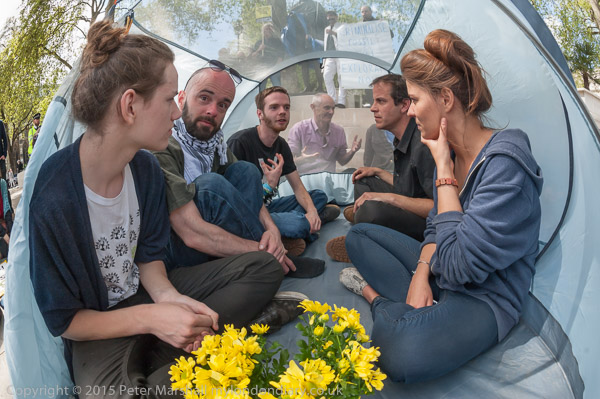
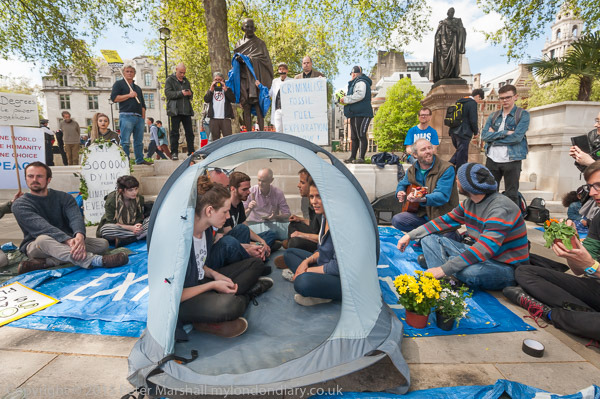
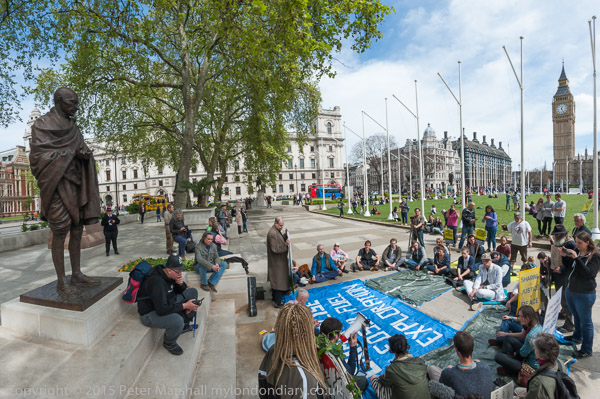
Occupy Gandhi – stop fossil fuel criminals on May 4, defied both the ban on tarpaulins and on tents in Parliament Square, though I imagine the protesters will argue in court that the tent was only symbolic and that they had no intention of using it to sleep in.

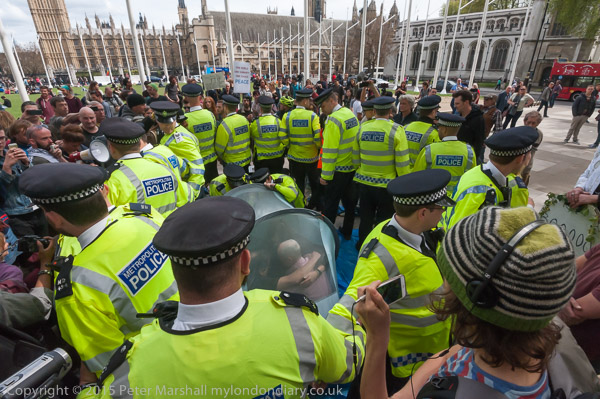
On this occasion police and GLA Security ignored the blue tarpaulins (except for asking one draped on the statue of Gandhi to be removed), and it was only after a tent had been erected in a deliberate act of civil disobedience that police first warned the protesters and later surrounded it and arrested those inside. You can read more about what happened in My London Diary.

Photographically the event once more proved the value of the 16mm fisheye, with several of the strongest images I made being take with it. It’s a lens that needs some care in use, usually at its best when absolutely upright, and the virtual level markers in the D800E viewfinder proved extremely useful.

The top image on this post is an example where no perspective correction was needed, and the curvature at the edges adds to the image, producing something of a tunnel effect. I liked the near-symmetry of the scene, and the framing through the fabric at the rear of the tent of Donnachadh McCarthy who was leading the protest (he quickly jumped inside the tent as the police arrived to make arrests.)

To make Donnachadh clearer I increased the local clarity and contrast in Lightroom, adjusting the exposure slightly too. The yellow of the flowers is a nice contrast to the blues of the clothing and tent, and the pink shirt also helps Donnachadh stand out. In some other frames I also managed to include the statue of Gandhi, but his head got cut off in this one (at top centre) and it would have been nice to have a little more of the flowers. Sometimes even a fisheye isn’t quite wide enough!

Theoretically I could have moved back a little, but practically that wasn’t possible. I’d quickly moved into position as I saw people going into the tent and worked with the 16-35mm on the D700, then moved away, coming back after the flowers had been put in the tent. After taking a frame with the 16-35mm I changed it for the 16mm fisheye and made a series of five exposures. The people inside the tent were having an animated conversation, and several of those five seemed interesting, but it was when Donnachadh briefly raised his hands that I had the picture I wanted.

The 16mm fisheye was also the ideal lens to take an overall view of the event, enabling me to work from a close viewpoint and get in both the statue of Gandhi and at the other edge, Big Ben. The horizontal angle of view is around 140 degrees, too wide for a rectilinear lens – which would render both Gandhi and the clock tower as extremely fat. Again I was using the 16mm on the D700, keeping the D800E for the DX format 18-105mm which gives a decent-size file at the 1.5x crop. The D700 lacks the viewfinder level indicators, which accounts for the curved horizon. Correction from fisheye to cylindrical perspective was essential to avoid a curved Big Ben, Gandhi and flag poles.

For the surrounding of the tent and the arrests it was fortunate that this took place next to the raised area with the Gandhi statue, giving me a good viewpoint, though the police did rather get in the way, as too did some of the protesters, many of whom were also taking pictures and sometimes holding up phones in front of me. Working with the D700 I did rather wish it had a hinged screen on the back like the Fuji X-T1, so much better when you do have to work with the camera held above your head. For some reason Nikon think this isn’t appropriate in their professional cameras, but I’d find it very useful. As well as the overall views with the 16-35mm, I was also able to take pictures over the shoulders or between the heads of police of the people inside the tent.

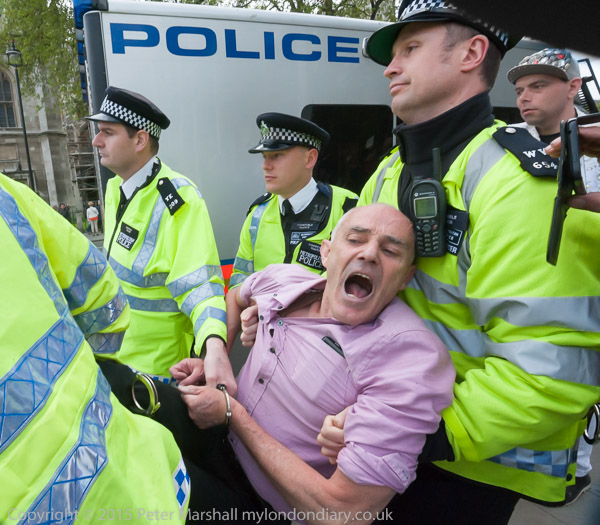
Later I went down to ground level and was able to work between the legs of the police surrounding the tent, leaving as Donnachadh was taken away by the police. He struggled as they led him away, then went limp, and was carried by the police to a van at the side of the square.

Another inexplicable failure by Nikon is with lens hoods, and in any close situation the lens hood on the 16-35mm will either be knocked completely off (I’ve lost half a dozen that way) or, perhaps even worse, get knocked askew.

This gives vignetting at top left and bottom right corners of the image at wider focal lengths, and is clearly visible in the viewfinder with the lens at 20mm or wider. Unfortunately when things get a little exciting and I’m working flat out I usually fail to notice it unless there is important subject matter in either of those two corners, and I end up with a lot of pictures with dark areas across them. Usually I crop the images to remove them, but often this means losing important subject matter.

The problem is I think a combination of the low profile of the filter mount on the lens with the flimsy flexibility of the Nikon HB-23 lens hood and could probably be more or less solved with a thicker moulding on the hood.

Usually I crop to the normal 1.5:1 format, but in this image I decided to simply cut off the left part of the frame, mainly occupied by more of the police hi-viz jacket. You can see the out of focus lens hood at top right, it’s visual impact removed slightly in Lightroom by desaturating it and the blue fringe it naturally has.

More pictures and an account of the event at:
Occupy Gandhi – stop fossil fuel criminals

Continue reading Gandhi and Civil Disobedience