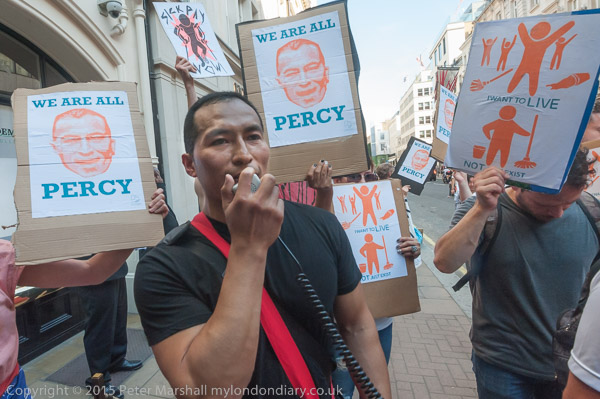
Immigrants not Criminals


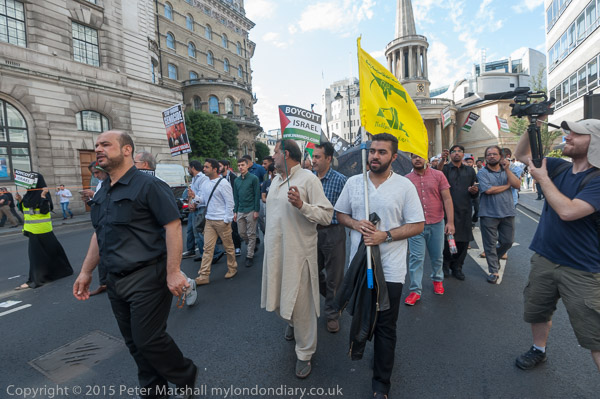
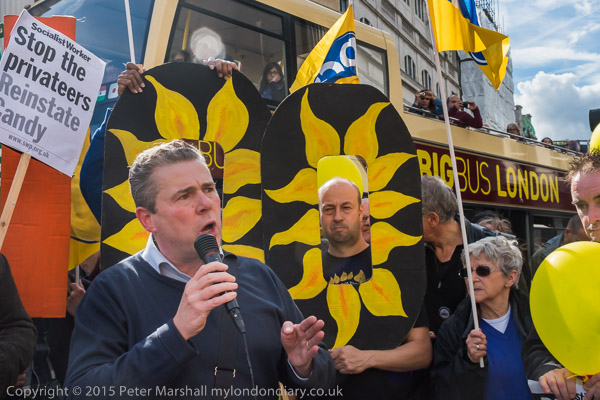
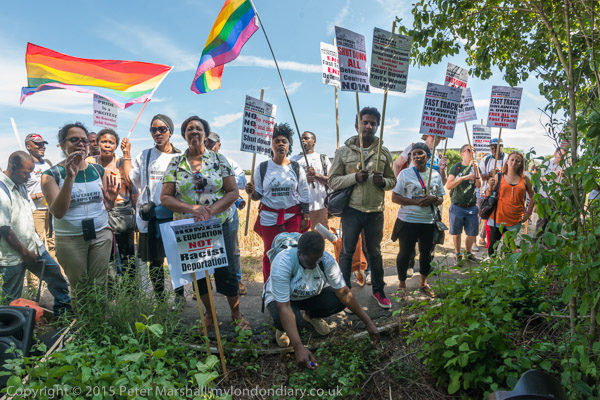
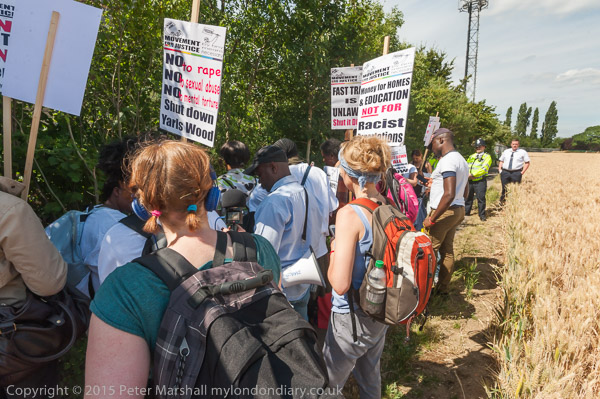
I photographed the protesters from inside the hedge in front of them using the 16mm fisheye

For years our right-wing press (and almost all the UK press is right-wing, owned by a handful of billionaires) have poured hate on immigrants, and successive governments have striven to outdo each other in repressive measures to stop people coming to settle and work in the UK. Unless of course they are extremely wealthy – its only for the rich that we really have freedom of movement around the world any more.

Words such as immigrant, asylum seeker and refugee have become terms of abuse in our racist press – and even in the reporting of more respectable organisations such as the BBC.

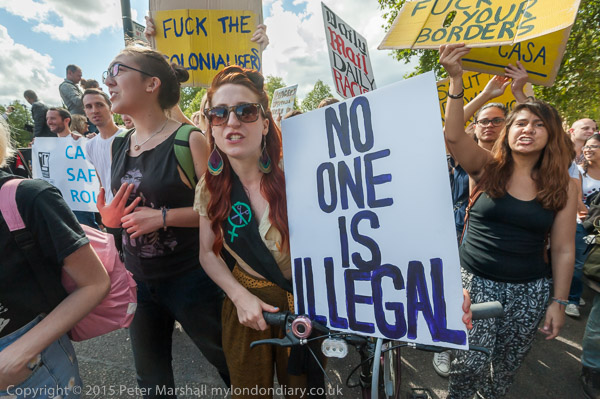
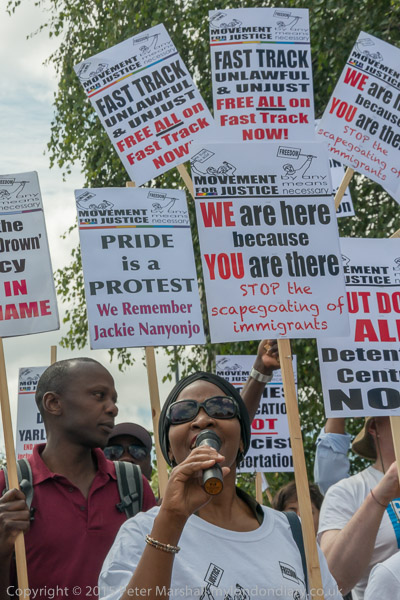
There has been an excessive obsession with numbers, and with terms such as ‘flood’ and ‘storm’ and even people who should know better talk and write about ‘illegal immigrants’ when there is no such thing; people may break the law but they are not illegal, as banners on these protests say – No One is Illegal.
Scare stories are run about huge population increases and the ‘fact’ that the UK is overcrowded. It isn’t, although some parts of London certainly are with tourists, who the government is trying to encourage. There is pressure on services such as schools in some areas – largely because of a failure to direct resources where they are needed in a timely way and the deliberate sabotage of local authority planning with the introduction of ‘free’ schools and academies. The severe housing problem has little or nothing to do with immigrants, but is a long-term problem which has been exacerbated by ‘right to buy’, the end of rent controls and the introduction of housing benefit to subsidise landlords, a failure to implement much-needed land reforms and other government policies. The decimation of our manufacturing industry and the move to a service economy with a proliferation of dead-end low-paid work isn’t a result of migration but deliberate government policies… Immigrants are a simply a convenient scapegoat, without the means to counter their scapegoating.

Except that is through movements such as the Movement for Justice, which continues to fight for them and their rights and occasionally the courts which when people manage to get their cases heard also stand for human rights and the rule of law. That they should have to do so against the Home Office is ridiculous and shameful.
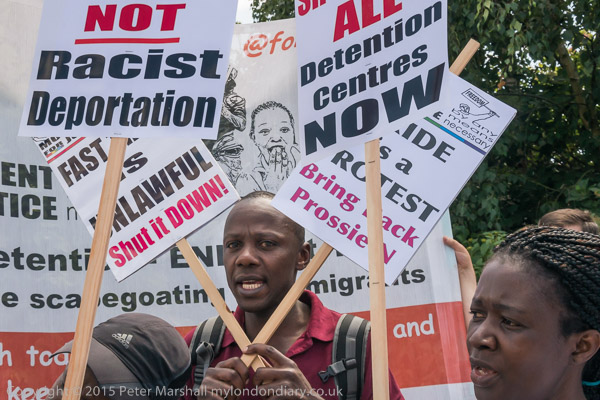
Migrants come here for various reasons, many as some of the placards at the detention prisons at Harmonsdworth & Colnbrook (Now renamed Heathrow Immigration Removal Centre) state ‘We are here because you are there.’ To Britain in particular because of the colonial legacy that built up our great cities – London, Bristol, Liverpool, Glasgow and the rest – and which continues though many international corporations based in London to exploit the labour, raw materials and consumer markets of our former Empire. Asylum seekers come because of wars and conflicts which arise from our invasion of Iraq, our earlier meddling with the politics and boundaries of the Middle East for oil, in Africa for its mineral resources and India for cotton, silk, and other textiles, tea and other goods (not forgetting opium.) And of course there was the trade in slaves, for which Britain perhaps too readily claims kudos for its abolition while refusing to fully acknowledge its involvement.

There is a remarkable inhumanity in sending those arriving to seek asylum, often traumatised by war, beatings, torture or rape, to detention centres. Even more inhumane to try and deport them back to the situations that forced them to flee by ‘fast track’ procedures deliberately designed to give them little chance to prove their suffering. The courts agreed, but still people remain at risk. Our Border Agency and immigration system – and the politicians that direct it – are inherently and institutionally racist and while some staff may work with good intentions (and sometimes are able to force sensible decisions) they do so within an overtly racist framework.

Normally in courts people are innocent until they are proven guilty, but for immigration the reverse applies – their stories are disbelieved and they have to prove they are true. It shouldn’t be like this. People should not be held for long and indefinite periods locked away from friends, and certainly should not be subjected to the rape, sexual abuse and mental torture that goes on in places such as Yarls Wood, private prisons staffed by overworked, underpaid and under-trained security staff.

The protests at Harmondsworth which houses male migrants have been going on for years – I first photographed there back in April 2006. More recently they have been a little overshadowed by MfJ protests at the women’s prison Yarl’s Wood, near Bedford, and by the revelations from inside there with undercover footage shown on TV. With a high profile demonstration due at Yarl’s Wood a few weeks later, there was less promotion of this protest and the numbers were a little lower than at some previous events.

Harmondsworth and Colnbrook prisons are next to each other, set back a hundred yards or so from the Bath Rd (A4) close to the east end of the Colnbrook bypass. A roadway goes down between their high fences to a BT site behind. Since the start of this year the protesters have been stopped from going down this private road and confined to an area in front of the Harmondsworth administration block near the front of the site. It’s hidden from the main road, though there is now in any case relatively little traffic along the A4, with most using the M4. The protests here are not visible to anyone but the prison staff and a few visitors to the prison.

Previously we would see some of the prisoners (our government thinks it makes it sound better to call them detainees) coming to the window and waving, holding up signs and welcoming the the protesters. Now they can’t see the protesters, but they can certainly hear the protest, and outside we can often hear them shouting back. Detainees are allowed mobile phones, and the protesters ring those inside and they can speak to the protest over them, though a mobile on speaker-phone held to a megaphone isn’t always too clear.

Among the protesters are those who have previously been held inside these and other immigration prisons, who also speak against the cruel and racist treatment inside them, the failures to provide proper medical services and the difficulties in trying to put together the case they should not have to make to prove their suffering against a culture of disbelief. While our justice system normally requires people to be proved guilty, under our asylum system they have to prove themselves innocent to avoid being returned to where they fled from oppression. But as the centre’s new name makes clear, this is not about justice, but about removing immigrants.
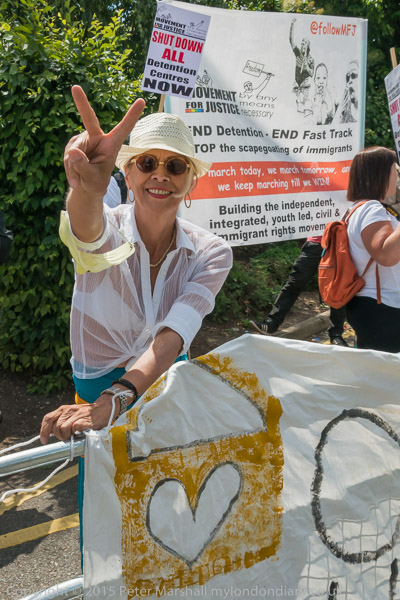
The protest pen gets fairly crowded, and the security staff and police won’t let me photograph from in front of it, though I do so as a matter of principle for a short while until forced to move inside. Telling police that it is a part of their job to facilitate the work of the press (and showing them the police guidance on this) doesn’t get you very far.
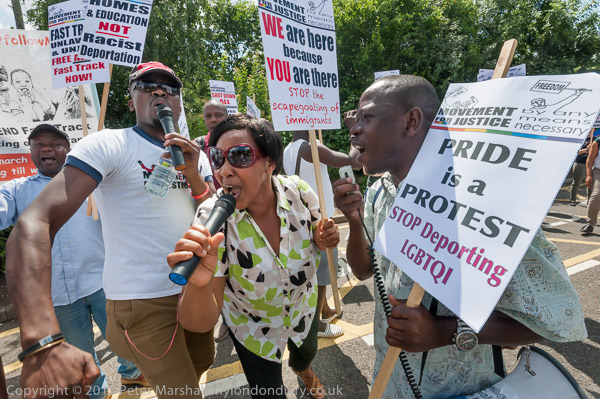
So I find myself working with very wide lenses – the wide end of the 16-35mm and the 16mm fisheye- in the middle of the protesters or sometimes leaning back over the barriers, hoping that being linked together they will not topple. I like working close, particularly with the fisheye, which brings a lot of interaction with the people I’m photographing, but it would be good to have the choice of a slightly longer view. The light’s good and I can use a reasonable shutter speed, needed even with a wide angle when the subjects are close and going across the field of view. It’s good not to use a very fast speed, and to sometimes get a little blurring as people wave their arms and fists, but mostly I’m working in the range 1/250-1/500. Again because I’m often very close I need to stop down for depth of field, and most the pictures are at f8 to f16. I don’t think much about shutter speeds and apertures when working, but set an ISO that gives me roughly what I want – in good light ISO640 or ISO800. Actually in terms of quality working with the D750 and D800E there is relatively little to be gained by any slower speeds, though I do use them for some landscape images.
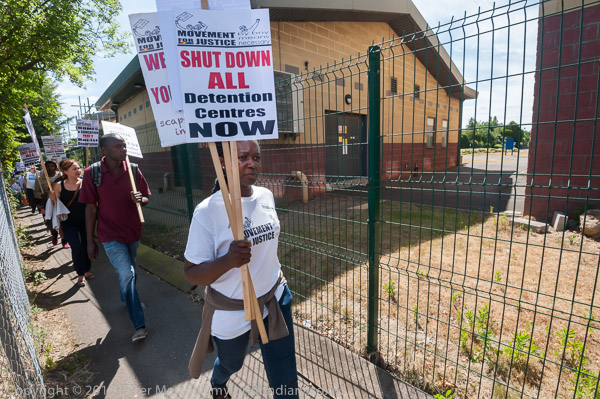
These are noisy protests so that those inside can hear, with drums and horns, but they are also protests with a lot of dancing and walking around in circles in the limited space available. As the protest was reaching its end, it marched out of the entrance onto the Bath Rd and then down a public footpath on the east edge of the Colnbrook prison, stopping in a field beside one of the blocks near the rear of the site. A large hedge and a tall fence behind it stopped us seeing any of the prisoners inside, but they were close enough to be clearly heard, and to join in with the shouting of slogans such as ‘Detention centre – Close them Down!’ with those outside. Police kept the protesters on the path by the hedge, and again the fisheye enabled me to work from inside the hedge looking towards the line of protesters along the edge of the field.
More pictures from the event on My London Diary at Surround Harmondsworth
Continue reading Immigrants not Criminals

DB Prize goes political

The shortlist for the 2016 Deutsche Börse photography prize is the subject of an article by Sean O’Hagan in The Guardian, Deutsche Börse photography prize shortlist: drones v the women of Tahrir, in which he writes it “is dominated by artists who engage with contemporary politics and social issues, from drone warfare to refugee activists in Africa.”

A small quibble in that, as he goes on to make clear in the next paragraph, Tobias Zielony actually “photographed the everyday life and struggles of African refugee activists in his native Germany for his exhibition The Citizen.” It’s work that seen on the web has only a limited appeal to me, but as well as the “Layout of 22 colour photographs, various sizes, on 11 large-scale pigmented inkjet prints, mounted on Aludibond, framed, 225 x 160 cm each” which you can view on screen the show also include an installation of newspapers, in 12 hanging displays, 130 x 205 cm each together with a 16 pages tabloid format which include the first-hand written accounts and interviews that O’Hagan mentioned. You get some idea of the look of these from the installation views of the show at the 2015 Venice Biennale also on the page.

Eric Kessels project ‘Unfinished Father‘ is more about an exhibition than about photography, and I’m not sure it will translate well to the Photographers’ Gallery. It certainly isn’t a book I would ever think of buying, and I think the photography in itself is of little interest, although the vintage images of the Fiats on the street towards the end of the short video have a certain charm, and incredibly empty streets.

Trevor Paglen‘s The Octopus is another installation which has little to offer me on the web, and from all I can see or read I doubt will engage me more in the gallery. But perhaps a closer investigation will bring out something of photographic interest.

I’ve mentioned Laura El-Tantawy‘s ‘In the Shadow of the Pyramids‘ several times on this blog, though unfortunately I missed the presentation she gave at one of our union meetings in London. But if you took my advice from In the Shadow of the Pyramids you will already have and have been impressed by her self-published book which is the subject of this short listing. And in response to a review of this work I added a little of my own thoughts in 1000 Words. The book as I predicted is sold out (and available on the web at around four times the original cost – but hang on and it will go up more), but the web site gives a great impression of the work and also includes page spreads and embeds a number of reviews.

I don’t much like these large competitions, which I think have a restrictive effect on photography, putting too much power over the future direction of the medium into the hands of a small and largely self-selected elite. It’s perhaps unhealthy too, that it’s banks which are behind a number of them – should we be relying so heavily on them for the future of the medium? And if these four photographers are all judged to be worthy of having their work exhibited at the Photographers’ Gallery I think there is something inherently unfair that just one of them should walk away with the £30,000 prize.  Usually it’s the wrong one.

Jerusalem Day

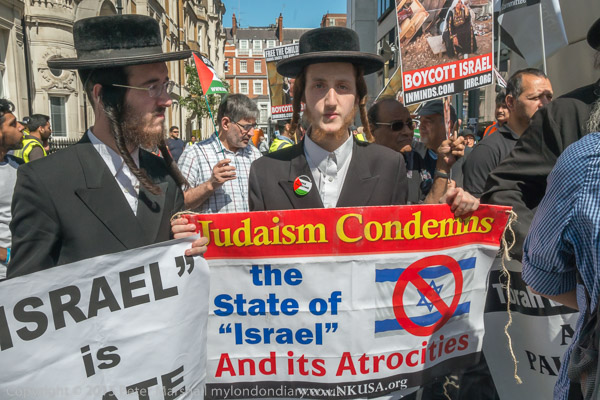
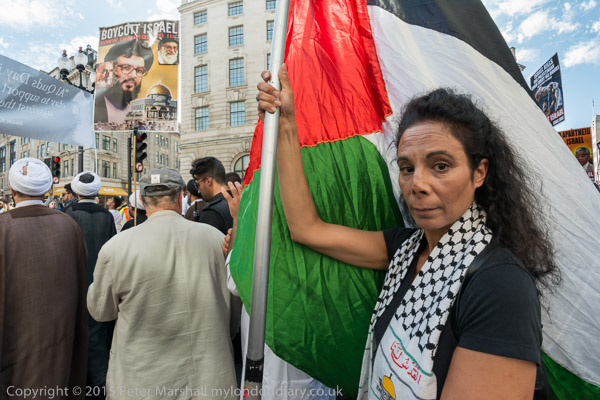
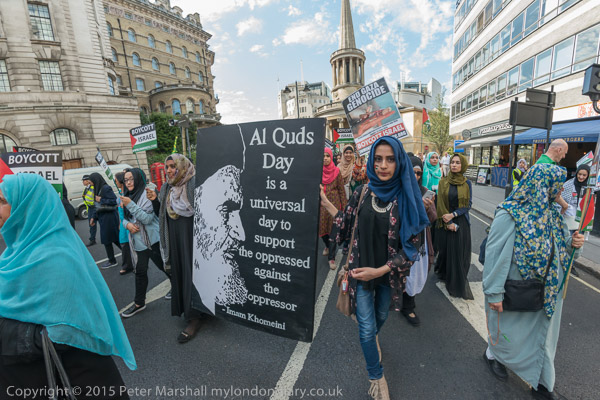
Al-Quds is the Arabic name of Jerusalem (and its Quds in Persian) and in 1979 the Iranian Supreme Leader Ayatollah Khomeini invited “Muslims all over the globe to consecrate the last Friday of the holy month of Ramadan as Al-Quds Day and to proclaim the international solidarity of Muslims in support of the legitimate rights of the Muslim people of Palestine.” He also said it was “a universal day to support the oppressed against the oppressor.”

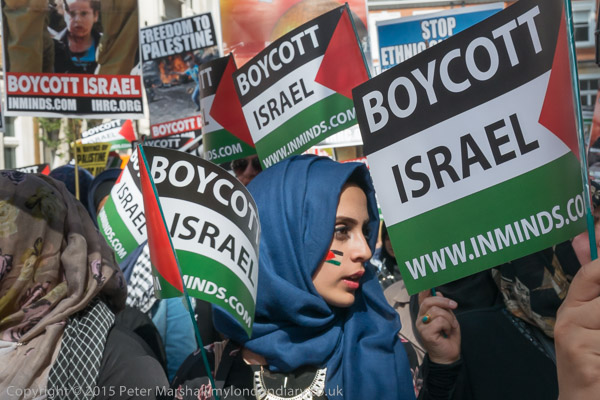
In Iran there are large state-sponsored protests against the Israeli domination of Jerusalem in particular, but also more widely against Israel’s repression of Palestinians in Gaza and the West Bank, and in support of the Palestinian cause. As well as in Iran, there are protests in a number of other countries around the world, including the UK. Here a major part of the protest is the call for a boycott of Israeli goods.

Although most of those actually marching in London are Muslims, including many from Birmingham, Manchester and other cities with substantial Muslim populations, the event is also supported by some non-Muslim groups, including the Stop the War Coalition and several Jewish groups including Jews for Boycotting Israeli Goods and the anti-Zionist ultra-orthodox Neturei Karta who oppose both the State of Israel and Zionism on religious grounds.

The march has been taking place annually in London for over 10 years (I think I first photographed it in 2006, though possibly I took images in previous years on film) and has attracted criticism from some Jewish and ultra-right groups, as well as various Iranian opposition groups – the march is organised by the Islamic Human Rights Commission which is thought to receive funding from Iran.

I’ve seen little evidence of anti-Semitism on these marches, and have seen the stewards take action to remove a clearly anti-Semitic banner. Clearly everyone marching is against Zionism and Israeli attacks on Palestinians and their human rights. One of the more curious spectacles on one previous march was s to see members of a neo-Nazi group, some with clear records of anti-Semitic actions hurling the insult of anti-Semitism at Jews and Muslims marching side by side and sometimes arm-in-arm through London.

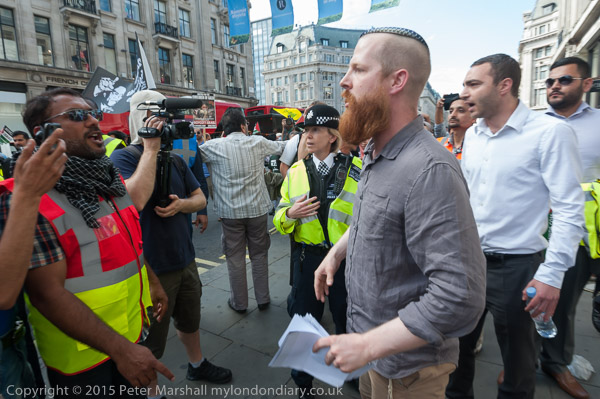
For the past couple of years there have been no real counter-protests – last year a pro-Zionist shouted and threw vegetables from an upper-floor window at the marchers and this year a young man shouted at the marchers and handed out misleading leaflets about how well Israel treated the Palestinians, arguing with some of them until the police led him away.

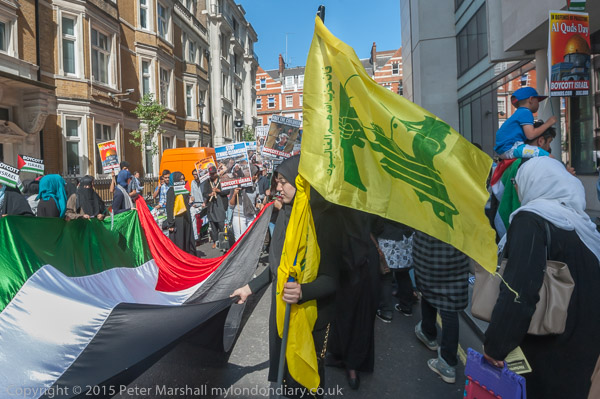
One complaint against the march has been that many on it carried Hezbollah flags and some have said this is illegal. The flag serves for both the military wing – which is proscribed – and the political party which forms a part of the Lebanese government, which, at least in the EU and UK, is not proscribed. There were in any case very few such flags in evidence at this year’s march -and I was looking carefully for them – a handful among the several thousand marchers.

Because of the origins of the event I was also particularly keen to photograph banners and posters which referenced Ayatollah Khomeini – and again these were relatively few. Overwhelmingly this is a march in support of Palestine and calling for its freedom and an end to Israeli aggression and repression there.

My pictures also include many more of women than of men on the protest, mainly because most of the women are in Muslim dress, while the men, apart from the religious readers wear the kind of casual dress that you would see on any high street. Just a few women turned away from my lens, but most seemed rather keen to be photographed, and I had no problems in taking pictures, something which has occasionally been a problem in the past at some Muslim events.

More on My London Diary at Al Quds Day march.

Continue reading Jerusalem Day

September 2015

Just over a month behind, last night I put the finishing touches to my posts on My London Diary for September 2015.


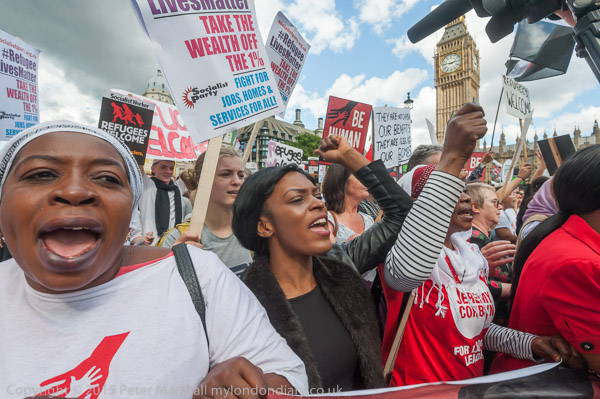
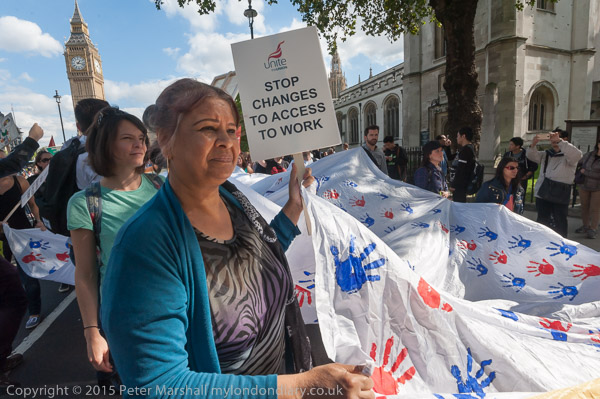
Refugees are Welcome Here march reaches Parliament

It was a busy month yet again for me, with over thirty stories, partly because of the DSEi East London Arms Fair – or rather the protests and events around it taking place, something which happens every two years.

It was also a very interesting month, with the election of Jeremy Corbyn as Labour Party leader and his appointment of John McDonnell as Shadow Chancellor. I’ve photographed and talked with and listened to both of them speaking many times over the years, but this has meant that both of them have been too busy to attend the events I’ve photographed this month.

Knowing both of them the media response to the election has been ridiculous in the extreme – as have been the comments of both government and some Labour party politicians. The establishment is clearly running scared and throwing all kinds of ridiculous assertions at them. They clearly give the Labour Party its only hope of winning the 2020 election after its recent failures and would also put the country under rather better management than it currently enjoys, though whether they would be able to break the stranglehold of the city and the ultra-rich is debatable. I think in the end they are both far too reasonable and conciliatory to really make the radical changes the country needs, but I still have some hope for the first time in some years.

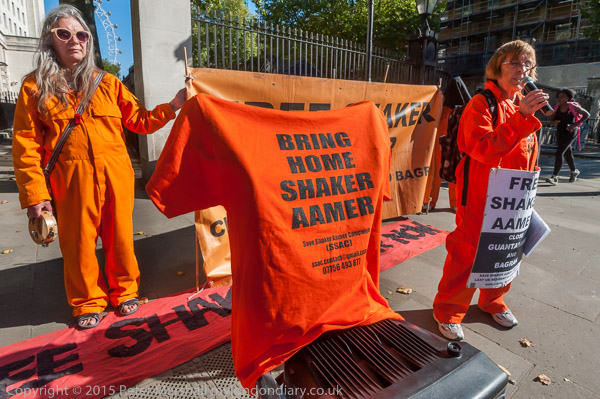
People often tell me that protest is useless and never achieves anything, but they are simply wrong. Two series of protests I’ve been photographing appear to have reached at least a reasonably successful conclusion this month, with an agreement being reached after 100 days of strikes at the National Gallery, and also apparently between the UVW and Sotheby’s, though I think details have yet to be finalised. The protests over refugees have so far only led to a minor shift in the Government’s position, but I think we may see more, and finally Shaker Aamer was released a couple of days ago and is back in a London clinic.

Continue reading September 2015

Victimised Workers


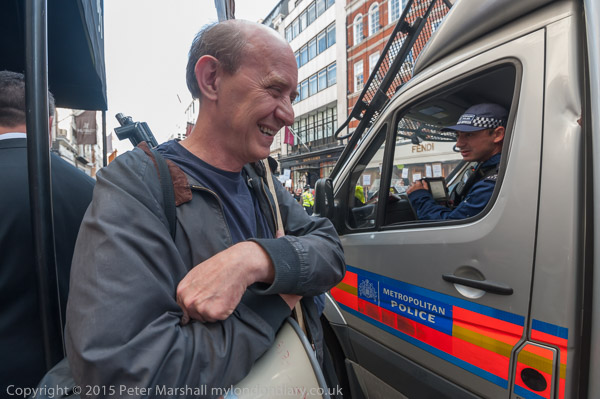
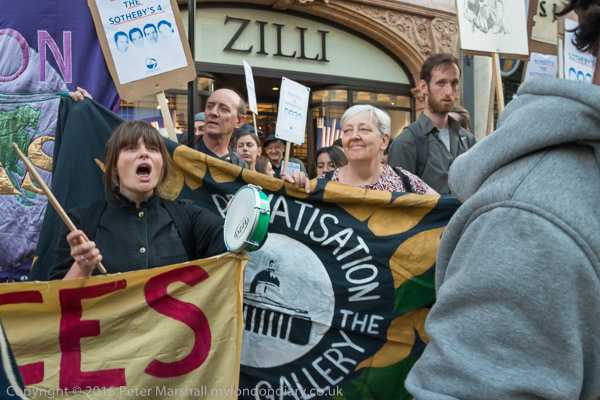
Sandy Nicoll from SOAS Unison smiles at police who ask him to move outside Sotheby’s

This will be a rather shorter post than usual (I hear murmurs of “Thank goodness” from readers) because I’m rushing to leave for an emergency demonstration called because Sandy Nicholl, SOAS Unison’s branch secretary has just been suspended by the SOAS management on grounds of gross misconduct.

As in other such cases, the allegations made against him appear to be false and in any case would not be grounds for their action, but are simply victimisation for legitimate trade union activities that annoy the management.


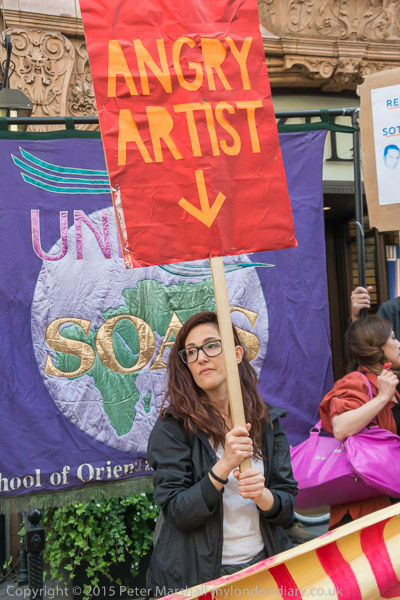
The SOAS Unison banner which Sandy brought to the protest at Sotheby’s

On the evening of July 8th I was taking pictures of a protest over another case of victimisation, where Sotheby’s had effectively sacked four workers for taking part in a legal demonstration calling for proper sick pay, holiday and pensions arrangements. As so often, the union involved, the United Voices of the World, was supported in its protest by other trade unionists, including other victimised union reps such as Candy Udwin from the National Gallery and Alan Brown from Bromley Council, and, as at many other such protests, by Sandy Nicholl with the SOAS Unison banner.


Sandy and Candy Udwin behind the National Gallery strikers banner

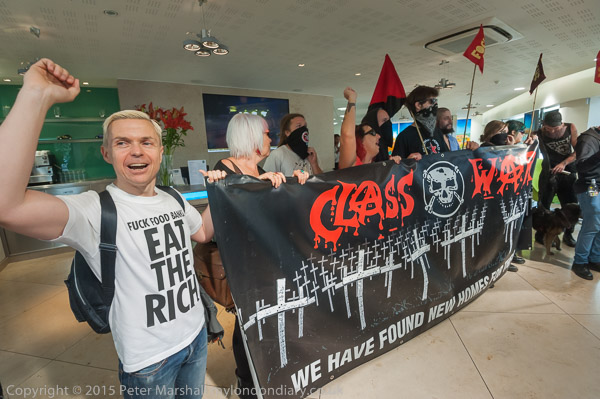
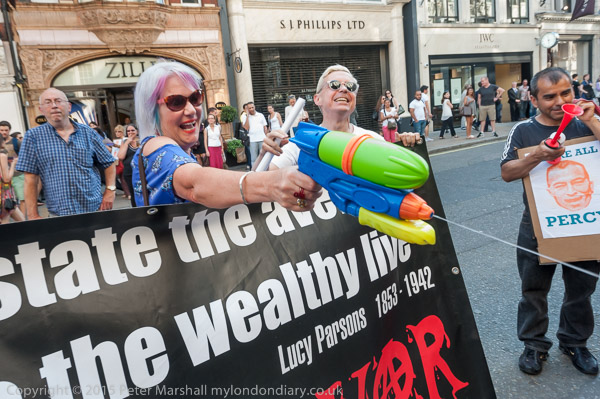
Of course there were others giving their support to the UVW, notably Class War, who had brought their water pistols, megaphone and ‘We have found new homes for the rich‘ banner and infused the occasion with their usual theatricality. Others making their presence felt included some from Lewisham People Before Profits and OSE (Open School East) Artists.

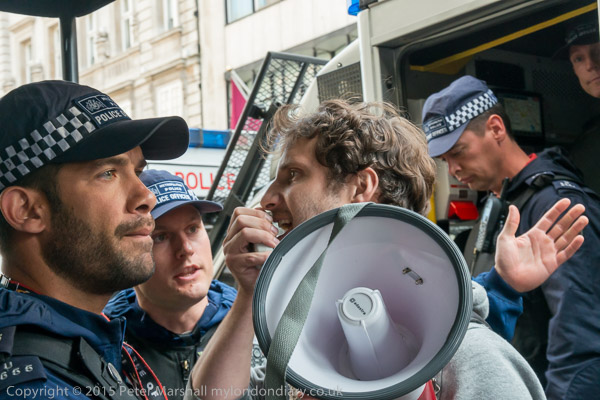
But at the centre were the UVW, and their General Secretary Petross Elia, standing up to some fairly extreme harassment by police who had obviously been leaned on very heavily by Sotheby’s and their influential friends to try and counter the protest rather than – as they should – facilitate it.  It’s a line on which police almost always favour the rich and powerful.


Police surround Petross Elia, refusing to look at him as they push him away

One of the placards which you can find if you search the images at Sotheby’s 4 sacked for protesting I think sums things up nicely; the text reads ‘Your worker’s rights are bad for my business!!’  But they are rights enshrine in law and the law should prevail, and in this case, eventually after some further months of struggle it seems as if here and at the National Gallery it has.

Now I’m off to SOAS to see more people standing up for the law.

Continue reading Victimised Workers

Budget Balls and More

The trouble with working on a Wednesday“, one military gentleman once remarked, “is that it cuts into two weekends“. I don’t like it either, as usually it’s the day of the week when I catch up with some of the little routine things that need doing regularly, none very important but a nuisance if I don’t do them. When you are a freelance and your work is largely driven by when other people decide to do things that you want to photograph you lose the kind of structure that most employment provides, and I find it good to have one fairly fixed point in the week.

Not that I don’t work on Wednesdays. I’m sitting here on a Wednesday writing this and later – after I’ve been out on a few errands in my local town centre – I’ll be putting in several hours of work on getting my web site closer to date, and perhaps also another few on getting images ready for my next book. But I’ll be ignoring the several possible events in my diary for today, interesting and possibly financially rewarding they might be, largely because it’s a Wednesday. If they had been on yesterday I would have gone.

It has to be something that I’m really interested in to get me out on a Wednesday, and on July 8th there were several such events taming place, some because it was Budget Day. Of course I wasn’t going to get out of bed to take the usual ritual picture of the Chancellor that the papers would almost certainly run (though a large squad of press photographers lined up for the non-event the chances of any particular image being used are fairly low) but quite a few people would be taking the day as an opportunity to protest at the various cuts in welfare spending that were bound to be announced.

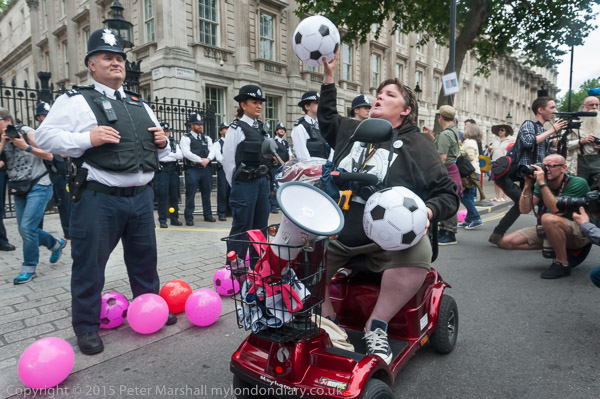
Prominent among the protesters were of course DPAC, Disabled People Against Cuts, and I’d received a message from one of the organisers that as well as the widely advertised ‘Balls to the Budget’ protest at Downing St, they were (as usual) planning a little surprise later.

What makes the picture of Paula Peters of DPAC attempting to throw a football with a message into Downing St for me is the policeman standing watching, thumbs tucked behind his waistcoat, standing in a row of pink and orange balloons and balls. Of course her message didn’t reach the gates into Downing St, though a number of others did manage to get kicked or thrown into that high security zone.

It isn’t really a picture that fits the 35mm format frame and would be better cropped a tiny bit at left and quite a lot at the right. Sometimes I do crop images before filing them, but often I’ll leave them un-cropped, knowing that too many editors have an apparently irresistible urge to desecrate images by cropping; if I crop to perfection they will then crop to destruction.


D700, 16-35mm at 16mm, 1/400 f10 ISO 640

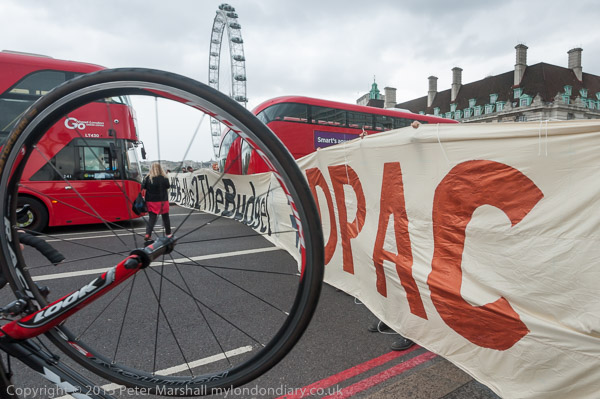
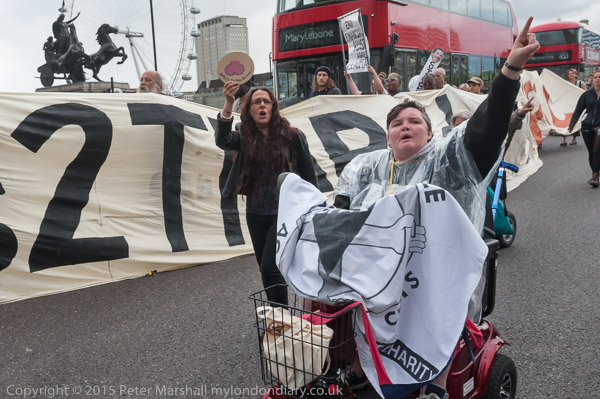
The little surprise turned out to be a 23 metre (75 foot sounds much bigger and better) long banner which they ‘dropped’, hanging on tightly to it over the Albert Embankment wall facing the Houses of Parliament with the message ‘#Balls2TheBudget #DPAC’ before bringing it up to join the other DPAC protesters, some in wheelchairs who had be then marched from Downing St to block Westminster Bridge.

It stretched all the way across the road and it was difficult to get a clear view of it for the buses it blocked and the protesters and other people taking pictures particularly those using their phones. Though I welcomed the cyclist who rode up to it at speed  before jumping off his bike just before it to give me the picture above.

The picture would perhaps have been better with a slower shutter speed to give a little blur as it was still rotating, but was able to nicely frame both it, the larger wheel of the London Eye and the banner. It was nice to have something a little different, and I had very little time to make the image before the cyclist lowered his bike. More pictures at DPAC blocks Westminster Bridge.


Paula Peters and Boadicea

As protesters left Westminster Bridge they were led towards Parliament Square by DPAC’s Paula Peters on her mobility scooter, and as she came up to the statue of Boadicea – also in her chariot – I made a number of attempts to show the two of them together. I think this was the best, with Paula’s gesture echoing that of the statue in the top left. Boadicea probably burnt the town where I now live but was eventually defeated by the Romans. Paula’s chariot as yet lacks the scythes.

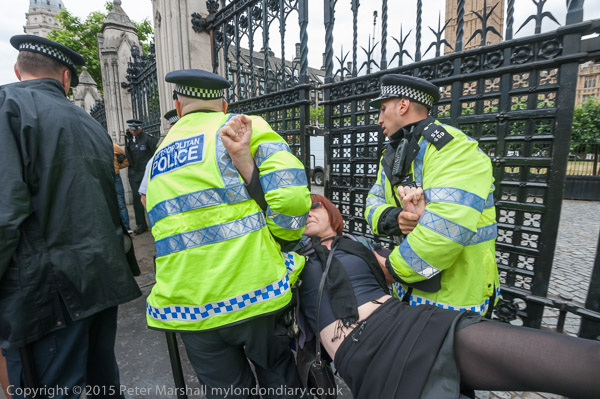
As the pictures in DPAC Parliament Square Budget Day protest show, the protest continued, for a while blocking traffic in Parliament Square. The police are faced with something of a dilemma by the protests by people in wheelchairs, realising the terribly bad publicity they would get by using the kind of tactics they use against other protesters. So while they may fairly forcibly drag away ambulant supporters, those in wheelchairs – at least while the press are around – are generally treated with rather more care.

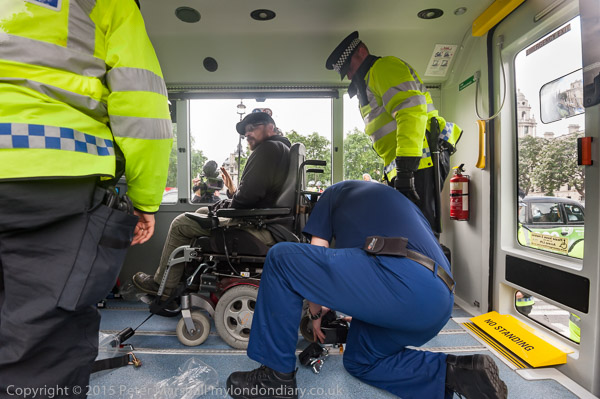
At this protest they had to hire a special vehicle which took quite a while to arrive to transport DPAC’s Andy Greene, locking down his motorised wheelchair with great care. Unlike police vans, it had large windows, and I was able (despite a little harassment by other officers) to photograph through them. They also took away pensioner Terry Hutt in the large and otherwise rather empty van. Two others arrested had left earlier in a more normal van. By the time I arrived at the police station in Savile Row an hour or so later, Andy had already been released, unusually fast as the police usually seem to prefer to hold people for long enough to release them in the early morning after most transport for them to get home has stopped as a little punishment even if they can’t find anything to charge them with.

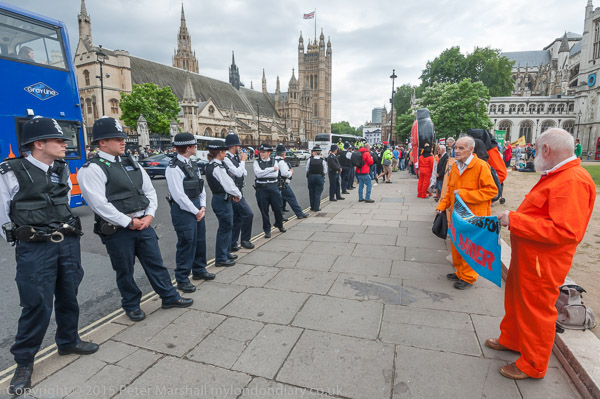
DPAC’s was not the only protest in Parliament Square, with people from several current industrial disputes in London – at the National Gallery and council workers from Barnet and Bromley – coming together for a Joint Strikers Budget Day Rally, and the usual Wednesday lunchtime Save Shaker Aamer weekly vigil who were confronted by an unusually large number of police lines up along the length of the pavement.

Their persistence in calling for the release of Shaker and for him to be returned to be with his family in Battersea seems to have eventually been succesful, though as I write he is still held there. Obama has given the required notice of his release and he could have been on a plane last Sunday, but the authorities at Guanantamo apparently couldn’t handle both that and a visit by three US Congressmen. Quite what has been holding it up since then I don’t know, but I hope it won’t now be long before he is home.

This wasn’t the end of my work on that Wednesday, but I’ve got jobs to do, so I’ll continue another day.
Continue reading Budget Balls and More

Ahwazi Action


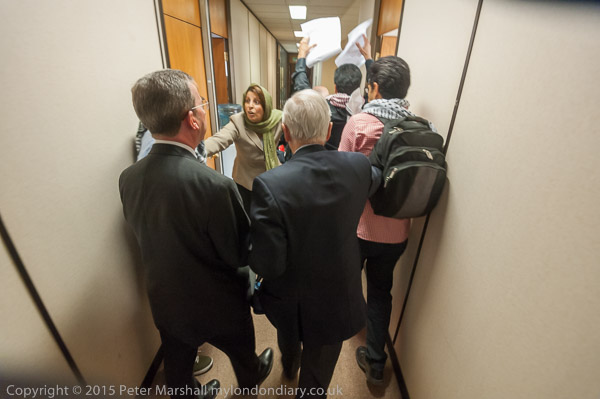
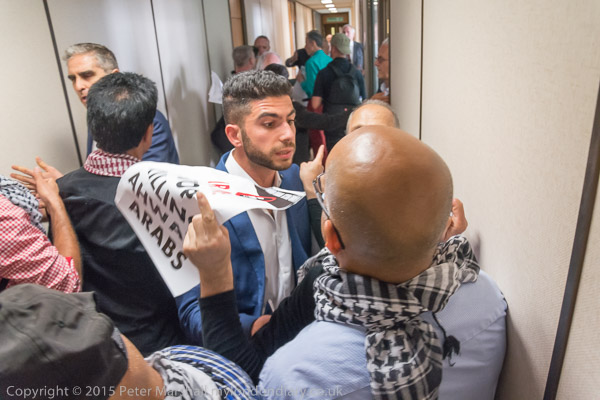
Protesters rush past people in the narrow corridor at the BICC offices

I don’t much like taking photographs inside buildings. So often the light is poor or difficult to work with, and spotlights and windows both tend to mess up autoexposure, even with matrix metering which is supposed to cope with such things. It’s all fine when you have plenty of time to make readings and set settings, but can be tricky when you are working under pressure.

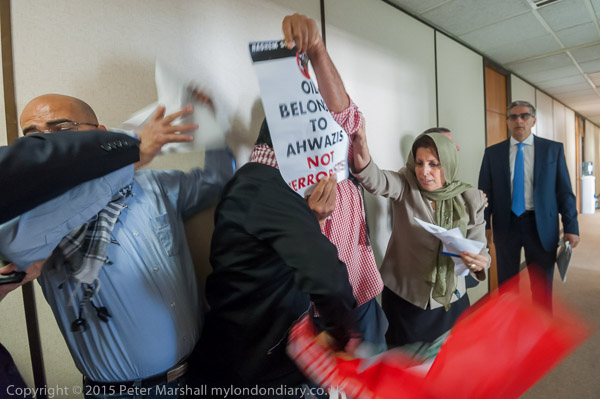
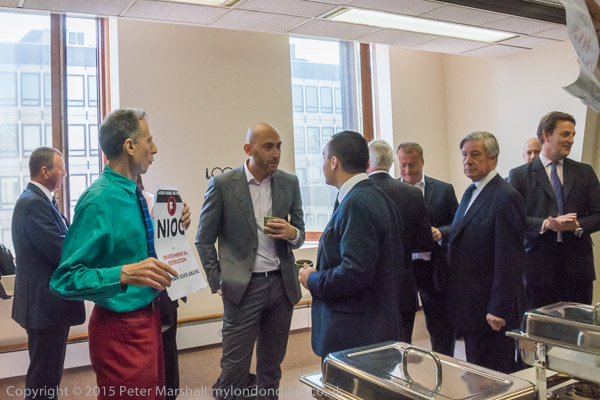
And in NIOC House I was certainly working under some pressure. I wasn’t there by invitation, but had rushed in following some Ahwazi Arab protesters. I’ve mentioned them before, but for anyone who isn’t sure, you’ve probably read about the Ahwazi homeland even if you’ve never heard of it, as it is supposedly the inspiration for Genesis’s garden. The death-knell for the Ahwazi Eden came with the discovery of oil there by the Anglo-Persian oil company in 1908, since when Iran, aided in the years before the Iranian revolution by the UK, has been trying hard to eliminate the Ahwazi people and culture.


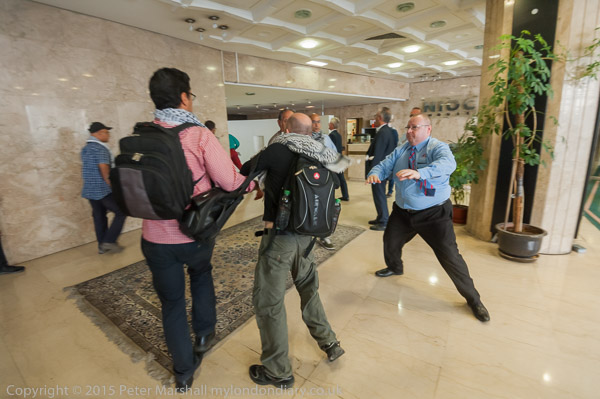
Peter Tatchell’s green shirt disappears around the corner as other protesters face security in the foyer

Even before the recent moves to lift sanctions there have been continued links between the UK and Iran, with NIOC house, less than 5 minutes walk from Parliament, at the centre. Few people walking past would know what goes on in there, or indeed that the initials stand for National Iranian Oil Company. It’s surely significant that although its address is always given as Victoria St, the only entrance normally in use is tucked away at the back on Tothill St.

Back in April I went into the foyer with a small group of Ahwazi protesters (see Ten Days of Rage for Ahwazi Intifada) and at the end of June received an invitation from the Hashem Shabani Action Group to join with them and the Peter Tatchell Foundation in an attempt to gate-crash secret UK-Iran business talks taking place in the offices of the British Iranian Chambers of Commerce (BICC) inside NIOC House.

I met with the group outside Westminster Abbey, were Peter Tatchell gave a short briefing on what they were proposing to do, and in particular on the non-violent nature of the protest. Also present were two other photographers I knew, along with two videographers and an intern.


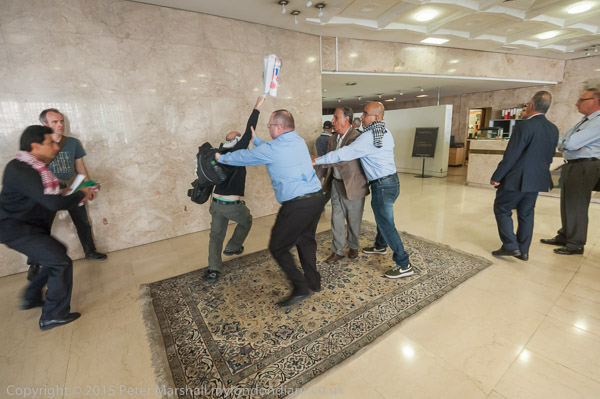
Security fail to stop an Ahwazi protester who runs past them.

I was more surprised not to be stopped by the building security as I followed the protesters who pushed past them and rushed to the stairs, along with the other two photographers; the videographers were a little slower and were apparently stopped in the foyer.

Had I known in advance that the meeting was on the sixth floor I might have declined the offer to attend the protest, and rushing up the stairs I was rather worried that I might not make it without collapsing, though I actually caught up with some of the protesters who were half my age. Despite being pretty totally knackered, put of breath and with a heart thumping at an unhealthy rate I was still able to follow the group as they ran along the corridor to the rooms where the meeting was being held.


More attempts to stop the protesters in the narrow corridor – and a trace of vignetting from my lens hood knocked slightly out of position

There was a certain amount of pushing and shoving in the corridor, and there were people telling me I couldn’t take photographs, but as none of them told me who they were and what authority they had to stop me I proved remarkably deaf. Everyone was a bit confused, but eventually we went into the room where those at the meeting were about to enjoy what looked like a very decent buffet lunch. Things inside the room were a little more civilised, with many seeming to totally ignore the protest and continue with their conversations, but when we got back into the corridor and were on our way out things became more hectic.


Peter Tarchell confronts some of those waiting for lunch who take little interest

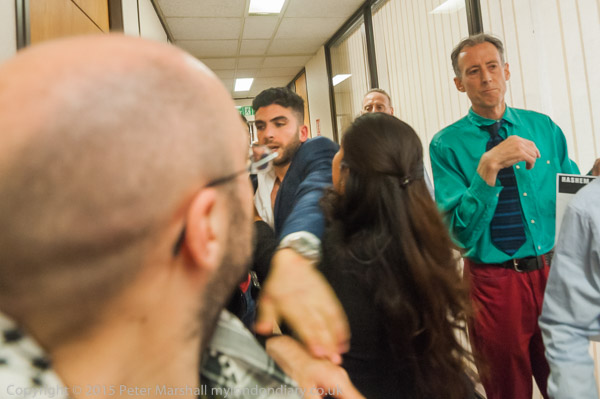
Coming out of the meeting room I took the wrong door and turned left towards the stairs rather than to the right and missed the opportunity to photograph the best known politician attending the event, Lord Lamont. I was at the wrong end of the corridor with people blocking my way when he was confronted by protesters, though both the other photographers were close to him and were able to get pictures. A few of the people who were trying to stop the protest did get rather physical, and one young Iranian, thought by the protesters to be an agent, obviously completely lost his temper, and had to be pulled off by some of the other staff after he assaulted one of the other photographers, knocking him to the ground and causing minor injuries.


A young Iranian man gets angry with the protesters. I can’t get past to the end of the corridor where protesters found Lord Lamont

At least I didn’t get more than a little shoving around, but photographically I was having problems with the D700 which had started to fail to focus and also over-exposing, both extremely annoying. It wasn’t really possible to try another lens on the camera as there was quite a lot of people milling around and I was getting pushed around as I was taking pictures. The light in the corridor was giving me exposures around 1/30 f4 (wide open on the 16-35mm) and with overexposure giving me even slower speeds and considerable subject and camera movement quite a few exposures were unusable. I would have been better to have used the fixed 20mm f2.8, but I hadn’t thought to put that in my bag.


A colleague tries to hold back the young Iranian who has been assaulting protesters

The 16-35mm f4 isn’t really a lens for low-light action, and is also big and heavy, and my lens is beginning to show its age. A year or so ago it needed a very expensive service, almost to the point it wasn’t viable. Now it does seem to be getting a little temperamental, and though it was working properly when I took a few pictures of the group outside NIOC after the event, occasionally since then I’ve had to switch to manual focus.

At fairly close range even at 16mm there isn’t a great deal of depth of field at f4, and manual focus in poor light isn’t too easy with modern cameras and lenses designed for autofocus. Back in the days of film with cameras like the Olympus OM4 and a suitable choice of focussing screen manual focus was much more viable. And with cameras like the Fuji X-T1 that use an EVF, manual focus is again easy, though too slow for rapid moving events like this.

Eventually we left, walking down those six flights of stairs again (I don’t know why they didn’t take the lift down, but I had to stay with them in case anything happened.) In the ground floor lobby we were stopped by police, and told that we were not under arrest but could not leave, even though we photographers showed our press cards.

We sat around in the lobby for three quarters of an hour while the police decided what to do, complicated slightly by the complaint of assault against the young Iranian. Police advised the photographer that his assailant – who they went and found and questioned briefly – probably was protected by diplomatic immunity and he decided not to press charges. The police came round and asked everyone for names and addresses which we gave and then we were allowed to leave. It was good to get outside.


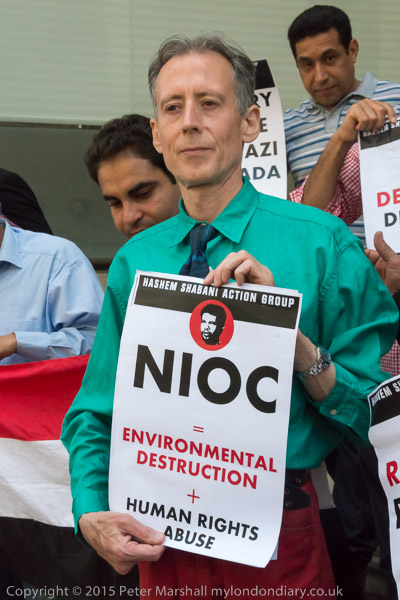
Peter Tatchell poses with the other protesters outside at the end of the protest

Although I don’t think any of the protesters (or photographers) was later arrested, certainly some of the non-violent Hashem Shabani Action Group, named after Arab-Iranian poet and human rights activists Hashem Shabani, executed for peaceful opposition to the Iranian regime in January 2014, have been harassed by police. Some influential UK politicians with busiiness interests in Iran, including some of those at this meeting we visited, have called for the organisation – which says “Our weapons are pens. Our bullets are words” to be banned as a terrorist organisation.

Iran says that Shabani confessed to being a member of the terrorist group “Al-Moqawama al-Shaabiya Al-Tahrir al-Ahwaz” which appears to be a figment of Iranian state imagination. The confessions made by Shabani and others came after extensive torture. Press TV reported the confessions and sentence claiming that the Al-Moqawama al-Shaabiya (People’s Movement) is backed by the US and UK, but there appear to be no reports of the organisation nor its supposed activities except from these Iranian government sources. Unfortunately the UK seem more interested in backing Iranian interests and ignoring  human rights issues in Iran in general and in particular the persecution of the Ahwazi people.

Continue reading Ahwazi Action

Harrodsburg

A remarkable set of pictures by ‘Glasweegee’ Dougie Wallace of the wealthy on the streets around Harrods and other shops selling ridiculously priced bling have apparently caused quite a stir in Qatar (where many of those he photographed have their homes) according the the British Journal of Photography, in an article Qatar responds to Dougie Wallace’s photographs of Britain’s wealth tourism.  The BJP also claim responsibility for having given him the idea, when they erroneously reported last December that he could be found working outside Harrods. It seemed to him to complement work he was doing in  one of the poorest areas of Glasgow, close to where he grew up.

You can see more of his work from ‘Harrodsburg‘ at The Story Institute, which also has some text worth reading on his work and the motives behind it. The area in which he worked – not just around Harrods, but down to Sloane Square and around the Ritz, once the home of many over-wealthy British, is now largely in the hands of “the various tribes of the global super-rich buying up London homes like they are gold bars, as assets to appreciate rather than as homes in which to live.”
More interesting than the BJP story is the article it links to in The Doha News, published in August.  It’s also worth reading the comments. (To save you worrying as I did, the hashtag  #دوغي_والاس  is simply #Doga_walas.)
Wallace’s images remind me of things that I’ve seen walking around some of those same streets, but have never photographed. Perhaps I should say, have never had the bottle to photograph.  Though rather that I’ve never had a very good reason to want to photograph. They are streets too that I dislike, only going through them when I have to, usually on my way to some embassy or other to photograph a protest. But his work is impressive – even if it doesn’t go down too well in Qatar. At the moment we can photograph freely on the street – a liberty I value that we may well lose unless we defend it.

Ooredoo (formerly Qtel Group) which provides most of the internet in Qatar (and probably other internet providers there) was quickly forced by the authorities to block the web site with the images, probably because as well as causing the ultra-rich embarrassment they also show their hypocrisy, particularly in wealthy visitors to London abandoning the strict rules of dress they forcibly impose on others in Qatar.
Pictures from ‘Harrodsburg‘ have been on show in London at the Printspace on Kingsland Rd, but the show, part of the East London Photomonth, was due to close today – or tomorrow or Wednesday – all three dates are in the links.

You can also visit Dougie Wallace’s web site, and buy his books Shoreditch Wildlife and Stags, Hens & Bunnies. The Shoreditch book is I think much better than the presentation on the web, and I hope that Harrodsburg will become available in print before too long.


Dignity Under the Hammer

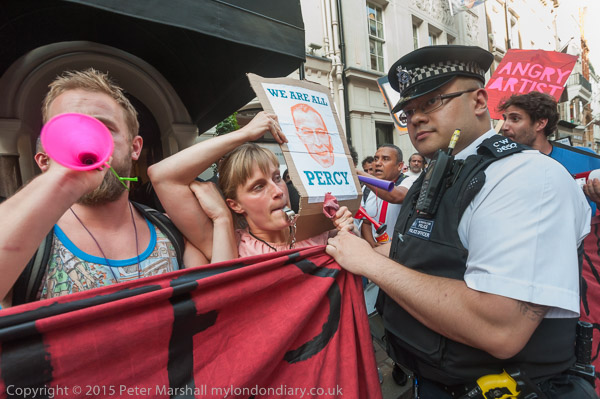
I imagine everyone reading this will have heard of Sotheby’s, one of the leading auction houses in the world, not least for photography. I’ve never actually been to an auction, though I’ve walked past their building in New Bond St often enough, and have been to shows in their S|2 gallery opposite their rear entrance in St George St. But I have often looked through their catalogues of photography sales on-line – and there are some interesting images in their next Paris photography sale in November 2015.

But on July 1st, I wasn’t going to Sotheby’s to make a bid for the hand-painted dollar bill by Andy Warhol that sold that night for £20.9 million, or any of the other high-priced contemporary art works that gave them a record sale of £130.4m. Take the m off the end of those prices and I might have considered them, though I would still find some of the amounts paid rather high. But the art market and the photography part of it in particular is simply crazy, and not about art but about money, a subject I have a relatively small interest in.

The workers I was going to photograph do have concerns about money, though previous actions by their union, the UVW (United Voices of the World) very grudgingly got their employer to pay them the London living wage. Although they work at Sotheby’s, cleaning up the place and carrying around those ridiculously expensive artworks, they are not employed by Sotheby’s.

At the time their union actions won the living wage – and contractual sick pay above the statutory minimum – they were employed to work in Sotheby’s by CCML (Contract Cleaning and Maintenance London Ltd.) But Sotheby’s then ended the contract with CCML and made a new contract with Servest, who presumably were able to offer a lower cost service because they decided to renege on the agreement previously reached with CCML, refusing to pay the backdated payments that had been agreed, refusing to honour the agreement over sick pay, stating they were doubtful that they would pay the increased London Living Wage due in November and taking unfair disciplinary action against one of the union reps.

The union, the UVW, is one of several grass roots trade unions set up by low paid workers who feel the traditional trade unions have – except in a few branches – failed to stick up for the lowest paid in the workplace, particularly where they also represent those on higher pay. Regrettably, some trade unionists have regarded attempts to acheive the living wage as an attack on pay differentials and have even sided with management in keeping some workers on the minimum wage. Many of the lowest paid in London are migrant workers and not native English speakers, and some unions have found this hard to cope with – and trade unions are not immune to racism.

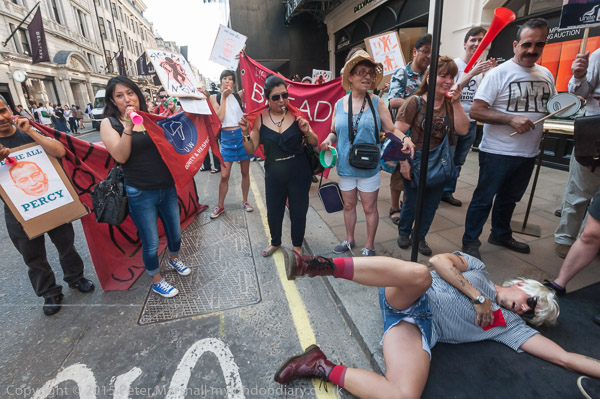
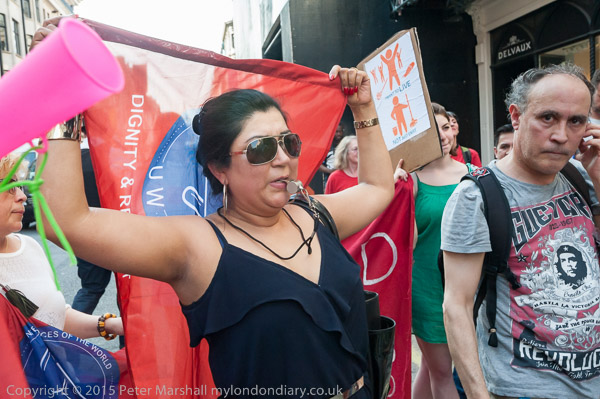
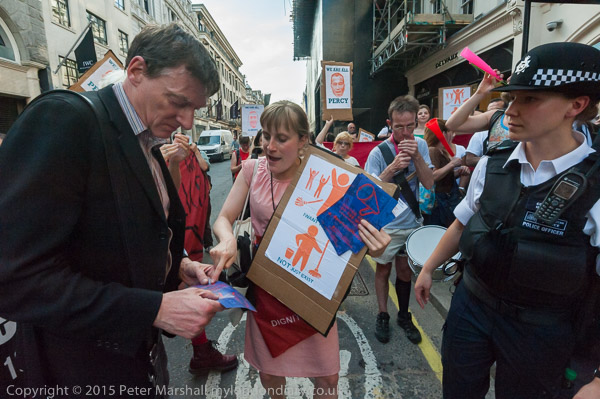
These new unions have brought a liveliness to protests that is seldom seen in the traditional union actions, with noisy protests where people parade and sometimes dance, blowing horns and whistles and banging drums. They want people to notice they are protesting, and it is certainly hard not to, and also they make clear with speeches, placards and banners why they are protesting. Some of the protest at Sotheby’s was in Spanish – the language of most of the cleaners – but it was also in English, and the ‘3Cosas’ that they were calling for were contractual rather than statutory minimum ‘Sick Pay, Holidays, Pensions’ and they wanted them ‘Now!!!’

Their chants could certainly be heard by everyone attending the auction at Sotheby’s as well as everyone else in the area. There was considerable tension between police and protesters, with the police trying to move the protest away from the entrance to Sotheby’s and to keep traffic along the street moving.

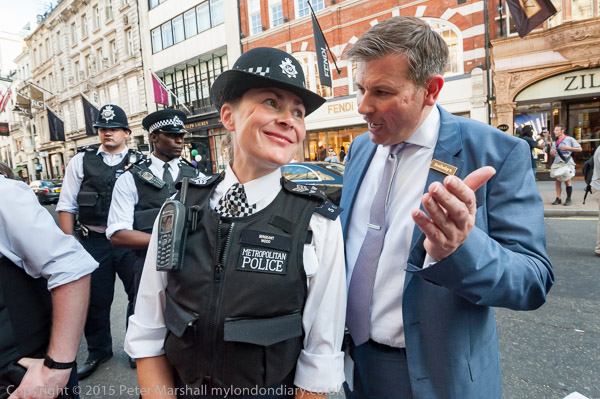
The protesters wanted to make their protest at Sotheby’s and to make those going into the auction aware of their cause and were not attempting to stop people entering or leaving, but the police seemed to the protesters to be siding with Sotheby’s and trying to minimise the impact of the protest. One of the managers did seem to spend a lot of time trying to persuade the police to be more assertive and clear the protesters away, and reinforcements did arrive and made an attempt to do so, pushing some of the protesters aside, but despite threats of arrest the protesters stayed around in front of Sotheby’s, though leaving the entrance slightly clearer.

As well as the UVW, the protest was also supported by a number of individuals and other groups, including other low-paid and victimised workers and their union branches and Class War, who injected their usual humour into the event, coming armed with water pistols and staging a mock shooting in front of Sotheby’s, as well as some dancing and mime.

Photographically it was a fairly straightforward event, working mainly at close quarters with the D700 and the 16-35mm (used in all the pictures on this post) with just a few longer shots with the D800E and the 18-105mm. The light was good, though the black carpet and awning over the entrance to Sotheby’s did create some deep shadows in that spot, otherwise the fairly bright but low contrast shade in the streets was easy to work with. There were a few times when police seemed over-officious telling me to get off the road, and a few times I was pushed out of the way, but most of the time things were polite and the atmosphere was reasonably friendly. I had to leave before the protest finished, but there were no arrests while I was there.

The day after this protest, 4 cleaners who had taken part in the protest were stopped going in to work, effectively sacked. Following another protest two were reinstated, but protests have continued to get the two most active union members their jobs back. As I write this, the UVW have called off another protest scehduled during tonight’s auction at Sotheby’s as talks have been agreed which it seems likely will end the dispute. It is a dispute that should never have happened, as Sotheby’s are making record profits and the amounts involved in giving their low paid workers decent pay and conditions are relatively small.

More information and pictures at Sotheby’s ‘Dignity under the Hammer’ protest.

Continue reading Dignity Under the Hammer

RIP ILF

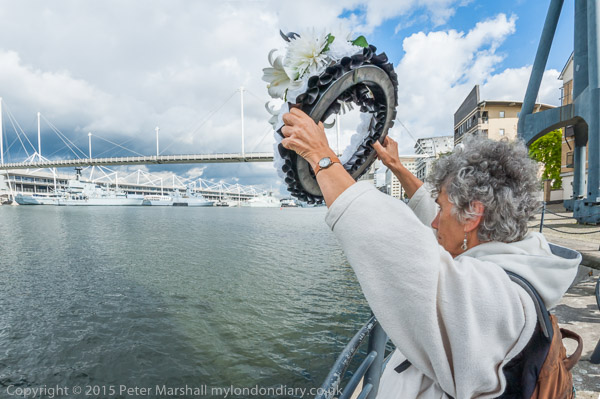
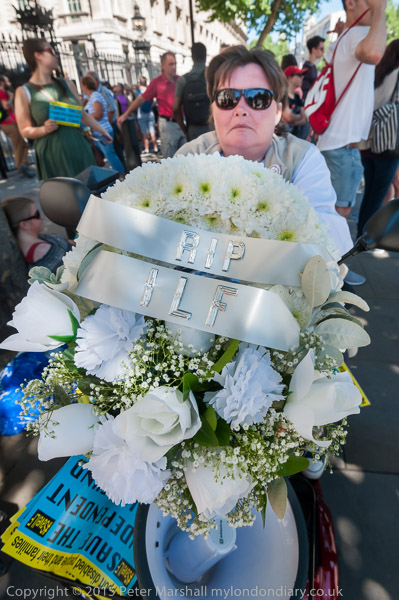
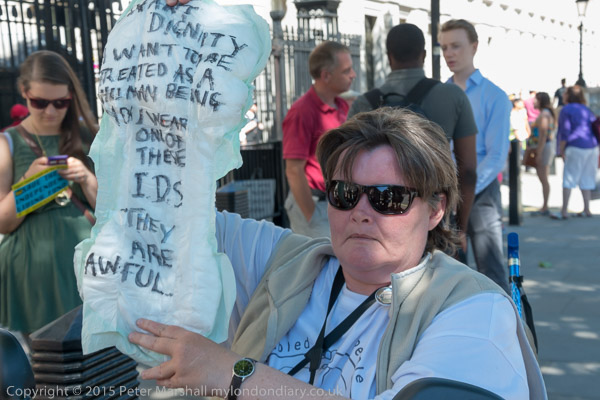
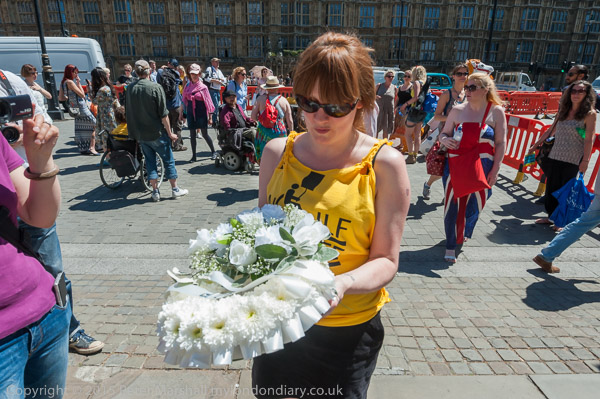
Paula Peters of DPAC, carrying the ‘RIP ILF’ wreath on her mobility scooter above, had a few minutes earlier written a message for Iain Duncan Smith on an incontinence pad : ‘I want dignity – I want to be treated as a human being – You wear one of these I. D. S. They are awful‘.

When IDS began his programme of ‘welfare reforms’ he obviously decided that the disabled would be an easy target, their disabilities making them unable to stand up against the cuts in the benefits that had been gained over the years of campaigning. It was clearly a mistake, and one that those campaigns over the years for equality for the disabled should have warned him about.

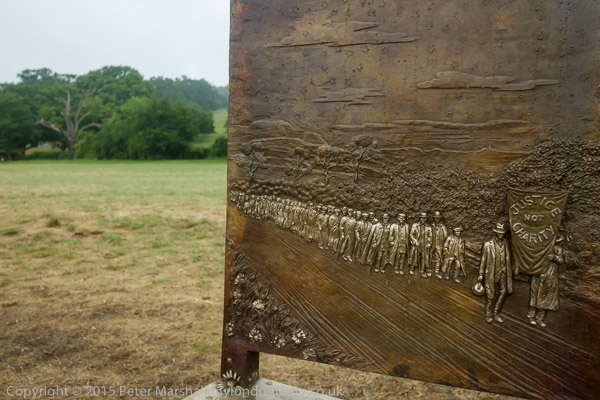
Disabled People Against Cuts (DPAC) and other groups like Black Triangle aren’t the first groups of disabled people to stick up for their rights.  One of the chairs in Hew Locke‘s The Jurors artwork at Runnymede depicts the 1920 march to a rally in Trafalgar Square from Leeds, Manchester and Newport behind a banner reading ‘Justice not charity‘ and the same slogan was used for protest marches in the 1980s and 1990s. The Disabled People’s Direct Action Network, DAN, was formed in 1993, and at least one of DPAC’s current activists has the tattoos to show his membership.

In the past few years, DPAC have been at the spearhead of protests against the cuts and against unfair ways of cutting the support to the disabled, such as the Atos administered computer-based tests of work capability, now taken over by Maximus (see Maximus – Same Circus, Different Clowns.)


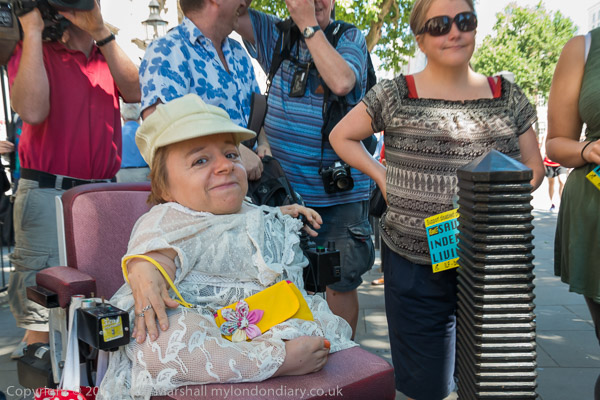
Sophie Partridge, disabled Actor, Writer & Workshop artist

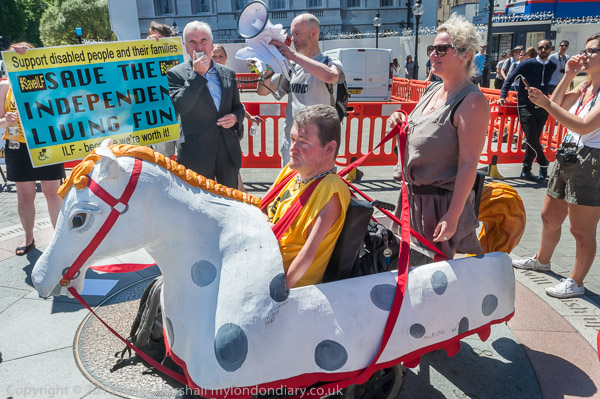
The Independent Living Fund was set up in 1988 to provide support for severely disabled people who need intensive, high-cost care to combat social exclusion on the grounds of disability. It could provide them with personal assistants so they could continue to live in their own homes, and for many of them to work and have a social life.  Funded by the Department for Work and Pensions it was run as an independent public body, and supported around 19,000 disabled people at an average annual cost of around £17,000 per year – around 60% of the average cost of a place in residential care.


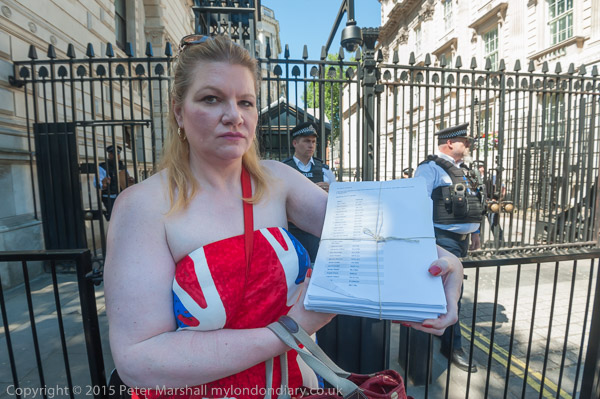
The petition to Downing St

The government’s idea was to shift that cost from central to local government, which it was engaged in savagely cutting, but to do so without providing any ring-fenced funding. In practice this is likely to lead to many of those on ILF being given dangerously low levels of support – those notorious 15 minute calls by care workers – by cash-strapped local councils leaving the disabled unable to take part in normal life, those working being unable to continue, and the kind of indignities that will leave them for long periods of the day and night in incontinence pads, not because they are incontinent, but because there is no one to help them reach a toilet.


John McDonnell MP speaking and John Kelly in Schimmel, the equine star and proud battle horse of the Threepenny Opera

Possibly part of the motivation for the government decision to close the scheme made in 2010 (when it closed to new applicants) was that providing support to the disabled did enable them to protest. The fight to keep the ILF was a long one, both on the streets and in the courts, with the court of appeal ruling in 2013 that the Minister for Disabled People had breached equality duties when deciding to close the ILF. But in the end they could only delay the truly evil day, and the ILF ended on June 30th 2015

The police at Downing St rather surprisingly accepted the petition that was delivered for David Cameron, but would not take the ILF wreath, which was laid instead opposite Parliament in Old Palace Yard.

More pictures at DPAC’s ILF Closing Ceremony on My London Diary.

Continue reading RIP ILF