New Year thoughts

I’ve tried hard not to add significantly to the barrow-loads of reviews of the year 2015, lists of the best photographs of the past year etc, as well as resolutions for 2016. Mostly they are excuses for writers having a week or two off over Christmas and the New Year and ignoring as much of what is happening as they can as they enjoy eating an drinking immoderately. And I have to admit that it’s something I’ve enjoyed taking advantage of in the past, and we all do need a rest from time to time.

I even sneaked a look at one or two of those compilations of the ‘best images of 2015’, though I found them in the main disappointing; too many pictures of politicians, sometimes obscure to those of us not the the USA doing nothing very interesting, and relatively few images that will stand the test of time.

It all makes for a good time for politicians to sneak out controversial announcements on the day when most MPs have already left for the Christmas break, knowing that the papers will mainly have their minds fixed on different things. But this year the Christmas break for many UK journalists and photographers was rudely interrupted by torrential rain causing flooding in cities, towns and villages in the northern half of England and parts of Scotland.

Terrible though this was for those who were flooded out – and having been an inch or two from the water coming into my own home for several weeks in 2014 and knowing others close by flooded I felt for them, as did most of the rest of the nation, though we didn’t let it spoil our celebrations. And even if a lost filling and some painful toothache hadn’t been making my own life something of a misery I wouldn’t have felt I could have contributed anything by travelling a couple of hundred miles to photograph other people’s troubles which were already being covered by so many photographers.

Possibly something good may come out of the floods. Perhaps they will have finally silenced the climate change deniers and several articles have appeared in newspapers suggesting a need to adopt sensible policies to lower the risk of further flooding. We may now see measures to slow run-off from agricultural land (including re-afforestation, semi-permeable barriers and reductions in sheep grazing and maize growing) and any new building in flood plains being designed with flooding in mind.

As for new year, I’d like it to be moved back to March 25th, where it was celebrated in England up to 1751. Perhaps then we could avoid the ridiculous almost two weeks of shutdown that we now get in midwinter that has me waiting so long for my dentist to come back to work. The Feast of the Annunciation, or ‘Lady Day’ marked the beginning of the agricultural year, and was when it changed from being one year to the next – so the day after March 25th 1715 was March 26th 1716.

Photographic new year jobs

But we do differently now, and I’ve just been performing some of the photographic rituals (yes, eventually this post gets around to photography) for the change in the year to 2016. If you, like me, file images by date, now is the time to set up folders for the new year 2016.

Lightroom too needs attention – as an e-mail from the Lightroom Queen Victoria Bampton reminded me. I’ve decided now to change to a new Lightroom catalogue each year, labelled with the year. I’ve found LR works much better if you don’t grow your catalogues too large. Yesterday I finished processing the images from 31st Dec 2015 and backed up the 2015 catalogue, then created a new catalogue for 2016.

It’s also worth deleting some of the old catalogue backups, though I like to keep a couple as well as the most recent, just in case one is corrupted.

Lightroom presets also need updating, in particular the import preset that I use to write copyright and contact information into every image I add to Lightroom. You do this from the import dialogue by selecting the preset, then choosing to edit it – and saving it, preferably under a name that reminds you it is for 2016.

I usually get around to altering the discrete copyright message that I add when writing images for the web from Lightroom by some time in April, but yesterday I managed to do it before importing any 2016 images. You do this from the ‘Edit’ menu, which rather to my surprise has the choice ‘Edit watermarks’. I selected my 2015 watermark, made a few changes, then saved it as pm2016 – it now puts ‘Copyright © 2016 Peter Marshall mylondondiary.co.uk‘ in a slightly different place and a little darker than before.

My web site, ‘My London Diary’ is also chronologically arranged, and I will need to set up a new page for the year, along with new versions of the monthly page and the individual pages. It’s getting to be something of a squeeze to get another year along the top of the monthly page for the top menu. I also have to change the copyright text on the pages and other library items that are on the pages. Fortunately this isn’t yet urgent, as I still have to finish adding my text and images for the last week of December 2015.

It might be slightly less simple to do all this on ‘Lady Day‘, but I’d happily make the changes then, listening perhaps to Billie Holiday with Prez.
30 Under 30 Women

I almost gave up with Photo Boite‘s 30 Under 30 Women Photographers, as although the initial page loaded rapidly, when I clicked on the link for 2016 I got just a large blank white page with just the header menu, now showing a larger 2016 and, scrolling down several blank white pages, the page footer.

I waited  and waited and after a minute or two,  went to check my e-mail. But fortunately I’d left the page open in Firefox and five minutes later came back to find the site had loaded.  I don’t know why the page should take so long to load, though around 3Mb of images doesn’t help, but I’m working on a connection where sites download at 35Mbps and pages with a similar amount of images download faster than I can scroll down them. Perhaps it loads all 30 pages at once, though the time seemed excessive even for that, or perhaps it was just very busy when I tried.

I tried the site in another browser, Internet Explorer, rather than the Firefox I normally use, and it did load rather faster, though still slow enough for many to have gone elsewhere.  But don’t be put off; once the site has loaded it works well, and shows a good number of images by each of the 30 women.

As well as the pictures, there are also short biographies of the photographers, many of whom have already enjoyed considerable success, and rightly so from the quality of their work, though there are a few who I felt were perhaps a little over-exposed and where a tighter selection of images might have helped. Or perhaps their work appealed to me less.

Despite the press release which describes the work as:

“A more feminine vision: 30 UNDER 30 exhibits the work of women photographers from around the world offering their visions based on their experience, along with their tact and composure, innocence and sensuality, at times fierce and provocative.

A more innocent vision: Driven by expression, this new generation draws its inspiration
and conveys it through its works with purity, free of disillusionment, through portraiture, photojournalism, landscapes, art and architecture, fashion and even war photography in a milieu traditionally practiced by their counterparts.”

I can’t really see anything about the work that would make me think they were ‘women photographers’ rather than simply thinking of them as photographers; my experience has always been that many of the best photographers I’ve known have been women. When I taught photography, the great majority of my better students were women.

Of course women have been under-represented in the pantheon of photography, but the reasons for this are not photographic but wider social issues.  When I put together a list of notable photographers for a photography web site,  there were only 41 women among the roughly 200 photographers, but these did include some who made really significant contributions to the medium, including Julia Margaret Cameron, Berenice Abbott, Diane Arbus, Nan Goldin, Cindy Sherman, Dorothea Lange, Margaret Bourke-White, Mary Ellen Mark, Imogen Cunningham and more. Many women have over the years played an important role behind the camera as well as in front of it, something I feel the introduction to ‘30 under 30 Women‘ fails to acknowledge.

Boxing Day Walk

Today, Dec 27th, the day after Boxing Day, seems a kind of non-day. Christmas in the UK traditionally lasted two days, Christmas Day itself and the next day, Boxing Day after which we all – or at least most of us – went back to work. Back in the early days when I was a teacher it was good to get another week or so of rest when most were back working. Now it seems to be almost a national holiday until after New Year’s Day, though today few of us will be celebrating the Feast of St. John, apostle and evangelist or National Fruitcake Day, apparently an unofficial US National Holiday, though we will certainly still be eating up our Christmas Cake.


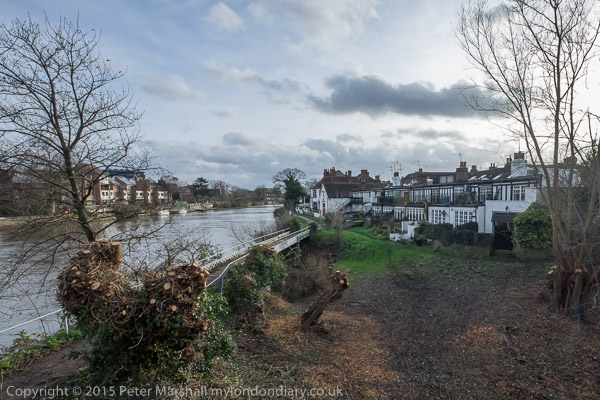
The Hythe next to Staines Bridge

Fortunately I’m in the half of the UK not currently covered by flood water – we had ours in Feb 2014, and the rain here this morning is only half-hearted. But our Christmas has been marked by a little worry about friends up north, who appear to have so far avoided flooding, and concern for the many not so fortunate. Our government appears to have gambled by cancelling or holding up hundreds of flood relief schemes, perhaps in the secure knowledge that they themselves live on higher ground – just as they are on financial heights untroubled by welfare cuts.


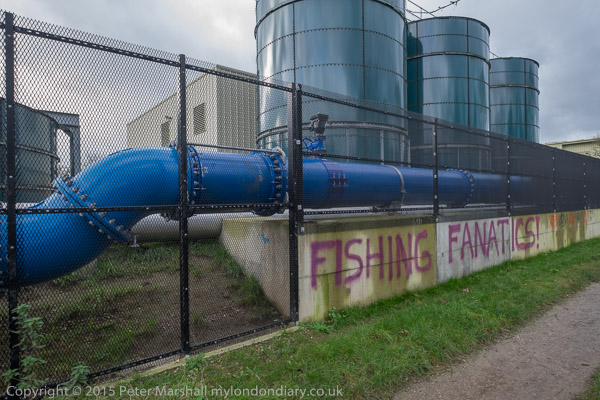
‘Fishing Fanatics!’ on the tow path by the water works, Egham

Yesterday, Boxing Day, we walked to my sister’s home for a second Christmas dinner – we needed a good walk to walk off the previous day’s at our home. She and her husband live around five miles away. Both our homes are a few hundred yards from the River Thames, and we can walk most of the way along what used to be the tow path, though towing would now be impossible with trees having grown up and many riverside residents having laid claim to the riverbank in front of their properties, fencing in what was public space and declaring it private.


Runnymede, Egham

But that route was too short and too simple for my wife and son, and we left the riverbank half-way top climb up and down and up and down the wooded hills overlooking the flood plain at Runnymede. Although I was determined not to add to the plethora of reviews of the year that provide respite for journalists to hold their pre-Christmas parties, it inevitably brought back to my mind the events of June, when the UK celebrated the 800th anniversary of Magna Carta by – among other things – a disgraceful and massive police restriction on the freedom of those living closest to the site where it was signed in the Runnymede Eco-village, which a few weeks later was evicted from its woodland site.


Footpath across the old course of the Thames, Runnymede

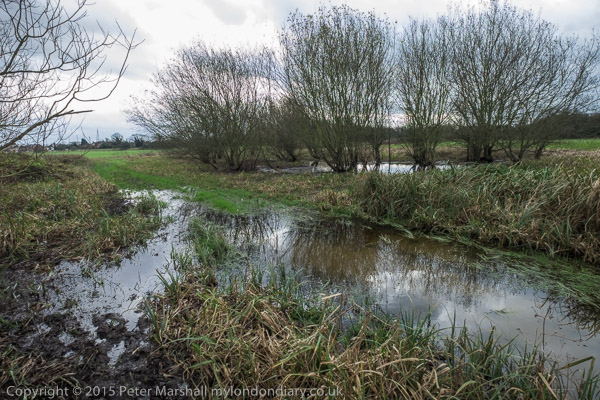
Our path took us through one of the old routes of the Thames, close to the bottom of the hill, a muddy wade through a few inches of water that at least in the wetter months of the year still insist on clinging to the old path, and then up and down by the fence around the former eco-village site.


America – Kennedy memorial, Runnymede

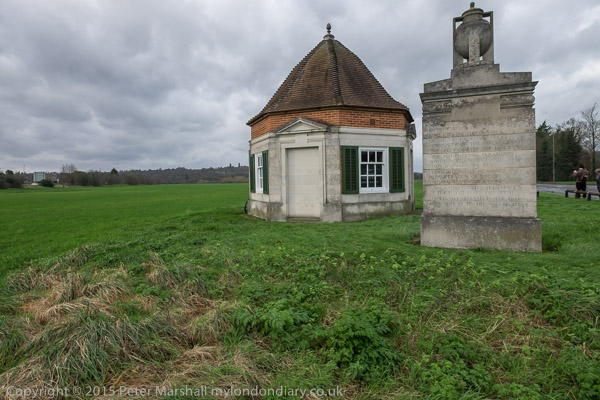
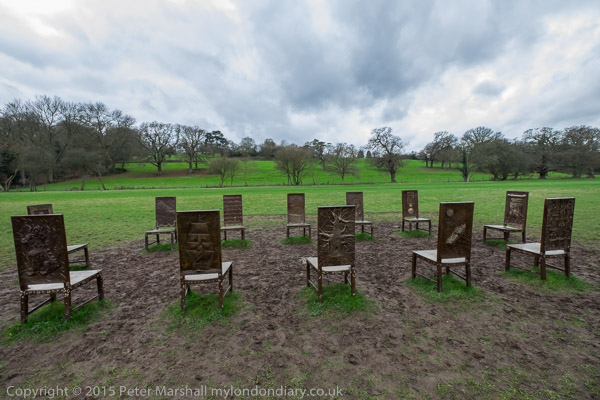
Then came a short visit to America, an acre of which is around the Kennedy memorial, before going down to the plain and the 12 bronze chairs of The Jurors.


The Jurors, Runnymede

From there it was a short walk by the river into Old Windsor, and along the Straight Road, where two red kites circling around took our minds away from the tedium of the traffic as we walked through puddles scraping the worst of the mud from our boots.

All of these pictures were made using the Fuji X-T1 with the 10-24mm lens, a truly excellent lens when there is enough light for its f4 maximum aperture not to be a problem. It isn’t the smallest lens for the camera, but considerably lighter than the full-frame Nikon equivalent.

I still have a problem with the white balance of the X-T1, which seems to be way out on my camera. A typical image from those above is at 5687K and Tint -37, while the ‘As Shot ‘ values were 5000K and Tint -1. The difference in the Kelvin value isn’t huge – and I’ve perhaps preferred a slightly warmer result, but the camera produces noticeably pink images. I’ve checked and double-checked the colour settings, but unless I remember and use a custom white balance setting, it views the world through rose-tinted glasses.

Yarl’s Wood

It was a warm sunny day in August when I set out for my first visit to Yarl’s Wood, though I’ve previously attended protests in London calling for its closure at least since 2008. But despite all its problems and many protesters, it remains, one of a number of similar blots of national shame where we lock up and mistreat people who have come to our country for asylum, often fleeing violence and torture. Yarl’s Wood differs from others such as Harmondsworth and Colnbrook closer to where I live in that the great majority of those imprisoned there are women and children.

The continuing protests, along with court actions which have also been a part of the campaign have had some success, but Yarl’s Wood and the other prisons remain. The Home Office have been forced to make some changes, and certainly have been prevented many from deportation back to persecution and possible death.

As many former inmates attest at the protests outside, they are a great morale booster for those still incarcerated who otherwise often feel that they have been locked away and forgotten, with no one caring. It is worse than prison they say, because at least when you are sentenced you know the length of your sentence. When you are taken to Yarl’s Wood your imprisonment is for an indeterminate time, and sometimes it seems it will never end. You could be forced onto a flight back to the country you have fled at any time without notice, or you could be released, but many seem to spend many months in this evil limbo.

The protests outside embolden those inside to stand up for their rights, to resist the bullying and assaults, to organise with fellow inmates against mistreatment or the failures of Serco and the other private companies running these prisons to provide the facilities that are supposed to be available. Management inside them seems often far more concerned with cutting cost than the welfare of the prisoners.

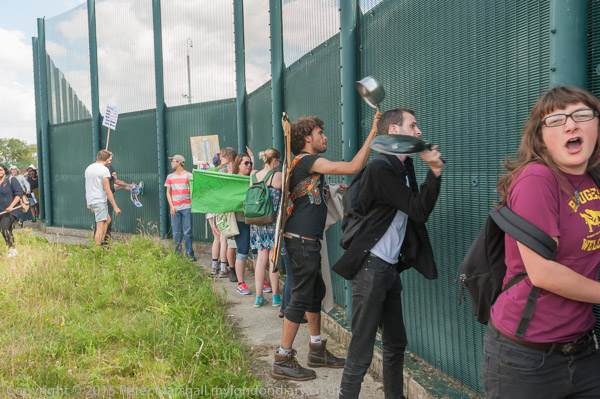
Yarl’s Wood is pretty well in the middle of nowhere, on a commercial estate in a former airport around 5 miles north of Bedford, where doubtless bombers took off to Germany in WW2. There were coaches organised from various cities including five from central London, but this would have made a very long journey for me. Instead I went by train to Bedford, from where the organisers had said there would be a coach from the station – and I found a small group already waiting for it when I arrived.  Soon the coach came and eventually we got to the road outside the business park, where a hundred or two other protesters had already arrived and more were expected.

The protest started there and it was a good time to take pictures as everyone was on a fairly small area of grass in front of the fence around the estate. Later people were more spread out. It’s often the case that the best time to take photographs is in the few minutes before an event actually starts as people are getting ready and in the first few mintues, and photographers often miss out by standing around talking with colleagues rather than getting down to work.

It’s easier too when you know many of  those taking part – or perhaps when they know you and trust you, and having photographed at many Movement for Justice protests both at Harmondsworth and in central London made it easier for me.

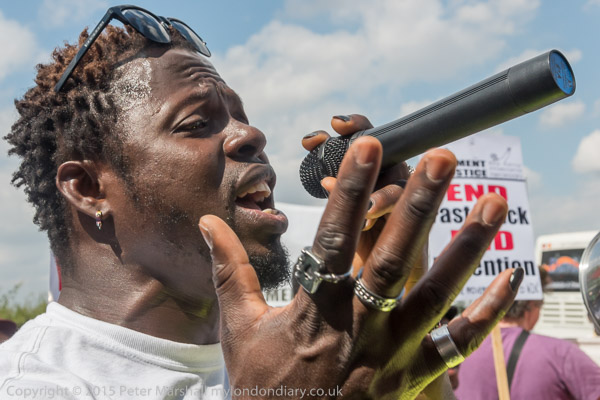
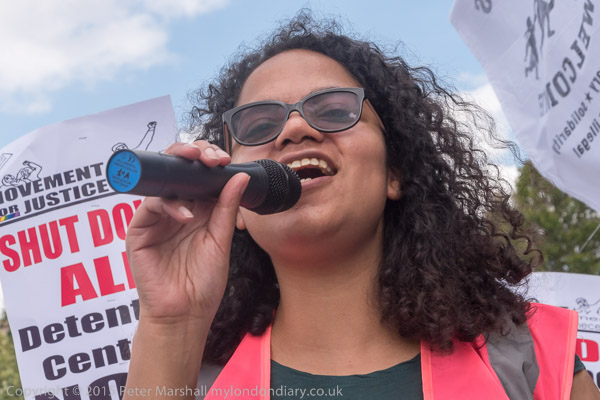
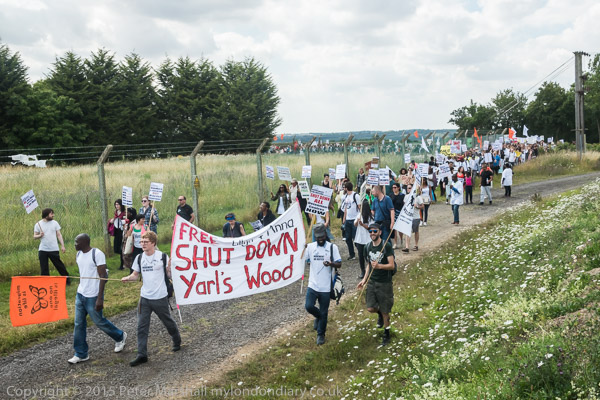
When all the expected coaches had arrived, the protesters – now approaching a thousand – set off to march to the detention centre, around half a mile distant, at first along the road and then on a public bridleway which goes around the boundary of the centre (and then around the actual wood, which I’ve still not visited.) I tried hard to find a way to show the size of the protest , but there was never a position where both ends of the march were visible.

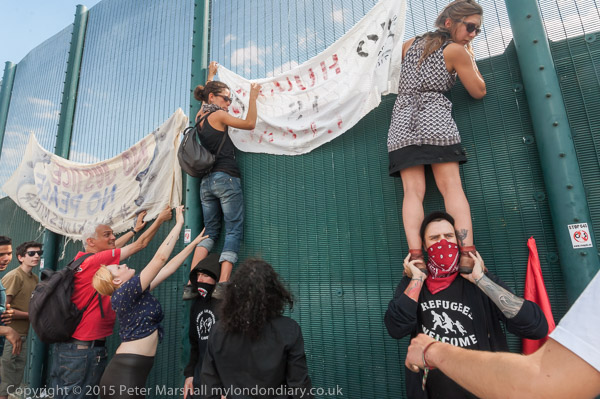
At the previous MfJ protest here a few months earlier which I’d missed, police had attempted to stop the protesters reaching the field beside the prison, but had failed with a length of fencing being pushed down. This time they had agreed to let the protest through and there were relatively few police on duty and we walked unhindered through the gate and up to the tall and substantial fence around the whole site. We could hear they shouts of welcome from the women inside the prison, and they could certainly hear people shouting back to them and making a huge noise beating and kicking the fence.

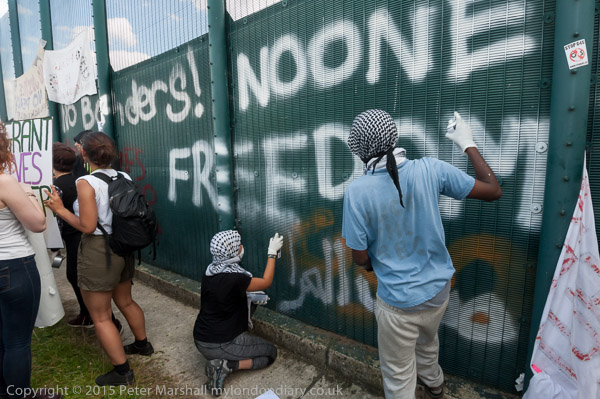
People climbed up on the shoulders of others to show banners and wave flags so that the women inside could see them, and then a group of protesters in masks began to spray paint slogans along the fence.

It’s always a slightly difficult situation when photographing protests like this where there is a possibility – though perhaps small – that people could be arrested and face charges and your pictures could be used as evidence. But people were masked and so less readily identifiable, and I mainly photographed from behind.

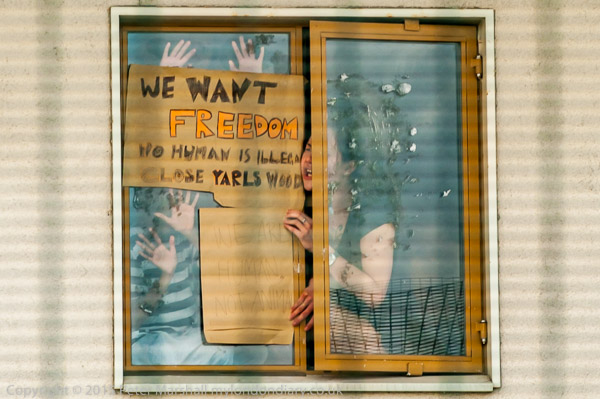
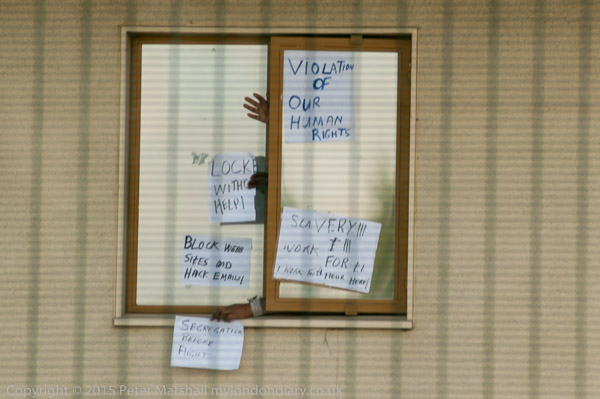
The field slopes up away from the fence, and from some distance back it was possible to see some of the women at the upper floor windows. These have only a very restricted opening, to stop escape or more likely suicide attempts, but the women were able to hold out posters and wave towels and articles of clothing. Others held up notices to the glass so we could read them.

Photographically there were problems. First was the distance, and even with my 70-300mm lens at its most extreme the windows were a little small in the frame. The image above is typical, cropped from 12Mp to 4Mp. I  think I should have taken it with a wider aperture which might have made the grid of the fence through which I had to work less evident, but I didn’t think to do so at the time.

But it was extremely difficult to focus – many of the frames I took were out of focus – and the smaller aperture would have helped here.  Autofocus was pretty useless unless I wanted sharp pictures of the fence and I soon resorted to manual focus. Although the windows were some distance away they were not sharp with the lens at infinity, and working with the 70.0-300.0 mm f/4.0-5.6 with manual focus is not too easy. Old-fashioned long lenses which were made for manual focus along with focussing screens of the day were much easier than with lenses and cameras made for autofocus.

There must also have been a good reason at the time to work with this lens on the D700 rather than the newly acquired Nikon D810, though I can’t now think what it could have been. The 18-105mm stayed on the D810 all day, while on the D700 I made use of the 16-35mm, 16mm fisheye and the 70-300m. On the 810 I could have worked in DX mode, making the 300mm into an effective 450mm and still have had 15Mp to play around with.

But the biggest mistake I made that day wasn’t photographic but was to forget to pack my sandwiches. By around 2.30pm I was feeling hungry and reached into the back of my bag where they should have been to find nothing there.  It was around 5.30pm that I managed to buy a snack at Bedford station raise my blood sugar and keep me going while rushing to catch a train.
Continue reading Yarl’s Wood

Morning Moods – Internet at Risk

I woke up in something of a black mood this morning, to radio coverage of the flooding in Cumbria, where we have friends who I think are fortunately safe. Although I was listening from the comfort of a warm bed, it brought back memories of our own local floods in February 2014, when dirty water was lapping around our street, above the level of our ground floor for anxious days, though we were fortunately saved from flooding by a ditch behind our house. Next time we probably won’t be so lucky, and the next time could come any time with the current climate instability, and I’m increasingly sceptical that the current climate talks in Paris will do much to help.

Other news only added to my unease, along with several concerns closer to home I won’t bother you with. So I was pleased when I sat down at my computer this morning to find Louis Stettner and the Glories of Penn Station, a beautiful set of black and white images from 1958, which really lifted my spirits.

It was also good to read A D Coleman coming out with what he calls an ‘Opening Salvo‘ against attacks on his Capa research by Magnum, who as he says has evolved from “the bohemian collective cum anarcho-syndicalist commune of its origins and first several decades” into “a substantial corporate entity with a multimillion-dollar annual revenue stream, a recognizable and decidedly upscale brand, an extensive and metastasizing product line, and a new executive director committed to aggressive and inventive marketing.”

Magnum has no facts or argument to answer the detailed research on Capa by Coleman and his colleagues but seem determined to try and discredit it to protect their image – now a highly commercial brand. Part of their response appears to be to a TV docudrama Magnum, made by Downton Abbey producer Carnival Films, which Coleman expects to reinforce the Capa myths about the ‘Falling Soldier’ and D Day rather than represent the truth – though he has contacted the company with details of the recent research.

Of course, though Capa was undoubtedly a great photographer, he was also a great raconteur, someone who would never have allowed the facts to get in the way of a good story, so Carnival Films could be said to be truly if cynically following in his tradition.

It’s also – as I’ve had occasion to say several time in the past few days, not least in the highly inaccurate recording of an apparently peaceful vigil in Walthamstow and almost every story about Jeremy Corbyn – very much in the tradition of at least parts of our press (though gutter and broadsheet have been vitriolically united over Corbyn, who I’ve known and photographed for many years and admire as a person even if I don’t always agree with his views.)

Another link in my feed reader this morning was from ‘Stand Up And Spit‘ and links to a BBC radio documentary from 1980 on a Sun newspaper shock horror probe on the Tilbury skinheads, Aggro Britain. It exposes how bad tabloid journalism can be, and how it was done, something that makes me ashamed of some fellow journalists (though the only real UK journalists union, the NUJ, is locked out of The Sun and other News International publications) and also reminds me how necessary it is to support the BBC, despite some of their often ridiculous news stories.

And a final bit of gloom from my e-mail, which could mean the end of the Internet as we know it. The EU Commission’s roadmap for copyright reform “could open the door to absurd new rules that would kill our ability to link freely – copyrighting hyperlinks and charging to link to freely accessible content online.” A ‘Link Tax‘ would make posts like this one impossible. If you click on one link today let it be to Save the Link to fill in your name on a message to Commissioner Oettinger “Link censorship has no place on the open Web. Please listen to users and guarantee our right to link freely.”

Protest Works – at least sometimes

Often people tell me there is no point in protests. They never change things. And of course they are wrong, although of course they don’t always succeed, even when they enjoy massive backing – as our involvement in the Iraq invasion and yesterday’s vote to bomb Syria show.

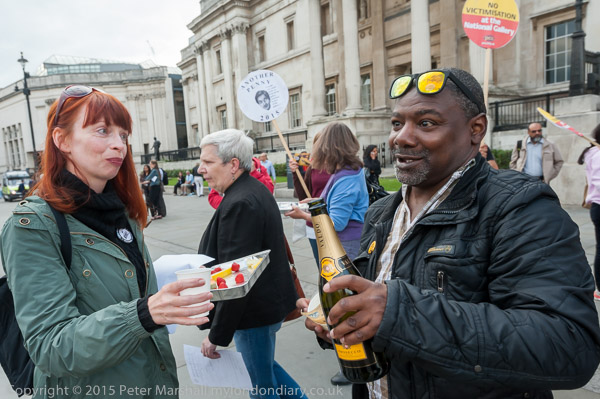
Two of the protests I covered in the last few days of July have since then resulted in at least a part successful resolution, achieving outcomes that certainly would not have happened without the protest. Both of them were protests about workplace issues, and both involved the unfair dismissal of people for normal trade union activities, and as well as opposing victimisation the protests also resulted in at least some progress on the issues over which they had been taking action. I don’t know the fine detail of the settlements reached, but I do know in both cases protest – and in the case of the PCS at the National Gallery, 100 days of strike – achieved gains which would otherwise not have happened.

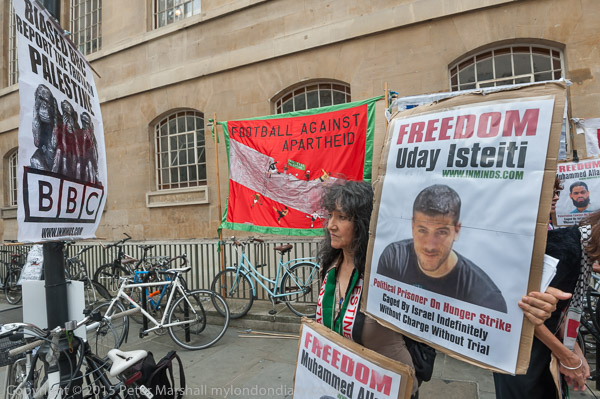
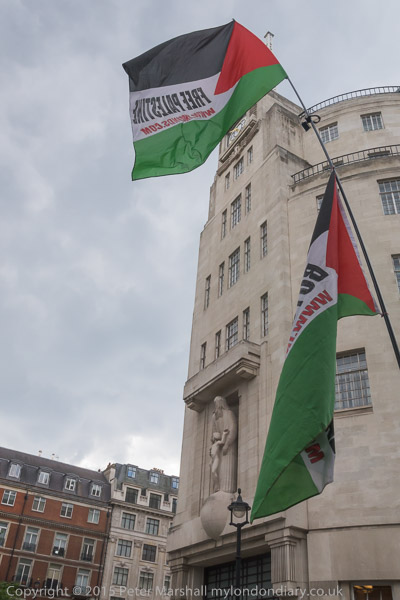
The third protest was about Palestine, and in particular about the failure of the BBC to report with the even-handedness it proclaims. Here there has been perhaps little progress, although more has come out – even from within the organisation – confirming its pro-Israel bias, and I think there has been a slight shift, with more attention being paid to the work of some of the BBC’s correspondents in Israel and Palestine rather than the prejudices of those in the studios and back rooms.

The strength of the BBC has always been in the reports of its foreign correspondents, who include some of the best journalists around. Its often at its best in the World Service rather than here in Britain. I remain a firm supporter of the BBC in spite of realising that we have to go elsewhere in search of what is happening in the UK and sensible unbiased opinion on politics in this country. It’s a real shame that it can’t reflect a more independent view here – and particularly in Westminster rather than so often following the promptings of our billionaire-directed press.

First up was a protest by National Gallery staff outside the leaving party for director Nicholas Penny in Trafalgar Square. I was shocked to find that many of the gallery staff had not even been invited, and they held their own little party outside, against the plans for privatisation and de-skilling that the departing director had signed off, despite giving his opinion that he didn’t feel they were appropriate.

The plans are all a part of the current government’s policy to sell off everything. Partly its a matter of reducing government debts, partly of putting fat profits into the hands of their mates (and themselves) in the private sector. Outsourcing cuts costs by employing less skilled staff on lower wages and inferior conditions and the only thing it ever improves is the bank balances of the out-sourcing company’s shareholders.

Photographically the only problem was in making something of fairly meagre subject matter. The light was fine, there were no problems of access, people were mainly happy to be photographed (though a few a little camera-shy) and there were few other photographers present.

The following day at the BBC there were more posters and banners, but I arrived rather late, and was short of time before the protesters left – and some had done so already.

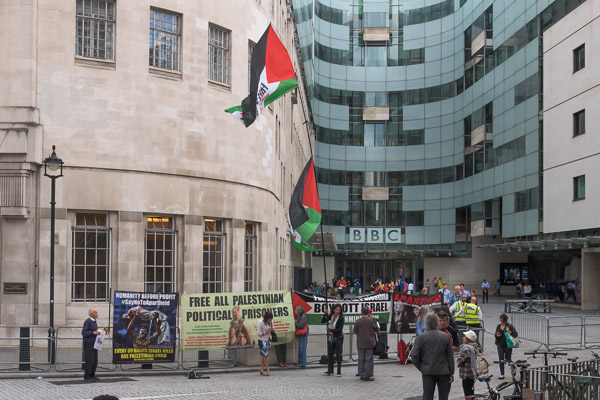
Although the old Broadcasting House is an iconic building and protesters can protest close to it, the entrance to the newer block which identifies it as the BBC is set well back in a private yard, which security keep protesters – or at least organised protests such as this – outside.  It’s a little hard to really visually link the protesters with the BBC. And although I recognise the frontage of Broadcasting House, I’m not sure how many will.

Even using a fairly long lens to compress distances, it’s hard to really link the protesters with their banners on the fence in front to that BBC above the entrance.

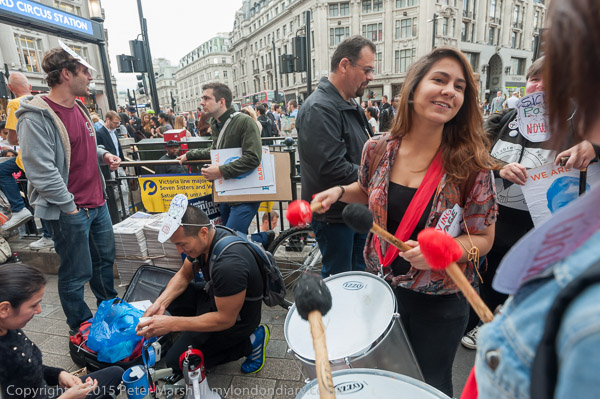
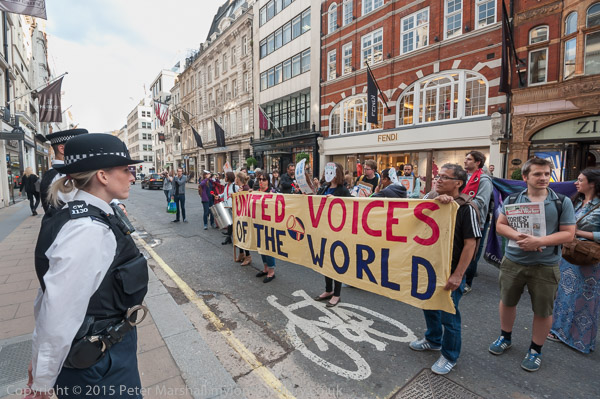
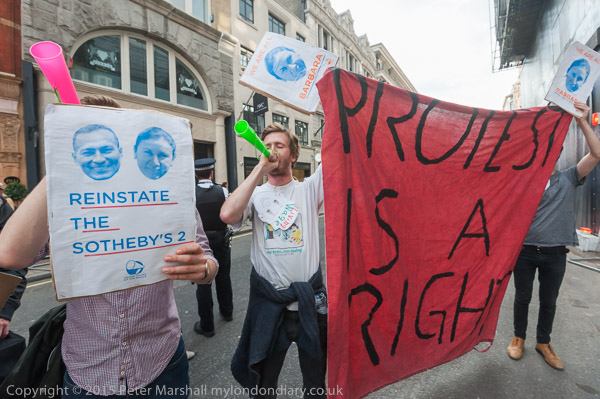
From Broadcasting House it is only a short walk to Oxford Circus where United Voices of the World were meeting to march to Sotheby’s for the start of the protest over the  ‘Sotheby’s 2′, Percy and Barbara, sacked for taking part in a protest outside their workplace for better conditions of employment – sick pay, holidays and pensions.

Previous protests had already let to the reinstatement of two sacked workers, and the last one a couple of weeks earlier had been met by a large and heavy-handed police response, trying to restrict the movement of the protest around the streets.  This time their were few police and they simply stood in a line along the pavement in front of the doorway.

It was curiously low-keyed, but perhaps showed that some officers at least had learnt from the previous  occasion, and this protest cause much less disruption of the area than the previous one. These are protesters who are prepared to make a lot of noise to make sure their protest is noticed, but not people out to cause any serious damage. But none of us likes being pushed around by police, and tempers sometimes flare on both sides if officers try aggressive tactics.

Protest‘, as one of the banners stated, ‘Is A right‘, and the police often claim that they facilitate it, though at times they seem more concerned with its restriction. But on this occasion things went smoothly. It wasn’t boring to photograph, though there were none of the scenes which are likely to make it news in the eyes of the media.

And that’s perhaps something of a dilemma for photographers who cover protests. We know that protests without violence are unlikely to make the news and that our chances of having pictures bought are relatively low.  I happen to think that the victimisation of low-waged workers by a prestigious high-profile employer like Sotheby’s who are making huge profits merits a place in the news. It is a scandal that should not happen in a civilised society.

But the wealthy owners and well-paid editors who control our news regard it as without interest – unless perhaps a ‘celebrity’ takes part or they can condemn those who lack power in our society.

It took another protest or two, but in the end Sotheby’s and the UVW came to some kind of agreement, though I don’t know the details. But here as in a number of other cases, they have managed to protect members and improve conditions by action.
Continue reading Protest Works – at least sometimes

Doves & Fuji Disappoint

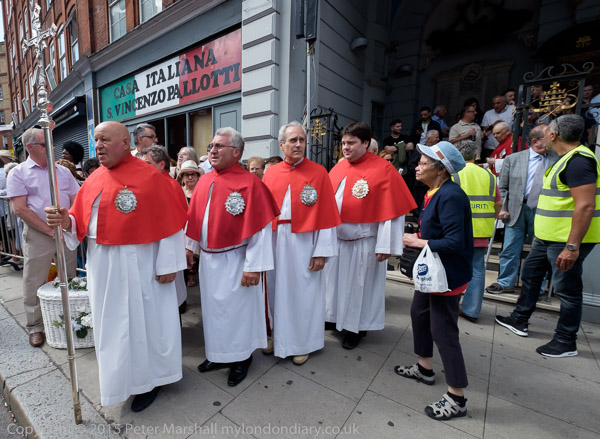
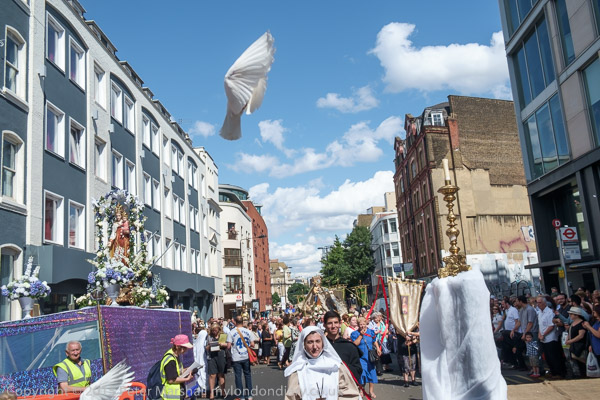
I can’t remember when I first photographed the annual Italian Church festival in London, one of our older traditions, dating back to when the community around the church in Clerkenwell was given special permission to hold a procession around their parish in 1883. Then a Roman Catholic procession was politically still very sensitive.

The Popery Act of 1698 had tightened the very strict limitations on Catholics, putting a bounty 0f £100 on Catholic priests and providing for the  “perpetuall Imprisonment” at the discretion of the King of priests taking Mass or anyone found to have been educating youths as Catholics. When the Papists Act of 1778 attempted to reduce this official discrimination London saw its worst riots ever with around 50,000 people taking part in angry marches to Parliament, with ‘King Mob’ attacking the homes of wealthy Catholics, embassies of Catholic countries and prisons – both Newgate and the Clink were largely  destroyed – and other targets in and around the city.

It was riot on a scale that makes our current protests look small beer indeed – with just the occasional window being broken, the occasional and possibly sacrificial police vehicle torched and where cereal being thrown at a shop window makes vicious headlines. After around 5 days of mob rule the army were brought in, shooting and killing almost 300. Around 450 people were arrested and later around 30 of them were tried and executed.

The legal discrimination against Catholics (and Protestant dissenters) was reduced by Acts in the 1820s but was only finally removed by the Religious Disabilities Act of 1846. But of course we continue to celebrate ‘Bonfire Night’ on November 5th, though perhaps few of us now remember it as an anti-Catholic event dating from 1605, and by  Act of Parliament until 1859.

It was one of my photographer friends whose father was Italian who first told me about the procession of Our Lady of Mount Carmel and I arranged to meet him there perhaps around 20 years ago, and I’ve met him again there most years since then, taking pictures and sharing a few tumblers of Italian wine in the Sangra.


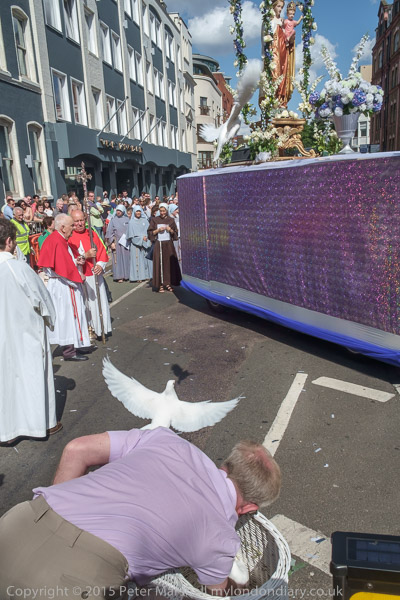
A rather bad picture of the release of the doves

One of the highlights of the event has always been the release of doves, and it’s something I make a point of trying to photograph. It changes a little from year to year and in most recent years I’ve been lucky in getting one decent image of it.

This year I had taken with me two Fuji cameras, the X-E1 and the X-T1, and most of the time I had the Fuji 10-24mm zoom on the X-T1 and the 18-55mm zoom on the X-T1. There were two releases of three doves, and I’d got in a good position for the first one and was waiting with the X-T1, and I set the shutter to continuous high-speed mode – 8 frames a second. As the lid to the first basket was raised, I raised the camera to my eye in readiness and the electronic viewfinder remained blank.  I just had time to grab the X-E1 and raise it to my eye and get a single image as the birds flew away. But they doves were not co-operating – one was flying low and mainly out of frame, a second was nicely in frame but performing a pancake impression, while the third had soared way up and behind me by the time I pressed the shutter.


My second attempt was slightly better

I saw a second basket and knew I had another chance later. So I checked the X-T1 again and found that the battery had run out – you get little or no warning. I changed the battery for a fresh one – I’d carefully taken 5 spare batteries with me and had checked before going out that all were fully charged . I tested the high-speed continuous mode with a short burst. Everything was fine. But as the dove man got ready to raise the lid of the basket, I put the camera to my eye and … Nothing. The viewfinder was blank. I tried the usual way to unblock the Fuji sulk, switching the camera off, then on. It still didn’t respond. Fortunately the doves were on a go-slow. They were sitting happily in the basket and having a good time, refusing to leave. I had time to lift the X-E1, adjust the zoom to 18mm and make a picture as the doves were persuaded to leave. You can see all three of them in the image – one still in the basket and two in flight (and a small black shadow dove as a minor bonus.) It certainly wasn’t the best picture I’ve made of the release, but at least I had a picture.

I don’t know why the X-T1 let me down that second time, but it illustrates well the frustration I have with what is in other respects a fine camera – with some really great lenses. It’s the same with other Fuji cameras too, though today for once the X-E1 performed without similar hiccoughs. I keep hoping that Fuji will sort out the problems in the next firmware update, but I suspect they are too basic.

Continue reading Doves & Fuji Disappoint

Dartford to Gravesend

I’ve not been taking many photographs recently, partly because of minor health issues, but also because I’ve been working almost day and night to get another Blurb book finished. I started working on the book ‘Dartford to Gravesend‘ well over a year ago, but it has been slow going, and doing a little bit here and a little there doesn’t really work.

For those who live away from south-east England I should perhaps explain that Dartford and Gravesend are both towns on the south bank of the River Thames, with Dartford just outside the Greater London area and Gravesend a few miles to the east, on the riverside facing London’s port at Tilbury.

My first visit to the area was actually to catch the ferry across to Tilbury in 1981, when a group I was part of had been invited to set up a project there – which never happened. It was 4 years later I returned to the area to take photographs, mainly as a part of a wider project on Britain’s disappearing industries as prime minister Thatcher decided to shift us away from manufacturing. But it was also – as I wrote in South of the Thames in January 2014 – prompted by two books, South East England, Thameside and the Weald, by Roy Millward and Adrian Robinson (1971), which contained a section ‘The cement industry of Lower Thameside’, and the rather more fanciful and poetic ‘Pilgrimage of the Thames’ by writer and illustrator Donald Maxwell (1932) who had begun his own journey up-river at Gravesend. It’s a more satisfactory starting point than the Thames Path which dared not venture beyond the Thames Barrier at Charlton.

Maxwell’s description of the area, written originally for the Church Times and illustrated with his sketches piqued my imagination:
Could our fathers visit Northfleet, Swanscombe and Greenhithe once again, they would simply not recognise them. Modernism has gone mad. Agriculture has fled. The reign of Christ and His saints is over – so he would reason – and Moloch, horrid king, besmeared with blood, reigns in his stead.

He continues in not dissimilar vein, calling it “a Hell that is Dantesque in its picturesqueness and Miltonian in its grandeur” and a page or two later comments “One Day , when the cement industry has left this valley … this district will be called the Switzerland of England, and weekend châlets, each with its aeroplane-landing on the cliff, will look down once again upon green shores and tree-embowered banks.”

After reading this, who could have resisted visiting the area? Back in 1985, the cement industry was still going, but had been rationalised into one giant plant at Northfleet (though that was only working at around a quarter of capacity) and there were yet no chalets.

Now – since 2008 – the cement industry has gone, the chalk worked out. Still no ‘aeroplane-landings’ or ‘châlets’, but there is a vast shopping centre in one disused quarry, a new town slowly appearing in its neighbouring canyons, the high-speed rail between London and Paris cutting through its centre before diving under the Thames and the threat of a vast TV and film them park. Maxwell would still recognise the reign of Moloch.

Of course I’ve been back to the area and taken more pictures since 1985-6 and those in this book. I revisited some parts in the 1990s, and again in the 2000s, with some images in the book Thamesgate Panoramas and in the exhibition Estuary at the Museum of London in Docklands. There are some more recent images on My London Diary, particularly earlier this year from Swanscombe.

As with some previous books, this one is published as a PDF on Blurb. This allows a good image quality (if you own a decent screen) at a price which is fair both for viewers and me at £4.99 – rather than the high cost of on-demand printing which makes a hard copy around £30. On top of that, Blurb uses a high-cost delivery which makes single copies ridiculously expensive. As usual I’ve ordered a small supply for UK customers which will shortly be available to UK customers for £28 including p/p. I’ll post again about these when they are in stock.

I’m also currently working on two further books of pictures from along the south bank of the Thames – and will perhaps later produce some on the Essex bank too. I’ve called this series ‘Thameside’ and although the first to be published, this is Thameside 2. Probably the next to appear – Thameside 1 – will look at the area from Woolwich to Dartford.

Continue reading Dartford to Gravesend

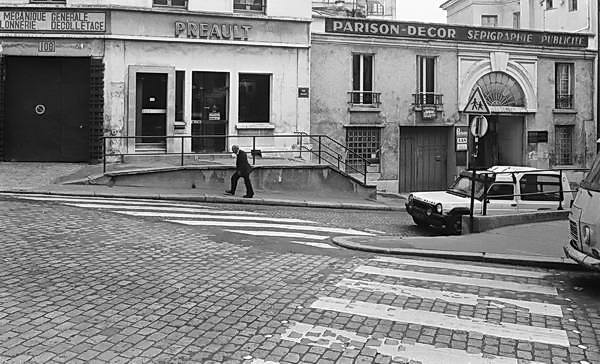
Paris

I’ve often been in Paris in November – like many involved in photography visiting the city around the time of Paris Photo, the largest of the annual shows of the photography art market – and I knew that many people I knew would be in the city when I heard the news of the terrible killings there on Friday.

I’d heard the news late, having been busy working on a new book and not keeping up with the news and was on my way to bed when my wife told me about it. She phoned her brother who lives just outside the city with his wife first thing on Saturday to check they were OK. They were; though he had been at a bar on one of the streets where one of the attacks took place most of Friday afternoon, he had left for home several hours before the shootings.

It was a relief too to turn on Facebook and see updates from many of my friends in Paris assuring us all of their safety. Of course it is still a great tragedy but it is good to know that those that you know are safe, though as I write only around 30 of the 129 confirmed dead (with another hundred or so in hospital with various injuries) have been named and there could still be shocks.

Although most reports have said that the attacks occurred away from the tourist areas, there were in the areas of Paris I know best, and where I have often stayed and photographed on my visits there, particularly around the Canal St Martin where the attacks on Le Petit Cambodge, Le Carillon, La Casa Nostra and the Bataclan theatre took place.

One of the pictures hanging above my living room mantelpiece shows a corner of Rue Bichat, though the shootings there took place a couple of blocks south where it meets Rue Alibert. It’s a street I’ve walked down many times and the same picture is also on the front page one of my more neglected web sites,  Paris Photos. Although it has quite a few of my pictures from Paris, particularly my pictures from 1973 and 1984, there are many more I should add.

My thoughts – like so many others around the world – are with Paris and those who have been killed or are suffering and their grieving relations and friends.

Sotheby’s Party Protest


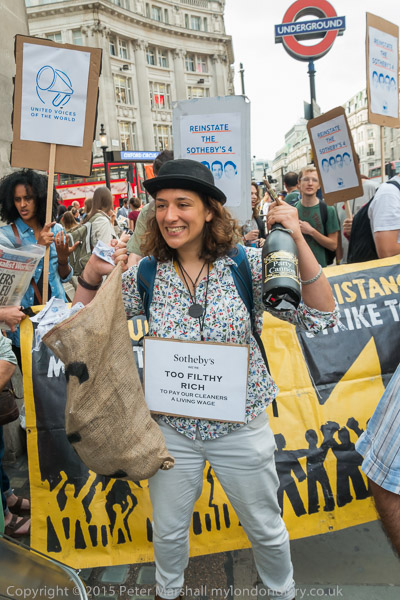
A sack full of money and an equally fake bottle of champagne for a party-themed protest

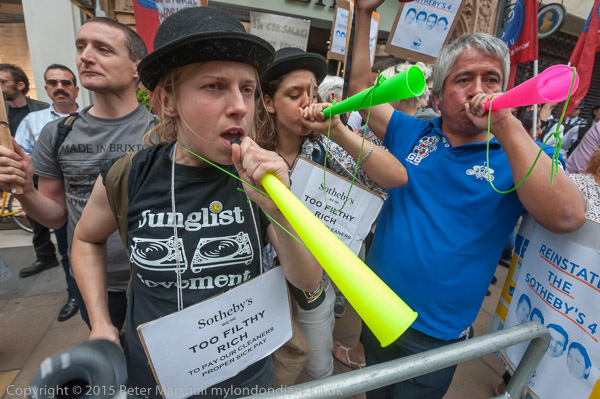
United Voices of the World went back to Sotheby’s intending to have a ‘protest party’ outside while Sotheby’s staff were having their staff party before their summer break inside the building. But the police were not in party mode at all, smarting from being given something of a run-around by the UVW at the previous protest.

Of course the union were there for a serious purpose, calling for the re-instatement of four cleaners who had been sacked for protesting outside their workplace calling for proper sick pay, holiday and pension arrangements.  The UVW want the Sotheby’s 4 to be re-instated.

The cleaners are not actually employed by Sotheby’s – so would not in any case have been inside at the staff party. They are employed by a contractor, Servest, but Sotheby’s had refused to let them come into work in the building, effectively sacking them.

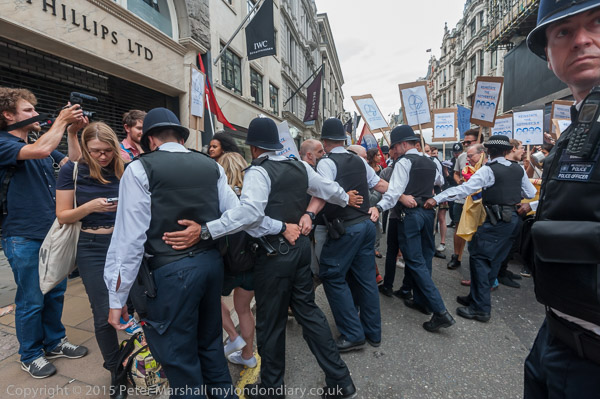
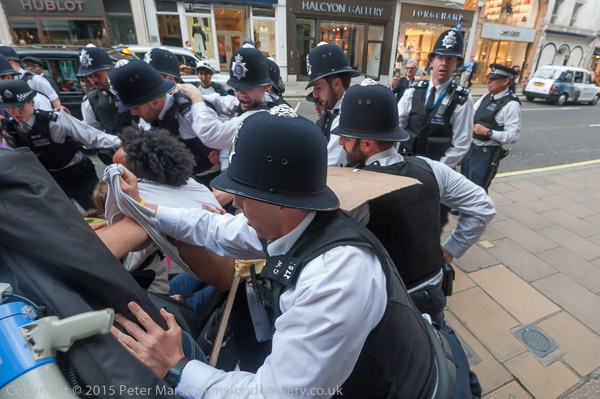
Had the police behaved sensibly there would have been a noisy but essentially good-natured protest outside the closed frontage of Sotheby’s, causing relatively little disruption to traffic in the area. But the police came determined to turn it into a battle and to show the protesters who was boss.  As the protesters came up to Sotheby’s they formed a block across the road, closing it to traffic for far longer than was necessary, eventually pushing the protesters off the road onto the opposite side of the street.

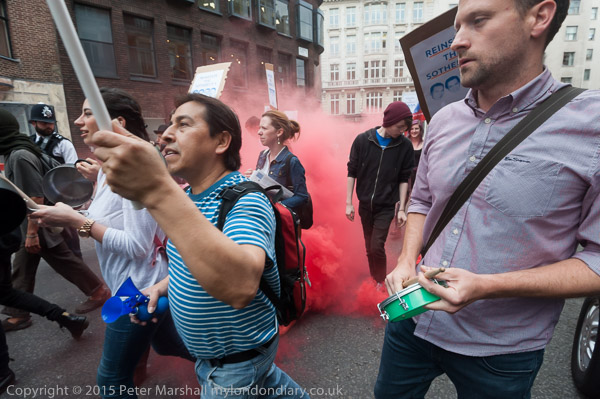
Later they attempted to stop the protesters from marching around the block, and again there was a lot of pushing and shoving by police, but the protesters walked around them and went around the block, letting off a couple of red smoke flares as they did so. When they arrived back at Sotheby’s police again pushed them off the road and behind the barriers which had been set up to contain the protest.

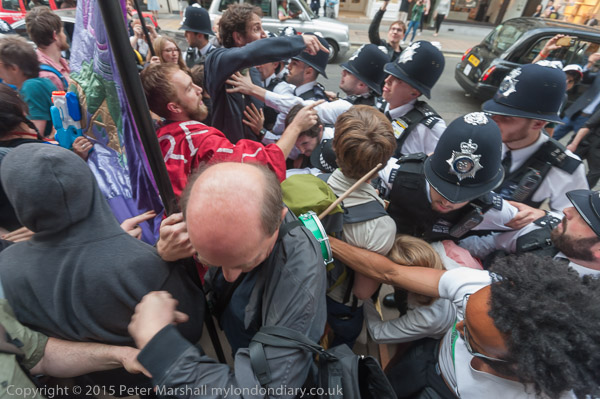
The atmosphere, which had started as good-natured was beginning to turn sour. People don’t like being pushed around by police, and when police again tried to stop them leaving the pen for a second walk around the block things got very heated. The protesters seemed to be pushing their way through when more police joined in, leaving the barriers behind unguarded.

People began unhooking them and moving out onto the street and it took a lot more pushing and manhandling of protesters by police to get them back. The police had really lost control, but the protesters weren’t really out to cause trouble – most just wanted an effective and peaceful protest and people just wandered around on the street shouting slogans.

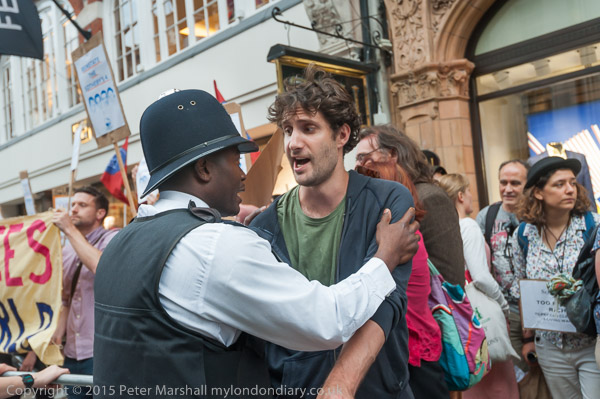
Eventually police reinforcements arrived and brought the situation under control. It looked for a while as if they intended to arrest some of the protesters, but they thought better of it – and it was perhaps hard to know what the charges might be. Eventually UVW General Secretary Petros Elia spoke to one of the officers, telling him that they wanted to bring the protest to an end, and he went to see the officer in charge and the protesters were allowed to march away.

I made my way home, thinking that an essentially peaceful protest had been policed with unnecessary force, and had cost the public several thousand pounds more than had been needed – all because of a little police dented pride.

Photographing such events I need to keep a certain distance and objectivity, which can often be difficult. I also try hard to avoid getting in the way of the police in the discharge of their duty.  Often police don’t want to be photographed and can be unnecessarily obstructive – and I was asked to move back on a couple of occasions during this protest when I felt it was entirely unnecessary – and also got pushed out of the way rather roughly. Annoyingly police often ask photographers and protesters to move ‘for your own safety’ when its clear we are in no way at risk.

More at Reinstate the Sotheby’s 4.

Continue reading Sotheby’s Party Protest