Black Panthers

On Lensculture you can see a set of 31 images and a short text by Stephen Shames, The Black Panthers — 50 Year Anniversary. The pictures are a selection from the 200 black and white images by him in the recently published Power to the People: The World of the Black Panthers by Bobby Seale with photographs by Shames.

Shames met and photographed Seale at an anti–Vietnam War rally in April 1967 and Seale became a mentor to the University of California student  who became the most trusted photographer to the party, remaining by Seale’s side through his campaign for mayor of Oakland in 1973.

The story of the Black Panthers is a remarkable one, not least for showing the illegal lengths that a white political establishment was prepared to go to maintain its racist supremacy, with military-style police attacks and a huge campaign of intimidation and assassination by the FBI.

Shames has produced many other fine projects and it’s worth spending time on his web site. In particular there are many pictures about child poverty and low income families and his work has been compared with that by Lewis Hine a hundred years earlier. As well as working with organisations involved in social issues he has also “started an NGO which locates forgotten children (AIDS orphans, former child soldiers, and children living in refugee camps) with innate talents and molds them into leaders by sending them to the best schools and colleges.”

Although most of his work has been concerned with the USA – which is perhaps why he is not well known in the UK, his essay Street Kids includes images from Brazil, Bangladesh, India, Romania and Honduras.

BBC Blindness


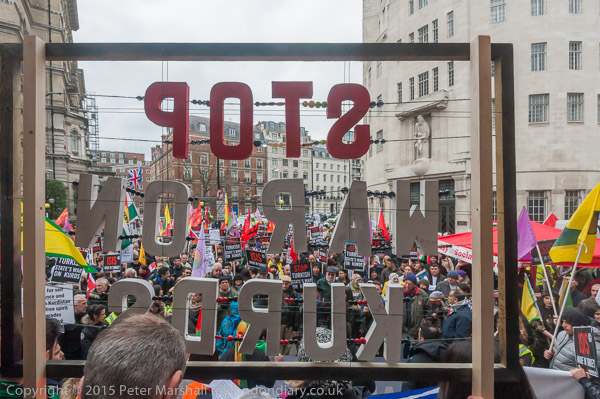
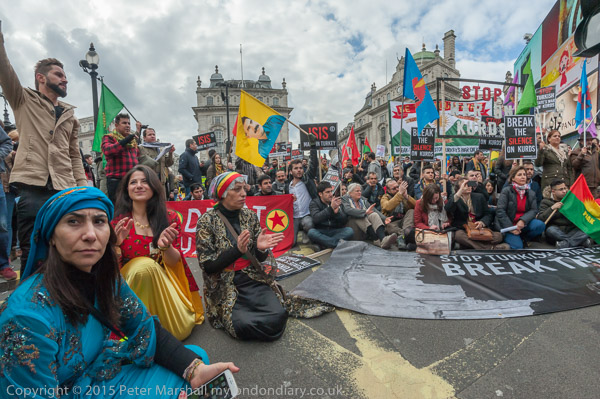
There was a short sit-down at Piccadilly Circus on the way to the Trafalgar Square rally

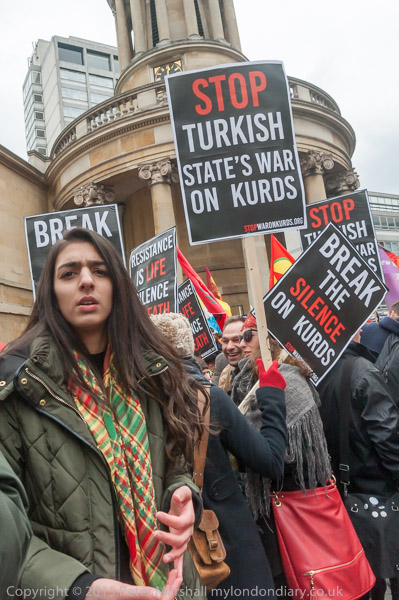
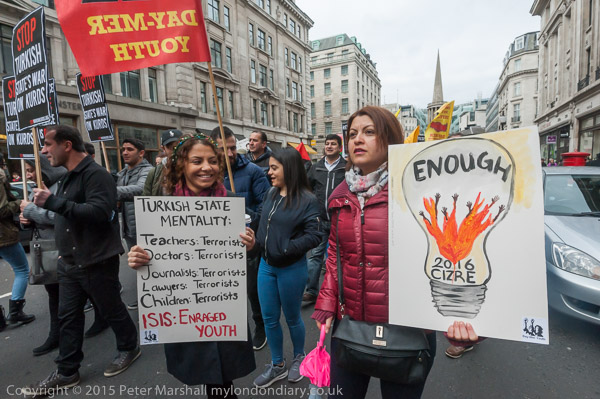
You, or certainly I, might think that a protest by over 5,000 people on the streets of London against the action of an oppresive regime that brings traffic to a halt is worthy of a mention on the BBC, but apparently it isn’t news.  I searched their site and found no mention, even though they cannot have failed to notice the large crowd which deliberately gathered outside Broadcasting House.

Perhaps the Kurds aren’t singled out for special treatment. The BBC routinely fails to report on protests in the UK, with a few exceptions, mainly where celebrities of one sort or another get involved, or there is some particular ‘human interest’ peg on which they can hang a report on, preferably on something only involving a handful of people and an entirely trivial subject.  But protests about serious issues tend to be avoided – unless they are happening overseas and particularly in a country the establishment has issues with.

According to Wikipedia, there are probably 50,000 Kurds resident in the UK. It’s figure used by government but which came from the BBC, as the government have not bothered to collect it – at the last census it wasn’t a category, but people could write in ‘Kurdish’ if they wanted to, and in England and Wales 48,239 reported their main language as Kurdish. Other probably even less reliable sources put the figure at 200-250,000.


The march assembled in front of Broadcasting House, spilling along the road north and south

Roughly one tenth of that population (on the BBC figure), which is spread out across most of our major cities, though with a significant number in north London and around Croydon – came to this protest about what is happening to the Kurdish community in Turkey (though many of them come from other areas of Kurdistan which also spreads across parts of Iraq, Iran, Armenia and Syria.) It’s a remarkable statistic, though the BBC didn’t think so.


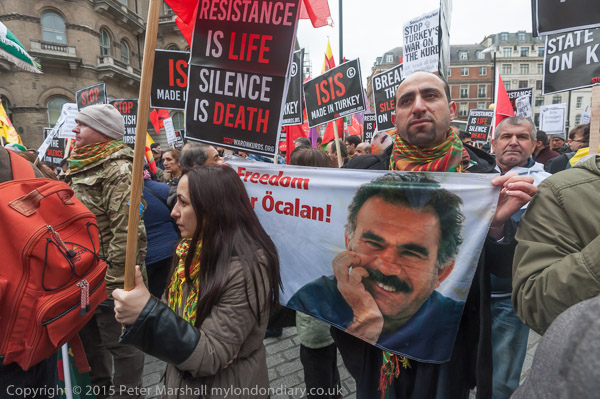
Freedom for Öcalan – his picture was also on many flags on the march

Kurds have long been a persecuted minority in Turkey, which has systematically tried to eliminate their language and culture.  Opposition to this has been both political and military, with the Kurdistan Workers’ Party (PKK) being regarded in many countries as a terrorist organisation (and is proscribed in the UK.) Its leader Abdullah Ocalan has been held in a Turkish jail since 1999; he still features on many of the flags carried in protests.

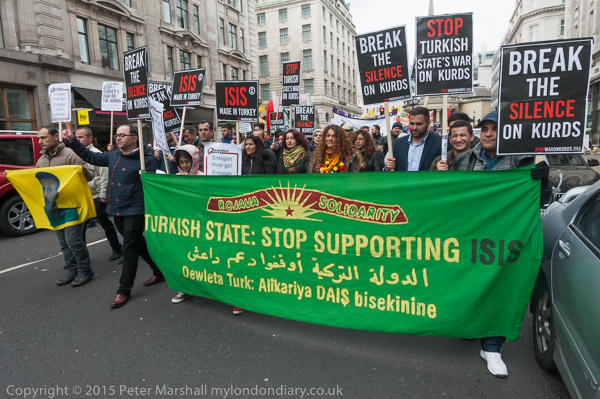
The Kurds also accuse Turkey of supporting ISIS (Daesh) both as a part of an attempt to turn Turkey into an Islamic dictatorship and also as a part of their fight against the Kurds, hoping that ISIS will make all of Kurdistan into part of its caliphate and sort out their Kurdish problem for them. They say Turkey – as Russian intelligence has also shown – provides a route for the oil exports that finance ISIS.

We support Turkey – and out government want to brush Kurdish issues under the mat – as a part of NATO in our continuing opposition to Russia. The US has supplied some arms to Kurdish fighters in Syria because they see their fight against the Syrian regime as also being against the increasing Russian influence. (They also got some British weapons but found they didn’t work…)  The Kurds have unfortunately become pawns trapped in the ‘Great Game’ in which our government and the BBC are players.

Photographing the march presented few problems, and it was more colourful than many with some wearing traditional Kurdish dress and many scarves in the Kurdish colours. The 16mm fisheye with its 147 degree horizontal angle of view enabled me to show the sit-down at Piccadilly Circus effectively (and as usual I ‘de-fished’ the image at the top of the page.) Like most landscape format images on this blog you can see it larger by right-clicking and selecting ‘View Image’.

I tried hard to represent the different groups and opinions in my picture – and you will see many posters, flags and banners in my pictures at Break the Silence! Turkey’s War on Kurds. As well as Kurds, the event was also supported by anti-fascist groups and a few others including human rights campaigner Peter Tatchell.
Continue reading BBC Blindness

Notting Hill Revisited


Portobello Rd, Notting Hill 1987

Notting Hill has “gone up in the world”, if down in my respect, one of London’s epicentres of gentrification, and now a mega-tourist attraction post the 1999 film of the same name. When we went there in March, the language on the streets was Italian – even some of the beggars had signs in Italian. Both tourism and gentrification have had a heavy toll, and little of the old Notting Hill remains, though in some respects the setting is the same.

Class War came to Notting Hill long ago -back in 1837 when John Whyte enclosed land to form a racecourse, the Hippodrome, and closed a well-used public right of way. At the first race meeting, several thousand are said to have used the closed footpath to make holes in the fence and get in free. More legally, a gang of labourers from the local authority went and cleared the obstuctions to the path but Whyte simply restored them.The matter went to court, where Whyte lost but still kept the path closed and instead tried to get an Act of Parliament to allow him to divert it rather than let the hoi polloi disturb him and his upper class mates.

The people set up a petition and went to the newspapers, telling them about the various illegal activities going on there, unlicensed drinking, gambling, prostitution, and pickpockets – and The Times (long before Murdoch who would probably have backed the racecourse) wrote a leader condemning it as a den of vice. Eventually Whyte was forced to re-route the racetrack and restore the footpath – which he did with a high metal fence on each side so the riff-raff could not see the toffs.

The race track soon failed, not because of the footpath but the heavy soil, which made it dangerous for racing in wet conditions, and many horse owners refused to risk their mounts.  The ground was sold to a Mr Ladbroke, a developer and that disputed footpath became, more or less, Ladbrooke Grove.

The radical history of Notting Hill continued – and you can read more in Tom Vague’s ‘Bash the Rich‘ where you can read about Chartist leader Feargus O’Connor, the Campden squatters, George Orwell, the Free Republic of Frestonia, the Angry Brigade, King Mob, the International Times, the original Hustler, the Carnival riots and more.
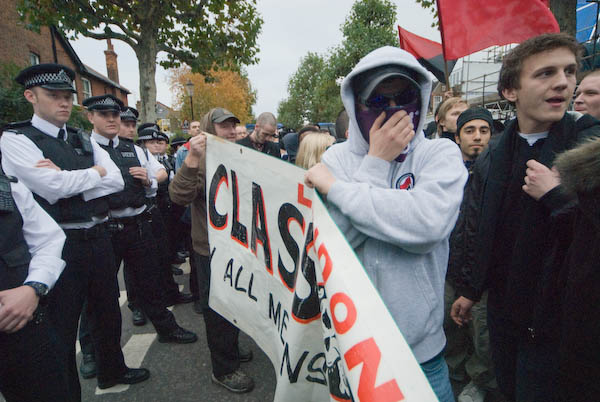

Bash the Rich, 2007
Class War returned to Notting Hill and marched through Ladbroke Grove to Holland Park on the first BASH THE RICH march in 1985. Twenty two years later they returned, and this time I went with them.
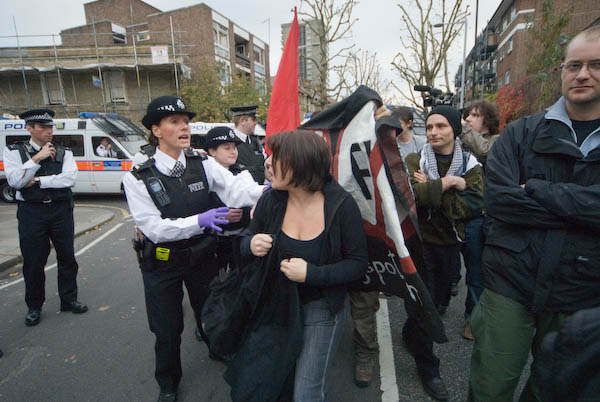

Bash the Rich, 2007

The event was heavily policed, with protesters and press getting pushed around considerably, and there were several arrests for no particular reason (mainly I think for objecting to police violence) with those arrested being released without charge after a few hours of arbitrary detention. You can see more pictures at Bash the Rich.
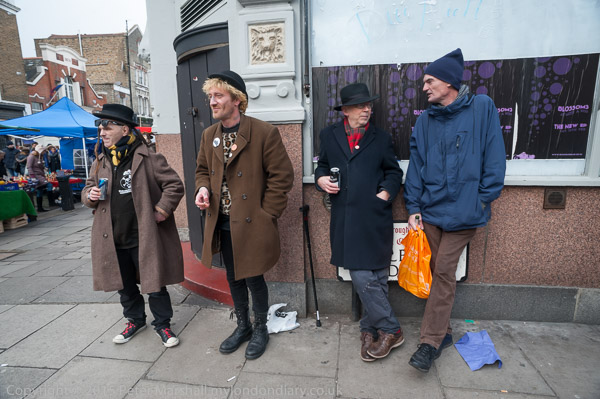
This year’s ‘historic, riotous and fun‘ Notting Hill pub crawl attracted rather fewer people and less attention from the police. It had been planned to start at the former Colville Hotel  where Class War’s first conference was held, but the few of us who had arrived on time to find the bar there boarded up and up for sale, and had to stand outside and drink from tins. With Class War’s Rita the Raven. But a close pub is no good to man, woman or beast and we didn’t hang around too long. So some late-comers missed the tour.
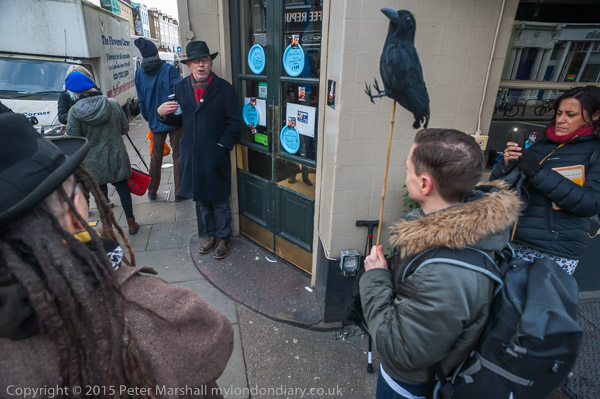
The next pub on the route, formerly the Warwick Castle, once the heart of Notting Hill is now gentrified out of recognition as simply the Castle, had ‘closed for maintenance‘ for a few hours having heard Class War was coming, so again we had to stand outside. There was no sign of any maintenance inside – the only thing being maintained was a very low and scared profile. People put up blue plaques (or rather blue paper plates) to mark this as the place where Ian Bone met Joe Strummer who jumped at the idea of the 1988 Rock Against the Rich tour.
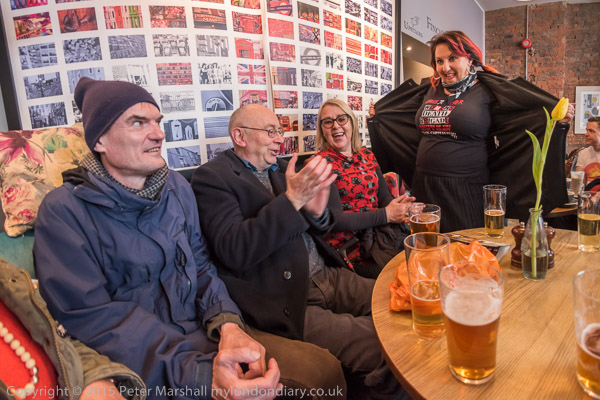
There were just a few police following us a few paces away as we walked down to the next venue, the Duke of Wellington tourist trap, once H H Finch‘s bar. They seemed to have extra bouncers on duty, but let us in and we got served, though Young’s isn’t my favourite brewery and the price was high. But I paid up and swallowed my Pride slowly. We sat for a while with a few more joining the tour, including a visit from Ray ‘Roughler’ Jones whose epic book about the Warwick Castle was titled ‘3000 Hangovers Later‘.
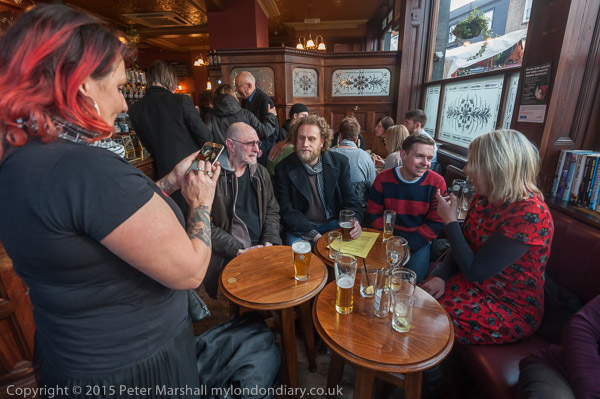
It wasn’t far until our next stop, one of the few real pubs left in Notting Hill, though not quite as genuine as it seems. The Earl of Lonsdale,  was once Henekey‘s, but was remodelled as Sam Smith‘s pub in a way that pretty authentically recreates the real thing – as do a number of other pubs they have worked on. It seemed we had settled down for the day, but more people were joining the tour, and onwards it went.

The next stop wasn’t a pub, but the house were George Orwell once lived – and which recently has appeared on in a faked image on Facebook with a CCTV camera Photoshopped on the the wall close to the blue plaque. As Lisa McKenzie gave us the low-down on Orwell as an upper class toff but one who understood the class war we noticed that there was indeed a small camera covering the doorway.
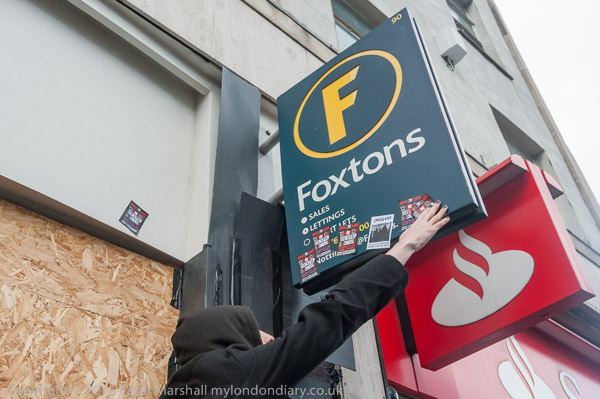
But this was Class War and we were close to a branch of Foxton’s, that arch-agency of gentrification, and it was our next stop. We were amused to find it had been closed and boarded up in anticipation of our visit, and it was duly stickered. A speech about the role of this company in gentrification had to be abandoned after a few minutes when a number of police vans came in sight and the tour melted away into the nearby Prince Albert, built in 1841 at the gate to the Hippodrome.
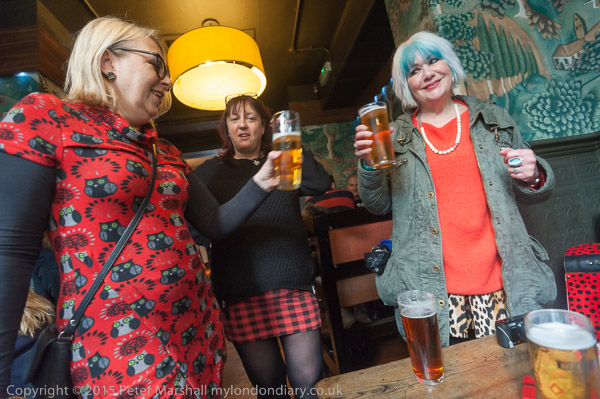
After we had been in there for around an hour (including a Class War make-up lesson) it became clear that this was to be the end of the tour rather than as intended the Daily Mail offices, where no food or drink was likely to be available, though probably a few police officers were still awaiting our arrival.  So I said goodbye and left as I could expect a good dinner waiting for me at home.

More pictures and text: Class War’s Notting Hill Pub Stroll

Continue reading Notting Hill Revisited
Work and Mental Health

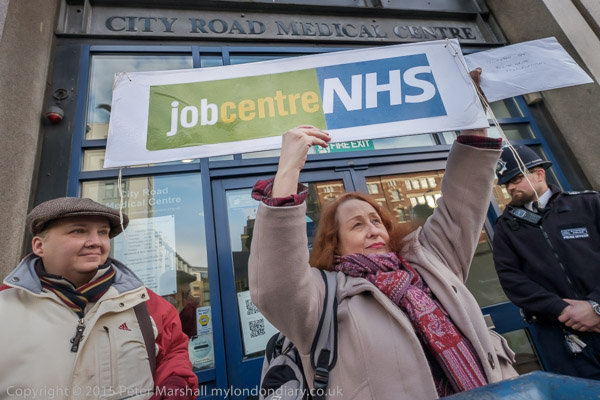
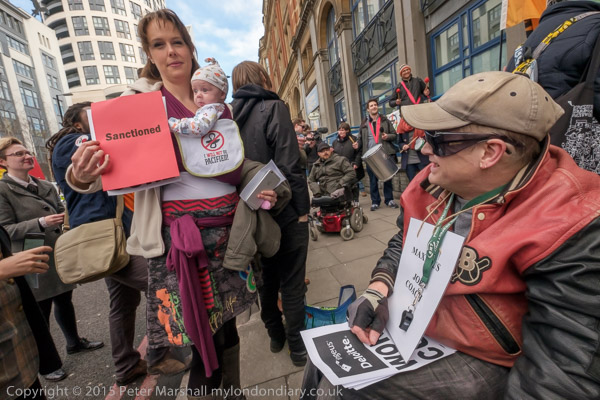
Since one of the main causes of mental health problems is workplace stress it seems odd that the current government appears to believe that somehow getting those with mental health problems into work is a miraculous cure. Of course finding suitable work can be a something which helps those who have recovered stay well, but it’s had to believe that job centres will help people find suitable work; instead they will be bullied into taking unsuitable work by advisers who get brownie points or bonuses for cutting benefits – either by forcing people into jobs or sanctioning them if they refuse.

There just are not suitable jobs for the great majority of those with mental problems or with physical disabilities, and even fewer than there used to be, both with the government closure of Remploy and other sheltered work and the removal of other support. Another major reason for many people’s mental health problems is the pressure on them to find work, the cutting of various benefits, benefit sanctions, the bedroom tax and other government policies.

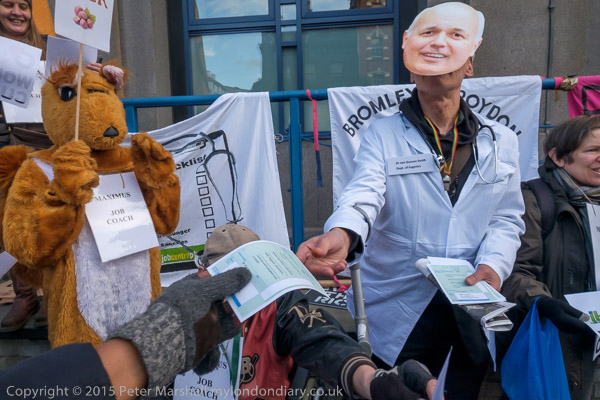
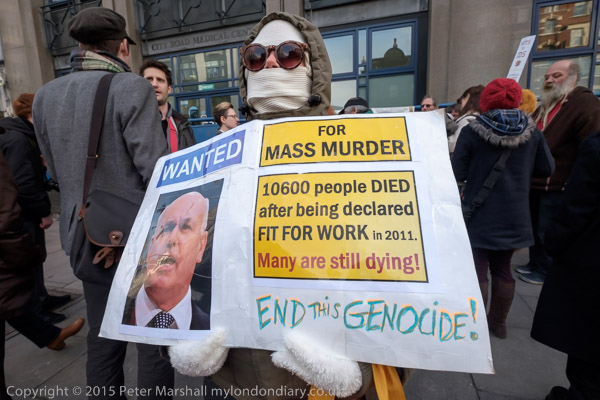
Finding disabled people fit for work through unsuitable ‘work capability assessments’ carried out by Atos and Maximus when they are demonstrably unfit is a major source of stress, and has led to many suicides. A very high percentage of those who appeal against these assessments succeed – but often only for the people concerned to be failed yet again when called in for another test. It’s perhaps an unsurprising effect of setting up a testing system that ignores medical reports and rewards the company administering the tests for failing people. It was a cruel system introduced under New Labour, but one which the coalition – even after its effects became clear – deliberately tightened the screw.

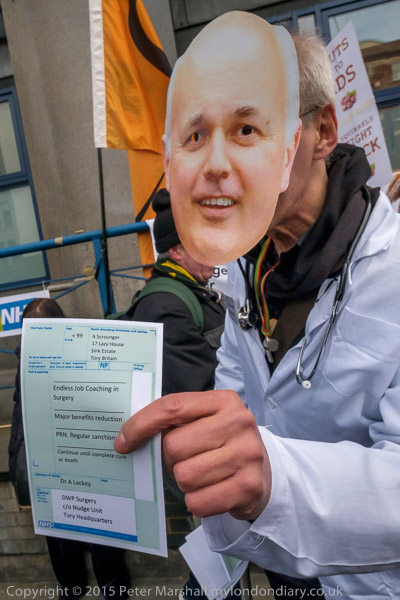
It would be hard to overstate the hate that many disabled people feel for the man who has directed the process, Iain Duncan Smith – and hard not to understand it when you hear one of them telling how eight of her friends have committed suicide thanks to his policies. He appears to combine a total lack of empathy and understanding of the problems faced by those on benefits with an outstanding incompetence.

This was a difficult protest to photograph outside the job centre because the pavement it was taking place on was rather narrow and soon get very crowded. There were too many people for the space and too many of us trying to take pictures. It was good that the protesters had plenty of props and costumes, but it was perhaps too elaborate to tell the story clearly, at least visually. I think it would have been easier in video.

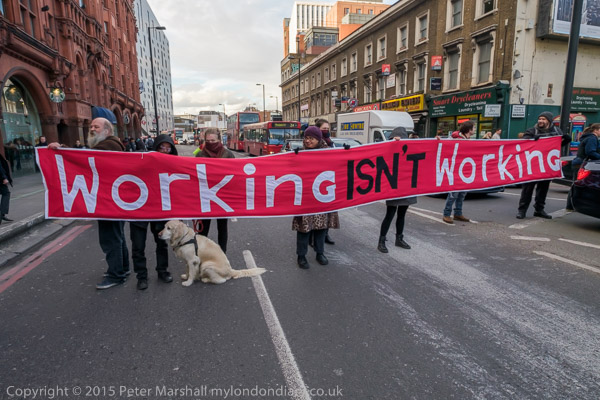
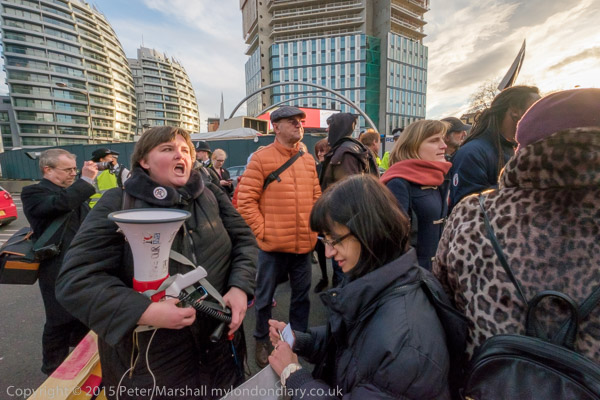
Things were simpler once the protesters began to march, and although the police didn’t seem to know what was happening, I think it was fairly obvious that they would attempt to block the Old St roundabout. Which they did for some time. As usual disabled protesters gave the police a problem; most have a genuine concern about manhandling disabled people, while others realise how it would look in the media. For both reasons they hang back from taking action for rather longer than would be the case with able-bodied protesters – though many of those taking part were not disabled.

But eventually the police would have had to take action, with one of London’s major junctions taken out, and DPAC realise they can only push things so far. After blocking the roundabout for around 20 minutes, Paula Peters of DPAC announce it was time to leave.

I wrote a fairly lengthy account of the action on My London Diary at No Job Coaches in GP Surgeries, and as usual there are plenty more pictures there. But although I took quite a few usable images, I didn’t manage to get one that really stood out and summed up the protest in the way I would have liked; but perhaps the issues were too complicated for that.

Trident


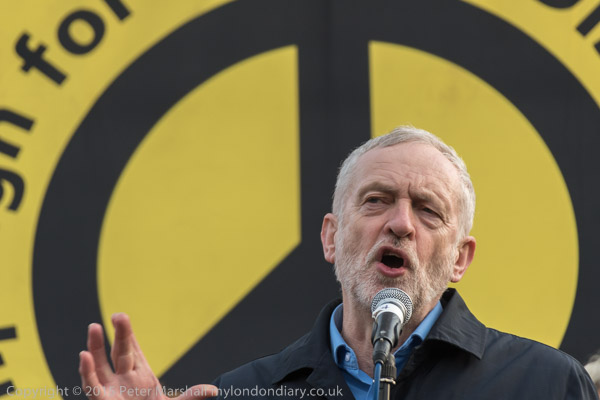
Jeremy Corbyn

I’ve seen rather less of Jeremy Corbyn since he became Labour leader, and at some events he has been surrounded by a baying crowd of photographers and TV crews that I seldom want to join.

At least when he was speaking on the platform at Trafalgar Square there was a clear view for all of us in the press area below the plinth the speakers use as a platform.

It isn’t an ideal viewpoint, and generally I like to stand some way back as otherwise you are looking rather steeply up at the speakers. Microphones also tend to get rather in the way, and sometimes the background can be rather messy. The obvious background for the speakers was of course the CND symbol on a number of banners. Depending on the angle I chose there was either a rather bright phthalocyanine blue or the mustard yellow which I chose for the image above. Mainly because of its position rather than its colour, but I do like the contrast between it and the blue of Corby’s shirt.

It’s at events like this I do and don’t wish that I had one of those military size telephoto zooms,  though Nikon’s versions are perhaps a little less impressive than their Canon counterparts. But the Nikon 200-400mm f4 G VR II AF-S ED would have been quite useful, though at only 14 inches long and around 7.5 pounds weight it is hardly in the major league.  Instead I had the 28-200mm f/3.5-5.6 G, working at its slightly soft 200mm maximum on DX format as 300mm equivalent in DX format on the D810. Taken at 1/500 f5.6 ISO 800 it isn’t bad – and the lens cost me – secondhand – around one thirtieth the cost of the 200-400 monster and weighs around a tenth as much.

I’d been standing around a couple of hours taking pictures of the many other speakers as we all waited for Corbyn to get back from Sheffield and rush from St Pancras station to speak. Even with my lightweight lens I was in pain from back ache, and I would never have lasted the wait with the heavy beast.

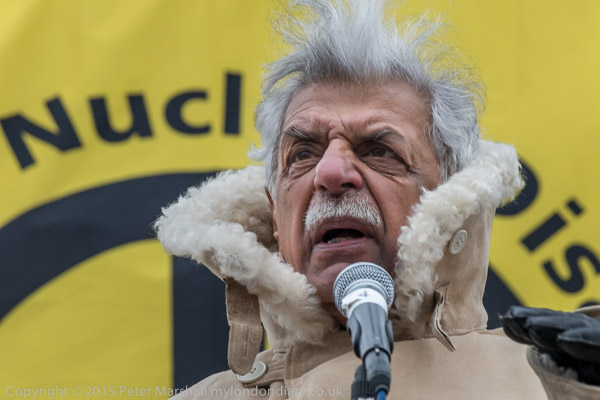
Tariq Ali in an ex-Russian Army winter coat

That lightweight lens is long obsolete, and back in 2003 was one that Nikon gear-fanatic snobs very much looked down on. But there is a lot to be said for a lens that covers such a wide range and is so light and compact. Looked at on screen at 50 inches wide (I only see around a third of the image width at a time) you can see it is slightly soft and would benefit from a little ‘smart sharpening’ but every one of Jeremy’s and Tariq’s facial hairs is clearly and distinctly visible. It would have been just a little sharper had I stopped down from full aperture, but it is still a usable lens for all but the most critical of applications (and I’m not sure what that would be – other than a reviewer’s cliché.) Although I took some photographs at these two events with the 16-35mm, all those in this post were made with this very versatile lens.
There were plenty of other faces to photograph, some very well-known and others less so, Kate Hudson, Vanessa Redgrave, Nicola Sturgeon, Leanne Wood, Caroline Lucas, Mark Serwotka, Bruce Kent, Giles Fraser, Christine Blower among them. You can see pictures of all of them and a few of the crowd at Stop Trident Rally.

It’s hard to find anyone outside the few who will profit greatly from the money spent on replacing Trident who would stand on any platform to support it. Most of the military see our so-called nuclear deterrent as an expensive and redundant side-show. It isn’t a weapon but a massive status symbol, and one we would be better off without.


On the march at Hyde Park Corner

There were (according to CND) sixty thousand people on the march, and it was certainly a large one, even if my guess would have been a little less than their. It was quite a struggle to get through the crowd that was packing Park Lane to reach the front of the march, where heavy stewarding made it difficult to take pictures.


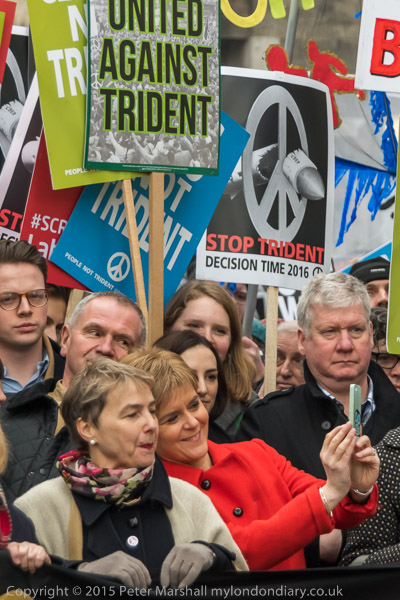
A quick selfie

But there holding the main banner, were many of those who would later speak, including Nicola Sturgeon, taking a selfie with Kate Hudson.


On the march in Park Lane

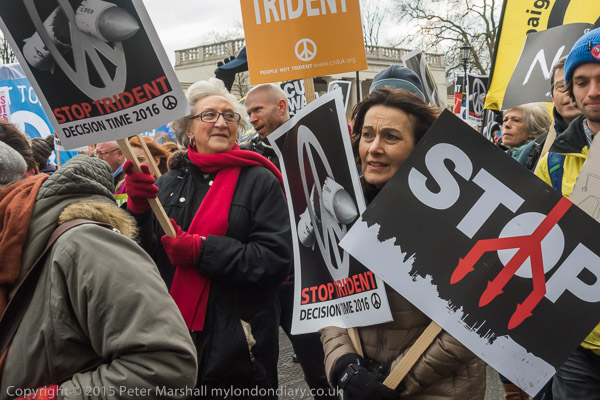
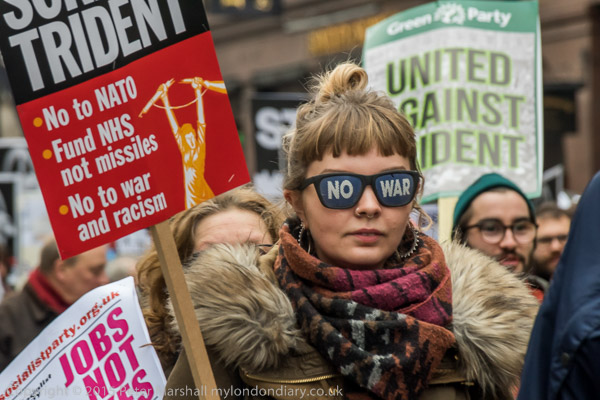
But it’s generally the rest of the protesters that I like to photograph, like this woman with her dark glasses and others in the body of the march. It’s the 30,000 or 50,000 people that are the real story of the march, not the few that are well-known.


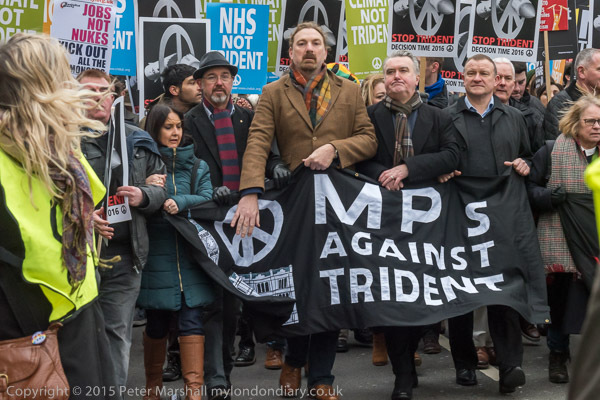
MPs Against Trident enter Trafalgar Square at the front of the march

I’m also not too good at recognising people. I think I’ve always suffered, though fortunately very mildly, from prosopagnosia or ‘face blindness’, which gave me some problems when I was teaching and sometimes when watching films and TV. Now I almost never watch  TV, which in itself makes recognising ‘celebrities’ something of a problem. Though I sometimes wonder if a touch of prosopagnosia might actually help when photographing faces, perhaps enabling you to see what is really there at the time rather than being misled by preconceptions.

Stop Trident Rally
Stop Trident March
Continue reading Trident

Yannis Behrakis

Don’t miss the video with Yannis Behrakis talking on Greek Reporter about the work which led to him and the Reuters team working with him being awarded in the Breaking News Photography category in this years 100th Pulitzer Prize awards.

Greek Reporter also has another article about him worth reading, Yannis Behrakis: The Man Behind the Image, which mentions him heing chosen by The Guardian as the agency photographer of the year in 2015, for his work covering the refugee crisis and the economic crisis in Greece.

The Guardian feature shows an incredible range of powerful images produced in a wide range of situations from his 28 years as a Reuters photojournalist, and although I’d seen some of the pictures before, I hadn’t until now realised they were all the work of the same man.

Climate Action

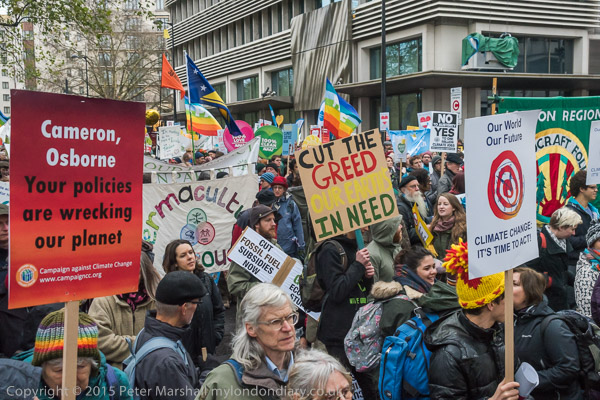
I had mixed feelings about November’s March for Climate Action, one of the larger of several thousand events around the world on the weekend before the start of the COP21 talks in Paris. Of course we need to get action on climate change. I first got involved in environmental issues in my student days, though it was a little later that people really began to become widely aware of the problem of the ‘Greenhouse Effect’ and the importance of rising carbon dioxide levels, although this had been pointed out over a hundred years ago – the role of carbon dioxide was first theorised in the 1820s and experimental evidence came in the middle of the nineteenth century.

It was obvious to Alexander Graham Bell back in 1917 that the world needed to move away from the unchecked burning of fossil fuels and towards alternative energy sources such as solar energy, but it is still something that successive governments here have failed to take with the necessary seriousness – and that our current administration is actually back-pedalling on.

We’ve had climate protests and marches in London for some years now; I think the first that I put on My London Diary was back in 2002, when I wrote (all in lower case):

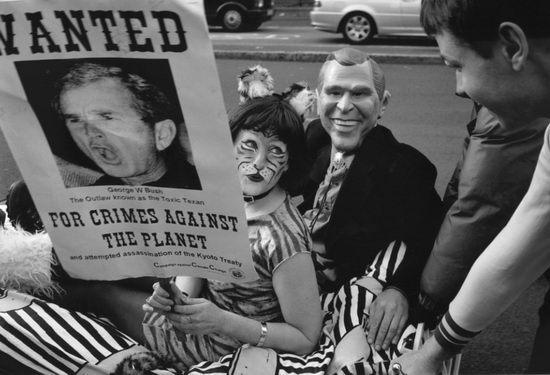
climate change is a threat to our continued existence on the planet. actions such as bush rejecting kyoto are grossly irresponsible, putting the short term interests of US companies before the planet. hence the demo with bush in bed with the esso tiger.

On that occasion there were problems with the protest – apart from it being ignored by the mainstream media – with the wheels coming off the bed carrying Bus and the Esso tiger coming off as it was pushed up the slight incline of the approach to Westminster Bridge. In later years the Campaign against Climate Change have organised many larger and more successful protests, and I’ve photographed most of them.

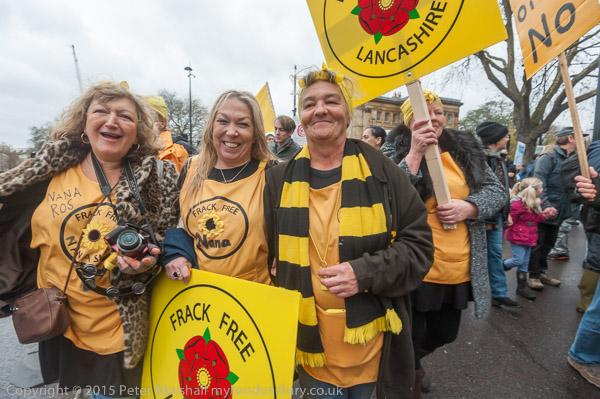
In more recent times, many other groups, including some large and well-funded charities, have come together to organise large climate marches, with groups such as the CACC being pushed to the sidelines. While its good that more people are becoming involved – and attracting more publicity – it sometimes has resulted in some of the real issues being sidelined.

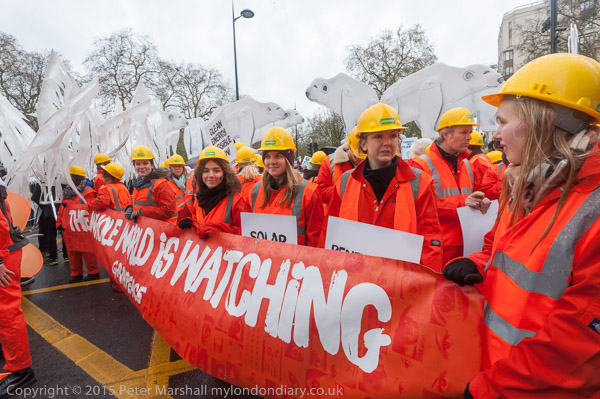
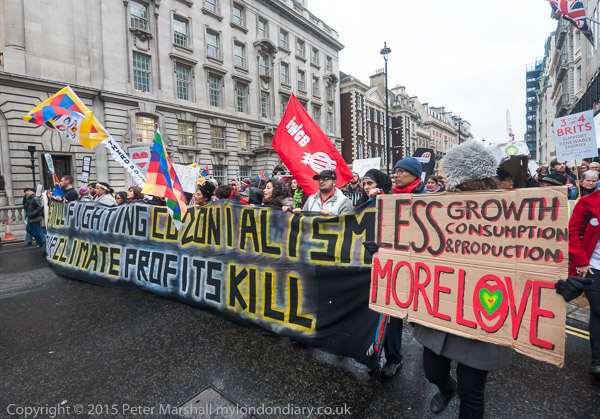
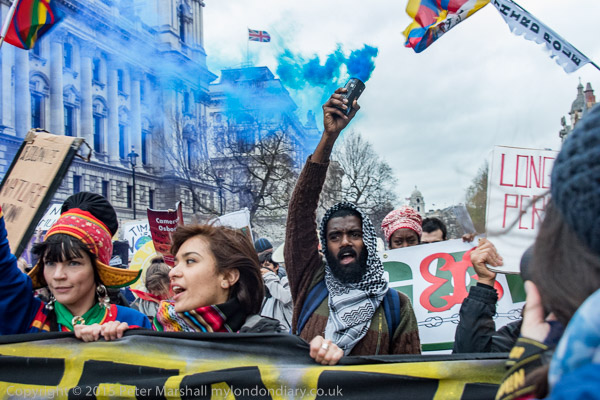
This year the wheels rather came off the protest,, when at the last minute some of the big charity backers decided that the Global Frontlines bloc which had been scheduled to lead the march was too radical for their taste, demanding global system change rather than minor adjustments. They tried to replace them with the main march banner along with performers in carnival animal costumes.

It wasn’t a change the protesters were going to take lying down, and they regrouped in front of the main banner. This was the first time that I can recall that a security company had been employed to act as stewards for a protest march, and ordered to remove the Global Frontlines bloc they made threats, and tried to do so, with some pushing and shoving. The protesters simply refused to move, simply moving back after they were pushed away. In my hearing the organisers asked the police to intervene, but to their credit they refused.

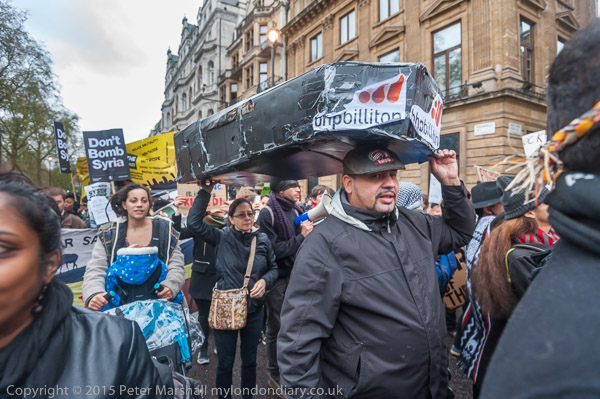
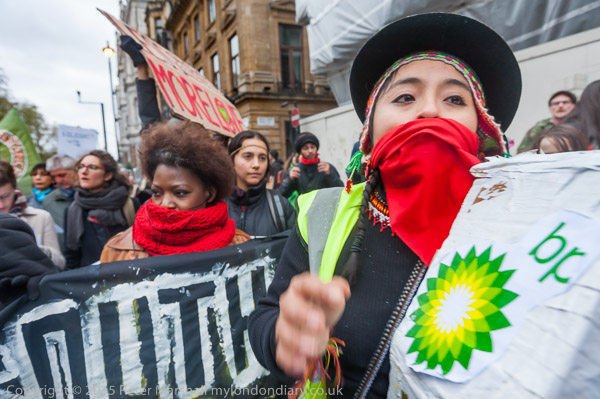
The banner at the front of the bloc read ‘STILL FIGHTING CO2ONIALISM YOUR CLIMATE PROFITS KILL’ and there were others with anti-colonial messages including ‘Extractivism is Colonialism’ and other anti-mining sentiments. Apparently what worried the more conservative charities most was the message ‘British Imperialism causes Climate Change’ as well as two coffins naming companies BP and BHP Billiton.

Eventually the protest split into two marches. First came the Global Frontlines bloc, who marched along the planned route, with a sit-down blocking Pall Mall a few yards from BP’s head office, as a protest against that company’s environmental destruction around the world and its collaboration with brutal repression of workers in some projects.

The rest of the march was held back for around ten minutes to create a gap between the furry carnival and the Global Frontlines. But other protesters also moved in front of the main banner, and by the time those sitting down on Pall Mall decided to continue, the march had more or less become one again as it went down Whitehall to the rally on Millbank. But there was a very bad taste left in my mouth.

The rally was frankly anodyne, and I met a number of long-term climate campaigners who told me that their groups had not been allowed to take part in it, as those in charge were determined that it should not be ‘political’.  There had been politicians and others at a rally on Park Lane before the start of the march, but only those of the protesters close to the stage were able to hear.

More pictures at Global Frontlines lead Climate March and
March for Climate Action Starts

Continue reading Climate Action

Nat Geo World

When I first saw the reports of a Photoshop cloning error on a Steve McCurry print widely reported after having been spotted by Italian photographer Paolo Viglione I decided there really wasn’t a lot more to say.

It seemed a careless error, and one that surprisingly hadn’t been spotted, but such errors aren’t difficult to make, and don’t necessarily result from any attempt to mislead. Years ago, when making a black and white print for sale, I’d done something similar, while cloning out a scratch from the negative late at night, my stylus had inadvertently dropped onto the tablet, probably as I briefly dozed, and added an extra piece to a shoreline. Fortunately I’d noticed it later, but only as I was taking a last look at the print before sending it to the customer, and was able to make a replacement print without the glitch.

It is something that probably wouldn’t happen now, even though I probably fall asleep at the computer more often, because I very seldom feel a need to use the clone tool now, as Photoshop’s other spotting tools have improved immensely over recent years. But it used to be the only real way to do the job back in the early days. I think the worst that has happened recently when I’ve nodded off has been to spill a glass of a rather good red wine across my keyboard. Doing so woke me with a start and I immediately tipped the keyboard upside down and there were no lasting effects, but I deeply regretted the loss of the wine, the last of the bottle, which I’d been keeping as a special treat for when I finished processing.

One of several prints on display in my bathroom is a large panoramic image of a house and garden, unsold after an exhibition where it was on public display for over a month. I can’t go in there without noticing a small error in the stitching process – it was made from three exposures – which means one of the windows in the house has a small part missing from its central white-painted vertical. I didn’t notice it in my careful inspection of the file, nor when it was on display, and if any who saw it at the show did, they said nothing. It hung on my own wall for several weeks before I noticed it, but now, although small and unimportant in the image, it seems glaringly obvious every time I use the bathroom.

Most of the time we see what we want to see, and not necessarily what is there, and I think that is perhaps one of the points behind photographer Peter van Agtmael‘s view on the McCurry controversy, ‘Why Facts Aren’t Always Truths in Photography‘. It’s an article I find rather disturbing, though entirely in agreement with his “very important qualifier” that “Any photographer working predominantly in a photojournalistic context needs to be rigidly transparent about digital manipulation“, and it is hard to dispute his statement that the best we can hope for in the intensely subjective craft of photojournalism is “a coherent personal truth.”

But in the piece he does seem to be acting as an apologist for a fellow Magnum member, even if one he says he hardly knows. Because it isn’t the silly and unintentional slip in that street photograph from Cuba that is at the heart of the controversy but the other examples of intentional deception that have emerged. And it is hard to believe that what we have seen is not just the tip of an iceberg.

The National Geographic Magazine
formed an important part of my early life, much of it spent, at least on rainy days, leafing through a large pile of the magazines covering the 1930s which had come to us after the death of a more affluent relative, along with his splendid stamp collection – he had worked for the General Post Office and made the most of his connections. The articles were at times rather tedious, but the black and white photographs spoke more directly, showing us how people around the world lived – and dressed, or not.

Coming back to ‘Nat Geo‘ years later was something of a surprise, with Kodachrome bursting out all over, but while presenting its rather over-enthusiastic view of the world, the emulsion was at least not susceptible to manipulation by photographers, though one could hide a great deal in its black shadows. But it would appear that with digital things have changed. Perhaps the revelations now being made will result in rather more editorial control.

I don’t warm to Nat Geo, which just somehow now seems far too American and politically not at all to my taste. That the National Geographic Channel is owned by the Fox Cable Networks division of 21st Century Fox, and the magazine since 2015 is part of a new partnership, National Geographic Partners, controlled by 21st Century Fox, perhaps says it all. But read ‘A Trip Around Steve McCurry’s Photoshopped World‘ by Paroma Mukherjee to see an Indian view of the photographers take on India.

Finally I’d like to mention an article in The Online Photographer, ‘C-E-R: Why we shouldn’t say “post” or “Photoshopping” any more‘. It’s not I think a very useful contribution, but one that reflects the anxiety some photographers feel about their own practices with images.

Post-processing or ‘post’ is just a useful term to cover everything that happens between when the file – raw or jpeg – emerges from the camera to when it appears on paper or screen. It isn’t really ‘after processing‘ as the article suggests, but ‘after exposure‘ processing’ If you want a more accurate term you could expand it to ‘post-exposure processing‘, but I’m all for keeping things short.

I’m not sure it is useful or possible to separate ‘correction‘ and ‘enhancement‘ as the article suggests, or to set clear limits as to what is allowable in photojournalism or documentary work (while in some other areas of photography clearly there are no limits on this or on the final category, ‘reworking‘.)

But what does seem clear to me is that this third element is simply something that should always be avoided by photojournalists and documentary photographers. And if Nat Geo aims to be anything more than a glossy travel-porn mag it certainly needs to give the photographers who work for it very strong guidance to that effect.

Don’t Bomb Syria

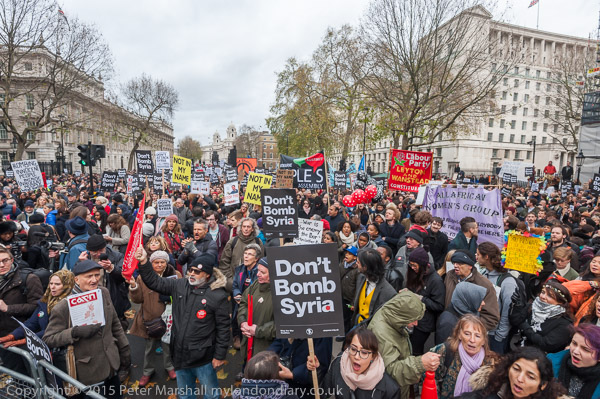
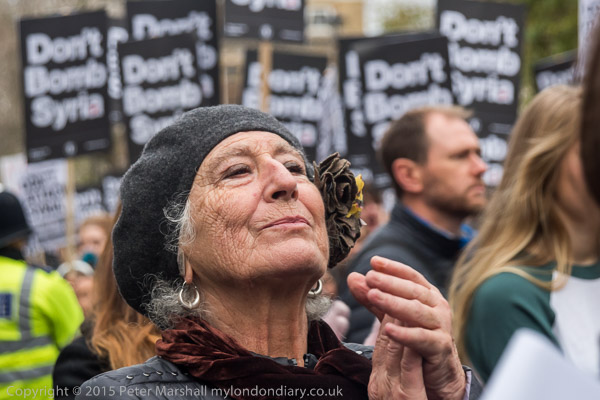
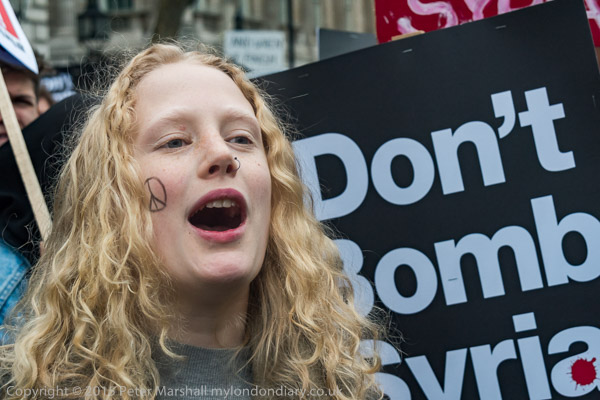
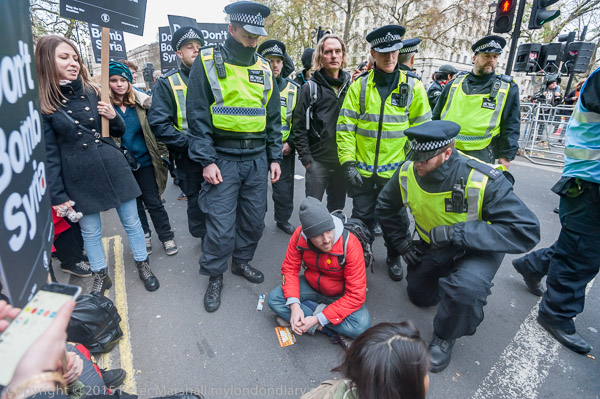
Don’t Bomb Syria was a big protest, attended by several thousand people, and obviously rather larger than the police had planned for, and it soon became obvious that their attempts to keep traffic flowing had been a mistake. It’s hard to think of any road in London which is a vital route – there are always other ways to drive from A to B, and there are often closures for various ceremonial or sporting events, but sometimes the whole purpose of policing protests appears to be to keep traffic moving.

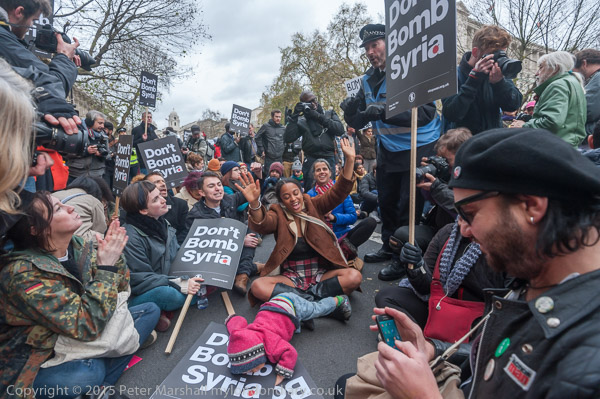
The numbers present forced them to  close the southbound carriageway a few minutes before the rally started, but they continued to keep traffic flowing northbound, having to keep clearing off groups of protesters who kept coming onto it from the pavement to get closer to the speakers. Finally enough people decided they had had enough of the police action and a large crowd moved on to the road and after a while sat down and blocked it.

London has been very slow to take the obvious move of pedestrianising some of its central areas; while many suburban high streets are now traffic-free, Oxford St is still full of traffic and Parliament Square remains a large traffic island. Almost everyone feels that Trafalgar Square is so much improved after the North Terrace was finally pedestrianised in 2003 – except for the National Gallery, which is upset by the buskers and ‘living statues’ who lower the tone by performing there. Much as I hate ‘living statues’,  and would certainly welcome some form of cull, it is far more pleasant now than when the area was full of buses, lorries and diesel fumes.

I wasn’t happy with some of the speakers at the protest, although I agreed that a military intervention by the UK at this time was unlikely to have any positive effect. We should have acted much earlier, though not directly, rather than speaking in support the Syrian opposition and against the dictator Assad but refusing to give those who opposed him any material support.

While the Russian position perhaps made it impossible to act directly it would have been possible to find ways for the Syrian rebels to have much more effective defence against the air attacks of the Syrian regime, and to stop the huge oil exports, mainly smuggled through our ally Turkey which have largely financed ISIS.

What I waited for in vain as I photographed the speakers at the event was for anyone giving a view from the Syrian opposition – instead we got many of the same speakers who get paraded at every Stop the War protest. Some of them are worth listening to, others too predictable to be really worth the effort. And several did stress the need to take effective action about the Turkish oil smuggling that is funding ISIS – something the Russian bombing and press releases have made us all aware of.

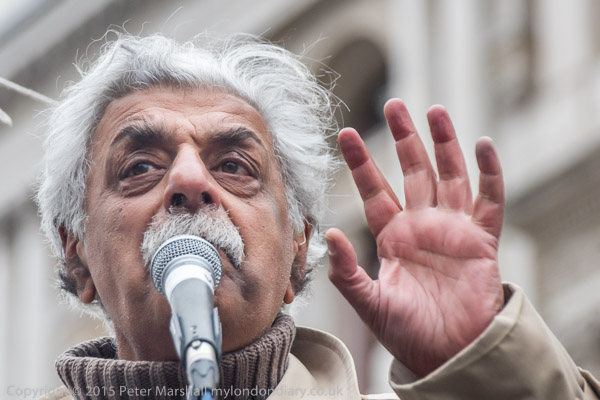
From a purely technical point of view it is always a pleasure to watch and listen to speakers such as George Galloway and Tariq Ali, whether or not what they are talking makes sense (and usually at least some of it does.)  Some of the others can reliably be expected to speak good sense, but  as I say in Speakers at Don’t Bomb Syria

” I was left waiting and wanting. There with notebook poised ready to write down the names of the speakers representing the Syrians and the Syrian Kurds, who should surely have been at the forefront of this protest rather than so many old ‘Stop the War’ war-horses. None came, not because none were available or willing to speak, but because the politics of those most closely involved don’t accord with those of Stop the War.”

Eventually I lost interest in the speeches and concentrated on the large group by now blocking the road, as you can see in the third part of my report:  Don’t Bomb Syria Blocks Whitehall.

After around an hour, people were beginning to leave, and the arrival of more police who then went around telling people they would be arrested if they continued to sit in the roadway fairly quickly persuaded the others it was time to end their protest.

Continue reading Don’t Bomb Syria

Back with the Ripper

The so-called ‘museum’ dedicated to Jack the Ripper in Cable St –  a tacky attraction for the strong-stomached tourist lacking in humanity or sense – received a couple of visits in November from protesters which I photographed.

Class War were one of the first groups outraged by the shop to get organised, and I photographed their protests outside in August (here and here) as well as one organised by Fourth Wave: London Feminist Activists in October. There have been other protests that I’ve either not been able to attend or only heard about after the event –  particularly those organised by local groups.

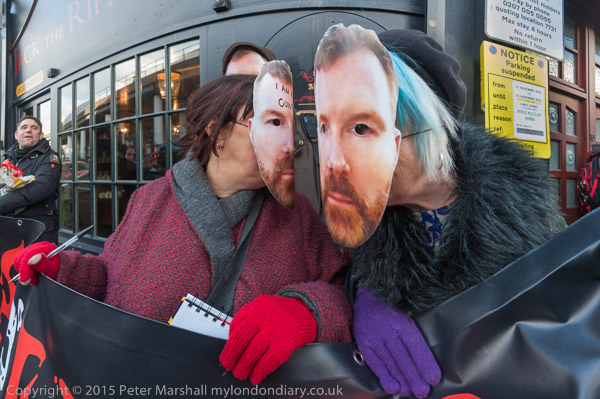
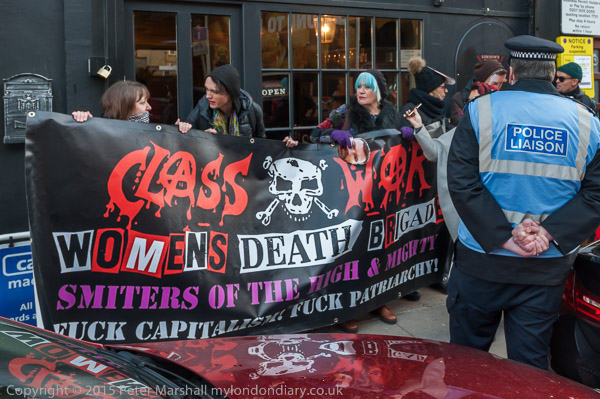
Class War were back again on a Saturday morning, several of them wearing masks showing the face of the museum owner, and stood outside the shop with their ‘Womens Death Brigade‘ banner.

It was a small but noisy protest, watched over by a couple of police officers who seemed quite amused by some of  Class War’s comments. He had to go inside the shop to talk with the proprietor’s partner who was  behind the counter and ask him to stop dialling 999  repeatedly as the police were already here.

He – and perhaps his assistant – were obviously unnerved by the protest, which appeared to have disturbed what otherwise would have been a rather lonely morning – the door to the shop was open until he decided to lock it, but I think there were no customers during the hour or more of protest. Clearly it doesn’t appear to be a viable business, despite quite an effort on the PR side, including some obviously false comments on online review pages, and a man who came along to complain at the protesters.

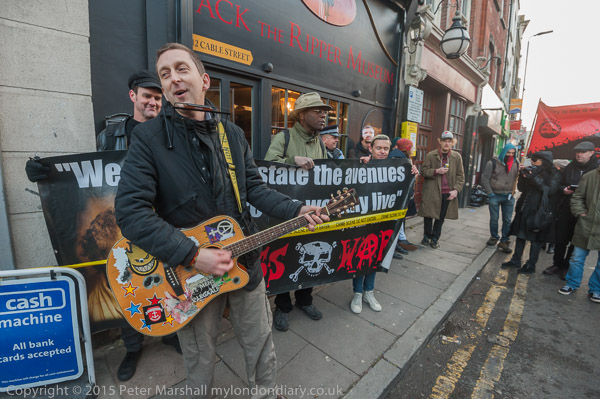
Rather more welcome was anarcho-folk singer/guitarist Cosmo, who came from Cardiff to perform some of his great songs at the event.  After which Class War decided it was time time for the pub, and for once I had the time to join them, though I didn’t stay long as I needed to get home and process and file the story.

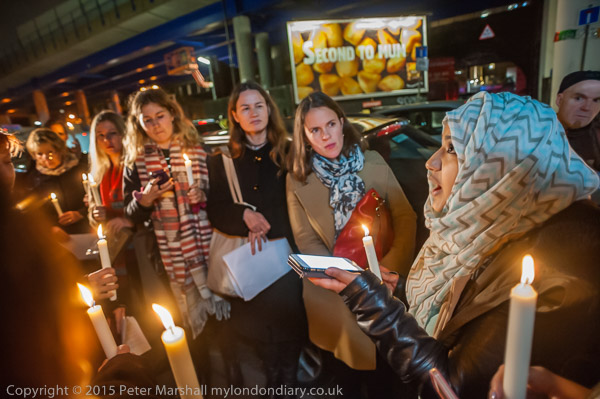
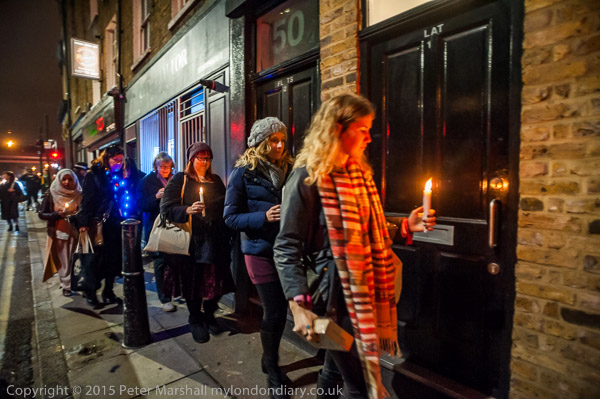
Five days later I was back at the same place for a protest with a very different feel, a candlelit vigil organised by the local Church of England and supported by the Theology centre at St George’s and London Citizens’ Whitechapel HQ as well as various women’s groups. There were one or two people present who had been there the previous Saturday, but it was a very different group, and included the great-great-great granddaughter of Catharine Eddowes , one of the Ripper’s victims.

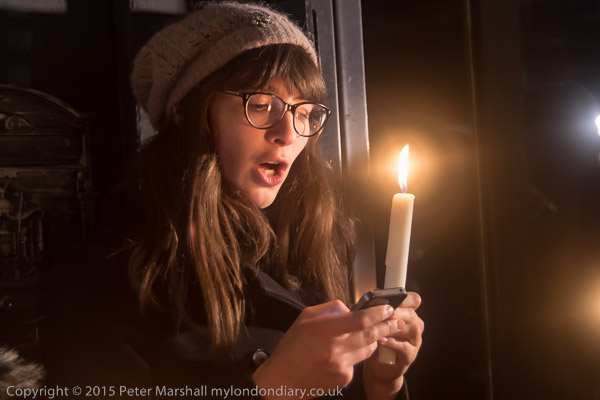
Photographically it was considerably more challenging, and something that would have been virtually impossible on film. Using the D700 I was working by candle light at ISO 3200. It was fine for people actually holding candles, but the light from them follows the normal inverse square rule for point light sources, and away from the candles it was dismal.


A woman holds a candle as she reads from her phone about one of the victims of Jack the Ripper outside the ‘museum’ which celebrates his vile murders.
I didn’t want to use flash, partly because it would destroy the lighting effect, but also because I felt it would be inappropriate at the vigil. The 16-35mm gave me a good angle of view working close to the circle of those taking part, but even with that wide angle I had problems with depth of field. Mostly the better pictures were made using the 20mm f2.8 – that extra stop over the f4 16-35mm was really useful. I didn’t use the D810 much, and had forgotten that I’d taken it off auto-ISO, which caused problems, though a few images were fine – like that above at 1/15s, f/4.5, ISO 800, -0.3Ev, 50mm (75mm equiv.)

A photographer working for the local paper was also present, and did use flash, but he took considerably fewer pictures than me. But when the cleaner who had been working inside the closed shop came out, and was photographed, he responded by shouting ‘Don’t take my photograph!’ and lunged at the photographer, grabbing his camera and assaulting him.

Without having flash on my camera, my pictures of this event were too blurred to be of use, but I’d had a clear view of what happened from several meters away. Police jumped out of the van where they had been sitting and threatened to arrest the photographer rather than his assailant! I and others volunteered to act as witnesses, but the photographer concerned declined to press charges.

After the vigil, when those taking part walked together to the local church I did take some flash exposures. By this time I was late for dinner and had to rush off before the service began.

More text and pictures at Class War at the Ripper ‘Museum’ and Ripper ‘Museum’ Candlelit Vigil.

Continue reading Back with the Ripper