Panoramas and Cigars

In my extreme youth I was a Brentford fan. Not that I ever went to a match at Griffin Park, though I think three of the under-11 team I played for went on to start professional careers there – and one of them stayed there until he retired a few years ago. I wasn’t a star player, and I think was sometimes the only player who didn’t manage to score when we thrashed some other teams 30, 40 or 50-nil (I think sometimes the ref lost count.) Even the goal-keeper sometimes put one in the opposite net, though at left or right back I could claim some credit for the nil on the other team-sheet, by fair means or foul.

But my attraction to Brentford was not just the football, but the romance, perhaps a strange word, but there was and still is something special about the place. It was always a thrill in my young days to take a trip on the bus along Brentford High St, though it was often too high, with the ammonia and tar of the gaswords sometimes almost overpowering, but visually too there was sometimes if you were fortunate the sight of a huge wall of re-hot coke as a furnace was opened and it cascaded down to ground level. I don’t know how many times I saw this, but it engraved itself indelibly on my memory.
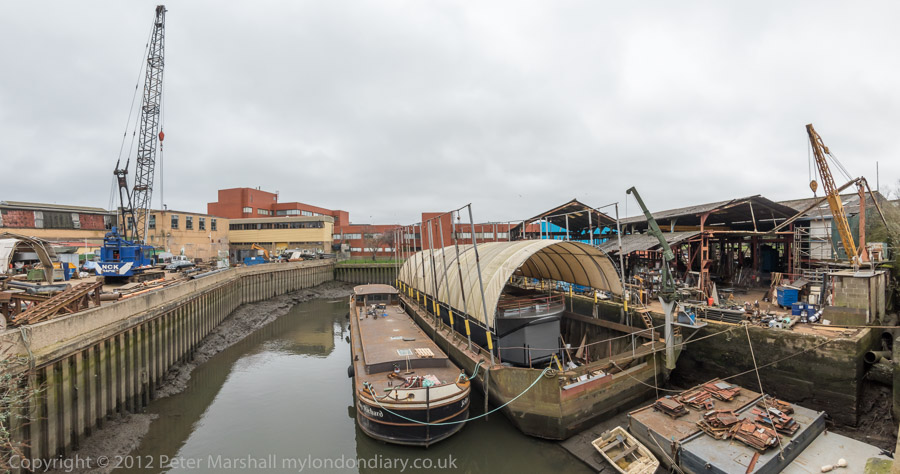
I think too my father may have taken us on days out, perhaps even bank holidays, not just to Kew on the bus through Brentford, but to walk along the Grand Union Canal, which enters the Thames here. Even now, many years later and long after the end of commercial traffic on the canals and the turning of Brentford Dock into a private housing estate, much still remains of the backwaters and streams of the River Brent between the high street and the river, hidden away from the casual visitor, but much more open to the public than when there was far more riverine commerce and only a few footpaths open.
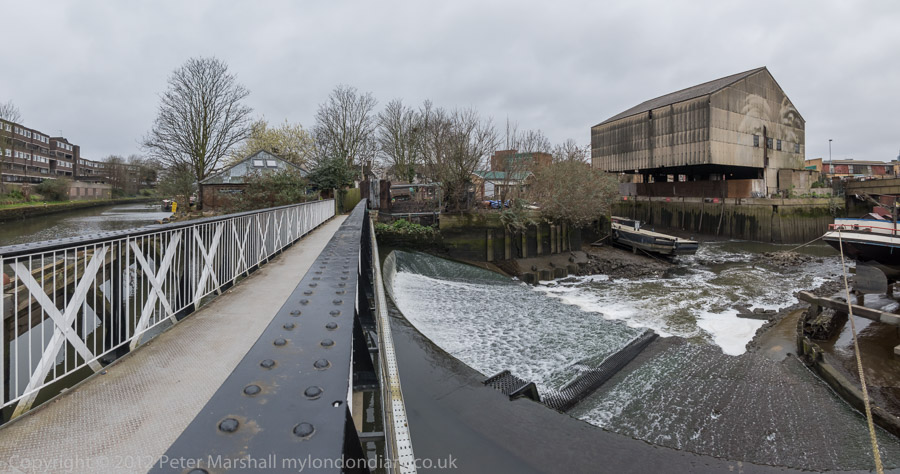
The opening up of the riverside hasn’t been altogether positive, with large blocks of offices and flats destroying some of the unique atmosphere, replacing it with an identikit blandness, but a little of the charm remains, as I hope you can feel from these images.

I’ve written a little previously about the later stages of the walk that took use from Kew Bridge through Brentford to Isleworth and Mogden during last Easter’s holiday. This was a photographers’ walk rather than the normal family route-march where I keep finding myself having to run to catch up the others striding 50 or more yards ahead after I’ve stopped to make a picture. We wandered back and forth, explored dead ends and different views, took our time and our pictures.

I’d come this way a dozen years earlier, working with the Russian swing-lens Horizon panoramic camera as well as the Hasselblad X-Pan fitted with the 30mm lens, on a slightly misty New Year’s Eve in 2003, and I was interested to see both how things had changed and how different things looked using digital rather than film. Of course I don’t have a swing-lens digital camera – which would need a curved sensor, but was using software to produce a similar result from full-frame 16mm fisheye images.

One big difference is that I haven’t yet got around to either printing or scanning more than one or two of those colour negatives that I took in 2003, while the digital files were very quickly processed. At least I have developed the film, though I still have a few rolls waiting to be done from around 10 years ago that somehow I’ve never got round to. I did send a couple of batches off to be processed a year or so ago, but haven’t yet got around to finishing the job.

So far as I can see from the negatives, the results from digital are very similar, except that they have a significantly greater field of view. One big advantage fro digital is the wider vertical field, which if you want a panoramic format such as the 1.9:1 I’ve used here, gives you considerable freedom as to where to place the horizon. With the two film cameras I was using the horizon was always central as the cameras have to be kept level to avoid a curved horizon.

The camera used for these pictures was the D810, and the images are 7360×4912 pixels – 36Mp – before cropping to panoramic format. While the orginal RAW files are a reasonable 35-40 Mb (Nikon compression does a great job) changing the perspective results in a 16bit Tiff file of over 210Mb which rather eats up disk space. But that 7360 pixel width means high quality prints at up to 25 inches wide, similar to what is possible from film with images 56x24mm or similar.
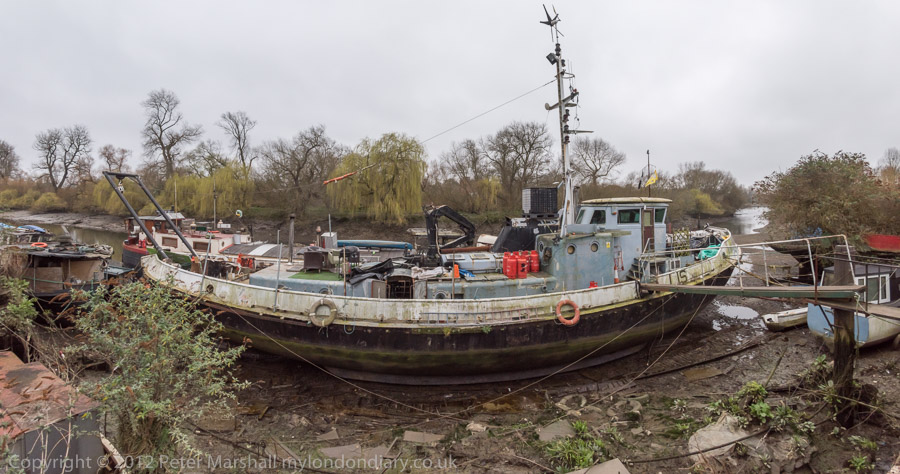
Since the images use the same ‘cylindrical’ perspective the compositional problems are much the same, and the main problem is with ‘cigarring’. Images taken face on of any large rectangular subject show this typical shape because the ends of the block are further from the camera than the middle. A couple of the images in Riverside Brentford Panoramas including the boat above show this too strongly for my taste. There are several different types of perspective that can be used other than the straightforward cylindrical which can reduce this effect – such as the Vedutismo applied here by PtGui.

There is a marked improvement, but it does over-emphasize objects at each end of the frame and isn’t always the best choice.
Continue reading Panoramas and Cigars

Education Issues

Back in what now seems like another life I was a teacher.  I worked for almost 10 years at what was then one of the largest (and certainly one of the least well-organised) secondary schools in the country, then went on to the rather more civilised atmosphere of sixth-form education, at what became a community college and than part of a larger FE college. When I left teaching to work in photography I continued to teach part-time for a few years, and I’m still a member of the NUT, albeit a retired member, as well as a full member of the NUJ.

It was an interesting career and had its enjoyable and rewarding moments, but if you’ve never tried it you can never appreciate how demanding and stressful it can be, and I glad to be able to leave the profession and make a living writing and taking pictures. And I was able to do so partly because of the experience I’d gained in teaching in one of the finest art departments in the country, with an A level photography course which I’d set up and helped to make almost certainly the best in the country, with colleagues whose skills and experience complemented mine.


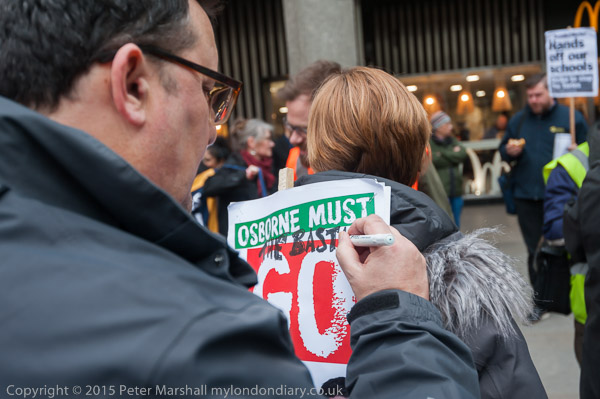
Osborne Must Go – The Bast…

I would probably have stayed in teaching longer but for the policies of successive governments and their various reforms and innovations which have made such a mess of our education system. Of course we needed changes, but changes that were made on educational grounds, not because of ignorance and dogma.

There seem to be several major underlying assumptions behind most of the reforms we have seen: that you can’t trust teachers or local authorities, that education experts know nothing about education and that the private sector will always make a better job of it.


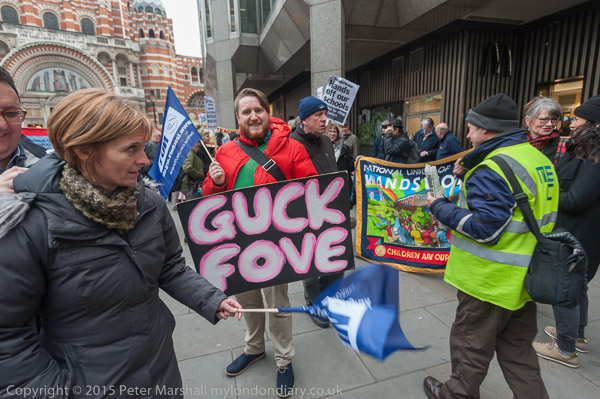
Guck Fove

Teachers were hoping for better things when when Michael Gove was replaced as Education Secretary, but instead got the threat to make all schools into academies – a hare-brained Labour scheme from the depths of New Labour, almost as unforgiveable as going to war in Iraq.

There is no evidence that academies improve the educational results of children and the plans remove all democratic controls from education as well as side-lining parents. They (along with so-called ‘free schools’, whose freedom seems to be mainly a freedom for some individuals to grab community assets) make sensible planning of educational provision impossible, and remove many of the safeguards on teacher employment that the unions have struggled for years to establish – perhaps their main attraction for the political right.

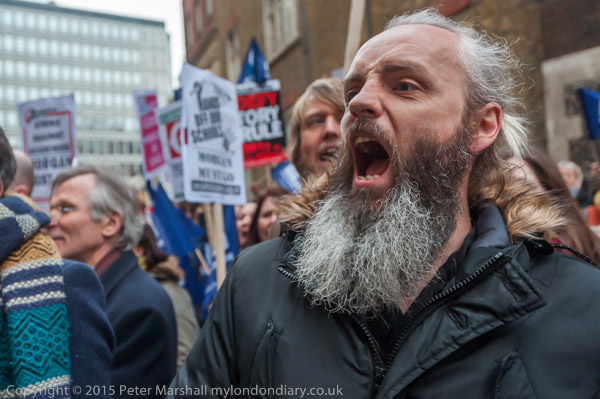
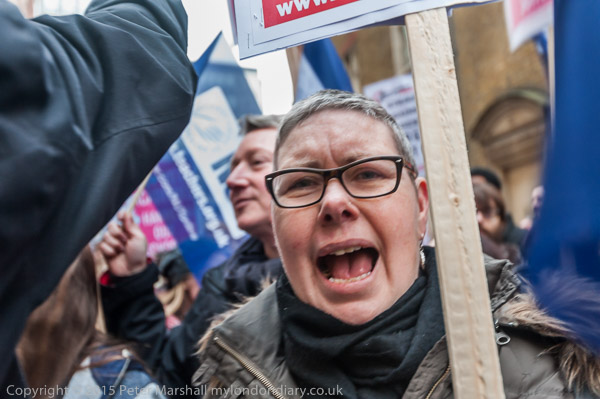
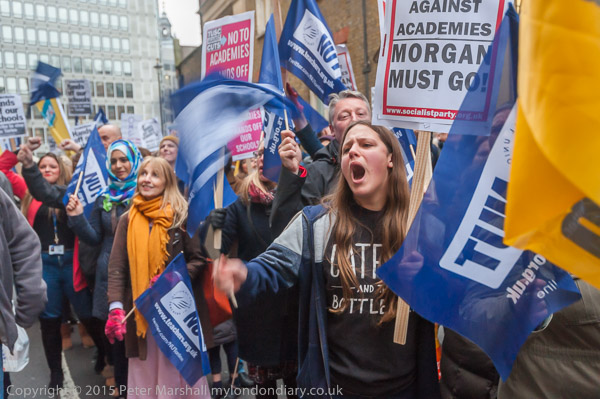
As someone who was a union rep for around 15 of my teaching years I can assure you that teachers by and large are a pretty conservative group and it isn’t easy to get them as a  body to show any militancy. But on 23rd March there seemed to be plenty of angry teachers marching to say Hands Off Our Schools, including those from the ATL, a union that many joined because they felt the NUT was too radical.

The unions say government should be addressing the real issues of teacher shortage, lack of pupil places and chaos in the curriculum rather than creating more organisational chaos. And clearly they are right.

By the time the march was going past the Dept for Education, the light was falling, and the narrow street with fairly tall buildings was getting pretty dim. I’d increased the ISO I was working at to ISO2000, but with the teachers getting rather agitated it perhaps wasn’t quite high enough, and many images were too blurred to use.

It’s always a bit difficult to know how high an ISO to use, and the image quality with both the D700 and the D810 does noticeably drop off at higher ISO, but ISO3200 is certainly normally usable and the extra 2/3 stop would have resulted in a few more sharp pictures – or a little extra depth of field.

All of the pictures at that point were taken with the D700 and the 16-35mm,  and even at 16mm depth of field isn’t huge when working close to the subjects as I like to do. And when close people’s movements become more important and more likely to blur. Of course blur in the right places – such as the hand and the NUT flag in the top picture – can improve images, but in the wrong places will ruin.

The 16-35mm does have image stabilisation, but that is really no help in stopping subject movement, though perhaps might cancel out some of the more erratic photographer movements. But somehow in those cases where it would be useful I almost always manage to have turned it off, though seldom intentionally.
Continue reading Education Issues

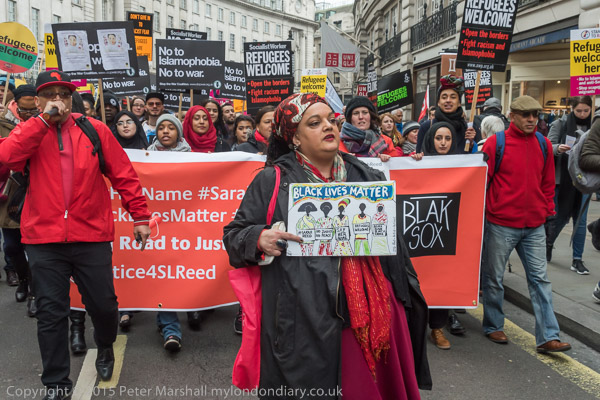
Refugees Welcome


Lee Jasper and Zita Holbourne lead the Black Lives Matter bloc

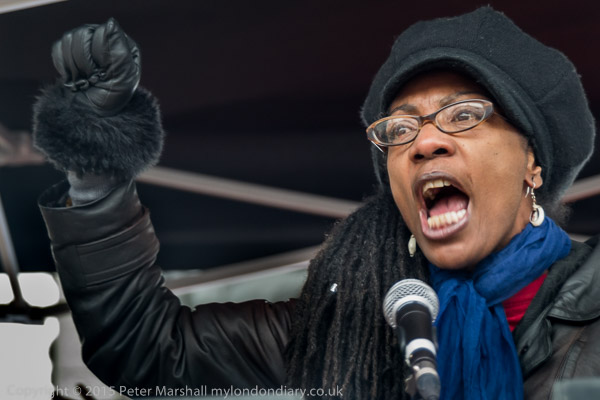
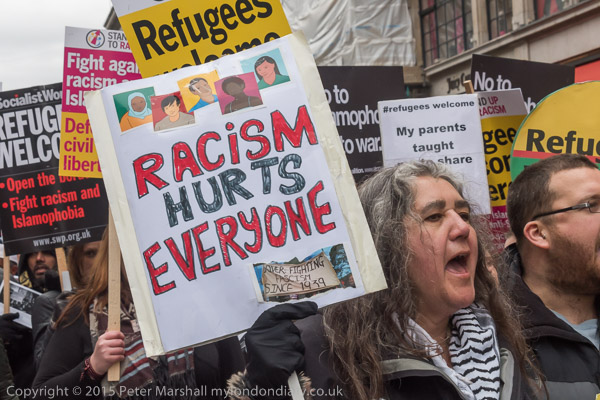
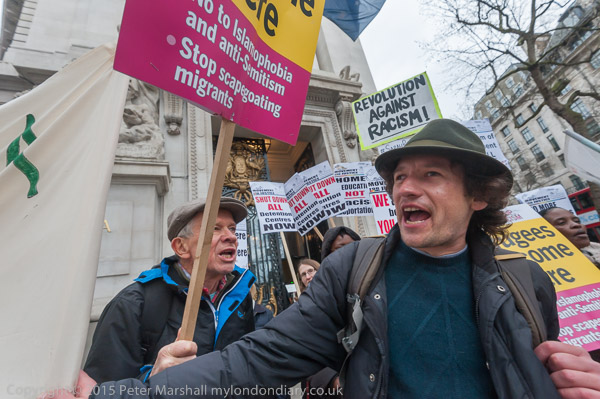
Every time we press the shutter release we are making choices, expressing a point of view. What we chose to photograph and how we decide to represent it. And later, which images we select from those we have taken and how we put them together to make a report, and the captions and other text we present with them. Covering events like the large march and rally against racism, Islamophobia, anti-Semitism and fascism organised by Stand Up to Racism on March 19th perhaps makes those choices more evident than many other events.


Marcia Rigg fighting for justice over the killing of her brother Sean by Brixton police

Of course the great majority of the British people have an immense sympathy for the plight of families fleeing from the wars in Syria and elsewhere, or indeed from famine and extreme poverty elsewhere – even despite the efforts of our billionaire-owned press and Tory politicians to demonise them, and a government that has almost totally failed to step up to the challenge.

But this was an event which brought together a huge range of issues and although I tried hard to cover them all, of course my view is a personal bias. There were many people on the protest that I knew and had photographed at other protests, and there were also those who would be known to a wider public. Although I try not to concentrate on celebrities, pictures of them, particularly of those who spoke at the rally, are important both in terms of gaining publicity for the causes and also paying my bills, though I try no to be over-influenced by the latter thought, and as much as possible avoid the media scrums around well-known figures.

There is also the question of visual appeal. Some people are certainly more interesting visually than others, and as photographers we have to make pictures that people will want to look at. We dramatise events, picking those who stand out in some way to photograph, and doing so in a way that will engage others. Dramatic gestures, unusual placards are to photographers like a flaming candle to moths.

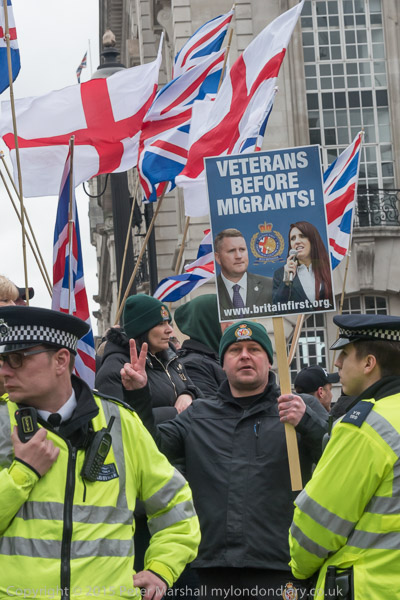
A very small group of protesters against the march who stood around the statue of Eros and shouted abuse, protected by several rows of police certainly attracted far more attention than they deserved – and I took a few photographs. They were a part of the story, but only a very small part.

One of the reasons for ‘My London Diary’ and this site is to enable me to present a much wider view of events such as this than is possible through the mainstream media. I think I posted far too many pictures from this event, but they do allow you to see that wider view, if very much from my perspective.

But though it’s obviously from my point of view, for me it’s vital to maintain a certain objectivity and distance from what I’m photographing. It’s important to me to be fair and not to misrepresent what I’m photographing, whether I agree or disagree , approve or hate. I often see pictures by some other photographers and think that had I taken that particular view – perhaps catching a picture of someone caught in a way that makes them look stupid – I would simply have deleted it, even if I don’t like them. If you ever see a picture by me that looks as if someone is making a Nazi salute it will be because I sure they were doing so and not just waving. Without integrity documentary is without value.

Refugees Welcome Rally
Stand Up to Racism – Refugees Welcome march


Australians protest against their country’s racist immigration policy

I left shortly before the rally in Trafalgar Square came to an end to go to a much smaller event also taking place on UN Anti-racism Day. Another reason for My London Diary is that I knew this would get no coverage at all in the UK’s mainstream media – though the other photographer present was covering it for an Australian newspaper.

Australians protest on UN Anti-Racism day

Continue reading Refugees Welcome

Housing problems


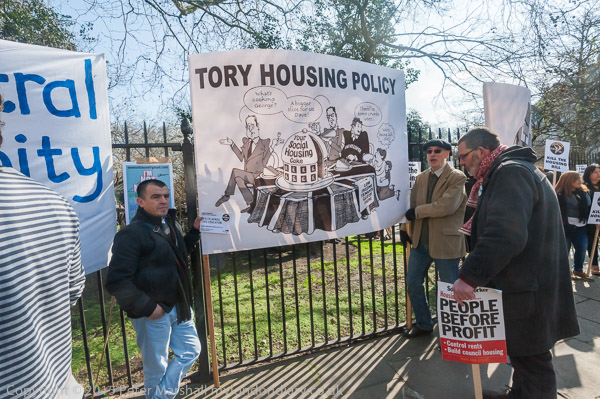
Housing campaigners meet to march against the Tory Housing Bill, March 2016

Linda and I are fortunate to own our own house, even if it isn’t a huge house and nothing special, a smallish semi-detached Victorian cottage almost certainly built for farm labourers around 1880 (much like the few houses my own grandfather built for his workers) and condemned in the 1950s. The landlord decided to make some minor improvements, converting the outhouse into a just indoor bathroom and toilet and after a few years sold it to the sitting tenants. Rent controls then made private letting hardly worthwhile and certainly needed sensible reform, but were instead scrapped.

Ten years or so later when we managed to scrape together a deposit and get an 80% mortgage after both of us had just got half-decent pay rises, we left our new town housing corporation flat and moved in – paying ten times the landlord’s sale price. We are still there 42 years later, having made a few minor improvements – double glazing, some insulation, gas fires etc – and essential maintenance but basically living in a house which is now something of a museum piece, and estate agents would almost certainly descibe as ‘in need of major imporvements’ while still happily trying to sell it for their fat share of over 30 times the amount we paid for it.
For us a house was a place to live, and to bring up our sons, handily placed for the railway station 5 minutes away that now takes me to London in 35 minutes. We never wanted to join the others we knew playing the housing market – who are now sitting in houses that sell for several times the relatively modest (for anywhere around London) amount ours would command.

When we bought was almost certainly the only time we could have afforded to do so, unless we moved away from the southeast, and it was thanks to my union whose campaigns and actions had managed to produce the only decent pay rise of my working career. It was a short window that soon closed as inflation eroded incomes and house prices rocketed. But we didn’t particularly want to become a home owners and only did so because it was clear that rents were rising fast and that buying was financially a much better long-term option. It was only a few years before the mortgage repayments were lower than the rent we would have been paying had we stayed as tenants – and to rent a house like ours in the private sector would now be costing more or less my entire income.

Tough as things were back then, the situation is far worse now, and the reasons are pretty clear to all but blinkered politicians. It isn’t basically that there are not enough homes, but more simply, people who need homes can’t afford them. There are enough homes in London, but many are owned as ‘investments’ by the wealthy, and often stay empty all or most of the year.

Building more homes will only help if people can afford them, and that must mean more council housing – as much or most soccial housing, even if so-called ‘affordable’ is too expensive for most. When market rents are more than many people earn, the 80% of those rents that can be classifed as ‘affordable’ clearly isn’t.

Thatcher’s ‘Right to Buy’ though advantageous for some who bought their properties was disastrous because those properties sold were not allowed to be replaced by new council housing. Like the current government, her aim was to get rid of council housing. Many of the properties sold under ‘right to buy’ are now privately rented, bought from the former tenants as ‘buy to let’ properties.

Buy to let is just another part of the problem. Borrow to buy a house, take the interest and repayment costs, add on an agents fee and ten or 15% profit and get someone else to live in the house and pay it all for you. It is trading on the ability of the wealthy to borrow to enable them to profit from the poor who the banks won’t lend to, and getting the poor to buy property for the wealthy.

We need proper rent controls and to increase security of tenure in all areas of housing – including protection for owner occupiers who fall behind in their repayments. We need more control over the type of property that is built in our cities, and in particular more council and other social housing.

But we also need changes in attitudes towards communities, particularly those living in the remnants of council housing on estates such as the Aylesbury or former Heygate in Southwark. Councils need to threat them as people and as communities rather than just looking at balance sheets, particularly when – as with the Heygate – they get the sums spectacularly wrong.

Most if not all of these estates need real regeneration rather than demolition and wholesale scattering of communities that is currently taking place – to the profit of private companies but with a great loss of places where the people our city relies on can live. It’s to the Labour party’s great shame that many of the councils with the worst records – Southwark, Newham, Lambeth etc – are Labour strongholds, and the party needs a serious change of direction on housing.

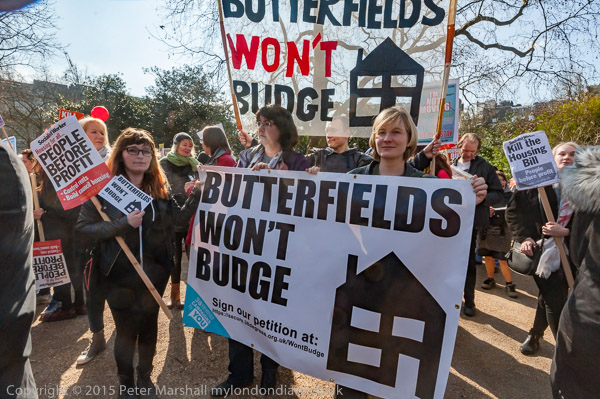
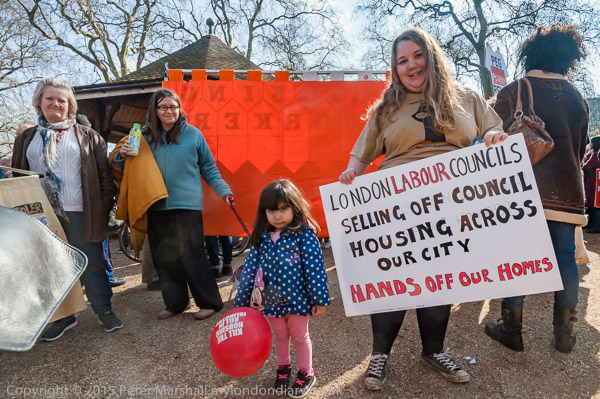
It isn’t surprising that people whose home are threatened are angry, and many came to the march to show that – against both the government and a housing policy dictated by estate agents and the Labour councils who essentially sing the same tune, though often also protesting against the Housing and Planning Bill. It’s hard not to think about motes and beams.

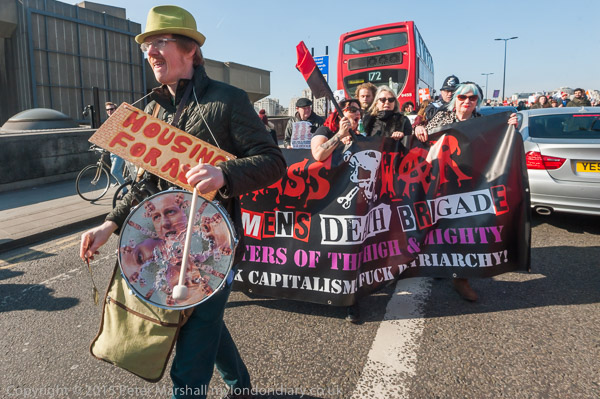
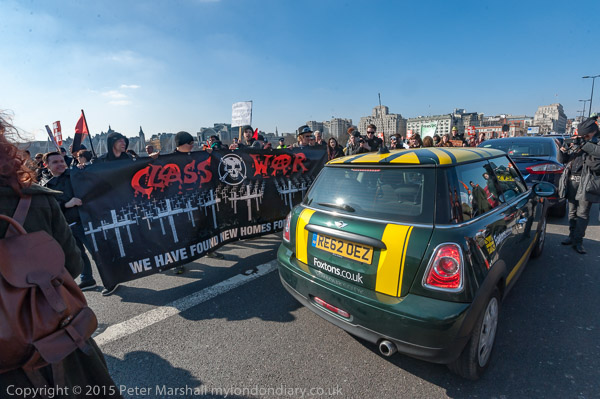
And hard too not to rant about housing as you can see. Unless that is you are ignorant about what is happening or too busy stuffing the loot into your offshore bank accounts. It’s an area which is class war at its most naked – and where the poor have been losing badly. And one which Class War, who appear in rather a lot of my pictures, have been one of the more active groups in protesting about and bringing on to the public agenda.

Kill the Housing & Planning Bill
Continue reading Housing problems

Magnum Busy

Magnum appear to be having some kind of pre-Christmas offensive on social media, or at least more of their posts are coming to my attention on Facebook, which  through its totally mysterious algorithms which determine which posts we each see – and more unfortunately which we don’t.

FB is actually becoming more than mysterious on my computer, it also manages to crash Firefox after a few minutes or seconds whenever I access my news feed, though on the pages feed or the groups I read it seems normally stable, and I have no problems with other sites. So far I’ve had advice to clear the Firefox cache, get rid of all FB cookies and change my password, none of which have made FB behave any better.

Those of you who live or visit London may like to make your way to the The Magnum Print Room at 63 Gee Street, London, EC1V 3RS where there is an exhibition of work from the collaborative project ‘Children’s World’, alongside images from David ‘Chim’ Seymour’s series ‘Children of Europe’ continuing until 27 January 2017. Its usually open 11:00 – 16:30, Wednesday – Friday, and if I finish work early enough and am not far away I might well drop in.

Chim’s work was commissioned by UNICEF, the United Nations International Children’s Emergency Fund which had just been set up at a time of Europe’s largest refugee crisis in the years following the end of WWII. In 1947-8 he “documented their efforts to provide basic needs – food, shoes and vaccinations – to the children of Europe. His journey took him to refugee camps, schools, hospitals, residential homes, remote villages and cities, now reduced to rubble by bombing, where he recorded the impact of war and its aftermath on children.”

This work had particular resonance now, where again so many children are suffering, refugees from the war in Syria and elsewhere; as the Magnum page says, “Chim’s sympathetic and compassionate portraits led a friend to note that war was an enormous crime against children“, and it clearly still is. And our own government’s response has been so hardhearted and minimal, despite the wishes of the great majority of us.

‘Children’s World’ came from happier times and the age and thinking that inspired Steichen’s great ‘Family of Man‘ exhibition in 1955. The previous year Magnum had sent its photographers,  Inge Morath, Henri Cartier-Bresson, David Seymour and Elliott Erwitt and others, to  photograph children in Uganda, Lapland, France, Cuba, Italy, England, Holland and the USA, and  other locations for a series that was published in Holiday magazine in three parts throughout 1955 and 1956.

Another FB post led me to the article A Surreal Friendship; How Man Ray, Marcel Duchamp and Henri Cartier-Bresson riffed on each other’s practices ,which was a great disappointment, failing to deliver what the title promised. You get a few facts about the relationship between Man Ray and Duchamp, with 3 photographs from 1968 of the two men by
Cartier-Bresson, and another of a urinal in Duchamp’s studio, but nothing of substance about the relationship between him and the others or how it affected his work. The subject would have made an interesting article, but that remains to be written.

On a far more positive note is the publication of Europa, An Illustrated Introduction to Europe for Migrants and Refugees which is being distributed free to new arrivals. Written in four languages – Arabic, Farsi, English, and French and “created by a group of Magnum photographers and journalists who have been covering both the refugee crisis in Europe and the many contexts across the Middle East, Asia, and Africa that gave rise to these migrations” it is “intended for practical use by migrants and refugees, and as an educational tool to inform, engage, and facilitate community exchange.” You can download a free PDF of the book and organisations working with refugees can ask for free hard copies.

The idea came from Magnum photographer Thomas Dworzak and the Magnum Foundation provided initial funding for Europa which has been “produced in partnership with the Arab Fund for Arts and Culture (AFAC) in the framework of the Arab European Creative Platform, Magnum Photos, Al-liquindoi, and On The Move, with support from Magnum Foundation, the Geneviève McMillan–Reba Stewart Foundation, MDIC, the Protection System for Asylum Seekers and Refugees (SPRAR), and the United Nations High Commissioner for Refugees (UNHCR). In cooperation with Allianz Cultural Foundation.

Finally from Magnum (at least today) is the first in a “new Photography Insiders series” , an interview with Alexia Singh who was a guest speaker at a recent workshop ‘The A-Z of Editorial Photography’ in London and is a content director and photo editor with 20 years experience in news and media.

Shut Down Yarls Wood

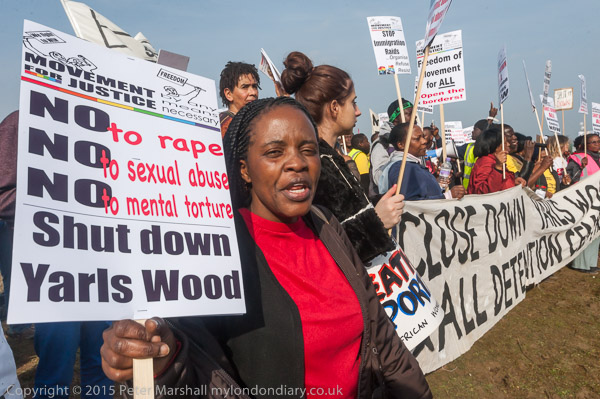
Yarl’s Wood is a small area of woodland close to the immigration prison at the back of Twinwoods Business Park which tooks its name. RAF Twinwood Farm opened in 1941 with aircraft taking off from a grass field, bu soon had three concrete runways, and was largely a base for RAF and later USAF night fighters when in 1944 it was taken over by the US Eighth Air Force to run in conjunction with RAF Thurleigh a mile or two to the north from which their Boeing B-17 Flying Fortresses were taking off to bomb France, Belgium and Germany.

After the war it, together with Thurleigh became the highly secretive Royal Aircraft Establishment (RAE Bedford) site, with Twinwoods housing giant wind tunnels. It was probably this use that stopped plans to make the area into a replacement for London Heathrow; in many ways its an ideal site, fairly empty countryside fairly close to the main London-Sheffield rail line and easily linked to both M1 and M11. After the site was decommisioned in the 1990s it became Twinwoods Business Park, with the vertical wind-tunnel now offering indoor skydiving and some of the buildings housing an occasionally open Glen Miller museum. Red Bull Racing also have a building there.

Twinwood’s major claim to fame is that it was from here that Glen Miller and his orchestra took off on its final flight in December 1944 (hence the museum).

Its major claim to infamy is the Yarl’s Wood Immigration Detention Centre, built at its southeast corner (there is a rather good view of it on Flikr from the top of the vertical wind tunnel – the protests take place in the field immediately to the left of the buildings, and Yarls Wood is the wooded area to the right.)

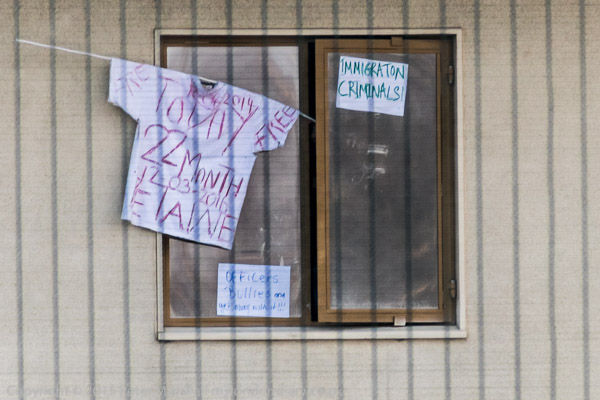
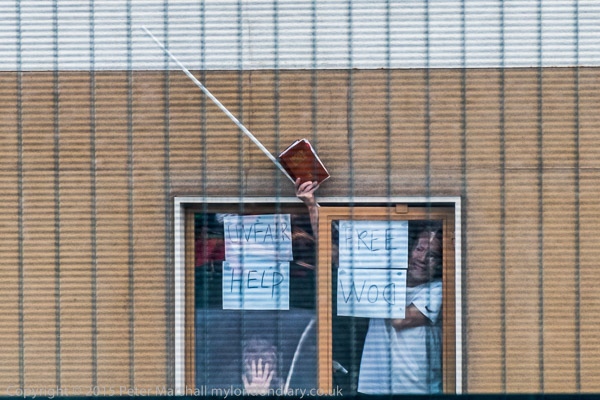
An official inspection in April 2015 concluded that Yarl’s Wood was “rightly a place of national concern” and this January the Shaw report  exposed the extreme vulnerability of many of those detained including victims of sexual assault and gendered violence, pregnant women, victims of torture, the elderly, disabled and those with mental health difficulties. Again in 2015 Channel 4 news  showed a series of undercover reports exposing the levels of abuse and racism in Yarl’s Wood and Harmondsworth detention centres.

It is totally shameful how this country treats asylum seekers, many who come here traumatised after threats, beatings and rape in their own countries to find a system that doesn’t believe their stories, locks them up for indefinite periods and threatens to return them to the hell they escaped.In 2015 the Parliamentary Inquiry into Immigration Detention report called for a 28-day time limit and judicial oversight of the use of immigration detention; one woman has now been held they for well over two years and many are held for six months or more.

We should have a fair and humane system for receiving and resettling refugees, not a process that is driven by the anti-immigrant ravings of a right-wing press to which both Tory and Lbaour have long kowtowed, outdoing each other in their attempts to appear tough on immigration.

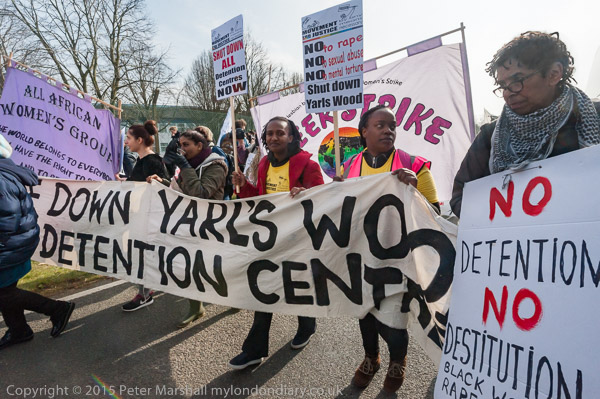
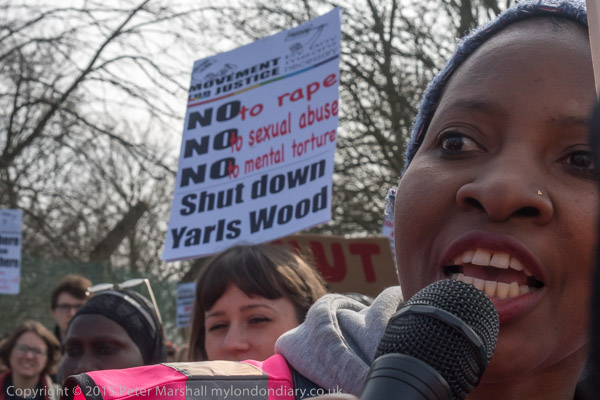
I’ve written on My London Diary about some of the things that happened on the day, and many times about the iniquities of our immigration detention system.  This cerrtainly wasn’t the first time I’ve been there and unfortunately as it remains open it won’t be the last.  I’ll be there again with Movement for Justice this Saturday. And will keep going back with them until it is closed down.

Shut Down Yarl’s Wood

Continue reading Shut Down Yarls Wood

Danny Lyon – Burn Zone

I was annoyed to realise yesterday that I’d forgotten to go and see the Danny Lyon show which closed a few days ago in London. I’d had it marked down in my list of things to do, but there were just so many other things. Not that I would have seen anything new to me in the show –  the pictures in the  BJP feature are all familiar. But it’s always good to see real prints on a wall, even though I think much photography works better in books.

Lyon in yesterday’s The Guardian article Danny Lyon on why he’s naming and shaming ‘climate criminals’ by Alex Rayner mentions the London show, and the comment by Lyon, ‘”There is a show now of my work in a London gallery,” he says. “I have nothing to do with it and no interest in publicizing it“‘, and the article also has a link to a gallery of his pictures from his major retrospective when launched at the Whitney Museum.

But the article is about Lyon’s latest book, Burn Zone, and you can download a PDF of this free from his Bleak Beauty blog. You can also order and pay for a print version.

The book, Lyon’s newest published work, is described as “a Cri de Coeur directed at the artist community and our youth asking them to join the fight to save planet Earth” and as well as a text about Lyon’s return to New Mexico after 30 years illustrated by his black and white photos, it also includes a state-by-state list of 50 leading US climate criminals prepared by climate activist Josephine Ferorelli at Lyon’s request for “a list of the worst of the worst, a climate j’accuse” with descriptions of their role and contact details, all from publicly available sources.

In the book Ferorelli says:

The people who profit from the sale of fossil fuels have played a really cunning game, and we have lost more than 20 years of possibility as a result. As we approach dangerous environmental tipping points, a phrase my friend Eiren Caffall wrote in a song comes to mind: “the wickedness of wasted time.”
The alliance of corporate executives, their legal teams and the politicians they finance has pushed the line so far back from progress that liberals now congratulate themselves simply for
acknowledging the existence of this threat to our lives.

Some of those named in the list are well-known, at least to climate activists here, such as the Koch Brothers about which Ferorelli comments “Almost mythic in their climate obstructionism, the Kochs are involved in just about every aspect of every fossil fuel, as well as beef, fertilizer, lumber, disposable dishes, and other environmental-nightmare products, through their many-faceted multinational corporation.

The book ends with an article by Lyon on “Kill the Koch Brothers” a Thanksgiving play by Ava Lyon, his 10-year-old granddaughter, which ends with a a Google search that reveals that the “the Koch brothers had successfully killed a documentary film that had been
made about them before it could be broadcast on PBS. It said, “Koch Brothers Kill Film.

The PDF comes free and with this comment:

“Bleak Beauty offers the entire contents of Burn Zone free to anyone who wishes to read it, download it, or print it. We want to have the widest possible distribution of this work, and hope you will put it out there, to every person and every website and organization possible.”

So I’ve shared the link here and hope you enjoy and make use of the book and share the work. Perhaps we should have a UK supplement naming and shaming our own climate criminals.

You can see a post on this blog with more about the Koch Brothers,  The Cost of Coal.

Against Benefit Sanctions

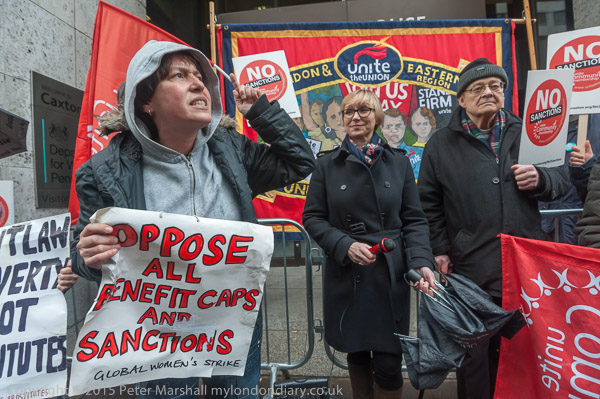
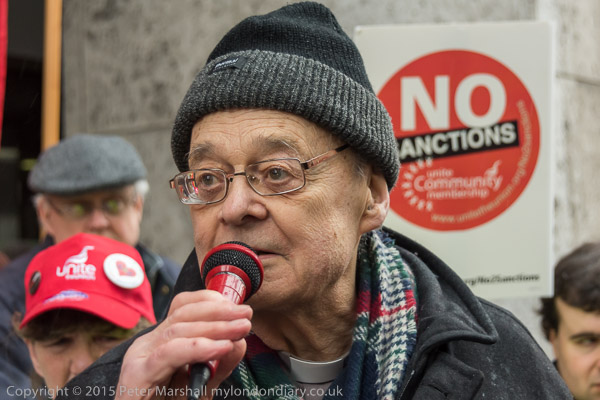
I’m not very good on names. Actually as I’ve written before, I’m not very good on faces either. But the three people in the picture above I can name.  On the left, clearly showing her anger is Didi Rossi of Global Women’s Strike, an organisation I’ve photographed on various protests since the days of film. Didi is clearly angry, and is right to be so, against the government for their ‘class war’ on the disabled and the poor, where their policy of stopping benefits for trivial reasons has resulted in some starving to death.

At the right of the picture is the Anti-poverty campaigner Rev Paul Nicolson, founder of Taxpayers Against Poverty whose fight against the cuts has eventually led to him running up huge debts, mainly to pay excessive High Court costs awarded against him (and rather than bankruptcy to an Individual Voluntary Arrangement  for repayment.) He was formerly the real ‘Vicar of Dibley’ or rather of Turville in Buckinghamshire where the TV series was filmed until his retirement 16 years ago.

And in the centre, standing in front of the London & Eastern Region Unite union banner is Liane Groves, National Organiser  for Unite Community who had organised this protest. The posters and placards make it pretty clear that it was a protest against sanctions. It would have been nicer to have a little more of the wall plate at the left telling us that this was all happening outside Caxton House, the office of the Department of Work & Pensions, and had that banner been a few inches lower we could have read the name Caxton House above it, but I felt that this was a picture that told its story pretty well.

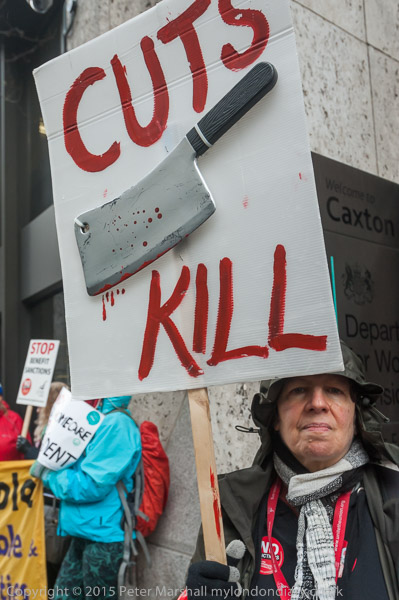
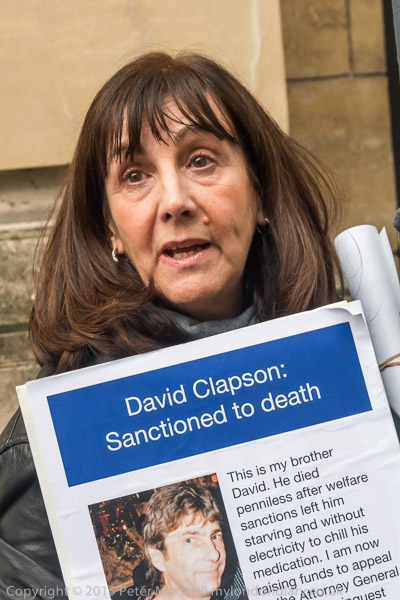
The message was a clear one. Cuts Kill. And also with Unite Community was another protest by Gill Thompson, sister of one of the victims of sanctions. David Clapson was an ex-soldier and a Type 1 diabetic who had left his job to care for his elderly mother and at the time his benefits were stopped was trying hard to find another job. But for missing an appointment at the job-centre (apparently because he had a doctor’s appointment for his diabetes) his benefits were stopped for a month; he had no money to buy food or to recharge his key to keep the electricity necessary to keep his insulin chilled. The result was that he died starving from from diabetic ketoacidosis caused by a lack of insulin.

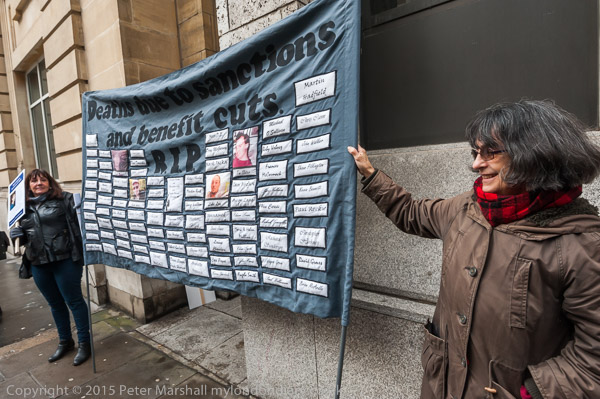
Gill Thompson is fighting to have an inquest which fully examines the cause of her brother’s death, and also against the deaths of others from benefit sanctions, and came with a banner listing the names of many other victims and a petition to hand in to an official from the DWP.

Over 200,000 people have supported her in on-line petitions and this in part led to a Parliamentary Select Committee Inquiry in March 2015, but the government turned down many of its recommendations or ‘accepted them in principle’ – which appears to mean decided to ignore them in practice.
David Clapson – Sanctioned to Death
Unite against Benefit Sanctions

Continue reading Against Benefit Sanctions

With International Women


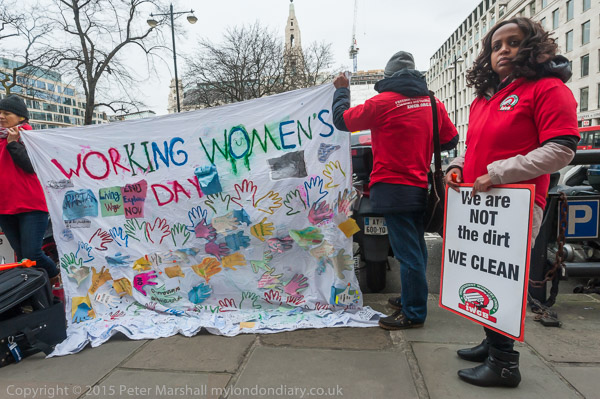
Working Women’s Day banner from the IWGB – and sacked rep Hanna Abebe

March 8th is International Women’s Day, which began in 1909 as a celebration of the previous year’s strike by the International Ladies Garment Worker’s Union, and the day was organised by the Socialist Party of America; the following year it was adopted by the women’s conference of the Socialist Second International and in 1911 it was widely separated across much of Europe, coming to the UK for a suffragette march in 1914. After the revolution it was officially adpoted in the USSR and later celebrated across the communist world, and by the left elsewhere, becoming a more general event worldwide after it was adopted as the UN Day for women’s rights and world peace in 1977.

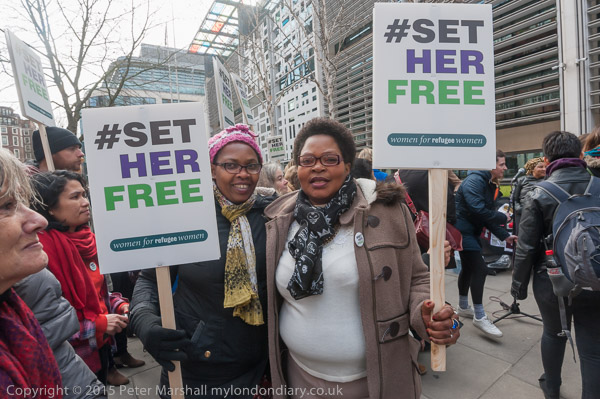
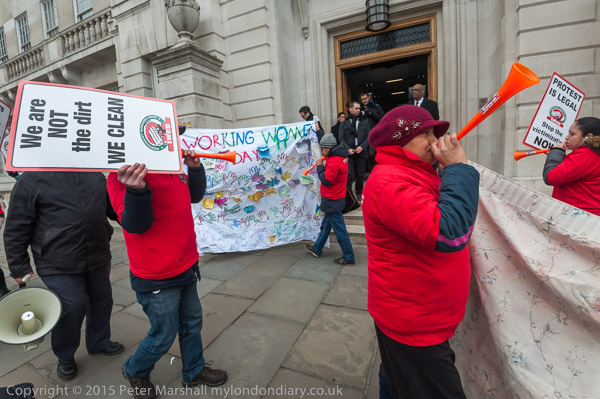
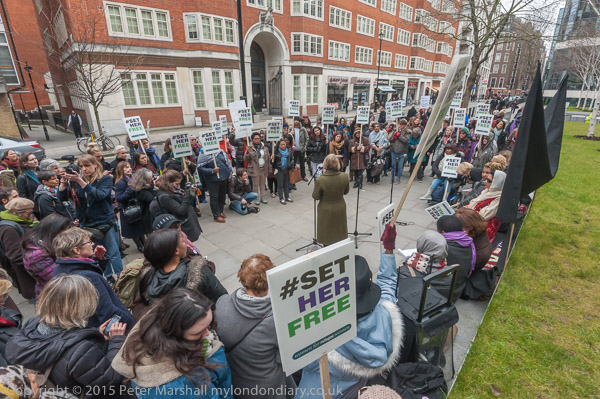
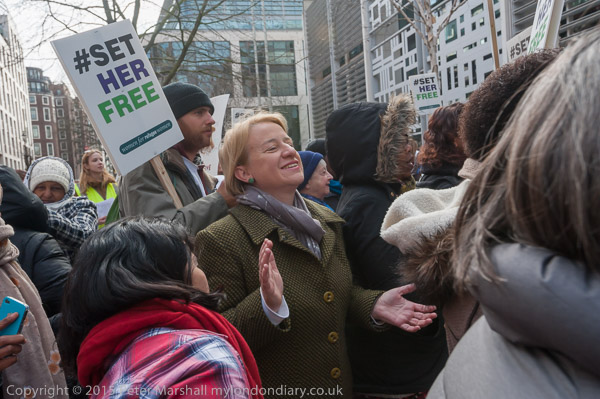
This year I covered two events on International Women’s Day, first a protest by the Independent Workers union IWGB (previously part of the Industrial Workers of the World, or IWW) against the sacking of a woman cleaner at Bloomberg’s Finsbury Square offices, and then at the Home Office by Women for Refugee Women calling for an end to the indefinite detention of asylum seekers, the closure of immigration prisons such as Yarl’s Wood and an end to the detention of pregnant women.

I’ve photographed many actions by the cleaners, both outside and inside various workplaces. One of their posters states ‘We are NOT the dirt WE CLEAN’, and I remain shocked by how they are treated as second-class citizens and paid a pittance while working at the offices of some of the wealthiest companies in the world in the City of London.

Treating employees with decency doesn’t cost a cent – and generally means they will do the job better. Paying them a wage they can live on in London would only make an infinitesimal impression on the huge profits that most of these companies are making. But they still choose to cheat the cleaners and other service staff by awarding contracts on the basis of saving pennies to contracting companies that treat their workers with contempt and pay them as little as they can.

Some companies have agreed – generally after protests by unions such as the IWGB – to pay the London Living Wage, but even then they often find ways to cheat on the agreements – or the contract goes to a new company which tears them up. Many companies are avowedly anti-union and refuse to acknowledge the union that their employees belong to – and our trade union laws bear down heavily on the unions but allow employers to get away with almost everything.  Trade union reps and others who demand their rights are often victimised – as with Hanna at Bloomberg. You can see more pictures and read more about her case at IWGB Women’s Day protest over sacked cleaner.

Highly visible and audible protests such as this one are often the only way to get companies to take responsibility for what is happening and re-instate workers and improve conditions.  The unions support some employment tribunal cases – and usually win them, but these are slow and now expensive. An unfair dismissal claim and hearing for a single worker costs £1200, an amount intended by the government to stop most people making them, and the claims are often opposed by some of the most expensive legal teams money can buy.
Outside the Home Office I felt a little out of place in an almost  entirely female protest by Women for Refugee Women, though there were a number of people who recognised me and clearly made me welcome. Perhaps it was more in my own mind than in any reality, but at times I felt a little as if I was intruding and not entirely welcome. So perhaps my pictures were a little more distant than usual, rather more taken with a telephoto lens than my usual wide-angle. And perhaps I didn’t always feel able to move exactly where I would want to to get the framing as precise as I like.

Aming those at the event – and later speaking – was the then Green Party leader Natalie Bennett (and behind her you can see one of the few others at the event with a beard.)

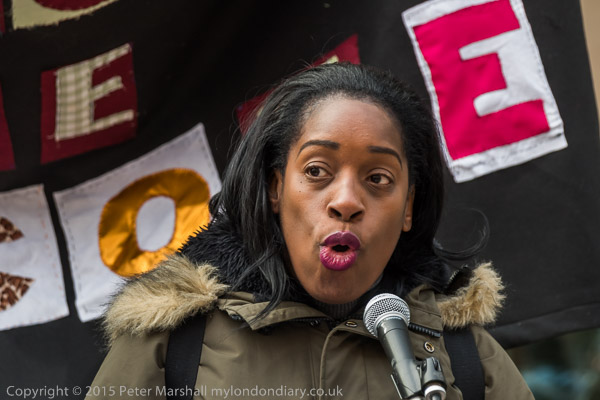
I stayed at the event for around 40 minutes, photographing a number of speakers including two Labour MPs, Stella Creasy and Kate Osamor (above) and then Natalie Bennett. It was sceheduled to go on for another couple of hours, but I was getting cold and felt I’d had enough.  Directly opposite where the protest was taking place is a bus stop for a bus which takes me to Vauxhall for my train home, and when I saw an 88 coming down the street I decided to become a “man on the Clapham Omnibus”. That legal hypothetical legal personage dates back to Victorian times, probably first used in court in 1871 – when that bus would have been horse-drawn, but the 88 still follows  for part of its journeys) the same route, though now longer to Knightsbridge but to Camden from its southern terminus now called ‘Omnibus Clapham’. But probably it should no longer be the ‘man’ but the ‘person’ riding it.

Set Her Free – International Women’s Day
Continue reading With International Women

Berta Cáceres vigil

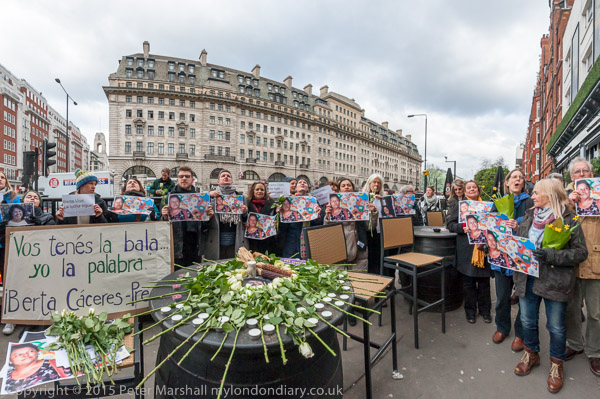
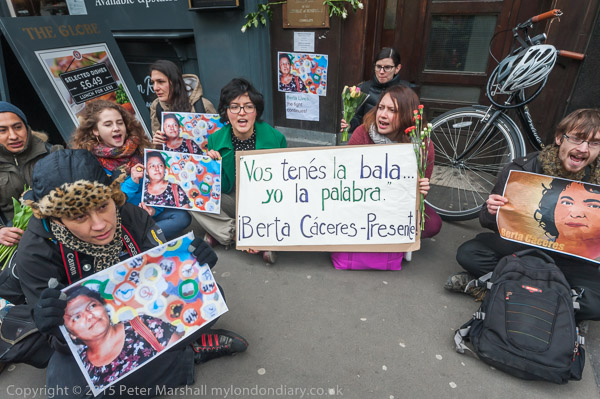
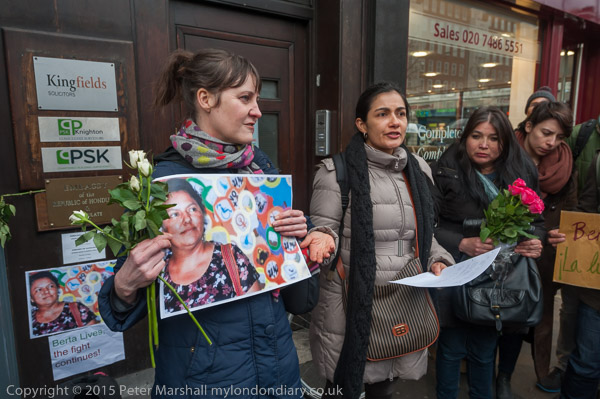
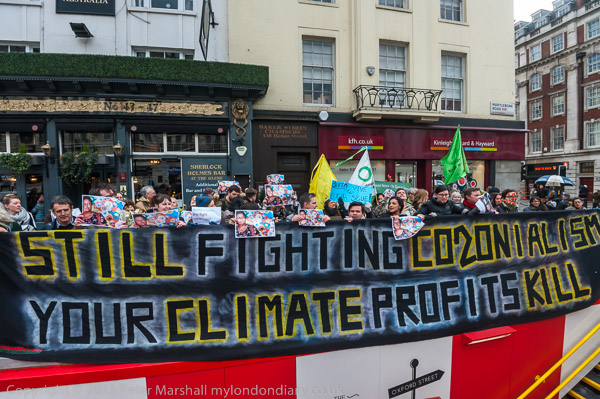
The vigil in remembrance of environmental activist Berta Cáceres, leader of the Civic Council of Popular and Indigenous Organisations of Honduras was a reminder that we are fortunate to live in a country where, at least if you are not a weapons expert with nuclear secrets or a Russian defector, the rule of law usually applies. And while our secretive services may well have been involved in a number of assassinations abroad (including that of Patrice Lumumba, prime minister of the Democratic Republic of the Congo and failed attempts to assassinate Gadafi and Sukarno) as well as some decidly dodgy activities in Northern Ireland that led to the deaths of lawyer Rosemary Nelson and Airey Neave, here things are rather safer.

Of course some protesters here have been subjected to lengthy harassment by police, our legal system and some rather more shadowy figures, and a few years ago we had the entirely ridiculous spectacle of Parliament passing a law aimed (unsuccessfully) at getting rid of Brian Haw who was embarassing them by squatting on the pavement opposite. And police fairly routinely provoke protesters by the use of un-called for force and carry out adminstrative punishment by arresting protesters and either releasing them without charge in the early hours of the following morning or – with the collusion of the CPS – making charges which they know have no basis and are only dropped shortly before they come to  trial.

In Honduras things are rather different and activists who put their heads up are at great risk of their lives. Berta Cáceres is only one of a number who have been assassinated, either by forces of the state or by groups encouraged by the state. Before her murder she had  death threats from the Honduran National Police and judicial harassment.

It was quite a difficult event to photograph because of the location, crowded into a relatively narrow pavement between the hard to find door of the embassy and the railings around a subway entrance. I arrived early, and eventually managed to find the embassy door, and was able to show it to the protesters who had been looking for it in Baker St around the corner.

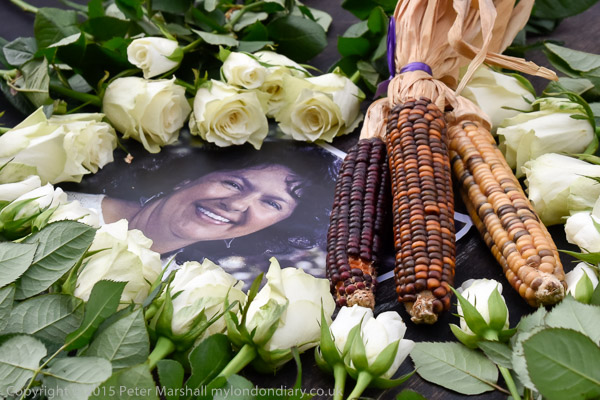
It was difficult for the protesters too, but fortunately the weather was cold and windy which meant that there was nobdoy using the tables and fixed chairs outside the neighbouring pub on which they set up a ring of white flowers and heads of maize around the picture of the murdered activist.

It was hard to avoid rather graphic images advertising the pub food when photographing the protesters with their pictures and posters, and you can see one in the picture above. I’m sure that Reuters wouldn’t approve, but I have darkened and desaturated it slightly to make it less obtrusive.

Usually I’d try to include some sign of the embassy in my pictures of any protest at an embassy, and here you can just see it, behind the white roses at the left of the picture.  There was another clue to its presence in a Honduran flag on the office on one of the upper floors, but it was too high to sensibly include in any image.

A few of the images were made across from the other side of those subway steps, and a few with me clinging to the railings on the small ledge with a large drop behind me down into the stairway. It wasn’t a situation I felt at all happy in, and I soon moved back to safer ground.

As always in confined spaces the Nikon 16mm fisheye came in useful – with the top picture in this post and two others in Vigil for murdered Berta Cáceres on My London Diary making use of its wide angle of view. As usual I ‘defished’ the images to make the verticals into straight lines and held the camera as close to level as possible to keep them vertical.

Continue reading Berta Cáceres vigil