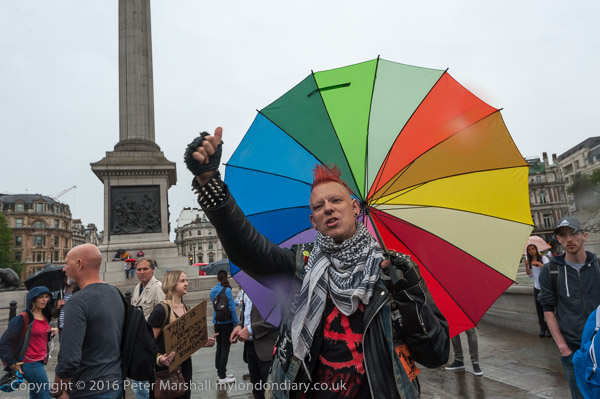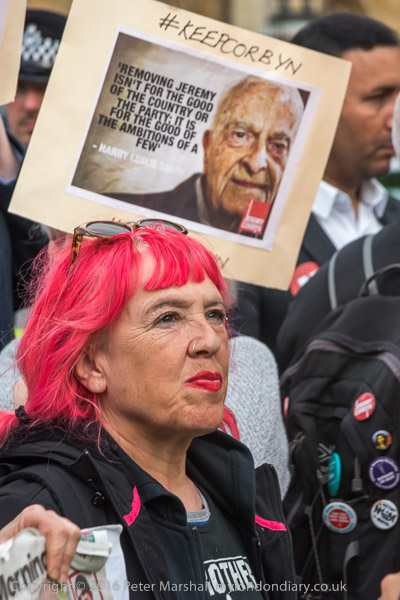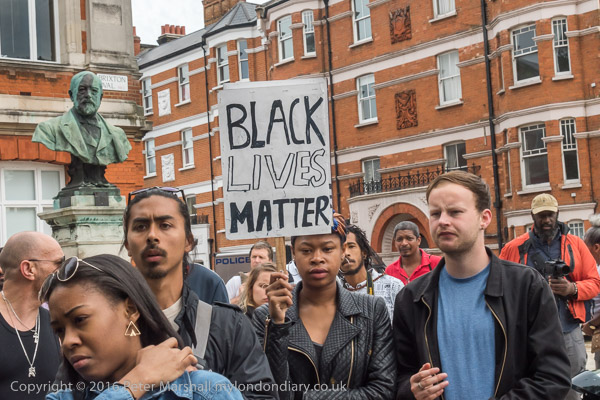
Black Lives Matter

Sir Henry Tate, looking down on a part of the crowd in Windrush Square, Brixton was a sugar manufacturer who made a fortune out of refining and selling cane sugar here in the UK. Although his business had no connection with the slave trade, which had ended in the British colonies around 1840, a few years after the 1833 Slavery Abolition Act and Tate only began in the sugar business in 1859, his was clearly a colonial business, making its profits from the sugar grown by freed slaves and their descendants in the colonies, notably Barbados.

Tate was a great philanthropist, giving generously to colleges and hospitals and endowing south London with four free libraries, at Streatham, Balham, South Lambeth, and Brixton and treated his own employees well, building a dance hall and bar for them opposite the Silvertown factory. And of course in 1897 he gave his art collection to the nation, paying most of the cost for a gallery to house on Millbank – which has officially borne his name since 1932.
Although the sugar he made the profits on came from workers in the Empire, I’m not aware that any of Tate’s philanthropy extended to them, but he did provide the library outside which the protest I was photographing took place, and the gardens, now known as Windrush Square in which we were standing were given to the public by Tate’s wife after his death, in keeping with his wishes.

Many of those who came from the Caribbean to Britain in the post-war period, starting with those on board the Empire Windrush in 1948, found work in and around Brixton after the first arrivals were housed temporarily in the no longer needed deep shelter on Clapham Common. And for some, that Tate Library was their university and the gardens outside a popular meeting place. It was renamed Windrush Square as a part of the 50th anniversary of the arrival of the ship, but a few years later was the subject of a savage makeover by Lambeth Council (whose offices are opposite) designed largely with the objective of making it an unpleasant and windswept place to discourage any gatherings there.
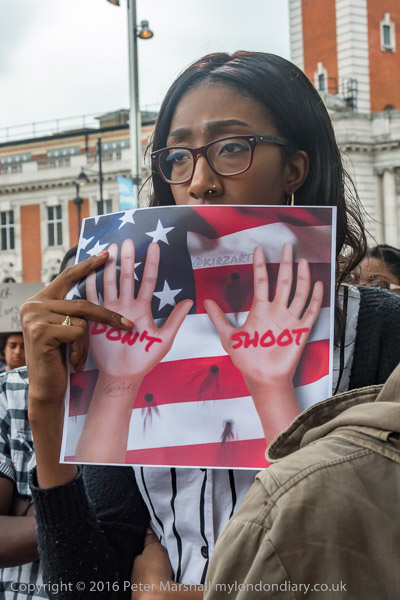
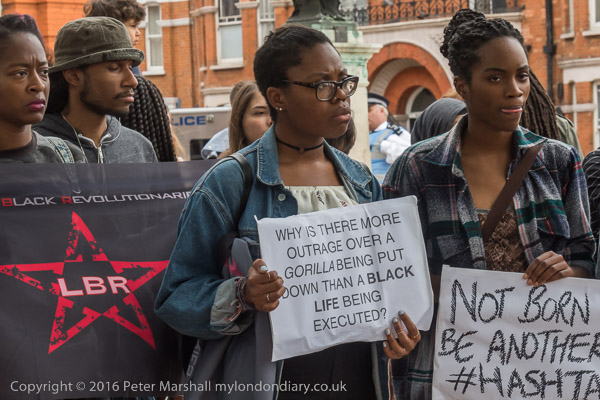
Despite this it remains a centre for the community, and several hundred gathered there for a rally and march in Memory of Alton Sterling, shot several times at close range while held on the ground by two white police in Baton Rouge, and Philando Castile, killed by a Mexican-American police officer in St Paul, Minnesota, two of the latest black victims of police violence, and to show solidarity with those murdered by police brutality, both in the US and here in the UK.
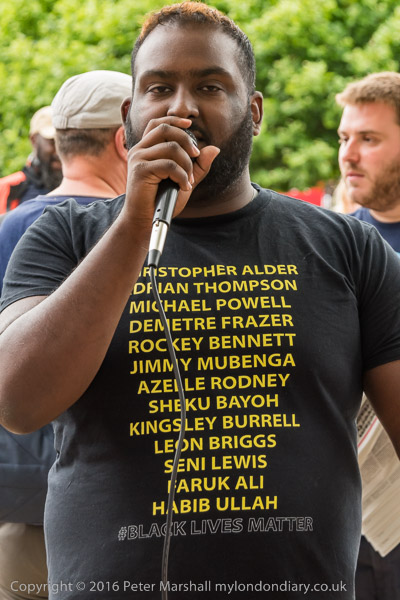
Police, here and in the USA, don’t just kill black people, but the victims of police killings are certainly disproportionately black, and Brixton has history of such events, including the deaths of Ricky Bishop, Sean Rigg and Olaseni Lewis. The situation is clearly even worse in the USA than here largely because all police carry guns, but at the annual commemoration of the lives of those killed in custody in London a list of several thousand who have died in suspicious circumstances is carried at the front of the procession down Whitehall.

One poster in particular – I think from a US source – had a message worth quoting in full:

“Yes, ALL Lives Matter. But we’re focused on the Black Ones right now OK? – Because it is very apparent that our judicial system doesn’t know that. Plus if you can see why we’re exclaiming #BLACKLIVESMATTER you are part of the problem.”
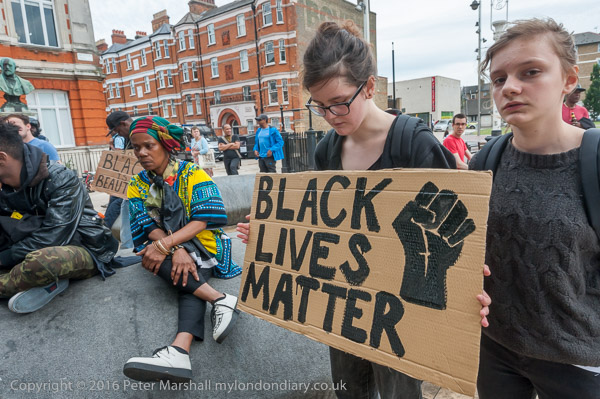
Speaker after speaker, all I think black, though there were a significant number of white supporters in the crowd – mainly at the back, wanted to have their say, and the rally went on much longer than had been planned.  So long that I was unable to stay for the march, which later I was told went to Brixton Police Station, where several young black men have died over the years in suspicious circumstances, blocking the road and bringing traffic on the busy road through Brixton to a stop for several hours.
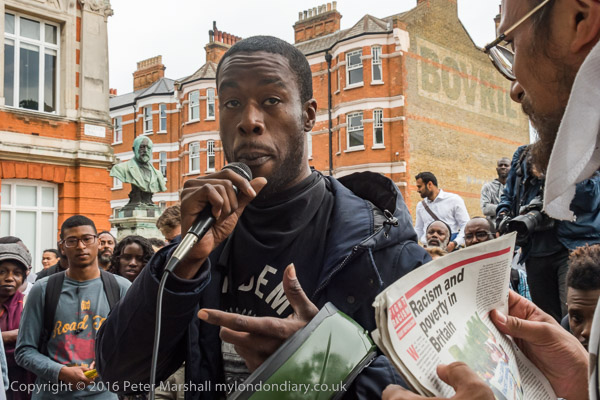

Brixton stands with Black victims
Continue reading Black Lives Matter
More Brexit

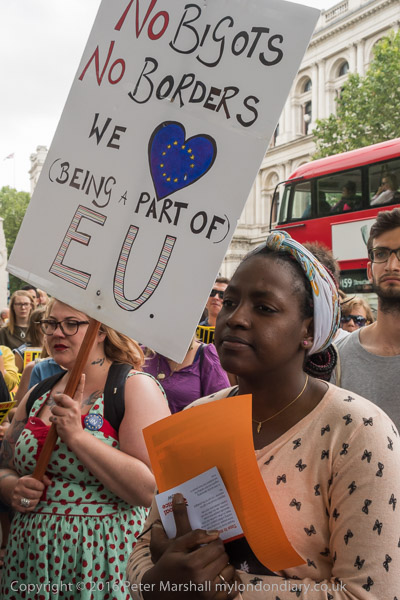
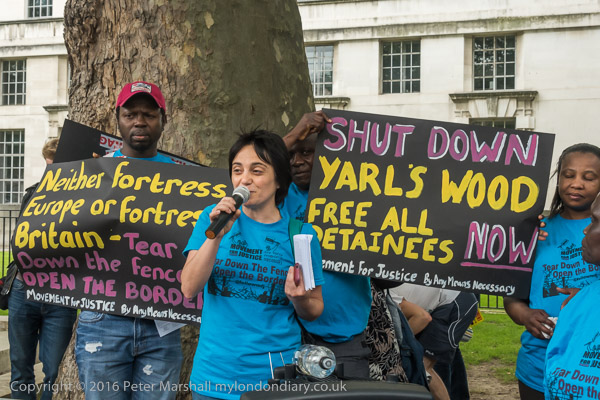
It remains difficult to see anything positive coming out of our vote to leave Europe, and it seems to have brought out a number of the worst sides of parts of the British public, with an increase in racist attacks and bullying. Another Europe is Possible hosted a rally opposite Downing St against this climate of fear and hatred after the Brexit vote, calling for an end to scapegoating of migrants and Islamophobia.

Its long seemed irrational to me to allow the free movement of capital but to restrict the movement of people; if the market is a good enough mechanism for one it should be for all, though perhaps we might be better with a certain amount of planning and intervention in both. But certainly we don’t need the kind of draconian measures that the UK currently takes against migrants in general and refugees and asylum seekers in particular. The contribution that migration has made both economically, in maintaining essential services and in broadening our culture during my lifetime has been enormous and a genuinely free press would welcome and praise it – and politicians would then not be able to stir up the kind or racist and xenophobic responses that were behind many of the votes to leave Europe.
I arrived as Anna from Movement for Justice was speaking about the terrible injustice and maltreatment of asylum seekers in our detention prisons such as Yarls Wood, and photographed her framed by MfJ posters; a still image doesn’t tell us what anyone was saying, but the posters make MfJ’s arguments clear.

Of course we can’t ignore the Brexit vote, close though it was, but it is still worth fighting for the kind of Brexit it is going to be, keeping up the pressure on Theresa May (and her possible successors) not to throw out the baby with the bathwater as they currently seem determined to do.
Another of the speakers as Syrian activist Muzna Al-Naib, urging the UK to take action over the atrocities of the Assad regime and to offer real support to the Syrian people and to offer refuge to more than the small handful of Syrian refugees that have already managed to come to the UK –  largely despite the efforts of our government.  Her’s was a message that called for love and for unity of peoples and again a banner on the barrier she was speaking behind seemed appropriate.
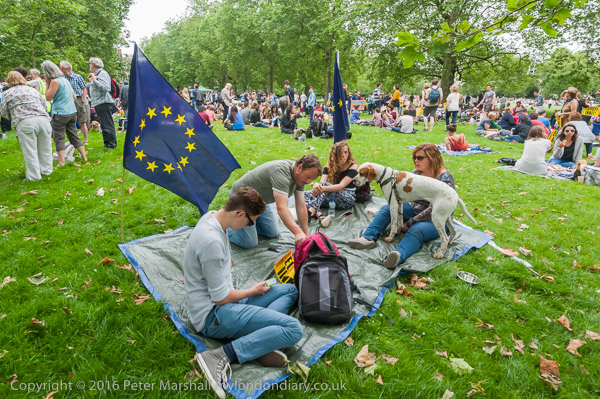
The Europe, Free Movement and Migrants protest ended with many of those present leaving to go to the Green Park Brexit Picnic,  and while many marched there, I took the tube. The picnic had been advertised as an opportunity for people to come together and debate the future under Brexit, though the great majority of those attending were obviously still feeling upset and cheated over the result of the vote obtained by an essentially dishonest campaign.

Those at the picnic were splitting up in to small groups to debate various aspects of the future as I arrived , some very small like that above, which seemed to me to be seceding into a small island of Europe in the sea of grass, and others considerably larger, circles with perhaps 20 or 30 or 40 people, and they were getting down to some sensible, organised and at times fairly heated discussions.

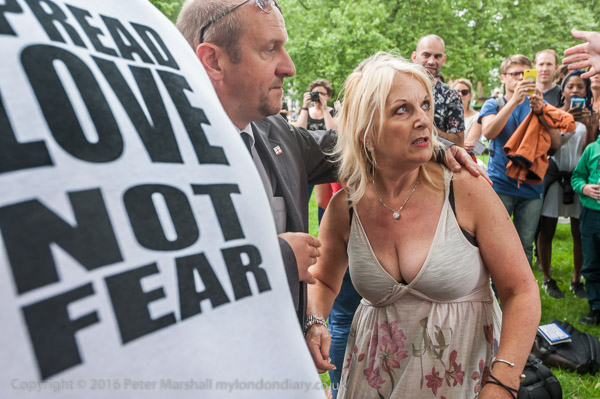
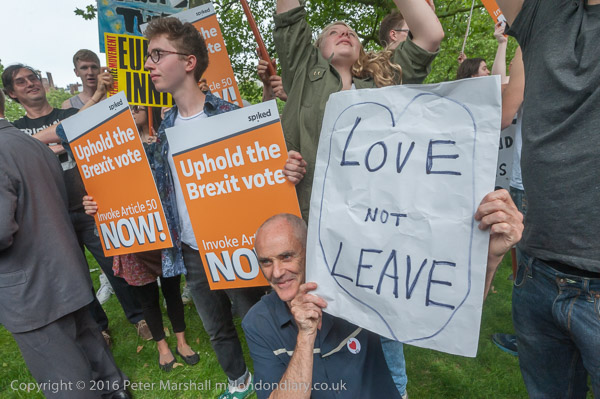
One group stood out, Brexit supporters who had come to counter the protest with their own ‘picnic for democracy’ organised by Spiked magazine calling for ‘Article 50’ to be invoked ‘NOW!’ They stood out in several ways, not least the number of empty cans and wine bottles and it was clearly in that respect a rather better party than the rest. I started to photograph them and got sworn at and threatened by one or two people who recognised me from right-wing protests I had photographed, but then they found a new outlet for aggression as the march from Downing St arrived with posters against Brexit and were joined by people wearing t-shirts with the message ‘Spread Love Not Fear’ and calling for ‘Hugs for Immigrants’ rather than hate.

There was some angry name-calling and posturing, but people from both groups came across and tried to calm things down, and stopped what had seemed an inevitable fight from developing.  The shouting had attracted the TV crews covering the event, and there was then a little largely good-natured jostling to get greater coverage from the cameras.

Having taken my pictures, I moved a few yards away and sat down to eat my own rather late sandwich lunch, after which as things seemed to have calmed down I decided to leave to cover another event.

Continue reading More Brexit

Garden Bridge & Progress

Unless you are a Labour Party member, you probably haven’t heard of Progress. It describes itself as an independent organisation of Labour party members which “aims to promote a radical and progressive politics”. It’s essentially a ‘New Labour‘ pressure group within the party, though it has tried to hide its Blairite identity in recent years by calling itself ‘Labour’s new mainstream‘, something which fools few.


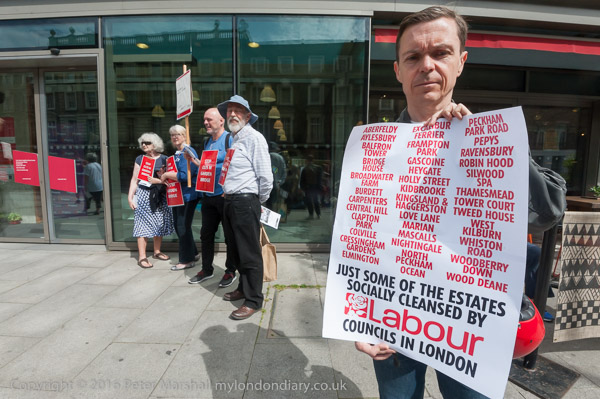
A protester holds up a list of Council Estates that Labour councils are socially cleansing

Though its right-wing views are at odds with the huge majority of the party membership, thanks to considerable funding largely by Lord Sainsbury, and some deft political maneuvering – its supporters are largely careerist politicians – it exercises considerable control over the party machinery, which has so far enabled it to resist efforts to get it proscribed, despite clearly being a party within the party, and it has managed to get many of its members selected as Parliamentary candidates, often to the considerable rage of local party members. So far unsuccessful in its attempts to get rid of Jeremy Corbyn as Labour Leader we are likely to see yet more dirty tricks by Progress MPs and at every party conference.


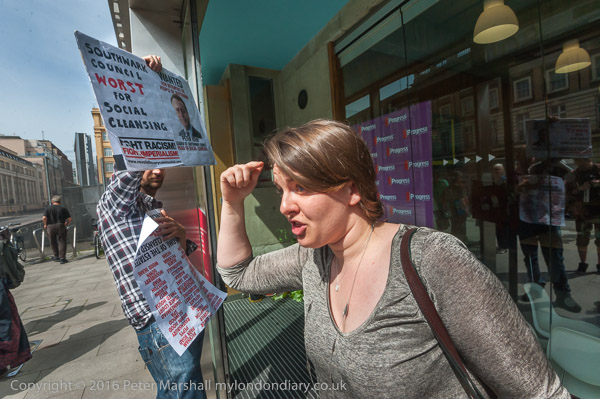
A woman comes out to shout at protesters and lie to them they are disrupting a youth health meeting

Most London Labour councils are dominated by members or supporters of Progress, and are pursuing policies which in areas such as housing which are completely at odds with the traditional values of the party, working with developers to sell of public assets and drive the less well off out of London.


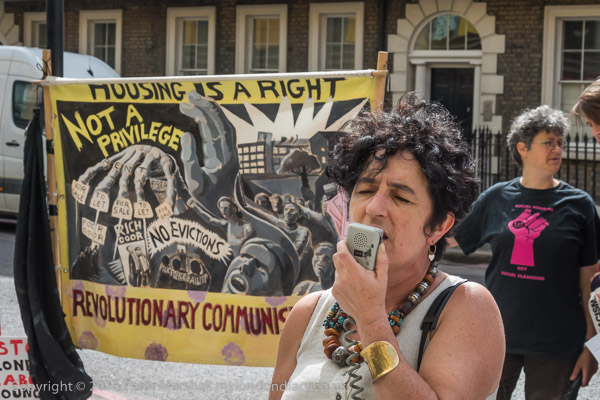
The Revolutionary Communist Group say ‘Housing is a right – Not a privilege’

Though their may be few brown envelopes changing hands, many Labour (or Progress) councilors are ending up with lucrative jobs, getting trips abroad and lavish lunches and dinners for playing their part in the evicting of social housing tenants, the demolition of their estates and their rebuilding as expensive flats, many simply to be sold as investment opportunities for wealthy foreign investors. Some get sold ‘off plan’ before they are built, being sold again before completion, and then perhaps again a few years later, but often never having been lived in – or perhaps visited a week or two a year for a trip to London.

In one not atypical example, 1700 social housing units were replaced by only 70 in the redevelopment, the former tenants and leaseholders being dispersed onto the fringes of London or further afield, many home owners getting only a fraction of the true market value of their properties, and tenants being forced into private renting with little security of tenure and much higher (and rising) rents.

Progress supports these policies, though hiding its intentions behind higher sounding ideals, the actual policies are all about realising asset values. But look at what has happened, for example to the Heygate Estate at the Elephant, what is happening to the Aylesbury Estate to the south, what Lambeth plan for Central Hill and at other estates around London and the pattern is clear.


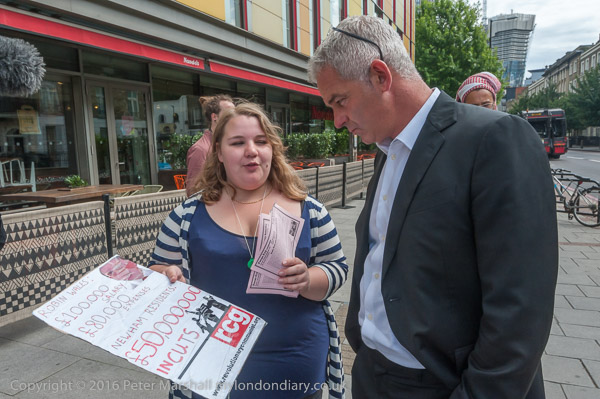
Jasmin Stone of Focus E15 talks with a man attending the meeting

Local councils are having a tough time of it with central government cuts, and are looking at estates like these as a way to solve financial problems rather than with any real concern about the people who currently live on them, or the many thousands on their housing waiting lists.

Their feeling about these people is summed up by one Labour Mayor who told protesters ‘If you can’t afford to live in London you can’t live in London‘ and at market rents relatively few can afford it. We need council housing and other social housing in London at prices that ordinary workers, including those on minimum wage, can afford. And one of the jobs of London’s local councils is to ensure it is provided in London, not indulge in social cleansing.


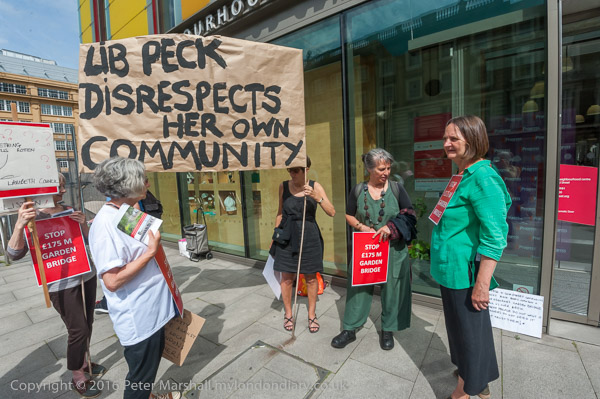
Local residents say Lambeth Council Leader Liz Peck disrespects the views of Lambeth residents

As well as housing protesters, the Momentum conference was also picket by local campaigners against one of London’s craziest plans, the Garden Bridge, a bridge neither necessary nor useful and a huge private project that would require considerable public investment for little public good. Recently there has been a damning report by Dame Margaret Hodge on the financial aspects of the plan, identifying a huge gap in funding which should be its death knell. But the protesters were more concerned that Lambeth Council were backing the scheme, and giving money towards it despite the opposition of Lambeth residents.

Housing Protest at ‘Progress’ conference
Garden Bridge ‘Progress’ protest

Continue reading Garden Bridge & Progress

Whatever happened to Chilcot?

When things go badly wrong in the UK, we get a public inquiry. Usually these are simply ways to shunt the problem into the long grass. Inquests into suspicious deaths are often used in the same way – sometimes taking many years to get to a decision, by which time it is often too late to take any sensible action.

These inquires are often scrupulously conducted and provide a great deal of highly lucrative employment for solicitors, barristers and the whole legal system. Chilcot too 7 years to tell us what we already knew – that Tony Blair had deliberately mislead both Parliament and the nation.

But if your crime is large enough, you can get away with it, at least most of the time. The bankers emerged largely unscathed after their dubious actions cost many billions and are now richer than ever, and Tony Blair has kept out of jail despite his crimes having emerged.

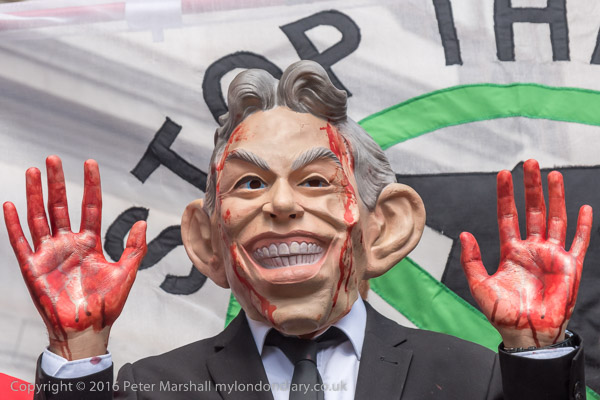
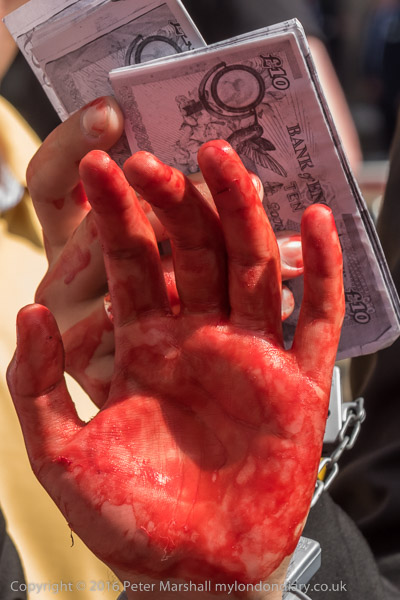
The top picture, with Blair holding up bloodstained hands in front of a ‘Stop the War ‘ banner is perhaps too obvious, and the image immediately above this, with the bloodstained hand of President Bush handing over bundles of Tenners is rather on the crude side – and needs explanation in a caption as to whose hands these are.

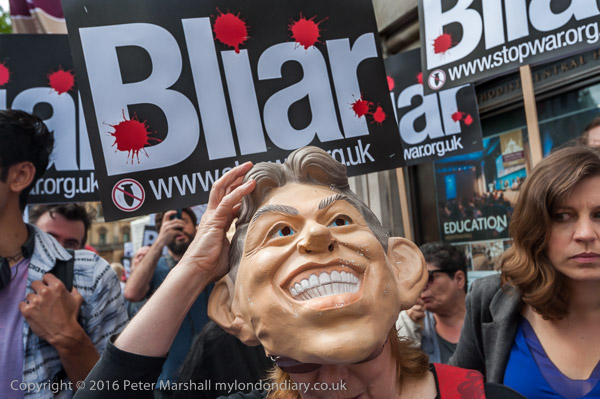
I rather prefer the third Blair image here, which shows him below the posters with the simple text ‘Bliar’ and its bloody bullet holes.

Wikipedia summarises the Chilcot report as saying:

Saddam Hussein did not pose an urgent threat to British interests, that intelligence regarding weapons of mass destruction was presented with unwarranted certainty, that peaceful alternatives to war had not been exhausted, that the United Kingdom and United States had undermined the authority of the United Nations Security Council, that the process of identifying the legal basis was “far from satisfactory”, and that a war in 2003 was unnecessary.

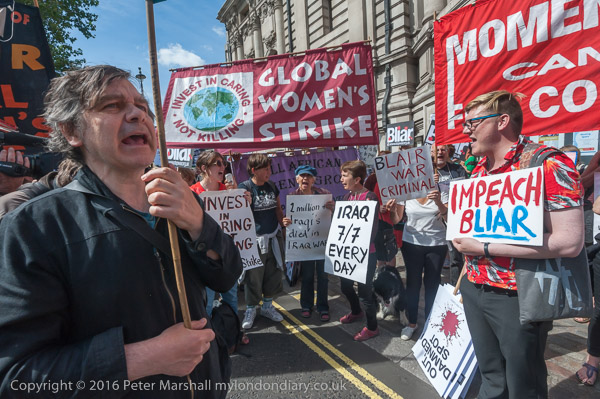
But more interesting still for me are the pictures of protesters – the man shouting at the left of this image, and, at the opposite side a guy in a rather improbable shirt holding the clear message ‘Impeach Bliar’.  Of course it hasn’t happened and is extremely unlikely for political reasons, despite the fact – as the poster held by one of the Global Women’s Strike protesters points out, 2 million Iraqis died as a result of his and Bush’s actions.

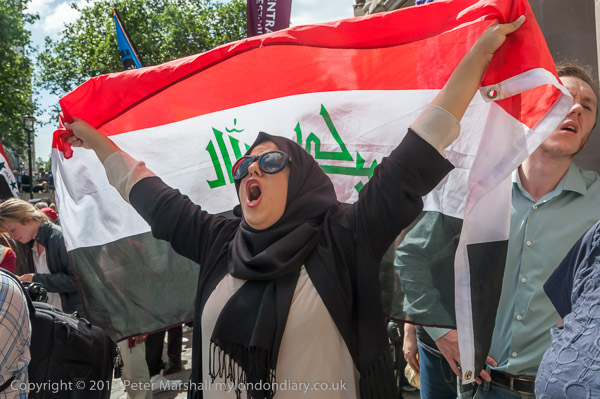
I like too the dynamism of the woman in black headscarf and top holding up the Iraqi flag as she shouts out  “Blair lied , Millions Died”.

You can see more of my pictures from the protest at Blair lied, Millions Died – Chilcot.

Inquiries such as this do sometimes come up with the more or less the right result, but if so, always too little and too late. No action has been taken as a result of Chilcot, which considerably pulled its punches in the way it dealt with many of the issues.

The British public, and Labour voters in particular, had already made up their mind about Blair. We knew he had lied and led the country to take part in a war that was a mistake for our country and a disaster for Iraq. It was a failure that played an important part in Labour’s failure to win the 2010 and still the 2015 elections, and one that only a complete break by the party as a whole from his ‘New Labour’ project can overcome in the foreseeable future.

Continue reading Whatever happened to Chilcot?

NUT on strike

Although I’ve been a photographer since around 1971, it was only in 2000 that I gave up a full-time teaching job to become a full-time photographer and writer, and for the next few years I continued with a little part-time teaching partly in case I didn’t make enough as a freelance, but also because there were parts of the teaching I still enjoyed – and I was able for most of the things that I continued to keep away from those aspects that were beginning to make most teacher’s lives hell.

By then I was running an industry-led computer networking course based on on-line materials that came outside of Ofsted’s remit – as did an evening course I also taught on elementary web design. And that meant I had no need to worry when the college had its Ofsted inspection. Inspectors did come into my lessons – having sought my permission – but only because they wanted to see what the future might look like rather than to inspect.

I’m still a member – a retired member – of the National Uniton of Teachers, as well as an current member of the NUJ (and sometimes get the NUT and NUJ confused in my mind) and so was happy to go along and photograph members of my old union as a member of the new one.

Succesive governments had stuck their messy fingers into education, all driven by a mistrust of teachers and a disdain for expert opinion, and largely sharing a common public perception that teaching is an easy number as teachers only work from 9am to 4pm (if that) and get long holidays.

Of course education needed reform. We needed to get rid of grammar schools – and one of the few things Mrs Thatcher deserves praise for is getting rid of so many, I think more than any other Prime Minister. We need a national curriculum – and got one thanks to Kenneth Baker, though it still needs to be made universal and less prescriptive in detail. We needed better in-service training, but Baker days really didn’t deliver. Inspection needed reform, but not Ken Clarke’s Ofsted, badly thought out and irrepsonisibly implemented. But we certainly didn’t nees Academies or so-called ‘Free Schools’, nor the increasing emphasis on national rather than local authority control of schools.

And many much needed reforms, including the change to middle and upper schools, with reform of 14-18 education and in particular vocational education and the replacement of long outdated A levels were reversed or sidelined, with various rather crackpot ideas replacing them.

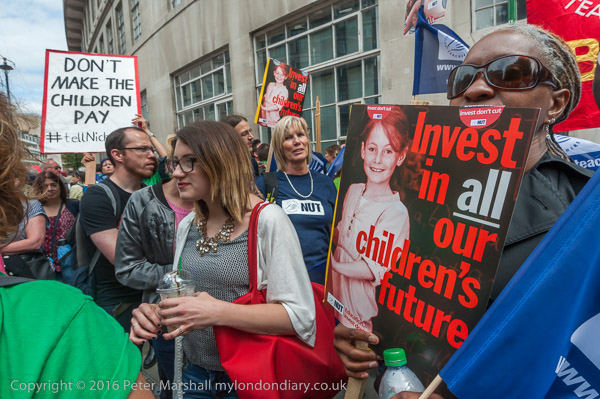
The NUT strike in July was against cuts in government funding and the increasing deregulation of teachers’ pay and conditions through the increasing pressure on schools to become academies – something which has got worse since Theresa May became Prime Minister not long after, though her aggresive plans to bring back Grammar Schools (somewhat ironically a sop to the Thatcherist right) seem to have been rather put on hold at the moment.

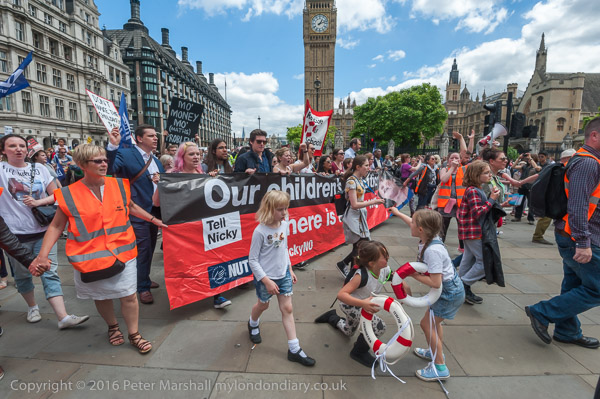
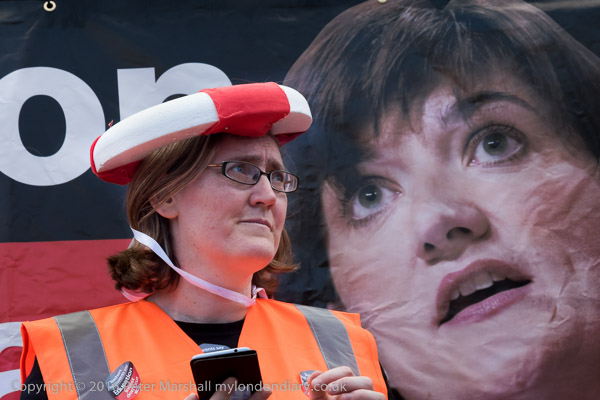
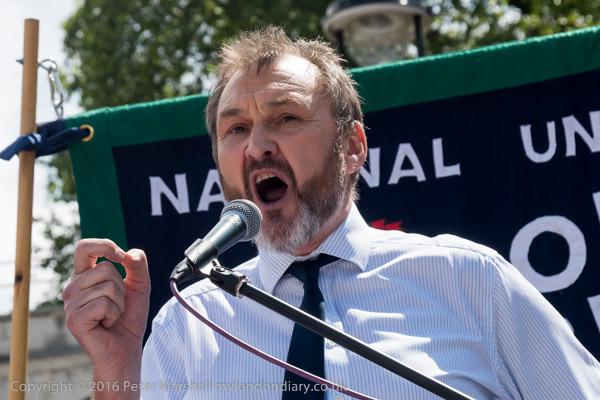
Teachers were supported at the event by parents, and in particular the parent-led ‘Rescue Our Schools’ campaign who brought along their children and life-belts, and one of whose founders spoke at the rally, as wll as one of the leaders of the Junior Doctors campaign aqnd of course the then Acting General Secretary of the National Union of Teachers, Kevin Courtney. I was pleased ehn he was eleceted as General Secreatry, not least as one of my earlier pictures of him was used on his campaign statement.

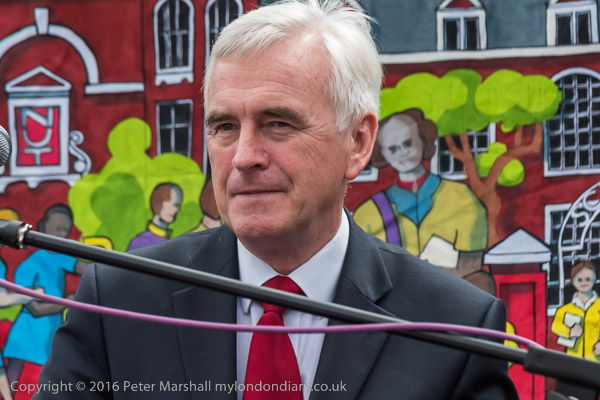
And it was good also to see and photograph Shadow Chancellor John McDonnell, and his speech give me a little hope that Labour might once again get a sensible education policy, though it remains to be seen how Jeremy Corby’s pledge to build a new National Education Service will actually translate into Labour education policy – and to see if Labour MPs can give up their anti-Corbyn plotting and get behind their only hope of returning to power in the foreseeable future. It really is long past time the right and their supporters got beyond saying that Corbyn is unelectable and got behind him trying to provide a proper opposition and to get their leader elected.

NUT Strike Day Rally
NUT Strike Day March

Continue reading NUT on strike

Jerusalem Day

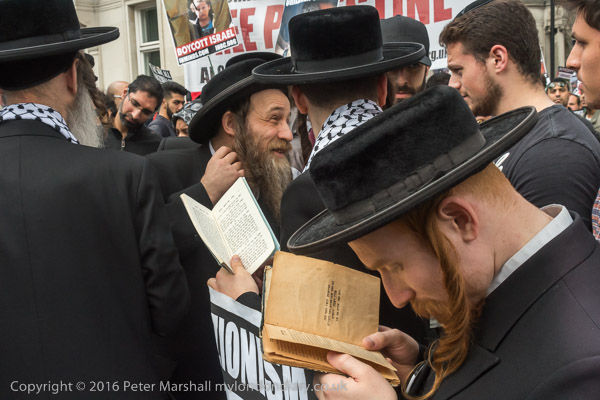
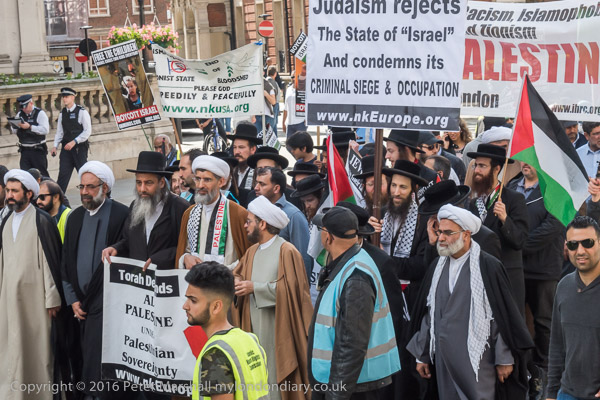
Writing on the day that the news is full of controversy over Ken Livingstone‘s continued suspension from holding office in the Labour Party, this protest and in particular the picture above seem rather appropriate. The Neturei Karta Jews shown in this picture waiting for the start of the Al Quds Day march are staunchly anti-Zionist, believing that ‘Torah demands ALL Palestine under Palestinian Sovereignty‘ and that ‘Judaism rejects the State of “Israel” and condemns its criminal seige & occupation‘.

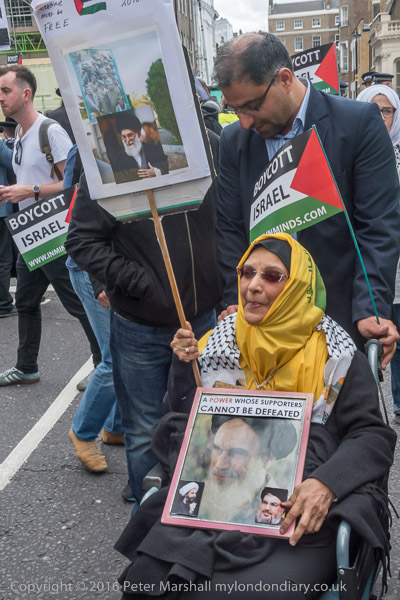
They were marching with Palestinians and their supporters on Al Quds Day, an event began by the Iranian Imam Khomeini in 1979, who stated ‘Al Quds Day is a universal day to support the oppressed against the oppressor’, but its main purpose is to show solidarity with the Palestinians, in particular over the occupation of Jerusalem and to generally oppose Zionism and the Israeli state. Israel has its own Jerusalem Day (Yom Yerushalayim), celebrating their gaining control of the city after the June 1967 Six-Day War.

Back in the 1930s, which Livingstone’s comments concerned, Zionism was not universally popular among Jews, and the British government was against mass migration of Jews to Palestine. In 1917 when they had made the Balfour Declaration calling for “the establishment in Palestine of a national home for the Jewish people” the only Jewish member of cabinet, Edwin Samuel Montagu, had warned strongly against it, calling it “a capitulation to anti-Semitic bigotry” and warning of the dangers.

Livingstone’s comments were clearly based on historical fact. Hitler was never a Zionist, but he wanted the Jews out of Germany, and the Hitler government reacted positively to suggestions from the Zionist Federation of Germany and supported their efforts to encourage Jewish emigration to Palestine from 1933 until it became impossible during the war. There were even Zionist training camps for settlers in Germany, where they were allowed to fly the Jewish national banner – now the familiar Israeli flag, though the Nazis still opposed the idea of a separate Israeli state.

It wasn’t politically astute to have said what he did when he did, but part of Livingstone’s appeal to me has always been a tendency to say what he thinks rather than think politically, and his comments have been manna to those opposed to the Corbyn leadership of the party. As an interview with Lord Levy on the Today programme this morning made plain, this is what is really behind the fuss over Livingstone’s alleged anti-Semitism.

Al Quds day is equally controversial, not least because the main organisation behind it in this country is the Islamic Human Rights Commission, which critics say is funded by Iran and which supports Hezbollah and Islamic extremism, and fails to criticize human rights abuses in Iran and some other Islamic states. My pictures over the years do show some supporters of Hezbollah on the marches, but whenever I’ve heard them, speakers have been clear that they are not anti-Semitic but firmly anti-Zionist, a distinction that their critics seem keen to dismiss.

Although IHRC is an imperfect organisation, it does useful and well-respected work in many areas, while most of those making the accusations are highly prejudiced and unreliable, and many of the details they state clearly fly in the face of facts.

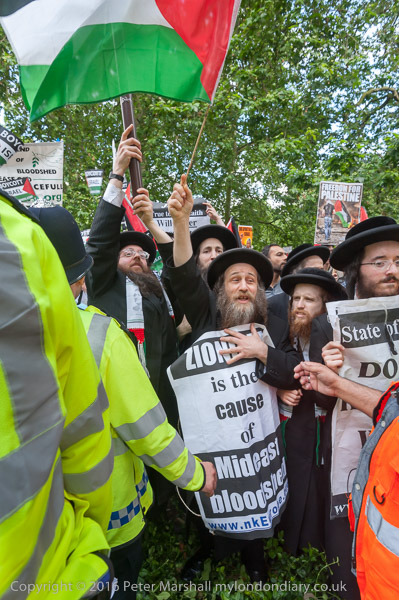
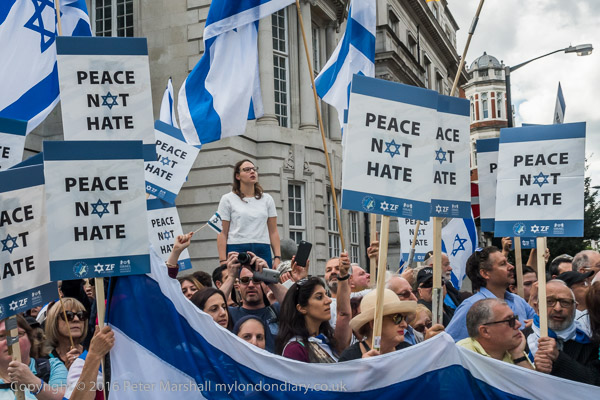
At the end of the march, outside the US embassy in Grosvenor Square, the Al Quds Day marchers were welcomed by a rather smaller but very vocal group waving those Israeli flags, the Sussex Friends of Israel, Zionist Federation and the Israel Advocacy Movement who were holding their ‘It’s Time To Stop The Hate: Stand With Israel‘ rally. While police more or less kept the two groups apart and the bulk of the Al Quds Day marchers moved on to their really in front of the embassy, most of the Neturei Karta climbed on to one of the raised beds opposite the Stand with Israel protest.

The pro-Israeli protesters weren’t too keen to be photographed, but the police who were keeping the two groups separate refused the requests by some of them to prevent photographers working, though I was unable to stay as close as I would have preferred. Although they were all holding placards proclaiming ‘Peace Not Hate‘ there was soon a barrage of what can only be called anti-Semitic insults and pure hatred being screamed over my head towards the Neturei Karta, who responded vigorously in similar fashion.

Al Quds Day March
Supporters Stand Up for Israel

Continue reading Jerusalem Day

Around Brexit

Understandably the vote – by a considerable but narrow majority – to leave the European Union was dominating our minds and events on the street at the start of last July. I suspect I’ve already made my own views on it pretty clear – it was a shocking gamble by a Tory Prime Minister concerned only with his problems inside the party and not with the interests of the country, and was won by cynical politicians – again mainly Tory – making promises they knew there was no possibility of being achievable.

Although we can’t know what the end result will be, things are not looking good, and seem likely to get worse. While exit from the EU seems inevitable now that the process has started, it also seems inevitable that it will lead to a tremendous disillusion among those who voted for it, as they find it won’t lead to more jobs or fewer immigrants, more money for the NHS or any of the other ‘goodies’ dangled before their eyes in the referendum campaign. Given the incredible levels of mistrust of politicians by ordinary people across the whole political spectrum this can’t be healthy, and seems likely to lead to some kind of populist backlash.

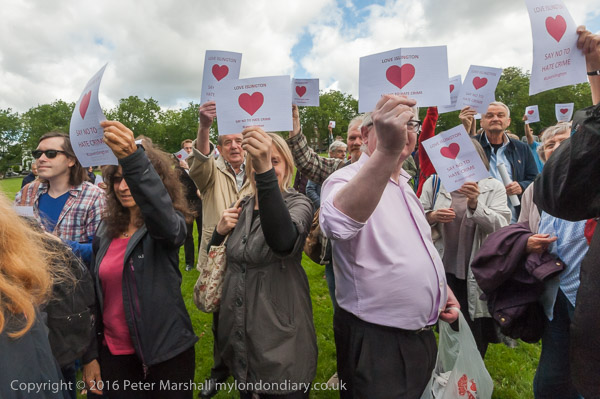
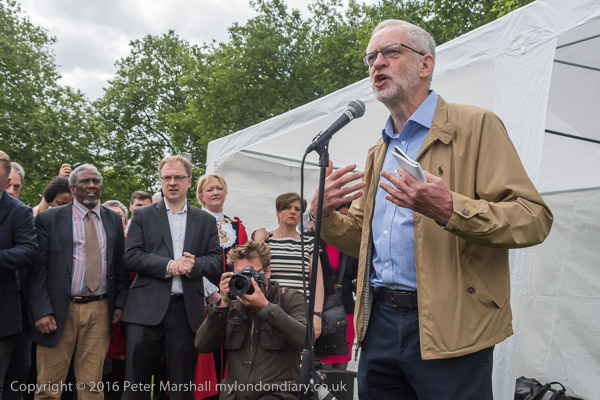
My first assignment (or rather self-assignment) of the month was a rally in Islington against the reported rise in hate crime which followed the referendum result, with people from across the community coming to stand together against hate crime against racial, faith and other minorities. I wasn’t surprised to find among the speakers a local MP, Jeremy Corbyn, not just because it was in his constituency, but because of his anti-racist views he has always expressed.

Corbyn’s rise to become leader of the Labour Party was an expression of the growing disillusion among Labour Party members and supporters against the kind of politics that have dominated the party over the past twenty or more years – and which still runs the party mechanisms, which has led to the continuing conspiracies in the party against him. And what really worries the handful of ultra-wealthy who own our media (and the BBC which is also controlled by our ‘elites’) is that he and those moderate socialists (largely Keynsian rather than Marxist) who back him could well win, though were I a betting man I might consider it wiser to put my money on Farage. And even were Corbyn to win, I think the most likely outcome would be for us to find a little more about where power actually resides under our strange and unwritten constitution.

So I took my pictures of the event and the speakers, wrote my captions, all stressing the issues and filed my pictures. And I actually made a little money from them, but the story wasn’t about race hate, but about the jacket Corbyn was wearing, a ‘designer jacket’. Though I expect the reporters who wrote the story, like me, probably knew or strongly suspected that he been given it or had bought it in a charity shop. And of course when I took the picture I too was wearing a rather similar designer jacket; most clothing these days appears to be labeled in this way.
Love Islington – NO to Hate Crime

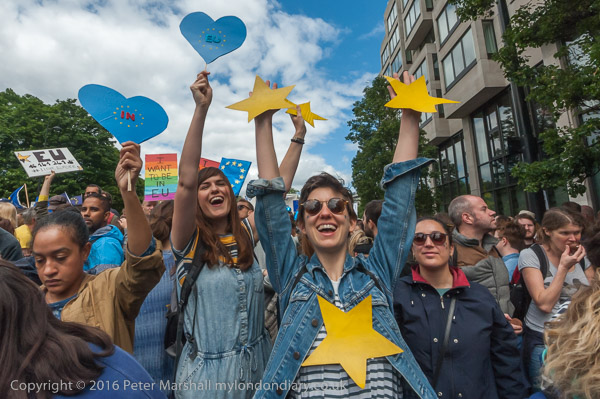
From Islington I rushed to Hyde Park Corner, where a March For Europe against Brexit was starting more or less as I arrived.  It was a large march, and it took well over an hour and a half for the fairly tightly-packed crowd to pass me as I walked up and down taking pictures of marchers and their placards before I walked briskly to the Underground for a train to Westminster, where the rally was taking place in Parliament Square.

Numbers are always difficult to estimate, but I think at least 5-600 people were going past me a minute, taking up the whole width of the road, and for over 90 minutes, giving an estimate of over 50,000 on the march.  Given the topicality of the issue and the numbers involved you might have expected some significant coverage in the media, but there was relatively little; it would have got more on the BBC had it been a protest against the government in Spain.

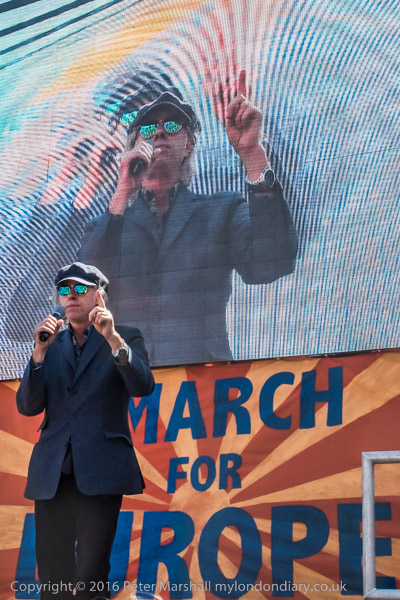
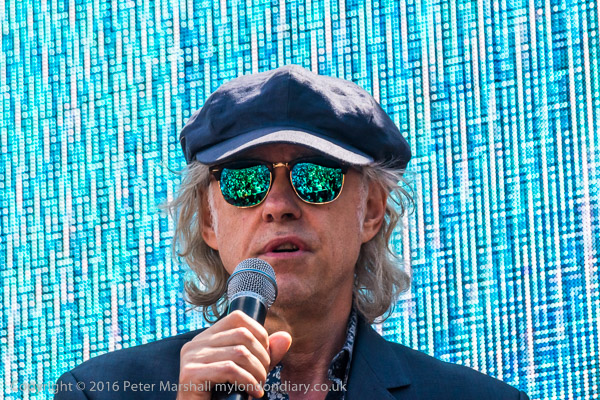
The Rally For Europe against Brexit had almost finished by the time I arrived – even though I’d come by tube, but I did catch a couple of the final speakers, including Bob Geldorf. There was a giant TV screen above the speakers relaying them to the large crowd in the square, many of whom would otherwise not have been able to see, and whoever was putting the image on to it was playing with some effects as Geldorf spoke, which made a more interesting background to my image of him. I found the slight delay – presumably due to the effect processing – between the two images interesting and you can see it in the different positions of his finger in the picture.

His was a speech that the content didn’t greatly detract from my concentration on the image, and I looked for ways to use the reflection  of the crowd in the mirror of his dark glasses – and found it when a suitable background came up on the screen behind.

The following day I was in Westminster again, photographing 16-17 Year olds demand the vote, a protest triggered by the referendum where they had no vote, despite being among those whose future would be most affected by it. Had they been able to vote it might have swung was was a fairly narrow margin (though I think it would have needed some of the other excluded groups too.)  Finally, after covering their rally in Parliament Square – rather smaller than that the day before,  I wandered over to the tribute to murdered Labour MP Jo Cox, the Jo Cox banner of love, to take a few pictures before going elsewhere to cover other protests.

Continue reading Around Brexit

The Struggle Continues…

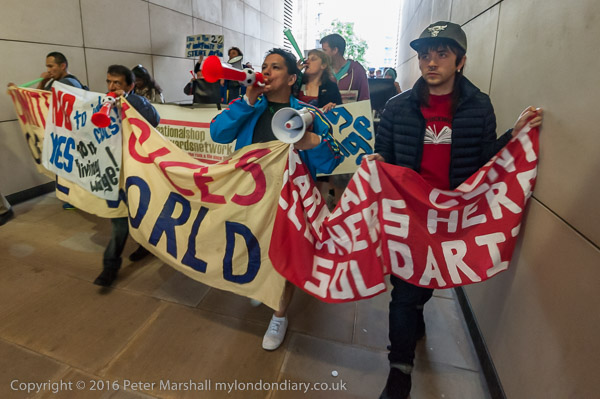
It’s hard to cover events that keep on and on and try to produce images that look fresh and different, but sometimes important to do so. The Wood St strike by cleaners in the United Voices of the World was a good example, and at the end of June had reached its 22nd day.

I hadn’t of course been there every day, though the pickets had been, but this was my fourth visit on days when the union had decided to hold a special rally, this marking the fourth week of their strike. While the UVW and other unions have held one or two day strikes, the UVW say this is the first indefinite strike in the City of London, and it looked as if it would continue for some time, with the direct employers Thames Cleaning having taken an extremely hard line, going to court to try stop the strike and getting an injunction covering the union’s actions, the costs of which came close to bankrupting the union, and Thames apparently getting the uncritical backing of the company that runs the offices, CBRE.

The picketing and rallies present an embarrassment to CBRE, but also, along with the lack of proper cleaning (though doubtless Thames were trying their best to keep things going though their managers and non-striking cleaners) were building up pressure on CBRE from the people who work in the offices and the well-known companies they worked for. Just because these city workers are themselves very well paid doesn’t mean they don’t have sympathy for those who are badly paid – and who they know they rely on to keep their workplace pleasant, and many had taken the leaflets from the strikers and some expressed their support.

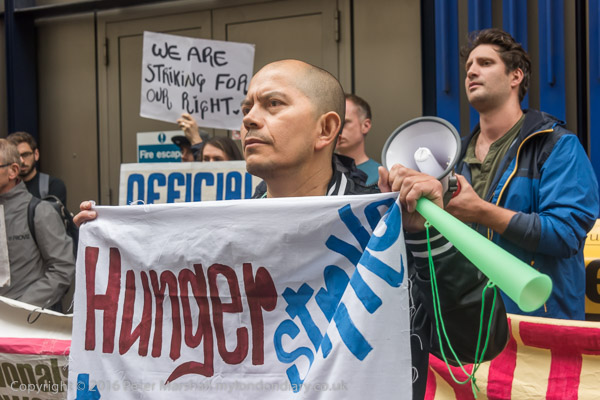
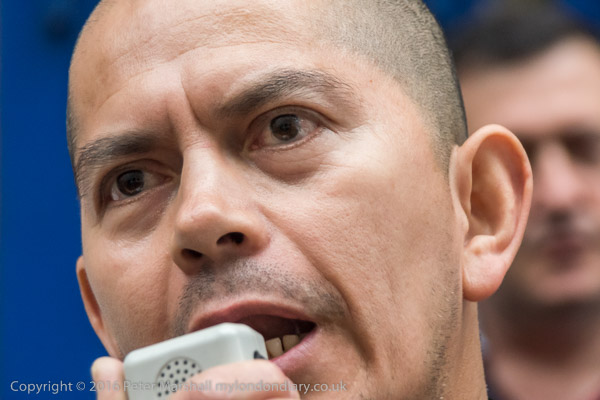
Publication of articles and pictures about the strike – even on the web and in the alternative press, but particularly when the story gets picked up my newspapers and TV stations disturb these powerful companies – and they put pressure on those they pay for office space who in turn dictate to the actual employers. CBRE are paying Thames and can and will in the end tell them to pipe down and come to an agreement with the UVW that will eventually end the strike – as they did around a month later. One new aspect which might have helped the strike get more publicity was the threat by on of the sacked workers to go on hunger strike.

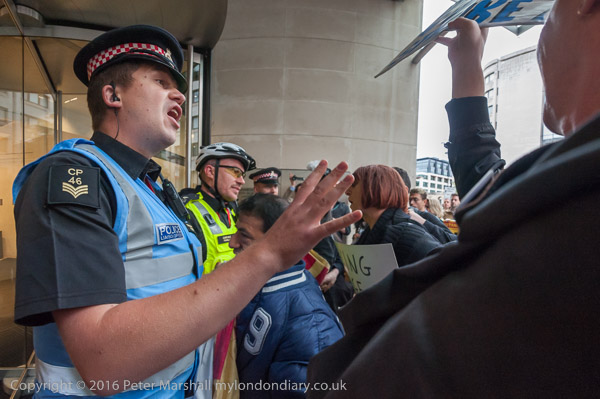
While I try hard to ensure my coverage of the events keeps to the facts, the very fact that I and other journalists are there and covering them is important in uncovering injustice, to me one of the vital roles of a free press. Its news that should be published, even if most of the media ignores it most of the time, often in favour of trivia. And the presence of the media does sometimes appear to improve the behaviour of both security staff and police.

There is no doubt that low pay and the increasing inequality of our society is an important topic, and it is actions like this that help put it on the national agenda – so much so that even a Conservative government recently felt it had to introduce a “Living Wage”, even though this was largely an evasion, well below an actual Living Wage, particularly in London. The figures for the living wage are readily available, published annually, but ignored by then Chancellor George Osborne.

UVW Wood St Strike continues
Continue reading The Struggle Continues…

London Mix

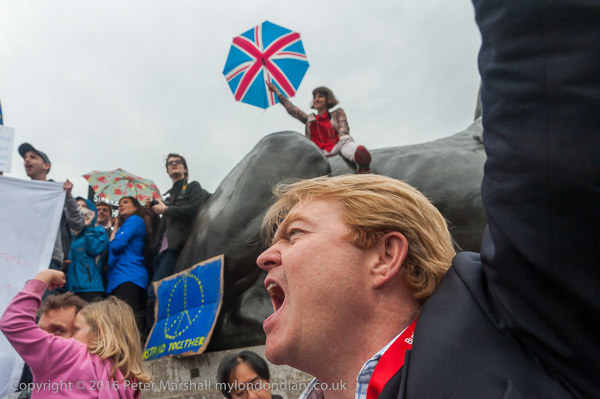
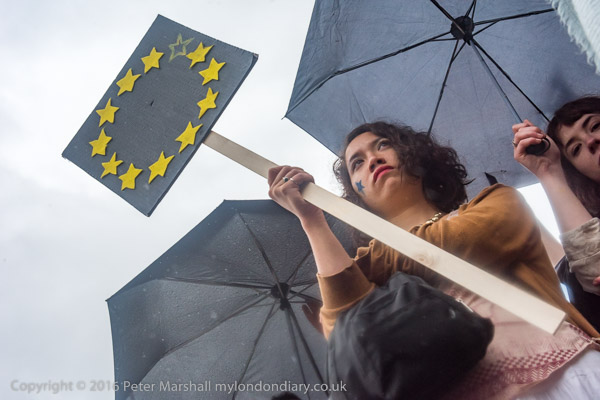
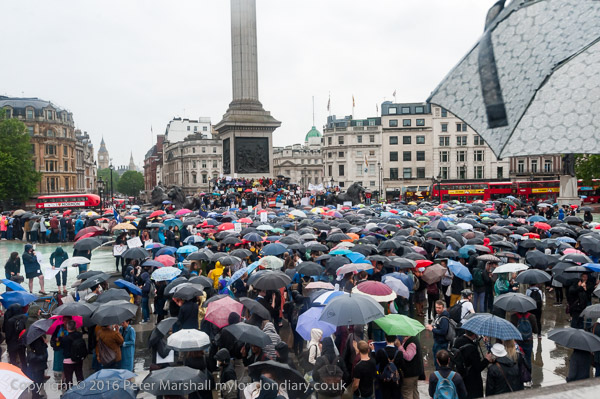
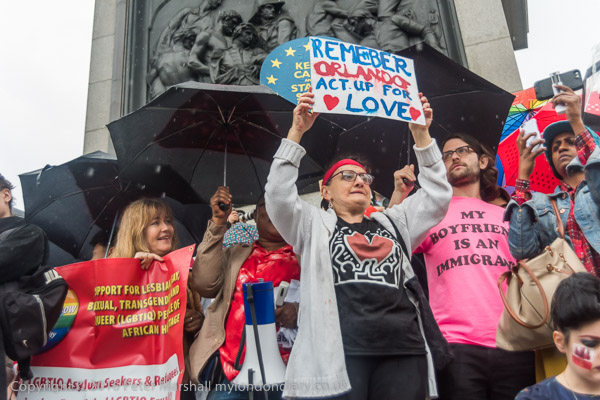
Some days there are just too many things happening in London. Well all days there are, but I mean too many things that I have access to and am trying to photograph, and June 28th last year was one of them. And in the early evening there were three protests occurring simultaneously in the same area of Trafalgar Square and to make things worse it was raining steadily and fairly intensively.

Rain isn’t necessarily a bad thing for photographers, and umbrellas can offer some visual interest – I once published an article ‘The umbrella in photography’ looking at examples by a number of photographers including Kertesz, though I have to admit I’ve probably seen more than enough pictures made through rain-drenched windows to last several lifetimes.

But umbrellas in crowds are something of a problem. Unless you have an assistant holding a large one over your head, they become pretty impossible to use when using a camera. If you are alone in plenty of space and there is little wind it can be manageable to hold one tucked under your left arm and held up by your wrist as you hold a camera to your eye, but this becomes untenable in crowds, as you get buffeted by other brollies and yours will uncontrollably poke other people in their eyes.

Working without one, you get wet. Wetter than just the rain would make you, as those other umbrellas around direct the rain they protect the holders from onto you, and unless you are wearing a hood, unerringly down the back of your neck, making you sodden from inside your clothing. In winter I wear a good waterproof jacket with an integral hood, but even an expensive ‘breathable’ coat becomes unbearably hot in summer.

Cameras too suffer from water. Even those that are ‘weather-sealed’ will slowly drown, but lenses generally go first. You can keep wiping the front surface with a chamois or microfibre cloth (and I often walk around holding one in front of the lens), but you do have to remove it to make the exposure. Zoom lenses which alter their length pump moisture into their interior as you alter the zoom, and even those that only move internal elements had something of the same tendency. Something that seldom gets a mention in the manuals is that lens hoods, at least with telephoto lenses, are at their most useful in keeping the rain off.

I do have a kind of plastic raincoat for my camera, but its a real pain to use, and though it diverts the rain (except from the front lens surface) it doesn’t stop the moisture. Usually I put one camera away in my bag to keep dry, and keep the other under my jacket as much as possible – though that does mean leaving my jacket rather open so the rain (and those brolly drips) can enter too.

And when the lens clouds over due to condensation on its inner elements, I take the other camera out of the bag and work with that. Until it goes too. Usually I’ve at least one more dry lens in the bag to change to, though that may mean I end up taking far more pictures than I really should on the 16mm fisheye.

When all my cameras, lenses and clothes are sodden, its time to give up and go home. Though at such times I always remember what my father used to tell us kids when we complained about getting wet, ‘You’ve got a waterproof skin’.

You can read what the protests were about and see more pictures on ‘My London Diary’:

Act Up for Love
London Still Stays

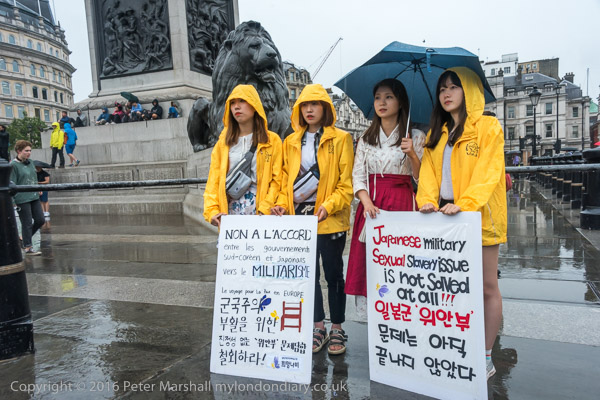
The third protest was a group of four women protesting over the agreement between the South Korean and Japanese government over ‘comfort women’, the Koreans used as sex slaves by Japanese soldiers in the second Worlad War – and I only used the one picture above.

Continue reading London Mix

Keep Corbyn


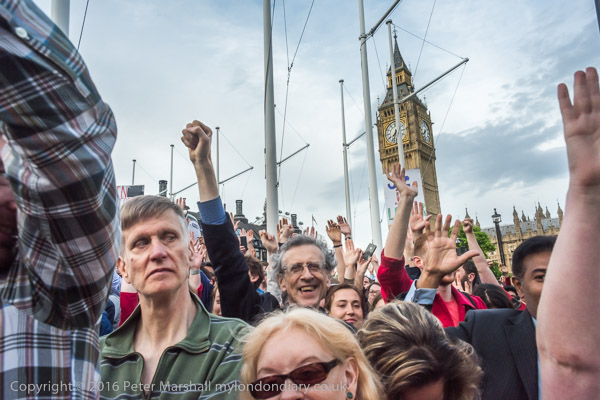
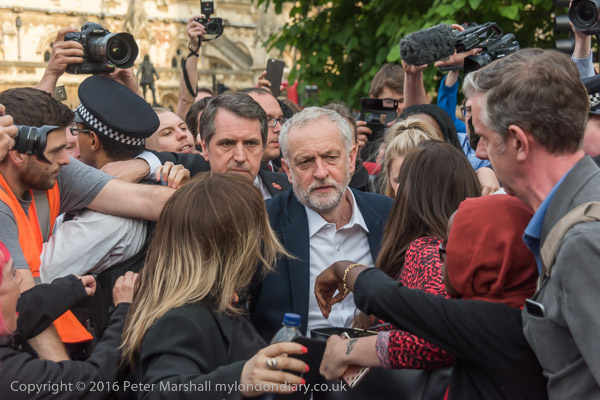
A grinning Piers Corbyn among thousands who turned up to support his younger brother

I can’t remember when I first photographed Jeremy Corbyn, but it must have been more than 20 years ago, and I’ve listened to him speaking at many events and often exchanged the odd word with him. He has always seemed to me to stand for the ideas and approach that are central to the Labour Party and which clearly differentiate it from the Conservatives, and states his views lucidly without a great deal of histrionics, but not without a certain passion and clearly a man of principle. If I had to pick a single word to represent him, it would be ‘reasonable’.

Like most, I was surprised when his name was put forward as a possible leader of the Labour Party, because he has never played the kind of politics that takes you to the top of political parties. It was perhaps precisely this that got him put forward as a candidate by the left of the party, as someone few MPs would be particularly antagonised by and who they would not feel had any chance of success – and so could be persuaded to back his nomination.

But it was also just this quality that appealed to many grass-roots members and supporters of the party who had become disillusioned with the politicians and who found a decent honourable man who clearly stood for the traditional values of the labour movement something which gave them hope for the future. Many joined the party to support him, though most existing members also backed him and were voting for change.

I’m not a fan of Corbynmania, but he was a man whose time had come, and I think rightly so. Most of the policies that Corbyn supports – for example in his recent ‘10 pledges to rebuild and transform Britain‘ enjoy wide popular support, even among many Conservative voters, but nothing in the press or media coverage reflects this. They seldom actually report on his policies, but spend a great deal of time on irrelevances or even truly ‘fake news’ such as a recent story over his tax returns which was patently untrue from the start, and simply showed the reporters had not bothered to read the document they were criticising. It’s a sign that those who really run the country are very worried that Corbyn could win.

It seemed obvious to me at the time he became leader that the same kind of reasons that led to his popularity also represented the only hope that Labour have of getting re-elected in our next general election – probably in 2020. But also obvious that this will only happen if Labour MPs get in line with the party as a whole and get behind him. Which unfortunately seems unlikely, and many of those MPs who continue to plot against him will lose their seats as a result.

But Labour MPs are not alonge; today with Theresa May delivering her Brexit letter to Europe we have another reminder that shooting ourselves in the foot now appears to be our overwhelming national characteristic.

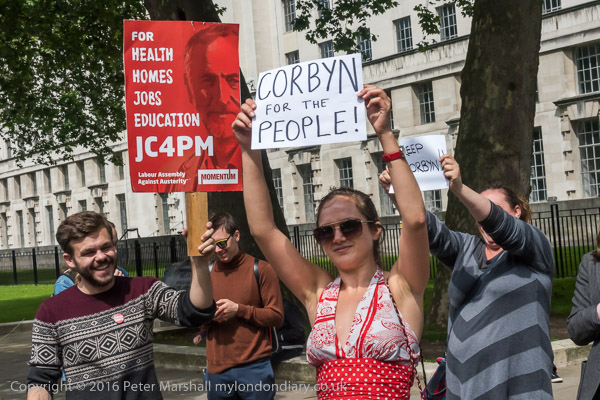
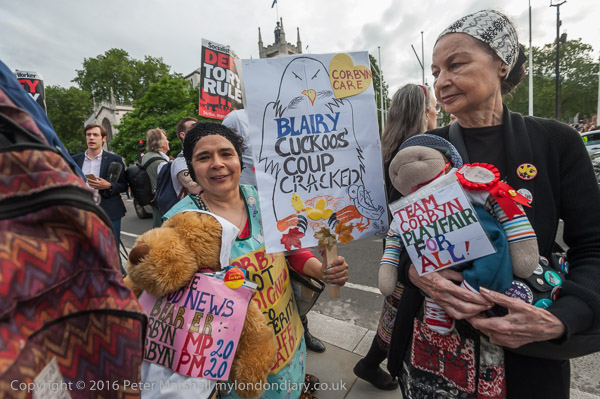
Back last June I covered two protests by supporters of Corbyn, one rather small and the other rather large when some right-wing Labour MPs attempted a coup against him. At the larger of these events another photographer asked me how many days I thought it would be before Corbyn resigned. I told him he had been reading too many newspapers and there was no chance he would go. And nine months later he is still leader, having won a second decisive contest with over 60% of the vote in September.

Pictures from both events:
Keep Corbyn – No Coup
Thousands rally to Keep Corbyn

Continue reading Keep Corbyn