Looking at Lens

Although I regularly take a quick glimpse at the New York TimesLens‘ blog, often just with my newsreader that doesn’t actually show the pictures, I don’t that often find things that are of enough interest to comment on here. Much of what they publish is interesting, but generally I only write about things if there is something I feel I can add to in some way or take a special interest in.

In the last week or so, there have been quite a few posts there that interested me, and I particularly warmed to some of Nathan Farb‘s pictures in 1967’s Other Summer of Love, perhaps because they reminded me of when I was young and a student, though Manchester in England was very different to the New York Lower East Side of his pictures. But there was just a little something of the same spirit of counter-culture in the air.

The slide show with this piece has 21 pictures, enough to get a good idea of the work, whereas sometimes on Lens I find there just isn’t enough. Usually of course you can find more pictures elsewhere – and Lens sometimes provides a link or you can search for yourself, but then things can get rather time-consuming.

That piece led me on to the large format and very posed portraits of Harf Zimmermann, who, inspired by Bruce Davidson’s book ‘East 100th Street‘ took his camera into the homes and onto the streets to photograph his fellow residents and workers in the East Berlin neighbourhood where he lived. His pictures have for me a kind of dissonance like I often feel in dreams between the people and place and perhaps seem more like theatre sets with actors rather than real people – whereas the colour images he took when he returned to the same area in 2010, judging by the couple of examples in the article, Exposing Life Behind the Berlin Wall, simply look like high-quality versions of family snaps.

East Germany was of course a police state, where it was healthy to assume that everyone except you was a Stasi agent (especially if you were not.) Rather like living in G K Chesterton’s nightmare novel ‘The Man Who Was Thursday‘. Though working as I do with many protest groups I find I often look around and wonder which of us present is one of the 144 undercover UK police stated recently by the authorities to have infiltrated more than 1,000 political groups since 1968 – around the time I first got involved in such things.

But there is also something very German about the pictures – and not just in some of the obviously German backgrounds. They didn’t remind me of Davidson, but they did remind me of August Sander and his attempt to study and classify the people of his country, interrupted by the Nazis who seized and destroyed his ‘Face of Our Time‘ in 1936.

I then went on to find several more ‘Lens’ posts worth looking at, including Fighting For Basic Rights in Morocco, Amid Crisis and the remarkable Venezuela’s Youth Wait to Live Again.

A Day at the Cleaners

Small grass roots unions such as the CAIWU, UVW and IWGB representing mainly migrant workers have spear-headed the drive to get the London Living Wage for low paid workers, particularly cleaners in London. Many are Spanish speaking and have found asylum here following various upheavals in Central and South America and others have Spanish passports. With some exceptions, the larger unions have found it hard to engage with these workers, partly because of language difficulties.


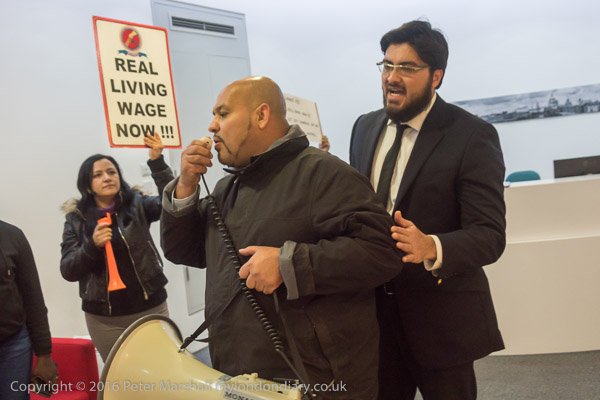
Alberto Durango of the CAIWU speaks inside Lloyds against racist sacking by Principle Cleaning Services

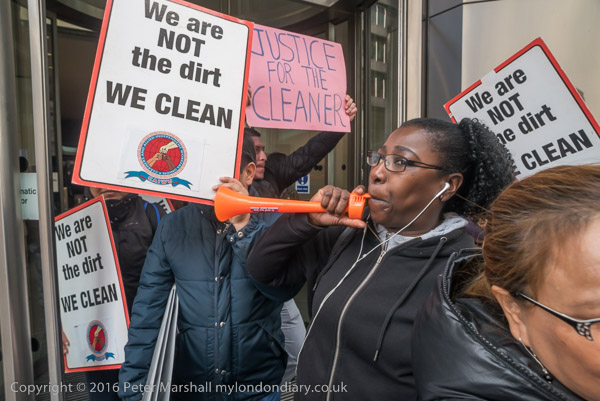
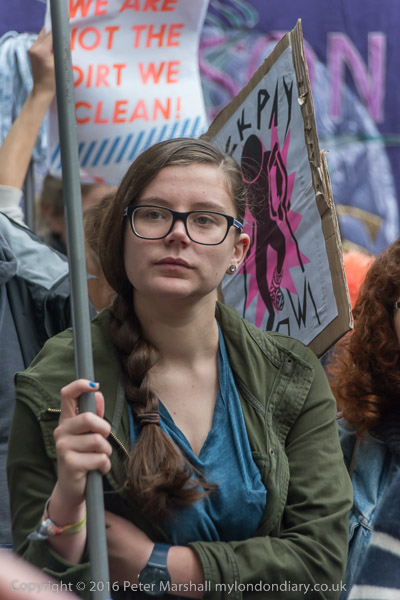
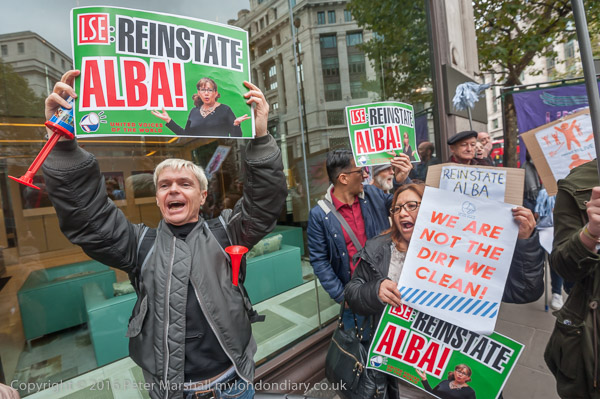
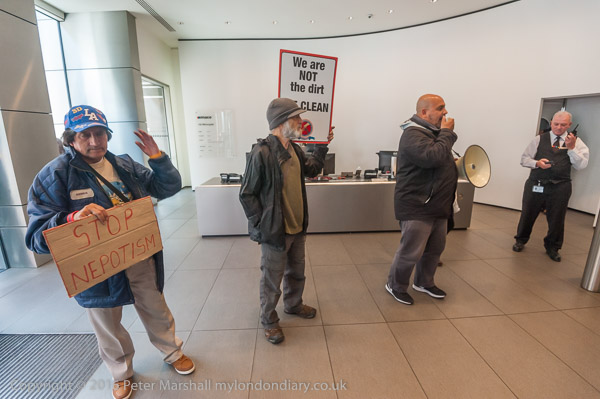
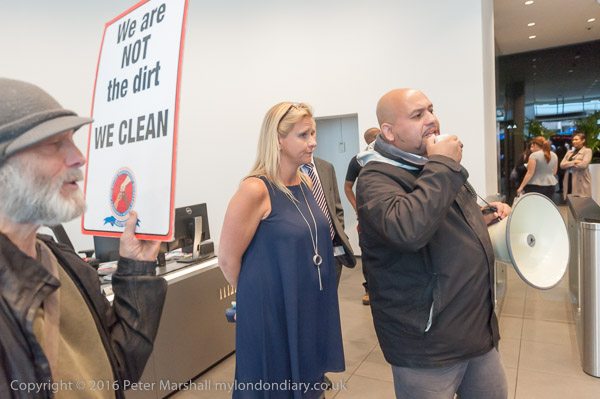
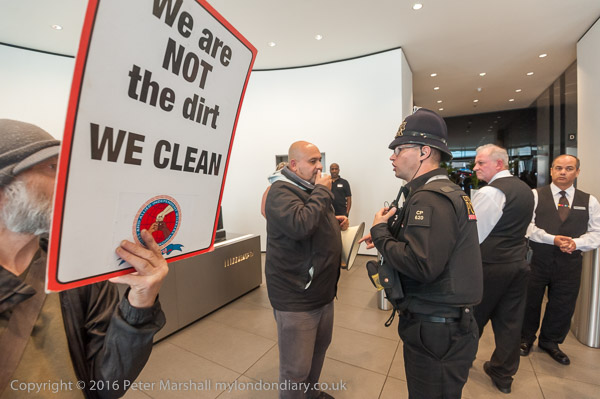
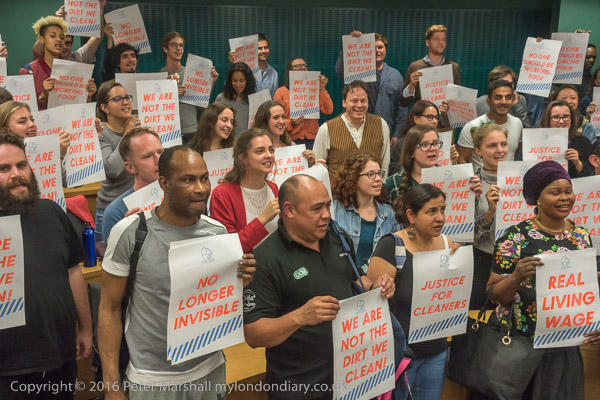
Many of those who have come to work in this country have come from more skilled work in their own countries and their qualifications mean little or nothing here or they do not have the language skills needed for similar jobs here. Generally they are more articulate and more politically aware than equivalent British-born workers, and often surprised at what British workers put up with from managers and trade union officials. Perpared to work hard, they demand to be treated with dignity and respect – as some of their placards say ‘We are NOT the dirt We clean’.

When I can, I photograph their protests, though these seldom make the UK newspapers and probably get more coverage around the world than in the UK. The pictures do get shared on social media and the presence of the press at them does increase their impact. Protests are a way of embarrassing the companies to take action, with their noise and visual impact making an impression of those who work in the same building or close by, and also through social media and publication on a wider audience and companies are generally sensitive to any possible damage to their image.

The demands the cleaners make are always reasonable. Everyone should be paid a wage that is enough to live on – the London Living Wage as a minimum. No-one should be bullied or harassed at work, or given impossible workloads. People should get decent conditions of service – sick pay, holidays, pensions… What they are fighting against is largely outsourcing of cleaning work, where reputable companies that would never cut salaries and conditions of their own workers to the bone employ cleaning contractors, generally on fairly short-term contracts which go to the lowest bidder – who trim their bids at the expense of the workers. They cut staffing levels, overworking the cleaners and lowering the standard of cleaning, they cut pay and conditions as far as they are able.

That can mean the legal minimums of pay and conditions, but protests by unions like the CAIWU can manage to persuade those setting the contract to include the insistence that all workers should be paid at least the London Living Wage, and they could also insist on a decent standard of conditions.

But outsourcing of cleaning and other services is just a part of a wider problem that seems particularly rife in the UK. Unnecessary levels of management where company A pays company B to provide a service which they then sub-contract to company C – with sometimes as many as five companies involved, each taking its profit for shareholders between the company that the work is done for and the guy who actually does it.


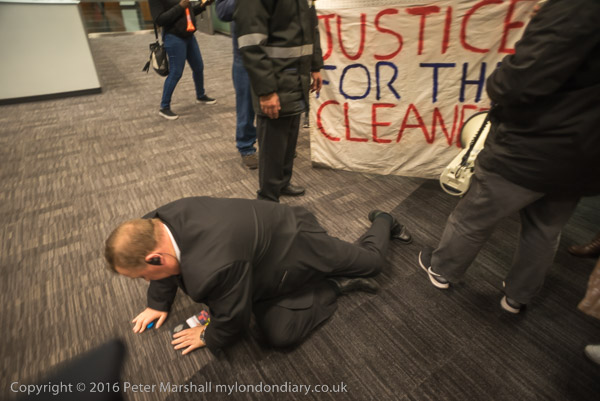
A security officer starts pushing the protesters, then has clearly been watching too much football…

and suddenly makes a rather unconvincing dive to the floor, pretending he has been hit

The Cleaners and Allied Independent Workers Union (CAIWU) is a small union with no paid staff and run on the contributions from members and some donations but it is an active one. I hadn’t realised when I travelled up to meet them at Liverpool St Station that they were intending to protest at three offices across the lunch time and early afternoon.

We started by walking to Lloyds, and the cleaners briefly occupied the foyer there before being forced to leave and protesting outside. The union accuse Principle Cleaning Services there of racial discrimination over the sacking two African workers, and of sacking a third African because of his trade union activities.

There was a curious incident when one of the security officers who had been pushing some of the cleaners suddenly dived to the floor, claiming he had been hit – see above. I was standing close to him and would have seen and certainly heard if a blow had been struck. But occasions like this make me realise how much better as evidence it would have been if I had been taking video rather than still photography. Usually there is at least one other photographer present with a video camera, but not on this occasion.


Cleaners leave 155 Moorgate to continue the protest on the pavement outside

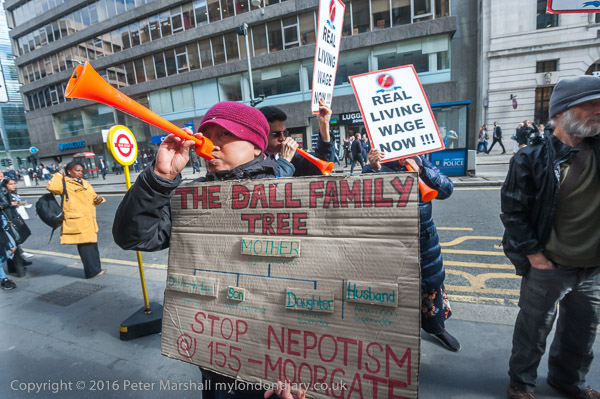
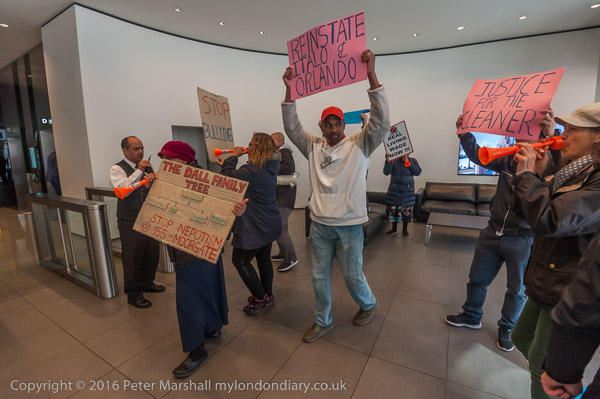
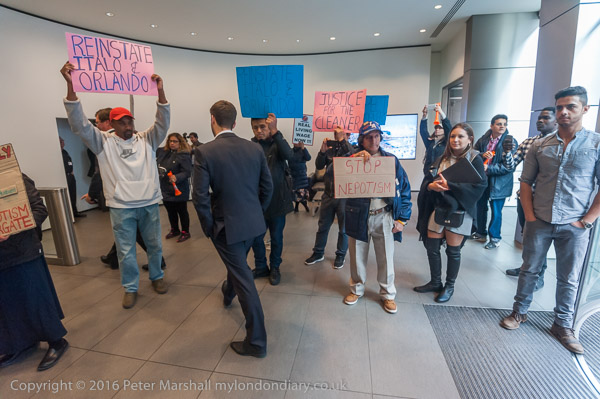
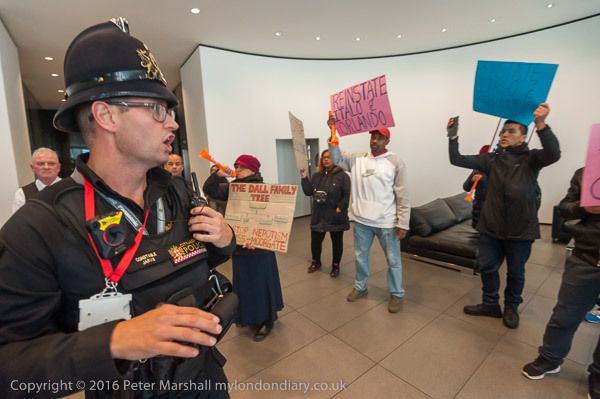
The cleaners then walked to Moorgate, to rush in to the lobby of Mace’s headquarters building in Moorgate in a noisy against cleaning contractor Dall Cleaning Service; they accuse the manager there of nepotism and say two cleaners have been improperly dismissed and reductions made in both conditions of service and the actual working conditions.

Again after a short protest inside they walked out to continue the protest in the busy street outside.


The receptionist at the offices housing Claranet’s London HQ pushes CAIWU organiser Alberto Durango

Finally, I caught a bus with them to Holborn, and the offices of Internet service provider Claranet, who with their cleaning contractor NJC have ignored the union’s attempts to negotiate for the London Living Wage where the protest followed the same pattern.

Cleaners at Claranet for Living Wage
Cleaners at Mace protest Dall nepotism
Cleaners in Lloyds against racist sacking

Continue reading A Day at the Cleaners

Another Night

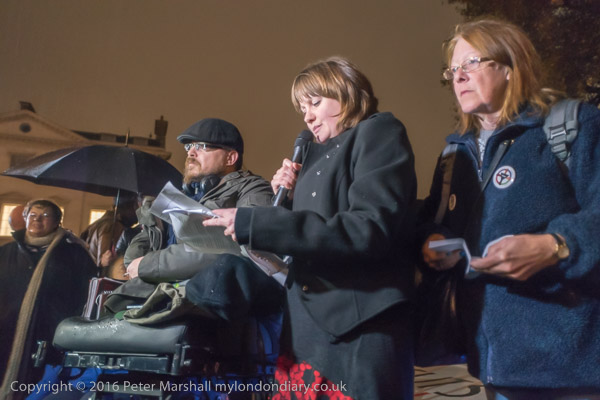
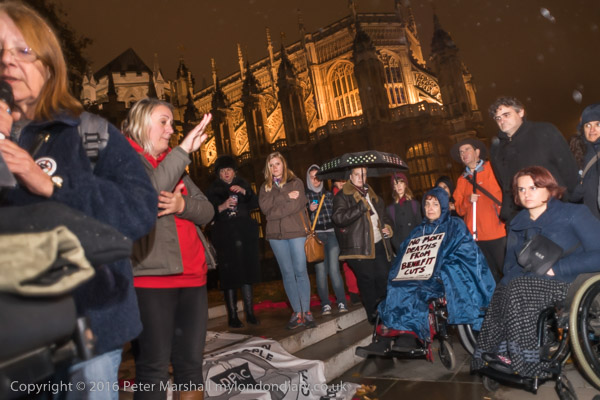
The following evening I was out again taking pictures of a protest, this time in Westminster at Old Palace Yard, opposite the Houses of Parliament. It’s a gloomy place at night, and even worse it was raining.

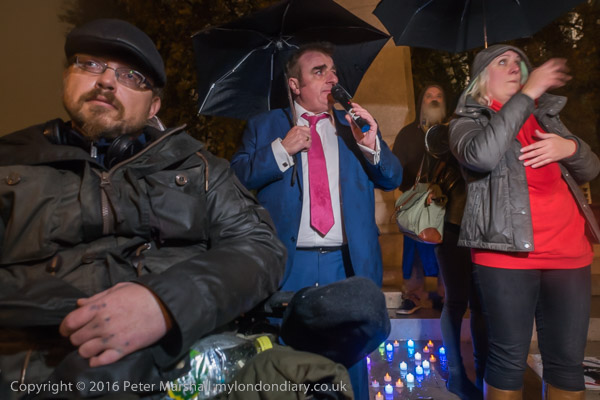
At times the rain was light, even almost stopping. Then it would poor down. I felt sorry for the protesters, from Disabled People Against Cuts and Black Triangle, including many in wheelchairs, though I think most had decent waterproof clothing and a number also umbrellas.

Of course I had an umbrella too, but it is seldom practical to use one when taking pictures – unless you have an assistant to hold it – and also I needed to work most of the time in a very restricted area between a ring of wheelchairs and the speakers, much of the time in a kneeling position so as not to impede the view of those sitting in the chairs. Occasionally sitting on the damp paving stones. Working with a micro-fibre cloth held on the lens filter, taking it away to take a picture, then wiping and covering up the lens again.

Most of these were taken with the LED light source, with a couple at the start of the event when there was still some weak light from the sky without any added light. Another photographer was videoing the event, and sometimes his LED video light lit up part or all of the scene for me – though other times it shone directly towards me and made taking pictures more or less impossible. I did take a couple of pictures with flash, but in rain it gets to be pretty useless, lighting up the rain drops and giving odd spots across the picture. With exposures around 1/15s to 1/60s spots of rain don’t show up except sometimes as streaks – which look very much like rain. But with the slow shutter speeds and probably a certain amount of shivering from me quite a few of the exposures were blurred even when there were no raindrops on the lens, and quite a few frames were unusable.

I also discovered one of the problems of the Neewer CN-216 LED light. It doesn’t have a battery cover – or at least mine doesn’t, and at one point after it got a slight knock, all 6 batteries fell out and rolled across the wet paving stones. Fortunately I and some of the other people around managed to pick them up, but now I put a length of masking tape across them and the back of the unit after replacing the batteries.

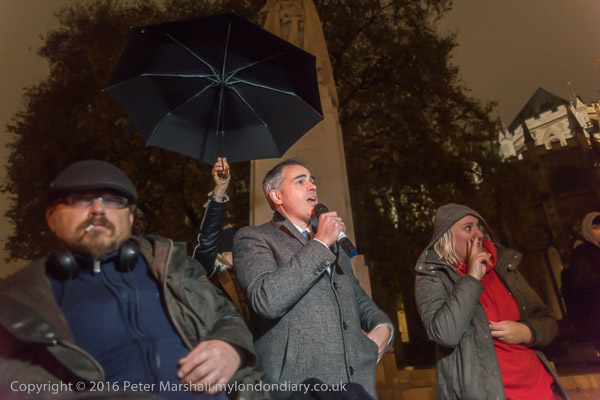
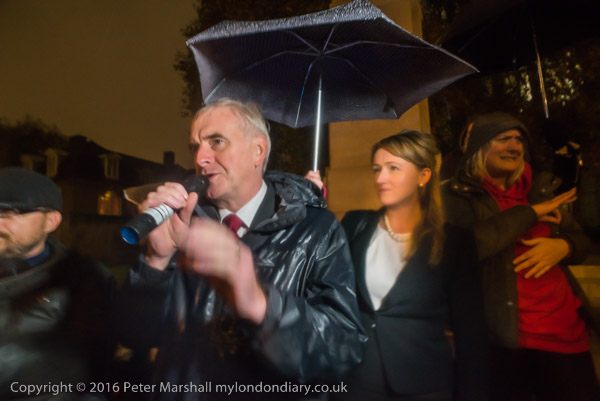
As the evening went on the rain worsened. There was quite a long list of speakers, including the Shadow Chancellor John McDonnell, for whom the heavens opened pretty drastically. Fortunately he had brought fellow Labour MP Rebecca Long-Bailey with him to hold an umbrella. They and other MPs came out from the debate on government plants for a cut in Employment and Support Allowance, despite a UN report condemning the ‘grave and systematic violations of disabled people’s rights’ which had resulted from the UK government welfare reforms..

It was really an evening that called for an underwater camera, or at least an underwater housing. I do carry a cheap plastic bag affair in my camera bag, but find it such a pain that I hardly ever use it. Fortunately I managed to keep the cameras under my coat much of the time, though having the front of it open to do this meant I did get rather wet. I was cold too, and very pleased when I could pack up and go home.

I wasn’t particularly happy with my work at this event – and so many of the images were ruined – but under the circumstances I felt I’d done a decent job to get any results at all. You can see more at End Discriminatory Welfare Reforms.
Continue reading Another Night

Night Work

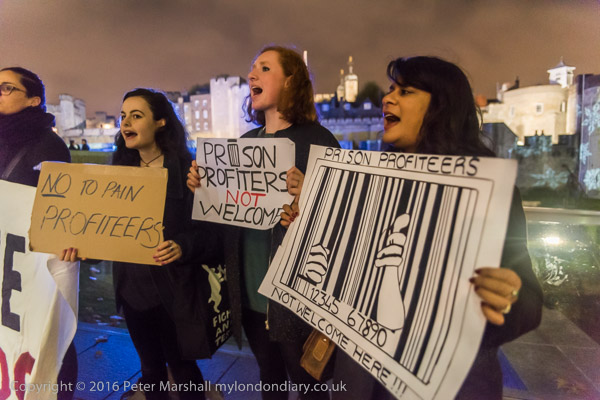
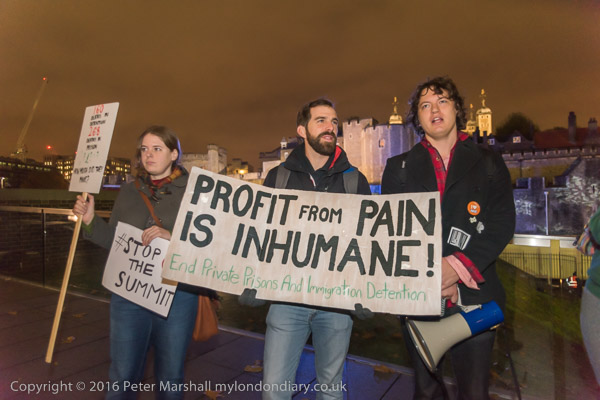
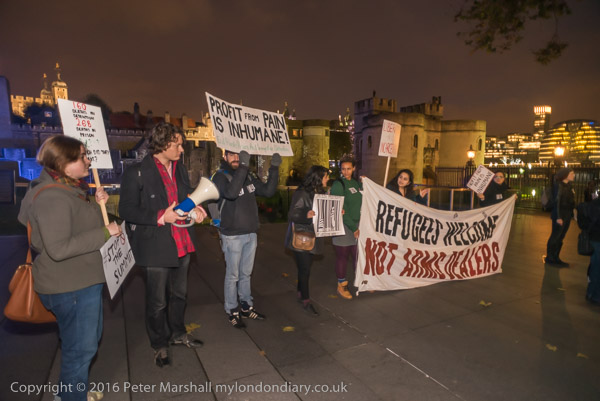
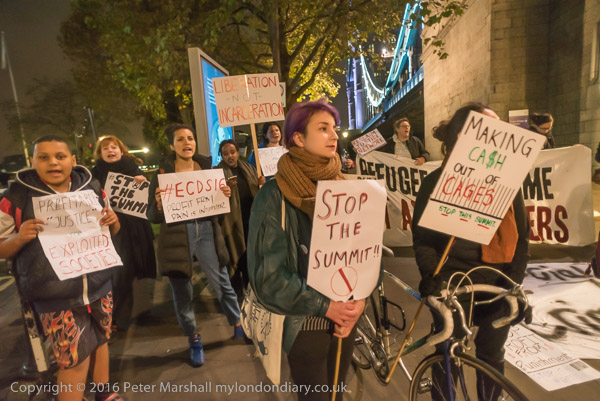
I don’t often photograph the Tower of London, but it would, I thought, a nice background for a picture, something that says ‘London’, and I went to the protest being held outside the Tower against the European Custody and Detention Summit being held there hoping to use it in my pictures.

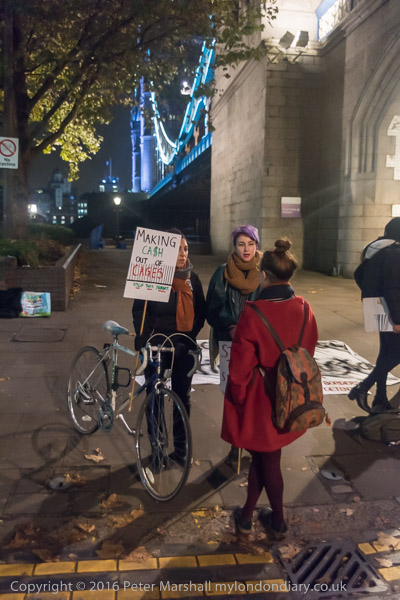
Unfortunately the protest was taking place in the early evening and this was November. There were groups at two locations, one on Tower Hill, where there was a view of the Tower behind the protesters, and a second down below Tower Bridge, where there wasn’t really a much of a view of the bridge and the Tower was completely out of sight.

I’d taken two light sources with me, the Nikon SB800 flash, and a cheap LED light, the Neewer CN-216, which has an 18×12 array of small LEDs  – 216 in all, hence the model number. It takes 6 AA cells, which adds considerably to its weight and will just about fit in a large jacket pocket. The flash, with only 5AAs is a little smaller and lighter.

Knowing it would be dark, I’d also packed the Sigma 24-70mm f2.8 and the two pictures above were both taken using this on a Nikon D810. I had the camera on shutter priority and both images were taken at 24mm, using the camera in full-frame mode at 1/50s and f2.8  – but there the simiilarities end. One used the flash at ISO 1,800 and the other the LED light at ISO 6400. Though it seems bright, those LEDs don’t really put out that much light.

I’ll leave it to you to decide which was which. The differences are easier to spot on the 7,360 x 4,912 pixel images, but after processing – including noise reduction – in Lightroom was less than I expected, and looking through the whole set at full screen size my guesses as to which used flash and which were LED where often wrong.

Both are relatively small light sources and so suffer similar problems with light falling off at roughly the square of distance, and I worked a little more ‘head on’ to groups than usual when I could to avoid too much having to dodge and burn in Lightroom.  One advantage of the LED was that I was able to hold it at arms length from the camera – much trickier with flash – and see the results of angling it away from closer subjects. The higher ISO I used with the LED meant that ambient lighting contributed more to the LED lit images and probably I would have been better using ISO 6400 with the flash as well. But I was worried about image quality, though it turns out I need not have been.

Increasing the ISO to 3200 for the wider group, taken with flash and using a Nikon 20mm f2.8  at 1/30s, f/2.8 on a Nikon D750 gave a good balance.

Down below Tower Bridge there was a little more light and I used the flash very little, relying on the LEDs for most pictures, though in some areas there was enough light from the street lights to make them the main light source.  The view of Tower Bridge in some of the pictures isn’t instantly recognisable.

I did have a few problems with fiddle fingers, and working in  S – shutter priority – mode does mean you get underexposure when you push the control dial in the direction of higher shutter speeds. With flash too the exposure drops – though with Auto FP High Speed Sync you no longer get just a fraction of the frame exposed. Fortunately Lightroom can cope with considerable underexposure if – as I do – you shoot RAW images.  And ISO settings don’t really have a great deal of meaning.

In low light conditions you also get problems with slow shutter speeds and subject movement, as well as camera shake. None of the lenses I was using has image stabilisation but it would have been of little or no help. But you do need to make a lot of exposures and to have a little luck.

More pictures of this protest by the Reclaim Justice Network which includes prison activists, refugee solidarity groups and anti-arms trade campaigners against this trade fair for  major arms companies, security companies, prison builders, and others profiting from expanding and privatising the criminal justice system at Custody Summit at the Tower.

Continue reading Night Work

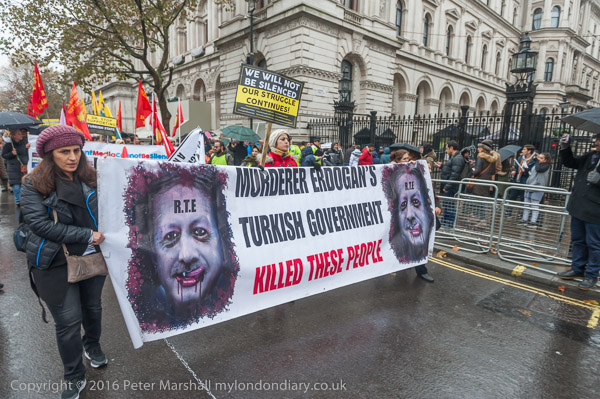
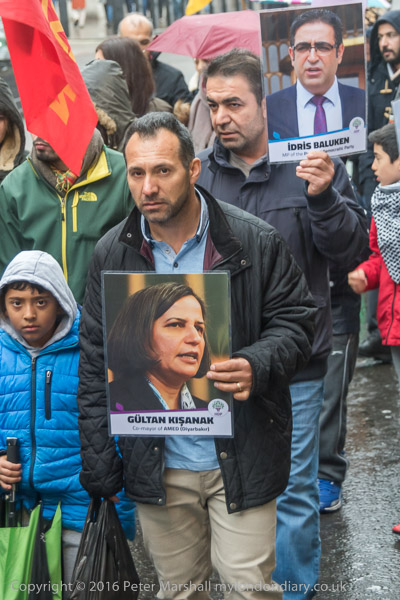
Kurds oppose Turkish Dictator

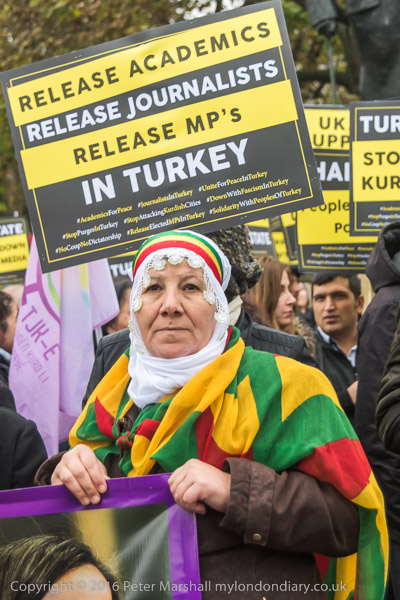
I’ve long admired the Kurds and their continuing struggle for their identity and culture in Turkey and elsewhere against a long policy of ‘Turkification’ since the end of the First World War. I think I first photographed them in October 1999 on the streets of London shortly after the arrest and death sentence (later commuted to life imprisonment) of their nationalist leader, Abdullah Ocalan, the face on many flags, still held in prison on a Turkish island.

Since then I’ve photographed many protests they have taken part in as well as cultural festivals, including their New Year festivities and of course London’s May Day march.  As well as the protests they organise, they also take part in a wide range of other protests in London.

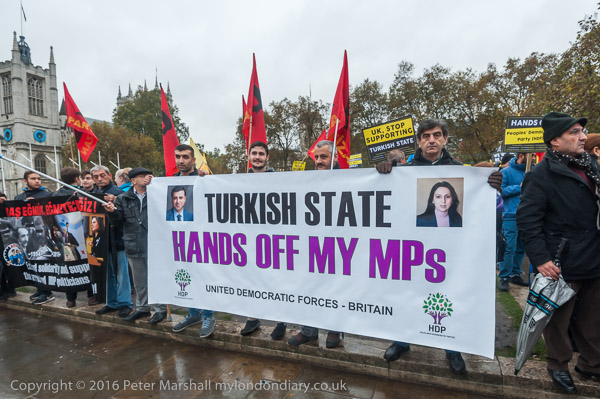
Although their struggles have gained some advances for Kurds in Turkey they are still very much under attack – military and otherwise – from the Turkish government under Islamist Recep Tayyip Erdoğan, who is increasingly pushing through laws and repressing opposition including the Kurds to make himself a dictator. Its a process that has accelerated since the Kurds gained greater representation in the Turkish parliament.

While Kurds outside Turkey, have made progress,  particularly in Iraq and now Syria where they have achieved de-facto independence, peace talks in Turkey initiated from prison by Ocalan broke down in 2015, since when the Turkish state has tightened its programme of repression and human rights abuses.

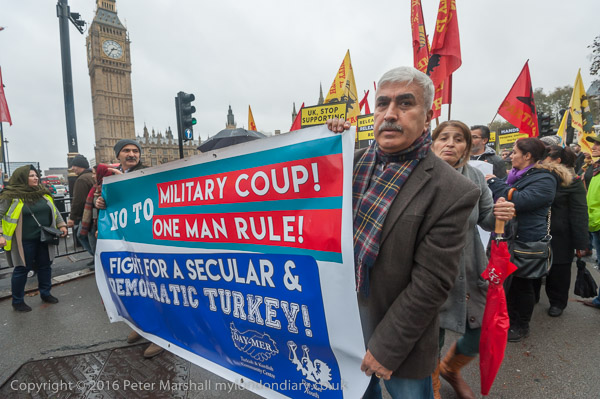
Erdogan used the rather pathetic military coup attempt of 15 July 2016, thought by many to be a ‘False flag’ event, as an excuse to carry out wholesale arrests of his political opponents, including MPs, academics and journalists.

There is a pragmatism about Kurdish protests, and a determination that is missing from many of those more organised events on London’s streets, and an unwillingness to be bound by petty restrictions and bylaws. I don’t think that they ever march along chanting ‘Whose Streets! Our Streets!’ but unlike some other groups that do, it is something they put into practice.  I met them in Parliament Square, from where the marched up Whitehall to Downing St, and then on to Trafalgar Square, where I left them. They told me they would perhaps go on to the BBC and from there to the Turkish Embassy in Belgrave Square.

And in Syria, in Rojava, a polyethnic community home to many Kurds among others and also known as Western Kurdistan, again thanks to Ocalan from jail in Turkey, they have put in place a remarkable constitution based on a “Charter of the Social Contract”  embodying the principles of democratic socialism, gender equality and sustainability. It is a model for democracy while perhaps not perfect in its application makes our own aging pseudo-democratic and class-dominated system look rather autocratic.

Kurds march through London
Continue reading Kurds oppose Turkish Dictator

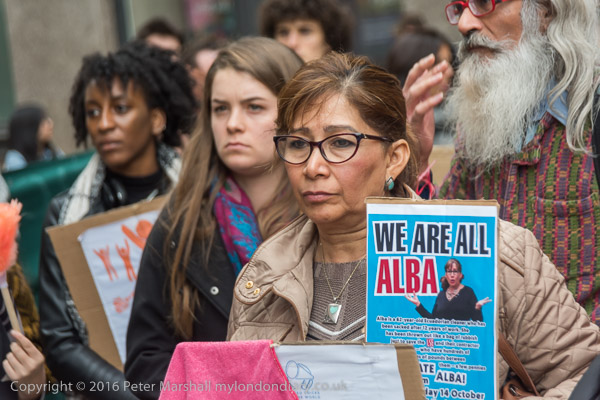
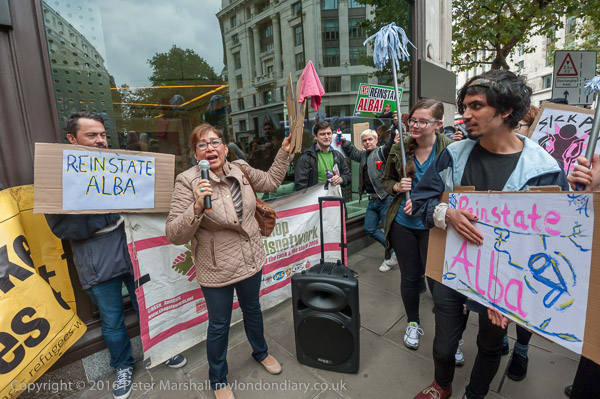
We Are All Alba

In a recent statement the United Voices of the World union (UVW) announced that although the cleaners at the LSE recently gained the “historic victory which resulted in them being brought in-house after 7 days of strike action and the largest cleaners strike in UK history, the cleaners will be back out on strike for 3 more days during the LSE students graduation over one remaining issue of dispute: Alba Pasmino.”

People first became aware of Alba’s sacking after she stood up at the meeting which began the dispute at the end of September 2016 and told everyone about it, and the meeting then pledged to support her.

A couple of weeks later on October 14th the first major protest in the UVW campaign made the sacking of Alba its main focus. After a rally outside the LSE student union, cleaners, students and other supporters marched along Kingsway to the building where LSE and the cleaning company Noonan which the LSE had outsourced the cleaning to have offices and held a rally outside.

Alba again spoke, as did others, and there was a great deal of chanting ‘Reinstate Alba!‘ as well as drumming and blowing of vuvuzelas to ensure that everyone around knew what was taking place – and why. It was a demand repeated on many further protests and strike rallies.

Alba was one of the longest serving members of the LSE cleaning team, having worked there for 12 years and had become one of the cleaning supervisors.  Noonan claimed they were making her redundant because they needed fewer supervisors – and the number has halved in the past few years. The UVW have taken her case to an  employment tribunal but that cannot not guarantee her reinstatement even if the judge accepts that she was unlawfully dismissed.

The UVW say that after an agreement has been reached in the dispute, “Noonan’s newly appointed Account Director is keen to see Alba return, but his efforts to bring that about are being blocked, without justification, by the chest-beating director of LSE Facilities, Allan Blair, who is callously using Alba as a political football which is cruelly at the expense of her livelihood and well-being.”

Obviously the UVW as well as Noonan want to see this matter resolved without delay, and the union are now threatening a further 3 day strike during the LSE student graduation which begins next week on Wednesday 12th July.  I sincerely hope the LSE will see sense and settle before then, but otherwise the strike will go ahead, I will be there taking more pictures of the cleaners, and support from others will be welcome – check the Facebook event page for details.

Justice for LSE cleaners
Continue reading We Are All Alba

Housing

It’s hard not to get depressed when thinking about housing in London, though I’m fortunate enough not to have to worry on my own account. Though even when we bought the house we still live in, back in 1974 we couldn’t afford one in either of the two places we thought about in London, so had to go just outside the Greater London boundary.

We had lived for some years in rented accommodation, at first privately rented, and the first landlord after we were married was decent enough, except for the excessive charges for gas and electric on his slot-meters. We bought a paraffin heater. But the rent for two rooms – the top floor of a small house – was the equivalent of around £2.80 a week, less than a quarter of my income (and around an eighth of our joint income.)

Things were a little less comfortable and more expensive when we moved to Leicester for a year- and the agent for the flat didn’t want to know much about anything except collecting the rent, and it was a relief when I got a job in Bracknell to qualify for housing from the development corporation, a new and spacious two bedroom flat at a lower rent than we had been paying a private landlord for out rather dingy single room.
We were only there four years, but they were four years when the rent more or less doubled, as rents were being brought into line with market rents I think solely for politically doctrinaire reasons. It made it easier to decide to buy a house (though we had other reasons too) as the rent was now very little different to the payments on a mortgage.

Now, many years later, that mortgage is long paid off – and we even made a profit as we had been advised to take out an endowment mortgage so my housing costs are limited to upkeep, though being a property owner isn’t always a good thing. But when I look at the rents that people pay in London now (or even on the edge where I live) I realise that unless I owned the house I would probably have to move elsewhere. It mightn’t be all that bad – I could still afford to live in Hull.
Back when I was small, my father still looked after some of the handful of cottages that his father had built for the men that worked for his various small businesses, none very successful, but these properties were never meant to be a source of income, just somewhere for those who shared in his work and their families to live. Rent control meant that the income from them failed to pay for keeping them in order, and when they were sold with sitting tenants as a part of my grandmother’s estate they were almost worthless (though now they probably fetch approaching half a million.)

Now private landlords are hugely subsided by the government paying housing benefit and are allowed to charge what they can get, with the result that rents have risen through the roof. And the incredible rise of ‘buy to let’ provides a way for those with some capital to exploit others and make money for nothing.

In my ideal world we would have a land tax and the ownership of land and property would be severely limited – sufficient to needs rather than for investment or profit. It’s an assessment that could be reasonably generous rather than unnecessarily punitive. But in the unequal world we have, there does seem an urgent need to do something to make private renting more affordable, as well as ending the taxpayer subsidy of practices which are clearly against the public interest.

I’d also like to see an good supply of socially provided rented housing – council homes, enough for all those who want it, something that would rapidly bring down private rents. But after the election of Mrs Thatcher, social housing figures fell steeply, continuing down to a miserable 13,500 under New Labour in 2003. Corbyn earlier this year promised a Labour government would build and average of 50,000 a year in its five year term (50% of his target for all new homes) – returning to a level last recorded under Thatcher in 1982. But Thatcher’s main contribution was of course the ‘right to buy’ which has removed 1.87 million social housing homes since 1980, a large percentage of which are now ‘buy to let’ private rental properties.

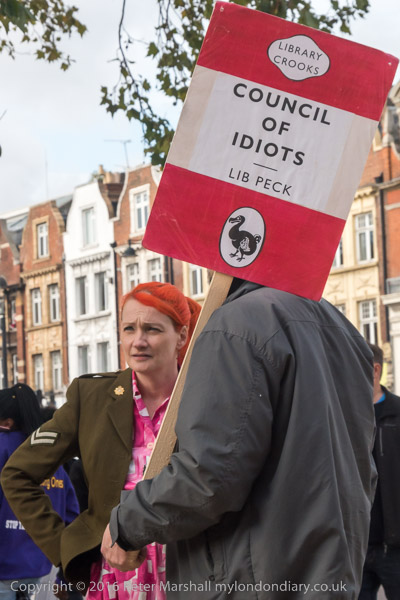
But even more shameful than Thatcher’s ‘right to buy’ is New Labour’s ‘Regeneration’ policy which, through the activities of London Labour councils such as Newham, Lambeth and Southwark has led to the wholesale loss of social housing, and a disruption of local communities that even the Luftwaffe failed to achieve.
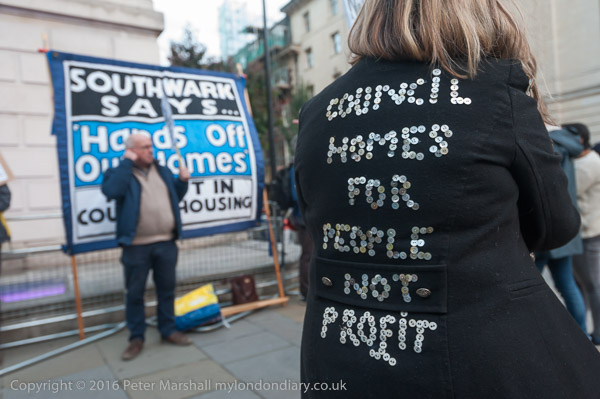
Southwark’s prime example (though they are currently working on rather more) is of course the architectural award-winning Heygate Estate which was at the Elephant and Castle, an example I’ve mentioned before. In 2007 the council valued the estate at £150m, though they had been employing consultants and PR to demonise it for some years, and deliberately housing difficult tenants there. Despite this, 189 of those living in the 1,212 council homes had liked living there enough to become leaseholders, and the few properties I went in were spacious and in good condition, with the landscape outside coming into maturity as the trees planted when it was built grew. In many respects it was a well-planned and well laid out site and most of the building had been to a high standard, and with relatively minimal care it could have lasted at least another 50 years.

Southwark spent at least £51.4m on clearing that estate, but they sold it to Lendlease for £50m and a promise (very unlikely ever to be fulfilled) that they would eventually get some of the developers excessive profits from the site. To replace those 1,212 (the leaseholders property having been taken back for peanuts) homes, the new Elephant Park will just 74 homes for social rent. This one estate represents over one eighth of the total loss of 8,000 social-rented homes.
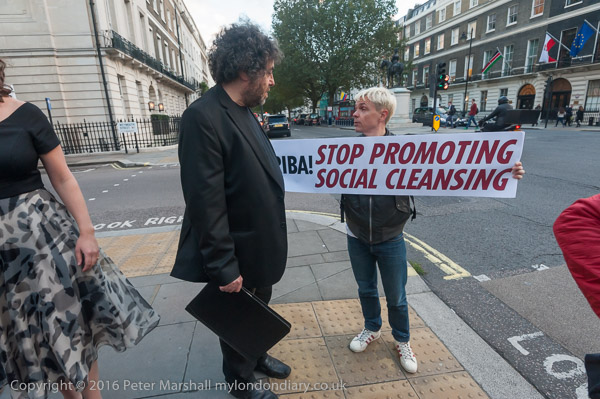
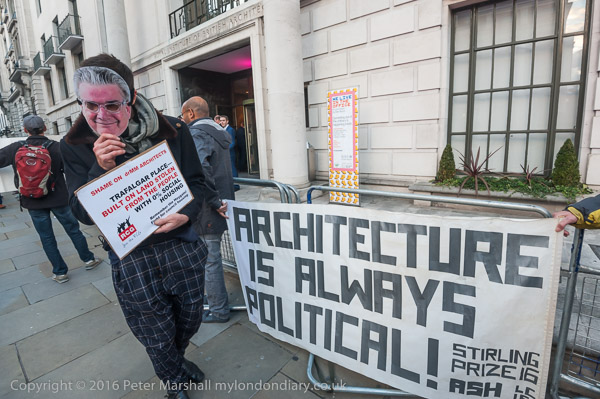
The protest on Thursday 6 Oct was outside the Stirling Prize Ceremony where Trafalgar Place, the first phase of Lend Lease’s development on the Heygate had been nominated for the prize. drMM Architects didn’t win that prize, but outside were awarded the Architects for Social Housing ‘O J Simpson Award for getting away with murder’ though they didn’t turn up to accept it.
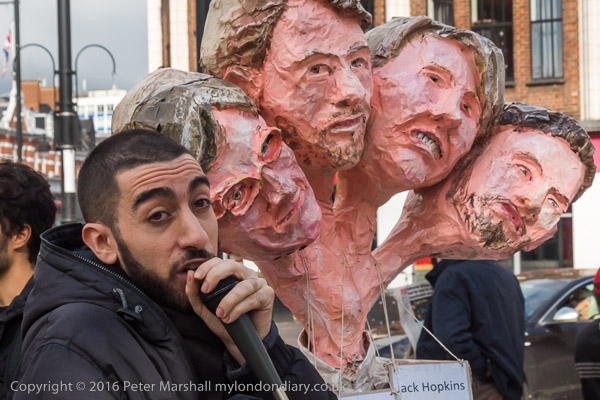
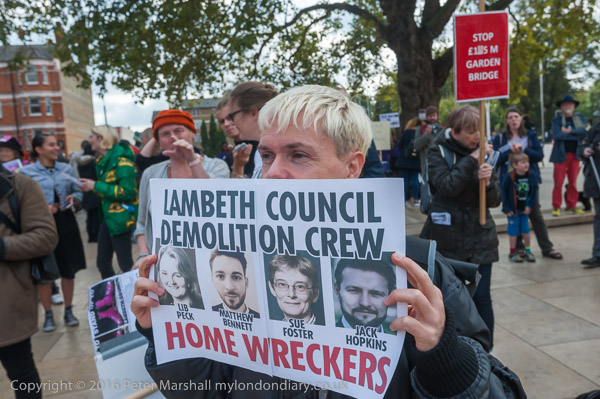
The following Saturday I was in the neighbouring borough, Lambeth, celebrating the achievement of that council, also Labour, calling on it to stop demolishing council estates, closing libraries and driving out local businesses with the closure of the Brixton Arches. Among the estates being demolished or marked for demolition are Myatts Field North, Cressingham Gardens and Central Hill, the last such fine example of good architectural and community design that it is hard to believe was denied listingon other than political grounds.

ASH protest Stirling Prize
Stand Up to Lambeth Council
Stand Up to Lambeth March
Brixton Arches & More
Continue reading Housing
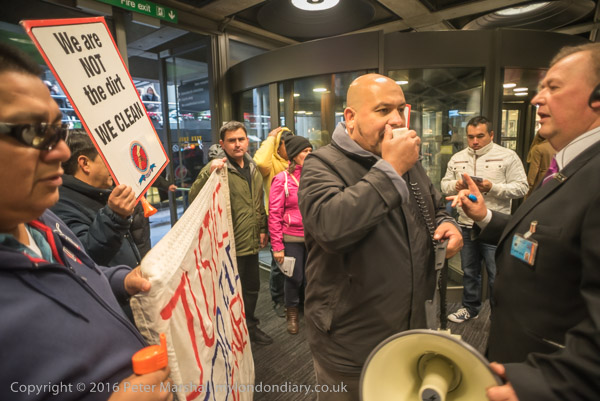
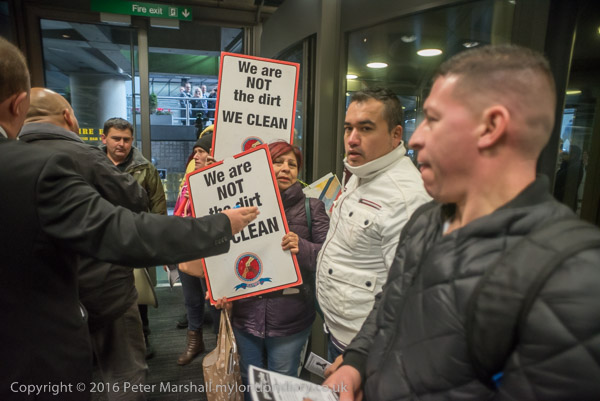
Cleaners at Mace

There are always a number of things on my mind as I photograph protests by low-paid workers such as the cleaners protesting at a workplace. Obviously there are the reasons for the protest  – and if I didn’t feel they were justified I wouldn’t be there. Often, as on this occasion the workers have a number of greivances. They say the employer, Dall Cleaning Services had promised to pay them the London Living Wage,  and then had sacked two cleaners and increased everyone else’s workload  to keep their costs down, and that these sackings had been without notice or proper procedures.

While these sackings could be taken to a tribunal, where in all probabilty the workers would win their case, going to tribunal takes a long time  and has now been made an expensive process, with costs calculated by the Tory government to be high enough to make it virtually impossible for the ordinary worker. One of the advantages of belonging to a trade union is that they can usually afford to take cases like this to tribunals and also supply trained legal support. But the changes in the law have made it much cheaper and faster to try to settle such matters by protests and strike.

Here the workers were also complaining about the Dall’s management, in the workplace , dominated by members of one family, whose members working there were treated better than the other workers. They want an end to nepotism in the workplace. It’s something that should be policed by Dall’s higher management but the cleaners say their complaints are simply ignored.

But I’m also thinking about my legal rights. On the street there are few if any restrictions on photography and on publishing as news coverage. But it seemed likely that the IWGB would manage to enter the foyer of the Mace offices. The position on private property is less clear, but certainly, unless I was specifically asked to stop taking pictures by a person I was convinced represented the owners of the building I intended to photograph the event.

I hang back slightly as the cleaners rush in, but after the first two or three have gone past any security at the entrance, follow in with the others. It certainly is no part of my job to actually force an entrance in any way, but if there is an open door from the street I’ll happily walk through it.

Fortunately no one asked me to stop taking pictures, and knowing that it was likely they would be going inside the building I’d remembered as we went towards it to increase the ISO  setting on both my cameras. Because there would be less light and there was a possibility of some action taking place I’d set both cameras at ISO2000 or ISO2500.

It’s an important advantage of the D810 that it has an ISO button on the dial at the top right of the body, and pressing it displays the ISO in the top panel, where its a simple matter of turning the command dial to alter it, and the same is true of the D700 with which I took all of the pictures I’ve actually used in this post.

With the D750 I now use you need to go into the menu, though I make things easier by putting the ISO on the user menu, along with other items I’m likely to want while working, and making sure to enter the User Menu before starting taking pictures.

I could rely on auto-ISO, which I actually usually have turned on, but for this to be really effective you have to select a fairly high shutter speed as the minimum speed at which the ISO increases. With a lens like the 28-200 zoom there is really no sensible choice. I’d be quite happy with 1/30th at the wide end, but at the long end I’d want 1/250th or faster. It would be nice if Nikon would allow the camera to apply the 1/focal length rule – and better still if it allowed you to choose from various fractions or multiples of this. All of the pictures in this post were made with the 16-35mm f4, though I was also using the 28-200mm.
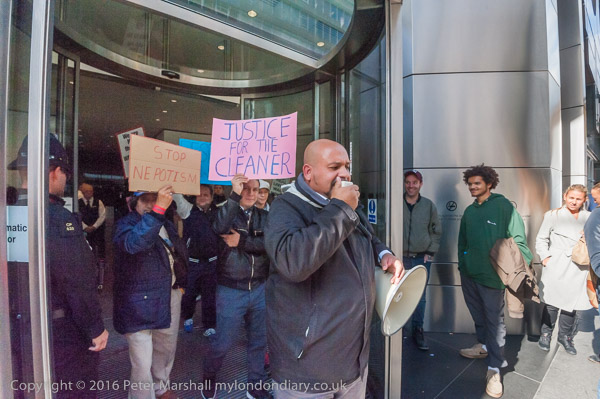
Inside occupations such as this it is difficult to work sensibly, in part because you never know how long you are likely to get to take pictures. I try not to simply dash off pictures but to get images that have something to say about the particular protest, looking for elements that identify the company concerned or make clear why the workers are protesting.  I also make a conscious effort to vary my viewpoint and angle of view to provide a variety of images.

An element of farce was introduced when the police finally arrived, a single officer who clearly didn’t really know what to do. After failing to get a great deal of attention from Alberto Durango who was leading the protest, he stepped aside and called for help.

As usual the protesters left in an orderly fashion when they felt they had made their point – and that the police might start to arrest them for aggravated trespass should they remain, and the protest then continued on the pavement.

Protests like this, that make clear how badly the cleaners who clean the Mace offices are treated and embarrass them as they would any respectable company, and usually lead to pressure being put onto cleaning contractors, all of whom seem out to give their staff little or nothing more than the bare legal minimum conditions and to employ management who just aren’t up to the job.

In this case I don’t recall the details, but it wasn’t long before  a further protest was called off as a satisfactory settlement had been reached.

You can see more of the pictures I took at this protest by the IWGB (Indpendent Workers of Great Britain) on My London Diary at Cleaners demand ‘End Nepotism’.

Continue reading Cleaners at Mace

Heathrow Again

I don’t like airports and air travel. As someone with a sensible level of concern about the environment I try hard not to fly – and managed to avoid doing so until I was sixty. Since then I’ve flown on I think 8 occasions, mainly when I’ve been invited to talk or exhibit photographs overseas, and where there was no real alternative.

I’m obviously not a great traveller, though I have been to quite a few parts of the United Kingdom over the years, but there is still so much that is new here that I’d like to explore. And even in London I occasionally still find parts I’ve not visited.

Airports like Heathrow seem designed to generate the maximum unease amongst those passing through, and are designed largely to sell goods to those passing through rather than to transfer passengers in an efficient manner from entrance to plane and vice-versa. I’ve travelled through a few smaller airports which do just that, where you can get off a plane and be taking a bus or taxi away in just a few minutes – and you can catch one with only a short queue to go through a security check and just a few minutes waiting. No huge shopping areas and extended periods to wait in them.
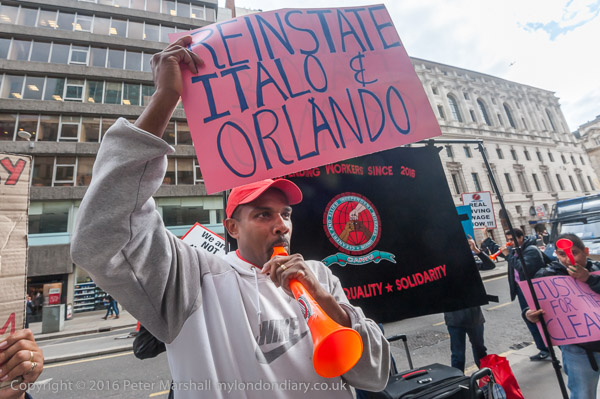
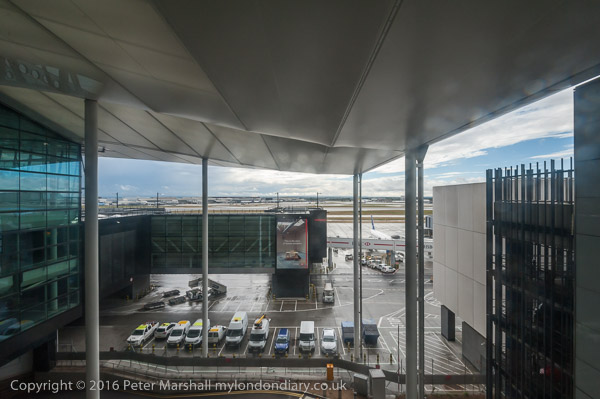
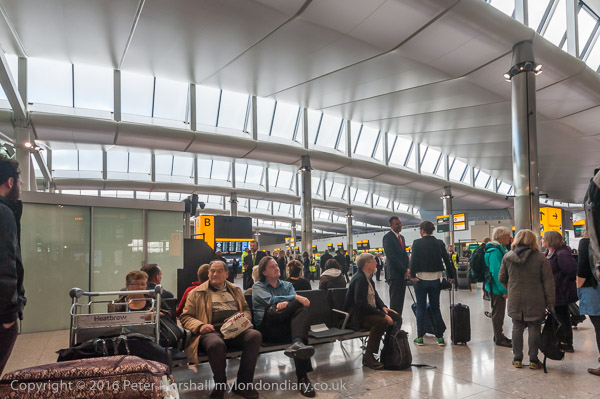
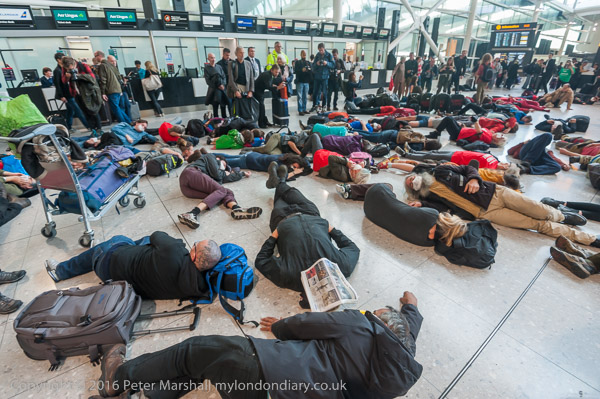
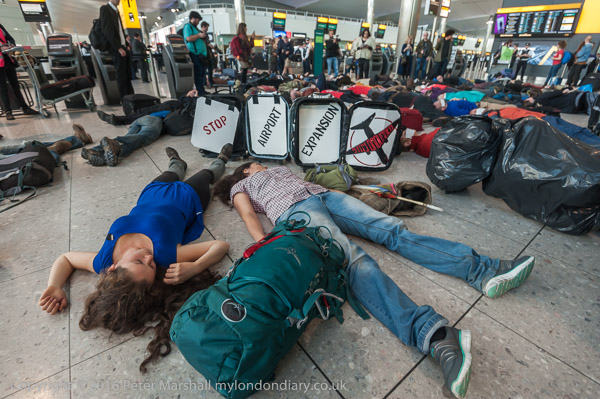
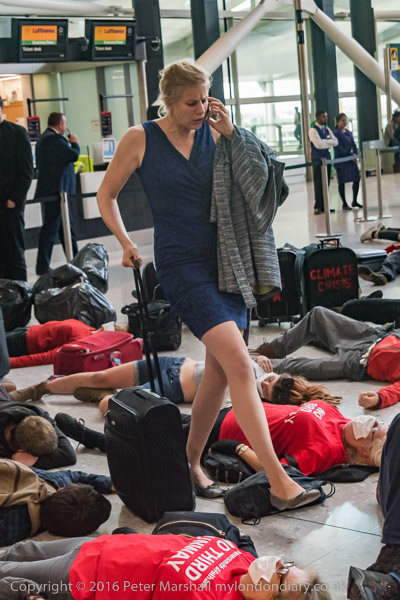
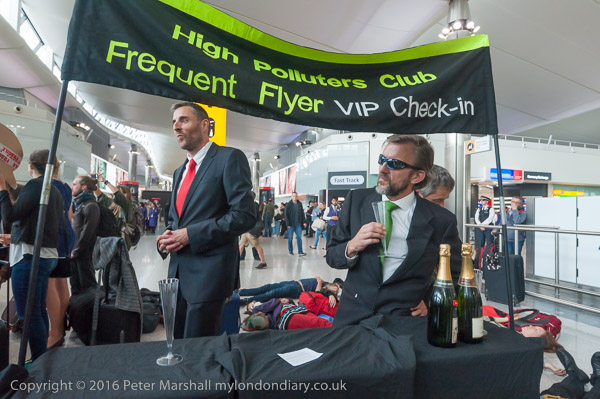
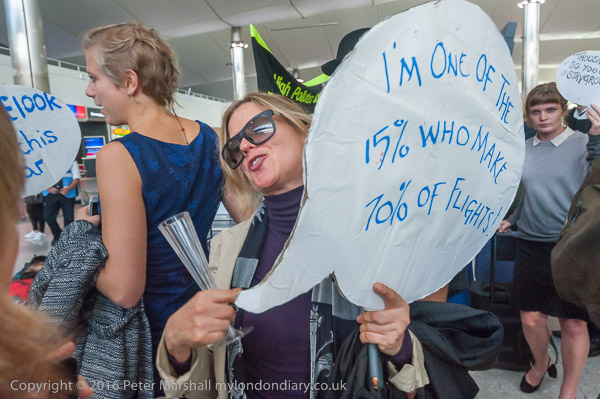
Reclaim The Power’s #StayGrounded protest made some of the issues clear, though perhaps not to all the travellers passing through Terminal 2, who probably couldn’t see the speech bubbles with things like “I’m one of the 15% who make 70% of all flights” and probably didn’t see or appreciate the ‘Frequent Fliers’ stepping over the ‘dead’ on the ground to get to the ‘High Polluters Club Frequent Flyer VIP Check-in’. And relatively few would have heard the speeches.

Photography – and of course video – is vital in getting the point of protests, particularly onrd like this which have a narrative across to an audience. And to a wider audience than those few members of the public who actually experience it. Of course the highest numbers see them through TV and newspapers, and this protest did make some of them even on the channels which like to ignore or minimise protest, but many too see them through social media. Even web sites and blogs like this have thousands of readers each day.

Air transport – for goods and people – is expensive and essentially wasteful. It creates pollution and wastes resources and is an important factor in climate change. We need to look not at ways to increase it, but ways to cut it. Some of its popularity is because of huge subsidies that currently encourage it, and those need to be removed.

Our recent election in the UK has perhaps served largely to show that we need a better voting system, that more accurately reflects the views of the British public. I welcome too the fact that it has brought out more young people to vote, and that a significant number of voters have begun to see through the media lies about Corbyn. As someone – not a Labour Party member – who had been saying since he became party leader that he represents Labour’s only chance of being elected to govern in 2020 I think the Labour vote shows I was right. Certainly he is the only Labour leader who could win if there is another election soon (and its highly likely.)

And until we do have another election the good news is that the vote needed for the expansion of Heathrow is unlikely to go ahead in this Parliament, which is good news for those of us who live in and around London, for the nation and for world climate.

I had been worried on my way to the protest that airport security might make photography difficult, but I had no problems as they stood back and watched, stopping the protesters from going into the security area and directing passengers in alternative ways to avoid being held up by the protest. The protesters too had obviously decided against any confrontation here, which was, for example why all the plastic champagne glasses of those ‘high polluting frequent flyers’ were filled only with air to abide with the bylaws.

You can see the whole story of the protest – which ended in singing and dancing – at Heathrow flashmob against airport expansion.
Continue reading Heathrow Again

LSE Cleaners dispute starts

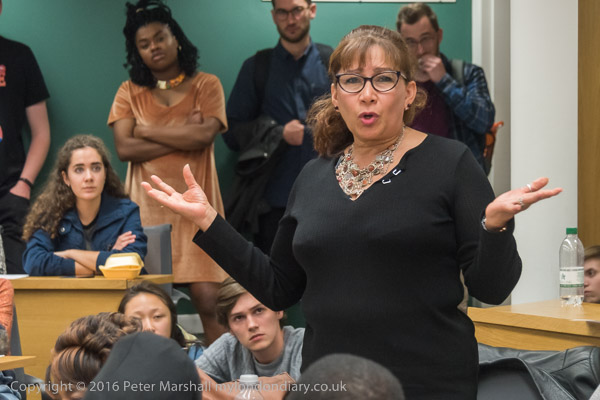
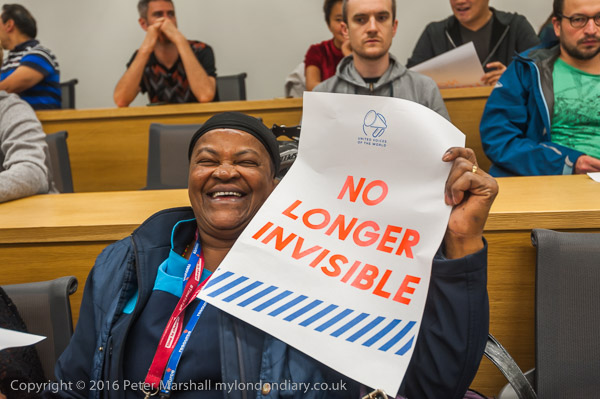
As a part of the LSE‘s 3-day ‘Resist’ Festival organised by Lisa McKenzie the United Voices of the World trade union which many of the LSE’s cleaners belong organised a meeting to launch their campaign for decent and equal treatment. The cleaners work in the various buildings around the LSE campus but are not employed by the LSE who use an outside contractor, Noonan, to employ them.

Outsourcing contracts like this are generally awarded to the cheapest bidder, and the companies involved cut costs by providing minimum standards – low wages and statutory benefits – and increasing workloads, employing fewer cleaners to do the same jobs. Workers are also not provided with proper safety equipment and many suffer health problems. Low wages for supervisors and managers also mean they generally get less competent managers – and at the LSE there were allegations of illegal favouritism and discrimination, and of generally being treated like dirt. Outsourcing results in these essential staff working in the LSE under conditions of service far worse than any that the LSE would offer to those directly employed – and also in lower standards of cleaning.

Our large trade unions that have traditionally represented low paid workers such as these have in many organisations failed lower paid staff and particularly out-sourced staff such as these, often being more concerned about maintaining pay differentials than getting better pay and conditions for the lowest paid. Language too has often been a problem, with many of these workers being Spanish speakers. So as at many other workplaces, the cleaners have joined grass roots unions formed and run largely by workers like themselves, often with support from academics and campaigners for social justice, such as the UVW. And because these unions are active and successful, many managements refuse to grant them recognition.

As well as seeking equal conditions of service to workers in similar grades directly employed by the LSE and to be treated with dignity and respect, the campaign at the LSE was also one for union recognition.

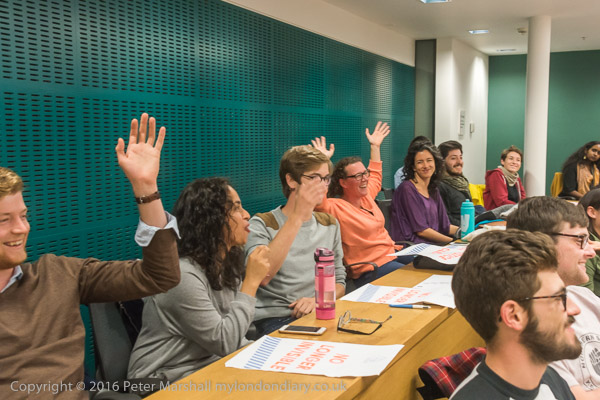
I was pleased to be able to attend and photograph the meeting, chaired by the UVW’s General Secretary Petros Elia, which was attended by many of the cleaners as well as their supporters including LSE students and staff, among them a whole group of students from the LSE’s new graduate course on equality issues and LSE Students Union General Secretary Busayo Twins.

All present were shocked when one of the cleaners, Alba, stood up and told us how she had been unfairly sacked that week after 12 years of service at the LSE, and the demand ‘Re-instate Alba‘ was immediately added to the campaign.

I was pleased that several of the photographs I took at this event were used by the UVW in promoting its campaign, and to be able to come back and photograph many of the protests and pickets that were a part of the fight for justice. Even more pleased to read a few days ago the following statement from the UVW:

UVW is proud to announce that the LSE cleaners will be BROUGHT IN-HOUSE and become employees of the LSE from Spring 2018! This will ensure they get, among other things, 41 days annual leave, 6 months full pay sick pay and 6 months half pay sick pay, plus proper employer pension contributions of up to 13% of their salary.

This is the most significant victory for any group of workers in UK higher education today, and will hopefully set a precedent to follow for other degraded outsourced workers across the country.

LSE Cleaners campaign launch

Continue reading LSE Cleaners dispute starts