Bangladesh and Harrods

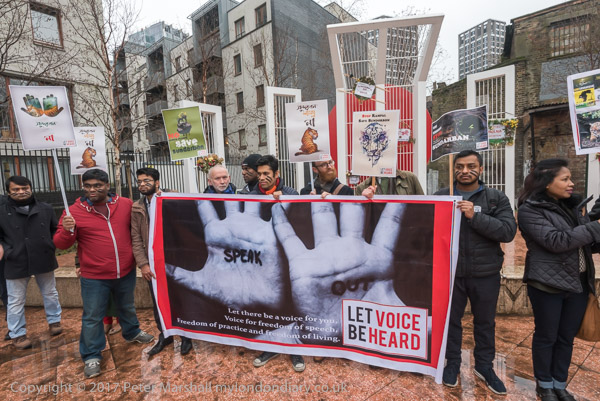
My New Year’s Resolution to take things a little easier this year started well and it was not until Saturday 7th January that I picket up a camera with intent, traveling to Whitechapel in the East End, the centre of London’s Bangladeshi community, for the London event in a the global day of protest to save the Sunderbans, the world’s largest mangrove forest.
I’ve never been to Bangladesh, though in the past I’ve been invited and we now have parts of our wider family there through my son’s marriage last year. But it would be a very long way on a bicycle and I really would have to have some vital reason to justify the environmental cost of flying there.
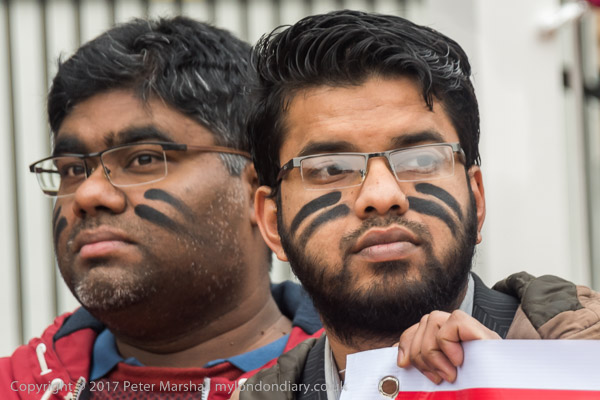
The Sunderbans protest was all about the environment, and the loss of a unique habitat and the species it supports, including the Bengal Tiger, threatened by the development of a coal-fired power plant on its northern edge at Rampal. The development would be disastrous for this fragile ecosystem, and also another nail in the coffin of our world as a whole, increasing the production of greenhouse gases and reducing an important area for their absorption.

It’s difficult for me to understand why anyone should want to build a coal-fired poor station in an area with such a abundant supply of solar energy, with the cost of generating electricity from this falling at a huge rate. If it goes ahead by the time it is built it will be outdated technology – but of course the same will be true about our own fearfully expensive white elephant under construction at Hinkley Point.

More at Save the Sunderbans Global Protest.

The journey from Whitechapel to Harrods was from one side of London to the other – East End to West End – and to very different issues, though I suppose still at base about the greed of the wealthy, who profit from wrecking the environment and also from stealing the waiter’s tips.
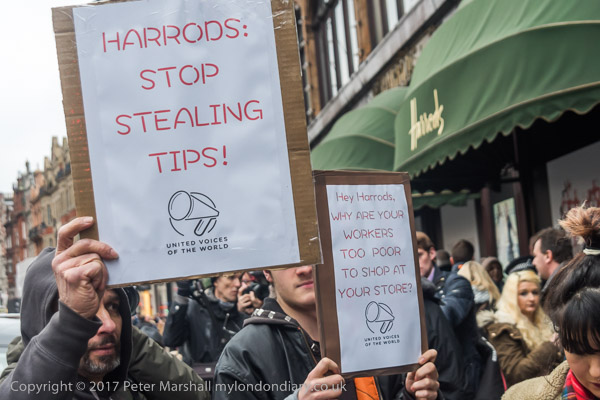
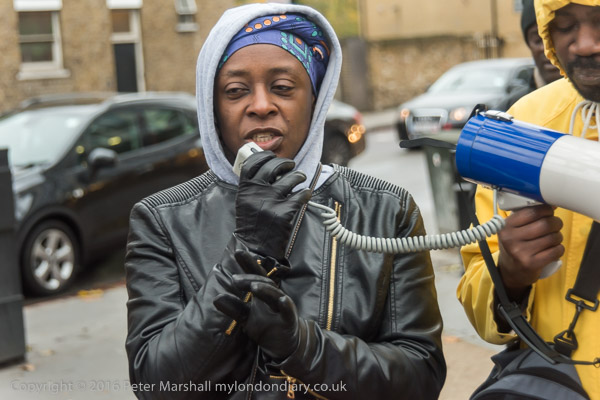
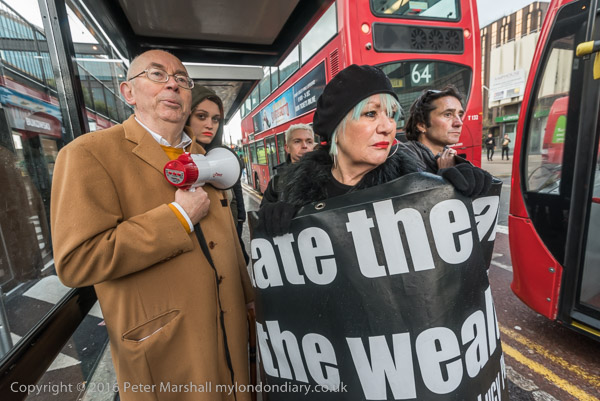
United Voices of the World were protesting outside Harrods on behalf of the many waiters who are paid on or a few pence above the minimum wage in an establishment that caters for the ultra-rich. When these diners leave tips for the waiters they expect them to go to to the waiters and catering staff – but much of them instead was going to swell the profits of the owners, probably the richest family in the worlds, the Qatari royal family.
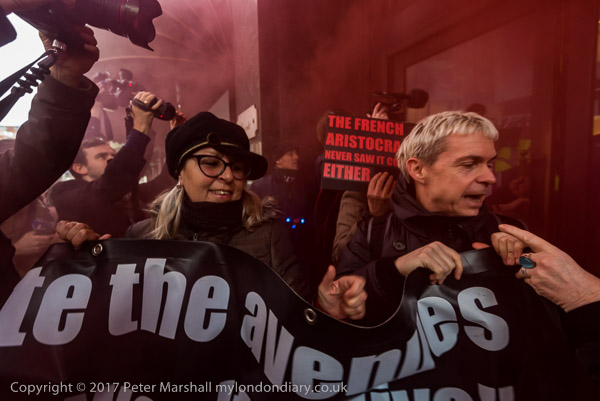
The action by the UVW was supported from its inception by Class War, who turned up with a couple of banners and helped to make the protest even more noticeable. It was perhaps the reputation of Class War that aroused a huge reaction from the police and the interests of some of the press, and the policing was really at extreme levels, with officers on all sides of the block containing the store and vans parked in all the side-streets around, considerably outnumbering the protesters. Harrods too seemed to have a large number of extra security officers on duty inside the store.

Officers came and told the protesters that if they entered the store to protest they would immediately be arrested for aggravated trespass. Some had already gone inside earlier, hiding leaflets about the protest in places where customers and staff would find them later, and had left undetected.
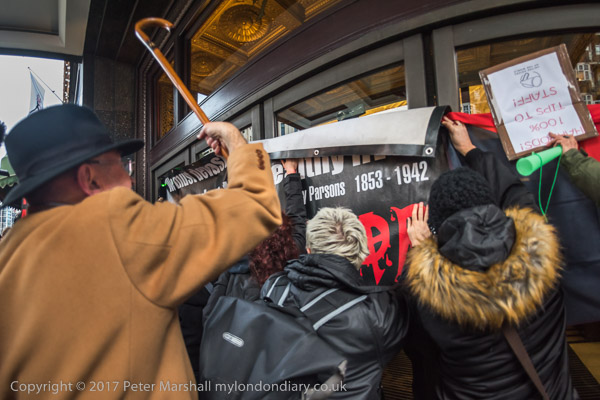
Class War’s methods were more direct, though largely street theatre rather than posing any real threat to property. There was a struggle to open the main doors, and to cover them with their banner to stop those inside filming the protesters, but mainly a lot of shouting and dancing.
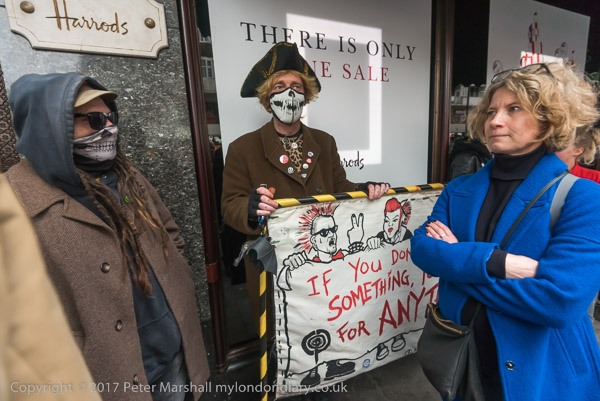
And there was very much a clash of cultures, which seemed to me to be summed up by the expression on the face of one well-dressed woman on seeing some of Class War’s more distinctive characters.
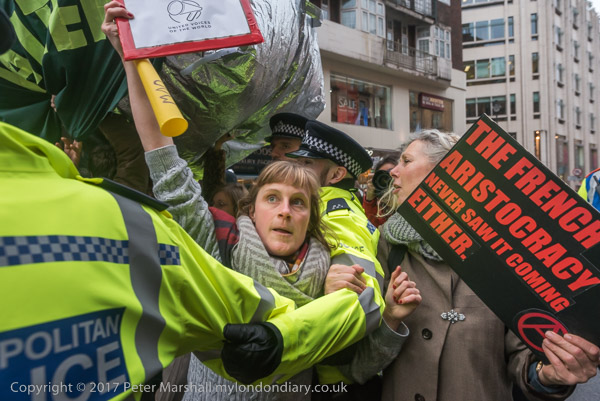
The protesters moved off the pavement onto the Brompton Rd in front of the store and were intending to march around the block, but police surrounded them and kept them blocking the road for some time, urging them to go back onto the pavement when they would probably have moved away much more quickly. Eventually the police gave up pushing and threatened to arrest anyone who stayed in the road and the protest moved back to block the pavement. One woman standing on the curb was arrested for arguing with the police that she was on the pavement, and a few minutes later police snatched another who they accused of letting off a smoke flare earlier.

The protesters moved to a wide pedestrian are at the corner of the building for a short rally and then brought the protest to an end, and people, including myself left. Later I heard that as the UVW was packing up police came and arrested four of them including the UVW General Secretary Petros Elia. They were kept in cells at Belgravia police station for up to 18 hours before being released without charge (though the guy accused of letting off a flare apparently accepted a police caution) but on police bail with a condition that they were not to go within 50 metres of Harrods.

These arrests of trade unionists seemed a clear abuse of police powers and a clear demonstration of whose side the police were on. I commented at the time:

It appears to be a deliberate abuse of the law to try to stop protests at Harrods – however legitimate these may be. Harrods and their owners, the Qatari royal family have many friends in high places including the Foreign Office and presumably these were able to put pressure on the police to take action against the protesters.

Many more pictures at: Harrods stop stealing waiters’ tips.
Continue reading Bangladesh and Harrods

M4-15

People often say things about it being a nice day to take photographs when its bright and sunny with a clear blue sky, but such days, welcome though they are for other reasons, especially in winter, are ones that photographers dread, with sun from a low angle, deep shadows and ridiculous contrast.

And December 22nd was one of those days, and I left home knowing things were likely to be tricky as I walked to the station. The trial of the Rising Up “M4-15” who had blocked the motorway spur into the airport in a protest against Heathrow expansion was taking place at Ealing Magistrates Court, and a protest in solidarity was starting there rather early in the morning.

I seldom do early mornings. For me its one of the perks of being my own boss and doing what I like to have a reasonably leisured start to the day, and in any case catching an early train doubles the fares. I decided arriving a little after 10am would be plenty early enough, and although the protest had been going for a while I hadn’t missed anything of importance. Many of those coming to the event had made a similar assumption too.
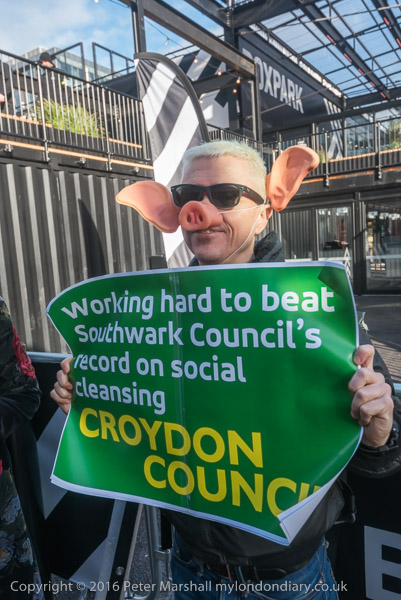
While there were a few things to photograph, the event only really got going later, and like almost everything to do with courts there was a lot of waiting around. And waiting around.


John Stewart’s head could have done with a little less exposure

You can see my problems with the light in a few pictures. Some of them could have been solved by using fill-flash, but others it would have created worse problems, so although I’d had the flash in my bag I hadn’t used it. There are some situations where the flash creates a very different atmosphere and this event, largely very informal, was one of them.

I like to keep things technically as simple as possible when I’m taking pictures, and the Exif data on every picture I took reads Mode: P, Meter: Matrix, No Flash, Auto WB. It’s mainly amateurs who express surprise that I usually work using Program mode, but it works and the dial under my thumb lets me chose a faster speed or a slower one for a wider aperture should I think it necessary. 99% of the time it gives the result I want without my having to pause and think about it.

Nikon’s matrix metering is pretty good too, though I usually have a third of a stop underexposure set to keep a little more of the highlights, I should probably have made that two or even three thirds for the high contrast light, as just occasionally I lost important highlights. Shadows don’t matter much as there is always more you can dig out from the RAW file in Lightroom.

I do sometimes use spot metering (or at least what Nikon call spot.) Back in the days of film I used it most of the time, both the spot metering of the Olympus OM system (surely the OM4 remains the best camera of all time for exposure metering) and also a handheld spot meter, because you needed to be precise, especially with transparency film, and even with black and white I enjoyed placing the key value on the Zone where I wanted it. But spot metering requires you think about it, and when you forget to change back to matrix produces some very uneven results, as I’ve too often proved.

Technically, digital cameras are almost certainly more clever than I am and, so long as you keep the highlights, allow you to play almost infinitely back on the PC with print exposure and contrast. I’m happy to put the camera on P and do that stuff while I concentrate on content and framing. As I’ve often joked, ‘P’ stands for Professional.

Eventually the 14 defendants had to go into court and those of us who didn’t want to go in with them were left standing outside. I don’t like having to hand all my camera gear over so I stayed out. And waited.

Not for all that long, as courts break early for lunch, and the defendants came out and some spoke. They were in good spirits as they felt things had gone well for those who had pleaded guilty but whose solicitor had been allowed to make clear that they were “but only guilty of standing up to climate injustice”.

I’d been hanging around long enough and left when they went back into court and only heard the verdict and sentences later in the day. The 12 who pleaded guilty were all given ‘conditional discharges’, and had to pay £20 victim surcharge and £85 prosecution costs. The cases of the two who had pleaded ‘not guilty’ were adjourned. The Daily Mail clearly didn’t like the verdict, but would probably not have been satisfied with anything less than them being hung, drawn and quartered.

See more at Heathrow “M4-15″protesters at court

Continue reading M4-15

Another Saturday

It was getting close to Christmas and I’d been expecting people to be too busy getting ready for the festival to be out protesting, but there were still protests happening in London.

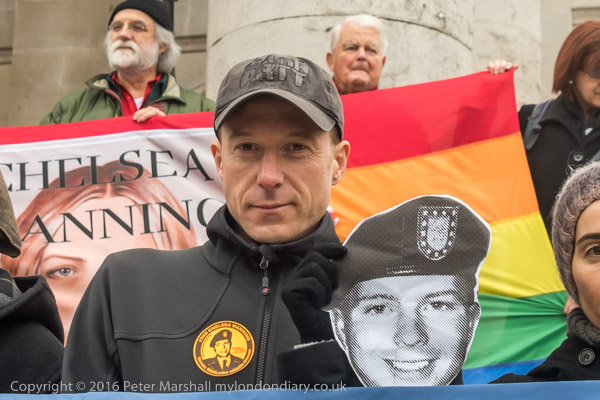
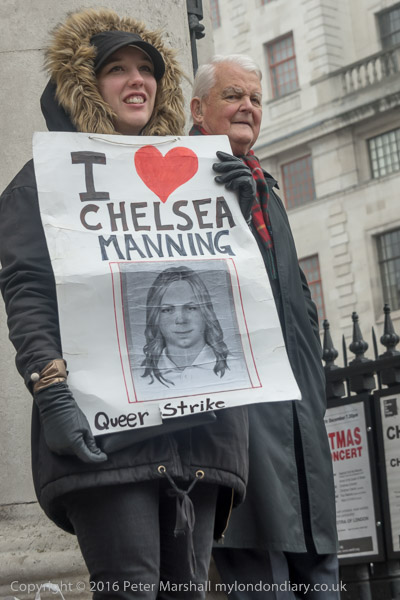
It was apparently Chelsea Manning’s 29th birthday and she was still in jail serving a 35 year sentence for espionage, theft and other offences. She had twice attempted suicide in the previous six months, the second time in November while in solitary confinement as a sentence for the first attempt.

Both a formal petition and one with over 100,000 signatures had been made earlier in the month to President Obama for clemency, asking him to reduce her sentence to time already served. Most commentators thought it unlikely to happen, although the protesters were hopeful – and a month later Obama did commute all but 4 months of her remaining sentence, saying it had been ‘very disproportionate’. President Trump said that she was an ungrateful traitor and should never have been released, but despite this, she was set free in May 2017.

This was a static and more or less silent protest on the steps of St Martin-in-the-Fields – all that is allowed there – and I was pleased to be able to produce quite a variety of images – and of course to have another opportunity to photograph Bruce Kent.

Vigil on Chelsea Manning’s 29th birthday

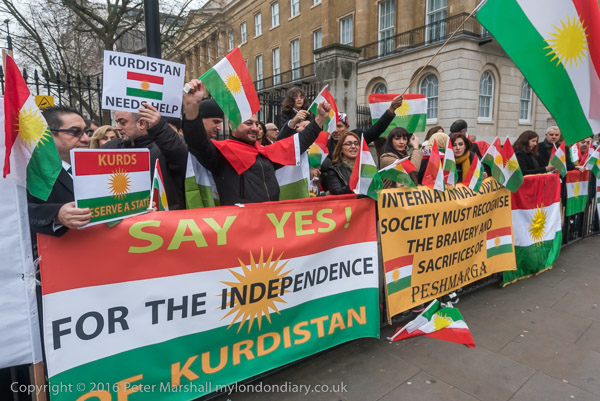
Kurds can always be relied on to be colorful, and I have a great deal of sympathy for them, particularly in Turkey where they have long been oppressed by the Turkish government. But this was a protest by Iraqi Kurds who have enjoyed some autonomy in Iraq since 1970 and more so in recent years, in support of the Peshmerga (or Peshmarga), the military force of the Kurdistan Regional Government (KRG) of Iraqi Kurdistan, established in 1992 with the protection of a US no-fly zone after the first Gulf War.

The Peshmerga stood their ground when ISIS invaded Iraq, while the Iraqi army fled and were the most effective fighting force in the area. But ISIS captured a great deal of up to date US equipment left behind by the Iraqis and are better equipped than the Pershmerga, who need more support – and this protest was calling on the UK government for help.

The UK and other western nations have been reluctant to give much help to the Peshmerga, and the scarf worn by the woman on the right , with its map of Kurdistan explains why, including as it does a healthy chunk of the territory of one of our allies, Turkey, as well as parts of Iraq, Iran and Syria (and I think some of Armenia), all of the territory where Kurds are in a majority.  Having the Kurds fight and help defeat Da’esh is a good thing, but Kurdish nationalism and the establishment of a Kurdish state, which the protest was also for,  would not suit the UK or USA, or for that matter, Russia. It might not even suit the Kurds, as the constitution of Kurdish Syria (Rojava) currently a de-facto autonomous region thanks to the civil war, while inspired by the Turkish Kurd leader ‘Apo’ (Abdullah Öcalan) from his Turkish jail is a rather different politics to that of the Iraqi Kurds.

Kurds protest for a Free Kurdistan

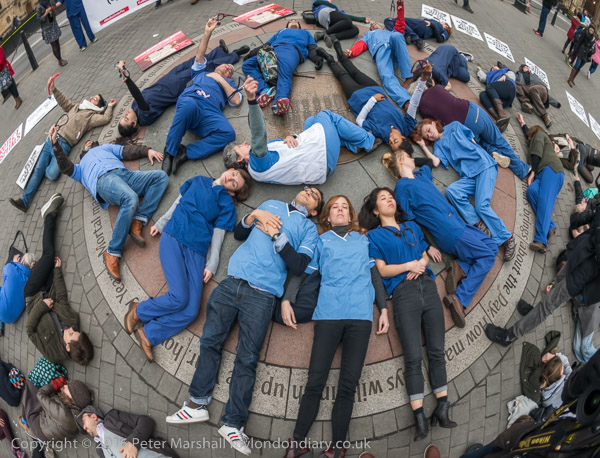
Syria was the subject of a very different protest a few hundred yards away in Old Palace Yard, where healthcare workers, including some who had volunteered in Syria,  held a die-in at Parliament in solidarity with the Syrian people, calling for an end to the bombing by Russia and Assad of hospitals and for the UK government to pressure the Assad regime to allow the delivery of medicines and other aid.

Since the protesters were on the circle in the pavement I thought it would be good to photograph them from directly above. Unfortunately I hadn’t brought my helicopter with me, not even a drone or a monopod, and the best I could do was to stand on the edge of the circle and stretch up my right arm forward and up as high as possible, holding the camera with the 10.5mm fisheye on it. I couldn’t see the viewfinder or the screen on the back of the camera, so had to do my best and then bring the camera down and look to see how I’d done. It took only one frame to decide it looked better without the camera strap in it, but quite a few to get the framing right.

There was still one problem. Because I hadn’t had the camera above the centre of the circle it was definitely not a circle in the image. So I’m afraid I cheated, turning what had been a 1.5:1 image into the 1.31:1  image you see here and making that circle look much rounder.

Doctors & Nurses Die-in for Syria

Continue reading Another Saturday

Students rent protest

Students have more or less always protested, though they sometimes seem rather passive to those of us who were students in the sixties. We protested about various things but in particular about education and the universities, where we sat in various offices and liberated documents about the connections between the universities and the military-industrial complex and called for a revolution and an end to an education system that was geared to supporting the status quo rather than questioning it.

We got a few concessions but really achieved little, though perhaps universities did start to take the teaching of undergraduates a little more seriously and a few more radical courses emerged, though it was more a matter of fashion rather than a change of direction.

But what we have seen since then is an increasing corporatisation of the universities and the professionalisation of management, with students less and less seen as an important part of a collegiate body and more as units to be processed and cash sources to be milked.

It’s a process which has been given a huge boost with the removal of grants and the introduction of student loans and huge course fees for students.

Of course it isn’t just the universities that see students as sources of profit, but also the private companies – in which many in Parliament, particularly on the Tory side have an interest. Student loans have an interest rate which is set to rise to more than 24 times the official Bank of England base rate next month, and student loan debt is now more than £100 billion and fast growing. It is already around one and a half times the total UK credit card debt. The student loans company was set up as a government owned non-profit company, but student debt is now being sold off to private companies.

Another huge earner from students is the provision of student housing, and many of the cranes now visible in London are building high-rise towers for students – or at least for wealthy students, as the rents in many of them are equal or greater than the maximum student loans.

Students used to live either in university halls of residence, in digs with local landladies providing bed and breakfast (and sometimes an evening meal) or in private flats, usually owned by small landlords. Now universities see halls of residence as businesses to make money rather than as a service to its members, and providing student flats has become a huge and highly profitable big business, attracting capital from overseas – such as Singapore’s sovereign wealth fund.

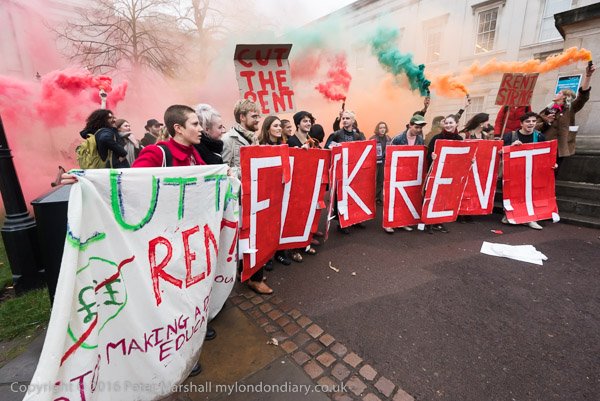
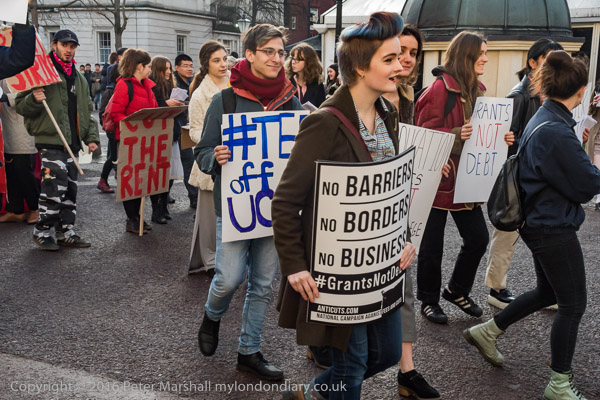
University College London, normally now only known by its initials UCL, has a number of halls of residence, and last year over a thousand students staged a rent strike. Some were striking because of the appalling conditions of their rooms, but others simply because the rents were too high, and the strike was a success, winning over £1.5m in concessions.

But students say the rents are still too high, say many students have to have two or three part-time jobs to study and live in London. They asked for a 10% cut in rents and were protesting after UCL management refused their demand.

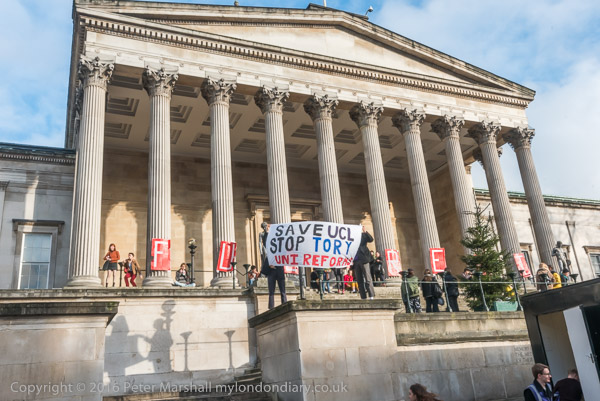
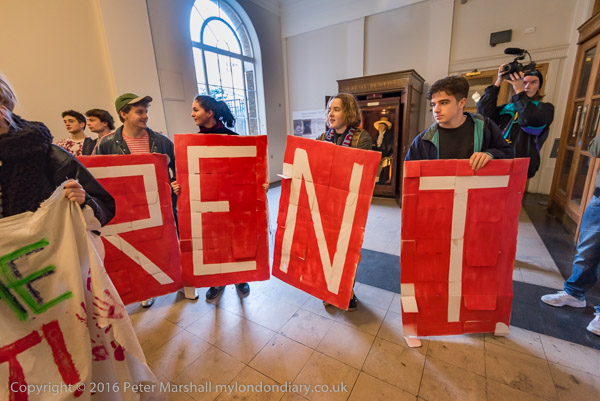
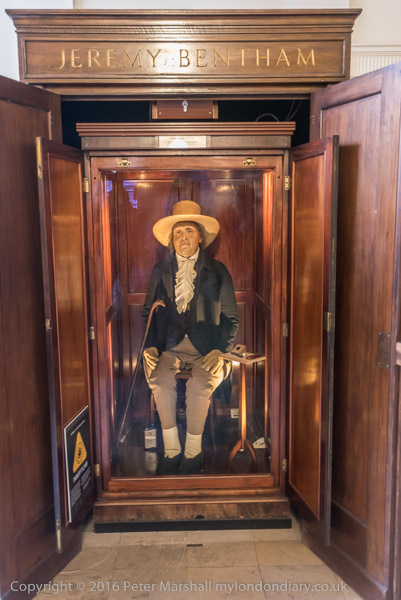
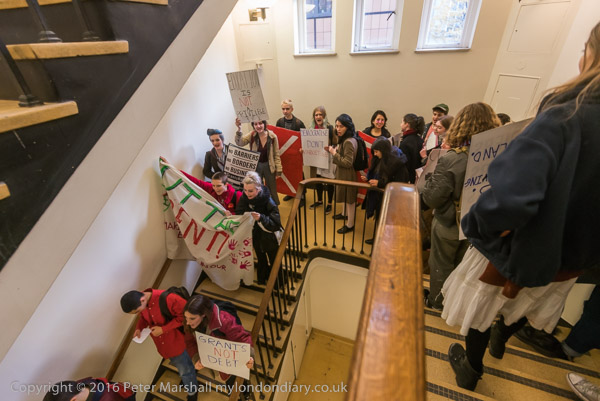
The protest started in the main quad at UCL with its steps and classical architecture, and after a few short speeches took a tour inside the main buildings, passing perhaps its most famous resident, its “spiritual founder”, Jeremy Bentham, (1748-1832), certainly now its oldest member at 268, still sitting in his cupboard.

Fortunately the students knew the way as we made our way along corridors and down stairs eventually to emerge into a courtyard and walk around the streets back to the main quad for some more speeches …

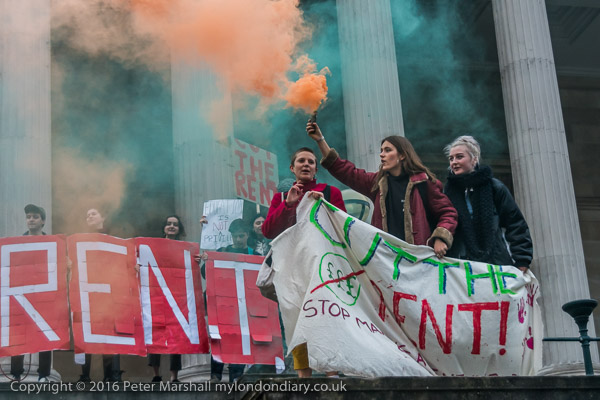
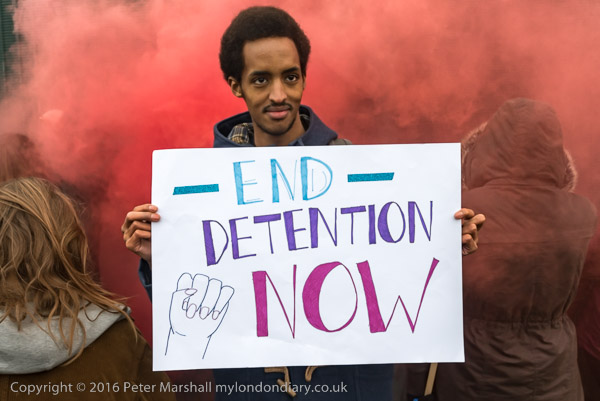
and of course some smoke flares. I made a lot of pictures (and you can see quite a few of them on My London Diary) but wasn’t entirely happy. Smoke is rather unpredictable and it’s difficult to know the best distance; getting in too close can simply mean your whole view becoming a coloured  mist.

UCL Students protest rents and marketisation
Continue reading Students rent protest

How the Grinch Stole Christmas!

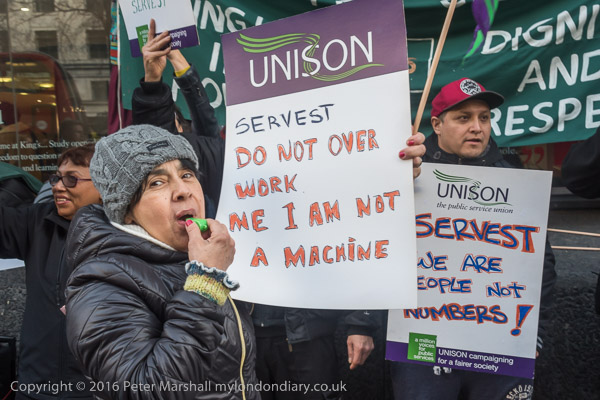
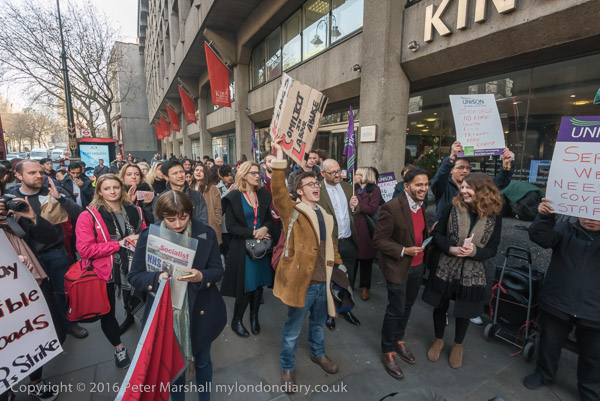
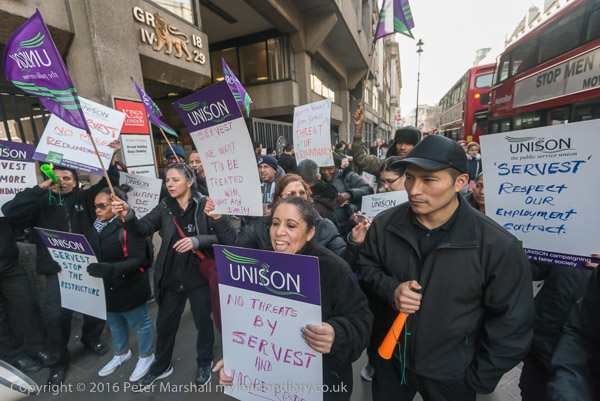
Cleaners were again on the street protesting, this time at King’s College, another of the leading colleges of London University, although as usual the problem arises because instead of King’s College employing cleaners they outsource the cleaning to a contractor, Servest. King’s doubtless feel they have to treat all employees with dignity and respect and give them decent condition of work and terms of service, but cleaning contractors seem generally happy to treat their workers with contempt, employing poor managers without proper supervision, and giving their workers low pay and unreasonable workloads and cutting things like pensions, sick pay and holidays to the minimum they can.

Cleaners at Kings belong to one of our major trade unions, Unison, and the union and Servest have been in talks at ACA, but haven’t manage to resolve the issues and Servest’s response had been to write to all of the cleaners wanting them thatthey intend to ‘restructure’ the workforce and that all of their jobs are at risk.

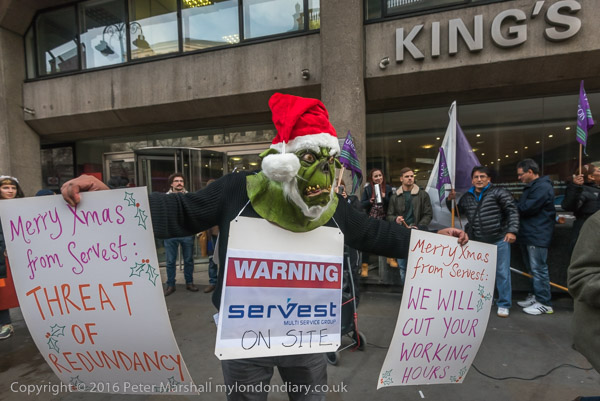
The warning letter came just a few weeks before Christmas, a time when family budgets are always under extreme stress, just about the worst Christmas present the workers could imagine. They felt that Servest, like Dr Suess’s Grinch, was trying to steal Christmas – and their jobs – away from them.

It seemed to be a pretty inept piece of management by Servest, with the union members about to vote on strike action, almost guaranteeing that there would be close to 100% support for this in the ballot – and it was no surprise to find 98% of them backing strike action. They also received great support from students and staff, with more than 50 academics at King’s signing a letter in support of their dispute, protesting at how the cleaners were being treated.

Although the pavement in front of Kings is wider than most, it got pretty crowded, making it a little hard to work as a photographer, and my wide angle lens was essential much of the time.

But it’s important to try an vary the views, and I tried hard to also use a longer lens, concentrating on individuals or small groups with the 28-200mm in DX mode. At the 28mm end this gives an effective 42mm, more or less a standard lens for full frame. The 50mm we usually consider as the standard is actually just a little on the long side, simply because in the early years of 35mm cameras it was a little easier to make lenses of that focal length rather than the image diagonal of 43mm (and the image diagonal is more generally the normal ‘standard’ focal length.)

It was a fairly dull winter’s day and the tall buildings around cut down the light; although it was lunchtime I found myself increasing the ISO to 1600 once the rally really got going. Although Unison is a rather more traditional British union the cleaners and their supporters soon increased the tempo and noise to match that of the grass roots unions such as the United Voices of the World, several of whose members (and the UVW General Secretary) had come to show their solidarity.

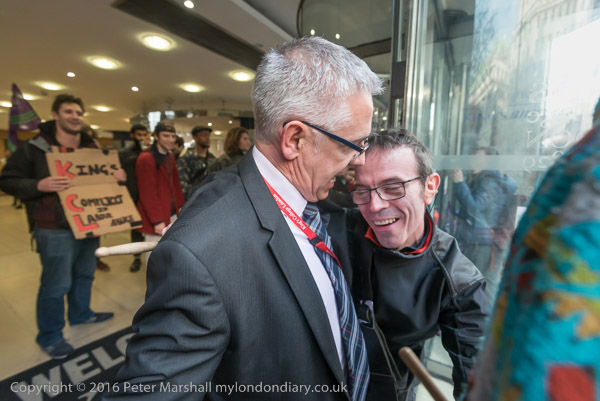
And in typical UVW style they made a rush into the foyer of King’s, confronting the security staff inside who were keeping an eye on the protest. But Unison’s organiser stopped his members from following their example.

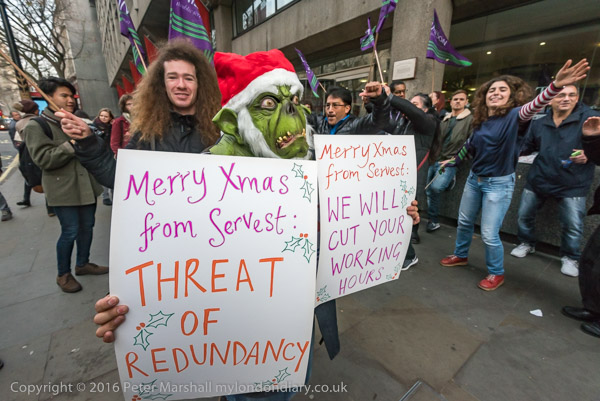
I’m glad I stayed on until the official rally had ended, although I’d been thinking of leaving along with a couple of colleagues. But the cleaners and some of the students and other supporters remained, and there was loud music and dancing, and more space to work – and the Grinch appeared.

More pictures: King’s College cleaners Servest protest
Continue reading How the Grinch Stole Christmas!

Yarls Wood 10


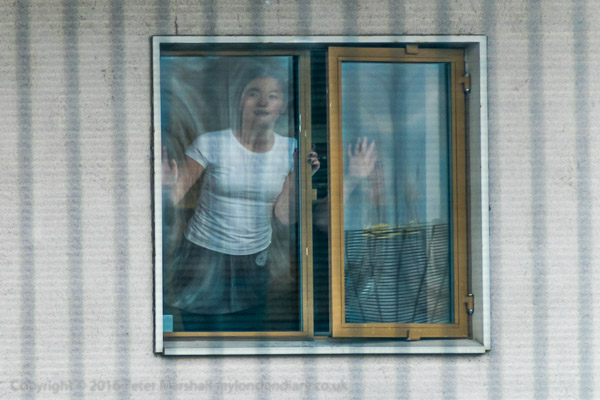
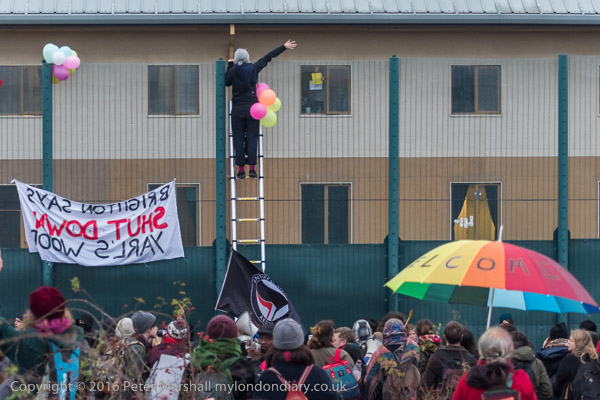
Detainees inside who could get to the windows welcomed the protest

Nothing expresses the racist and and oppressive state of our country more obviously than our immigration detention centres and the whole state apparatus for harassing asylum seekers and refugees. People fleeing violence and persecution, often rape and attacks flee to the UK and are greeting with a Home Office wall of disbelief. While in our legal system you are innocent until proved guilty, for migrants the system works in reverse; the Home Office assumes that they are liars and cheats unless they can produce evidence to prove their claims – and evidence is often impossible to provide.


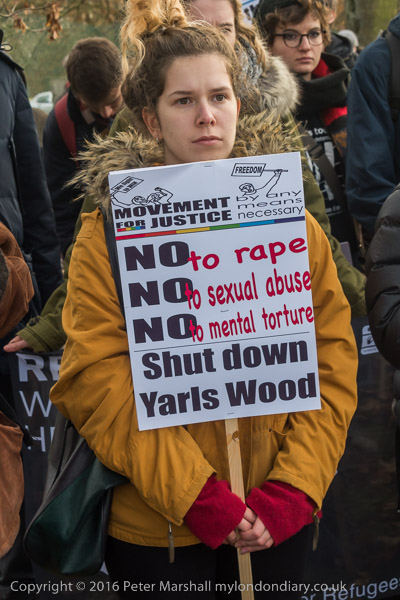
Detainees in Yarl’s wood are subjected to rape, sexual abus and mental torture

Routinely gay asylum seekers are told they are not gay – and sent back to countries where they will face danger and violence because they are gay, Some have to go into hiding, others commit suicide rather than return or after they arrive home.

Others who came here when young or even may have been born here are told they have no right to be in this country – and are sent to countries they may never have been in and where they have no families or friends, removing them and splitting up families living in the uk.

Increasingly under Theresa May and now Amber Rudd as Home Secretary it has become simply a numbers game, trying in any way possible to cut down the number of migrants without regard to personal circumstances or hardship, using mass deportation charter flights to send people to Nigeria and elsewhere, including many whose asylum claims are still being processed.


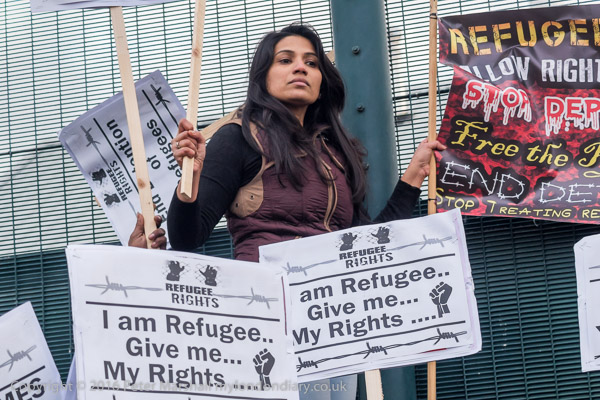
People climb up to show placards and balloons and speak to the detainees

Our immigration prisons are now officially called ‘removal centres’, although many who are held in them will have a legitimate right to remain here. The name change reflects the aim to remove them – whether or not they will be able to prove a right to remain, as many still do.


Refugees to the UK are refused their rights in centres such as Yarl’s Wood

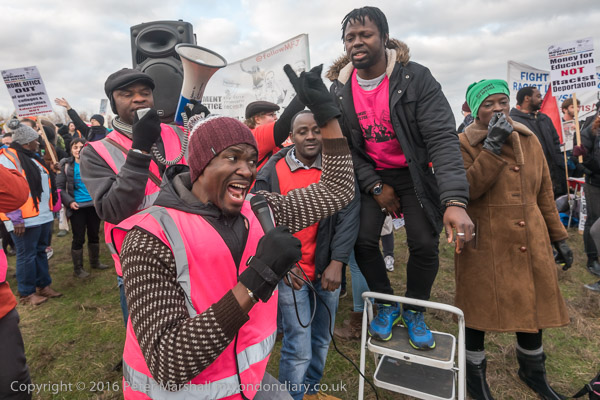
The protest on December 3rd was the 10th at this remote centre in Bedfordshire organised by Movement for Justice, and I think the ninth I’ve attended to photograph. It’s a journey of several hours, made easier on the protest days by a coach provided by MfJ from Bedford Station. Most of those held are effectively cut off from their friends and fellow migrants by the length of the journey and its cost – as most migrants live in urban centres and are poor if not destitute. MfJ also organise coaches from London, Birmingham and further afield for the protests and make it possible for refugees and others short of funds to make the journey. Otherwise it means an expensive train journey to Bedford followed by an over five mile taxi ride from the station.

I don’t cover events like this for the money – and seldom make enough to cover my costs from them – but because I think it important to record what is happening in our society and to make people aware of the issues and I want to do what I can to make that happen. I think the same is true for many of the other photographers there taking pictures.


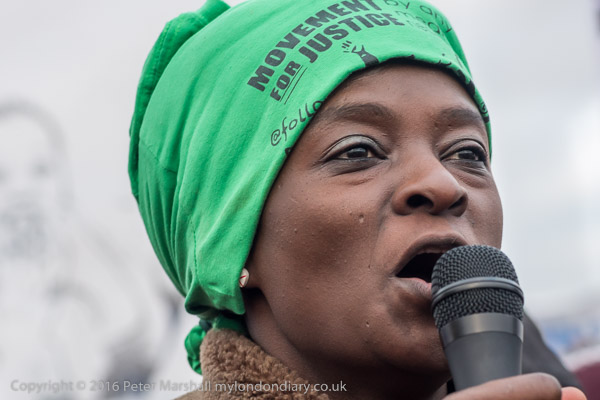
Movement for Justice has led the fight to end immigration detention

Many of those who spoke – and could be heard by those inside the prison – were people who had spent time inside Yarl’s Wood or other detention centres. And a few inside were able to speak from inside using mobile phones – one of the few privileges detainees have over those in our normal prisons. These are prisons in all but name, but with the difference that none of those held knows what will happen to them. Some have been held for weeks, others for years, and many find themselves being taken from them and put on a flight home. Now these are mainly special chartered flights after passengers on regular flights objected to the forcible restraint of detainees on them, at times refusing to let the flights take off, clearly recognising the inhumanity involved.

These detention centres are also a threat hanging over refugees and asylum seekers living in our communities, who have to attend regularly to reporting centres. Every time they go it for these routine appointments they know they may be leaving in transport direct to Yarl’s Wood or another removal centre – sometimes returning from where they have previously been released. Inside these centres, run by private firms such as Serco, they are routinely refused their rights, bullied and poorly treated. Some have died because they have been refused medical treatment, others have been sexually abused.

These centres are a national disgrace, and a quite unnecessary punishment for those who have committed no crime and pose no threat to our society. They make it harder for the claims of those inside to be furthered and justice to be obtained. Any humane government would close them down and offer real help and support to asylum seekers in their place.

I took a great many pictures of the protest, and you can see a selection of them on My London Diary, as well as read a short account of the day in Shut Down Yarl’s Wood 10.
Continue reading Yarls Wood 10

Cleaners & Students united

One chant common on marches and at protests – both in Spanish and in English is ‘El pueblo unido jamás será vencido‘ – or for us monoglots, ‘The people united will never be defeated’. It began life three months before Pinochet’s military coup in 1973, a part of the left-wing New Chilean Song movement with music by Sergio Ortega and was unfortunately followed by the huge setback of the overthrow and assasination of Salvador Allende, though of course the people continued their struggle. In 1975 it was the basis for a piano piece of the same name with 36 variations by modern US composer Frederic Rzewski.


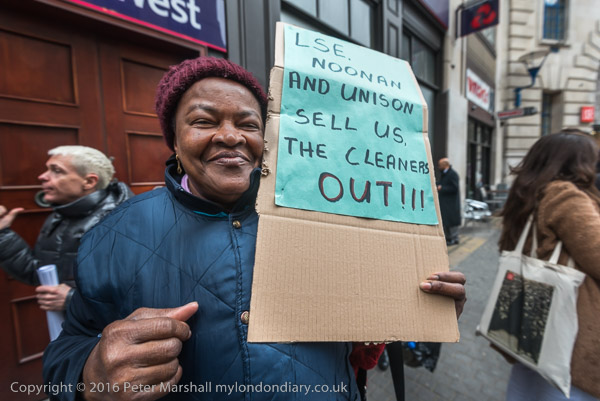
LSE cleaner Mildred

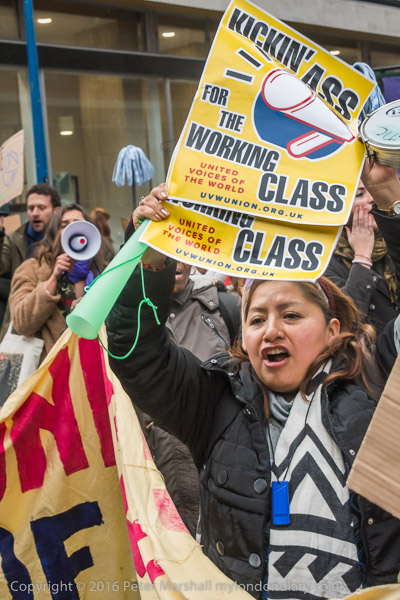
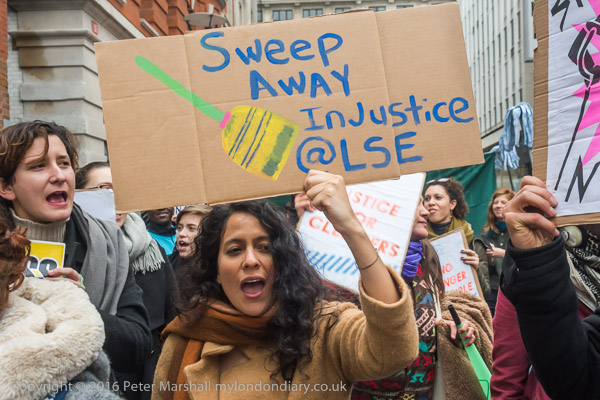
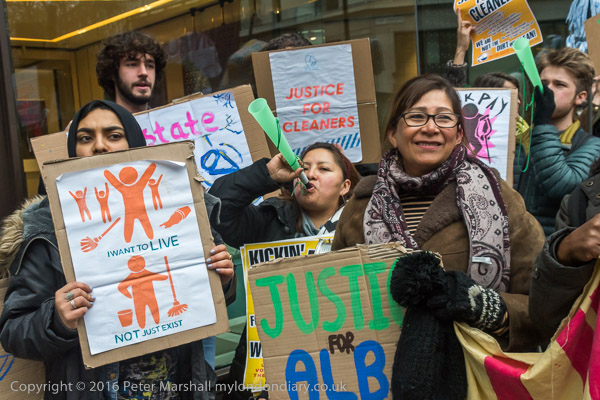
Cleaners & Students united (along with a few members of staff) and with the backing of the cleaners union the United Voices of the World and a few of their friends to secure dignity of treatment and equality of working conditions for the cleaning staff at the LSE. I’d been present when the campaign was launched at the end of September 2016, and again at their protest in October, and was pleased to be back with them again at the start of December. And even more pleased when after around 9 months of campaigning they finally achieved a successful conclusion to their fight.


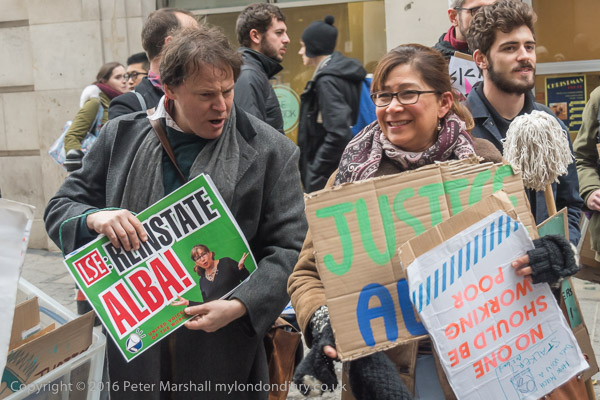
LSE Anthropology Professor David Graeber with sacked cleaner Alba


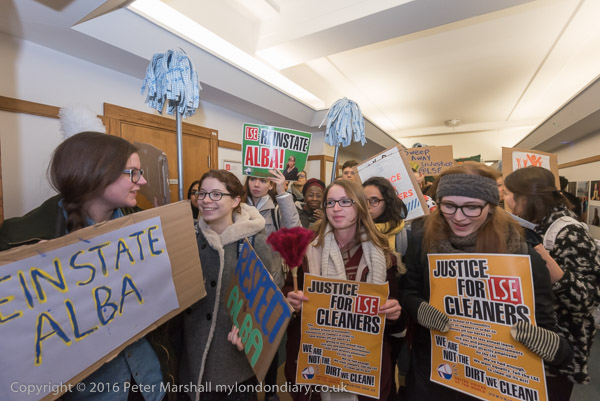
Students, some carrying mops, in a corridor of LSE’s Old Building

The campaigners met in Houghton St, and then defied security and marched through the corridors of the Old Building to Portugal St. As well as protesting on behlaf of the cleaners, this was also at statement by the students that this was their university. As marchers on the streets shout ‘Whose Streets? Our Streets!’ they shouted ‘Whose University? Our University!’. It was a reminder how far institutions like the LSE have been been taken over by managements who seem to regard students as inconvenient but necessary clients who provide the institution with income rather than as members of a collegiate body.


Protesters in Portugal St

Once outside the building the protest continued, and finally marched down Kingsway to the corner with Aldwych, where at 1 Kingsway are the offices of the Estates Division from which Noonan, the outsourced company which employs the cleaners, operate on the campus. The loud protest there made their campaign very visible to the many members of the public on the busy street.


Outside 1 Kingsway

I took many pictures and put rather a lot of them on-line, probably too many, but it was a lively protest and I found it almost impossible to take bad pictures! You might like to look at them with ‘Quilapayún 1973 – El pueblo unido jamás será vencido‘ as a sound track. The protest at the LSE was considerably smaller but had something of the same spirit.

Justice for LSE Cleaners
Continue reading Cleaners & Students united

Class War

I always like photographing protests by Class War. Although they are a small group (though sometimes quite large numbers join with them them) their protests are often very effective in raising issues, and are often unpredictable. The protests are always interesting, both because many of them have interesting views which they share freely and often amusingly, but also because of a sense of theatre.

Generally too there is some visual interest which a photographer can work with, with some excellent banners and posters. And they believe in having fun with their serious politics.

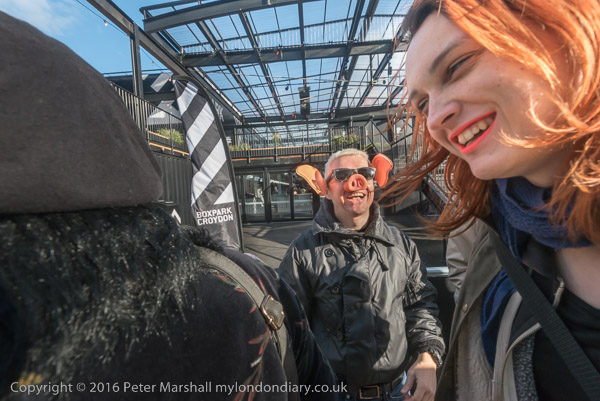
Their confrontational style also tends to make for good pictures, though at Croydon Box Park this was somewhat mollified by the owner coming down and having a serious talk with them, agreeing with much of what they were saying about the gentrification of Croydon and inviting them to come and have a talk later. Though there was more of a confrontation later when they spotted the BBC developers’ apologist Mark Eaton making his way into a meeting.

The heavy showers also dampened the atmosphere a little, sending us all into a nearby bus shelter. Later the large banner with its quotation from US anarchist Lucy Parsons showed its worth as those holding it carried it held over their heads to keep off some driving rain.

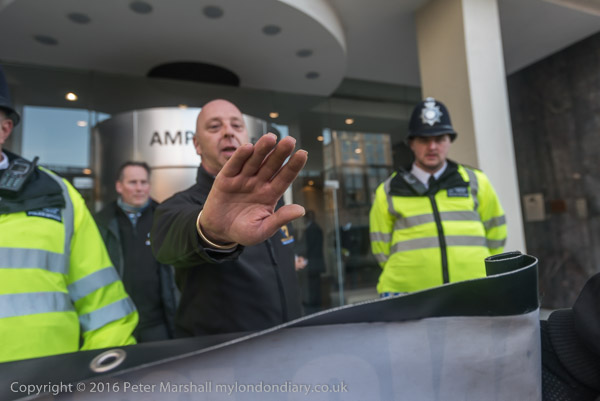
I had my own small confrontation too. As I note in the caption for the picture above, “The only possible response when someone says ‘You can’t photograph me’ is to photograph them.”

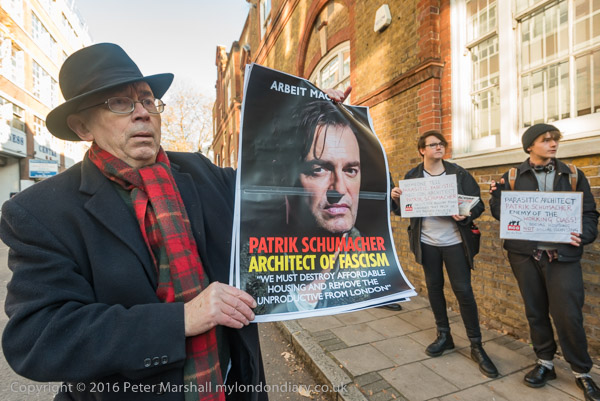
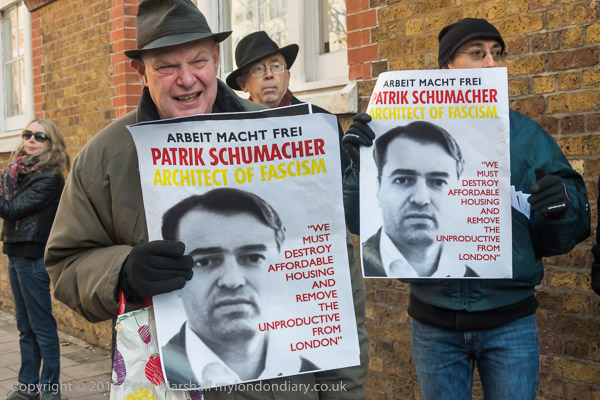
A week later I met up with Class War again, this time protesting against architect Patrik Schumaker of Zaha Hadid Architects, who had talked at a conference in Berlin about getting rid of social housing and public space in cities. The posters from Class War carried what was apparently a quotation from his presentation, “We must destroy Affordable Housing and remove the unproductive from the capital to make way for my people who generate value

It was a chilling sentence, with clear similarities to the thinking and actions of the Nazis, and brought condemnation from a wide range of those concerned with human rights and equality, and housing campaigners in particular.

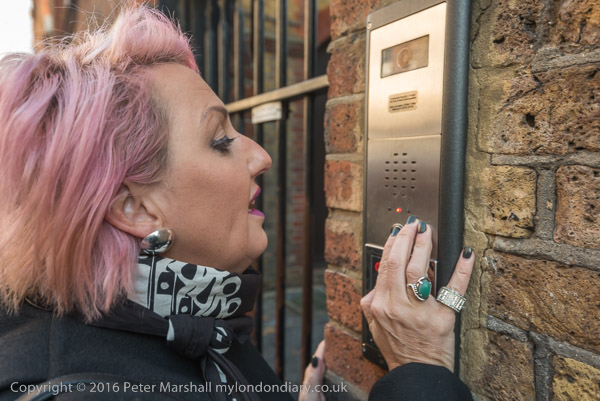
Schumaker’s views were not shared by all architects, and Class War received a message of support from one of those working under Schumaker. Not surprisingly their attempts to make contact with him through the entry phone at the gate and an invitation to come out and discuss the issue were met with no success.  There were extra security guards at the entrances, and even Lisa McKenzie couldn’t charm her way in.

Joining Class War in the protest were others from the London Anarchist Federation and the Revolutionary Communist Group, who also favour a similar kind of direct action and often cooperate at protests.

More text and pictures:

Class War Croydon ‘Snouts in the trough’
Class War protest ‘Fascist Architect’

Continue reading Class War

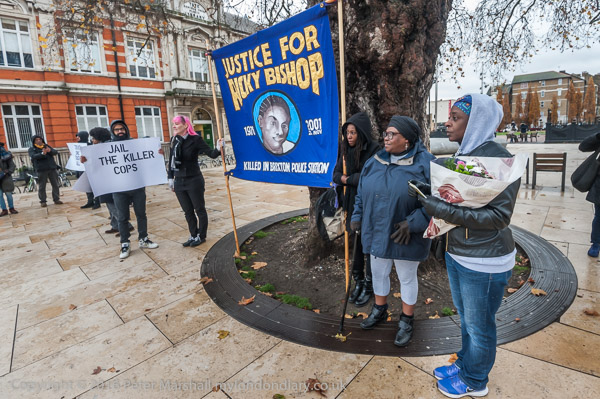
No Justice over Ricky Bishop

Rocky Bishop is just one of the 1,619 people have died while in contact with the police, whether in custody, being pursued, or shot since 1990 – around one every six days on average.

Of course not every one of those is a result of police actions; a few will have died of natural causes, some may have taken their own lives, but the great majority of them are previously healthy people who have been killed, some accidentally but others deliberately by the actions of police. It’s hard to know how many we should describe as manslaughter and what fraction as murder, but a very large number died as a result of actions that had they been carried out by a member of the public would have resulted in convictions.

But, as you may know, and as certainly many of us at the sixth anniversary of the shooting by police of Mark Duggan did know, not a single police officer has been convicted of any crime for these many deaths.

Whenever someone dies at the hands of the police, the first reaction is always to cover up. Police deliberately spread false rumours about the victim – he was a drug dealer, he choked swallowing a package of drugs, he was carrying a gun, he was a dangerous criminal, a gang leader…. And the papers and media broadcast these falsities, creating an atmosphere where the public believes the victim had it coming to him.

One of the most blatant cases was that of an innocent Brazilian electrician, catching the tube on his way to work, gunned down as he sat quietly in the carriage at Stockwell Station. A few days ago it was Rashan Charles, where police spread the lie he was a drug dealer and swallowing drugs. As so often, once the idea had been firmly lodged in the public mind, they issued a correction, which got much less publicity.

Not only this, there is seldom if ever a proper investigation. If we were a suspect in a possible murder or manslaughter case we would be questioned at length, almost certainly arrested and statements taken, but after these lethal incidents occur there seldom seems to be any proper inquiry. Often we find the officers involved have not been questioned days or weeks after the event.


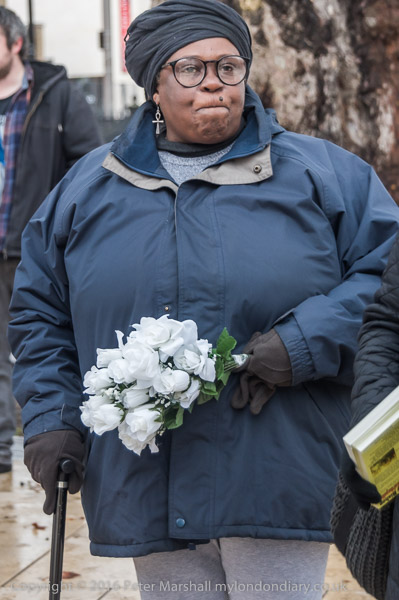
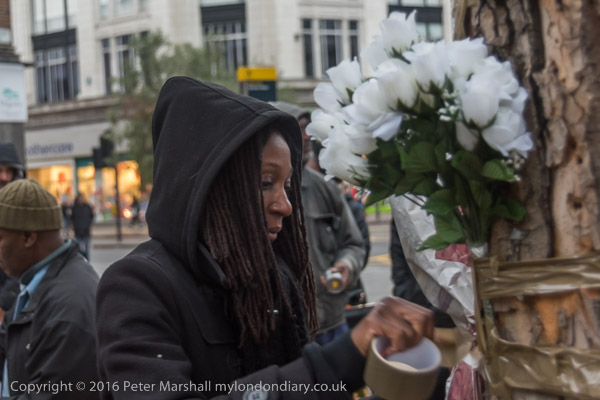
Doreen Jjuko, Ricky Bishop’s mother holds white roses

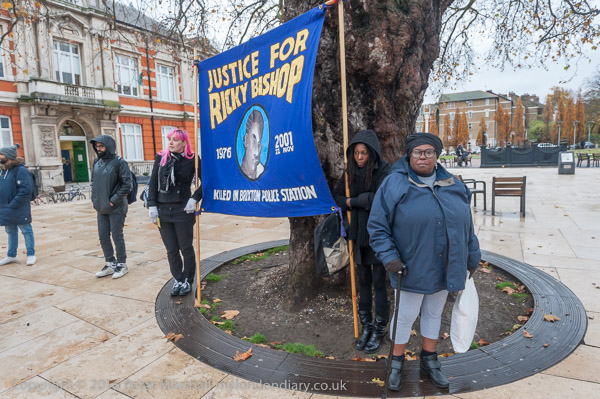
Sixteen years after her son Ricky Bishop died in Brixton police station, Doreen Jjuko is still calling for justice. He was in a car stopped by police who searched him but found no drugs, and taken to Brixton police station, though not arrested. Four hours later he was dead. The judge at his inquest denied the jury the possibility of a verdict of manslaughter and brought in a verdict of death by misadventure.


Sister Unity had also brought flowers in memory of Ricky Bishop

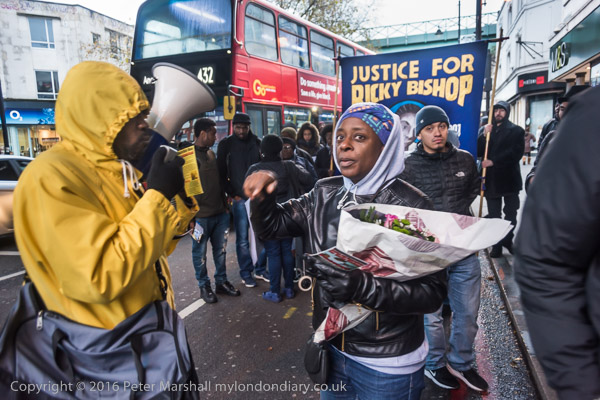
His family are convinced the 12 officers concerned are guilty of murder, and as they marched through the centre of Brixton they and their supporters shouted out ‘Who Killed Ricky Bishop?‘ with the answer ‘Police killed Ricky Bishop!’ and going on to name each of the 12 officers, calling them murderers.

The march went very slowly along Brixton’s main street, stopping for some minutes in front of Brixton’s busy Underground station, blocking one lane of the road, but getting their message across to those in the busy street. A police car with two officers drew up beside the march, blocking the second lane – and thus the whole of the north-bound traffic, and the officers got out to tell the marchers they were obstructing the highway and putting themselves in danger, trying to persuade them to leave the road and walk along the pavement.

It seemed an act of senseless naivety, but the protesters were surprisingly polite in their refusals, simply telling the police that if they stopped murdering people they arrested and investigated crimes by fellow officers properly they would not be marching, but otherwise they ignored them and carried on their slow march to Brixton Police Station for a rally at the tree outside, which they call the ‘lynching tree’.

This tree was for some years adopted by the community as a memorial to those killed at Brixton Police Station, with pictures and tributes to Ricky Bishop, Sean Rigg and others. But when police knew that all the family members would be at the annual United Families and Friends march in Whitehall on October 31st 2015, police stripped the tree and have kept it bare since. Their action showed an appalling disregard for community relations, disgusting many.


Rhonda, Ricky Bishop’s sister tapes the flowers to the memorial tree

There were speeches and Sister Unity performed her poem ‘The Lynching Tree Down Brixton Way‘ which she wrote after hearing an interview with Doreen Bishop in 2004, and then there was a silence and candles were lit in memory of Ricky. Had he lived he would now be 41, the same age as my elder son.

Doubtless soon after the vigil ended, the police would come out and remove the flowers, the pictures and the candles. At least I hope they at least waited until the vigil had ended, but I had to leave shortly before.

Continue reading No Justice over Ricky Bishop

No Third Runway

Heathrow has over the years shown a voracious appetite for growth, always at the expense of the local community who have continually been made promises that have never been kept. The airport was set up in war-time under the false pretence it was needed for military use and the lies have continued ever since.

Of course it has created jobs in the local area – and for some time there were many skilled jobs, but increasingly now they are low paid and low skilled jobs in what has become more and more a shopping centre with an airport attached. Increasingly jobs will be lost as automation at the airport continues, and Heathrow is likely in the future to create less employment than almost any other possible use of its huge site.

What it does bring to the area – and in great variety – is pollution. Most obviously noise pollution, now affecting a large swathe of West London and further out in Berkshire, but also air pollution, not just from the planes and vehicles using Heathrow, but from the cars and lorries which bring and take away passengers and freight, and by the congestion that these cause to other non-airport related traffic in the area.

By the 1970s it had become clear that Heathrow was in the wrong place, and that London needed a new site for its major airport. Had the right decision been made, Heathrow would long ago have joined Croydon as a former London airport (and Croydon was probably rather better placed.) But Government buckled to the interests and lobbying of a powerful aviation lobby, joined by others, and Heathrow continued to be allowed to expand, with a fourth terminal, and then a fifth, and then the push for the ‘third runway’.

I took part in an photographed the protests against that third runway and the celebrations when that proposal was defeated, with even the Conservative Party leader David Cameron making a clear promise it would not be built. But Heathrow and the vested interests came back, with the setting up of an inquiry by the government on premises that were almost bound to favour further expansion, and the spectre of the third runway re-emerged, despite the ever-increasing argument of the enviromental catastrophe it would be.

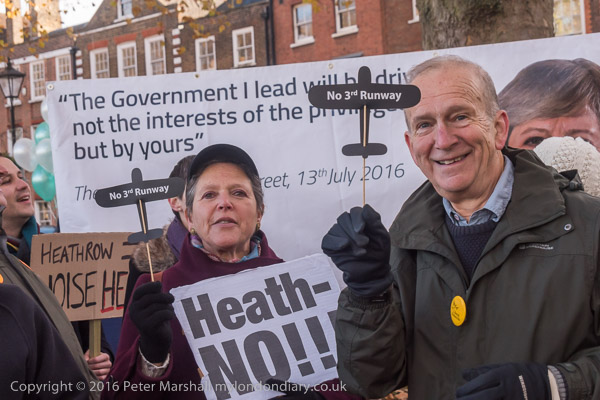
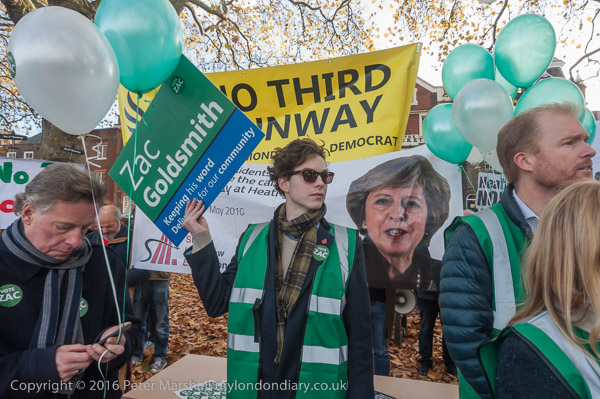
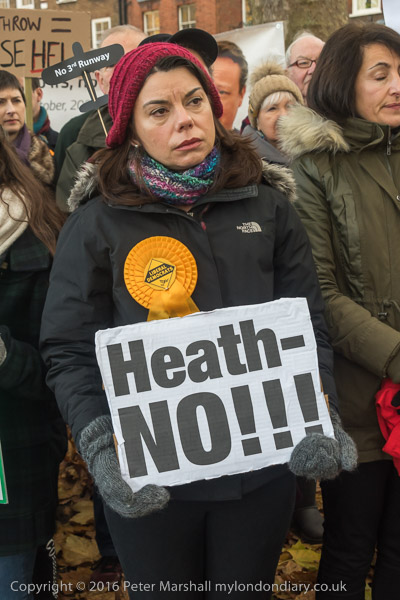
I’m not a fan of Zac Goldsmith, the Conservative MP who had organised a rally on Richmond Green – and had resigned when his party changed tack to back Heathrow expansion, and was fighting a by-eleciton on the issue, but I went to photograph the rally which was supported by all the local groups fighting against the plans.

What I hadn’t expected was to be harassed by one of Goldsmith’s crew, who told me that this was a private event and that I couldn’t take pictures, threatening to get the police to evict me. I told him that this was a public meeting in a public place and I had every right to report it, but for several minutes he followed me around trying to stop me. I told him rather forcefully to go away and talk to the police – and he did, so I was bothered no more. But so much for freedom under the Conservatives!

I wasn’t sorry when Goldsmith lost his seat to Sarah Olney – also opposed to Heathrow expansion, and whose supporters were also present (looking rather less like estate agents) and it was something of a disappointment when he regained it – by 75 votes in the June 2017 election. Goldsmith took the seat in 2010 from Susan Kramer, a Liberal Democrat MP who had been a staunch fighter against Heathrow expansion.

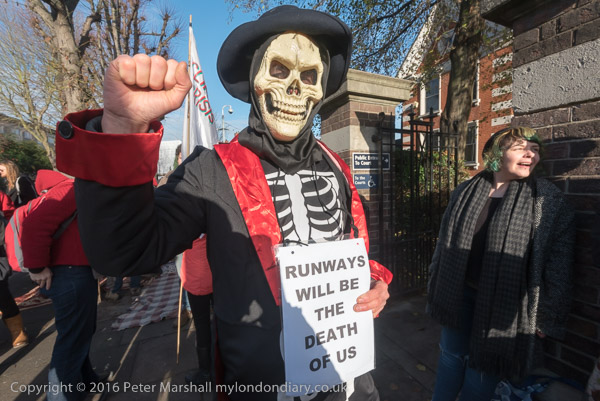
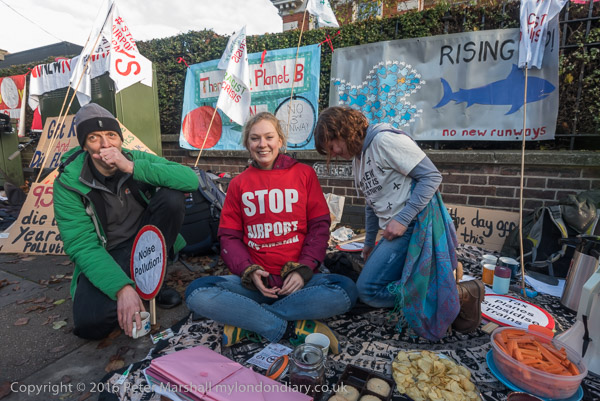
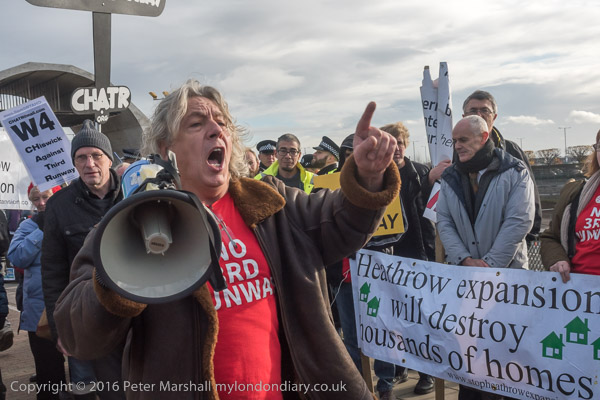
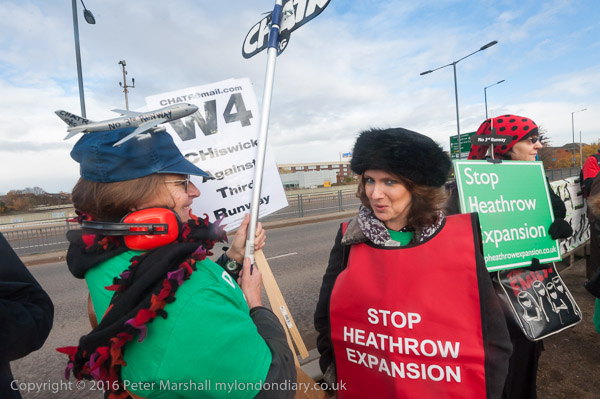
From Richmond I took a train and a bus to the Three Magpies on the Bath Road at Cranford on the northern edge of Heathrow. Nearby some activists from Rising Up! were blocking the motorway spur into the airport while on the bridge above the road a few hundred yards away I covered the ‘family friendly’ rally that was also taking place – with a huge and unnecessary police presence.

More at:

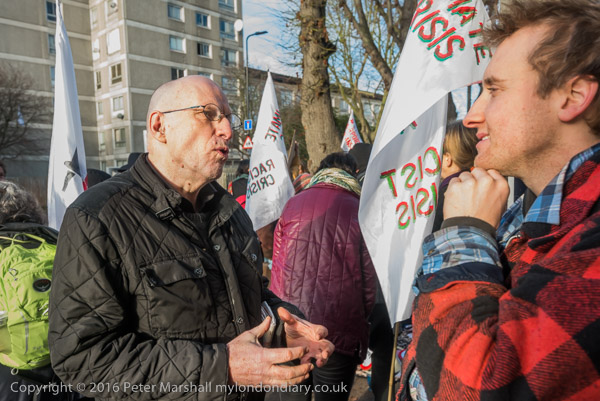
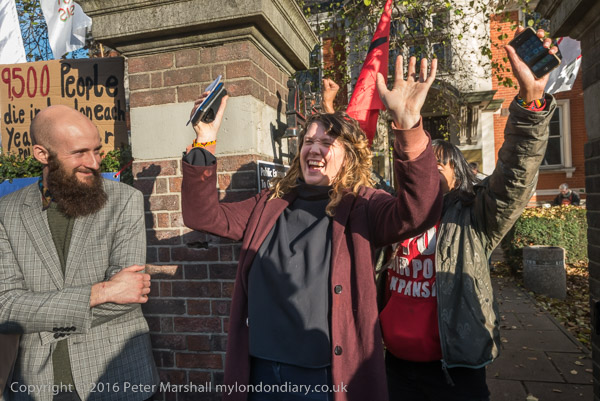
Climate Crisis rally against Airport Expansion
Rally against Heathrow Expansion

Continue reading No Third Runway