Death on the Roads


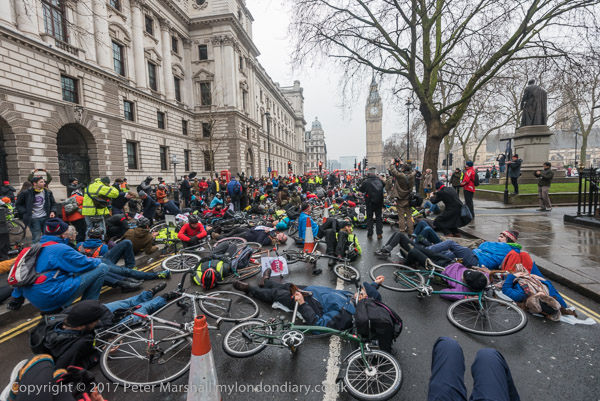
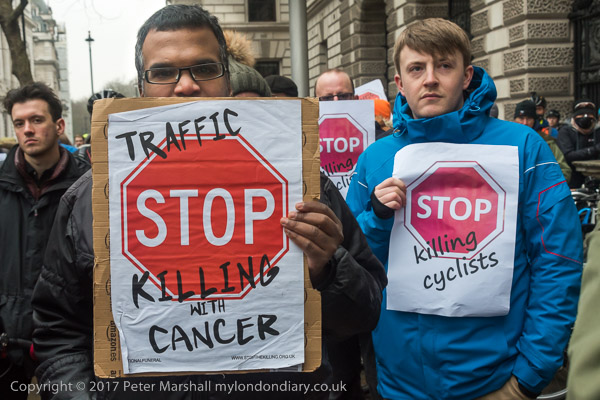
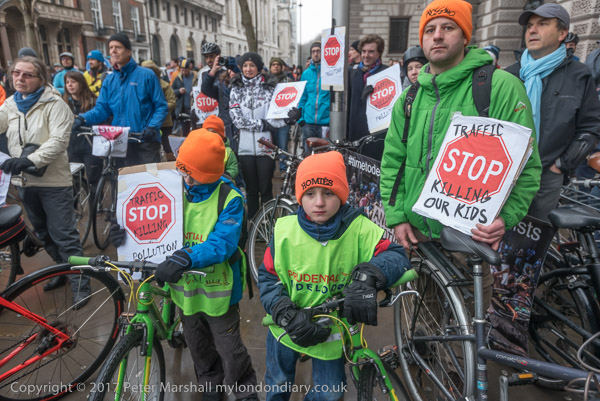
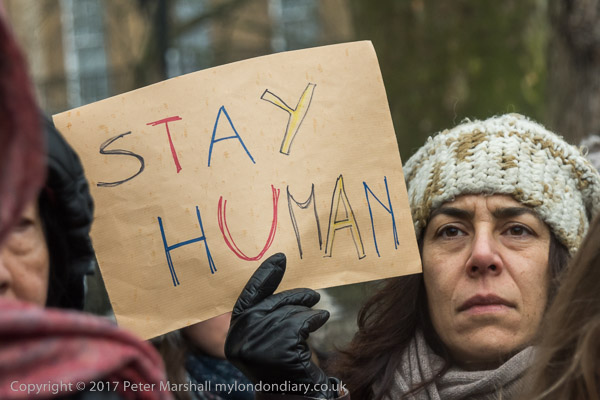
Die-in remembers 3 cyclists and 2 pedestrians killed on London roads in the previous week

Cyclists arouse deep and entirely irrational prejudice among many vocal members of the British public, and I’ve spent some time trying to understand why, though with no great success. And here some of my somewhat random thoughts possibly related to the subject.
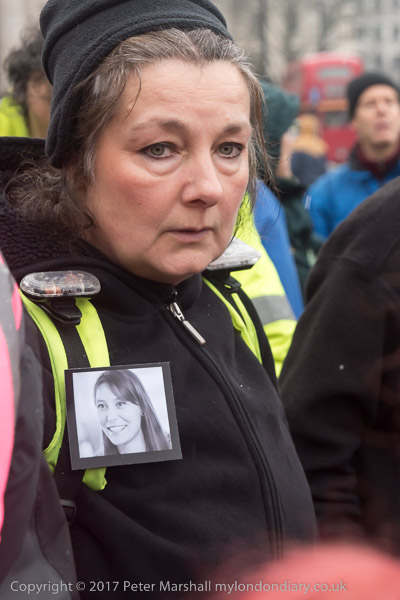

Many at the protest wore phoographs of one of the cyclists killed that week

Back in the 1890s there was a bicycling craze here and in the US in particular; the introduction of the ‘safety bicycle’ with its smaller wheels and chain drive and its widespread availability changed the way people lived.

In particular it led to much greater freedom for women, changing the way they dressed and how they behaved – so much so that Susan B Anthony in 1896 said, “the bicycle has done more for the emancipation of women than anything else in the world.” The popularity of bicycles also provided a need for smoother, pothole free roads, and the roads that we now use were largely made for the use of bicycles.

Back in the 1940s and early 1950s, pretty well everyone except the rich rode bicycles. They were (and are) a cheap and reliable form of transport and schools and factories would have large cycle sheds. But times were changing, and as Harold Macmillan said in 1957 “most of our people have never had it so good”; the post-war boom meant the working class was getting more money and it became a part of everyone’s aspiration to get a car. Back at school in the early 1960’s we all envied one of my friend who had a part-time job and could afford to own and run a Morris Minor, not least for its potential in attracting members of the opposite sex.

Bicycle clips became an emblem of failure. Or of extreme crankiness (rather appropriate for cyclists although of course it derives from the Dutch or German for sick.) People on bikes began to be seen inferior beings who should always give way to their motorised superiors. Planners and road engineers (with a few exceptions, particularly in the new towns) almost entirely disregarded the needs of cyclists in the interest of making the movement of motorists faster and reducing congestion.
Attitudes and behaviour towards children have also changed. When I was primary school age my parents were happy for me to go and play with friends out on the streets, to ride around the area on my bike. By the time I was in long trousers – at 11 – I was cycling all over a wide range of outer London, making my way to Box Hill, Virginia Water, Windsor, the Devil’s Punchbowl and more, sometimes with friends, but often on my own.

When those of my generation went to youth clubs or activities we weren’t taken by car (my father didn’t own one, though he had possibly driven when in the RAF and had certainly ridden a motorbike in his younger days, but when I knew him he rode an ancient bike, or when he had heavy loads used a push-cart) but used bike or occasionally bus.
Roads then were even more dangerous than now. In 1960 almost 7,000 people were killed on UK roads; by 2015 that had dropped to 1700, and injuries, particularly serious injuries, were also greatly reduced. Though the kind of side streets that I lived and played on are perhaps more dangerous, partly because there are many more parked cars which obscure vision, but mainly because people drive much faster down them – why more areas are now getting 20mph limits – though nothing is done to enforce them.

The change isn’t driven by safety but by perceptions of danger, and particularly perceptions of ‘stranger danger’ driven by some rather hysterical campaigning. Children have always been at risk from some adults, largely from family members, but also from a few strangers, and I don’t think those risks have increased. We were given simple and straightforward advice. But we were also given a freedom which no longer exists. Parents who behaved like almost all parents did then would now find themselves threatened by social workers – as happened to a family we knew in our area a few years ago.

Owning a car if you live in a city like London isn’t an entirely rational act, but one that the car makers have had to encourage and promote though millions spent on advertising. For longer journeys, except in the outer suburbs where public transport is often poor it’s a slow and generally inconvenient way to get to places, and for shorter journeys a bike is generally much faster. At least some of that motorist hate comes from seeing people on bikes moving much faster than them through traffic queues – and sometimes doing so in slightly unconventional ways.
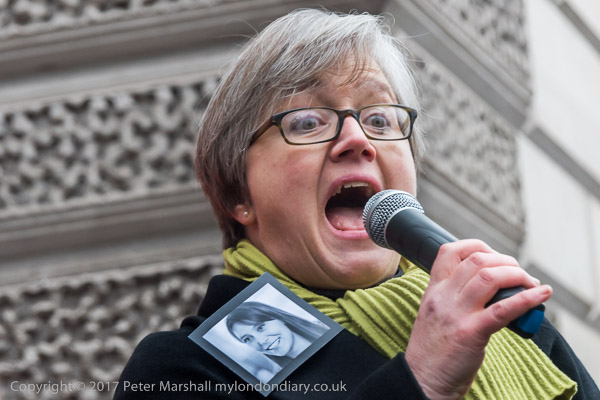

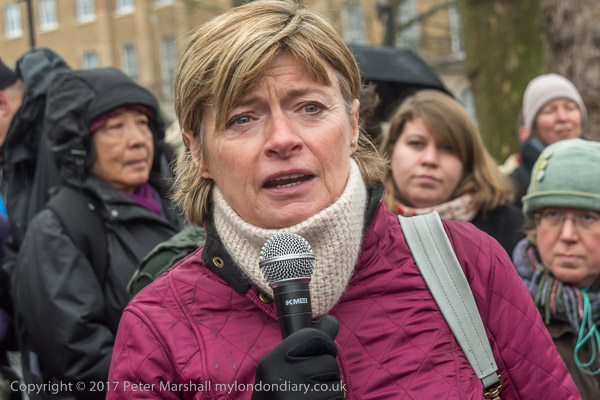
Green Party London Assembly member Caroline Russell

Perhaps the greatest boost to cycling in London came from the 2005 terrorist attack, making some reluctant to use tube or bus to get to work. Another factor has certainly been the rise of the Brompton folding bicycle, which many can take on the train and into their workplace to cut the risk of theft. Brompton’s aren’t cheap, though there are also cheaper folders on the streets. And thanks to Ken Livingstone we also have ‘Boris Bikes’.

With more people cycling we have more deaths of cyclists and the protest and die-in outside the Treasury in Parliament Square came at the end of a disastrous week in which 3 cyclists and 2 pedestrians were killed by drivers in London. Most deaths of cyclists come from them being hit by lorries and other large vehicles which have large areas of restricted visibility due to their design – something which has to change.

Serious accidents involving cyclists and pedestrians are rare – the energy involved in such collisions is so much lower. Probably rather more injuries are caused by accidents involving other pedestrians which are common and usually unrecorded. Probably pedestrian hate is more a matter of the visibility of cyclists – and the way some mainly young cyclists ride fast on pavements past people. Usually their fast reactions and control of their bikes avoids collisions but can frighten some. While cyclists and pedestrians can mix safely – as they do on many miles of officially shared pavements – cyclists should certainly do so with appropriate caution, as the movements of pedestrians are often unpredictable.
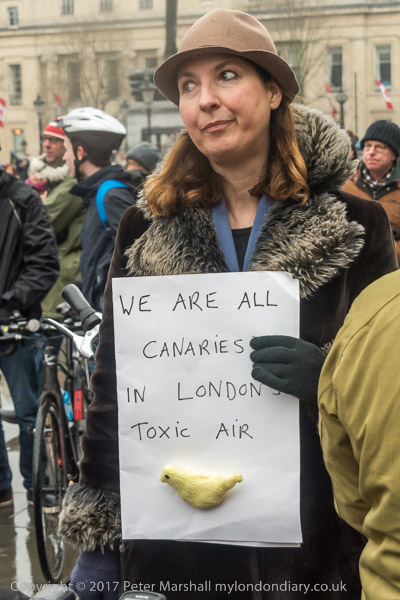
Cycling has much to contribute to the city, cutting down congestion and pollution, and to our health as a nation suffering from over-consumption and obesity. It should be encouraged by making it easier and making it safer. London needs a giant leap in spending to cut deaths from traffic pollution and poor health, as well as policies that increase public transport and cuts the use of cars and other motor vehicles, both petrol and diesel, moving all those buses, taxis and other necessary vehicles to electric over a relatively short time-frame.
Continue reading Death on the Roads

Shame on May

One area that has shown the real inhumane and nasty nature of our current government most clearly has been its treatment of refugees, particularly those fleeing Syria. Theresa May’s response stands in such incredible contrast with that of Angela Merkel. Merkel isn’t a person whose politics generally I have much sympathy with, and certainly not someone I would have regarded as a person of great warmth. But faced with the huge flow of people in distress she made a courageous decision – and one which she will have known was politically dangerous – to help the refugees.

Theresa May in complete contrast has been consistently inhumane – both as Home Secretary and Prime Minister over this and related issues. It isn’t just that she lacks any empathy for her fellow human beings, but it is also cowardice, running scared of the right-wing bigots of her own party.

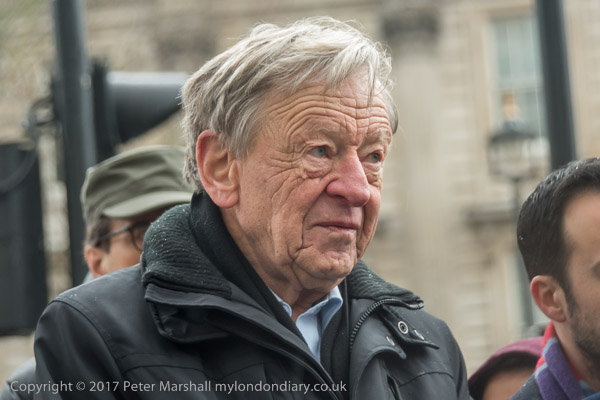
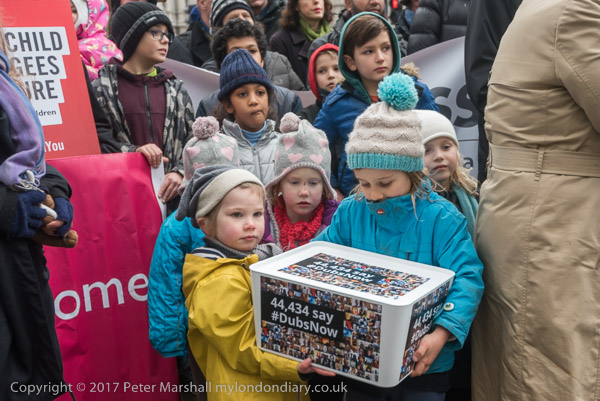
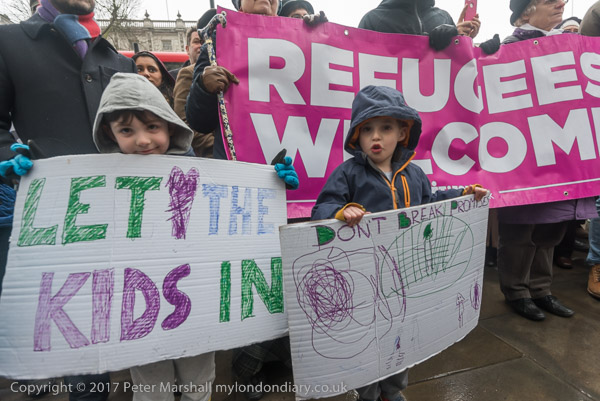
The Lord Dubs, formerly for some years Alf Dubs, Labour MP in Battersea, gained widespread support in both houses of Parliament for his amendment to the Immigration Act 2016 which offered unaccompanied refugee children safe passage to Britain and the Tory government was forced to accept it. But they did so grudgingly, and acted in a desultory manner, inventing excuses to avoid implementing it to any great extent, pretending there were no places for the children to go even when many local authorities had offered them, and eventually abandoning the program in February 2017 after only 300 of the 3000 children should have been brought here.

I’m pleased that my own signature was one of the 44,434 on the petition that was taken to 10 Downing St, but angry that this failed to get a response. Though not surprised, as this is only one of a number of occasions on which the Tory government have ignored or flouted the law.

Lord Dubs has of course a particular personal involvement in the issue. Born in Czechoslovakia in 1932, he was one of the almost 700 children saved from the Nazis by the English stockbroker Nicholas Winton and his team of helpers, though it was only in later life that Dubs learnt the details. Among those who spoke at the event was a woman who had been a friend of Winton (who was knighted in 2002, thanks in part to campaigning by Dubs) who reminded us of his motto, ‘If it’s not impossible, there must be a way to do it.‘ Unfortunately, despite wide political support for bringing the children here, May remained unmoved.

More at Dubs Now – Shame on May.
Continue reading Shame on May

Flares at King’s

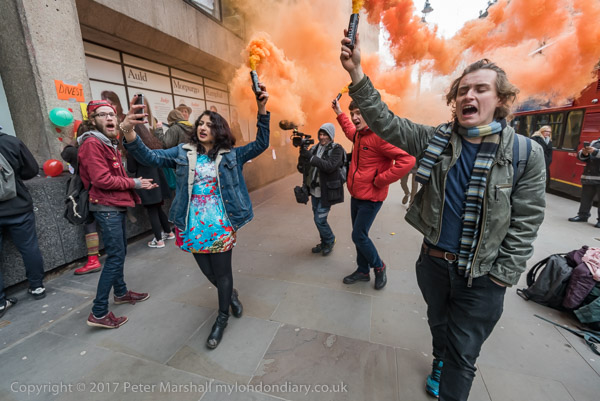
Photographing people holding flares is something of a hit or miss thing, with rather a lot of unpredictable behaviour. There are the people holding the flares, and protesters movements are often fairly unpredictable, but smoke is also peculiarly so. And if you actually get in the smoke, camera exposure metering gets pretty unhinged too and it can also be difficult to focus.

Though I usually like to get as close as possible for most of my pictures (though I know it often pays to stand back a little for a wider view) it seldom works to get too close to people holding smoke flares – and can be quite uncomfortable too. The smoke isn’t good for the lungs or the eyes and has an unpleasant smell, and very close contract can result in burns and stains on clothing that are hard to remove.

It isn’t I think illegal to set off smoke flares, although police and government web sites state it is. The relevant law is clear that it is only an offence “if in consequence a user of the highway is injured, interrupted or endangered” and I think that would be hard to show in this case. But of course, I’m not a lawyer.

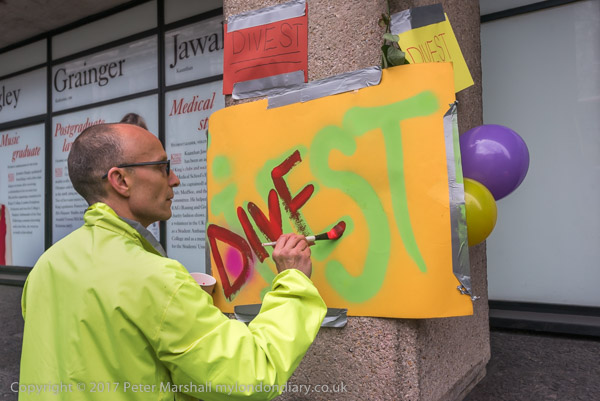
Another case where laws are often invoked against protesters is for the use of chalk and other easily removed markings on roadways, pavements and walls. Police during this protest talked with and asked for names and addresses of some of those who painted with chalk on the wall of King’s College. It’s had to prove ‘criminal damage’ when a simple wipe of a damp sponge – or even the rain – will remove it, though at least one protester was convicted for this a year or two back at the University of London Senate House – and a specialist cleaning company apparently got paid hundreds of pounds for a few seconds wielding a damp rag.
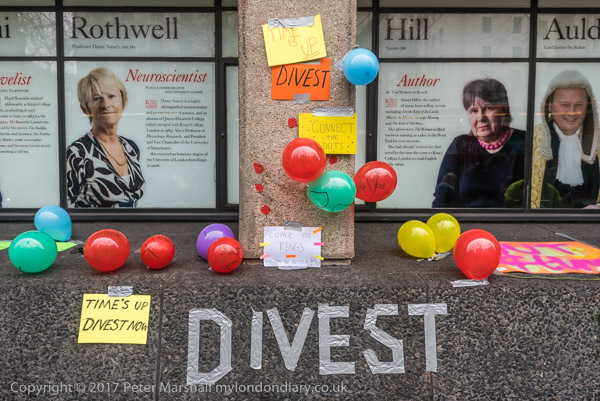
The organiser of this protest, PhD student Roger Hallam had been suspended for writing “Divest From Oil and Gas Now. Out of Time!” in spray chalk at an earlier protest, and in response at this event there was a great deal of displaying messages by other non-permanent methods, as well as a few who chose to deliberately paint washable coloured dots.

There is so far as I’m aware no law relating to the use of balloons on the public highway, and the protesters took full advantage of this. It was just a little difficult to photograph the long line, and space was limited between the wall and he protesters as they moved to tape them onto it.

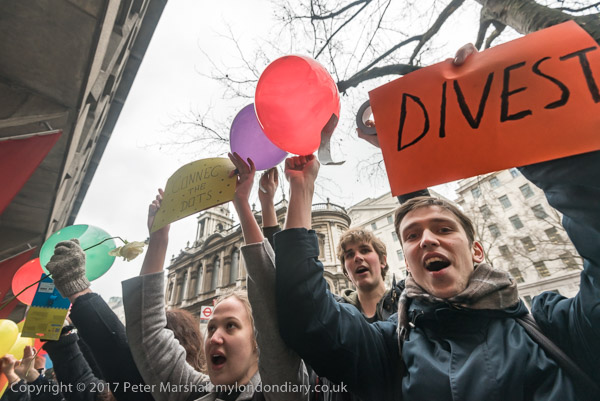
The aim of the protest was to persuade King’s College to end its investments in fossil fuels and switch to investments in renewable energy,  part of a London-wide divestment  campaign.

More at King’s College Divest Oil & Gas Now!

Continue reading Flares at King’s

Trump & May

Mobile phones are a mixed blessing. I don’t like the thought that your every movement can be tracked whenever you carry one, though it was very useful when I left mine on a bus earlier this year – and was able to watch it slowly moving along the map towards the depot, from where a couple of days later I collected it. But as a journalist I don’t like the idea that the police can now track my movements – and would like it even less if I was working in some foreign countries.

And on my recent holiday it was great to be able to see my own position on the OS map I’d bought and downloaded to the phone, something I used far more than the paper copy. This year, rather unusually I didn’t get lost at all.

But being available for people who know your phone number to contact you at any time – or at least when your phone is switched on and has battery – is not always a good thing. Though much of the time when I’m actually working there is too much noise for me to hear (or notice a vibration) from the phone in my pocket.


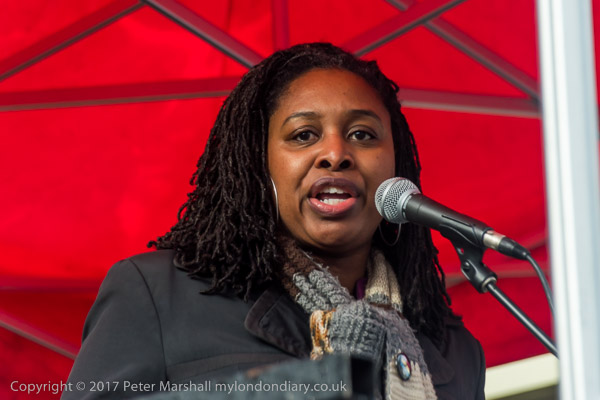
Dawn Butler MP

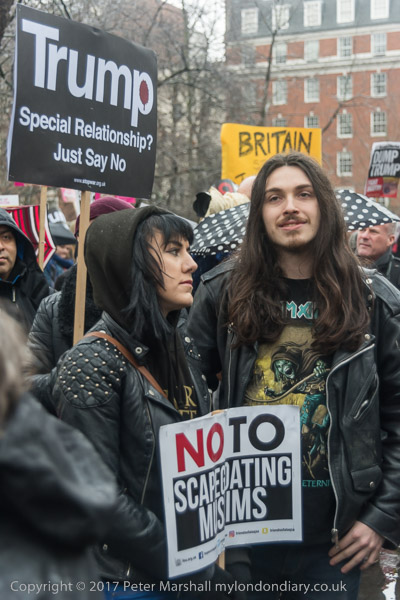
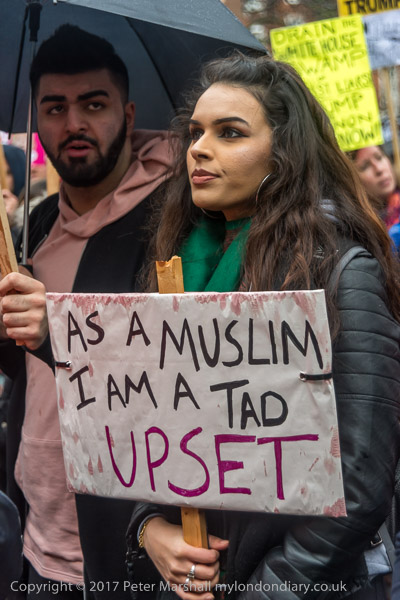
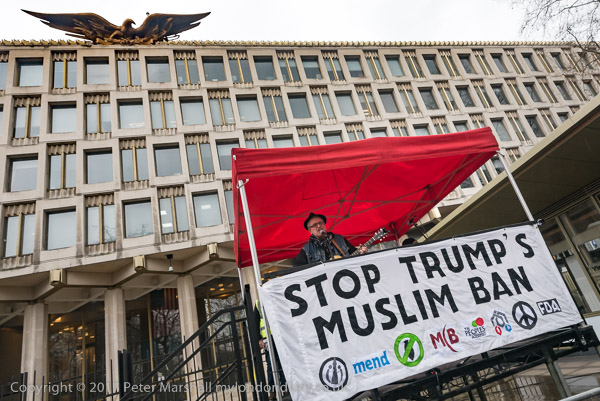
At lunchtime on 4th Feb I was more or less at the front of a densely-packed crowd in front of the US embassy, in a good position to photograph the speakers at a rally calling for Trump to end his Muslim ban and for May to withdraw the invitation to a State Visit here. It was at a quiet moment in the proceedings when a refugee poet was reading one of her works that I heard a faint ringing and answered the call.

It was my wife, and she was locked out as the lock on our back door would not open with her key. And she wasn’t well, or I might have stayed to finish the job before making the fairly long trip home, but I began walking to the bus stop as I talked to her, abandoning the protest. An hour and a quarter later I found my key didn’t work either, but fortunately I had the keys to the front entrance which did. More bad news was that we needed a locksmith who came, couldn’t open the lock and had to use a jemmy and then an angle grinder to cut through the lock and fit a new one. It wasn’t cheap.

Fortunately I’d already taken enough pictures to file a decent story, including probably the two most important speakers, Brent Labour MP Dawn Butler, shadow minister for diverse communities before she resigned to vote against the Brexit Bill and NUT General Secretary Kevin Courtney, and plenty of the protesters and their placards – it was a protest that brought out wit and obscenities – so I was able to file a decent story, though I had to miss the march to Whitehall and the further rally there.

It’s often the case with marches than the best opportunities for pictures are before they start, when people are often more closely packed and a little less organised. Back when I photographed some carnival processions with a few of my photographer friends we would usually pack up and go the the pub as the procession began. And for many of the longer political marches in London don’t walk the whole way.

Taking photographs means a lot of walking backwards as well forwards, going too and fro, and is considerably more tiring than simply marching. And as I usually want to cover marchers at the back as well as at the front (and those in-between) with large marches I try to find a convenient point to take the tube to the destination.

I often see other photographers standing around talking with each other before a protest starts, and while I like to be sociable (and often we have useful information to exchange) I sometimes feel they are missing opportunities and will leave them and get on with the job. And at some marches there are some photographers who only photograph the people carrying the banner at the front and just walk ahead of this all the way. It’s seldom a place to get the most interesting pictures.

And a small note to event organisers. A red roof to the stage is not a good idea. It really doesn’t provide a good background and it bathes the speakers in red light which isn’t flattering. Please chose a fairly neutral colour, perhaps a light or mid grey.  18% would help with our exposures!

More pictures at: No Muslim Ban, No State Visit.

Continue reading Trump & May

Slash, Trash & Plunder

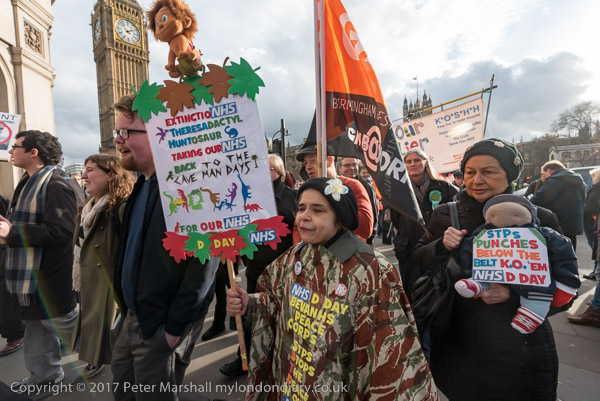
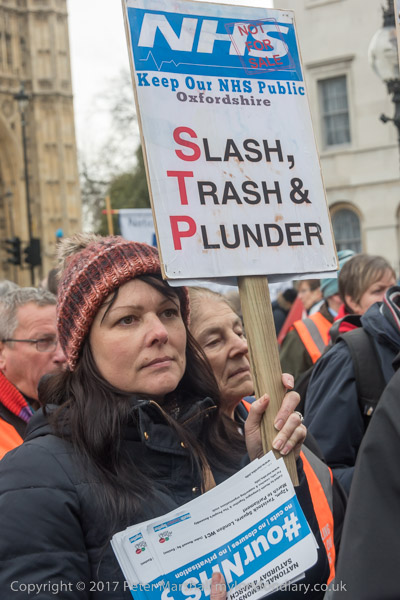
STP must be one of the most overloaded TLA’s (Three letter acronyms), with well over 30 possibilities listed on a Google disambiguation page, including the Government’s latest back-door approach to the transfer of our National Health System (NHS) to the private sector, the Sustainability and transformation partnerships, but not the alternative interpretations favoured by pro-NHS campaigners such as Slash, Trash & Plunder.

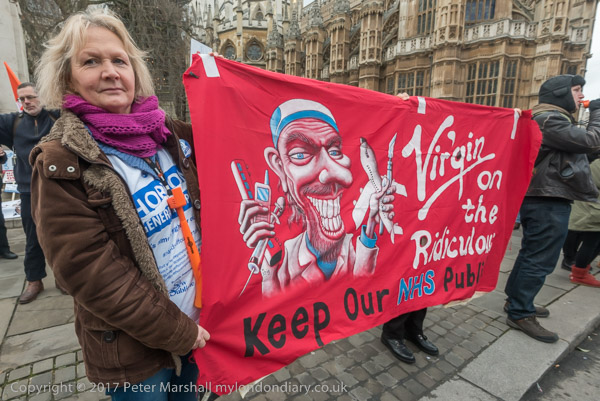
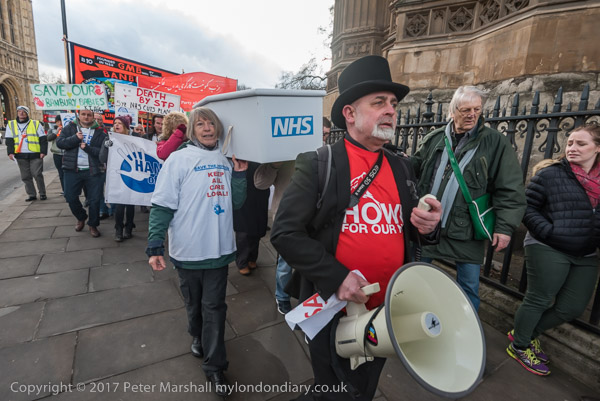
Campaigners, many of whom work in the NHS, see the STP’s as a part of the plan by minister Jeremy Hunt to replace our NHS with a privatised system based on the US model which he advocated in a book published well before he became Health Secretary. They say the STPs amount to a cut of £22m in NHS funding and will result in cuts in services, reduction of quality, cuts in social care and increased health inequalities And they point out that our public system is several times more cost-effective than the US model the government is moving to by stealth.

It’s a move that will mean rich pickings for those with money invested in healthcare companies, including many Conservative MPs. Already companies like Virgin Healthcare are taking over many more straightforward aspects of the NHS, with Richard Branson laughing all the way to the bank – and currently suing the NHS because he hasn’t been awarded more contracts.

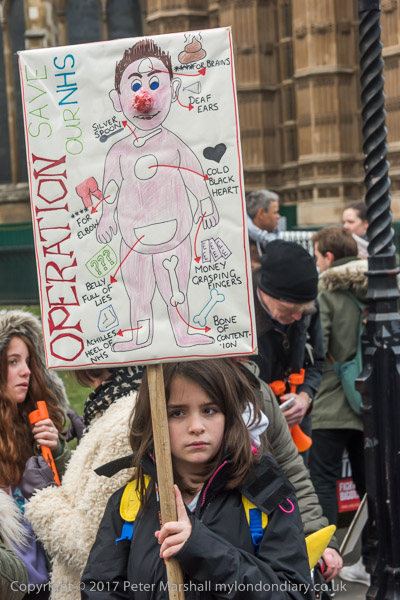
My medical knowledge is probably at about the level of playing that the ‘Operation’ game demands, though I lack the hand-eye coordination and motor skills required to do well.

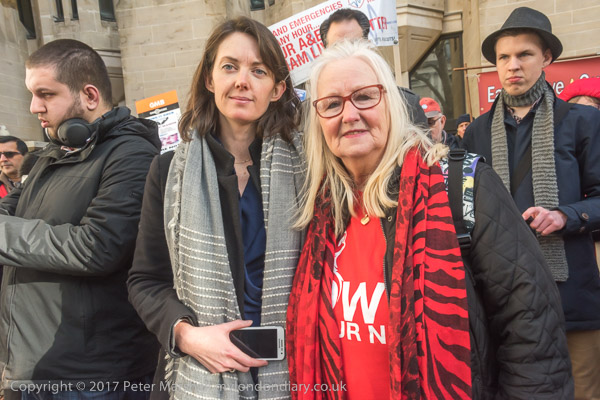
After a rally with speeches, including one from the first baby born under the NHS in the first seconds of 1948, Aneira Thomas (shown below with Junior Doctor Aislinn Macklin-Doherty), the campaigners marched to the Department of Health on Whitehall for a further rally.

But unfortunately it will take more than a minor medical miracle to cure the deliberate deafness of the Tories chasing the scent of lucrative winnings from replacing a public service by their private businesses.

Perhaps another of those TLA possibilities listed by Google might be appropriate for the British public given the plot of the Tory privateers; there is apparently a Society for Threatened Peoples, and our health provision is certainly facing a massive threat. And the only hope for the NHS is a change of government.

More pictures at Save our NHS from STP Cuts.

Continue reading Slash, Trash & Plunder

HP BETT

In the past I’ve bought HP printers. Both inkjet and laser printers for the college at which I taught, and we still have an HP Laserjet 1100 attached to my wife’s computer, still going strong after around 18 years, though now always with cheap compatible toners. I won’t buy HP – and their toners cost 5 times as much.

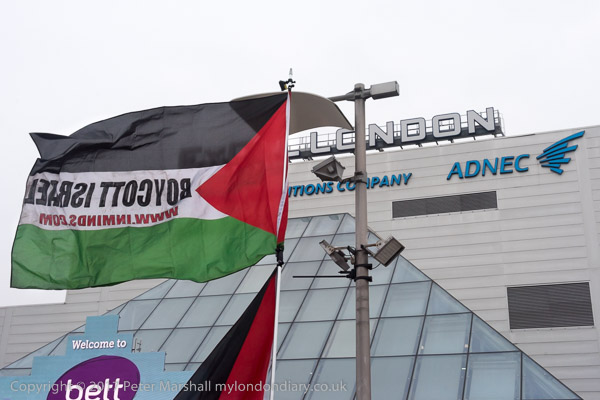
I probably first bought HP printers after seeing them on the HP stand at BETT, which used to be known as the British Educational Training and Technology Show but is now billed as the “World’s Leading EdTech Event” and likes to hide the British bit of its name. Back when I first went it was at the Barbican, then moved to Olympia, where I took my first ever pictures with a digital camera on one of the stands (and wasn’t too excited by the quality) and is now held every January at the Excel Centre on London’s Royal Victoria Docks.
People do come from all around the world to the show now – not that there is really any need to, but it’s a good excuse to get out of school for a few days and get a trip to London and your hotel paid for by your employer, though for me it was only a day off and the train fare. You can pick up a few ideas at the various sessions and stands of all the leading companies, and I certainly saved my employers money by getting some good deals on gear, but that was before the days there was so much on line that big shows like this with all the travel etc are really just a perk for those who get to dine out on them. How much longer we can waste all the carbon involved?
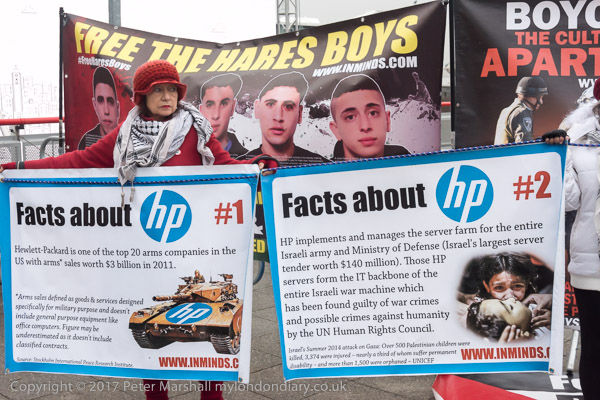
But now I certainly wouldn’t buy from HP, as I’ve read all the information from Inminds at this and other protests, and know the vital role that HP play in supporting the often illegal and inhumane persecution of Palestinians by the Israeli state and its military. Inminds launched its campaign to boycott HP in September 2014 and I’ve covered a number of their protests at various venues since then. You can read why they boycott HP on their web site, which also has some of their pictures from the protests and graphics which show some of the posters too small to read in my pictures.

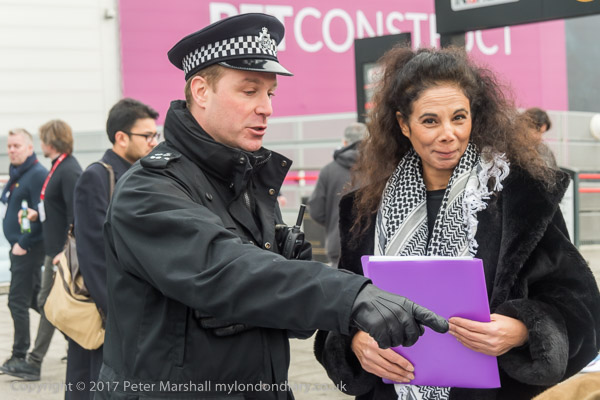
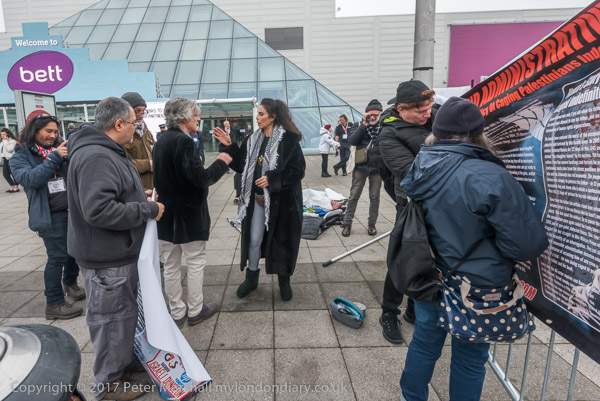
I didn’t stay too long at the protest – the courtyard in front of the exhibition centre is a cold and windswept place. It’s also one of London’s many (and increasing) privately owned public spaces, and although the centre’s management don’t try to prevent the protest, they do try to marginalise them. Throughout the time I was there the police were constantly coming to the protest organisers and trying to move them further away or restrict their activities, though their requests were not always complied with.

Quite a few of those going into the show came to read the posters and others came across when they came out from the exhibition for a cigarette break. There were a couple of people who reacted adversely – one complained bitterly and loudly that they were not protesting about the mistreatment of Armenians, and was told if he felt strongly about the issue he should organise a protest. Police eventually led him away and talked to him and he went on into the exhibition.

Another man threw a hefty show catalogue at the protesters, fortunately missing them and complained that they were anti-semitic. They told him that they had no issues with Jews – and several of the protesters were Jewish, handed his catalogue back and told him to behave himself, and again police came and told him to keep the peace.

But there were more who came to praise the protesters and thank them, taking photographs on their phone and tweeting about the protest, including one woman who then went along the line of protesters, hugging and kissing each in turn.

More pictures: Ban HP from BETT show

Continue reading HP BETT

King’s Cleaners

Until recently, my main contact with King’s University in the Strand in London has been waiting for buses outside it, most usually for the short journey to Waterloo or Westminster. A lot of buses stop there, though as often in London you can wait a little while before the one you need comes along. And while you do, there are giant portraits along the frontage of Kings (aka KCL) of some of the alumni listing their achievements.

And it is an impressive pantheon. King’s began in 1829 when King George IV and the Duke of Wellington got together to found it, and not surprisingly it got a royal charter that same year. In 1836 it got together with University College London (which predated it by 3 years) to found London University. In more recent years it has added to the names it can proudly display by a number of mergers, taking in among others Queen Elizabeth College (formerly its Ladies Department), Chelsea College of Science and Technology, the Institute of Psychiatry, the United Medical and Dental Schools of Guy’s and St Thomas’ Hospitals and the Florence Nightingale School of Nursing and Midwifery.

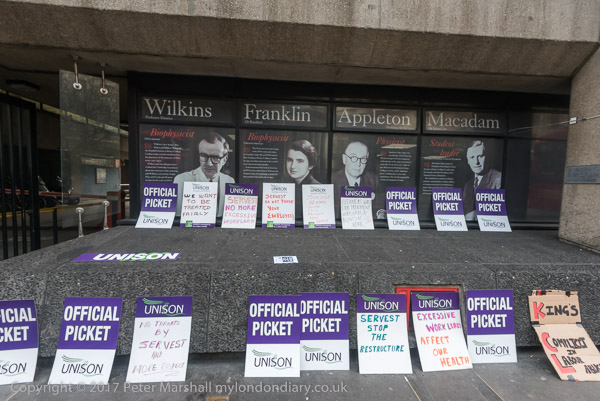
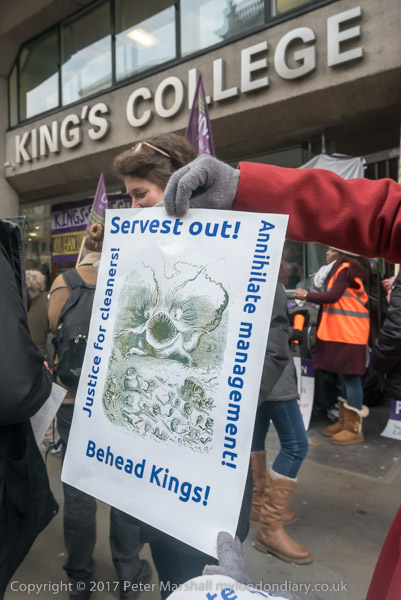
Something it can’t be so proud of is the way it has treated its cleaners. So ashamed that it actually has employed another company to do its dirty work, outsourcing the cleaning to Servest.

Cleaners at King’s are paid less than the London Living Wage and are overworked, often expected to do the work of colleagues who are sick or on holiday in addition to their own. They have conditions of employment significantly worse than King’s would dream of giving staff directly employed by them, getting only statutory sick pay and other benefits and are subjected to arbitrary disciplinary measures. They work in King’s to keep King’s clean – but King’s denies any responsibility for them.

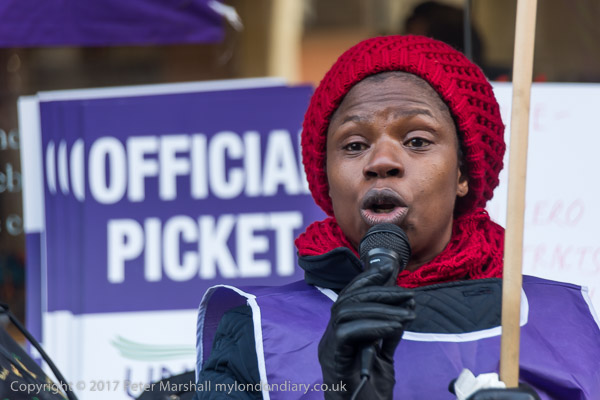
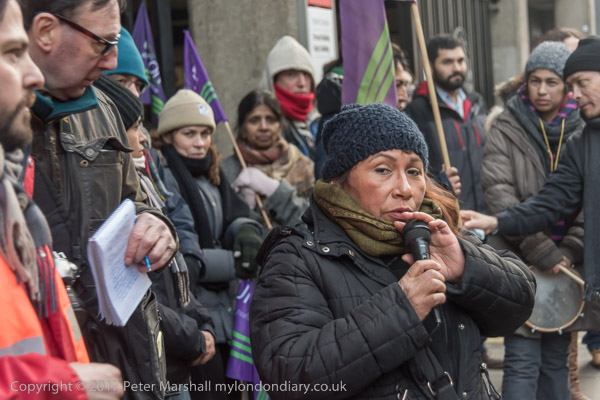
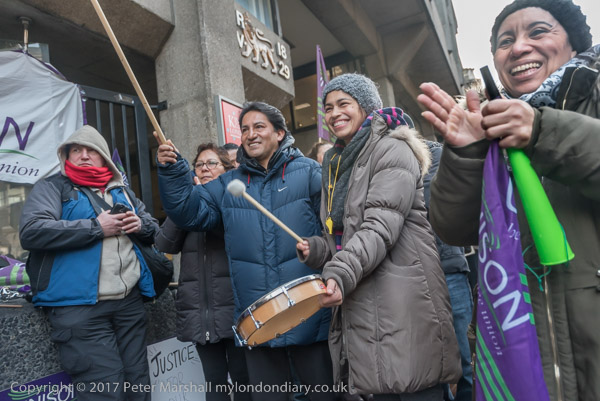
Perhaps surprisingly, the cleaners are members of one of our major trade unions Unison. And much less surprising was that in the ballot they voted 98% in favour of taking strike action. And this rather dull day I was photographing their lunchtime rally on the second day of their strike. They had been picketing there since the early morning, but were still in great spirits, blowing horns, speaking, shouting and dancing, supported by some King’s students and staff, and Unison members from other branches, as well as some cleaners from elsewhere in other unions including the UVW. There does seem to be an increasing feeling that low paid workers need to work together to get a wage they can live on and for cleaners to no longer be treated like the dirt they clean.

King’s College cleaners strike
Continue reading King’s Cleaners

Peckham against Deportations

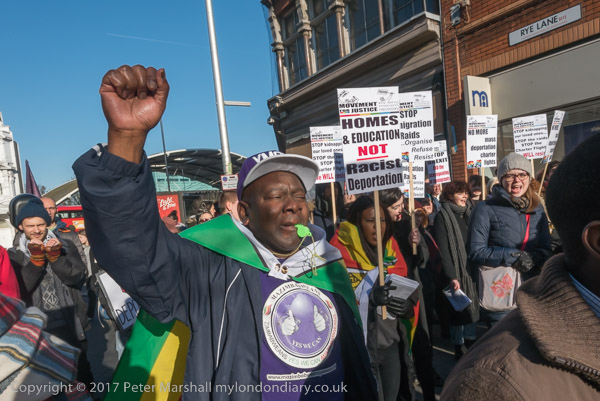
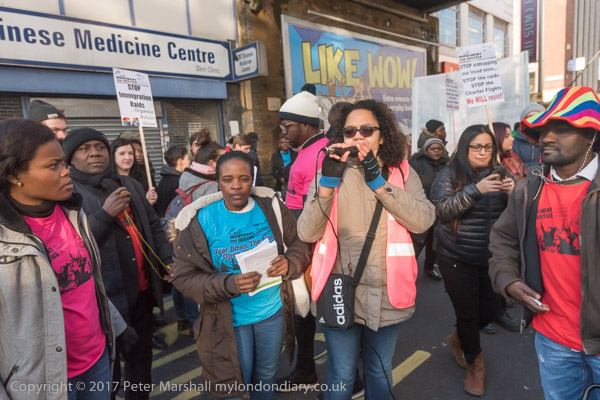
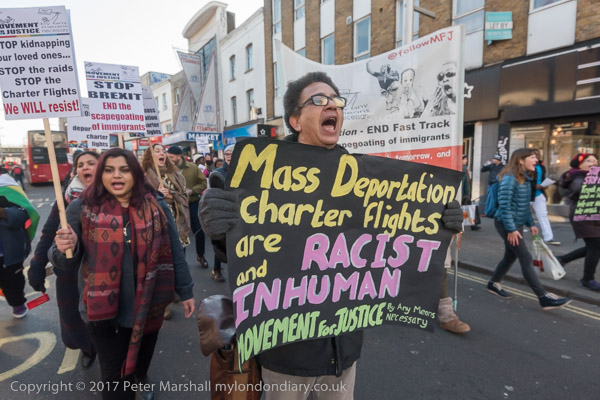
A week after their march in Brixton, Movement for Justice returned to South London for another march against deportation, this time in Peckham, another area where immigration raids have met with anger from the local population.

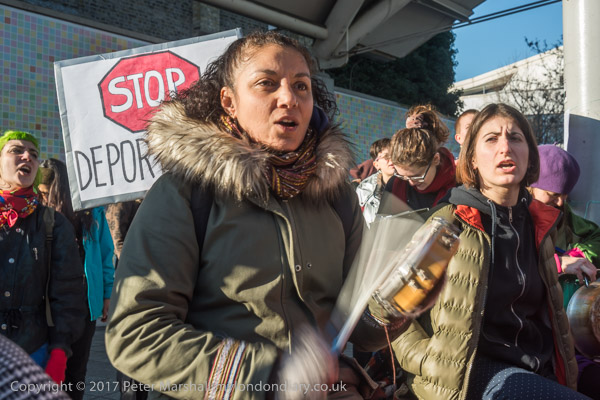
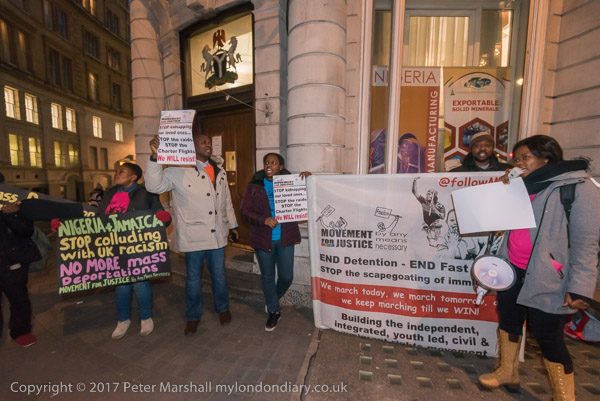
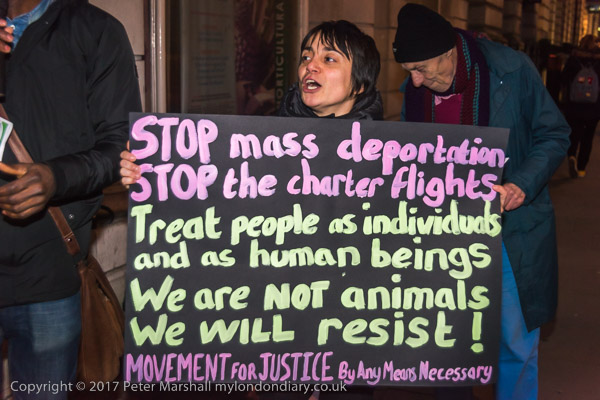
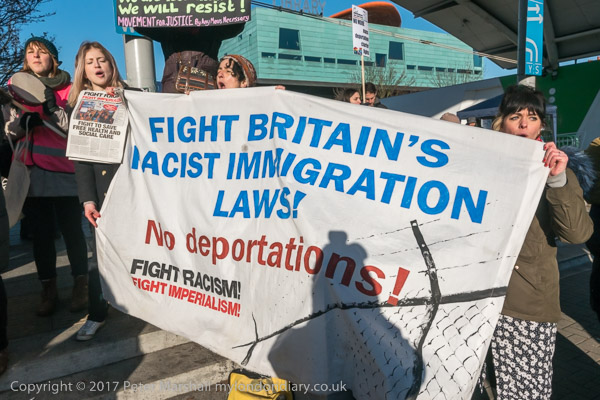
The protesters are calling on the governments of Nigeria, Ghana, Jamaica, Pakistan and Afghanistan to end their collusion with the racist UK government. They say that immigration raids and mass deportation charter flights are targeting long-established African, Asian and Caribbean communities, dividing families, deporting people who have built lives in the UK with parents, partners and children here.


One of several stops for short speeches to let everyone know why they are protesting

They compare these flights to the ships used in the slave trade, calling them modern slave ships, with deportees shackled with a guard on each side in a cruel and divisive act of racist discrimination.

High Court decisions have ruled that the Home Office has exceeded its legal powers in its deportation of people between 2005 and 2015 with over 10,000 asylum seekers having been illegally deported from the UK in that period. But those who oversaw these illegal acts – including Theresa May have gone unpunished.

Among those supporting the march were SOAS Detainee Support (SDS), Anti Raids Network, Zimbabwe Human Rights Organization Mazimbabweans, Jewdas, BLMUK, London Mexico Solidarity, Sisters Uncut South East London and Lesbians and Gays Support the Migrants.

More at Peckham march against deportations.

Continue reading Peckham against Deportations

Trump, Trump

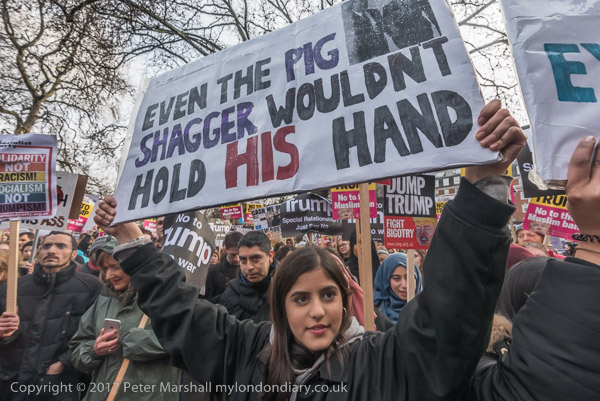
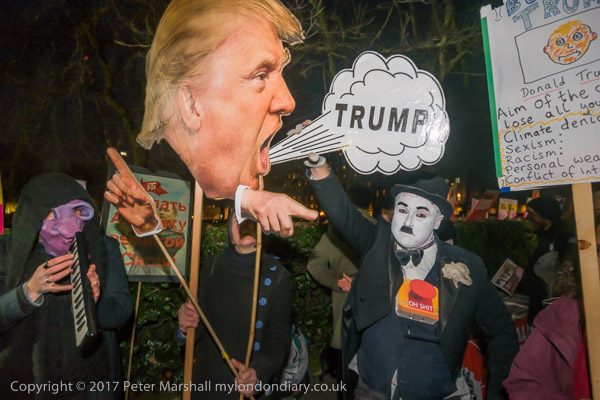
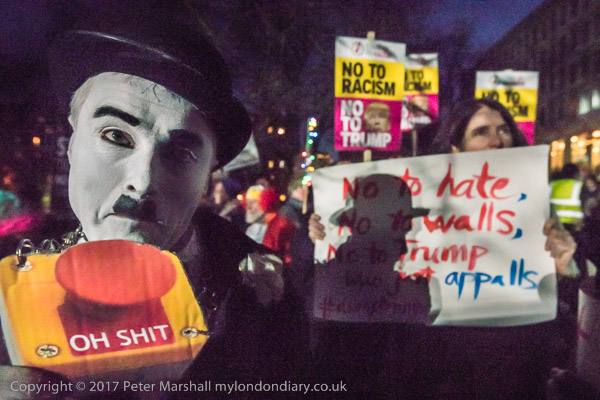
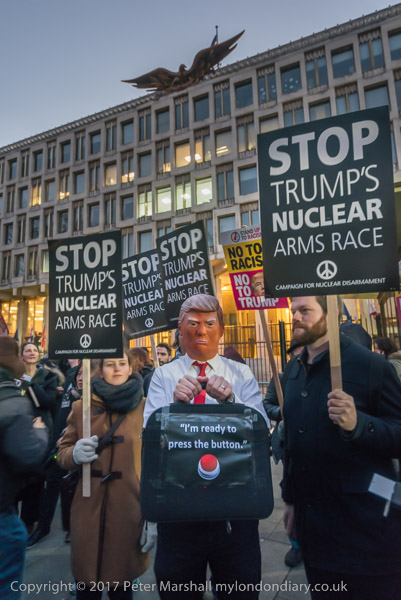
There is a particularly Stygian gloom in front of the US Embassy, as if by some secret technology they are able to extract light from the area for when protests are taking place, but the under-exposure of the image above was more down to my fidgety thumb, always a problem when I work in shutter priority mode. I’d set the shutter speed to 1/60 when I gave up working without flash, but gradually the setting had been nudged up as I walked around taking pictures. While I was still using flash, or in areas where there was movie lighting it wasn’t a problem and things looked fine on the camera back when I bothered to check. The frame before this one was exposed at 1/400th f4, and while the background is dark, the foreground figures are well exposed (a little too well) by the flash.But for this I needed the shadow, and so off went the flash and I took the picture by ambient light; 1/400th at f4, ISO3200. Of course I usually deliberately under-expose at night – it doesn’t look dark otherwise, but this was another three stops less, and three stops too far. When I saw later what I had done, Charlie’s comment below the red button he was carrying seemed rather apt.

Even with a lot of noise reduction and burning and dodging it really is just a little too far out, though I could probably improve a little. You can see the purple that covers highly underexposed shadow areas in quite a few areas of the picture, and further retouching could reduce this, as well as apllying some more local noise reduction in some areas.

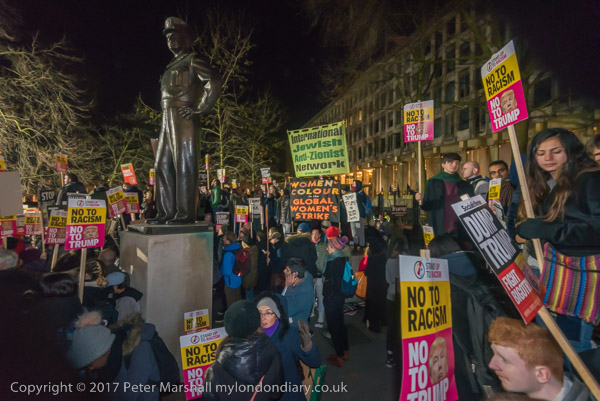
It was the night of President Trump’s inauguration and there didn’t seem to be a great deal of celebration going on at the Embassy, but the was a sizeable crowd protesting outside – and more in Trafalgar Square where I went later.

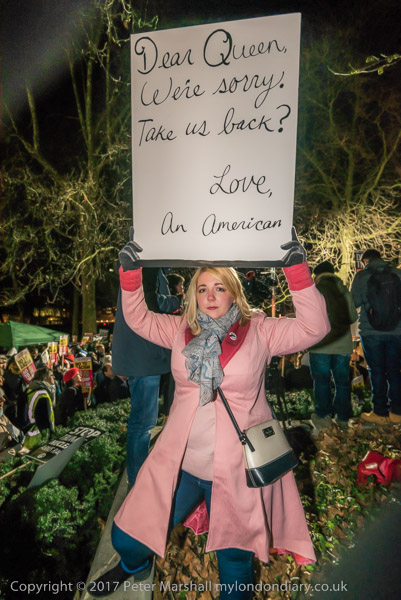
Perhaps the poster this woman in pink was holding up in the flower beds in front of the embassy, ‘Dear Queen, We’re Sorry. Take Us back? Love, An American‘ was rather widespread.

There were some speeches, and a large crowd gathered around the tented platform from which they were being made. But a strong fluorescent tube light just behind the speakers head made trying to photograph the speakers unrewarding, and the posters seemed more eloquent. Many in the crowd probably thought so too, or perhaps it was just too crowded to get near enough to hear, but they spread out over a wide area in front of the embassy – the booth from which speeches were made was out of the picture above to the left.

Here’s another picture of Trump, Trumping thanks to Charlie X. The speeches were still trundling on when I left to see what was happening in Trafalgar Square, where a protest had also been called.

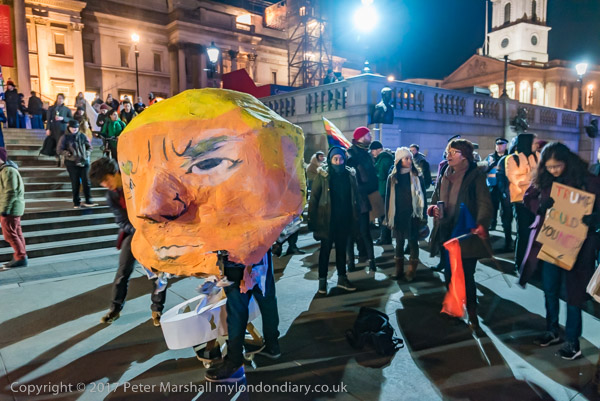
The answer when I arrived was not very much, though there was a giant orange Trump head and groups of protesters rather scattered around the square, with Heritage wardens telling them they were not allowed to protest there. The protest there had not really begun, and I decided I’d had enough and left.

Later I heard that things did get going some time after I went home, and that there had been several arrests after protesters had come under an unprovoked attack from the police.

Crowds protest Trump’s Inauguration
F**k Trump
Continue reading Trump, Trump

Nigerian Flights

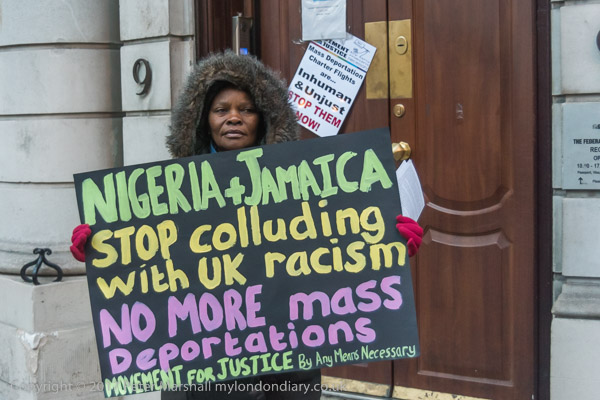
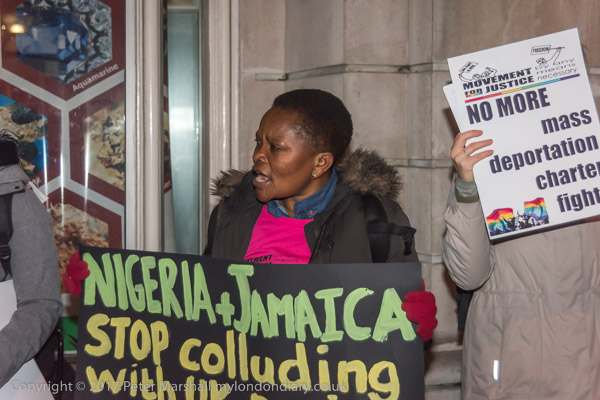
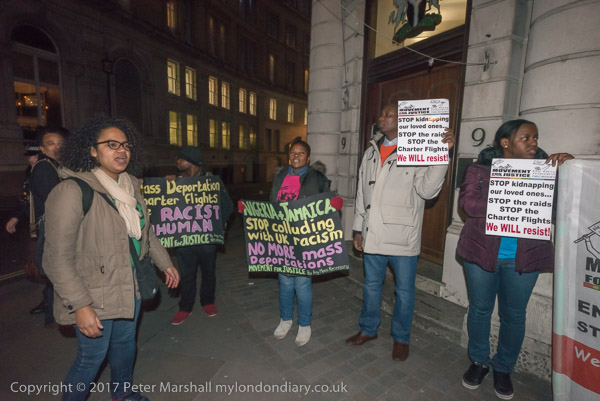
On Wednesday Jan 11th I joined Movement for Justice at their protest outside the Nigerian High Commisison in Shaftesbury Avenue, always one of London’s gloomiest streets, lined with tall buildings and large trees. Darkness was falling anyway as the protest began in late afternoon, and I set the D810 on Auto ISO with a minimum speed of 1/100th to take some pictures without flash. Working with the 28.0-200.0 mm f/3.5-5.6 lens the pictures were taken with the lens wide open and then the ISO went up to 4500 and then my maximum setting of 6400 and then the shutter speed began to drop. When it arrived at 1/40th I decided I had to use flash as these protests are fairly lively events.

I kept the ISO fairly high, generally around ISO2500 to keep a decent amount of exposure in the background and avoid a typical bad flash look, and changed to shutter priority (Nikon’s flash gets some crazy ideas in P mode, using the ISO setting to stop down the lens, which to me makes absolutely no sense.) I began with a shutter speed of 1/160, but as usually happens that slowly crept up as handling the camera jogged the main control dial.

On the wideangle images taken with the D750 and the 16.0-35.0 mm f/4.0 I’d forgotten to move the dial from ‘P’ to ‘S’ with the result that the first few images I took were at f11 (see above) and gave a typical background gloom with closer figures far too light. I could compensate partly by some burning in with the RAW files in Ligthroom, but it wasn’t ideal.

Fortunately I soon noticed the error and switched to working in A, aperture priority, mode. With the wide angle I’m less worried about shutter speed and decided I would get sufficient depth of field working more or less wide open, occasionally taking it down a half a stop or so. The 16-35 is a good performer wide open, but improved by just that little stopping down.

The Home Office arranges charter flights to Nigeria every couple of months, and to help with its figures isn’t fussy about who it decides to forcibly deport. Many are people who have been in the UK for most of their lives, with parents, partners and children here, as well as students who have not yet finished their courses, some are still in the course of making their claim for asylum, others people with serious health problems and carers for elderly and disabled relatives and some those who will face violence on their return, particularly if gay.

People don’t matter to the Home Office. They are just numbers in their racist ‘numbers game’.  The protest called on Nigeria to refuse to accept these flights

End Deportation Charter Flights to Nigeria

Continue reading Nigerian Flights