Travelcard Day

The following Saturday I could well have used that bicycle again, but decided to take it a little easier and stick to a Travelcard. The Brompton is a fine machine for getting around London, but has one vital flaw – it is a magnet for thieves, with a relatively high value and so easy to pop into a car boot or van. And – as videos on YouTube show – there is no bike lock made that can delay a well equipped thief for longer than 30 seconds. I do have a sturdy lock, and occasionally use it in out of the way places, but in London it’s best to keep a Brompton with you wherever you go. It just isn’t possible to photograph protests and keep your eye on it at the same time, though I have very occasionally done so when I know there will be few problems.
I’ve several times been interviewed by journalists who have asked to name my most important photographic accessory and my answers have varied according to mood and the kind of photographs we are talking about. A good pair of shoes is one of my favourites, but the thing that really made much of my photograph of London possible was the Travelcard, introduced when Ken Livingstone was in charge of the Greater London Council before Mrs Thatcher put London Government back thrity years in a fit of pique by abolishing the GLC and selling off its building. Before the Travelcard travelling around London was a ticketing nightmare, and could become ridiculously expensive. Of course it is still expensive compared to public transport in most cities, but sometimes you can make enough journeys to make the Travelcard good value, and this day was one of them.
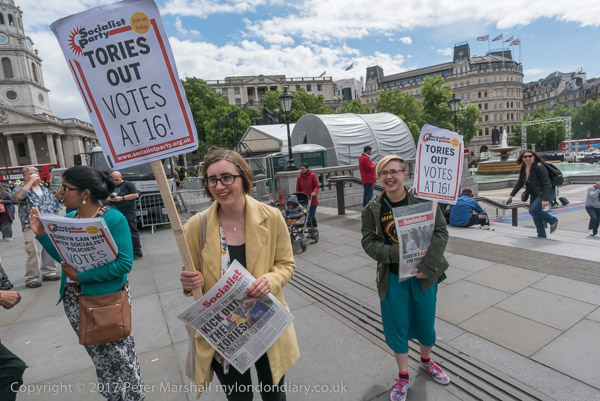
There were two protests starting at 11.00am in Trafalgar Square, so that was where my day started – after just a short journey on the Bakerloo from my London Terminus. Both were rather smaller than I – and the organisers – had hoped, though perhaps expecting teenagers to get to something starting that early on a Saturday was a little optimistic. Probably the numbers on both picket up after I had taken my pictures and left, but I wanted to be elsewhere.

Teen Voice says votes at 16
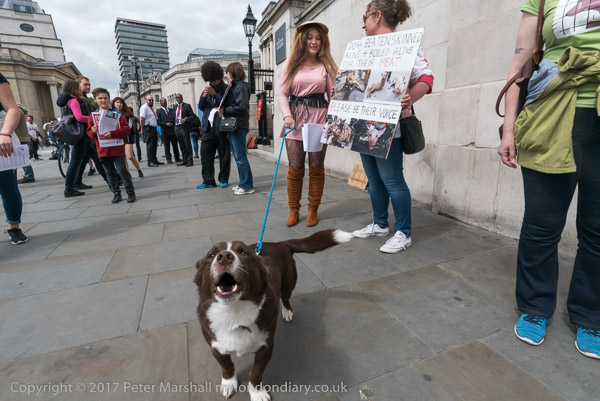
End dog and cat meat trade

Next the Travelcard took me on the Northern Line to Kings Cross, where I had a short walk to The Guardian in Kings Place, for another protest starting at 11 o’clock – though it was nearer noon when I arrived. This was a livelier affair with more scope for photography, particularly as the show of solidarity with President Maduro and the working class Bolivarian revolution in Venezuela, had attracted a counter-protest by more middle-class  Venezuelans violently opposed to his socialist reforms which have decreased poverty, provided free health care and education, devolved power into the hands of local collectives and built homes for the working class.
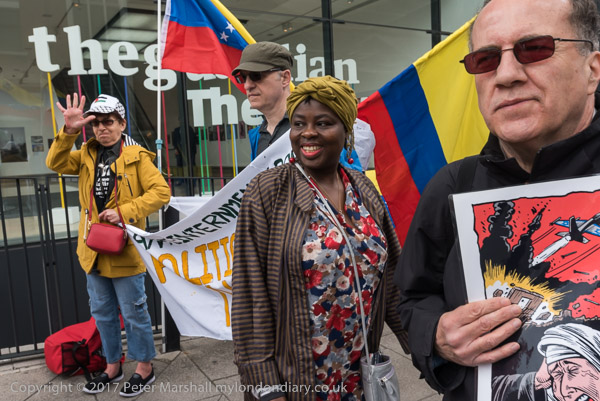
The protest was taking place outside The Guardian as those protesting accuse it of failing to report the truth about what is happening in Venezuela, which appears to be a fairly typical US-backed right wing coup attempt backed by wealthy Venezuelans including the newspaper owners there, who fail, like The Guardian, to report the many deaths in attacks on hospitals, schools and socialist cities. The counter protesters called Maduro a murderer and there were some heated exchanges of views.

End media lies against Venezuela

It was back to Kings Cross and the Piccadilly line to Holborn to change to the Central to Stratford for me.  There Focus E15 were protesting in the wide open public space in front of Stratford Station, launching and handing out the free copies of their latest publication, ‘The Newham Nag’, based on and visually similar to  Newham Council’s fortnightly information sheet,  delivered at council tax payers expense to every address in Newham.
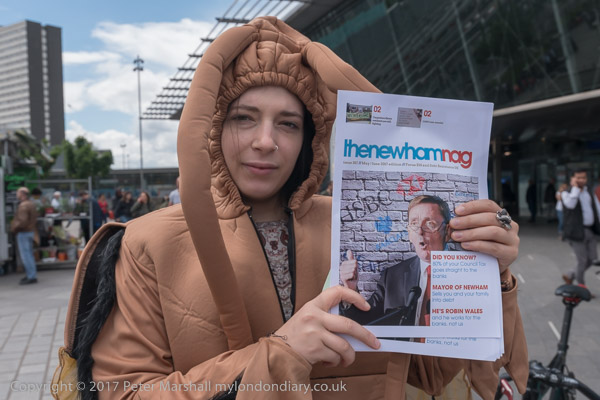

A protester dressed as a cockroach to highlight the poor conditions in which Newham houses some people

Though the look was the same, the content was rather different, revealing Newham’s financial ineptitude in taking out risky LOBO loans which they say means that 80% of council tax goes direct to the banks as interest payments, and that the council has the largest number of homeless of any borough in the country and is failing in its duty to provide housing for its residents.

Focus E15 are not popular with Newham Council for pointing out such failures and for their attacks on the competence of Newham’s long-term Mayor whose major skill seems to be in manipulating the party processes to keep in power. Police and council officials have often harassed their weekly street stalls in the town centre, once going so far as to carry out an actual arrest of a table (which they later had to return) and this occasion was no different. Police first tried to get them to move, and then two Newham Council staff handed out a fixed penalty notice of £100 for alleged obstruction of the highway in the wide public open space in front of the station.

Focus E15 launch The Newham Nag

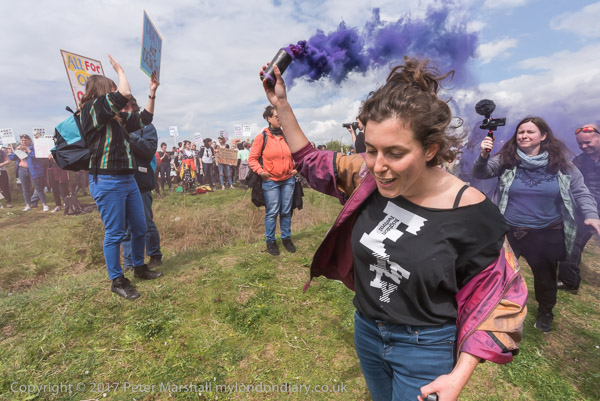
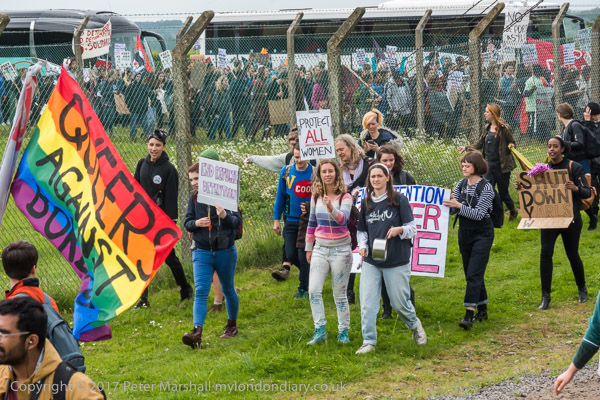
I left Stratford on the Central Line, which took me straight through to Bond St for the next protest which was outside the US Embassy. This year’s March Against Monsanto in London wasn’t a march but a static protest with a number of speeches.

Again it wasn’t too exciting a protest to photograph, though I did my best, and there were a few posters, including one set from a woman (made by her daughter) who had come along to protest in favour of GMOs, and calling for any opposition to be based on scientific evidence. It’s not a simple issue, and is clouded by the fact that much of the research is paid for by companies such as Monsanto, while other researchers certainly have a bias against them; it is difficult if not impossible to separate the science from the politics on either side of the issue. What is certainly true is that some of the products can be used in a way that is destructive of biodiversity and destroys the livelihoods of many while making nice profits for the bio-tech companies – and that governments around the world have been lobbied and bribed to prevent proper controls of their activities.

The whole area is one where we need to be far more cautious and call for much greater and more objective testing before introducing new technologies. And also one where there need to be proper legal safeguards that prevent some of the attempts of wealthy companies to bully poor farmers around the world.

From the Embassy it was back to Bond St and the Jubilee back to Waterloo for my train home. I think I’d got pretty good value from my Travelcard.
Continue reading Travelcard Day

Yarl’s Wood 11

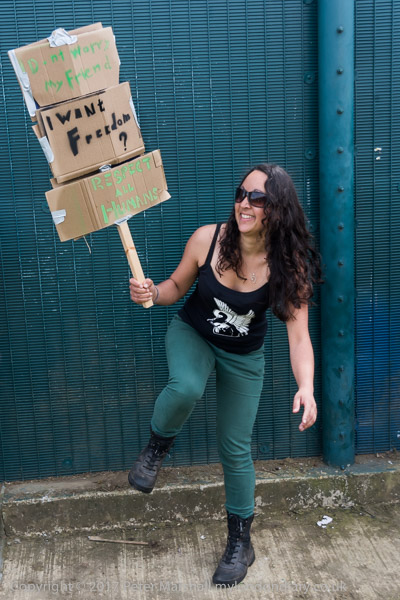
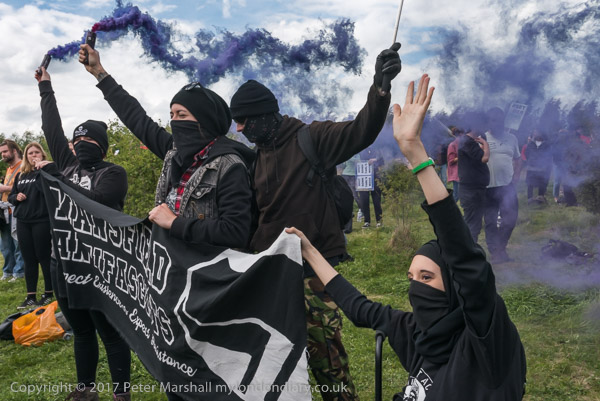
This was Movement for Justice’s 11th protest at Yarl’s Wood, and the 10th that I’ve attended, having missed the first and perhaps most exciting when people actually broke down a fence to get to the prison fence. Now the authorities leave a gate open that they can go through to the field next door to the detention centre.

I don’t often travel so far to take pictures, except for very special events, partly because of the time it takes, but also because it gets a little expensive. And partly for medical reasons I no longer drive, no that I ever did much. So that means public transport, and getting to Bedford is easy enough, though it costs more than the average repro fee I get. Financially any trip out of London is likely to be a loser for me, but this is a protest that I cover not for the money but because I think the cause is a particularly important one.

Yarl’s Wood is a little over 5 miles north of Bedford which is a little over 50 miles from where I live. Going by train to Bedford station takes around 2 hours, but from there the journey is a little tricky. MfJ put on coaches from London, but I’d have to leave home rather early to catch them, and there was also a coach from Bedford station, for a donation of a fiver for the return journey, which I’d used previous times, but it was slow (especially when the driver didn’t know the way) and has sometimes meant I’ve arrived rather late. I could take a taxi, but unless I found someone to share this would be expensive. There is a bus from Bedford, to nearby Milton Ernest, which would be free for me, but leave me with a mile walk uphill to the meeting point. As the bus is only hourly it would add considerably to the journey time.

So the obvious thing to do was to take my folding bicycle on the train. I could then walk off the train at Bedford, unfold the Brompton and pedal away, getting to Yarl’s Wood rather quicker than the MfJ coach which would be waiting around and probably only leaving the station car park more or less as I was riding to the Yarl’s Wood meeting point.

It more or less worked out. But I hadn’t really allowed for the hills, and the road goes up and down a bit. The down is OK, but the ups were just a little tiring, particularly as for some reason I could only get the middle and top of the bikes three gears. And the last stretch up from the main road at Milton Ernest was pretty exhausting, but fortunately the road levels out just before my destination and I was able to arrive at the protest at a reasonable speed – and to cheers and catcalls from some of my colleagues who had come up from London by car.

Carrying my photo gear on the bike probably isn’t good for it, but the Brompton has a front carrier bag which will double as a rather poor camera bag simply by fitting a shoulder strap on it. Back when I first got the Brompton at the end of 2002, I used it mainly for taking me out into the landscape with a panoramic camera.

At the protest I locked the bike to a fence, took off the bag and put it on my shoulder and worked as normal. But then the protesters set off on the march to the field next to the immigration prison. I cycled ahead of them on the road, then jumped off and took some pictures, and some more as they were going into the first field. From there it got difficult, as there is around three-quarters of a mile of footpath mainly along the edges of some fields, some of which were a little rough and muddy. The Brompton isn’t a good off-road bike and most of the way I had to get off and push – and there are no pictures on My London Diary from this section of the march. Once we got the the field I could lock it and leave it again and get down to work.

Fortunately the weather had been reasonably dry for the previous few weeks, or the mud on the path would have been more of a problem. And where we were protesting was relatively dry – on some previous visits the mud had made it very hard to keep on your feet while taking pictures, particularly as the ground is uneven.

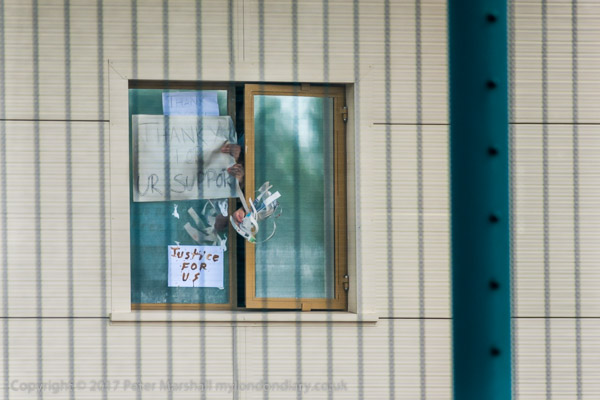
As always there was a huge welcome from the prison windows which overlooked the protest, with those inside shouting and waving and pushing out messages and anything to hand through the narrow slits that the windows will open. Between us and them is a 20ft high fence, the lower half solid, but the upper part a mesh through which we and they could see, though making it hard to take photographs.


Mabel Gawanas spent almost three years inside Yarl’s Wood

It’s totally shameful that this country looks up asylum seekers in this way for indefinite periods, leaving them never knowing whether at any moment they will be taken away and an effort made to deport them. Something like two thirds are eventually given leave to remain; some others are released with their cases still undetermined and some are packed onto planes and flown home, sometimes to face persecution in their own countries. Locking them up makes it much harder for them to prove their cases, and is no way to treat people who have fled persecution and physical danger, often beatings, torture and rape, and are in need of care and compassion. As too many reports, particularly those by undercover journalists who have got jobs inside them have shown, in Yarls Wood and the other immigration removal centres they are physically and mentally abused, even sexually abused. And of course there are the stories from the detainees themselves, some of which from both current and former detainees, are heard at these protests. Unlike convicted criminals, the detainees in our immigration prison are allowed mobile phones and their calls can be relayed to us outside.

The centres like this one are run for profit, with corners being cut on food and care, often understaffed and by people with inadequate training and unsuitable for the job. These centres should be closed down, and only those people who present a real threat to others – a vanishingly small percentage of those currently held – should be detained.

Getting back home was quicker too and I could leave when I liked. Better still, apart from one short very steep hill it was more or less downhill all the way, and caught a train an hour earlier than I would probably have done on the coach. The total journey home, with two trains and the underground between London stations was actually a little faster than the only time I’ve gone to Yarl’s Wood by car.

Many more pictures at Shut down Yarl’s Wood Prison

Continue reading Yarl’s Wood 11

Back at the LSE

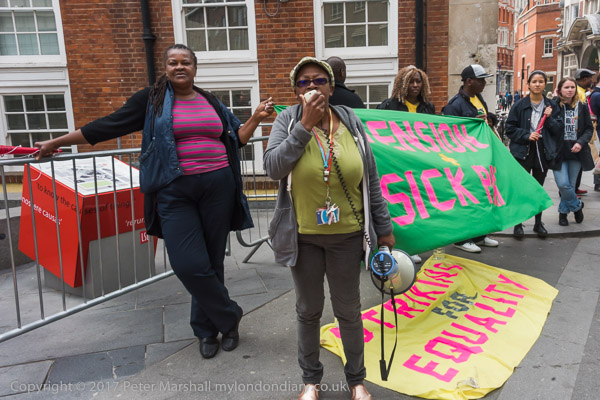
I seem to have spent a great deal of time at the LSE recently, with two separate groups of protesters both supporting the campaign by the cleaners for parity of terms and conditions with staff employed by the LSE. It is time to end the practice of outsourcing key services like cleaning as a way to get the work done using employment practices that the University itself would never allow.

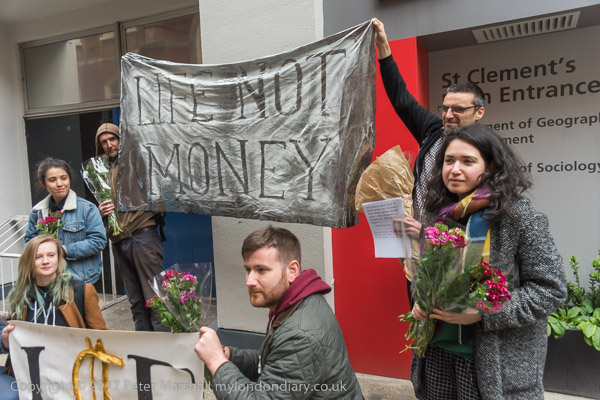
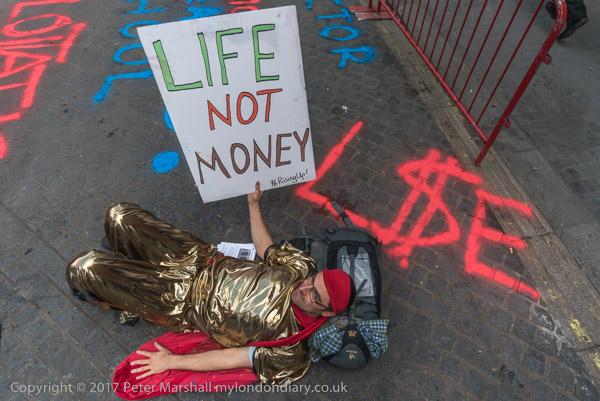
The cleaners belong to the United Voices of the World, a registered trade union which follows normal trade union practices – if a little more boisterously than most, picketing the workplace and also taking part in peaceful though noisy protests, together with sympathisers and students. ‘Life Not Money at the LSE’ is a direct action group allied to Rising Up, which calls ‘for a fundamental change of the political and economic system to one which maximises well being and minimises harm’ and believes that a more confrontational approach is necessary.

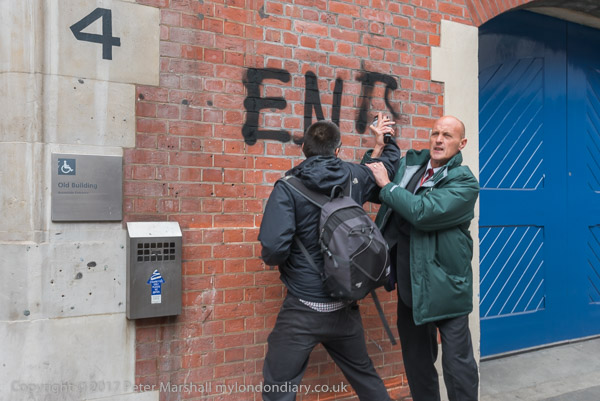
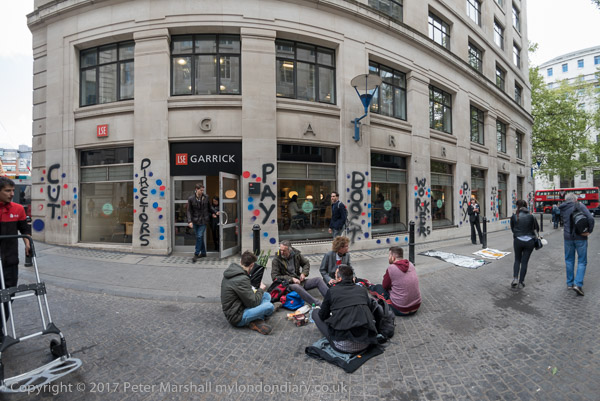
Life Not Money came to the LSE on May 3rd and tried to protest at the entrance to the library but were moved by security onto the road outside where they handed out fliers and displayed banners, posters and flowers. But the main point of their protest that day was to force the LSE to get someone arrested, with one of them attempting to write the slogan ‘END INEQUALITY AT THE LSE’ in spray chalk next to one of the doorways.

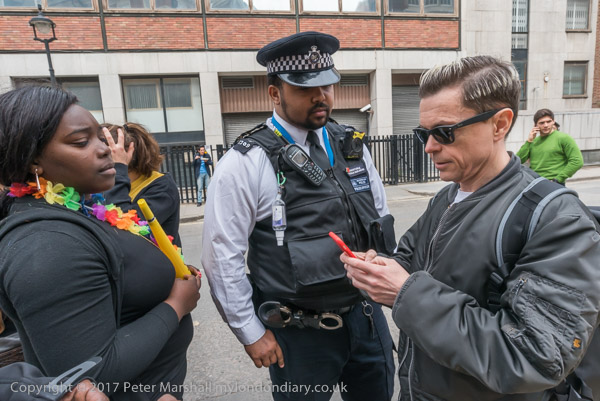
Unfortunately his timing wasn’t too great and he only got as far as EN and halfway through the D when he was tackled by a security guard, who held him until two police officers arrived to make an arrest. Life Not Money feel it will shame the LSE into action if a number of people get arrested for ‘criminal damage’ in this way, particularly as the chalk used wipes off cleanly with no damage and should any case get to court there is a good chance of it being dismissed as a petty waste of the court’s time.

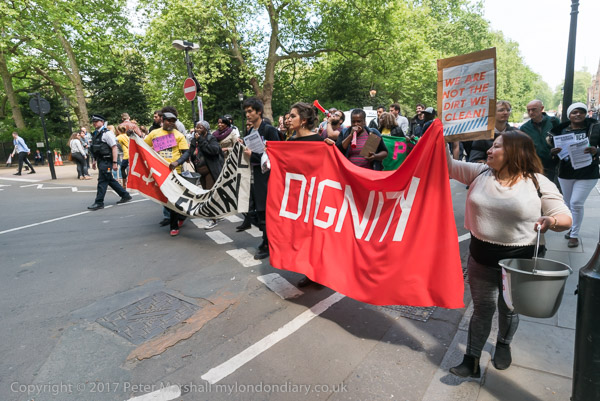
Eight days later there was a further protest at the LSE when the UVW cleaners were holding a one-day strike and a lunchtime rally in the street outside the LSE Library. They came with vuvzelas and megaphones as well as banners and leaflets and made a great deal of noise. Although there was plenty of support from many who walked past, one or two staff stopped to argue with the protesters and tried to make them stop, but police supported their right to protest. But police also harassed some of the supporters, including Sid Skill from Class War, and it seemed likely they might arrest him. He left, followed by two officers, but managed to jump on a bus just as the doors were closing and left them behind.

As the UVW rally was coming to an end, after a march around other sites on the campus we were listening to performances by several of Poets on the Picket Line in the area outside the student’s union when we heard a disturbance a short distance away and rushed to find three protesters from Life Not Money blocking Portugal St and the entrance to the LSE’s extensive building works.

This time they had chalked on the road and not on the walls, and their message read ‘Next Director on £500,000 But No Pensions for the Cleaners! London School of Exploitation – L$E‘ and they were sitting patiently on the road in colourful red and shiny gold costumes waiting to be arrested. But on this occasion there were no arrests.

LSE Equality Life Not Money protest

LSE Cleaners strike


Since the successful end to the LSE campaign some of the same activists and others have been involved in another Rising Up campaign ‘Stop Killing Londoners‘ against the almost 10,000 premature deaths a year in London caused by excessive pollution levels. Four were arrested on November 6th 2017 and held in custody on remand until their trial on November 14th, with some going on hunger strike. They had been under bail conditions not to return to City Hall after having been arrested there for chalking slogans the previous day, but had returned and chalked ‘Cut Air Pollution – Air Pollution Kills’ in large letters and waited to be arrested. At their trial they were found guilty and fined £385 each but no conditions were imposed. There is an appeal for donations to cover their legal costs.

Continue reading Back at the LSE

Disabled protest Tory hate

One of the problems of the Conservative Party has long been a failure to understand how most people live. Of course there are poor people who vote Tory, and people in the party who have come from working class backgrounds, but their policies are largely made by people who have never known (or long forgotten) what it is like to live in poverty. And those few who started poor often seem to blame those who remain poor, feeling they worked their way out of it so why can’t everyone else?

Austerity was always the wrong policy and it hasn’t worked, but it has led to a great deal of suffering and misery, punishing the poor for crimes of the rich and the failures of successive governments to regulate the activities of the wealthy, allowing huge levels of tax avoidance and encouraging scams such as ‘buy to let’ and the use of housing as an investment vehicle, particularly for foreigners, which, along with a concerted attack on social housing are at the root of our ‘housing crisis’. We don’t really have a housing crisis – there are enough homes to go round, but many are empty part or all of the time and beyond the means of those who need them, while private landlords benefit from high rents made possible only by heavy housing subsidies – and low pay for workers means companies are subsidised by ‘in-work’ benefits while CEOs and other higher management get silly money.

A recent study published by the BMJ concludes that austerity has led to an increase in death rates and suggests that this has led to 120,000 additional deaths since 2010 due to cuts in public expenditure on healthcare and social care. The study’s lead author was quoted in The Independent as saying “It is now very clear that austerity does not promote growth or reduce deficits – it is bad economics, but good class politics. This study shows it is also a public health disaster. It is not an exaggeration to call it economic murder.” Though those who get their news from the BBC will probably have missed the story.

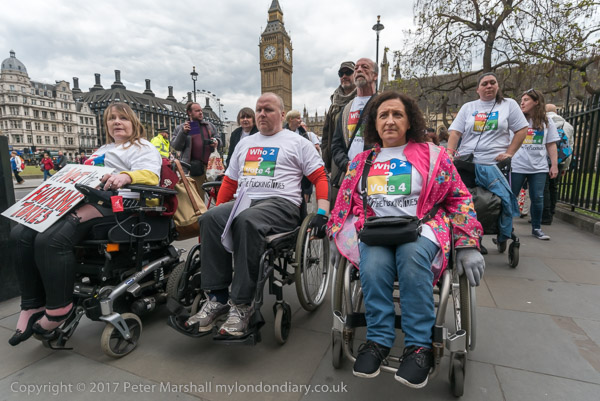
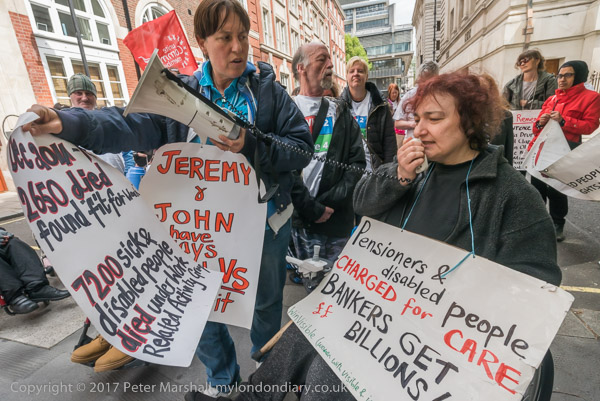
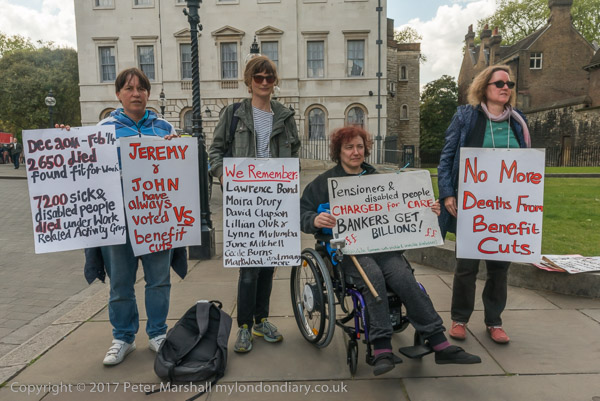
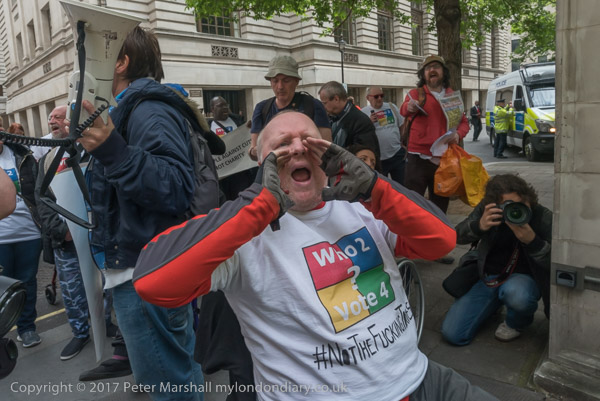
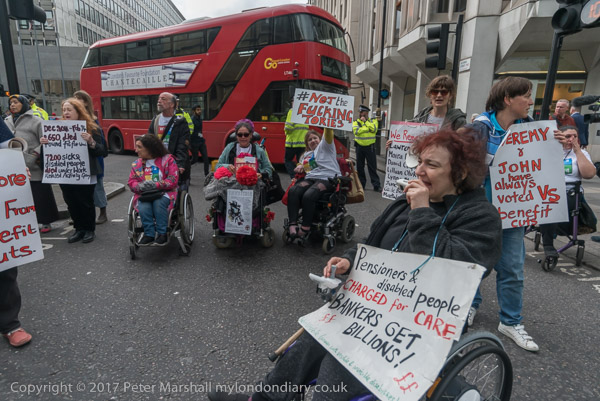
The Tories seem to have a special hatred reserved for the disabled. They seem to see them simply as a drag on the economy, taking high levels of benefits without any return to society (though paradoxically they have cut much of the support which did previously enable many to make a positive contribution.) They appear to have thought the disabled would be an easy target and would just go away and die quietly. But although far too many have died, campaigning groups such as DPAC (Disabled People Against Cuts) and MHRN (Mental Health Resistance Network) have been some of the most active protesters against their policies. And on this protest they reflected back a little of the Tory hate with t-shirts that read ‘Who 2 vote 4? Not the f**king Tories’.

In part this comes from desperation, and from clearly seeing that the cuts are life-threatening. But it is also helped by considerable public sympathy – at least once the public are told what is happening. The police find disabled people difficult to deal with, partly out of a genuine sympathy, but also because they realise how badly they might look in the press attacking the disabled – which is one reason why its important that I and other journalists cover their actions. There are also practical difficulties for them in making arrests, needing specially adapted vehicles for those protesters in wheelchairs or on mobility scooters – and police stations also may lack disabled facilities.

Not all disabled people are in wheelchairs, and not all disabilities are visible. One of the groups present at many of these protests is Winvisible, women with visible and invisible disabilities, and of course there are men too. But wheelchairs and scooters have proved very useful in protests, especially for blocking roads, and after protesting outside Parliament on the last day of its sitting before the General Election and then going on to protest outside the Tory HQ nearby, the protest finished by bringing traffic to a halt on busy Victoria St, leaving the road only after final warnings of arrest from the police. Stopping traffic in London, though an annoyance to those blocked, is one of few reliable ways to get any protest noticed.

More at: DPAC against Tory Hate

Continue reading Disabled protest Tory hate

Class War Paper Launch

Way back, soon after Ian Bone moved to London, Class War began to produce a newspaper or magazine, an irregular tabloid size publication, which became notorious for some of its covers, several of which have more recently appeared as posters, such as ‘We have found new homes for the rich’, showing a huge cemetery of crosses. In its early days it was produced in an obscure tower block in North Kensington where Bone was living, which has more recently headlined the news, Grenfell Tower.

When Class War decided to produce a new issue of the newspaper, I was asked if they could use some of my pictures from their events, and I was pleased to let them do so. It was perhaps more serious than the earlier issues, with some substantial articles about Class, Housing, the Women’s Death Brigade etc, as well as some hilarious horoscopes and features on Duncan Disorderly and Potent Whisper.

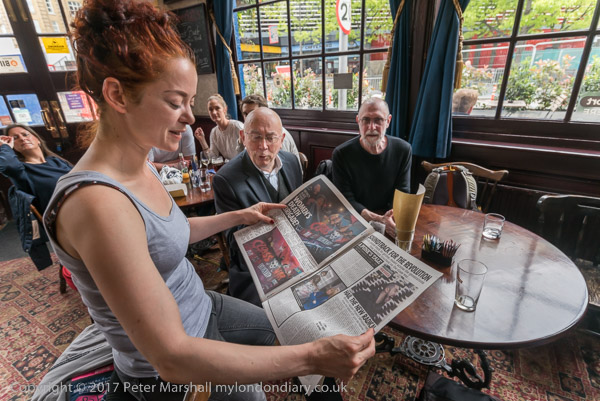
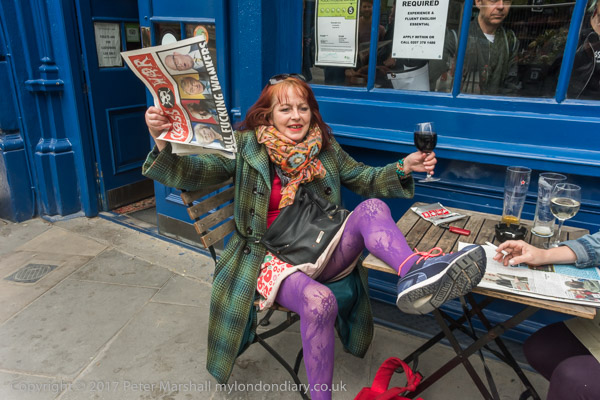
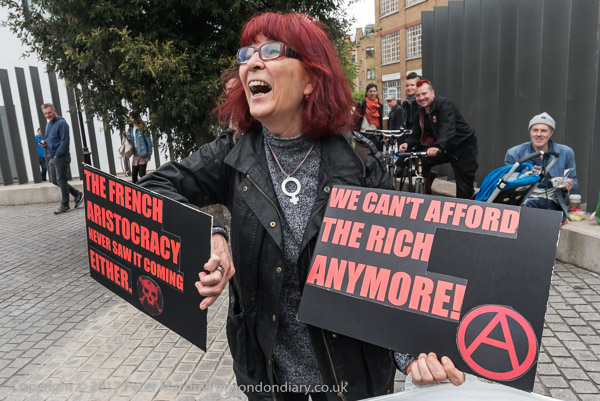
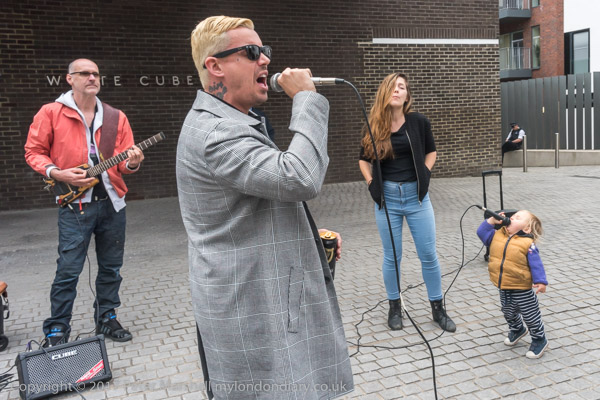
The protest outside the White Cube Gallery had been planned earlier as a protest against gentrification, following on from earlier protests there  in December 2015 –  Class War at Gilbert & George ‘Banners’ and January: Class War Footy at White Cube. As with many Class War events, in started in a nearby pub, where copies of the newly printed newspaper were read.

Eventually people walked down the street to the yard in front of the gallery:

And people posed for a group photograph with copies,

before playing a little football, something which isn’t usually allowed on the yard, empty space in a crowded inner city with astronomical land prices, seen by Class War as akin to burning £50 notes under the noses of the working class population of the area, still present in the Peabody and council flats despite the increasing hipster invasion.

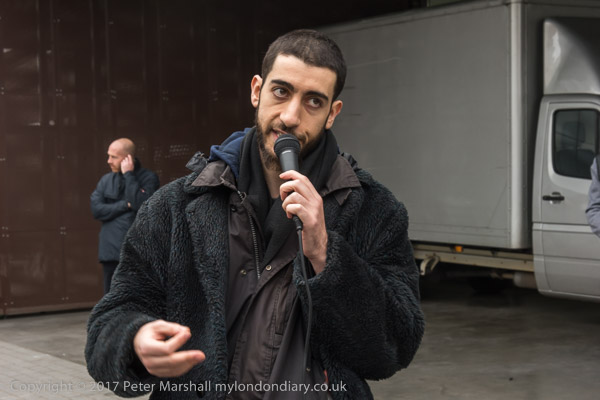
But the real treats of the afternoon were at a higher cultural level, though not appreciated by the gallery staff hiding behind police and security with the gallery locked for the afternoon. First Potent Whisper performed his latest spoken word piece on the housing crisis, Estate of War, followed up by speeches by Simon Elmer from Archtiects for Social Housing (ASH), Ian Bone and another well-known anarchist, Martin Wright, then songs from ‘one-man anarcho-folk-punk-hiphop phenomenon’ Cosmo, more from Potent Whisper and then a truly incredible new improvised performance from Adam Clifford and his guitarist (unfortunately not recorded for YouTube), after which Jane Nicholl performed her introduction to   Adam’s performance of ‘The Finest F**king Family in the Land‘.

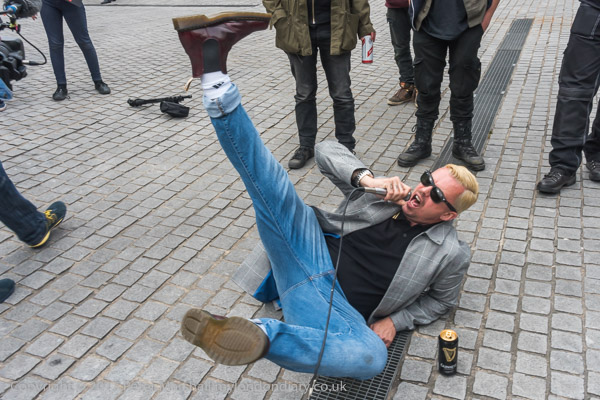
Adam ended his performance in his usual style:

and the event was still continuing with other musical performances when I had to leave.  It had been, as I wrote at the time, a legendary performance, rather eclipsing anything the White Cube has had to offer at their site, and I felt privileged to have witnessed it.

Class War at White Cube

Continue reading Class War Paper Launch

On and Off Photography

Back in the late 1970s when there seemed to many of us that their was a least a glimmer of a photography culture emerging in the UK that might support serious photographers, thanks to the efforts of Creative Camera, the Arts Council  and a few people in education, particularly in the Midlands, including Paul Hill and Ray Moore, we suffered a huge academic land grab which more or less snuffed out that fledgling. Creative Camera degenerated, the Arts Council altered course and many photographers were relegated to obscurity.

Photography was largely sacrificed on the altar of academic respectability, becoming subservient to the word, being relegated to what many saw as its rightful subservience in our logocentric culture. You want a degree you’ve got to read learn a secret language to read deliberately obscured texts and write pretentious essays, never mind the pictures.

The flagship of this enterprise was a curious work, On Photography by Susan Sontag, which came at the top of every degree course reading list. My own copy of this 1977 best-seller soon got into a sorry state from being thrown down at its more ridiculous sentences, its margins annotated with my explosions at her ignorance and misunderstandings, her half-digested regurgitations from earlier sources.

It did make rather a good television programme, which I had recorded and watched several times, and felt to be far superior to the book, not least because in it her thoughts became tied to actual examples, the particular rather than the generalisation.  And perhaps because of the work of a better editor than at her publisher and the more limited canvas available.

It was a book that spawned more books, but never provoked any photography of significance, that led to a whole school of academia that treats photographs as just an abbreviated list of the objects and events they depict, largely dismissing the aspects that make photography an vital and visual medium.

We no longer simply looked at photographs, no longer experienced them, but in that oh so reductive usage, we ‘read’ them. Not that reading photographs can’t give us valuable insights – and it was always a part of looking at them – but it is only a partial exercise, and the visual, expressive, aesthetic aspects were generally dismissed as unworthy of study.

On Photography is a book that should only appear on reading lists for students with a health warning, and one of the best health warnings is provided by an article recently resurrected by A D Coleman, Susan Sontag: Off Photography, originally written by him in 1979 but not published until 1998. In his introduction to this republication, Coleman notes:

Sontag subsequently acknowledged that photography was not her real subject and had simply served her as a convenient whipping boy, and — in Regarding the Pain of Others (2003) — she eventually retracted most of what she’d had to say in her original diatribe.

Regarding the Pain of Others is certainly a far better book about photography, and the photography of war in particular, but I don’t recall ever seeing it on the reading lists for photography students. Perhaps it should be, replacing her ‘On Photography‘.


LSE sprayed with chalk

The t-shirt for sale in the university shop at the LSE, pointed out to me by Lisa McKenzie, then an academic working at the LSE and who can be seen photographing the shop window, seemed to be a rather too accurate reflection of the current priorities of the institution, with its message ‘£$€‘ , though perhaps these days it should also somehow include ¥ and .

I was at the LSE for a protest by students and workers in the ‘Life Not Money’ campaign  who were calling on the LSE to change from what they say is thirty years of growing neglect, cruelty and outright corporate greed towards workers and staff at the school to something beautiful and life affirming. In particular the contrasted the high salary of the director – said to be around £500,000 a year  – with that of the lowest paid workers such as the cleaners who are paid less than the London Living Wage and have unpaid breaks and are bullied and treated as second-class citizens.

While the cleaners’ trade union, the UVW, has been taking action with a series of demonstrations and strikes, Life Not Money have decided a more effective method is to use more colorful direct action with the deliberate intention to get some of their supporters arrested. It’s an approach that does seem to have worked in other disputes.

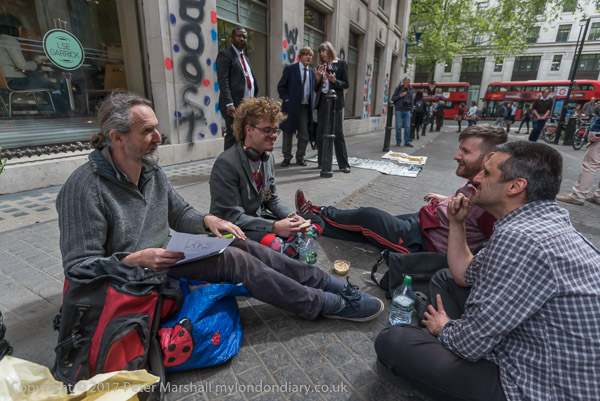
I was a little aggrieved that after having been invited to photograph the event I was left photographing what was an action intended to divert the LSE security while the actual direct action of writing and drawing on the wall of one of the university buildings in nearby Houghton St actually took place. Perhaps this was just an oversight, but by the time I got there, the writing was already on the wall:

‘Cut Directors Pay Boost Workers Pay We All Know it Makes Sense’

and those who had done it were sitting quietly having a party and waiting patiently to be arrested.

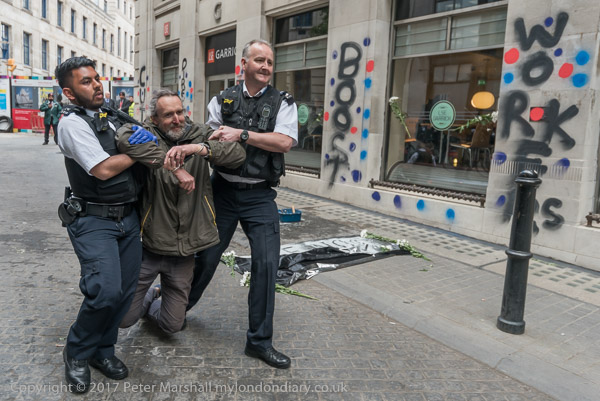
It wasn’t real paint that had been used, but spray chalk, and there was no actual damage to the wall, just to the image of the LSE and the pride of its security team who had failed to stop it.  The protesters had even brought along damp sponges and offered to remove the writing but security and police were not prepared to allow them to do so.  It’s hard to see that writing on a wall with chalk that can easily be removed with a damp cloth could be seen by a court as ‘criminal damage’ – which the LSE alleged and police arrested the writer for.

Increasingly arrest and a period of often up to 18 hours in police custody – they like to release people in the early hours of the morning when little or no public transport is running – is being used as a minor punishment by police for offences where there would be little chance of securing an actual conviction, and where often no charges are made. And in some cases police release people on bail with conditions intended to prevent further protests, such as banning them from the area where they were arrested, often for several months, though this appears to be unenforceable. And property, sometimes including clothing, may be taken as ‘evidence’ for cases that stand little or no chance of coming to court – and is sometimes lost by police.  It seems to be a little procedural bullying which has no basis in law, and for which some have managed to receive compensation.

In this case the police didn’t seem unduly worried about the apparent crime, and they kept the four perpetrators waiting for over an hour before they arrived to arrest them – and I’d almost given up waiting and gone to catch my train home.

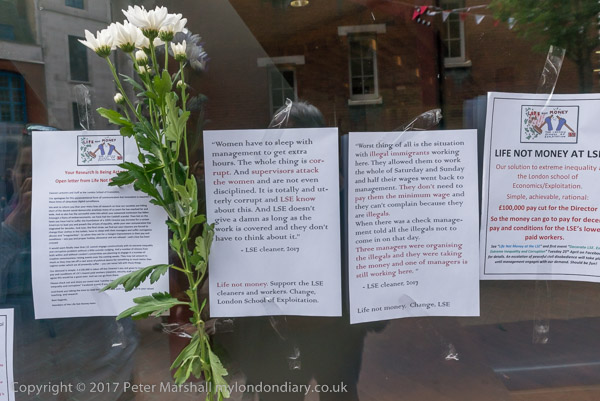
Among the allegations from cleaners employed by Noonan for the LSE on the posters that students posted:

“Women have to sleep with management to get extra hours. The whole thing is corrupt. And supervisors attack the women and are not even disciplined … LSE know about this. And LSE doesn’t give a damn so long as the work is covered and they don’t have to think about it.”

“Worst thing of all is the situation with illegal immigrants working here … half their wages went back to management. They don’t have to pay them the minimum wage and they can’t complain because they are illegals. When there was a check management told all the illegals not to come in on that day.”

These are the crimes that police should be investigating, not protesters chalking on walls.

More at: LSE decorated against inequality & corruption

Continue reading LSE sprayed with chalk

Scientists for Science

It’s hardly a surprise that scientists are in favour of science. What is surprising is that so many people – and those with most power and responsibility including our political establishments here and in the US seem not to be. Our BBC, largely the voice of the establishment, maintains its pretence of impartiality by giving climate denying lunatics like Lord Lawson the same or greater prominence as climate scientists, and Facebook and the web are full of miracle cures for cancer.

Rather than listen to the experts, to those whose ideas are based on science, we distrust them. It seems likely to be our civilisation’s undoing in the not to distant future. I’m fairly sure our planet will outlast my lifetime (at least if people keep Trump away from that red button) but far from convinced for my grandchildren’s future.

Part of the problem is that many things that have little or no scientific basis set themselves out as science – and a prime area is of course economics, which seems to apply mathematics to derive results which are simply reflections of the premises of whichever school is involved.

Science isn’t really like that, though perhaps sometimes in minor details it can be mere speculation. The most basic necessity of any scientific theory is that it could be proved to be wrong and can survive such attempts. It’s good to be able to prove things are right, but necessary to be possible to prove them false.

Our particular culture in Britain has been one based on an education in the Classics and on the primacy of the word. In the beginning was the word, and for the rest of the way too, with numbers and playing with real stuff being relegated to the rude mechanicals. And we’ve shut them away in labs where they have done remarkably well, perhaps at least in part because they are away from the distractions of talking to the rest of us.
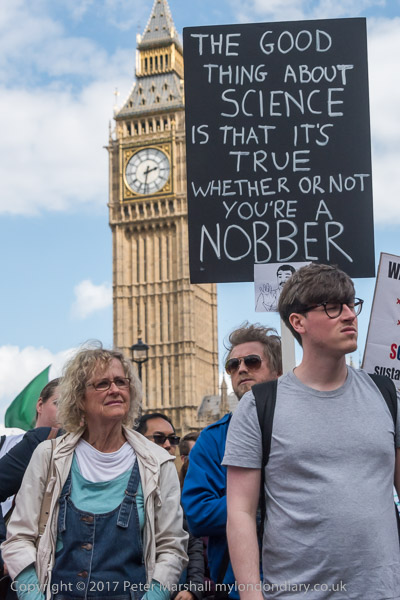
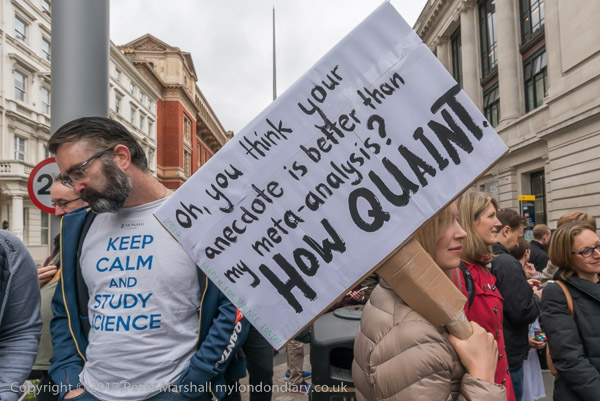
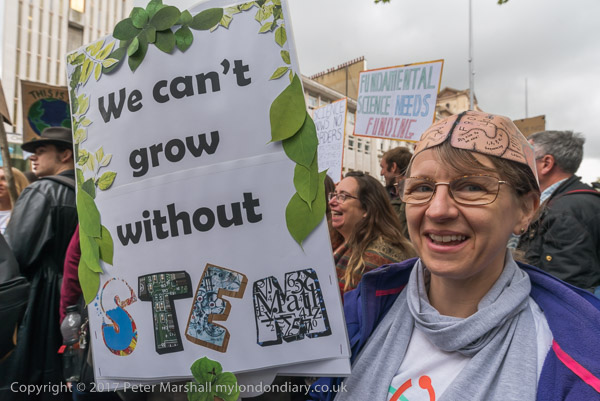
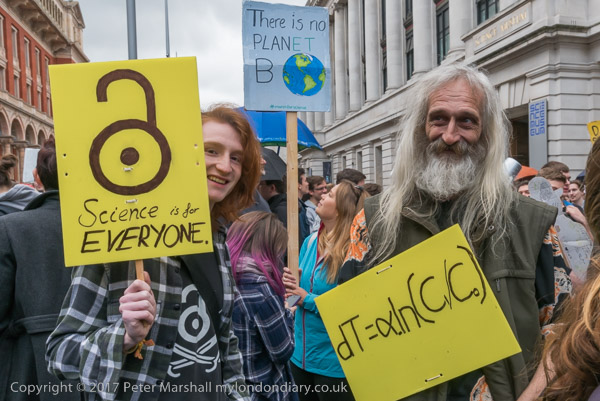
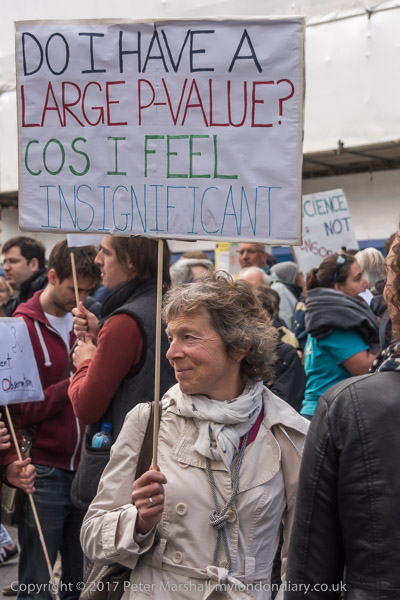
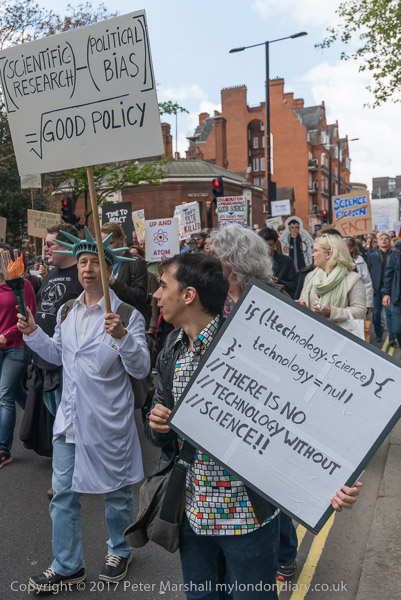
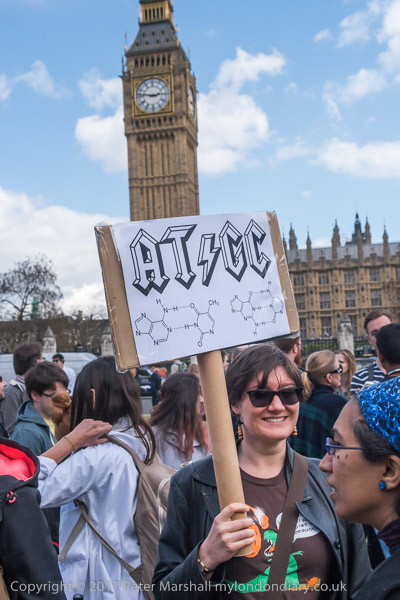
What can one make of a protest in which placards read ‘Do I have large P-value? Cos I feel Insignificant’ or ‘dT=α.ln(C1/C0)’? I have a couple of science degrees and had some idea about the first but had to go and ask about the second.
Scientists march for Science
Scientists Rally for Science
Continue reading Scientists for Science

Save Latin Village

Our system of local authorities is a mess. But worse than that it has largely become dysfunctional, often working against the interests of the population it is meant to serve. We seem to have lost the local pride that led to the great municipal developments of the late Victorian era, and which one still sees across the Channel, and councils seem to have morphed into businesses serving their own ends.
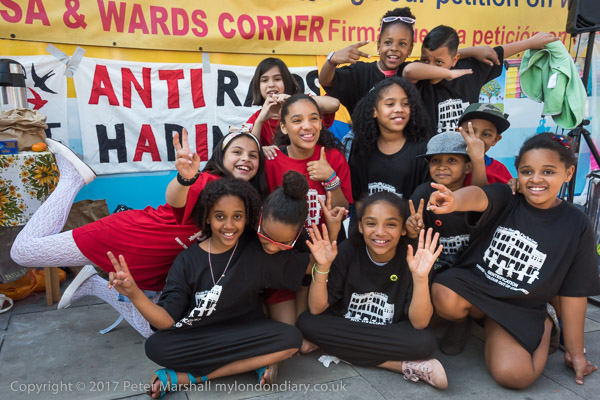
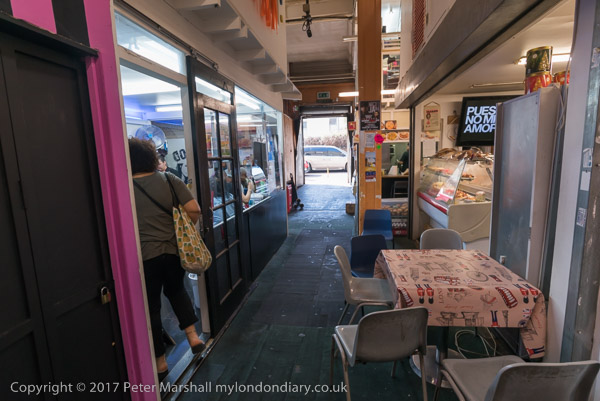
The Latin Village which has grown up around Seven Sisters Indoor Market is a thriving and vibrant community, a community asset that any local council should admire and encourage, and be proud of. But Haringey Council want to destroy it.

The block stands on a prime site on top of Seven Sisters Underground Station and on the area’s major road. So the council want to make property developers rich by replacing it with expensive flats and chain stores, profiting investors at the expense of the community. It’s something that you might expect of some sleazy and corrupt administration in a country with a bent administration, and that is exactly what it is, though the council runs under the Labour label. Italian anti-mafia expert Roberto Saviano recently called the UK ‘the most corrupt place on Earth‘, and we have a legal, political and law enforcement system that has developed over the years to protect ruling class interests and the corrupt financial system that powers the City.

It has been a long fight by the community against the council, and back in 2008 they gained the support of the then London Mayor Boris Johnson, who forced the council to think again. They did and came back with the same answer – knock it down, destroy the community and replace it by a bland block with housing for the wealthy and chain shops just like those on any other high rent high street. And big profits for their friends the property developers.

It was a lively afternoon, with speeches and music and dancing. I took a few minutes to go inside the Indoor Market, which I’ve only walked past on the outside before, and was amazed. So many people, so many shops, so much life. But I didn’t want to miss what was happening outside, so I didn’t stop to take pictures, meaning perhaps to go back later, though I’ve not yet done so, though I have since seen some good images and video by others.

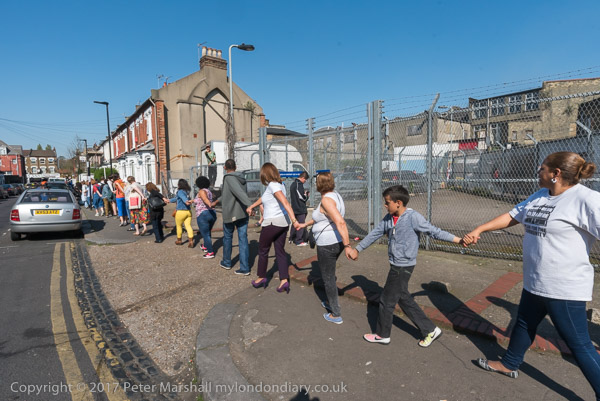
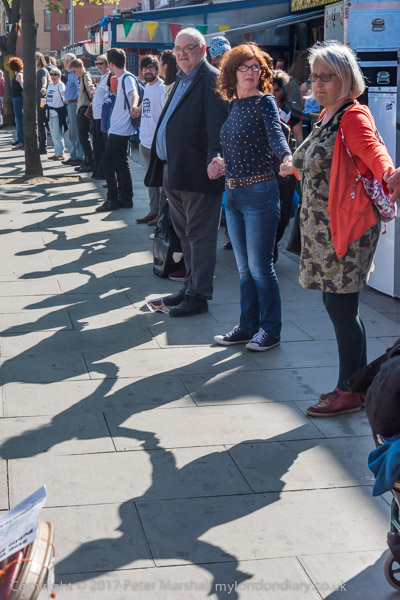
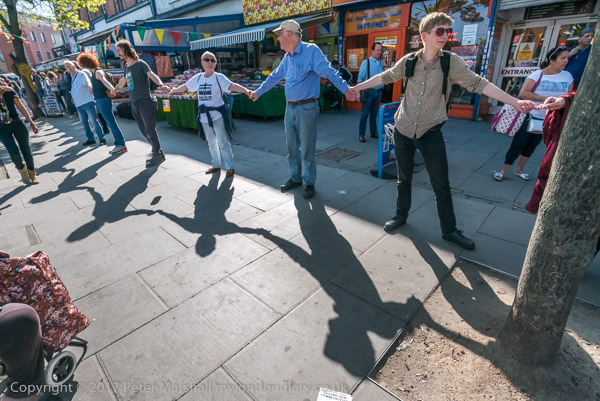
The main event of the afternoon was to form a human chain around the block, and while the chain didn’t quite link up all the way round it did get to be around 300 metres long, and had people really stretched out it would have made it. I followed it around and then walked the missing 80 metres along West Green Road, where the line of shops would have made it a little difficult back to the Tottenham High Rd where the chain had begun.

People were still there, still holding out their hands to the next in line, and the afternoon sun was putting their shadows onto the pavement. These looked like those strings of paper men we used to make by folding paper and cutting out the shapes attached by their arms and hang as chains.

The fiesta was still continuing when I left for home, with more music scheduled into the evening. It’s places like the Latin Market and others also under threat from councils and developers that make London a great place to live in – and which London’s mainly Labour councils seem hell-bent on sterilising.

More pictures: Human Chain at Latin Village

Continue reading Save Latin Village

Exploiting Terror

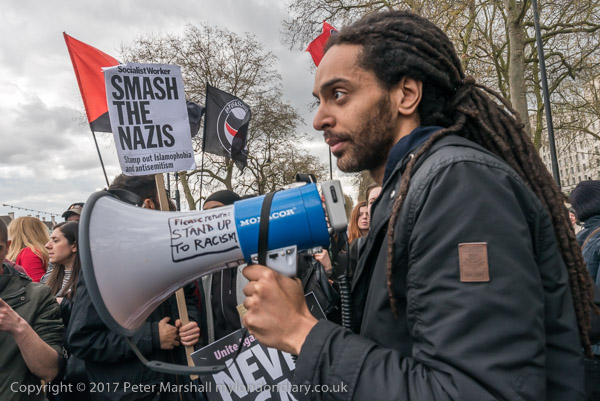
I don’t like photographing the extreme right, though I think it is important to document their activities, as well as those that go out onto the streets to oppose them. But their attempts to exploit the reprehensible attacks by a few deranged terrorists on people on the streets of London for their Islamophobic agenda I find particularly depressing and distasteful.

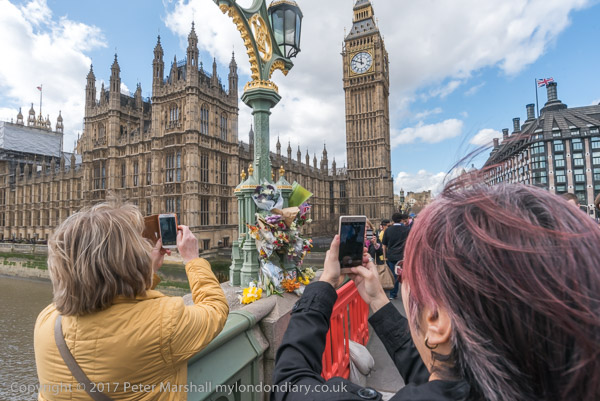
Londoners had made their feelings clear, both in the flowers on Westminster Bridge and in Parliament Square, and in the vigil the day after the Westminster attack in Trafalgar Square in which all communities in our city – including many Muslims – took part.

Britain First have a record of insulting Muslims, of making a nuisance of themselves in mosques and more. Their deputy leader was found guilty of religiously aggravated harassment and fined £2000 for abusing a woman simply because she was wearing a hijab, and their leader jailed for eight weeks for breaching a High Court ban on his entering any mosque in England and Wales.

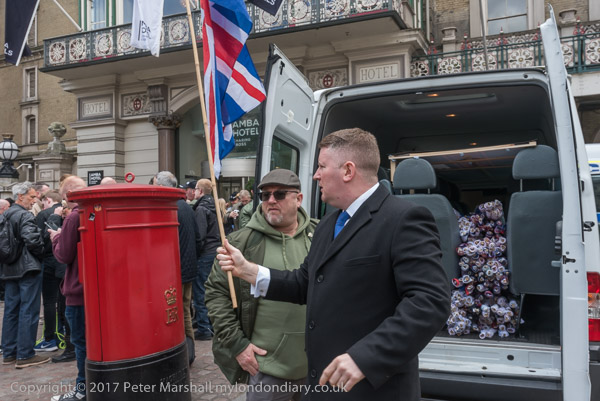
Behind the banner at the front of their march was a man carrying a ‘Knights Templar’ flag, an organisation including a number of former BNP members with strong links to European neo-Nazi and extreme right groups including the self-styled paramilitary Shipka Bulgarian National Movement and a banned Hungarian group.

But it is too easy to take dramatic pictures full of flags of Britain First – and leader Paul Golding arrived with a van full of them, though a few others had brought their own.

I found the rally upsetting, and in particular its misuse of Christianity, which did make me wonder how many of those present would be in church the following day. Certainly there was no Christian charity or message of love on display, and I think there would be vanishing few sermons preached in churches that would have been acceptable here.

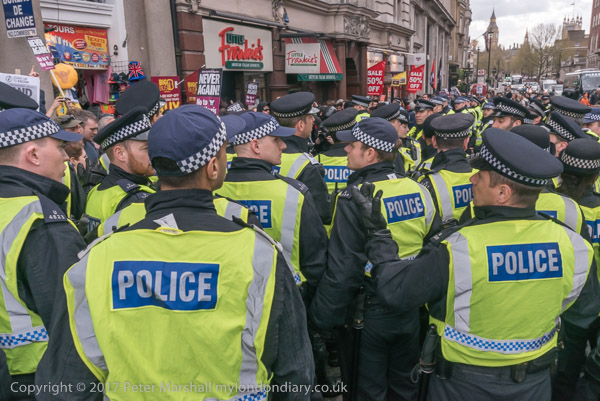
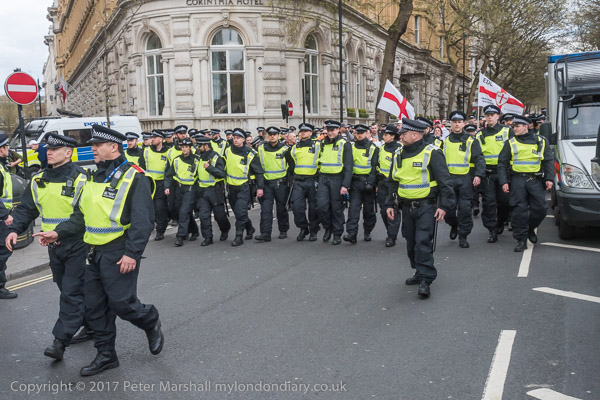
Also out on the streets were the EDL, though they met at the Wetherspoons on Whitehall – and I photographed the police actually forcing them back into the pub as the anti-fascists were being rather heavy-handedly escorted away from the area on the opposite side of the road. At one time one group of police was trying to push them down Whitehall while another group of officers attempted to stop them, and a few protesters got rather badly squashed in the middle. It was rather a muddle, and there were a few arrests and at least one photographer assaulted by police. I got just a little pushed around but tried hard to keep out of the way.

Eventually police did manage to escort the few EDL supporters down for a rally close to where Britain First were holding their rally. For some reason they didn’t want to be photographed, and one of their stewards insisted I leave – and made a complaint about me to the police.

I didn’t have any time for the officer who came to speak to me, reminding her of the MPS Guidelines which clearly state “Members of the media have a duty to report on incidents and do not need a permit to film or photograph in public places. Police have no power or moral responsibility to stop them filming or photographing incidents or police personnel” and saying it was none of her job to run around for the EDL.

So I took my pictures and then left, hoping to be able to take some more pictures of the anti-fascist, but because of the police barricades it took rather a long walk to get to them, and many had left by the time I arrived. But it was good to be back again among people who were happy to be photographed.

More at:
UAF protest extreme right marches
Britain First & EDL exploit London attack

Continue reading Exploiting Terror