Grenfell

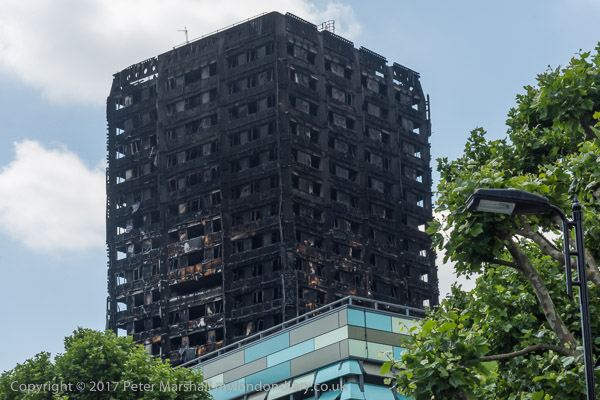
June 14th is now an important date in British history. The day of the great fire. On a smaller scale that the Great Fire of London, though killing perhaps a dozen times as many people. And a public spectacle that shocked us all with an immediacy that the earlier event lacked, shown live on TV. Though the TV pictures showed nothing of the true horror of people being burnt alive inside their homes.

Several of my friends had connections with Grenfell Tower. It was where one had lived for several years when he first came to London, and I think one of my Facebook Friends – who I didn’t know personally – was a resident and a victim.

When I woke to the news at 7 am I thought briefly about whether I should go there. It was obviously a huge news story, but it would be a couple of hours before I could be there, and I was sure there would be many others covering it. And it isn’t the kind of news I feel particularly well equipped to cover, either in terms of lenses or personality and I don’t have the kind of direct links for getting the story out that you need for a major incident. The kind of story of it I would be interested in too would require a long-term commitment, making contacts, getting to know people in the community and going day after day, and I wasn’t ready to give that. I thought that going there I would just be in the way, and stayed home.

Some of my photographer friends were there even while I was still in bed, woken by calls to cover the event or ealy risers who switched on the radio, heard the news, picked up their cameras and jumped on their bikes. Had I been younger and closer I might have done the same. Others I know rushed there as volunteers to see what they could do to help, and some remained going there day after day – and I followed their reports on Facebook.
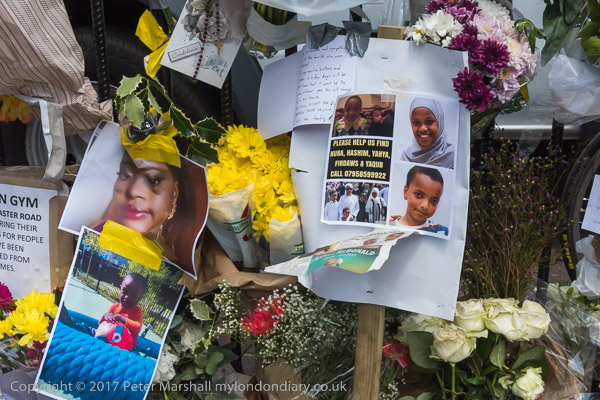
It was three days after the event that I first walked close enough to see the blackened tower, going to pay my respects at the shrine outside Notting Hill Methodist. The media were still there behind the police tape sealing off a large area around but I didn’t really feel one of them, I was there as a human being, not a journalist, though I did take a few pictures and sent some to my agency who I knew wanted them.
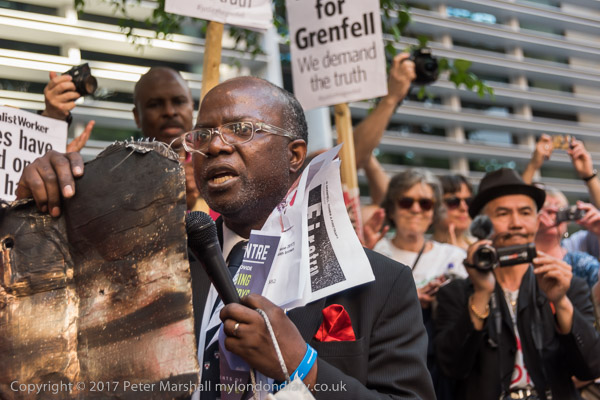
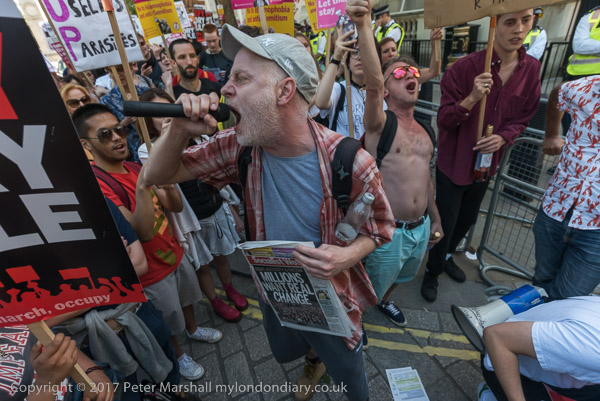
The evening before my visit I’d photographed a protest about Grenfell, beginning at the Home Office, after which most of those present marched to Downing St. There were speeches from a man who was announced as a local councillor but I think was just a local resident who seemed obviously still in shock, describing how he had seen people buring in their homes and jumping to their death, holding a square of the flammable panels which had spread the flames rapidly up the building (we learnt later it was not intended for use on high buildings and had been installed without the proper fire gaps.)
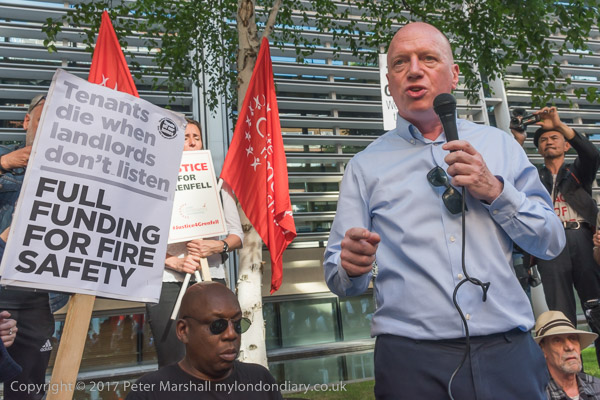
And Matt Wrack, General Secretary of the Fire Brigades Union, spoke about how cuts had inhibited the ability of firefighters to deal with events such as this, and that the system of fire inspection had been deliberately made less rigorous to allow councils such as the Royal Borough of Kensington and Chelsea to save money on making necessary modifications. Again later we heard the TMO they set up to administer their council properties had deliberately employed an inspector who would not insist on proper measures as a way of cutting their costs.
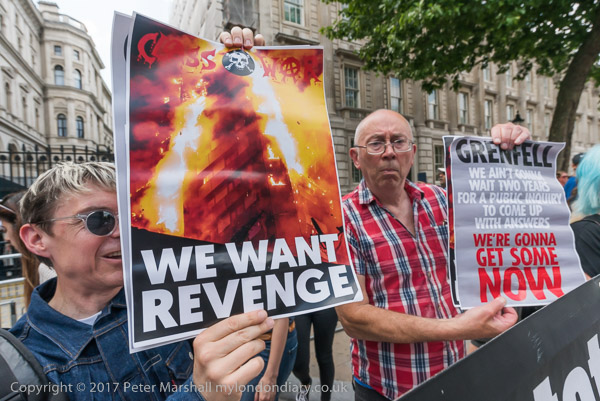
And on the Saturday when I returned from visiting Grenfell, I found Class War holding a brief protest at Downing St.

A day or two ago, an official inquiry – not the Grenfell inquiry – came out with an interim report about fire safety, having taken evidence from over 300 interested people and bodies – and is continuing its work. But many see such official inquiries as a way of putting off action and of sweeping issues under the carpet.
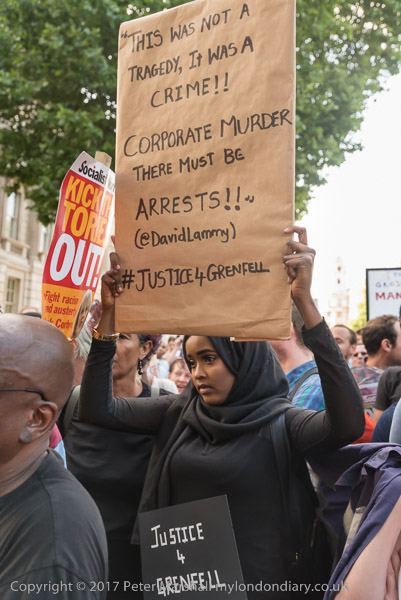
If you want to know the truth about the fire and its causes, read The Truth about Grenfell Tower: A Report by Architects for Social Housing, (PDF available here: The Truth about Grenfell Tower) which was published 5 weeks after the fire (it does start with one small error – the fire began in the early morning of 14th June and so was actually on a Wednesday.)  It is a remarkable report and although not definitive (and there are some pertinent comments at the end by Robert Singer) it does I think make the major issues clear.  And if a small – if expert – group like ASH can produce this in a few weeks, surely we should have a full official report – and proceedings beginning in the courts – over six months after the tragedy.
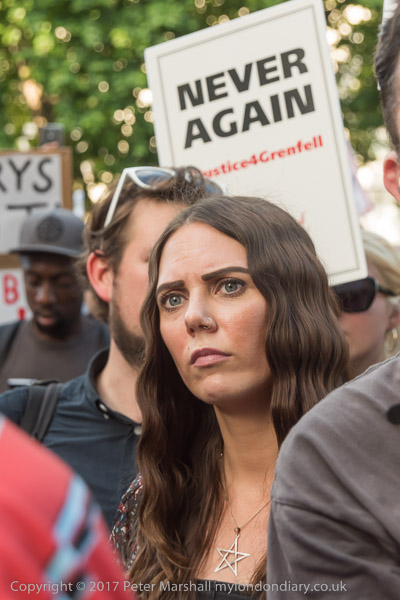

‘Never Again’.

But it will happen again unless we bring back proper fire safety inspections and provide
safe housing for those who live in social housing and if the government continue to make
profit take priority over the safety of people.

Grenfell
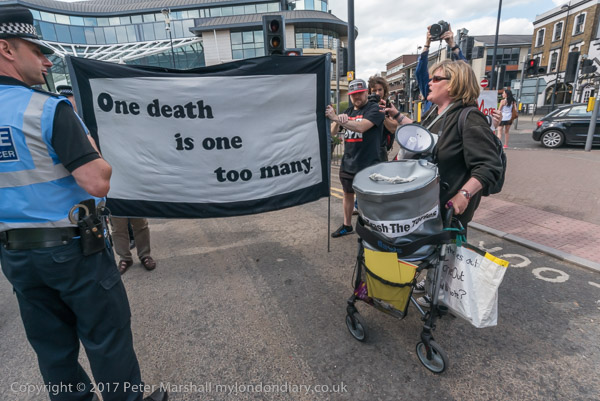
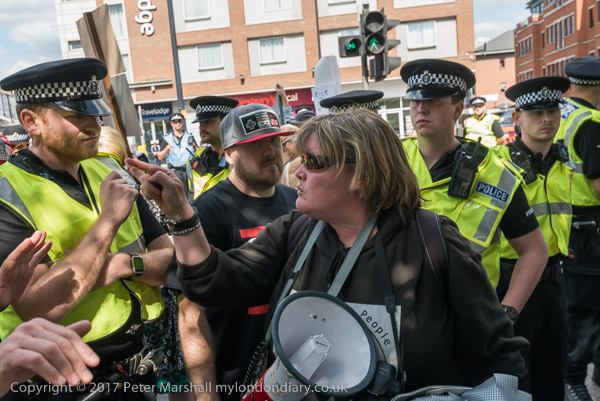
Justice for Grenfell Downing St protest
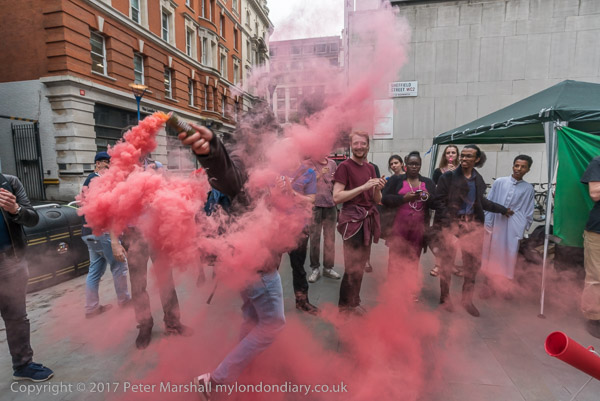
Justice for Grenfell Ministry protest
Continue reading Grenfell

Save Council Housing

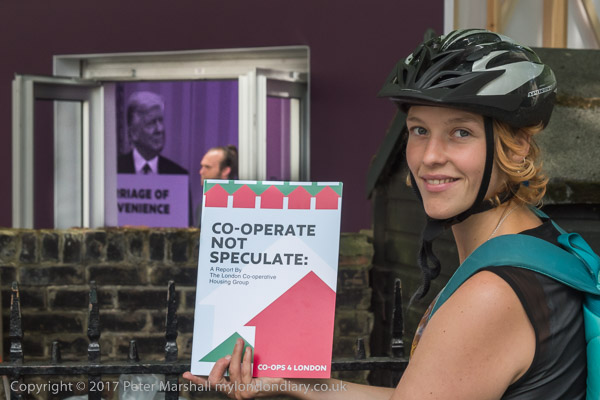
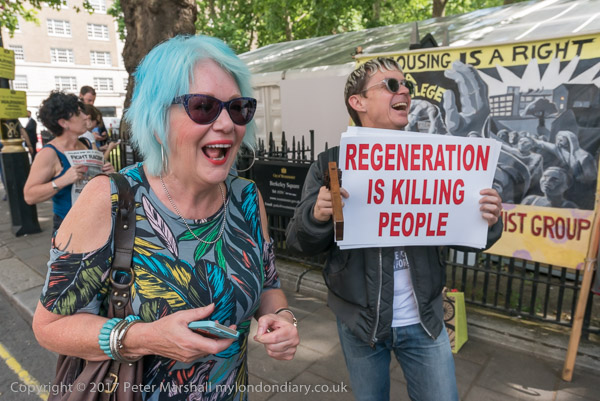
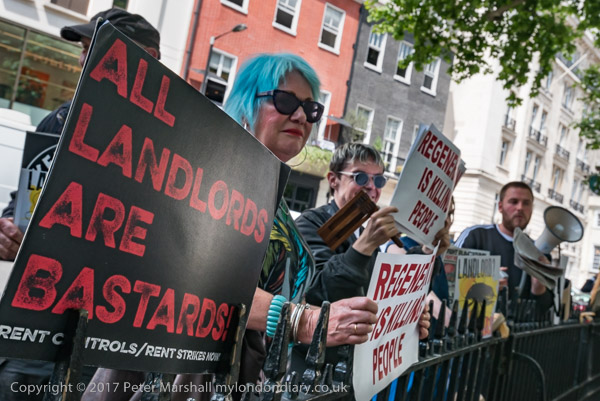
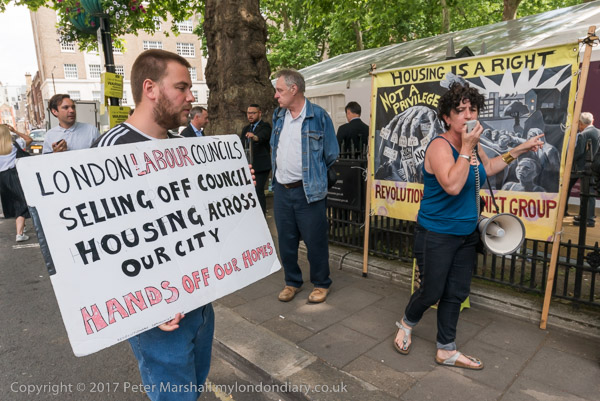
In June I photographed three events connected to the housing crisis in London, and in particular to the loss of social housing as London councils, mainly Labour dominated, rush to realise the asset value of the sites that council estates are built on.

Many London council estates are built in places that have good transport links to the City and West End where some are fortunate to have well-paid jobs and want somewhere convenient to live and can afford to pay the ridiculously high London market rates – well beyond the means of the average worker and of key public sector workers including teachers, social workers, police etc. Many Londoners are forced to live on the outskirts and travel in to work, often with long journey times.

Council housing generally pays for itself with rents half or often considerably less than market rents, providing housing that those on average or lower incomes can afford. But when council estates are demolished, their replacements involve little if any truly low cost housing, and often only a token amount of ‘affordable’ housing, which at up to 80% of market cost is usually well beyond most people. Often existing tenants are made promises of rehousing, but end up paying twice as much rent as before and with a less secure tenancy and usually in a far less convenient area. Those who have bought their properties find the compensation they get is only around half the cost of inferior properties built on the site of their former homes, and are forced to move, often to the edges of London and beyond.

Councils team up with private developers or with housing associations which are now little different to private developers, with the result that huge publically owned estates and properties become privately owned. It’s a bonanza for the shareholders, but a tragedy for the residents, and often fails to deliver for the councils, though a few councillors and council officers seem to end up with lucrative jobs in the private housing sector. Calling it ‘Regeneration’ is a con, though the policy comes from New Labour but its application is part of a long history of corruption in local politics by politicians of all parties.

The first two protests were outside the Berkelely Square London Real Estate Forum, an annual event involving council, architects and developers all after a piece of the lucrative cake from the private development of what is currently public housing, transforming what are now homes for the low paid into homes for the wealthy and investments often kept empty for overseas investors relying on the increase in prices on the London housing market.

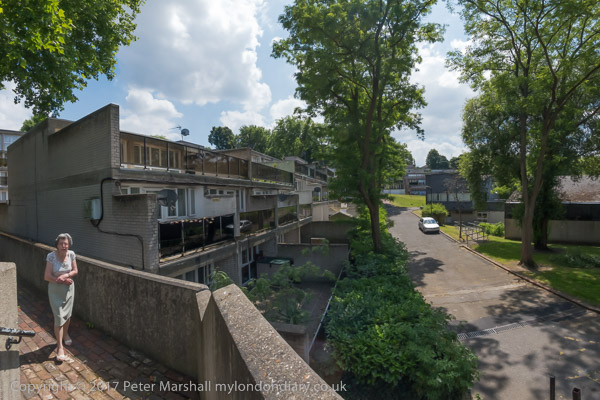
Some of the estates that have been demolished or that councils intend to flatten are of genuine architectural merit, and many more are communities that have developed to give a decent life to those who live there and want to remain. Often they have suffered from a lack of maintenance over the years and need some bringing up to current standards for example of insulation, but most older properties were built to higher standards of space and basic construction than currently apply.
The Heygate estate deservedly won an architectural medal and its basic concepts were sound and despite a long attempt by Southwark to demonise it, using it to house problem residents and employing a PR firm to do it down, remained popular with many residents and was developing into a maturity. The council actually gave it away, making a loss on the deal which has converted it into the private Elephant Park. And rather than learning from their mistakes they are currently repeating them on the nearby Aylesbury Estate and others in the pipeline.

Another fine estate under threat, this time from Lambeth Council, is Central Hill and I was pleased to be able to be there when former Lambeth Council leader Ted Knight came to speak about the vision that led to its building, that nothing was too good for the working class. Now Lambeth want the working class to be forced out of the area. Our current listing process, run by Historic England, has shown itself to be averse to listing large projects of considerable architectural merit such as this, or the Robin Hood estate in Poplar, in favour of quirky oddities with some popular appeal (such as Philip Larkin’s former flat in Hull) which involve little or no financial considerations.

Stop demolishing council estates
London Co-operative Housing Group report
Ted Knight speaks for Central Hill

Continue reading Save Council Housing

May Has to Go…

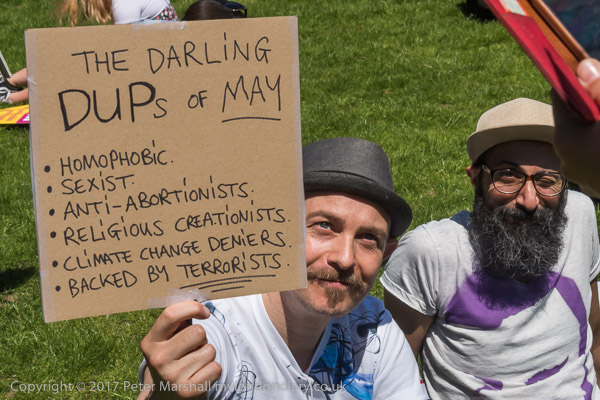
But she didn’t go. Not yet. Despite losing her absolute majority in the General Election, the Tories were still the majority party. None of the other parties was keen to form a coalition to support her, but despite the need for austerity she was able to put together a large enough bribe to gain the support of the DUP, the so-called Democratic Unionist Party, founded and dominated for 37 years by the Rev Ian Paisley. It is a right-wing party, opposed to anything that threatens ‘Protestant’ domination of Ulster or in any way advances the rights of nationalists or human rights generally in Northern Ireland, and according to Wikipedia, it:

“was involved in setting up the paramilitary movements Third Force and Ulster Resistance.

It is right-wing and socially conservative, being anti-abortion and opposing same-sex marriage.”

It’s social policies are dominated by the bigotry of the Free Presbyterian Church of Ulster, another Paisley creation, with just 15,000 members, mainly in Northern Ireland.  Its continuing opposition to social reforms have meant that there is very much a different law applicable in Northern Ireland to that in the rest of the UK, and make it hard for many of us to understand any real object to different laws relating to the movement of goods – as customs boundary at the Irish Sea.


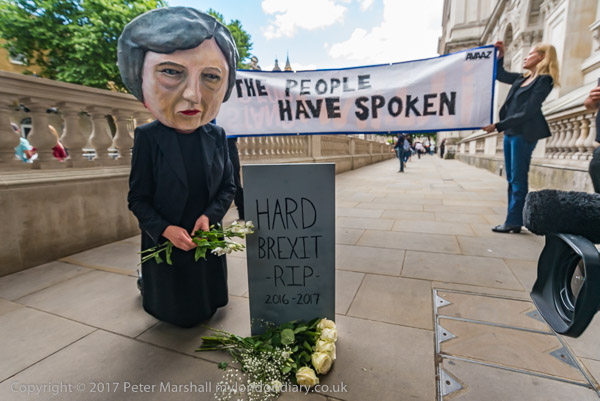
The people have spoken’ – but not quite clearly enough

So far the ‘support agreement’ between the Tories and the DUP has held, though it appears to have needed some further bribery to get the recent agreement with the EU to enable the talks with them to move on to the next stage, and it seems likely that as talks develop further it may be impossible to keep the DUP on side. And since the coalition between the Tories and Lib-Dems from 2010-2015 led to the near demise of the Lib Dems and has made coalition a poisonous concept in UK politics it seems more than likely we will have a further election well before 2022.

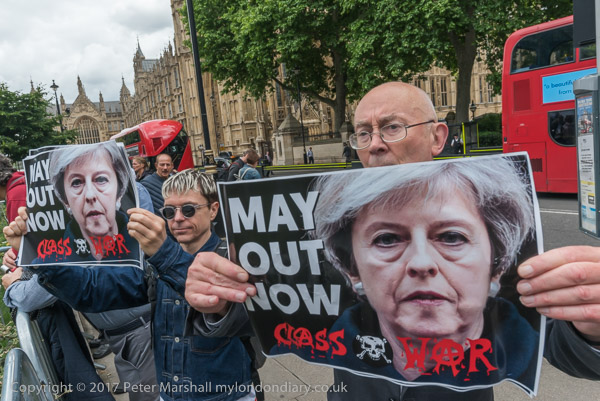
But back in early June, immediately after the election it seemed unlikely that May could hang on, and protesters were out on the streets  with the message ‘May Must Go.’  I went to Downing St on the morning after the results and photographed protesters there and outside the temporary media village on College Green.

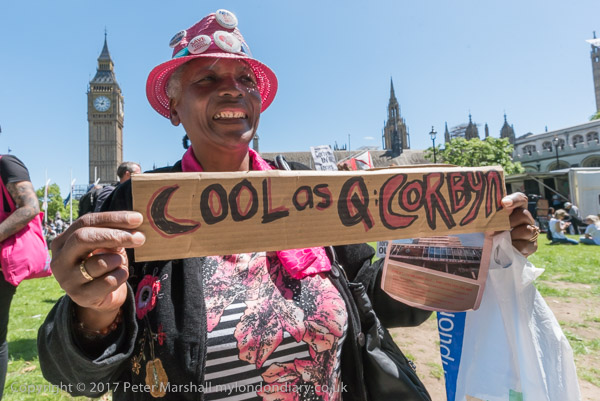
The following day was a Saturday and there was a May Has To Go Party/Protest #notourgovernment in Parliament Square, celebrating Jeremy Corbyn’s performance in bringing Labour close to victory, despite the opposition to him within his own party. The result showed clearly that he was electable even if not this time, destroying the arguments of his right-wing critics, though some continue to mutter and plot.

At the end of the rally, most of those present marched to Downing St and protested there for a while, before marching off. But there was no plan, and nobody knew where to go, and at Trafalgar Square they simply turned around and marched back to Parliament Square where I left them.

Protests follow Hung Parliament Vote
May has to go rally!
May has to go march!

Continue reading May Has to Go…

DPAC at Maidenhead

As regular readers will know, I seldom travel outside London simply to photograph events, the main exception recently being a number of visits to Yarl’s Wood for the protests their about immigration detention. But when Disabled People Against Cuts (DPAC) announced they were going to protest at Maidenhead, I added that to my diary.


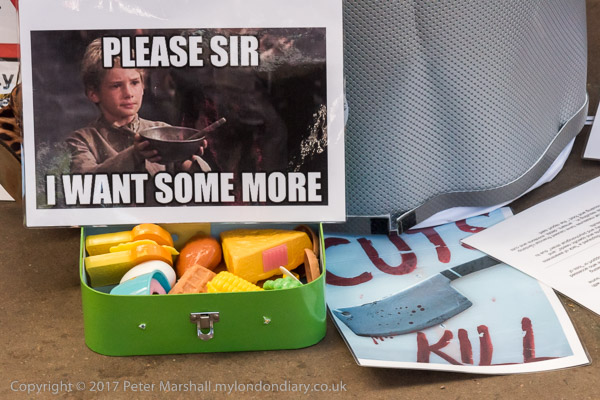
‘Please Sir, I want some more’ and a lunchbox – May was promising to replace free school lunches with a 7p breakfast

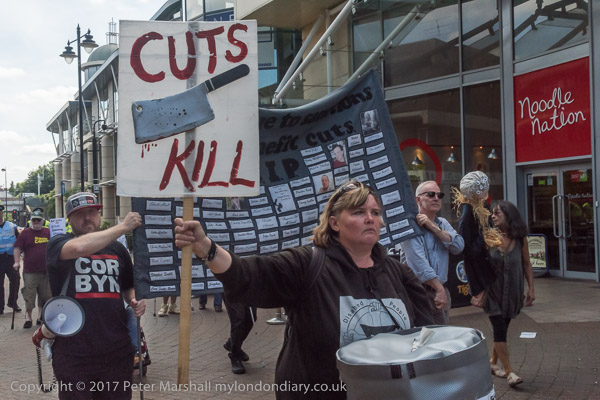
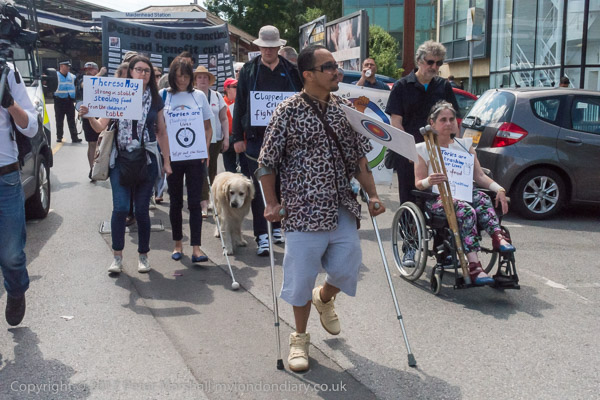
Maidenhead is the constituency of Prime Minister Theresa May, and the General Election she had called was only a few days away. The disabled have suffered most from the Tory cuts since 2010; DPAC say Tory polices are heartless and are starving, isolating and ultimately killing the disabled and that they regard them as unproductive members of society, a sentiment recently stated rather clearly by the Chancellor, Philip Hammond. They also point out that a UN investigation has found the UK guilty of grave and systematic violations of disabled people’s human rights – though of course that verdict was rejected by the Conservative government.

Maidenhead is also not very far from where I live, a part of the true blue London fringe of wealth tax avoidance and complacency (though my particular area is rather more down-market, but electorally swamped by its neighbours.) I could have gone there by bicycle, mostly a pleasant ride of around 13 miles along towpath and various tracks with just a little on main roads, or slightly faster by keeping to the roads, and it was a nice day. But it was rather hot and I was feeling lazy and decided to take the bus – or rather two buses – which was only a little slower.

Buses still exist but are neither frequent nor very liable in these outer areas, and the service to Maidenhead from Windsor was roughly hourly in the main part of the day. And should there be problems I could always return – if rather slowly and expensively by train. By three trains (and a short walk between stations!) Most of those taking part in the protest had a much shorter journey than me with a fast and direct service from London Paddington, and they met up with local protesters to march from the station.

The bus journey to Maidenhead proved a little more difficult that expected, when my bus arrived at a different stop to that shown on-line, I think thanks to a one-way system, and a quick look on my phone showed I needed to be a quarter of a mile away in two minutes. I made it, somewhat out of breath, and the second bus was seven minutes late in arriving. Things came more or less to time on the way home, and the schedule meant I had 19 minutes to make the change – and from the same stop. All would have been fine had I not reached into my pocket for my phone when I arrived home and found it missing – I must have left it on the second bus.

I was able to confirm this, tracking its progress on my computer as it slowly made its way back to the depot at Slough, with nobody answering my calls. But the software enabled me to put a message on to it with my phone number, and I was relieved an hour or so later to get a call from the driver to tell me he had found it and it would be in the depot at Slough where I could collect it the next working day – Monday.

This time I did get on my bike, though it was a rather cooler and windy day with the odd spot of rain in the air, and was pleased to get to Slough rather faster than the bus would have taken me (it does go a rather longer way round) and relieved to get my phone back in one piece.

There were no problems in photographing the protest, though it was rather less lively than some by DPAC, and there were relatively few Maidenhead residents in the pedestrian area outside the shopping centre where the police suggested was the best place to protest (and I think they were probably right.) After the protest they marched back to the station where they had met, and a couple of photographers who had travelled by train from London left. I stayed on because I was sure something would happen.

Most of the police had left too, and the protesters then turned around and as I expected, blocked the road at a busy junction close to the station. The police were soon back and trying to persuade them to leave, with rather less patience than the Met usually show.

Police were a little mystified when one of the protesters identified himself as identified himself as General William Taggart of the NCA and claimed the law gave the military privilege a right to block roads in times of national emergencies such as these, but they shortly decided to argue with DPAC’s Paula Peters instead, threatening her with arrest unless she got off the road. Slowly the protesters moved off the road having blocked it for around 15 minutes, and the last were just leaving as I walked away to try to find the bus stop for my bus that was due shortly. Fortunately it was a few minutes late as the stop was not quite where Google marked it and not in the street it was named after.

Theresa May of course won comfortably in her constituency, though her share of the vote was down very slightly at 64.8%; the Labour vote was up 7.5% but still under 20% and even the Lib Dems gained slightly to get 11.2%. The remaining ten candidates shared a little over 4%.

DPAC Trash The Tories in Maidenhead
Continue reading DPAC at Maidenhead

LSE Cleaners struggle and win

June 2017 began for me with three protests related to the campaign by cleaners at the LSE. At the start of the month I wrote:

After 8 months of their campaign for equality the LSE have only offered derisory concessions and are refusing to recognise the UVW and and hold sensible talks with them, or to reinstate a sacked worker.

and I went to the LSE to photograph the sixth and seventh days they were on strike.  On both days the cleaners had been there since early in the morning, forming a picket line to lobby workers coming to work to try and persuade them to support the strike. There are strict rules limiting the activities of pickets, putting a limit on numbers (I think a maximum of 6) and what they can do, but the union can also hold rallies and protests so long as these are clearly not a part of the picket, and supporters came to these on both days.

This was a campaign I’d been involved with from the start, having been invited to photograph the initial meeting last year when cleaners and students decided to work together, and it had led to some interesting events, but I’d rather hoped – doubtless with the cleaners – that the campaign would have ended rather sooner.  Noonan and the LSE were obviously hoping they would wear the cleaners down, and losing seven days pay is a considerable hardship for people who don’t have enough to live on to start with, though there was a strike fund with donations from other trade union branches and individuals that will probably have alleviated the worst of the hardship.

United Voices of the World is a small grass-roots union, run on a shoestring from members subscriptions and donations from supporters. It’s total annual staff costs for 2016 were under £10,000  and its legal fees slightly greater.  But it has taken on organisations that have budgets in billions and won, and it was great to hear later in the month that they had reached a successful settlement with the LSE and employer Noonan, and it was good to be able to attend and photograph their victory party.

It’s hard to know how much the protests by Life Not Money at the LSE’  contributed to the LSE’s decision to settle the dispute, though they were certainly a noisy embarrassment which added to the pressure to settle.

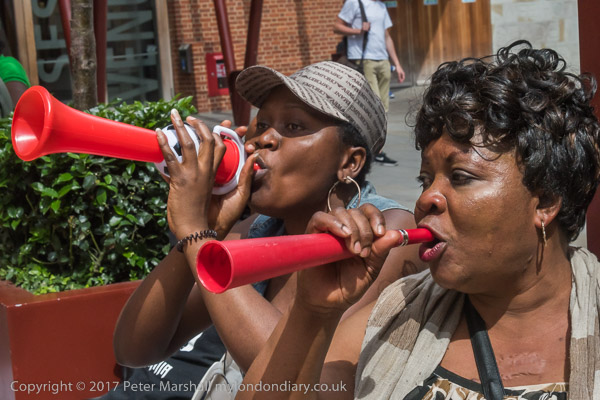
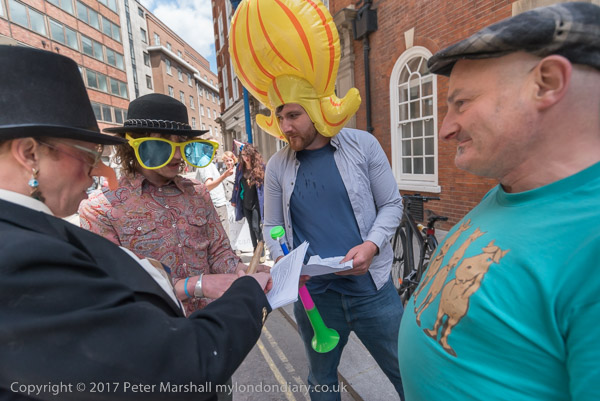
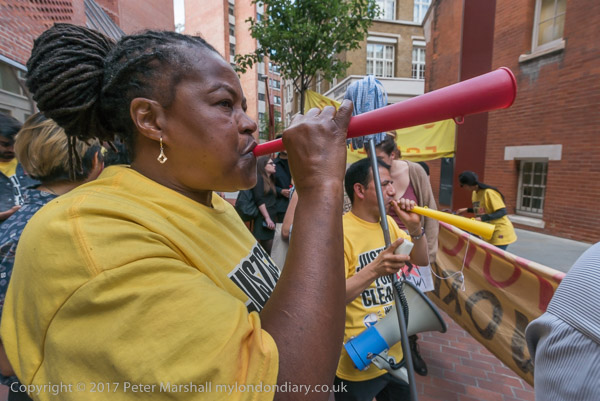
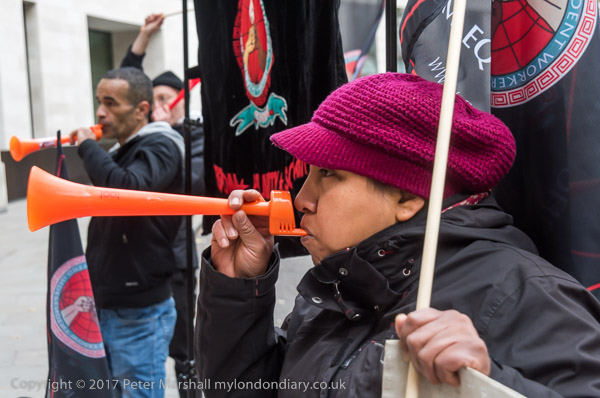
It’s difficult as a photographer to keep photographing a whole series of essentially similar events, and to take pictures which are fresh.  There may be an infinite number of ways to photograph people blowing vuvuzelas and holding posters, but they do tend to look rather similar when it is the same people and often in the same places. I guess it is a challenge, and one I haven’t always been too successful at, though it does help when the people are as interesting as some of the students and cleaners involved in this long-running protest. And there were a few little incidents that kept up my interest at most of the events I photographed.

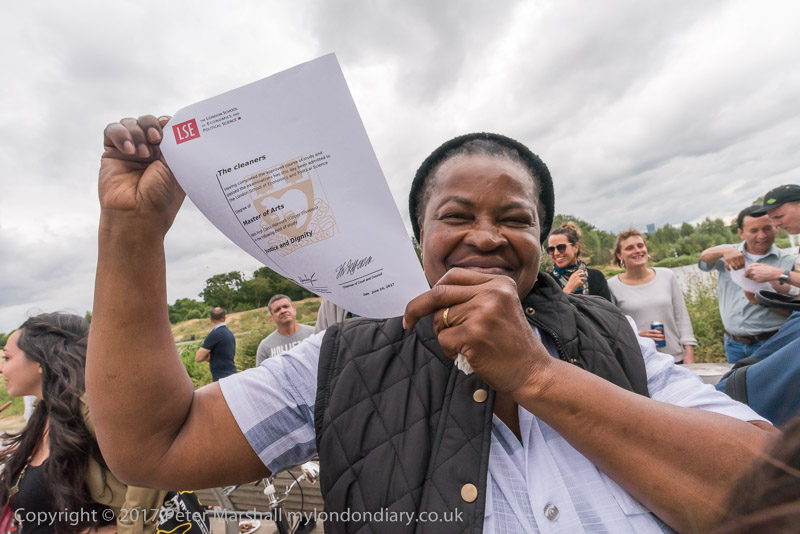
So of course I was delighted to hear that a further protest had been called off because the cleaners demands had been accepted by the LSE and Noonan (although it took a little longer for one outstanding matter, the illegal sacking of a worker to also be settled.) And pleased to be invited and able to attend the victory celebration where the LSE students awarded the cleaners  ‘Masters of Arts’ certificates with First Class Honours in Justice and Dignity.

LSE Cleaners strike for equality
LSE Cleaners strike Day 7
Street Theatre against LSE Inequality
LSE Cleaners Victory Party

Continue reading LSE Cleaners struggle and win

Fox Sake May

I don’t usually work on Bank Holidays. Actually now they don’t have a great deal of significance for me, working as a freelance, they are just another day. I don’t drive so I’m not going to spend hours sitting in a traffic jam to some popular destination. Sometimes its a day or a weekend where we go away and stay with family who have an extra day off work, or we go out for a longish walk. But generally for us it’s a day just like any other.

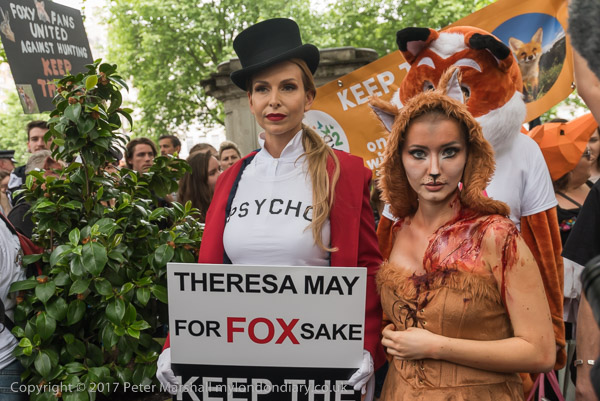
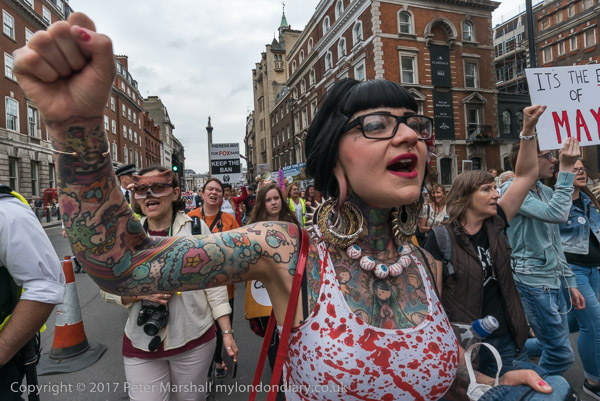
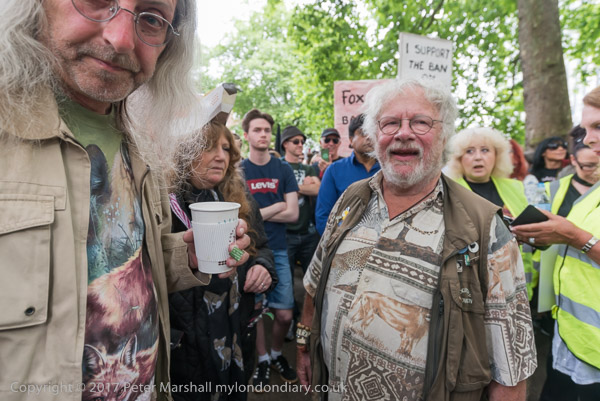
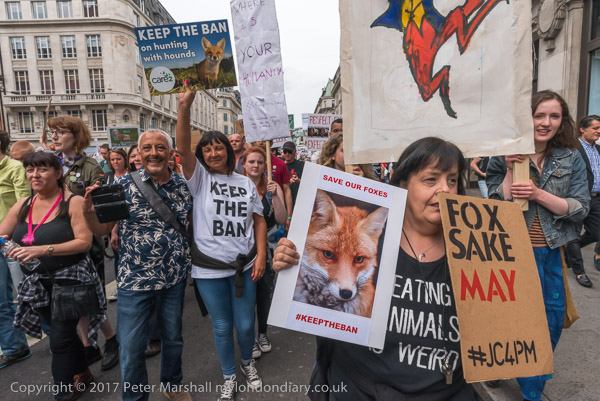
This year, in our rather silly late May Bank Holiday (a kind of fixed Whitsun) there was a protest to tell the Prime Minister that the public are against having a vote in Parliament on the fox hunting bill. It’s a cruel and barbaric practice, chasing a terrified animal across country and often ending with it being torn apart by dogs. Something there should be no place for – like bear-baiting and dog fighting. Something that still goes on despite the act, and the efforts of hunt sabs – and often with police turning the other way so they can’t see either the illegal hunting or the violence against the sabs.

It has never been an effective way of controlling the numbers of foxes – and of course always depended on foxes being kept alive to hunt. Foxes can be a problem, as the bloody mess of chickens in one of my friends coops a few years back made only too obvious. But where necessary they can be killed humanely without making it a so-called sport.

I wouldn’t join the sabs because although I’m against it, there are many other things I feel more strongly about, but I rather admire them for standing up for their principles, despite the abuse and violence they are often met with. If we had a local hunt I’d probably go along and take pictures of that and try to expose what they are subjected to.

Despite a little celebrity support (and the little celebrity in this case was Bill Oddy) it was a protest that got relatively little coverage in the media, partly because the organisers determination to keep it well-behaved and entirely legal made it a little boring and predictable. The police were obviously expecting something rather more interesting and came in force, including some sniffer dogs, though I did wonder if they got extra overtime pay for working on a Bank Holiday.

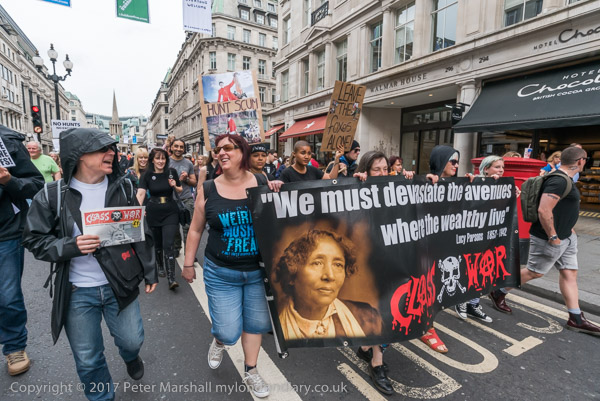
And of course hunting is very much a class issue, more so now than ever. Keeping a horse is an expensive business, and packs of hounds even more so, though it does provide a small amount of employment in the countryside. So it wasn’t surprising to find Class War on the march, but like me they soon lost interest in the speeches opposite Downing St and went to the pub.

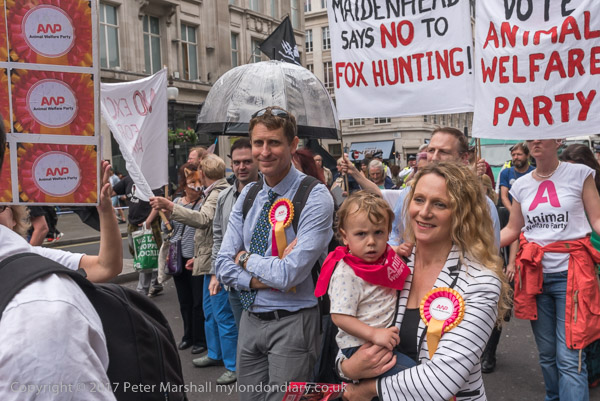
Class War were not standing any candidates in the General Election a couple of weeks later, but the Animal Welfare Party were, in Theresa May’s Maidenhead constituency. And although their banner read ‘Maidenhead Says No to Fox Hunting’, Andrew Knight got only 282 votes, around a third of that of the Green Party and UKIP and was rather comprehensively eclipsed by May’s 37,718 – though perhaps they contributed to this being down by 1.1%.

And the Animal Welfare Party did get rather more votes than Lord Buckethead, Grant Smith, Howling ‘Laud’ Hope of the Monster Raving Loony Party, the Christian Peoples Alliance candidate Edmonds Victor, The Just Political Party’s Julian Reid and Yemi Hailemariam and Bobby Smith!

Keep the Fox Hunting Ban

Continue reading Fox Sake May

Friday Protests

I’ve had a few busy days and not had time to write on this blog, partly with several events to photograph, but also with other things to do and to worry about, but also with trying to get my main web site, My London Diary, a little more up-to-date with events. A diary should really be something you write up at the time, not as I’ve been doing recently around a month later. But should you click on the link above today when I post this, you should find that it only a day or two adrift – and later today it should include some of the latest pictures I’ve taken from Saturday.

Yesterday, Sunday, as I came around in bed the curtains were open and I could see snow falling, and when an hour or two later, having posted my daily picture of Hull I turned to post this onto Facebook I was greeted by picture after picture (mainly by rather bad picture after picture) showing people’s back gardens and streets with a little snow on them. I’d been wondering whether to go and photograph a couple of things in London, but decided not to; although I could have coped with the snow, our transport system would probably be on the blink. Later several of the things I’d had in mind were cancelled due to the weather, and there were reports of transport chaos. And more bad snow pictures.

It wasn’t much of a snowfall where I live (and today it has all disappeared and we are getting cold rain with the odd snowflake mixed in) and I decided not to bother to try and take photographs of it. We had snow rather better in the past, with weeks in the 70s and 80s where it lay inches deep – and drifts of a foot or more, with many suburban roads only passable with difficulty on foot and some closed to traffic for several days, and I felt I’d already served my share of snow pictures.

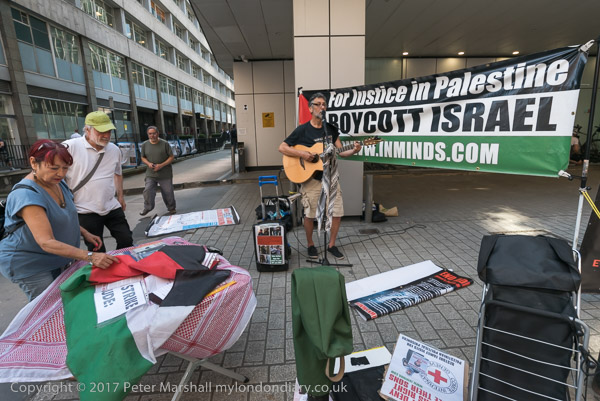
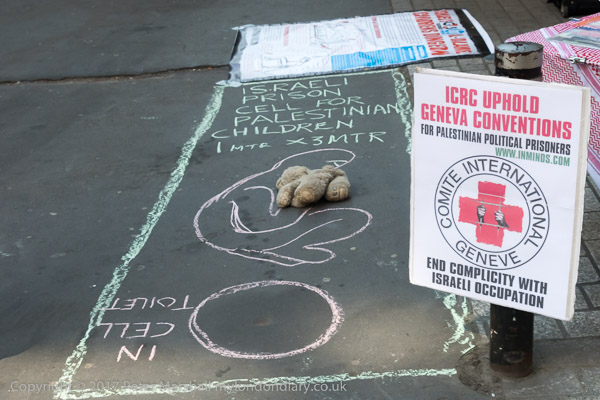
Today it feels quite good to look back to when days were longer and warmer around the end of May, and another Friday where I was busy, starting with a very similar event. Human rights group Inminds holds regular fortnightly protests about Palestine, usually on a Friday afternoon, drawing attention to the human rights abuses by Israel against the Palestinians, and calling for freedom for Palestine and for a boycott of Israel, and when I’m free and in London I try to cover these events, although often my visits to them are rather brief. The protest on this occasion was outside the Moorgate offices of the UK Mission of the International Committee of the Red Cross, demanding it end complicity with Israel’s violation of the rights of Palestinian prisoners, many of whom were then taking part in a hunger strike.

It was easier to photograph than most of their protests, partly because it was a new location, but also because there were specific posters for the event, and unlike some other of their protests there was little traffic and few pedestrians to get in my way as I was taking pictures; it was almost a private event, so photographs, mine and also those that Inminds itself take – had an added importance as the only way it reached the public.

There are accusations made that some of those who belong to Inminds are antisemitic, but protests such as this are clearly against particular illegal activities of the Israeli state and part of their campaign against the occupation of Palestine. I’m clear that it is possible to support the Palestinian cause without being antisemitic, though it isn’t possible to do so without being accused by some of antisemitism. I’m also clear that I’m not a member of Inminds, but a journalist who reports on some of their protests – as I do on protests by many other groups.

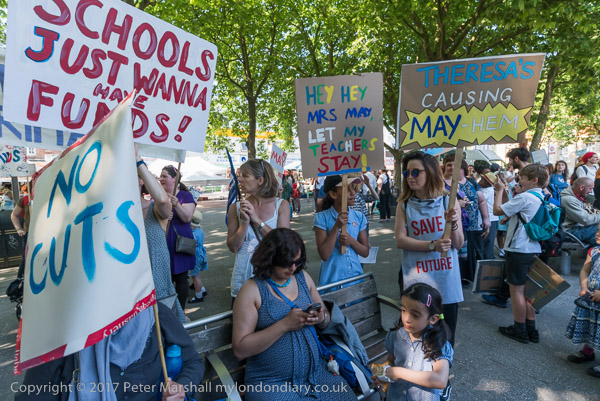
From Moorgate my next stop was Walthamstow Central, where parents and children were marching after school to a rally against education cuts. Photographing children has become difficult now, and photographers are always under suspicion if they point a camera at a child for whatever reason, and I did feel a little difficult doing so. In the past there were so many great photographs of children and I think it is a shame that we are now so inhibited about taking pictures of them. Of course there are terrible abuses of children and it’s right to do all we can to prevent the activities of abusers, but there is no real connection between those abuses and people taking pictures on the streets.

If taking photographs will not generally harm children, the changes in funding for schools certainly will, and that effect will be greatest in city areas such as London E17, where Waltham Forest schools were to lose over £25m from their annual budgets – £672 per pupil on average, with some schools losing over £1000 per pupil. It means fewer teachers – coincidentally also around 672 fewer in Waltham Forest, and at a time when numbers in schools are increasing. As a retired member of the NUT as well as a current member of the NUJ I have a particular concern.

I listened to a few of the speeches, but then had to leave, traveling back to the centre of London with the Victoria line taking me direct to Westminster. I’d missed the pre-election protest by Stop Killing Cyclists a few days earlier outside the Labour HQ, but this evening it was the turn of the Tories in Matthew Parker St, a short walk from Parliament.

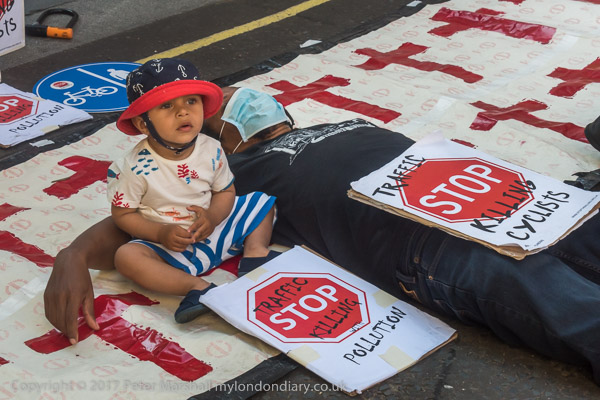
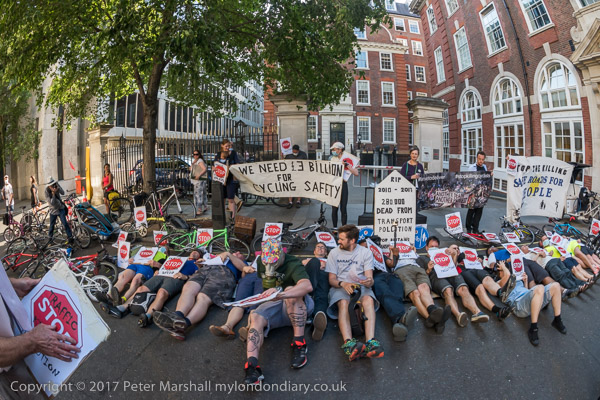
There I photographed another child, wearing a face mask sitting beside his father who was lying ‘dead’ on the ground outside as a part of a protest against traffic and air pollution both killing cyclists in London. Not just cyclists of course, traffic and pollution both kill pedestrians and drivers too, but cyclists face a particular risk when riding amongst faster moving and much more massive vehicles, and breathing their fumes on the road.

Later enough of the cyclists lay down to fill the frame of my fish-eye lens – and the house in the centre behind them is the Tory HQ.  Money spent on making safe protected cycle paths encourages many more to use their bikes to get around the city, reducing transport pollution which currently results in over 9,000 premature deaths a year in London as well as much suffering from illness, and more people getting on their bikes also means more people getting a little exercise to improve their healths.  More people cycling also cuts traffic congestion – with an increase in road space considerably greater than the loss caused by building protected cycle routes. In fact the only downside is that it leads to greater traffic speeds and so greater impact damage when vehicles hit people, something that needs to be mitigated by greater use and enforcement of 20mph zones.

But policies are generally driven not by facts, not be research, not by safety but by lobbying of politicians and the prejudices of the press, also  firmly guided by the saloon bar ‘common sense’ (not that we still have saloon bars – but we still have the attitudes.) Neither of the main parties had a sensible road traffic policy and was willing to spend the amounts needed to encourage cycling by making it safer.

Red Cross act for Hunger Strikers
E17 Protest Against School Cuts
Cyclists Tory HQ die-in against pollution

Continue reading Friday Protests

Thursday Lates

I hate the early nights we have at this time of year, when sunset comes to London at around 15.52 and so many things, including most protests take place in twilight or darkness. So I look back with some warmth at my diary for May 25th, when the sun only set at 9pm, giving me some colourful sunset skies to watch from the train window on my way home.

Photographers notice the light more than others, or at least we should, though on some winter days I’ve been caught out by the falling light and only realised too late that my shutter speed in some auto mode has dropped far too low giving an unwanted motion blur to my subjects, often only noticeable when I zoom into the image. Viewing the whole image on the camera back can seem sharp even when images are unusable.

The answer I’ve now adopted on the Nikons is auto ISO. Working in Program mode and setting the minimum shutter speed to perhaps 1/100th and the maximum ISO to 6400 or even 12,800 more or less guarantees usable results except at more extreme focal lengths. Once I realise its getting dark, or have a need for flash or greater depth of field or stopping faster movements I’ll change the settings, but until then I find this works. The Nikons have an Auto setting for the minimum shutter speed, which takes into account the focal length of the lens, and does allow you to choose different settings, faster or slower, based on this, which sounds useful, but I think fails with moving subjects, where the fixed speed seems to work better.

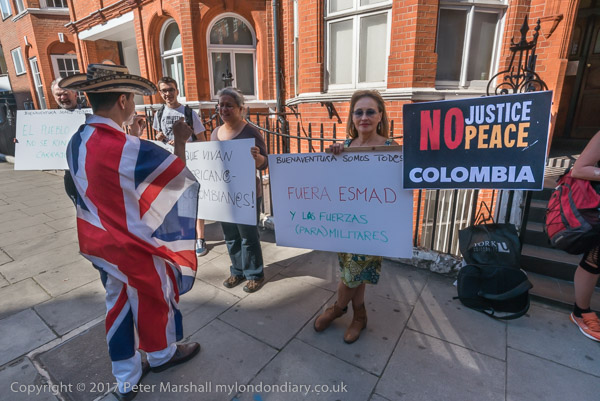
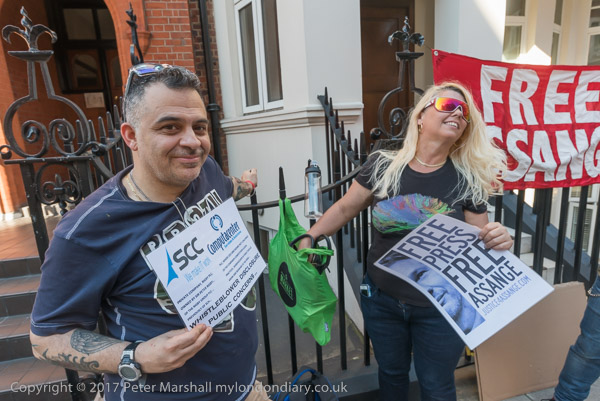
But back in those longer days, I had no such problems. I started work at 4pm – which at this time of year is just after sunset, but towards the end of May was bright sunlight outside the building behind Harrods which houses both the Ecuadorian and Colombian embassies. A small die-hard group of supporters of Julian Assange was outside as they had been on so many occasions over the almost five years he had been holed up in there. His continuing detention is a monument to the stubbornness of Theresa May, but it is a pointless act which has cost us millions and harms us diplomatically. He should have been allowed to leave for Ecuador when granted immunity there.

Grant Assange Safe Passage


Protesting on the same pavement – and with some overlap both physically and in terms of people – were the Colombian Solidarity Campaign, demanding that the Columbian government end the use of force against the people of Buenaventura and instead tackle the social, economic and ecological problems that have led to the civic unrest there.

Photographically my problems were mainly that half of the protest was in bright sun and half in shade, giving a huge dynamic range. Even with careful exposure this still requires considerable post-processing to reveal shadow details and tone down the brightly lit areas.

Timing was also a problem, and although the protest was due to begin at 4 pm,  people only began to drip in slowly some time after that – and I had to leave before the event had really got going. South American time, as I learnt when I visited Brazil some years ago – is a rather different concept to English time.

Lift the Siege of Buenaventura

Axe the Housing Act were rather more punctual for their protest intending to make housing an issue in the snap general election which was taking place, thanks to a moment of madness on the Prime Ministers walking holiday.  Labour were still in disarray, with its centre and right MPs refusing to accept the zeitgeist that had moved the party membership to elect Jeremy Corbyn and were still acting like spoilt children who had lost their toys and encouraged and supported  by a Tory-dominated media were determined to undermine him in any way possible with a series of smears,  lies, coup attempts and party machinations.  Had they accepted defeat with any grace and got down to work for the party rather than for their own interests the election would never have been called, as Labour would have had a massive lead in the opinion polls.

But we had an election, and housing despite the effects of protesters which have put it on the political agenda, never became a major issue.  It’s an area where Labour still has a great deal of work to do, with many Labour councils still busy demolishing council estates and cosying up with private developers despite a new direction from the leadership which at the party conference a few months later called for policies based on housing people rather than realising asset values. Its a battle still to be fought, let alone won. Although the protest was called a vote for decent, secure homes this wasn’t generally a choice on our ballot papers.

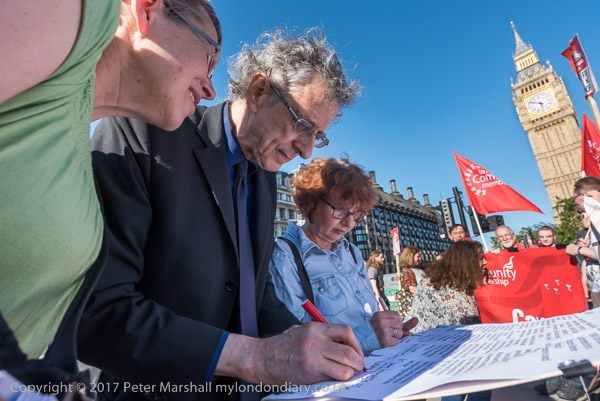
The picture above shows Piers Corbyn (Jeremy’s elder brother) signing the poster-sized letter which the protesters were to deliver to Downing St, and the sun is still bright at ten to six, a time when now we would have passed through civil twilight and nautical twilight and be about to move from astronomical twilight into full blown night time.

Vote for decent, secure homes

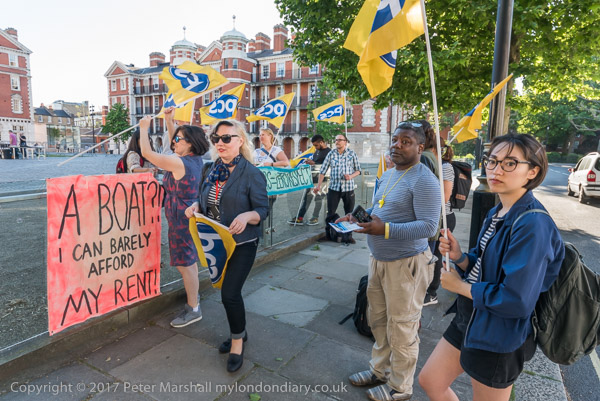
I left the housing protesters as they left for Downing St and walked down to Tate Britain, where the PCS Culture Group were to picket the leaving party for retiring director Nicolas Serota. Staff there, many of whom are on zero hours contracts with lousy conditions from Securitas and are paid on or close to minimum wage – much less than the London Living Wage and something the Tate could not dare to justify for anyone it directly employed were asked to contribute to a leaving present for him of a sailing boat – and of course were not invited to his leaving party.

Instead they launched their annual Golden Boat Awards, naming Serota as the first recipient for his services to the cause of privatisation, casualisation and low pay at the Tate. They demand an end to this cheapskate use of facilites companies to provide staff who should be employed directly with acceptable conditions and pay.

It was around 7pm when I left the Tate, still two hours before sunset.

Golden Boat Award for Serota

Continue reading Thursday Lates

November 2017 complete


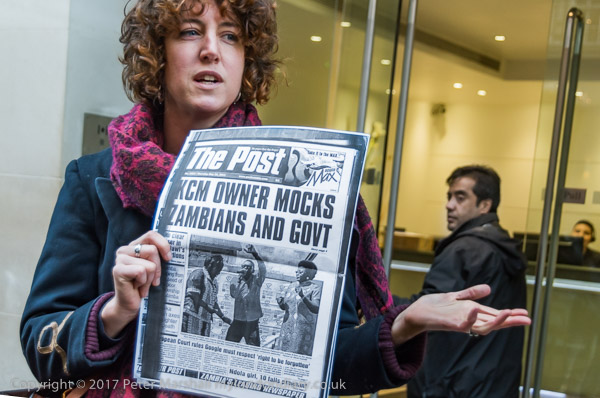
Zambia’s The Post reports the exposure of mining company Vedanta’s tax fraud

November was another busy month for my posts to My London Diary, and it seems there are ever more things to protest against. But undoubtedly the most moving event was the monthly silent march for Grenfell Tower, the first time I had been on this. In contrast towards the end of the month I went on a very noisy demonstration about that same disaster.  There was yet another protest at Yarls Wood, against a cruelly unfair system of immigration detention, a rather long and tiring day for me.

Nov 2017

‘Toxic Tour’ shames mining companies


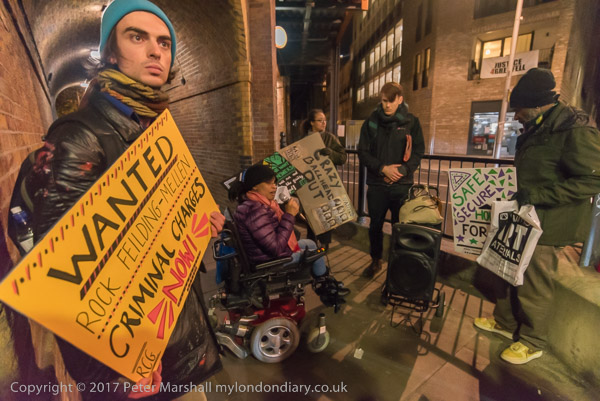
Protesters visit Grenfell councillors
End Slave Auctions in Libya


CAIWU protests for blacklisted Beatriz
Protest at Turkish LGBTI+ ban
Zimbabweans celebrate Mugabe’s resignation
Homes for All Budget protest
Budget Day Brexit Protests
IWGB protest London Uni outsourcing


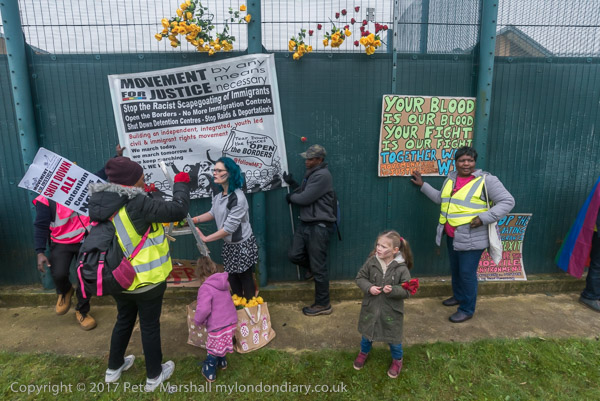
Shut Down Yarl’s Wood 12
Students march for free education
Silent Walk for Grenfell Tower
Another Canada Goose animal cruelty protest
Orange Lodges Remembrance Day parade
Remember Refugees on Armistice Day
Close Canada Goose for animal cruelty
Silent Remembrance Peace Vigil
ORAL Squat empty NatWest Bank
Vigil for Islington cyclist killed by HGV

LSE against Homophobia
Picturehouse Strike for a Living Wage


Class War back at the Ripper
Equal Rights & Justice for Palestine
Maria Spiridonova – Armed Love
Vigil for Daphne Caruana Galizia
Mexican murders Day of the Dead vigil

London Images

Continue reading November 2017 complete

LSE Cleaners Strike for Equality

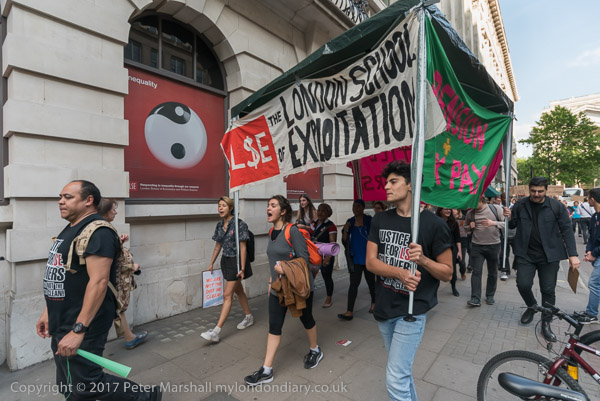
As a photographer I see it as my role to record events and not to set them up, but sometimes that does mean not quite getting the pictures that I would like. But I think it vital to place integrity above impact, though of course I work hard to make pictures that tell the story as best I can.

I’d earlier walked several times past a poster in one of the many street-facing windows of LSE buildings which celebrated the LSE’s record in fighting inequality, and thought it was one which spoke to the central theme in the dispute between the cleaners and the LSE, and thought it would be good to use it in a picture.  So as students marched past holding the appropriate banner I tried, but rather failed as you can see above.  The marchers were walking quite fast and there were a number of parked bicycles at my right that made it difficult to get into exactly the right position, and I was a foot or so too far back to keep ahead of the banner by the time I could take the picture.

Had I been setting this up I would have had a second chance – and more, but the moment had gone as soon as I pressed the shutter. It would have been nice to have had the letter ‘I’ at the start of the word ‘Inequality’, to have got the gut carrying the rear pole of the green banner to move a little to the right, to have moved a little to my right and framed the poster and the banners a little more tightly…  But that would not have been how it happened.

Of course there are some posed images in my set LSE Cleaners strike for equality on My London Diary. But they are pictures that those taking part set up and posed themselves in, not ones that I imposed on them.  Sometimes other photographers do set up pictures and I sometimes also photograph these, though I try to make clear in the caption with phrases like “pose for photographs”. But generally I photograph things that happen as they happen, though of course I impose my own order on them. Though I do like a bit of chaos, which can help to get away from the clichés.

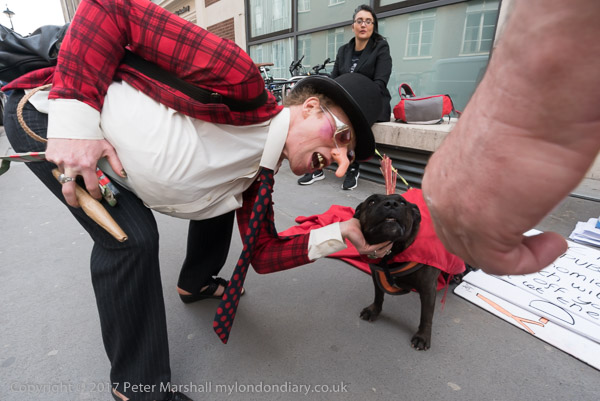
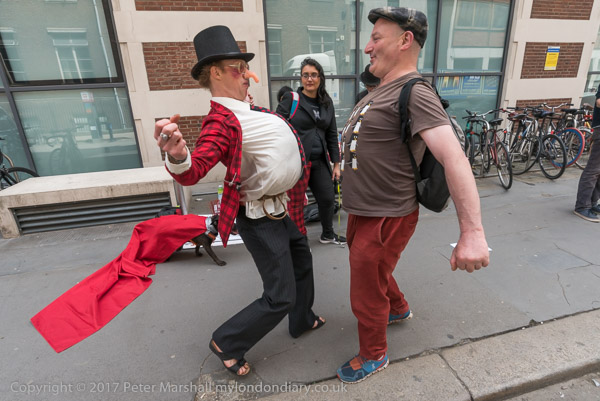
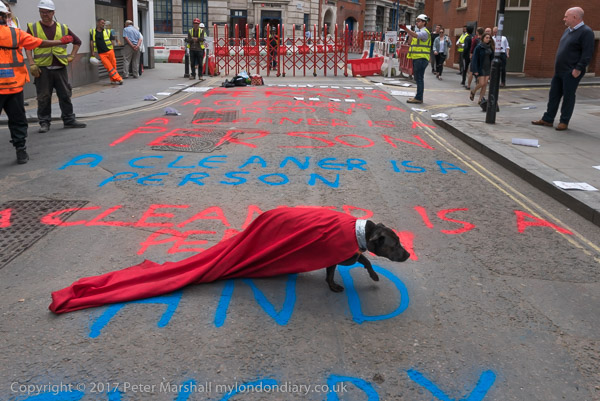
There was perhaps a little more chaos two weeks later when ‘Life Not Money at the LSE’ staged a somewhat surreal happening in the cleaner’s support. Though perhaps my rather deadpan description at End Gross Inequality at the LSE does it little justice:

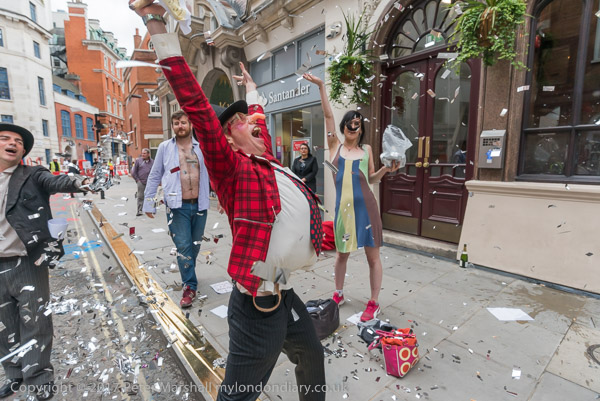
The group sprayed chalk slogans on the road chanting ‘London School of Exploitation’ in a wide range of silly voices and then performed a short play in which a character playing the LSE director tore the shirts off the backs of several cleaners and boasted about his huge and rapidly rising salary.

The tall buildings surrounding Portugal St created a rather eerie echo as the players chant loudly ‘London School of Exploitation’ in a range of silly voices, and the interruption of proceedings by a cement mixer and a man on some kind of cherry-picker (what a useful photo accessory that would be) somehow added to the event. But I did feel it was one event where sound and movement would have helped, though I think it would have needed a team with several cameras to film it adequately.

It wasn’t too easy to follow the finer details (such as they were) of the playlet that ended the performance, with several cleaners having the shirts stripped off their back by the ‘LSE Director’, a little rogering and a lot of tinsel, but I did my best.

LSE Cleaners strike for equality

End Gross Inequality at the LSE

Continue reading LSE Cleaners Strike for Equality