Barts – NHS vs Serco (and PFI)

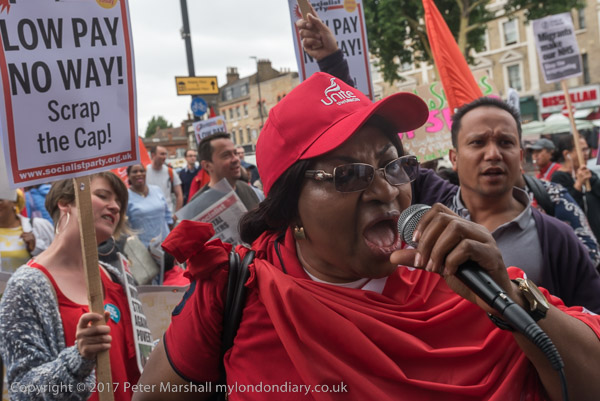
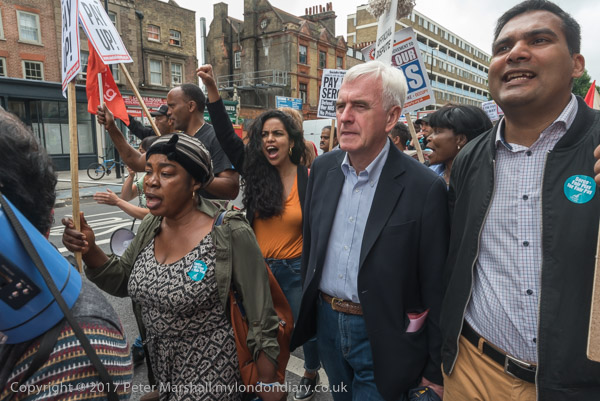
The rally and march from the Royal London Hospital to Mile End Hospital has a new relevance with the recent collapse of Carillion, which has brought new attention to the problems of PFI and of out-sourcing of facilities that are at the root of the problems at Barts Health Trust. One of the speakers at the rally – seen on the march in the picture above – was Shadow Chancellor John McDonnell, whose criticisms of both of these problems have received considerable airing in the last few days, though of course he has been making them for a very long time.

The dispute was between the cleaners and porters of Barts Trust who are members of the Unite Union and had been on strike for five days, demanding an increase of 30p per hour in line with inflation and cost of living increases . The strikers voted 99% in favour of strike action, their militancy because of the actions of Serco, whose first action when they took over the contract was an attempt to take away their paid tea breaks.

Serco were forced to back down over that by concerted action, but the cleaners still accuse Serco of increasing stress and workload with a climate of bullying, intimidation and fear and a failure to set up procedures for reporting problems with facilities. And they say that Serco have acted illegally during the strike by  bringing in agency workers with inadequate training to replace them, resulting in insanitary conditions in the hospital.

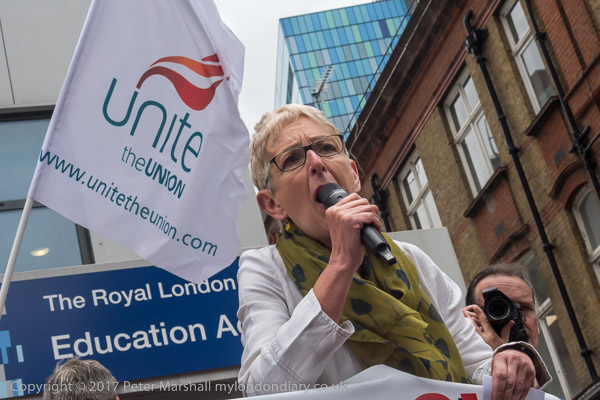
I took a number of pictures of Unite’s Gail Cartmel at the event but particularly like this one of her speaking, which shows something of her dynamism. It also includes in the frame some key elements – the Unite flag (and flags are always problematic for photographers, seldom behaving as we want them at the right time so they can be read), the inbuilt caption ‘The Royal London’, and both some of the hospital’s Victorian building at right, as well as at top centre the new PFI-built hospital which has crippled the Bart’s Trust with a huge debt –  £2.4m per week in interest payments – under a disastrous New Labour deal.

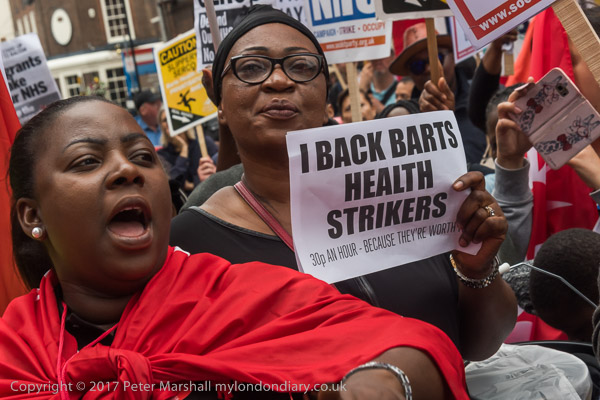
It was hard to chose just one of the pictures of the strikers to put in here, and I chose this  particular image partly because it seemed to show something of their determination, but also for the poster which explains what the image and the dispute is about, “30p an Hour – Because They’re Worth It”, and the crowd of placards behind.

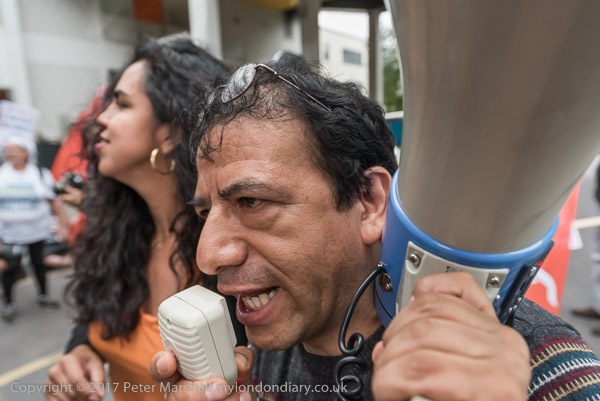
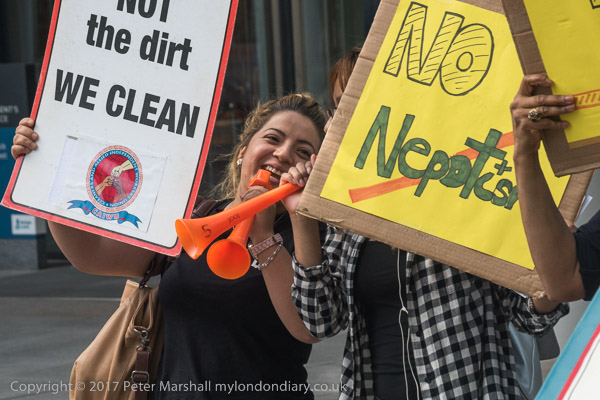
And although this dispute involved one of our big unions, some of the most vocal support at the rally and on the march came from other cleaners, particularly in the United Voices of the World. Victor Ramirez, a cleaner from the UVW spoke at the rally and was among the leaders of the march, with his spirited contributions in Spanish being translated by Claudia from the UVW behind him in this picture – and marching behind John McDonnell in the top image.

Barts NHS Cleaners march against Serco

Continue reading Barts – NHS vs Serco (and PFI)

Reclaimed Pride

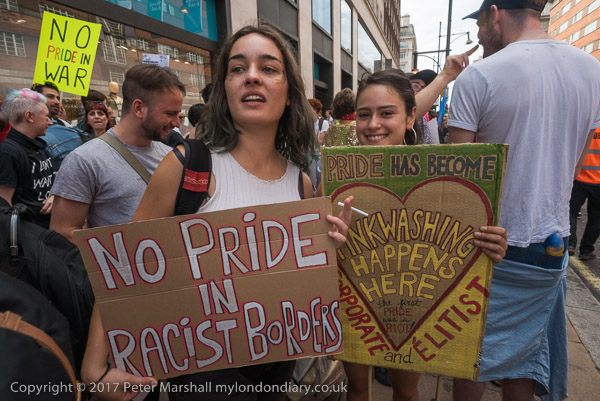
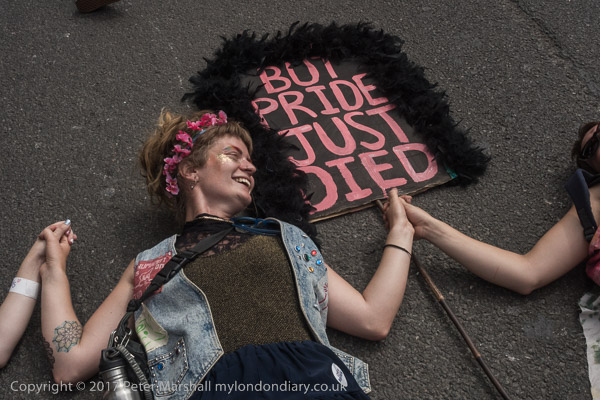
It was back in 1993 that I first photographed Pride – or as it used to be called then, Gay Pride, and I returned to photograph it every year for quite a while – and you can see some of the pictures in ‘Ten Years of Pride‘, the second show of some of that work at the Museum of London.  My going there in 1993 was a part of a general growing awareness that gay rights was not just an issue for the gay community, but an important aspect of human rights.

Over those ten years there was a very clear change in the nature of Pride. What had been a protest clearly of great moment to many of those taking part – and for quite a few it was their first public ‘coming out’ – gradually became more and more corporate, at first mainly a reflection of the growing pink economy and later of the importance of the pink pound in the wider economy. In recent years it has become a huge sponsored parade, dominated by major companies, with large contingents from the armed forces, police and other public services, with just a few groups keeping up the tradition of protest tagged on to the end.

I’d continued to cover it most years, missing out only when I wasn’t in London, and it had become one of the few events for which I’d applied every year for accreditation, as it had become highly organised and this had become necessary.  But I was finding it less and less interesting, and in 2017 had decided not to bother with the actual parade, thinking that perhaps I would just photograph on the streets of Soho where things are more spontaneous and interesting.

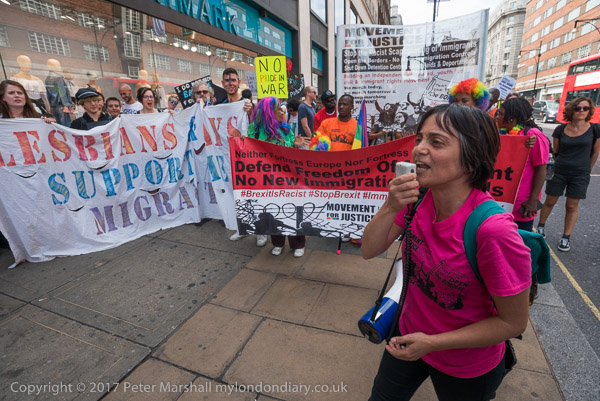
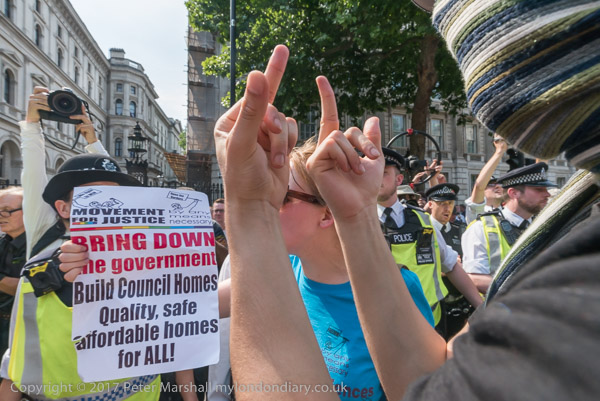
In the end it didn’t turn out like that, and I started on Oxford St where the previous year I had photographed the Migrant Rights & Anti-Racist Pride organised by Movement for Justice for those who wanted to show their opposition to the corporate nature of Pride, with sponsors such as Barclays and BAE systems. In 2016 they marched to Oxford Circus and then joined the back of the official parade with other protest groups.

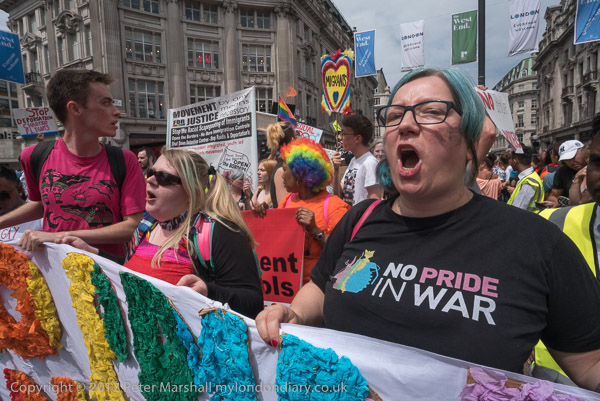
But for 2017 the organisers had decided on tight security, insisting that no groups who hadn’t signed up and got the official armbands would be allowed to join the parade. But it isn’t easy to stop several hundred determined protesters and the police had the sense not to try as they spilled onto the route at Oxford Circus in front of the official head of the parade.  Police tried to get the parade stewards to allow the protesters past but they refused, and for a while there was a stalemate, with the parade route blocked.

Eventually the main parade was held up and the Migrant Rights & Anti-Racist Pride went along the official route past cheering crowds leading the whole event – though the mainstream media colluded with the organisers to pretend they didn’t exist in their coverage.

There was another hold up at the end of the parade, where some of those who had been on the march from ‘No Pride in War’ decided to lie down and block Whitehall. Pride stewards held up the front of the main parade at Trafalgar Square and tried to clear the road without success, but after a few more minutes the police decided to take action, threatening those still blocking the road with arrest. They decided they had made their point very effectively and got up.

I decided too that I had my story for Pride and it was rather more interesting than most years, and decided it was time to go home. The crowds in Soho would have to wait for another year.

Anti-Racist & Migrant Rights reclaim Pride

Continue reading Reclaimed Pride

Facebook

I often feel like mounting a one-person protest outside Facebook, which so often seems to be misbehaving in some way or other. It messes up my posts and hides the posts of many of my friends from me, so often I only find out about things too late. Of course it isn’t all Facebook’s fault, and I’d like to see a complete ban on all the automated software that people use to post to Facebook that clutters it up with so much rubbish. Perhaps one of those checks to show your were not a robot on every post would be annoying, but it would make Facebook much more useful for users, if not for marketing.


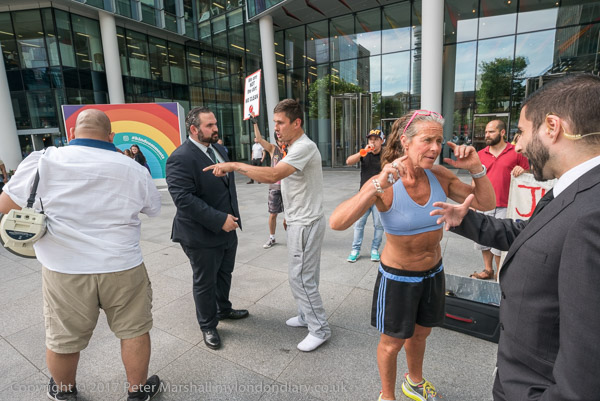
Men from company that employs the cleaners at Facebook watches me as I photograph them watching the protest

But my frustrations with Facebook are nothing compared to those suffered by some who work in their offices, though the cleaners are not actually employed by Facebook; as I point out on My London Diary:

There are two redundant levels of management at these offices; rather than employing cleaners directly, Facebook uses the property management company JLL who in turn use Peartree cleaning services to employ the cleaners; money which should go to the workers goes to these unnecessary levels of management and profit.

People often talk about the greater efficiency of outsourcing, but it is a myth. It isn’t greater efficiency but a lowering of standards, almost always of the actual services delivered but invariably of the conditions of employment of the people who actually do the work.  Companies that claim to be ethical employees with good conditions of service – pensions, sick pay, holidays etc – seem happy to give contracts to companies that employ for people who work for them, providing services at their workplaces which have minimal concern for their employees and provide only the basic minimum possible under our laws, often combined with poor management practices – bullying, discrimination etc – and a failure to properly engage with trade unions, often attempting to prevent union organisation by victimisation.

Both the Grenfell disaster and the failure of Carillion have exposed some of the problems caused by the contracting out of services – with level after level taking their unfair share and problems in communication. If Facebook employed their cleaners they would know what was happening, would ensure fair processes and conditions and not be able to say it was none of their business, denying responsibility for people who keep their business working.

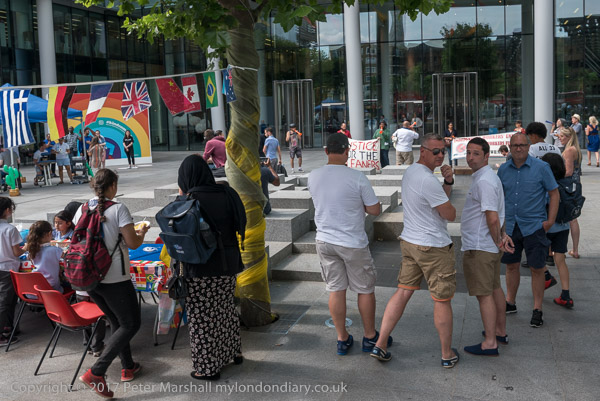
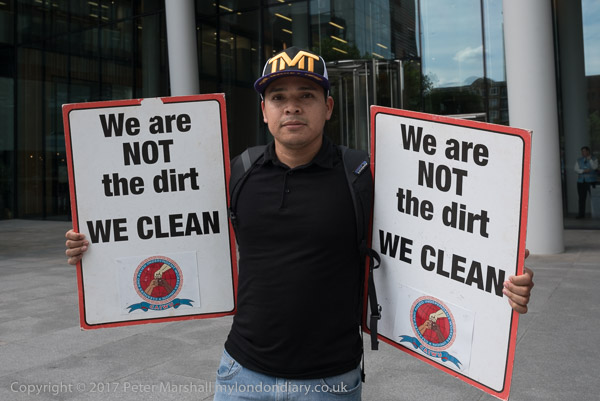
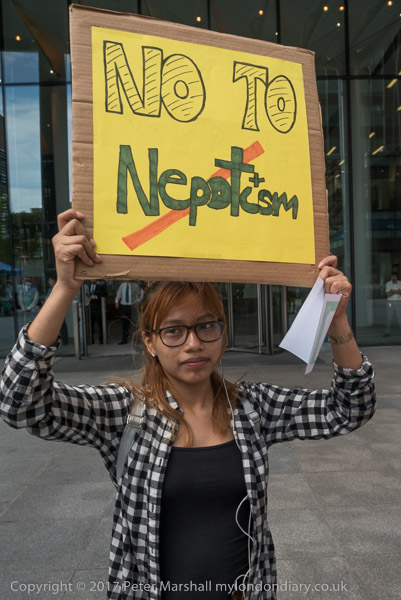
The protest was organised by the Cleaners and Allied Independent Workers Union (CAIWU) who say managers on site are guilty of racism, bullying and nepotism and who are also demanding to be paid the London Living Wage. At the end of the protest CAIWU organiser Alberto Durango talked briefly with Peartree’s commercial director Stuart Conroy who had been in a group watching the protest and there seemed to be some hope that a dialogue might emerge.

The protest took place in one of London’s now many privately owned public spaces, and I was pleased that the security there actually intervened when a couple of people tried to interfere with the protest.

The CAIWU had agreed with them that the protest would be a short one so as not to interfere greatly with a community event that was taking place. Photographers I know have been stopped when taking photographs in this area, but I and others covering the protest were not approached – nor have I been at other protests in this area.

Cleaners protest at Facebook HQ

Continue reading Facebook

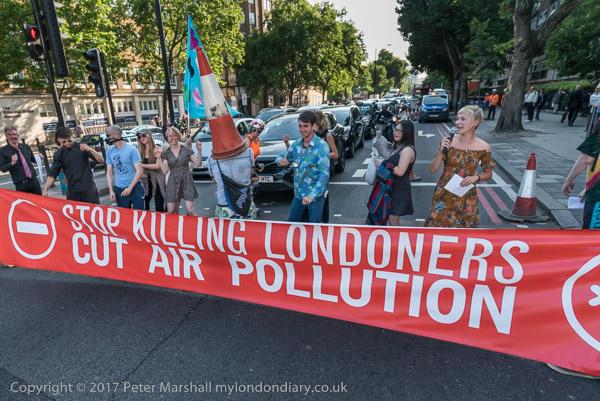
Stop Killing Londoners

Air pollution in London is a serious problem, with official figures pointing to nearly 10,000 premature deaths each year in Greater London as a result of it, as well as a great deal of suffering from various respiratory illnesses, with many lives made miserable. But although there has been an increasing realisation that something needs to be done about it – though our former mayor Boris liked to laugh it off – there seems to be little action.

The major source of harmful pollutants is road traffic. Recently the finger has been pointed at diesels, with their manufacturers having been found in various ways to have engineered test procedures that gave artificially low figures for the harm they were causing – including one manufacturer even installing software to fool the test. Many older diesel vehicles – cars, taxis, buses, lorries – are highly polluting and need to be phased out as rapidly as possible. People now agree on this, but not on how it should be done.


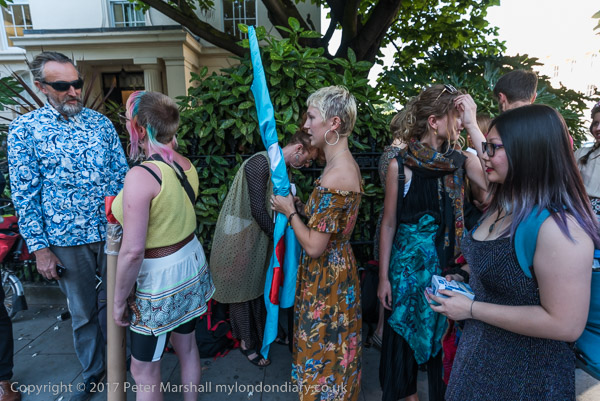
Campaigners wait for the start of the protest which had a ‘disco’ theme

Mayor Sadiq Khan has made statements and begun to make plans, but little so far has been done that has any impact on pollution levels, and Londoners continue to die early, though at least things now appear to be moving, if only slowly. But there is no sign of any of the kinds of radical policies that have tackled similar problems in cities in other countries over many years.

As someone who works regularly on the streets of London, its a problem I’ve very aware of, and one which is often only too visible when distant views are often shrouded in haze and you can see a cloud of pollution in the sky, and when my eyes begin to sting. Where I live, 20 miles to the west the air is hardly pure – with the M25, M3 and M4 as well as Heathrow we have plenty of local polluters – but the air is often palpably cleaner when I get off the train to walk home. And I do get more than my share of persistent chest and throat infections which I’m sure healthier air would see off.


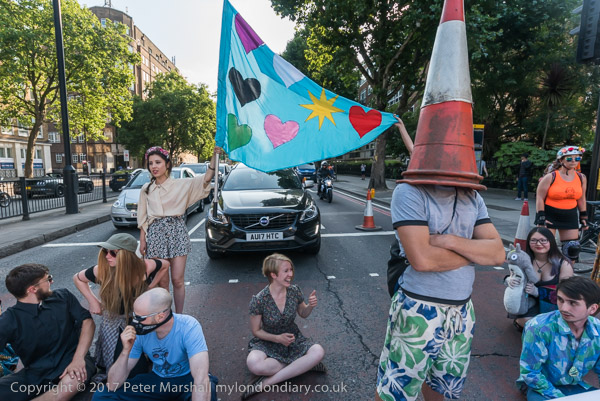
Protesters sitting on the road were behind the banner

‘Stop Killing Londoners’ isn’t the first group to protest about these problems, and in particular a longer runing campaign with a similar name, Stop Killing Cyclists has raised the issues in their protests around the capital both at their vigils following the killing of cyclists on the roads and in more general protests over the several years they have been active. And as well as protesting, Stop Killing Cyclists and its members have put in a lot of work with other groups and councils- including with the Mayor and London Assembly – to get some action. As might be expected, these are issues that the Green Party and its councillors have been working ontoo.


and rather easier to photograph when they stood up

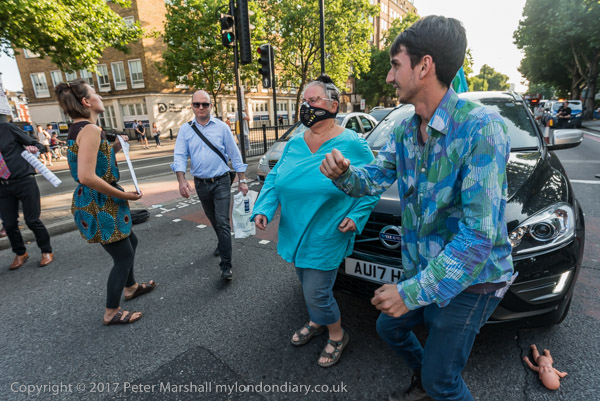
But Stop Killing Londoners feel the situation is so critical that more needs to be done, and believe that a series of direct actions which will confront the authorities is the way to raise public awareness and to push the authorities into action. The protest on July 5th was the first in a series of peaceful direct actions London-wide aimed at getting everyone to know about it and to act together to get effective action to cut air pollution in the capital. They keep their actions brief so as to avoid serious disruption to people on the roads but are confrontational – and some at least are prepared to use their arrests as a way to challenge complacency. However on this occasion, although a few drivers got a little angry, the police only arrived after the event had finished and the protesters were walking away for a picnic in Regent’s Park to discuss what they had done and plan further protests.


A driver argues angrily with the protesters

Photographically there were a few challenges. There was only one large banner and that only had its message ‘Stop Killing Londoners – Cut Air Pollution’ on one side, and it was a little difficult to convey what the protest was about in some pictures. And while five or ten minutes may seem a long time to a driver in a hurry to get somewhere, it seems very short to a photographer trying to think about what they are doing and how best to show it. There were opportunities I missed by the pressure of the rush, when I really needed to keep rather calmer and think more.

I’d had little idea what the protest would be like when I was asked if I would photograph it, and afterwards I was left wondering how the campaign would develop – and whether it would have the desired result.  On it’s own I think not, but perhaps it will add a little urgency to the efforts of others who want action, including those in Transport for London and the Mayor.

Stop Killing Londoners Road Block

Continue reading Stop Killing Londoners

Siege of Haringey

Housing has been an issue very high on my agenda for some time, though I’m fortunate enough to own my own house, I can still remember the days when things were different, and the sometimes frantic search for somewhere to live when I was a student. I spent my first year in a hall of residence, but then moved out into flatland along with two of my former schoolfellows. The first place we found was just one very large room on the first floor of a Victorian house that had been marginally converted, and we spent a term there. I think I was the lucky one who got the single bed while the two others shared a double.

The place had a large open staircase up its three storeys and we were sometimes disturbed by noisy footsteps going up and down it and pretty well all hours of the night. We soon found out that the fairly demurely dressed young woman in another room on our floor made her living from the many men who paid her relatively short visits from early evening to late at night, and that the older and brassier woman from the ground floor who came every Friday to collect the rent shared a similar occupation. And there were a few rather embarassing moments when I was the only flat-dweller in when she came to collect and seemed to want rather more.
We began to look for better accommodation, searching through the Manchester Evening News and phoning any likely looking adverts or rushing to them where there was no phone number. We found a very nice place in a quiet part of North Manchester, just what we wanted and a reasonable rent, but having shown us around the woman asked said to us “But you’re not Jewish are you – I’ll have to ask my husband” and promised to let us know. We weren’t Jewish and we never heard. Finally we did find another flat, rather more poky, on the first floor of a house on the edge of Moss Side, and spent the next two terms there before hearing of a rather better place some third years were leaving from in Dickenson Road which we snapped up. Unlike the earlier two this was a real student flat, with a landlady living on the ground floor who always had students (though I hope most were quieter than us) and was often pleased to make us tea and tell us some often fascinating stories about her youth when she had been a secretary to Lloyd George. I only wish I had written them down.
The following year, after 6 months as an industrial chemist, I returned to Manchester and was again looking for accommodation, this time on my own. The first room I found, in an Irish house in Fallowfield looked OK, but after my first night I found I was covered in red bumps where the bed bugs had found warm flesh. I bought some powder that was supposed to kill them, but I think it just made them more vigourous and multiply. I gave my notice and moved out at the end of the week to a Polish house in Rusholme that served for the rest of the year until I could get a place in university accommodation. The Poles were friendly at it turned out fine, though the glass of Polish spirit I was handed every Friday night when I went to pay the rent was near lethal.

My first two years of married life were spent on the top floor of a terraced house off Platt Lane. The rent was reasonable, but the gas and electricity meters swallowed coins at a huge rate, with great profit to our landlord. Draughty sash windows made it a truly chilly place and we plugged the gaps with plastic bags and bought a paraffin heater, the damp from which brought the wallpaper falling off the walls. And first thing when we moved in was to get rid of the several inches of congealed fat on the bottom of the cooker. But it served us well for the next two years and I was sorry to move away, especially as the next flat we found, in Leicester, was rather worse. It was there I had to break the ice to wash, and began to grow a beard because it was too cold to shave.
But from there I went to work in a New Town, with a two-bed flat from the housing corporation at a social rent and a really decent sized living room and the luxury of built in heating. But we wanted to move nearer to London and industrial action including strikes by teachers led to the 1974 Houghton report and a considerable rise in teachers’ pay; together with a promotion to Head of Department it meant there was a short window when I could afford to buy a house, and we took the opportunity and have lived in it since. Other colleagues who made similar purchases at that time have moved and ‘traded up’ and now have properties worth several times as much, but we like it here, so why move?

In many ways we would have preferred to live in social housing. Its a system that works and can provide quality housing at much lower cost than the private sector. But government after government of both parties have found ways to take money out of the system. The Tories are keen to destroy it and to make profits for private enterprise, and much of Labour is the same, though with a greater delusion that somehow this is in the public interest, holding to this even as they trouser the proceeds.

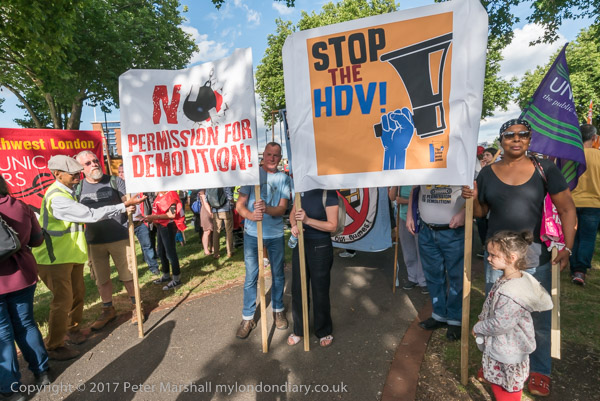
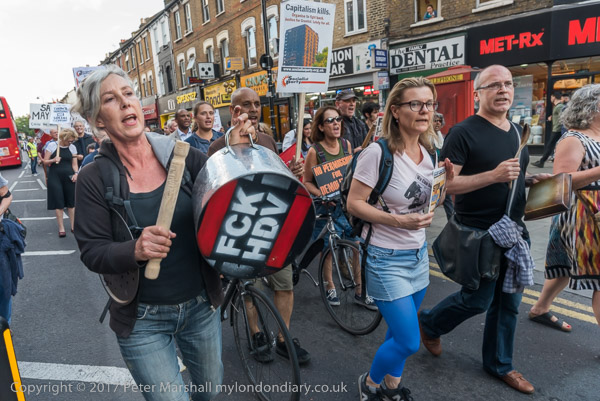
The Haringey Development Vehicle, or HDV, looks at those large, well planned council estates, with large amounts of green space between the buildings (which still achieved high densities) and sees it just as acreage, ripe for development with large numbers of high market price units with the odd sop of unaffordable “affordable” housing. It’s perhaps unfortunate that there are some people currently living there, homes and communities, but CPOs, minimal compensation and vague promises that will never be kept will soon deal with that. And £2 billion of public property is gifted to the developers who will doubtless find various ways to reward those benefactors generous with what they do not own.
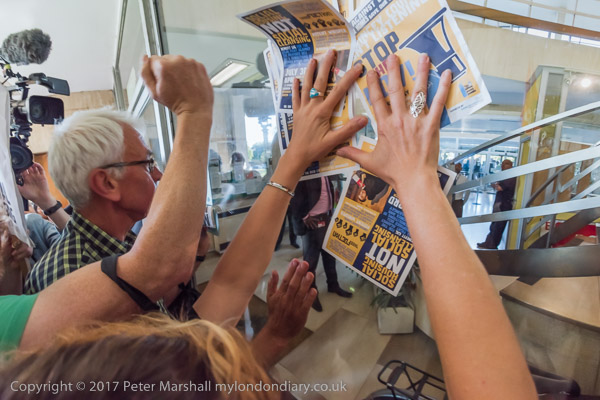
It should be criminal, but we don’t generally have laws against the kind of crimes that make the rich wealthier, which is after all how those who make the laws – and particularly the monarchy and aristocracy – got where they are.

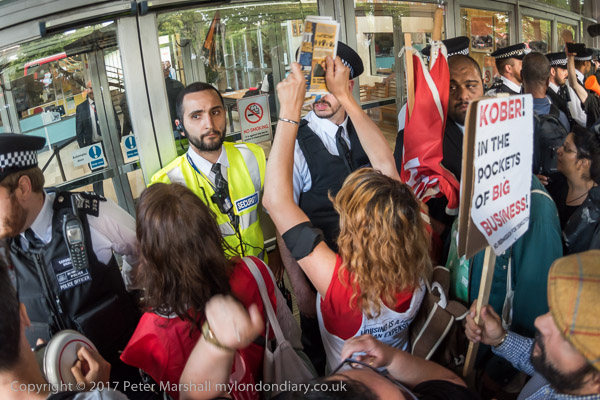
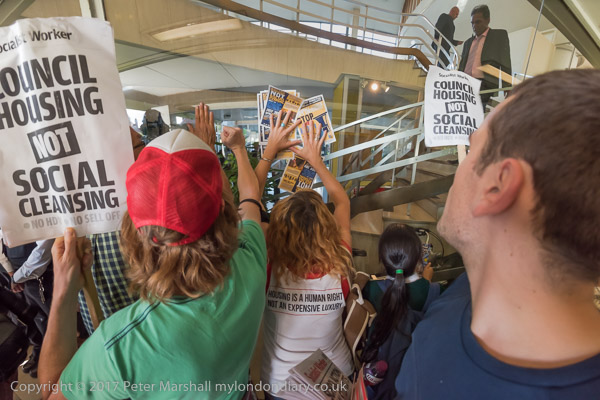
You can read about what happened when the march reached the council offices, and you can see it in the pictures. Technically there were a few problems as the light was getting a little low, and there was a lot of crowding and movement. It was hard to get to the right place, and hard to keep the camera still while taking pictures. Once again it was a situation where the 16mm fisheye proved its worth. I had been taking pictures of people behind the barriers in front of the council offices at ISO 800 when the rush to the doors began, and had to climb over a railing to get rapidly near the doors rather than take a longer route around. Around the entrance was a dense, surging crowd, in the middle of which I needed to increase the ISO and make some lens changes.

I began photographing with the 18-35mm on the D750, changing the ISO to 3200, then decided I needed a wider view and put the 16mm fisheye onto the D810. It also has the advantage at f2.8 of being a faster lens. Unfortunately it was only after taking a few images, some of them rather blurred, that I realised I had left the ISO at 800, and needed to increase it. I soon spotted another mistake too; I’d been using the D810 with my 28-200 telephoto in DX mode (makeing it a 42-300 equivalent) and had left it in DX mode rather than switch to FX. When things really happen suddenly like this it is hard to get everything right.
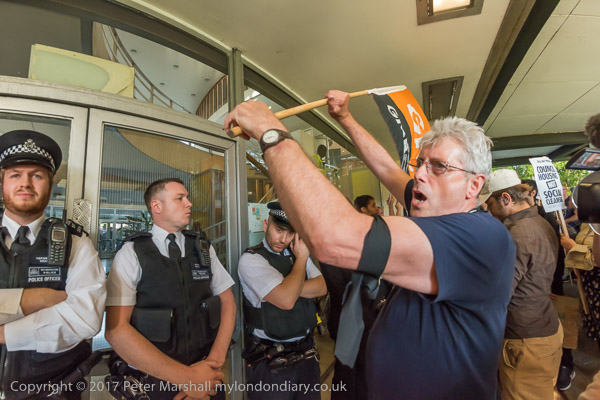
Things calmed down a little and I suddenly saw that some of the protesters were heading for the back of the building and rushed to follow them. Soon I was standing against a huge glass window there feeling it flex around half an inch or more as the protesters attacked it, and at first I stood back a few inches to avoid the movement shaking my camera before deciding there was a good chance it would shatter and I wasn’t in a good place. I rapidly moved back a couple of meters, just as the police rushed in from the front of the building and formed a line across the front to stop protesters trying to break it down. I did feel a little relieved.

Those inside the council offices were still looking very worried, but the police stood their ground but sensibly didn’t try to take much action as they were greatly outnumbered, and the situation slowly settled down, with a rally with speeches taking place on the steps at the front of the building. Inside the council meeting continued, though they would have been very aware of the strength of feeling being demonstrated outside. Not all of the councillors had managed to get into the meeting, and there were a few protesters inside who were unable to leave, but it seemed clear that there would be little else for me to photograph and I left for home.

Council meetings now are largely a matter of rubber-stamping the decisions already taken by a very small group of cabinet members, with little real attempt at discussion, and I’m told that this was the case, with the plans passing through to the next stage. There will of course be further protests, as well as attempts to challenge the decision in the courts, and it seems likely that a number of councillors backing the HDV will lose their seats in the May elections, though this may be too late to stop the plans.

Haringey Residents protest housing sell-off

Continue reading Siege of Haringey
Theresa May Must Go!

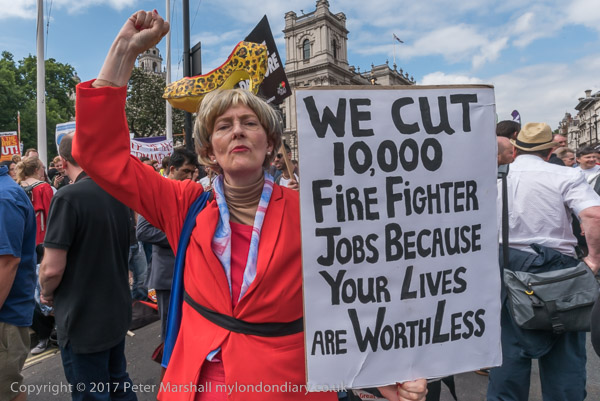
There were I think over 20,000 people on the march organised by the People’s Assembly Against Austerity from the BBC to Parliament Square calling for Theresa May and the Conservatives to go, and I photographed quite a few of them.


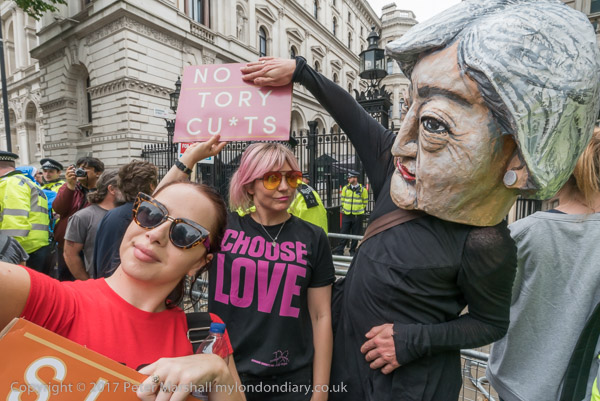
Theresa May at Downing St

Taking part were people from a wide range of groups and causes, all affected by the cuts under the Tories and wanting change to policies that put the interests of ordinary people, particularly those in greatest need, ahead of those of the already rich who include many Tory MPs and the relatively small group of people who donate to Tory Party funds. Tory Party membership has declined dramatically and is now thought to be around 70,000, roughly a tenth of Labour membership, and smaller than that of the Lib-Dems and SNP.


Theresa May in Parliament Square

With so many to choose to photograph I doubt if anyone’s pictures can be truly representative, but I tried hard to show the wide range of causes as well ad photographing the people and posters and banners that seem most interesting.

One of the trade union banners that attracted me was a new one for Hull City Unison Branch, which includes Amy Johnson in ‘Jason’ towing a banner with the emblems of the 3 unions that formed UNISON, the Humber Bridge and Spurn Lighthouse and a lifebelt, the Spanish Republican flag and two of the eight from Hull who went to fight with the International Brigade, dockers leader Walter Greendale, Hull’s Rugby League legend Clive O’Sullivan, Mary Murdock, Hull suffragette and the first woman doctor in the UK, Tony Benn, a member of Hulls LGBT community, Headscarf Revolutionary ‘Big Lil’ Bilocca who forced legislation to improve safety on trawlers and Hull’s iconic ‘Dead Bod’.

Of course like most photographers I was drawn to the various smoke flares set off by some of the marchers, which always add a little drama. And despite their aversion to ‘A to B’ marches, Class War were on this one, though they disappeared briefly before the end.
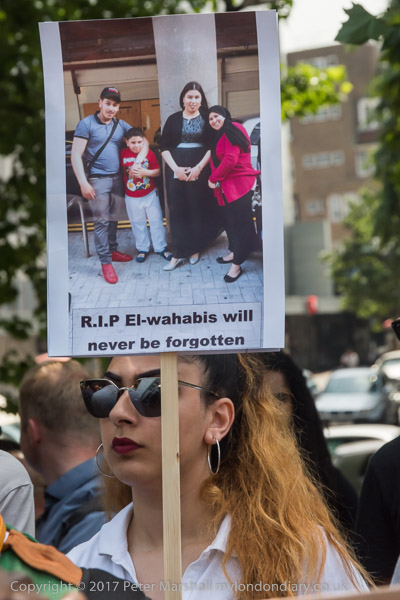
I was sorry to miss them when they returned to Parliament Square to confront Jeremy Corbyn over the terrible Labour housing policies of most Labour councils, with almost 200 council estates on the list for demolition and replacement by high cost housing, in what is a far greater threat to social housing than the Blitz, forcing those on low pay out of much of London in a huge programme of social cleansing. Of course it is a program driven by Corbyn’s enemies on the right of the party and there may be some changes in Labour policies in boroughs as Corbyn supporters – many of whom were on the march and chanting that drearily sycophantic ‘Oh Jeremy Corbyn’ flex their muscles and become local councillors.

Its an issue which Class War and their friends in ASH (Architects for SOcial Housing) have done more than any other group to put on the agenda, and they have been at the forefront in other housing issues, for example with the lengthy campaign against ‘Poor Doors’ – separate doors for social tenants and the wealthy living in the same block which I recorded in a magazine, still available from Blurb, or direct from me to UK addresses for £7.50 including postage.

Tories Out March


Continue reading Theresa May Must Go!

EDL, FLA & Anti-Fascists

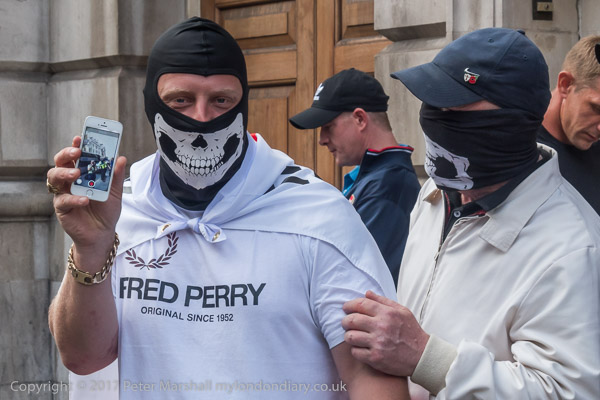
Police has taken what seemed excessive precautions to prevent a clash between the EDL and anti-fascists on the streets of London, imposing conditions for their protests under Section 12 and 14 of the Public Order Act, 1986, due to their concerns of serious public disorder, and disruption to the community, and there was a very large force on the streets, easily outnumbering the protesters.

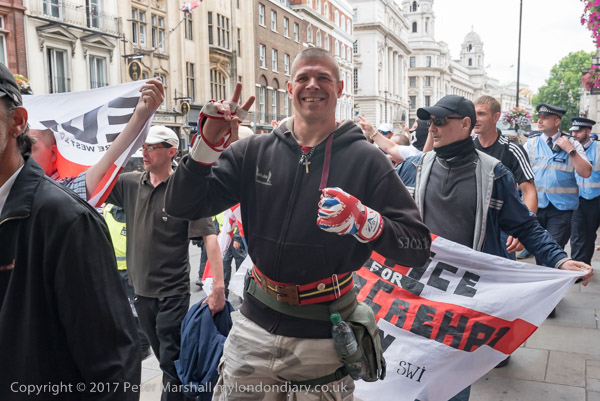
Of course neither group conformed in detail to the conditions, but there were plenty of police around to keep the anti-fascists away from the EDL and rather more to protect the small group of EDL supporters as they stood outside the Wetherspoons (a few more were inside) but the numbers of both groups were pretty small – perhaps a total of around 50 for the EDL and roughly twice that for the UAF counter-protet. Though I can’t understand why any police officer thought they would get the EDL to gather anywhere but in a pub.

Obviously I have my own views on the EDL, but as well as making these clear in what I write I’ve always tried to report their actions objectively and accurately – which is perhaps why I get so much hate from a few of them. Fortunately there were plenty of police around and I felt reasonably safe taking pictures from a close distance with my usual wide-angle lens. And as usual there were some of them who also photographed me, probably to add to the portfolio on right-wing hate sites which encourage violence against photographers.

But most of them were in a reasonably good mood, enjoying the day out and the publicity – and even smiling for the camera. Police had held them at the pub until they had escorted most of the anti-fascists down to a pen on the embankment a couple of hundred yards away from where the EDL rally was to be held.

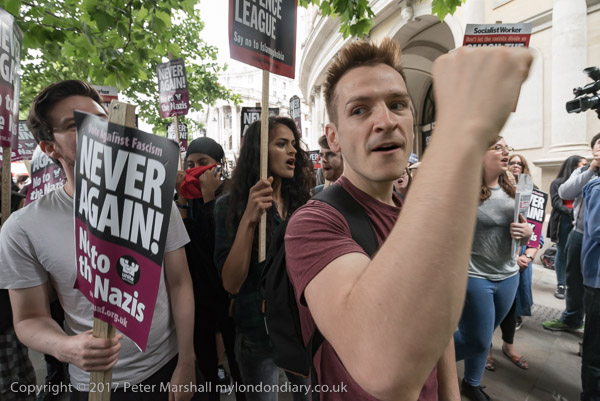
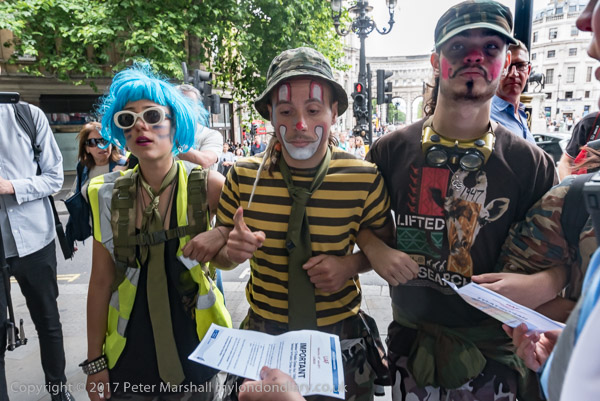
I’d earlier photographed the anti-fascists as they gathered at the top of Northumberland Avenue which they had thought the EDL would be escorted down. They were a much more ethnically diverse group than the EDL, with many women and looked rather more like a typical London crowd, though some were wearing mask and there was a group of clowns. But the whole atmosphere was much more friendly and positive and there were absolutely no problems in taking pictures – even from very close distances with the police standing well back.

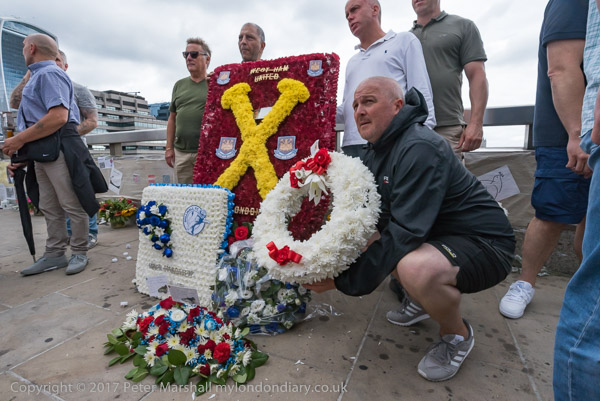
I moved back and forth a little between the two groups and then followed the EDL as they were escorted down to their rally, around half an hour later than I had expected. Their late departure meant that I arrived at a third protest, by a new group called the Football Lads Alliance (FLA) more or less as the event ended with laying of wreaths on London Bridge, the scene of the most recent terror attack in London. The police had also issued them with conditions, preventing them from marching on to Borough Market.

Although I reported that the march was a silent one – as the organisers had intended, I later watched a video that showed at least some of the marchers had been shouting and chanting anti-Muslim slogans on the route, though the thousand or more football supporters on the bridge were applauding politely when I arrived and held a short silence in memory of those killed in the attack.

Like the EDL, the FLA are keen to point out that they are not a racist organisation, though some of the actions they urge the government to take seem both simplistic and an attack on the human rights of citizens, and particularly Muslims. Clearly on this march some of the marchers had no qualms about being openly Islamophobic. And although the event was more restrained than those organised by the EDL, with no flags or banners, there was no evidence of any of the left-wing or anti-racist football groups and campaigns being involved.

I walked down to London Bridge station, stopping briefly to take pictures of the many sticky notes and huge pile of flowers, now rather faded, left by Londoners in memory of the dead, and then caught the Jubilee line back to Westminster where I had a couple of other events to photograph before moving on to the US Embassy and then a victory party for the cleaners which I wrote about earlier.

EDL march against terror
Anti-fascists oppose the EDL
Football Lads Alliance at London Bridge

Continue reading EDL, FLA & Anti-Fascists

University fails workers


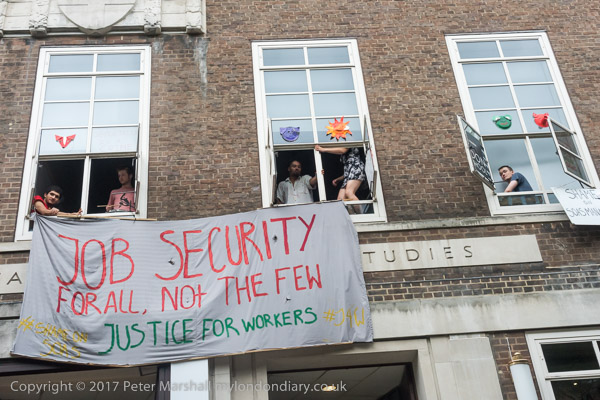
The rally outside SOAS

Students and staff at SOAS London University have been campaigning for over ten years to get fair treatment for the staff that work their, many of whose jobs have been contracted out to companies that have none of the ethical culture that universities have always expounded. Particularly at institutions like SOAS and the LSE professors teach courses against exploitation and for liberal values and justice, while in the buildings they work  vital services are provided by poorly paid and badly treated staff, employed for the university by companies with no concern for their welfare.


Occupiers in the SOAS management offices take part in the rally outside

It has been a long fight as SOAS, but eventually the cleaners achieved a proper living wage and promises of better conditions of service though direct employment by the university, but in June catering staff employed there by EliorUK were told that the main building refectory was to close and workers there would be made redundant. Supporters of the SOAS Justice for Workers campaign occupied the management offices demanding proper consultations and demanding no cuts, no closures and no redundancies and that all workers at SOAS should have fair contracts offering equal sick pay, holiday pay, with zero-hours contracts being replaced and outsourced workers brought in-house.


Doors are locked at SOAS to stop the protesters entering

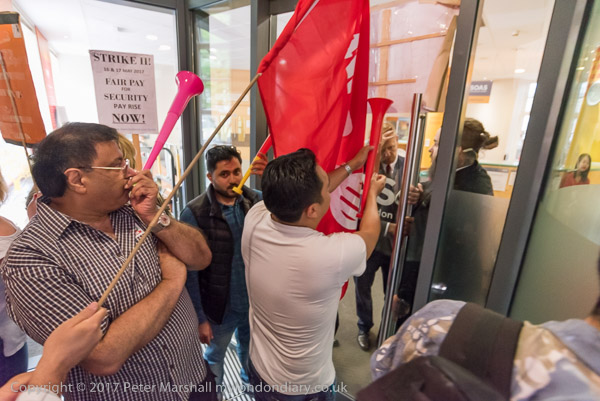
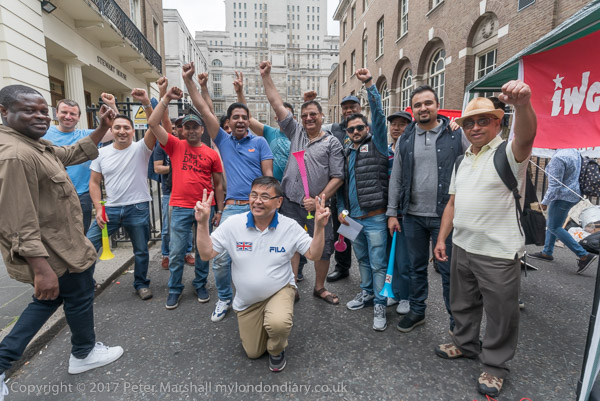
The rally outside the occupation took place on the same day as University of London Security Officers at neighbouring Senate House belonging to the Independent Workers Union of Great Britain (IWGB) were on strike demanding talks with the university and contracting firm Cordant over the restoration of pay differentials which have been reduced by over 25% since 2011.

As their day of picketing ended they came to join the SOAS campaigners, protesting briefly with them at SOAS before going on together to hold a noisy protest outside Senate House.


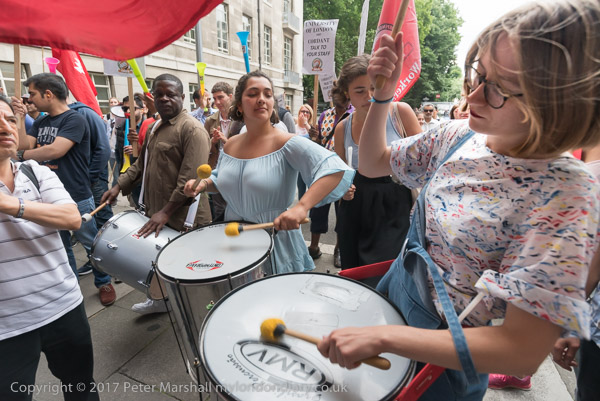
Drummers accompany the protest outside Senate House

SOAS J4W & IWGB Security Workers

London University Security officers

Continue reading University fails workers

Rage for Grenfell


Grenfell Residents spoke calling for a peaceful protest. The organisers assured them that they had always intended for the protest to be peaceful and that stories about violence were simply a deliberate media distortion

We could I think do with a little more rage. So many things happening now that would justify it, including the current crisis in the NHS, underfunded for years, crippled by PFI debt and being increasingly privatised to  the benefit of Mr Branson and other friends of the Tories – many of whom have shares in the companies that are taking it over. Then there are the railways, suffering from a disastrous and wholly unsuitable privatisation, with huge subsidies going to the privatised franchises, sending large profits to nationalised European railway companies so they can continue to provide rail services at a quarter or a fifth of what we pay. And so on. And while we should be raging and be out on the streets like those currently protesting in Iran we go on, moaning a little but largely soaking up the lies of a right wing press and a media which supports the status quo rather than demanding justice and change.

Grenfell gave just a little glimpse of what is wrong with the way our society is run – and also showed a magnificient response of ordinary people to a tragedy.  But while many people – including both rich and poor – responded with humanity, it also showed the complete failure of the local council and the duplicity of our national government in their response – and soon their were vultures swarming in to try and take things over for their own profits, sadly including some major charities.

Movement for Justice were I think entirely right to call for a ‘Day of Rage’ over Grenfell, though this led to a frenzy of denigration in our right-wing media. We should all be angry and calling for the truth to come out and for justice to be done. It wasn’t a call for barricades in the street and riots, but for an end to the customary hiding under carpets and long grass that is the usual response of our political establishment.

Over six months later little has been done by the authorities for those severely affected by the fire, the survivors from the tower and the surrounding properties made uninhabitable. Many families spent Christmas in overcrowded hotel rooms, some without the cash payments they were entitled too because of administrative incompetence. And many have not received the kind of mental health support and counselling they need, with several suicides. Promises made by Theresa May and the government have largely turned out to be empty words, and most local people have lost faith in an inquiry which is sidelining them and their concerns, while the police have failed so far to bring charges against those responsible for the tragedy.

‘Day of Rage’ march for Grenfell

Continue reading Rage for Grenfell

Al Quds

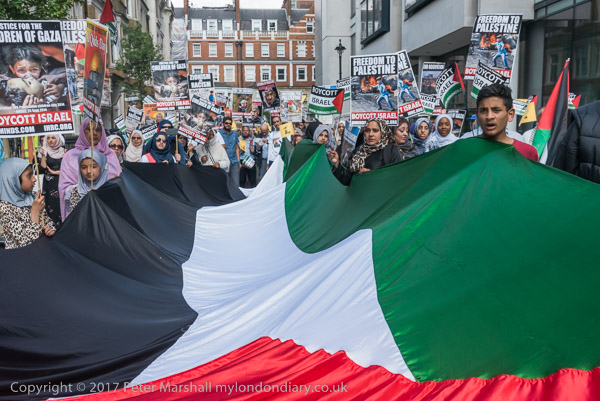
Al Quds Day – Jerusalem Day – was inaugurated by Ayatolla Khomeni in 1979 and is celebrated on the last Friday of Ramadan as an expression of support for the Palestinians and Israel’s occupation of Jerusalem in particular and the occupation of Palestine, the Jewish settlements on occupied land and Zionism more generally. It was seen as a response to the Israeli celebrations of Jerusalem Day (Yom Yerushalayim) since May 1968, which became a national holiday in Israel in 1998. The march in London this year was held on a Sunday.

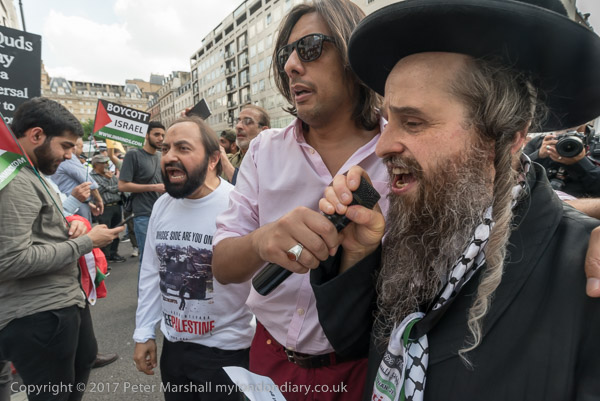
Some Jewish organisations accuse the event and its organiser Nazim ALi of anti-semitism, but in some past years the stewards have asked people with antisemitic placards to leave the march. Clearly it is anti-Zionist, and many Jews conflate the two. This year there were complaints made to the police against Ali for hate speech, which the police investigated and declined to prosecute.


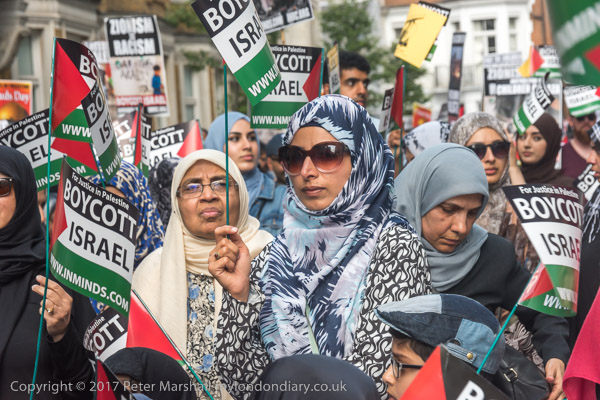
Spot the Hisbullah flags – there are a few among hundreds of other placards, flags and banners

A few on the march carried flags with the Hizbullah logo and the message ‘This flag is to show support for the political wing of Hizbullah‘, though there were few of these on show this year. Again there were complaints to the police, alleging that this was an illegal flag, but the police refuse to take action, as this flag is used by the Lebanese Shi’a Islamist political party Hizbullah which is not proscribed here as well as the military wing which is banned in the UK as a terrorist organisation. A police statement later made this clear “As the flag represents both Hezbollah’s political party and the proscribed terrorist group, displaying it in these circumstances alone does not constitute an offence under Terrorism Legislation.”

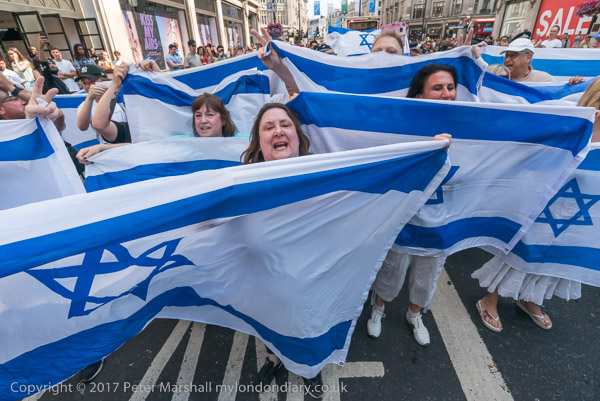
As well as making complaints to the police, a small number of Zionist activists, led by Joseph Cohen attempted to disrupt the march. Police kept a small group of them away on the opposite side of the road as the march gathered, but as it reached Oxford Circus around 25 of them ran out into the road in front of the march holding up Israel flags. The marchers made no attempt to engage with them, but asked the police to clear them from the agreed route, which eventually they did, but the Zionists simply moved on a few yards and blocked the route again.

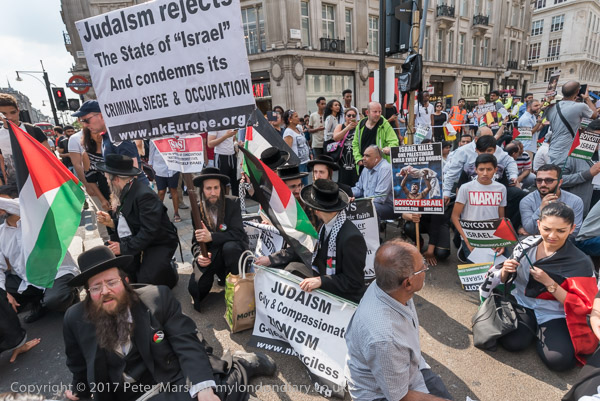
The Al Quds marchers then sat down on the road and waited for the police to move the Zionists again, after a few minutes they decided to hold the silence they had meant to hold later in respect for those who died at Grenfell Tower. By the time this was completed the police had moved the Zionists a little further on, and the march continued down Oxford St with police between the two groups keeping the Zionists moving. I left at this point.

Among those taking part in the Al Quds day rally were as usual a number of Jewish socialists and the ultra-orthodox Neturei Karta anti-Zionist Jews, who marched with a number of imams at the head of the procession. One carried a banner with the message ‘Judaism demands freedom for Gaza and all Palestine & forbids any Jewish state’ and others had posters with similar messages.

The main banner on the march has a clear message: ‘United Against Racism, Islamophobia, Anti-Semitism and Zionism – Free Palestine – Quds Day – London‘ and this seemed to me to be the spirit in which the march takes place here in London, and why it gets support from a wide range of organisations.

This year saw a coordinated campaign before the march to get it banned, accusing it of supporting extremism and terrorism. The web site of the main organising group, the Islamic Human Rights Commission web site published some of the viler comments and threats from Twitter, Facebook and blogs which led them to contact the police and write an open letter to London’s Mayor. His reply defended the right to protest and stressed that the police had carefully monitored all of the “speakers and chanting”, and that “no offences were reported from the march.” The web page also links to a wide range of press and web articles about the march, and includes brief details of the speeches.

Many connect the frenzy whipped up by right wing and Zionist movements about this march with the terrorist attack by a 47-year-old van driver from Cardiff who drove a van into people on the street outside Finsbury Park mosque early on the following day, a few hours after the march and rally ended, killing one man and injuring 11 others. He was charged with terrorism related murder and attempted murder and his trial starts on January 22nd. He is said to have told people in a Cardiff pub that he was coming to London to attack the march.

Continue reading Al Quds