Put the Green in Greenwich

Though I’m not a Greenwich resident, I have taken an occasional interest in politics in this Labour-dominated council (currently 42 Labour and 9 Conservative councillors) because of various developments in the area where several of my friends live or lived.  One of my main projects in the 1990s was on the Greenwich Meridian in London (you can read more about it and see some picture on the Urban Landscapes site) which were for some years on a leading Greenwich site, and the borough has one of the best independent news sites, the 853 blog, which tirelessly comments on local matters and in particular the local council sheenanigans. As the blog claims, it really does do all the kinds of things that good local newspapers used to do, but most are now part of huge enterprises which largely regurgitate press releases and don’t employ local reporters with local knowledge and time to investigate.
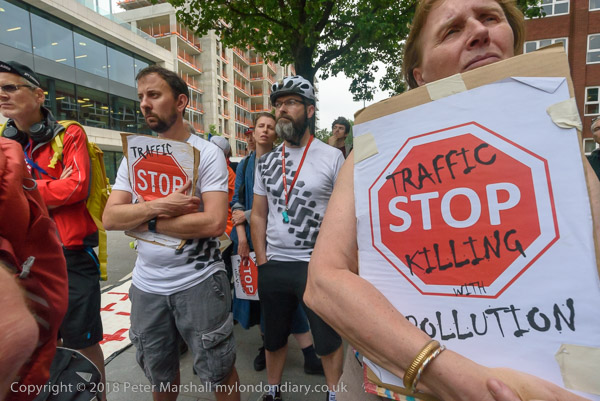
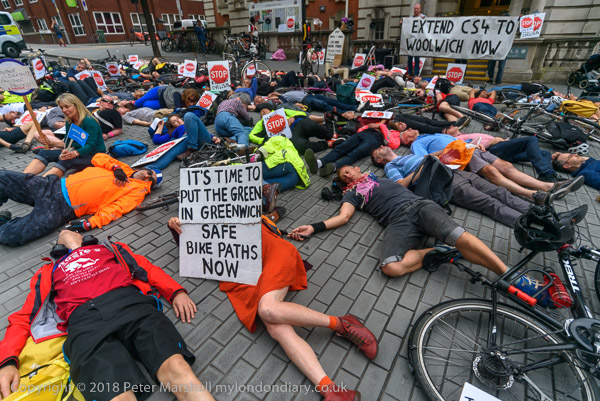
The protest outside Woolwich Town Hall (the HQ of the London Borough of Greenwich) in May by ‘Stop Killing Cyclists’ came after Edgaras Cepura was killed cycling around the junction of the A206 and the Blackwall Tunnel approach. Another cyclist, Adrianna Skrzypiec, had been killed at the same place nine years earlier, and there have been many other incidents when lorries and cars have hit cyclists in the area, notoriously unsafe for cycling.

It should by now have become a part of Cycle Superhighway 4, which was planned to go all the way from Woolwich through Greenwich to London Bridge, but pressure from Greenwich Council led to all of its route in the borough being axed, and when complete it will now end at the borough border. I’m reliably informed that the reason plans for Greenwich were dropped was a matter the then Woolwich council leader’s personal antipathy to Boris Johnson’s former cycling commissioner Andrew Gilligan, and the council certainly gained a deserved reputation for dragging its feet over any provision for safe cycling.
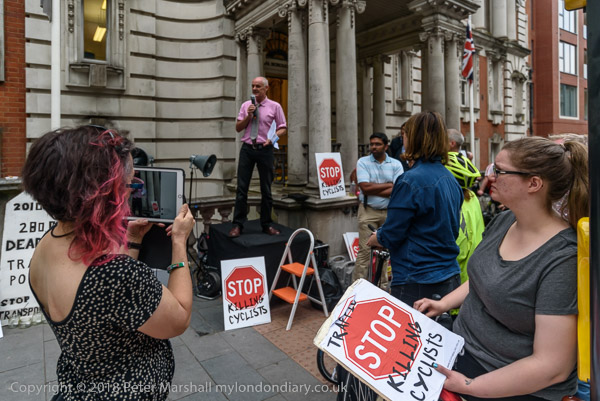
We still haven’t got CS4, and last week the third cyclist was killed this year on the route where it should be. Under Boris Johnson, TfL (Transport for London) in 2014 published a list of 33 places for which “substantial cycle infrastructure improvements” were needed, including the A206/Blackwall roundabout, but nothing has been done there. London Mayor Sadiq Khan has said that the plans still exist and they still have a date when they should take place, although the junction was left out of a more recent list from TfL.

Safer cycling isn’t just about saving the lives of cyclists. It also makes a great improvement to the health of the city’s population. The danger faced by cyclists on city roads is a major factor stopping many from using their bikes in the city, when for many journeys it would be the most convenient way to go. Making roads safer means more people use bikes, reducing the pollution – mainly from traffic – that causes almost 10,000 early deaths a year in London, as well as huge suffering from lung diseases. For those who take to their bikes, the exercise makes them healthier, both improving their lives and saving public funds. More people on bikes means fewer cars on the road, reducing congestion. Everyone wins.
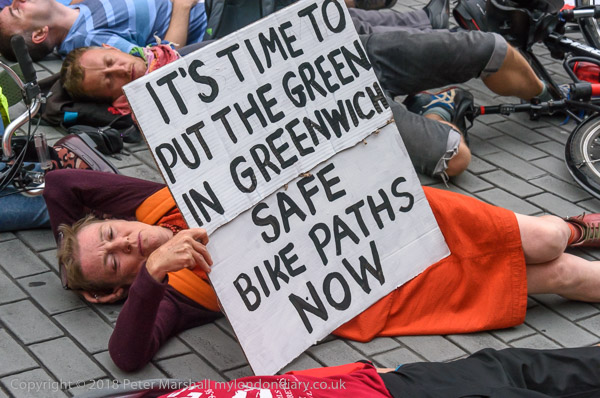
I think changes in Greenwich Council have given it a more positive attitude towards cycling, and hope they will now be urging Sadiq Khan to get on with the job. But he has as yet shown little drive towards making the streets safer, and many other councils are still dragging their feet over the issue. Protests such as this by ‘Stop Killing Cyclists’ are vital to get things moving and add great support to the work of other organisations including the London Cycling Campaign.
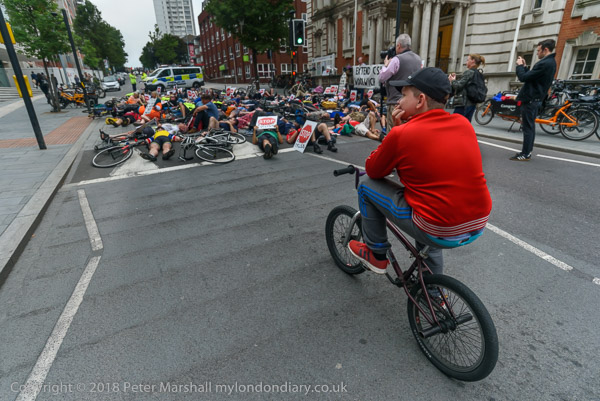
Coming up shortly on October 13th 2018 is the ‘National Funeral for the Unknown Cyclist-Pedal on UK Parliament‘ organised by Stop Killing Cyclists, with rides from various parts in and around London organised by London Cycling Campaign members, IBikeLondonThurrock Cycling Campaign and others to Lincoln’s Inn Fields from where the funeral procession will proceed to Parliament Square for a rally and die-in.

______________________________________________________

There are no adverts on this site and it receives no sponsorship, and I like to keep it that way. But it does take a considerable amount of my time and thought, and if you enjoy reading it, a small donation – perhaps the cost of a beer – would be appreciated.

My London Diary : London Photos : Hull : River Lea/Lee Valley : London’s Industrial Heritage

All photographs on this and my other sites, unless otherwise stated, are taken by and copyright of Peter Marshall, and are available for reproduction or can be bought as prints.

To order prints or reproduce images

________________________________________________________
Senate House protest

Senate House at the University of London, a tall slab designed by Charles Holden as the start of a larger scheme for the university in the 1930s continues the Orwell theme of a few posts ago.

During the Second World War, the building was taken over as the Ministry of Information. George Orwell’s wife Eileen worked there and it was the inspiration for the Ministry of Truth in his ‘1984’, published four years after the war ended. (It also inspired Grahame Greene a few years earlier, writing his Ministry of Fear and the film version by Fritz Lang in 1944.) Somewhere inside that vast hulk was Room 101, though what happened there was prompted by Orwell’s experiences of long and tedious meetings in the Conference Room of another iconic 1930s builing, the BBC’s Broadcasting House.

Senate House is the administrative centre of London University, part of a block that extends along Malet St and to Steward House in Russell Square, and it is a location I’ve visited many times over the years, including for various conferences and while working as an assistant examiner.

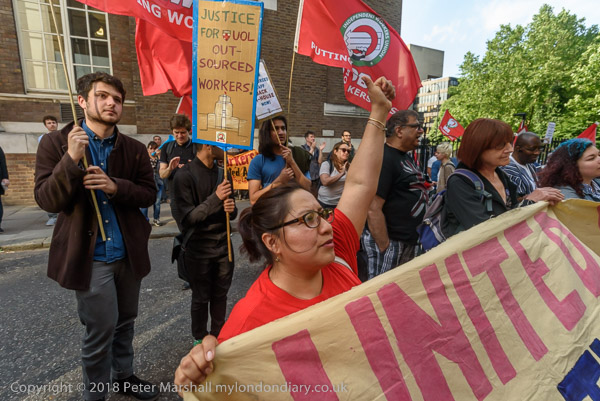
But my visits in recent years have been rather noisier, accompanied by cleaners and other low-paid workers, campaigning for a living wage, for decent conditions of service, and most recently to be brought back ‘in-house’, to be directly employed by the university rather than at the non-existent mercy of contracting companies, always out to squeeze maximum profit by exploiting them.

Slowly, slowly, all of these campaigns have reached a satisfactory conclusion. The University management know they have no leg to stand on and cannot support the way these companies treat their workers – and the members of the university – staff and students – let them know that they support the workers.

The delaying tactics continue – and it took the workers at SOAS next door to the Senate House ten years of protests to finally be brought back in house this year. The staff serving Senate House and the nearby University Halls – cleaners, porters, security etc – know they need to keep up the protests to keep the managment on its way to their goal.

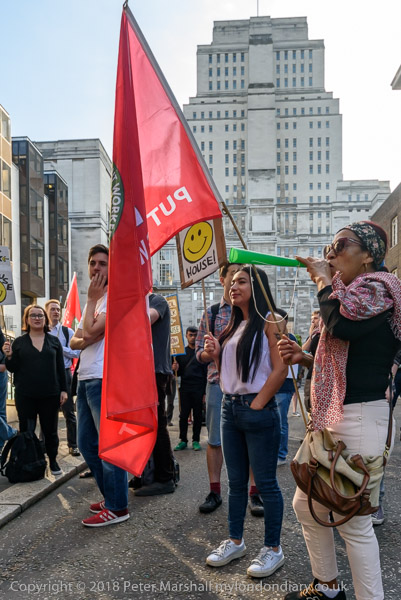
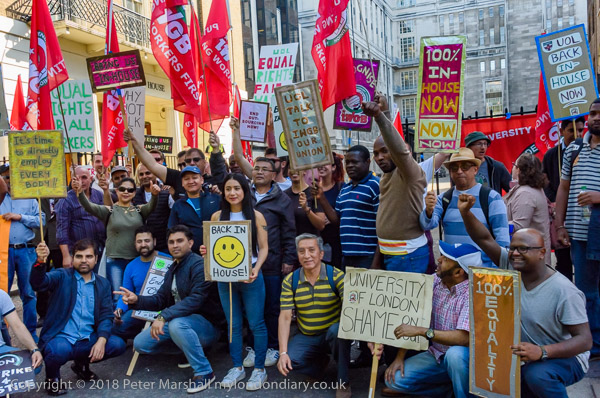
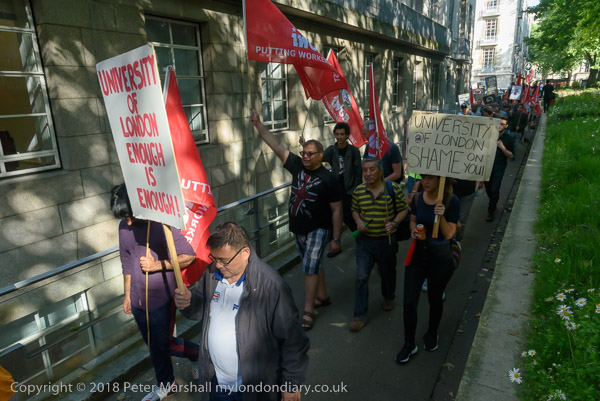
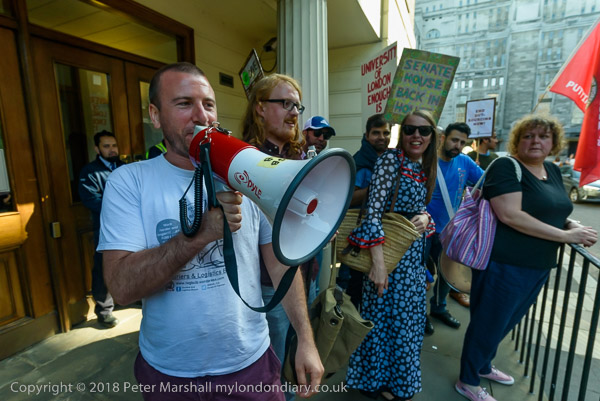
At this protest, the workers didn’t actually go inside Senate House, though the rattled the gates at the bottom of the block from both sides, and walked all around the building, blowing vuvzelas, speaking through a powerful megaphone and shouting slogans to make their presence felt. The University had employed extra security staff for the occasion as many of the usual secuirity officers were taking part in the protest which came at the end of a one-day strike by cleaners, porters, security officers, receptionists, gardeners, post room staff and audiovisual staff.

The event was organised by the IWGB (Independent Workers OF Great Britain) University of London Branch, and they were supported by other trade unionists, including some from United Voices of the World, SOAS Unison and the UCU, and by ‘Poetry on the Picket Line’. As at a many other workplaces, the management has failed to recognise the union to which most of the staff now belong, perferring to stick to old agreements with more traditional unions who have often done very little to support low paid workers and have lost credibility. As well as getting better conditions for the workers the IWGB and other grass roots unions are also fighting for union recognition and an end to discrimnation against union members and activists.

More pictures: University of London staff in-House now

______________________________________________________

There are no adverts on this site and it receives no sponsorship, and I like to keep it that way. But it does take a considerable amount of my time and thought, and if you enjoy reading it, a small donation – perhaps the cost of a beer – would be appreciated.

My London Diary : London Photos : Hull : River Lea/Lee Valley : London’s Industrial Heritage

All photographs on this and my other sites, unless otherwise stated, are taken by and copyright of Peter Marshall, and are available for reproduction or can be bought as prints.

To order prints or reproduce images

________________________________________________________
Protest condemns cold-blooded killing

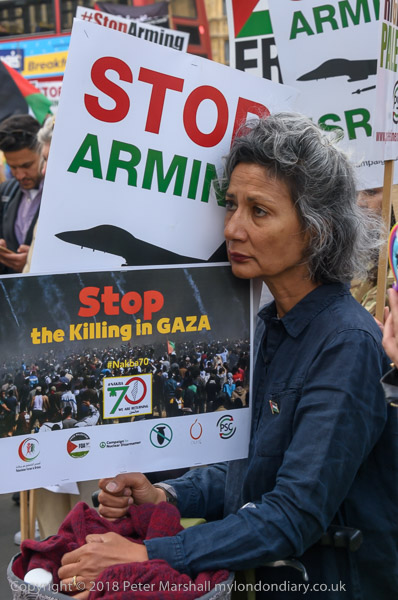
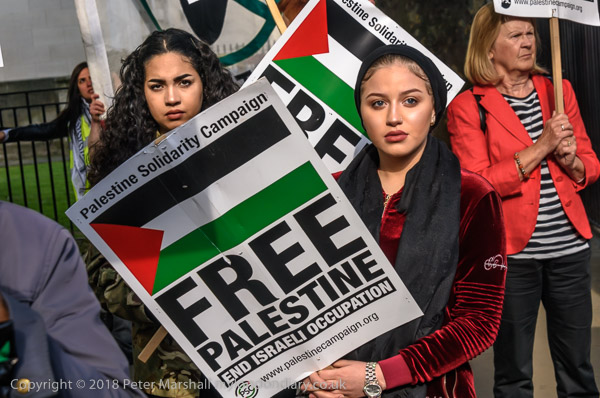
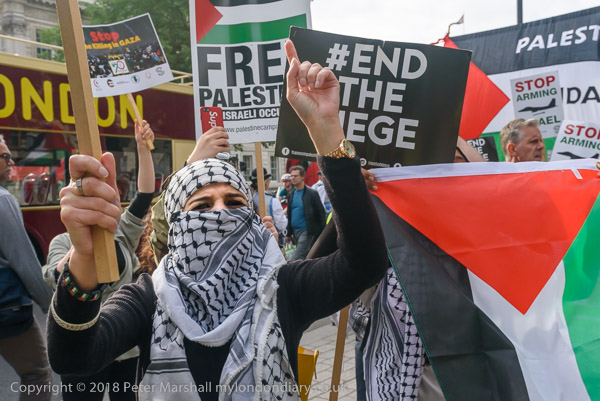
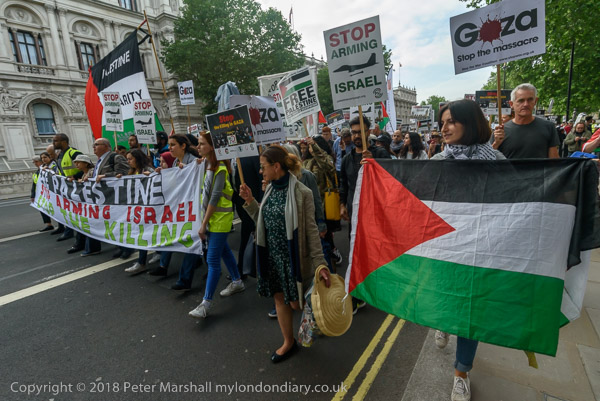
Videos showing Israeli snipers in a carefully planned exercise shooting unarmed Palestinian protesters several hundred yards from the separation fence they were protesting against, including those clearly running away from it shocked the world. So I was not surprised to see a large crowd at the protest at Downing St, even though it was on a Monday evening, seldom the best time for demonstrations.

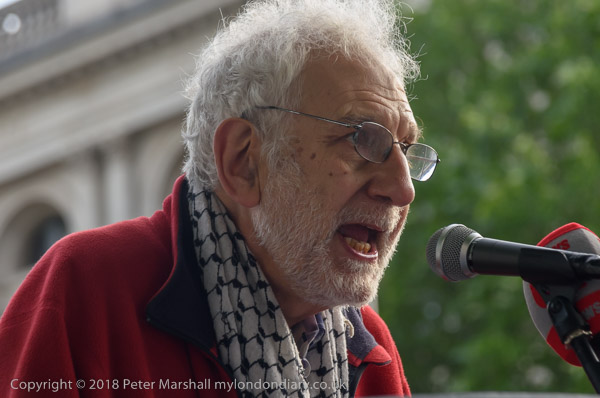
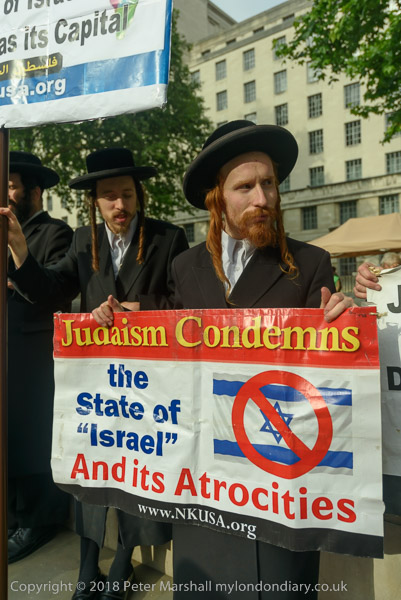
Nor was it any surprise that quite a few of those at the protest, including some of the speakers were Jewish, although the voices of those opposed to the Israeli government seldom get much time on our mass media, who often seem to accept the views of some Zionists that any criticism of Israel is anti-Semitic.

Before the Second World War, historians (including Jewish historians) tell  us that Zionism wasn’t particularly widely accepted among the Jewish community, and there are still those who condemn it on religious grounds as well as those who criticise the actions of the Israeli state on political and humanitarian grounds.

I’ve photographed many pro-Palestinian protests over the years, and almost all have included Jewish protesters, and the protesters have always been clear that the protests were against the actions of the Israeli state and Zionism and were not against Jews. When people have on a few occasions expressed anti-Semitic opinions it has always been challenged, and  has been made clear that these are not acceptable, and people have been asked to leave. But today – as on almost every such protest – there were no such views.

After speeches at Downing St, the protesters marched to protest in Old Palace Yard, inf front of Parliament. They were calling for and end to the killing and an end to UK arms sales to Israel.

Here there were more speeches, and those killed were remembered, with their names being read out. Among the Palestinians taking part in the protest were some holding up the keys to their family homes in Palestine, which they were forced to leave in 1948.

A few months earlier, some celebrated the 100th anniversary of the Balfour Declaration, which was important in paving the way for the setting up of a state of Israel:

Dear Lord Rothschild,

I have much pleasure in conveying to you. on behalf of His Majesty’s Government, the following declaration of sympathy with Jewish Zionist aspirations which has been submitted to, and approved by, the Cabinet

His Majesty’s Government view with favour the establishment in Palestine of a national home for the Jewish people, and will use their best endeavors to facilitate the achievement of this object, it being clearly understood that nothing shall be done which may prejudice the civil and religious rights of existing non-Jewish communities in Palestine or the rights and political status enjoyed by Jews in any other country.

I should be grateful if you would bring this declaration to the knowledge of the Zionist Federation.

Yours,

Arthur James Balfour

Unfortunately although the “national home for the Jewish people” has been established, the “the civil and religious rights of existing non-Jewish communities in Palestine”  have clearly been and continue to be subject to extreme prejudice. Including being shot for taking part in peaceful protest for those civil rights.

More pictures at: Free Palestine, Stop Arming Israel
______________________________________________________

There are no adverts on this site and it receives no sponsorship, and I like to keep it that way. But it does take a considerable amount of my time and thought, and if you enjoy reading it, a small donation – perhaps the cost of a beer – would be appreciated.

My London Diary : London Photos : Hull : River Lea/Lee Valley : London’s Industrial Heritage

All photographs on this and my other sites, unless otherwise stated, are taken by and copyright of Peter Marshall, and are available for reproduction or can be bought as prints.

To order prints or reproduce images

________________________________________________________
Remembering 1984

‘1984’ means different things to different people. For Google the the first 100 results are mainly about George Orwell’s novel, published in 1949 and set 35 years into the future largely in London in a post-nuclear war England which is in some respects rather chillingly close to what we now accept at normal.

Of course technology has advanced rather differently from that foreseen by Orwell, but we have come to take for granted something approaching the total surveillance, both from CCTV cameras in every shop and street and also through our willing participation in the internet and through the use of mobile phones and card-based payments. The tracking of our thoughts, movements and actions is less obvious than he envisaged but considerably more detailed, though largely carried out in the first instance by commercial organisations such as Google who monitor every click you make; though behind them sit the huge computers of GCHQ, sifting and analysing the whole of the internet. As you read this, Big Business as well as Big Brother is watching you!

But sinister though this sometimes seems, especially to some of my more tinfoil-hat wearing friends, it still represents more of a potential than an actual threat, used mainly to send us advertisements for things we have already bought.

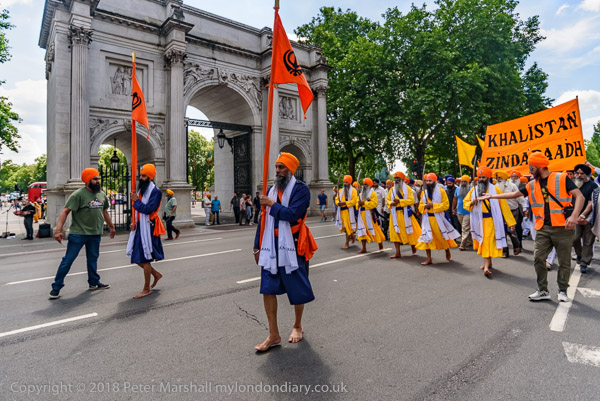
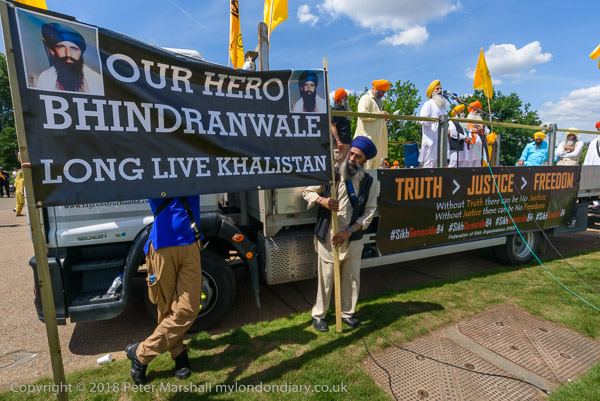
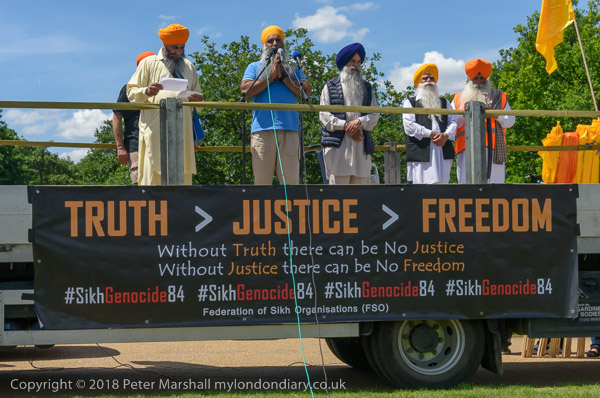
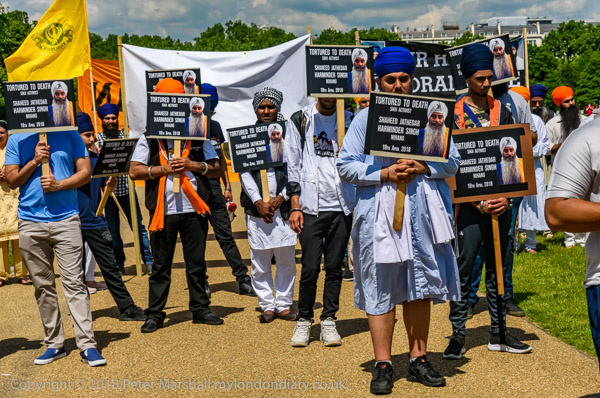
But for some people, 1984 has a different and far more sinister ring. Sikhs remember it as the year when India turned upon them, the Indian Army killing thousands attacking the Golden Temple complex and the Indian government spurring on mobs to continue the carnage after the assassination of Indira Ghandi at the end of October that year. The ‘Sikh Genocide’ which began at Amritsar was the second massacre in that city, the first being in 1919 when the British Indian Army opened fire on an peacefull protest in the Jallianwala Bagh Garden close to the Golden Temple, a key event in the rise of Indian nationalism that eventually led to independence and partition.

That partition of the Indian subcontinent by the colonial power at independence in 1947 was bound to result in a bad deal for the Sikhs, who were a small minority in the country and had no region in which they were a majority. They trusted the Indian National Congress and its promised more than those of the Muslims, but few of those promises were fulfilled. There are some problems for which there is no satisfactory solution and India in the 1940s was certainly one of them, though many would argue that better solutions could have been found. And given the current domination of India by Hindu nationalists, along with the long term problems of Pakistan, Bangladesh and Kashmir, it might be difficult to argue that Britain did much of a job back then.

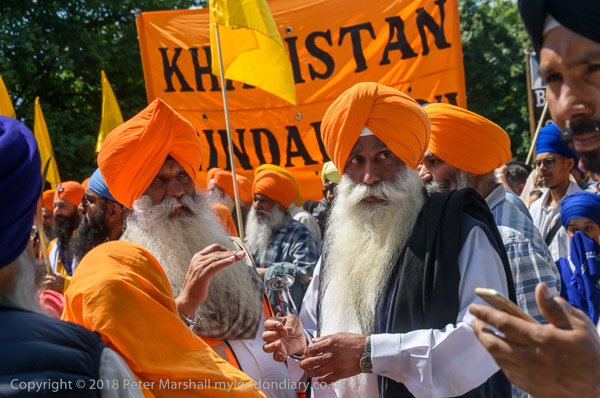
Though history is history and can’t be changed, it continues to reverberate, and the events of 1984 remain a vital issue for many Sikhs, including many who were not even born 34 years ago. This annual march has sometimes attracted the attention of the UK police, keen to crack down on the support for Babbar Khalsa, an international group which, according to Wikipedia, “wants to establish an independent country for Sikh religion called Khalistan, and uses bombings, kidnappings and murders to accomplish their goals” and is banned as a terrorist organisation in India, Canada, the EU, the UK, USA and Japan.

Of course many in the UK who support the foundation of Khalistan are against terrorism, and though there were speakers and banners calling for Khalistan this does not imply support for Babbar Khalsa and their activities in India or elsewhere.

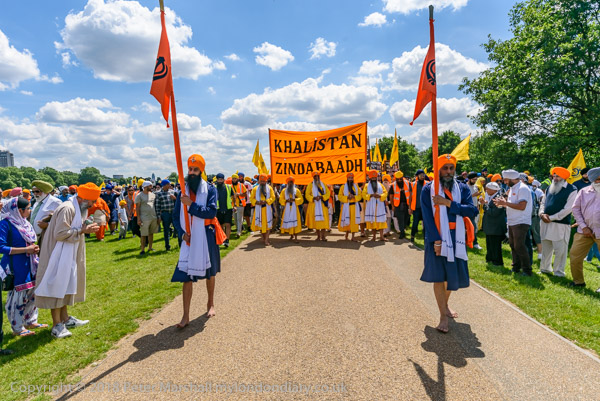
The march, with a large banner, ‘Khalistan Zindabaahd’, began by getting lost, failing to turn right as it left Hyde Park, led as usual by the standard bearers and ths five Khalsa with swords raised representing the ‘Five Blessed Ones’, who clearly had not been informed of the details of the route. The police who would normally have led them had not arrived to do so (those government cuts have meant much less policing of most protests) and the processsion ended up going around Marble Arch and then returning into Hyde Park to wait for the police to arrive and guide them. I think those leading the protest had come from Birmingham and were unfamiliar with the area.

Eventually the march made a second start, going down Park Lane with the police in attendance, and I left them as they turned onto Piccadilly to march down towards Trafalgar Square for a rally.

______________________________________________________

There are no adverts on this site and it receives no sponsorship, and I like to keep it that way. But it does take a considerable amount of my time and thought, and if you enjoy reading it, a small donation – perhaps the cost of a beer – would be appreciated.

My London Diary : London Photos : Hull : River Lea/Lee Valley : London’s Industrial Heritage

All photographs on this and my other sites, unless otherwise stated, are taken by and copyright of Peter Marshall, and are available for reproduction or can be bought as prints.

To order prints or reproduce images

________________________________________________________
Internet wanderings

I’m often surprised by the Internet, or rather I should say by the World Wide Web, invented by Tim Berners-Lee, whose name though etched in my memory I was unable to recall in a pub quiz last night to my extreme annoyance. Both by what you can find out using it, and sometimes by what you can’t.

Currently, as some will know, most days I post a black and white picture taken in London in 1979 on Facebook, with a usually short comment on the subject matter. All of the pictures are on my London web site, but currently there are only brief captions, as in today’s example:


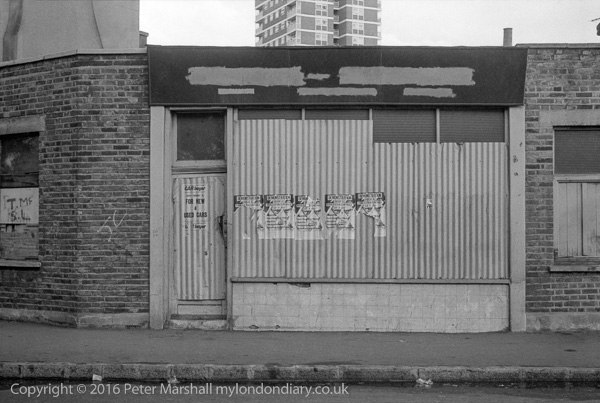
Disused shop, Hackney, 1979
21l-66: shop,, derelict,

Back in 1979 I took relatively few photographs on often long and protracted walks and kept few records; for me then the photograph was the record, and it was only a few years later that I began to keep something of a diary of my walks and to annotate the contact sheets of my films with street names and grid references.

When I wrote the web page I only had a vague idea about where I made this image – somewhere close to London Fields and not far from Broadway Market. That I now know where it was taken to within a yard or two is thanks largely to Google Street View, and the two buildings in the background, both of which appear in other pictures of mine.

Street View of course has its limitations. Where this shop stood is now simply a brick wall, and Street View only allows limited time travel, usually back to 2008, when the shop was long gone.  Its often impossible to get a view from exactly the place and angle you need, and it doesn’t share my predeliction for alleys and footways, with rare exceptions sticking to where a car can drive. It also has a very annoying habit of jumping inside shops where no-one wants to go, which greatly reduces its utility to the public if enriching Google from the owners of these premises.

But of course Street View is a remarkable asset, and one which has almost rendered some photographic projects unnecessary, as I commented in my 2014  post Bleeding London – re-Inventing Streetview?  It’s a resource I now often use when planning walks and visits to new locations.

The time limitation isn’t just confined to Street View. Most of the material on the web has been put there in the last few years, and there is relatively little information about the times before it existed. Various projects have put considerable efforts into digitising historical material and putting local history research into web sites, but much published material from the last century is still unavailable, either not digitised or hidden behind paywalls. Of course much is still copyright, and will remain so until 70 years after the death of its authors, and as a photographer I welcome that (although I am considering gifting my own work to the public domain on my death.)

The posters across the front of the shop are for a march from Hounslow West Station to protest at Harmondsworth Detention Centre on Saturday 21st July. A calendar on the web for 1979 confirms that the 21st of July that year was a Saturday, so these posters, despite their condition, were fairly fresh when I photographed them, probably on the 22nd or 29th July 1979.  But the small print at the bottom of them cannot be read, and I can find no record on the web about this demonstration.

I was surely interested about it when I took the photograph because I was living just a 20 minute bike ride from the immigration prison (I still live in the same place, but the bike ride takes me a little longer) and also because I grew up spitting distance from the starting point of the march.  But probably taking this photograph would have been the first I had heard about the march. Before the web, this photograph illustrates how information about most protests was shared, by fly-posting. Leaflets were handed out at other protests – as they still are – and in some busy inner London streets and markets, information shared at political and trade union meetings.

Left-wing newspapers were mainly sold at street stalls, again on some busy inner city streets, but often only shared details of the events of their particular faction. There were of couse newsletters of major national organisations such as CND and the Anti-Apartheid Movement and Peace News but most smaller demonstrations I often only found out about after the even when I happened to come across the posters.

This protest must have been in some of those printed sources, and as well as the posters there will have been flyers. At that time we still had a local press, and almost certainly the Middlesex Chronicle reporter will have been there covering the protest, even if, as today it will have been ignored by the National Press and broadcasters. But none of these sources about that July 21st protest is accessible via the web.

You can find many reports of more recent protests at Harmondsworth – including my own from my first visit there in 2006 (and more later) and also some information about the detention centres and reports from those held inside them. But little of this is from the first ten or fifteen years of the web or covers anything about the last century. It’s so easy to forget what things were like even relatively recently.

I put my first small site on the web back in 1995 (Family Pictures, still available, only slightly adapted to keep it working, but still with its typical mid-90s flatbed print scans), not that long after the first visual web browsers that would display images became widely available. Mosaic, running on Unix, appeared two years after the start of the web in 1993, when most of us were only using the Internet for e-mail and forum systems along with file transfer and rather odd things like ‘Archie’, all text-based.  Windows 3.1, which first really brought Windows to life had come a year earlier (and still seems to be used by parts of our rail network.)

But when I was making a living writing about photography on the web from 1999-2007 my problem at the start was that so little photography was available on the web. By the end of my tenure things where rather different, and the problem was that so much was there it was getting hard to sort the wheat from the tons of chaff.

______________________________________________________

There are no adverts on this site and it receives no sponsorship, and I like to keep it that way. But it does take a considerable amount of my time and thought, and if you enjoy reading it, a small donation – perhaps the cost of a beer – would be appreciated.

My London Diary : London Photos : Hull : River Lea/Lee Valley : London’s Industrial Heritage

All photographs on this and my other sites, unless otherwise stated, are taken by and copyright of Peter Marshall, and are available for reproduction or can be bought as prints.

To order prints or reproduce images

________________________________________________________
Knife crime

London is a safe city, with relatively low crime and absolutely no ‘no-go’ areas, despite the scare stories put out by some US right-wing personalities and ‘fake news’ web sites. The murder rate in London – at 1.8 per 100,000 people in the year ending March 31 2018 – is around half that of New York (though it did briefly overtake that city earlier this year) and less than all of the  US’s 50 main cities, which are led by  Detroit on  39.7, New Orleans on 40.4 and Baltimore with an astonishing 55.8, over 30 times the London figure. Even this is topped by St Louis at 65.8, though this still puts it well behind cities in Venezuela, Mexico and Brazil, with, according to Statista, Los Cabos and Caracas more or less tying for top place at 111.

Even so, London’s figure of over 100 murders so far this year, showing a considerable recent increase, particularly with around 60 mainly youths being killed by knives and around ten shootings are worrying, and every single death is a tragedy for the victim and family.

So I welcome London Mayor Sadiq Khan’s announcement of a ‘Glasgow’ policy based on a public health approach, which saw the rate halved in that city, and hope it will have the same effect in London. London’s knife killings are largely of young people, particularly of young black men and are often linked with violence between gangs, though not all the victims are gang members.

Both shootings and stabbings are often linked with drug trafficking, and the legalisation of cannabis and the return to a proper system of regulated use of heroin by registered addicts would almost certainly lead to a considerable reduction in these killings, as well as in the huge amount of petty crimes carried out by people to pay for the high-price illegal drugs they need. Years of evidence show that our present approach to drugs just doesn’t work – or rather only works for the organised crime that supplies the drugs.

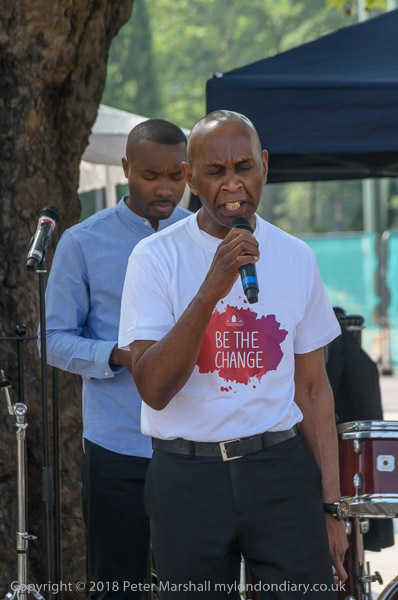
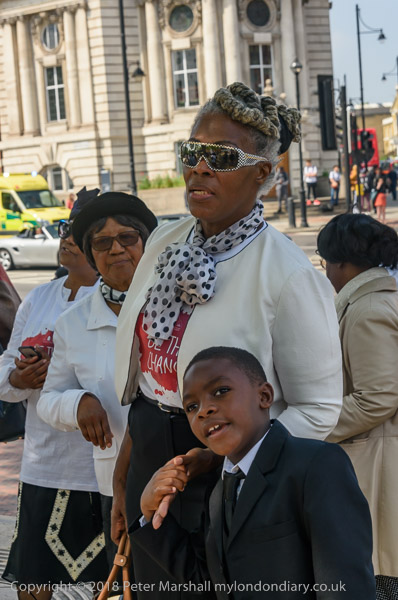
Problems with my train service meant that I arrived too late in Brixton to go the the 7th Day Adventist Church to photograph the ‘Be the Change’ march from there to Windrush Square. I tried to meet them on their way, but they took a different route to that I had thought most likely as it would have made the march more visible; by the time I had realised this and returned to the square they had arrived and the event there was beginning.

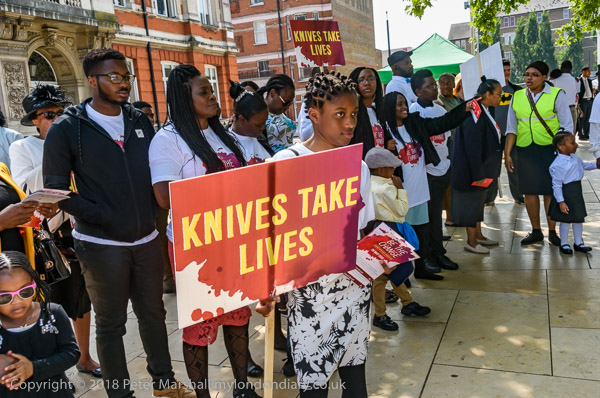
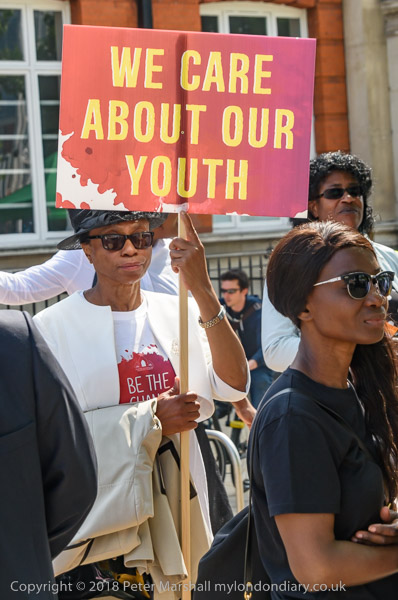
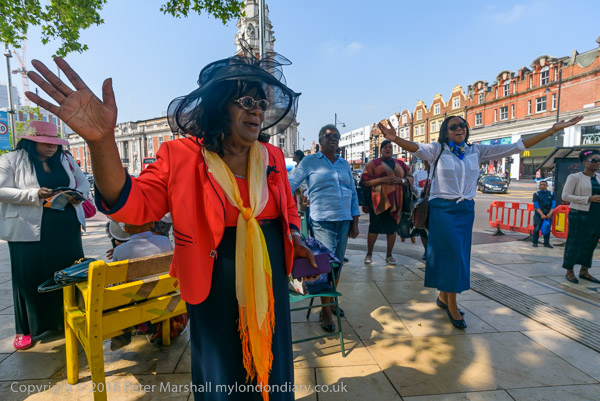
A gospel group sang, a preacher prayed and preached, there was more music and the congregation sang and danced, and there were placards ‘Knives Take Lives’, ‘We Care About Our Youths’ , ‘Be The Change’, ‘Knives Take Lives’ and ‘God Is Love’ , but spirited though the event was, it attracted little attention from the people of Brixton, and I think myself and a photographer friend were the only people there who would not normally be worshipping in that Brixton church, though a few walking past did turn and look as they walked.

While I’m sure the church is sincere and does good work, particularly among those families who attend, from what I saw at this event I think this  has little effect on the wider community. It needs wider initiatives such as that proposed by the Mayor – and changes in the way working-class communities are seen and regarded by the authorities – police, schools, councils and government etc – to produce the changes in society that would change lives for young people growing up poor and currently disaffected in cities such as London.

More pictures at ‘Be the Change’ Knife and Gun Crime.

There are no adverts on this site and it receives no sponsorship, and I like to keep it that way. But it does take a considerable amount of my time and thought, and if you enjoy reading it, a small donation – perhaps the cost of a beer – would be appreciated.

My London Diary : London Photos : Hull : River Lea/Lee Valley : London’s Industrial Heritage

All photographs on this and my other sites, unless otherwise stated, are taken by and copyright of Peter Marshall, and are available for reproduction or can be bought as prints.

To order prints or reproduce images

________________________________________________________
Seeing Red over Universal Credit

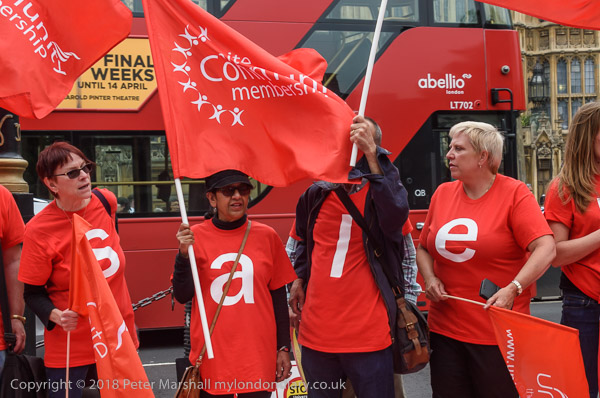
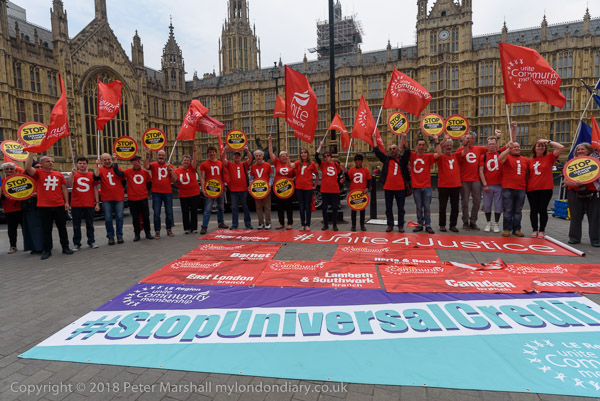
Those t-shirts reading ‘#STOPUNIVERSALCREDIT’ that I’d photographed earlier at Tate Modern were again on display outside Parliament later in the day, though there were some different messages before everyone got sorted out and in order, and I took advantage of this. Of course the full message does also contain a number of three letter words, ‘TOP’, ‘PUN’, and ‘RED’ as well as ‘EDIT’ (and I suppose some might count ‘UNI’.)

But even when it was all sorted out, I didn’t manage to make much of a picture, perhaps partly because there were other photographers crowding round which meant I wasn’t in the optimum place, but more because I didn’t really think there was a decent picture possible.

Red isn’t my favourite colour for photography, and I think is best used more sparingly. It seems somehow less subtle than other colours in its photographic rendition, and often needs a little darkening and ‘de-hazing’ to restore gradation. Fortunately not all those taking part were in red, nor were the banners.

Another problem with ‘#STOPUNIVERSALCREDIT’ for photographers is simply that it is 20 characters long, and the message itself will occupy a rather narrow strip across any picture. Banners are often rather long, and I seldom like to photograph them in their entirety from directly in front, preferring to work fairly close to one or other end, and gaining some interest from the people nearest to the camera.

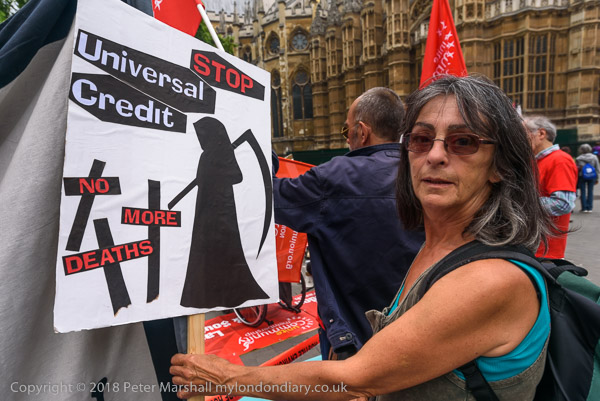
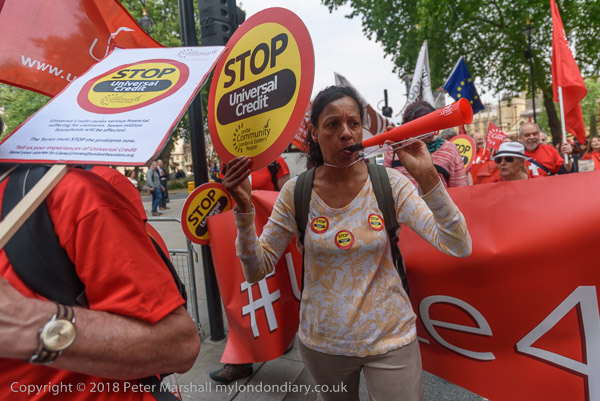
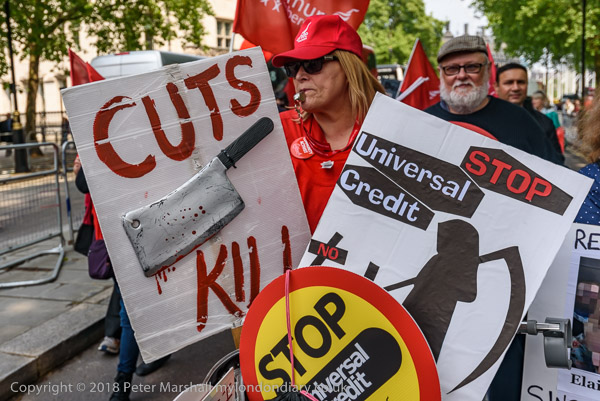
The march which followed, through Parliament Square to Caxton House was more to my liking in terms of photography, enabling me to hide much of the red and also to concentrated on some of the protesters.

The protest which followed in front of Caxton House was also photographically interesting, though the very limited space and crowding made it hard to work.

Universal Credit is almost universally recognised to be a disaster, causing a great deal of hardship – and even some deaths – among both the working poor and those who are unable to work. Delays in payment and reductions in benefits have led to many being evicted from their homes and a dramatic rise in people needing the support of food banks and the demand on street kitchens. The government are pressing ahead with the programme despite the growing evidence of its terrible consequences, with some ministers clearly gloating over its effects on the poorer members of our community.

Although the aim of simplifying and unifying the benefits system was laudable, Universal Credit was designed and is being implemented by people who simply are incapable of understanding how most ordinary people live with little or no financial resources. No money in the bank (if they have an account), no savings, no wealthy friends or family who can help them out if they are short at the end of the week or month.

It could perhaps have worked, had it been combined with a true living wage and a proper transition that didn’t leave people without money for weeks or months. But that would have needed more money to implement. It would also need a system that didn’t feel so obsessive about over-payment and possible benefit fraud. The rich who avoid or defraud the tax system on a huge scale get away with it most of the time, and the government makes surprisingly little effort to stop this (even admitting that in some cases they haven’t taken action as it would ‘damage the reputation’ of those concerned) and the losses there are hundreds or thousands of times greater than any loss over benefits. We have a benefits system – with excessive use of ‘sanctions’, taking away benefits for up to three years – that is clearly designed to publish the poor, and reports have shown to cause many deaths – according to some estimates one every 33 minutes.

More pictures at Universal Credit rally & march

There are no adverts on this site and it receives no sponsorship, and I like to keep it that way. But it does take a considerable amount of my time and thought, and if you enjoy reading it, a small donation – perhaps the cost of a beer – would be appreciated.

My London Diary : London Photos : Hull : River Lea/Lee Valley : London’s Industrial Heritage

All photographs on this and my other sites, unless otherwise stated, are taken by and copyright of Peter Marshall, and are available for reproduction or can be bought as prints.

To order prints or reproduce images

________________________________________________________
Universal Credit at the Tate

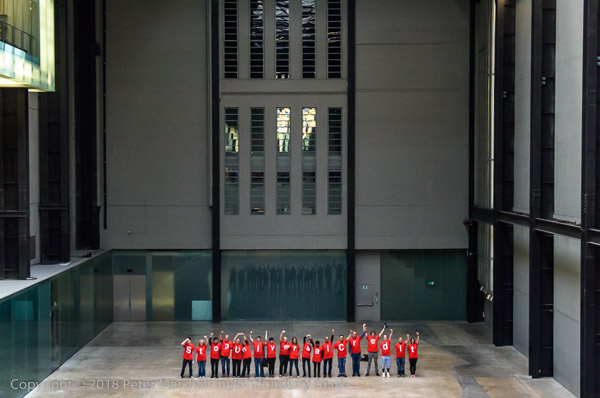
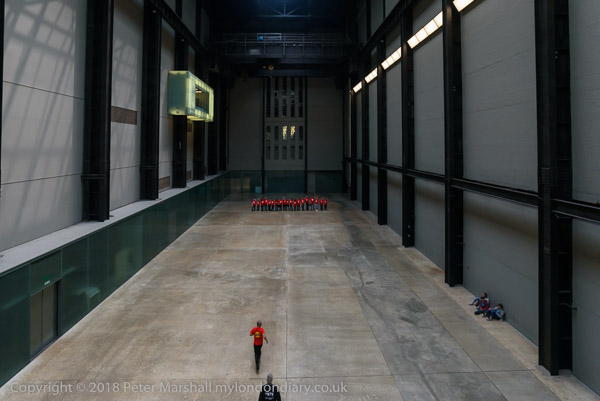
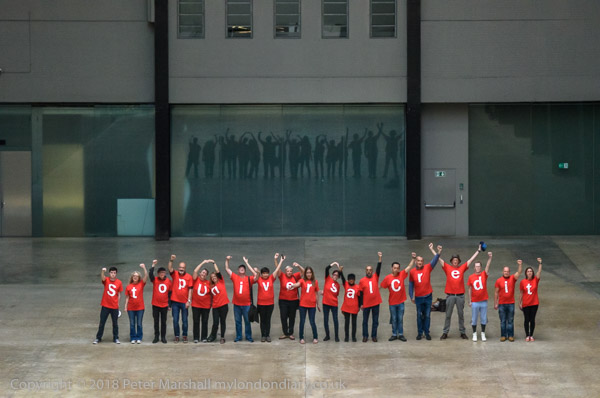
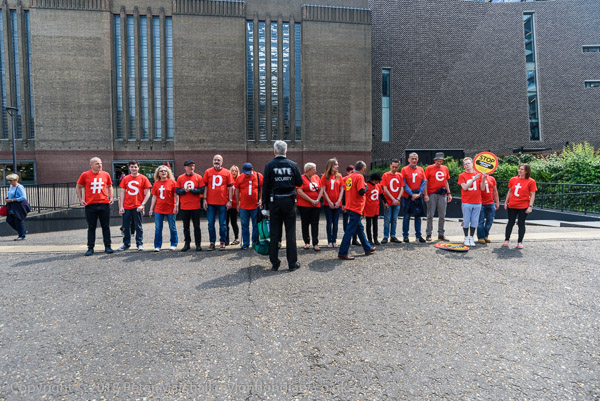
Sometimes space in photographs can be very important, and this picture of protesters in the Turbine Hall of Tate Modern in London is I think a good example. But it isn’t without its problems, and as this small reproduction shows one of them is that we really can’t read the message on the t-shirts unless the image is used on a rather larger scale.

The picture is one of around a dozen taken of the group of protesters, and actually one of them is missing. In this picture it reads STOPUNIVERSALCREDIT and there should have been a ‘#’ at the left. But the ‘#’ was talking to and delaying the security man who was trying to stop the protest, and a later picture shows running to join the protest with security runinng after him.

I was standing on the bridge across the hall, I think at the same level as the horizontal beam along the wall at the right, and hoping that there were going to be no security officers trying to stop me taking pictures – and fortunately there wasn’t. And I was able to take a series of pictures before the security officer rather got in the way of the message, some of which were more legible in small reproduction.

As well as making the message more legible, the larger scale also makes the reflection on the rear wall stand out more, helped by a little massaging in post-production. I’ve also done a little tweaking to make the inside walls of the building more or less vertical as intended, which is a lot easier on the computer than when we had to tilt the easel holding the paper under the enlarger.

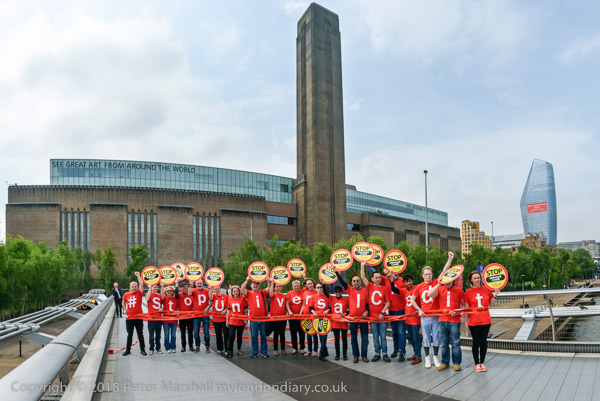
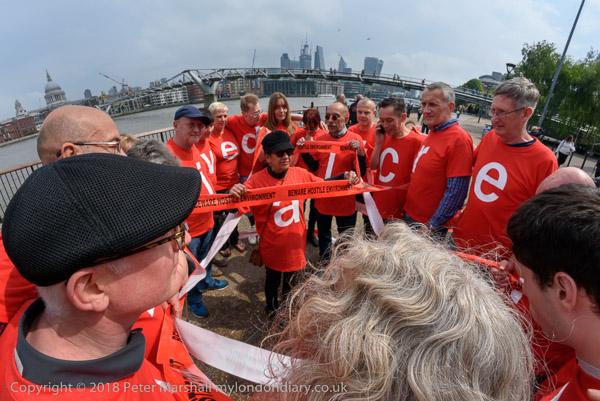
I’d started taking pictures of the group earlier, at the riverside outside Tate Modern, and we had to start with the protesters with their back to us as they didn’t have quite enough people to wear the full set. Then they managed to persuade a person (or was it two) walking by to make up the numbers for a full frontal image by the river and then on the Millenium bridge before a couple of late-comers made it. It needed the 16mm fisheye to get in the whole group on the bridge with the former power stationi behind them.

But I think the pictures I like most from the riverside are those where you can’t read the message at all, or only the odd bit of it – and the tape which says ‘Beware Hostile Environment’.

And there was even a role for that over-zealous security officer when the protesters went to pose on the tarmac outside the building and he came to insist that they go completely off the property. But the logo on his jacket enabled me to take a photograph showing clearly where the protest was taking place. I’ve put the image on the web without cropping, but should really have cropped the group tighter, taking out the woman in blue at the left and a little of the foreground.

Universal Credit is now pretty universally admitted to be a disaster, but the government is refusing to halt its roll-out, creating greater hardship to so many, leading to evictions and suicides as well as a huge degree of deprivation and misery. If we lived in a society that was truly just, Iain Duncan Smith would be in jail and the whole programme scrapped.

The action at Tate modern was a prelude to other protests in London and elsewhere on a day of action against Universal Credit, of which more later. But its also a set of pictures, a little over 30 in all, which show very clearly how I was working that day, about the closest I like to get to studio photography.

Universal Credit protest at Tate Modern

______________________________________________________

There are no adverts on this site and it receives no sponsorship, and I like to keep it that way. But it does take a considerable amount of my time and thought, and if you enjoy reading it, a small donation – perhaps the cost of a beer – would be appreciated.

My London Diary : London Photos : Hull : River Lea/Lee Valley : London’s Industrial Heritage

All photographs on this and my other sites, unless otherwise stated, are taken by and copyright of Peter Marshall, and are available for reproduction or can be bought as prints.

To order prints or reproduce images

________________________________________________________
July 2018 in London

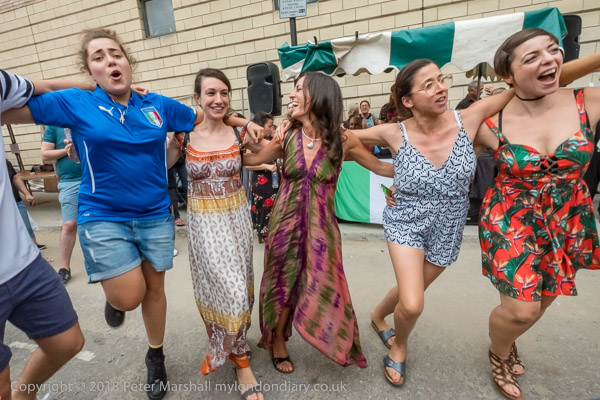
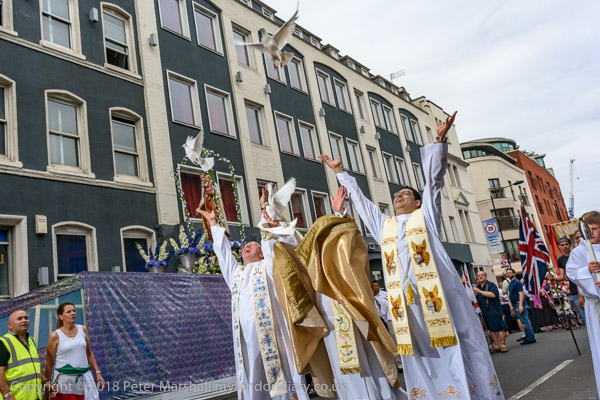
I’ve already posted about the Hull pictures I took at the end of July on a few days there, but I have now completed the rest of the work for the month, so here are some links to the pictures I took in London during July. As well as various protests I also photographed the annual celebrations at London’s Italian church, St Peter’s, in Clerkenwell, an event I’ve attended most years since the 1990s, along with a few photographer friends, one of Italian origin. It has become an annual day out together, helped along, mainly after the procession, by Italian wine at the Sagra. Every year I try and get a good picture of the release of the doves, whose flight when released is almost entirely unpredictable. At least this year I managed a picture with all three of them in flight.

July 2018

Sagra – Italian festival


Our Lady of Mount Carmel procession


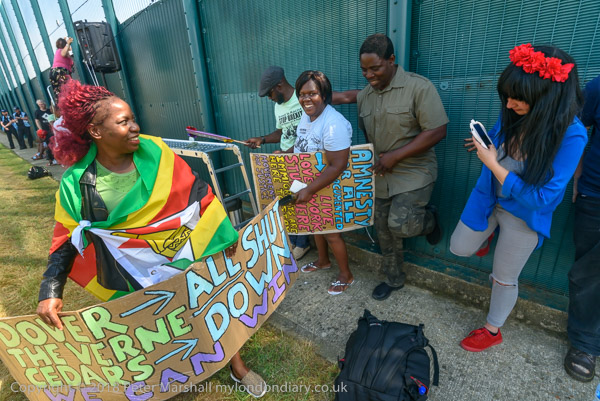
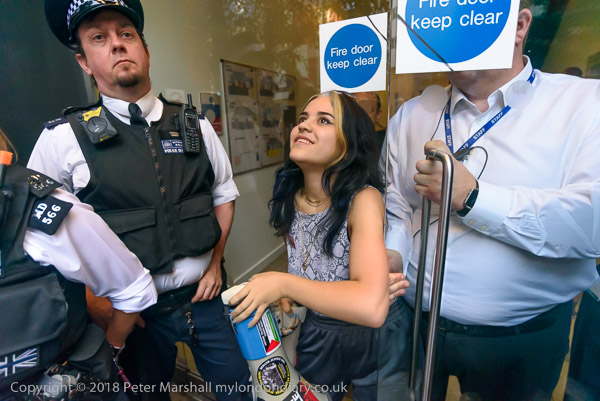
Shut Down Yarl’s Wood 14
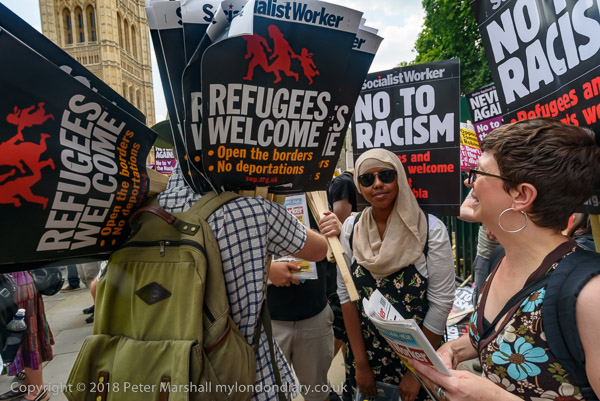
Whitehall rally against extreme-right
Anti-Fascists & Police harassed by hooligans


Against Tommy Robinson & Trump
Croydon Pride Procession
Massive protest against Trump’s Visit


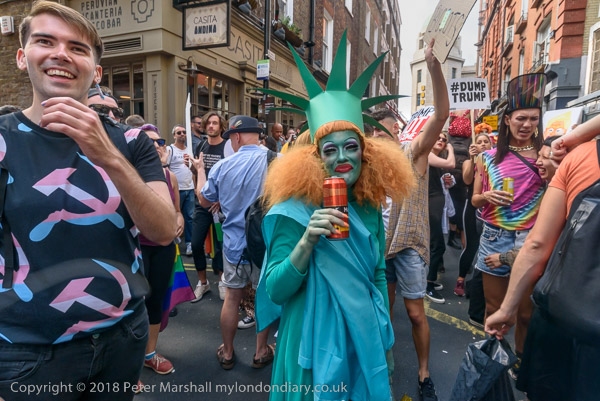
Soho parties to protest Trump’s visit
‘Bring The Noise’ Women march against Trump
‘Trump: Climate Genocide’ Giant banner
Noise protest against Trump
UoL #LeadingWomen protest hypocrisy


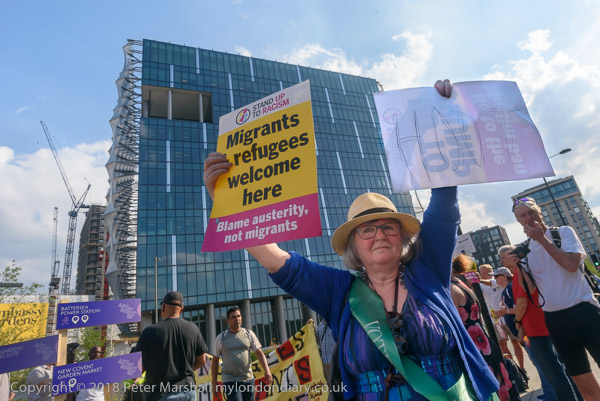
US Embassy protest says NO to Trump
Vauxhall & Nine Elms
NHS at 70 – Save St Helier Hospital


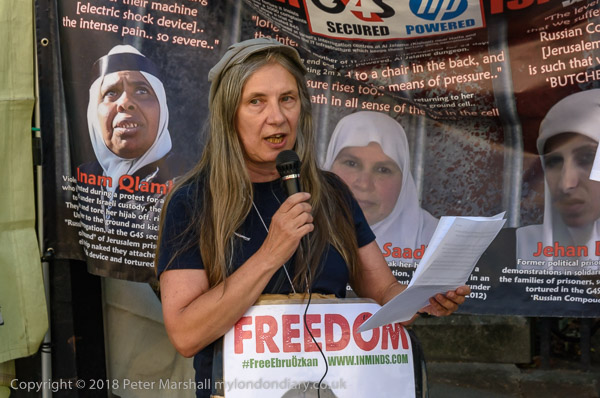
Free Ebru Ozkan Vigil
Bangladesh Quota Reform Movement
Legal right to use cannabis


Refuse plans to destroy the Elephant

London Images

______________________________________________________

There are no adverts on this site and it receives no sponsorship, and I like to keep it that way. But it does take a considerable amount of my time and thought, and if you enjoy reading it, a small donation – perhaps the cost of a beer – would be appreciated.

My London Diary : London Photos : Hull : River Lea/Lee Valley : London’s Industrial Heritage

All photographs on this and my other sites, unless otherwise stated, are taken by and copyright of Peter Marshall, and are available for reproduction or can be bought as prints.

To order prints or reproduce images

________________________________________________________
Keep Guards on Trains

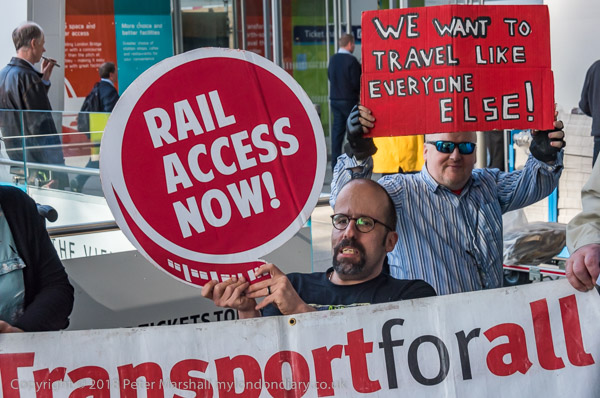
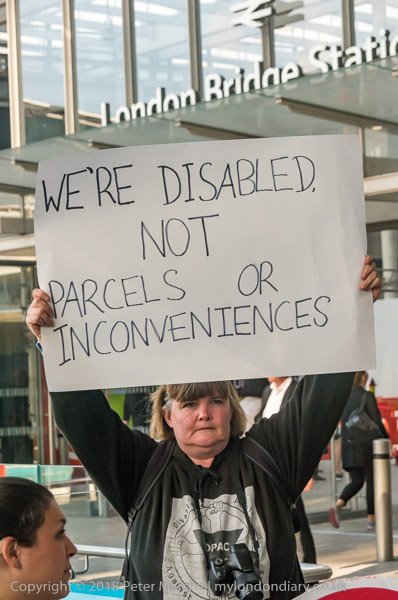
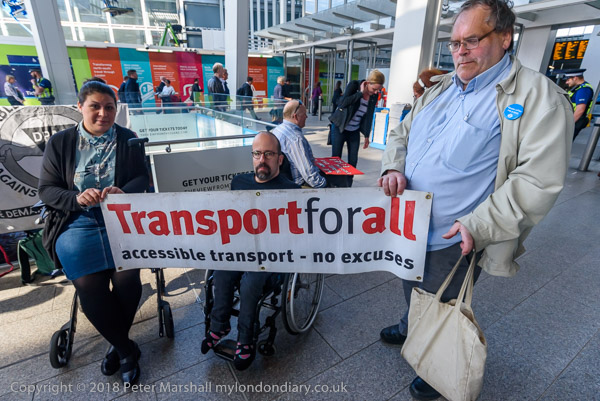
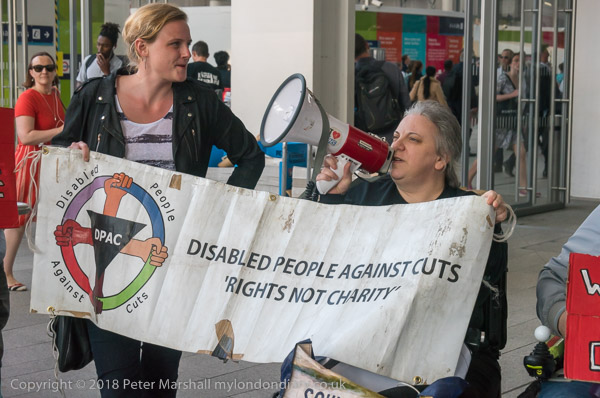
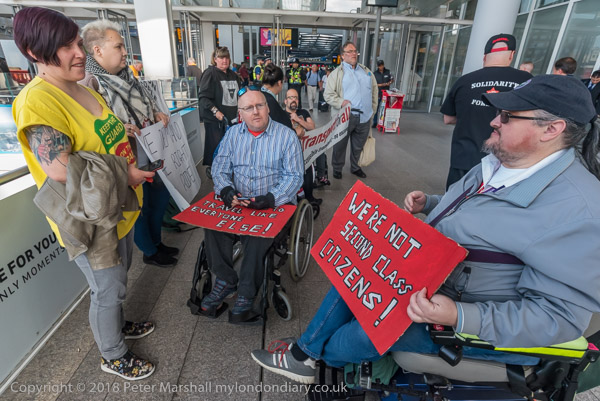
It wasn’t a huge protest, perhaps with only around 20 people involved, but I was pleased to be there and to be able to photograph it, because I think it raises issues that are important, not just for the disabled people who were protesting, but as an indicator of the values that are important to those in charge of our society.

A UN Committee reported last year that the UK government the government has “failed to recognise living independently and being included in the community as a human right” and its Chair described this as a “human catastrophe”.

Of course there is much more to it than travel, and in particular the committee had earlier  condemned the disproportionate effect of government cuts in health and social security budgets on the disabled, and also the effect of benefit sanctions and the lack of proper education provision.  The government – and in particular Iain Duncan Smith, in charge of the DWP from 2010-2016 – picked on the disabled thinking they would be an easy target, unable to protest and fight back, but protests like this, organised by DPAC (Disabled People Against Cuts) have proved them wrong.

Perhaps the governments orders to the train companies to get rid of the guards on trains are at least in some small part a reaction to protests such as this, but more likely they reflect a more general disregard for the travelling public in general and the disabled in particular.

Unstaffed stations have long made it difficult or impossible for disabled people to board or leave trains,  and they need to book journeys well in advance to get assistance to do so. And while staff on the platforms generally do their best, the companies don’t always manage to ensure the required help is available despite their duty under the Equalities Act.

Several who spoke at the event told horror stories about their travels, but the protest was prompted by the latest orders given to staff by rail operator Govia Thameslink Railway (which runs trains, though not as often as it should), on all Thameslink, Great Northern, Southern and Gatwick Express routes that they should leave wheelchair users (it de-humanises them as  ‘PRM’s) on the platform, even when they have arranged and pre-booked a journey, if to allow them to board would hold up the train. They should also be taken beyond their intended stop rather than cause the train to run late.

The new instructions also come with a new timetable which has cut in half the time allowed for most station stops, making it almost impossible to stop long enough to get a wheelchair on board except in the unusual circumstance of a train running early.

It would be simple for the rail companies, including GTR,  to provide the service they are required to provide accessible transport under the Equalties Act on trains with a guard, simply by ensuring all trains carry a lightweight portable ramp, at hand ready to use.  A longer-term solution would ensure that all new trains would be fitted with the kind of retractable access ramps now fitted to London’s buses.

The protest was supported by the RMT, who are campaigning to keep guards on trains for safety reasons, not just for disabled people but for the rest of us as well. As a frequent rail passenger its a campaign I fully support.

DPAC protest GTR rail discrimination

______________________________________________________
There are no adverts on this site and it receives no sponsorship, and I like to keep it that way. But it does take a considerable amount of my time and thought, and if you enjoy reading it, a small donation – perhaps the cost of a beer – would be appreciated.

My London Diary : London Photos : Hull : River Lea/Lee Valley : London’s Industrial Heritage

All photographs on this and my other sites, unless otherwise stated, are taken by and copyright of Peter Marshall, and are available for reproduction or can be bought as prints.

To order prints or reproduce images

________________________________________________________