Other Cultures

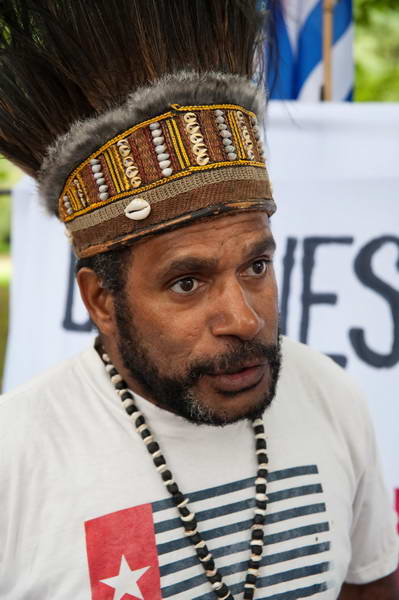
Photographing people from other cultures is something that I think always requires a degree of humility from photographers, and I find the work of Jimmy Nelson disturbing. In yesterday’s Guardian, John Vidal writes about the criticism of his work by indigenous people and Survival International, and I share the views that he relates. Nelson seems to regard the people he photographs as models to be used to illustrate his own fantasies, which are largely unrelated to their own lives and to promote himself as a photographer. Ethnic fashion rather than ethnography. As well as quoting Stephen Corry, the director of Survival International, Vidal also gives the view of Benny Wenda, who I’ve met and photographed on several occasions, protesting about the persecution of his people by the Indonesian regime.


Benny Wenda protesting at the Netherlands embassy calling for the promised free elections in West Papua

In his very expensive book, Corry says Nelson describes Wenda’s Dani as a “dreaded head-hunting tribe”, while Wenda states “My people, the Dani people, were never headhunters, it was never our tradition. The real headhunters are the Indonesian military who have been killing my people.”

I’ve not seen Nelson’s exhibition, but was sorry to miss the protest outside it by Nixiwaka, an Amazon Indian from the Yawanawá tribe, which you can read about on his blog at Survival International.

For a look at some real photography of peoples from various parts of the world, I’d recommend some time on the web site of Giles Perrrin, who I first met when he showed me his work in Birmingham in 2007. There is a sensitivity in his work, whether in Detroit, Veille Aure, Ethiopia or anywhere else around the world that seems entirely lacking in Nelson’s fashion plates.

And another interesting cross-cultural show, one I’ve not seen but only read about, is taking place in Coventry, and continues until 11 January 2015 at the Herbert Museum.  ‘Photographs of India’, work by Coventry by based photographer Jason Scott Tilley from 1999 and 2009 is augmented by work from his Anglo-Indian grandfather Bert Scott, who worked for the Times of India from 1936-40 and headed the Indian Army photographic unit in Burma during the Second World War.

Also on show are pictures from the collection of the Library of Birmingham of images of Indian people published in eight volumes between 1868 and 1875 by the India Office in London and containing 470 original photographic prints, an expression of the “British government’s desire to create a visual record of ‘typical’ physical attributes and characteristics of Indian people to help them understand the population of the newly-acquired colony“. You can view this remarkable work in its entirety on the New York Public Library Digital Gallery.

Rene Burri (1933-2014)

René Burri, who died on October 20th, aged 81, was a photographer who was not appreciated as he should have been here in the UK – something which could be said about almost all photographers, but especially true in this case. Wikipedia lists almost 20 major shows of his work, quite a few of which were shown in several cities, but not a single one of them in the UK. I saw his René Burri – Rétrospective 1950-2000 in Paris in 2004 and was surprised at the breadth of his work, with many images that were unknown to me.

Most of us will recognise the six images he talks about in the video on Vimeo, and there are some others that are well-known as well as others that surprised me in another short video, Impossible Reminiscences, which came out for the publication of the book of the same title. But the best place to see his work is probably on his Magnum page, although the material on show there still only scratches at his huge output- he has left his archive of over 30,000 pictures to the Musée de l’Élysee in Lausanne.

The slide-show on Magnum starts with his first picture, Winston Churchill standing up in a car going through Zurich in 1946, when Burri was 13, and he was supremely a man with the great ability to be in the right place at the right time. But he was more than that; for him it was not just ‘f8 and be there’, but the ability to be there and to see things differently.

Of particular personal interest on the Magnum site was his set of over a hundred images of Brasilia, mainly taken around the inauguration in 1960, but also some images from the 1970s. Some of these brought back memories of my own trip there in 2007, though I wasn’t there to take pictures but to show them, and only took a compact camera with me.

I wrote briefly about the 2004 show in Paris as follows:

The queue at the MEP stretched out the length of the garden into the street, but it only took us around fifteen minutes to get in. Inside it was pretty crowded, at times too full to really look at the pictures. The main show was of work by Swiss photographer Rene Burri (1933-) who joined in 1955. Burri was a pupil of Hans Finsler at the School for Arts and Crafts in his hometown of Zurich. It was both an exhaustive and exhausting show that left me feeling that he would have been better served by a significantly more selective editor.

Burri is best known for such iconic works as his portrait of Che Guevara smoking a cigar. By far the strongest of the work on show was from his book on Germany made in the late-1950s (he brought out a revised version including some later pictures more recently.) Burri’s work is more traditional than that of his compatriot Robert Frank and more cerebral than that of Leonard Freed (who also produced a book on Germany.) Burri caught the Germans at a time when their memory of the war and the consequences of defeat were still very evident, and recovery was only beginning to make itself felt.

One image shows two elderly men in Weimar perhaps planning a holiday route, poring over a map spread over the bonnet of a car. The overtones of invasion are only too clear. Another picture of a street in Rheinpfalz on a misty day in 1959 has a man in the centre walking toward the camera. The street looks down-at -heel and the young man is a worker, wearing a hat and muffler. In is arms he holds awkwardly horizontal a baby, whose white bonnet is outlined perfectly against the black coat of an older and more distinguished figure walking away from the photographer. We see the new Germany coming out of its murky past with the hope of a brighter future, while and older generation is left behind in the past.

So far the obituaries I’ve seen have done little more than state brief biographical details together with a few pictures, with the best I’ve seen to date on PDN.  Doubtless more substantial accounts will be forthcoming – and if you come across any before I do, please feel free to add the details in a comment to this post.


Fuji X in the wet

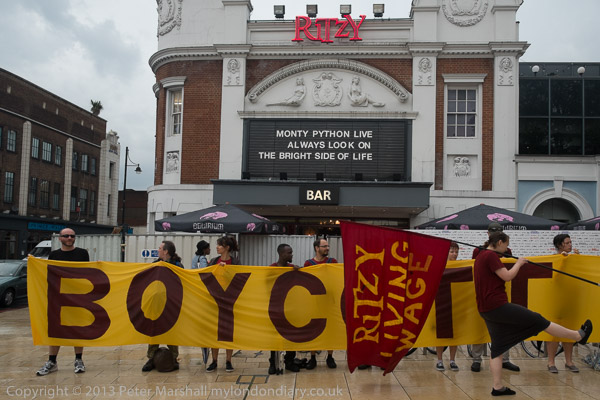
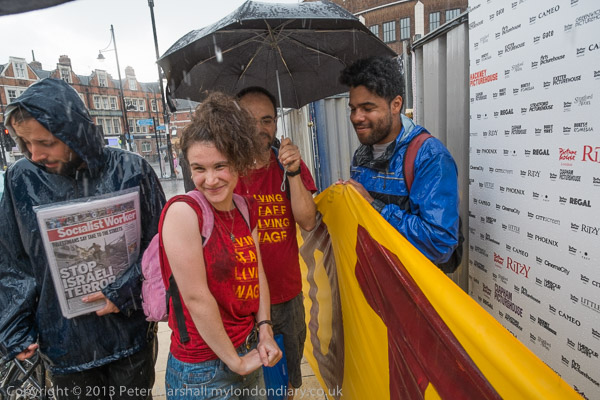
I’d rushed away from the procession for Our Lady of Mount Carmel in Clerkenwell, down the road to Farringdon station and on the tube to Brixton where the workers at the Ritzy Cinema were picketing the cinema in their campaign for a living wage.

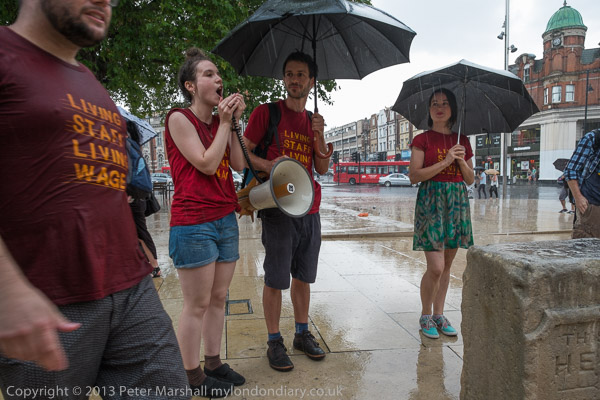
But when I got to Brixton, there was a crowd blocking the exit as torrential rain was coming down outside. I stood with the others just inside the station watching with surprise what was really an unusual cloudburst. After five or ten minutes the sky got just a little lighter and the rain slackened off a little to heavy and I thought it was clearing. With quite a few others I put up my umbrella (there is always a folding one in my camera bag – except when I take it out to use and forget to put it back after drying) I struck out towards the Ritzy – just a short tread away.

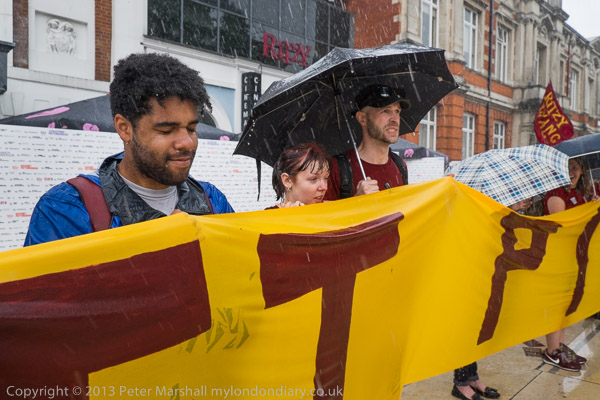
It was still raining when I arrived, and the protesters holding the banner outside were wet; those without umbrellas were soaked. At least they left the big tree when they redesigned Windrush Square a few years back to try and stop people hanging out there, making it a bleak and inhospitable place. And I made for it, only to find the rain was as bad under it as not, dripping down from the sodden canopy above.

I don’t like working in the rain, but I’d thought it might make for some interesting pictures, and I think I was right. But the rain came on again, as heavy as before. I started taking pictures one-handed, holding the umbrella in the other. Autofocus takes care of focusing, but changing the focal length is another problem, involving holding the lens to the hand holding the umbrella to use it to push the zoom ring round. It’s easier to do this without trying to look through the viewfinder, looking at the focal lengths on the scale, or you can find the rain dripping from one of the umbrella spines down your neck as you accidentally tilt the umbrella as you twist the ring.


My umbrella at top left

The umbrella is ok when using a telephoto, but with a wideangle it does tend to creep into a corner of the frame as you take pictures. And forget it with a fisheye, but in any case it isn’t easy to change lenses without an extra hand. I had two cameras with me, both Fujis, with the X-T1 with the 18-55 zoom and the X-E1 with the 14mm. The X-T1 is supposed to be weather resistant, but neither lens is, and the bag I was carrying the kit in is not that waterproof either. Most of it was around my neck in any case, though the 8mm fisheye was in the bag and stayed there.

The rain came down heavier still. Not just cats and dogs but horses too. Even under the umbrella it was raining, with a fine mist of small drops spraying through as the larger drops stormed down from above. I was getting wet. I moved back under the tree, and was still getting wet.

It had been bright and sunny when I came out, and hot. The forecast was for it to get hotter, with no mention of rain, and I hadn’t brought a coat. But now the temperature had dropped perhaps 10 degrees – Centigrade – and I was both wet and cold. My shirt was getting damp from the spray through the brolly and lower down my trousers were wet from the top of my legs down, soaked by the knees and below. The rain was slowly filling up my shoes too, and I was squelching as I walked. But the pickets were standing there – some without umbrellas, and I thought if they can do it so can I.

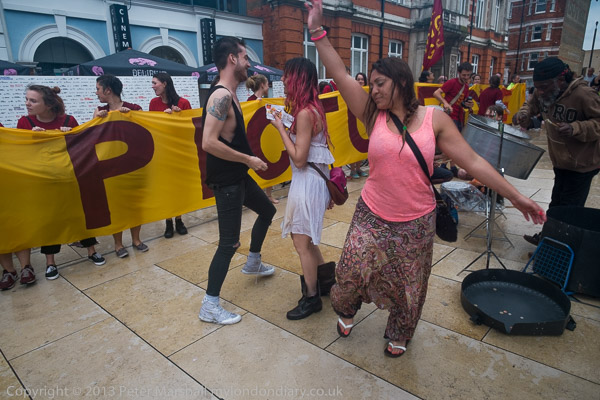
Eventually it did ease off, and finally it even stopped raining. By then Acre Lane was in flood, the stream running along its gutter too wide to jump, but it soon went down. As the rain eased, a man turned up with his pans, and along with the couple of drummers who had been playing in the rain we got some live music, and people began to dance. It began to look like it was going to be a fine evening, both in terms of weather and in the atmosphere around the picket, but it was also around time for me to go home.

I think I was right about the weather making for some more interesting images – well at least they were different –  although of course this was very much down to the spirit shown by the strikers. Both Fuji cameras and the two lenses seemed to put up with a bit of rain – and I got none of the misting up that can often be a problem with the Nikon lenses – down in part to the heavy lumps of glass in the 16-35 and the vigorous pumping action of the 18-195 zoom, though that might have been down to the particular quirks of the weather.

Both cameras coped pretty well with this event, and I’m beginning to feel more confident with using them at least where no fast-moving action is likely to be important. I’m hoping that the Fuji wide-angle zoom will come down a bit in price shortly. Unfortunately the £200 cashback offer from Fuji for buying two lenses excludes the only other Fuji lens I’m thinking of buying to make up a versatile kit.

Text and pictures at Ritzy workers strike for Living Wage.
Continue reading Fuji X in the wet

Good/Bad Light

I’ve written at times about my own rather coarse flash techniques using high ISO, and it was interesting to come across an article by a photographer working in a very different area,  Kristian Dowling, on PetaPixel a few weeks ago. Obviously the ideas and solutions that Dowling presents in  What Photographers are NOT Considering When Using High ISO work well for him – as you can see from the example images – but I’m not sure they are suitable solutions in my own practice, where situations tend to be fairly fast-moving and often rather crowded with both protesters and other photographers.

Like Dowling I have experimented with using LED lights, though not the Westcott Ice Light mentioned in the feature, and have not been too impressed with the results, though I’ve often piggy-backed on the video lights of others at events (though at other times they have been an annoyance.) At $500 the Ice-light seems a little on the expensive side (and there are ‘Accessories Galore’ to add to the expense), but perhaps it does do a better job than the £15 ‘160 LED Video Light Lamp Panel’ you can find on E-Bay. This seems to claim a similar light output, but is perhaps a more suitable rectangular shape than the long, thin, Ice Light sabre. But the cheap units I’ve tried have been a little disappointing in terms of light output for photographic use, though good for other purposes. More powerful units are available for around £100, but I’ve yet to try these.

Similarly while fashion work may make the Phottix Odin wireless TTL flash triggers seem a snip at $329 or $399 for the twin pack with second receiver, for those who work for the poverty fees now paid by newspapers and magazines (or more often 50% or less of them) may find the Yongnuo RF 603-II which offers a manual Wireless Flash Trigger and 2 Transceivers for around £20 of more interest (or if you want iTTl the Yongnuo YN-622N is around £60). At these kinds of price I’m tempted to try one out myself.

But I think what is important is to understand the difference between good and bad light, and there are things in the article by Dowling that I find confusing, either because they are confused or because I got to bed to late last night. Here’s how I think about lighting.

Quantity & fall-off

Light intensity is perhaps the most obvious feature. And for most artificial light sources we need to think in terms of the inverse square law – twice as far away means a quarter of the intensity etc. (Theoretically only for point sources but even with large soft boxes or bounce the light falls off, just not quite so dramatically.)

Spread

The angle from the light source over which you get relatively even light distribution. Can be increased by diffusers over the light source

Size

The size of the light source viewed from the subject (where the sun is a small light source but the light from a small flash tube bounced off a large white wall is large.) This mainly effects the hardness/softness of the shadows. Despite what many photographers seem to think, putting a diffuser in front of a flash hardly effects this unless the diffuser is considerably larger than the flash reflector, at least where there are no large reflectors around – it does work in rooms with low white ceilings. But using it outdoors simply cuts down the range of the flash and increases recycle time.

Colour

Pretty obvious, but mainly important in avoiding mixing light of different colour temperature. Filters come in handy at times, though I seldom bother to filter my flash, there are times when it would help to do so. The LED panels usually come with both a simple diffuser and an amber one to use with tungsten lighting, but little outdoor lighting is 3200K.

Direction & Position

The horizontal angle between the light, the subject and the camera, and the angling of the light down (usually) on the subject

Main Light and Ambient/Fill

Although we can have very complex lighting situations, it is useful to think in terms of the main light – which gives the subject its ‘volume’, the ambient which illuminates the whole of the scene and the fill, light used to soften lighting contrast by putting light into the shadow areas.

In Practice

The main light is always better away from the camera, whereas fill is best from close to the lens. So flash on camera is great for fill, but rather lacking as a main light. With camera systems like Nikon, flash in bright sun for fill is simple, and handled very well by the TTL BL mode with a flash in the hot shoe. With some lenses you can alternatively use the built-in flash on some bodies, but physically large lenses such as the 16-35 cast an ugly shadow in the frame.

At night, working in fairly brightly lit areas, you can still use flash for fill, (though not in P mode) by working at high ISO, setting up the camera with appropriate underexposure to give some feeling of night, and then adding a touch of flash to illuminate close subjects. Often I’ll combine the flash – of short duration – with relatively slow shutter speeds such as 1/15s to retain information in relatively dimly lit areas of the background.

When the light falls so low as to make flash the only possible main light source, again I usually like to use as high an ISO as practicable so as to pick up what little I can from ambient in the background. Here it would be good to have the light source off camera, but it isn’t always practical to do so. Probably the easiest method for my sort of work would be a long flash cable enabling me to hold the flash in my left hand, arm outstretched and above head height, but I think a wireless flash trigger would give more control and get in the way rather less, so I’m considering that option.

Even with flash on camera, there are things you can do to make life easier and your pictures better, at least with units like the SB800 I like, where the head will swivel both left and right and up and down. If you are able to have close foreground on only one side of the frame (often the case) you can get some help from the flash fall-off by angling the head away from the closer parts of the subject. Just occasionally I see the chance to bounce the flash from a suitable white wall or even a white coat or other white object rather than use direct flash, almost always an advantage.

And then of course there is post-processing, burning in closer parts of the subject and brightening the more distant. And just occasionally a little burning in parts of the face can help add the volume that the flash wiped out. Getty might not approve, but it is getting back towards how I saw the subject – without the distortions introduced by the flash.

How Not to Write About Women Artists

When I taught photography, many of our best students were women. Perhaps over the years there were half a dozen who I thought really had potential as photographers, but I can only recall having that same feeling about one male student. As it happens he is the only one who has gone on to become really successful as a photographer, though others who passed through our classes with less obvious photographic talent have made a living behind a camera. As Eric Barker puts in in his  Time article on careers, “Persistence trumps talent”. Or perhaps it is rather harder for people who have a definite personal vision find to produce work that fits the dimmer perception of others.

Many of the contemporary photographers whose work I admire are women. I’ve never thought to check what percentage, but certainly many come to mind, not because they are women but because of their work. Where perhaps in the first hundred of so years of the history of photography women were notable exceptions – because of wider societal restrictions and conventions – this is no longer the case. And some of those exceptions were truly notable – including such examples as Julia Margaret Cameron, Berenice Abbott and Dorothea Lange. Wikipedia has an interesting list.

When I was teaching and when I was writing about the medium for a living I wrote about and used examples from the work of many women photographers, some well-known, others less so. Many of our students were inspired by the work of Diane Arbus, Cindy Sherman, Nan Goldin, Sally Mann, Jo Spence, Fay Godwin and others – as well as that of male photographers.

I wrote as well about others who I felt deserved to be better-known – such as Nelly’s and Grete Stern (neither well-served on the web) and about a few others who were well-known but whose work I could not relate to or felt rather lacking in photographic interest. Although I mainly wrote about things I liked, I was running a site which I felt had to provide at least basic information across the whole range of things photographic (though I drew a line at so-called “glamour”.)  But there were a few women photographers whose reputation seemed to me more connected with feminist politics than artistic production, though this was and is dangerous territory for male comment and I largely restricted myself to giving the facts and links rather than opinions in their cases.

It was a link to an article posted by Alan Griffiths of Luminous Lint that started me thinking about “women photographers” again. In Hyperallergic, Alex Heimbach (a freelance writer and graduate student at NYU) reviews a recent book with the title ‘Women Photographers from Julia Margaret Cameron to Cindy Sherman‘ under the heading How Not to Write About Women Artists.

The photographers – who are arranged alphabetically, itself a curious choice, begin chronologically with Anna Atkins, who, while an important figure in the history of photography, was probably not a photographer. Her Photographs of British Algae: Cyanotype Impressions, its first installment published in 1843, is considered to be the first photographically illustrated book, using the cyanotype process invented the previous year by her friend Sir John Herschel and the photogenic drawing technique she had learnt from another friend, a Mr Talbot. Quite likely she had learnt his calotype process from him as well, and may have been the first woman photographer, but no evidence of this remains. The Wikipedia article on her provides a rare link to a piece I wrote about her work in 2005, rather a flashback for me.

Among the 55 photographers in the book by Boris Friedewald listed on the contents page (which you can view on the ‘Look Inside!’  page at the Amazon link above) are around 40 that I have at some time or other written about, one I know personally, half a dozen I’ve not heard of and a similar number who I feel certainly don’t deserve inclusion. There are quite a few – including Atkins who perhaps fall outside the remit of the title, the others being from post-Sherman generations. You can also see the pages on Berenice Abbott and Eve Arnold in the preview.

But the article by Heimbach has some more serious criticisms. As she writes; “it’s impossible to imagine an equivalent book titled Men Photographers: From Eugène Atget to Jeff Wall.” And while projects like these ideally “serve to illuminate lesser-known artists, who may have been discounted because of their gender (or race or sexual orientation or class)“, too often as seems to be the case with this book “their thoughtlessness generally renders them pointless at best and misogynistic at worst.”


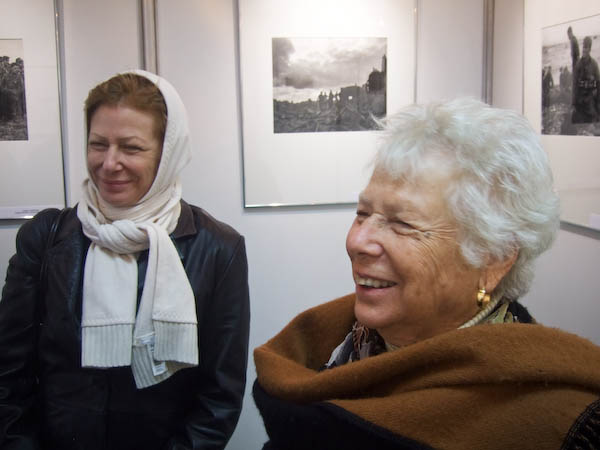
Nina (left) and Naomi Rosenblum with pictures by Walter Rosenblum, 2007, Peter Marshall

There is more to her argument than this, and the article is worth careful reading, and she contrasts its approach with that of Naomi Rosenblum‘s A History of Women Photographers, (incidentally first published by Abbeville Press in 1994, rather than 2010), a book I used, together with Rosenblum‘s A World History of Photography in my teaching.) As Heimbach says “Rosenblum’s book aims not only to highlight the work of female photographers, but also to dig into what their gender means for their lives and careers. Rosenblum offers not just a who but a why.”

Arles Disaster?

You are almost sure to be aware that there is a photo festival every year at Arles. I’ve never been to it, though I’ve occasionally commented on what happened there, and have written about why I’ve not gone on several occasions. But rather than do so this year, I just want to refer you to a post on l’Oeil de la photographie Arles 2014: An Off Year? Worse—A Disaster!.

I should have gone to Arles perhaps 20 or more years ago, but then I was always busy with my students’ photography examinations at the time it took place, early in July. Since then the nature of this festival – and many others – have changed, as the article puts it “it’s becoming a buyer’s festival, that galleries and collectors and agents are crowding in, that deals are being made, that guys and girls from all over are bringing an astounding creativity to the “off” and “off-off” sections of the festival.”

That this is happening to the fringe is good in some ways – and particularly good for those photographers taking part. If you look at my reports on the several Paris Mois de la Photo I’ve attended I’ve written for this site you will have hear my thoughts that the activities on the fringe are generally much more interesting than the relatively few shows of the actual Mois, and certainly from the delear’s festival few days at Paris Photo.

In his editorial, Jean-Jacques Naudet writes:

we’ve had enough of these veterans: enough Martin Parr, enough Raymond Depardon, enough Christian Lacroix, enough Erik Kessels. They’re all great, but their ubiquity has become unbearable. At this rate, if Hébel and the festival weren’t parting ways, then next year’s edition would have featured Martin Parr’s cookbook, Raymond Depardon’s garden gnomes and Christian Lacroix’s children’s toys.

and he talks about the wild passions and outsized egos of recent years.

I’m not sure I agree when he says that one day we will want to revisit these – perhaps we will want only to revisit some aspects of some of them, and there are other parts we will want to bury our memories of. Well there are some of Depardon’s images I’ll be glad to see again, the garden gnomes are perhaps not among them, and although I admire some of Parr’s work, too often he appears to be trading on his reputation rather than than producing anything of great import. I’ve yet to see anything by Lacroix I’d want to revisit, but hopefully he will in time prove me wrong.

But somehow I hope that festivals like Arles which have such an important place in photography would become in some way more democratic and more varied – perhaps with the official festival becoming more like the fringe.

As well as the editorial there are of course other reports on Arles, both on the l’Oeil de la photographie and elsewhere, so you can read these and make up your own mind. The Guardian has a video review which seems to me to underline the vacuity of the event, and a set of the ‘finest shots on display in Provence’ which suggest that the best work was from the 1950s in Chile or perhaps a little later in with John Davies’s Elf Services, Autoroute A26, Nord-Pas-de-Calais (1988). It’s hard to believe there has been so little of worth produced in black and white (the theme of this year) since then. Actually we know this isn’t true.

Though perhaps it is worth asking why anyone should work in black and white now, when so many of the reasons we chose to do so in the past have gone. It’s perhaps relevant in this to point out that Peter Hugo’s slightly odd heads and shoulders images were actually taken in colour, then converted to bring out the melanin to black and white in Photoshop. And most of today’s black and white images were actually taken in colour, their conversion to monochrome more a stylistic fad than anything else.

I spent over 30 years working in black and white, thinking in black and white, as my primary medium. I worked in colour too, often only doing so for images where colour seemed particularly significant or indeed the subject of the image – I was certainly a colourist at heart in my colour work. Few if any photographers now seem to think in black and white. My own approach to colour has changed too, and I’m not sure I could satisfy myself with monochrome except for the very occasional image.


Derbyshire & Sheffield

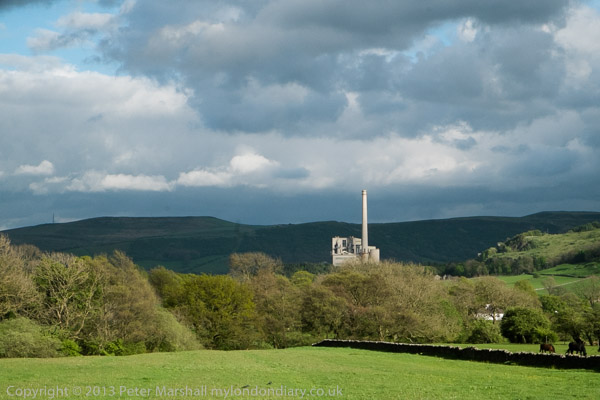
It was good to get away from London for a weekend, although it was a bit rushed and not entirely relaxing.  But I was able to spend a little time using the Fuji XE1 and both the 14mm and 18-55mm and 8mm Samyang lenses.

The 14mm was great for some group pictures (not included on My London Diary) at the conference weekend I was taking part in, and also a good lens for some landscape pictures. But I did have one problem with it. It’s largely a matter of getting familiar with the system and I haven’t yet used it enough to spot the things that are likely to go wrong.

The focus ring on the lens has a nice feature which switches from manual to autofocus by a short push towards or away from the camera body, which also hides and displays the distance scale. It works very well and needs just enough of a push that you are unlikely to change it accidentally. It’s also very clear in the viewfinder when you are using autofocus, with a green rectangle or cross (depending on whether you are using single or continuous autofocus) appearing, But I still managed to make quite a few exposures with the lens in the manual position while I thought I was using autofocus.  I’ve now set it to make a beep as well – something I really find annoying, but perhaps I need it.

It’s particularly annoying, because one of the things I really like about the Fuji-X cameras is how quiet they are compared to the Nikons. The other great thing is of course their light weight and small size.

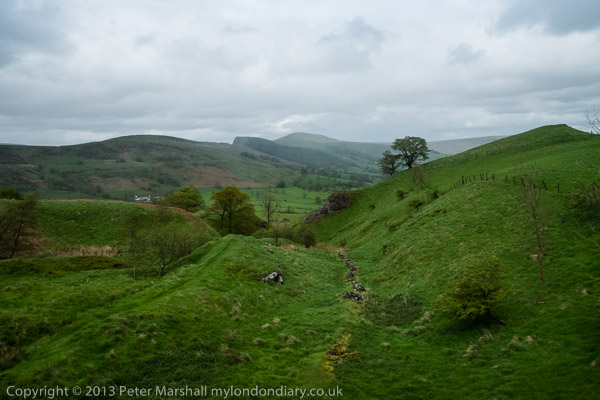
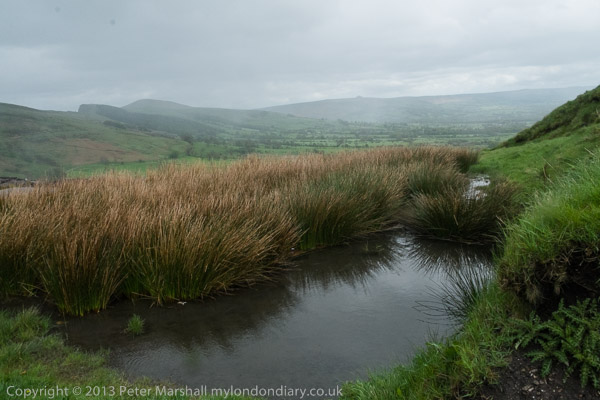
On the Saturday afternoon we had a free couple of hours and left hoping to get to the top of Mam Tor, which was not a huge distance from the conference centre. I took the XE1, three lenses and several spare batteries, the camera on a strap around my neck, a lens in each of the large pockets on left and right of my waterproof and one on the camera, the plastic bag of batteries in an inside pocket. No need for a camera bag.

It was raining on and off, and it was no problem to tuck the XE1 inside my jacket to keep it dry, unlike the Nikon with the 16-35mm which is just a little bulky to fit comfortably. I could easily have fitted in a second Fuji body and lens too.

There were a few times when I would have liked something longer than the 18-55mm (27-83mm equivalent); the extra reach of the Nikon DX 18-105mm is really a big advantage. But it does weigh 35% more and takes a 67mm filter compared to 58mm for the Fuji – despite the Fuji being almost a stop faster. Optically I don’t think there is much to choose between the two; despite the Nikon being one of the cheapest Nikon lenses it is a better performer than many in their range, though the build quality is perhaps best illustrated by the fact that I’m now on my third example. The Fuji certainly seems better built and is more expensive when bought alone.

Even more expensive at around £750 is the new Fuji XF18-135mmF3.5-5.6 R LM OIS WR which is roughly the same size as the Nikon, but looks pretty impressive – and is weather resistant with a claim that it offers the equivalent of 5 stops of image stabilization to partly make up for its rather low maximum aperture.

But for most purposes you can use a bit of ‘digital magnification’, cropping the 4896 x 3264 pixels (16.3 Mp) to say 3264 x 2176 – still 7Mp – and enough for most purposes. That makes the 55mm into a respectable 127mm telephoto. I think I’ll stick with the 18-55mm, though possibly getting a longer zoom for those few occasions where length is vital. Of course it’s actually the wider end that interests me more, and the Fuji 10-24mm f4 R OIS is a rather lighter alternative to the Nikon 16-35mm, so may well be my next lens purchase.

Unfortunately we ran out of time and had to turn back before the final climb to the top of Mam Tor, but at least is wasn’t because of exhaustion at carrying a heavy camera bag. But it does still take longer to take photographs on Fuji than on Nikon, and there were still some of those frustrating moments where the quickest way to bring the camera into life was to turn it off and then on again. If only Fuji could follow Nikon’s example, where the lightest touch on the release instantly brings the camera back into picture-making mode.


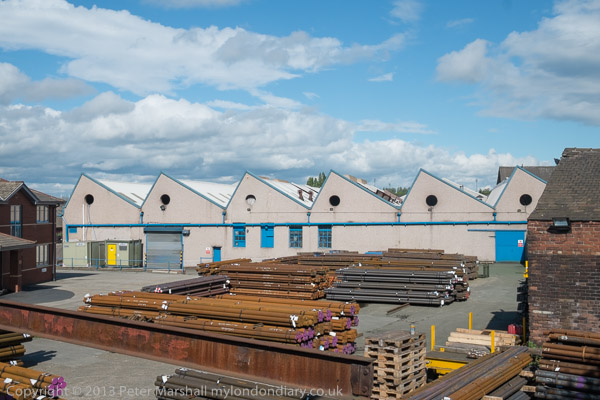
There is still some steel in Sheffield

I had a second chance to use the camera on the way home, where I was able to take a more leisurely walk around a little of central Sheffield as we had an hour to two to wait for a train. With a little more time to take care over what I (and the Fuji EX1) was doing there were no problems with the photographs.

More pictures from Derbyshire and Sheffield.

Continue reading Derbyshire & Sheffield

Adobe Upgrades

Today was I think a good day for photographers so far as Adobe products are concerned. I don’t know if the upgrade to Lightroom 5.5 really changes a great deal, but like most such upgrades, it does feel just a little snappier, which is no bad thing. And I’ve yet to try the updated Bridge and to do anything substantial with  Photoshop CC 2014, though I don’t think any of the enhancements that Julieanne Kost enthuses about will have any great impact on my work – or that of any other real photographer. If I want motion blur etc I’ll take photographs of things that are moving.

Perhaps the improved content-aware fill tool will help improve retouching my scans but most of the other things – like most Photoshop features – are ways to destroy the photographic nature and content of your images rather than tools to enhance. At least 90% of Photoshop should be irrelevant to photographers, but we use it because it does the 10% better than anything else, though it sometimes needs a little help from plugins.

It’s taken a bit of fiddling around to get my favourite plugins working with 64bit Photoshop CC and with Photoshop CC 2014. There are strict instructions to use the plugin providers install software rather than trying to install by hand, but this didn’t work for me for some. Fortunately finding the correct ‘64.8bf’ files and copying them to the plugins directory does work. But having four versions of Photoshop on my system is probably confusing. Perhaps I can cut it down to two now.

But the good news (or at least slightly good news) is that the $9.99 per month photographers package is now a standard one rather than a special offer (with VAT that’s £8.78 in the UK – or you can save 50p a year with a pre-paid annual sub.) It isn’t quite the same, with less cloud storage and no ‘Behance’ portfolio for new subscribers (I haven’t used either) but seems to me to be reasonable value, costing not very much more than the regular upgrades to Lightroom used to. And if, as most photographers seem to nowadays you buy new cameras fairly often, you do need to keep Lightroom up to date. I’d want to in any case, as so far each new full version upgrade – the ones I had to pay for – has added welcome improvements.

It would be even better value if I had an iPad and iPhone now that Lightroom works on these too, something I can see many photographers making use of, though you are only able to work on ‘smart previews’ rather than the actual files.

I’d rather that Adobe had not gone the CC route, but I can see why they have elected to do so. So many photographers I know use somewhat less than legal versions of their software. And I can see why they do as well, given the cost of the old standalone versions – it was really just too expensive for many photographers. Until the announcement yesterday I was a little worried that Adobe had not got the message and might ramp up the price again, but it looks as if they now realise the different market.

Curved Images

This picture and that below this paragraph were both taken from more or less the same position and more or less the same time. As you can see, I’ve moved just a little to my right in to taken the lower image, hiding the lower part of the Banksy image behind the Palestinian flag.

Both are images take with a lens of focal length 16mm on full-frame sensors. The upper image was made with the 16-35mm on the D700 and the lower with the 16mm Nikon full-frame fisheye. The most obvious difference is the much wider angle of view both horizontally and vertically in the lower image.

The difference in perspective is very marked, particularly in the floor tile and in the ceiling, but much less so in the central strip where the people and the banners are. The differences between the two images would be rather greater if I had not used the Fisheye-Hemi plug-in for Photoshop on the lower image, transforming it to cylindrical perspective. In the original fisheye image those hefty square pillars were curved, but here the verticals remain straight.

The plug-in also makes the centre of the lower image jump out a little less; straight from the camera it would have been more dominant, and objects close to the edges, such as the man on the left such as the figures at either edge would have been noticeably thin and curved. You also lose a little at each corner of the image and have to allow for this in framing our images. Somehow looking though the viewfinder these corner parts that are lost aren’t very important, perhaps because of the their smaller scale and curvature.

I don’t like to use the word ‘distortion’ about them; it isn’t really a distortion, just a different perspective. The fisheye in fact seems to have very little distortion, and the rectilinear lens rather more. Some time back I decided that for the kind of subject matter I more often photograph a little distortion is seldom a problem, and changed the default profile Lightroom uses with images from the 16-35mm so as not to bother to correct it.  It shows up in the upper image, particular in the lines in the floor which have a slight curve. If I had thought about it when I was processing these images in Lightroom I would have corrected this by turning the distortion setting on the profile tab for Lens corrections back to 100% for these rectilinear images. Then those lines would have been truly straight.

Lightroom’s default for the 16mm is also to try and straighten these curves for the lower image, forcing it into rectilinear perspective but this just does not work. The image just gets too stretched and blurred towards the corners – where there just aren’t enough pixels to work with.

You can use this and crop the image to remove the soft edges, but you end up with an image that could have been taken with the 16mm rectilinear lens (or perhaps just a little wider.) If you don’t use very wide angles very often and your widest other lens was something like a 21mm or a 24mm it might be more useful to supplement this with the semi-fisheye 16mm (or its equivalent on the DX format, the 10.5mm) especially if you use a D800 which has plenty of pixels to spare. Then you would have the really extreme (180 degree diagonal angle of view and around 147 degrees horizontal) fisheye or, after cropping the equivalent of something like a 12-20mm digital zoom in a very small and light and relatively cheap package. With 32Mp to play with you can crop quite a lot and still end up with a decent size hi-res image.

The same kind of think is also possible at the long end. At times I leave the 70-300mm at home knowing that in an emergency I can crop  the 16Mp DX image I get from the 18-105mm DX lens and crop the images from that to give myself the equivalent of the 300mm with enough pixels for almost all purposes.

The occasion for a whole series of six truly ultrawide images was when a protest outside the G4S offices in Victoria St against the services they provide for Israeli prisons where Palestinians are locked up, often without charge or trial and many are tortured decided to move inside into the office foyer. Most of the images were made with the 16-35mm, but there is a series of half a dozen starting with the one above that were made with the fish-eye.

Here is another. It’s obvious when you look at it and think about it, but I don’t think most people would notice. And it is the pictures that don’t immediately make you think ‘fisheye’ (or anything else about how they were made) but get you looking at and thinking about the subject matter than I think are successful.

More pictures (and text) at G4S Occupied on Palestinian Prisoners Day.
Continue reading Curved Images

Centr Cam

I’m more than mildly tempted by the CENTR camera, a Kickstarter project I read about on PetaPixel that gives you a tiny doughnut of a camera you can handhold (with your thumb up the hole in the middle, and a ring of LEDs on the bottom so you can keep it level if you want. Using 4 cameras and stitching their images results in a 360 degree video with a circumference of 6900 pixels and a height of 1080 pixels, which you can also view (and print) as a long thin image. Each of the identical f2.0 lenses produces a horizontal view of 110 degrees and a vertical 75 degrees.  More details

It looks an incredible piece of gear, and should be shipping in Feb 2015 to Kickstarters who pledge $299 or more (+ $55 for shipping outside the US) which makes it around £210 in the UK. It is expected to go on the market – if it reaches the Kickstarter target – for $399.

A few things only make me reluctant to put my money up. Remarkable though it is, it is still quite a lot of money for something which I see essentially as a toy. Though the sample video is impressive, the still image quality is rather less so. There is a link on the page to some “high resolution still images“, which are around 5000 x 720 pixels (the camera works in either 720 or 1080 pixel high modes.) On screen, some of these are quite impressive at 33% size, though with a lot of blue fringing, which could probably be greatly reduced with suitable software. But at full size – as with viewing the movies full screen – they are noticeably soft and lacking in detail. I’ve not tried printing any of these (and you can see some prints in the Kickstarter video) but I don’t think I would be very happy with anything larger than a long strip about two and a half inches high.

Last week I saw a 360 degree panorama by a friend of mine, Mike Seaborne, taken on the Swanscombe peninsula (where I’ll soon be getting on my 1985 walks in North Kent I’m occasionally posting here), taken with a Nikon D800E, part of a show ‘The Swanscombe Project’ by 16 photographers at Goldsmiths, University of London which ends on 4 May. I can remember quite how long it was, but very long, printed on canvas that Mike says was too long to completely unroll inside his living room. Perhaps around 12 feet, and you could walk along beside it, looking as close as you like and seeing detail. A completely different experience. The pictures from the show aren’t on his web site but you can see some of his other pictures of the area on the page linked above.

But that’s not to knock the Centr, just to point out the kind of thing it isn’t suitable for. I think 360 panoramas are actually best suited for viewing interactively on screen and although I’ve made some in the past I’ve never printed them as such. The added experience of the movie is I think great for them, though I find the interface a little uncontrollable. Probably the only thing that makes me hesitate about supporting the Kickstarter project is that you need to have a smartphone to work with the camera, and my current mobile is anything but smart, a museum piece of technology that has enabled me to make and receive calls since around 2001, and I now see described on e-Bay as “Vintage Retro Collectible“. It’s probably time I got a new phone, but the ancient Sony works and costs me very little to run on pay as you go.