Rhubarb: Giacomo Brunelli

When Giacomo Brunelli sat down in front of me and told me he liked going and photographing animals on the streets I did wonder what I was in for. But as soon as he opened his box of prints I knew that here was something rather special.

(C) 2007, Peter Marshall
Giacomo meets Max Kandhola

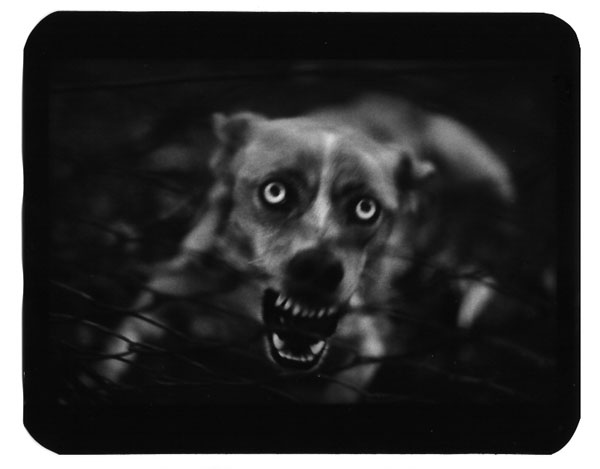
They were small, intense black and white – mainly black – prints with black borders and rounded corners. It was an unusual presentation that entirely suited the work, with dogs with glowing eyes, snarling tiger-like cats; creatures, or parts of them emerging from darkness. His is a universe of menace and strangeness, finding rather more excitement in what is probably someone’s pet than in the pictures from exotic safaris. But while some of these animals may be pets, his images remind us they are not far from the wild, and they are often shown roaming the streets or countryside in a world their ‘owners’ have no knowledge of.

(C) 2006, Giacomo Brunelli
Untitled, 2006 (C) Giacomo Brunelli

Brunelli was born in Perugia (Italy) in 1977 and graduated in international communication in 2003. He was 24 when he first took an interest in photography, and the work on animals is a project he has been pursuing for two years. You can see his work on his web site at www.giacomobrunelli.com

Brunelli uses old Miranda 35mm SLR cameras made over 30 years ago and black and white film, and likes to work in the half-light to produce his powerful personal visions. Often the subject is picked out by a limited depth of field against a blurred and indistinct background, sometimes caught in a patch of light. Light, and lighting contrast, white against black, in some images is more important than sharpness. His printing is dark and sombre.

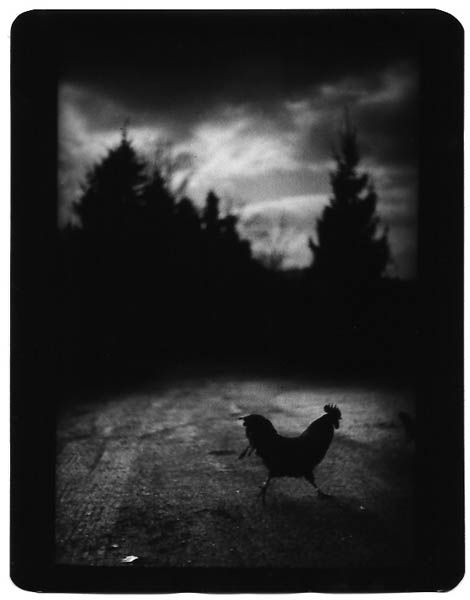
Brunelli is truly a hunter, catching the wild lives of these animals on the run, whether a dog prowling down an empty cobbled street or a cat in full flight.Some of the pictures show a more reflective mood, more the stalker. A peacock struts on a dusk (or dawn) street, its neck and head silhouetted against the glowing road, in the background the hint of a fence, a palm tree and the sinuous curve of a lamp post against the clouded sky. Another similar image (shown above) has a chicken stood across a mean street, the curve of its back rhyming with the out of focus trees against the stormy sky behind.

(C) 2006, Giacomo Brunelli
But more often he works by confronting, pushing his lens close, often to its closest point of focus, perhaps around half arm’s length, aggressive, almost touching his subject (and the pictures have a very tactile nature), forcing flight or fight from his subject, and photographing these reactions.

This project reveals a determination to express a personal view, to probe and explore a subject in his own way. Its an attitude that will I am sure make further projects by Brunelli equally worthy of attention.

Peter Gwyn Marshall

Rhubarb: Reiner Riedler

On Friday morning I walked with other reviewers from the Burlington Hotel to Curzon Street Station and found my table waiting for me in a light and airy first-floor room showing the ‘Otherlands Exhibition’, certainly the most interesting of the shows in Curzon Street. Several of those included were names I recognised, and one in particular was Austrian photographer Reiner Riedler, with an unforgettable image showing Superman leaping through the air.


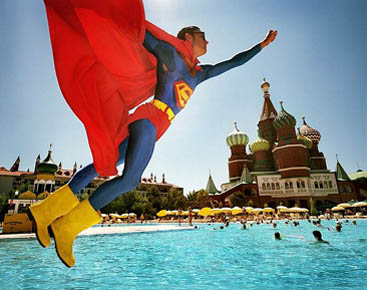
Turkey; Antalya; Lara Beach; World of Wonders, Kremlin Palace;
Animator dressed as Superman © Reiner Riedler / Anzenberger

In April 2006 when I was still writing for ‘About Photography‘ I did a short note on the Anzenberger Gallery in Vienna. The Anzenberger Agency was founded in 1989 and represents photojournalists, documentary photographers and portraitists, selling their work to clients including The New York Times, National Geographic, Geo, Stern, Vogue, New Yorker, Aperture and Le Monde.

In 2002 they decided to open a gallery, and when I looked there was work by around 20 photographers on the site. Among those I mentioned as of particular interest was Reiner Riedler (b 1968, Austria), with work from Russia, the Ukraine, Albania on show. Since then I’ve seen some of his work – including the above image – in magazines.

It came as a welcome surprise – and a rewarding start to the day, when my first visitor (as a late booking not on my schedule) was Riedler with a portfolio of his work on ‘Fake Holidays‘, pictures in theme parks and similar venues around the world. It’s hard for any photographer to resist taking pictures of these places, but very difficult to produce the sustained level of work that Riedler has.

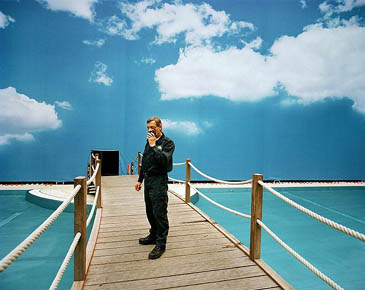
Looking at his images, as well as dealing with the obvious commercial surreality, he has found various ways to invest them with other layers of interest, including the humour of the Titanic Hotel as a shark about to swallow the unsuspecting swimmers in the pool or the slight resemblance in the stance, gesture and features of a man perhaps about to be pounced upon by a dinosaur and that prehistoric creature, or in the menace of a cloud of insecticide spray. Sometimes the focus is on the customers, sometimes on the costumed animators and at other times on the artificiality of the structures themselves. In his images of the indoor “Tropical Islands” pool in Berlin, things could almost be real until you notice the join in the background sky.


Germany; Indoor Pool “Tropical Islands” in
Berlin Brandenburg; © Reiner Riedler / Anzenberger

Of course photography is itself an illusion, producing simulcra of the world, (the postcards gathered and produced proudly by Michel-Ange and Ulysees in Godard’s ‘Les Carabiniers‘.) In the artificial environments Riedler has photographed, capitalism has taken simulcra into a further dimension and peopled them with real people, but they still lack reality, flawed copies. His photographs add a further layer, usually adding a reality which their subjects lack. His superman image above is atypical, in that it works playfully with the fantasy rather than subverting it, reminding me a little of some of Argentine photographer Marcos López’s kitsch Pop latino work.

You can find out more about Riedler and see his pictures on his own web site, www.photography.at

Rhubarb Reviewfest

The centre of Rhubarb Rhubarb (R-R for short) for photographers is undoubtedly the reviews, although for reviewers it is perhaps the hotel bar! We kept the bar at the Burlington Hotel busy until late, a comfortable place, although the choice of beers was abysmal and the prices high. (The Burlington is one of if not the best hotels that Birmingham has to offer, rebuilt at the turn of the 20th century and refurbished for the millennium, although with much of its character retained, including the slightly quirky 1902 bathroom fittings in my room.)

(C) Peter Marshall
It was good to meet some friends from other events, including Karol Hordsiej from the Foundation for Visual Arts in Poland and Jim Caspar of Lens Culture, one of my favourite photography web sites (see links at right), along with a number of people I’d corresponded with but never met in the flesh. Mainly the reviewers were curators from galleries and institutions, editors from magazines and book publishers along with a few representatives of agencies. The galleries and publications included some of the major institutions in photography, such as Aperture, the Victoria & Albert Museum, Sothebys, the Photographers’ Gallery, George Eastman House and more. Most of the reviewers came from Britain, Europe, Canada and the USA, but there were a few from elsewhere – including Yuting Duan from China.

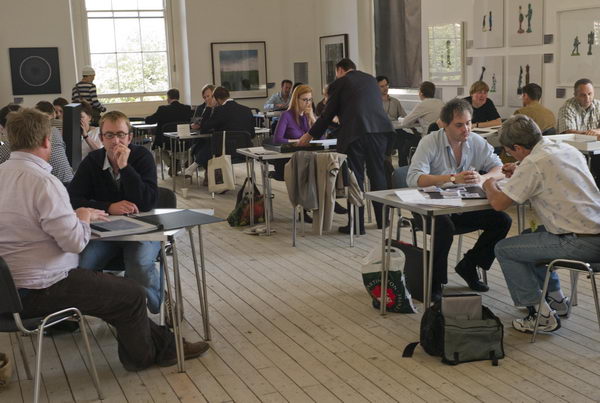
(C) 2007, Peter Marshall
Reviewers and photographers at Rhubarb Rhubarb

When I’d registered as a reviewer I had been working for About.com, Inc as Photography Guide for almost 8 years, creating a large on-line resource on the medium, but by the time I got to Birmingham I had shifted my territory. Luminous Lint is a web site created by Alan Griffiths, and describes itself as “the ultimate online resource for collectors and connoisseurs of fine photography – authoritative reference materials, online exhibitions, expert analysis, commentaries and reviews, press releases, calendars of important events such as auctions, exhibitions and shows, a specialist online bookstore and much more.” By the time I arrived at R-R I’d contributed just two pieces to the site in what I hope will be a long and productive relationship.

Also of course I’m writing for this site, “Re>PHOTO“, which I hope will give a more personal slant on photography than would be appropriate either for ‘About Photography’ or ‘Luminous Lint‘. At About.com, the editorial policy – quite rightly – prevented me from promoting my own photography or that of my friends, although there were several hundred of my pictures scattered around the site, largely as illustrations.

Essentially I think I was at R-R as a photography critic. Someone who likes to look at photographs and write about the experience – or in this case try and talk about it. Of course, the various gallery curators and editors present are also critics. What surprised me a little was that there were no reviewers listed as simply as photographers (though some of those present were also photographers) or as independent critics, and perhaps only one representing an academic institution (although rather more actually taught.)

Most of those I’ve shown my own work to and had useful comments from have been photographers – including (in no particular order) Raymond Moore, Paul Hill, John Blakemore, Ralph Gibson, Martin Parr, Lewis Balz, Paul Trevor, Fay Godwin, Charlie Harbutt, Leonard Freed and many other less well-known names.

Of course some of those reviewing in other capacities are also photographers, but I think fairly small minority. I believe strongly that photographers are the most important sector of the photographic community, and that the medium in a very real way belongs to us. The other guys are parasites, feeding on us for their living, although I don’t intend that term in a pejorative sense. They are necessary and at times useful, and the relationship can be one that benefits photographers as well. But there is something wrong when these people, rather than the practitioners drive the medium.

Peter Marshall 

Rhubarb Rhubarb: Ian Wiblin

Rhubarb Rhubarb (this year’s event was 26-29 July) is a festival with various aspects, including the seminar “East Meets Eastside” on the Thursday afternoon which I was unable to attend, although the reports of it were intriguing. Another is the exhibitions held at the main centre of the event, which this year for the first time was Curzon Street Station close to the centre of Birmingham, as well as at associated venues. The New Art Gallery at Walsall was one of these with a show of colour work by Ian Wiblin, “Recovered Territory“, which continues there until Sept 9, 2007.

(C) 2007, Peter Marshall
The New Art Gallery, Walsall

The art gallery is a fine modern building in the centre of Walsall, standing out among some indifferent modern sheds and remaining proud Victorian relics as a symbol of the possibilities for regeneration of the area. I arrived in Birmingham on Thursday afternoon just in time to jump on a coachfor the short trip to Walsall, along with a few of the other reviewers, volunteers, organisers and others at the festival. We were then treated to the full Birmingham experience of a traffic jam on the motorway, along with a short circular tour around Walsall’s town centre when our coach driver missed the gallery first time round.

Inside the gallery a warm welcome awaited us, along with some even more welcome refreshments, before we took the lift the the top floor, where Ian Wiblin’s work was on show. This is a fine exhibition space, with large windows giving a view over the surrounding town (unfortunately a little rain meant we were unable to use the roof terrace), and a 30 foot or so high ceiling which perhaps rather dwarfed the small colour images on show, well spaced out on the tall white walls.

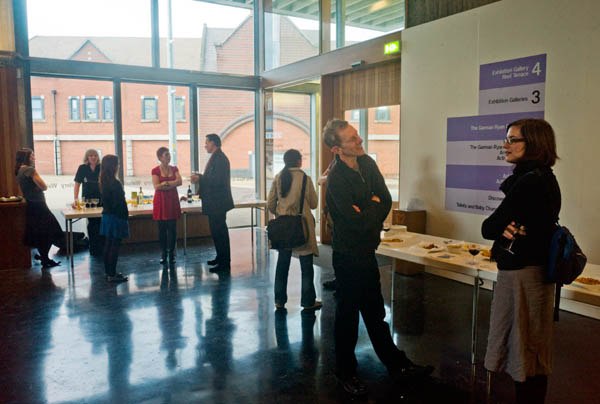
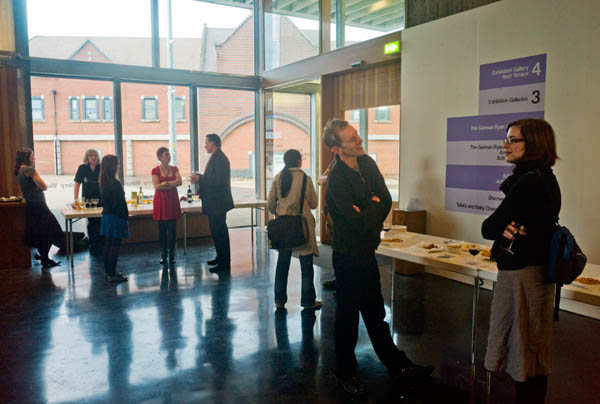
(C) 2007, Peter Marshall
Ian Wiblin and visitors in the gallery reception area

The old Polish city of Wroclaw had a largely Germanic population from the 13th century, and in 1741 officially took on the German name of Breslau, later becoming one of the major cities of Prussia. By the start of the Second World War, the Nazis had cleared out remaining Poles along with most of the Jews, and the city became a Nazi stronghold, the last German city to fall to the allies after a long siege by the Red Army. Almost three quarters of the city was destroyed, and many of the German civilians were killed. The rest were evicted in a post-war settlement, Stalin sliding Poland toward the west, incorporating Breslay under its Polish name of Wroclaw. The city gained a new Polish population displaced from Lwow, (renamed Lviv and added to the Ukraine), along with rather more Poles from Warsaw and Poznan.

In Wroclaw, as in the rest of the “recovered territories” large investments were made to remove traces of its German past, including the removal of many German signs and inscriptions and the restoration of many of the ancient building in order to promote a partly or largely mythical Polish past.

Wiblin first visited Wroclaw shortly before the fall of communism in 1989, producing the series of images “Wroclaw” shown at the Photographers Gallery, London (and elsewhere) in 1990. He returned to the city for a few days in 2006, working in colour to produce “Recovered Territory.” The title refers both to the lands incorporated into Poland following the war and also to his personal impression of the change from a state-controlled communist city into a capitalist one. As with his earlier black and white work, these carefully framed fragments showed an intense and often unusual, sometimes surprising vision, glimpses that reflect past history that are often compelling, sometimes strangely uneasy. Perhaps I found the need for some text on the walls – perhaps equally fragmentary – to anchor these visions to their context.

In Wiblin’s previous black and white work from Wroclaw as well as in the images in “Night Watch“, the book from his year in residence in Cambridge in 1994-5, Ian’s printing added greatly to the impression that the images created, its dark charcoal greys and glowing lights being very much integral to the syntax with which he worked. Here the images were in colour and in a much more neutral key; perhaps an area which he might exploit more fully. But it was a show I found intriguing and powerfully evocative, and I look forward to more work by him in colour.

It was perhaps a shame that there were not more of us on the visit – and that there were not more shows around the area as a part of the festival. And although it was good to see those that were taking place at Curzon Street Station, they could perhaps have been made a more positive feature in the programme. Since much of the work was in the review areas, viewing was really only possible in the breaks during the day. Some of the photographers who only attended for a single day will probably not have seen much of this work.

(C) 1982, Peter Marshall
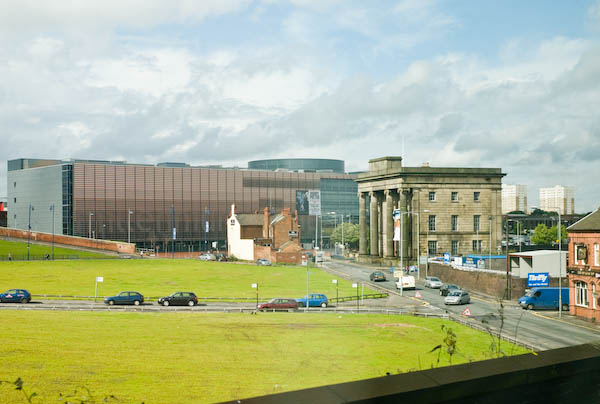
Curzon Street Station, seen from the train.

Curzon Street Station is a fine building, the first station linking Birmingham to London, built in 1838, and built to impress. Although the tracks are long gone, the building still impresses, dominating the largely cleared area around it and providing light, airy spaces within, although in some aspects in need of refurbishment. With some investment it would make a fine centre for photography and digital imaging.

I was fortunate to be reviewing in a room containing perhaps the best of these shows, ‘Otherlands‘ with some exceptional work by a number of photoographers including Vee Speers, and Reiner Reidler (of whom more in later features), and there were aslo some pleasing works in the more public areas such as the stairways and landing, notably a set of John McQueen‘s colour pictures showing the once proposed Birmingham Ship Canal with a toy liner cruising the city. There were also a few images I related less positively to, including a pair so badly off-colour that it made me feel ill to view them, but fortunately such things were rare.

More of my impressions from Rhubarb shortly.

Peter Gwyn Marshall

Gillian Laub – Testimony

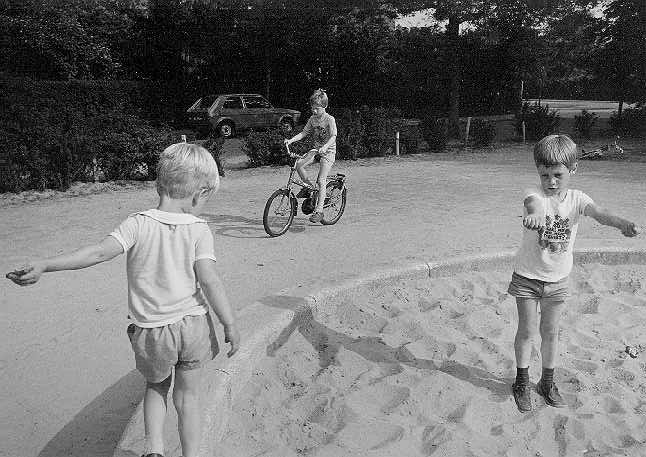
Gillian Laub (b1975, Port Chester, NY) is a New York based photographer who completed a BA in Comparative Literature at the University of Wisconsin before studying photography at the ICP in New York. Her show at the Bonni Benrubi Gallery in New York, An American Life, closes tomorrow, July 7, 2007, and is a series of large colour images that show often intimate moments in the life of her own extended family, in Florida, New York and the suburbs. It’s work that gives an insight into the life of some Americans, and certainly very proficiently done, with several images that I like considerably (Grandpa eating on the beach at Naples, Florida for example) but overall I had a certain feeling of deja-vu, not least because I photographed a very different family some twenty or more years ago with occasionally similar results.

(C) 1982, Peter Marshall
Joseph, Jan Willem & Samuel 1982 © Peter Marshall
(C) 1977 Peter Marshall
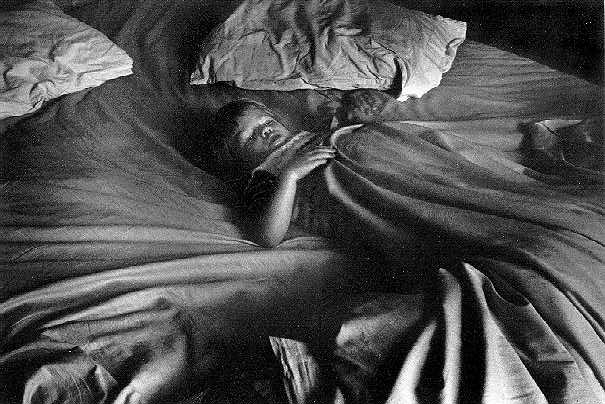
Samuel 1977 © Peter Marshall

Well, families are families, although in some ways it is what is in the background of these pictures that that is of more interest, setting Laub’s particular family in a social context, and perhaps seen most clearly in ‘ Jamie Practicing for the Family, Armonk, NY 2003′.

What I find considerably more interesting than ‘An American Life‘ are Laub’s images from Israel and Palestine, some of which were shown earlier at Bonni Benrubi, and can be seen in the fine PDF portfolio ‘Beyond Wounds‘, as well as on Laub’s own web site. This work, some of which is in her newly published Aperture book, Testimony, seems to be of entirely a different and higher order of magnitude. These images of Israeli Jews, Israeli Arabs, displaced Lebanese families, and Palestinians all caught up in conflict in the region, taken over a four year period have an incredible depth and complexity.

If you are in London next Thursday, 12 July, 2007, you can hear Gillian Laub talking about her book at the Photographers’ Gallery at 6.30pm, followed by a book launch and signing in the Bookshop. It’s a free event, and no booking is needed.

Family Album was the first web site I ever wrote, and is still on the Internet (with some very minor changes to the code.) I also wrote a feature for About.com, Family Pictures at About Photography, which became one of my more popular features on the site. The discussion about the problems of nudity in images of children it contains surprisingly caused some controversy, although only around five years after it was put on line.

Flandrien: Hard Men and Heroes

Cycling and photography have a long and not always entirely harmonious history, and it’s one I’ve remarked on several times, for example in my short piece on the 1896 Photographic Salon. Both came to be popular middle class recreations in the same decade, with the widespread adoption of the dry plate around 1880-81 and J. K. Starley’s iconic Rover Safety bicycle of 1885.

I’ve previously written briefly on the fine photography of Belgian photographer John Vink, both on his own website and Magnum, and whose work was features strongly on Magnum in Motion‘s essay on the Tour de France.

On Wednesday I went to see the work of another fine Belgian cycling photographer, Stephan Vanfleteren, at HOST gallery (Honduras Street) in London. Flanders and the north of France have what are almost certainly the toughest cycle races and the hardest cyclists in the world, with riders battling it out in rain, hail and headwinds on muddy paves and forest tracks. Races like Paris-Roubaix (L’enfer du Nord) and the Tour of Flanders which make even the Tour de France look an easier option.

His gritty black and white images are a perfect match for the landscape and the people, and he looks at the events as a whole, including the spectators as well as the riders. Many of the images on show are taken during local kermesses (village fairs) which include races going through the village. The show also includes extremely powerful portraits of most of the leading Flandriens (Flemish cyclists) of postwar years, including such legends as Eddie Mercx and three times Paris-Roubaix winner Johan Museeuw.

The show continues until 31 July, and there is a special late night opening on Thursday, 5 July, 6.30pm-9pm, one of a series of summer soirees including DJs and cocktails. You may get a better view of the show during normal opening hours (10am-6pm, Mon-Fri and 11am-4pm, Sat.)

Honduras St is off Old St (a few minutes walk from Old St station or the Barbican) and close to Magnum’s London print room, where the show ‘New Blood’ with work by associate members Antoine D’Agata, Jonas Bendiksen, Trent Parke, Mark Power and Alec Soth must also be worth a visit (63 Gee Street EC1, 11.30am to 4.30pm Wed to Fri only – or by appointment.)

Peter Marshall 

Minnesota Fashion

Think Paris, and you think Fashion. Think Minnesota and I guess my mind is pretty blank. Maybe gophers or lakes? Actually my mind is pretty blank about gophers too, though I think they are some kind of burrowing rat, and in the primitive days of the Internet (around 1991), courtesy of the University of Minnesota, the gopher protocol used to burrow for information for us before web sites existed. Lakes I can understand, although around here they are largely a cheap way of abandoning sand and gravel sites, but in Minnesota, wilderness.

Of course I’m unfair. The twin cities have a long artistic tradition, and Alec Soth is one of my favourites among his generation of photographers. There is even a French connection, in the state motto “L’Étoile du Nord“, and it does after all have a border with Canada.

Even so, a straightforward fashion show of images by Alec Soth would perhaps be less than overwhelming, but his actual work for the thick glossy magazine ‘Paris Minnesota‘ is fascinating. This is the third of Magnum‘s annual “fashion magazines” where every image – fashion, editorial and advertising – is by a single photographer (previous issues were by Martin Parr and Bruce Gilden) and although these were interesting this looks like being the best to date. Due in a month or so, it is a publication that will become a collector’s item, and signed copies are available too at a relatively small extra cost – so you are advised to pre-order now if you want one.
Soth’s work gains from his realisation that he isn’t really a fashion photographer. As he says “I’m not really comfortable saying I know anything about Paris or its fashion world. And I suspect that most fashionable Parisians know just as little about Minnesota. What is interesting is the space between us.” He found it difficult to work with fashion models who themselves have such a clear idea of how they should look, composing themselves for the camera. Of course his pictures of them are of interest, and he learnt to work much faster than before with his 8×10 camera, sometimes managing to capture something of them before they had retreated into their glossy shells. But perhaps of most interest are the highly detailed advertising images taken in Minnesota, where part of the game is in the search for the actual product, which Jim Casper describes in his LensCulture feature on the Paris opening.

This is an approach that I think we may see setting a trend. So look out for work in the fashion magazines over the next year or so where the product takes some finding. I don’t think these are likely to be taken in Minnesota, but more likely in edgier high energy city settings such as Peckham, Moss Side or in the hotter parts of the banlieue.

The best places to see more about Soth are Magnum and his own web site, and in particular his blog, which has some other links to articles on Paris Minnesota and to pictures of the opening.

How We Are: Twentieth Century Blues

Coming back finally to the current Tate Britain show, ‘How We Are’, the first section ‘First Moves’, dealing with the nineteenth century is certainly the most comprehensive and inclusive of all six chronological sections of the exhibition.

Around 120 photographers are listed for the remaining five sections, and they include some fine photographers (as well as some whose inclusion is hard to justify on any grounds.) My own selection of a similar number of photographers would perhaps have included rather under half of those chosen. It was certainly good to see a fair number of those whose work I think deserves to be better known – for example Norah Smyth and Edwin Smith in their very different genres, and obviously pleasing to see a number of photographers I know or have know with work on the wall, as well as to find some of those books on my shelves are now museum pieces. Some people – such as Bill Brandt – could not of course be omitted (although I’m assured that it was initially planned to do so.) Others, quite frankly had little relevance even to the particular view that the curators were presenting, perhaps representing strongly argued cases by some of those called in to review the plans.

In part the titles given to the different eras both indicate and dictate the omission of many fine photographers. ‘Into the Twentieth Century’ may seems pretty vague for the period 1900-1918, but appears to be a pretext for ignoring almost all of the pictorial photography and news photography of the era. As this was the first age in which cheap methods of mass reproduction led to photographically based newspapers, I would have expected more emphasis on how these new media used photography, rather than the rather specialised examples in the show. The photography of the Suffragette movement, with Christina Broom (Christina Livingstone, (1863-1939), Britain’s first woman press freelance photographer) and Norah Smyth, is a highlight of this section, reflecting the curatorial interest perhaps more in that movement than in their photography, which for both was considerably wider than the visitor to this show might conclude. Both of them are also featured in Mike Seaborne’s Photographers’ London: 1839-1994, which, despite its obvious metropolitan bias, succeeds in offering a considerably wider view of this era and others covered by the show.

By defining the period 1918-1945 as ‘New Freedoms in Photography’, the curators again choose particular work from the era rather than cover it more generally. Despite the title, there is perhaps less emphasis on photojournalism that might be expected from the era that saw the growth of the photographically illustrated magazines such as Liliput, Weekly Illustrated and Picture Post.

Again, it seems to me impossible to consider the period 1945-69 adequately as a whole under the title ‘The New Britain’; for most of us it changed radically at some point between the fifties and the sixties.

Equally it seems hard to argue that the seventies and eighties were dominated by ‘The Urge to Document’ or indeed that since then we have been making ‘Reflections on a Strange Country’. These are strange generalisations indeed, and the choices (and missing persons) they lead to make the show unrepresentative.

That isn’t to say that there is not a great deal of work of interest in this show. British photography does have a great deal to offer, and the story of British photography shown here is at time enthralling. But different curators would have made different choices of photographers and images, telling at least an equally valid view of photographing Britain.

So here are just a few names from the 70 or so who would have been on my personal list for 1900-1990 but are missing, in vaguely chronological order. Where I’ve written about them elsewhere and remember I’ll give a link.

Horace Nicholls, John H Avery, George Davison Reid, Emil Otto Hoppe, Felix H Man, Margaret Monck, Cyril Arapoff, Kurt Hutton, Thurston Hopkins, Henry Grant, John French, Eric de Mare, Raymond Moore, John Blakemore, Philip Jones Griffiths, Don McCullin, Ian Berry, John Benton-Harris, Jo Spence

Among the foreign visitors who perhaps have a greater claim to be included than most of those actually present are Izis Bidermanas, Henri Cartier-Bresson, Robert Frank and Sylvester Jacobs.

The final selection deals with contemporary work, and selection in this area is always going to be a lottery. The 20 or so photographers whose work appears in this section are an almost random cross-section from the several hundred whose work I find of some interest at the present time.

Although there is much to see, How We Are is a show that disappoints, as a missed opportunity. How long will it be after this before Tate Britain once again tries to tell the story of photography in Britain?

Missing Persons: First Moves

The ‘Missing Persons’ series has provided me with a little amusement although I think the point is basically serious – publicity from Tate Britain suggests that How We Are: Photographing Britain is “The unique story of British photography” when it is just one of many possible stories about British photography.

To adequately tell the story of British photography would need a larger space and a larger budget than the Tate provided. (Budget problems may also explain the rather unusual choice of images for some photographers.) As well as the particular viewpoint of the curators, these factors also helped to shape the show that we see.

This first section, entitled ‘First Moves’, and dealing with the nineteenth century is certainly the most comprehensive and inclusive of all six of the chronological sections of the exhibition. As a history it lacks some major figures, but also fails almost completely to deal with the technical, aesthetic, political and even largely the social changes that helped to change the nature of photography in Britain over the sixty years concerned.

There are of course many others apart from those already mentioned in ‘Missing Persons’ who might well be included in a proper overview of British nineteenth century photography, far too many to devote a whole feature to each one of them. So here are just a few more from the nineteenth century who I would have expected to see in any show claiming it was the story of British photography.

One of the best of the daguerreotypists was Antoine Claudet, and Calvert Richard Jones and John Dillwyn Llewelyn produced some fine work with the calotype and later wet plate process. It is hard to believe that there were no portraits by Lady Clemintina Haywarden in the show (perhaps by some error they left her out of the credits?), but she is not on the list. David Wilkie Wynfield was another of those to whom Julia Margaret Cameron turned for advice, and on who she perhaps based her approach.

A man very much after my own tastes, Henry Dixon produced some splendid records of London streets, showing both the buildings and the people. He also took some early candid street pictures, using a camera obscured by tarpaulin on the back of a cart.

Of course there are so many other interesting photographers of the period who I’ve not mentioned who are an important part of the early history of photographing Britain. What we do get – and is certainly of some interest – is a number of relatively anonymous works by rather ordinary photographers, including the work of commercial studios (some good, some bad) and others.

Viewed on its own, and for what it is – a kind of cross section of Victorian photography, seasoned with a number of choice tidbits from some of the finest photographers of the era – this section has much to recommend it. The coverage of some of the later eras – as I’ll show in later posts – is much less complete and more biased.

Peter Marshall

Summer Photography

Certainly the most satifying of the various photographic shows currently in London is the Summer Photography Exhibition at Bernard Quaritch Ltd on the edge of Golden Square in Soho. It gains from being a relatively small show, concentrating on photographers who have photographed within a particular community or urban area. The show continues until 29th June, 2007 and is open Mondays to Fridays, 9.30-5.30.

(C) 2005, Mike Seaborne.
Mike Seaborne, Bethnal Green, 2005

Quaritch is an antiquarian bookseller, established in 1847 by Bernard Quaritch, who on his death in 1899 was described, according to The Times, as “the greatest bookseller who ever lived.” Their premises in Golden Square, where they moved in 1970, have something of the air of a gentlemen’s club and the walls are lined with bookcases of old and rare volumes.

Before going into the downstairs gallery, we lingered around a glass case with some examples of the work of Thomas Annan, including a couple of fine large published volumes of his work, the superb carbon prints published in 1878/9 and the photogravures published in 1900 by his son, Robert Craig Annan, which included 12 of his prints along with 38 taken by his father. The photogravures are also splendid prints.

Downstairs in the gallery is a rare treat, 5 salt prints from the calotype images that Hill and Adamson made at the fishing village of Newhaven on the edge of Edinburgh, not a great walk from their Calton Hill studios. These prints are still powerful images 160 years later, and I was particularly struck by the image of the three fishermen. The different poses they have adopted to attempt to remain still for the lengthy exposure required express powerfully their varied characters. It remains a far more powerful portrait than anything I saw in Photo-London, and reminds me strongly of some of the best images of August Sander, taken some 80 or 90 years later. The five fishwives grouped around some of their baskets is also one of their more interesting images.

The five Thomas Annan prints in the show are glowing examples of his work on the closes of Glasgow in 1868-71 (printed in 1877.) Carbon prints are perhaps capable of a quality unequalled by any other photographing printing process, and these are good examples.

John Thomson’s Street Life in London, with text by Adolphe Smith is represented in the show by six Woodburytype prints. These are carbon prints produced in a printing press from a lead relief plate, created under high pressure from a gelatin relief image made in a similar manner to a carbon print, contact printing a dichromate sensitised gelatin coated sheet under the negative using a powerful UV source.

Street Life in London was one of the truly pioneering works of documentary, and the nicely produced Quaritch catalogue for the show (Catalogue 1351) lists copies both of this work and ‘Street Incidents’, published a few years later to get rid of unsold sheets of prints from ‘Street Life.’

Although Henry Dixon along with Alfred and John Bool produced many fine images recording London around the 1870s and 1880s, their work was perhaps the least striking in the show. Compared to the Annan images, the prints shown lacked depth, and both the viewpoints and the choice of times when the streets were largely deserted make their work of less interest.

By contrast, Roger Mayne’s images from North Kensington, Notting Hill and Paddington in the 1950s are entirely about incident. I was particularly taken with his view of children and teenagers on the doorsteps of St Stephen’s Gardens. Times have changed, not only in the dress and behaviour of children, but also in public attitudes to photographers and being photographed; it would be a brave photographer who tried to take similar pictures on the streets of London today.

Again by contrast, Mike Seaborne’s ‘Facades are deliberately empty of people. Taken from across the street with a square format Rolleiflex camera, they create a systematic visual catalogue of shopfronts surviving (in some cases only just) from an earlier age. Taken in 2004-6, these colour images (some of which are on the Urban Landscapes site I started with Mike) are powerfully evocative, the remains of an older world still with us, often in contrast with ugly 2000s street furniture.

Also included in the show is a single print of New York by Berenice Abbott, a beautiful riot of washing in the yard of New York’s first model tenements, built in 1882 and photographed by here in 1936.

Peter Marshall