Nan Goldin’s Mirror on Life

This article started as part of my lecture notes and was added to at the time of Goldin’s Whitechapel Gallery show in 2002, and later a version was published on the ‘About Photography’ web site I was then writing. It has been rewritten in 2007.

For copyright reasons, no images by Goldin are included here. At the end of the article are a number of links to her work on the web, as well as to some other articles about her and several of the other people mentioned here.

Life and Work

The division between photographers’ lives and their work is sometimes but not always important. That we now know a little more about the life of E J Bellocq, where once all we had were his enigmatic but often stunning images from the brothels of Storyville certainly has not altered the way I appreciate his work, and there remain many photographers who I admire but know little or nothing about.

Some of course have provided us much more. Edward Weston for many years wrote what he felt were his intimate thoughts in his day-books, and although he excised some names and passages with a razor blade before allowing Nancy Newhall to edit them, these published diaries still perhaps still tell us more than we need to know about his personal life, fascinating though it may be at times. What he thought about his work is really of more interest, although his writing sometimes seems too arty and full of pretensions to match the directness of his best and most direct camera work.

Weston’s relationships with women – Magarethe Mather, Tina Modotti and Charis Wilson Weston among others – were obviously a vital part of his life and had their impact on his work, which I tried to bring out in my features on him without going into the minutiae of his many relationships. But perhaps these aspects of his titillated his major biographer and others, and distracts them from his work, distorting distort their and thus our appreciation. Landscapes are less sexy than the nude even without the artificial spice of personality journalism, but they may be more profound.

An obsessive record

With Nan Goldin things are different; life and work overlap to the point of identity. As she writes in the introduction to her first book, published in 1986 “The Ballad Of Sexual Dependency is the diary I let people read.” Goldin wanted, or even needed, the camera to become part of her and to “obsessively record every detail” of her life.

Of course the camera can’t oblige. It only offers us glimpses, framed and caught with more or less skill by the person who directs it – and Goldin’s control as a director is remarkable. The glimpses depend on both the technology — lenses, angles of view, depth of field, the film etc — and the plans and decisions of the photographer. These together produce a view of what was there in front of the camera. Photographs are not simply ‘traces’ or some kind of objective replica, but objects that are produced from a particular viewpoint – moral, ethical and judgmental as much as spatial.

Relationships

The taking of a photograph is only one stage of a process. Goldin uses her pictures to tell a story, and in doing so creates her own story. The cover picture of ‘The Ballad Of Sexual Dependency’ (a cropped version of one of the slides from the sequence) shows two people on a bed. Brian, closer to camera, is turned away from it, looking out of the picture to the left. Sitting naked on the edge of the double bed, he smokes a cigarette, detached and apparently deep in thought. A flash to his left, roughly level with his face light it, and also casts the shadow of the brass bed head on the bare wall a few inches from it, as well as catching Nan’s face as she lies awkwardly, head on pillow watching him, anxiously. Her upper body is covered by a black robe from which only her left hand emerges, flat on the sheet, with watch and a gold wedding ring. A golden glow bathes the image, turning everything – Brian’s flesh, the wall – to shades of yellow, orange and brown, the colours of sunset. They are a couple together on a bed, but clearly separate, at different ends, he upright, she horizontal.

It is such a carefully crafted tableaux – and in the un-cropped original, even more clearly so. Looking at this we see how the position of the light draws our attention to the faces of the two people, lighting them and the pillow on which Nan’s head is uncomfortably resting, while casting a shadow behind her and on the lower part of the bed. We also see, staring out at us from the wall a repeat image of Brian, a photograph again with a cigarette, this time dangling from his lip as he gazes intently at camera. The gaze at the camera (and the photographer) in that photograph suggests a quite different relationship from the one we see being acted out in front of us.

As so often in Goldin’s work, this picture combines a remarkable detachment in the creation of the work with a total involvement in the scene she is taking part in. Goldin is always very much a part of her pictures, whether she appears in frame or not. Unlike Diane Arbus, who at times photographed a similar subculture very much as a tourist or an empathetic collector of rare and unusual species, Goldin did not stand and look in; if anyone is a voyeur it is us and not her.

For Goldin, the private – or at least a carefully organised part of it – has become public. This is a picture of a relationship that she had been in for some years and was apparently on the point of breaking up, but we also see that if you wanted to live in Goldin’s life you also had to play her games for the camera.

Death and ecstasy

The book ‘The Ballad of Sexual Dependency‘, (1986) (Ballad), was dedicated “to the real memory of my sister, Barbara Holly Goldin.” Nan Goldin was the youngest of four children in a very middle class family; born in Washington DC, her family soon moved to Maryland. Goldin at eleven was very close to her eighteen-year-old sister and knew about some of the problems she had in reconciling her sexuality with the attitudes of society, problems that led her to lie down on a railway track in front of a train. A few days after the shock of the suicide, and while she was still desperately mourning the loss of her sister, Goldin was seduced by an older man. Within that week she experienced both great loss and pain and was also “awakened to intense sexual excitement.”(Ballad) These two dramatic events shaped the future of her life and her art.

I find it difficult to imagine the position she was in, with these immense emotional pressures coming at an age when I was still in short trousers and being taught that sex was a Latin numeric prefix. Life was not without its traumas, but mine were less dramatic. Goldin was confronted in those sudden and tragic events with forces that most of us become aware of slowly over a period and evolve mechanisms to deal with or repress, and it is hardly surprising that the issues behind them have dominated her work. I don’t share her lifestyle or some of her attitudes, but I admire the honesty and clarity of her approach.

Goldin ascribes her need to take photographs to the death of her sister. The obsession with recording her friends comes from a realisation that although she remembered the things Barbara has said to her, she had lost “the tangible sense of who she was, what her eyes looked like” (Ballad) and she was determined not to let that happen again. Later when many of her friends were suffering from Aids, she had a feeling she could keep them alive if she photographed them enough. Of course what she could and has kept alive is a memory of them, but her photography has kept her alive also.

A new family

Fearing that she might too literally follow in her sister’s footsteps, Goldin ran away from home and its repressive attitudes at the age of fourteen to be able to live in her own way. She drifted through a series of foster homes, eventually ending up in a flat share with half a dozen other disaffected teenagers. These friends became a new family to her, and among them were two people who were to become her greatest friends, David Armstrong and Suzanne Fletcher.

It was here in the summer of 1972 she first took up still photography, although she had already experimented with shooting movies. Her first photographs – and her cine footage – were pictures of herself and her friends dressed up and with heavy make up, posing dramatically as the movie stars of their dreams. Armstrong was her favourite model – he was just discovering drag – and he also became a photographer.

She describes in ‘The Other Side‘ (1993) how when she first saw drag queens on the street in Boston in 1972 she immediately followed them and shot some Super 8 footage. A few months later, David Armstrong took her to ‘The Other Side‘, a drag club in Boston and introduced her to some. Aged 18, she moved in with a pair and was busy photographing them and their friends.

Fashion and Boston

Goldin decided she wanted to become a fashion photographer and that she would become famous by using the queens as models on the cover of ‘Vogue’. She enrolled in a photography evening class and had her first show in a basement in Cambridge, Mass the following year, with all her models attended the opening in drag. These black and white images are the basis of her series ‘The Boston Years.’

In 1974 Goldin moved out and went full time to study at the ‘School of the Museum of Fine Arts’ in Boston, She describes the pictures she took on the course as the worse she had ever done, but it was there that she began to develop the look for which she became noted, switching from black and white to colour, and moving from natural light to an almost exclusive use of flash. Until 1990 she used a 35mm SLR, shooting on transparency film and having this printed using the direct positive ‘Cibachrome’ process (now sold as ‘Ilfochrome Classic’, but still generally known by its older name.)

Cibachrome tends to exaggerate colour, producing highly saturated results which maximizes the apparent sharpness of transparency film. The kind of glow – often yellow or orange – that she gets in some of the pictures comes easily and naturally from this process. In 1990 she switched to working with Leica M6 rangefinder cameras. Some of her more recent work seems to show a more natural lighting effect, possibly through the use of more sophisticated flash equipment with larger reflectors.

Much has been talked of the ‘Boston School’ of photographers, including Goldin and David Armstrong along with Mark Morrisroe (1959-89), Philip-Lorca diCorcia, and Jack Pierson (although Goldin didn’t meet Pierson until 1985 in New York.) They were all of a similar age, moved to New York around 1980, had similar tastes in music and drugs and often photographed each other as well as mutual friends.

New York (and England)

After her art course, Goldin found it difficult to relate to many of her old friends and in particular the drag queens in the same way. She continued to photograph her life and the people in it, without really finding much she could really work with, taking pictures in Boston and travelling around.

In 1978 Goldin and some of her close friends decided to move to New York, where she soon began photographing in the bars and clubs. She also lived in England for a time in 1978-1979, where she photographed punks and mods. The pictures from London have a different feel; the clubs and music were harder, more masculine, more working class, and had little of the artsy chic and posing of New York.

The Ballad of Sexual Dependency

Goldin gave her first public slide show as a part of a celebration of Frank Zappa’s birthday at the Mudd Club, probably in 1980. The show and the audience featured many of those whose lives were to be exposed in her later work, including David and Suzanne as well as various New York East Side celebrities including the transsexual artist Greer Lankton and poet Cookie Mueller.

Soon the slide show was expanded and gained a musical sound track and the title title ‘The Ballad of Sexual Dependency’. It continued to evolve over 15 years, eventually containing around 700 slides and running around 50 minutes. The images showed her views on relationships between people – couples of various types – and the different ways in which both men and women constructed their gender roles. The book, published in 1986, had as its earliest image a rather conventional looking group of young people eating cake on the grass of the Esplanade in Boston from 1973 and the latest were from the wedding of her friends Cookie and Vittorio in 1986, but the current slide show includes some pictures up to 1989

Men & Women

Goldin had realised at an early age that she could form strong relationships both emotionally and sexually with both men and women. She and her friends were strongly aware of their gender and in various ways attempted to redefine it. She felt intensely both a need to be loved and a need for independent personal space. The idea of “the struggle between autonomy and dependency” was central to her life and her work in the ‘Ballad’, and it was a theme with almost universal appeal. Even many of the more conventional and stiff-lipped of us at times feel the constrictions of our position. Like her we need to be together but we want to be alone.

Watching the ‘Ballad’

The ‘Ballad’ doesn’t really have a story, being more a series of episodes or themes, announced by changes in the accompanying music. It’s both a celebration and an examination of a subculture crowded with mainly young people in 80s cool playing with drugs, gender, sex and each other. Those who shared her world felt that Goldin captured the essence of the times in that particular milieu. Watching the slides I often felt astonished that someone presumably in more or less the same state as those in the pictures (and often she was in the pictures and in quite a state) had managed to function to even make the work, let alone make it so precisely.

Fifteen years on, I still found it both powerfully moving and at times hysterically funny, though few others in the rapt audience with which I shared it at the Whitechapel Gallery – most of a more similar age to the people in the pictures – seemed to share my amusement. In an art gallery context it tends to get taken in silence as ‘great art’, something that there was little chance of in the Mudd club. Goldin made it to be entertainment as well as art.

Wild Women

There are a few funny bizarre pictures, but it was mainly the excruciatingly obvious juxtapositions of the soundtrack excerpts from blues, pop, rock, reggae and opera that make it hard not to laugh. Name an old, sad love song and it’s probably there, together with some more upbeat numbers such as the exultantly angry ‘Wild Women Don’t Have the Blues.’ The music ranges through Brecht and Dean Martin, Callas, Aznavour, James Brown and Marlene Dietrich to some deservedly unknown names from the 80s.

Technically it seemed amateur by modern standards, with slow slide changes and some annoying seconds of blank screen. There are also some slow fade effects apparently sprinkled with little rationale, reminiscent of low budget ‘audiovisual’ productions of the 1980s – exactly where it started. In a way it was a disappointment to go back for a second view a couple of weeks later and find it was much slicker, and I realised that the gallery had not noticed that one of the projectors had not been working on my first visit.

In fact it I think it still wasn’t working as it should, with some images too dim to see properly, and certainly looked amateur and inept compared to her later slide presentations. Some of the dupes used in the seemed rather poor, and had probably deteriorated over the show. Of course, with work shot over a period of almost 20 years, the originals will also show considerable differences with changes in film emulsions. But for gallery showing, transfer to a digital format would have great advantages.

The slide shows, and in particular the ‘Ballad’, are central to Goldin’s work, and the prints on the wall are in a sense secondary, which is difficult for galleries to comprehend – and the art world in general tends to see them as a rather inconvenient and hard to market irrelevance. The ‘Ballad’much is a work that deserves more care and professionalism from galleries.

What started as a diversion between sets in punk clubs became a cult and is now finally a museum piece. We first saw it in the UK at the Edinburgh festival, then a couple of years later at the Institute of Contemporary Arts (ICA) in London. The ‘Ballad’ is very much a work of its times, in its clothes, the artefacts and also perhaps the ideas, though some of these remain the material of best sellers. “I often feel“, wrote Goldin “that men and women are irrevocably strangers to each other … almost as if they were from different planets“, a sentiment that sums up several more recent popular psychology books. You can learn rather more from her pictures than you can from them.

Brian and Nan

One of the relationships that runs through the ‘Ballad’ is her own long term one with Brian (the man sitting on the bed in the picture described in the previous section.) It was a relationship that was to end shortly after the picture was taken, possibly in part because Brian had read some of her diaries, with Goldin battered and nearly blinded in Berlin in 1984. One of the most moving pictures in the sequence is a close head and shoulders portrait of her taken at her request by Suzanne Fletcher a month after the attack. It shows her facial bruises and a bloodshot part-closed left eye matching her bright red lipstick as she stares straight at the camera. This and similar images had an important function for Goldin, in persuading her that she should not renew her relationship with him.

Mise en Scène

Goldin’s work impresses by her ability to direct her subjects, to relive her and their lives for the camera as they live it. Some of the pictures are certainly snapshots, but most just look like snapshots, and demonstrate her ability to pick a suitable time and place and to set thing up exactly as she wants them.

She is truly a master (one can’t say a mistress without unfortunate connotations) of mise en scène. Even aspects that appear amateur – such as frames that are not sharp or are damaged by fogging or with strong colour casts are used deliberately to enhance the idea that these are part of a family album. I suspect the couple of reversed slides in the last performance I saw were genuine error rather than design, but they and the noise of the slide changes (along with some rather inept cross fades) all added to the impression of a private amateur showing in someone’s front room. Goldin’s family slides are absorbing to watch (we are all voyeurs at heart) but many like me will be glad to be only a visitor and to sit these events out in real life.

Drugs

After the break-up with Brian, Goldin became more and more addicted to drugs. Many of her friends were also beginning to suffer from continued abuse of their bodies by alcohol and drugs. It made things wors that this came at a time when many of her friends were dying from Aids, and she became involved in photographing a number of them, trying in her mind to keep them alive through photographer, but succeeding only in preserving them on film.

All By Myself

By 1988, Goldin she was in such a bad state that she decided to go into hospital to detox. But there they took her camera away and she didn’t know what to do. When she was transferred to a halfway house, she got her camera back and started to produce an intensive series of self-portraits, taken with available light.

These pictures, together with other self-portraits over the years were later to form the basis of another slide show, called ‘All by Myself‘, (1995-6), with an Eartha Kitt soundtrack. Some critics have found this too saccharine and kitschy. For me the interplay between the searing honesty of some of her pictures and the very different emotional tones and depth of the music makes this one of her most effective works. It’s certainly a piece that makes me warm to Goldin as a person rather than to simply admire her as an artist.

Aids and Memories

Goldin’s idea that her photography is very much a way of keeping memories of people alive is at its most explicit in several sequences dedicated to the memory of friends who have died from Aids, including ‘The Cookie Mueller Portfolio’, (1976-90), ‘Gotscho + Gilles. Paris’, (1992-3) and ‘Alf Bold Grid‘, that dominated her work in the early nineties.

Goldin has described how she first heard about Aids in 1981, when Cookie Mueller read an article about a new illness from the ‘New York Times’ to a group including Sharon, Cookie’s lover, David Armstrong and a few others. They all laughed it off, sure it wouldn’t affect them, but only the following year one of David’s lovers was the first of many friends to die from it.

Mueller, according to John Waters, the first to recognise her potential as a film actress (and director of her first film, “was a writer, a mother, an outlaw, an actress, a fashion designer, a go-go dancer, a witch-doctor, an art-hag, and above all, a goddess.” Born in 1949 in Baltimore, Cookie and became good friends with Goldin in 1976, and she photographed Cookie and Vittorio’s wedding in New York in 1986. The portfolio is a montage of pictures that follow Cookie from the fullness of her life to her corpse in the casket in 1989.

Gilles was her French art dealer. She photographed him with his lover while still in good health and then made a fine picture of the couple in hospital. Alf Bold was a German friend who also died of Aids.

Greer Lankton

Greer Lankton, (1958-1996), was born the son of a Presbyterian pastor and had a sex-change operation at the age of 21 in 1979.  She appears in many fine pictures by Goldin and was well known for her dolls and sculptural installations, including a life-sized doll of the famous fashion columnist and editor Diana Vreeland (1903-1989) who worked for both Harpers Bazaar and later Vogue (and discovered Andy Warhol.) Greer suffered from alcohol and drug addiction and anorexia. The section of pictures of her in ‘The Other Side’, is probably the most effective part of this book.

More of a Drag

In 1990, Goldin returned to photographing drag queens, photographing again in New York clubs. However, by this time the subject had lost its frisson. Drag was no a normal aspect of the scene, no longer an esoteric fringe, and such studies were now almost a standard subject for many if not all student portfolios. With a few exceptions, such as a fine action picture, ‘Jimmy Paulette on David’s bike. NYC 1991’ where her flash catches the two riders in centre frame against a blurred background, the results (also shown in ‘The Other Side’) were disappointing.

Tokyo Love

Her collaboration with the Japanese photography Nobuyoshi Araki was of considerably more interest. Araki is an extremely prolific photographer, who has also produced visual diaries for many years. Goldin met him in 1992, and returned in 1994 to work together on the book ‘Tokyo Love‘. Their work alternates throughout the book, mainly in double pages, but with some sets or four or six pictures. Araki contributes studio portraits of young adolescent girls who are in their first Tokyo spring.

Goldin’s work also looks at young people, but ranges more widely, with a great picture of the ‘Honda Brothers with falling Cherry Blossoms’ swirling like lilac snowflakes as they stand in the street, as well as many people in clubs, homes and elsewhere. Goldin found young Japanese who reminded her of a younger self, with the same attitudes, the same beliefs she had as a teenager. Like her they had “transcended any definitions of hetero or homosexual.” She found the project was like a journey back into an age of innocence, “before my community was plagued by Aids and decimated by drug addiction” (Tokyo Love.)

BBC Film

Goldin had started shooting movie film before she took up photography, and slide show works such as the ‘Ballad’ can perhaps be seen as a film shot as stills. In 1996 she worked with the BBC on a TV programm, ‘I’ll Be Your Mirror‘, shooting most of the interviews, including those with Gotscho, Sharon Niesp and her girlfriend, and Greer Lankton. Some of her own early footage from Boston years was also included.

In an interview for ‘Thirteen Online’ with Kathy High, she made clear that she was not happy with the way the BBC’s middle-class Oxford-educated director removed the film from reality, including scenes that would appeal to a British audience but did not represent how things had been. Bringing a 16mm film crew and lights into relatively intimate situations also falsified them, changing things completely from how she really lived and worked. To her disappointment, much of the footage she herself shot for the film – including almost all of that related to Aids – was never used.

I can’t help thinking that a film made with Goldin herself in charge would have had a far more lasting interest, and that the BBC missed a great opportunity in making a BBC film rather than getting a Goldin movie, which would have had a much greater interest. Their director may have made a ‘better TV programme’ with higher production values but this was at the expense of the rigorous realism and often-uncomfortable truth central to Goldin’s work.

She also found the concept of a film limiting, in that it is forever stuck at the particular state and point of time at which it was edited. With the ‘Ballad’ and other slide shows that she has updated them over the years. A year after the film was made, the lives of many of the people featured had changed – Greer for example was dead, but the film doesn’t change to reflect that.

More recent work

Goldin’s photography around the turn of the century fell into two areas. She has continued to work with couples, but has concentrated on photographing their more intimate moments, producing series of images including ‘First Love’, ‘French Family’, ‘The Boys’, and ‘Valerie and Bruno’. Pictures from these sequences, along with some others were combined in her slide sequence, ‘Heart Beat, 2001’, a passionate hymn to love, with a John Taverner soundtrack setting of the ‘Kyrie Eleison’ (Greek for ‘Lord Have Mercy’), part of the traditional Christian mass, performed with amazing vocal agility and intensity by Björk.

Goldin has also photographed scenes without people, including landscapes, interiors, skies, cityscapes, under the title ‘Elements’ (presumably a reference to Earth, Air, Fire and Water) which are often curiously abstract. A second series ‘Relics and Saints’ concentrated as its name suggests on religious imagery found in churches, grottoes and catacombs.

Working for Prints

In the ‘Ballad’, the slide presentation was clearly the primary work, with the prints and book illustrations allowing you to see the individual frames at leisure (some only flash briefly on screen.) Recently there has been a shift in the balance between prints and slide presentations with the prints becoming primary. Portfolios such as ‘Cookie Mueller’ used a grid of smallish prints, but her more recent work is uses sequences or groups of very large (1×1.5 metre) Cibachrome colour prints, and the projections using them appear secondary.

Goldin is one of a few well-known fine art photographers who have made some original prints available at affordable prices. At many of her shows she has sold limited edition moderately sized Cibachrome at a reasonable price (75UK pounds plus sales tax at her London show) with proceeds often going to Aids charities. She still remembers the times when she was hard up and interested in photography.

Conclusion

Thirty five years after her first Boston pictures, Nan Goldin is still photographing, still showing us how the world looks to her, letting us get inside, get insight into the life led by her and her friends. It is a remarkable body of work, even if occasionally I feel a little uncomfortable watching.

WEB LINKS

NAN GOLDIN

Artnet: Goldin’s story by Mia Fineman
Good feature with illustrations.


Centre Pompidou: Around Nan Goldin
Informative illustrated site from the Centre Pompidou (English version.)

ClampArt

Eight pictures by Goldin, including several self portraits

Culture Vulture: Fraenkel Gallery 2002
Review on ‘Culture Vulture’ of a show from 2002, illustrated by pictures from 1999 and earlier.

Digital Journalist: Goldin on Aids
Cookie at Vittorio’s casket, NYC, Sept 16, 1989 and ‘Cookie in her casket, NYC, November 15, 1989, with a link to a statement by Goldin.

Ikon Gallery
Six pictures by Goldin.

Stedelijk 1997
Pictures include Cookie’s Wedding and the Honda Brothers.

Tate Gallery
Six images available on line including ‘Greer and Robert on the bed, NYC (1982)’ and ‘Nan one month after being battered (1984)’.

Whitechapel Gallery: Nan Goldin – Devils Playground
Text and one images from her 2002 London show (also shown in Paris).

TEXT ONLY

Artforum:
Nan Goldin talks to Tom Holert (2003) A detailed interview on the 1980s.

Thirteen Online
Transcript of a telephone interview with Goldin about her BBC film ‘I’ll be your Mirror.’

Observer
Sheryl Garratt talks to Nan Goldin about love, survival and loss

OTHER WEB LINKS

Emotions & Relations
A ‘Boston School’ show in Germany. Nan Goldin, David Armstrong, Mark Morrisroe, Philip-Lorca diCorcia and Jack Pierson -text and two pictures.

Greer Lankton
A page with examples of her work.

Cookie Mueller Dreamland Gir
A site dedicated to the memory of this multi-talented woman.

David Wojnarowicz,
Friend and collaborator with Goldin who died from AIDS in 1992. Text and images.


Peter Marshall 2007
Railway Lands: Angela Inglis

I was pleased I made the effort to attend the launch of Angela Inglis’s book ‘Railway Lands‘ last week.

Railway Lands
Matador Press/Troubador Publishing, November 2007,
ISBN-10:
1906221405 ISBN-13: 978-1906221409.


Strolling to Old St Pancras Church down Crowndale Street from Mornington Crescent, past the Working Mens’ College I relived some old memories. Many years ago my student card there saved me more on photographic materials than the cost of the evening class. Out of habit I turned to wander into the old burial ground, then remembered it was no longer the place it used to be, derelict, gloomy, foreboding, and at its best in rain and fog, but now a tidy and ultimately depressing garden, and kept straight on for the church, also considerably restored and now bright and cheerful and full of people.

Inglis’s photographs (see her web site) were arranged on the shelving around the body of the church and included some fine large prints, but they were rather hard to see for the bodies, many seated on hard church chairs perusing copies of her book just purchased. It was certainly a volume that seemed to arouse some intense local interest, and this was not surprising.

Local archivist Malcolm Holmes gave the book an enthusiastic welcome, in particular because it dispelled some local myths as well as recording the developments. Holmes was an appropriate choice, with a considerable amount of the information in the book from the borough archives for which he worked, but also because essentially this is a work firmly bound in local history and a pictorial view of the area.

My own approach to the area, perhaps since I do not live locally, has been more concerned with the wider political and environmental issues the development raises, as well as from a long interest in industrial archaeology. I was involved in the early years of the Kings Cross Railway Lands Group http://www.kxrlg.org.uk/group/history.htm set up to oppose the development plans in 1987 which published its award-winning ‘Towards a People’s Plan’ in 1990, and have followed with interest the political and legal developments over the years, although from a distance.

In 1989 I was fortunate to tour and photograph parts of the railway lands site in a GLIAS (The Greater London Industrial Archaeology Society ) group led by Malcolm Tucker, who wrote the section on Industrial Archaeology for the London 4: North volume of ‘The Buildings of England that deals with this area. It was good to see him again at the book launch, along with others from GLIAS, which has done much to raise the general awareness of the importance of understanding and preserving our industrial heritage – including not least the gas holders and railway infrastructure of this area, and who could have provided some rather more authoritative input on these aspects than the magazine article quoted in the volume.

Obsession is always a good thing in photography, and I can only applaud Angela Inglis for her decision to photograph the area and her dedication to the task over a number of years. Her extensive coverage – the book has over 250 pages packed with pictures, but presumably is only the iceberg-tip of her archive – appears to have started around the year 2000 (a few earlier images generally appear more ‘arty’ than documentary) and continues until April 2007.

She writes “When the plans were submitted for the building of the new terminal at St Pancras Station for the Channel Tunnel Rail Link, I foresaw the loss of much of this landscape and photographed it urgently. Its buildings are architecturally interesting: some are gems; they represent a proud and innovative past

Of course many had previously photographed the area – and particularly its gems – and there is some fine work from the 1920s and 1930s. A chug through my own database tells me I first took pictures in the area in 1978, and rather more when it became clear in the mid-80s that extensive redevelopment was bound to take place.

When I came, there were indeed some streets in the area where it seemed rare to walk and not see a film crew at work or a photography student practising architectural photography skills with a view camera on a tripod. But what is particularly valuable about Inglis’s work are the images of many often overlooked details and in particular those that show not how it used to be, but the area in transition, the record of its destruction and redevelopment.

Some images particularly appeal to me, including a splendidly busy panorama of the building site at St Pancras from near the old church, taken in October 2004, and, almost the final image in the book, a faded Fred Astaire and Ginger Rogers dancing on the wall of Stanley Buildings North (now demolished). This mural was much loved over the years by locals and photographers (and I sold a print of it to the National Building Record in the 90s.)

As a book, I feel this would have benefited from a stern editor. Photographers are not always the best editors of their own work (as most of my own projects demonstrate), nor are writers and poets, and Inglis performs in all roles in this volume. However she is to be greatly applauded for this book represents a major investment in both time and money.

A few of the images do seem let down by the printing. Some of the later pictures in particular seem a bit muddy, and others – such as the view of Kings Cross from Camden Council offices and Pancras Road and railway bridge, May 2000 – noticeably lack sharpness; at least one (p18-19) seems to have been printed from a screen layout file rather than one at print resolution.

The book has two useful fold-out maps of the area in 1999 and 2005 at front and rear, but I did at times feel that the design, particularly the handling of text, was a little lacklustre. Overall however the production is certainly better than most works of local history.

The book also has some surprising omissions. There is very little coverage of the part of the site to the north of the canal, and both the Granary, one of the finest buildings in the area, and the Eastern Coal Drops are entirely absent, but the book remains a valuable visual record of an important area in a time of considerable change, and is a volume that anyone with an interest in the Kings Cross/St Pancras area will want.

Although the publication date is listed as November 14, you can pre-order this book from Amazon now at roughly two thirds of the RRP of £30.00

Peter Marshall

Teamphoto at the Gym

I’m not sure when the ‘Turnhalle’ or ‘German Gymnasium’ at the back of Kings Cross lost its national epithet. The building itself has received a considerable makeover during the recent and continuing rebuilding of the area, looking as clean and shiny as it doubtless did in 1864-5 when it was built, and its fine brickwork and interior roof beams, although it has unfortunately lost its former entrance building. The German Gymnasium has hosted varied events over the years, from the first London Olympics in 1866 to more recent fetish events, but it is simply as the Gymnasium that it makes a fine venue for Brian Griffin’s latest show, ‘Teamphoto’, on a somewhat temporary looking first floor in this large hall.


Brian Griffin in an interesting jacket at the opening

Griffin was commissioned to produce a series of pictures to mark the building (at last) of a high speed rail line to link the Channel Tunnel with London, which unfortunately for those of us in the south and west, serves a rebuilt St Pancras station, and will significantly increase my journey times to Paris. Ah progress!

Working with art director Greg Horton, he concentrated on the team of people who worked on the line, described as Britain’s largest construction project (the Channel tunnel to which it links, was officially described as “many years of boring activity”.)

One of the more interesting aspects of the evening was that many of those portrayed in the images were present in person at the special preview, and I was intrigued both to eavesdrop on their comments – and in particular those of their friends – as well as to compare the person with the image that Griffin had created.


Two of the workers with portraits of them by Brian Griffin

The pictures fell into three major groups – workers, bosses and groups – with a few others. The images of the workers were mainly powerful black and white ‘studio’ portraits, heads taken against a plain background, sharp, detailed and contrasty, showing every pore and every blade of stubble with perfect clarity. They reminded me strongly of Helmar Lerski’s portraits of industrial workers and others published in his ‘Kopfe des Alltags’ (1930), glorifying the everyday faces in strong close-up, and of the images of workers as heroes in Soviet Socialist Realism, mythic stakhanovites.

If Griffin’s workers are heroes, the bosses and managers often seem lost, dejected, ill at ease or just downright shifty. The colour images often look like the odd random scenes from old films you might come across flipping through the channels on a hotel TV and quickly move on in hope – usually forlorn – of something better. I overheard one man ask a colleague if he had seen his portrait yet, and he continued that they had thought of sticking up a post-it on the frame with the caption “Someone’s stolen my fxxking car

I found many of these fascinating studies, generally more so than the black and white workers, powerful though some of these are. There were a few that were clearly following a storyboard (the post woman delivers a copy of the 1996 Act of Parliament for the line to a man in a suburban yard in America), others where I could identify a clear reference (one of my favourite images in the show is a Hopperesque tableau set in a hotel lobby, the subject at the counter, a head just visible on the other side and a third man in the open lift, all captured in a light that somehow curiously drains away much of the colour of the scene) but others that just left me guessing. Odd corners of sites, car parks, rather anonymous spaces that were perhaps convenient to where the person was working.

The groups are Frans Hals oils , perhaps the Cluveniers and I think a style that has often been used in advertising. Griffin’s examples are lively but to me have less interest than the other work in the show. Some of the images that don’t fit into the main three categories also intrigued me; a straight forward image of a driver and another man on a construction train, and my other favourite image in the show, a black and white of a man in an office viewed through a venetian blind, which reminded me of the best of Griffin’s portraiture for ‘Management Today’ that established his reputation.

Of course, openings are only partly about the pictures, and it was good to meet the photographers and others present, including in particular Paul Trevor, back from Spain on a visit connected with his forthcoming London Photo Month show, here talking to BJP editor Simon Bainbridge.

Teamphoto continues at the Gymnasium, St Pancras, NW1 until Nov 19, 2007.

Brian Griffin’s web site

Peckham Rising

The Sassoon Gallery is a nicely converted space in a railway arch under Peckham Rye station (train or bus is much the best way to travel there), in an enclosed yard which is reached by walking through a bar, Bar Story, in Blenheim Grove.

Peckham Rising is only on show until 9 Sept, so get there fast (open noon-6pm.) It is a show curated by Paul Goodwin, a research fellow at the Centre for Urban and Community Research at Goldsmiths in nearby New Cross, as a part of his ‘Re-visioning Black Urbanism’ project. It includes work by three artists, photographs by Thabo Jaiyesimi and Daniele Tamagni and a sound piece by Janine Lai.

Installaion - Thabo Jaiyesimi
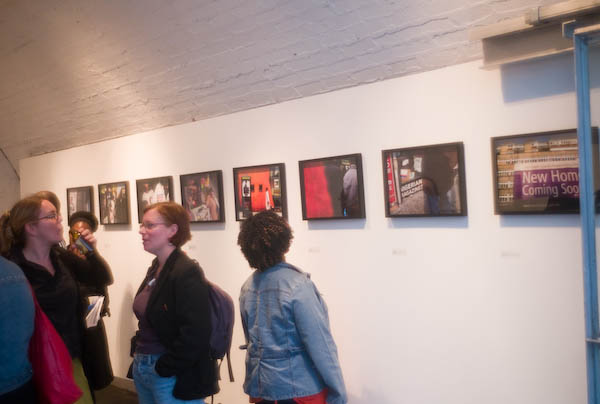
Thabo Jaiyesimi’s work on the gallery wall

Thabo’s series of eight images taken on the streets explore some of the issues and cultural richness of the area, often using vivid and emotional colour. A sign for housing in front of a locally notorious block of flats, shop fronts making the link to Nigeria, and another image with a black woman making a phone call tell of the distant roots of many in the area. A crowd bustles in front of the bus from central London, a black woman in a white coat pulls her shopping trolley in from of a bright orange wall and a telephone carrying a advert for the 2005 film ‘Get Rich or Die Tryin’, a partly autobiographical movie in which Curtis “50 Cent” Jackson as ‘Marcus’ plays a drug dealer who aspires to be a professional rapper.

(C) Thabo Jaiyesimi
Image courtesy of Thabo Jaiesimi

For me the most interesting image was one taken on the recent protest against gun crime in Peckham. Thabo’s flash lights up a pink glove pointing at the poster on a man’s chest reading “MURDER £20,000 reward”. The black girl’s finger points as she reads the smaller print, but reads like a gun. You can see more of his work on his web site.

Installation - Daniele Tamagni
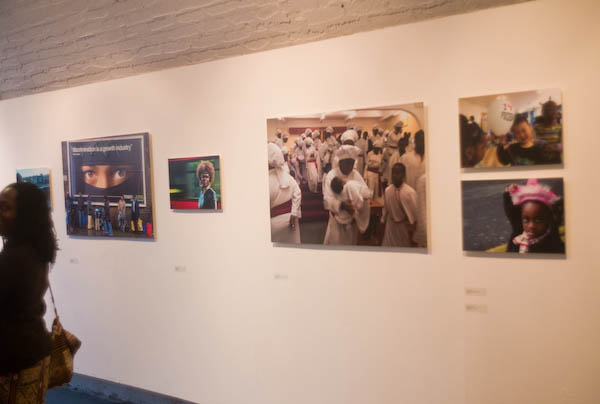
Daniele Tamagni’s work on the wall

I talked to Italian photographer Daniele Tamagni about his work in Peckham, and he showed me a newspaper feature on his previous show of pictures taken in black churches in Peckham. The large image from this project on show at the Sassoon was an extremely striking picture, a sea of white-robed figues with a woman in the foreground coming towards the photographer cradling a baby. The only white face in the image, carefully framed between the figures, is a statue of Jesus, arms outstretched on the wall at the front of the church behind the people.

Although there were a number of interesting images in his work, overall I found the selection too disparate, and at the same time too small to represent the multiplicity of Peckham. I would much rather have seen a more focussed display of his work – such as that on the churches or another project Tamagni has done on hairdressers in the area.

Listenitng to the sound piece by Janine Lai
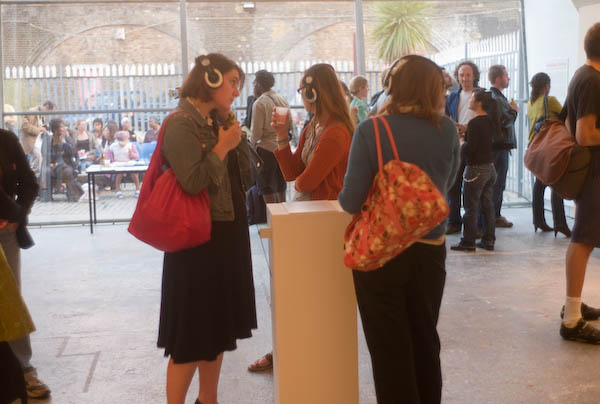
Listening to Janine Lai’s sound piece

The voices recorded by Janine Lai, who works at Peckham Library presented an interesting kaleidescope of views from Peckham residents, although I found the presentation difficult to follow, trying to listen to two people at a time. It will also doubtless work rather better during the rest of the show than at the opening, with only three sets of headphones available. Perhaps for the opening it could have been put through a loudspeaker?

Perhaps the hardest part of the show for me were the texts by the curator, Paul Goodwin. In so far as I could understand the rather obscure language that is apparently a prerequisite for academic credibility, I think that he seemed to be promoting a rather uni-dimensional view of Peckham that is as limiting in its different way as the media stereotypes which he seeks to confront.

But Goodwin’s intention is, at least in part, to promote dialogue, and both the show and the lively ‘Peckham Regeneration debate‘ that took place during the opening showed a more cosmopolitan Peckham than emerges from the apparently simplistic viewpoint of black urbanism. It is an interesting show, although I’m not quite sure why, according to ‘Myspace‘ it is Female and 47 years old!

The Debate
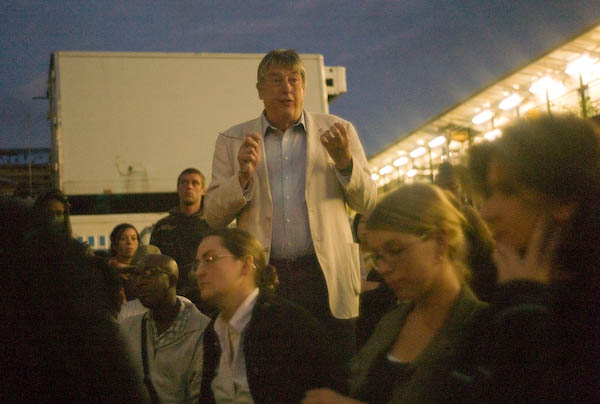
The Peckham Regeneration debate – a contribution from the floor

You can see more of my pictures from the opening, (shot with a Leica M8 and a 35mm f1.4 lens that can almost see in the dark) on ‘My London Diary‘ shortly. They include images of the speakers at the debate, more of the installation and some pictures of the photographers I met at the show.

Footnote
The Sassoon name is one with an interesting Peckham connection. The Sassoon family were Sephardic Jews, descendants of King David, and were some of the first Jewish settlers in Bagdhad, where they became courtiers and wealthy businessmen. But it was only in the nineteenth century that David Sassoon established a great empire trading with India and the Far East, and sent one of his son’s to open a small outpost in London in 1858. After his death, the family, sometimes referred to as the Rothschilds of the East, largely moved to England.

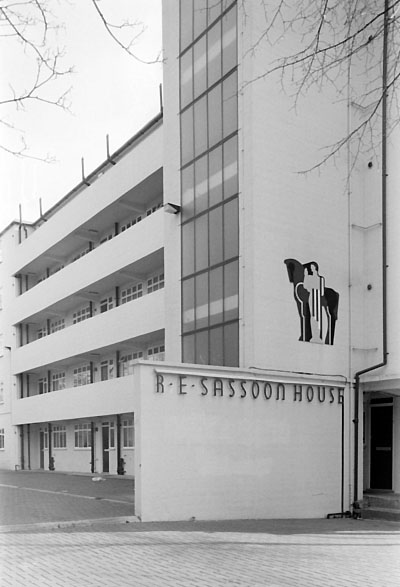
In 1932-3, the incredibly wealthy widow of Meyer Elias Sassoon, Mozelle Sassoon, engaged architect Maxwell Fry to build Sassoon House, his first modernist work, a still striking block of working class flats in St Mary’s Road, Peckham, as a gift to the Pioneer Housing Trust in memory of her son, R E Sassoon.

(C) 2007, Peter Marshall
R E Sassoon House, Peckham. (C) Peter Marshall, 1989, 2007

Mozelle was the great aunt of Siegfried Sassoon, although he first met her in 1914 when he was in his late 20s. His artistic talent probably came mainly from his mother’s side, where hordes of the Thornycroft family – including many talented women, were well-known as sculptors and painters in the 19th century – as you go over Westminster Bridge you pass Thomas Thornycroft’s ‘Boadicea and Her Daughters.’ But probably the best-known Sassoon now is hairdresser Vidal, who, so far as I know, is without links to Peckham (although his Greek-born father’s family had its origins in Iraq) and was born in poverty in Whitechapel.

Peter Marshall

Taming the Swirl

Since I’ve had the Nikon 10.5mm semi-fisheye I’ve come to regard it as an essential lens. It isn’t something I want to use every day on every subject, but when you find a subject that needs it, it is generally the only thing that will do.

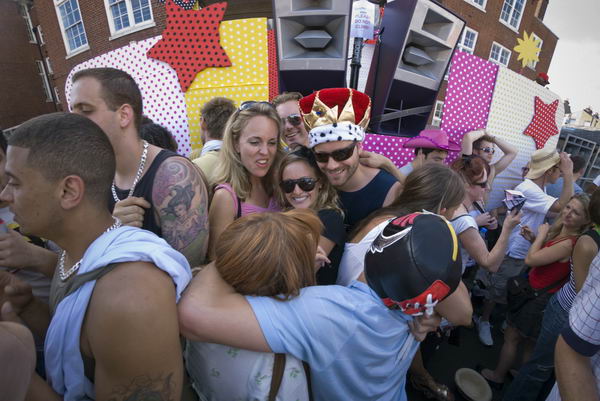
One thing I love is the ability to shoot in crowds, where you have essentially zero working distance – if you try and draw back to get your subject in frame, other people just fill up the gap. With the ‘fish’ you can avoid leaving gaps and take your pictures. But there is a down side, and it is what happens close to the frame edges, where people (or anything else) gets curiously curved towards the edge and stretched out vertically. Sometimes you get a face that looks more like a caricature drawn on a kind of crescent moon.

Corrected Image
Image has been corrected using Fisheye Hemi.

It’s all a matter of perspective, and working on digital makes it a simple matter to alter the perspective projection; many images are considerably improved by re-mapping them using the free Panorama tools plugin for Photoshop. Its perhaps surprising that changing to the normal rectilinear mode seldom gives usable results, at least not without excessing cropping. It just isn’t a viable method for very wide angles of view, as it greatly stretches anything near the edges of the picture.

Usually the best results are made using the ‘QTVR-Panoramic’ setting, although the ‘PS-Sphere’ can also be interesting. Both do however involve a noticeable loss of the image.

You can see some examples and comments in my Getting More from the Nikkor 10.5 Fisheye
and also Fisheye Hemi and other plugins. The others include the very versatile PTLens, an essential tool for anyone shooting digital, particularly if you ever photograph subjects with straight lines.

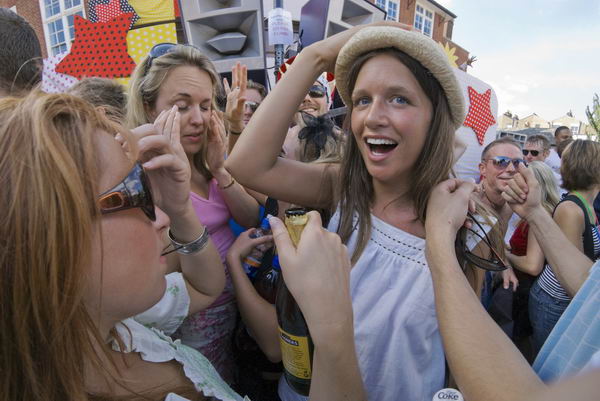
The two images here were both made using the appropriate Fisheye Hemi plugin to remap the perspective. I also used Lightroom to remove chromatic aberration and remove the slight lightening at the edges of the frame – a kind of negative vignetting.

Corrected using Fisheye Hemi
Another corrected fisheye image

I don’t know what Reuters would make of this; it almost certainly would be in breach of the actual rules they set down. To me, this kind of manipulation is an important part in making my pictures more accurately represent the situation I was photographing. It would be nice if lens-makers could produce lenses that worked more like the way that we see things, but I think physically impossible. With digital we can use software to get closer.

Peter Marshall

Perrin’s People

It was impossible not to respond positively to the work of French photographer Gilles Perrin taken in Africa and elsewhere around the world, although I also found it hard to know what to say when he brought it to show me at Rhubarb Rhubarb in Birmingham. His images, taken carefully, reverentially of his subjects, using a 4×5 camera on a tripod and using long exposures (from perhaps 1/8 to a second) acknowledge and value the individuals who work with him, and the use of a Polaroid Neg/Pos film enables him to give them their image while he retains the negative for later printing.

Much though I admired his work, and the patient and sometimes dangerous travels which he made to find his subjects, I also found myself wondering how his practice could be supported, and whether it was in some respects a relic from a bygone age. Some of his subjects too, he told me, no longer appreciated the kind of humanistic exchange represented by the gift of an image, and demanded payment rather than a picture. He travelled among tribes where everyone had a gun, and it was necessary to pay the fee that they demanded.

Looking at his work, my mind went back to my childhood years, and the large pile of yellow-bordered magazines that had once belonged to a distant richer uncle, ‘National Geographic‘ magazines from the 1920s and 1930s. In their pages were images not dissimilar from many of those Gilles showed me (though seldom anything like as clear or assured) but that it seemed to me was the ideal client for his work – given a time machine. It was, incidentally, these magazines that I think first got me interested in photography, though not necessarily always for the right reasons.

Surprisingly, although all he showed was black and white, and many of the images would have been both more informative and possibly more startling in colour, it was not until near the end of his presentation that I really felt a strong need for colour, when a multiple image print including Tibetan prayer flags seemed somehow too drab. The images of people have a rapport, a connection with the subject that is strong enough to make thoughts of colour irrelevant (although it may weaken their interest as simple records of these rapidly disappearing cultures.)

I won’t put his work here – you can see so many sets on the web site, and read – almost entirely in French – his thoughts about the work. There are so many fine black and white portraits from Africa, Egypt, South America, Asia and of course France.

You can also see some colour urban landscapes from the Val de Marne and Bobigny (a suburb just to the north-east of Paris where I’ve sometimes changed buses to get to my brother-in-law’s place at Noisy-le-Grand.) The work from Val-de-Marne seems somehow more personal and more varied, and even includes one image actually shot as panoramic, rather than the triptychs and sets of four carefully aligned images Perrin more normally uses. Perhaps in the work from Bobigny the sheer technique needed to produce the work prevents the kind of spontaneity and interaction that I like.

Although I loved the work, admiring the images, I ended up wondering about whether it somehow was out of time. When others before done this kind of thing so well, is there still something new to say, or should photographers in the twenty-first century be finding new pastures? And perhaps importantly, is there a market for work of this type now? I’m not sure, but I hope so. Work of this quality and integrity deserves to be seen and to be rewarded.

Looking at Gilles’s work, I found it hard to know what to say, other than to admire it. But having seen the web site perhaps I can offer just a little advice. Firstly, to that he should get his own domain. Then to take a good look at the web design and in particular produce an index page that is more visual, and to cut down the overwhelming blackness that diminishes the images. And finally to provide the text in English (as well as French) on all pages; like it or not, English is the major language of the web.

Rhubarb Rhubarb: Jaskirt Dhaliwal

I met Jaskirt Dhaliwal, one of the festival volunteers helping with the running of Rhubarb Rhubarb, on the coach trip on the coach trip to Walsall, and had enjoyed hearing about her project in Bearwood and her enthusiasm about it, Birmingham and photography, so I was intrigued to see what her pictures were like. So when I saw her sitting with a box of pictures at the book launch I went over and took a look.

I wasn’t disappointed. Her work has a freshness I find appealing, and the Bearwood series, which examines peoples ideas about community through a series of portraits of residents of this small town on the edge of Smethwick, just outside the centre of Birmingham. Each is shown in a location that has a particular resonance for them, and she has explored through them the question of why some people at least “continue to live in the same area for decades“, although, as she found, “a lot of other people photographed for this series believed the notion of community has disappeared.”

Unlike many groups of photographs which centre around a strong theme, the images here also show a sensitivity to the situation and the personalities involved. I benefited from hearing something about the people in these pictures as I was shown the images, and I think it would be useful to have some short texts with the images on the web site. Looking at the image of Mick, for example, it is not immediately obvious where he has chosen as the location for this image, nor his reasons. It is a portrait that echoes something of his personality, but for the project we need more.

Mick (C) Jaskirt Dhaliwal
Mick

Jaskirt graduated this year from Coventry University, where her degree was in Communication, Culture and Media. Her final project proposal, on Women Footballers, gained her the Photo Imaging Council Award 2007, and was exhibited earlier this year at Redditch United Football ground, at Focus on Imaging in the NEC at Birmingham, and, together with work from Bearwood, at Coventry Glasshouse gallery. You can also see work from Women Footballers on her Flickr site, as well as four images of British Asian Musicians.

Peter Marshall

Foto8 – The Dirty Magazine

I’ve just been looking at the latest issue of foto8, the so-called ‘Dirty’ issue, although there will be some very disappointed customers if they buy it on the basis of this title. Rather than being a ‘dirty magazine’ its an issue that concentrates on issues related to the environment – and a few other things.

You can see a preview including an index of the issue on the foto8 web site, although the thumbnail pages are considerably too small to give much idea of the features – I’d certainly suggest some re-design in this area, perhaps linking each to a page with a rather larger image, and, at least in the case of the longer features, some explanatory text. I can’t imagine many would feel impelled to buy from what is on show here.

If, like me, you have an interest in documentary photography and photojournalism, then I think it is ones of the best magazines around. I’m happy to be a subscriber, although I’ve yet to take advantage of their special offers on books.
It would be very difficult to guess from the thumb that Andrea Dapueto‘s ‘A Room of Their Own‘ is about the work areas of prostitutes in the bushes by the Italian roadside, and while the title ‘Cry for Me‘ might indicate that Alberto Giuliani’s images are from Argentina, there is almost nothing that can be inferred from the minute image about what is in some ways the most interesting portfolio in the issue.

Justin Jin‘s image in ‘Rags to Riches‘ is simply some blue blotches. It’s actually probably not a good editorial decision as the opening image for the story in any case, atypical and possibly the weakest image in the piece, which is an interesting look at the manufacture of fashionable jeans in China – with pictures showing the workers who at considerable risk to their health produce and distress these items for near slave rates.

I’ve written previously about Jacob Holdt‘s American Pictures. In 1969 Holdt ran from his native Denmark to avoid trial for political activities and spent around ten years hitching around America, staying with anyone who would put him up, as it says on his web site, “from the poorest migrant workers to America’s wealthiest families such as the Rockefellers. They not only gave him a hospitality and warmth, but their continuing friendship to this day.”

He gave blood twice a week to buy film to photograph mainly the 400 families he stayed with. You can see some of the work from this trip on his American Pictures site, and in particular in the presentation Roots of Oppression, which uses his pictures alongside historical images of the slave trade and of segregation in America.

Holdt in many respects isn’t much of a photographer, but in some ways the images gain from being mainly simple snapshots. I don’t think I’ve seen him mentioned in a print photo magazine before and although it is useful as a pointer to his work, viewing on-line has many advantages. The careful selection of his work for inclusion in the magazine perhaps makes it look rather different with its concentration on the dramatic. Incident rather than normality.

Perhaps the weakest aspect of foto8 is in the writing; the three ‘columns’, whose connection with photography is rather tenuous; the reviews too seem generally superfluous and sometimes ill-considered, and I’m sure the magazine would be stronger without them. Of course there are exceptions – such as the article on the documentary film ‘Black Gold’, and the end page item ‘On My Shelf’, where someone talks about the books that have influenced them is often interesting.

Rhubarb: Matthew Pokoik

Its interesting to see comments from the other side of the table about Rhubarb Rhubarb, and one of the photographers who presented his work to me on Friday afternoon was Mathew Pokoik. So far on his blog you can read two comments on the event, Rhubarb Rhubarb – a dream – and Walker Evans and Italo Calvino, portfolio reviews, and Perseus.

I find myself in agreement with much of what he says, although I think it rather silly to worry about what he calls the ‘pay to play‘ aspect. You can’t really expect all the work and organisation that goes into such an event to happen for free. Someone does has to pay for it all.

As a reviewer, I didn’t have to pay, though it did in fact cost me not inconsiderably in several ways to be there in Birmingham for the four nights. I didn’t begrudge it, as Matt says, it is a great way to meet people.

The meeting between reviewer and photographer is perhaps the closest thing in photography to the confessional, and I certainly have no intention of revealing the secrets that passed between Matt and myself. I can however say that I invited him to send some of his work from his work in progress ‘the global city‘ for the urban landscape site that I run along with Mike Seaborne, who is curator of photographs at the Museum of London.

In one of his pieces Matt says “After presenting my work time after time today, honing my “spiel”, frankly I’m a bit tired of all this talk about myself!” I think most reviewers would actually prefer a more relaxed attitude, though probably not the “speak only in mythological images” approach he muses about. The mistake of some (fortunately few) of those I saw was to try and speak too much about their work rather than let the images speak for themselves. We don’t have much need for mythology when we have photographic images.

Matt also writes of having dreamed of a unknown young Walker Evans bringing the dummy for ‘American Photographs‘ into the portfolio review, and how he would have been treated. Had he come he might have met his ‘Lincoln Kirstein’, as two of today’s best book editors were certainly among the Rhubarb reviewers. ‘American Photographs‘ certainly owes a great deal to Kirstein who helped Evans greatly on the selection, sequencing, design and possibly, through donations to MoMA, the financing of the book.

Considering that the critics of the day mostly panned the book on publication (some of the worst comments came from other photographers), Pokoik gives the Rhubarb reviewers a pretty good batting average by suggesting that “that roughly a third of the reviewers would tell this young artist that the work was too broad“.

Actually I think not. Walker would have put the case for his work simply and straightforwardly and his pictures would have done the rest. There were several portfolios I saw over the 3 days that left me little to say, although I’m pretty well certain I saw no young Walker Evans.

Reviewers too have their different motivations for taking part in these exchanges (not least that we would all like to discover a young Evans), but most of them get to be reviewers by in some way demonstrating their competence. You can – if you wish – still read the several thousands of features, some trivial others less so, that I’ve written on the medium, or even look at the perhaps ten times as many images I’ve published, mainly indifferent, some bad and a few good. The thirty years of teaching is harder to inspect, though a few of my students haven’t done too badly.

Of course some of the photographers also have considerable experience, but the reviewer always has a considerable advantage, that of being able to view the work in a more detached manner. I wrote a little about the review process on the way home from Rhubarb Rhubarb in a piece called (after Minor White) ‘Three Canons’ and the second of these is I think a very valuable piece of advice:

  • When making your pictures think for yourself; when preparing to present your work, think of your audience.

But putting yourself in the place of your audience isn’t easy, and its something many photographers find themselves unable to do. But reviewers are a part of your audience, and those at Rhubarb a particularly knowledgeable and articulate segment If you want to get your money’s worth from the event it makes sense to think very carefully about what they say, even if in the end you reject it. If as many as a third of them are giving a similar message, it is perhaps time to consider very strongly if they might have a point, even if it isn’t one you want to hear.

Equally important is not to read into advice things that are not there. I sincerely doubt anyone in Birmingham was advising any photographer to move down “a path of safety and mediocrity” so we have to think what might have really been said and whether it was justified. If as many as a third of reviewers actually said so there is a very good chance it was.

I’d suggest that people take a look at ‘the global city‘ on Matthew Pokoik’s web site. It’s perhaps interesting given the concern Matthew expresses about ‘”honing’ his spiel’ that on the web site he appears to present it without text.

Rhubarb: Louis Quail

I enjoyed talking with Louis Quail at Rhubarb Rhubarb, and looking at project he is developing on office work, ‘Desk Job’. Perhaps surprisingly the office is an area that has attracted some fine work from photographers in the past, and some of Louis’s work colour images reminded me of the black and white portraits taken by Brian Griffin for ‘Management Today’, as well as the colour documentary work by Anna Fox from the 1980s, published in 1988 by Camerawork as ‘Workstations‘.

I first saw her work when Anna came to a few meetings of ‘Framework‘, a small group of photographers who met in West London in the 1980s, and was immediately a fan (and it made me switch to printing on Fuji paper.) Unfortunately her work is hard to find now, although I was pleased (but certainly not surprised) to see it included in the Tate show “How We Are”. Presumably she is too busy running the photography programme at the Surrey Institute to think about a web site.

Another photographer I’ve met who has produced interesting work on the office is Lars Tunbjork, who I met in Poland in 2005. His show was one of the highlights of the festival there for me, but I’ve never published the piece I wrote about his work because the pictures it needs are not on the web. You can see a few images from his work at the Moscow House of Photography, and also in the ‘Booktease’ at photo-eye, but you really need to see either the finely printed book or his originals to fully appreciate the work.

I enjoyed seeing the work and thinking about it, and I hope the discussion was of some interest to Louis.  I look forward to seeing the finished project listed on his web site. He did also show me some of his pictures from a project on UK Swingers:

(C) Louis Quail
Image (C) Louis Quail: UK Swingers. First published Arena Magazine, Jan 2003.

and you can see more of this project on his web site, along with some other great features including a personal project on the world of Club 18-30 holidays.

Quail’s work has been published in a wide range of magazines including The Saturday Telegraph Magazine, The Sunday Telegraph Magazine, Telegraph Newspaper, The Sunday Times Magazine, Observer Life, Marie Claire, Arena, Stern, Dagbladet, Nieuwe Revu, kronenzeitung, The Mirror Weekend Supplements and FHM, and he also does advertising work for some well-known clients.