New York in London

There is of course a sense in which a show like ‘The New York School‘, currently at the Michael Hoppen Gallery in London’s Chelsea, is bound to disappoint, and it is one that is heightened by the hype in the listings which describe it as “An overview of a period of intense photographic creativity from the Big Apple featuring the likes of Diane Arbus, Robert Frank and William Klein” (BJP)

It certainly isn’t an overview. Michael Hoppen is a commercial gallery and the contents of their show is determined by what can be found currently on the market and so offered for sale – only a couple of the works were without prices. It would be impossible to mount a real overview without the collaboration of various museums and collectors in lending work, and would require a considerably larger space. London saw a much better overview as the first half of the major Barbican show ‘American Images‘ in 1985 – and that just isn’t the kind of thing a commercial gallery can hope to match.

We can perhaps take “the likes of Diane Arbus, Robert Frank and William Klein” simply as sloppy journalism, in that the very point about these photographers was that they stood out as each having a particular view. There is a decent print of one of Klein’s better pictures in the show, but Frank and Arbus are poorly served by the couple of examples on offer, at least one of which should clearly have gone direct into the darkroom waste bin.

I went to the gallery not expecting a great deal, and in that respect I wasn’t really disappointed. There were however at least a couple of prints that interested, even moved me, including a fine photogravure of four men from the mid 1950s by Roy DeCarava (surprisingly not included in his fine volume ‘the sound I saw‘ although his second picture in the show, to me less interesting image of dancers is – and I think looks better in the book.) Unfortunately the lighting in the gallery gave maddening reflections – if you want to see the richly stygian ‘Four Men‘ at its best you should take a large black card along with you. I could only really make out two of them in the show.

One of a few Leon Levinstein pictures also caught my attention, although it perhaps lacked the kind of shock of his best work it did have a little of his characteristic directness.

Overall, by the time I’d been round the show – which does include some other pictures, particularly by Weegee and Louis Faurer, of at least some interest – I was beginning to think a more accurate title might have been ‘New York on a Bad Day’. Most of the photographers in it are deservedly well-known, but not on the basis of what was on show here. (I’ve never quite understood why people rate Ted Croner (1922–2005), an early Brodovitch student who he sent to photograph the city at night, and certainly what I saw here didn’t help.)

But as an overview, it simply omitted so many photographers whose work seems so central to the creative ferment stirred up by the New York Photo League and by Brodovitch in the period around and after the war. It was also perhaps rather defocussed by the inclusion of work from the city by two visiting British photographers, David Bailey and Neil Libbert.

Perhaps the good prints from the ‘New York School’ are all elsewhere, in galleries on on people’s walls, or, hideous thought, stashed in vaults by ‘investors’. Fortunately we are talking photography, and it is often best seen in books. One of the best overviews of what this show purports is still the catalogue of the Barbican show, ‘American Images‘ still readily available secondhand at a very reasonable price (ranging from 74p from one US bookseller, up to £65 elsewhere.)

Changing Spaces at Photofusion

I usually like going to exhibition openings at Photofusion, though more often it’s the people I meet there that make it interesting than the pictures on the wall. Photofusion is very much a photographers gallery and most of the people at openings have a real interest in the medium. Its also a much more friendly place that most galleries, one where you can talk to strangers and meet new people, as well as bumping into old friends and acquaintances.

If anyone doesn’t know, Photofusion is London’s largest independent photography resource centre with a full range of facilities and services for pros, amateurs and students. Members can work in a well-equipped digital suite (or for the retro, darkrooms) hire a studio attend courses and events at reasonable rates, and Photofusion’s picture agency represents the work of many photographers whose work deals with social and environmental issues – including some of my own.

It’s also very handily placed in Brixton, 2 minutes walk from both the Victoria line tube and Overground station. When I did a project on people on buses Brixton was one of my favourite places to work, because there were just so many buses and people. I dropped in to Photofusion last night on my way back from photographing in the centre of London, a fifteen minute journey by tube.

The current exhibition, Changing Spaces, (until 21 June, 2008) has work by five photographers, Laura Braun, Mandy Lee Jandrell, Isidro Ramirez, Simon Rowe, Gregor Stephan and is a part of the Urban Encounters programme, a collaboration between Photofusion and the Centre for Urban and Community Research at Goldsmiths (part of the University of London, based at New Cross.) Curated by Paul Halliday and Catherine Williams, this also includes a conference, talks and workshops.

The show aimed to present different approaches by photographers to urban spaces, and is one of the more interesting currently on view in London, although I find some of the writing about it more than opaque. Here’s a short chunk:

Laura Braun’s move towards sub-urbanisation in the mid 1900s, show social and public spaces devoid of the photographs of Downtown Los Angeles, the once glamourous heart of the city, side-lined and in decline since the pressure of people however with the traces of their passing intact.

This certainly isn’t English as we know it, and must surely be the output of some deranged computer programme that strings together random phrases in an attempt to demonstrate artificial intelligence. But doubtless it will be clear to speakers of Acadamese.

Two projects of the five appealed particularly strongly. One was by Isidro Ramirez who gained a BA on the Editorial Photography course at the University of Brighton in 1998 and an MA in Photography and Urban Cultures at Goldsmiths in 2006. His pictures in the project What We Don’t See are of spaces in which blind and visually impaired people live and work, and show a fine sense of both space and light. I think they reveal considerably more about how the photographer sees than about how those who inhabit the spaces perceive them. Keeping spaces relatively open and uncluttered is of course essential when vision is limited, as we found when my late father-in-law used to stay in our untidy home.

Simon Rowe worked with Francesca Sanlorenzo and Ben Gidley of Goldsmiths on the 2004 Pepys Portrait Project. His work on show is “part of a larger project about the Pepys estate, present a portrait of a South East London housing estate as it moves into a new era. The project reflects a sense of the multiplicity of human and social relationships against a background of social change and regeneration.” Both this text and his pictures are models of clarity and show a real feeling for the people and place.


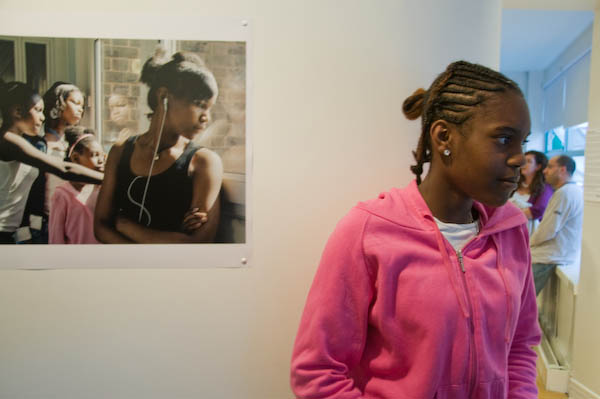
Some of the people in Simon Rowe’s pictures were at Photofusion for the opening

The Pepys estate in Deptford was built by the GLC, (Chief Architect Ted Hollamby,) in the 1960s on a prime 45 acre site next to the Thames to provide over 1,300 homes. Opened by Lord Mountbatten of Burma in July 1966, it was lauded at the time as a landmark in social housing, and gained a Civic Trust award.

Pepys Estate (C) Peter Marshall
Pepys Estate, 1982 (C) Peter Marshall.

By the 1980s, when the estate was handed over to Lewisham Council, the buildings had deteriorated through poor upkeep and the estate had become known for crime, vandalism and drugs. Problems were confounded by those of language, with many asylum seekers being housed there.

Regeneration started in the early 1990s, mainly refurbishing existing buildings, but came to a halt in 1998, with six blocks on the prime riverside sites not completed. Lewisham engaged in complex and highly doubtful moves, against considerable opposition from Pepys tenants, finally resulting in Aragon tower being refurbished as a private block by Berkley Homes (handy yuppy flats for over-paid workers at Canary Wharf) and the five low rise blocks being replaced by 250 new homes by Hyde Housing Association.

Robert Rauschenberg: Photographs

Suffering today from the annual and unwelcome reminder of ageing (though the presents are nice) I got to thinking about Robert Rauschenberg, who died two days ago on May 12, aged 82.

As the New York Times obit by Michael Kimmelman says

“A painter, photographer, printmaker, choreographer, onstage performer, set designer and, in later years, even a composer, Mr. Rauschenberg defied the traditional idea that an artist stick to one medium or style. He pushed, prodded and sometimes reconceived all the mediums in which he worked.”

Although I have a book of his photographs (Robert Rauschenberg Photographs, Thames & Hudson, 1981, ISBN 0 500 54075 6) it seems to me that photography is the one medium about which this isn’t true, although of course he made considerable use of photographs in various mixed media works, both using his own pictures and solvent transfer prints from magazine images.

In the book Rauschenberg comments that he first took up photography as a young man, it was a “social shield“, covering up the perosnal conflict he felt “between curiousity and shyness“. In the interview published in the book with Alain Sayag, Rauschenberg says that while studying with Josef Albers (who he elsewhere said “was my best teacher, and I was his worst student“) at Black Mountain College in 1949 he became aware that he had to make a choice “I was serious enough or dedicated enough to know that I could not have at that point two primary professions“. Since at that point his photographic project “was to photograph the entire U.S.A., inch by inch” it’s perhaps good that he chose painting (later, in 1980-1, in his project ‘In + Out City Limits’, he did try to photograph at least parts of the country.)

Had Rauschenberg been as excited by other teachers at Black Mountain – perhaps Aaron Siskind or Harry Callahan, the history of art and photography would have been different.

Rauschenberg’s early photography was good enough for Edward Steichen to buy two of his prints – one a portrait of his friend Cy Twombly – for MoMA‘s photography collection – his first sale to a public collection.

The first group of pictures in the book are from the period when he had given up photography, and are perhaps the strongest, uncropped square format images with a strongly emotional content, although the often square-on approach to the subject and sensitivity to lighting carry suggestions of Walker Evans. His later work when he returned to photography (I think, from the evidence of the images with a 35mm SLR) in 1979-80 are more related to formal concerns and less personal, although many are still very interesting, concentrating largely on urban details. Many of them were from the project In + Out City Limits (1980-81) mentioned above, which was followed by other photographic projects, including Photems (1981/1991), and Chinese Summerhall (1982-83.)

Rauschenberg comments that for him photography is “a kind of achaeology in time only, forcing one to see whatever the light of the darkness touches and care” and goes on to state: “Photography is the most direct communication in non-violent contacts.”

Sayag asks him why he never crops, and gets this response:

Photography is like diamond cutting. If you miss you miss… You wait until life is in the frame, then you have the permission to click. I like the adventure of waiting until the whole frame is full.”

Rauschenberg was certainly a great artist, and had he devoted himself to the medium could also have become a great photographer.

Unfortunately very little of his photographic work seems to be available to view on the web.

Here is an example Untitled, ca 1952 though it is not in my opinion one of his more interesting images. There are also one or two fairly poor reproductions from In + Out City Limits: Baltimore, Los Angeles and a rather better exhibition poster for Los Angeles.

Steichen Portraits – National Portrait Gallery

Americans visiting London sometimes express surprise at coming across the National Portrait Gallery close to Trafalgar Square, so perhaps I should make it entirely clear that the show of portraits by Edward Steichen (1879-1973) is not at that venue, but in the National Portrait Gallery, part of the Smithsonian Institution in Washington, DC. Fortunately some 21 of the portraits are in a web gallery, and a good reminder of why, as the site reminds us, in the 1920s Vanity Fair called him “the greatest of living portrait photographers” although this was perhaps coloured by the fact that he was being taken onto the staff as chief photographer for Condé Nast publications.

There are several very fine photographs among those on the web, including his well-known self-portrait as a young artist and his dramatic image of J P Morgan, both made in 1903, although perhaps the selection of later images misses some of his best. You can see a wider range of his work on Luminous Lint, or of course on Google Images, which includes one of my favourite portraits by him, of Greta Garbo, hands on head. It’s interesting to see it along with other images of the star on the Greta Garbo page (click on the images for larger versions.)

Here is something from my notes about the Morgan picture:

Use of the gum process, together with high contrast lighting led to a powerful effect. Morgan sits on a chair, facing the photographer squarely. Virtually all of his dark suit merges into the dark background, leaving his face with it’s piercing eyes staring intensely out. The lighting falling at an angle across his hand and on the arm of the chair produces a sunlight shape that can only be seen as a dagger in his grip, grasped and menacing. Also emerging from the dark background are Morgan’s white business collar and his watch chain – clearly symbolising the industrial process by which human labour was combined and synchronised to the clock.

The show ‘Edward Steichen : Lives in Photography‘ opens at the Palazzo Magnani, Reggio Emilia, Italy today, until June 8, and then travels on for a showing in Madrid. A collaboration between the Foundation for the Exhibition of Photography and the Swiss Musée de l’Elysée, curated by William Ewing and Todd Brandow, it has already been shown in Paris and Lausanne, but surprisingly there is no British showing planned for this major show with over 250 original prints and considerable supporting material.

Or rather it isn’t surprising, just a reflection of a continuing lack of real recognition for photography in the UK.

Ryan McGinley’s Lost Summer

In the past I’ve written appreciatively about the work of Ryan McGinley, thoough I wasn’t greatly overwhelmed by his Oscars portfolio. I have to admit I share much of Joerg Colberg‘s doubts about his current work on show at the Team Gallery in New York, although I’ve only seen it on the web, not in the flesh (and there is plenty of that in the show.) James Danziger, in another blog on my regular reading list, suggested that the opening of this show on 3 April was “the place to be in New York this week (if not the entire spring)” and goes on to includes most of the publicity from the Team web site. But it’s worth looking at his blog on the show, not just because it saves you a bit of clicking to see some of the pictures at a viewable size (Team does really need a site redesign) but for the comments that others have added.

McGinley is now 30, and frankly seems to have got lost, perhaps seduced by becoming too well-known. From being someone who said “I eat, sleep, move and breath photography 24-7” and trying to photograph the whole of his life and his fantasies, he has moved into everything being a production. “In the summer of 2007, for example, he traversed the United States with sixteen models and three assistants, shooting 4,000 rolls of film. From the resulting 150,000 photographs, he arduously narrowed down the body of work to some fifty images, the best of which are on display here at the gallery.”

Perhaps if he fired the models and assistants and got a life again the work would be more interesting – or he could have tried perhaps a million shots. Getting his inspiration from “the kinds of amateur photography that appeared in nudist magazines during the 60s and early 70s” may not have been such a good idea, though it may explain why the word that sprang into my mind on seeing this stuff was “insipid“. Actually some aren’t bad, but even the better images seem to me to be a kind of pastiche. One reminds me of my least favourite (but incredibly commercial) American painter of the 20th century, others I’ve seen on poster stalls in markets, as nude pictures of reader’s wifes…

One picture I do rather like is Firework Hysterics, which has a kind of medieval touch to it, and has a curiously flat figure floating in a starry black sky, though I have a suspicion that it works far better at the 272×400 pixels of the web site than as a 40×30 inch C-Print.

McGinley sprang into the photography world when still a student at Parsons School of Design in 1999, by printing a 50 page book ‘The Kids are All Right‘ on his computer, selling 50 copies and sending another 50 free to magazine editors and artists that he admired – including Larry Clark, who had photographed the young McGinley a part of his 1990 series “Skaters“. He also put up a show of this work in an empty area of a building being refurbished on West Broadway in New York in 2000. His initiative got him work for magazines while still a student and into a group show in a New York gallery in 2002, as well as shows in Berlin and Milan. In 2003 became the youngest artist to have a one-person show at The Whitney Museum of American Art, as well as shows at the Rhode Island School of Design and in Toronto. The ICP were perhaps a little slow in waiting until 2007 to give him the Infinity Young Photographer Award. The New York Times ran a feature on him at the time, as well as publishing my piece on About.com (no longer available on line.)

Tiny Vices has links to pictures of a number of his projects, including work from ‘Sun and Health‘ and ‘Irregular Regulars‘ and some more pictures elsewhere from I Know Where The Summer Goes.

Silverprint

It’s a while since I last visited Silverprint in Valentine Place, off Webber St, a few minutes walk from Waterloo Station in south London. With the shift to digital in most aspects of photography, my requirements for photographic materials in general have dropped greatly. I seldom make actual prints, viewing images on screen, supplying work as digital images.

Even for exhibitions I’ve supplied work digitally. The 24 pictures I sent to Brasilia travelled by e-mail (all 96Mb) and I’ve previously written about my excitement when the prints, made by the best lab in Brazil, in Sao Paulo, were unwrapped for hanging. I’ve not actually seen the extremely large print made from my file I sent to Hungary for the touring ‘Europe Of Culture – The Culture Of Urbanity‘ show, and even for the two shows across London in Hackney which I had pictures in last year the images were sent as files.


This picture was in ‘Out and About in Hackney ‘at the Hackney Museum

The pictures for the Roof Unit show at Space went digitally because we had decided to print using Lightjet, and I have to admit they were very nice prints, although probably I could have done as well on the considerably cheaper Epson R2400 I normally use.

But most of my older work on photographic paper was made on materials imported by Silverprint – and it’s precursor in Muswell Hill, Goldfinger, where I benefited from the advice that was available both personally from Peter Goldfield and Martin Reed and in print in the old Goldfinger craftbook. Later came an encyclopaedic Silverprint Ag+ manual and Silverprint magazine that became Ag+ magazine.

You can read the latest news from Silverprint on their web site and one of the more interesting additions to their range is InkAID, which enables you to coat almost any surface – including traditional fine art papers, metal, plastic and wood veneers, so they can used to make decent ink jet prints – assuming of course that you can feed them through your printer.

Also available as a large download(10Mb) from the site is an article by a photographer I mentioned recently, Angus McBean, written and photographed by him for ‘Homes & Gardens‘ magazine in March 1977. This describes the restoration by him of his Elizabethan house, and as might be expected he certainly makes it into something theatrical if not a place I would find comfortable to live in. The photography is of course extremely professional, but frankly rather ordinary, and unless you have a particular interest in period homes your time would be better spent at the rather eccentrically designed Angus McBean web site.

A Day with Panasonic

I’ve often seen the RIB (Rigid Inflatable Boats) speeding along on the river and wondered what a trip in one would be like. Today, thanks to Panasonic, I got to find out. It actually felt surprising smooth and safe, although they did tilt at quite a steep angle when turning sharply at high speed, and I often felt a need to hold on with one hand while taking pictures. But it was enjoyable and rather more exciting than the conventional river trips, although these would be considerably easier to take photographs from.
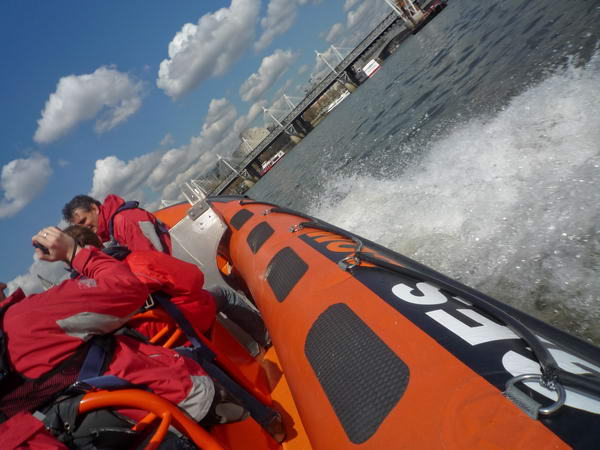
RIB Thames

If you are planning a trip to photograph London from the river, its also worth taking a look at the tide tables. When the tide is fairly low you do get the advantage of some uncovered sand and mud which might add pictorial interest, but at high tide the added height gives you a better viewpoint, as do the raised decks of some of the larger river boats.

Panasonic had invited a number of bloggers to come and look at their latest products, both in their Lumix range of still digital cameras and also their camcorders.
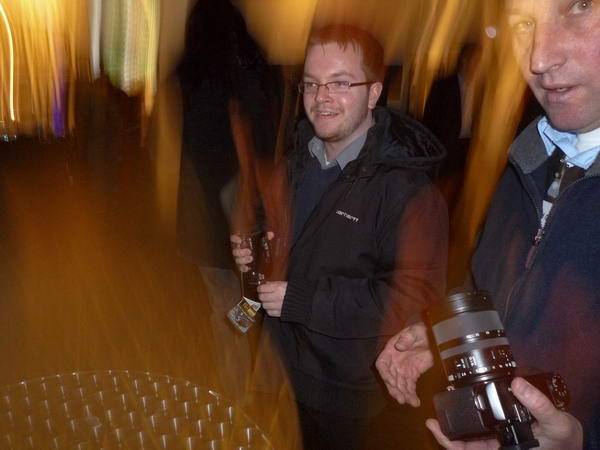
We met in Dali Universe, handily close to Waterloo station, and the morning started with an opportunity to handle the cameras and then a presentation about them. Panasonic came to still cameras late, but have from the start realised the need to offer new ideas, becoming one of the more innovative companies. Some of the ways they are doing this sound very interesting, such as intelligent exposure which can, among other things – and if I understood correctly, make use of different ISO speeds in different areas of the same image to produce more evenly lit effects when using flash.

Panasonic cameras also have benefitted greatly through cooperation with one of the most repsected firms in the business, Leica in lens design. It is perhaps the link-up with Leica that has enabled them to offer wider angles of view on their compact digitals, with 28mm or even 25mm equivalent as the widest angle of view on many of their cameras. Leica make some of the best wide-angles available for use on their M-series cameras, and I only wish I could afford a couple of their recent designs to use on my Leica M8, which gives the sharpest results of any digital camera.

After the talk we were allowed to choose a camera to get some hands-on experience with during a RIB river trip, which took us up close to Canary Wharf then back past the Houses of Parliament and then to the pier at the London Eye. It was an exhilarating journey.
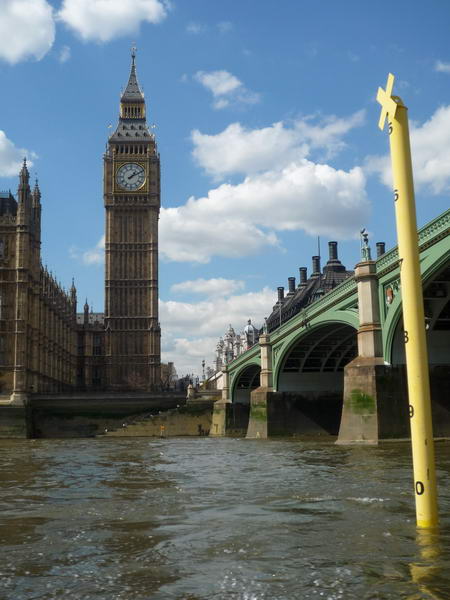
HP

Panasonic DMCFX-500

Given my preference for wide-angle lenses, I chose one of the new compact cameras with a 25mm lens to use on the trip, the Panasonic DMCFX-500. It’s a beautifully compact design and gives sharp 3648×2736 images, as I found under rather trying conditions of shooting from a RIB going rather fast along the Thames. If I needed a new compact for general use, this would be camera around the top of my list. It’s not fair to judge it from my limited trial under rather trying conditions, but it generally performed pretty well, and I imagine if I’d had the time to read the manual and fine tune things it would have done even better.

The colour was pretty good, the images were showed low noise. I left the camera on auto, and it was a sunny day, so almost all were at ISO 100). They had good detail with just a hint of over-sharpening (less than with the default settings of many compacts.)

But it isn’t my ideal camera. Despite the nice large clear viewing screen I still want an optical viewfinder, but that is fast becoming a lost cause. But what I had most problem with was shutter lag. Perhaps 20% of the pictures I took were not as intended, either because of the speed of the boat which meant the camera was pointing at something different by the time the picture was actually made or because I’d not held the camera still for long enough after pressing the shutter.

I blame Henri for this, Cartier-Bresson that is. Long ago I read his advice on taking pictures, about getting to know your camera so well that you could make all the settings needed without looking at your camera, then take pictures in a single rapid movement of the camera to your eye for the 1/125 of a second or so needed to frame and expose before bringing it down again. With a compact camera you need to remember to keep holding it steady for a second or so after you press the release, and the delay with the FX-500 seemed just a little longer than my current compact – so more pictures of the back of the seat in front of me than I really needed.

The camera also features image stabilisation, but either I didn’t have it turned on or the vibration on the RIB was just too much for it to cope with, and many of the images at longer focal lengths were unsharp due to camera shake. I didn’t see any problems with those taken on dry land, but mostly those were wide-angle pictures.

The screen image was large and very clear, possibly the best I’ve worked with in bright light. On auto, the camera also made some fairly intelligent decisions about when fill-flash was needed, although it wasn’t clever enough to spot the reflective clothing in one picture that always creates problems with its use.

Overall it seemed a nice camera to use, although I would need to get used to the shutter lag and for this reason wouldn’t choose it for action photography. But as a camera to put in your pocket for when you don’t have your Nikon or Canon DSLR it would be a reasonably versatile choice.

Examining the images back at home on my computer I was pleasantly surprised by the image quality. It seemed pretty even across the frame and there was little or no vignetting, perhaps thanks to the Venus4 engine. It looked as if this was also doing a fine job of removing chromatic aberration, as although there was some weak red cyan fringing, this could not hardly be improved using my usual software lens corrections. There was also a small amount of blue fringing visible, but not objectionable in any of the images I took.

The exposures were pretty consistent, and mainly more or less spot on, though in some cases a little highlight detail was clipped. I didn’t find out if it was possible to display a histogram or otherwise examine this. But there were quite a few images where it occurred to me that a RAW file would have been a great advantage. I don’t like to shoot jpeg, but most of these were very acceptable straight out of the camera, though almost all were improved slightly with a little tweaking in Lightroom.

Overall, although the Panasonic DMCFX-500 seemed to be a very good compact camera with the 25mm lens and image quality (at ISO 100 – not tried at faster speeds) a big point in its favour, but the shutter lag did seem worse than my current model, and the shot to shot time also seemed a little slower, although I didn’t measure it.

If you don’t already have a decent digital compact, the DMCFX-500 is certainly worth a look. It would be a good camera to take on a holiday where you wanted to travel light. Some people might prefer the longer 10x zoom range of the slightly less compact TZ5, but this would be my first choice

Video?

What really impressed me more than the still cameras was the amazing quality of the video made on the same boat trip using the Panasonic HDC-SD9 was amazing. We we were able to see it immediately on our return to Dali Universe, played back a a very large widescreen TV, and the colour, exposure and general image quality were superb.

Also impressive was the SDR-SW20, although the image quality is only DVD standard. This camera can shoot under water – even in the sea – up to 5 foot below the surface and is robust enough to juggle with (though you do need at least three for this.)

I was so impressed that I decided it was time to try video again and came away from the afternoon with the diminutive Panasonic SDR-S7, only 180g and fitting a pretty small pocket. Although I don’t think its likely I’ll stop using the Nikon D200 or Leica M8, perhaps soon you’ll see the occasional video added to this blog!

More pictures (but no video) from the day on My London Diary. All pictures in this post and the My London Dairy post were taken with a Panasonic DMCFX-500.

‘Bangladesh 1971’ at Autograph

I was surprised not to see more people at the press view of ‘Bangladesh 1971‘ yesterday, at Autograph ABP‘s superb new premises that opened last year in Rivington Place in London’s now-trendy Shoreditch.

Women preparing for battle prior to the crackdown of 25th March 1971
Photographer: Rashid Talukder, courtesy of Drik and Autograph ABP

Produced in partnership with Shahidul Alam and the Drik Picture Library (I was disappointed not to meet Shahidul, having corresponded with him over the years, and read his newsletters, but he was held up getting his visa for Croatia) this is in several ways an important show, and one that curators Mark Sealy of Autograph and Shahidul Alam can be proud of.

The show in the superb ground-floor gallery is of photographs, taken mainly by Bangladeshi photographers, of the events that led to independence for Bangladesh. One of the bitterest and bloodiest conflicts ever, many of the details are not widely known and still contested, and one of the aims of the curators was simply to provide a true account through photographs.

As they state, “For Bangladesh, ravaged by the war and subsequent political turmoil, it has been a difficult task to reconstruct its own history. It is only during the last few years that this important Bangladeshi photographic history has begun to emerge.” After showing here it is hoped that this exhibition will return to Bangladesh and become a part of a museum collection there. Although it is a show with considerable photographic interest, it is also one where the historical background is vital for fuller appreciation.

In an attempt to impose its will on the country the Pakistan army implemented the systematic killing of Bengali members of military forces, intellectuals and students, along with any other able-boded men they came across. Estimates of the number killed range from 200,000 to three millions (although an official Pakistan government investigation somehow arrived at a figure of only 26,000.) Similarly, estimates of the number of women raped during the atrocities cover range between 3000 and 400,000.

Over two million refugees fled from the army atrocities over the border to India. I also watched the film ‘Bangladesh 1971‘, part of the associated ‘Bangladesh 1971 Film Season‘ at nearby Rich Mix Cultural Centre, which includes powerful scenes from film made during the liberation struggle. We see refugees stepping through deep mud on their journey and of an old, near blind woman making her way by putting down a bamboo staff flat on the ground every few steps to find a route.

The 60 minute film, produced by a group at the Rainbow Film Society in Bethnal Green, describes the events in a clear time line, with footage of some of the key scenes also covered by the still photographs – and I think one or two of the featured photographers may be seen in it.

This show is politically important, and not just for Bangladesh, or the British Bangladeshi community- many of whom live in neighbouring Tower Hamlets – but also is very much relates to the British history of involvement in India since the days of ‘John Company‘, founded in 1600 “for the honour of the nation, the wealth of the peoples” of England, leading to over 300 years of colonial exploitation (in some respects little changed by independence in 1947.) The partition of India at independence was an unsatisfactory (and also extremely bloody) solution, and one which underlies the events of 1971.

US support of Pakistan, both through military aid and at the UN, also had disastrous consequences, and it would be good to see this show put on in the America. President Nixon even urged the Chinese (who also armed and supported Pakistan) to mobilise its forces on the Indian border, as well as sending the nuclear-powered aircraft carrier the USS Enterprise to the Bay of Bengal. Such support encouraged Pakistan to launch a ‘pre-emptive’ attack on India, and it was the failure of this followed by the rapid intervention of Indian forces against the Pakistan army in Bangladesh that brought the war for independence there to a speedy victory.

If I’ve spent too long on history and politics, it is because this show is in several respects an importantly political one (and if I have a criticism it would be that the exhibition needs to have more background material on display, including a time-line of the main events.)

But it is also an powerful show in terms of the actual photography – and also one that relates to the politics of photography. These are pictures taken by photographers from Bangladesh, several of whom deserve to be far more widely known. Although some of the images are important simply for what they show and in other respects are typical or even rather poor press images, there are also some outstanding pictures here. There are several very fine photographers among the dozen or so included here (and at least one excellent anonymous image) but the work of Rashid Talukder (b1939, India) and Abdul Hamid Raihan is outstanding.

Two Boys
Two boys stand among rocket bombs left by Pakistani army at the picnic corner in Jessore, Bangladesh. 11/12/1971
Photographer: Abdul Hamid Raihan, Courtesy of Drik and Autograph ABP

One picture by Raihan which stays in my mind is of a man standing in the ruins that were once his house. You can see it, along with another 32 of his pictures at Majority World, a “collaboration between The Drik Picture Library of Bangladesh and kijijiVision in the UK to champion the cause of indigenous photographers from the developing world and the global South.”

Talukder’s work is also striking, and in many cases not for the squeamish, with a startling picture of the discarded head of an intellectual along with bricks in a puddle, or the public bayoneting of a collaborator by guerillas. He also has a fine images of more peaceful events, including the release of a dove by Bangabandhu in 1973. Again you can see more of his work – over 90 images – on Majority World.

Drik, set up in 1989 by a small group including Shahidul Alam, its name the Sanskit for ‘vision,’ has pioneered the representation of photographers from the majority world, seeing it “vibrant source of human energy and a challenge to an exploitative global economic system.” It has very much challenged “western media hegemony“, promoting work from the majority world, running education programmes and setting up the first Asian photography festival, Chobi Mela.

The show – and the work of Drik – also raise questions about the future. We live in a rapidly changing world, one where India is fast becoming a leading power in the world economy, and also one where Bangladesh itself is under considerable threat from rising sea levels as a result of global warming.

The exhibition opens April 4 and runs until May 31, 2008. It is hoped it may also show elsewhere in the UK.

Photographers by the Yard

Along with 20 other photographers (dozens according to the NUJ site, but I made it exactly 1.67 dozens) I went along to New Scotland Yard this afternoon to photograph the one person protest by Jeremy Dear, NUJ General Secretary, to highlight the failure of law enforcement officers to protect media freedom.

If you are a regular reader of My London Diary and this blog you will know I often have reason to complain about the way some police officers impede the work of photographers covering protests on the streets. Sometimes its a matter of individual officers deciding that we shouldn’t be photographing particular events – as in the case of the officer who stood in my way while a young man was being stopped and searched in Whitehall, and when I attempted to move into a position that gave me a clear view while in no way interfering with the work of the police ordered me back. At other times its a failure by the officer in charge to realise that we need reasonably close access to events to photograph them adequately. Sometimes we are even denied access on spurious grounds of road safety – when police officers are standing further out in the road than photographers would.

There are agreed guidelines, but too often police simply ignore them. At times officers have even denied that my NUJ Press Card is a valid press card, and have treated me as a protester rather than a reporter, refusing for example to allow me to leave a protest when I have finished taking pictures.

In particular the SOCPA legislation which has made many demonstrations around Parliament illegal has soured relations between police and press – as well as those between police and protesters. So its good news to hear that the relevant aspects of this law are to be reviewed, although we may fear that a SOCPA Mark 2 will be no less inimical to the rights of citizens to protest.

SOCPA provided a limited right for one person demonstrations, which although they had to give notice, the police are not entitled to ban, although they can impose restrictions. So Jeremy had duly applied, filled in the forms and answered various questions about his demonstration (the police were apparently very exercised about the actual wording of his placard) and been granted permission, and photographer Marc Vallée had talked, texted, e-mailed and contacted through Facebook and other on-line sites with photographers to persuade them to come and photograph the event at New Scotland Yard, bribing us with the offer of a free drink to celebrate the out of court settlement his lawyers recently agreed with the Met for his injury during the ‘Sack Parliament’ demo in October 2006.

It was a fairly daunting group of photographers to be working with, including a few well-known names and as always we all wanted to take a better picture than the pack. There wasn’t really a lot to work with – just Jeremy with a placard, New Scotland Yard as a background, and of course the other photographers, so it was something of a challenge.

NUJ photo protest

I started with a straightforward picture of Jeremy with the placard and the New Scotland Yard (or Met Police) sign behind him. Not a bad snap, but nothing special.

But obviously it would be more interesting to have both him and the photographers. I tried a ‘Hail Mary‘ from behind with the 18(27)mm wide-angle end of the 18-200; perhaps a bit too prosaic, and of course you can’t see his face, nor the whole of the placard.
NUJ PHotographers protest

Unfortunately for once the police were simply ignoring us and standing some distance away. I tried a few shots including them, but the placard was just too small, so I came back to photograph the pack from close in using an extreme wide-angle.

NUJ Photographers protest

Several rather similar shots to choose of which I thing this is the best.

Taking a higher viewpoint gives a different view, but shows a line of photographers rather than a pack
NUJ Photographers protest
and coming down lower perhaps provides a more interesting shot.

Moving in close to Jeremy, still working with a very wide lens I could show him, the poster (though a rather oblique view) and the line of cameras pointing at him.
NUJ Photographers protest

Jeremy then moved to hand in a letter to New Scotland Yard, but they refused to take it. I moved fast to be in the right place and shot from close with the 12-24mm, getting a couple of shots that aren’t bad.

NUJ Photographers protest

Finally we moved to the corner of the building where the windows were showing the infamous posters, including the anti-photographer poster:

THOUSANDS OF PEOPLE TAKE PHOTOS EVERY DAY. WHAT IF ONE OF THEM SEEMS ODD?

Again my starting point was a simple image of Jeremy with placard in front of this.
NUJ Photographers protest

Then I shot the pack facing him, but couldn’t include the poster in this.
NUJ Photographers protest
Shooting over their heads provides an image including the poster, but not I think a very strong one.
NUJ Photographers protest

David Hoffman has produced one of many parodies of this poster available on the web – and you can buy his as T-shirts, mugs etc. He decided to photograph himself in front of it, and I caught him doing so, with tongue out

and looking rather more normal
David Hoffman

Finally came a few pictures of photographers standing in front of the poster and looking odd. If I post these here they might never speak to me again, so I’ll tuck them away in case I ever need them for blackmail.

Peter Marshall

David Spero – Urban Churches

Taking one of my regular looks at the ‘Conscientious‘ blog I was interested to see a familiar building from Finsbury Park, London, the former cinema which became the ‘United Church of the Kingdom of God.’

This is one of a series of 15 churches in various odd buildings mainly around London photographed by David Spero, a photographer born in 1963 who studied at the Royal College of Art. Most of the locations in the series were familiar to me, although in one or two cases I’d photographed the same buildings before they were in use as churches.

Spero goes for the clear overall view, and does it well, and like
Jörg Colberg I find this the most impressive of his projects. Part of the reason for this is I think in the very variety of the buildings concerned as in some of his other projects (both when I’ve seen them on gallery walls and on his web site) I find the images too similar. Of course to Spero this was perhaps the point, but I find it a little tedious and long for a little more surprise in the next image in some of his work.

Some of projects in the ‘archive’ section of the site are represented by a very small number of images. ‘Interiors‘, ‘Boardrooms‘, ‘Control Towers‘ look like promising areas, but what he shows us is enough to tantalise but not to satisfy. It seems hardly worth putting only 4 or 5 images from each on the site – it isn’t as if the web was an expensive medium to use.

The churches project is a good example of how concentrating on a small subject and presenting it can work well. Although I’ve shown images of such urban buildings pressed into new use, and particularly images of black-led churches, I’ve never approached it as a discrete subject in this way.

Finsbury Park

One of my best-hidden web sites does however take a look at Finsbury Park and the surrounding area (although I’ve also photographed it on quite a few other occasions.) The pictures I put on those pages were made when I had just started to work seriously with a Hasselblad Xpan, and don’t actually include the church/cinema though I’ve photographed it on several occasions and probably while making these images.

Finsbury Park
Finsbury Park, London, 2002

A rather prettier picture of the New River in Finsbury Park from the series actually won a photo competition concerned with the regeneration of the area.

At the time I posted the images and wrote on-line that I had walked around the area carrying the Hasselblad I got several messages from people telling me I must be mad to go on the streets there with an expensive camera. One at least came from someone who had lived in a flat there for some years. But if you are sensible – and at least slightly street-wise, London remains a very safe city.